LEARNING DEEP REPRESENTATIONS FOR
LOW-RESOURCE CROSS-LINGUAL NATURAL
LANGUAGE PROCESSING
A Dissertation
Presented to the Faculty of the Graduate School of Cornell University
in Partial Fulfillment of the Requirements for the Degree of Doctor of Philosophy
by Xilun Chen
c
2019 Xilun Chen ALL RIGHTS RESERVED
LEARNING DEEP REPRESENTATIONS FOR LOW-RESOURCE CROSS-LINGUAL NATURAL LANGUAGE PROCESSING
Xilun Chen, Ph.D. Cornell University 2019
Large-scale annotated datasets are an indispensable ingredient of modern Nat-ural Language Processing (NLP) systems. Unfortunately, most labeled data is only available in a handful of languages; for the vast majority of human lan-guages, few or no annotations exist to empower automated NLP technology.
Cross-lingual transfer learning enables the training of NLP models using labeled data from other languages, which has become a viable technique for building NLP systems for a wider spectrum of world languages without the prohibitive need for data annotation. Existing methods for cross-lingual trans-fer learning, however, requirecross-lingual resources(e.g. machine translation systems) to transfer models across languages. These methods are hence futile for many low-resource languages without such resources.
This dissertation proposes a deep representation learning approach for low-resource cross-lingual transfer learning, and presents several models that (i) progressively remove the need for cross-lingual supervision, and (ii) go beyond the standard bilingual transfer case into the more realistic multilingual setting. By addressing key challenges in two important sub-problems, namely multi-lingual lexical representation and model transfer, the proposed models in this dissertation are able to transfer NLP models across multiple languages with no cross-lingual resources.
BIOGRAPHICAL SKETCH
Xilun Chen was born in Jilin City, China. He was intrigued in computers as a kid and started teaching himself to program in Pascal and C in middle school. He then trained and competed inOlympiad in Informatics (OI) in high school, and won national awards, on account of which he was admitted to Shanghai Jiao Tong University to study Computer Science. During his undergraduate study, he developed interest in Natural Language Processing, and started conducting research ondeciphering logographic languageswith Professor Hai Zhao.
After obtaining his Bachelor’s degree, he joined Cornell University to pur-sue a Ph.D. degree in Computer Science. During his Ph.D. study, he worked on learning deep representations for low-resource cross-lingual natural language processing to address the scarcity of annotated training data in most human languages. He also did several internships at Google, IBM Research, Facebook, and Microsoft Research, working on various machine learning and natural lan-guage processing projects.
ACKNOWLEDGEMENTS
First and foremost, I am immensely grateful to my advisor, Claire Cardie, for her support, patience, insights, as well as all the guidance and help she provided throughout my Ph.D. study. I am also thankful to my brilliant minor advisors, Jon Kleinberg and John Hopcroft.
Part of this dissertation was based on an internship project I did at Microsoft Research with my mentor Ahmed, and my collaborators Hany and Wei.
Many thanks to Yu, Ben, and Kilian for their collaboration on my first project in cross-lingual NLP, which later became the foundation of my dissertation re-search.
I would also like to thank Tianze, Arzoo, Xun, Felix, Lillian, Bishan, Lu, Jack, Xanda, Ana, Jon, Moontae, Ozan, Vlad, Kai, Xinya, Liye, Yao, Esin, Ashudeep, Rishi, Ryan, and all other members of the Cornell NLP group for their inspiring discussions and helpful feedback.
I thank Hai Zhao, my Bachelor’s thesis advisor, as well as the people at Mi-crosoft Research Asia, Dongdong, Lei, Nan, Mu, Shujie and Ming for introduc-ing me to Natural Language Processintroduc-ing research.
Finally, I thank my family for their love and support, and all my friends for their help and company. Special thanks to Jue, for all the love and joy you brought into my life that made me a much better person.
TABLE OF CONTENTS
Biographical Sketch . . . iii
Dedication . . . iv
Acknowledgements . . . v
Table of Contents . . . vi
List of Tables . . . viii
List of Figures . . . x
1 Introduction 1 1.1 Cross-Lingual Transfer for Natural Language Processing . . . 1
1.2 Contributions . . . 4
1.3 Roadmap . . . 6
2 Background and Related Work 8 2.1 Cross-Lingual Transfer Learning . . . 8
2.1.1 Supervision for Cross-Lingual Transfer Learning . . . 9
2.1.2 Resource-based and Model-based Cross-Lingual Transfer Learning . . . 10
2.1.3 Bilingual and Multilingual Transfer Learning . . . 12
2.2 Deep Representation Learning . . . 14
2.2.1 Distributed Word Representations . . . 17
2.2.2 Hidden Representations for Sentences and Documents . . 19
2.2.3 Cross-Lingual Word Embeddings . . . 22
3 Language-Adversarial Training for Cross-Lingual Model Transfer 24 3.1 Related Work . . . 25
3.2 Language-Adversarial Networks (LAN) . . . . 26
3.2.1 Network Architecture . . . 28
3.2.2 Language-Adversarial Training . . . 30
3.3 Experiments and Discussions . . . 33
3.3.1 Data . . . 34
3.3.2 Cross-Lingual Text Classification . . . 35
3.3.3 Analysis and Discussion . . . 39
3.3.4 Implementation Details . . . 47
3.4 Chapter Summary . . . 47
4 Multinomial Adversarial Networks 49 4.1 Related Work . . . 51
4.2 Multinomial Adversarial Networks (MAN) . . . . 53
4.2.1 Model Architecture . . . 54
4.2.2 MANTraining . . . 56
4.3 Theoretical Analysis of Multinomial Adversarial Networks . . . . 58
4.4.1 Multi-Domain Text Classification . . . 65
4.4.2 Experiments for Unlabeled Domains . . . 66
4.4.3 Experiments on the MTL Dataset . . . 68
4.4.4 Implementation Details . . . 71
4.5 Chapter Summary . . . 72
5 Multilingual Model Transfer: Learning What to Share 74 5.1 Related Work . . . 76
5.2 TheMAN-MoEModel . . . . 77
5.2.1 Model Architecture . . . 79
5.2.2 Model Training . . . 83
5.3 Experiments and Discussions . . . 85
5.3.1 Cross-Lingual Semantic Slot Filling . . . 87
5.3.2 Cross-Lingual Named Entity Recognition . . . 91
5.3.3 Cross-Lingual Text Classification on Amazon Reviews . . 93
5.3.4 Visualization of Expert Gate Weights . . . 95
5.3.5 Implementation Details . . . 97
5.4 Chapter Summary . . . 99
6 Unsupervised Multilingual Word Embeddings 100 6.1 Related Work . . . 102
6.2 Model . . . 104
6.2.1 Multilingual Adversarial Training . . . 105
6.2.2 Multilingual Pseudo-Supervised Refinement . . . 109
6.2.3 Orthogonalization . . . 111
6.2.4 Unsupervised Multilingual Validation . . . 111
6.3 Experiments . . . 112
6.3.1 Multilingual Word Translation . . . 113
6.3.2 Cross-Lingual Word Similarity . . . 119
6.3.3 Implementation Details . . . 122
6.4 Chapter Summary . . . 123
7 Conclusion and Future Work 124 7.1 Summary of Contributions . . . 124
LIST OF TABLES
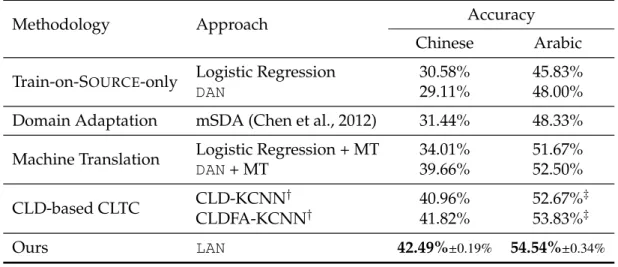
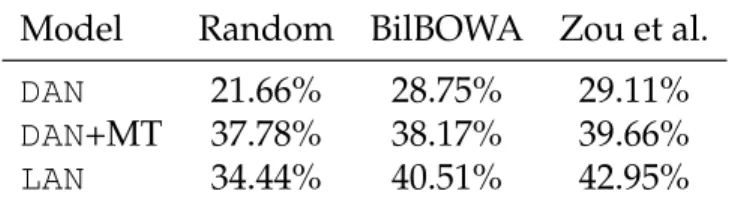
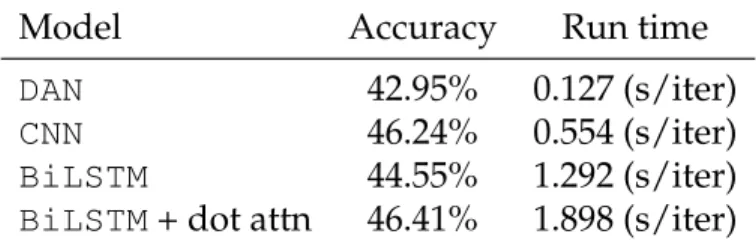
3.1 LAN performance for Chinese (5-class) and Arabic (3-class) text classification without using labeled TARGET data. All systems but the CLD ones use BWE to map SOURCEand TARGETwords into the same space. CLD-based CLTC represents cross-lingual text classification methods based on cross-lingual distillation (Xu and Yang, 2017) and is explained in Section 3.3.2. For LAN, av-erage accuracy and standard errors over five runs are shown. Bold numbers indicate statistical significance over all baseline systems with p<0.05under a One-Sample T-Test. . . 35 3.2 Model performance on Chinese with various (B)WE initializations. 44 3.3 Performance and speed for various feature extractor
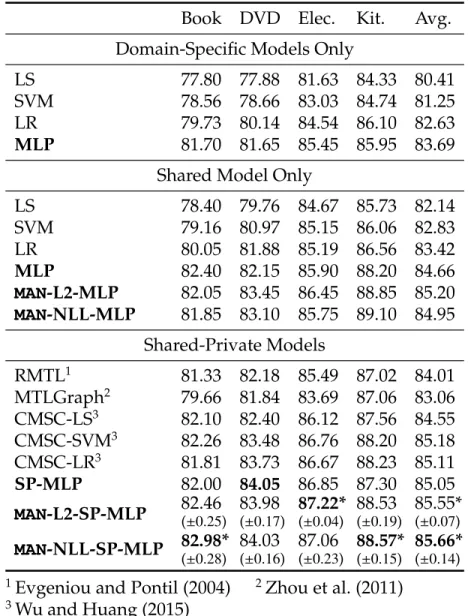
architec-tures on Chinese. . . 45 4.1 MDTC results on the Amazon dataset. Models in bold are ours
while the performance of the rest are taken from Wu and Huang (2015). Numbers in parentheses indicate standard errors, calcu-lated based on 5 runs. Bold numbers indicate the highest per-formance in each domain, and ∗ shows statistical significance
(p<0.05) over CMSC under a one-sample T-Test. . . 64 4.2 Results on unlabeled domains. Models in bold are our models
while the rest are taken from Zhao et al. (2018). Highest domain performance is shown in bold. . . 68 4.3 Results on the FDU-MTL dataset. Bolded models are ours, while
the rest are taken from Liu et al. (2017). Highest performance is each domain is highlighted. For our full MAN models, standard errors are shown in parentheses and statistical significance (p < 0.01) over ASP-MTL is indicated by *. . . 69 5.1 Statistics for the Multilingual Semantic Slot Filling dataset with
examples from each domain. . . 86 5.2 F1 scores on the Multilingual Semantic Slot Filling dataset. The
highest performance is in bold, while the highest performance within method group (with vs. without cross-lingual supervi-sion) is underlined. . . 88 5.3 Ablation results on the Multilingual Semantic Slot Filling dataset. 88 5.4 F1 scores for the CoNLL NER dataset on German (de), Spanish
(es) and Dutch (nl). . . 92 5.5 Results for the Multilingual Amazon Reviews dataset.
Num-bers indicate binary classification accuracy. VecMap embed-dings (Artetxe et al., 2017) are used for this experiment as MUSE training fails on Japanese (Section 4.2.1). . . 94 5.6 The hyperparameter choices for different experiments. . . 98
6.1 Detailed Results for Multilingual Word Translation. . . 114 6.2 Summarized Results for Multilingual Word Translation. . . 114 6.3 Precision@5for Multilingual Word Translation: Detailed Results . 117 6.4 Precision@5for Multilingual Word Translation: Summarized
Re-sults . . . 117 6.5 Multilingual Word Translation Examples. Top 5 predictions are
shown for each model. Correct predictions are highlighted. . . . 118 6.6 Results for the SemEval-2017 Cross-Lingual Word Similarity
task. Spearman’s ρ is reported. Luminoso (Speer and Lowry-Duda, 2017) and NASARI (Camacho-Collados et al., 2016) are the two top-performing systems for SemEval-2017 that reported results on all language pairs. . . 120
LIST OF FIGURES
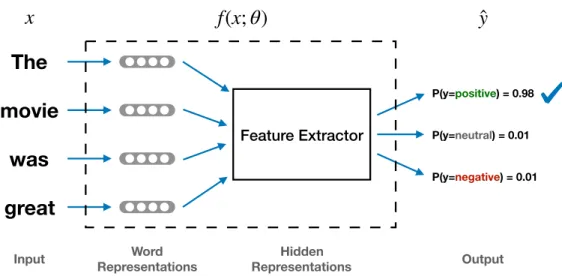
2.1 Abstract view of a sentiment classifier. . . 16
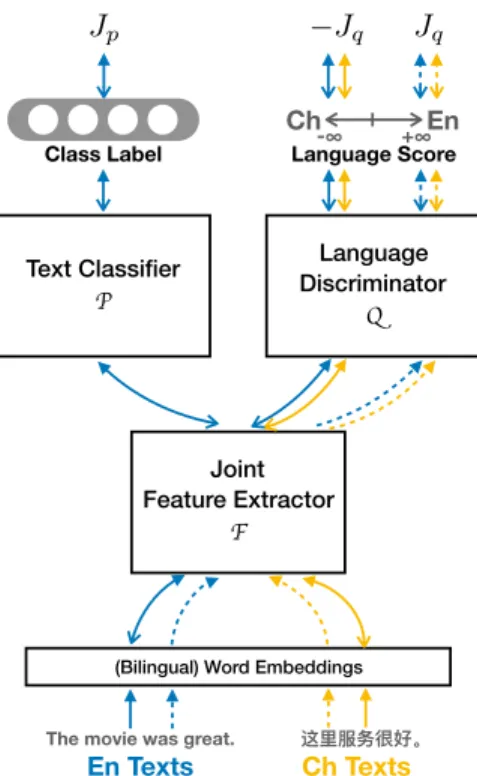
3.1 LAN with Chinese as the target language. The lines illustrate the training flows and the arrows indicate forward/backward passes. Blue lines show the flow for English samples while Yel-low ones are for Chinese. Jp and Jqare the training objectives of PandQ, respectively (Section 3.2.2). The parameters ofF,Pand the embeddings are updated together (solid lines). The param-eters ofQare updated using a separate optimizer (dotted lines) due to its adversarial objective. . . 27
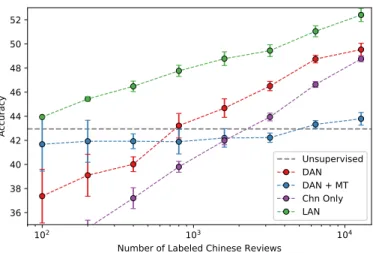
3.2 LAN performance and standard deviation for Chinese in the semi-supervised setting when using various amount of labeled Chinese data. . . 40
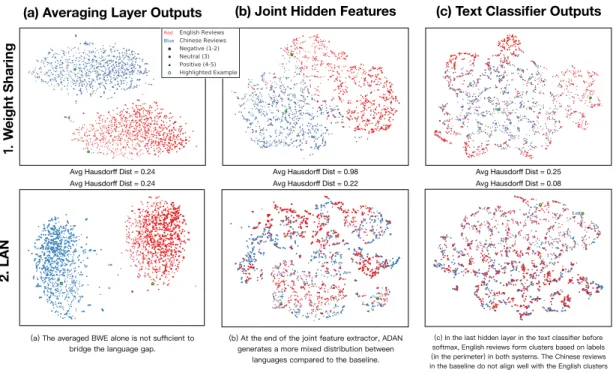
3.3 t-SNE visualizations of activations at various layers for the weight sharing (train-on-SOURCE-only) baseline model (top) and LAN (bottom). The distributions of the two languages are brought much closer in LAN as they are represented deeper in the network (left to right) measured by the Averaged Hausdorff Distance (see text). The green circles are two 5-star example re-views (shown below the figure) that illustrate how the distribu-tion evolves (zoom in for details). . . 41
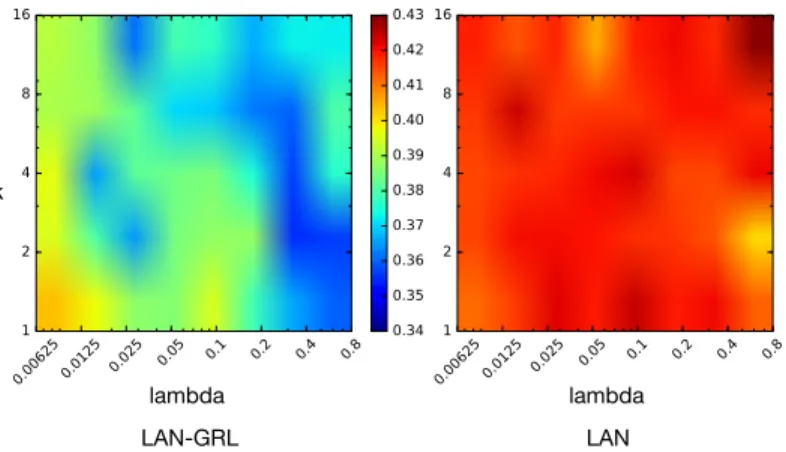
3.4 A grid search onk andlambdaforLAN (right) and theLAN-GRL variant (left). Numbers indicate the accuracy on the Chinese de-velopment set. . . 46
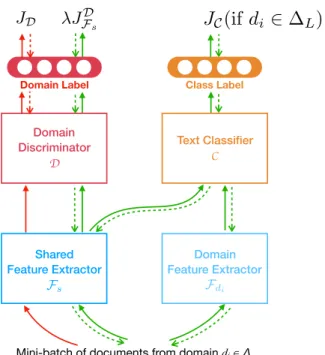
4.1 MANfor MDTC. The figure demonstrates the training on a mini-batch of data from one domain. One training iteration consists of one such mini-batch training from each domain. The parameters of Fs,Fd,C are updated together, and the training flows are il-lustrated by the green arrows. The parameters ofDare updated separately, shown in red arrows. Solid lines indicate forward passes while dotted lines are backward passes. JDF s is the domain loss forFs, which is anticorrelated with JD(e.g. JFD s = −JD). (See Section 4.2 and Section 4.3) . . . 54
5.1 An overview of theMAN-MoEmodel. . . . 78
5.2 TheMoEPrivate Feature ExtractorFp. . . 81
5.3 TheMoEPredictorCfor Sequence Tagging. . . 82
5.4 Average expert gate weights aggregated on a language level for the Amazon dataset. . . 96
6.1 Multilingual Adversarial Training (Algorithm 6.1). langi and langjare two randomly selected languages at each training step. JDj and JMi are the objectives ofDj andMi, respectively
CHAPTER 1
INTRODUCTION
1.1
Cross-Lingual Transfer for Natural Language Processing
A variety of natural language processing (NLP) tasks have benefited from the recent advance of modern deep neural network models. Most of these deep neu-ral models, however, require large-scale annotated datasets for training. While we have witnessed the increasing availability of such annotated datasets for various NLP problems in recent years, most of these annotations only exist in a handful of high-resource languages such as English. Most other world lan-guages, however, are not able to benefit from the deep learning revolution since they do not enjoy such an abundance of labeled data for training modern deep neural networks for a variety of NLP tasks.
As it is prohibitive and inefficient to manually annotate training data for all languages of interest, cross-lingual NLP, or more technically, cross-lingual
transfer learning(CLTL) comes to the rescue and enables the learning of
mod-els for atarget languageusing annotated data from other languages (source lan-guages) (Yarowsky et al., 2001).
Now we introduce some basic concepts of cross-lingual transfer learning, which will be revisited in more details in Chapter 2.
Bilingual Transfer and Multilingual Transfer Traditionally, research on
cross-lingual transfer learning mostly investigates the standardbilingual transfer setting, where the training data (for a specific NLP task) comes from a single
source language. In practice, however, it is more often the case that the labeled data is available in a few languages, and it is desirable to be able to utilize all of them when transferring to other languages to further boost the performance on the target language. This scenario is referred to asmulti-source cross-lingual transfer learningormultilingual transfer learning.
Supervision for Cross-Lingual Transfer Learning In this dissertation, we
identify three common types of supervision, or resources, for performing cross-lingual transfer, and we name them type 0, I, and II supervision, respectively.
First of all, cross-lingual transfer learning by definition needs some
train-ing data in the source language(s)for a certain NLP task (type 0 supervision),
which is always required.
Another kind of supervision is task-specific target language annotation
(type I supervision). The availability of such type I supervision usually de-termines the objective of the cross-lingual transfer task. When labeled data is available in the target language, the goal of cross-lingual transfer in this case is usually to leverage additional training data from other language(s) in order to achieve a better performance than using the target language training data alone. On the other hand, there are cases when no target language annotations are available, and cross-lingual transfer aims to build a system for the target language solely relying on the training data from other (source) languages.
The last common type of supervision is general-purpose cross-lingual
re-sources(type II supervision), also referred to ascross-lingual supervision.
Exam-ples of this kind of supervision include generic-domain parallel corpora or a Machine Translation (MT) system. These cross-lingual resources are not
task-specific and can be used for transferring models in multiple NLP tasks, which are especially important in the absence of type I supervision. For instance, a commonly used approach for cross-lingual transfer without type I supervision is to use a Machine Translation system to translate the target language text into the source language, and employ the supervised source language NLP model to make predictions.
Whether a cross-lingual transfer learning system leverages type II supervi-sion often dictates the high-levelmethodology. In the absence of type I supervi-sion, most prior work employsresource-basedmethods (see Chapter 2) that resort to type II supervision to replace the need for target language training data. On the other hand, such type II supervision is also difficult to obtain for many low-resource languages. Therefore, this dissertation concentrates on eliminating the dependence on both type I and type II supervision, by proposing a series of deep neural network models that learn better feature representations for cross-lingual transfer.
Feature Representation Learning for Cross-Lingual Transfer In this
disserta-tion, we focus on learning deep feature representations (see Chapter 2 for more background information) that are better suited for cross-lingual transfer. In par-ticular, two sub-problems need to be addressed when pursuing this deep repre-sentation learning methodology. First, a unique challenge faced by cross-lingual transfer learning, compared to other transfer learning problems such as domain adaptation, is thedisparate input spaceproblem. For instance, different languages such as English and Chinese barely share any words at all, leading to almost dis-joint vocabulary sets. As a first step, the model needs to build a cross-lingual
divergence between languages is beyond the word level, and it further calls for an effectivemodel transfer method for transferring the NLP models from the source language(s) to the target.
This dissertation consists of several works that progressively eliminate the need for both type I and type II supervision, by addressing key challenges in both problems of model transfer and cross-lingual lexical representation. It ex-tends the frontier of cross-lingual transfer learning and enables the application of modern deep neural NLP models to an increasing number of low-resource languages.
1.2
Contributions
Cross-Lingual Model Transfer without Parallel Training Data. Unlike most
traditional work for cross-lingual model transfer that directly rely on type II supervision (parallel data), we proposeLanguage-Adversarial Training, a model-based approach that only requires unlabeled monolingual texts from each lan-guage during training. This is achieved by learning a lanlan-guage-invariant hid-den feature space in which the distribution of the feature vectors of samples from the source and target languages are similar to each other, so that the knowl-edge learned on the source language training data can be better transferred to the target language. Experiments show that our model achieves state-of-the-art performance on cross-lingual text classification (Chapter 3).
Model Transfer for Multiple Languages and Domains. We further propose a
learn-ing an invariant feature space among multiple populations (e.g. languages or domains). In particular, we introduce the Multinomial Adversarial Network (MAN), a general machine learning framework for minimizing the divergence
among multiple probability distributions. MAN is applied to multi-domain text
classification to validate its effectiveness where it outperforms previous models (Chapter 4), and additional experiments can be found in Chapter 5 whenMANis applied to the multilingual model transfer task.
Multilingual Model Transfer with more than Language-Invariant Features.
We take one more step forward and devise a novel multilingual model transfer approach, which, unlike most prior work, can utilize not only the language-invariant features, but also language-specific features from each individual source language for transferring to the target language. This is extremely help-ful in the multilingual transfer setting, especially when the target language is similar to a subset of the source languages. Strong performance is attained in multiple multilingual model transfer experiments on various NLP tasks ranging from text classification to sequence tagging (Chapter 5).
Unsupervised Multilingual Lexical Representation. We then study the other
fundamental sub-problem in cross-lingual transfer learning, the cross-lingual lexical representation problem, and propose the first method for learning unsu-pervised multilingual word embeddings (See Chapter 2 for more background information). It is shown that our model outperforms unsupervised and even supervised baseline methods in two separate experiments (Chapter 6).
Zero-Resource Cross-Lingual Transfer Learning. Finally, by combining these efforts in eliminating type II supervision for both the model transfer and lexi-cal representation problems, we are able to perform zero-resource cross-lingual transfer where neither type I nor type II supervision is needed. It is referred to as zero-resource in a sense that we are able to transfer the type 0 supervision to a different language using no additional resources. This makes cross-lingual transfer methods more widely applicable to an increasing number of low-source languages, where both annotated data and cross-lingual resources are scarce. Experiments in Chapter 3 first show promising results, and more experiments of zero-resource cross-lingual transfer can be found in Chapter 5.
1.3
Roadmap
The remaining of this dissertation is organized as follows.
We first introduce, in Chapter 2, the relevant background information on cross-lingual transfer learning and deep neural network models for NLP.
We proceed to tackle the cross-lingual model transfer problem in Chapter 3, 4 and 5, aiming to remove the requirement of type I and type II supervision. In Chapter 3, we present language-adversarial training, a pioneering effort to-wards eliminating the need for parallel data when performing cross-lingual model transfer. We give a theoretically sound generalization of language-adversarial training to support multiple populations (languages or domains) in Chapter 4, and propose a further improved approach for multilingual model transfer in Chapter 5.
Furthermore, we study the cross-lingual lexical representation problem in Chapter 6, and present a model for learning unsupervised multilingual word embeddings.
Finally, we conclude in Chapter 7 by summarizing the contributions of this dissertation and outline possible directions for future work.
CHAPTER 2
BACKGROUND AND RELATED WORK
In this chapter, we present background knowledge and review existing re-search on the key problem that this dissertation tackles, cross-lingual transfer learning, as well as the key methodology that this dissertation takes, deep rep-resentation learning for natural language processing.
2.1
Cross-Lingual Transfer Learning
The diversity of human languages poses a critical challenge on Natural Lan-guage Processing, especially in the modern deep learning age, as it is pro-hibitive to obtain sufficient training data for many NLP tasks in most of the world languages. Cross-lingual NLP, or more technically cross-lingual transfer learning(CLTL), aims at this problem and offers a possibility of learning models for a target language using labeled training data from other (source) languages, and has been applied to a wide variety of NLP tasks such as part-of-speech tagging (Yarowsky et al., 2001), syntactic parsing (Hwa et al., 2005), text clas-sification (Bel et al., 2003), named entity recognition (Täckström et al., 2012), semantic role labeling (Padó and Lapata, 2009), and many more.
In this section, we review the background of cross-lingual transfer learning along three dimensions.
2.1.1
Supervision for Cross-Lingual Transfer Learning
As summarized in Chapter 1, there are three common types of supervision ex-ploited in cross-lingual transfer learning. Namely,training data in the source lan-guage(s)(type 0 supervision), training data in the target language (type I
super-vision), and general-purpose cross-lingual resources (type II supervision). Here,
type 0 and type I supervision is task-specific, meaning different training data is needed for different NLP tasks. Type II supervision, however, can be general-purpose in that the same cross-lingual resource can be used to transfer NLP models for multiple tasks, since type II supervision (such as Machine Transla-tion systems) provides general knowledge for connecting the semantics of two or more languages.
Cross-lingual transfer learning by definition requires type 0 supervision. On the other hand, the objective and approaches of cross-lingual transfer learning vary in the literature depending on the availability of type I and type II super-vision. In particular, given that the motivation of cross-lingual transfer learning is to address the scarcity of annotated data in the target language, many previ-ous works assume no availability of type I supervision (other than that used for validating and evaluating the models). For simplicity, we refer to this setting as theunsupervised CLTLsetting, for the CLTL system is unsupervised in the target language. Most prior work relies on type II supervision in this case to bridge the language barrier between the source and target languages, such as parallel corpora (sentence translation pairs) (Yarowsky et al., 2001; Hwa et al., 2005), bilingual dictionaries (word translation pairs) (Prettenhofer and Stein, 2010), or Machine Translation systems (Wan, 2009). On the other hand, when type I supervision is available for training a monolingual supervised model for
a certain NLP task in the target language (the supervised CLTL setting), the goal of CLTL is usually to utilize the additional training data available in the source language(s) in order to improve the performance on top of the monolin-gual target language NLP model. This direction is relatively less investigated as i) it requires annotated training data in the target language and can thus be only applied to a few languages in practice, and ii) the addition of source lan-guage training data is usually beneficial only if the target lanlan-guage is close to the source. Many CLTL approaches designed for the more challenging unsu-pervised setting can be applied to the suunsu-pervised setting as well, while other methods are specifically targeting the supervised setting with techniques such as multi-task learning, fine-tuning, etc (Swietojanski et al., 2012; Yang et al., 2017).
2.1.2
Resource-based and Model-based Cross-Lingual Transfer
Learning
While the existence of type I supervision determines the motivation and objec-tive of CLTL, whether a CLTL method leverages type II supervision, in con-trast, often dictates its high-level methodology. Based on the role of type II supervision, CLTL methods can be loosely divided into two categories: resource-basedCLTL andmodel-basedCLTL. Resource-based methods center around a par-ticular cross-lingual resource for connecting the source and target languages, while model-based approaches seek to directly transfer the source language NLP model into the target language.
Resourced-based CLTL One common type of resource-based CLTL is achieved via cross-lingualprojection. For instance, in annotation projection, the source language NLP model can be projected through a parallel corpus to gen-erate pseudo-supervision for the target language (Yarowsky et al., 2001; Hwa et al., 2005) by making predictions on the source side of the parallel corpus and assume the same labels apply to the target side of the bitext. To reduce the noise generated in this projection process, some works propose to project the expecta-tion over the labels (Wang and Manning, 2014), or to project soft labels (Xu and Yang, 2017). Another family of methods rely on bilingual lexica (word trans-lation pairs) to bridge the language gap (Bel et al., 2003; Mihalcea et al., 2007; Prettenhofer and Stein, 2010). Finally, one line of research focuses on the use of machine translation (MT) systems to achieve CLTL (Wan, 2009; Amini et al., 2009; Zhou et al., 2016).
Model-based CLTL In contrast, model-based CLTL aims to directly transfer
the NLP model from the source language to the target. This can be done, for example, through sharing the model parameters, or learning language-agnostic features. A key challenge, though, is the disparate input space problem, where the source and the target languages may have considerably dissimilar vocabu-lary sets, making building a successful model-based transfer system highly chal-lenging. This problem contributes to the fact that model-based CLTL is much less investigated in the past compared to resource-based ones, despite model-based CLTL being more appealing in that it does not require additional type II supervision. Some prior work circumvents the disparate input space problem by relying only on delexicalized features (e.g. part-of-speech tags) so that the source model can be directly applied to the target language (McDonald et al.,
2011). However, such methods are only applicable to certain NLP tasks such as parsing, and generally do not work well for distant language pairs.
Another paradigm that can lead to model-based CLTL is to explicitly ad-dressing the disparate input space problem first by utilizingcross-lingual
lex-ical representation, which provides a shared input representation for two or
more languages. For instance, one can use characters as the shared input rep-resentation (Yang et al., 2017) if the source and target languages have the same alphabet. Alternatively, one can build an interlingual lexical (or document) rep-resentation using techniques such as latent semantic indexing (Littman et al., 1998), kernel canonical correlation analysis (Vinokourov et al., 2003), or more recently cross-lingual word embeddings (Klementiev et al., 2012; Mikolov et al., 2013b). Using these cross-lingual lexical representations, the remainder of the CLTL task, the cross-lingual model transfer part, can be reduced to adomain adaptation problem, where abundant literature exists on model-based transfer learning methods (Pan and Yang, 2010) such as parameter sharing, fine-tuning, and learning shared features. One caveat, though, is that most of these tradi-tional approaches for learning cross-lingual lexical representation are resource-based that require type II supervision, and more recent advances in this field are discussed in Section 2.2.3.
2.1.3
Bilingual and Multilingual Transfer Learning
Historically, most research on cross-lingual transfer learning focuses on the sim-plest and most fundamental setting, the bilingual transfer setting, where the training data comes from a single source language. On the other hand, the
mul-tilingual transfer setting, also known as the multi-source CLTL setting, refers to the scenario where type 0 supervision in multiple source languages is lever-aged simultaneously when transferring to the target language. Previous work shows that it can result in significant performance boost over the bilingual set-ting due to the use of training data in additional source languages (McDonald et al., 2011). While the multi-source CLTL setting can sometimes be viewed as a straightforward generalization of the bilingual transfer setting, and some meth-ods designed for bilingual transfer can be adapted to support multiple source languages, it is still desirable to study dedicated approaches for the multilingual transfer (Hajmohammadi et al., 2014; Guo et al., 2016), because i) not all bilin-gual transfer methods can be applied to the multilinbilin-gual setting, and ii) it is often beneficial to devise a more sophisticated mechanism specifically designed for the multilingual transfer that can take into account the relation between all source languages and the target (instead of treating each source-target pair as an independent transfer task or a simple aggregation of all source languages).
Another factor that contributes to the fact that multilingual transfer is less studied is that resource-based methods are less suitable for the multi-source transfer setting, as it is prohibitive to obtain type II supervision (e.g. parallel cor-pora) between all source-target language pairs. On the other hand, the model-based CLTL approaches proposed in this dissertation, are free of this constraint and can be readily employed for the multilingual transfer task to enjoy the per-formance boost over the standard bilingual transfer case without the need for additional resources (Chapter 4 and Chapter 5).
2.2
Deep Representation Learning
A wide range of Natural Language Processing (NLP) tasks can be formulated aspredictiontasks, where the goal is to seek the most likely output y ∈ Ygiven
an input x ∈X. HereXandYare the sets of all possible inputs and outputs. A
few examples of NLP tasks formulated this way include:
• Predicting the sentiment of a sentence, where X is the set of all possible English sentences andY={positive,neutral,negative}.
• Predicting the most likely succeeding word given a partial sentence (lan-guage modeling), where X include all possible prefixes of English sen-tences, andYis the set of all English words.
• Translating an English sentence into French, whereXis the set of all En-glish sentences, whileYis the set of all French sentences.
A model for solving a predictive NLP task can be viewed as a functionyˆ = f(x;θ)that predicts an output yˆ given the input x, and is parametrized by a set of parameters (weights)θ. A probabilistic model f(x;θ) = p(y|x;θ)predicts the probability of the output y given the input x, where the model predictionyˆ is determined by finding the most likely output label:
ˆ
y= fˆ(x;θ)= arg max y
p(y|x;θ) (2.1)
There are multiple approaches for deriving a good model f(x;θ), such as manually writing a set of rules for predicting yˆ given an input x. A more ap-pealing method is to use Machine Learning to automatically learn the best set of parameters θ based on training data. In the supervised learning setting, we
assume access to a set of (x,y) pairs which can be used to train our model to predict the desired output for a given input. We denote such training data as
D= {(xi,yi)∈X×Y} |Ni=1 (2.2)
The optimal parametersθˆ are learned by minimizing aloss function Lbetween the gold-standard labelsyion the training data as well as the model predictions.
ˆ θ= arg min θ X (xi,yi)∈D L(yi, f(xi;θ)) (2.3)
For instance, in the commonly adopted Maximum Likelihood Estimation (MLE) paradigm, the likelihood of observing the training data under a probabilis-tic model is maximized in order to obtain θˆ. Please refer to the following book (Murphy, 2012) for more details on Machine Learning.
In a NLP model f(x;θ), the first step is often to decide how to represent the input x. For instance, how do we represent a word? Furthermore, given the word representations, how do we learn representations for higher-level lan-guage structures such as sentences or even documents? Traditionally, deciding on the data representation takes a tremendous amount of human expertise and feature engineering. For example, domain experts look at the NLP task at hand, and make a series of model decisions such as:
• Whether to use morphological features (word lemmas, capitalization, etc.)?
• Whether to use syntactical features (part-of-speech tags, parse trees, etc.)? • Whether to use additional features from external knowledge bases (e.g.
WordNet hypernyms, a lexicon of subjective words, etc.)? • How much context to retain and how to represent it?
Feature Extractor
The
movie
was
great
Word RepresentationsInput RepresentationsHidden
P(y=positive) = 0.98 P(y=neutral) = 0.01 P(y=negative) = 0.01
f
(
x
;
θ
)
Outputx
y
̂
Figure 2.1: Abstract view of a sentiment classifier.
These decisions are difficult, and require expertise and extensive trials and er-rors. Moreover, models engineered this way do not generalize well to a different task, and one needs to start from scratch when facing a new task.
On the other hand,(deep) representation learningstrives to automatically learn useful representations for a given task relying solely on the training data, and has enjoyed unmatched success in recent years in various Artificial Intelligence fields in and outside of NLP. To illustrate the high-level architecture of a mod-ern deep representation learning system, Figure 2.1, as an example, shows an overview of a sentiment classifier model, which predicts the sentiment of given piece of text. Here each word in the input x is first represented by the word
representations (Section 2.2.1) of choice, which is further passed to a feature
extractor (usually a deep neural network) to learn higher-level hidden
repre-sentations (Section 2.2.2) that retain useful features for solving the sentiment
classification task.1 Please refer to the book by Goodfellow et al. (2016) for a
1Note that not all systems learn representations following this two-step paradigm. For ex-ample, Zhang et al. (2015) directly model the input document as a sequence of characters, elim-inating the step of word representation learning.
(much) more detailed introduction to Deep Learning.
Finally, despite not the focus of this dissertation, it is worth mentioning that thearg max operation in Equation 2.1 might not be straightforward to take de-pending on the task. For instance, when Y is a moderately sized set of pre-defined categories such as the sentiment polarities (Such tasks are referred as classification tasks.), one can simply iterate over all possibleyvalues and find the most likely label. On the other hand,Y can be extremely large or even infinite (as in the translation case), and finding the most likelyyˆ (or an approximation of it) is a non-trivial challenge and an open research direction calledstructured prediction(Bakir et al., 2007). For simplicity, we will be mostly focusing on the non-structured output case whereyis a scalar. Some of the techniques presented in this dissertation can be applied to the structured output case as well, though, as shown in Chapter 5.
The following three subsections will first introduce the two representation learning stages of learning word representations (Section 2.2.1) and hidden (document) representations (Section 2.2.2), and finally discuss a sub-task in word representation learning that is very relevant to cross-lingual NLP — the learning of cross-lingual word embeddings (Section 2.2.3).
2.2.1
Distributed Word Representations
Word representation provides a mathematical representation of the words (or tokens) in the input text, and is the first step of many NLP models. Tradition-ally, a widely-used word representation method is calledone-hot representation, which represents each token as a one-hot vector, where each dimension in the
vector corresponds to a uniqueword typeand the length of the vector equals to the size of thevocabulary(all word types in English). Only the dimension corre-sponding to the token is set to 1, while all other dimensions are set to 0. A major problem with this one-hot representation is that it represents each word type as an atomic and independent categorical feature, disregarding any similarity or relationship between different words. As the vectors for any two word types are orthogonal to each other, it makes the model unable to generalize to unseen word types and the system may hence suffer from training data sparsity.
Distributed Word Representations (also known as word embeddings) aim
to address this draw back by embedding words into a low-dimensional real-valued vector space2instead of a high-dimensional sparse one-hot vector space.
The resulted embedding space captures certain syntactic and semantic relation-ships between various word types, and can provide much better generalization across different words. For instance, in a sentiment classification model where the training data has a positive sample of “The movie was great.”. Us-ing the one-hot representation, the system could not generalize to “The movie was awesome.” assuming that it has never seen it during training, because the
words “great” and “awesome” are treated as two separate and independent
words orthogonal to each other. On the other hand, with distributed word rep-resentations that can capture similarities between words, the model will hope-fully embed the two words close to each other in the vector space, providing improved generalization to unseen word types.
One commonly adopted principle for inducing such distributed word rep-resentations is the distributional hypothesis (Harris, 1954): words occurring in 2Also known as vector space model. There are distributed word representations that adopt alternative forms of representation such asmatrix space models that represent a word using a matrix instead of a vector (Rudolph and Giesbrecht, 2010).
similar contexts share similar meaning. Therefore, such co-occurrence statis-tics, which is readily available from the enormous unlabeled text data, can be leveraged to learn word embeddings. There are many successful methods pro-posed in the literature (Bengio et al., 2003; Turian et al., 2010; Collobert et al., 2011; Mikolov et al., 2013a; Pennington et al., 2014; Bojanowski et al., 2017), and word embeddings have become the de facto standard for word representation in modern deep neural NLP models.
2.2.2
Hidden Representations for Sentences and Documents
As shown in Figure 2.1, for a predictive NLP task such as text classification, it is often necessary to go beyond word representations and learn higher-level repre-sentations that take into account the contexts in the input sentence or document3
(the Feature Extractor box in Figure 2.1). These representations are known as hiddenrepresentations (or features), because they are often the outputs of some hidden layers4inside a deep neural network (Goodfellow et al., 2016).
In this section, we present several commonly adopted approaches for learn-ing hidden text representations, uslearn-ing the text classification task as an exam-ple. They are referred to as feature extractors in Figure 2.1 since they take the word representations of a various-length input sequence of tokens, and output a fixed-length feature vector that are learned automatically and can be used for predicting the task labely.
3For simplicity, we in this dissertation denote the inputxas asentenceunless otherwise noted, despite thatxcan sometimes have multiple sentences in practice.
Bag-of-Words Composition One of the simplest way of combining all the word presentations into a single feature vector is the (orderless) bag-of-words representation. Iyyer et al. (2015) propose Deep Averaging Networks that first take the arithmetic mean of all the word embeddings in the input sequence, and pass it through a number of fully-connected hidden layers to form the final fea-ture vector. This representation does not consider the order of the words at all and inevitably loses many potentially useful information. It nonetheless shows relatively competitive performance (Iyyer et al., 2015) and is extremely simple and efficient.
Convolutional Neural Networks (CNN) One clear limitation of the
bag-of-words composition is that language far more than a simple aggregation of words. For instance, in the translation task, there are many idioms and set phrases in each language whose meaning cannot be directly deduced from those of the individual words. Convolutional Neural Networks (Lecun et al., 1998) can extract local features with convolving filters. In the case of NLP, it means that the context around each word is taken into account to produce a local fea-ture vector for that word, and a pooling mechanism (such as max pooling) is then used to find the most salient local features (Kim, 2014).
Recurrent Neural Networks (RNN) Despite CNN being able to take context
into account, it still does not consider one of the key factors in human languages: word ordering. Therefore, CNN works well on tasks where finding salient lo-cal features generally suffices, such as the sentiment classification task where identifying key words and phrases expressing strong sentiment can help solve many cases. On the other hand, more sophisticated tasks that involve a
compre-hensive understanding of the entire sentence or document such as the machine translation task would require asequential compositionmethod for learning hid-den representations that can incorporate word order information. Recurrent Neural Networks is an autoregressive model that composes the hidden repre-sentation starting from the beginning of the sentence, and recursively processes each token one at a time to form a hidden feature vector. The processing of each token is called atimestamp, and the parameters of a RNN are shared across all timestamps. The RNN output at each timestamp can be viewed as a contextu-alized word representationthat takes into account the past utterance (left context) of the token. In order to generate a fixed-length feature vector for the entire input, a pooling mechanism is again needed. For instance, one can use the last hidden output as the representation for the entire input, or one can take the av-erage of all hidden outputs. A more sophisticated pooling technique is the self-attention (Cheng et al., 2016) mechanism that automatically learns a linear com-bination of all hidden outputs as the final feature vector. There are many archi-tectures for the RNN unit (the neural model that processes each timestamp), and the ones widely used in practice are mostlygatedones such as LSTM (Hochre-iter and Schmidhuber, 1997) or GRU (Cho et al., 2014). In addition, to overcome the drawback that a RNN only takes into account the context on the left, one can combine a left-to-right RNN with a right-to-left one to form a bidirectional RNN (Schuster and Paliwal, 1997) that considers contexts in both directions.
Other Structural Compositions In RNN, the sentence representation is
com-posed in the natural order (left to right). It is possible, however, to adopt al-ternative composition strategies when learning the hidden representations. For instance, one idea is to leverage the syntactic structure(parse tree) of the input
sentence, and compose the sentence representation following the tree structure using a Recursive Neural Network (Socher et al., 2013; Tai et al., 2015).
Recently there is a newTransformermodel that composes the hidden repre-sentations solely based on self-attention (Vaswani et al., 2017), which has shown strong performance on multiple NLP tasks.
2.2.3
Cross-Lingual Word Embeddings
One subfield of word representation learning that is pertinent to this disserta-tion is the learning of cross-lingual word representadisserta-tion. With the rise of dis-tributed word representations, it has also become popular to learn disdis-tributed cross-lingual lexical representation, namely cross-lingual word embeddings. Cross-lingual word embeddings project words from two or more languages into a single semantic space so that words with similar meanings reside closer to each other regardless of language.
Traditionally, most methods for learning cross-lingual word embeddings were supervised, relying on cross-lingual supervision such as bilingual dictio-naries (Klementiev et al., 2012; Mikolov et al., 2013b), or parallel corpora (Zou et al., 2013; Gouws et al., 2015). Some methods attempted to alleviate the de-pendence on such cross-lingual supervision by only requiring comparable sen-tences or even documents (Vuli´c and Moens, 2015).
On the other hand, there are efforts focusing on the multilingual case to learn a shared embedding space across more than two languages (Ammar et al., 2016; Duong et al., 2017), resulting in a set of multilingual word embeddings (MWEs).
In comparison, the standard cross-lingual embeddings between two languages are referred to as bilingual word embeddings (BWEs). Please refer to this sur-vey (Ruder et al., 2017) for a more detailed coverage on existing research of cross-lingual word embedding induction.
CHAPTER 3
LANGUAGE-ADVERSARIAL TRAINING FOR CROSS-LINGUAL MODEL TRANSFER
In this chapter, we propose the Language-Adversarial Training technique for the cross-lingual model transfer problem, which learns a language-invariant hidden feature space to achieve better cross-lingual generalization using only unlabeled monolingual textsfrom the source language and the target. It is a pi-oneering effort towards removing type II supervision (cross-lingual resources) from cross-lingual model transfer.
This chapter is based on (Chen et al., 2016; Chen et al., 2018b).
In this chapter, we focus on a simple yet fundamental NLP task, text classifi-cation, and present our language-adversarial training approach in the context of cross-lingual text classification (CLTC). In the text classification task, the input is a piece of text (a sentence or document), and the output is chosen from a set of predetermined categories. For instance, one may want to classify a product review into five categories corresponding to its star rating (1-5).
Similar to all cross-lingual transfer learning tasks, the goal of CLTC is to leverage the abundant resources of asource language (likely English, denoted as SOURCE) in order to build text classifiers for a low-resourcetargetlanguage (TARGET). Our model is able to tackle the more challengingunsupervisedCLTC setting, where no target language annotations (type I supervision) are available. On the other hand, our method remains superior in the semi-supervised setting
with a small amount of type I supervision available (See Section 3.3.3).
3.1
Related Work
Cross-lingual Text Classification is motivated by the lack of high-quality
la-beled data in many non-English languages (Bel et al., 2003; Mihalcea et al., 2007; Wan, 2008; Banea et al., 2008, 2010; Prettenhofer and Stein, 2010). Our work is comparable to these in objective but very different in method. Most previous works are resource-based methods that are directly centered around some kind of type II supervision (cross-lingual resources), such as machine translation sys-tem, parallel corpora, or bilingual lexica, in order to transfer the knowledge learned from the source language into the target. For instance, some recent ef-forts make direct use of a parallel corpus either to learn a bilingual document representation (Zhou et al., 2016) or to conduct cross-lingual distillation (Xu and Yang, 2017).
Domain Adaptationtries to learn effective classifiers for which the training and
test samples are from different underlying distributions (Blitzer et al., 2007; Pan et al., 2011; Glorot et al., 2011; Chen et al., 2012; Liu et al., 2015). This can be thought of as a generalization of cross-lingual text classification. However, one main difference is that, when applied to text classification tasks, most of these domain adaptation work assumes a common feature space such as a bag-of-words representation, which is not available in the cross-lingual setting. See Section 3.3.2 for experiments on this. In addition, most works in domain adap-tation evaluate on adapting product reviews across domains (e.g. books to elec-tronics), where the divergence in distribution is less significant than that be-tween two languages.
Adversarial Networks are a family of neural network models that have two or more components with competing objectives, and have enjoyed much suc-cess in computer vision (Goodfellow et al., 2014; Ganin et al., 2016). A series of work in image generation has used architectures similar to ours, by pitting a neural image generator against a discriminator that learns to classify real versus generated images (Goodfellow et al., 2014). More relevant to this work, adver-sarial architectures have produced the state-of-the-art in unsupervised domain adaptation for image object recognition: Ganin et al. (2016) train with many la-beled source images and unlala-beled target images, similar to our setup. In addi-tion, other recent work (Arjovsky et al., 2017; Gulrajani et al., 2017) proposes improved methods for training Generative Adversarial Nets. In Chen et al. (2016), we proposedlanguage-adversarial training, the first adversarial neural net for cross-lingual NLP, which will be described in this chapter. As of the writing of this dissertation, there are many more recent works that adopt adversarial training for cross-lingual NLP tasks, such as cross-lingual text classification (Xu and Yang, 2017), cross-lingual word embedding induction (Zhang et al., 2017; Lample et al., 2018) and cross-lingual question similarity reranking (Joty et al., 2017).
3.2
Language-Adversarial Networks (
LAN
)
The central hypothesis of language-adversarial training is that an ideal model for CLTC should learn features that both perform well on text classification for the SOURCE language, and are invariant with respect to the shift in language. Therefore, as shown in Figure 3.1, our proposed model, Language-Adversarial Network (LAN), has a jointfeature extractor F which aims to learn features that
Joint Feature Extractor
F
The movie was great. 这⾥里里服务很好。
(Bilingual) Word Embeddings
En Texts Ch Texts Text Classifier P Language Discriminator Q Class Label Jp Language Score En Ch-∞ +∞ Jq Jq
Figure 3.1:LAN with Chinese as the target language. The lines illustrate
the training flows and the arrows indicate forward/backward passes. Blue lines show the flow for English samples while Yel-low ones are for Chinese. Jp and Jq are the training objectives ofPandQ, respectively (Section 3.2.2). The parameters ofF,P
and the embeddings are updated together (solid lines). The pa-rameters ofQ are updated using a separate optimizer (dotted
lines) due to its adversarial objective.
aid prediction of the text classifier P, and hamperthe language discriminator Q,
whose goal is to identify whether an input text is from SOURCEor TARGET. The intuition is that if a well-trainedQcannot tell the language of a given input using the features extracted byF, those features are effectively language-invariant. Q
is hence adversarialsince it does its best to identify language from learned fea-tures, yet good performance fromQindicates thatLANis not successful in
learn-ing language-invariant features. Upon successful language-adversarial train-ing, F should have learned features discriminative for text classification, and
language of a given input.
As seen in Figure 3.1, LAN is exposed to both SOURCE and TARGET texts
during training. Unlabeled SOURCE(blue lines) and TARGET(yellow lines) data go through the language discriminator, while only the labeled SOURCE data pass through the text classifier1. The feature extractor and the text classifier are
then used for TARGET texts at test time. In this manner, we can trainLANwith labeled SOURCE data and only unlabeled TARGET text. When some labeled TARGET data exist, LANcould naturally be extended to take advantage of that for improved performance (Section 3.3.3).
3.2.1
Network Architecture
As illustrated in Figure 3.1,LAN has two branches. There are three main com-ponents in the network, a jointfeature extractorF that maps an input sequencex to a fixed-length feature vector in the shared feature space, atext classifierPthat predicts the label forxgiven the feature representationF(x), and alanguage dis-criminatorQthat also takesF(x)but predicts a scalar score indicating whetherx is from SOURCEor TARGET.
An input document is modeled as a sequence of wordsx=w1, . . . ,wn, where
each w is represented by its word embedding vw (Turian et al., 2010). For im-proved performance, pre-trained bilingual word embeddings (BWEs, Zou et al., 2013; Gouws et al., 2015) can be employed to induce bilingual distributed word representations so that similar words are closer in the embedded space regard-less of language.
1“Unlabeled” and “labeled” refer to task labels; all texts are assumed to have the correct language label.
A parallel corpus is often required to train high-quality BWEs, makingLAN
implicitly dependent on the bilingual corpus. However, compared to the MT systems used in other CLTC methods, training BWEs requires one or two orders of magnitude less parallel data, and some methods only take minutes to train on a consumer CPU (Gouws et al., 2015), while state-of-the-art MT systems need days to weeks for training on multiple GPUs. Moreover, even with randomly initialized embeddings, LAN can still outperform some baseline methods that use pre-trained BWEs (Section 3.3.3). Another possibility is to take advantage of the recent work that trains BWEs with no bilingual supervision (Lample et al., 2018).
We adopt the Deep Averaging Network (DAN) by Iyyer et al. (2015) for the feature extractorF. We chooseDAN for its simplicity to illustrate the effective-ness of our language-adversarial training framework, but other architectures can also be used for the feature extractor (Section 3.3.3). For each document,DAN
takes the arithmetic mean of the word vectors as input, and passes it through several fully-connected layers until a softmax for classification. InLAN,F first
calculates the average of the word vectors in the input sequence, then passes the average through a feed-forward network with ReLU nonlinearities. The ac-tivations of the last layer inF are considered the extracted features for the input and are then passed on toPandQ. The text classifier Pand the language dis-criminatorQare standard feed-forward networks.Phas a softmax layer on top for text classification andQends with a linear layer of output width 1 to assign a language identification score2.
2Qsimply tries to maximize scores for SOURCE texts and minimize for TARGET, and the scores are not bounded.
3.2.2
Language-Adversarial Training
Before describing the adversarial training approach employed inLAN, we intro-duce a pre-existing formulation of its adversarial component in which training is done using a Gradient Reversal Layer (Ganin et al., 2016). We refer to this version ofLANasLAN-GRL.
In LAN-GRL, Qis a binary classifier with a sigmoid layer on top so that the
language identification score is always between 0 and 1 and is interpreted as the probability of whether an input textxis from SOURCEor TARGETgiven its hidden features F(x). For training, Q is connected toF via a Gradient Rever-sal Layer (Ganin and Lempitsky, 2015), which preserves the input during the a forward pass but multiplies the gradients by−λduring a backward pass. λ is a hyperparameter that balances the effects that P and Q have on F
respec-tively. This way, the entire network can be trained in its entirety using standard backpropagation.
Unfortunately, researchers have found that the training ofF andQinLAN -GRL might not be fully in sync (Ganin and Lempitsky, 2015), and efforts need to be made to coordinate the adversarial training. This is achieved by settingλto a non-zero value only once out ofkbatches as in practice we observe thatF trains faster thanQ. Here,kis another hyperparameter that coordinates the training of
F and Q. When λ= 0, the gradients fromQwill not be back-propagated toF.
This allowsQmore iterations to adapt toF beforeF makes another adversarial
update.
To illustrate the limitations of LAN-GRL and motivate the formal introduc-tion of ourLANmodel, consider the distribution of the joint hidden features F
for both SOURCEand TARGETinstances:
PsrcF , P(F(x)|x∈SOURCE) (3.1)
PtgtF , P(F(x)|x∈TARGET) (3.2)
In order to learn language-invariant features, LAN trains F to make these
two distributions as close as possible for better cross-lingual generalization. In particular, as argued by Arjovsky et al. (2017), previous approaches to training adversarial networks such asLAN-GRL are equivalent to minimizing the Jensen-Shannon divergence between two distributions, in our case Psrc
F and P tgt F . And because the Jensen-Shannon divergence suffers from discontinuities, providing less useful gradients for training F, Arjovsky et al. (2017) propose instead to minimize the Wasserstein distance and demonstrate its improved stability for hyperparameter selection.
As a result, theLANtraining algorithm (see Algorithm 3.1) departs from the
earlierLAN-GRL training method. InLAN, we instead minimize the Wasserstein distanceWbetweenPsrc
F andP tgt
F according to the Kantorovich-Rubinstein dual-ity (Villani, 2008): W(PFsrc,PtgtF )= sup kgkL≤1 E f(x)∼Psrc F g(f(x))− E f(x0)∼Ptgt F g(f(x0)) (3.3)
where the supremum (maximum) is taken over the set of all 1-Lipschitz3
func-tionsg. In order to (approximately) calculateW(Psrc F ,P
tgt
F), we use the language discriminator Q as the function g in (3.3), whose objective is then to seek the supremum in (3.3). To make Qa Lipschitz function (up to a constant), the pa-rameters ofQare always clipped to a fixed range[−c,c]. LetQbe parameterized
Require: labeled SOURCEcorpusXsrc; unlabeled TARGETcorpusXtgt;
Hyperpamame-terλ >0,k∈N,c>0.
1: repeat
2: .Qiterations
3: forqiter=1tokdo
4: Sample unlabeled batchxsrc∼Xsrc 5: Sample unlabeled batchxtgt ∼Xtgt 6: fsrc=F(xsrc)
7: ftgt=F(xtgt) .feature vectors 8: lossq =−Q(fsrc)+Q(ftgt) .Eqn (3.4) 9: UpdateQparameters to minimizelossq
10: ClipWeights(Q,−c,c)
11: .Main iteration
12: Sample labeled batch(xsrc,ysrc)∼Xsrc 13: Sample unlabeled batchxtgt∼Xtgt 14: fsrc =F(xsrc)
15: ftgt=F(xtgt)
16: loss=Lp(P(fsrc);ysrc)+λ(Q(fsrc)− Q(ftgt)) .Eqn (3.6) 17: UpdateF,Pparameters to minimizeloss
18: untilconvergence
Algorithm 3.1:LANTraining
byθq, then the objective Jq ofQbecomes:
Jq(θf)≡max θq F(xE)∼PsrcF [Q(F(x))]− E F(x0)∼Ptgt F Q (F(x0)) (3.4)
Intuitively, Q tries to output higher scores for SOURCE instances and lower
scores for TARGET (as shown in Line 8 of Algorithm 3.1). More formally, Jq is an approximation of the Wasserstein distance betweenPsrc
F andP tgt
F in (3.3). For the text classifier P parameterized by θp, we use the traditional cross-entropy loss, denoted as Lp(ˆy,y), where yˆ and y are the predicted label distri-bution and the true label, respectively. Lp is the negative log-likelihood thatP predicts the correct label. We therefore seek the minimum of the following loss function forP: Jp(θf)≡min θp E (x,y) h Lp(P(F(x)),y)i (3.5)
Finally, the joint feature extractorF parameterized byθf strives to minimize both the text classifier lossJpandW(PFsrc,P
tgt F )= Jq:
Jf ≡ min
θf
Jp(θf)+λJq(θf) (3.6) where λ is a hyper-parameter that balances the two branches P and Q. (See Line 16 in Algorithm 3.1.)
As proved by Arjovsky et al. (2017) and observed in our experiments (Sec-tion 3.3.3), minimizing the Wasserstein distance is much more stable w.r.t. hy-perparameter selection compared to LAN-GRL, saving the hassle of carefully
varyingλduring training (Ganin and Lempitsky, 2015). In addition,LAN-GRL
needs to laboriously coordinate the alternating training of the two competing components by setting the hyperparameterk, which indicates the number of it-erations one component is trained before training the other. The performance can degrade substantially ifkis not properly set. In our case, however, delicate tuning of k is no longer necessary since W(PsrcF ,PtgtF) is approximated by max-imizing (3.4); thus, training Q to optimum using a large k can provide better performance (but is slower to train). In our experiments, we fix λ = 0.1 and k = 5 for all experiments (train 5 Q iterations per F and P iteration), and the
performance is stable over a large set of hyperparameters (Section 3.3.3).
3.3
Experiments and Discussions
To demonstrate the effectiveness of our model, we experiment on Chinese and Arabic text classification, using English as the SOURCE for both. For all data used in experiments, tokenization is done using Stanford CoreNLP (Manning et al., 2014).
3.3.1
Data
Labeled English Data. We use a balanced dataset of 700k Yelp reviews
from Zhang et al. (2015) with their ratings as labels (scale 1-5). We also adopt their train-validation split: 650k reviews for training and50k form a validation set.
Labeled Chinese Data. Since LAN does not require labeled Chinese data for
training, this annotated data is solely used to validate the performance of our model.10kbalanced Chinese hotel reviews from Lin et al. (2015) are used as val-idation set for model selection and parameter tuning. The results are reported on a separate test set of another 10k hotel reviews. For Chinese, the data are annotated with5labels (1-5).
Unlabeled Chinese Data.For the unlabeled TARGETdata used in trainingLAN,
we use another150kunlabeled Chinese hotel reviews.
English-Chinese Bilingual Word Embeddings. For Chinese, we used the
pre-trained bilingual word embeddings (BWE) by Zou et al. (2013). Their work provides 50-dimensional embeddings for 100k English words and another set of100kChinese words. See Section 3.3.3 for more experiments and discussions.
Labeled Arabic Data. We use the BBN Arabic dataset (Mohammad et al., 2016)
for Arabic text classification. The dataset contains 1200 sentences (600 valida-tion + 600 test) from social media posts annotated with 3 labels (−, 0, +). The dataset also provides machine translated text to English. Since the label set does not match with the English dataset, we map all the rating 4 and 5 English instances to+and the rating 1 and 2 instances to−, while the rating 3 sentences are converted to0.
Methodology Approach Accuracy Chinese Arabic Train-on-SOURCE-only Logistic Regression 30.58% 45.83%
DAN 29.11% 48.00%
Domain Adaptation mSDA (Chen et al., 2012) 31.44% 48.33% Machine Translation Logistic Regression + MT 34.01% 51.67%
DAN+ MT 39.66% 52.50% CLD-based CLTC CLD-KCNN † 40.96% 52.67%‡ CLDFA-KCNN† 41.82% 53.83%‡ Ours LAN 42.49%±0.19% 54.54%±0.34% †Xu and Yang (2017). ‡
As Xu and Yang (2017) did not report results for Arabic, these numbers are obtained based on our reproduction using their code.
Table 3.1:LANperformance for Chinese (5-class) and Arabic (3-class) text classi-fication without using labeled TARGETdata. All systems but the CLD ones use BWE to map SOURCEand TARGETwords into the same space. CLD-based CLTC represents cross-lingual text classification methods based on cross-lingual distillation (Xu and Yang, 2017) and is explained in Section 3.3.2. For LAN, average accuracy and standard errors over five runs are shown. Bold numbers indicate statistical significance over all baseline systems withp<0.05under a One-Sample T-Test.
Unlabeled Arabic Data. For Arabic, no additional unlabeled data is used. We
only use the text from the validation set (without labels) during training.
English-Arabic Bilingual Word Embeddings. For Arabic, we train a 300d
Bil-BOWA BWE (Gouws et al., 2015) on the United Nations corpus (Ziemski et al., 2016).
3.3.2
Cross-Lingual Text Classification
Our main results are shown in Table 3.1, which shows very similar trends for Chinese and Arabic. Before delving into discussions on the performance ofLAN
compared to various baseline systems in the following paragraphs, we begin by clarifying the bilingual resources used in all the methods. Note first that in all of our experiments, traditional features like bag of words cannot be directly used since SOURCE and TARGET have completely different vocabularies. Therefore, unless otherwise specified, BWEs are used as the input representation for all systems to map words from both SOURCE and TARGET into the same feature space. (The only exceptions are the CLD-based CLTC systems of Xu and Yang (2017) explained later in this section, which directly make use of a parallel cor-pus instead of relying on BWEs.) The same BWEs are adopted in all systems that utilize BWEs.
Train-on-SOURCE-only baselines We start by considering two baselines that
train only on the SOURCE language, English, and rely solely on the BWEs to classify the TARGET. The first variation uses a standard supervised learning al-gorithm, Logistic Regression (LR), shown in Row 1 in Table 3.1. In addition, we evaluate a non-adversarial variation ofLAN, just theDAN portion of our model (Row 2), which is one of the modern neural models for text classification. We can see from Table 3.1 that, in comparison to LAN (bottom line), the train-on-SOURCE-only baselines perform poorly. This indicates that BWEs by themselves do not suffice to transfer knowledge of English text classification to TARGET.
Domain Adaptation baselines We next compare LAN with domain
adapta-tion baselines, since domain adaptaadapta-tion can be viewed as a generalizaadapta-tion of the cross-lingual task. Nonetheless, the divergence between languages is much more significant than the divergence between two domains, which are typ-ically two product categories in practice. Among domain adaptation