Books Management System Management System Research Data
in the Intelligent Retrieval Algorithm
Yunpeng Guo
Qingdao Vocational and Technical College of Hotel Management [email protected]
Abstract
As people demand more and more obvious, for knowledge construction of university library, puts forward more higher goals and requirements, the emergence of library management system, greatly simplify the readers find the complexity of the lending and other related business, and with the widely application of the rapid development of Internet and computer, the Internet information to make use of the idea of ontology knowledge organization, and these resources are intelligent, semantic retrieval is an important topic of the current study, this paper, based on the idea of ontology and semantic retrieval, this paper proposes a model of intelligent semantic retrieval system based on ontology, in order to realize the semantic retrieval, this paper design and verify a semantic similarity algorithm, verify the feasibility of the design.
Keywords: Library; Knowledge organization; Semantic retrieval. Similarity algorithm
1. Introduction
Modern library to use digital technology to provide retrieval service for readers, it has become the primary way to contact the library readers, how to build a good retrieval system has become one of the highlights in agro-scientific research in the library technology. Users are using retrieval system, can retrieve all the collection in the library, and get useful information. Library provides the high-quality service is the premise of accurate grasp of the demand for users, and therefore must be on the reader demand characteristics in-depth research, to ensure the effectiveness of the work.
In books retrieval, offers readers can maximize the satisfaction of needs of a query retrieval results is one of the most fundamental, it is required to design a good retrieval method, at the same time to guarantee the quality of search results and efficient retrieval speed. Books of intelligent retrieval system is not with the traditional retrieval system and the simple combination of computer network technology, but need to consider the reader's personalized information such as the potential information resources, to help readers find want resources. But how to build such a system is still under research and exploration. To achieve books retrieval function, the current thinking basically has the following two kinds: one kind is to use the key words and provide search function index; another is the use of the related technologies of artificial intelligence, improve the accuracy of search results. Keyword indexing method is simple, but you can ignore the auxiliary recommended by relevant information. And the method of artificial intelligence, although to implement more difficult, and is still in the research phase, but it can better meet people personalized retrieval needs.
Knowledge organization is to point to in order to promote or subjective objective subjective knowledge and objective knowledge and to reasonable and effective organization of knowledge objects, structured, in order to achieve the efficient access, use and management of knowledge. In the field of knowledge organization research, the development of projects, and practice, etc., has been more in-depth abroad.
With the rapid development of Internet, the Internet information in the form of index in rapid growth, make the information explosion problem more and more prominent. Due to the huge Numbers of information resource, discrete content distribution, organization form is varied, is relatively higher degree of factors, brought many difficulties to retrieve. How, in such a vast ocean of information retrieval to the valuable information become the current computer retrieval system must solve the problem.
At present, there are two kinds of the main technology of information retrieval. A directory of retrieval is based on the technology, it will organize related theme page, form a directory tree. As a result, the retrieval process, is the process of traverse a directory tree. The other is a retrieval technology based on keyword matching, is also one of the most common retrieval technology.
In recent years, the semantic web is put forward to promote the intelligent search engine provides a good technical support. It will be in the network resources into computer can recognize and deal with structured resources. In the process of retrieval, the computer will retrieve the first word ontology, and then through the search engine to parse, reasoning, and the related information extracted from the ontology library, finally returned to the user. The semantic intelligent retrieval technology based on ontology can improve the recall ratio and precision of information retrieval, improve user satisfaction.
In this paper, by studying the learning theory of semantic Web and related technologies, the ontology technology, build a domain ontology library, and through the network search, gather information, Web pages and documents will be in the professional field data stored in the basic information database, and through the RDF (S) instantiated information, stored in the database, the formation of ontology knowledge base; Then through knowledge indexing table, and domain ontology repository connection; Professional field semantic intelligent search for users.
2. Related Works
Ontology is a philosophical concept, originally translated as "Ontology", is to study the nature of entities and their general theory. Later, the "ontology" is introduced into artificial intelligence field. Ontology is a philosophical concept, originally translated as "Ontology", is to study the nature of entities and their general theory. Later, the "ontology" is introduced into artificial intelligence field.
In the field of Ontology's goal is to capture relevant knowledge, to provide a Shared understanding of knowledge about the field, determine the mutual recognition in the field of vocabulary, and these words from the different levels of formal model (term) and the relationship between vocabulary clearly defined [1].
Ontology is the basis of domain knowledge sharing, integration, and reuse. Ontology put forward by the original goal is to realize knowledge sharing, integration, and reuse, which is the main effect of ontology and research the meaning of ontology. Ontology of the specific function [2] is: (1) support the knowledge exchange, (2) support the interoperability between different systems, (3) improve the efficiency and quality of the implementation of the informatization.
At present many existent ontology, out of respect for their problems and concrete engineering, the process of constructing ontology is also each are not identical. Since there is no a standard ontology construction method, many researchers in order to be able to guide the people to construct ontology, starting from the practice, they put forward many beneficial to construct ontology standards. Based on the analysis summary, the design principle of ontology can be summarized as follows [3]: (1) the objectivity and clarity, completeness, (2) the consistency, extensibility, (3) ontology minimum agreed, (4) the minimum code deviation.
The current typical methods of building ontology from specific ontology construction projects through reverse engineering summed up. Is first appeared in 1995, according to
the university of Edinburgh, the experience of the Enterprise ontology and TOVE ontology [4]. With the deepening of the research of ontology, appear some new method of building ontology, such as KACTUS engineering method, METHO - NTOLOGY, SENSUS ontology construction method, etc.; In addition, the software development process by IEEE standards (IEEE 1074-1995) for the construction of ontology has a certain guiding significance and reference value.
The IEEE 1074-1995 was formulated in 1995 IEEE group international standards on standard software development process. The development of ontology engineering can consult the IEEE standard for software development life cycle method. Based on the standard ontology development process description is as follows [5]:
(1) ontology building life cycle models: choose an ontology development lifecycle model, determine the development
Steps and the order of each steps.
(2) the stage of engineering management: the development of planning, control and quality management system;
(3) ontology development stages: a. in the early stage of the development, studying the running environment of ontology and ontology development feasibility study, etc.; B. during development, ontology development needs analysis, design of ontology, ontology construction (coding, etc.), test evaluation of ontology; C. in the late development, carries on the ontology of storage, installation, operation, support, maintenance.
(4) ontology integration phase, including ontology development documentation completed, ontology configuration management and personnel training, etc.
As the mechanism of ontology research gradually thorough, a growing number of ontology development activities are carried out at home and abroad. However is a huge knowledge ontology development projects, the researchers in the process of using the above method to construct ontology encountered various problems, such as the consistency check, ontology display and so on, people are keen to have some tools to help its ontology development task. Arises at the historic moment, in this case, the ontology construction tools are trying to develop various research unit suitable for a specific domain ontology construction environment, to support multiple links in the process of ontology development. With the aid of these tools, ontology construction can be the main energy in the organization of the ontology content, without having to know detail such as ontology description language and the way of description, bringing great construction of ontology. At present, there are already many ontology construction tools abroad, typically including OntoEdit, WebOnto, WebODE, KAON and Protege, NeOn and SWOOP.
3. Ontology Construction and Semantic Retrieval
At present, the method of ontology building from various specific domain ontology through inverse process summed up in the process of development, application field is very limited, and method details is coarse, less relevant technology, extensive application has certain limitations. Although many universities abroad, information institutions and research institutes are through concrete practice project to develop a variety of ontology editing tool, and the ontology editor has been relatively mature. But at present the domain ontology construction requires a lot of time, manpower and money, these have become recognized the fact that on the whole, there is no a standard method of building ontology, domain ontology construction is still in an exploratory research stage, the construction of domain ontology of lack of engineering management. In the process of building a domain ontology still exist many problems, specific as follows [6]:
(1) inadequate demand without planning and construction
(2) there is no specification in the process of building engineering management (3) the build results lack of assessment standard
Domain ontology construction is for the purpose of providing Shared between different application systems of semantic basis. The process of the construction of the domain ontology is part of a rich human knowledge accumulation process. Sharing and reuse is the essential requirement of the ontology, so, attention to the sharing and reuse of domain ontology are important issues in the domain ontology construction.
Domain ontology is used to describe the specified domain knowledge of a specialized ontology, as a result, the construction of domain ontology is usually done by domain experts to participate in, only in this way can guarantee the correctness and completeness of the ontology semantic. But due to the limitations of domain expert knowledge itself and the continuous development of domain ontology knowledge, and understanding of the unknown knowledge and discovery. In the process of the construction of domain ontology, tend to be in accordance with the "analysis, building, and reasoning, evaluation process, and to form a perfect domain ontology, require multiple iterative evolution at build time. Based on the above analysis, this paper proposes a new construct domain ontology based on spiral model in software engineering method, the method of the software engineering based on spiral model of software life cycle, is introduced into the ontology construction process. Spiral model is a Unified software development Process RUP (Rational Unified Process) practical strong development model.
This paper analyzes and compares the domestic and international various kinds of ontology construction method, a combination of the advantages of ontology construction, in accordance with the general principles of ontology construction, follow and draw lessons from the thought of software engineering methodology, this paper proposes a new ontology construction model, spiral model. Spiral model including domain ontology needs analysis, reuse existing ontology, ontology structure analysis, ontology construction, inspection and evaluation of ontology, ontology storage and so on six process.
Specific steps are as follows [7]:
1. The domain ontology needs analysis. This stage is mainly is to explicitly construct domain ontology of covering professional scope, purpose and function of the ontology construction, and some special expressions for specific areas of professional and specific content of annotation, etc.
2. Reuse existing ontology. Sharing and interoperability is one of the main characteristics of ontology, before the construction of domain ontology, first through the research to the development of the field clear whether there is a ready-made ontology. If there is no existing ontology, then transferred to the third step; If there is a ready-made ontology, whether existing ontology to meet project requirements, don't meet is transferred to the third step, if meet the project needs to step 5.
3. Analysis of body structure, list areas important terms and concepts. In the initial stages of domain ontology to create, as far as possible to list the key terms and concepts of the field, these key terms and concepts from by using the method of automatic or semi-automatic thesaurus, subject headings or extraction in relational database tables, fields, and then manually collect or dynamic ontology learning mechanism to expand the perfect terms and concepts. These terms and concepts by domain experts confirmed, as the core of the domain ontology concept set.
4. The ontology construction. With the aid of ontology development tools to build ontology. In the process of building ontology, the need to define the class, class hierarchies, and attributes of a class.
(1) the definition of domain ontology classes [8]. In step 3 sets out a number of concepts and terminology is a vocabulary of no organizational structure, is in a chaotic state and unrelated to the unstructured, at this moment, need to classify them according to certain logical rules, forming different work areas. In addition also need to evaluate the importance of these concepts and terminology, select the key terms and concepts, the
streamline express domain knowledge and accurately as possible. To form the framework of the domain knowledge of a system.
(2) defined hierarchical relationships between classes. Define the class of hierarchical relationships tend to have from the top down (top down) and bottom-up method (bottom - up) and a hybrid method (combination), and other three methods. From the top down first defined in the field of comprehensive, general class, then gradually expand elaboration to the small class. Bottom-up method to define specific, special concept, from the bottom, the smallest class definition, and then gradually to the superior class definition. Hybrid method combines the top down and bottom up method, first define the concept of the obvious, then up and down, respectively, are summarized and refined to them. In the project specific what kind of method according to the actual situation to decide.
(3) define the attributes of a class. After defines the hierarchy of class and class, most of the remaining terms and concepts can be these attributes of a class. Attributes are used to describe classes, by describing the concept of inner structure to determine what the term or concept which attributes of a class is described.
5. Inspection and evaluation of the ontology. Corresponds to the software development process of the testing phase, and requires the identification and evaluation of ontology construction achievements. But because of the complexity of the domain knowledge, domain boundary ambiguity, and cross between areas, the construction of domain ontology is hard to step to complete. So, need a spiral iterative process, to improve the ontology. Through the inspection and evaluation of ontology, return the third step, if the results do not comply with requirements of ontology is analyzed and amended again, until meet the requirements.
6. The ontology of storage. In ontology construction has been completed, need for storage of ontology. Is compared commonly simple, smaller ontology can be stored by OWL document form, and for complex, document number is larger, the bulk of the need to use a relational database storage ontology, the concrete application can choose according to the actual situation.
Knowledge base is a collection of facts, rules, and concept, knowledge base is on the basis of knowledge unit, give full consideration to the needs of users and information available to the user knowledge model and rule, the nature of knowledge and knowledge of the relationship between the sequence revealed that the establishment of knowledge organization system is helpful to reveal the relationship between the nature of knowledge and knowledge, to promote the construction of knowledge base.
The construction of knowledge base mainly carried out in accordance with the following four steps [9]:
(1) the original information collection
(2) for feature extraction of document information (metadata extraction) (3) metadata semantic reasoning metadata semantic coding
(4) the metadata semantic reasoning
4. The Semantic Retrieval Model
According to the thought of ontology and semantic retrieval, this paper puts forward a model of the semantics of the intelligent retrieval system based on ontology, it can be divided into the following four modules: pretreatment module, information retrieval module, information query condition index module, sort results module.
(1) the query condition preprocessing module: due to the query conditions may not be standard user input, information retrieval module can't directly to the input of information query, so according to the established domain ontology, standardized, structured processing of the query terms.
(2) retrieval module: information retrieval module has two child function module, one is the semantic similarity and relevant extension module, retrieval statement is obtained
by similarity algorithm first concept more than setting the similar concept similarity threshold set, then use the correlation calculation method for similar concepts focus on a relatively more than the critical value of related concept set, extend the concept of the concept of the resulting retrieval set. Another is the ontology reasoning module, focus on the concept of using expanded concept, inside the ontology reasoning, searching and extend the concept shown in concept is directly related to the concept, properties.
(3) information index module: through the retrieved ontology concept indexing in the knowledge base, find answers to satisfy the conditions or page.
(4) the results of sorting module: the retrieval results according to the concept of correlation matching sorting, feedback to retrieve.
Model of the workflow is as follows [10]: 1. The construction of domain ontology.
2. The establishment of ontology knowledge base (1) the original information collection
(2) for feature extraction of document information (3) metadata semantic coding
(4) the metadata semantic reasoning
3. The realization of semantic information retrieval Pretreatment.
1) the query conditions (2) coding of query conditions
Under the guidance of domain ontology framework, according to the resource description framework (RDF) model, after pretreatment of query conditions serialized into the query expression of RDF/XML format.
(3) information retrieval (4) information indexes (5) the retrieval results
(6) retrieval results back. Will be ordered after processing the retrieval results in the form of appropriate returned to the user.
Below give an example system operation process, if we want to retrieve "Microsoft chairman who is, will this problem after the input model, query filter based on word segmentation technology, carries on the semantic understanding, analysis of the actual said the sentence semantic" have an attribute whose value is called 'position' 'Microsoft President ". By ontology and knowledge base, the system through reasoning, can know in the class called "people" known as "post" attribute, so, when making semantic reasoning, generates an instance of the class, including attribute "post = Microsoft President", and through the knowledge base, the name of this instance attribute is "Bill Gate". At this time, we won the "Bill Gate" of the answer. Finally, we can also be retrieved from the database and knowledge base various potential information related to Bill Gates.
5. Semantic Similarity Computation
In order to can comprehensively and accurately in the semantic intelligent retrieval will result feedback to the user, the need for semantic reasoning, through the analysis of the results with the required similarity retrieval and relevance, return according to user's semantic relevance ranking result set, find the most similar and related content in an all-round way.
1. The semantic similarity computation (1) The principle of similarity calculation
In order to make the internal concept of ontology semantic similarity between calculation more accurate and objective, comprehensive experience and many of the existing research results, this article puts forward the semantic similarity calculation should follow a few basic principles [11]:
A. quantitative principle. Similarity is a numeric value, the value is commonly [0, 1]. If it is beyond the scope of the normalized processing. Connectionless link the two word similarity value is 0, words and their semantic similarity of 1.
B. simplicity principle. Similarity computing complexity as simple as possible, in order to convenient calculation, and can be used to merge into an ontology method to calculate the concept of similarity between multiple ontologies.
C. make full use of the characteristics of the ontology. Will all influence factors into consideration as far as possible.
D. can be regulatory. Word similarity with very strong subjectivity, different application environment, the similarity of words is different also, by setting the parameter to adjust the calculation result of the similarity in order to satisfy different systems.
E. symmetry. Concept of similarity to symmetric, that is, content: Sim (A, B) = Sim (B, A), multiple concept similarity comparison between symmetry can be conveniently and conversion.
(2) the semantic similarity computation
In this paper, the design of semantic similarity computation mainly consider three factors: the semantic coincidence degree, level depth and semantic distance. Due to the adjustment factor is set up according to the practical application environment, so in this article is set to the constant parameters.
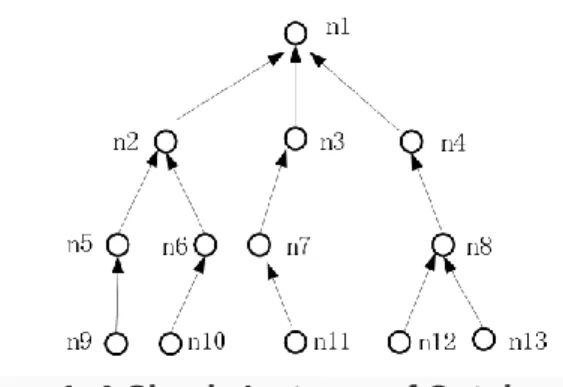
Define semantic contact ratio [12] 1: refers to the concept of ontology internal contain the same between upper concept of number. Semantic coincidence degree show the same degree between the two concepts. In the actual calculation, can be converted into computing two nodes have a common node number, use the I (x) studying the I (y) to represent the two concepts of x, y between the semantics of the coincidence degree, the node x (x) said I ascend to the number of nodes in the root node.
Figure 1. A Simple Instance of Ontology
For example, in figure 1, the concept of n5 ascend to the and node number of nodes in the n1 is 3, so I (n5) = 3, the same available: I (n6) = 3, I (n9) = 4. By calculating available: I (n5) studying the I (n6) = 2, I (n5) studying the I (n9) = 3. Can see from the graph, the semantics of the concept of contact ratio is bigger, the concept of semantic similarity between the greater. On the contrary, the concept of semantic coincidence degree, the smaller the concept semantic similarity between the smaller also. As can be seen from the figure 1, the concept of similarity between n5 and n9 is greater than the similarity between the n5 and n6.
Definition 2: the semantic distance refers to connect these two concepts in ontology graph nodes access the shortest path across the number of edges, the two concepts constitute the number of the edge of the shortest distance. Concept of the semantic distance between A and B to D (A, B). Semantic distance is a decisive factor affect the semantic similarity. In general, the smaller the semantic distance between two concepts, the higher its semantic similarity, a concept itself with semantic distance is zero; Conversely, the greater the semantic distance between two concepts, the smaller the
semantic similarity. Semantic distance and semantic similarity between can build a simple inverse relationship. In this kind of inverse relationship, need to meet the following three conditions: first, the semantic distance between two concepts of infinite (i.e., no pathway between two concept nodes), the semantic similarity is zero; Second, the semantic distance between two concepts is zero (i.e., between concept and its itself), the semantic similarity is 1; Third, the semantic distance between two concepts is smaller, the greater its semantic similarity. From the figure 1, it can be learned that D (n4 interchange, n5) = 3.
Definition 3 level depth: the same distance of two concepts, the concept of semantic similarity as the sum of their level increases, decreases with the increase of the level difference between them. In figure 1 simple ontology concept n12 and n13 the semantic distance between the two, the concept of n3 and n4 interchange between the semantic distance of 2, the semantic similarity between the n12 and n13 than the semantic similarity between n3 and n4 interchange. So, the size of the two concepts level sum is also calculate semantic similarity between two concepts of basic factors. In addition, the difference between the concept hierarchy is also affects the two are not the same depth, the concept of the similarity between the important factors. The level difference between the two concepts, the greater the degree of similarity between concepts instead of smaller. As shown in Figure 1, node n9 and similarity between n5 is greater than the degree of similarity between it and n1.
Comprehensive the above factors should be considered, puts forward the concept of similarity computation formula is as follows [13]:
2 [ ( ) ( )] ( , ) ( , ) *[ 1 2 ( 1 2) / 2] I x I y Sim x y D x y h h h h (1) In type (1): D (x, y) represents the concept of semantic distance between x and y; I (x) studying I (y) represents the concept semantic coincidence degree between x and y; H1, h2 represents the concept of x, y, respectively, the level of the corresponding depth.
By type (1) the calculation of the later can get to meet the requirements of the relevant factors as a result, but not all because of its numerical results in [0-1], so but according to the quantitative principle, to the calculation results are normalized processing, this paper puts forward the normalization formula is as follows [14]:
1
S i
( ,
)
1
1
* S i
( ,
)
C
m x y
u
m x y
(2)In type (1): u is a normalization factor, the value for real number greater than zero. U value, the greater the calculation result more rapidly approaching 1.
When use the program to realize concept similarity calculation process is as follows: (1) between the initialized to the concept of calculation; (2) based on semantic similarity factor to calculate semantic coincidence degree between concept and semantic distance, hierarchy depth difference; (3) according to the concept similarity calculation formula of similarity calculation; (4) according to the result of normalized formula for computing the normalized processing.
In order to improve the recall ratio, will be associated with the retrieval of content in accordance with the relevant high and low, in turn, display to the user. The correlation between concepts including some can reflect the connotation of the objective existence of the relationship between concepts. As quantitative index of correlation, correlation measure between the concepts of relative degree. Generally, correlation value of interval [0-1]. If there is no link between the two concepts, the relevance of the concept of the two is zero. If have a direct link between the two concepts, the relevance of 1. Asked by the related concept, correlation can be divided into direct, indirect, direct and indirect inheritance of related 4 kinds of inheritance.
Defining 4: the concept of correlation between A and B to Rel (A, B), its specific definition is as follows:
If A and B is directly related to the two concepts: the Rel (A, B) = 1;
If A and B two concepts through n indirectly related: the Rel (A, B) = 1 / (n + 1) If A and B two concept inherited directly related: the Rel (A, B) = 0.5;
If A and B two concept indirect inheritance: the Rel (A, B) = 1 / (2 n + 2);
Relevance, by definition, to a large extent depends on the definition of domain ontology by domain experts to resources in the field of labeling. Domain experts authoritative domain concepts of the partitioning system, rely on the domain ontology by computing (including resource as example) the concept of correlation is more reasonable.
6. Conclusion
As people's increasing demand for knowledge, the library bibliographic retrieval optimization work is particularly important. Design a data mining algorithm accurately retrieved from the book database user needs the books of knowledge information and gives reasonable Suggestions and recommendations is necessary. First analyzes the current problems existing in the method of building ontology, and then introduced in the process of building ontology engineering thoughts, this paper proposes a new construct domain ontology based on spiral model in software engineering method; And then summed up the four steps of the knowledge base of ontology construction; Then according to the thought of ontology and semantic retrieval, design a semantic intelligent retrieval system based on ontology model, model of ontology construction and the semantic intelligent retrieval process done in detail; Finally design and verify a semantic similarity algorithm, for the realization of semantic intelligent retrieval algorithm.
References
[1] Holyoak K. J., Glass A. L. and Mah W. A., “Morphological structure and semantic retrieval”, Journal of Verbal Learning and Verbal Behavior, vol. 15, no. 2, (1976), pp. 235–247.
[2] D. B., A. D. W., “Semantic Retrieval, Mnemonic Control, and Prefrontal Cortex”, Behav Cogn Neurosci Rev, vol. 1, no. 3, (2002), pp. 206-218.
[3] Kiefer C., Bernstein A. and Lee H. J., “Semantic Process Retrieval with iSPARQL”, In Proc. of the 4th Europ. Semantic Web Conf, (2007).
[4] H. B., C. L. G., “Common and Unique Neural Activations in Autobiographical, Episodic, and Semantic Retrieval”, Journal of Cognitive Neuroscience, vol. 19, no. 9, (2007), pp. 1520-1534.
[5] Pejtersen A, M., “Semantic information retrieval”, Communications of the ACM, vol. 41, no. 4, (1998), pp. 90-92.
[6] Hammiche S., Benbernou S. and Hacid M., “Semantic retrieval of multimedia data”, In Proceedings of the MMDB, (2004).
[7] K. S. Alan and Sabuncu O., “An ontology-based retrieval system using semantic indexing”, //Data Engineering Workshops (ICDEW), 2010 IEEE 26th International Conference on. IEEE, (2010), pp. 197-202.
[8] Bhavsar V. C., Boley H. and Yang L., “A Weighted-Tree Similarity Algorithm for Multi-Agent Systems in e-Business Environments”, Computational Intelligence, vol. 20, no. 4, (2004), pp. 584–602.
[9] Jingmin Z., “An Improved Similarity Algorithm For Personalized Recommendation”, Computer Science-Technology and Applications, 2009. IFCSTA '09. International Forum on, (2009), pp. 54-57. [10] Xia S. and Hong-bin C., “Similarity Algorithm Based on Schema of XML Document”, Computer
Engineering, vol. 36, no. 21, (2010), pp. 54-56.
[11] “Modified concept similarity algorithm”, Computer Engineering and Applications, (2009). [12] Peng Q., “University Z, China. A Similarity Computing Algorithm for Proteins”, CAD-CG, (2005). [13] Chang J., Bista R. and Kim Y. K. A. Y., “Spatio-temporal Similarity Measure Algorithm for Moving
Objects on Spatial Networks”, Lecture Notes in Computer Science, (2007), pp. 1165-1178.
[14] Hong-S. W., Shu S. Z. and Xiao L. B., “Optimal-matching-based 3D CAD model similarity assessment algorithm”, Computer Integrated Manufacturing Systems, vol. 13, no. 10, (2007), pp. 1921-1927.
Author
Guo Yunpeng, he received the B. Eng degree in Library Science from Heilongjiang University and the M. Eng. degree in Library Science from Sun Yat-sen University in 2004 and 2009 respectively. He is working in Qingdao Vocational and Technical College of Hotel Management. He is currently researching on intelligent retrieval algorithm in Library management system.