Workflow Provenance:
from Modeling to Reporting
A Thesis Submitted to the
College of Graduate and Postdoctoral Studies
in Partial Fulfillment of the Requirements
for the degree of Master of Science
in the Department of Computer Science
University of Saskatchewan
Saskatoon
By
Rayhan Ferdous
c
Permission to Use
In presenting this thesis in partial fulfilment of the requirements for a Postgraduate degree from the University of Saskatchewan, I agree that the Libraries of this University may make it freely available for inspection. I further agree that permission for copying of this thesis in any manner, in whole or in part, for scholarly purposes may be granted by the professor or professors who supervised my thesis work or, in their absence, by the Head of the Department or the Dean of the College in which my thesis work was done. It is understood that any copying or publication or use of this thesis or parts thereof for financial gain shall not be allowed without my written permission. It is also understood that due recognition shall be given to me and to the University of Saskatchewan in any scholarly use which may be made of any material in my thesis. Requests for permission to copy or to make other use of material in this thesis in whole or part should be addressed to:
Head of the Department of Computer Science 176 Thorvaldson Building 110 Science Place University of Saskatchewan Saskatoon, Saskatchewan Canada S7N 5C9 Or Dean
College of Graduate and Postdoctoral Studies University of Saskatchewan
116 Thorvaldson Building, 110 Science Place Saskatoon, Saskatchewan S7N 5C9
Abstract
Workflow provenance is a crucial part of a workflow system as it enables data lineage analysis, error tracking, workflow monitoring, usage pattern discovery, and so on. Integrating provenance into a workflow system or modifying a workflow system to capture or analyze different provenance information is burdensome, requiring extensive development because provenance mechanisms rely heavily on the modelling, architecture, and design of the workflow system. Various tools and technologies exist for logging events in a software system. Unfortunately, logging tools and technologies are not designed for capturing and analyzing prove-nance information. Workflow provenance is not only about logging, but also about retrieving workflow related information from logs. In this work, we propose a taxonomy of provenance questions and guided by these questions, we created a workflow programming model ’ProvMod’ with a supporting run-time library to provide automated provenance and log analysis for any workflow system. The design and provenance mech-anism of ProvMod is based on recommendations from prominent research and is easy to integrate into any workflow system. ProvMod offers Neo4j graph database support to manage semi-structured heterogeneous JSON logs. The log structure is adaptable to any NoSQL technology. For each provenance question in our taxonomy, ProvMod provides the answer with data visualization using Neo4j and the ELK Stack. Besides analyzing performance from various angles, we demonstrate the ease of integration by integrating ProvMod with Apache Taverna and evaluate ProvMod usability by engaging users. Finally, we present two Software Engineering research cases (clone detection and architecture extraction) where our proposed model ProvMod and provenance questions taxonomy can be applied to discover meaningful insights.
Acknowledgements
First of all, I want to express my deep gratitude to my supervisors Dr. Chanchal K. Roy and Dr. Kevin A. Schneider for their research guidelines, direction, advice and above all for their inspiration, encouragement and continuous patience. The research work would not have been possible without their support.
I want to thank Dr. Banani Roy, for her direction at every single step of the work from the beginning. Being a newbie in the research domain, it would not be possible to frame the research work in a standard manner without her.
I want to thank all the Software Research Lab members for their cooperation, participation in the insightful discussions that gave me an opportunity to grow. In particular, I would like to thank Golam Mostaeen and Mahjabin Alam for their collaborative support.
I would like to thank all the summer research interns from the last two years and all the graduate students from other labs who took part in the user study as well as provided any collaborative support.
I am grateful to the Department of Computer Science at the University of Saskatchewan for providing me with financial support. I am thankful to any staff at the department for helping me to get rid of any formal procedure with ease, specifically Gwen Lancaster, Findlay Sophie, Heather Webb and Shakiba Jalal.
I am thankful to my parents Ferdous Alam and Rozina Parveen from the very deep of my heart, who provided me with inspirational and mental support from the very distance. Without their patience, I would not be able to solely focus on my work. My younger brother Arman Ferdous, whom I love the most after my parents, brings me meaning and comfort in my life. His presence and achievements also bring me happiness. I also want to thank any of my friends whoever motivated me from abroad personally to continue my research and keep focus.
Finally, I want to express my special gratitude to Md Zahidul Islam, faculty of Computer Science and Engineering at Khulna University, Bangladesh who was my supervisor during my B.Sc. studies and always taught me how to focus on quality but not quantity. My research journey truly began by holding his hands. He is always a true inspiration in my life!
I want to dedicate this thesis to those creative people, who hold the courage to dream big, think different and pursue their dream with patience!
Contents
Permission to Use i
Abstract ii
Acknowledgements iii
Contents v
List of Tables viii
List of Figures ix
1 Introduction 1
1.1 Contribution . . . 3
2 Preliminaries 6 2.1 Terms and Definitions . . . 6
2.1.1 Programming Model . . . 6 2.1.2 Provenance . . . 6 2.1.3 Workflow . . . 6 2.1.4 Workflow System . . . 6 2.1.5 Module . . . 6 2.1.6 Data Item . . . 7 2.1.7 Reporting . . . 7 2.2 Importance of Provenance . . . 7
2.3 Important Features of Provenance . . . 8
3 ProvMod: The Model 10 3.1 Design Goals . . . 10 3.2 Definitions . . . 11 3.2.1 Workflow W . . . 11 3.2.2 Data D . . . 11 3.2.3 Module M . . . 11 3.2.4 Properties P . . . 11 3.2.5 Type . . . 11 3.2.6 Dataflow→ . . . 11 3.2.7 Module Invocation . . . 11
3.3 ProvMod, Graph and Graph Database . . . 13
3.4 Querying . . . 14
3.4.1 Decide: The First Elementary Query . . . 14
3.4.2 Extension of the First Elementary Query . . . 14
3.4.3 Module Chain Regeneration with Decide . . . 14
3.4.4 Property Mapping with Decide . . . 14
3.4.5 Time Sequence Mapping: The Second Elementary Query . . . 15
3.4.6 Data Sequence Mapping: The Third Elementary Query . . . 15
4 Classifying Provenance Questions 16 4.1 Methodology of Deriving Taxonomy . . . 16
4.2 The Provenance Questions Taxonomy . . . 17
4.4 Monitoring Related Questions . . . 20
4.4.1 Real-time Aggregation . . . 20
4.4.2 Fixed-time Aggregation . . . 21
4.5 Statistical Analysis Related Questions . . . 21
4.5.1 Statistical Analysis Questions . . . 22
5 Implementation 23 5.1 System Architecture . . . 23
5.2 Logging Mechanism . . . 23
5.2.1 Taxonomy of Workflow Systems by Cruz et al. . . 25
5.2.2 Description of ProvMod Provenance Mechanism . . . 27
5.3 Workflow Components . . . 27
5.4 Logging Levels . . . 29
5.5 Services . . . 30
5.6 Log Schema . . . 32
5.7 Workflow Implementation . . . 32
5.8 Tool Development and Integration . . . 33
6 Experimental Analysis 37 6.1 Sparse Workflow . . . 39 6.2 Large Workflow . . . 41 6.3 Deep Workflow . . . 43 6.4 Performance Analysis . . . 45 7 Reporting 50 7.1 Visualization for Graph Related Questions . . . 50
7.2 Visualization for Time Series Monitoring Questions . . . 51
7.3 Visualization for Monitoring Metrics . . . 53
7.4 Visualizing Proportional Measurements . . . 53
7.5 Visualizing Nominal vs Nominal to Ordinal Monitoring . . . 54
7.6 Visualizing Statistical Analysis and Monitoring . . . 55
8 Integration and Performance Analysis 60 8.1 Integration with Apache Taverna . . . 60
8.1.1 Fixed Routine for ProVerna . . . 60
8.1.2 Coding Template . . . 60
8.2 Benchmark for Comparison . . . 60
8.3 Result Analysis . . . 61
8.3.1 System Performance Analysis . . . 61
8.3.2 Query Performance Analysis . . . 62
8.3.3 Notes on Performance Overhead . . . 62
9 Comparisons 68 9.1 Provenance Mechanism Comparison . . . 68
9.2 Completeness of Provenance Questions Taxonomy . . . 68
9.3 Comparison of Reporting Service . . . 71
10 User Study 72 10.1 The Method . . . 72
10.1.1 Learning ProvMod . . . 72
10.1.2 Implementing ProvMod . . . 72
10.1.3 Inspecting Log Schema . . . 73
10.1.4 Learning Taverna . . . 73
10.1.5 Using ProVerna . . . 73
10.2 Evaluating Dashboards . . . 74
10.2.1 Assessing Graph Visualization . . . 74
10.2.2 Assessing Monitoring Visualizations . . . 75
10.3 User Information and Skill Level Demonstration . . . 77
10.4 NASA TLX Score . . . 79
10.5 Limitations of The Study and Future Goals . . . 81
11 End User Features 82 11.1 Tool Development . . . 82
11.2 Workflow Implementation . . . 84
11.3 Logging Configuration . . . 84
11.4 Tuning Log Levels . . . 85
11.5 End User Reporting . . . 85
11.6 Integration . . . 85
12 Two Software Engineering Use Cases of ProvMod 86 12.1 Clone Detection Meets Provenance . . . 86
12.1.1 Questions about Clone Analysis . . . 87
12.2 Architecture Extraction of Legacy Systems . . . 91
12.2.1 Questions about Architecture Extraction . . . 91
13 Related Works 95 13.1 Surveys . . . 95
13.2 Automated Logging . . . 100
13.3 Data Provenance and Querying . . . 104
13.4 Workflow Provenance and Querying . . . 108
13.5 Analytic Provenance: Querying with Visualization . . . 111
13.6 Software Engineering . . . 113
14 Discussions 115
15 Conclusion and Future Work 117
List of Tables
5.1 Provenance mechanism of ProvMod . . . 34
5.2 User Properties . . . 34
5.3 Object Properties . . . 35
5.4 File Properties . . . 35
5.5 Document Properties . . . 36
5.6 Module Properties . . . 36
9.1 Provenance mechanism comparison of Taverna, ProvMod and ProVerna . . . 69
10.1 Average TLX score out of 10 from the user study. Scale 0 to 10 refers to low to high score. . 80
10.2 Median for TLX scores from the user study . . . 80
List of Figures
1.1 A layer based architecture for our proposed programming model . . . 3
1.2 System components services architecture . . . 4
3.1 Relation among components of ProvMod in a workflow . . . 12
3.2 Module behavior with conditional . . . 13
4.1 A classification of provenance questions in our work . . . 17
5.1 Implementation of ProvMod and relation between other components of the whole workflow system that we propose . . . 24
5.2 Lifecycle of workflow systems by Cruz et al. [1] . . . 25
5.3 Taxonomy presented by Cruz et al. [1] . . . 26
5.4 Description of ProvMod based on the taxonomy of Cruz et al. [1] . . . 28
5.5 ProvMod model components . . . 29
5.6 JSON log structure . . . 31
5.7 Implementing a workflow . . . 32
5.8 Tool development and integration template . . . 33
6.1 Experimental dataset overview . . . 38
6.2 First workflow for simulation . . . 38
6.3 Second workflow for simulation . . . 39
6.4 A portion of the provenance graph with 300 nodes generated by the simulation with sparse workflow. Green nodes are different modules with module name as label. Red nodes are intermediate Data Object items with data value as label. Blue nodes are Data File items with file path as label. The edges are labeled with IN or OUT. IN is directed from data to module and OUT is directed from module to data. . . 40
6.5 The large workflow used in our experimental analysis . . . 41
6.6 A portion of the provenance graph with 100 nodes generated by simulation with large workflow. The red node is the Sharpen module labeled with tool name and all other green nodes are generated output data from Sharpen. Green data nodes are labeled with an ID. There is only one input to Sharpen in the full graph that is not highlighted here. The graph is expanded around the single Sharpen node only. . . 42
6.7 The deep workflow used in our experimental analysis . . . 43
6.8 A portion of the provenance graph with 100 nodes generated by simulation with deep workflow. The red nodes are the different instances of Sharpen tool with same parameter setting. Green nodes labeled with IDs are either an input or output data items. One generated data item is used as input in the next module. . . 44
6.9 Execution overhead of sparse workflow . . . 45
6.10 Query overhead of sparse workflow . . . 46
6.11 Comparison of ProvMod execution time with and without provenance . . . 47
6.12 Execution overhead of large workflow . . . 48
6.13 Query overhead of large workflow . . . 48
6.14 Execution overhead of deep workflow . . . 49
6.15 Query overhead of deep workflow . . . 49
7.1 A graph visualization to answer graph related question that does not return a single metric value, Objects are Blue, Modules are Red and Files are Yellow in color . . . 51
7.2 A time series visualization for representing real-time, time-series investigation of any property 52 7.3 A time series visualization for representing real-time, time-series investigation of multiple prop-erties . . . 52
7.4 An average of CPU load for a fixed-time range for different modules . . . 53
7.5 An average of CPU load for a fixed-time range for different modules with a goal of 50% CPU load . . . 53
7.6 Metric view of two nominal property frequency . . . 54
7.7 Pie chart to provide a proportional view of a nominal property (here success and MRE or module run-time error) . . . 55
7.8 Pie chart to provide a proportional view of two nominal property frequencies (here success and MRE or module run-time error along with the module types) . . . 56
7.9 Heatmap to represent tool name vs error type to frequency of their occurrence . . . 57
7.10 Heatmap to represent tool name vs error type to CPU load . . . 58
7.11 Percentile distribution of CPU load grouped by tool names . . . 58
7.12 Standard deviation of CPU load for different tools . . . 59
8.1 A coding template for the developer that implements RemoveSpace function, to remove any space in the file content . . . 63
8.2 A real-world pipeline as the benchmark for ProVerna . . . 64
8.3 Comparing ProVerna and Taverna . . . 65
8.4 Execution time overhead based on the number of iterations . . . 65
8.5 Memory overhead based on the number of iterations . . . 66
8.6 Time taken to build graph during workflow run for two kinds of queries . . . 66
8.7 Full graph query time based on the number of nodes in the provenance graph . . . 67
8.8 Performance of elementary queries Decide, Time Sequence Mapping and Data Sequence Mapping 67 9.1 Query coverage of proposed taxonomy with respect to existing works . . . 70
9.2 Visualization feature comparison with respect to existing analytic provenance research works 71 10.1 Python programming fluency of different users . . . 77
10.2 Workflow experience . . . 77
10.3 Experience level with JSON . . . 78
10.4 Feedback on the question: Is the coding template reusable? . . . 78
10.5 Feedback on the question: Is the documentation simple, concise and to the point? . . . 79
11.1 Implementing existing tool FastQC in ProvMod . . . 82
11.2 Developing a tool from scratch . . . 83
11.3 A pipeline to implement the tool Entropy from ProvMod library with input file gene.txt, to produce a data item with the entropy value in it . . . 84
12.1 Specialized clone analysis approach with the elementary queries . . . 87
12.2 JHotDraw clone visualization. JHotDraw is a notable tool for its adherence to design principles. The nodes are function level code fragments labeled with an ID from the NiCad results. All clones are clustered in the graph. Any node connected to another means that they are both clones to each other. . . 88
12.3 Bioblend - A Galaxy library’s clone visualization . . . 89
12.4 Taverna Mobile clone visualization . . . 90
12.5 Specialized functional dependency extraction approach with the elementary queries . . . 91
12.6 A functional dependency graph for a specific usage scenario of CRHM. The system starting point is the yellow root node labeled with ’crhm’. Nodes system functions. Those are catego-rized and colored on the basis of their source file name. The nodes are connected with directed edge labeled ’calls’. So, if node A calls node B, there is a directed edge from A to B. . . 93
1 Introduction
Workflow provenance maintains information about workflow processes, configurations, data propagation and lineage through logging. The importance of provenance has been pointed out by different researchers [1, 2, 3, 4]. For business process analysis, knowledge management, process re-engineering, and business intelligence, provenance is necessary [5]. Davidson et al. [6] clearly states, provenance is necessary for reproducibility and it enables data analysis and further exploration through collaboration. Besides, provenance is necessary for debugging, administration, error detection and fixes as well as security, data authentication, origin tracing, storage management and anomaly detection [7, 8, 9]. As scientific workflow systems have evolved to tackle Big Data in the cloud computing environment [7, 8], workflow provenance can make such systems efficient and traceable. Automated provenance is necessary to go beyond humanly written queries, data exploration, pattern mining, error detection, validation, diagnosis, collaboration to manage diverse or heterogeneous data sources [8]. For data-centric performance measurements, provenance is required [10]. Causal lineage capturing is important and can be done with provenance [8]. Real-time monitoring of provenance information makes it possible to use already allocated resources to be used again for the failed processes and then fine-tuning of a parallel process is possible [11]. Querying for identifying provenance graphs, overlaps among the graphs and similarities among them is discussed by Karvounarakis et al. [12] which is an important research topic. Above all, data visualization is also tightly coupled with any topic of provenance research [7, 8] to offer complex insight.
Even though provenance is a crucial part of any workflow system, provenance mechanisms differ from system to system [13, 14]. Cross-domain research and collaboration are now of paramount importance in data science and big data analytics. Prominent workflow systems and their features are best modularized to support modification and integration. Developers may need to modify or update the provenance mechanism of any existing workflow system to meet certain goals. The design and mechanism of provenance highly depend on the design, architecture, modelling, and orientation of the workflow systems. Thus modifying or updating the provenance part of a workflow system is not a common task with a standard approach. Building a new workflow system is also challenging and additional effort is necessary in order to integrate provenance into a new system. There are different tools and technologies for capturing and logging events (Log4j for Java, Logging for Python) but they were not built targeting provenance. So even though the developers use them they still need to design and implement a provenance model which will be able to answer certain provenance questions. Such development tasks are burdensome [15]. It is because provenance is not only about logging events in any software system but also about retrieving information about the workflows from
those logs.
To solve the stated problem, we propose a comprehensive taxonomy of workflow provenance questions influenced by existing research. Standing on the proposed taxonomy and state of the art of workflow research, we propose a workflow programming model ’ProvMod’ which is capable of automated logging and oriented to answer a variety of provenance questions. Such automation is of high importance [15, 16, 17]. ProvMod is provided as a library and can also be integrated with any existing workflow system. Such logs hold a number of properties ranging from the workflow level to the OS level that is solely focused on answering provenance questions from the taxonomy. The logs follow a simple JSON structure. Thus it can be adapted to any NoSQL technology to fit into big data systems which is important [18]. Even the developers can add or reduce properties in the log schema to capture the desired amount of information.
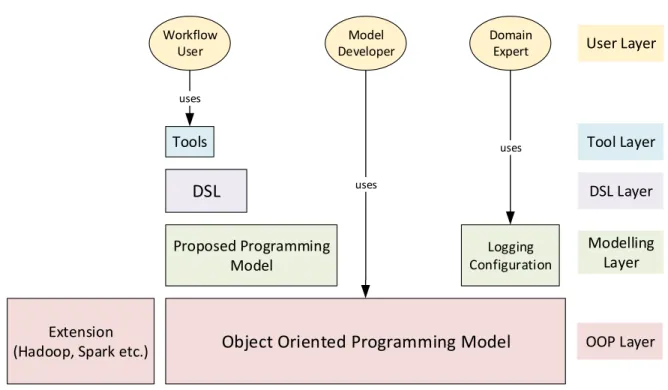
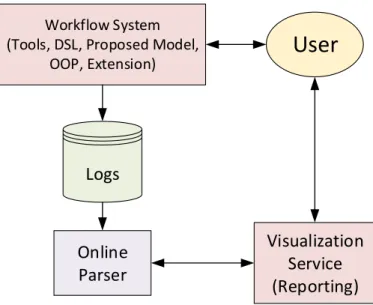
ProvMod is developed using an OOP (Object Oriented Programming) and thus easy to implement with less learning curve. With a layered architecture (illustrated in Figure 1.1), every component stands separately as a distinct service. Such architecture is inspired by existing work [18, 19]. On the OOP layer, there stands the model. The tools stand on the model and there could be a DSL in the middle for domain specific tasks. Logging configuration is also kept separate for custom logging with different logging levels. Such customization is highly inspired [7]. The core services are illustrated in Figure 1.2. We implement the model in Python. ProvMod leverages the power of Neo4j graph database to handle semi-structured heterogeneous log data. A highly coupled graph database support is better for provenance [20]. It can be also be directly used to represent workflows DAGs (Directed Acyclic Graphs). Above all, the end user also gets real-time monitoring features in ELK Stack which is crucial for auditing a running system [5, 11]. Elasticsearch is used in ProvMod for real-time log parsing and Kibana is used for monitoring, data visualization, and statistical analysis.
Finally, in order to show that our model is adaptable to existing workflow systems and configurable, ProvMod is integrated with Apache Taverna Workflow System [21] which is done with our provided simple tool development template. It generates a new workflow system that we name ProVerna. ProVerna not only has the Taverna front end and features for building workflows but also all the facilities of ProvMod. We also compare Taverna, ProVerna, and variations of ProVerna to evaluate the overhead of the model from different angles.
Object Oriented Programming Model
Proposed Programming
Model
Tools
DSL
Extension
(Hadoop, Spark etc.)
Logging Configuration Workflow User Domain Expert Model Developer uses uses uses
OOP Layer
Modelling
Layer
DSL Layer
Tool Layer
User Layer
Figure 1.1: A layer based architecture for our proposed programming model
1.1
Contribution
We try to touch every parts and phase of the workflow systems and executions. So, we have a number of contributions that are distinct. We made the following contributions in this work:
1. We propose a provenance question taxonomy, that covers a number of provenance questions. The taxonomy can even be extended.
2. We propose a workflow programming model named ProvMod, that is oriented to answer workflow provenance questions.
3. ProvMod follows a layered architecture and SoC design principle to keep the workflow, provenance, provenance database, tool database and visualization services of the model separate and independent.
4. We define a graph model for ProvMod that is highly adaptable to Graph Databases.
5. ProvMod is adaptable to existing tools. When adapted, all the features of ProvMod and the tools will be available in the newly adapted tool.
6. Developing new tools from scratch is also supported in ProvMod in an easy fashion and minimal OOP knowledge is required.
Workflow System
(Tools, DSL, Proposed Model,
OOP, Extension)
Logs
Online
Parser
Visualization
Service
(Reporting)
User
Figure 1.2: System components services architecture
7. Workflow implementation with ProvMod is designed with care and during the workflow implementation developers do not need to focus on anything other than the pipeline.
8. Implemented workflows and tools can be reused or shared with other developers.
9. Workflows in ProvMod can support conditional module execution as well as multiple distinct inputs and outputs.
10. Due to layered architecture, the user can create another custom layer between the workflow and Prov-Mod to offer DSL (Domain Specific Language).
11. ProvMod captures workflow level provenance automatically as well as the user can generate their own custom log at any step of the implementation at will.
12. Automated logging has small overhead and does not affect the data analysis.
13. The automated logging can be disabled or even modified based on the target domain.
14. Logging and the workflow modelling is completely separate in ProvMod. So, domain experts can modify the log schema/configuration/model and developers/analysts can focus on only implementing the workflows.
15. ProvMod is integrated with Neo4j Graph Database and the workflow provenance graphs support any Cypher query for analysis.
16. Data visualization is the primary way of answering provenance questions in ProvMod. We offer a number of real-time data visualizations that can answer a number of provenance questions.
17. We use several modern technologies to ship the model such as, Python programming language for workflow implementation, RESTful Web Service for cloud integration and separation of components as services and security, JSON for logging and adaptation with NoSQL databases like Cassandra and CouchDB, Elasticsearch for automated log management, data streaming and security, Kibana and D3 for data visualization, Neo4j for workflow graph management and analysis with Cypher query language.
18. We show how complete our provenance questions taxonomy is based on the state of the art research works. We also describe the mechanism of ProvMod provenance and compare with other provenance enabled systems. Again, we also compare the enhanced visualization features of ProvMod with existing analytic provenance systems.
19. For ProvMod we show several use cases to present its application and advantages in other software engineering topics.
20. We analyze our model with three different kinds of workflows that we define, sparse, large and deep to observe the model performance behaviour from different angles. For these purposes, we implement Bioinformatics and Phenotyping image analysis workflows.
21. We compare ProvMod with Apache Taverna Workflow System [21] for evaluating ProvMod using a real-world Bioinformatics benchmark and evaluate the model.
22. We also integrate our model with Apache Taverna to offer a new model named ProVerna that offers end user with the Taverna GUI and all the ProvMod features in the background.
23. We perform two separate user studies on implementing the programming model and the visualization supports of ProvMod.
2 Preliminaries
We present the definitions and overview of the research of several concepts for the readers’ simplicity here. It will help them to get an overview and idea about the importance of this research.
2.1
Terms and Definitions
We present some basic definitions for several terms that we use throughout this thesis frequently.
2.1.1
Programming Model
A programming model is based on a theoretical concept that helps the developer to implement the theoretical concept without implementing it from scratch.
2.1.2
Provenance
Provenance in computing means to save the relevant information whenever a data is processed and trans-formed so that later on, using the saved logs the process details can be regenerated.
2.1.3
Workflow
A workflow is basically a directed graph that represents the data flow and propagation through different data analysis tools. The graph contains different types of nodes to represent data and tools. The directed edges represent the data flow direction. Workflows may or may not contain cycles that represent loops. Any workflow that never has loop turns into a directed acyclic graph (DAG).
2.1.4
Workflow System
A workflow system is a system that offers various features and tools to implement pipelines and workflows to implement data-flow and run them without building them from scratch. Workflow systems are more formally known as workflow management systems. Workflow systems can be made for scientific or business domains. Scientific workflow management systems are sometimes referred as SWFMS in short.
2.1.5
Module
2.1.6
Data Item
By data item, in this thesis, we refer to any data object in a workflow system.
2.1.7
Reporting
Reporting refers to present any final result using various forms such as data visualization and interactivity.
2.2
Importance of Provenance
The importance of provenance was strongly mentioned by different researchers. In this section, we present a number of critical points that got attention from researchers in recent years. The following statements are clearly mentioned in the existing works that provide motivation to our research.
1. For business process analysis, knowledge management, process re-engineering and business intelligence provenance is necessary [5].
2. Davidson et al. [6] in their work states the importance of provenance. They also discuss clearly that, it is necessary for reproducibility. It enables data analysis and further exploration. Data mining and visualization are also tightly coupled with provenance research. Provenance enables collaboration.
3. Workflow has already entered into the domain of cloud computing thus entered provenance. For data-intensive systems it is important [7, 8]. Provenance is necessary for debugging, administration, error detection and fixation as well as security, data authentication, origin tracing, storage management, anomaly detection [7, 8, 9].
4. The integration of provenance in Big Data is burdensome and thus it should already be there when a data-intensive system is ported [15]. Automated provenance is necessary to go beyond humanly written queries, data exploration, pattern mining, error detection, validation, diagnosis, collaboration to manage diverse data sources.
5. For data-centric performance measurements of any system, provenance is required [10].
6. Provenance can also be used to analyze legacy systems [22].
7. For heterogeneous data management, provenance is required in cloud computing and data-intensive systems [8].
8. Causal lineage capturing can be done with provenance [8].
9. Real-time monitoring makes it possible to use already allocated resources to be used again for the failed processes [11] Fine tuning of parallel processes also becomes possible then. It also enables elasticity.
10. Provenance can be shipped in two ways, lazy or eager and which way is better in which case is a matter of evaluation [23, 10].
11. Provenance components from workflow systems were identified by Hartig et al. [24].
12. Querying for identifying provenance graphs overlaps among the graphs and similarities among them is discussed by Karvounarakis et al. [12].
13. Workflow provenance and data provenance concepts are clearly distinguished and the importance of workflow provenance can be found in the work of Amsterdamer et al. [25].
2.3
Important Features of Provenance
Various features of provenance were also mentioned by the recent researches that they emphasize for any provenance enabled systems. Now we present a number of crucial features that is very important for any provenance enabled systems. The following features, when present in a provenance enabled system, can make it complete.
1. VanderAalst et al. and Costa et al. [5, 11] mention the importance of real-time monitoring in their work as data-intensive processes takes time to finish and processes need to be investigated in the middle of execution. Larger workflow management systems contain more noise due to human or system related errors and thus it becomes more complex to mine provenance from such bigger systems [5].
2. The feature of conditional workflow is mentioned by Bahsi et al. [26].
3. Freire et al. [20] mentions that tightly coupled provenance facilities are better for workflow management systems.
4. Davidson et al. [6] state, the need for simplicity and usability is very important for provenance. Debugging system problem through visualization is also emphasized by their work.
5. Adaptability and custom configuration are necessary by provenance [7] since configuring logs require domain knowledge and that is time-consuming as well as error prone.
6. Various level of user access is important for ensuring security and protection of data and the system [7].
7. Overhead or performance is an issue to consider in provenance for data-intensive systems [15, 8, 18].
8. Security is another issue to consider in provenance [15, 8, 18].
9. Automation in provenance is required [15, 17, 16, 17].
11. User-oriented provenance model is emphasized in existing works [27]. User-based custom annotation is preferred [18].
12. Provenance in an open world system rather than a closed one is preferred for heterogeneous data based systems [22]. Heterogeneous data modelling should be supported [18].
13. Legacy system’s provenance capturing is also important [22].
14. The need of elasticity or adaptability of system tools is necessary for provenance [8].
15. We need APIs for application-specific provenance capturing to ensure extendability [8, 19].
16. Atomicity (the most elementary information) of provenance data is important for workflow systems [8].
17. Causal lineage ordering is necessary for provenance [8].
18. A layer-based architecture is preferred by researchers for provenance enabled workflow systems [18, 19].
19. Scalability is also necessary for provenance in data-intensive systems [18].
20. Data visualization and further data analysis features are important for provenance [18].
21. Graph database could be used in provenance for analyzing semi-structured or unstructured data [18].
22. Temporal and time-series data analysis is emphasized in provenance analysis to get a better under-standing of the system and process changes [18, 23].
23. A need for a general standard in provenance research was mentioned by Buneman et al. [28].
24. Different levels of provenance information with properties were emphasized by researchers [9].
25. Provenance facilitated system should have query features [9, 19].
3 ProvMod: The Model
This section presents the theoretical definition of our model including different components. We define the workflow, data, module, their properties, data flow, invocation and type. The model is oriented to answer provenance questions. Different provenance questions with a proposed taxonomy are described in Chapter 4. Although the model is oriented to answer provenance questions, it is not fully dependent on the question types and queries. It may create problem and limitation in the long run. To overcome such issues, we introduce properties in the model. Any model component holds certain properties that are relevant to the system domain. More properties can be added if necessary. So, in summary, any provenance question our model answers, the answer is derived from the properties. For supporting different workflow systems, we introduce the module and data items. Clearly, any further kind of workflow artifacts can be introduced.
3.1
Design Goals
When designing the model, we follow some simple design goals. They are:
1. The model is oriented to answer provenance questions.
2. Any workflow artifact will hold specific properties. Any information about the artifact has to be retrieved from the properties of the artifact only.
3. Since, the artifacts’ information is solely retrieved from the properties, new properties can be introduced in a new system.
4. The model has to be as simple as possible with respect to workflow implementation. So, it will offer some familiar operations that are relevant to any workflow implementation.
5. The model will follow SoC to interact with other system components.
3.2
Definitions
In this section, the theoretical definitions of the model components are presented.
3.2.1
Workflow W
A workflowW = (V, E) is a Directed Acyclic Graph (DAG) V ={v:v∈D∪M}, E={e:e∈F} whereD
denotes Data, M denotes Module andF denotes Dataflow.
3.2.2
Data D
Data is a workflow element from W = (V, E) where, D ={d:d∈ V, d= (pi)ni=1 = (p1, p2, ..., pn), pi ∈ P}
andP denotes an ordered set to represent a number of properties of D.
3.2.3
Module M
Module is a workflow element fromW = (V, E) where, M ={m:m∈V, m= (pi)ni=1 = (p1, p2, ..., pn), pi ∈
P}andP is an ordered set to represent a number of properties of M.
3.2.4
Properties P
PropertiesP = (pi)ni=1= (p1, p2, ..., pn) is an ordered set associated with any data elementd∈D or module
itemm∈M from a workflowW whereT ype(p)∈ {N ull, Any}.
3.2.5
Type
Type is a function that returns the data type of any property itempfrom the workflow when applied upon it. The data type could beN ullorAny. Any is a set that contains all possible data types from a particular implementation of the workflow W.
3.2.6
Dataflow
→
A dataflowF is an ordered tuple containing two workflow elements to represent a directed edge in a workflow
W where, F = (d, m)|(m, d), d ∈ D, m ∈ M. (d, m) and (m, d) are correspondingly considered as input dataflow (written asd→m) and output dataflow (written asm→d).
3.2.7
Module Invocation
A module invocationKis an ordered tuple containing two dataflows where,K={(f1, f2) :f1= (di, m), f2=
There are several features that are supported by our model based on the model components’ definitions. They are,
1. The users can be considered as a property any workflow components.
2. Properties can be modified for different components as well as systems.
3. Modules can not only have multiple inputs but also multiple outputs.
4. Multiple inputs or output data items can be different.
5. Modules can be incorporated with certain logical conditions and can generate default values when not executed.
6. The model can be incorporated with any types from a certain implementation.
7. Module abstraction and invocation are conceptually separated from each other.
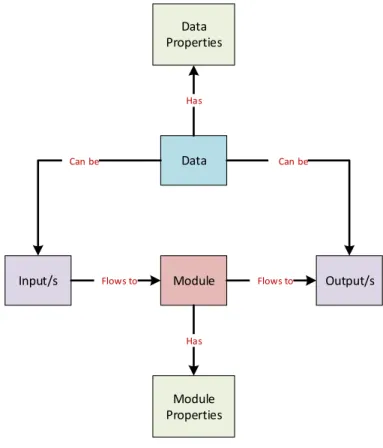
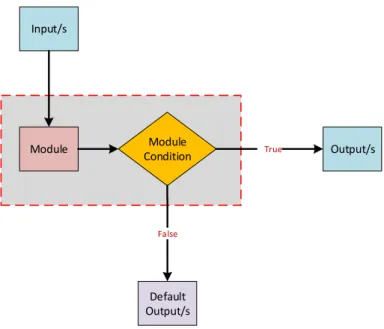
How the components are related to each other can be understood from the Figures 3.1. How a module behaves with a condition is described in Figure 3.2.
Data
Input/s Module Output/s
Module Properties Data Properties Can be Can be Flows to Flows to Has Has
The module components can also support conditionals that are already mentioned. When a module condition is false, a default data flow can be generated in ProvMod.
Input/s
Default Output/s
Module Module
Condition True Output/s
False
Figure 3.2: Module behavior with conditional
3.3
ProvMod, Graph and Graph Database
The very basic relational schema between data and module items (Figure 3.1) is indeed a graph. This graph can be considered the most elementary workflow for our model. The graph is more specifically a DAG that contains one data as input to a module and one data output from that module. From this observation, we become encouraged to acquire graph database technology in our model ProvMod. A graph database is one of the modern database technologies that is getting huge interest in the Big Data domain. Even many relational database technologies are being replaced by NoSQL databases [30]. For example, Google’s BigTable [31] and Facebook’s Cassandra [32] are coming into light. Graph database such as Neo4j offers a trivial way to implement such graph data structure quickly [33]. Surely, such structure can be obtained and represented through relational database tables, but that will add up another overhead of implementation to the model. Graph database such as Neo4j also offers great performance and is lightweight [30]. Our model also being property-centric, Neo4j is of great advantage to us. Neo4j also has other APIs available to work with for different purposes. Thus the graph database can later be extended as we obtained Neo4j.
Based on the motivations presented, design goals and future goals we move forward to model the querying features of our model ProvMod.
3.4
Querying
We propose a set of 3 queries that can cover a number of provenance queries from the existing literature and also can be used to derive more. The last two are derived from the first one. So, we consider them as elementary queries and the first one to be an atomic query.
3.4.1
Decide: The First Elementary Query
We propose the first elementary query and name it Decide. It is named that way because this query is used to retrieve the smallest information from the provenance graph. Such information could be for example, the value of a target property of a target node.
The elementary query Q is a function of the workflow W that returns a collection of property p that satisfies certain condition(s)C. So,
Q=f(W, C) wherep∈P andC is a Boolean condition. In Cypher the query format should be,
MATCH (n:Type) WHERE Condition RETURN n;
3.4.2
Extension of the First Elementary Query
The first query Decide can be extended to generate workflow and pipeline module chains and data tables as property to property mapping.
3.4.3
Module Chain Regeneration with Decide
A workflow could be regenerated using the elementary query Decide with a sequence of dataflows.
For example,Q1=A→B, Q2=B→C, Q3=C→D which givesA→B→C→D.
3.4.4
Property Mapping with Decide
A dataset could be generated using the first elementary query Decide.
For example, Q1 = (x1, x2, ..., xn) and Q2 = (y1, y2, ..., yn) thus Q1 ↔ Q2 is an one-to-one mapping
be-tween the ordered sets that gives ((x1, y1),(x2, y2),(x3, y3)).
The two extensions can be used to create two other important queries that we consider as elementary but derived from the first query Decide. Note, every node in the graph is also uniquely identified with an
identifier property. So, querying that unique property is indeed getting nodes from the graph.
3.4.5
Time Sequence Mapping: The Second Elementary Query
Time-series analysis is an important issue in provenance and thus we consider it as an elementary query so that it can be featured as a native facility in ProvMod and used for further analysis in a portable manner. Using the extensions described above, the Time Sequence Mapping query structure in Cypher will be,
MATCH (n:Type) WHERE Condition RETURN n.p ORDER BY n.time;
We name this elementary query that way because it is used to retrieve a time-series data. Since time-series is a very frequently used data analysis topic, we consider it as an elementary query.
3.4.6
Data Sequence Mapping: The Third Elementary Query
If we want to map between two different properties from the nodes of the graph, we can use this query to derive a dataset for further analysis in general. The Data Sequence Mapping query structure in Cypher is,
MATCH (n1:Type1), (n2:Type2) WHERE Condition AND n1.p == n2.p RETURN n1.p1, n2.p2;
Data to data mapping also being important and very frequently used data analysis topic, we also consider this query as elementary and name it that way.
4 Classifying Provenance Questions
In this chapter we demonstrate our proposed provenance questions taxonomy to classify them. For each category from the classification, we mention a number of derived questions in the following sections. For all the questions, we also provide the reader with a template so that they can implement it in a graph database technology. We focus on Cypher query language primarily, though we present the queries in a possible generic format. To get a clear idea for each query, the queries are accompanied with examples.
4.1
Methodology of Deriving Taxonomy
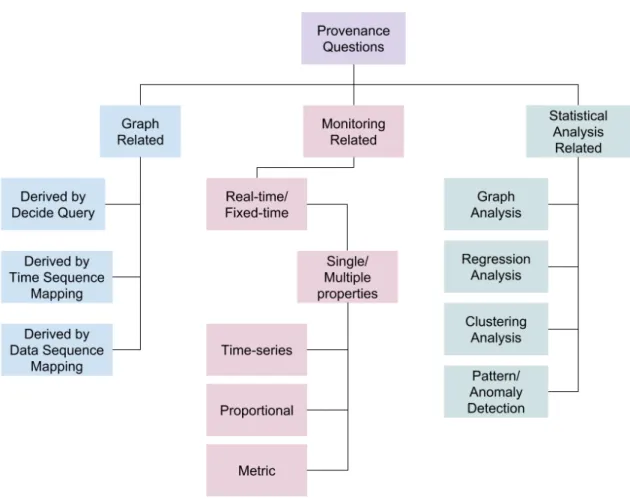
We follow a theoretical approach to derive such a taxonomy illustrated in Figure 4.1. The following matters are considered when we create the taxonomy.
1. Whenever we ask a workflow provenance question, its answer can be directly retrieved from the prove-nance graph.
2. We have already proposed a model that is based on three provenance queries. Those three queries are related to the provenance graph.
3. Clearly, the question can be either about a particular data value (Decide query), or a time-series of data values (Time-Sequence mapping), or a mapping between two kinds of data values (Data-Sequence Mapping).
4. These three queries can be combined with each other to derive any other types of data mapping holding multiple data items.
5. The graph related provenance questions are indeed to derive a desired dataset for further analysis. It is because, if we have the dataset, we can answer relevant questions. So, we propose monitoring related questions that works with aggregation.
6. We propose three basic aggregation types, Time-series, Proportional and Metric.
7. Finally, the question may involve multiple aggregation, that we call Statistical Analysis questions. This kind of questions involves applying different tools and techniques for prediction, clustering and so on.
8. We classify Statistical Analysis type into further generic categories, Graph analysis, regression or clus-tering and so on.
Since we consider real-time monitoring, we also include real-time or fixed-time category in our taxonomy. Again, if we find any general question type in future that is not already in the taxonomy, it can be added in the relevant class to extend the taxonomy. Workflow provenance questions were mainly derived from the graph related questions, but we also include analytic questions. Any aggregation is covered by Monitoring questions and any tool application is covered by Statistical questions.
4.2
The Provenance Questions Taxonomy
Provenance questions and their answers are our main goal to be discovered in this work. So we discuss this topic in a separate chapter. We categorize the question into three parts. A brief picture is in Figure 4.1. They are as follows:
Figure 4.1: A classification of provenance questions in our work
1. Graph related questions: Graph related questions involve the workflow graph analysis at any time. It is an offline mode of analysis and not real-time.
2. Monitoring related questions: Monitoring questions involve any workflow graph/node related met-ric (properties) analysis that is also real-time. It is related to simple aggregation on the provenance graph data.
3. Statistical analysis related questions: Statistical analysis related question involve any kind of com-plex analysis to find any statistical measurement of the workflow graph/node related metrics (proper-ties). These questions involve the application of different statistical or machine learning based tools on the provenance data. Such kind of analysis largely depends on the approach and available data.
4.3
Graph Related Questions
In this section, we present a number of provenance questions that we focus to answer in our work that is related to workflow graph analysis in offline mode. The questions are from very basic to advanced level for provenance and some of them were already discussed in recent works from different angles. Even some of the existing works only focused on several of them. We categorize the queries into different classes and each of them contains many questions that fall under provenance.
Also, since these questions are for graph analysis, we present the corresponding Cypher queries for their retrieval in this section. The Cypher queries mentioned here are in abstract form to show the general structure of them. For more details, the reader may refer to the Implementation section.
The very first question of workflow provenance is:
• What is the complete workflow DAG G?
Match (n) return n;
For example, this query can be used to retrieve the complete provenance graph collection until now from the beginning of time the system was being used.
The first question can be used to derive several other provenance questions. They are as followed:
• What is the workflow DAG G containing node n1, n2, ... , nn? (Using Decide)
Match (n1), (n2), ... , (nn) Where n1.p =n1, n2.p =n2, ... , nn.p = nn return n1, n2, ... , nn;
For example, this query will retrieve a subgraph that has only some particular nodes identified by a property. The property itself can be an unique identifier. The subgraph will also hold any edges if there is any among the target nodes.
• What are the inputs of a module M in workflow DAG G?(Using Decide)
Match (i), (n) where (i)-[:INPUT]->(n) return i, n;
For example, this query will retrieve only the input and the target module nodes as a subgraph from the full provenance graph. INPUT is a ProvMod keyword.
• What are the outputs of a module M in workflow DAG G?(Using Decide)
Match (O), (n) where (n)-[:OUTPUT]->(O) return n, O;
Similar to the previous query this query will retrieve the outputs and the target module node. OUTPUT is a ProvMod keyword.
• What are the outputs of a module M in workflow DAG G?(Using Decide)
Match (i), (n), (O) where (i)-[:INPUT]->(n)-[:OUTPUT]->(O) return i, n, O;
This query will retrieve the input and output nodes and the target module node as a pipeline from the full provenance graph.
• Does a node hold a property P in a workflow DAG G?(Using Decide)
Match (n:Type) where n.P1<> Null return ”P”;
This query will check whether a property is held by a certain type of node.
• What is the value of property P of node N in a workflow DAG G?(Using Decide)
Match(n) return n.p;
For example, this query will retrieve how much CPU load was used for a module run which is saved as one of its property.
• What is the collection of all workflow DAGsG1, G2, ..., Gn? (Using Decide)
Match(n) return n;
This query is the same as the very first query that we have already mentioned.
• What is the time ordered list of property P from workflow DAG collectionG1, G2, ..., Gn?
(Using Time Sequence Mapping)Match(n) return n.P order by n.time;
For example, this query will retrieve all the module names from the full provenance graph with ascending order of their creation time, so that we can find out, the serial order of modules that were executed one after another.
• What is the property K ordered list of property P from workflow DAG collectionG1, G2, ..., Gn?
(Using Data Sequence Mapping)
Match(n) return n.P order by n.K;
This query can, for example, retrieve the module names in ascending order by their CPU load, so that we get an idea of- which module uses the most or least CPU during execution. Such a query can also be used to create datasets from the full provenance graph. The previous query is also a derivation of this query in a simple manner.
• What is the workflow DAG G holding a certain condition C?(Using Decide)
Match(n) where C return n;
The graph related provenance questions and corresponding Cypher query can also be found in the Ap-pendix.
4.4
Monitoring Related Questions
Provenance monitoring involves real-time observation of provenance-related properties such as system re-sources, error occurrences and so on. With these questions, the user can get an idea of what is going on in the workflow system. Here we present the question in a generic format that can be adapted to any workflow model. Monitoring is highly related to data visualization in our work. The questions are also classified into several categories.
4.4.1
Real-time Aggregation
Real-time Aggregation on Single Property
For any aggregation A on any property P, from time T, for workflow node group G:
• What is the real-time, time-series representation?
For example, we want to monitor the CPU load of a workflow system integrated with ProvMod. This can be a line chart, area chart or even a bar chart. The X-axis is the time and the Y-axis is the CPU load in this case. The time series chart may hold several CPU load indexes for several tools. They can be distinguished by their colour. Since real-time, the chart changes over time.
• What is the real-time, proportional representation?
This kind of representation can be a pie chart or a donut chart for example. It is good for single nominal properties such as module names and how many times they occurred as well as their proportional frequency or occurrence.
• What is the real-time metric representation?
Based on the aggregation, this kind of representation provides the user with a value found from the aggregation function applied.
• What is the real-time metric representation for nominal properties P1 and P2?
This kind of representation can be useful for comparing between two nominal properties such as tool names and error types. They can be placed on a heat map and the heatmap colour can represent a selected property CPU load for example.
Real-time Aggregation on Dual Property
• What is the real-time, time-series representation?
As explained before, this time-series can hold several properties with different line colours for compar-ison.
• What is the real-time, proportional representation?
Two pie or donut charts can be bonded together to get an overall proportional measurement of the selected properties based on the applied aggregation.
• What is the real-time metric representation?
Different metrics can be represented together beside each other.
4.4.2
Fixed-time Aggregation
Fixed-time Aggregation on Single Property
For any aggregation A on any property P, from time T1 to T2, for workflow node group G:
• What is the time-series representation?
This kind of representation is similar to the time series representation discussed above but is not real-time and static based on the selected time range.
• What is the proportional representation?
• What is the metric representation?
• What is the metric representation for nominal properties P1 and P2? Fixed-time Aggregation on Dual Property
For any aggregation A on two properties P1 and P2, from time T, for workflow node group G:
• What is the time-series representation?
• What is the proportional representation?
• What is the metric representation?
4.5
Statistical Analysis Related Questions
Statistical analysis related questions involve analyzing the provenance data in offline mode for getting certain insight. It actually depends largely on the goal, system, domain and so on. It mainly covers the data analysis that incorporates mining data using certain statistical, machine learning or deep learning tools for finding insight. Here we present several statistical analysis questions that can be important for provenance research. Please note, they may also fall under the fixed-time analysis criteria or not.
4.5.1
Statistical Analysis Questions
For a time range T1 to T2:
• What is the similarity metric for a subgraph G1 and subgraph G2 from the complete provenance graph collection G?
Such queries can be used to find similar subgraphs from the full provenance graph. It can lead to finding the insight about what are the core pipelines that are being executed again and again over the time.
• What is the cluster of nodes holding a certain condition of interest from the full provenance graph?
For example, based on particular analysis criteria, we may try to find a cluster of nodes. Say, those nodes are around a particular node, or similar in values and so on. This can lead to mining insight about the usage scenario and patterns.
• What is the centrality of a workflow DAG G?
Such statistical measurement of graphs can be used for mining provenance graph.
• What is the correlation between two ordinal workflow properties P1 and P2?
The properties of different nodes from the full provenance graph can be used to prepare a mapped dataset and find the correlation between them to discover further simple insights.
• What is the prediction of a workflow property P in a future time point F?
Based on the insights, for example, found from the previous correlation question, we may predict the future CPU loads if a regular pattern is discovered. Another example could be, to predict the usage time of certain users or how much resources they might be using so that the workflow system resource management can be done in a smarter manner.
• What is the pattern of a workflow property P?
Such question insight can be used to discover anomalies in any system components, unexpected be-haviour or even user or security breaches.
At the moment we do not put much emphasis on this type of questions because they involve different goal and analysis that depends on the domain and problems goals. Our main goal is to create a generalized workflow programming model for featuring and enhancing provenance related features but not any particular data mining or analysis.
5 Implementation
This chapter describes the architecture of ProvMod. It also describes the logging mechanism of the model standing on a prominent research work of Cruz et al. [1]. Several technical model features are described, such as- logging levels, services, log schema that we used along with their details. Finally how the model was implemented and how it can be used for integration is also described.
5.1
System Architecture
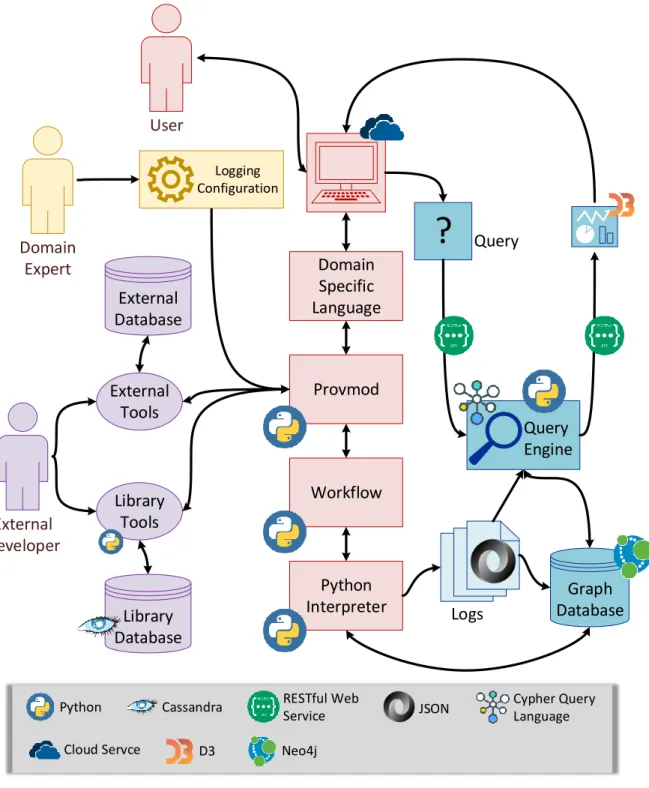
The implementation of ProvMod is provided in Figure 5.1. The user uses a workflow through the user interface. Through the user interface, they may use a DSL to implement their workflows that stands on the ProvMod model. ProvMod stands on Python Interpreter at the core. The logging configuration can be customized by a different user who is an expert in the domain. External tools can be integrated with Provmod that can even be developed by other users. ProvMod also offers a number of tools as Library Tools. External tools and Library Tools may have their own database facilities. The ProvMod, leveraging the power of Python Programming Language and Logging Configuration, saves the logs in a Graph Database that we implemented with Neo4j [33]. Through the user interface, the user may later submit a query through a query engine. The query engine uses Cypher Query Language to parse logs from the Graph Database using Elasticsearch [34]. The query result is provided with Kibana [35] or D3 in a web browser. All the communication between each pair of components is done through RESTful Web Services [36]. We also emphasize using NoSQL database such as Cassandra [32] for Library Tools.
5.2
Logging Mechanism
Standing on the excellent workflow taxonomy from the work of Cruz et al. [1] we describe the provenance mechanism of ProvMod. It is presented in Figure 5.4. To know more about the taxonomy of Cruz et al. the reader may refer to 5.3. The taxonomy is described in the followings in details.
User
Domain
Specific
Language
Provmod
Python
Interpreter
External
Tools
Library
Tools
External
Database
Library
Database
Workflow
Domain
Expert
Graph
Database
External
Developer
Query
Engine
?
Logs
Query
Python JSON Neo4j Cassandra Cloud Servce D3 Logging Configuration RESTful Web Service Cypher Query LanguageFigure 5.1: Implementation of ProvMod and relation between other components of the whole workflow system that we propose
Figure 5.2: Lifecycle of workflow systems by Cruz et al. [1]
5.2.1
Taxonomy of Workflow Systems by Cruz et al.
Although the taxonomy is for workflow systems, it is oriented to classify the provenance mechanisms. There are different criteria that Cruz et al. considered. Such as capture, access, subject and storage of provenance. They are described in brief here.
Capture
Capture refers to the fashion of capturing any provenance event. They are also measured from several angles:
1. Tracing: The provenance may be traced in an eager or lazy fashion. The eager way is to capture the provenance immediately as the event occurs. The lazy way is to capture the provenance data only when necessary.
2. Levels: There are different levels of provenance information. Workflow level provenance holds informa-tion only about the workflow which is retrieved from the workflow layer. Activity provenance is about the internal information of any process. OS level provenance more information about the system being used.
3. Mechanism: The provenance mechanism may be externally included to any system, or it may be internally included.
4. Technique: Technique is classified into annotation and inversion. Annotation involves containing important information with the data items, either by the user or the system. Inversion is to recreate the data products which are expensive or inaccessible. The inversion method is used to regenerate the data items.
Access
There are several ways to access provenance. They are:
Figure 5.3: Taxonomy presented by Cruz et al. [1]
2. API: A system specific API can be used to access provenance data.
3. Query: Query can be performed over the provenance database. Also, the system can provide a way to perform queries over the database.
4. Browse: Provenance information can be browsed for meeting user needs through such supporting interface.
Subject
What information is being saved in provenance is a matter of concern. Based on this there are different subjects of provenance:
1. Orientation: Provenance can be captured for process or it can also be captured for data items.
2. Phase: The provenance can be specifically captured in a particular phase of a workflow lifecycle state. There are three phases of a workflow lifecycle (5.2). Composition phase refers to building any workflow and even reuse it further. Execution phase is about executing the workflow and monitoring it. Analysis phase involves visualization and querying to analyze provenance data.
3. Granularity: Provenance information has two granularity levels. One is fine-grained or data prove-nance and the other is coarse-grained or workflow proveprove-nance.
Storage
How provenance data is stored is another measurement for modern workflow systems. They are measured with the following features:
1. Scalability: The provenance storage can be centralized or distributed. For distributed storage support, it may support homogeneous data of a single structure or heterogeneous data of various structures.
2. Coupling: Provenance can be highly coupled or loosely coupled with any workflow systems.
3. Persistence: It is about the conceptual modelling of the system that it uses to manage workflows. Although different standards were proposed, still there is no well-accepted standard for workflow mod-elling. Based on the modelling, the provenance data can be expressed in various ways. They can be relational, XML based, OWL based or semi-structured.
4. Archiving: How provenance data is being stored is the matter of this measurement. Provenance data can be captured immediately as the original log data which is known as the time-stamping approach. Another approach is the sequence of Delta. This approach captures the changes and version information between two consecutive provenance data states. So, later on, the difference between any two states can be used to derive the target provenance information.
Based on this taxonomy, we describe the provenance mechanism of ProvMod in the following section.
5.2.2
Description of ProvMod Provenance Mechanism
Standing on the taxonomy of Cruz et al. [1], we describe the taxonomy of our proposed programming model in Figure 5.4. For a quick look, a brief description of each mechanism category of ProvMod can be found in Table 5.1.
5.3
Workflow Components
There are several component types (Figure 5.5) that are already implemented and supported by the ProvMod while implementing any pipelines. The components are:
• Data: Data is a superclass type that has some basic features to represent any data item in the workflow.
• Object: An Object is a class of data that is inherited from the Data class. Object class is used to represent any data item in the workflow using any direct value. For example, an integer, string, number, a list, tuple and so on that comes with the programming language the developer is using to
Mechanism of ProvMod
Capture Access
Subject Storage
Tracing Levels Mechanism Technique Visual API Query Browse
Granularity Phase
Orientation Scalability Coupling Persistence Archiving
Eager Time-Stamping Activity and limited OS level Internal
Automatic Yes Yes Yes Yes
Data and process
All Coarse Possible High Semistructured
Figure 5.4: Description of ProvMod based on the taxonomy of Cruz et al. [1]
implement ProvMod. Primarily we use Python and it can work with any data types from Python programming language. This class is very useful for representing intermediate data items that are created in the middle of workflow runs and removed from the memory when the system exits the workflow environment.
• File: A File class is used to represent a file object in the workflow. File class does not hold a file itself but a file lookup reference to read the file or to write a new file in that reference. It is useful for representing data that are saved in the disk.
• Document: Any NoSQL data item is represented with a Document class. It is similar to File class but has a lookup reference to read data from a database system or to write in it.
• Module: Module is a class to represent any tool that takes Data items as inputs and creates Data items as outputs.
• Edges: There are two types of workflow edges to represent the data flow. INPUT and OUTPUT. INPUT represents a data flow from any data item into a Module and OUTPUT represents a data flow
from any Module to new data items.
• Properties: There are several properties that are incorporated with the workflow components. They are considered as workflow node properties and can be used for graph query to real-time monitoring. The list and meaning of each property can be found in Table 5.2, 5.3, 5.4, 5.5, 5.6.
• User: User is a class in the workflow model ProvMod but is not directly used by the developer but is automatically generated when the model is used.
Workflow
Data
Module
Document
File
Object
Module
Properties
Object
Properties
Document
Properties
File
Properties
Figure 5.5: ProvMod model components
5.4
Logging Levels
Different logging levels are supported in ProvMod that can also be tuned and even disabled or enabled according to the will of the user. The logging levels are dependent on the base programming language that is used to implement ProvMod. Here we used Python as thus have the following logging levels.
1. INFO: Info is a coarse level logging level. With this level, we will be analyzing any function or main module (a python script that is directly run) but will not be looking into their internal details. So, any
function or main scope is considered as a black box in this log level. We will get information about inputs, parameters and outputs. Look at the figure that makes clear about the points where to use Info.
2. DEBUG: Debug is more detailed than Info. We will look into more details like, how the parameter values are affecting, how the internal states are being changed etc. So, any log level that is deeper than Info will be of Debug level.
3. WARNING: If the developers think there might be a problem in any place of the program but that is not creating an issue, then they could provide a warning levelled log with an appropriate message.
4. ERROR: Error level log is for that kind of error that properly cared with exception handler by the programmer. So, it occurs often times but does not make the program to abort.
5. FATAL: Fatal errors are those errors that make the program to abort immediately.
5.5
Services
The ProvMod model, use different services to accomplish certain tasks. Different components are kept separate. The components communicate with each other using RESTful Web Service.
The automated log generation is done with the configuration that is also a separate service. The model makes use of it during any workflow execution.
External tools, any related databases involving them are considered as independent and separate services. Tools that ship with the model are also separated by design and can be considered as distinct services.
The provenance database is not to be confused with the tool library database or any external tool database. They are important for their operation where the provenance database is responsible for holding provenance and workflow history. That is built on Neo4j Graph Database. So JSON is easily obtained here. The service must be ready before the workflow run and any feature that comes with Neo4j can be used to analyze the graph data later on without even using the model.
Log parsing and real-time monitoring is done by Elasticsearch. Elasticsearch has its own way of log parsing and management in a cluster system. In our work, we use the default user mode of Elasticsearch and do not focus on any distributed data management rather than the model. Easily, Elasistacsearch is configurable in an HPC environment, and thus such HPC features will be shipped to the model if the developer wants. Elasticsearch being a separate service, it must be ready before any workflow runs for log parsing. Note, logs are parsed both to Neo4j during workflow run as provenance is highly coupled in our model as well as to Elasticsearch index. The reason behind this is to enable real-time monitoring. On the other side, Kibana is another front-end service for the user that communicates with Elasticsearch and offers real-time monitoring. Kibana should also be ready before workflow execution.
![Figure 5.3: Taxonomy presented by Cruz et al. [1]](https://thumb-us.123doks.com/thumbv2/123dok_us/9958713.2488381/37.918.125.787.107.570/figure-taxonomy-presented-cruz-et-al.webp)
![Figure 5.4: Description of ProvMod based on the taxonomy of Cruz et al. [1]](https://thumb-us.123doks.com/thumbv2/123dok_us/9958713.2488381/39.918.120.799.138.589/figure-description-provmod-based-taxonomy-cruz-et-al.webp)