Case Based Reasoning Adaptive E-Learning System
Based On Visual-Auditory-Kinesthetic Learning
Styles
Abdul RahmanMaster of Science Program in Computer Science Budi Luhur University South Jakarta, Indonesia
Utomo Budiyanto Master of Science Program in
Computer Science Budi Luhur University South Jakarta, Indonesia [email protected]
Abstract— Current technological developments have reached all fields including education. With the support of technology, teaching and learning activities can increase to a better level. The problem that occurs at this time in improving the quality of education is the difficulty of students to get grades that are in accordance with the Minimum Completeness Criteria, the difficulty of the teacher providing material in accordance with each student's learning style. This study aims to develop adaptive E-Learning to assist teachers in recommending material that is suitable for each student's learning style. This adaptive e-learning adopts a Visual Auditory Kinesthetic (VAK) learning style and to recommend material using the Case Based Reasoning (CBR) method. Student test results after using adaptive E-learning have fulfilled the Teaching Mastery Criteria with an average grade of 85. This suggests that under adaptive E-learning has been able to improve student grades.
Keywords— adaptive e-learning, learning style vak, visual, auditory, kinesthetic, case based reasoning (cbr)
I. INTRODUCTION
In Indonesia, which consists of many islands and various types of tribes, there are not a few found that teachers who teach are not in accordance with their competencies, so that education received by students is less able to have a significant impact on understanding the knowledge that has been studied. Education has a very important role in improving human resources and efforts to realize the ideals of the Indonesian people in realizing public welfare and educating the life of the nation. The challenge in the field of education that has been felt so far is the difficulty of improving the quality of education, so that the government's focus on education is always aimed at perfecting the teaching system and the material seen from the government's efforts to make improvements and refine the curriculum which includes the contents of the subject matter, objectives learning or methods in teaching.
Learning is a process that makes people learn. Every learning process, the role of the teacher as an educator is in charge of helping students to learn well and easily. In addition, students try to find information, solve problems, and express their opinions. Learning implies the existence of learning and teaching activities, where those who teach are educators and those who learn are students, who are oriented towards developing the knowledge, attitudes, and skills of students. Dunn & Dunn divides learning styles into five categories seen from the type of stimulus, namely
environmental, emotional, sociological, physiological, and psychological stimulus. Another opinion expressed by Fleming, there are three learning styles (modalities), namely visual, aural (auditory) and kinestethic. But Fleming adds new modalities, namely read or write modalities. Read or write modalities are solutions to parts of visual modality. Read or write modalities lead to written verbal discussion, as stated in the form of stories and papers, while visual modalities refer to non-verbal discussion, such as charts, maps, symbols, and graphs [1].
Basically every individual has a variety of learning styles, but there is one that is dominant, and has a tendency to one particular learning style. In formal learning, in this case at school or college, teachers should be able to see the dominant learning styles that exist in their students. Learning styles can be influenced by the use of media such as the use of music for aural type learners, pictures or posters for visual type learners, and so on. With students knowing their learning styles, a sense of learning comfort can be obtained, reducing conflicts that arise as a result of learning and generating learning motivation.
II. LITERATURE REVIEW A. Visual Auditory Kinesthetic Learning Style
According to [2] explaining that we each have a natural preference for receiving and delivering material, this is largely determined by our genes. But this can also change depending on our age, when we were young our neural pathways are still being built. There are many ways to increase our effectiveness in communication.
Learning styles classify the various ways people learn and how they are informed. In more complex terms, some experts define different learning styles as the processes students like when they learn, and some believe that, unlike intelligence, specific learning styles are owned by each student. In other words, students will find it easier to learn with the learning styles they like, and it will be easier to learn if conditions allow to use learning styles.
One of the most common and widely used categorizations of various types of learning styles is Fleming's VARK, the VARK or VAK model stands for Visual (V), Auditory (A), and Kinaesthetic sensory modalities (K) which provide students with their learning style profiles , based on the sensory modalities involved in retrieving information. This model is extended to the
previous Neuro-linguistic programming (NLP) model. In NLP the senses are divided into three groups (Visual, Auditory and Kinesthetic) which are referred to as Representational Systems (rep systems). This term is related to the fact that the brain uses the senses to build our internal, or model of the world around us [2].
These three learning styles have different characteristics, as presented below :
1. Visual Learning
Visual learning is a teaching and learning style in which ideas, concepts, data and other information are associated with images and techniques.
2. Auditory Learning
Auditory learning is a learning style in which a person learns through listening.
3. Kinesthetic Learning
Kinesthetic learning is a learning style in which learning done by students is actually done by physical activities, rather than listening to lectures or just watching a demonstration.
B. Case Based Reasoning (CBR)
According to [3] the CBR algorithm uses knowledge of previous experiences or similar situations to solve new problems. This is based on how humans will solve problems in certain situations. Solutions to problems we have encountered previously can help guide us to make decisions for new problems. CBR has been applied in various fields including emergency response, remanufacturing processes and cost estimates. The CBR algorithm also contributed to the development of various Intelligent Tutoring Systems (ITS) including UZWEBMAT, CBRPROMATH, MACBR, Domus, PLS-ML and STIMTutor.
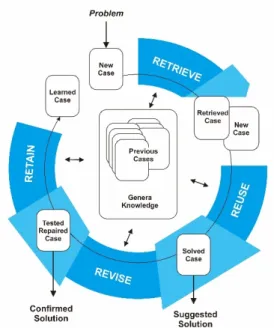
The problem solving cycle in the CBR system, which is explained in Figure 1. In general, the process cycle in the CBR is as follows :
1. Retrieve
Get / get back the cases that are most similar / relevant (similar) to new cases. This retrieval stage begins by describing / describing some of the problems, and ends if a match is found to the previous problem with the highest level of compatibility. This section refers to the aspects of identification, initial compatibility, search and selection and execution.
2. Reuse
Model or reuse old case knowledge and information based on the weight of the most relevant similarity in the new case, so as to produce a proposed solution where an adaptation to the new problem might be needed.
3. Revise
Review the proposed solution then test it in a real case (simulation) and if necessary improve the solution to fit the new case.
4. Retain
Integrate or save new cases that have succeeded in getting a solution so that it can be used by subsequent cases that are similar to those cases. But if the new solution fails, then explain the failure, improve the solution used, and test it again.
To clearly understand the CBR cycle, it can be seen in Figure 1.
Figure 1. Case Based Reasoning (CBR) Cycle. C. Nearest Neighbor Algorithm
According to [4] nearest neighbor algorithm is an approach to look for cases with the closeness between new cases with old cases, which is based on the weight matching of a number of existing features. This method looks for distances to the destination of data that has been stored previously. After the distance is obtained then the closest distance is sought. The closest distance is used to find the destination identity as shown in Figure 2.
Figure 2.Illustration of Nearest Neighbor's Algorithm From Figure 2 the illustration above can be explained that there are 4 old patients symbolized by (A, B, C and D). When there is a new patient, the solution is taken from the case of old patients who have the greatest closeness. For example j1 is the distance between new patients and patient A, j2 is the distance between new patients and patient B, j3 is the distance between new patients and patient C, j4 is the distance between new patients and patient D. From the illustration the picture shows that j1 is the closest with a new case. Thus, the solution of the case of patient A will be used as a solution for the new patient.
The formulas used in the calculation of proximity (similarity) as in (1):
Similarity (problem,case) = (𝑠1∗𝑤1)+(𝑠2∗𝑤2)+⋯+(𝑠𝑛 ∗𝑤𝑛) 𝑤1+𝑤2+⋯+𝑤𝑛 (1)
III. RESEARCH METHODS
In this study involving 34 students of class X majoring in multimedia with the basic subjects of the revised 2013 curriculum graphic design, basic competency 3.3 is about discussing layout principles, including: proportions, rhythm, balance, contrast, unity (unity ), and harmony in making graphic designs. To detect learning styles using Visual, Auditory, Kinesthetic learning styles and recommend learning materials using the Case Based Reasoning (CBR) method with the Nearest Neighbor algorithm.
A. Application of Case Based Reasoning with the Nearest Neighbor Algorithm
Broadly speaking, the way CBR works with the Neirest Neighbor algorithm in this adaptive E-learning is as shown in Figure 3.
Figure 3. How CBR Works Using the Nearest Neighbor Algorithm In Figure 3. it is explained that old cases stored in the knowledge base are Visual, Auditory and Kinesthetic characters. The CBR workflow itself is as follows.
1. Proses Retrieve
This process is to find the similarity value of new characters held by students with old characters stored in the knowledge base using the Neirest Neighbor algorithm.
2. Proses Reuse
This process is to recommend appropriate material to each student.
3. Revise
This process is to revise the material that has been given is in accordance with the character of students.
4. Retain
This process is to save the character that has been found the solution.
B. Represetation of the Retrieve and Reuse Process
Because in this case the VAK (Visual, Auditory, Kinesthetic) questionnaire was used, each question was given the same weight, namely 5. For more details, you can see in the table of each case. CV (Criteria Visual), CA
(Criteria Auditory), CK (Criteria Kinesthetic). To be clearer as Table I.
TABLE I. WEIGHT OF EACH CHARACTER
No CV Weight CA Weight CK Weight
1 V1 5 A1 5 K1 5 2 V2 5 A2 5 K2 5 3 V3 5 A3 5 K3 5 4 V4 5 A4 5 K4 5 5 V5 5 A5 5 K5 5 6 V6 5 A6 5 K6 5 7 V7 5 A7 5 K7 5 8 V8 5 A8 5 K8 5 9 V9 5 A9 5 K9 5 10 V10 5 A10 5 K10 5 11 V11 5 A11 5 K11 5 12 V12 5 A12 5 K12 5 13 V13 5 A13 5 K13 5 14 V14 5 A14 5 K14 5 15 V15 5 A15 5 K15 5 16 V16 5 A16 5 K16 5 17 V17 5 A17 5 K17 5 18 V18 5 A18 5 K18 5 19 V19 5 A19 5 K19 5 20 V20 5 A20 5 K20 5 21 V21 5 A21 5 K21 5 22 V22 5 A22 5 K22 5 23 V23 5 A23 5 K23 5 24 V24 5 A24 5 K24 5 25 V25 5 A25 5 K25 5 26 V26 5 A26 5 K26 5 27 V27 5 A27 5 K27 5 28 V28 5 A28 5 K28 5 29 V29 5 A29 5 K29 5 30 V30 5 A30 5 K30 5
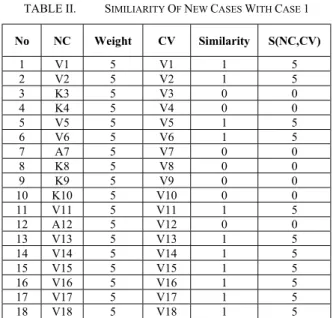
The next process is the calculation of the value of the semiliarity (s) of new cases with data of old cases that have been stored and provides recommendations for material suitable for new cases. To calculate the similarity value by adding up all the product of the semiliarity (s) by weight (w) and then dividing by the total weight of each character. Then after that the process of matching cases based on the value of similiarity (s) of new cases with old cases, NC (New Case), as explained in Table II, Table III, Table IV.
TABLE II. SIMILIARITY OF NEW CASES WITH CASE 1
No NC Weight CV Similarity S(NC,CV) 1 V1 5 V1 1 5 2 V2 5 V2 1 5 3 K3 5 V3 0 0 4 K4 5 V4 0 0 5 V5 5 V5 1 5 6 V6 5 V6 1 5 7 A7 5 V7 0 0 8 K8 5 V8 0 0 9 K9 5 V9 0 0 10 K10 5 V10 0 0 11 V11 5 V11 1 5 12 A12 5 V12 0 0 13 V13 5 V13 1 5 14 V14 5 V14 1 5 15 V15 5 V15 1 5 16 V16 5 V16 1 5 17 V17 5 V17 1 5 18 V18 5 V18 1 5
No NC Weight CV Similarity S(NC,CV) 19 V19 5 V19 1 5 20 V20 5 V20 1 5 21 A21 5 V21 0 0 22 V22 5 V22 1 5 23 V23 5 V23 1 5 24 V24 5 V24 1 5 25 K25 5 V25 0 0 26 V26 5 V26 1 5 27 A27 5 V27 0 0 28 V28 5 V28 1 5 29 V29 5 V29 1 5 30 V30 5 V30 1 5
From Table II we get the similiarity value of new cases and case 1 of 0.666666667, the similarity value is obtained from the calculation.
TABLE III. SIMILIARITY OF NEW CASES WITH CASE 2
No NC Weight CA Similarity S(NC,CA)
1 V1 5 A1 0 0 2 V2 5 A2 0 0 3 K3 5 A3 0 0 4 K4 5 A4 0 0 5 V5 5 A5 0 0 6 V6 5 A6 0 0 7 A7 5 A7 1 5 8 K8 5 A8 0 0 9 K9 5 A9 0 0 10 K10 5 A10 0 0 11 V11 5 A11 0 0 12 A12 5 A12 1 5 13 V13 5 A13 0 0 14 V14 5 A14 0 0 15 V15 5 A15 0 0 16 V16 5 A16 0 0 17 V17 5 A17 0 0 18 V18 5 A18 0 0 19 V19 5 A19 0 0 20 V20 5 A20 0 0 21 A21 5 A21 1 5 22 V22 5 A22 0 0 23 V23 5 A23 0 0 24 V24 5 A24 0 0 25 K25 5 A25 0 0 26 V26 5 A26 0 0 27 A27 5 A27 1 5 28 V28 5 A28 0 0 29 V29 5 A29 0 0 30 V30 5 A30 0 0
From Table III we get the similiarity value of new cases and case 2 of 0.133333333, the similarity value is obtained from the calculation.
TABLE IV. SIMILIARITY OF NEW CASES WITH CASE 3
No NC Weight CK Similarity S(NC,CK) 1 V1 5 K1 0 0 2 V2 5 K2 0 0 3 K3 5 K3 1 5 4 K4 5 K4 1 5 5 V5 5 K5 0 0 6 V6 5 K6 0 0 7 A7 5 K7 0 0 8 K8 5 K8 1 5 9 K9 5 K9 1 5 10 K10 5 K10 1 5 No NC Weight CK Similarity S(NC,CK) 11 V11 5 K11 0 0 12 A12 5 K12 0 0 13 V13 5 K13 0 0 14 V14 5 K14 0 0 15 V15 5 K15 0 0 16 V16 5 K16 0 0 17 V17 5 K17 0 0 18 V18 5 K18 0 0 19 V19 5 K19 0 0 20 V20 5 K20 0 0 21 A21 5 K21 0 0 22 V22 5 K22 0 0 23 V23 5 K23 0 0 24 V24 5 K24 0 0 25 K25 5 K25 1 5 26 V26 5 K26 0 0 27 A27 5 K27 0 0 28 V28 5 K28 0 0 29 V29 5 K29 0 0 30 V30 5 K30 0 0
From Table IV we get the similiarity value of new cases and case 3 of 0.200000, the similarity value is obtained from the calculation.
From the description of Table II, Table III and Table IV, we get the value of similiarity (s) of new cases with cases 1,2 and 3 are Similiarity (K, 1) = 0.666666667, Similiarity (K, 2) = 0.133333333 and Similiarity (K, 3 ) = 0.200000. Therefore the new case has a level of similarity to case 1 by having a Visual learning style and recommended Visual material.
C. Revise Process
The revision process is carried out if the value of trust generated in the retrieve process has a low level of trust. In the case above the similarity value in the new case is 0.666666667 which means it can be said to have similarities with the old case.
D. Retain Process
In this process, if a new case is found, then the data will be stored into knowledge data.
IV. RESULTS AND DISCUSSION A. Kinesthetic Visual Auditory Questionnaire page
On this page students before choosing subjects are required to fill out a questionnaire in order to recommend the appropriate material. For more details, see Figure 4
Figure 4. Kinesthetic Visual Auditory Questionnaire B. Student Questionnaire Results Page
On this page students can see the results of the questionnaire that has been done, the student questionnaire page display can be seen in Figure 5
Figure 5. Student Questionnaire Results Page C. Visual Auditory Kinesthetic (VAK) Results
After testing the questionnaire on 34 students of class X MM1 learning styles obtained on average is auditory, to be more clearly seen in Table V.
TABLE V. VISUAL AUDITORY KINESTHETIC (VAK) RESULTS Id Visual % Auditory % Kinesthetic % Learning Style
1 27% 10% 63% KINESTHETIC 2 30% 57% 13% AUDITORY 3 23% 57% 20% AUDITORY 4 53% 23% 23% VISUAL 5 10% 53% 37% AUDITORY 6 20% 30% 50% KINESTHETIC 7 33% 50% 17% AUDITORY 8 50% 23% 27% VISUAL 9 37% 47% 13% AUDITORY 10 47% 37% 10% VISUAL 11 27% 27% 47% KINESTHETIC 12 43% 27% 30% VISUAL 13 37% 43% 20% AUDITORY 14 27% 30% 43% KINESTHETIC 15 13% 43% 40% AUDITORY 16 43% 37% 20% VISUAL 17 23% 43% 30% AUDITORY 18 37% 20% 43% KINESTHETIC 19 17% 40% 43% KINESTHETIC 20 27% 33% 40% KINESTHETIC
Id Visual % Auditory % Kinesthetic % Learning Style
21 40% 23% 37% VISUAL 22 33% 40% 27% AUDITORY 23 40% 23% 37% VISUAL 24 30% 30% 40% KINESTHETIC 25 37% 40% 23% AUDITORY 26 40% 30% 30% VISUAL 27 37% 40% 23% AUDITORY 28 30% 40% 27% AUDITORY 29 40% 37% 23% VISUAL 30 23% 37% 40% KINESTHETIC 31 33% 40% 27% AUDITORY 32 33% 27% 40% KINESTHETIC 33 37% 33% 30% VISUAL 34 40% 20% 40% KINESTHETIC VISUAL-Average 33% 35% 32% Auditory
The dominant learning style in class X MM1 is Auditory 35% of the total number of 34 students, for Visual 33% and Kinesthetic 32%. For comparison, you can see in Figure 6.
Figure 6. Learning Style D. Student Examination Results
From the data collection done at the documentation stage, after students learn with the material recommended by the Case Based Reasoning (CBR) method, then to measure the success of the material recommended by this adaptive E-Learning by giving test questions to students. This exam question consists of 30 questions collected from the material that has been studied. For Minimum Mastery Criteria (MMC) the minimum value is 75 and can be declared passed the test.
From the collection of data in the form of student grades in the 2018/2019 school year on graphic design subjects obtained data values as in Table VI.
TABLE VI. STUDENT VALUE DATA FOR SCHOOL YEAR 2018/2019 Class Students Total Value Min Mean Value Value Max MMC
XMM1 31 27 58 73 75
XMM2 34 13 48 87 75
XMM3 37 13 54 87 75
After learning implementation is done by using adaptive e-learning with case based reasoning methods, the values are as shown in Table VII.
TABLE VII. STUDENT VALUE DATA FOR SCHOOL YEAR 2019/2020 Class Students Total Value Min Value Mean Value Max MMC
XMM1 34 75 85 100 75
By comparing students' grades from Table VI and Table VII, they obtained very different grades in the 2018/2019 school year and 2019/2020 school year. The average value in each class in the 2018/2019 school year the students' grades did not reach the Minimum Mastery Criteria (MMC), whereas in the 2019/2020 school year using adaptive e-learning values were obtained that exceeded the Minimum Mastery Criteria (MMC) value.
Thus it can be concluded that after using this Adaptive E-learning the student's grades have been able to reach the Minimum Mastery Criteria (MMC) value and the material provided is in accordance with each student's learning style. In this study the data used are the grades of students who are different in the class, so that students who are used as respondents are from various classes. For better results, you can only involve 1 class with the same data..
V. CONCLUSIONS AND RECOMMENDATIONS A. Conclusion
The conclusion of the Adaptive E-Learning research Based on Visual Auditory Kinesthetic Learning Style With Case Based Reasoning Method is adaptive e-learning is able to make the teacher to know the learning styles of each student, adaptive e-learning is able to make the teacher provide material that is appropriate to their learning styles - students, adaptive e-learning using the VAK questionnaire is able to detect auditory learning styles as much as 35%, visual 33% and kinesthetic as much as 32%, student test results after using adaptive E-learning have met the
Teaching Completion Criteria that is with an average grade 85 and this adaptive e-learning system has been tested for acceptance using UAT with a percentage of 91%.
B. Recommendations
Based on the results of the study, the suggestions given for developing adaptive E-learning are as follows:
1. A record of activities in adaptive E-learning is needed so that the teacher knows how many presentations students have in accessing material that has been recommended.
2. It is necessary to test the validity of the material recommended from the results of the Visual, Auditory and Kinesthetic learning styles.
3. It is necessary to test the validity of the questions tested to measure the level of student success in the learning process.
4. To recommend suitable material you can use another intelligent algorithm.
Thus the advice that the author can give, hopefully these suggestions can be used as input material that can be useful for writers in particular and generally for the wider community.
REFERENCES
[1] S. Akhmad, “Pengaruh Gaya Belajar Terhadap Hasil Belajar Pada Mata Pelajaran Akuntansi Kelas Xi Ips SMA N 3 Tapung,” J. Pendidik. Ekon. Akunt. FKIP UIR Vol 6 No 1 Tahun 2018 P- ISSN 2337-652x | E-ISSN 2598-3253, vol. 6, no. 1, 2018.
[2] S. SK and T. C. Helena, “Styles of Learning VAK Styles of Learning Based on the Research of Fernald , Keller , Orton , Gillingham , Stillman , Montessori and Neil D Fleming,” Int. J. Innov. Res. Multidiscip. F., vol. 3, no. 4, 2017.
[3] Y. A. Gerhana, M. Irfan, and C. Slamet, “Implementasi Technology Acceptance Model Untuk Mengukur Penerimaan Guru Terhadap Inovasi Pembelajaran (Studi Kasus Model Pembelajaran Cbr Di SMK),” ISSN 1979-8911, vol. X, no. 2, pp. 1–18, 2017.
[4] Salamun, “Penerapan Algoritma Nearest Neighbor dan CBR pada Expert System Penyimpangan Perilaku Seksual,” JOIN (Jurnal Online Inform., vol. 2, no. 2, pp. 63–70, 2017.