
RE-THINKING SUPPLIER RISK MANAGEMENT WITH CASE STUDIES AND AGENT-BASED SIMULATION
ANTON SHEVCHENKO
A DISSERTATION SUBMITTED TO THE FACULTY OF GRADUATE STUDIES IN PAR-TIAL FULFILLMENT OF THE REQUIREMENTS FOR THE DEGREE OF DOCTOR OF
PHILOSOPHY
GRADUATE PROGRAM IN ADMINISTRATION YORK UNIVERSITY
TORONTO, ONTARIO
June 2017
ii ABSTRACT
This mixed method research uses a series of case studies and an agent based simulation to in-vestigate how firms do and should acquire information to manage risks inherent in supplier pro-cesses. Managing this risk born from supplier non-compliance is important because it can not only threaten a firm’s reputation and bottom line, but it can also affect various stakeholders. Cur-rent literature on supplier risk management recommends that firms acquire comprehensive in-formation on potential triggers of supplier non-compliance to mitigate this risk in an effective manner. Nevertheless, the literature fails to acknowledge that firms often choose not to obtain such information. In fact, the results from multiple case studies indicate that firms seek to ac-quire comprehensive information on potential triggers of supplier non-compliance only when they do not see other alternatives to address the risks of supplier non-compliance. The sampled firms reduce their need for comprehensive information on supplier processes because of close relational ties with suppliers or the presence of powerful external stakeholders, such as regulato-ry agencies, monitoring supplier processes. The agent-based simulation then reveals conditions under which firms should rely on the relational ties and powerful stakeholders to reduce the sup-plier risks they face.
iii TABLE OF CONTENTS
Abstract ... ii
Table of Contents ... iii
List of Tables ... iv
List of Figures ... v
Chapter One: Introduction ... 1
Chapter Two: Literature Review ... 5
The value of supply chain transparency ...5
The role of information in supplier risk management ...7
The effect of supplier governance ...13
The effect of supply chain complexity ...16
Chapter Three: Multiple Case Studies ... 19
Case study description ...19
Case study results ...57
Chapter Four: Agent-Based Simulation ... 66
Simulation description ...68
Simulation results ...79
Chapter Five: Discussion ... 101
A decision to mitigate supplier risks ...102
A decision to avoid supplier risks ...104
A decision to tolerate supplier risks ...109
Limitations ...110
Chapter Six: Conclusion ... 112
Bibliography ... 116
Appendix A. Related Concepts and Systematic Literature Review ... 131
Appendix B. Case Study Protocol ... 135
Appendix C. Case Description ... 138
iv LIST OF TABLES
Table 1. Definitions of supply chain transparency ... 6
Table 2. Data collected for each case ... 25
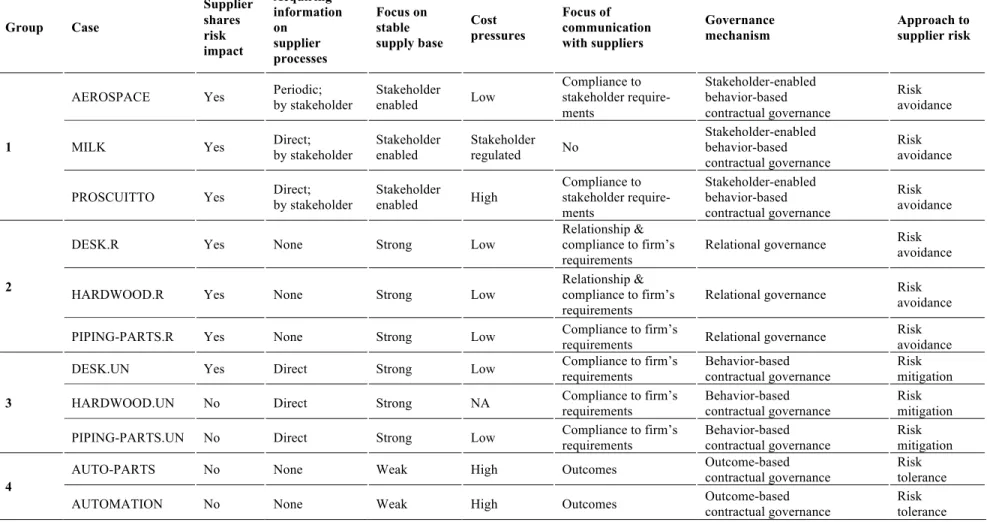
Table 3. Description of case groups ... 44
Table 4. Description of factors common among firms in each case group ... 45
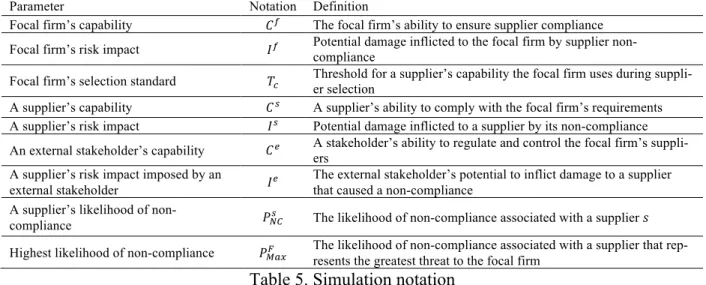
Table 5. Simulation notation ... 69
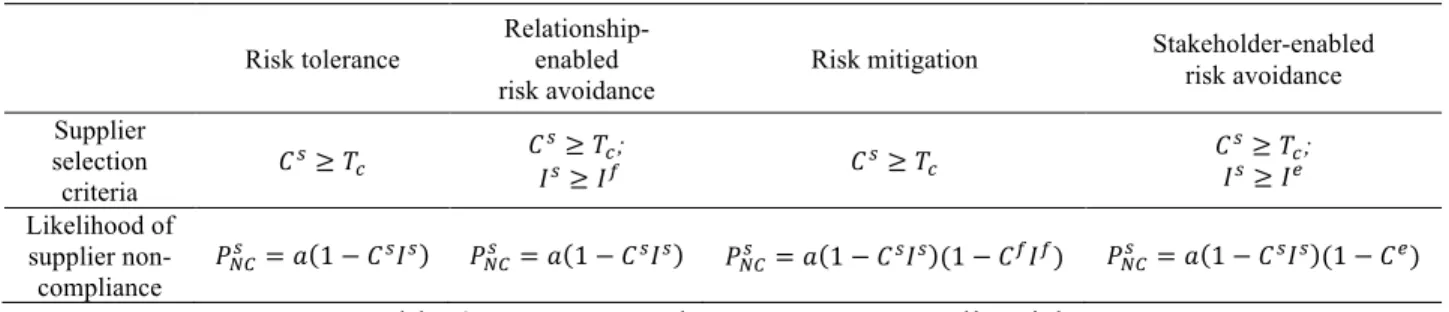
Table 6. Four approaches to manage supplier risks ... 77
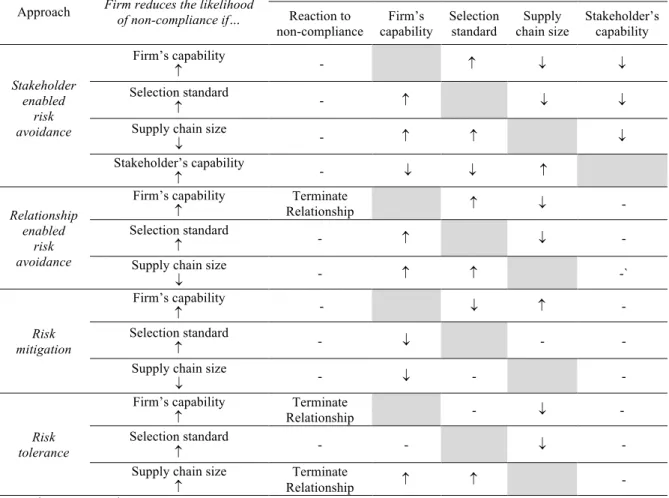
Table 7. Summary of simulation results ... 80
v LIST OF FIGURES
Figure 1. Sampling matrix ... 21
Figure 2. Initial theoretical model ... 26
Figure 3. Final theoretical model for case analysis ... 28
Figure 4. Paths determining firm’s approach to supplier risk ... 58
Figure 5. Flowchart of simulation algorithm ... 71
Figure 6. ‘Select suppliers’ sub-process ... 73
Figure 7. ‘Non-compliant suppliers attempt corrective action’ sub-process ... 75
Figure 8. The role of stakeholder’s capability in determining the likelihood of supplier non-compliance under stakeholder enabled risk avoidance ... 82
Figure 9. The role of a firm’s supply base size in determining the likelihood of supplier non-compliance under stakeholder enabled risk avoidance ... 83
Figure 10. The role of a firm’s supply base size in determining the likelihood of supplier non-compliance under relationship enabled risk avoidance ... 85
Figure 11. The role of a firm’s capability in determining the likelihood of supplier non-compliance under relationship enabled risk avoidance in small and large supply bases ... 85
Figure 12. The role of a firm’s capability and its selection standard in determining the likelihood of supplier non-compliance under risk mitigation in small and large supply bases ... 87
Figure 13. The role of a firm’s supply base size in determining the likelihood of supplier non-compliance under risk mitigation ... 88
Figure 14. The role of a firm’s supply base size in determining the likelihood of supplier non-compliance under risk tolerance ... 90
Figure 15. The role of a firm’s capability in determining the likelihood of supplier non-compliance under risk tolerance in small and large supply bases ... 91
Figure 16. The role of a firm's capability in determining the likelihood of supplier non-compliance under risk tolerance vs. under relationship-enabled risk avoidance ... 94
Figure 17. The role of a firm’s supply base size in determining the likelihood of supplier non-compliance under risk tolerance vs. under relationship-enabled risk avoidance ... 95
Figure 18. The role of a firm’s capability in determining the likelihood of supplier non-compliance under risk mitigation vs. under relationship-enabled risk avoidance in small and large supply bases ... 97
Figure 19. The role of a firm’s selection standard in determining the likelihood of supplier non-compliance under risk mitigation vs. under relationship-enabled risk avoidance ... 97
Figure 20. The role of a firm's capability in determining the likelihood of supplier non-compliance under risk mitigation vs. under stakeholder-enabled risk avoidance in small and large supply bases ... 99
vi Figure 21. The role of a firm’s selection standard in determining the likelihood of supplier
non-compliance under risk mitigation vs. under stakeholder-enabled risk avoidance in small and large supply bases ... 99
1 CHAPTER ONE: INTRODUCTION
A firm’s operational, environmental, and social performance to a great extent depends on the ability of its suppliers to comply with order requirements (Krause et al. 2009; Lambert, 2008). Yet, firms often lack information to ensure that their suppliers remain compliant. Identifying possible supplier non-compliance is important because it can threaten the firm’s reputation, bot-tom line and survival, while also affecting its cusbot-tomers and other stakeholders.
To ensure supplier compliance, the literature recommends creating transparent supply chains (e.g., Awaysheh and Klassen, 2010; Lamming et al., 2001; New, 2010; Skilton and Robinson, 2009; Tse and Tan, 2012). In transparent supply chains, firms have comprehensive information on supplier processes. The firms can thus easily ensure that suppliers follow product quality re-quirements, do not cause supply delays or other operational disruptions, and do not engage in socially irresponsible practices (Marucheck et al., 2011; New, 2010).
While the literature clearly articulates that firms should create transparent supply chains, it is yet to explain how to do so. In particular, it remains unclear what barriers firms face when they attempt to acquire comprehensive information on supplier processes and how the firms overcome these barriers. Without such knowledge, it is difficult to determine how firms should acquire comprehensive information on supplier processes. To address this gap in the literature, I use a combination of multiple case studies and an agent-based simulation to explore how firms do and should acquire comprehensive information on supplier processes to ensure compliance.
Using a series of case studies, I first investigate how firms acquire the information required to ensure supplier compliance. The collected case studies offer a number of empirical
contribu-2 tions. First, they clarify that firms approach the issue of transparent supply chains from the risk management perspective. Only firms that face significant risk of supplier non-compliance strive to acquire comprehensive information on supplier processes to mitigate this risk, i.e., to take ac-tions aimed at reducing the likelihood of supplier non-compliance. Furthermore, the cases show that firms that seek to acquire comprehensive information on supplier processes focus their ef-forts on the first-tier suppliers, and not the entire supply chain. Finally, the case studies reveal that many firms choose not to acquire comprehensive information on supplier processes. Instead, they depend either on close relational ties with their suppliers or on powerful external stakehold-ers, such as regulatory agencies, to manage the risk of supplier non-compliance.
I use these unexpected empirical findings as the foundation for an agent-based simulation that explores how a firm’s decisions influence the likelihood of supplier non-compliance. Manipulat-ing a firm’s decision-makManipulat-ing in a simulation helps compare the empirically observed behavior with the behavior recommended by the literature. Hence, the simulation addresses the second research question: What decisions should firms make to reduce the likelihood of supplier non-compliance?
The prescriptive results of the agent-based simulation complement the descriptive results of the case studies. Combined, the case studies and the agent-based simulation offer a number of contributions to the literature on supplier risk management. First, while the literature recom-mends risk mitigation for all firms (e.g., Sodhi et al., 2012), this research clarifies that only firms with a high capability to assess and monitor suppliers’ processes should favor risk mitigation. Firms that lack this capability should instead seek to avoid the risk of supplier non-compliance. These firms are better off not acquiring comprehensive information on supplier processes to
en-3 gage in risk mitigation, because they are unable to use this information to substantially reduce the likelihood of supplier non-compliance.
This research reveals two paths firms may take to avoid, rather than mitigate, the risk of sup-plier non-compliance that have been neglected by the supsup-plier risk management literature. One path to avoid the risk of supplier non-compliance is to form close relationships with suppliers. Firms relying on close relational ties with their suppliers do not collect information on supplier processes because they believe the relationships provide strong incentives for suppliers to com-ply, allowing them to avoid the risk. Despite some authors warning against close, trust-based re-lationships in supplier risk management (e.g., Harland et al. 2003), this research indicates that this approach may be suitable, especially for firms that lack the capability to fully assess supplier processes. Another path to avoid the risk of supplier non-compliance exists in industries where a powerful external stakeholder is involved in controlling the suppliers. A number of authors have warned that firms can be in a vulnerable position when they know less about their supplier risks than their stakeholders do (e.g., New, 2010; Scherer et al., 2013). Yet, this research shows that firms benefit from having an external stakeholder that monitors supplier processes and incentiv-izes their suppliers to remain compliant. Finally, this research also shows that some firms choose to tolerate supplier risks, an approach largely omitted in the supplier risk management literature (Hajmohammad and Vachon, 2016). These more tolerant firms manage non-compliances only if they materialize. In doing so, they contradict the literature that focuses on prevention and risk minimization.
This research offers important managerial implications. First, it shows that firms should make a decision to mitigate the risk of supplier non-compliance not only by considering the source of the risks, the processes of their suppliers, but also by taking into account whether they possess a
4 high capability to assess and monitor supplier processes. Second, this research shows that firms that rely on close relationships to avoid the risk of non-compliance face a threat of overestimat-ing a supplier’s ability to comply. It then reveals that a small supply base that is selected usoverestimat-ing strict criteria and faces termination for non-compliance, diminishes this threat. Third, this re-search provides a recommendation for firms that operate in highly regulated industries and have an external stakeholder involved in controlling their suppliers. These firms should view such a stakeholder involvement as a beneficial arrangement. Whenever these firms believe that the stakeholder lacks capability to ensure supplier compliance, they should complement the stake-holder's efforts by having stricter selection standards and sourcing from fewer suppliers. Finally, this research clarifies the value of monitoring supplier processes. Supplier monitoring is required to ensure low likelihood of non-compliance in large supply bases. In many industries with com-plex production, firms have to source from a large number of suppliers. This research shows that these firms can assure supplier compliance only if they, or an involved stakeholder, oversee sup-plier processes.
The cases allowed for a detailed exploration of what firms did. The simulation offered a de-tailed exploration of what they should do. Combined they offer meaningful new insight into sup-plier risk management and help to elaborate on the conditions when acquiring comprehensive information on supplier processes is appropriate.
5 CHAPTER TWO: LITERATURE REVIEW
The existing literature recognizes that firms are vulnerable to supplier non-compliance (e.g., Marucheck et al., 2011; Sodhi et al., 2012). This risk can not only damage the firms’ reputation and bottom line but also threatens the society at large (Madsen, 2009; New, 2010). To address this risk, the literature recommends creating transparent supply chains (e.g., Lamming et al. 2001; Skilton and Robinson, 2009; Tse and Tan, 2011; New, 2010; Awaysheh and Klassen, 2011). In transparent supply chains, firms have comprehensive information on supplier processes and thus can mitigate the risk of supplier non-compliance in an effective manner (Roth et al. 2008; Williams et al., 2013).
In addition, the systematic literature review on supply chain transparency conducted prior to the collection of case data (Appendix A) revealed that two theoretical themes, governance mech-anism and the complexity of a firm’s supply chain, are related to the process of creating trans-parent supply chains. Specifically, the reliance on relational governance makes it more likely that firms will gain access to comprehensive information on supplier processes (e.g., Jiang, 2009; Peck, 2005). The complexity of supply chains can substantially inhibit firms’ efforts to collect this information (e.g., Mena et al., 2013; Speier et al., 2011).
The value of supply chain transparency
The systematic review of supply chain transparency literature (Appendix A) reveals a large number of studies that refer to the notion of supply chain transparency. Yet, only a few of them offer a formal definition (Table 1). Some authors note that supply chain transparency is associat-ed with a firm’s ability to acquire information on supplier processes (e.g., Lamming et al. 2001; Roth et al. 2008). Others argue that the supply chain transparency is determined by the extent a firm shares this information with its external stakeholders (e.g., Awaysheh and Klassen, 2010;
6 Carter and Easton, 2011; Skilton and Robinson, 2009). I employ the former approach and define supply chain transparency as the extent to which a firm is able to acquire comprehensive infor-mation on supplier processes. I chose the perspective of the focal firm, and not on of its stake-holders, because the focus of this research is on the firm’s own efforts to acquire information on supplier processes.
Citation Definition
Lamming et al. (2001) “the two-way exchange of information and knowledge between customer and supplier” (p. 4)
Skilton and Robinson (2009)
“the extent to which information about sources, processes and relationships is readily accessible to counterparties in an exchange, and to outside observers” (p. 41)
Roth et al. (2008) “the lack of secrecy, or the systematic provision of product and processing infor-mation under informal and formal agreements” (p. 23)
Angeles and Nath (2001) “[the] ability to share and exchange information needed to complete transaction sets and to fulfill requirements of shared business applications” (p.112)
Inkpen and Crossan (1995) “the openness and willingness of the partner firm to share its embedded knowledge” (p. 613)
Hamel (1991) “openness of the firm to its partner” (p. 85)
Awaysheh and Klassen (2010) “the extent to which information is readily available to end-users and other firms in the supply chain” (p. 1249)
Carter and Easton (2011)
“proactively engaging and communicating with key stakeholders and having traceability and visibility into upstream and downstream supply chain operations” (p. 49)
Table 1. Definitions of supply chain transparency
Despite the disagreements in definitions, the literature agrees that firms benefit from supply chain transparency, with many authors arguing that firms should strive to create transparent sup-ply chains (Blackhurst et al., 2011; Christopher and Lee, 2004; Co and Barro, 2009; Hora et al., 2011; Kleindorfer and Saad, 2005; Lamberti and Lettieri, 2009; Lamming et al., 2001; Marucheck et al., 2011; New, 2010; Neiger et al., 2009; Vlajic et al., 2012; Tse and Tan, 2012). To create transparent supply chains, firms are required to have an objective understanding of supplier processes and therefore need to ensure that the suppliers do not conceal any issues
pre-7 sent in their operations (Roth et al. 2008; Williams et al., 2013). Roth et al. (2008) explain that in transparent supply chains there exists mutual openness and “a lack of secrecy” (p. 23) between the firms with their suppliers. Overall, supply chain transparency is necessary to identify “disrup-tions from normal activities” (Kleindorfer and Saad, 2005: 53) that have potential for great nega-tive impact on a firm and its stakeholders. These disruptions from normal activities are supplier risks. They include product safety violations and the use of socially irresponsible practices (Blackhurst et al., 2011; Kleindorfer and Saad, 2005; Lamberti and Lettieri, 2009). Supply chain transparency then is required to identify and manage potential triggers of supplier risks.
The role of information in supplier risk management Supplier risks: Definition and drivers
Supplier risks vary from labor strikes in supplier facilities to supply delays to procurement of counterfeit components. This research focuses on process-based risks and hence defines supplier risk as a supplier non-compliance that can disrupt a firm’s operational processes and, as a result, can harm its reputation (Harland et al., 2003; Jüttner et al., 2003; Jüttner, 2005; Marucheck et al., 2011; Narasimhan and Talluri, 2009). The literature distinguishes two characteristics of supplier risks. The first is their likelihood, which is associated with the presence of risk triggers, i.e. devi-ations from a firm’s requirements, in supplier processes (Ellis et al., 2011; Harland et al., 2003). The likelihood of supplier non-compliance is high when the triggers are present in the supplier’s daily operations. In contrast, this likelihood is low when the triggers appear only in extraordinary circumstances. The second characteristic of supplier risks is their impact; what a firm will face if these risks materialize (Hora and Klassen, 2013; Lewis, 2003). The impact of supplier non-compliance is high when the non-non-compliance has the potential to create long-term damage to the
8 firm, or even put it out of business. The impact is low when supplier non-compliance causes short-term disruptions and losses, but does not threaten the firm’s survival (Harland et al., 2003).
In some buyer-supplier relationships, a supplier that fails to comply with a firm’s require-ments will share the negative impact of its non-compliance with the firm (Manuj and Mentzer, 2008; Kleindorfer and Saad 2005). Jüttner (2005) empirically shows that firms prefer sourcing from such suppliers. Manuj and Mentzer (2008) point out that firms usually benefit from situa-tions when they share risk impact with their suppliers. However, some suppliers may remain un-affected by their non-compliances and may knowingly cause a non-compliance, threatening a buying firm’s viability (Gümüs et al., 2012).
Drivers to ensure supplier compliance
The supplier risk management literature highlights both internal and external driving forces that push firms to create transparent supply chains to ensure supplier compliance. The internal driving force is a firm’s own vulnerability to supplier risks. A firm’s performance – operational, environmental, and social – depends on its suppliers (Lambert, 2008). A supplier may threaten a firm's performance if it uses poor practices, inferior raw materials or improper packaging (Marucheck et al., 2011). Marucheck et al. (2011) claims that manufacturing and pharmaceutical firms are often forced to oversee how their suppliers design and produce components, because suppliers can significantly undermine product security and safety. Leaders in sustainability trace the origins of their products to ensure that their suppliers take steps to limit the impact on the en-vironment and society (Pagell and Wu, 2009). Thus, only in transparent supply chains firms can ensure that the suppliers operate in a way that does not inhibit their performance (Christopher and Peck, 2004; Marucheck et al., 2011; Mena et al., 2013).
9 The external force driving firms to create transparent supply chains to ensure supplier compli-ance is stakeholder pressure. Stakeholders can pressure a firm when supplier non-complicompli-ance not only has a negative impact on the firm, but also on society at large (Awaysheh and Klassen, 2010; Christmann, 2004; Doorey, 2011; Madsen, 2009; New, 2010). This can occur when sup-pliers compromise product safety or pollute surrounding communities. Various stakeholders use different means to pressure firms. Government agencies rely on legislation; for instance, E.U. legislation requires firms in many industries to ensure supplier compliance with product safety standards and trace the origins of product components (Alfaro and Rábade, 2009; Viaene and Verbeke, 1998; Wagner and Bode, 2006). Customers can express their demands through product preference. Park-Poaps and Rees (2010) empirically demonstrate that American consumers pre-fer products with labeling that guarantees good working conditions in supplier facilities. Industry initiatives also often motivate firms to ensure their suppliers comply with codes of conduct (Egels-Zanden, 2014).
Powerful stakeholders, such as NGOs and government agencies, may seek to gain access to supplier information and discover potential risk triggers in firms’ supply bases (Awaysheh and Klassen, 2010; Scherer et al., 2013). Many large firms react to such stakeholder actions by trans-ferring questionable practices to offshore divisions (Surroca et al., 2013). Christmann (2004) empirically shows that firms cease such activities if their stakeholders are likely to cooperate with each other to investigate the firms’ operations. Many authors argue that firms should instead proactively identify and manage the risks associated with their suppliers before their stakeholders become aware of them (e.g., Awaysheh and Klassen, 2010; Madsen, 2009; New, 2010). In par-ticular, New (2010) notes that firms should address potential supplier risks by helping their sup-pliers improve working conditions and limit pollution levels.
10 In addition, firms should proactively address stakeholder pressure by engaging with various stakeholder groups (e.g., Parmigiani et al., 2011; Carter and Rogers, 2008; Wu and Pagell, 2011; Alvarez et al., 2010) to ultimately ‘convert’ stakeholder pressure into a source of knowledge (Roome and Wijen, 2006; Griesse, 2007). External stakeholders may help identify what specific information a firm should acquire to ensure supplier compliance. The stakeholders may also clar-ify the extent to which a firm is responsible for its supply chain (Carter and Rogers, 2008). As Sloan and Oliver (2013) argue, ultimately a firm should change its relationship with external stakeholders from power-based – when the stakeholders push the firm to address their demands – to trust-based. The authors, however, note that most firms do not share values with their holders and consequently find it difficult to establish trust-based relationships with the stake-holders.
Finally, firms often face both internal and external driving forces to ensure supplier compli-ance. However, one driving force is likely to dominate over the other. For instance, a manufac-turer of industrial machinery may be concerned about eliminating potential threats to product quality in its supply chain because the dependability of its products requires having suppliers that follow strict order requirements (the internal driver). In contrast, a chain of coffee shops may strive to ensure good working conditions at coffee farms, from which it procures its coffee beans, to demonstrate the supply chain-wide commitment to the goals of sustainability (the external driver).
Why effective risk management requires information on supplier processes
Agency theory has been central to creating a better understanding of how firms should man-age supplier risks (e.g., Hajmohammad and Vachon, 2016; Whipple and Roh, 2010; Zsidisin and
11 Ellram, 2003). Agency theory focuses on a relationship between a principal (e.g. a firm) and an agent (e.g. a firm’s supplier). When the principal assigns a task to the agent, it faces the threat of the agent failing to complete the task successfully. This threat exists because the agent’s goals may not align with the principal’s, the principal did not observe how the agent completed the task, or the principal may have misjudged the agent’s ability to complete the task successfully (Anderson and Oliver, 1987; Eisenhardt, 1989A; Fayezi et al., 2012).
The principal can ensure successful task completion by controlling inputs, behavior, or out-puts. Input control focuses on ensuring that the agent has the required skills and incentives prior to assigning the task (Hajmohammad and Vachon, 2016; Ouchi, 1979). That is, input control is oriented towards ensuring goal alignment between the agent and the principal (Fayezi et al., 2012; Ketchen and Hult, 2007). Behavioral control is associated with verifying whether agent behavior satisfies the requirements the principal established for successful task completion (Ei-senhardt, 1989A; Zsidisin and Ellram, 2003). Finally, output control focuses on assessing agent performance after task completion (Eisenhardt, 1989A).
The supplier risk management literature notes that under certain circumstances, firms can rely on input control to avoid supplier risks (Hajmohammad and Vachon, 2016). Specifically, firms can avoid risks by sourcing from suppliers operating in environments where causing a non-compliance is unacceptable (Jüttner et al., 2003). For example, a firm can avoid the risk of slave labor if it does not source from manufacturers with facilities located in countries known for weak labor laws, poor work and safety practices, and frequent violations of human rights. Neverthe-less, the literature assumes that the instances when a firm can ensure that it has avoided all sup-plier risks are rare.
12 Agency theory recommends behavioral control when a principal faces high uncertainty asso-ciated with how an agent completes the task (Zsidisin and Ellram, 2003). This suggestion is based on assumption that the principal is “flawless” and that it has the capability to accurately assess the agent’s behavior: a “questionable” assumption (Fayezi et al., 2012: 565) that also un-derpins the supplier risk management literature on risk mitigation via behavioral control.
The supplier risk management literature presupposes the existence of the uncertainty associat-ed with supplier processes and for that reason focuses prassociat-edominantly on using behavioral con-trols to mitigate supplier risks. Risk mitigation refers to a firm’s actions aimed at reducing the likelihood of supplier non-compliance (Harland et al., 2003; Jüttner et al., 2003; Kleindorfer and Saad, 2005). The majority of articles to date view risk mitigation as the essential component of supplier risk management (Sodhi et al., 2012). Finally, because the literature focuses on prevent-ing risks from materializprevent-ing rather than on respondprevent-ing to materialized supplier risks, output con-trol is generally absent in the literature (Sodhi et al., 2012).
The supplier risk management literature contends that risk mitigation depends on a firm’s ability to acquire comprehensive information on potential risk triggers (Christopher and Lee, 2004; Jüttner et al., 2003; Marucheck et al., 2011; Neiger et al., 2009). In other words, only in transparent supply chains can the firms mitigate supplier risks. Neiger et al. (2009: 156) highlight the importance of acquiring timely information for “real-time assessment, evaluation, treatment and monitoring of risks”. Marucheck et al. (2011: 717) also discuss the need for “real-time moni-toring of processes across a global supply chain that allows companies to manage supplier be-havior”. Christopher and Lee (2004: 390) further emphasize the importance of comprehensive information on supplier processes, warning against situations “when one member of a supply chain has no detailed knowledge of what goes on in other parts of the chain”. Speier et al. (2011)
13 warn that acquiring comprehensive information on potential risk triggers requires substantial ef-fort and resources. Behavioral controls, in the guise of gathering comprehensive information to mitigate risks, have been the primary focus of the supplier risk management literature.
The effect of supplier governance
A firm’s effort to create transparent supply chains and hence to engage in risk mitigation re-quires cooperation from suppliers. A firm is more likely to have access to comprehensive infor-mation on supplier processes if it builds collaborative, trust-based relationships with its supplier (Jiang, 2009; Lamming et al., 2001; Peck, 2005). Thus, the way a firm governs its relationships with suppliers determines if the firm requires comprehensive information on supplier processes and influences how it acquires this information (e.g., Poppo and Zenger, 2002; Whipple and Roh, 2010). Supplier governance refers to a set of mechanisms a firm employs to coordinate and control exchanges with its suppliers (Mahapatra et al., 2010). The supplier governance literature distinguishes among behavior-based contractual, outcome-based contractual and relational gov-ernance mechanisms.
Under relational governance, a firm relies on interpersonal relationships and “implicit and ex-plicit understandings” (Bensaou and Anderson, 1999: 462). Relational governance emphasizes the importance of bonds between a firm and its suppliers (Nyaga et al., 2010; Poppo and Zenger, 2002; Wathne and Heide, 2004). Rather than relying on a contract, “mutual respect, trust, and close interaction that exists between the partner firms” (Cousins et al., 2006: 853) empower this governance mechanism. A firm is likely to use relational governance if it believes that its suppli-ers are trustworthy and thus motivated to comply with its requirements (Joshi and Campbell, 2003; Poppo and Zenger, 2002). When the firm relies on this governance mechanism it assumes that its suppliers value relationship continuity (Jiang, 2009; Joshi and Campbell, 2003; Nyaga et
14 al., 2010). That is, the focus is on creating relational ties that “influence or restrain a [supplier’s] actions’’ (Palmatier, 2008: 77). At the same time, Poppo and Zinger (2002) emphasize that close relational ties do not presuppose that no formal contract exists between a firm and a supplier; in-stead, the ties enable the relationships.
Relational ties enable behavior control since they encourage suppliers to share information on their processes with buying firms (Barratt and Oke, 2007; Johnston et al., 2004; Speier et al., 2011). For instance, a supplier is more likely to disclose the social and environmental aspects of its operations if its relationship with a buyer is candid and long-term oriented (Bendixen and Abratt, 2007; Roth et al., 2008). Jiang (2009) empirically shows that suppliers are more likely to commit to supplier codes of conduct if a buying firm relies on relational governance. Cousins et al. (2006: 856) argue that close social ties are associated with such benefits as “lower costs, im-proved delivery, fewer quality problems, early insights into new technologies, on-time product launches, and others.” Firms are likely to employ relational governance in industries with com-plex production (Jiang, 2009; Mahapatra et al., 2010; Poppo and Zenger, 2002), because they require frequent interactions with suppliers, and close relationships enable more effective com-munication.
Yet, under some circumstances relational governance can fail to lead to desired outcomes. Villena et al. (2011) emphasize that a firm’s excessive reliance on cooperation and trust can lead to opportunistic supplier behavior. Telser (1980: 27) highlights the fragile nature of relational ties and argues that the ties last as long as ‘‘each party believes to be better off by continuing the agreement than [it] would be by ending it’’. Poppo and Zenger (2010) argue that for firms with large supply bases, fostering close relationships is a resource intensive practice. Link and Marxt
15 (2004) highlight that cooperative relationships often suffer from irregular and fragmented ex-change of information between partners.
Under contractual governance a firm relies on a legally binding agreement to guide its ex-changes with suppliers. This agreement focuses either on the supplier behavior or on the out-comes they need to achieve (Mahapatra et al., 2010). The key principle behind behavior-based contractual governance is to source from suppliers with processes that satisfy a firm’s require-ments (Heide et al., 2007; Whipple and Roh, 2010). Since suppliers may choose to ignore these requirements, a firm relying on this governance mechanism needs to engage in behavioral con-trol by “[gathering] information about supplier behavior and then influencing that behavior, thus achieving higher supplier compliance” (Selviaridis and Norrman, 2014: 156). Nevertheless, some suppliers may not allow the firm to oversee their processes, because they have serious op-erational issues they wish to conceal (Gümüs et al., 2012) or they are concerned that allowing a buyer to oversee their processes may lead to opportunistic behavior such as a buyer using the in-formation to leverage its bargaining power (Saeed et al., 2005). In contrast, outcome-based con-tractual governance focuses on specifying the performance requirements suppliers need to achieve (Heide et al., 2007; Selviaridis and Norrman, 2014; Whipple and Roh, 2010). Firms rely-ing on this governance mechanism do not oversee supplier processes. Instead, they assume that proper processes are in place if outcome goals are met (Eishenhardt, 1989A; Selviaridis and Norrman, 2014). At the same time, the effectiveness of outcome-based contractual governance depends on a supplier’s willingness to achieve the required outcomes. In addition, this govern-ance mechanism can fail if a supplier lacks capabilities to perform at the level that a contract pre-scribes (Simpson et al., 2012; Delmas and Montes-Sancho, 2010). As a result, firms tend to use this governance mechanism when the uncertainty of suppliers achieving the outcomes is low,
16 e.g., when they source relatively simple products. Firms also rely on outcome-based contractual governance if they prioritize cost minimization in procurement (Jiang, 2009; Mahapatra et al., 2010).
In summary, governance mechanism influences whether a firm can create transparent supply chain. Under relational governance, a firm’s supplier may grant access to comprehensive infor-mation on supplier processes because the relationships with the firm are mutually open. Under behavior-based contractual governance, a firm can choose suppliers that agree with having such a requirement in a contract. Finally, under outcome-based contractual governance, a firm is un-likely to seek comprehensive information on supplier processes.
The effect of supply chain complexity
Many modern supply chains are complex networks that consist of multiple tiers with a large number of suppliers in each tier (Skilton and Robinson, 2009). The complexity of supply chains increased as the firms started dealing with “[higher] number of suppliers in the supply base, [greater] level of supplier interaction, and [an increasing] degree to which these suppliers vary in terms of organizational culture, size, location, technology, and so on” (Choi and Krause, 2006: 638). With the increased complexity of supply chains, it becomes harder and costlier to ensure supplier compliance (Fawcett et al., 2012; Mena et al., 2013; Speier et al., 2011). In such supply chains, firms often face fragmented information flows: information sources are harder to identify and incoming information is often unreliable (Pathak et al., 2007).
In global supply chains, firms face the additional challenge of managing relationships with suppliers of diverse cultural and national backgrounds (Awaysheh and Klassen, 2010). The choice of country, from which firms choose to source, may impair the ability to gain reliable
in-17 formation from their suppliers (Awaysheh and Klassen, 2010; Bhattacharyya et al., 2010). In many developing countries, the flow of information is restricted, and governmental institutions tend to overlook various issues ranging from human rights violations to poor product security. This institutional environment inhibits firms’ ability to ensure that their suppliers adhere to the imposed requirements (Kostova and Zaheer, 1999). Furthermore, the trend towards global sourc-ing has inhibited firms’ ability to establish the origins of their product components. This issue is especially salient in industries with high product safety concerns, such as baby food industry (Lamberti and Lettieri, 2009). Finally, Fine (2013) offers a general critique of current global sourcing practices. He notes that the trend towards global sourcing was a cost cutting initiative that had exposed firms to greater levels of supplier risks. Fine argues for a more “intelligent” ap-proach to sourcing that takes into account both potential returns and risks.
While we still lack a full understanding of how to manage complex supply chains, a number of important findings have emerged in the literature. Ellis et al. (2011) highlight the benefits of closer proximity to suppliers, as distance tends to increase uncertainty. A number of authors ar-gue that the only way to manage lower-tier suppliers is via direct interaction (Mena et al., 2013; Wagner, 2010; Wagner and Silveira-Camargos, 2012). This last measure also helps to increase the reliability of the information acquired from the supply chain (Speier et al., 2011)
In summary, the literature agrees that high complexity of supply chain inhibits a firm’s ability to create transparent supply chains to ensure compliance. In general, the simpler the structure of the supply chain is, the easier it is for a firm to acquire information on supplier processes. At the same time, it is not clear what aspects of modern supply chains play the most important role in hindering a firm’s ability to acquire this information. Moreover, manufacturers of complex prod-ucts often cannot significantly reduce complexity of their supply chains. Yet, we lack
under-18 standing on how these firms should ensure supplier compliance despite having complex supply chains.
19 CHAPTER THREE: MULTIPLE CASE STUDIES
The literature has long acknowledged that firms are both internally and externally driven to acquire comprehensive information to ensure supplier compliance (e.g., New, 2010; Marucheck et al., 2011; Christopher and Lee, 2004). Furthermore, we understand that a firm’s supplier gov-ernance mechanism and complexity of its supply chains are likely to influence the firm’s efforts to acquire this information. At the same time, we still do not fully understand how firms do it. This gap in the literature calls for an empirical investigation.
Qualitative methods are highly desirable for emergent research topics (Yin, 2014). The use of field data can provide a more in-depth understanding of organizational processes (Eisenhardt, 1989B; Pagell et al., 2014). Operations management scholars favor multiple case studies over a single case study, due to greater generalizability and easier replication (Barratt et al., 2011). Thus, the first stage of the research is a series of case studies of firms that are actively engaged in acquiring information required to ensure supplier compliance.
Case study description Sampling strategy
Multiple case study research designs benefit from theoretical sampling, because it allows the incorporation of existing knowledge by taking into account themes emphasized by the literature (Eisenhardt, 1989B; Miles and Huberman, 1994) and ultimately makes the results more general-izable and replicative (Pagell et al., 2014). Thus, to develop a better understanding of how firms acquire comprehensive information on supplier processes, I used the relevant literature to con-struct a 2´2´2 sampling matrix. The first dimension of the matrix captures a driver pressuring firms to acquire information on supplier processes to ensure compliance. The literature
high-20 lights two drivers: a firm’s own vulnerability to supplier risks and the stakeholder pressure. The former is an internal driver and the latter is an external driver. It was difficult to determine the dominant driver a priori. For that reason, I had instead identified whether for a firm a certain driver was present; that is, I sampled firms that were at least to some extent internally driven and firms that were at least to some extent externally driven. Namely, the performance of the four internally driven firms in the sample can be significantly undermined by supplier non-compliance and for that reason they are driven to acquire information on supplier processes. In contrast, the four externally driven firms in the sample are expected to acquire information on supplier processes to satisfy stakeholder demands.
The second dimension captures how a firm governs relationships with its suppliers. The litera-ture shows that a firm’s supplier governance affects whether a firm can access comprehensive information on supplier processes (e.g., Jiang, 2009; Poppo and Zenger, 2002). Since I could not easily identify how a firm governs its relationships with suppliers a priori, I used firm size as a proxy. I chose this proxy because small firms often lack power over their suppliers and are more likely to engage in relational governance than their larger counterparts (Lepoutre and Heene, 2006). Firm size corresponds to the number of full-time employees. Firms with 500 or more em-ployees are considered to be large and firms with fewer than 500 emem-ployees are considered to be small (Tether, 1998).
The third dimension is supply chain complexity. The literature agrees that high supply chain complexity inhibits a firm’s ability to acquire comprehensive information on supplier processes to ensure compliance (e.g., Awaysheh and Klassen, 2010; Bhattacharyya et al., 2010). Similarly to the other dimensions, the complexity of a firm’s supply chain could not be assessed a priori. Therefore, I used a firm’s product complexity as a proxy for supply chain complexity. I
opera-21 tionalized product complexity via three dimensions: difficulty to produce and develop products due to product design architecture, number of distinct components in a purchased product, and level of interaction between these components (Closs et al., 2008; Mahapatra et al., 2010; Novak and Eppinger, 2001).
Sample
Eisenhardt (1989B) recommends sample size for multiple case studies to be between four and ten cases, but notes that data collection should continue until researchers have reached the point of theoretical saturation, when “incremental learning is minimal because the researchers are ob-serving phenomena seen before” (p. 545). I reached that point after collecting the seventh case. Yet, the data collection continued until an eighth case to confirm that theoretical saturation has been reached and to have two firms in each cell of the sampling matrix.
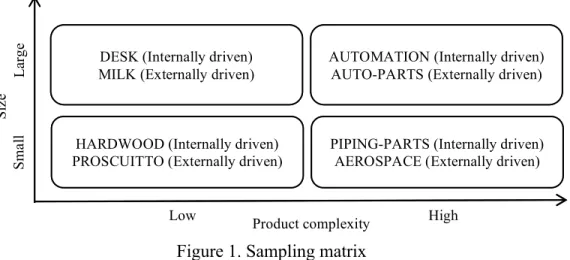
Figure 1. Sampling matrix
The eight collected cases are firms from eight different industries, all based in Canada. During early contacts with the sampled firms, their representatives confirmed that their firms were ac-tively engaged in acquiring information needed to ensure supplier compliance. Figure 1 shows the allocation of the eight cases along the three dimensions of the sampling matrix. Firms that
Product complexity
Si
ze
DESK (Internally driven) MILK (Externally driven)
HARDWOOD (Internally driven) PROSCUITTO (Externally driven)
PIPING-PARTS (Internally driven) AEROSPACE (Externally driven) AUTOMATION (Internally driven) AUTO-PARTS (Externally driven)
Sm al l Low High La rg e Product complexity Si ze
DESK (Internally driven) MILK (Externally driven)
HARDWOOD (Internally driven) PROSCUITTO (Externally driven)
PIPING-PARTS (Internally driven) AEROSPACE (Externally driven) AUTOMATION (Internally driven) AUTO-PARTS (Externally driven)
Sm al l Low High La rg e
22 fall under low product complexity produce relatively simple products and, as a result, source mainly raw materials from their suppliers: DESK is a large manufacturer that produces office furniture. MILK is a large company that produces a variety of dairy products. HARDWOOD is a small plant that processes North American woods. Finally, PROSCUITTO is a meat processing plant that manufactures frozen and dried pork products. Firms that fall under ‘high product com-plexity’ category have more complex products than those in ‘low product comcom-plexity’ category. AUTOMATION is a large company that manufactures engineer-to-order equipment. AUTO-PARTS is a large retailer that sells a variety of automotive products such as car mats and wiper blades. Finally, both PIPING-PARTS and AEROSPACE are mechanical component manufac-turers.
DESK and HARDWOOD rely on business models easily affected by supply disruptions, such as supply delays. For that reason, they are internally incentivized to prevent supplier non-compliance. AUTOMATION and PIPING-PARTS prioritize high product quality and thus are internally driven to ensure that their suppliers comply with their quality requirements. MILK, PROSCUITTO, and AEROSPACE operate in highly regulated industries and are externally driven to assure high product quality of their purchases. Finally, AUTO-PARTS is under exter-nal pressure from its customers to ensure that its products have a low defect rate.
Level of analysis
Each case focuses on the firm’s supply base for a specific product family. The level of analy-sis is the supply base, but since the aim of the multiple case studies is to understand how a firm gains information on supplier processes, the unit of observation is the firm. Three of the firms, DESK, HARDWOOD and PIPING-PARTS have two distinct supply bases that provide the same
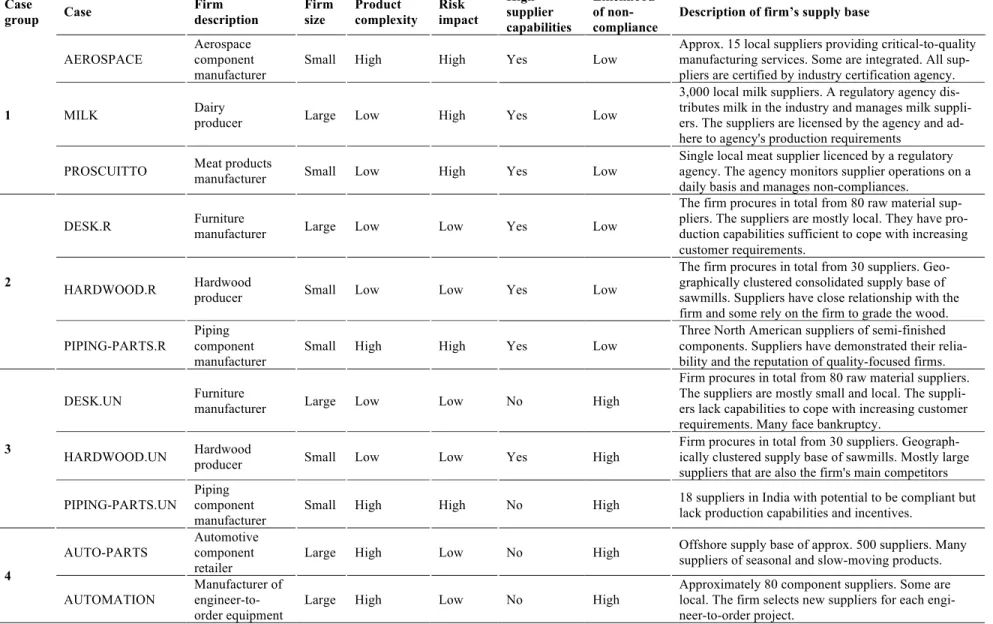
23 inputs: one where the firm perceives that it faces a negligible likelihood of non-compliance and a second where it faces a high likelihood of non-compliance. Consequently, for each of these firms there were two supply bases: DESK.R and DESK.UN, HARDWOOD.R and HARDWOOD.UN, PIPING-PARTS.R and PIPING-PARTS.UN, where R stands for the reliable supply base and UN for unreliable supply base.
Data collection
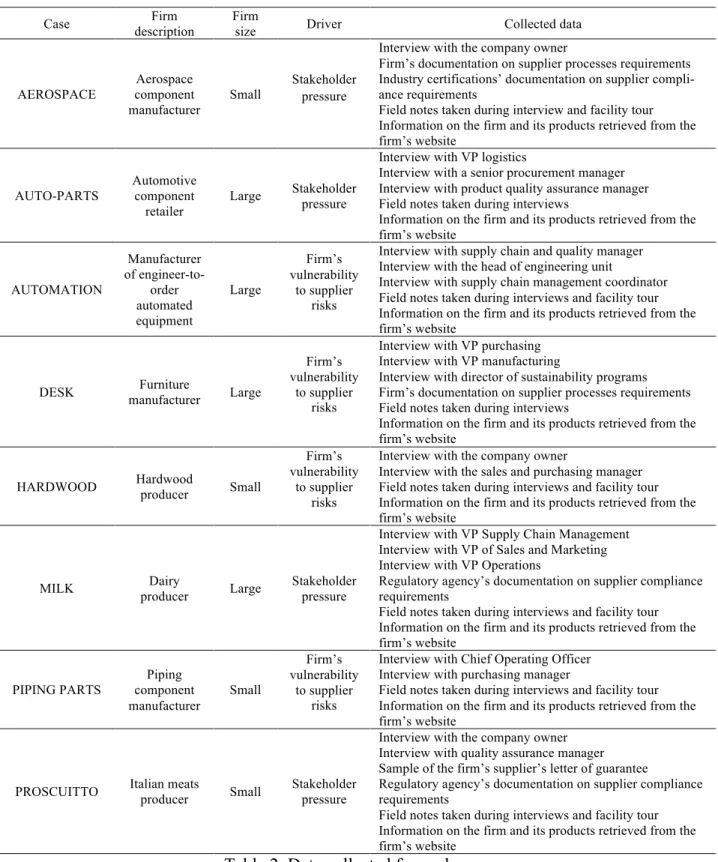
In each case, I collected data from multiple sources in order to ensure construct validity (Yin, 2014). The main data sources were interviews. I used semi-structure interviews, as recommended for studies where concepts are underdeveloped (Miles and Huberman, 1994). The interview pro-tocol appears in Appendix B. For each firm, I interviewed the manager responsible for procument, which is a key organizational function for this research. I also interviewed a manager re-sponsible for customer or stakeholder relations to gain a better understanding of the role of cus-tomers and other external stakeholders in a firm’s ability to acquire information on supplier pro-cesses. In addition, I interviewed a manager who provided insights on the firm’s operations. In all four large firms, I interviewed three managers; while in small firms, responsibility for pro-curement, customer relations, and operations often overlapped or fell on one person. In small firms, I interviewed two managers, with the exception of AEROSPACE where the owner pro-vided information on all three organizational functions. Most interviews lasted 45 to 60 minutes. In addition, I toured the production facilities of six out of eight sampled firms. I also asked for relevant documentation, and collected online information. For AEROSPACE, MILK and PRO-SCUITTO, I collected detailed documentation on how external stakeholders were involved in controlling the firm’s suppliers. Table 2 summarizes the data collected for each case.
24 To ensure reliability, the case study protocol guided data collection (see Appendix B). Fur-thermore, I and another person familiar with the topic of supply chain management collected the case data. Each person took notes during the data collection process and all interviews were rec-orded and then transcribed (Yin, 2014). Moreover, a researcher with expertise in supply chain management who was not involved in data collection verified the subsequent coding.
25
Case description Firm Firm size Driver Collected data
AEROSPACE component Aerospace manufacturer
Small Stakeholder pressure
Interview with the company owner
Firm’s documentation on supplier processes requirements Industry certifications’ documentation on supplier compli-ance requirements
Field notes taken during interview and facility tour Information on the firm and its products retrieved from the firm’s website AUTO-PARTS Automotive component retailer Large Stakeholder pressure
Interview with VP logistics
Interview with a senior procurement manager Interview with product quality assurance manager Field notes taken during interviews
Information on the firm and its products retrieved from the firm’s website AUTOMATION Manufacturer of engineer-to-order automated equipment Large Firm’s vulnerability to supplier risks
Interview with supply chain and quality manager Interview with the head of engineering unit
Interview with supply chain management coordinator Field notes taken during interviews and facility tour Information on the firm and its products retrieved from the firm’s website
DESK manufacturer Furniture Large
Firm’s vulnerability
to supplier risks
Interview with VP purchasing Interview with VP manufacturing
Interview with director of sustainability programs Firm’s documentation on supplier processes requirements Field notes taken during interviews
Information on the firm and its products retrieved from the firm’s website
HARDWOOD Hardwood producer Small
Firm’s vulnerability
to supplier risks
Interview with the company owner
Interview with the sales and purchasing manager Field notes taken during interviews and facility tour Information on the firm and its products retrieved from the firm’s website
MILK producer Dairy Large Stakeholder pressure
Interview with VP Supply Chain Management Interview with VP of Sales and Marketing Interview with VP Operations
Regulatory agency’s documentation on supplier compliance requirements
Field notes taken during interviews and facility tour Information on the firm and its products retrieved from the firm’s website
PIPING PARTS component Piping manufacturer Small Firm’s vulnerability to supplier risks
Interview with Chief Operating Officer Interview with purchasing manager
Field notes taken during interviews and facility tour Information on the firm and its products retrieved from the firm’s website
PROSCUITTO Italian meats producer Small Stakeholder pressure
Interview with the company owner Interview with quality assurance manager Sample of the firm’s supplier’s letter of guarantee
Regulatory agency’s documentation on supplier compliance requirements
Field notes taken during interviews and facility tour Information on the firm and its products retrieved from the firm’s website
26 Case coding and within-case analysis
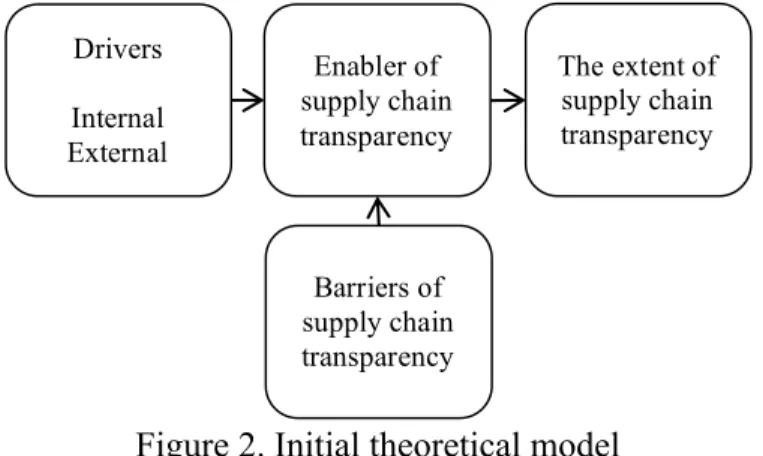
Case coding was an iterative process (Miles and Huberman, 1994). The first few iterations of coding were based on the initial theoretical model (Figure 2). This model was based on a sys-tematic review of relevant literature. Appendix A describes how I conducted the literature re-view. The initial theoretical model consisted of the following theoretical constructs: (1) the ex-tent of supply chain transparency (i.e., the exex-tent to which a firm is able to acquire comprehen-sive information on supplier processes); (2) enablers; (3) drivers; (4) barriers. Following this model for each case study, I coded what information the firm acquired about supplier processes and what practices enabled the firm to do it. I also identified what drove or who pressured the firm to acquire this information, along with contextual factors that inhibited the firm’s ability to acquire this information. Later, during the within-case analysis, I elaborated the theoretical mod-el (the process is described bmod-elow) and revised the coding scheme.
Figure 2. Initial theoretical model
Within-case analysis was another iterative process (Miles and Huberman, 1994) aimed at de-scribing and explaining the collected data. During the within-case analysis, I constructed a num-ber of displays to explain the data. Ultimately, the within-case analysis included a context chart and an analytic text. The processes of creating the context chart and writing the analytic text were performed in parallel to help shape each other. The context chart displayed key theoretical
Drivers Internal External Enabler of supply chain transparency The extent of supply chain transparency Barriers of supply chain transparency
27 concepts found in each case, while the analytic text provided a detailed description of these con-cepts.
During the analysis, the theoretical model considerably changed. Figure 3 depicts the final theoretical model. The model significantly differs from the initial model because the case data revealed new theoretical constructs relevant to the research question. The key change is related to the concept of supply chain transparency, which was the focus of the initial theoretical model. The collected data revealed that firms that choose to create transparent relationships with their suppliers do not attempt to increase transparency of the entire supply chain, instead they focus on acquiring comprehensive information on the processes of their first-tier suppliers. Furthermore, the sampled firms approach supply chain transparency strictly from the perspective of supplier risk management. For these reasons, I omitted the concept of supply chain transparency from the final theoretical model and instead focused on how firms acquire comprehensive information to manage supplier risks.
28 Figure 3. Final theoretical model for case analysis
Second, the data indicated that firms use different approaches to manage supplier risks. These approaches, in turn, relate to what information the firms acquire about suppliers. Third, the data show the importance of distinguishing between cases where supplier non-compliance, if materi-alized, affects the focal firm and the non-compliant supplier, and cases where it affects only the focal firm. For that reason, in the revised theoretical model I added a construct specifying wheth-er a suppliwheth-er shares the negative impact of a matwheth-erialized risk. Fourth, I made a firm’s suppliwheth-er governance mechanism an explicit part of the model. Fifth, in the initial theoretical model I used the word ‘enabler’ to describe practices that help a firm’s efforts to acquire comprehensive in-formation on supplier processes. The cases data clarified that enablers are contextual factors. For that reason, I added ‘enabling conditions’ along with ‘inhibiting conditions’ in the part of the
Drivers Internal External FIRM Supplier governance mechanism Approach to manage supplier risk SUPPLIER Supplier risk Information acquired to
manage supplier risk
Enabling & Inhibiting Conditions Internal External INVOLVED STAKEHOLDER Practices enabling firm’s supplier
govern-ance mechanism
Risk Impact Individual
vs. Shared with a
29 model that describes the contextual factors. Finally, in three cases, the firms rely on a third party, a powerful external stakeholder, that is involved in controlling and regulating the firms’ suppli-ers. These firms then learn about supplier processes indirectly by knowing what requirements the involved stakeholder imposes on their suppliers. Below I briefly describe each case and provide a more detailed description in Appendix C.
AEROSPACE (small firm; high product complexity; externally driven)
AEROSPACE is a small manufacturer of customized mechanical components in the aero-space defense industry. This industry is characterized by stable relationships among supply chain partners. As a result, AEROSPACE does not have many competitors, but at the same time it cannot easily find new customers. Customized mechanical components are a niche market where product quality is the main priority. AEROSPACE relies on a number of critical-to-quality sup-pliers that provide such services as casting, anodizing, and grinding. These supsup-pliers are a poten-tial source of the firm’s main supplier risk, the risk of its suppliers undermining product quality. The risk of a supplier undermining product quality is a high impact supplier risk. The firm’s final customers – producers of aerospace and defense machinery – face the threat of operational catastrophe if non-compliant mechanical components are installed in their products. For that rea-son, the final customers endorse supply-chain-wide adoption of industry certifications, AS9100 and NADCAP (National Aerospace and Defense Contractors Accreditation Program). These cer-tifications specify requirements for various types of production processes and oversee how firms in this industry adhere to these requirements.
Overall, AEROSPACE’s management believes that due to the involvement of the certification organizations it is unlikely that one of its suppliers would undermine the quality of its products.
30 In addition, the presence of these certifications influences how the firm governs its suppliers. AEROSPACE engages in behavior-based supplier governance, but outsources to the certifying organizations monitoring of supplier processes. In addition, these organizations incentivize the suppliers to comply with the imposed requirements.
AEROSPACE chooses not to acquire comprehensive information on processes of its critical-to-quality suppliers. The firm relies on the certifying organizations to control and regulate its suppliers and trusts that the certification auditors properly assess the suppliers’ production capa-bilities. Therefore, AEROSPACE manages the risk of a supplier undermining product quality by avoiding it. The firm is convinced that its suppliers ensure that any non-compliant components, if ever produced, are destroyed and would never reach the firm or its customers.
AUTO-PARTS (large firm; high product complexity; externally driven)
AUTO PARTS is a large retailer that specializes in automotive consumer products. Its target consumers are young families that prefer buying inexpensive but relatively reliable products. The firm faces the risk of its suppliers failing to produce products at an acceptable quality level. The firm is externally driven to address this risk as customer satisfaction is easily affected by poor product quality. Overall, it is a low impact risk as having defective products in stock can lead to financial and reputational losses but the losses are unlikely to be significant.
The firm has a large supply base located mostly offshore. AUTO-PARTS’s priority is to source from suppliers that can produce high volumes of products at a low cost. The product qual-ity plays a secondary role: only once potential suppliers are chosen, the firm ensures that these suppliers can achieve the required quality level. As a result, the risk of a supplier failing to achieve acceptable quality level has high likelihood.
31 The firm interacts with its suppliers mostly during the supplier selection process. Its quality team visits supplier facilities to assess their manufacturing capability. If the firm selects a suppli-er, a sample of the supplier’s products undergoes prototype testing. Once the supplier starts mass production the firm controls product quality via random testing.
AUTO-PARTS relies on outcome-based supplier governance. The firm sources from suppli-ers that can achieve the needed outcomes: producing high volumes of low-cost products of ac-ceptable quality. Overall, the firm assumes that suppliers are able to achieve the needed outcome levels, unless there are indications of non-compliance. As a result, AUTO-PARTS is willing to tolerate a certain level of the supplier risk and tends to address the risk only if it materializes and only if the costs associated with the non-compliant supplier are significant.
AUTOMATION (large firm; high product complexity; internally driven)
AUTOMATION is a large company that manufactures engineer-to-order equipment. The firm’s customers, OEMs, put significant cost pressures and choose to source from AUTOMA-TION because of its ability to achieve the required product quality level despite the cost pres-sures. The firm is forced to source from suppliers that can provide low-cost components of ac-ceptable quality facing a high-likelihood risk of its suppliers failing to achieve the required prod-uct quality level.
The firm is internally driven to address this risk. It strives to protect its reputation as a firm known for its ability to provide acceptable quality products despite the high cost pressures. Yet, this is a low impact risk. The firm’s customers accept that some of the components the firm pro-cures can lead to a product failure.
32 For each engineer-to-order project the firm selects component suppliers on the open market. On a regular basis, AUTOMATION deals with between 80 to 120 external component suppliers. The firm relies on outcome-based supplier governance seeking suppliers that can provide the needed outcomes: low cost components of an acceptable quality level. To ensure that its suppli-ers can produce products of acceptable quality, the firm engages its enginesuppli-ers when it selects suppliers. The engineers assess the manufacturing capabilities of a potential supplier. If there is evidence that the supplier is able to provide acceptable quality, the firm requests a sample order for destructive testing to further confirm that the supplier has the required quality system in place.
AUTOMATION has a certain tolerance for the supplier risk and hence chooses not to work with customers who are more risk adverse. Moreover, the firm is prepared that over time some of its suppliers will fail to achieve the required product quality becoming non-compliant. It is only when the risk of supplier non-compliance materializes that does the firm increase control of the non-compliant supplier or finds a new supplier.
DESK.R (large firm; low product complexity; internally driven)
DESK.R is a contract furniture manufacturer that specializes in customized office furniture. The firm’s final customers include law firms, universities, and Fortune 500 companies. The con-tract furniture market segment faces increasing customer expectations. The firm’s ability to meet customer requirements while remaining efficient internally makes the firm one of the few large furniture manufacturers with production facilities located in Canada.
As a contract manufacturer, DESK.R does not produce products to stock and hence faces short lead times. As a result, the firm’s main supplier risk is a supplier non-compliance that can
33 delay orders and negatively affect their reputation among their customers. This is a low impact supplier risk: while supplier non-compliance will delay the firm’s fulfillment of a particular cus-tomer order, it is unlikely to severely affect its reputation.
The firm works with 80 main suppliers. Most of its suppliers produce commodity products and raw materials. The firm’s management believes that these suppliers have sufficient capabili-ties as well as incentives to fulfill orders following the firm’s requirements. With these suppliers, the firm relies on relational governance. Over time, the firm developed close ties with its suppli-ers investing significant resources in supplier development and helping them adapt to the in-creasing industry requirements. Furthermore, DESK.R does not require the suppliers to have cost reduction initiatives, thus limiting cost pressures on its suppliers. The firm also ensures that its suppliers have sufficient capabilities to produce the needed amount of product within a short time window following the firm’s requirements for product and processes.
Overall, the firm is convinced that its suppliers have both sufficient capabilities and incentives to fulfill orders following the firm’s requirements. The firm’s management believes that when they procure from these suppliers the likelihood of supplier non-compliance is low. In fact, close relational ties make it unnecessary to acquire comprehensive information on supplier processes as relational governance allows the firm to avoid the risk of supplier non-compliance.
DESK.UN (large firm; low product complexity; internally driven)
This case focuses on the same firm sourcing the same inputs as in DESK.R but considers how this firm sources from a supply base consisting of unreliable suppliers. This supply base is of considerably smaller size than the firm’s supply base of reliable suppliers. The firm sources from unreliable suppliers, because it faces short lead times and thus has to procure the majority of its
34 raw materials locally. Some of its local suppliers tend to lack production capabilities and, as a result, over time are likely to cause a non-compliance.
These are mostly small local suppliers of raw materials. They tend to struggle to adapt to emerging industry requirements and do not have sufficient knowledge of new trends in the indus-try. These factors necessitate the firm to have a greater level of oversight of processes of these suppliers.
Specifically, with these suppliers, DESK.UN engages in behavior-based contractual govern-ance. First, the firm makes sure that the suppliers agree to adhere to its terms and conditions. However, because of low capabilities the suppliers may fail to comply with the firm’s order re-quirements. For that reason, the firm assigns employees to remain in facilities of these suppliers and ensure that the suppliers engage in processes that comply with the firm’s requirements. Ac-quiring information on supplier processes enables the firm’s governance mechanism and allows it to mitigate the risk of supplier non-compliance. If any of these suppliers sufficiently improve their processes, the firm starts to rely on the relational governance mechanism and stops directly acquiring comprehensive information on supplier processes.
HARDWOOD.R (small firm; low product complexity; internally driven)
This case focuses on a small hardwood producer. The firm seeks to procure timber of high quality and carries a diverse inventory that its competitors choose not to stock. HARDWOOD.R is in a weak market position: some of the firm’s current customers seek to procure directly from its suppliers and some of its largest suppliers are its main competitors.
35 The firm’s suppliers are sawmills located in the United States and Canada. On a regular basis, the firm sources from 30 to 50 saw mills. The firm faces supplier non-compliances both in terms of wood quality or delivery time. This supplier risk has low potential impact. If materialized, this risk will cause short-term financial losses and disrupt the firm’s processes, but is unlikely to have lasting negative effects on the firm. HARDWOOD.R is internally driven to address this supplier risk and prefers working with suppliers it believes to be reliable. The firm’s management be-lieves that these suppliers are associated with low likelihood of non-compliance. Over time these suppliers have demonstrated their ability to provide a reliable supply of high quality timber.
The firm relies on relational governance to manage these suppliers. It trusts the suppliers and does not directly oversee how the suppliers prepare the ordered wood. Instead, the firm’s man-agement fosters close relational ties with these suppliers. In addition, some of these suppliers are dependent on the firm’s expertise in wood grading. Overall, long-term relationships, trust, and mutual dependence enable the firm’s governance mechanism.
HARDWOOD.R seeks to avoid the supplier risk when it sources from suppliers it views as reliable. The firm expects that these suppliers will remain responsive to its requirements for wood quality and delivery times. It chooses not to oversee how the suppliers fulfill its orders and instead believes that relational ties allow it to avoid risk.
HARDWOOD.UN (small firm; low product complexity; internally driven)
This case considers the same firm as in HARDWOOD.R but sourcing timber from a different supply base. This supply base consists of suppliers that the firm views as being unreliable. The firm’s supply chain has been consolidated, and as a result, the firm cannot be as selective about
![catena Poly[[[aquasilver(I)] μ 4,4′ bipyridine κ2N:N′] 4 aminobenzoate nitrate hydrate]](data:image/gif;base64,R0lGODlhAQABAIAAAP///wAAACH5BAEAAAAALAAAAAABAAEAAAICRAEAOw==)