
SOLID MECHANICS AND ITS APPLICATIONS
Volume 166
Series Editor: G.M.L. GLADWELL
Department of Civil Engineering University of Waterloo
Waterloo, Ontario, Canada N2L 3GI
Aims and Scope of the Series
The fundamental questions arising in mechanics are: Why?, How?, and How much? The aim of this series is to provide lucid accounts written by authoritative research-ers giving vision and insight in answering these questions on the subject of mech-anics as it relates to solids.
The scope of the series covers the entire spectrum of solid mechanics. Thus it in-cludes the foundation of mechanics; variational formulations; computational mech-anics; statics, kinematics and dynamics of rigid and elastic bodies: vibrations of solids and structures; dynamical systems and chaos; the theories of elasticity, plas-ticity and viscoelasplas-ticity; composite materials; rods, beams, shells and membranes; structural control and stability; soils, rocks and geomechanics; fracture; tribology; experimental mechanics; biomechanics and machine design.
The median level of presentation is the first year graduate student. Some texts are monographs defining the current state of the field; others are accessible to final year undergraduates; but essentially the emphasis is on readability and clarity.
For other titles published in this series, go to www.springer.com/series/6557
Ciaran Simms
•
Denis Wood
Pedestrian and Cyclist Impact
Ciaran Simms Denis Wood
Centre for Bioengineering Denis Wood Associates Trinity College Dublin Consulting Forensic Engineers
Dublin Dublin
Ireland Ireland
ISBN 978-90-481-2742-9 e-ISBN 978-90-481-2743-6
Library of Congress Control Number: 2009931917 © 2009 Springer Science+Business Media, B.V.
No part of this work may be reproduced, stored in a retrieval system, or transmitted in any form or by any means, electronic, mechanical, photocopying, microfilming, recording or otherwise, without written permission from the Publisher, with the exception
of any material supplied specifically for the purpose of being entered
and executed on a computer system, for exclusive use by the purchaser of the work. Printed on acid-free paper
Springer is part of Springer Science+Business Media (www.springer.com) Springer Dordrecht Heidelberg London New York
Table of Contents
Foreword xi
Acknowledgements xiii
About the Authors xv
Chapter 1: Introduction 1
Chapter 2: Pedestrian and Cyclist Injuries 5
Introduction 5
Global View of Pedestrian and Cyclist Fatality and Injury Rates 5
Main Pedestrian and Cyclist Injury Database Sources 7
Distribution of Pedestrian Injuries 8
Distribution of Cyclist Injuries 10
Injury Risk as a Function of Age and Sex 16
The Distribution of Vehicle Impact Speeds 17
Injuries from Vehicle and from Ground Contact 21
Injury Risk as a Function of Vehicle Size and Type 21
Injuries and Disabilities 24
Pedestrian Injury Trends over Time 25
Concluding Remarks 25
Chapter 3: Pedestrian and Cyclist Impact Kinematics 31
Introduction 31
Sources for Studying Pedestrian and Cyclist Movement 32
Classification of Pedestrian and Cyclist Impact Configurations 32
Pedestrian Sideswipe Collisions 34
Wrap Projection 35
Pedestrian/Cyclist Head Contact in Wrap Projections 40
Forward Projection 43
Post Head Impact Kinematics for Forward and Wrap Projection Cases 45
Concluding Remarks 48
viii Table of Contents
Chapter 4: The Relationship between Vehicle Impact Speed and
Pedestrian and Cyclist Projection Distance 51
Introduction 51
Stages of Pedestrian and Cyclist Projection 52
Post Impact Separation from the Vehicle 53
Effective Coefficient of Retardation in the Ground Contact 54
Accident Data 54
Staged Tests 57
Comparison between Accident Reconstructions and Staged Tests 58 Regression Models Relating Impact Speed to Pedestrian Projection
Distance 60
Physics Based Models Relating Impact Speed to Pedestrian
Projection Distance 62
Theoretical Considerations: The Particle Projection Model 63
Wrap Projection 66
Pedestrian Forward Projection 67
Confidence Limits for Vehicle Impact Speed Prediction 70
Other Models 70
Concluding Remarks 72
Chapter 5: Injury Mechanisms and Injury Criteria 75
Introduction 75
Head Injuries 76
Head Injury Criteria 77
Spinal Injuries 82
Thorax Injuries 84
Abdominal Injuries 85
Pelvis Injuries 87
Lower Extremity Injuries 87
The Long Bones: Femur, Tibia and Fibula 88
The Knee 92
The Ankle and Upper Extremities 93
Concluding Remarks 93
Chapter 6: Vehicle Design Standards for Pedestrian and Cyclist Safety 99
Introduction 99
Bodies Developing Pedestrian Safety Standards 100
Types of Test Proposed 101
Subsystem Tests: Legform Impactor to Bumper 102
Upper Legform to Bonnet Leading Edge 104
Headform to Bonnet Top: Adult and Child 107
Implementation into Legislation 109
Pedestrian and Cyclist Impact Mechanics ix
Chapter 7: Mathematical Formulations for Impact Modelling 115
Introduction 115
Notation 116
Timing 117
Impulse and Momentum 118
Single Segment Formulation Using Momentum Considerations 120
Post Primary Impact Kinematics 121
Head Contact Time 121
Post Head Impact Kinematics 122
Pedestrian Formulation Using an Ordinary Differential Equation
(ODE) Approach 124
Rigid Body ODE Approach with a Hinge Segment 127
Three-Dimensional Effects 130
Problems with a Rigid Body Approach 131
A Finite Element Approach to Pedestrian Impact 132
Concluding Remarks 135
Chapter 8: Models for Simulating Impact 137
Introduction 137
Pedestrian Physical Dummy Models 137
Mathematical Models 138
Multibody Models 141
Finite Element Models 145
Application of Finite Element Pedestrian and Cyclist Models 152
Concluding Remarks 152
Chapter 9: Ground Contact Injuries 159
Introduction 159
Relative Severity of Ground Versus Vehicle Impact 161
Variability of Ground Contact 162
Vehicle Impact Speed Effects 163
Influence of Vehicle Design 165
Possible Methods to Reduce Ground Contact Injuries 168
Concluding Remarks 169
Chapter 10: The Influence of Vehicle Design on Pedestrian and
Cyclist Injuries 171
Introduction 171
Definitions 172
Influence of Vehicle Mass 175
Influence of Vehicle Stiffness 176
Influence of Overall Vehicle Shape 178
Bumper Shape 181
Influence of Bumper Height on Whole-Body Kinematics 184
x Table of Contents
Bumper Lead 187
Bumper Stiffness 187
Bullbars 189
Shape of Bonnet and Bonnet Leading Edge 189
Bonnet Leading Edge Stiffness 194
Head Impact on the Bonnet/Windscreen 196
Evaluation of Production Vehicles via Proposed Pedestrian
Safety Regulations 200
Concluding Remarks 203
Chapter 11: Conclusions and Future Perspectives 209
Introduction 209
Epidemiology and In-Depth Crash Injury Studies 209
Kinematics 211
Population Variations to Injury and Disability Outcomes 212
Modelling and Simulation 213
Cost Benefit Calculations of Future Gains for Pedestrians and Cyclists 214 Immediate Problems of Pedestrians and Cyclists in Low Income Countries 214 Seperation of Fast Flowing Traffic from Pedestrians and Cyclists 215 Reduction of Vehicle Impact Speed with Pedestrians and Cyclists 215 Implementation of Pedestrian Friendly Front-End Design in Those
Vehicles Which Are Most Likely to Collide with Pedestrians and Cyclists 216
Design Requirements for Future Vehicles 216
Requirements for a Global Pedestrian/Cyclist Friendly Standard 217
Conclusion 218
Foreword
In the world today there are roughly 800 million cars, trucks and buses. There are also perhaps 500 million motorcycles and other motorised two-wheeled vehicles. No one really knows how many bicycles there are but, since 1990 the annual production of bicycles has been around 100 million, so it is likely that there are more bicycles in the world than all other road vehicles put together. Currently of road traffic deaths globally, three quarters of those deaths are to vulnerable road users, mainly ped-estrians and cyclists. More important however are the seriously injured survivors. Although data are fragmentary in many parts of the world, for every death there are at least three casualties with serious, disabling injuries; brain or neurological dam-age or disruption of a major joint in the lower limbs. Financially and socially, the costs of the survivors represent some 80% of the costs of traffic injuries to society.
Hence the importance of this book. Ciaran Simms and Denis Wood have pro-duced a book which is relevant to public health policy makers, transportation plan-ners and particularly vehicle desigplan-ners and the legislators who influence vehicle exterior design. By giving a biomechanical perspective to the subject of pedestrian and bicyclist impacts, they emphasize the crucial importance of exterior design of all road vehicles. Historically, vehicle crashworthiness has been skewed by activit-ies in the United States where vehicle occupants have been the sole concern because of the highly motorised, car based conditions in North America. Modern car design now provides the occupants with airbags, seat belts and deforming structures which minimise the crash forces by providing large ride-down distances in severe impacts. It seems only right that the much more numerous pedestrians and cyclists in the world should get a few centimetres of useful ride-down distance and the appropriate exterior shape to reduce the severity of the injuries which they receive.
The authors provide an excellent historical perspective of the topic, illustrating its complexity and imperfectly documented epidemiology. They then explain in de-tail the current tools which are available through experimental testing, improved information on impact injury mechanics, injury criteria and modelling. This leads to the conclusion that although our knowledge is still imperfect what we do know can and should be applied. The benefits of such an approach on a global scale could be enormous.
xii Foreword
By bringing together past research and current knowledge the authors have produced an important book which should be in the library of every biomechanical engineer, public health specialist, every car, truck and bus designer and every legislator who is concerned with traffic safety.
Murray Mackay, FREng. Isle of Man, April 2009
Acknowledgements
We would like to thank the following: Patrick Prendergast, David Simms and Craig Meskell at Trinity College and Murray Mackay (IRCOBI President) for reading sections of the book and providing valuable feedback, Eero Pasanen at the Helsinki City Planning Department for providing film data of pedestrian accidents, Elaine Long at Denis Wood Associates for assistance with the figures, Nicola Pierce for the indexing, and Springer and Karada Publishing Services for all their help. We would also like to thank the organisations who have granted permission to reprint illustrative material in this book, and we note that they retain the copyright for this material.
About the Authors
Ciaran Simms, BA BAI, PhD, MIEI ([email protected]) is a Lecturer in the
Depart-ment of Mechanical and Manufacturing Engineering at Trinity College Dublin, and also a Principal Investigator in the Trinity Centre for Bioengineering. Prior to working in TCD he held research engineer positions with TNO Automotive in Delft and Detroit and with Denis Wood Associates in Dublin. His research interests are in injury biomechanics with a particular focus on vulnerable road users, and soft tissue constitutive modelling.
Denis Wood, BE (Mechanical), MEngSc, PhD, Chartered Engineer ([email protected]), has worked as a consulting forensic engineer since 1979. He specialises in the forensic investigation of vehicle collisions and injury. He has carried out research in the areas of collision mechanics, crashworthiness, vehicle occupant and pedestrian/cyclist injury biomechanics. He is the author and co-author of more than 60 papers in the area.
Chapter 1
Introduction
In 2004 the World Health Organisation predicted that road traffic injuries will be-come the third leading contributor to the global burden of disease by 2020, unless appropriate countermeasures are taken [1]. The proportion of road fatalities who are pedestrians and cyclists varies in different countries, but overall the protection of pedestrians is the most important road traffic safety priority [2]. This is best achieved using a combination of road engineering, vehicle design, legislation/enforcement and accident avoidance technology. The separation of pedestrians and cyclists from fast-moving motorised vehicles is clearly an ideal approach to preventing fatalities, and there are now also pre-crash sensing methods combined with brake-assist tech-nology aimed at preventing the occurrence of pedestrian and cyclist accidents [3, 4]. However, these approaches cannot prevent all accidents, and vehicle/pedestrian and vehicle/cyclist collisions will remain a real and frequent problem in most countries for the foreseeable future.
This book is aimed at understanding the physical processes which occur when pedestrians and cyclists are struck by motorised vehicles. We provide a clear over-view of the importance of pedestrian and cyclist impacts and the principal goals are to show how pedestrian and cyclist pre-impact movements and vehicle design in-fluence subsequent injury outcome. This involves recourse to several academic dis-ciplines: epidemiology, mechanics and anatomy/physiology. Therefore, this book presents pedestrian and cyclist impact from a biomechanical perspective.
We have had a basic understanding of the relationship between vehicle design and pedestrian injuries since the 1960s [5], but the safety of pedestrians and cyclists was not a serious consideration in vehicle design until the 1980s. This was encouraged by the popular but mistaken belief that little could be done to protect pedestrians in the event of a vehicle impact [6, 7]. This is best illustrated by a statement in a review paper in the Journal of Accident Analysis and Prevention in 1972 which concluded that “it would appear that pedestrians and vehicles are just not compatible” [6]. This common perception permitted manufacturers to continue to neglect an area of vehicle design not governed by legislation and not considered to provide added value to the vehicle. However, times have changed, and the advent of New Car Assessment
2 1 Introduction
Programs has meant that there is now substantial public appetite in many countries for the regulation of vehicle design for pedestrian safety.
This book provides a comprehensive treatment of the biomechanics of pedestrian and cyclist impacts. It should therefore be of value to new and established research-ers alike. We give a detailed treatment of the mechanics of pedestrian impact, as well as a review of the accident databases and the relevant injury criteria used to assess pedestrian and cyclist injuries. A further focus is the effect on injury outcome of the variability of initial position and speed of pedestrians and cyclists relative to the striking vehicle and the influence of vehicle design.
This is the first structured book on the mechanics of pedestrian and cyclist im-pact presented from a biomechanical perspective. It is intended to become a ‘one stop’ source for understanding the mechanics of pedestrian and cyclist impacts, and the book features a comprehensive treatment of the impact equations. Therefore, this book will serve as a primer and teaching tool for new researchers but also as a reference text for established researchers. The book highlights important improve-ments in pedestrian safety in recent decades and provides the necessary theoretical foundations for the reader to fully understand these advances.
This book is principally designed to be read sequentially, with later chapters building on fundamental foundations presented in earlier chapters. However, con-siderable effort has also been made to bring coherence to individual chapters. The book is structured as follows:
• Chapter 2 summarises pedestrian and cyclist injuries using the available accident databases.
• Chapter 3 provides an analysis of the movements of pedestrian and cyclists when struck by the front of vehicles.
• Chapter 4 presents the relationship between pedestrian projection distance and vehicle impact speed which is used for accident reconstruction and for biomech-anics research.
• Chapter 5 is a summary of the injury mechanisms and injury prediction criteria that are used in the assessment of vehicle design.
• Chapter 6 describes the existing standardised tests to assess pedestrian safety in production vehicles.
• Chapter 7 provides mathematical formulations for impact modelling.
• Chapter 8 presents the state-of-the-art of existing simulation tools for modelling pedestrian and cyclist impact.
• Chapter 9 considers the relationship between vehicle related injuries and ground related injuries for pedestrians and cyclists.
• Chapter 10 provides a detailed analysis of the influence of vehicle design on pedestrian and cyclist injuries.
Pedestrian and Cyclist Impact Mechanics 3
References
1. World Report on Road Traffic Injury Prevention. World Health Organisation, 2004.
2. Mackay, G., Mechanisms of injury and biomechanics: vehicle design and crash performance.
World Journal of Surgery 16, 420–427, 1992.
3. Marchal, P., Gavrila, D., Letellier, L., Meinecke, M., Morris, R., and Mathias, M., SAVE-U: An innovative sensor platform for vulnerable road user protection. In Proceedings of World
Congress on Intelligent Transport Systems and Services, Madrid, 2003.
4. Mlekusch, B., Wilfling, C., Groger, U., Dukart, A., and Mark, F., Active pedestrian protection system development. In Vehicle Aggressivity and Compatibility, Structural Crashworthiness
and Pedestrian Safety, Detroit, SAE Paper No. 2004-01-1604, 2004.
5. Severy, D. and Brink, H., Auto-pedestrian collision experiments using full-scale accident sim-ulation. In Society of Automotive Engineers, Detroit, SAE Paper No. 660080, 1966.
6. Fisher, A. and Hall, R., The influence of car frontal design on pedestrian accident trauma.
Accident Analysis and Prevention 4, 47–58, 1972.
7. Crandall, J., Bhalla, K., and Madeley, N., Designing road vehicles for pedestrian protection.
Chapter 2
Pedestrian and Cyclist Injuries
Introduction
This chapter presents a general epidemiology of pedestrian and cyclist accidents. We begin with an overview of the scale and worldwide variability of both pedes-trian and cyclist injuries. However, there is far more information available for ped-estrian than for cyclist accidents and it can be difficult to distinguish between them, as they are sometimes jointly categorised in accident databases as Vulnerable Road Users [1]. In other cases, cyclist accidents are excluded from accident databases altogether [2] and even where they are included, underregistration is significant.1
However, the general pattern of injury severity for pedestrians and cyclists is similar [4] and, due to their higher significance and the increased data available, the focus of this chapter is on pedestrian injuries. Pedestrian accident databases are the prin-cipal source of information, but it will be seen that those available mostly contain accidents from a small number of industrialised countries. Therefore, their findings must be interpreted cautiously when assessing pedestrian and cyclist injury levels in less industrialised countries. Nevertheless, the existing accident databases provide the best available overview of pedestrian and cyclist injuries.
Global View of Pedestrian and Cyclist Fatality and Injury Rates
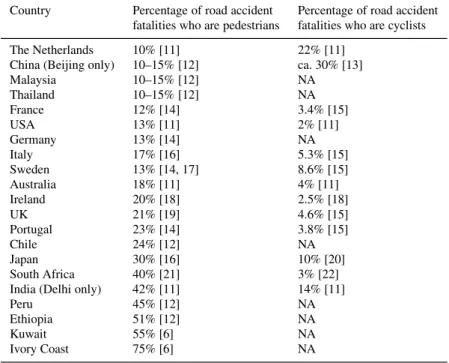
The World Health Organisation has estimated that worldwide 1.2 million people are killed in road traffic crashes and that up to 50 million are injured each year [5]. The proportion of road accident fatalities who are pedestrians and cyclists varies substantially throughout the world, with large divisions evident between low and high income countries, as shown in Table 2.1. For example, in the US, France and Sweden vehicle occupants represent more than 60% of all road fatalities and the proportion of pedestrians and cyclists is 12–13% and 2–9% respectively. However, 1For example, only 15% of cycling accidents involving bodily injury are recorded in Belgium [3].6 2 Pedestrian and Cyclist Injuries
Table 2.1 Proportion of overall road traffic fatalities who are pedestrians and cyclists in different countries, presented in increasing order of pedestrian risk.
Country Percentage of road accident Percentage of road accident fatalities who are pedestrians fatalities who are cyclists
The Netherlands 10% [11] 22% [11]
China (Beijing only) 10–15% [12] ca. 30% [13]
Malaysia 10–15% [12] NA Thailand 10–15% [12] NA France 12% [14] 3.4% [15] USA 13% [11] 2% [11] Germany 13% [14] NA Italy 17% [16] 5.3% [15] Sweden 13% [14, 17] 8.6% [15] Australia 18% [11] 4% [11] Ireland 20% [18] 2.5% [18] UK 21% [19] 4.6% [15] Portugal 23% [14] 3.8% [15] Chile 24% [12] NA Japan 30% [16] 10% [20] South Africa 40% [21] 3% [22]
India (Delhi only) 42% [11] 14% [11]
Peru 45% [12] NA
Ethiopia 51% [12] NA
Kuwait 55% [6] NA
Ivory Coast 75% [6] NA
this relationship is largely inverted in many African, Asian and South American countries. In the Netherlands, pedestrians account for 10% and cyclists for 22% of fatalities. In contrast, pedestrians account for over 50% of road accident fatalities in Kuwait and Ethiopia and 75% in the Ivory Coast [6], and pedal and motorcyclists combined rank first for road accident fatalities in India and Surinam [6]. An explan-ation of these variexplan-ations lies in the cultural as well as socio-economic differences between these regions. However, some reports are conflicting as the availability of detailed accident data in lower income countries is generally poor, and the major-ity of pedestrian fatalities occur in countries which do not routinely collect detailed road accident statistics. Therefore, this information shortfall in countries where it is most needed must be addressed if worldwide pedestrian and cyclist fatalities are to be significantly reduced.
It has been predicted that the number of road accident fatalities will rise to 2 mil-lion by 2020, and that 85% of these collisions will occur in low-income countries. Furthermore, these projections indicate that 75% of road accident fatalities will be pedestrians, cyclists and motorcyclists [7].
Apart from regional variations, the urban/rural divide is also important for distin-guishing the relative importance of pedestrian fatalities. The majority of pedestrian accidents occur in built-up areas [8], and in London pedestrians account for half of
Pedestrian and Cyclist Impact Mechanics 7
road fatalities [9]. In Kenya, pedestrians represent 70% of all urban fatalities, but just over 30% of rural traffic fatalities [10].
Main Pedestrian and Cyclist Injury Database Sources
In many countries, the police record basic information following an accident, such as time of day, scene description, vehicle type, presence of tyre/blood/glass traces detailed accident databases linking police and hospital records and predicting the range of impact speeds and vehicle/pedestrian/cyclist configurations at impact re-quire significant resources. Therefore, pedestrian accident databases are either gen-eral and contain a large number of cases, or in-depth and contain a small number of detailed accident reconstructions.
Some highly motorised countries routinely maintain pedestrian accident data-bases,2and these mostly show consistent findings: about 80% of pedestrians were standing up and moving across the road when struck from the side by the fronts of passenger cars [23, 24]. About 60% of pedestrians made no avoidance maneouver such as jumping, accelerating, turning away or stopping [25]. The distribution of impact directions for cyclists is more complex, but lateral impact on the cyclist lower limb by the vehicle front is most common [26], accounting for about 60% of accident configurations [27–30]. A breakdown of the relative importance of the dif-ferent impact directions for pedestrian accidents in the APROSYS database and for Japanese serious cyclist injuries and fatalities is given in Figures 2.1a&b respect-ively. While Figure 2.1a shows that 89% of pedestrians are struck on either the left or the right side, Figure 2.1b shows that for cyclists only 66% of fatalities involve side impact, and front/rear impacts are relatively more important for cyclists than for pedestrians.
Older databases such as the US Pedestrian Injury Causation Study (PICS) con-tain only accidents from the 1970s, and vehicle design and pedestrian injury pro-files have changed considerably since then [25]. In recognition of this, the Pedes-trian Safety Working Group of the International Harmonised Research Activities (IHRA)3 body have collated recent pedestrian accidents from Australia, Europe, Japan and the USA to a common format [2], see Table 2.2. The principal IHRA findings are presented here: the dataset consists of 1605 pedestrian accidents which resulted in 9463 injuries, of which 6158 were AIS14injuries and 3305 were AIS2-6 injuries. The IHRA database does not include pedestrian injuries from developing countries or any cyclist accidents, but it is the most comprehensive and up-to-date pedestrian accident database available.
2 Eg German In Depth Accident Study (GIDAS), US Pedestrian Crash Data Study (PCDS), APROSYS European In Depth Pedestrian Database, Australia Transport Safety Bureau Fatal File. 3IHRA are part of the United Nations Economic Commission for Europe (UNECE).
4AIS Abbreviated Injury Scale, categorising injuries from minor (AIS1) to unsurvivable (AIS6) [33].
8 2 Pedestrian and Cyclist Injuries
Fig. 2.1 Relative contribution of impact directions for (a) pedestrians in the APROSYS database (impact angles not available) adapted from [31] and (b) Japanese cyclist serious injuries and fatal-ities, adapted from [32].
Table 2.2 IHRA pedestrian accident data sources [2]. Country Pedestrian accident database source
Japan 240 urban pedestrian accident cases collected by the Japanese Accident Re-search Institute (JARI) between 1987 and 1988 and in-depth case study data of pedestrian accidents conducted by the Japanese Institute for Traffic Acci-dent Research and Data Analysis (ITARDA) between 1994 and 1998. Germany 783 urban and rural cases collected between 1985 and 1998 by the German
In-Depth Accident Study (GIDAS). Accidents in which pedestrians were overrun or impact speed could not be established were excluded.
United States 521 urban cases between 1994 and 1999 were collected in the Pedestrian Crash Data Study (PCDS). The first point of contact between the vehicle and the pedestrian had to be forward of the top of the A-pillar.
Australia 80 urban accidents between 1999 and 2000 were collected. These included 64 with passenger cars, SUVs or 1 box type vehicles where the pedestrian was standing, walking or running away. The main point of contact with the pedestrian on the vehicles was forward of the top of the A-pillar.
Distribution of Pedestrian Injuries
The IHRA data shows that a wide variety of pedestrian body regions are injured. However, it is important to distinguish between the severity of different injuries and the frequency with which these occur. In the following presentation of the IHRA data, AIS1 injuries are not included since the large number of these minor injuries considerably skews the dataset. The overall distribution of AIS2-6 pedestrian
Pedestrian and Cyclist Impact Mechanics 9
Table 2.3 The main IHRA pedestrian body regions injured and their frequency [2]. Body region % AIS2-6 injuries
Head 31.4 Face 4.2 Neck 1.4 Chest 10.3 Abdomen 5.4 Pelvis 6.3 Arms 8.2 Legs 32.6
Fig. 2.2 Distribution of IHRA pedestrian injury severities, adapted from [2].
ies to both adults and children categorised by body region is shown in Table 2.3. Figure 2.2 shows that, in all four source countries, approximately 70% of injuries are Maximum AIS [MAIS] 1–2, 20% are MAIS3–4 and 10% are MAIS5–6.
The head (excluding the face) and leg regions each account for about one third of AIS2–6 injuries, while the thorax region (pelvis, abdomen and chest) accounts for over 20% of AIS2–6 injuries, see Table 2.3. The remainder is principally accounted for by injuries to the face, neck and arms. These results compare well with German in-depth accident data from 1973 to 2000, where it was reported that the head and face accounted for nearly 30% of serious injuries to both adults and children, while thoracic injury accounted for 26% of adult and 19% of child injuries [34]. An Aus-tralian study of fatal pedestrian accidents between 1997 and 1999 found that 50% of pedestrian deaths were from AIS4+ injuries to the head/chest or a combination of these. However, 17% of fatal injuries were due to trauma of the chest, spine or abdomen [34].
Analysis of UK hospital records showed that the most common location of leg skeletal injury in pedestrian fatalities was the tibia (30%), fibula (25%), pelvis (21%) and femur (14%). Fibula fractures occur in 78% of cases where a tibia fracture is sustained, but when tibia fracture occurs, the risk of injuries to the ankle and knee
10 2 Pedestrian and Cyclist Injuries
is reduced. The risk of femur and pelvis injuries is also reduced by a tibia fracture, especially in combination with a fibula fracture [35].
The distribution of IHRA pedestrian AIS2-6 injuries for both adults and children as a function of body region and striking vehicle component is shown in Tables 2.4 and 2.5. The tables contain alot of information, and parts (a) and (b) have been constructed to present the same data in a slightly different manner. For example, row 2 in Table 2.4a shows that for adult AIS2-6 injuries caused by the front bumper, 3% are to the head and 71% are to the lower leg. Table 2.4a column 2 also shows that 28% of all adult AIS2-6 injuries are to the head. By comparison, column 2 in Table 2.4b shows that for adult AIS2-6 injuries to the head, 21% of cases are caused by the bonnet/wing top and 24% are caused by the windscreen frame/A-pillars.
The bumper, front panel and bonnet leading edge are the main sources of leg in-jury for both adult and child pedestrians. For mid-body regions, the bonnet leading edge and bonnet top are the leading sources of injuries for both adults and children. The top surface of the bonnet is the main cause of head injuries to children, but surprisingly, a substantial number of child head injuries are attributed to the wind-screen. For adults, the windscreen glass is the main source of pedestrian head injury, followed by the windscreen frame/A-pillar and top surface of the bonnet and wing [2].
Distribution of Cyclist Injuries
The IHRA data does not include cyclist injuries, but Japanese accident data between 1995 and 1998 showed that 72% of cyclist fatalities resulted from head injuries, compared to 64% for pedestrians. For serious injuries, the leg accounted for 43% of cyclist injuries compared to 49% for pedestrians, and head injuries accounted for 21% of cyclist and 22% of pedestrian serious injuries [32]. Swedish accident data from 1989–1990 indicated that 31% of cyclist injuries were to the head and face, and 25% to the foot, knee, wrist and leg [37]. The breakdown of cyclist injuries in the German In Depth Accident Study (GIDAS) [38] and the European APROSYS in-depth accident database [23] are given in Tables 2.6 and 2.7.
There is some variability evident: the GIDAS data shows cyclist head injuries in 42% of cases, compared to 28% of cases for the APROSYS data. The GIDAS data also shows substantially higher knee injury risk for cases where cyclists were struck from the side by cars compared to head-on impact [38]. The GIDAS data shows that 61.4% of cyclists struck by the fronts of cars suffered osseous and/or ligament injuries to the knee, but tibia plateau fractures were much less common in cyclists than pedestrians [38].
However, both the APROSYS and GIDAS data indicate that, as for pedestrians, cyclist injuries are spread throughout the body and the upper and lower extremities and the head are more frequently injured than the midbody regions. Analysis of 136 bicycle accidents in Germany in the 1970s concluded that impact with the road surface was responsible for 31% of injuries, while the bumper, bonnet leading edge
Pedestrian and Cyclist Impact Mechanics 11 Ta b le 2 .4 a IH RA adul t p edest ri an A IS2-6 inj uri es b y body re gi on and v ehi cl e cont act [2]: num bers and p ercent age of body re gi on in ju ri es by each v ehi cl e com ponen t.
12 2 Pedestrian and Cyclist Injuries Ta b le 2 .4 b IH RA adul t p edest ri an A IS2-6 inj uri es b y body re gi on and v ehi cl e cont act [2]: num bers and p ercent age of v ehi cl e com ponent associ at io n w it h each body re gi on in ju ry .
![Fig. 2.1 Relative contribution of impact directions for (a) pedestrians in the APROSYS database (impact angles not available) adapted from [31] and (b) Japanese cyclist serious injuries and fatal-ities, adapted from [32].](https://thumb-us.123doks.com/thumbv2/123dok_us/1783092.2754241/20.659.83.580.78.356/relative-contribution-directions-pedestrians-aprosys-database-available-japanese.webp)
![Table 2.3 The main IHRA pedestrian body regions injured and their frequency [2].](https://thumb-us.123doks.com/thumbv2/123dok_us/1783092.2754241/21.659.163.487.102.506/table-main-ihra-pedestrian-body-regions-injured-frequency.webp)
