Published online in Wiley InterScience (www.interscience.wiley.com). DOI: 10.1002/asmb.581
Measuring short- and long-run promotional effectiveness
on scanner data using persistence modelling
Marnik G. Dekimpe
1,2,*
,y, Dominique M. Hanssens
3, Vincent R. Nijs
4and Jan-Benedict E. M. Steenkamp
51
Catholic University Leuven, Belgium
2Erasmus University, Rotterdam, The Netherlands 3
University of California, Los Angeles, U.S.A.
4Northwestern University, U.S.A. 5
Tilburg University, The Netherlands
SUMMARY
The use of price promotions to stimulate brand and firm performance is increasing. We discuss how (i) the availability of longer scanner data time series, and (ii) persistence modelling, have lead to greater insights into the dynamic effects of price promotions, as one can now quantify their immediate, short-run, and long-run effectiveness. We review recent methodological developments, and illustrate how the analysis of numerous brands and product categories has resulted in various empirical generalizations. Finally, we argue that persistence modelling should not only be applied to traditional performance metrics such as sales, but also to metrics such as firm value and customer equity. Copyright#2005 John Wiley & Sons, Ltd.
KEY WORDS: promotional effectiveness; scanner data; time-series analysis; persistence
INTRODUCTION
Consumers are confronted with all kinds of promotional activities when visiting various retail outlets such as supermarkets. Indeed, temporary price cuts, features, and displays seem to be omni-present. Recent figures (see e.g. Reference [1]) indicate that 24% of all purchases in Dutch supermarkets take place under some form of promotional support. Comparable numbers are observed in the United Kingdom and Spain, while in the United States, this number approaches 40%. Price promotions are the most often used form of promotional support. As such, it should come as no surprise that the effectiveness of price promotions has been studied extensively in the marketing literature (see e.g. References [2, 3]).
*Correspondence to: Marnik G. Dekimpe, Catholic University Leuven, Naamsestraat 69, 3000 Leuven, Belgium.
y
E-mail: [email protected]
Promotional–effectiveness research has been facilitated through the advent of scanner data. Initially, scanner data offered a major impetus to cross-sectional research, in particular the study of heterogeneity in consumer response to price promotions. This heterogeneity has been studied at the level of brand choice, purchase quantity, and category incidence (see Reference [4, Table 1] for a recent review). Multinomial logit and probit models have been the most frequently used modelling approaches in this respect (cf. Reference [5]).
As longer scanner time series became available, an interest emerged in using these data sources to make inferences on price promotions’ over-time impact, and to separate immediate from short-run and even long-run effectiveness. A number of research streams that deal with this issue have emerged. Mela et al. [6] and Papatla and Krishnamurthi [7], among others, incorporate standard dynamic specifications such as the Koyck model (see Reference [6]) into individual-choice logit or probit models. While these methods are appropriate to study dynamic consumer response in stable markets, where constant means and variances in performance and marketing support have already been esta-blished, they are not well suited in evolving, or stochastically trending markets [8]. Indeed, the Koyck model implies that performance will return to its pre-promotion level, and hence precludes the detection of any persistent effect, i.e. a situation where the price promotion causes a permanent deviation from previous performance levels. Such effects are allowed for under the impulse–response and persistence modelling approach of e.g. Dekimpe and Hanssens [9] and Dekimpe et al. [10], and adopted in the current paper.
PERSISTENCE MODELLING OF SCANNER DATA
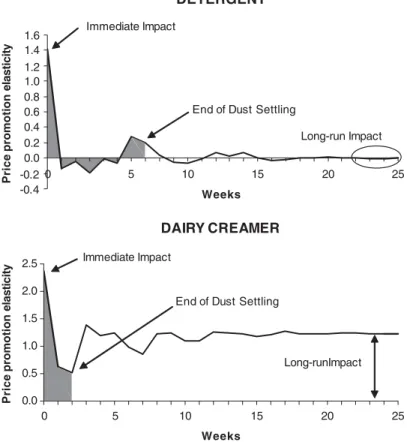
Without going into mathematical details, we can graphically illustrate the key concepts of this approach in Figure 1 (taken from Reference [11]):
In this figure, we depict theincremental primary demand that can be attributed to an initial price promotion. In the stable detergent market of Panel A, one observes an immediate sales increase, followed by a post-promotional dip. After some fluctuations, which can be attributed to factors such as purchase reinforcement, feedback rules, and competitive reactions, we observe that the incremental sales converge to zero. This does not imply that no more detergents are sold in this market, but rather that in the long run no additional sales can be attributed to the initial promotion. In contrast, in the evolving dairy–creamer market depicted in the bottom panel of Figure 1, we see that this incremental effect stabilizes at a non-zero, or persistent, level. In that case, a long-run effect has been identified, as the initial promotion keeps on generating extra sales. Behavioral explanations include new customers who have been attracted to the category by the initial promotion and now make regular repeat purchases, and existing customers who have increased their product usage rates. From these impulse–response functions, it has become customary (see e.g. References [4, 9, 11–13]) to derive various summary statistics, such as:
(i) the immediate performance impact of the price promotion;
(ii) the long-run or permanent (persistent) impact, i.e. the value to which the impulse– response function converges; and
(iii) the combined cumulative effect over the dust-settling period. This period is defined as the time it takes before the convergence level is obtained. For the figure in panel A, for example, the total effect over the dust-settling period (also referred to as the short-run
effect) amounts to the area under the curve (specifically, the sum of the IRF estimates that have not yet converged to zero).z,}
In a nutshell, persistence modelling offers two distinct advantages. First, it offers a clear and quantifiable distinction between short- and long-run promotional effectiveness, based on the difference between temporary and permanent movements in the data. Second, it uses a system’s approach to market response, in that it combines the forces of customer response, competitive reaction, and firm decision rules. Indeed, the chain reaction of all these forces is reflected in the impulse–response functions (which are themselves derived from a multi-equation vector–autoregressive model; see
DETERGENT -0.4 -0.2 0.0 0.2 0.4 0.6 0.8 1.0 1.2 1.4 1.6 0 10 15 20 25 Weeks P ri c e promoti on e lasticit y Immediate Impact
End of Dust Settling
Long-run Impact DAIRY CREAMER 0.0 0.5 1.0 1.5 2.0 2.5 0 10 15 20 25 Weeks P ri c e promotion e lastic ity Immediate Impact
End of Dust Settling
Long-runImpact 5
5
Figure 1. Impulse response functions. (Reprinted by permission, Nijs VR, Dekimpe MG, Steenkamp J-BEM, Hanssens DM. The category-demand effects of price promotions. Marketing Science 2001;20: 1–22. Copyright 2001, the Institute for Operations Research and the Management Sciences, 7240 Parkway
Drive, Suite 310, Hanover, MD 21076, U.S.A.)
z
In panel B, the dust-settling period is defined in terms of the last period that has an impact significantly different from the non-zero asymptotic value (see Reference [11] for details).
}In persistence research (see e.g. References [1, 4, 8–14], as well as in the current paper) ‘permanent’, ‘persistent’ and
‘long-run’ effects are used as synonyms. Similarly, the term ‘short-run effects’ is often used to denote the combined effect over the dust-settling period, while the effect in the promotional period itself is called the instantaneous or immediate effect. Other research traditions (see e.g. References [6, 7]) use different delineations of the short run vs long run. Obviously, the marketing discipline would benefit from a generally accepted definition of these terms.
References [8, 9] for technical details). As such, it is very complete in its treatment of market response, and relates well to the complexities of real-world promotional effectiveness.
In 1995, Blattberget al. [2, p. G127] called the long-term effectiveness of price promotions ‘probably the most debated issue in the promotional literature, and one for which the jury is still out.’ In 1999, Dekimpeet al.[10] showed how persistence modelling could be used to infer long-run promotional effectiveness. They applied the technique to four different FPCG categories (catsup, detergent, soup, and yogurt), and identified long-run promotional effectiveness in one of them (soup). Since Dekimpeet al. [10], promotional effectiveness research using persistence modelling has evolved along two main dimensions: (i) some methodological developments have made the techniques better suited to the special characteristics of most promotional environments, and (ii) a large number of brands and product categories have been analysed, resulting in a rich and novel set of empirical generalizations, as well as tests of various market-ing-theory based hypotheses on the underlying drivers of short- and long-run promotional effectiveness (see e.g. References [1, 11–14]). We briefly elaborate on each of these developments.
METHODOLOGICAL DEVELOPMENTS
Alternative performance metrics.In the past, persistence modelling has focused predominantly on sales as the performance variable of interest, either in units or volume (e.g. liters). Market shares, an alternative performance metric used commonly in econometric models, have received less attention (see Bronnenberg et al. [15], Franses et al. [16] and Srinivasan et al. [17] for notable exceptions). One issue related to the use of market shares in persistence models is that category expansion effects are not captured.} Even though long-run effects occur very rarely, significant short-run category expansion is a common occurrence that should not be ignored when modelling promotional effectiveness (see References [11, 19]). There are also added complexities in establishing the order of integration of market-share data, due to the logical consistency requirement (i.e. shares are between 0 and 1, and their sum is equal to one). Franseset al. [20] develop a procedure based on Johansen’s test for cointegration [21], which uses a system-based approach that can accommodate these requirements by imposing specific model restrictions. Their procedure is more reliable than Dickey–Fuller tests applied to individual equations. Further work in this area is needed to help disseminate the use of market-share data in persistence models. Second, many studies (see e.g. Reference [12]) look at composite measures, such as revenues
ðprice *volumeÞ or profits ððprice2marginal costÞ* volumeÞ: More research is needed to determine whether or not the substantive insights obtained from analysing composites vs their constituent components are similar. The decomposition approach in Reference [4] may be used in this regard.
Structural breaks and outliers
Weekly scanner data may contain ‘extreme’ observations in sales and/or the marketing-mix variables. In some instances, these unusual observations and their causes or consequences are of particular interest to marketers. For example, the addition of a new Internet channel (see Reference [22]) or of a new television station (see Reference [23]), may permanently alter the
}
One way to alleviate this problem may be to include an ‘outside good’ in the model specification (see Nevo [18] for an application in Empirical Industrial Organization).
nature of the underlying data-generating process for the performance series of interest (incumbent newspapers’ revenues in Reference [22] and revenues of the advertising industry in Reference [23]). In such instances, structural-break tests and subsequent impulse–response analyses may be used to explicitly model the consequences of these major events. If, however, these aberrant data points are numerous and not the main focus of the research, they may be labeled as outliers (e.g. caused by data errors, competitive promotions on which information is not available, etc.). If not properly accounted for, such data points can produce sizeable biases in the estimation of long-run marketing effects. To deal with this data problem, Franses et al. [16] present generalized maximum likelihood methods to obtain persistence estimates that are significantly more robust to outlying observations.
Heterogeneity
Heterogeneity in marketing effects across stores, brands, and consumers has long been an important topic of research in marketing. Within the persistence modelling paradigm however, only very limited research on heterogeneity has been conducted. Most papers have used market or chain-level data due to availability, estimation convenience, and the fact that managers usually do not have access to data at lower levels of aggregation. The use of such data brings up the potential problem of aggregation bias (see Reference [24]). Nijs et al. [11] and Srinivasan et al. [25] find this bias to have at most a limited impact. However, store-level data offer opportunities for micro-marketing. Horva´th and Wierenga [26] allow for heterogeneity in both contemporaneous and dynamic marketing effects across stores by extending the random-effects model to a time-series context. A further valuable step would be to model this heterogeneity as a function of store (environment) characteristics, e.g. using hierarchical Bayes methods.
While great strides have been made in accounting for consumer heterogeneity in aggregated data (e.g. Reference [18]), no such methods have been applied to persistence models. However, Limet al. [27] developed an easy-to-implement approach to determine if the long-run impact of marketing efforts varies across, for example, heavy vs light users. The authors apply a priori segmentation based on consumer-level usage data and then estimate persistence using data that have been aggregated to the segment level (e.g. sales data are created separately for heavy and light users). A valuable extension to this work would be to simultaneously derive the determinants of heterogeneity and the persistence model parameters.
A final source of heterogeneity considered here is that across brands/SKUs (Stock Keeping Units). The vast majority of papers in marketing use either data at the brand level (i.e. data aggregated across SKUs) or focus on just a few large SKUs. While the issue of dimensionality is often important in econometrics, it is even more so for persistence models. Indeed, persistence models are very flexible in capturing marketing dynamics, but this leads to a high level of parameterization, which limits the opportunity to investigate differences in marketing effectiveness across many SKUs. Future research is needed in this area to allow researchers to impose and evaluate various model restrictions and parameter structures (e.g. a factor structure).
INSIGHTS ON PROMOTION EFFECTIVENESS
As mentioned earlier, recent research has applied persistence modelling to large scanner data sets, encompassing hundreds of FPCG categories and brands. This allows us to both derive
empirical generalizations on the short- and long-run effectiveness of promotions, and to test various marketing-theory based hypotheses on the underlying drivers of short- and long-run promotional effectiveness (see e.g. References [1, 11–14]).
The empirical generalizations that can be derived from these studies constitute an important body of marketing knowledge in their own right (e.g. Reference [28]), and can serve as benchmarks in developing marketing plans. Using persistence modelling, Steenkamp et al. [1] and Srinivasanet al.[12] reported an average short-run own-sales elasticity of price promotions of about 4.0. Any annual marketing plan featuring price–promotion actions and sales targets can be compared to this benchmark. The manager is ‘compelled’ to argue why sales targets are above or below the benchmark (are there special circumstances?). The empirical generalizations can also be used to develop generalized theoretical explanations. This is in line with the ETET (empirical–theoretical–empirical–theoretical) model of scientific evolution described by Bass [29]. Moreover, the parameters obtained from persistence models (e.g. short- and/or long-run effect of a price promotion for a given brand in a given category; see Figure 1) can be used as input for a second research stage in which the variation in the effectiveness estimates is explained, using theories and constructs from marketing, consumer behaviour, and industrial economics, among others. This allows the marketing scientist to test various theory-based hypotheses on the underlying drivers of short- and long-run promotional effectiveness across a broad set of product–market contexts. Much of the relevant theory in marketing and industrial economics deals with brand- and market-specific effects, which can be tested most reliably when a wide range of brands and markets is included in the study.kFor example, analysing 560 FPCG categories, Nijset al.[11] found that the short-run category-expansion effect of price promotions is larger in perishable and in more concentrated categories and in categories characterized by high price–promotion frequency, low advertising intensity, and absence of major new-product introductions. In addition, long-run category-expansion effects of price promotions were larger in perishable and less heavily advertised categories.
Analysing competitive reaction behaviour of over 1200 brands in more than 400 FPCG categories over a four-year period using persistence modelling, Steenkampet al.[1] reported that simple competitive retaliation to price–promotion attacks was more intense when the attacking brand is more powerful, when the power disadvantage of the defending brand is small, in less concentrated markets, and when the product category is high on impulse buying or on interpurchase times. These effects were consistent with theorizing. It illustrates that reaction behaviour involving price promotions is affected both by company, competitor, market structure, and consumer behaviour variables (see also Reference [31]). An interesting area for future research is to investigate if some of the factors explaining cross-sectional variation in immediate, short- or long-run effectiveness, also explain (predict) transitions between prolonged periods of stability and subsequent intervals of evolutionary market behaviour.
Last, but not least, the effect of promotions on thefinancialperformance of manufacturers vs retailers has been studied with persistence models on a five-year long weekly scanner database for 25 product categories [12]. Overall, price promotions typically do not have permanent monetary effects for either party. However, there are important differences in the cumulative promotional impact on the financial performance of manufacturers vs retailers. Price promotions have a predominantly positive impact on manufacturer revenues, but their effects
k
Alternatively, it would be valuable to assess whether some of these insights can be replicated in field experiments (see e.g. Reference [30]).
on retailer revenues are mixed. Moreover, retailer category margins are typically reduced by price promotions. Even when accounting for cross-category and store-traffic effects, there is still evidence that price promotions are typically not beneficial to the retailer. Like the promotion reaction study in Reference [1], this paper also reports on a number of second-stage correlates of promotional impact.
CONCLUDING THOUGHTS
In conclusion, the advent of long time series of scanner data and the use of persistence modelling have greatly enhanced the state of our knowledge on promotion effectiveness. In particular, they have produced a virtually unanimous jury verdict on the question of whether or not price promotions have a long-term impact on brand sales. These techniques can also be used to quantify the impact of other marketing investments [28] and, as such, they have become an integral part of modern-day marketing science. Nagel [32] (cited in Reference [29, pp. G10-11]) provided a general definition of science that can be modified straightforwardly to marketing science: ‘Marketing science seeks to provide generalized explanatory statements about disparate types of marketing phenomena and to provide critical tests for the marketing relevance of the attempted explanations.’ Two key aspects of this definition are: (1) explanation of marketing phenomena and (2) marketing relevance of explanations.Explanation of marketing phenomena requires theory and statistical models. As argued, persistence modelling is very suitable to quantify marketing phenomena, which can subsequently be explained using company, competitor, market structure, and consumer variables. The critical test of the marketing relevance of explanations is typically provided by the results of actual decision making. Persistence modelling yields benchmarks, models actual behaviour in the market place, and captures the net result of all actions taken by companies, competitors, retailers and consumers. As such it provides a long-run perspective that makes it eminently suitable for use in marketing decisions, but also, and perhaps even more importantly, for linking marketing decisions to other metrics such as firm value (see Reference [14]) or customer equity (see Reference [33]). In this way, persistence modelling is a tool that quantifies how marketing contributes to shareholder value, which will further enhance the importance of marketing in corporate strategy.
ACKNOWLEDGEMENTS
Financial support by the Flemish Science Foundation (F.W.O.) under grants G.0145.97 and G.0116.04 is greatly appreciated.
REFERENCES
1. Steenkamp J-BEM, Nijs VR, Hanssens DM, Dekimpe MG. Competitive reactions to advertising and promotion attacks.Marketing Science2005; in press.
2. Blattberg RC, Briesch R, Fox EJ. How promotions work.Marketing Science1995;14:G122–G132. 3. Neslin SA.Sales Promotion. Marketing Science Institute: Cambridge, MA, 2002.
4. Pauwels K, Hanssens DM, Siddarth S. The long-term effect of price promotions on category incidence, brand choice and purchase quality.Journal of Marketing Research2002;39:421–439.
5. Franses PH, Paap R. Quantitative Models in Marketing Research. Cambridge University Press: New York, NY, 2001.
6. Mela C, Gupta S, Lehmann DR. The long-term impact of promotion and advertising on consumer brand choice.
Journal of Marketing Research1997;34:248–261.
7. Papatla P, Krishnamurthi L. Measuring the dynamic effects of promotions on brand choice.Journal of Marketing Research1996;33:20–35.
8. Dekimpe MG, Hanssens DM. The persistence of marketing effects on sales.Marketing Science1995;14:1–21. 9. Dekimpe MG, Hanssens DM. Sustained spending and persistent response: a new look at long-term marketing
profitability.Journal of Marketing Research1999;36:397–412.
10. Dekimpe MG, Hanssens DM, Silva-Risso JM. Long-run effects of price promotions in scanner markets.Journal of Econometrics1999;89:269–291.
11. Nijs VR, Dekimpe MG, Steenkamp J-BEM, Hanssens DM. The category demand effects of price promotions.
Marketing Science2001;20:1–22.
12. Srinivasan S, Pauwels K, Hanssens DM, Dekimpe MG. Do promotions benefit manufacturers, retailers, or both?
Management Science2004;50:617–629.
13. Pauwels K, Srinivasan S. Who benefits from store brand entry?Marketing Science2003;23:364–390.
14. Pauwels K, Silva-Risso J, Srinivasan S, Hanssens DM. New products, sales promotions, and firm value: the case of the automobile industry.Journal of Marketing2004;68:142–156.
15. Bronnenberg BJ, Mahajan V, Vanhonacker WR. The emergence of market structure in new repeat-purchase categories: the interplay of market share and retailer distribution.Journal of Marketing Research2000;37:16–31. 16. Franses PH, Kloek T, Lucas A. Outlier robust analysis of long-run marketing effects for weekly scanner data.
Journal of Econometrics1999;89:293–315.
17. Srinivasan S, Popkowski Leszczyc PTL, Bass FM. Market share response and competitive interaction: the impact of temporary, permanent and structural changes in prices.International Journal of Research in Marketing2000;17: 281–305.
18. Nevo A. Measuring market power in the ready-to-eat cereal industry.Econometrica2001;69:307–342.
19. Van Heerde H, Gupta S, Wittink DR. Is 75% of the sales promotion bump due to brand switching? No, only 33% is.Journal of Marketing Research2003;40:481–491.
20. Franses PH, Srinivasan S, Boswijk P. Testing for unit roots in market shares.Marketing Letters2001;12:351–364. 21. Johansen S.Likelihood-Based Inference in Cointegrated Vector Auto-Regressive Models. Oxford University Press:
New York, NY, 1995.
22. Deleersnyder B, Geyskens I, Gielens K, Dekimpe MG. How cannabalistic is the internet channel? A study of the newspaper industry in the United Kingdom and the Netherlands.International Journal of Research in Marketing
2002;19:337–348.
23. Kornelis M. Modeling market skake-ups using time series data.PhD Thesis, SOM, University of Groningen. 24. Christen M, Gupta S, Porter JC, Staelin R, Wittink DR. Using market-level data to understand promotion effects in
a nonlinear model.Journal of Marketing Research1997;34:322–334.
25. Srinivasan S, Pauwels K, Nijs VR. Dynamic drivers of retail prices.Working Paper, University of California, Riverside, 2005.
26. Horva´th C, Wierenga JE. Combining time series and cross sectional data for the analysis of dynamic marketing systems.Working Paper, University of Groningen, 2002.
27. Lim J, Currim I, Andrews RL. Capturing consumer heterogeneity in long-run effects of promotions.Working Paper, University of California, Irvine, 2003.
28. Hanssens DM, Parsons LJ, Schultz RL.Market Response Models(2nd edn). Kluwer Academic Publishers: Boston, MA, 2001.
29. Bass FM. Empirical generalizations and marketing science: a personal view.Marketing Science1995;14:G6–G19. 30. Anderson E, Simester D. Does promotion depth affect long-run demand?Marketing Science2004;23:4–20. 31. Pauwels K. How dynamic consumer response, competitor response, company support, and company inertia shape
long-term marketing effectiveness.Marketing Science2004;23:596–610. 32. Nagel E.The Structure of Science. Harcourt: New York, NY, 1961.
33. Villanueva J, Yoo S, Hanssens DM. Customer acquisition channels and customer equity: a long-run view.Working Paper, University of California, Los Angeles, 2003.