• No results found

Keywords: Security; data warehouse; data mining; statistical database security; privacy

N/A
N/A
Protected

Academic year: 2021

Share "Keywords: Security; data warehouse; data mining; statistical database security; privacy"

Copied!
11
0
0

Loading.... (view fulltext now)

Full text

(1)

Security in Data Warehouses

By

Edgar R. Weippl, Secure Business Austria, Vienna, Austria

Favoritenstrasse 16

1040 Wien

Tel: +43-1-503 12 80

Fax: +43-1-505 88 88

E-mail: [email protected]


(2)
(3)

Security in Data Warehouses

ABSTRACT

The last several years have been characterized by global companies building up massive

databases containing computer users’ search queries and sites visited; government

agencies accruing sensitive data and extrapolating knowledge from uncertain data with

little incentive to provide citizens ways of correcting false data; and individuals who can

easily combine publicly available data to derive information that – in former times – was

not so readily accessible. Security in data warehouses becomes more important as reliable

and appropriate security mechanisms are required to achieve the desired level of privacy

protection.

INTRODUCTION

Landwehr (2001) defines how the etymological roots of the term “secure” are

found in “se” which means “without,” or “apart from,” and “cure,” i.e. “to care for,” or

“to be concerned about”.

While there are many definitions of the primary requirements of security, the

classical requirements are summarized by the acronym CIA. CIA is the acronym for

confidentiality, integrity, and availability. All other security requirements such as

non-repudiation can be traced back to these three basic properties.

Avizienis (2004) defines

confidentiality

as the absence of unauthorized disclosure

of information,

integrity

as the absence of improper system alterations and

availability

as

readiness for correct service.

Dependability

is a broader concept that encompasses all primary aspects of

security save confidentiality, and, in addition.

Reliability

, which refers to the continuity of correct service.

Safety

, defined as the absence of catastrophic consequences for user(s) and

environment.

Maintainability

, which is the ability to undergo modifications and repairs.

BACKGROUND

While security obviously encompasses the requirements of the CIA triad this article will

focus on the mechanism of access control (AC) as this addresses both confidentiality

and—to some extent—integrity. Database security was addressed in the 1960s by

introducing

mandatory access control

(MAC), driven mainly by military requirements.

Today,

role-based access control

(RBAC) is the commonly used access control model in

commercial databases.

There is a difference between trusting a person and trusting a program. For instance, Alice

gives Bob a program that Alice trusts. Since Bob trusts Alice he trusts the program.

However neither of them is aware that the program contains a Trojan. This security threat

leads to the introduction of MAC. In MAC, the system itself imposes an access control

policy and object owners cannot change that policy. MAC is often implemented in

(4)

Security in Data Warehouses     4 


systems with mulitlevel security (MLS). In MLS information objects are classified in

different levels and subjects are cleared for levels.

The

need-to-know

principle, also known from the military, stipulates that every subject

receives only the information required to perform its task. To comply with this principle,

it is not sufficient to use sensitivity labels to classify objects. Every object is associated

with a set of compartments. Subjects are classified according to their security clearance

for each given area/compartment.

Classification labels are of the form (

Ss

,

Sc

) where

Sr

is a sensitivity and

Sc

a set of

compartments. (

Os

,

Oc

) dominates (

Ss

,

Sc

) if (

Ss

,

Sc

)<=(

Os

,

Oc

).

This <= relation is true when

Ss

<=

Os

where the <= relationship here is with respect to the classified <

sensitive < secret < top secret sensitivity classification, and

Sc

<=

Oc

where the <= relationship is a subset relation of sets.

The Bell LaPadula (BLP) model (1975) forms the fundamental architectural idea behind

guarantee of secrecy in MLS. The Biba model by the Mitre Corporation (1997) is used to

protect integrity: BLP’s read-up and write-down properties are inverted to the

no-write-up and no-read-down rules. Today, Oracle’s Label Security and DB2’s Label

Access Control are contemporary examples of this security model.

The most widely used access control model is the role-based access control (RBAC)

model. This section will briefly summarize various properties of NIST’s RBAC model as

pointed out by Sandhu et al. (2000). The notion of

scalability

is multi-dimensional.

RBAC does not define the degree of scalability implemented in a system with respect to

the number of roles, number of permissions, size of role hierarchy, or limits on user-role

assignments, etc.

As RBAC is based on permissions that confer the ability to do something on holders of

the permission, it does not contain

negative authorizations

(prohibitions). The

nature of

permissions

is not specified in the RBAC model itself. Permissions can be either

fine-grained or coarse-fine-grained and may also be customized. The exact nature of permissions is

determined by the application.

Moreover, RBAC does not specify the ability of a user to select which roles are activated

in a particular session. The only requirement is that it should be possible to allow a user to

activate multiple roles simultaneously. It does not matter if the user is able to explicitly

activate roles or if all roles are automatically activated by the system.

RBAC Constraints

Since permissions are organized into tasks by using roles, conflicts of interests are more

evident than if dealing with permissions on a per-user basis. In fact, a conflict of interest

among permissions on an individual basis is hard if not impossible to determine.

Separation of duties among roles (i.e., defining mutually exclusive roles) provides the

administrator with enhanced capabilities to specify and enforce enterprise policies. Since

RBAC has static (user-role membership) and dynamic (role activation) aspects, the

following two possibilities can be distinguished accordingly.

(5)

constraints on the assignment of users to roles. This means that if a user is authorized as a

member of one role, the user is prohibited from being a member of a second role.

Constraints are inherited within a role hierarchy.

Second,

Dynamic Separation of Duties

(DSD) is based on role activation. It is employed

when a user is authorized for more roles that must not be activated simultaneously. DSD

is necessary to prohibit a user from circumventing a policy requirement by activating

another role.

Administrating RBAC

Definition of roles and constraints, assigning permissions to roles, and granting

membership to roles are the most common administrative tasks in RBAC. When a new

employee enters the company, the administrator simply adds this person to one or more

existing roles according to the users tasks and needs. Similarly, users can be removed

from a role when they leave the company or added to new roles when their functions

change.

It is commonly agreed that one of RBAC’s biggest advantages is its easy administration.

Nonetheless, managing a large number of roles can still be a difficult task. However,

Sandhu and Coyne (1996) present an intriguing concept that shows how RBAC might be

used to manage itself. An administrative role hierarchy is introduced, which is mapped to

a subset of the role hierarchy it manages.

Coexistence with MAC / DAC

Mandatory access control is based on distinct levels of security to which subjects and

objects are assigned. Discretionary access control (DAC) controls access to an object on

the basis of an individual user’s permissions and/or prohibitions. RBAC, however, is an

independent component of these access controls and can coexist with MAC and DAC.

RBAC can be used to enforce MAC and DAC policies as shown in (2000). The authors

point out the possibilities and configurations necessary to use RBAC in the sense of MAC

or DAC. For a detailed discussion on defining and organizing roles please refer to

Nyanchama and Osborn (1994), who introduce a formal role graph to facilitate role

administration. Ferraiolo and Kuhn (1992), for example, published fundamental concepts

on granting and revoking membership to the set of specified named roles.

SCIENTIFIC CONCEPTS

Classic access control is still the mechanism of choice to protect not only databases but

also data warehouses. The difference between a database and a data warehouse is that

database is designed and optimized to process individual tuples and the data warehouse is

optimized to respond to queries that analyze aggregated data. OLTP (On-Line Transaction

Processing) systems are secured by controlling access to individual tuples but for data

warehouses the issue of data protection is more complex. For typical access control there

are several shortcomings. First and foremost, users can do anything with the data once

they have access to it; Second, even if access to fine grained detail data is not permitted,

(6)

Security in Data Warehouses     6 


querying different similar datasets can reveal fine details; this is also known as inference

attacks. The first issue can be addressed—in theory—by usage control as described by

Park and Sandhu (2004), the second by several methods of statistical database security.

Both topics are very active fields of research.

Usage Control

The main problem with data collection is that people might allow companies to use data

for specific reasons (such as recommending related products) but do not consent to other

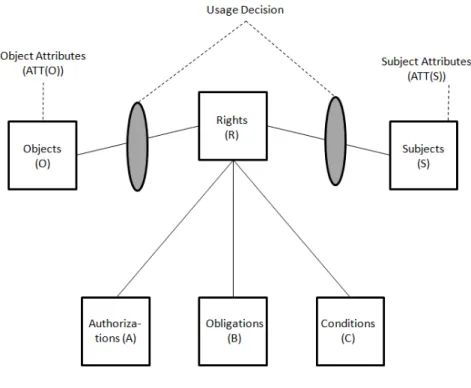
uses of the same data. Usage control byPark and Sandhu (2004) is a concept that makes it

possible to enforce pre- and postconditions when using data. It is similar to a traditional

reference monitor, only that the restrictions are enforced during the entire access, as

proposed by Thuraisingham (2005): The privacy control would “limit and watch access to

the DBMS (that access the data in the database).”

Figure 1: The UCONABC usage control model by Park and Sandhu

(2004).

Statistical Database Security

(7)

queries (such as asking for the average age and not an individual’s age). Nonetheless,

inference can be used to infer some secret information. Data warehouses are built to

support data mining. If a data mining tool can be used to derive sensitive information

from unclassified information legitimately obtained, there is an inference problem, as

discussed by Bertino et al. (2006).

Well-established protection concepts for statistical database security, such as:

restriction-based techniques, query set size control, expanded query set size control-audit restriction-based

(assumed information base), perturbation-based techniques, data swapping (distribution

unchanged), random-sample queries, fixed perturbation (modify data), and query-based

perturbation. For an in-depth description Castano et al. (1994) and Willenborg and De

Waal (1996) are excellent sources.

Query set size control

Enforcing a minimum set size for returned information does not

offer adequate protection. Denning (1982) described trackers that are sequences of queries

all within the size limits allowed by the database; when combined with AND statements

and negations, information on individuals can be inferred. While simple trackers require

some background information, Denning (1979) as well as Denning and Schlorer (1983)

show how general trackers can be used without in-depth background knowledge.

A very simple example illustrates how inference causes information leakage. If it is

known that Alice is the oldest person but her age is unknown, repeatedly asking “How

many people are older than

X

years? ” with different values of

X

until the database returns

the value 1, allows inference of Alice’s age. By enforcing that each query returns

aggregated data of more than one rows will not solve the problem. Repeatedly querying

“How many employees are older than

X

? ” until the system rejects the query because the

query would return less than

N

rows, identifies a minimum set. This set includes

N

+1

employees, including Alice,

w

are older than

X

; let

X

=66 at this point. Subsequently, a

query “Retrieve the sum of ages of all employees who are older than

X

? ” will return a

result

R

1. The last query “Retrieve the sum of ages of all employees who are not called

Alice and are older than

X

? ” will return

R

2. Finally, subtract

R

2 from

R

1 to obtain

Alice’s age. The example includes a query “not called Alice” that excludes a single item.

If the “not equal” operation would not be allowed, a binary search could still be used to

exclude a single item with a comparison operator. Simple control of result sizes as

described here are not designed to prevent such an exclusion.

In

audit-based expanded query set size control

aka. Nabil and Worthmann’s (1989)

‘query set overlap control’ the system decided whether to grant access to an “assumed

information base,” which is the history of all the requests issued by the user. The assumed

information base contains all possible inferences that can be generated with the results of

all previously issued queries; before answering a new query the system has to decide

whether the query could be combined with the assumed information base to infer

confidential information.

Perturbation-based techniques

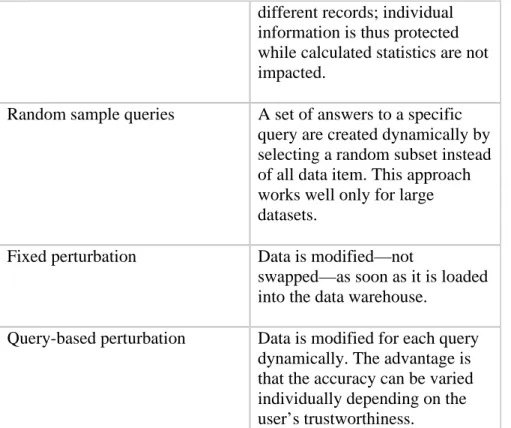
(cf. Table 1) are characterized by modifying the data so

that the privacy of individuals can still be guaranteed even if more detailed data is

returned than in restriction-based techniques. Data can be modified in the original data or

in the results returned.

(8)

Security in Data Warehouses     8 


different records; individual

information is thus protected

while calculated statistics are not

impacted.

Random sample queries

A set of answers to a specific

query are created dynamically by

selecting a random subset instead

of all data item. This approach

works well only for large

datasets.

Fixed perturbation

Data is modified—not

swapped—as soon as it is loaded

into the data warehouse.

Query-based perturbation

Data is modified for each query

dynamically. The advantage is

that the accuracy can be varied

individually depending on the

user’s trustworthiness.

Table 1: Different perturbation-based techniques

According to Samarati and Sweeney (1998) k-anonymity refers to a concept that

guarantees that data of an individual will remain indistinguishable from that of at least

k

-1

others. The basic idea to protect privacy is centered on quasi-identifiers. Quasi-identifiers

are usually a combination of data items that probably allow an identification of a person

such as birth date, ZIP code, and gender. The idea, explained by Sweeney (2002), is that

the data provider knows which data is externally available, for example a list of people

with their names, birth date, ZIP code and gender. High dimensionality, however, may

cause problems. Charu (2005) points out that once the number of dimensions increases to

about 20, even 2-anonymity cannot be preserved in most cases without losing too much

original information.

K-anonymity can be attacked using the homogeneity attack or the background knowledge

attack. The homogeneity attack is very simple. If all

k

datasets have the same values in the

field with sensitive data, privacy is not protected. For instance, if 5-anonymity is

guaranteed and all patients suffer the same illness, there is no longer privacy. The

background knowledge attack uses background knowledge to exclude impossible or

unlikely datasets,as shown by Loukides and Shao (2007). Machanavajjhala et al. (2006)

state that l-diversity is a measure that even the attacker needs

l

-1 relevant pieces of

background knowledge to infer a (positive) disclosure.

(9)

The previous sections focused on security concepts that are relevant for databases in

general and—as data warehouses are databases optimized for a certain type of queries—

for data warehouses. When implementing a data warehouse it is, however, essential that

security is considered in an end-to-end way. The real goal is to protect the data and not

only the data in the data warehouse. Before data is loaded into the DWH, it needs to be

extracted from the source systems and is subsequently transformed, cleansed and prepared

for loading. During this process the data has to be secured to the same standard as in the

data warehouse. When clients query data, client security also becomes an issue. The data

may be well protected in the DWH but a compromised client with full access to the DWH

will certainly compromise all of the data. Security considerations need to consider all

layers of the system involved. A DWH is not secure unless the underlying operating

system is well secured and network security is adequately addressed.

DWH security and privacy is an active research area and is also relevant for industrial

projects. Oracle, for instance, provides a detailed white paper on this topic. In industry,

the challenge is mainly securing an entire and complex system, whereas academia strives

to establish methods to preserve privacy of individuals and yet allow for the computation

of meaningful statistics and detection of patterns.

FUTURE TRENDS AND OUTLOOK

Future research in data warehouse security will address several issues. First, with the

increasing size of DWHs containing very personal information, privacy-preserving

techniques will become more important. This area of research has also received more

attention because nation-wide data gathering programs for national security are

established. Second, while this theoretical research is certainly important, there are many

more aspects to security that need to be considered. A nationwide DWH needs to be

secured as an entire system including the mechanisms of data delivery, data querying, and

usage. Security in DWH rests on three tiers: (1) technical infrastructure such as firewalls,

encryption, (2) security in data gathering, privacy preserving techniques, and (3) secure

applications including authentication, access control, authorization and auditing[20].

With the increasing number of DWH applications, incorporating security into training and

education are important. Guimaraes (2006) describes a curriculum that addresses both

database security and data warehouse security. Fernández-Medina et al. (2006) propose a

model for access control and audit in DWHs. This approach is promising because it

supports the specification of security requirements in early stages of establishing a DWH.

REFERENCES

[1] Nabil, R. A., & John, C. Worthmann (1989). Security-control methods for

statistical databases: a comparative study.

ACM Computing Surveys

, 21(4), 515–

556.

[2] Charu, C. (2005). Aggarwal. On k-anonymity and the curse of dimensionality. In

Proceedings of the 31st VLDB Conference

.

(10)

Security in Data Warehouses     10 


concepts and taxonomy of dependable and secure computing.

IEEE

Transactions of Dependable and Secure Computing

, 1(1), 11–33.

[4] Bell, D., & La Padula, L. (1975).

Secure computer system: Unified exposition

and multics interpretation.

Esd-tr-75-306, Technical Report mtr-2997, Bedford,

MA: The MITRE Corporation.

[5] Bertino, E., Khan, L. R., Sandhu, R., & Thuraisingham, B. (2006, May). Secure

knowledge management: Confidentiality, trust, and privacy.

IEEE Transactions

on Systems, Man, and Cybernetics, Part A: Systems and Humans

, 36(3), 429–

438.

[6] Castano, S., Martella, G., Samarati, P., & Fugini, M. (1994).

Database Security

.

Addison-Wesely, ACM Press.

[7] Mitre Corporation (1997, April).

Integrity considerations for secure computer

systems.

Technical Report esdtr-76-372, esd,/afsc, mtr 3153, Bedford, MA:

Mitre Corporation.

[8] Denning,

(1982).

Cryptography and Data Security

. Addison Wesley.

[9] Denning, D. E., & Denning, P. J. (1979). Data security.

ACM Comput. Surv.

,

11(3), 227–249.

[10] Denning, D. E., & Schlorer, J. (1983, July). Inference controls for statistical

databases.

IEEE Computer

.

[11] Fernández-Medina, E., Trujillo, J., Villarroel, R., & Piattini, M. (2006). Access

control and audit model for the multidimensional modeling of data warehouses.

Decis. Support Syst.

, 42(3), 1270–1289.

[12] Ferraiolo, D.F., & Kuhn, R. (1992, October). Role-based access control (rbac).

In

Proc. 15th NIST-NSA National Computer Security Conference

, Baltimore,

MD.

[13] Guimaraes, M. (2006). New challenges in teaching database security. In

InfoSecCD ’06: Proceedings of the 3rd annual conference on Information

security curriculum development

, 64–67, New York, NY, USA, ACM.

[14] Landwehr, C.E. (2001). Computer security.

Int. Journal of Information Security

,

1(1), 3–13.

[15] Loukides, G., & Shao, J. (2007). Capturing data usefulness and privacy

protection in k-anonymisation. In

SAC ’07: Proceedings of the 2007 ACM

symposium on Applied computing

, 370–374, New York, NY, USA: ACM.

[16] Machanavajjhala, A., Gehrke, J., Kifer, D., & Venkitasubramaniam, M. (2006).

L-diversity: Privacy beyond k -anonymity. In

ICDE ’06: Proceedings of the

22nd International Conference on Data Engineering (ICDE’06)

, 24,

Washington, DC, USA: IEEE Computer Society.

[17] Nyanchama, M., & Osborn, S. (1994). Ifip wg 11.3 working conf. on database

security. database security viii: Status and prospects. In

Proc. 15th Annual

Computer Security Applications Conference

, North-Holland.

[18] Osborn, S., Sandhu, R.S. & Munawer, Q. (2000). Configuring role-based access

control to enforce mandatory and discretionary access control policies.

ACM

Transaction on Information and System Security

, 3(2), 85–206.

(11)

[19] Park, J., & Sandhu, R. (2004). The uconabc usage control model.

ACM

Transactions on Information Security

, 7(1), 128–174.

[20] Priebe, T., & Pernul, G. (2004). Sicherheit in Data-Warehouse- und

OLAP-Systemen.

Rundbrief der Fachgruppe Modellierung betrieblicher

Informationssysteme (MobIS) der Gesellschaft für Informatik e.V. (GI)

.

[21] Samarati, P., & Sweeney, L. (1998). Protecting privacy when disclosing

information: k-anonymity and its through generalization and suppression. In

Proceedings of the IEEE Symposium on Research in Security and Privacy

.

[22] Sandhu, R. S., Coyne, E. J., Feinstein, H. L., & Youman, C. E. (1996, February).

Role-based access control models.

IEEE Computer

, 29(2), 38–47. doi:

http://csdl.computer.org/comp/mags/co/1996/02/r2toc.htm.

[23] Sandhu, R.S., Ferraiolo, D., & Kuhn, R. (2000, July). The nist model for

role-based access control: Towards a unified standard. In

Proc. of 5th ACM

Workshop on Role-Based Access Control

, Berlin, Germany: ACM, ACM Press.

[24] Sweeney, L. (2002). k-anonymity: a model for protecting privacy.

International

Journal on Uncertainty, Fuzziness and Knowledge-based Systems

, 10(5), 557–

570.

[25] Thuraisingham, B. (2005). Privacy constraint processing in a privacy-enhanced

database management system.

Data & Knowledge Engineering

, 55, 159–188.

[26] Willenborg, L., & De Waal, T. (1996).

Statistical Disclosure Control in

Practice

. Berlin: Springer-Verlag.


Figure

Figure 1:  The UCONABC usage control model by Park and Sandhu        (2004).
Table 1: Different perturbation-based techniques

References

Related documents

The low cross-talk properties were successfully realized by the design optimization and could be estimated by the simulation based on the coupled power

Abstract The aim of this study was to compare the perceptions of the role performance of a clinical research coordinator (CRC) between the investigators and clinical

Groundwater/Soil monitoring template Lic No: P0577-03 Year 2013 Surface water EQS Groundwater regulations GTV's Drinking water (private supply) standards Groundwater

This is further confirmed by Mercury, the l(araka for.. l5O Prcfeeeion Thtough ktrclogt atod with Venus. Venus repreeents paints' Also these very planete aspect the tenth

The objectives of the paper are to (1) investigate soil nutrient characteristics of Hani terraced paddy fields under special geographical environmental conditions and

The Shaping the Future research identifies measurement, assessment and evaluation – gathering information to assess the impact of actions and inform decision-making – as a

The set of genes (blue lines consisting of yellow pixels in Figure 2-a) is generated inside the building footprint (Red rectangle in Figure 2-a) using the DDA (Digital

Tahun 2018, backbone backbone sistem jayapura berada di sistem Transmisi dan Gardu  sistem jayapura berada di sistem Transmisi dan Gardu Induk sebagai penyalur energi listrik