and the Graduate School of the University of Oregon
in partial fulfillment of the requirement for the degree of Master of Science CAPSTONE REPORT University of Oregon Applied Information Management Program 722 SW Second Avenue Suite 230 Portland, OR 97204 (800) 824-2714
Applying Lean Thinking
Principles to Software
Development
Ray Tatum
Program Manager
Hewlett-Packard
June 2005
Approved by
Dr. Linda F. Ettinger Academic Director, AIM Program
Abstract For
Applying Lean Thinking Principles to Software Development
Lean thinking principles, based on the Japanese concept muda, have been successfully applied in manufacturing and product development organizations since the 1940s. The software development community can realize similar benefits, with potential to eliminate wasted efforts inherent in the serial and structured traditional software development process. This study defines the seven basic principles of lean thinking (Poppendieck and Poppendieck, 2003), examines how they relate to the software development process and suggests techniques for their application.
Table of Contents
Abstract... iii
Table of Contents...iv
List of Tables...v
List of Figures...v
Chapter I. Purpose of the Study...1
Brief Purpose...1
Full Purpose...3
Principles of Lean Thinking...4
Limitations to the Research...10
Problem Area...12
Chapter II. Review of References...16
Chapter III. Method...23
Data Collection...23
Data Analysis...25
Data Presentation...27
Chapter IV. Analysis of Data...29
Principles of Lean Thinking...30
The Application of Lean Thinking Principles to the Software Development Process...46
Chapter V. Conclusion...57
APPENDIX A - Definitions...61
APPENDIX B – Phase One Coding Form...64
APPENDIX C – Phase One Coding Results – Terms that Define Lean Thinking...65
APPENDIX D – Phase Two Coding Results – Lean Thinking in Relation to Software Development...68
List of Tables
Table 1: Software Product Life Cycle...12
Table 2: Search Strategy...24
Table 3: Phase One Coding Terms/Phrases...31
Table 4: Lean Thinking Principles and Their Components...32
Table 5: Traditional and Lean Views of Development Concepts (from Kilpatrick, 2003)...34
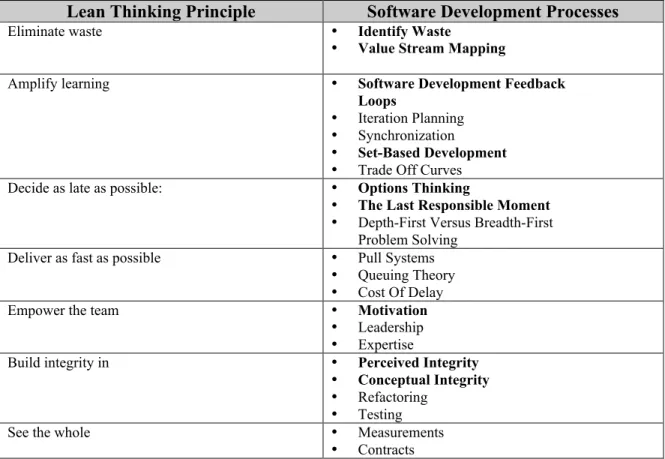
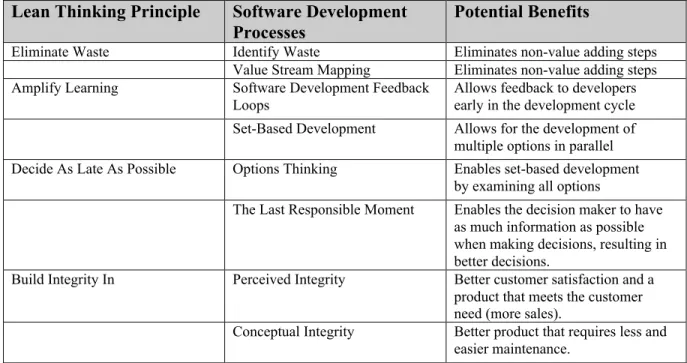
Table 6: Lean Thinking Principles & Process Definitions...46
Table 7: Lean Thinking Principles and Software Development Processes...48
Table 8: The Seven Wastes (from Poppendieck and Poppendieck, 2003)...49
Table 9: Thinking and Software Development Benefits...57
List of Figures Figure 1: Trade-Off Curve Example...38
Chapter I. Purpose of the Study
Brief Purpose
Traditional software development has embraced methodologies that are very serial and structured (Kennedy 2003). Another system is available, called “lean thinking”, that provides an alternative to these traditional methods. Lean thinking is defined by Womack and Jones (1996) as "… a way to specify value, line up value-creating actions in the best sequence, conduct these activities without interruptions whenever someone requests them, and perform them more and more effectively." (p.15). According to several lean thinking experts including James Womack (1996), Mary and Tom Poppendieck (2003), and Michael Kennedy (2003), traditional software development creates wasted engineering efforts. These same authors suggest that lean thinking provides ways to eliminate this waste.
The purpose of this study is to provide aset of resources for software
development managers regarding the principles of lean thinking (Womack and Jones 1996). The intent of these resources is to (1) examine how these principles apply to software development (Kennedy 2003) (2) in ways that have potential to eliminate wasted efforts inherent in the more traditional software development process.
A review of existing literature (Leedy and Ormrod 2001) is conducted to select published materials regarding lean thinking principles and how they relate to software development. The goal of literature selection is not only to obtain information about the principles of lean thinking, but also how lean thinking can be applied to software development to enable organizations to realize the benefits of lean thinking.
Once the literature resources are collected, they are examined using content analysis with a conceptual analysis approach (CSU Writing Center, 2005). Content analysis is conducted in twophases. Phase One identifies the principles of lean thinking and the principles of traditional software development. Phase Two examines selected caseexamples in the literature of the application of lean thinking principles, in order to identify how lean thinking processes can be usedinthe software development process to eliminate wasted efforts inherent in the more traditional software development process.
The results emerging from this content analysis are formatted as a set of resources for software development managers in two different outcomes. The outcome derived from Phase One is presented in two forms: two tables and a set of definitions. The first tableprovides software development managers with a solid foundation of the principles of lean thinking. Overviews of the principles are presented in thetable, including sources cited for each. In addition to the overviews there are detailed definitions of the
principles. A second table provides lists lean thinking software development principles, derived from the writings of Kennedy (2003) and the Poppendiecks (2003). The outcome derived from the Phase Two relates lean thinking principles to traditional software
development processes. The second outcome is presented in two forms: a narrative and a table. The narration aligns a summary of each lean thinking principle to case examples of the software development processes, selected from the literature. This alignment
illustrates lean thinking implementation options in relation to software development in ways that have potential to eliminate wasted efforts. In addition to the narrative, there is a table that lists lean thinking software development principles, derived from the writings of Kennedy (2003) and the Poppendiecks (2004).This table shows which lean thinking
principles can be applied to software development processes and the benefits from the application of the principles, in relation to eliminating waste.
Full Purpose
The purpose of this study is to provide managers who lead software development organizations with an overview of the principles of lean thinking and a set of related resources to enable extension of these principles into the realm of software development. Since lean thinking was originally developed with manufacturing in mind (Womack, Jones and Ross 1991), a discussion on how these principles apply to software
development is extrapolated by the researcher, with emphasis on ways to eliminate wasted efforts.
Traditional software development strategies generally follow a very linear process and are required to adhere to a very structured framework (Kennedy 2003). The linear process includes project management practices that cover how to conduct meetings, format reports, define required reports and other defined procedures. Reports can include Gantt Charts, Pert Charts, Work Breakdown Structures, Task Usage, Resource Usage and others (Gray and Larson 2000). When applied to software development, a set of required meetings are defined including project, design review, code walk-through, schedule status and defect review meetings.
Kennedy (2003) outlines the typical fivestages of software development as system definition, design specifications, subsystem development, prototyping, and final integration. Typically, a very rigid schedule is created in the early stages of a project. If a defect is identified in any phase of the program and it has to loop back to a previous phase, it can result in a restart from that point and the project schedule can be drastically
impacted (Kennedy 2003). This restart can be due to any number of factors, includinga resulting design change, major turmoil in the code base or a change in the project objectives. Adherence to these traditional processes can create waste and reduce an engineer's productivity. On average, as reported by Kennedy (2003), engineers working on projects that followed rigid processes with numerous meetings and reports were only spending 20% of their time in added-value activities, while engineers that followed lean thinking principles were spending 80% of the time on productive tasks.
Another system is available that can be applied to the software development process, called “lean thinking”. Lean thinking provides an alternative to the traditional linear method. Lean thinking is defined by Womack and Jones (1996) as "… a way to specify value, line up value-creating actions in the best sequence, conduct these activities without interruptions whenever someone requests them, and perform them more and more effectively" (p. 15). While lean thinking principles have their foundation in manufacturing, software development organizations should be able to realize benefits when applying them to traditional software development processes (Kennedy 2003). The writings of Kennedy (2003) and Poppendieck and Poppendieck (2003) provide examples of how lean thinking principles can be applied to software development resulting in the elimination of waste that is created by traditional methods.
Principles of Lean Thinking
Lean thinking is based on the concepts of the Toyota Production System
pioneered by Taiichi Ohno in the 1940s. There are seven principles of lean thinking, of which eliminating waste is just one. The full set of seven principles is (Poppendieck and Poppendieck, 2003):
1. Eliminate waste. 2. Amplify learning.
3. Decide as late as possible. 4. Deliver as fast as possible. 5. Empower the team.
6. Build integrity in. 7. See the whole.
A brief explanation of each of the principles as relevant to the focus of this study follows. Viewed as a set, these seven principles are guiding ideas and insights about lean thinking. While the principles are generic, the application of processes must be tailored to a specific environment (Poppendieck and Poppendieck 2003).
Eliminate waste. The core principle of lean thinking that all others are based on is eliminating waste. Once somebody has developed the skillof identifying waste, they have started on their path to implementing lean thinking (Poppendieck and Poppendieck 2003). Ohno defines this waste as anything that does not create value for the customer (Poppendieck and Poppendieck 2003). Ohno (1988) uses the Japanese word muda to identify waste and defines it as:
defects (in products), overproduction of goods not needed, inventories of goods awaiting further processing or consumption, unnecessary
processing, unnecessary movement (of people), unnecessary transport (of goods) and waiting (by employees for process equipment to finish its work or on an upstream activity) (pp. 19-20).
Womack and Jones (1996) provide the following examples of muda:
• Production of items that nobody wants • Processing steps that are not needed • Movement of resources without purpose • People waiting for deliverables
• Defective releases
• Goods and services which don't meet the needs of the customer
Amplify learning. At the center of this principle is the concept to learn from past experience (Womack and Jones 1996). While this concept seems obvious, many times when a problem is solved the solution is not documented. If the issue is seen again the solution has to be reconstructed, resulting in waste (Poppendieck and Poppendieck 2003). Processes need to be put into place to capture and make experiences available in the future.
Decide as late as possible. Traditionally software requirements are established and finalized before any development begins. This approach tends to force designers to establish a depth focus on the project instead a breadth focus (Poppendieck and
Poppendieck 2003). This type of approach is what leads to looping back into a previous stage that was previously mentioned. If design decisions are made earlier rather than later, options for solving problems that are identified later in the development process are limited (Womack and Jones 1996).
The principle of concurrent development or set-based design provides a way to begin with a breadth approach and then when appropriate move to a depth view. The core principle behind concurrent development and set-based design is to work on several different solutions at the same time and as problems surface, eliminate ones that do not meet the needs of the project. The final decision as to which solution to use is prolonged
to the last possible moment, either when only one solution is obviously feasible or when a decision has to be made because other parts of the project are waiting on the solution (Poppendieck and Poppendieck 2003).
Deliver as fast as possible. The more frequent the deliveries are in a project, the sooner issues can be identified (Poppendieck and Poppendieck 2003). If the development team is on a schedule to deliver releases to test once a month, it will take two months for any fixes to be seen in future releases. When this schedule is modified so that the releases are available on a weekly cycle, then fixes are seen in a maximum of two weeks
(Poppendieck and Poppendieck 2003).
Empower the team. This principle addresses the organizational level that decisions are made. Decisions need to be made at the lowest level possible in order to allow the person with the best knowledge of the issue to make the decision (Womack, Jones and Ross 1991). There is a tendency for managers to want to make the final decision since they are the ones who are ultimately responsible. They need to learn to trust the people that have the knowledge to make the right decisions and focus their attention on issues that belong to them (Poppendieck and Poppendieck 2003). Compare this to the way that planning takes place in the Marine Corps. When planning and
executing a campaign, high-ranking officers and intelligence groups plan the strategy and the big picture of the campaign. This includes the high-level goals and responsibilities. Once the mission is underway and issues arise on the battlefield, the officers and men on site make the decisions on how to adjust to address the issues.
Build integrity in. Two types of integrity are defined in this principle by Poppendieck and Poppendieck (2003) -- perceived and conceptual. They write:
Perceived integrity means that the totality of the product achieves a balance of function, usability, reliability and economy that delights customers. Conceptual integrity means that the system's central concepts work together as a smooth cohesive whole. (p. 125).
The Poppendiecks (2003) further define perceived integrity as what the customer thinks the integrity is. It can be influenced by marketing, sales, and other factors that have nothing to do with the true quality of a product. Conceptual integrity is based more on how well the product is designed and developed. When you combine conceptual and perceived integrity the result is what is known as product integrity.
A study at Harvard Business School by Kim Clark (Clark and Fujimoto1994) shows that companies that value product integrity and make it a part of the development methodology consistently deliver superior products. Lean thinking takes this concept to heart and says that product integrity should influence everything you do when making decisions about the development of a product (Ward 2002).
See the whole. In this principle, Poppendieck and Poppendieck (2003) describe a system as not the sum of the parts but the product of the interactions. One of the
challenges for developers is that while they are working on small pieces of the solution they must never lose sight of the overall picture of the product. When developers lose sight of the overall picture, problemsarise around the interaction points of the different parts. (Poppendieck and Poppendieck 2003).
A literature review was selected as the research method for this study (Leedy and Ormand, 2001). The search for literature begins with the reading of Lean Thinking Banish Waste and Create Wealth In Your Corporation (Womack and Jones 1996) and Product Development for the Lean Enterprise (Kennedy 2003). From these readings,
additional resources are identified that provide a base knowledge of the principles of lean thinking. For the second stage of data collection, the writings of Kennedy and the
Poppendiecks are reviewed for a foundation of how to apply lean thinking to software development.
Conceptual Analysis is chosen as the strategy to perform the content analysis of the reviewed literature (CSU Writing Center 2005). The CSU Writing Center guide identifies eight steps in performing conceptual analysis. They are:
1. Decide the level of analysis.
2. Decide how many concepts to code for.
3. Decide whether to code for existence or frequency of a concept. 4. Decide on how you will distinguish among concepts.
5. Develop rules for coding your texts.
6. Decide what to do with “irrelevant” information. 7. Code the texts.
8. Analyze your results.
These steps are used to identify writings with the theme of "lean thinking', "software development" and "waste". Rules are established to further identify writings that
addressed all three of these themes. Additionally these steps allow the data to be analyzed in chunks of manageable data and determine if relevant information is contained. Phase One of the content analysis examines writings that address lean thinking principles as defined by Womack and Jones (1996) and Kennedy (2003). How the principles are being applied or what type of organization is applying them is not taken into consideration. Also included in this phase is an overview of traditional software development principles.
Phase Two examines case study reviews that address how lean thinking principles have been applied to software development organizations
The result of each phase of the content analysis is presented in separate outcomes. The first provides a list of lean thinking principles, framed for the software development manager as a foundation to understand lean thinking principles. The outcome includes detailed explanations of each of the principles with cited references if further information is required and a table that summarizes each of the principles in a one or two sentence definition.
Outcomes of the second phase include examples of how lean thinking principles can be applied to traditional software development procedures. Included in this outcome are examples of how the principles have been applied in real-life experiences, with a summary of the resulting impacts from the implementation of lean thinking principles. A three-column table summarizes the data collected during the second phase of data
analysis. The first column contains a traditional software development process, the second identifies a lean thinking principle that can be applied to it, and the final column lists the resulting benefit related to eliminating waste.
Limitations to the Research
Lean thinking has its roots in the automobile design and manufacturing industry, more specifically, Toyota Corporation (Womack, Jones and Ross 1991). Since the focus of this paper is the application of lean thinking on software development, how lean thinking pertains to manufacturing was not addressed specifically. Reference to Toyota and manufacturing is in the context of background when discussing the principles of lean thinking.
While the foundation upon which lean thinking isbased started at Toyota in the early 1940s (Poppendieck and Poppendieck 2003), it was not recognized as a viable approach to design and development until the early 1990s. The industry was introduced to lean thinking by books like The Machine that Changed the World (1991) by James Womack, Daniel Jones and David Ross.
While traditional software development practices are not the focus of this study, they need to be reviewed and examined for context. Since they are contained as a reference point, only one resource is utilized, Project Management The Managerial Process (Gray and Larson 2000). This book is picked as the single source for traditional software development practices based on the reputation of the authors. They are both long time members of the Portland, Oregon chapter of the Project Management Institute. Both Gray and Larson have published numerous articles concerning management and project management. Their consulting activities focus on project management (Gray and Larson 2000).
Literature with focus pertaining to software development and lean thinking did not appear until late in the 20th century. Works applying lean thinking to software development are found post-1995, while works with focus oncase studies and emphasis on best practices are from the early 2000s. In addition the majority of this literature is from two authors, Mary and Tom Poppendieck. They are recognized by other experts in the field of Lean Thinking. Allan Ward (2002), Michael Kennedy (2003), Jerry
Kilpatrick (2003) and Mark Windholtz (2003)reference them in their works on the subject. The majority of the additional literature located on this part of the subject either supported the Poppendiecks or a review of their publications.
The majority of the literature located on the subject of lean thinking is in the form of case study reviews and examples of lean thinking principles in the industry. Analysis of these case study reviews and examples provide insight into practices that have been successful, and can be expressed assuggested techniques for managers to aid them in their own transition.
Problem Area
Traditional software development has embraced methodologies that are very serial and structured. Requirements and specifications are developed down to the minute detail before coding even begins, as well as multiple teams with very narrow areas of responsibility and structured reporting guidelines (Poppendieck and Poppendieck 2003). The software product life cycle is defined by Gray and Larson (2000) as a process that sequentially passes through definition, planning, execution and delivery phases. The activities that typically occur in each phase are listed in Table 1: Software Product Life Cycle below (from Gray and Larson, 2000).
Definition Planning Execution Delivery
• Goals • Specifications • Tasks • Responsibilities • Teams • Schedules • Budgets • Resources • Risks • Staffing • Status Reports • Changes • Quality • Forecasts • Train customers • Transfer documents • Release resources • Reassign staff • Lessons learned Table 1: Software Product Life Cycle
One of the cornerstones of the traditional project lifecycle is that you must complete one phase of the cycle before you can move onto the next. This process falls apart when a defect or issue is identified in the execution phase that requires a change in
the specifications. If you are following the traditional paradigm to the letter,you must then go back to the definition phase and start over. While the second pass through will be shorter than the original, it may still significantly impact the schedule (Kennedy,2003).
According to Moore (1991), traditional software methodologies work fine when an organization is in the Tornado phase – that time when an organization is working in technology that is new. When new aspects of a technology are developing rapidly, the consumer is willing to pay a premium price for the technology (Moore 1991). In this phase, sales are booming, profit margins are high and budgets are unlimited, resulting in an environment of ‘just do what you have to do to get product out’. Methods used in the Tornado stage produce waste that is considered to be acceptable due to the high profits and ‘just get it out the door’ mentality. This waste is identified by Poppendieck and Poppendieck (2003) as anything that does not create value as perceived by the customer.
Moore (1991) contends that as the technology matures, competitors enter the market and consumers start demanding a more competitive price point. This moves the business into the Main Street phase. In this phase sales are leveling off, profit margins are reduced, and budgets are tight. Managers need to look for ways to reduce
development waste when they have entered the Main Street phase so that software development becomes a lean, mean, producing machine (Moore 1991).
Kennedy (2003) and Womack and Jones (1996) each suggest that one potential benefit of utilizing lean thinking principles in software development is that it may provide an excellent way to reduce the development waste. The waste elimination will result in shortened development time and reduced development cost (Kennedy 2003). Lean thinking is an approach that has been proven successful in several organizations (Womack 1996) for eliminating “waste”.
The following comparison of two similar projects provided by Poppendieck and Poppendieck (2003) demonstratesone example of how these methodologies can affect the outcome of a project:
Jim Johnson, chairman of the Standish Group, told an attentive audience the story of how Florida and Minnesota each developed its Statewide Automated Child Welfare Information Systems (SACWIS). In Florida, system development started in 1990 and was estimated to take 8 years and to cost $32 million. As Johnson spoke in 2002, Florida had spent $170 million and the system was estimated to be completed in 2005 at the cost of $230 million. Meanwhile, Minnesota began developing essentially the same system in 1999 and completed it in early 2000 at the cost of 1.1 million. That’s a productivity difference of over 200:1. Johnson credited Minnesota’s success to a standardized infrastructure, minimized
requirements, and a team of eight capable people. (Johnson 2002 p. xxi). While there is no magic or silver bullet to ensure similar results when applying these types of principles, there are some proven practices that enable higher performance and waste elimination (Poppendieck and Poppendieck 2003). These practices, known as the Toyota Lean Production System, have their roots in automotiveproduction and were developed by Taiichi Ohno working at Toyota in the 1940s. This system results in less direct labor, minimizes work-in-process, reduces parts inventory and results in fewer defects. After realizing the benefits from these practices in their production organization, Toyota leveraged this system into their product development teams and titled this new system Lean Product Development. This system is aimed at elimination of wasted effort and the application of other lean production principles to product development (Kennedy
2003). The phrase lean thinking has become associated with the core principles of both lean production and lean development (Womack and Jones 1996).
Chapter II. Review of References
The review of references provides an annotation of the primary resources used for this paper. These and all other resources are listed in the References. Each annotation addresses the following three issues: a summary of the resource’s content that is pertinent to this study, which sections of the study the resource is relevant to, and the criteria used to select the resource.
CSU Writing Center (2005). Introduction to Content Analysis 2005. Retrieved March 2005 from: http://writing.colostate.edu/references/research/content/.
This web-based source provides an overview of content analysis and how to apply it to a research project. It is maintained by Mike Palmquist and students from the
Department of English at Colorado State University. This source was used as a guideline on how to conduct the content analysis for this paper. It was chosen because of its association with a credentialed institution and Palmquist’s reputation in the field of content analysis.
Gray, C. and Larson, E. (2000). Project Management The Managerial Process Boston: Irwin McGraw-Hill.
Gray and Larson’s book provides a basic understanding of traditional software development principles. Since these principles are not the central focus of this paper, it is the only source used for these principles. Gray and Larson are used to explain traditional software development practices in the Purpose and Problem areas of this study. As stated in the Limitations section of this paper, it was chosen on the reputation of the authors and because it is the primary text for project management in the University of Oregon AIM Masters program.
Kennedy M. (2003). Product Development for the Lean Enterprise Richmond: The Oaklea Press.
This book provides a review of the process a product design organization might go through in making the decision to move toward lean development. It provides a view of what is lacking in traditional product development and how lean principles can address this gap. The book is highly recommended by lean thinking expert Allen Ward as an introduction to lean thinking and how it helps an organization develop the framework for lean thinking. It was chosen based on the recommendation of Dr. Ward who has been a consultant on lean thinking in product development for Hewlett-Packard. Kennedy’s book is quoted in the Purpose and Problem areas of this study to support what is wrong with current software development techniques and how they can benefit from lean thinking.
Moore, G. (1991). Crossing the Chasm New York: Harper Business.
Geoffrey Moore’s book describesthe need to tailor development and marketing strategies for high tech products more carefully than other industries. It provides
examples of how high-tech organizations can make the transition from the Tornado phase of a product into the Main Street phase. Lean thinking is one of the techniques he
discusses.
Moore is quoted in the Purpose area of this study to show some of the issues with product development in the high-tech industry and why some corporations have
This book was selected because of Moore’s in-depth analysis of the issues with development in the high-tech industry and how lean thinking can address these issues.
Ohno, T. (1988). The Toyota Production System: Beyond Large Scale Production Portland: Productivity Press.
Taiichi Ohno was inventor of Just-In-Time (JIT) manufacturing at Toyota. JIT was the foundation upon which lean thinking was built. Ohno’s principles and guidelines are still considered to be the cornerstones of lean thinking and this resource is selected on this basis. Ohno is recognized as the father of lean thinking by experts in the field
including Womack (1991), Poppendieck (2003) and Kilpatrick (2003).
This resource also provides a definition of waste, one of the foundations of lean thinking and a look at the early beginnings of lean thinking. Quotes and data from the resource are utilized in the Problem Area and Analysis of Data sections to aid in the explanation of the origin of lean development.
Poppendieck, M and Poppendieck T.
Mary and Tom Poppendieck are considered to be two of the leading experts in the application of lean thinking to software development. They own and manage
Poppendieck, LLC that is a company dedicated to bringing lean thinking to software development. Both Tom and Mary instruct courses on lean software development and agile design thinking. The Poppendiecks are quoted in the Purpose, Problem and Analysis of Data areas of this study to aid in the definition of lean thinking and how it can be applied to software development.
Several works of the Poppendiecks are selected as key references to support this studybecause of their insight and knowledge of lean software development. This is seen by the volume of the publication, the diversity of where it is published and other experts’ references to them in their own publications.
Poppendieck, M. and Poppendieck T. (2003). Lean Software Development An Agile Toolkit Boston: Addison Wesley.
In this resource, Mary and Tom Poppendieck identify seven lean principles and provide techniques for implementing them in a software development environment. This resource is used as a foundation to identify how to realize improvements in software development organizations from the implementation of lean thinking. Quotations from this publication are used in the Purpose and Analysis of Data sections of this paper to support the theory that lean thinking principles can be beneficial to software
development. It was also utilized in the Problem Area to emphasize the issues with current software development principles.
In addition to the reasons for selecting work by the Poppendiecks already mentioned in the introduction of these authors, this book was selected because of its focus on software development and lean thinking principles. This work is referenced by numerous articles on the web that address lean thinking as it applies to software
development.
Poppendieck, M. (2002). Principles of Lean Thinking. Retrieved March, 2005 from: http://www.poppendieck.com/papers/LeanThinking.pdf.
Mary Poppendieck provides an introduction to lean thinking in this resource. In respect to this study it provides an excellent mapping of lean thinking principles to software development. Quotes from this resource are used to support the application of lean thinking principles to software development in the Analysis of Data area of the study. It was chosen because of the emphasis on lean thinking and software development as well as the reputation of the author as an expert in the field of lean software
development.
University of Oregon (2005). Evaluating Information on the World Wide Web Service of University Libraries. Retrieved March, 2005 from:
http://libweb.uoregon.edu/guides/searchweb/evaluating.html
A web-based resource maintained by the University of Oregon that provides guidelines for evaluating information on the World Wide Web. It provides criteria for researchers to evaluate web articles to determine if the information is credible and viable for their project.
Ward A. (2002). The Lean Development Skills Book Ann Arobt: Dollar Bill Books This publication is a pocket book written by Allen Ward that provides managers a quick reference on how to apply lean development into their organizations. It provides concise definitions of lean thinking principles. The information provided by this publication was used in the Purpose and Analysis of Data areas of this study to provide clarification of lean thinking. Ward is recognized by experts in the field of lean thinking, such as James Womack, to be the leading U.S. authority on Toyota’s product
managers at Hewlett-Packard in 2004. The ideas and concepts presented in this talk formed the impetus for this study.
Womack, J and Jones D. (1996). Lean Thinking Banish Waste and Create Wealth In Your Corporation New York: The Free Press.
In addition to another view on Toyota lean thinking principles, Womack and Jones provide case study reviews of these principles as they areapplied in the
automotive, aerospace and other manufacturing industries. While the information is not focused on software development, it does provide examples and arguments of how lean thinking can improve productivity. Information from this resource provides quotes that aid in the development of the definition of lean thinking and are quoted in the Purpose, d Problem and Analysis of Data areas of this study. Literature, including The Machine That Changed the World, authored by Womack and his associates. Womack is the founder and president of the Lean Enterprise Institute and has authored or co-authored several
publications on lean thinking over the past twenty years including Lean Thinking Banish Waster and Create Wealth In Your Corporation (1990), The Machine That Changed the World, Lean Thinking (1986), Lean Thinking (1996), From Lean Production To The Lean Enterprise (1994) and Beyond Toyota: How to Root Out Waste and Pursue Perfection (1996). Womack is also referenced by Kennedy, Ward and the Poppendiecks in their publications.
Womack, J, Jones, D. and Ross, D. (1991). The Machine That Changed the World Harper Perennial.
Womack, Jones and Ross explain lean production and discuss its implications for development organizations. The explanation is based on a five-year study of the
worldwide auto industry and provides insights on how lean production has improved productivity. Quotes from this resource are used in the Purpose and Analysis of Data areas of this study to support the basic principles of lean thinking and their benefits. It was selected because of Womack’s reputation that is addressed in the review of his work Lean Thinking Banish Waste and Create Wealth In Your Corporation.
Chapter III. Method
Data Collection
Literature review (Leedy and Ormrod 2001) is the method of study used in this work. This technique reviews the works of others and develops a view or interpretation of the data. The researcher began the search for resources on lean thinkingwith a
conversation with colleaguesat Hewlett-Packard who have been active in investigations around lean thinking and software development. They suggested Moore (1991), Womack (1996) and Reinersten. (1997). An initial review ofthese books provided key words and reference points for a literature search.
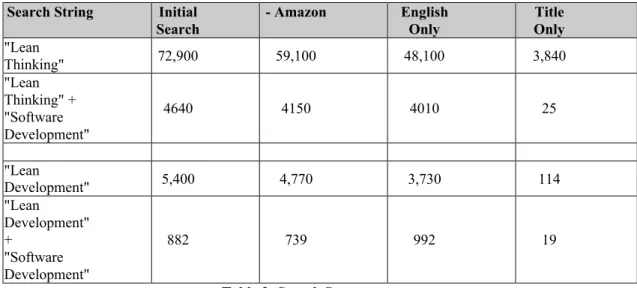
For articles from the WEB the Google search engine is used with lean thinking, lean development and software development as key words. Additional limitations are applied to searches to narrow the results. Results with references to Amazon were removed to eliminate WEB pages that are for ordering books. A restriction to limit the results to articles written in English is also applied. A final restriction is placed to limit results in which the key phrases are part of the title. The refined searches and their results arelisted in Table 2: Search Strategy.
Search String Initial Search - Amazon English Only Title Only "Lean Thinking" 72,900 59,100 48,100 3,840 "Lean Thinking" + "Software Development" 4640 4150 4010 25 "Lean Development" 5,400 4,770 3,730 114 "Lean Development" + "Software Development" 882 739 992 19
Table 2: Search Strategy
The resulting 44 articles are evaluated for authority, objectivity, accuracy and currency as outlined by the University of Oregon Libraries (2005). Authority addresses who the author is, what are their credentials and institutions with which they are
affiliated. Objectivity tries to identify the purpose of the paper, if the goals of the paper are stated, and if the paper is designed to educate or if it is a soapbox for the author and if any affiliation bias is evident in the paper. Accuracy is used to evaluate the paper in respect to the grammar, formatting, layout and completeness. Finally currency looks at the creation/revision dates, do all of the links work and if the paper has been kept current. This evaluation results in 32 web articles for data analysis.
The initial review of the works of Kennedy (2003), Moore (1991) and Womack (1996)also identifies several books for review such as Beck (2000), Reinerstein (1997), Poppendieck and Poppendieck (2003), Cusummano (1998) and Ward (2002) on the subject of lean thinking and it's application to software development. A Web page at http://www.poppendieck.com/overview.htm is managed by Mary and Tom Poppendieck and provides resources addressing lean thinking and software development and it is used as a resource in this area.
Data Analysis
Conceptual Analysis is chosen as the strategy to perform the content analysis of the selected literature (CSU Writing Center 2005). The CSU Writing Center guide
identifies eight steps in performing conceptual analysis. The data analysis is performed in two phases. During Phase One, data is analyzed that pertains to lean thinking principles in general. These steps are applied in the following manner.
1. Decide the level of analysis. – In this step it is decided to code for the occurrence of the phrase lean thinking.
2. Decide how many concepts to code for. – With the focus of this phase being the principles of lean thinking without reference to any type of organization, the analysis is performed using the single concept of lean thinking.
3. Decide whether to code for existence or frequency of a concept. – Since the analysis is looking for literature pertaining to the principles of lean thinking, existence of the term and related concepts is coded for instead of frequency. 4. Decide on how you will distinguish among concepts. – Lean thinking principles
are additionally referred to as lean development; therefore, both phrases are coded for to identify the desired concepts.
5. Develop rules for coding your texts. – Coding is performed by identify which lean thinking principle, as identified by Poppendieck and Poppendieck (2003), is referred to in an article.
6. Decide what to do with “irrelevant” information. – References to how lean thinking is implemented in specific organization are ignored since the researcher is looking for general information
7. Code the texts. – The coding of the text is performed by keeping notes from the readings of the sources in a Microsoft Word document. These notes are coded with references to appropriate principle, source and page.
8. Analyze your results. – Analysis of the data is performed by examining the different views obtained from the selected literature and then developing a combined description of the lean thinking principles.
In Phase Two of the content analysis, data is analyzed that examines how lean thinking principles can be applied to software development.
1. Decide the level of analysis. – In this step it is decided to code for the occurrence of both lean thinking and software development
2. Decide how many concepts to code for. – With the focus of this phase being how the principles of lean thinking can be applied to software development the
analysis isperformed using both the concepts of lean thinking and software development.
3. Decide whether to code for existence or frequency of a concept. – Again, in this step occurrence is code for existenceinstead of frequency.
4. Decide on how you will distinguish among concepts. – Lean thinking principles are additionally referred to as lean development and thus both phrases are coded for to identify the desired concepts. In addition, software development is also referred to as software project management and software program management so all three of these terms will need to be considered while reviewing data.
5. Develop rules for coding your texts. – Coding is performed by identifying which of the lean thinking principles (Poppendieck and Poppendieck 2003) is referred to
in the literature and which software development practices it is applied to (Gray and Larson 2000).
6. Decide what to do with “irrelevant” information. – References to other paradigms besides lean thinking and how they apply to software development are ignored since that is not the focus of this paper.
7. Code the texts. – The coding of the text is performed by keeping notes from the readings of the sources in a Microsoft Word document. These notes are coded to reference to appropriate principle, source and page.
8. Analyze your results. – Analysis of the data is performed by examining the different ways lean thinking has been, or can be, applied to traditional software development processes. Then a combined description is developed.
Data Presentation
The results of each phase of the content analysis are presented in separate
outcomes. The first result provides a list of lean thinking principles, which is then framed for the software development manager (see Table 4: Lean Thinking Principles and Their Components).
This outcome provides detailed explanations of each of the principles with cited references if further information is required. And while specific examples of the
implementation of these principles are not provided, examples of general usage are included. In addition to the detailed explanation there is a table that summarizes each of the principles in a one or two sentence definition.
Results of the second phase of content analysis are framed into a table (See Table 5: Lean Thinking Principles and Processes), presenting examples of how lean thinking
principles can be applied to traditional software development procedures. Included in this outcome are examples of how the principles have been applied in real-life experiences, with the resulting impacts. These examples are taken from case study reports and other references to lean thinking and software development in industry. The three-column table contains a traditional software development process in the first column, a lean thinking principle that can be applied to it in the second column, and a description of the resulting benefit related to eliminating waste in the final column.
Chapter IV. Analysis of Data
Data analysis is conducted in two phases as describe in the Data Analysis section of the Method chapter. Thirty-two sources are selected using the criteria outlined by the University of Oregon Libraries (2005). This criterion is authority, objectivity, accuracy and currency. The analysis is conducted using conceptual analysis as described by the CSU Writing Center (2005). Conceptual analysis is composed of eight steps and the application of these steps to this study is explained in the Data Analysis section in Chapter III. Method.
Phase one of data analysis is aimed at locating material that provides a detailed definition of lean thinking in general. Jerry Kilpatrick (2003) defines lean thinking as:
A systematic approach to identifying and eliminated waste through continuous improvement, flowing the product at the pull of the customer in pursuit of perfection. (p. 1)
While this definition provides a general overview, a much more detailed definition is presented in the Principles of Lean Thinking section of this chapter, as a result of the data analysis. Also presented in this section is additional explication ofthe core principles of lean thinking. Mary and Tom Poppendieck list seven principles in their book Lean Software Development An Agile Toolkit (2003). A set of ten principles is presented in Mary Poppendieck’s paper entitled Lean Programming (2001). Other experts in the field provide both lists of seven (Kilpatrick 2003) and ten principles (Womack and Jones 1996). While the lists are different in the way they are presented and seldom match exactly, the list of seven principles provided by the Poppendiecks (2003) and explained in the Full Purpose Section in Chapter 1: Purpose of the Study, is representativeof all of the
lists. The longer lists just break some of the principles down into two. For clarification, the list use in this study is repeated below (Poppendieck and Poppendieck, 2003):
1. Eliminate waste 2. Amplify learning
3. Decide as late as possible 4. Deliver as fast as possible
5. Empower the team 6. Build integrity in 7. See the whole
Phase two of data analysis is focused in providing the reader with processes that can be utilized in applying lean thinking principles to software development. While there aredefinite differences between the types of production systems from whichthe
principles of lean thinking sprout and software development, there are enough similarities that enable software development organizations to benefit from lean thinking
(Poppendieck and Poppendieck 2003). When this application occurs it isknown as Lean Software Development (LSD) Windholtz (2003). Windholtz (2003)defines LSD as a system “…to develop software in one-third of the time, with one-third the budget and with one-third the defect rate.”
The Lean Thinking and Software Development section of this chapter provide techniques for applying lean thinking to software development. Also provided is a demonstration ofhow lean thinking principles map into the activities associated with software development.
Principles of Lean Thinking
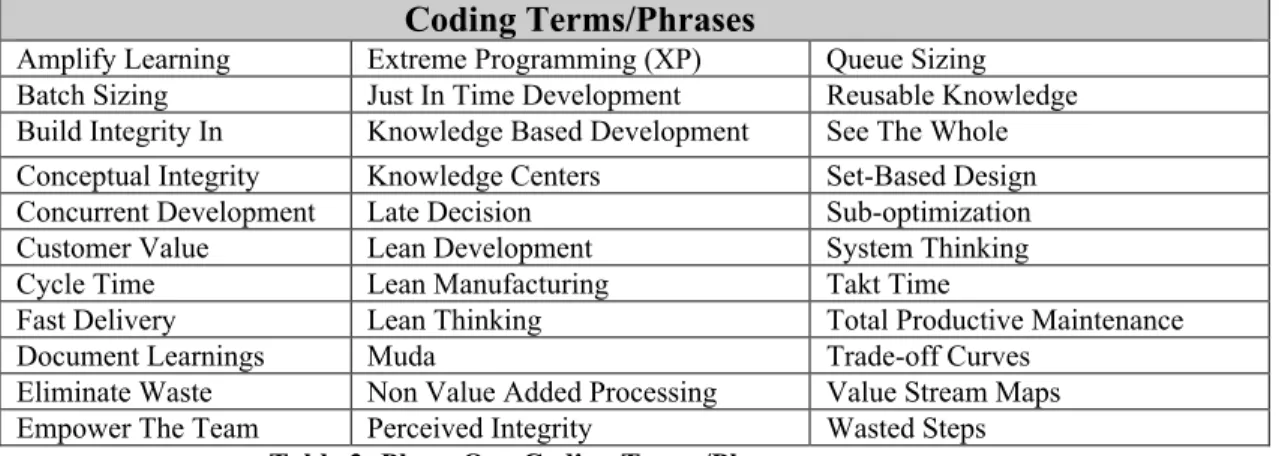
The first phase of data analysis in this studyis the coding of sources for lean thinking principles in general. A list of words, terms and phrases that relate to lean thinking principles is created from the book Lean Software Development An Agile Toolkit
(Poppendieck and Poppendieck, 2003). These terms and phrases are listed in Table 3: Phase OneCoding Terms/Phrases.
Coding Terms/Phrases
Amplify Learning Extreme Programming (XP) Queue Sizing
Batch Sizing Just In Time Development Reusable Knowledge
Build Integrity In Knowledge Based Development See The Whole
Conceptual Integrity Knowledge Centers Set-Based Design
Concurrent Development Late Decision Sub-optimization
Customer Value Lean Development System Thinking
Cycle Time Lean Manufacturing Takt Time
Fast Delivery Lean Thinking Total Productive Maintenance
Document Learnings Muda Trade-off Curves
Eliminate Waste Non Value Added Processing Value Stream Maps
Empower The Team Perceived Integrity Wasted Steps
Table 3: Phase OneCoding Terms/Phrases
After the list is created, seventeen sources are reviewed for the occurrence of these terms or phrases and recorded in a separate form for each source. References to how a specific organization implemented lean thinking are ignored since the goal is to obtain a definition of lean thinking. The format used to record the coding results is located in Appendix B – Phase OneCoding Form. In addition to this coding of the existence of the terms, each source and specific page number isnotated forfurther reference (see Appendix C: Phase One Coding Results – Terms that Define Lean Thinking).
Additional analysis is performed to identify similar ways of identifying the same lean thinking principle. Similar data is aligned with a primary category according to which lean thinking principle it represents. The resulting reorganizeddata is listed in Table 4: Lean Thinking Principles and Their Components. This table provides a mapping of the termsandphrases used in the coding of the data to the principles of lean thinking. It provides some insight into just what each ofthese principles means.
Lean Thinking Principles Components
1. Eliminate waste •
Muda
• Non Value Added Processing
• Value Stream Maps
• Wasted Steps
2. Amplify learning •
Concurrent Development
• Document Learning
• Knowledge Based Development
• Knowledge Centers
• Re-usable Knowledge
• Set-Based Design
• Trade-Off Curves
3. Decide as late as possible: •
Just In Time Development
• Late Decisions
4. Deliver as fast as possible •
Extreme Programming • Queue Sizing • Batch Sizing • Cycle Time • Queue Sizing • Takt Time
5. Empower the team • Make Decisions At The Right Level
• Self-Determination
• Motivation
6. Build integrity in • Conceptual Integrity
• Customer Value
• Perceived Integrity
7. See the whole • System Thinking
• Sub-optimization
Table 4: Lean Thinking Principles and Their Components
Before beginning the discussion of the seven principles of lean thinking, additional information around lean thinking in general and its history is required.
Womack, Jones and Ross (1991) introduced the world to the term “Lean Thinking”. They suggest that lean thinking started back with Henry Ford and his production line
innovations. While lean thinking may have started with Ford, the basic lean thinking principles as they are known today evolved after World War II from a small Japanese automobile company named Toyota and one of their engineers named Taiichi Ohno. The guiding principle of lean thinking is the absolute elimination of waste (Poppendieck 2001).
The Toyota organization was a successful spinning and weaving company and Ohno already had knowledge about how to build a good product. Basic ideas, such as
stopping the weaving machine as soon as a flaw was detected, were applied to
automotive manufacturing. Ohno insisted that each automobile part was inspected for defects the minute it was produced and gave the power to the inspector to stop the line when a defect was identified (Womack, Jones and Ross 1991).
In describing an organization that is not lean, Poppendieck (2002) discusses the way Sears centralized theeyeglass laboratory of the first half of the 20th century. It consisted of a long distribution channel that included centralized equipment, huge distribution centers and lengthy distribution channels to realize the economies of scale. These mass production techniques create a huge amount of work that does not add end user value. The shipment of eyeglasses to a factory for one hour of processing adds far more time to the overall process than the manufacturing of them. Sears had a practice of building up an inventory of orders, resulting in having to track these orders, numerous queries about these orders, and constant order changes.
Womack, Jones and Ross (1991) compare lean thinking to this kind of long distribution channel:
The lean producer, by contrast, combines the advantages of craft and mass production, while avoiding the high cost of the former and the rigidity of the later… Lean production is ‘lean’ because it uses less of everything compared with mass production – half the human effort in the factory, half the manufacturing space, half the investment in tools, half the engineering hours to develop a new product in half the time. Also, it requires keeping far less than half the inventory on site, results in many fewer defects, and produces a greater and ever growing variety of products. (p. 13)
Lean thinking principles provide a different aspect on concepts most managers are taught in school. Jerry Kilpatrick (2003) provides a table with a comparison (see Table 5: Traditional and Lean Views of Development Concepts).
Development Concept Traditional Organization Lean Organization
Inventory An asset, as defined by
accounting terminology
A waste – ties up capital and increase processing lead-time Ideal Economic Order Quantity
and Batch Size
Very large – run large batch sizes to make up for process downtime
ONE – continuous efforts are made to reduce downtime to zero
People Utilization All people must be busy all the
time.
Because work is performed based directly upon customer demand, people might not be busy
Process Utilization Use high-speed processes and run
them all the time.
Processes need to only be designed to keep up with demand
Work Scheduling Build products to forecast Build products to demand
Labor Costs Variable Fixed
Work Groups Traditional (functional)
departments
Cross-functional teams
Accounting By traditional Financial
Accounting Standards Board
“Through-put” Accounting
Quality Inspect/sort work at end of
process to make sure we find all errors
Processes, products and services are designed to eliminate errors Table 5: Traditional and Lean Views of Development Concepts (from Kilpatrick, 2003)
The previous paragraphs provide an overview of lean thinking and its origins in Toyota Manufacturing. With that understanding, each of the seven principles analyzed in this study are described in further detail below. Each component of each principle is not examined; rather, selected components that best demonstrate the intention of the principle are addressed.
Principle 1 - Eliminate waste
The core principle of lean thinking that all others are based on is eliminating waste. Ohno defines this waste as anything that does not create value for the customer (Poppendieck and Poppendieck 2003). Value is measured by customer perception -- it doesn’t matter if it makes things easier for the manufacturer, if it improves the profits of the company, or if it looks good on somebody’s resume. If when viewed by the customer it is not perceived as providing value to them, then it is waste (Womack and Jones, 1996).
Muda: Taiichi Ohno (1988) uses the Japanese word muda to identify waste and defines it as:
…defects (in products), overproduction of goods not needed, inventories of goods awaiting further processing or consumption, unnecessary
processing, unnecessary movement (of people), unnecessary transport (of goods) and waiting (by employees for process equipment to finish its work or on an upstream activity) (pp. 19-20).
Non-value Added Processing: Muda has become one of the buzz words for lean thinking. Supporters of these principles use muda on a regular basis to
describe things that do not add value. When listening to a group of lean thinkers it is not unusual to hear them say something is “muda” when it is determined to add no value. Womack and Jones (1996) provide the following examples of muda:
• Mistakes that require rectification • Production of items that nobody wants • Processing steps that are not needed • Movement of resources without purpose • People waiting for deliverables
• Defective releases
• Goods and services which don't meet the needs of the customer
In addition to this definition of muda, Shigeo Shingo identifies seven types of manufacturing waste, including: inventory, extra processing, overproduction, transportation, waiting, motion and defects (Shingo 1981).
Value Stream Maps: One way to identify waste is to create a value stream. Value streams are defined by Womack and Jones (1996) as “… the set of all the specific actions
required to bring a specific product through the three critical management tasks of any business”. They further define these tasks as problem-solving, information management and physical transformation.
Problem-solving – Taking a concept from design to engineering to production.
Information Management – The management of the flow of customer orders from order-taking to the delivery schedule to the actual delivery of the product.
Physical Transformation – The process by which raw materials are transformed into a finished product.
Analysis of these value streams will result in assigning each step in the value chain to one of the following three categories: (1) Steps that unambiguously create value. (2) Steps that create no value whatsoever, but are unavoidable with current technologies. (3) Steps that create no value at all and can be immediately eliminated (Womack and Jones 1996).
Wasted Steps: Documents, diagrams, and other artifacts that are produced during the product development are only considered waste if nobody uses them. If business policies or processes require that an engineer or developer create a report that is never used by another step in the value chain, then it is muda. Poppendieck (2001) states “The burden is on the artifact to prove not only that it adds value to the final product, but also that it is the most efficient way of achieving that value.”
Principle 2 – Amplify Learning
The central idea behind this principle is to retain your knowledge and make a decision based upon that knowledge. This is so obvious, but is one of the hardest to
accomplish. There is a whole area of study that addresses this principle known as
Knowledge Based Development (KBD). The premise is to document knowledge learned so it does not have to be recreated in the future and is accessible to whoever requires it (Kennedy 2003).
Concurrent Development and Set-Based Design: Amplifying knowledge is not just about retaining what you have learned, but using concepts such as set-based design, concurrent development and tradeoff curves in addition to retained knowledge to make data-driven decisions. Set-based design and concurrent development are ways to design and develop multiple solutions for a problem in parallel. Instead of trying to predict the future by choosing one solution at the beginning of development, the design/development team selects multiple solutions and eliminates the non-optimal ones at the appropriate point. Some are eliminated as soon as they are discussed, others in the design phase, and more in the early stages of development until finally a clear optimal choicecan be made (Poppendieck and Poppendieck 2003). At first glance this may seem like waste, but the learning from each eliminated option can be leveraged into development of the remaining options. While there are arguments that set-based design and concurrent development still create waste, but in comparison,finding out three-quarters of the way through
development that the choice you made during design is invalid and having to start over generates significantly more waste (Ward 2002).
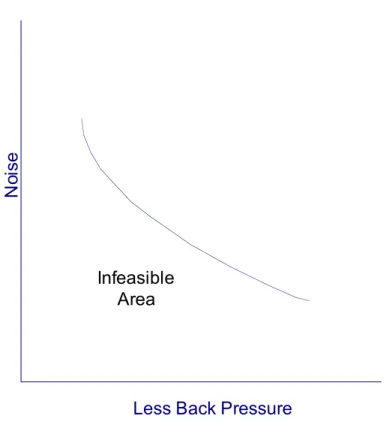
Trade-off Curves: A trade-off curve is model used to make a data-based decision. They make visible the physics and economics of a product or process. They can also show the physical limitations of a solution and where the value points are (Ward 2002). An example of a trade-off curve is shown in Figure 1. This curve sketches the
on the curve are the infeasible regions, while the points on the curve are actual solutions. With this curve a decision can be made as to the optimal level of back-pressure to achieve an acceptable level of noise.
N
oi
se
Less Back Pressure Infeasible
Area
Figure 1: Trade-Off Curve Example
The core value of this principle is to retain knowledge and use that knowledge to make decisions based on data, not assumptions (Ward 2002).
Document Learning: Documentation of the process including cycle times, work flow and process definitions was created by the workers who performed the work, not desk-bound engineers (Womack, Jones and Ross 1991). This empowered the individuals and made them feel like part of the team. This team building also created almost a choreographed flow similar to a relay race team on the production line. As one process was completed, the baton was handed off to the next worker on the line. A culture where workers took pride and ownership in the entire product evolved resulting in an
environment where when one worker had to reset a machine or recover from some other malfunction, co-workers came to their aid.
Principle 3 - Decide as late as possible
The principle of deciding as late as possible is closely tied to set-based design and concurrent development. Windholtz (2003) says that the idea here is to wait to make any decision until the last possible moment and that moment is the point at whichif you do not make a decision, an outside factor is going to make it for you. This late decision-making helps keep options open since if you have not made a choice, you still have multiple options. Also, if you have multiple options and one of them proves to be non-optimal, you do not have to realize the change cost that is associated with starting up a new option.
An example of this principle in today’s market is provided by Poppendieck (2001):
“In a market in which volatile technology requires constant product upgrades, Dell Computer has a huge advantage over its keenest
competitors because it doesn’t forecast demand; rather it responds to it by making-to-order in an average of 10 days. While Dell holds only days’ worth of inventory, its competitors maintain weeks’ worth. Dell’s ability to make decisions as late as possible gives the company a significant competitive edge in a fast-moving market.” (p. 4)
This is an excellent example of making a decision as late as possible. Dell waits until the last possible moment to buy components and then to build the PCs. This allows them to maintain minimum inventory of just what they need both in parts and finished product.
Enrico Zaninotto, an Italian economist, states that the underlying mechanism for controlling complexity in just-in-time systems (JIT) is minimizing irreversible actions (Poppendieck and Poppendieck 2003). Zaninoto also states that when a system that has options built into it is confronted by a system that has no options available, the system with the options will win in a complex market.
The final decision as to which solution to use is prolonged to the last possible moment, either when only one solution is obviously feasible or when a decision has to be made because other parts of the project are waiting on the solution. Delaying irreversible decisions until this last possible moment when uncertainty has been minimized leads to better decisions, limits risks, and provides value to the customer (Poppendieck and Poppendieck 2003).
Principle 4 - Deliver as fast as possible
The principle of ‘deliver as fast as possible’ complements ‘decide as late as possible’. The less time between deliveries, the later you can make decisions. If it takes weeks instead of months to see the results of a change, you can make a decision about a change later in the process (Poppendieck and Poppendieck 2003).
Advantages of rapid delivery can also be seen in the requirements process. Windholtz (2003) states that the amount of change in requirements increase non-linearly as the length of the project increases. A typical 12-month process will generate a 25 percent change in requirements. However, the amount of average change over any given month is only 1–2 percent. By delivering more frequently, you can reduce the amount of change between any two deliveries during the development of a product.
Care must be taken when interpreting the meaning ofthe title of this principle. While it reads “deliver as fast as possible”, it really means deliver as fast as is reasonable.
If a development team is told to deliver a product to test every morning, but it takes three days to perform the testing procedures and then it takes the developers two days to get fixes into a new product,then delivery on a daily basis does not add value. The idea behind this principle is to deliver on a schedule that optimizes development and provides usable deliveries for partners in the value chain (Reinerstsen 1997).
One way to determine the optimal time between deliveries is to utilize queuing theory. A quick summary of how it works is provided by Poppendieck and Poppendieck (2003):
1. Measuring the amount of work waiting to be done is equivalent to measuring the cycle time of a system.
2. As variability increases (in arrival time or processing time), cycle time and work-in-queue will increase.
3. As batch size increases, variability in arrival and processing time increases and therefore cycle time and work-in-queue will increase.
4. As utilization increases, cycle time will increase non-linearly.
5. As variability increases, the non-linear cycle time happens at ever-lower levels of utilization.
6. Continuous flow requires a reduction in variability.
7. Variability may be reduced by an even arrival of demand, small batches and an even rate of processing and parallel processing.
8. Decreasing variability early in the process has larger impact thandecreasing variability late in the process.
The application of queuing theory will enable an organization to optimize batch sizes and reduce cycle times resulting in a delivery schedule that is both fast and efficient.
Principle 5 - Empower the team
The quality of a team is the most important element in successfully delivering a product. If you make the team responsible for the outcome and give them the power to make decisions on how to make it happen, you have a group that is willing to take responsibility, motivated and acts like a team (Kilpatrick 2003).
Make Decisions at the Right Level: Empowering the team allows the decision-making process to be driven down to the lowest possible level in the organization
(Womack, Jones and Ross 1991). The concept behind this principle is to allow the person who has the most knowledge about an issue to make the decision about how to resolve it. When there is a problem, a team of outside experts are not sent in to document what is wrong and how the process should be performed. People who know what is going on, the workers, are given the tools to evaluate and improve the process. Supervisors are trained to encourage work teams to solve their own problems (Poppendieck 2001).
An excellent example of the power of this principle is the General Motors plant in Freemont, California. GM closed it down in 1982 because of low production, low quality, high absenteeism and union problems. In 1984 it was reopened by the New United Motor Manufacturing, Inc. (NUMMI), a joint venture between GM and Toyota. Toyota
managed the plant, but rehired eighty-five percent of the former employees including the entire union leadership. By 1986 the plant had the highest productivity rate of any GM plant, the lowest absenteeism rate and the substance abuse problems they had before the closure was now minimal. What happened? Management first taught employees how to design their own jobs then created small teams that designed their own work procedures and work standards with teams doing the same job on different shifts. Management and
engineers are there as tools for the teams to accomplish their jobs, not to dictate how they are done. Each team was given the responsibility for its own procedures, its own quality and for the smooth flow of parts from upstream to downstream teams (Poppendieck and Poppendieck 2003).
Motivation: Another way to empower a team is to give them purpose. People generally want to have a purpose in life and when they have that purpose they care about fulfilling it. Poppendieck and Poppendieck (2003) provide the six ways to help a team gain and hold a sense of purpose.
• Give them a clear and compelling purpose • Be sure the purpose is achievable
• Give the team access to customers • Let the team make its own commitments • Management’s role is to run interference • Keep skeptics away from the team
Self-determination: These are only a few ways to aid a team in holding onto a purpose and empowering them to be accountable for themselves. If team membershave a purpose and feel that they are responsible for it, then they will take ownership of the product they are producing.
In the Full Purpose section of Chapter 1. Purpose of the Study, the United States Marine Corp providesan example of the empowerment of the team principle. In the Marines decisions are made at the level that makes sense for the situation and time. During the high level planning stages of a mission, top level command are involved in the decision process of taking on a particular mission. During the next phase of the planning where it is decisions are made about when the operation will take place and who will be