Archive University of Zurich Main Library Strickhofstrasse 39 CH-8057 Zurich www.zora.uzh.ch Year: 2006
Document clustering in large German corpora using Natural Language
Processing
Forster, Richard
Abstract: Seitdem die Computer und das Internet in unseren Alltag getreten sind, hat die Informa-tionsmenge, zu der wir theoretisch Zugang haben, exponentiell zugenommen. Eine Methode, um diese gewaltige Datenflut zu bewältigen, ist die Clusteranalyse, mit der grosse unstrukturierte Textmengen in Haufen von miteinander verwandten Dokumenten unterteilt werden können. Text-Clustering besteht aus zwei grundlegenden Schritten: der Text-Repräsentation und dem Clustering. Trotz umfangreicher Literatur zur Clusteranalyse fehlt ein eigenständiges Lehrbuch zum Text-Clustering, weshalb der erste Teil dieser Arbeit einer systematischen Übersicht über die Cluster-Algorithmen und die geläufigen Repräsentationsmethoden gewidmet ist. Anschliessend wird ein Schema zur Klassifikation von Text-Clustering-Anwendungen eingeführt, das sich an den zeitkritischen Komponenten orientiert. Der zweite Teil untersucht die Verwendung Natürlichsprachlicher Datenverarbeitung (Natural Language Processing - NLP) bei der Text-Repräsentation. Zu diesem Zweck werden fünf grosse deutsche Korpora zusam-mengestellt und beschrieben. NLP-Techniken aller Art werden über den fünf Sammlungen zur Anwen-dung gebracht und evaluiert. Es zeigt sich, dass der Erfolg vieler NLP-Methoden vom jeweiligen Korpus abhängt, wofür hypothetische Erklärungen formuliert werden. Insgesamt sprechen die Ergebnisse sowohl für wie wider den Einsatz von NLP. Für die Mehrheit der untersuchten Fälle kann jedoch ein deutliches Verbesserungspotential durch Natürlichsprachliche Datenverarbeitungsmethoden gezeigt werden. Ever since the advent of computer systems and, in particular, the Internet, the amount of information theoret-ically at our disposal has been increasing exponentially. One way to deal with the extraordinary flood of data is cluster analysis. It is used here to divide large unstructured document corpora into groups of more or less closely related documents. Document clustering consists of two fundamental stages: document representation and clustering. Despite a number of detailed textbooks on cluster analysis in general, no such work seems to have been carried out on the specific needs of document clustering. The first part of the thesis is therefore dedicated to comprehensive surveys of existing clustering algorithms and document representation techniques. In addition, a scheme is presented for classifying different clustering applica-tions in accordance with their time-criticality. The second part of the thesis is devoted to an evaluation of Natural Language Processing (NLP) as a means of improving the document representations. To this end, five large German data sets have been compiled and described. NLP techniques ranging from the very simple to complex syntactic and semantic models were evaluated on these five data sets. It emerges that the success of many NLP representation techniques depends on the data under consideration, for which a hypothetical explanation is offered. All in all, evidence is found both pro and contra Natural Language Processing. For the majority of individual cases, distinct potential for improvement through NLP can be shown.
Posted at the Zurich Open Repository and Archive, University of Zurich ZORA URL: https://doi.org/10.5167/uzh-163398
Originally published at:
Forster, Richard. Document clustering in large German corpora using Natural Language Processing. 2006, University of Zurich, Faculty of Arts.
Document Clustering
in Large German Corpora
Using
Natural Language Processing
Thesis
presented to the Faculty of Arts
of the University of Zurich
for the degree of Doctor of Philosophy
by
Richard Forster
of Neunkirch (SH)
Accepted on the recommendation of
Professor Dr. Michael Hess and
Professor Abraham Bernstein Ph.D.
Abstract
Ever since the advent of computer systems and, in particular, the Internet, the amount of infor-mationtheoreticallyat our disposal has been increasing exponentially. This phenomenal growth in data is not only a blessing: the more information is available, the more difficult it becomes to find one’s way to the particular piece of information of interest. As a consequence, investigations into old and new techniques for dealing with the extraordinary flood of data remain topical for information science.
Cluster analysis has a rich and independent history of its own. Relatively recently it has acquired two new application areas in the fields of Information Retrieval and Data Mining. Clustering is used here to divide large unstructured document corpora into groups of more or less closely related documents. The clusters can then be used as a well-arranged interface to a potentially huge and overwhelming number of documents, allowing a prospective user to home in quickly on his specific requirements.
Document clustering consists of two fundamental stages: document representation(the trans-formation of documents as linear strings of words into suitable data structures) andclustering (the algorithmic grouping of these representations). Despite a number of detailed textbooks on cluster analysis in general, no such work seems to have been carried out on the specific needs of document clustering. Special attention is therefore paid to a comprehensive introduction. The first part of the thesis is dedicated to systematic surveys of existing clustering algorithms (with emphasis on those used for documents) and document representation techniques as encountered in practice. Particular care has been taken with the presentation of a uniform notation since the cluster analysis literature is notoriously rich in notations and multiple names for, often, one and the same concept. In addition, a scheme is presented for classifying different clustering applications in accordance with their time-criticality.
The second part of the thesis is devoted to an evaluation of Natural Language Processing (NLP) as a means of improving the document representations. More generally, the goal has been to help answer the old key question of whether or not the extra effort usually required for sophisticated NLP applications is rewarded by sufficient extra benefits; document clustering provides one typical battle-ground.
To this end, five large German data sets have been compiled and described. Each consists of several thousand documents and each was extracted from a specific source (two news outlets, two book services and one encyclopaedic data base). In each data set the documents carried separate content labels derived from meta-information provided by the original source. Serving as “objective truths”, these labels were used to evaluate the performance of different clustering algorithms and document representations.
NLP techniques ranging from the very simple to complex syntactic and semantic models were then tested and evaluated on these five data sets. The techniques were divided into two groups: those aiming at a reduction of the representation complexity (with the twofold goal of achieving qualitative improvements and quantitative savings) and those aiming to enhance document representation with extra features (the goal now only being to improve the results through a more refined representation). Separately, there followed an evaluation of how well the various techniques worked together.
The thesis ends with an interpretation of the results, a discussion of the virtues shown by NLP methods in this particular domain and an overview of future research areas. It emerges that the success of many NLP representation techniques depends on the data under consideration, for which a hypothetical explanation is offered. All in all, evidence is found both pro and contra Natural Language Processing. For the majority of individual cases, distinct potential for improvement through NLP can be shown.
Zusammenfassung
Seitdem die Computer und das Internet in unseren Alltag getreten sind, hat die Informations-menge, zu der wir theoretisch Zugang haben, exponentiell zugenommen. Dieses Wachstum ist nicht nur ein Segen; denn je mehr Informationen uns zur Verf¨ugung stehen, desto schwieriger wird es, genau die gew¨unschte Einzelinformation zu finden. Die Erforschung von alten und neuen Strategien zur Bew¨altigung dieser Datenflut steht deshalb noch immer im Zentrum der Informationswissenschaften.
Die sogenannte Clusteranalyse blickt auf eine abwechslungsreiche Geschichte zur¨uck, doch wurde sie erst vor relativ kurzem f¨ur das “Information Retrieval” und “Data Mining” entdeckt. Sie wird hier dazu gebraucht, grosse unstrukturierte Textmengen in Gruppen oder Haufen (“Clus-ters”) von mehr oder weniger stark miteinander verwandten Dokumenten zu unterteilen. Daraus lassen sich einfache und ¨ubersichtliche Schnittstellen zu potentiell riesigen Korpora gewinnen, die es dem Anwender erlauben, schnell zu den f¨ur ihn relevanten Texten vorzustossen.
Text-Clustering besteht aus zwei grundlegenden Schritten: der Text-Repr¨asentation (Um-wandlung von Texten als Zeichenketten in geeignete Datenstrukturen) und demClustering (Ana-lyse dieser Repr¨asentationen und Ordnung in Gruppen). Trotz umfangreicher Literatur zur Clusteranalyse fehlt ein eigenst¨andiges Lehrbuch zum Text-Clustering, weshalb in der vorliegen-den Arbeit besonderer Wert auf eine umfassende Einleitung gelegt wurde. Der erste Teil der Dis-sertation besteht aus einer systematischen ¨Ubersicht ¨uber die Vielfalt der Cluster-Algorithmen (mit Schwerpunkt auf den f¨ur das Text-Clustering interessanten Methoden) und ¨uber die gel¨ aufi-gen Text-Repr¨asentationsmethoden. Angesichts der zahlreichen Synonyme und vielf¨altigen Nota-tionen in der Clusteranalyse-Literatur wird dabei speziell auf eine einheitliche Notation geachtet. Anschliessend wird ein Schema zur Klassifikation von Text-Clustering-Anwendungen eingef¨uhrt, das sich an den zeitkritischen Komponenten orientiert.
Der zweite Teil der Dissertation untersucht die Verwendung Nat¨urlichsprachlicher Datenver-arbeitung (Natural Language Processing – NLP) bei der Text-Repr¨asentation. Auf einer h¨oheren Ebene geht es dabei um die Frage, ob der oft betr¨achtliche Zeitaufwand f¨ur NLP durch qualitative Gewinne gerechtfertigt werden kann, mit Text-Clustering als typischem Fallbeispiel.
Zu diesem Zweck werden f¨unf grosse Textsammlungen in deutscher Sprache zusammengestellt und beschrieben. Jede besteht aus mehreren Tausend Dokumenten und entstammt einer spe-zifischen Quelle (zwei Nachrichten-Korpora, zwei B¨uchervertriebe und eine Enzyklop¨adie). In jeder Sammlung werden die Dokumente anhand vorhandener Angaben bestimmten Klassen zu-geordnet. Diese Klassen gelten fortan als “objektive Wahrheit” und dienen der Evaluation ver-schiedener Clustering-Ergebnisse.
NLP-Techniken aller Art werden ¨uber den f¨unf Sammlungen zur Anwendung gebracht und evaluiert. Zwei grosse Gruppen von Methoden werden hierbei unterschieden: auf der einen Seite die “Reduktionstechniken”, mit der doppelten Zielsetzung, die Datenkomplexit¨at zu vermin-dern und die Clustering-Qualit¨at zu steigern, und auf der anderen Seite die “Erweiterungstech-niken”, die neue zus¨atzliche Textmerkmale generieren und ausschliesslich der Clustering-Qualit¨at verpflichtet sind. Mit separaten Experimenten wird anschliessend untersucht, wie gut die ver-schiedenen Techniken miteinander kombiniert werden k¨onnen.
Die Dissertation schliesst mit einer Interpretation der Ergebnisse, einer Diskussion des Wertes Nat¨urlichsprachlicher Datenverarbeitung (NLP) im gegebenen Kontext und einem Ausblick auf offene Forschungsfragen. Es zeigt sich, dass der Erfolg vieler NLP-Methoden vom jeweiligen Korpus abh¨angt, wof¨ur hypothetische Erkl¨arungen formuliert werden. Insgesamt f¨ordert die Untersuchung Ergebnisse zutage, die sowohlf¨ur wiewider den Einsatz von NLP sprechen. F¨ur die Mehrheit der untersuchten F¨alle kann jedoch ein deutliches Verbesserungspotential durch Nat¨urlichsprachliche Datenverarbeitungsmethoden gezeigt werden.
Contents
Abstract . . . iii
Zusammenfassung . . . iv
Contents . . . v
List of Figures . . . xi
List of Tables . . . xiii
1 Introduction to Document Clustering 1 1.1 Motivation . . . 2
1.2 Thesis Structure . . . 3
1.3 Principal Concepts . . . 5
1.4 Purpose and Applications of Document Clustering . . . 7
1.4.1 Supporting Retrieval of Documents . . . 7
1.4.2 Supporting Presentation of IR Results . . . 9
1.4.3 Direct Access to Document Collections . . . 11
1.5 Systems in Practice . . . 12
1.6 Notation . . . 13
2 Cluster Analysis 17 2.1 Data Representation . . . 18
2.1.1 Vector Space Model . . . 18
2.1.2 Metric Space Model . . . 19
2.1.3 Graph Model . . . 19
2.2 Similarity Measures . . . 20
2.2.1 Inter-Object Similarity . . . 20
2.2.2 Inter-Cluster Similarity . . . 22
2.3 Non-Hierarchical Algorithms . . . 25
2.3.1 Iterative Partitional Clustering . . . 26
2.3.1.1 Cluster Criterion Function . . . 26
2.3.1.2 The Initial Partition . . . 31
2.3.1.3 Allocation of Documents to Clusters . . . 32
2.3.1.4 Stop Criterion and Post-Processing . . . 32
2.3.2 Alternative Clustering Algorithms . . . 33
2.3.2.1 Single-Pass Sequential Algorithms . . . 33
2.3.2.2 Density-Based Clustering . . . 33
2.3.2.3 Probabilistic Models . . . 34
2.3.2.4 Self-Organising Maps (Kohonen Maps) . . . 36
2.3.2.5 Genetic Algorithms . . . 36
2.3.2.6 Decision Trees . . . 36 v
2.4 Hierarchical Algorithms . . . 37
2.4.1 Hierarchical Agglomerative Clustering . . . 37
2.4.1.1 Cluster Criterion Function . . . 37
2.4.1.2 Local Criterion Functions . . . 38
2.4.1.3 Global Criterion Functions . . . 39
2.4.1.4 Stop Criterion . . . 40
2.4.1.5 Modifications to HAC . . . 40
2.4.2 Hierarchical Divisive Clustering . . . 40
2.5 Cluster Solutions and Properties . . . 41
2.5.1 Shape . . . 42
2.5.2 Structure . . . 42
2.5.3 Model Selection Problem . . . 43
2.6 Evaluation and Validation . . . 44
2.6.1 Approaches to Evaluation and Validation . . . 44
2.6.2 External Criteria . . . 45
2.6.2.1 Overlap Indices . . . 46
2.6.2.2 TheQ0-Measure . . . 46
2.6.2.3 Distance Measures . . . 47
2.6.2.4 Precision and Recall Measures . . . 47
2.6.3 Internal Criteria . . . 49
2.6.4 Relative Criteria . . . 49
2.6.5 Ranked-List Criteria . . . 51
2.6.6 End-User Criteria . . . 52
2.6.7 Complexity and Performance . . . 52
3 Document Representation 53 3.1 Document Space . . . 53
3.1.1 Restricted vs. Open Topics . . . 54
3.1.2 Collection Size . . . 54
3.1.3 Document Size . . . 54
3.1.4 Language . . . 55
3.1.5 Intra- and Inter-Document Structure . . . 55
3.1.6 Document Quality . . . 56
3.1.7 Knowledge about the Document Universe . . . 56
3.2 Document Vectorisation . . . 56 3.2.1 Bag-of-Words . . . 57 3.2.2 Annotated Bag-of-Words . . . 57 3.2.3 Word Sequences . . . 58 3.2.3.1 Statistical Phrases . . . 58 3.2.3.2 Syntactic Phrases . . . 59 3.2.3.3 Other Approaches . . . 59 3.2.4 Non-Textual Features . . . 60 3.3 Feature Weighting . . . 60
3.3.1 Local Feature Weighting . . . 61
3.3.2 Global Feature Weighting . . . 61
3.3.3 Normalisation . . . 61
3.4 Feature Refinement . . . 63
3.4.1 Feature Selection . . . 63
3.4.1.2 Pruning . . . 65
3.4.1.3 POS Selection . . . 66
3.4.1.4 Advanced Weighting . . . 67
3.4.2 Feature Standardisation . . . 67
3.4.2.1 Truncation and Stemming . . . 67
3.4.2.2 Lemmatising . . . 68
3.4.2.3 Compound Splitting . . . 68
3.4.2.4 Semantic Concepts . . . 69
3.4.3 Feature Extraction . . . 69
3.4.3.1 Double Clustering . . . 70
3.4.3.2 Latent Semantic Analysis . . . 70
3.4.3.3 Random Indexing . . . 71 3.5 Time Constraints . . . 71 3.6 Cluster Presentation . . . 74 3.6.1 Clustering Structure . . . 74 3.6.2 Cluster Description . . . 74 3.6.3 Interactive Clustering . . . 77 4 Experimental Setup 79 4.1 Document Data . . . 79
4.1.1 Brief Review of English Collections . . . 80
4.1.2 Five German Data Sets . . . 81
4.1.2.1 Springer Data Set . . . 82
4.1.2.2 Amazon Data Set . . . 84
4.1.2.3 Schweizerische Depeschenagentur Data Set . . . 86
4.1.2.4 Wikipedia Data Set . . . 87
4.1.2.5 Neue Z¨urcher Zeitung Data Set . . . 89
4.1.2.6 Summary . . . 90
4.2 Software . . . 93
4.3 Evaluation Methodology . . . 93
4.3.1 Cluster Validity . . . 93
4.3.2 Confusion Matrix and ROC Diagram . . . 95
4.3.3 Matrix Size . . . 95
4.3.4 Interpreting Multiple Experiments . . . 97
4.4 Algorithms and Parameters . . . 97
4.4.1 Choice of Algorithm . . . 99
4.4.2 Choice of Weighting Scheme . . . 99
4.4.2.1 Inverse Document Frequency Squared . . . 102
4.4.2.2 Validity of IDF Squared . . . 105
5 Reduced Document Representations Using NLP 109 5.1 Baseline . . . 110
5.1.1 Preparation . . . 110
5.1.2 Interpretation . . . 110
5.2 Bag-of-Lemmata . . . 116
5.2.1 POS Tagging and Lemmatising . . . 116
5.2.2 Experimental Results . . . 118
5.3 Statistical Reduction Techniques . . . 120
5.3.2 Latent Semantic Analysis . . . 124
5.3.3 Conclusions . . . 124
5.4 Stopwords . . . 126
5.4.1 Explicit Stoplists . . . 127
5.4.2 Stopword Extraction Techniques . . . 127
5.4.2.1 Self-Validation . . . 130
5.4.2.2 Cross-Validation . . . 131
5.4.3 Conclusions . . . 135
5.5 Part-of-Speech Selection . . . 135
5.6 Comparison of Matrix Reduction Techniques . . . 137
5.7 Feature Weighting Techniques . . . 139
5.7.1 Part-of-Speech Weighting . . . 139
5.7.2 Stopword Weighting . . . 139
5.7.3 Weighting Front Nouns . . . 139
5.8 Summary of Reduction Experiments and NLP . . . 142
6 Enhanced Document Representations Using NLP 145 6.1 Using Morphological Information . . . 145
6.1.1 Mechanical Compounds . . . 146
6.1.2 Organic Compounds . . . 146
6.1.3 Restrictive Compound Splitting . . . 150
6.1.4 Conclusions . . . 152
6.2 Using Syntactic Information . . . 154
6.2.1 Bigrams . . . 154
6.2.2 Multi-part Names . . . 155
6.2.3 Noun Phrases . . . 160
6.2.4 Conclusions . . . 161
6.3 Using Semantic Information . . . 164
6.3.1 GermaNet . . . 164
6.3.2 Word Sense Disambiguation . . . 165
6.3.3 Semantic Mapping . . . 165
6.3.4 Restrictions on Semantic Mapping . . . 170
6.3.5 Conclusions . . . 172
6.4 Summary of Enhancement Experiments and NLP . . . 172
7 Combining Document Representation Techniques 173 7.1 Combining Matrix Reduction Techniques . . . 174
7.2 Combining Matrix Enhancement Techniques . . . 176
7.3 Combining Matrix Reduction and Enhancement Techniques . . . 179
7.4 Conclusions . . . 181
8 Summary and Outlook 183 8.1 Document Representation Techniques for Clustering . . . 183
8.2 The Case of Natural Language Processing . . . 186
8.3 Future Research . . . 186
B Proofs 193
B.1 Equivalence of Euclidean and Cosine Similarity . . . 193
B.2 Minimum Variance Simplification . . . 194
B.3 Comparative Examination of Internal Cluster Criteria . . . 194
B.4 External Clustering Criteria . . . 197
C Stoplists 199 C.1 German . . . 199
C.2 English . . . 205
D Experimental Result Tables 209 D.1 Experiments in Chapter 4 (Setup) . . . 209
D.2 Experiments in Chapter 5 (Matrix Reduction) . . . 212
D.3 Experiments in Chapter 6 (Matrix Enhancement) . . . 230
D.4 Experiments in Chapter 7 (Combining) . . . 238
Bibliography 241
Acknowledgements 261
List of Figures
1.1 Two main components of document clustering . . . 4
1.2 Standard scenario of information retrieval . . . 6
1.3 Results page of the Killerinfo search interface . . . 13
2.1 What is a cluster? . . . 18
2.2 Trivial clustering algorithm . . . 26
2.3 Iterative clustering algorithm . . . 27
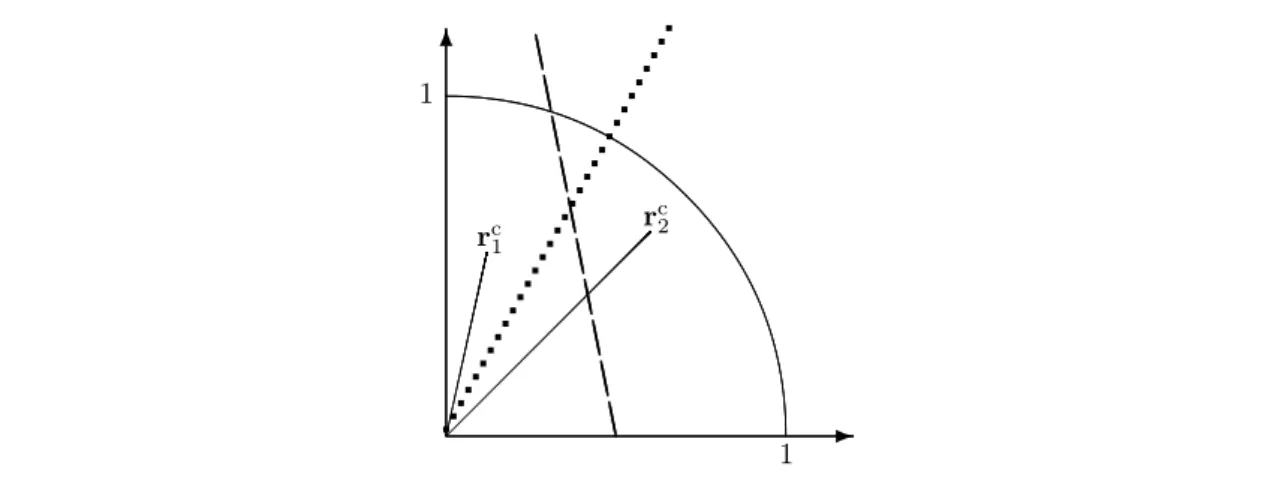
2.4 Cluster boundary: Euclidean and cosine similarity . . . 30
2.5 Two non-convex clusters . . . 34
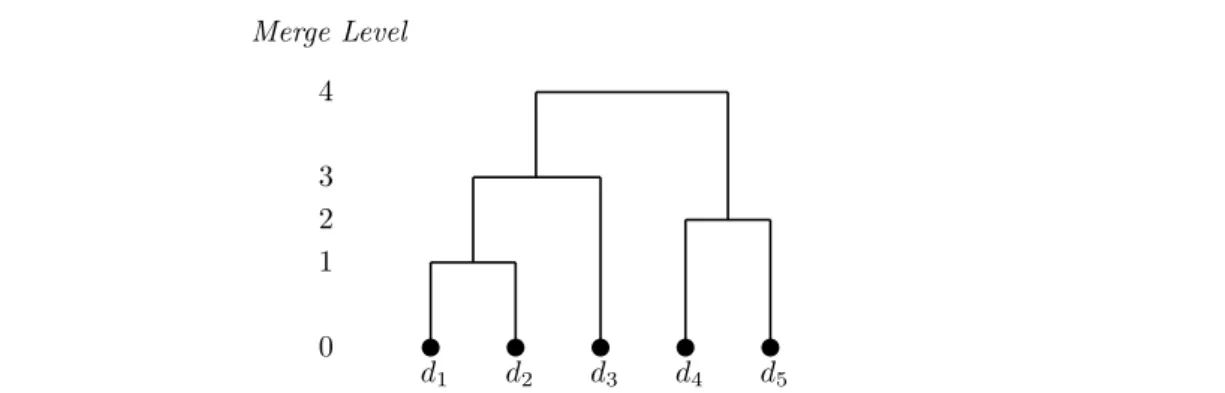
2.6 A dendrogram . . . 37
3.1 Resolving power according to Luhn’s curve . . . 64
3.2 Sample page from the Open Directory Project . . . 75
3.3 Viv´ısimo’s Internet search interface . . . 75
4.1 Categories of thespringerdata set . . . 83
4.2 Categories of theamazondata set . . . 85
4.3 Categories of thesdadata set . . . 86
4.4 Categories of thewikidata set . . . 88
4.5 Categories of thenzzdata set . . . 89
4.6 POS distributions . . . 91
4.7 Visual comparison of different clustering algorithms . . . 101
4.8 Evaluation of Cluto’s built-in weighting models . . . 103
4.9 Double-weighting experiments . . . 104
4.10 Differentidfandidf2variants . . . . 106
4.11 Squaredidfapplied toClutotest sets . . . 107
5.1 Baseline results . . . 111
5.2 Bag-of-lemmata versus bag-of-words . . . 119
5.3 Global pruning with similarity preservation . . . 121
5.4 Pruning with upper and lower bounds . . . 122
5.5 Local pruning . . . 123
5.6 Stopword removal with manually compiled stoplist . . . 128
5.7 Self-validation of stopword discrimination measures . . . 132
5.8 Cross-validation of stopword discrimination measures . . . 133
5.9 POS-based feature selection . . . 136
5.10 Extra weight for POS categories . . . 140
5.11 Stopword weighting instead of elimination . . . 141 xi
5.12 Selected linguistic and statistical reduction methods in comparison . . . 143
6.1 Splitting “mechanical” compounds . . . 147
6.2 Splitting all compounds . . . 149
6.3 Modifications to compound splitting . . . 153
6.4 Clustering with bigram features . . . 157
6.5 Clustering with multi-part name features . . . 159
6.6 Clustering with noun phrases . . . 163
6.7 Clustering with synsets . . . 167
6.8 Clustering with refined synset selection . . . 171
7.1 Combining reduction techniques . . . 175
7.2 Combining matrix enhancement techniques . . . 177
7.3 Sub-sampling of matrix enhancement techniques . . . 178
List of Tables
2.1 Lance-Williams coefficients . . . 39
3.1 Local feature weighting variants . . . 61
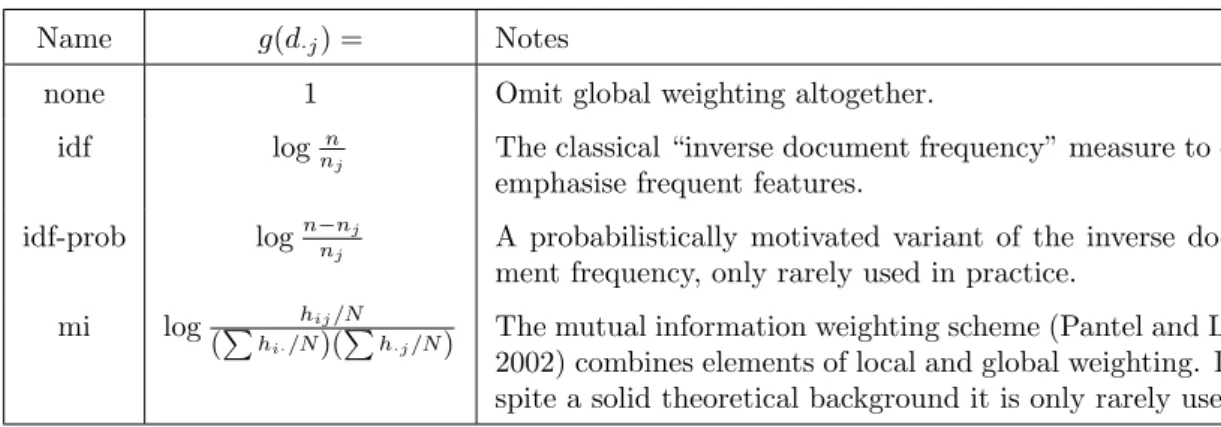
3.2 Global feature weighting variants . . . 62
3.3 Vector normalisation . . . 62
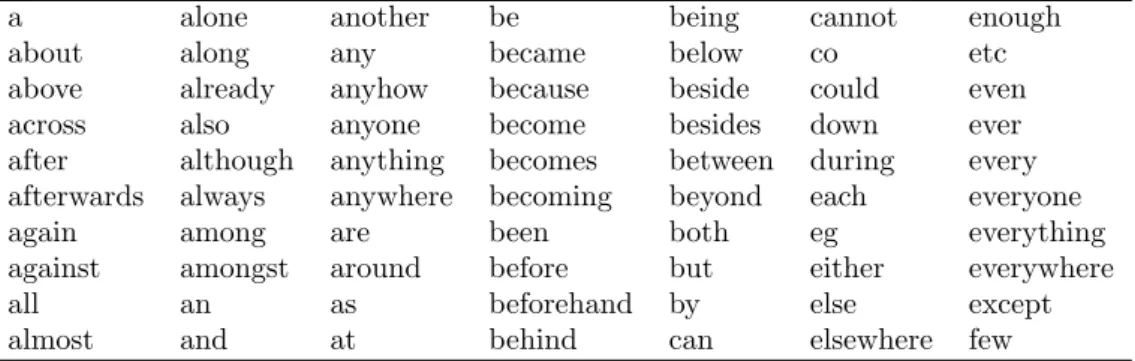
3.4 Van Rijsbergen’s stoplist . . . 65
3.5 Stemming example . . . 68
3.6 Clustering scenarios and time-criticality . . . 72
3.7 Representation methods and application stages . . . 73
4.1 Twenty Newsgroups data set . . . 80
4.2 BankSearch data set . . . 81
4.3 Summary of the five German data sets . . . 90
4.4 POS distributions . . . 92
4.5 Correlation of evaluation measures with ordinary clusters . . . 94
4.6 Correlation of evaluation measures with random data . . . 94
4.7 Parameter choices forCluto . . . 98
4.8 Comparison of different clustering algorithms . . . 100
4.9 Time demands of different algorithms . . . 100
5.1 Confusion matrix of springerbaseline . . . 113
5.2 Confusion matrix of sdabaseline . . . 113
5.3 Confusion matrix of nzzbaseline . . . 113
5.4 Confusion matrix of amazonbaseline . . . 114
5.5 Confusion matrix of wikibaseline . . . 115
5.6 Generic mapping of Tree-TaggerandGertwol tag sets . . . 116
5.7 Time demands of different pruning techniques . . . 125
5.8 Top ten stopwords from eight measures . . . 129
5.9 Overlap between stopword discrimination measures . . . 130
5.10 Self-validation with rank-sums . . . 131
5.11 Cross-validation rank-sums for different stopword extraction techniques . . . 134
5.12 Experiments with reduced number of clusters . . . 138
5.13 Stopword removal with mutilatednzztexts . . . 138
6.1 Compound statistics: mechanical, organic and pseudo-compounds . . . 150
6.2 “Organic” compounds and their POS tags . . . 151
6.3 Twenty most frequent bigrams . . . 156
6.4 Twenty most frequent multi-part names . . . 158 xiii
6.5 Gojol-parsing success rates . . . 160
6.6 Twenty most frequent noun phrases . . . 162
6.7 GermaNetstatistics . . . 165
6.8 Twenty most frequently used synsets (part one) . . . 168
6.9 Twenty most frequently used synsets (part two) . . . 169
7.1 nzzconfusion matrix with split “AUSL” category . . . 177
7.2 Results with “optimal”(ex-post)document representation . . . 182
B.1 Internal clustering criteria in comparison . . . 197
D.1 Evaluation of Cluto’s built-in weighting models . . . 209
D.2 Double-weighting experiments . . . 210
D.3 Different idfand idf2 variants . . . . 210
D.4 Squaredidfapplied toClutotest sets . . . 211
D.5 Baseline results . . . 212
D.6 Bag-of-lemmata versus bag-of-words . . . 212
D.7 Global pruning with similarity preservation . . . 212
D.8 Pruning with upper and lower bounds . . . 213
D.9 Local pruning . . . 214
D.10 Latent Semantic Analysis . . . 215
D.11 Stopword removal with manually compiled stoplist . . . 215
D.12 Self-validation of stopword discrimination measures (averages) . . . 216
D.13 Self-validation of stopword discrimination measures . . . 218
D.14 Cross-validation of stopword discrimination measures: unified lists . . . 220
D.15 Cross-validation of stopword discrimination measures: intersected lists . . . 222
D.16 Subset experiments for stopword removal (amazon) . . . 224
D.17 Subset experiments for stopword removal (wiki) . . . 226
D.18 POS-based feature selection . . . 227
D.19 Extra weight for POS categories . . . 228
D.20 Stopword weighting instead of elimination . . . 228
D.21 Extra weight for leading nouns . . . 228
D.22 Linguistic and statistical reduction methods in comparison . . . 229
D.23 Splitting “mechanical” compounds . . . 230
D.24 Splitting all compounds . . . 230
D.25 Modifications to compound splitting . . . 231
D.26 Subset experiments for compound splitting (amazon) . . . 232
D.27 Subset experiments for compound splitting (wiki) . . . 233
D.28 Clustering with bigram features . . . 234
D.29 Clustering with multi-part name features . . . 234
D.30 Clustering with noun phrases . . . 235
D.31 Clustering with synsets . . . 235
D.32 Clustering with refined synset selection . . . 237
D.33 Combining matrix reduction techniques . . . 238
D.34 Combining matrix enhancement techniques . . . 239
Chapter 1
Introduction
to Document Clustering
There is a tsunami of data that is crashing onto the beaches of the civilised world. This is a tidal wave of unrelated, growing data formed in bits and bytes, coming in an unorganised, uncontrolled, incoherent cacophony of foam. It is filled with flotsam and jetsam. It is filled with the sticks and bones and shells of inanimate and animate life. None of it is easily related, none of it comes with any organisational methodology. (...) The tsunami is a wall of data— data produced at greater and greater speed, greater and greater amounts to store in memory, amounts that double, it seems, with each sunset. On tape, on disks, on paper, sent by streams of light. Faster and faster, more and more and more.
Richard Saul Wurman (Information Architects, 1996)
Following the tragic natural catastrophe in December 2004 in East Asia the occasionally en-countered term “information tsunami” has assumed a new ring, and for reasons of piety it had probably better be dropped altogether from information scientists’ vocabulary. For the moment, however, it is worthwhile to dwell a little longer on the parallels between the lethal oceanic phe-nomenon and its comparatively harmless counter-part in cyberspace. In both cases we are dealing with phenomena of absolutely staggering dimensions having dramatic implications for our lives. In both cases the consequences exceed everything known before, beating all human anticipations by far. In both cases there is no means of preventing or containing the phenomenon—all we can do is look out for strategies and techniques to cope with it as well as possible and to keep the damage to a minimum.
With the advent of the Internet the mass of data daily pouring onto us or at least standing at our free disposal has started to grow exponentially. And it keeps growing. A recent study estimated the size of the “indexable” Web at over 11.5 billion pages (Gulli and Signorini, 2005) and there is no end in sight. In fact, as entire libraries are undergoing a process of digitisation, we may have seen just the beginning.
This unimaginably huge flow of data is having a far-reaching impact on our societies, economies and daily lives. The immense quantity of available data offers us not only an un-precedented wealth of riches and possibilities, it also confronts us with a multitude of challenges and problems not encountered before. Because coping with the data is not trivial.
The dangers accompanying the surge of information are not to be underestimated and are well illustrated by buzzwords such as “Infoglut” (Allen, 1992), “Information Fatigue Syndrome” (Lewis, 1996), “TechnoStress” (Weil and Rosen, 1997), “Data Smog” (Shenk, 1997), “Data As-phyxiation” (Winkle, 1998) and “Information Pollution” (Nielsen, 2003). Whole new fields of psychology have been opened just to deal with the information overload and with our difficulties and perplexity resulting therefrom.
At the other end, an explosion of new research into fields such as data mining, information storage, information retrieval, knowledge extraction and knowledge management has set in. It is directed at developing the new tools that are desperately needed to cope with one of the big challenges of the 21st century: the information challenge.
The present thesis cannot but deal with a very tiny aspect of the global endeavour to fight the information flood. First, we restrict ourselves totextual data. Second, of the dozens (if not hundreds) of strategies and techniques that are being developed to cope with the information load, we pick out two: document clustering andnatural language processing (NLP). We subject them to an in-depth study and try to assess the benefits of their combined application. The results should offer guidance to future investigations and other combinations of NLP with information retrieval techniques.
The rest of the present chapter is divided as follows: the first two sections motivate and introduce document clustering and natural language processing, giving as well an overview of the structure of the thesis (Sections 1.1 and 1.2). The next section presents a few central concepts in some more detail (Section 1.3). Two further sections deal with the purpose and applications of document clustering in theory and praxis (Sections 1.4 and 1.5), while the final section introduces the formal notation used in the following chapters (Section 1.6).
1.1
Motivation
The present thesis focusses on two aspects of automated information processing and their com-bined application:
Document Clusteringas an approach to bring order into largesets of unordered docu-ments,
Natural Language Processingas an approach to extract good descriptions ofindividual documents.
In particular, it is the goal of this thesis to establishwhich natural language processing tech-niques are useful in a pre-processing step and to which extent they can improve clustering results. The work will be further characterised by the choice of five independent, diverse and relatively large sets of German documents that have been specifically collected for the present study.
Cluster analysisis an old and well-established procedure for bringing a general order into large sets of all kind of data, including texts. In information retrieval, it has long remained in the background because of the predominant pursuit of powerfulsearch techniques (i. e. ways to find particular documents or documents about a particular topic). But with the development of adequate solutions to the straightforward search problem (as demonstrated by Google1and other leading search companies), more complex information handling strategies, including document clustering, have received a new boost.
Natural language processinghas its own long history with a wide number of applications such as machine translation, speech generation, question-answering systems, text summarisation and many more. Applied to the document clustering problem, NLP is used to replace the tradi-tional view of a document as a random conglomerate of letters and digits (words) by an analytical linguistic view of these symbols. We want to show that an accordingly refined representation of documents in terms of linguistic concepts leads to superior clustering results, and in particular we want to find out which NLP techniques are the most suitable for the task.
The application of NLP techniques in information retrieval (IR) has frequently been discussed in the past and it remains a controversial issue.2 In the end, it all boils down to a classic trade-off problem: do the extra benefits warrant the extra effort that is required by NLP? Notable experts such as Smeaton (1997) and Sparck Jones (1999) have taken a rather critical view of the general use of NLP in text retrieval systems. By narrowing the discussion to one specific aspect of information retrieval and subjecting our data to a thorough examination by an arsenal of different NLP techniques, we hope to be able to reach a more reliable verdict, even if only for one particular area of IR. A further aim is to characterise the circumstances under which the use of NLP is recommendable.
1.2
Thesis Structure
The structure of this thesis is governed by the two main components of a document clustering system (see Figure 1.1):
Thedocument representation component, which takes as input the documents (raw texts, Web pages, etc.), then extracts pertinent features and transforms them into a data structure that is suitable for clustering. Normally, a vector representation is chosen for the individual documents, resulting in ann×m document-feature matrix for the whole set. Element (i, j) of the matrix then indicates the strength/presence of featurejin documenti.
Thecluster analysis component, which takes as input the data structure generated in the previous step and groups similar rows (documents) together. Typically,ndata points are thus partitioned intokclusters. Cluster analysis is independent of the original domain (documents) and has applications in the most diverse areas of science. Its basic ingredients are a measure of (dis)similarity between data points and an algorithm for grouping them. Depending on the application, the clusters thus gained can be further processed, e. g. by a cluster visualisation component. Some of these post-processing approaches will be touched upon in the text, but they are mostly outside the scope of this study. The goal is to integrate NLP techniques into the document representation component against the background of document cluster analysis.
The thesis is divided into eight chapters as follows:
1www.google.com
ntext documents -ndocument vectors -ndocuments grouped inkclusters Document
Representation Cluster Analysis
Figure 1.1: The two main components of a document clustering system. Thedocument representation component maps text documents onto a suitable internal structure (usually a vector); thecluster analysis component determines a suitable grouping based on the input matrix built from the document vectors.
Chapter 1 (Introduction): The rest of the present chapter describes various applications and purposes of document clustering. The reader is introduced to the different situations and contexts in which clustering is used to organise text. A brief, annotated list of on-line resources is also given. Finally, the main concepts are introduced formally as a preparation for the following two theoretical chapters.
Chapter 2 (Cluster Analysis): First, we get acquainted with the main principles, data struc-tures and algorithms that are used in the Clustering Component. We learn to know typical similarity measures, the main clustering algorithms (iterative, hierarchical and some oth-ers) and evaluation and validation techniques. Even though the discussion is kept at a fairly general level, special attention is paid to those clustering issues that are relevant to the domain of textual cluster analysis.
Chapter 3 (Document Representation): We then turn to the Document Representation component. We learn more about the mapping of documents onto data structures and about the processes of feature weighting, selection, standardisation and extraction. We introduce statistic and linguistic methods and conclude with a brief section on time con-straints and cluster presentation.
Chapter 4 (Experimental Setup): After disseminating the theoretical background we turn to the experimental setup. We describe the five corpora used in the further experiments, the evaluation procedure for different representation methods and the clustering software.
Chapter 5 (Reduced Representations Using NLP): The first part of the experiments is devoted to representationreduction techniques. We examine different methods (including stopword removal, part-of-speech selection and several others) to filter and reduce the document representations. The aim is to reduce clustering complexity and to increase clustering quality.
Chapter 6 (Enhanced Representations Using NLP): We then proceed to representation enhancement techniques. We examine how morphological, syntactic and semantic infor-mation can be used to achieve richer and better document representations. The focus here is on improving clustering quality without unnecessarily increasing clustering complexity.
Chapter 7 (Combining Representation Techniques): After having analysed all tech-niques separately, we examine how well they combine with each other. We first look
at reduction and enhancement techniques among themselves, and then at selected combi-nations from both groups.
Chapter 8 (Summary and Outlook): The last chapter concludes with a summary of our findings and a brief analysis of the implications for Natural Language Processing. An outlook points to further research tasks that appear most rewarding in the light of the present study.
The thesis is rounded off by an appendix consisting of a glossary, a proof section, the stoplists and a detailed numeric account of the experimental results.
1.3
Principal Concepts
Let us characterise some of the principal concepts of the further discussion in a few more words:
Natural Language Processing (NLP). Natural Language Processing encompasses all those theories, hypotheses and practical applications which are directed at automatically process-ing textbased on knowledge of language, linguistics and human interaction. The history of NLP dates back to the very beginning of the computer age and has been a central aspect of linguistic research and artificial intelligence ever since.
Jurafsky and Martin (2000, 4), after a brief overview of NLP history, distinguish six central areas of language processing:
phonetics and phonology: the study of sounds,
morphology: the study of meaningful components of words,
syntax: the study of structural relationships between words,
semantics: the study of meaning,
pragmatics: the study of language used as a means to achieve certain goals,
discourse: the study of complex linguistic interactions.
The present work features NLP techniques from the fields of morphology, syntax and semantics.
Information Retrieval (IR). Information retrieval is the science aiming to provide end-users with efficient access methods to large collections of data, usually in the form of documents. A concise definition is lacking, but the following quotations capture the essence:
“Information retrieval is concerned with the representation, storage, organization, and accessing of information items. . . . In actuality, many of the items found in ordinary retrieval systems are characterized by an emphasis on narrative information. Such narrative information must be analyzed to determine the information content and to assess the role each item may play in satisfying the information needs of the system users.”—Salton and McGill (1983, 1–2).
“Information retrieval is the term conventionally . . . applied to the type of activity discussed in this volume. An information retrieval system does not inform (i. e. change the knowledge of) the user on the subject of his inquiry. It merely informs on the existence (or non-existence) and whereabouts of documents relating to his request.”— Lancaster (1968, quoted in van Rijsbergen, 1979, 1).
1. User has information need.
2. User transforms information need into query. A query normally consists of one or more query terms explicitly or implicitly combined by Boolean operators.
3. IR system processes query. It matches the query to the documents in the collection and returns the best matches.
4. User is given a list of document references, often sparsely annotated and sorted by relevance (as perceived by the system).
5. User pursues one or more documents and/or modifies the query in the hope of obtaining better results (→returns to step three).
6. User’s information need is satisfied after reading the documents, and user is happy. As new information needs arise, he returns to step one.
Figure 1.2: The standard scenario of information retrieval.
“Information retrieval [is] an area of science and technology that deals with cataloging, categorization, classification, and search of large amounts of information, particularly in textual form. An outcome of an information retrieval process is usually a set of documents containing information on a given topic, and may consist of newspaper-like articles, memos, reports of any kind, entire books.”—Strzalkowski (1999, xiii).
“Information retrieval is the task of finding relevant documents from a text corpus or collection in response to a user’s information need.”—Smeaton (1997, 15).
The standard IR scenario is described in Figure 1.2. In order to work, it requires powerful algorithms and storage methods. Often it is further refined by extra steps, feedback-loops, etc.
IR has been a primary concern of computer scientists since the 1960s, and it continues to play an extraordinary role which is well demonstrated by the unique importance of search engines for our own daily “Web behaviour” as well as for the marketing specialists and the emerging “search engine optimisation” industry.
Text/Document Retrieval. As we have just seen, information retrieval is concerned with bringing documents to users’ attention. Whether the documents contain the information actually sought cannot be determined, though, and it is up to the user to extract and assess the information from the documents. Naturally, it would be even more desirable for systems to handle actual pieces of information and extract and present them rather than dealing only in coarse documents. In order to distinguish between such as yet mostly experimental systems and those in use at present, it has been suggested that today’s ordinary search systems had better be described as text or document retrieval systems (van Rijsbergen, 1979, 1), with the therm information retrieval reserved for system that will be really capable of handling information. In the present work, however, the terms information retrieval, document retrieval and text retrieval will be used as synonyms.
Document Clustering. A document clustering system analyses a large set of documents and then groups similar documents together. As a result it produces a number of more or less well-defined clusters (groups) of documents. The process autonomously creates distinct
groups based on inter-document similarities. It thus imposes an order onto the previously unordered documents. Ideally, this order corresponds to a structure already inherent but not trivially discernible in the data.
The clusters may be entirely independent of each other. Alternatively, there may also be an order between the clusters. Some clustering systems produce an hierarchical order while others arrange clusters in a two- or three-dimensional space.
Clustering is anunsupervised learning task, as noa priori information is required.
Document Categorisation/Classification. Categorisation and classification (henceforth used synonymously) are strongly related to clustering. In both cases a potentially very large number of objects is to be grouped into a scheme of flat or hierarchical “classes”. Yet, there are important differences between the classification/categorisation task and the clustering task (Willett, 1988):3
Classification is the process of assigning one or several objects to a predefined scheme. In other words, the individual classes are all givena priori and the task is to determine the best-fitting class for each new object. The classes have to be determined by the user, either intensionally (e. g. by a Boolean expression on a number of features that completely describe the class) or extensionally (by giving a sample of members for each class). Training an algorithm to recognise an extensional classification scheme is asupervised learning task; the algorithm is tuned on a pre-labelledtraining set.
Our focus is strictly on clustering (i. e. with no pre-defined classes), but the close rela-tionship makes it unavoidable from time to time to compare our findings with those of the classification literature. Even though classification uses similar or identical data structures, the algorithms are often very different from those used for clustering.
Text Data Mining. Text data mining is a sub-discipline of data mining. It is the task of automatically extracting and processing information from textual data. Text data mining is a very wide but relatively unexplored and far less structured field than text retrieval (Hearst, 1999a; Williams, 2000a,b). In the long run it will no doubt play a key role in the global quest to accommodate the information avalanche. As with IR techniques, the question also arises how to make optimal use of NLP techniques for text mining.
1.4
Purpose and Applications of Document Clustering
Document clustering has been used for such diverse text data mining tasks as automatic gen-eration of Frequently Asked Questions (FAQs) (Wen et al., 2001; Wen and Zhang, 2003) and automatic functional annotation of gene products (Renner and Asz´odi, 2000), as well as for many other tasks. By far the most typical applications of document clustering, however, have so far been found in information retrieval and they will be discussed in the rest of this section.
1.4.1
Supporting Retrieval of Documents
Historically speaking, document clustering was first used with the aim of improving the retrieval performance of existing IR systems.4
3Unfortunately and rather confusingly, the terms “clustering” and “classification” have occasionally also been
used as substitutes (e. g. by van Rijsbergen, 1979).
Traditional IR systems compare a query with every document in the collection and return those that best meet certain similarity criteria. An alternative is cluster-based retrieval, which involves these differences:
1. Documents are clustered in an off-line process (in advance). 2. Queries are matched against clusters instead of documents.
3. One or several clusters are returned rather than individually chosen documents.
If implemented successfully, this procedure promises a number of advantages over an ordinary IR system:
Faster execution because of a reduced number of comparisons for each query.
Better recall5 because relevant documents are still found even if they happen to use a slightly different terminology.
Higherprecision6 because single documents that accidentally share many terms with the query but in terms of content belong to a different subject are not retrieved.
That being said, it must be noted that it is not at all obvious that the procedure can be made to work. As observed by van Rijsbergen, cluster-based retrieval can only work if the cluster hypothesis (Jardine and van Rijsbergen, 1971) holds:
Cluster Hypothesis. Closely associated documents tend to be relevant to the same requests(van Rijsbergen, 1979, 45).7
Provided the hypothesis is true—i. e. if relevant and non-relevant documents for a specific query are well separated—the aforementioned improvements may be gained by statically clus-tering the document collection. However, van Rijsbergen (1979, 45–48) mentions two further important requirements:
A clustering algorithm which is able to exploit the relevant associations among documents, which is stable with regard to new additions and small errors, which is independent of the order in which the documents are processed and which easily scales up.
An algorithm to efficiently retrieve the best-matching cluster(s) for any given query. In practice results have been rather mixed and the desired goals were often missed (Jardine and van Rijsbergen, 1971; van Rijsbergen and Sparck Jones, 1973; Voorhees, 1985, 1986; Willett, 1988; Hearst and Pedersen, 1996). Therefore, cluster-based retrieval is no longer in the focus of the document clustering community. A lack of distinct success and the difficulties transporting the concepts to modern large-scale Web search engines have led to the demise of this particular clustering application.
Other clustering approaches in the retrieval domain includequery clusteringto identify similar queries and answer them in a uniform way and keyword clustering as a technique of query expansion (Sparck Jones, 1971; Xu and Croft, 1996; Chang and Hsu, 1998).
5For a definition see Section 1.6 (Eq. 1.17). 6For a definition see Section 1.6 (Eq. 1.18).
7For a recent discussion of the cluster hypothesis see the work by Tombros. He claims that the cluster hypothesis
is always true if an appropriate, query-dependent similarity measure is chosen (Tombros and van Rijsbergen, 2001; Tombros, 2002; Tombroset al., 2002).
1.4.2
Supporting Presentation of IR Results
The application of IR technology to such a huge and diversified text collection as the World Wide Web (WWW) has given rise to a number of new issues. Storage, indexing, updating and retrieval all needed thorough re-thinking. The same was true (and still is) for thepresentational aspects. New methods are needed to efficiently handle result sets comprising not just a few dozens but hundreds and thousands of documents.
This challenge has been tackled from various directions, but research is still far from com-pleted. Much effort has gone into the devising of sophisticated ranking algorithms which aim to maximise the likelihood of returning highly relevant quality documents at the top of the list. Most prominent among these methods is Google’s PageRank citation ranking (Page et al., 1998).
Beyond the Ranked List
However, relatively often it is impossible to determine which documents are most relevant with regard to a specific user’s request. Be it that the query is very short and allows multiple inter-pretations, be it that the query as a whole or individual parts thereof are inherently ambiguous. Joshi and Jiang (2001) differentiate between three possible reasons:
Polysemy: search words have multiple meanings.
Phrases: a phrase may have a meaning different from that of the individual words (e. g. “Sunday Times”).
Term dependency: words in a composite term may be depending on each other (e. g. “Digital Equipment Corporation”).
One approach to resolve these ambiguities consists of a model for the individual user, thus taking into account thecontext of each query. An example of such anInformation Management Assistant tracing the individual user’s behaviour isWatson(Budzik and Hammond, 1999). An-other approach is to leave the ambiguities unresolved and refrain from making any presumptions on the user’s intent. Instead of a list, the user is presented with aclustered view of the retrieved documents, a concept put forth by Willett (1985) and much explored ever since.
Compared to the common ordered results list, the clustered view approach comes with a number of advantages:
Fewer assumptions are made on the user’s intention.
Within a few system interactions the user can reach a much larger number of documents than in a sequential list. Especially with clusterhierarchies, significant gains in time can be achieved (Leuski, 2001).
Good cluster descriptions immediately give the user an overview of the main topics within the retrieved set of documents.
The often difficult task of formulating concise queries loses in importance.8 Instead, the query may remain fairly general and unspecific, with common navigational skills replacing the more demanding query formulation techniques (cf. Chang and Hsu, 1998).
8In fact, even without clustering interfaces available, most users prefer very short queries. Spinket al.(2001)
report an average query length of 2.4 terms, with less than 5% of the queries featuring Boolean operators. Clustering would thus seem to be a highly desirable feature. (The study was based on 1997 data from the Excite search engine.)
In fact, using a clustering interface to a search engine combines the two major Web content access techniques: searchingandbrowsing (Largeet al., 1999, 143). Back in 1994 Bowmanet al. had predicted that a combination of the two techniques would be necessary to keep pace with the fast development of the Web. Much document clustering work in recent years has been explicitly devoted to clustering Web search results.9
Document clustering as a means of search result presentation (also known as “ad-hoc” or “ephemeral” clustering) is different from document clustering for retrieval purposes. It can be characterised as follows:
Clustering is performed dynamically (“on-the-fly”). Time is thus at a high premium and fast algorithms of crucial importance.
The clustering algorithm must be scalable and flexible, managing small result sets just as well as very large ones.
Clustering must be able to deal with a very large variety of documents of different lengths, structures, languages, etc.
The system must be able to come up with sensible, humanly understandable descriptions of the clusters (cluster digests). Furthermore, navigation and visualisation of the clusters must be user-friendly.
Link-structure, HTML tags and other special features may be exploited for document representation and clustering.
Unlike in a static environment, questions concerning updates and maintenance of the cluster structure are irrelevant.
In analogy to Jardine and van Rijsbergen’s original cluster hypothesis for retrieval, a second cluster hypothesis for ephemeral clustering may be formulated:
Second Cluster Hypothesis. Documents in a collection can be grouped in such a way that significant benefits result for different users intending to review different specific parts or the whole of the document collection.
Implicitly, this hypothesis is assumed to be true by most researchers in the field. However, there is valid reason to cast doubts, especially since studies have shown that users often have strong individual preferences and divergent views of what constitutes a “good” or “correct” clustering (Macskassy et al., 1998). Moreover, the suitability of a particular clustering may depend on the search situation. With different types of searches having different types of pages as objects (Pirolliet al., 1996) the same may be true of clustering.
Information Seeking Theory
In order to improve document clustering applications in IR, thecontext of the search situation (Vakkari et al., 1997) needs closer attention, leading us into the field of information seeking theory.
Systematic research into the technical, practical, cognitive and emotional aspects of informa-tion seeking dates back to the 1960s (e. g. Taylor, 1968). But only in the 1990s did it become
9E. g. Zamir and Etzioni (1998, 1999); Zamir (1999); Maareket al.(2000); Heet al.(2001); Stefanowski and
apparent that for a quickly growing number of people the traditional information skills such as filtering, acquiring and storing information were no longer enough. The ability to recognise information needs in time, to express them and to satisfy them by activelyseeking for appropri-ate information has become essential, both in professional and everyday life. Accordingly, the research into information seeking which had been rather neglected for a long time, started to attract new attention (Vakkariet al., 1997, 7) and various attempts have been made to bring IR and information and library sciences closer together again (Vakkari, 1999).
Various information seeking models have been described in literature (Bates, 1989; Yang, 1997; Marchionini and Shneiderman, 1988; Marchionini, 1995) and particular attention has been paid to theinformation seeking process (Marchionini, 1989, 1992, 1995; Largeet al., 1999; Shnei-dermanet al., 1997; Shneiderman, 1998).
A more specific branch of research deals with the various search types and behaviours that occur in practice (Ellis, 1989; Ellis and Haugan, 1997; Chooet al., 2000a,b; Yang, 1997; Rosenfeld and Morville, 1998; Devlin and Burke, 1997; Saunders and Sheffield, 1998; Broder, 2002).
Rosenfeld and Morville, for instance, distinguish four general types of information search (Rosenfeld and Morville, 1998, 101–103):
Known-item searching. The user looks for a clearly defined bit of information. He knows that his question has a single, correct answer. Known-item searching may be regarded as the most “easy” concept, well supported by traditional IR instruments. Two typical known-item search tasks arehomepage finding andnamed-page finding (Ogilvie and Callan, 2003).
Existence searching. The user looks for some fairly well-defined bit of information but he does not know whether it actually exists and he may have difficulties understanding and describing his need accurately.
Exploratory searching. The user has an open question or idea on which he wants to learn more. He may not know what exactly he wishes to find and there is unlikely to be a single, correct answer to his need.
Comprehensive searching (research). Just as exploratory searching, comprehensive search-ing has an open character. The difference is that the searcher wants to uncovereverything related to the particular topic, not just a few useful pages.
For most searches of the first kind (known-item searches), a straightforward ranked list will do. But for existence and, in particular, exploratory searching a clustering interface offers new and perhaps more efficient access methods to a set of retrieved documents. Finally, also a comprehensive search may profit from the order gained by the presentation in clusters.
Further systematic research is needed to combine the insights from information seeking theory with document clustering and other sophisticated IR techniques. Intuitively, however, a clustered view of search results has a number of promising applications.
1.4.3
Direct Access to Document Collections
Document clustering has further been employed in several innovative collection access methods which are not directly relying on text retrieval. Usually they are based on a combination of search and browse activities. Some of these methods are briefly described below. In nature they are often quite similar to the approaches discussed in the previous two sections.
Korfhage (1991) presents a system which, in principle, can display all documents of a col-lection in relation to a few user-defined reference points, thus allowing a situation-dependent navigational access. For obvious reasons, the system fails to scale up to Web standards.
Scatter/Gather (Cuttinget al., 1992, 1993; Hearst and Pedersen, 1996) is an algorithm which works on a result set or a pre-clustered collection. Rather than calculating a detailed cluster hierarchy, the crude top-level clustering is only further refined as need arises, i. e. as the user navigates his way up and down the hierarchy.
WebACE (Boley et al., 1999a) is a system monitoring a user’s activity on the Web and building a user profile by clustering frequently visited pages. In a second phase the system supports the user by presenting him with new documents found on the Web based on that user profile.
WebCluster (Harper et al., 1999; Muresan, 2002) is a system offering mediated access to a potentially very large collection (such as the Web) by presenting users with a static clustered view of a selected, domain-specific sub-collection. The actual search is only launched after the user has identified the clusters that appear most pertinent to his information need.
1.5
Systems in Practice
Here follows a non-exhaustive list of systems that implement a more or less sophisticated clus-tering of documents and which can (or could) be found on-line on the Internet:
Grouper. A research project at Washington University using an innovative algorithm called Suffix Tree Clustering (Zamir and Etzioni, 1999; Zamir, 1999). Since the year 2000 the clustering interface Grouper and the underlying meta-search engine HuskySearch are no longer publicly available.
NorthernLight.10 This used to be a Web search engine which displayed its search results grouped into a number of predefined classes. Thus, it does not actually use clustering but a classification algorithm. After a change in proprietorship the company is specialising in enterprise search solutions which also include a clustering algorithm. It no longer provides a free Web search service, however.
WiseNut.11 A Web search engine powered byLookSmart which groups results into a varying number of clusters. The algorithm seems to work exclusively with page titles.
Teoma.12 A Web engine with a standard list of most relevant documents, but which offers in a sidebar a number of rudimentary refinement options derived from a clustering of the Web pages into so-called “communities”.
KartOO.13 A commercial content search solution with a highly advanced and dynamic graphic interface for displaying contents and documents, also including clustering functionalities.
Viv´ısimo.14 A commercial content clustering solution, coming with a popular and free meta-search engine as an illustration of its document clustering capabilities. Its special feature is hierarchicalconceptual clustering, resulting in clusters which it is claimed can be described “concisely, accurately, and distinctively” (Viv´ısimo, 2003). A number of raving white papers at their Web site propagate the many virtues of clustering technology.
10www.northernlight.com
11www.wisenut.com
12www.teoma.com
13www.kartoo.net
Figure 1.3: Killerinfo. A view of the results page of the Killerinfo meta search engine, with clusters in the right half of the window.
Search Allinone MetaSeach.15 Another, more recent meta search engine which presents a twofold view of the results: ordered list and grouped results.
Killerinfo.16 A meta search engine with considerable stress on the hierarchically clustered pre-sentation of search results. Figure 1.3 shows the Killerinfo interface.
Entrieva.17 A company developing various professional knowledge management tools which use, among others, taxonomies and algorithms for automatical taxonomy generation.
1.6
Notation
This section introduces the formal notation used in the following chapters. It refers to a standard document clustering application within a standard IR system. Special systems may require notations and definitions differing from those given here.
For simplicity’s sake and in accordance with the majority of the relevant literature, the distinction between row and column vectors is only made explicit where necessary. In those cases,xrefers to a column vector andxT to a row vector.
Document. LetDi abstractly denote an individual documenti.
15www.searchallinone.com
16www.killerinfo.com
Document Universe. Let Ω be thedocument universe, i. e. the set of all documents known to the IR system:
Ω ={Di | i∈N}. (1.1)
N is the set of natural numbers.
Document Set. LetS be thedocument set, i. e. thosendocuments that form the input to the clustering process:
S={D1, D2, . . . , Dn} ⊆Ω. (1.2)
Note: For many—but not all—applicationsS equals Ω.
Feature Set. Let
F={f1, f2, . . . , fm}, (1.3)
withFaset ofmfeaturesandfian individual featurei. Each feature stands for a concrete or abstract document property.
Document Vector. Let
di= (di1, di2, . . . , dim), (1.4) with di thedocument vector of documentDi in an m-dimensional feature spaceF. The
jth component ofdi (written asdij) corresponds to thevalue orstrength of featurefj in documentDi. dij is usually a non-negative real number:
dij ∈R+0. (1.5)
Document Feature Matrix. Let
H = d1 d2 .. . dn , (1.6)
withH thedocument feature matrix, defined by the individual vector representationsdof allD∈ S. The document feature matrix is usually the input to the clustering algorithm.
Document Vectorisation Function. Let τ be a function which transforms a text document into anm-dimensional vector representation in feature spaceF:
di=τ(Di), withτ: Ω→Rm, (1.7) withRthe set of real numbers.
Feature Transformation Function. Let φ be a function which transforms a document vec-tor from one feature space (F1) into another (F2), sometimes making use of additional information from the document feature matrixH:
d0i=φ(di, H), with φ:RmF1,Rn×m→RmF2. (1.8)
Document Frequency. Let
df(j, H) =X i
|sgn(hij)|, (1.9)
with thedocument frequency df(j, H) the number of documents with a non-zero value for featurefj.
Cluster. Let acluster Ci be an subset ofS:
Ci⊆ S, (1.10)
and letni be the number of objects in clusterCi:
ni=|Ci|. (1.11)
Cluster Solution. Let
C={C1, C2, . . . , Ck |Ci⊆ S ∀i∈1. . . k}. (1.12) Acluster solution C is thus defined as a set ofkclusters.
Cluster Algorithm. Let
C=κ(H), with κ:Rn×m→ P(S) (1.13) and withκdenoting the cluster algorithm,P(S) the power set ofS andR the set of real numbers.
Cluster Representative. Let
ri= (ri1, ri2, . . . , rim), (1.14) withri arepresentative vector for cluster Ci in anm-dimensional feature spaceF.
Individual Cluster Criterion Function. An individual criterion function E(C) measures the quality of a single cluster:
E:P(S)→R, (1.15)
withP(X) the power set ofX andRthe set of real numbers.
Overall Cluster Criterion Function. An overallcriterion function Ψ(C) measures the qual-ity of an entire cluster solution:
Ψ :P(P(S))→R, (1.16)
withP(P(S)) the set of all possible cluster solutions.
Type and Token. Within documents it is common to refer to wordtypesand wordtokens. The former refer abstractly to features in a document or a corpus, while the latter refer to indi-vidual occurrences. Formally speaking, the tokens of a document are abag (which allows multiple occurrences of the same element). The types are the set created by eliminating all duplicates from the token bag.
Recall and Precision. In IR two widespread performance measures are defined by the set of documents in a collection that arerelevant to a particular query (A) and those documents that are actuallyretrieved by the system (B):
Recall(R) = |A ∩ B|
|A| , (1.17)
P recision(P) = |A ∩ B|
|B| . (1.18)
Their weighted arithmetic mean, the so-calledF-Measure is also used frequently (see Equa-tion 2.77 for an example).
For guidance to the notation used in the experimental results tables, please consult Sec-tion 4.3.1.
Chapter 2
Cluster Analysis
For instance, bird differs from bird by gradation, or by excess and defect; some birds have long feathers, others short ones, but all are feathered. Bird and Fish are more remote and only agree in having analogous organs; for what in the bird is feather, in the fish is scale.
Aristotle (On the Parts of Animals)
For millennia grouping similar natural phenomena together and classifying them into cate-gories has been a fundamental and vital strategy for mankind to find its way in a complex and dangerous environment. It is thus not surprising that the first systematic classification schemes for animals date back to Aristotle (384–322 BC) and his pupil Theophrastos (c371–c287 BC). The urge to bring order into things by creating clusters and classification schemes has grown ever since.
But even though evolution has shaped the human mind into a classifierpar excellence, the information age has also shown us our limits: although we have no problem dealing with small-sized data sets in 2-dimensional spaces, our mind is ill-equipped for dealing with thousands and millions of data points and unstructured high-dimensional feature spaces. Here systematiccluster analysis must set in, which in turn may provide the foundations for a systematic classification scheme and later serve as a basis for an automated categorising procedure.
Cluster analysis has almost an infinite number of applications in a wide spectrum of sciences such as archaeology, astronomy, biology, chemistry, medicine, market research, pattern recogni-tion, psychiatry and many others (Duda and Hart, 1973; Everitt, 1993; Berry and Linoff, 1997). In particular biological taxonomy has long been a driving force in the development of powerful and sophisticated algorithms (Sneath and Sokal, 1973). These in turn have boosted research and application in the other areas as well.
Clusters
Clustering is a process aimed at finding clusters in data. But what exactlyisa cluster? Practice has shown this to be a surprisingly difficult question to answer. Jain and Dubes (1988, 1)
r r r r r r r r r r r r r r r r r r r r r r r r r r r r r r r r r r r r r r r r r r r r r r r r
Figure 2.1: What is a cluster? Situations may arise where no cluster solution is universally “correct”. In this example different solutions are equally plausible.
define a cluster as a “number ofsimilar objects collected or grouped together”. Capturing the phenomenon more formally is not easy and may even be misguiding (Everitt, 1993, 6). Everitt mentions further definition attempts, including some based on internal cohesion and external isolation of individual clusters.
Why too rigid a definition of “cluster” may not be desirable is illustrated by Figure 2.1. How many clusters can be discerned? And if the answer shall be two, which data points belong together?
It becomes evident that despite the great efforts to get a tight formal grip on clustering, a task-inherent arbitrariness will always remain and for many situations a single “correct” criterion for defining the clusters cannot be guaranteed to exist. Depending on the context and individual preferences, different solutions may suit best.
This insight has been confirmed for document clustering by a study on human performance in clustering Web pages. It was shown that the participants developed distinctly different cluster solutions for the same set of documents (Macskassyet al., 1998). Especially in a high-dimensional domain such as document clustering the optimal solution is thus often subjective to some degree. The rest of this chapter seeks to provide an overview of the more important formal aspects of cluster analysis. Sections 2.1 to 2.4 deal with data structures, similarity measures and clustering algorithms. Sections 2.5 and 2.6 deal with cluster properties and evaluation/validation methods. Individual clustering techniques and terminology vary from one application area to another. The present introduction will focus on those aspects relevant for the document clustering do-main.1
2.1
Data Representation
In order to automatically cluster real-world phenomena (objects), they need to be captured and translated into formal representations. We distinguish between three principal possibilities of viewing the data: the vector space model, the metric space model and the graph model.
2.1.1
Vector Space Model
In the vector space model, each object is represen