Universidade Nova de Lisboa
Faculdade de Ciências e Tecnologia
Departamento de Informática
A Semi-automatic Approach to Code Smells Detection
Tiago Alexandre Simões Pessoa
Dissertação para obtencão do Grau de Mestre em Engenharia Informática
Orientadores: Prof. Doutor Fernando Brito e Abreu Prof. Doutor Miguel Pessoa Monteiro
ii (Page intentionally left blank)
iii
Universidade Nova de Lisboa
Faculdade de Ciências e Tecnologia
Departamento de Informática
Dissertação de Mestrado em Engenharia Informática 2º Semestre, 2010/2011
A Semi-automatic Approach to Code Smells Detection
Tiago Alexandre Simões Pessoa
Orientadores: Prof. Doutor Fernando Brito e Abreu Prof. Doutor Miguel Pessoa Monteiro
iv (Page intentionally left blank)
v
Acknowledgements
Fernando Brito e Abreu Miguel Pessoa Monteiro
Sérgio Bryton Mãe
Pai Tanya
vi (Page intentionally left blank)
vii
Resumo
A erradicação de cheiros no código é frequentemente apontada como uma forma de melhorar a legibilidade, extensibilidade e desenho do software. Contudo, a detecção de cheiros no código continua a ser uma actividade consumidora de muito tempo e propensa a erros, parcialmente devido à inerente subjectividade do processo de detecção correntemente usado. Para mitigar este problema de subjectividade, esta dissertação apresenta uma ferramenta que automatiza uma técnica para a detecção e avaliação de cheiros no código fonte em Java, desenvolvida como um plugin Eclipse. A técnica é baseada num modelo de Regressão Logística Binária que usa métricas de complexidade como variáveis independentes e que é calibrado pelo conhecimento de peritos. É fornecida uma visão geral da técnica, a ferramenta é descrita e a sua utilização é validada por um caso de estudo de exemplo.
Palavras-Chave: Engenharia de Software Automatizada, Refabricações, Cheiros no Código, Avaliação Empírica, Métricas
viii (Page intentionally left blank)
ix
Abstract
Eradication of code smells is often pointed out as a way to improve readability, extensibility and design in existing software. However, code smell detection remains time consuming and error-prone, partly due to the inherent subjectivity of the detection processes presently available. In view of mitigating the subjectivity problem, this dissertation presents a tool that automates a technique for the detection and assessment of code smells in Java source code, developed as an Eclipse plugin. The technique is based upon a Binary Logistic Regression model that uses complexity metrics as independent variables and is calibrated by expert‟s knowledge. An overview of the technique is provided, the tool is described and validated by an example case study.
Keywords: Automated Software Engineering, Refactoring, Code Smells, Empirical Evaluation, Metrics
x (Page intentionally left blank)
xi
Table of Contents
1 Introduction ... 1 1.1 Motivation ... 2 1.2 Context ... 3 1.3 Solution ... 3 1.4 Expected Contributions ... 4 1.5 Document Structure ... 4 2 Quality ... 5 2.1 Quality Models ... 6 2.2 Software Metrics ... 6 2.3 Empirical Evaluation ... 6 2.4 ISO 9126/IEC ... 7 3 Refactoring ... 93.1 Refactoring: Meaning and Context ... 10
3.2 Refactoring Process ... 11
3.3 Code Smells ... 13
3.4 Refactorings Format... 17
3.5 Illustrative Example of a Refactoring Application ... 18
3.6 Refactoring Tools ... 19
4 Automated Code Smells Detection ... 20
4.1 BLR Model ... 21 4.2 Automation ... 23 4.3 Models of Use ... 25 5 Smellchecker ... 27 5.1 Eclipse ... 28 5.2 Metrics Plugin ... 31
xii
5.3 Smellchecker Overview ... 33
5.4 Smellchecker Architecture and Implementation ... 36
5.5 Smellchecker Usage ... 43
6 Case study ... 54
6.1 Objectives ... 55
Problem Statement ... 55
Design Planning ... 56
6.2 Source Code Projects ... 56
6.3 Data collection and descriptive statistics ... 57
6.4 BLR Estimation ... 61
6.5 Conclusions ... 68
7 Related Work ... 69
7.1 Papers and Articles ... 70
7.2 Open Source Tools... 75
8 Conclusions and Future Work ... 77
8.1 Closing Remarks ... 78
8.2 Threats to Validity ... 78
8.3 Future Work ... 79
xiii
List of Figures
FIG.1:ISO9126QUALITY MODEL ... 8
FIG.2:THE REFACTORING PROCESS ... 12
FIG.3:EXTRACT METHOD EXAMPLE (ADAPTED FROM[33]) ... 18
FIG.4:CODE SMELLS DETECTION PROCESS ... 23
FIG.5:LOCAL USAGE ... 25
FIG.6:REMOTE USAGE ... 26
FIG.7ECLIPSE SOFTWARE DEVELOPMENT KIT ... 28
FIG.8:AST WORKFLOW [ADAPTED FROM HTTP://WWW.ECLIPSE.ORG]... 30
FIG.9:METRICS VIEW OF A METHOD METRICS ... 31
FIG.10:SUMMARIZED METRICS AT PACKAGE LEVEL ... 32
FIG.11:SMELLCHECKER‟S COMPONENT DIAGRAM ... 37
FIG.12:SMELLCHECKER PERSPECTIVE ... 44
FIG.13:'SMELLCHECKER:CODE METRICS' VIEW ... 47
FIG.14: SMELLCHECKER PROPERTIES PAGE ... 47
FIG.15:SMELLCHECKER PREFERENCES PAGE ... 48
FIG.16:WARNING INVALID THRESHOLD SETTING ... 49
FIG.17:SMELLCHECKER TOOLBAR ... 49
FIG.18:SMELLCHECKER MENU ACTIONS ... 50
FIG.19:WARNING NO PROJECT ELEMENT SELECTED ... 50
FIG.20:INFORMATION OF THE TOTAL OF ANNOTATIONS FOUND IN THE CODE ... 51
FIG.21:WARNING DATABASE NOT POPULATED ... 51
FIG.22:ERROR R IS OFFLINE ... 52
FIG.23:ERROR R COULD NOT COMPUTE BLR COEFFICIENTS ... 52
FIG.24:SUCCESS BLR MODEL CALIBRATED ... 52
FIG.25:JOPT MLOC BOXPLOT ... 58
xiv (PAGE INTENTIONALLY LEFT BLANK)
xv
L
IST OFT
ABLESTABLE 1:MÄNTYLÄ BLOATERS ... 14
TABLE 2:MÄNTYLÄ ABUSERS ... 15
TABLE 3:MÄNTYLÄ PREVENTERS ... 15
TABLE 4:MÄNTYLÄ DISPENSABLES ... 15
TABLE 5:MÄNTYLÄ COUPLERS... 16
TABLE 6:KERIEVSKY CODE SMELLS ... 16
TABLE 7:SAMPLE EXTRACT FOR CALIBRATING A LONG METHOD CODE SMELL ESTIMATION MODEL ... 22
TABLE 8:METRICS PLUGIN1.3.8 METRICS ... 33
TABLE 9:JOPT AND APACHE DESCRIPTIVE STATISTICS ... 57
TABLE 10:JOPT MLOC STATISTICS ... 58
TABLE 11:LONG METHOD TAGGED INSTANCES ... 60
TABLE 12:SPEARMAN RHO CORRELATION TEST FOR JOPT ... 60
TABLE 13:SPEARMAN RHO CORRELATION TEST FOR APACHE ... 61
TABLE 14:BLR PREDICTION JOPT (THRESHOLD=0,8) ... 62
TABLE 15:JOPT BLR ESTIMATIONS ON JOPT ... 62
TABLE 16:BLR PREDICTION APACHE (THRESHOLD=0,8) ... 63
TABLE 17:APACHE BLR ESTIMATIONS ON APACHE ... 64
TABLE 18:JOPT BLR ESTIMATIONS ON APACHE ... 65
TABLE 19:APACHE BLR ESTIMATIONS ON JOPT ... 65
TABLE 20:SPEARMAN CORRELATION TEST ON AGGREGATED DATA OF THE TWO PROJECTS... 66
TABLE 21:AGGREGATED BLR ESTIMATIONS ON JOPT ... 67
TABLE 22:AGGREGATED BLR ESTIMATIONS ON APACHE ... 68
TABLE 23:SMELLS DETECTION COMPARISON PART 1 ... 73
TABLE 24:SMELLS DETECTION COMPARISON PART 2 ... 74
xvi (PAGE INTENTIONALLY LEFT BLANK)
xvii
Code Listings
LISTING 1:JAVA METHOD EXAMPLE ... 31
LISTING 2:PLUGIN.XML ECLIPSE‟S POPUPMENUS CONTRIBUTION ... 40
LISTING 3:SMELL ANNOTATION TYPE ... 41
LISTING 4:SMELL ENUM TYPE ... 41
LISTING 5:LONG METHOD ANNOTATION ... 45
xviii (Page intentionally left blank)
1 | P a g e
1
Introduction
Contents
1.1 Motivation ... 2 1.2 Context ... 3 1.3 Solution ... 3 1.4 Expected Contributions ... 4 1.5 Document Structure ... 4_____________________________________________________
2 | P a g e 1.1 Motivation
As advocated by the agile XP methodology [1], refactoring techniques are sought to reduce costs associated with software life cycle at both the construction phase [2] and the production phase [2] by supporting iterative and incremental activities and also by improving software extensibility, understandability and reusability [3]. Taking into account that software maintenance activities are the most costly in the software life cycle [4], [5],[6], tangible benefits are expected from regularly performing refactoring. Empirical evidence showing the dire consequences of code infested with smells, seems to concur [7].
Even with an approach based on guidelines offered by Beck [1] and Fowler [3], the need of informed human assistance is still felt, to decide where refactoring is worth applying [8]. It is here that the concept of code smells makes a contribution [3]. Nevertheless, we have found, in the context of post-graduate courses, that the manual detection of code smells is an excessively time-consuming activity (therefore costly) and is error-prone, as it depends on the developer‟s degree of experience and intuition. Empirical studies on the effectiveness of code smells detection techniques are still scarce, but there is some evidence that their eradication is not being achieved to a satisfactory degree, often because developers are not aware of their presence [9]. This is due to the lack of adequate tool support, which requires sound techniques for code smells diagnosis. The subjective nature of code smells definition hinders that soundness [3, 10].
Currently used code smells detection techniques come in two flavours. The first concerns qualitative detection using (inevitably biased) expert-based heuristics. The latter uses thresholds on software metrics obtained from the source code under analysis and seems more appealing for supporting automation due to its repeatability. However, it has two important preconditions for effective use. First, the same set of metrics cannot be used to detect all smells of a catalog such as the one in [3] since code smells are very distinct in nature. Second, even with a customized set of metrics chosen by an expert for detecting a particular smell, the resulting model must be calibrated, i.e., its internal values must be determined to reduce false positives and false negatives. That entails an empirical validation based on existing classification data. Mantyla et al. [11] confirm the difficulty of assessing code smells by using metric sets and the hard task of defining a detection model.
3 | P a g e Even worse, studies of refactoring essentials such as smells detection and quality effects upon refactoring are still scarce, with little empirical evidence on both ends [9].
The main point is that even the most mature activity of the refactoring process (e.g. refactoring mechanics) is not fully automatic. Noting that the remaining activities of the process are considerably more debatable, much research is necessary for more systematic refactoring usage [8].
1.2 Context
The design and development process has a lot to gain by using assessment techniques to help effectively identify code smells, as well as helping to know when refactoring can be beneficial. Code smell identification can be used through intuition, according to the programmer or designer‟s degree of experience, but it is desirable to better support it through more objective and precise means (using metrics).
It is of paramount importance the usage of the right software metrics, since these represent the most effective way to supply empirical evidence, contributing to our understanding of the different dimensions of the software quality concerns. But the refinement of metrics to use for a particular code smell can only be obtained with experienced expert‟s knowledge and it is even suggested it might be impossible for some cases [3, 12].
1.3 Solution
This work contributes to the field of code smells detection by providing an automated process, supported by a tool (an Eclipse plugin), capable of code smell assessment in Java source code in an objective and automatic way. In contrast with existing proposals that rely purely on the opinion of a single expert, we propose a statistical based detection algorithm that will go through progressive calibration based upon a developers‟ community. The detection algorithm, based on Binary Logistic Regression, was initially calibrated by using a moderately large set of pre-classified methods (by human experts) and validated for the Long Method code smell, as depicted in Bryton et al. [10]. The larger the set, the better is expected to be the detection. This approach relies on the community of users to perform continuous recalibration of the code smells detection models (one per each smell).
4 | P a g e A prototype version of the Smellchecker tool is presented: an Eclipse plugin for detecting code smells in Java code. This prototype allows smell tagging, visualization and detection. The assessment of this automatic process validity will be made using the Long Method code smell. On a second phase the process will be pushed further to test the same analysis process with other code smells to see if it is extendable.
1.4 Expected Contributions
The expected contributions of this work are the following:
Automate an objective and semi-automatic technique for code smells detection based on Binary Logistic Regression;
Further validate the soundness of that process for the detection of th Long Method code smell;
Validate the process with other code smells detection; Improve metrics for code smells assessment;
Extend the Eclipse IDE with a code smell detector tool.
1.5 Document Structure
This document has a chapter on a brief notion of Software Quality, followed by a detailing chapter about Refactoring. The description of our automated solution follows. Then the Smellchecker plugin is explained. A case study is presented next. Concluding the document with conclusions and future work and the bibliographical references.
5 | P a g e
2
Quality
Contents
2.1 Quality Models ... 6 2.2 Software Metrics ... 6 2.3 Empirical Evaluation ... 6 2.4 ISO 9126/IEC ... 76 | P a g e Software development methodologies are used to enhance the quality of software products and to reduce its production costs [13]. Software quality assessment is a process in software development. Depending of the software development methodology in use, different aspects of the source code can be evaluated.
2.1 Quality Models
Quality models convey an overview of the set of characteristics that are indicative of product quality and the way of measuring them. These models are usually constructed in a tree-like structure with the main quality factors divided into a set of quality sub-factors or criteria that are easier to understand, quantify and measure. Actual metrics are proposed for the criteria [14].
2.2 Software Metrics
In Software Engineering metrics are used to collect data of entities regarding: the process of software production, its products and resources required [14]. Software metrics can measure internal or external attributes. Internal attributes of a product, process or resource can be measured solely on its own, separately from its behavior. External attributes, on the other hand, are measured taking into account how the product, process or resource relates to its environment. Its behavior is the focus.
Examples of internal attributes are the size of a software module in terms of lines of code; the complexity in terms of how many decision points exist in the code; or the dependencies among modules. This kind of attributes can be statically measured.
The number of failures experienced by the user, or the time it takes to retrieve an information from a database, are examples of external attributes and can only be measured at runtime.
2.3 Empirical Evaluation
Empirical evaluation is a key activity to enable us to obtain evidence and learn about the quality of our software artifacts. Empirical evaluation is a deep concern to researchers and practitioners in the area of software development.
Systematic assessment of software development techniques is imperative through all the software lifecycle phases, from requirements engineering to implementation and maintenance. For example, estimation models and measures of software internal
7 | P a g e attributes are assessment techniques that can assist software developers, managers, customers, and users to characterize and improve the quality of code and products. As a consequence, assessment is a central issue to enable the effective transfer of new construction techniques to the mainstream of software development and to gain industrial attention for the new techniques. In [9] Bennett et al. point out to the need of a code smell assessment strategy and means to apply it. The work in this dissertation contributes to that end, since it aims at improving the code smell detection process by means of a quantitative based decision process, based on complexity metrics collected from source code.
2.4 ISO 9126/IEC
ISO/IEC 9126 [42] is an international standard for the evaluation of software. It builds on previous work done by McCall [15] and Boehm [16].
It defines a quality model which includes a set of primary characteristics under which the software should be evaluated. These characteristics are further refined in sub-characteristics comprising the totality of the internal and external quality model [43]. According to the standard, source code quality can be characterized by the following main characteristics: functionality, reliability, usability, efficiency, maintainability and portability.
ISO 9126 also addresses guidelines for the measurement of the characteristics of the quality model by using external metrics [45], internal metrics [44], and quality in use metrics [46].
8 | P a g e Fig. 1: ISO 9126 Quality Model
9 | P a g e
3
Refactoring
Contents
3.1 Refactoring: Meaning and Context ... 10 3.2 Refactoring Process ... 11 3.3 Code Smells ... 13 3.4 Refactorings Format... 17 3.5 Illustrative Example of a Refactoring Application ... 18 3.6 Refactoring Tools ... 1910 | P a g e 3.1 Refactoring: Meaning and Context
As the evolution of a software system causes continuous readjustments to its code base, its internal structure becomes more complex and the initial design may become progressively cluttered [3]. In that perspective Martin Fowler formalized a systematic approach to cleaning up, maintaining and expanding the design in a controlled way he defined refactoring [3].
The term refactoring was first introduced by Opdyke, meaning the process of applying code transformations to improve code‟s structure, style and design without altering its external behaviour [17]. Refactoring also stands for the sequence of steps in which a behaviour preserving transformation can be made possible.
For enforcing refactorings behavior preserving nature, Opdyke [17] introduced the notion of refactoring pre-conditions: invariants that must be true before applying a refactoring, with Roberts [18] extending the concept to refactorings post-conditions: invariants that remain true after refactoring application.
Since manual refactor is error-prone refactoring operates in small changes to guarantee preservation of behaviour. To this end every alteration should be carefully tested before being validated, hence the importance of good tests coverage and the need of a systematic approach for their use. Common tests associated with refactoring are unit tests. These tests concern single modules. In the context of refactoring, unit tests serve as regression tests.
Regression testing is a software testing practice that seeks to uncover bugs in existing functionality that may occur after functional or structural enhancements. Ensuring that code modifications do not invalidate previously accepted tests [19].
Fowler advises systematic use of refactoring whenever it facilitates the introduction of a new functionality, when bad design arises, and at code reviews [3]. Fowler and Kent Beck further evolved the concept with application guidelines and introduced the code smell notion which is the description of a symptom that might indicate a potential problem of poor structure or style in source code aimed for refactoring [3]. Eradication of code smells is known to improve code readability, improved implementation of Object Oriented concepts, improved code maintainability, changeability and improved extensibility [3].
Refactoring origins are linked to Object Oriented Development and an initial catalogue of refactorings for source code transformation can be found in Fowler‟s seminal work
11 | P a g e on refactoring [3]1. Kerievsy [20], fusing concepts of Gang Of Four‟s Design Patterns [21], extended Fowler‟s catalogue with specific code smells and refactorings to evolve the code to make use of design patterns.
Refactoring also found use by evolutionists occupied with a paradigm shift, Laddad [22] suggested refactorings to migrate Objected-Oriented systems into Aspect Oriented ones. Opening way to Monteiro and Fernandes initial catalogue [23] of refactorings and smells proper to evolve Object-Oriented source code to its Aspect aware counterpart. Refactoring is also advocated by Beck as one of the founding design practices in the Extreme Programming (XP) agile methodology [1].
More recently, architectural refactoring focused in higher level design emerged as further prove to refactorings vitality [24]. In the reverse engineering field, experimental studies suggested that refactorings may help identify how and why a system changes over time [25].
3.2 Refactoring Process
To prepare the refactoring process for an automate reasoning we adapted Mens and Tourwé‟s refactoring process activities [8] to five main activities2
: 1. Detect refactoring opportunities (Code Smells Detection);
2. Determine appropriate refactorings concerning each one of those opportunities;
3. Select refactoring(s) to apply;
4. Assess the effect of the refactoring in software or process quality characteristics;
5. Repeat the previous steps until no more opportunities to improve are detected.
1
A revised and actualized source for this refactoring catalogue can be found in
http://www.refactoring.com/catalog/index.html [6 September 2011]. 2
Note that every refactor is a behavior preserving operation by definition, so the activity of guaranteeing that the system remains functional unchanged is implied on the above steps. Also, the purpose of applying the refactoring process is to improve code‟s quality so the checks to guaranteeing that the quality was in fact improved are in the model.
12 | P a g e This process is presented in Fig. 2. Note that a list of refactoring opportunities is produced as output from the first phase. The second phase associates a list of appropriate refactorings to each entry of the previous list. In phase three, a refactoring or a set of refactorings are selected from that list and applied. Next the quality is assessed based on precise criteria and a quantitative result is produced. The process iterates itself until no more refactoring opportunities arise.
Fig. 2: The refactoring process
The process described is generic enough to be applied to different software artefacts - mainly design diagrams and source code.
The process can be analyzed at different levels of abstraction. At a higher level, refactoring opportunities are described as generalized code smells. Selected refactorings to remove these kind of smells are applied in a generalized way to every intervenient artefact on the process (e.g. at this level of abstraction artefact covers classes, methods or variables depending of the aim of the refactoring operation).
For example, considering the refactoring Rename Method aimed to remove a code smell3 we could define as Long Name (i.e. symptom of an artefact name that may be too long). In this context various occurrences of the referred code smell may be presented throughout the code. The refactoring action must rename each one of them, resulting in the application of several instances of Rename Method to several instances of Long Name code smell.
At a lower level of abstraction more detail is specified and every particular instance of a code smell is identified. Regaining the previous example, the aim is not to remove the Long Name code smell from every artefact but instead remove a particular instance of that smell pertaining to a single artefact.
3
In the context of chapter 4, code smell is used to identify a symptom of a design problem that may be present in any software artefact, source code or other.
13 | P a g e For the purpose of this work a code smell is always an identifier for a refactoring opportunity. Refactoring is always a solution to a problem or at least a perceived problem. Refactoring opportunities are from here on referred interchangeably with the term code smells. The appropriate refactorings suggested to remove such smells can be derived from catalogues. Various authors identify code smells and propose appropriate refactorings to deal with them. The process of selecting which refactoring to apply from the list of different possibilities is the most problematic phase of the process. It is not yet clear how to accomplish that objective although works in the area have tackled the problem [26].
The assessment phase is dependent of the evaluation criteria used to measure the quality objectives for the system. In any case it should be formal and quantitatively based. The criteria used to measure the quality of the system under refactoring should also guide phase 3 of the refactoring process, aiding in choosing the best possible refactoring solution.
3.3 Code Smells
A code smell is the description of a symptom that might indicate a potential problem of poor structure in source code [3]. From the point of view of a programmer code smells are heuristics to indicate when and what to refactor.
One example of a bad smell identified by Fowler is Duplicated Code. The simpler refactoring for eliminating it is Fowler‟s Extract Method, where the Duplicated Code goes in a method of his own and it is invoked where is needed [3]. The procedures for dealing with such code smell are summarized by Fowler [3] in the following way:
Identify where occurrences of the Duplicated Code are.
If Duplicated Code is in different methods of the same class apply Extract Method and invoke the new created method from the places where the replicated code originally appeared.
If Duplicated Code appears in sibling subclasses, apply Extract Method followed by Pull Up Method to parent class.
If code is duplicated in unrelated classes, then the code belongs to only one of them and should be invoked by the others, or it may belong to neither of
14 | P a g e the classes and should belong to a third class, either a pre-existing class or a entirely new one.
This process of Duplicated Code smell identification, provided by Fowler and Beck, simple amounts to: when you have identical expressions, either in the same class or some other class, probability suggests the Duplicated Code smell is in evidence and you should apply the respective refactoring.
In their seminal work Fowler and Beck announced 22 original bad code smells [3]. Coupled with guidelines distilling the context where they might constituted a problem they become symptoms for bad structuring of the source code. Refactorings suggestions were then presented to mitigate or completely resolve the stink. Although refactoring mechanics were meticulously explained, code smells suffered from the vague aesthetic its fancy name tried to hide. Expressed in natural language, the qualitative heuristics served as ambiguous, confusion-prone torches set to blaze the minds afire of practitioners, developers and common people alike as seen in the previous example. In his book [12], Bill Wake revolved around resolving code smell problems. Providing a set of practical examples and the first glimpse of order, Fowler‟s proposed code smells were unequivocally divided in Smells Within Classes and Smells Between Classes. At the same year of 2003, as part of his Master Thesis [27], Mäntylä fathered in May a taxonomy to further expose smell‟s relationships, providing a better understanding of the concepts evolved to five groups.
Table 1: Mäntylä Bloaters
The Bloaters Long Method
Large Class
Primitive Obsession Long Parameter List
DataClumps
Represents something that has grown so large that it cannot be effectively handled. Primitive Obsession and Data Clumps are actually more of a symptom that causes bloats. When a
Primitive Obsession exists, there are no small classes for small entities. Thus, the functionality is added to some other class
15 | P a g e Table 2: Mäntylä Abusers
The Object-Orientation Abusers
Switch Statements
Temporary Field
Refused Bequest
Alternative Classes with Different Interfaces
The common denominator for the smells in the Object-Orientation Abuser category is that they represent cases where the solution does not fully exploit the possibilities of object-oriented
design
Tables Table 1, Table 2, Table 3, Table 4 and Table 5 detail Mäntylä code smells taxonomy. Respectively, from top to base: group name, smells in the group and reasoning behind the grouping. Note that all Fowler‟s original smells are represented except Comments and Incomplete Library Class that aren‟t included in any grouping. A new code smell named Dead Code is introduced by Mäntylä and it represents code fragments left behind. Pieces that were once used but currently not.
Table 3: Mäntylä Preventers
The Change Preventers Divergent Change
Shotgun Surgery Parallel Inheritance Hierarchies
Are smells that hinder changing or further developing the software. These smells violate the rule suggested by Fowler and Beck which says that classes and possible changes should have a one-to-one relationship. For example, changes to the database only affect one class, while changes to
calculation formulas only affect the other class
Table 4: Mäntylä Dispensables
The Dispensables Lazy Class Data Class Duplicate Code Dead Code Speculative Generality
The common thing for the Dispensable smells is that they all represent something unnecessary that should be removed from the source code
16 | P a g e Table 5: Mäntylä Couplers
The Couplers Feature Envy Inappropriate Intimacy
Message Chains Middle Man
This group has four coupling-related smells. This group has 3 smells that represent high coupling. Middle Man smell on the other hand represent a problem that might be created when
trying to avoid high coupling with delegation. Middle Man is a class that is doing too much simple delegation instead of really contributing to the application
Kerievsky [20] introduced the concept of refactoring source code to patterns. Updating Fowler‟s original catalogue with new code smells that possible indicate the introduction of patterns as a possible refactoring solution. Kerievsky also extended some of Fowlers smells to take in account that a possible pattern could be a solution. In Table 6 are all the code smells Kerievsky worked.
Table 6: Kerievsky Code Smells
Kerievsky Code smells
Duplicated Code Indecent Exposure
Long Method Solution Sprawl
Conditional Complexity Alternative Classes with Different Interfaces,
Primitive Obsession Lazy Class
Large Class Switch Statements
Combinatorial Explosion Oddball Solution
Literature has various evidences of new code smells beeing suggested. In most cases they are merely reashes of Fowlers smells adapted to a particular domain: Van Emden and Moonen produced a new set of code smells qualitative heuristics specific to deal with test code [28], and suggesting not conformance to particular coding rules to be identified as code smells so as specific concrete language constructs (i.e. Typecast and Instanceof in Java) [29]. Another example is Dudziak and Wloka [30] with the definition of two new smells: Shared Collection (a field of a collection is modified via
17 | P a g e getter and setter methods when the access to a collection field should be encapsulated) and Unnecessary Openness (a class has public and package-visible features that aren´t use outside of its scope).
A domain example specific to a paradigm jump is the work of Monteiro e Fernandes [23] where the concept of code smells is extended to support Aspect Oriented constructs.
An indicator for the presence of code smells in the source code could come from a higher perspective. Code smells as detailed by Fowler were suggested [31] to indicate the presence of anti-patterns [32]. Proposing that code smells could function as symptoms for the presence of design smells and the presence of anti-patterns the possibility of encountering Fowler‟s code smells at the source code level.
3.4 Refactorings Format
Fowler described the code transformations known as refactorings using the following format: name of the refactoring, summary that includes typical situations where the refactoring is needed and what it does, motivation that indicates why the refactoring is needed, mechanics that include a concise series of steps on how to apply the refactoring and examples that show a code example of the refactoring usage [3].
Two different refactorings are mentioned on the above solution for resolving the bad smell of Duplicated Code: Extract Method and Pull Up Method. Fowler provided a detailed description on the mechanics to perform Extract Method [3]:
Select the code fragment to be extracted.
Create a new method with a suggestive name indicating what it‟s responsible for.
Copy the extracted code fragment from the source to the newly created method body.
Inspect the extracted fragment for variables that are local in scope to the source method and make them parameters to the method or temp variables if they are only use within the extracted code.
If any of those local variables are modified by the extracted code and needed outside of it they may be passed as return values.
18 | P a g e
In the source method, replace the extracted fragment with a call to the new created method.
Test the new solution.
The motivation for the usage of this refactoring is driven by the possibility of aggregating code that will be simpler to understand on its own method. It also increases the potential for its reuse and makes the higher-level methods more readable, providing a simple and descriptive naming convention for the new method is followed.
Another refactoring often used is Move Method and it is characterized by moving a method from one class to another. This type of action is indicated when a method uses, or will be using, more features of another class than the features of the class where it actually is.
3.5 Illustrative Example of a Refactoring Application
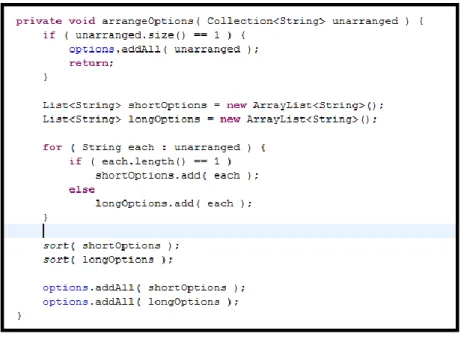
Symptom of the code smell Duplicated Code is observable in Figure 1 since the first three instructions from the methods „void hopOverLong()‟ and „void showOff()‟ are the same (left area code).
In Fig. 3, the result of applying the Extract Method refactoring to the duplicated instructions is displayed in the right code square. A method „void popWheelie()‟ was created and the Duplicated Code moved to this new method. Calls to the new method replace the old Duplicated Code fragments.
19 | P a g e 3.6 Refactoring Tools
Initial refactoring tools serve the main purpose of guarantying safe transformations to the code so the programmer don‟t have to retest the program at every single refactoring step [3].
The origins of systematic refactoring as a practice are linked to Smalltalk [3]. So it‟s no surprise the first proper tool for that end erupted in that niche circle. Known as the Refactoring Browser, the tool permitted a series of automatic refactorings interactively, in a safe and fast manner [33]. The tool gained wide acceptance once its functionalities were integrated in conjunction with the Integrated Development Environment (IDE) for Smalltalk the Smalltalk Browser [3].
Refactoring tools now cover all activities of the refactoring process. From smell detection tools to prototypes developed to discover the best refactoring when more than one can be of use [8]. Currently well known IDEs provide some refactoring support (e.g. Eclipse, NetBeans, IntelliJ, Visual Studio). However, this support is limited to semi-automatically applying a refactoring [8], with the developer still responsible for selecting the area of code he wishes to refactor and assist with additional information depending on the particular refactor the developer whishes to apply. IntelliJ is graced with extra functionalities when compared with other IDEs since it is capable of software inspection capabilities such as a code duplicates detection and visualization mechanism, and a Dead Code detection system.
Automated tools base their decisions on specific metrics oriented to detect structural bad designs or smells. Some tools use inside information (via metrics) to inspect for code smells evidence, leaving for the user the responsibility to decide which refactor to apply. Additionally more powerful tools try to indicate which refactor is the most indicated to eliminate the detect code smell [34].
Simmond and Mens [35] identified one fully automatic tool, named Guru, capable of restructuring inheritance hierarchies and refactoring methods of SELF programs [36]. A category of tools of software visualization exists to support developers identification of code smells [37-38].
20 | P a g e
4
Automated Code
Smells Detection
Contents
4.1 BLR Model ... 21 4.2 Automation ... 23 4.3 Models of Use ... 2521 | P a g e 4.1 BLR Model
This work main objective is the contribution of an automatic process capable of code smells assessment. The process here proposed is based on a technique first introduced in 2010 by Bryton et al.[10]. The authors suggested and demonstrated the validity of a process adjusted for code smells detection that is objective, deterministic and possible of automation. The process was built around the idea of utilizing the power of statistical techniques to obtain a mathematical model able to detect Long Method instances upon source code analysis.
The approach relied on a statistical regression technique, where the independent variables that explained the model could be drawn automatically, thus providing an opening for automation. The dependant variable was in turn gained by directly accessing expert‟s knowledge.
Before covering any more details on the process an explanation of the Binary Logistic Regression Model ensues.
Binary Logistic Regression
Binary logistic regression (BLR) is used for estimating the probability of occurrence of an event (here, the existence of a code smell) by fitting data to a logistic curve. It is a generalized linear model where the dependent (aka outcome) variable has two possible values (code smell present or absent) and an arbitrary set of numeric independent (aka explanatory) variables can be used (a set of code complexity metrics). The general equation of the logistic function used to estimate the percentage of probability of a particular code smell is the following:
.
Where z is called the logit, are the regressors or explanatory variables (code complexity metrics collected from the source code) and are the regression coefficients calculated during the calibration process. The usefulness of the BLR model is that allows the ranking its results by probability.
To perform BLR calibration with a statistical tool such as SPSS or R, a sample with values for all variables (explanatory and outcome) is needed. Table 7 presents an extract
22 | P a g e of such a sample, corresponding to four methods on the org.apache.commons.cli package from Apache Commons CLI 1.2. The collected metrics are MLOC (method lines of code), NBD (nested block depth), VG (cyclomatic complexity), and PAR (number of parameters). These are the explanatory variables in the BLR model. Long Method is the dependent variable: an expert indication of the presence of the Long Method code smell on the particular method.
After calibration and validation of the regression coefficients, the instantiated model is used to predict the possible presence of a particular code smell.
Table 7: Sample extract for calibrating a Long Method code smell estimation model
Application ApacheCommonsCLI1.2
Package org.apache.commons.cli
Class GnuParser Parser HelpFormatter PosixParser
Method Flatten parse renderOptions burstToken
MLOC 69 67 59 46 NBD 5 5 4 4 VG 11 14 10 6 PAR 3 4 5 2 Long Method 0 1 1 0 Process Details
To use the BLR model, first we have to calibrate it to fit the data to a logistic curve that mimics real occurrences. So a sample collecting all variables for the model is the first step of the process.sda
The explanatory variables to be used are code complexity metrics and can be obtained automatically by means of software applications. The choice of the adequate metrics to select for each code smell estimation model based on BLR can be performed by using the Wald or the Likelihood-Ratio tests.
The outcome variable is added to the model by domain experts (code smells connoisseurs). The quality of these assessments and the quantity of data provided will contribute for the model accuracy.
23 | P a g e Next is the proper calibration of the BLR model using mathematical calculus to derive the regression coefficients for the model. This can be done by a statistical engine (SPSS or R for instance). Final step is testing the model for goodness-of-fit, and the application of its estimations to predict code smell instances in selected code bases.
The described logic is the platform on which the process proposed in this work builds up. Developments required for its automation and the model of use expected to guarantee results and usability of the concept are unveiled in the following sections.
4.2 Automation
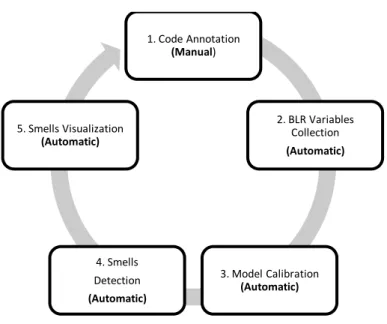
Fig. 4 outlines how the BLR model approach to code smells detection can be sequenced to evolve it to automatic processing. Note the necessity of input by domain experts at the start of the cycle. Although it is a limitation for automation purposes, its necessity can be reduced and favorable conditions can be offered to ease this action, not dismissing the fact that the power of this process and expected quality improvements to the model rely on human effort.
Fig. 4: Code smells detection process
Since one of the goals is to provide tool support of the activities in Fig. 4, we start by grounding this approach to more concrete terms, narrowing its scope the following way:
Code Annotation. In the first iteration, experts must tag the code sample for the presence of code smells in methods, classes or interfaces. So to yield an adequate
1. Code Annotation (Manual) 2. BLR Variables Collection (Automatic) 3. Model Calibration (Automatic) 4. Smells Detection (Automatic) 5. Smells Visualization (Automatic)
24 | P a g e sample for the initial calibration of the models. In subsequent iterations those developers will only tag false positives (developer disagrees with a detected smell) and false negatives (developer identifies a non-detected code smell). These cases are expected to decrease over time as more data results in more finely calibrated models that produce more precise results (and more in sync with the user tastes). The finer the results less is the necessity for the users to calibrate the model. It is expected that the quantity of calibrations decrease over time, with the necessity for recalibration efforts only being called for when the user starts perceiving the model as inaccurate.
BLR Variables Collection. Automatic process that requires a parser-enabled tool that computes metrics on the target source code (the one annotated by domain experts). More metrics means more predictable variables for the BLR model, and better chances at estimating valid code smells predictions models. Because not all code smells are created equal, so is the need for different metrics to evaluate each of them. Information on code smell presence are taken from the annotations.
Models Calibration. Calibration of the BLR models by calculating and validating the regression coefficients. It is an automatic process performed by a statistical processor. Note that there will be one model for each code smell. Each model may have different explanatory variables (metrics) and it is up to the end user to give the final call about their validity, providing feedback to better attune it to his needs.
Smells Detection. Application of the calibrated BLR models to selected source code elements. This estimates the probability of presence of the corresponding code smell in the selected artifact.
Smells Visualization. Identification of the source code artifacts where code smells are estimated to be present. Developers can set the threshold probability (e.g. see only the code smells above 90% probability) for each code smell. Detected code smells will vary depending on the selected probability threshold. Increasing the probability too much will cause more false negatives, while decreasing it in excess will cause more false positives. It will be up to the developer to fine tune the threshold to get the adequate level of advice (let us call it “sensitivity”) regarding the presence of code smells. It will also be up to the developer to decide on the adequacy of applying a given refactoring to remove a detected code smell.
25 | P a g e The described process can have two different usage patterns. The first concerns a single user with a single machine. The second, a remote usage for more than one user. Next section exemplifies them.
4.3 Models of Use
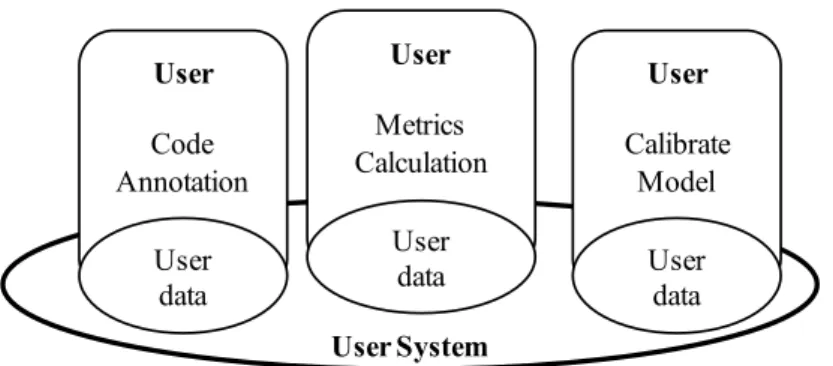
Local Usage
In this case the process (including the calibration) is completely local (Fig. 5). The user is responsible for tagging an initial source code base to calibrate the models. Then, the user can apply the models to detect the occurrence of code smells in all code bases of his choice. It is also possible to refine the calibration of the model by providing additional code smell tagging information.
The usefulness of this option is one of practical value: tuning the models, through progressive calibrations, to personal user preferences, thus matching the models to the user notions of where a code smell might be present.
Fig. 5: Local usage
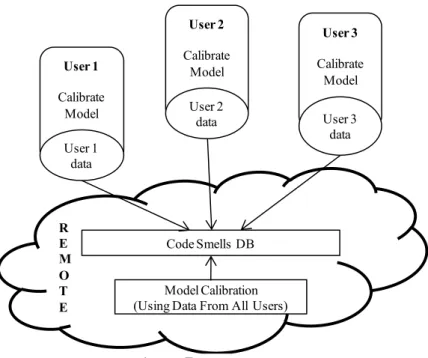
Remote Usage
The process has a remote central server responsible for storing, on its own data base, the code smells tagging and metrics values provided by several users (Fig. 6). With the calibration and validation of the BLR model being performed on the server, users can remotely query the server for the most recent model parameters. This model is calculated from the aggregated data provided by all users, augmenting the statistical significance of the BLR estimates and thus providing a more accurate detection of the code smells. User Code Annotation User data User System User Metrics Calculation User data User Calibrate Model User data
26 | P a g e One of the simpler updates the user can make is to provide feedback on false positives and false negatives detected, thus contributing for the models‟ progressive enhancement.
Fig. 6: Remote usage
We will further define the boundaries and scope of our detection process by providing a concrete tool to exemplify its usage. The tool, called Smellchecker, will be described in the next section.
User 1 Calibrate Model User 1 data Code Smells DB User 2 Calibrate Model User 2 data User 3 Calibrate Model User 3 data Model Calibration (Using Data From All Users) R E M O T E
27 | P a g e
5
Smellchecker
Contents
5.1 Eclipse ... 28 5.2 Metrics Plugin ... 31 5.3 Smellchecker Overview ... 33 5.4 Smellchecker Architecture and Implementation ... 36 5.5 Smellchecker Usage ... 4328 | P a g e This chapter describes the development and implementation of the code smells detection tool Smellchecker. Developed as an Eclipse plugin it was designed to bring code smells detection capability to Eclipse‟s Java Development Tools (JDT).
This chapter gives details of Smellchecker‟s architecture and implementation and examples of use. First it starts with a description of the Eclipse Software Development Environment (IDE), its plugin architecture and the concepts behind JDT‟s source code manipulation with Java Model and the Abstract Syntax Tree. Because Smellchecker‟s extensively use Metrics Plugin 1.3.8 functionalities a section detailing it precedes a Smellchecker‟s plugin overview. Detailed architecture and implementation specifications are given next. Ending this chapter is an exploratory example of Smellchecker‟s usage.
5.1 Eclipse
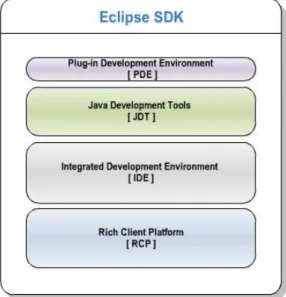
Eclipse is an open platform. It was designed to be extensible. At the core is the Eclipse Software Development Kit (SDK), with which we can build various tools. These products or tools can further be extended by other tools. For example, a simple text editor can be extended to create a XML editor. Eclipse‟s extensibility is achieved by creating these products/tools in form of plugins. Fig. 7 shows the principle components within Eclipse´s SDK.
29 | P a g e Rich Client Platform (RCP) provides the architecture and framework to build any rich client application. Integrated Development Environment (IDE) is a tools platform and a rich client application in itself. It is possible to build various kinds of tools by using the Eclipse IDE. Plugin Development Environment (PDE) provides all tools necessary to develop plugins and RCP applications. Java Development Tools (JDT) is a complete Java IDE that provides APIs to access and manipulate Java source code. It also permits the creation of new projects and handles modifications to existing ones, providing the tools to build and launch Java programs.
Plugins
Eclipse is built upon the OSGI framework (Equinox) . The OSGi framework provides a dynamic modular architecture in which bundles can be deployed (Eclipse uses the term plugins). Eclipse plugins are the same as OSGi bundles and are used to extend the Eclipse framework. Eclipse isn‟t a single Java program, but a small program which provides the functionality of typical loader called plugin loader.
A plugin is a Java program which extends the functionality of Eclipse in some way. Each Eclipse plugin can either consume services provided by other plugin or can extend its functionality to be consumed by other plugins. These plugin are dynamically loaded by Eclipse at run time on an on-demand basis.
When a plugin wants to allow other plugins to extend or customize portions of its functionality, it will declare an extension point. The extension point declares a contract (typically a combination of XML markup and Java interfaces), that extensions must conform to. Plugins that want to connect to that extension point must implement that contract in their extension. The key attribute is that the plug-in being extended knows nothing about the plug-in that is connecting to it beyond the scope of that extension point contract. This allows plug-ins built by different individuals or companies to interact seamlessly, without their knowing much about one another besides the extension point contract.
A plugin consists of a bundle manifest file: MANIFEST.MF that provides important details about the plug-in, such as its name, ID, and version number. The manifest tells also what Java code it supplies and what other plug-ins it requires. A plugin may provide code, documentation, resources bundles, or data to be used for other plugin.
30 | P a g e A plugin can also provide a plugin manifest file: plugin.xml. It describes how it extends other plugins, or what capabilities it exposes to be extended by others (extensions and extension points).
Java Model and Abstract Syntax Tree
Java‟s JDT allows accessing Java source code in two different ways: either by using the Java Model or by using the Abstract Syntax Tree (AST). Where Java Model is a light-weight and fault tolerant representation of the Java project. It does not contain as many information as the AST (e.g. it does not contain the main body of a method) but is fast to re-created in case of changes. Eclipse‟s outline view uses the Java model for its representation, this way the information in it can quickly be updated.
The AST is a detailed tree representation of Java source code. The AST defines API to modify, create, read and delete source code. Each element in the Java source file is represented as a subclass of ASTNode. Each specific AST node provides specific information about the object it represents. For example you have MethodDeclaration (for methods), VariableDeclarationFragment (for variable declarations) and SimpleName (for any string which is not a Java keyword). Fig. 8 shows the overall AST workflow and how it relates to file source code.
31 | P a g e 5.2 Metrics Plugin
Java Metrics 1.3.8 provides metrics calculation and a dependency analyzer plugin for the Eclipse platform. Our main interest is on the metrics provided. Yet, we decided to keep all Metrics Plugin functionalities because they provide for a good analysis. Even if Smellchecker‟s cannot understand the dependency analyzer visioning, still Smellchecker‟s users may find it useful to check dependencies between modules.
Listing 1: Java method example
Metrics resources provide a good compliment to code smells tagging operation. Users can check metrics of a particular software element while annotating the code, this may provide useful to make more informed decisions. For example, when wondering if the code on Listing 1 should be annotated for the Long Method presence, the user may check for metrics values to assist him by looking at the Metrics view on Fig. 9.
32 | P a g e Metrics provides summarized information on metrics calculated at the level of the components: package and system. This measures are shown with average and standard deviation calculation. This is important because the aggregated info can be drilled down within the view to decompose it to its basic elements. For instance, it means that the Method Lines Of Code (MLOC) metric is summarized (sum aggregation) at the package level and with a click on the metric name within the view, information of MLOC of all classes within the package will show. Information we can further drill down in the same view by choosing to see the methods metrics.
An example is seen in Fig. 10, where the metric MLOC at package level is drilled down to the compounding classes information. This can facilitate code inspection for code smells, allowing the user to check metrics organized by their value. Spotting on the example given in Fig. 10 the classes with more MLOC within a package/system component for further analysis.
Fig. 10: Summarized metrics at package level
Metrics provide other views and visualization capacities, more information on the Metrics Plugin may be found online4.
Most important for Smellchecker is the capacity of calculus of various metrics types for Java source code elements.
4
33 | P a g e Table 8 displays all the metrics available on Metrics Plugin, and this is the ones Smellchecker will use. Details of the metrics names, with the kind of element of a Java project they can be measured on, are in the table.
Table 8: Metrics Plugin 1.3.8 metrics
Metric Acronym Type Method Package/System
Number of Methods NOM X X
Number of Fields NOF X X
Total Lines Of Code TLOC X X
Method Lines Of Code MLOC X X X
Number of Parameters PAR X
Specialization Index SIX X
McCabe Cyclomatic Complexity VG X X
Weighted Methods per Class WMC X X
Lack of Cohesion of Methods LCOM X
Afferent Coupling Ca X
Instability I X
Abstractness A X
Normalized Distance from Main Sequence Dn X
5.3 Smellchecker Overview
Java was the language chose for the tool implementation, and it is also upon Java source code that the tool will detect code smells instances. That is because Java is a modern, well known, all purpose programming language, with many open source available software solutions we could use for aiding in implementing the Smellchecker tool. Eclipse framework was selected as the target platform to support Smellchecker‟s development due to its advanced Java support, available refactoring features, along with its plugin development facility. Eclipse is also a stylish and appropriate choice for our tool deployment (as a plugin) since its architecture by components supports integration of virtually any component within its architecture. And yet, despite its advanced support for Java source code refactoring, as part of its standard JDT toolkit, code smells detection is by and large completely lacking (2005‟s Code Nose Plugin[39] is the known exception, although a version of it seems to not be available online for testing or using purposes).
34 | P a g e Smellchecker was developed as an Eclipse plugin using Eclipse‟s Plugin Development Environment (PDE). The Smellchecker prototype architecture uses Java 1.6 and it was built upon Eclipse platform 3.5.
In order to concentrate our efforts on the specialization aspects of the code smells detection process a mechanism that provided code metrics calculations was necessary. Although there are various tools that perform metrics calculations on Java source code, few of them provided the capability of exporting its calculations in a way that could be used for automation. So we focused on open source projects that provided free access to their source. We tried CyVis5 0.9.0, Dependenct Finder6 1.2.1, State of Flow Eclipse Metrics7 3.14, and Eclipse Metrics8 1.3.8.
The combination of quality and quantity of metrics, combined with its nature as an Eclipse plugin, made Eclipse Metrics Plugin 1.3.8 the natural and most appropriated choice for incorporation within our tool. And comparing with State of Flow Eclipse Metrics 3.14, Metrics 1.3.8 was the best documented version of the two.
Smellchecker‟s extends the source code of the Eclipse Metrics 1.3.8 plugin for the purpose of supporting the functionalities required for the code smells detection activity. It leaves Metrics components almost unchanged, only making a minor modification to its activator class. All other contributions are on Smellchecker‟s own packages and the only resource used at source level from Metrics is a static class that returns the metrics calculations for a Java element passed as input.
There were two main reasons why the choice was made for directly extending Metrics Plugin source code. First of them is that the plugin does not implement an extension point that provides access to elements metrics. It only provides extensions to add new metrics and to add new export type files. The other is that it would not be desirable to burden the user with the necessity of exporting the metrics calculations from Metrics and feed them to Smellchecker. Also, the computational burden would be elevated by the necessity of parsing an entire file every time metrics were needed. Even if we started by reading Metrics entire project metrics calculations only once in the beginning of the process, every time any change occurred in the project‟s source code would mean the repetition of the process (and a heavy one). A better solution is to make the necessary
5 http://cyvis.sourceforge.net/ 6 http://depfind.sourceforge.net/ 7 http://eclipse-metrics.sourceforge.net/ 8 http://metrics2.sourceforge.net/
35 | P a g e modifications to the Metrics Plugin source code (that is why the project‟s source code is made available) and make the process automatic.
The cleaner and transparent way of giving Smellchecker‟s plugin direct access to Metrics‟ metrics calculations, would be by adding to Metrics an extension point to permit direct metrics access, and then making Smellchecker implement an extension for it. This was not our solution however. Ours was to directly change Metrics and add the new behavior to the source code itself. This decision comes from the fact that in the future, new metrics must be added to Smellchecker‟s. And as it is, Metrics extension point that permits adding new metrics, makes restrictions on the type of calculations it does, namely that they must be numeric. So, Metrics core code itself must be updated to achieve higher flexibility on the metrics it processes. Also, to deal with Metrics source code was to have a good head start to know how it operates and how to modify it. The metrics supported by Smellchecker are the ones Metrics provides. Was behind the scope of this work to extend them, so the BLR explanatory variables we can use are confined to Metrics measurements. Which constraints the number and efficiency of code smells that can be detected. For instance, we could test to relate Lines of Code (LOC) with the Duplicated Code smell. In fact one could argue that Long Methods have a high probability of having Duplicated Code in them. That may be true. But it is also true that even a method with one line of code could be duplicated. I happens all the time when different classes implement the same basic functionality because they are unaware of other classes implementations. So for Duplicated Code more efficient methods already exist [40] than trying to support their detection with Smellchecker‟s current available metrics. That is not saying that the BLR approach Smellchecker uses is not powerful enough for some smells, but metrics should be adjustable to a specific code smell, and for the current moment we only can use in Smellchecker‟s a restricted subset of them.
Smellchecker‟s is fully integrated on the Eclipse IDE. Source code annotation will be permitted by accessing the appropriate option of code smell tagging on the context menu for both classes and methods entities. The tagging will be evident on the source code in the form of Java annotations. Java annotations were the choice for marking the code because they are native to the Java language. Although they are not guaranteed to always have support (some java compilers may delete annotations information), Eclipse‟s JDT makes sense of them and they are the only way to express outside information on Java source code using the standard Java language. The other choice at
36 | P a g e our disposable was by using Eclipse‟s Markers, but that way it would be confined to the Eclipse framework and the annotation information would have to be saved outside the Java files to guarantee persistence. Java annotations are visible in the source code and the files can be parsed by another tool to get the annotation information.
In terms of statistical processing Smellchecker‟s first and only choice was R9. R‟s powerful statistical engine was even more appealing because of its open source nature. BLR coefficients model calculation activity will be dynamic and to the user is required have the statistical R tool installed. Following sections will detail the components development and integration and it will be clear what is expected from R and how the communication between Smellchecker and R will proceed.
Interaction with Smellchecker‟s users is made trough Eclipse‟s Workbench facilities and main Java text editor.
Details of Smellchecker‟s architecture and implementation solutions follow in the next section.
5.4 Smellchecker Architecture and Implementation
The development of the proposed code smells detection solution can be agruppated by functionalities (traceable to the activities described in Fig. 4) that support:
Source Code Annotation (Java annotations)
BLR Variables Collection (Eclipse Metrics Plugin) BLR Calibration (R communication)
Code Smells Detection (source code parsing) Code Smells Visualization (Eclipse JDT)
An overview of all the major components comprising Smellchecker is provided in Fig. 11.
9
37 | P a g e Fig. 11: Smellchecker‟s component diagram
User‟s interactions with the application are made through Eclipse‟s workbench elements and they are associated with three main user interaction components: Code Smells Tagging «UI», BLR Calibration «UI» and Code Smells Detection «UI». This are all associated with the JFace UI «Eclipse» component that is responsible for the actual UI interaction.
To each of this components corresponds a action phase of the detection process that requires user interaction. Code Smells Tagging «UI» deals with the Source Code Annotation, BLR Calibration «UI» calibrates the BLR model, and Code Smells Detection «UI» is associated with the Code Smells Detection and Visualization functionalities previous stated. In order to perform each action required by users, internal components are responsible for the dynamics of the process.
The Code Smells Tagging «UI» interacts with the Tag Source Code «Smellchecker» component to write annotations to the code. Code Smells Tagging «UI» is comprised of a set of Eclipse‟s user interface environment (UI) workbench popup menus actions necessary to annotated the code. It also receives the appropriated action events raised by the user and calls the appropriate function reasoning on the Tag Source Code «Smellchecker» component that is responsible for updating the source code. Being this last component responsible for writing or deleting annotations to the code.



![Fig. 3: Extract Method Example (adapted from[33] )](https://thumb-us.123doks.com/thumbv2/123dok_us/789442.2599800/36.892.131.773.826.1104/fig-extract-method-example-adapted.webp)
![Fig. 8: AST workflow [adapted from http://www.eclipse.org]](https://thumb-us.123doks.com/thumbv2/123dok_us/789442.2599800/48.892.166.732.691.986/fig-ast-workflow-adapted-from-http-www-eclipse.webp)