Gossip-based Partitioning and
Replication Middleware for
Online Social Networks
Master of Science Thesis
Stockholm, Sweden 2013
TRITA-ICT-EX-2013:181
Muhammad Anis Uddin Nasir
School of Information and Communication Technology KTH ROYAL INSTITUTE OF TECHNOLOGY
Degree Project for European Master in Distributed Computing Gossip-based Partitioning and Replication Middleware for
Online Social Networks
Author: Muhammad Anis Uddin Nasir Supervisor: Sarunas Girdzijauskas
Declaration
This thesis is an account of research undertaken between January 2013 and June 2013 at School of Information and Communication Technology, KTH Royal Institute of Technology, Sweden. I hereby certify that I have written this thesis independently and have only used the specified sources as indicated in the bibliography.
July 8, 2013
(Muhammad Anis uddin Nasir)
Abstract
The nature of Online Social Networks (OSNs) has created many scalability challenges for OSN providers in the last decade. The main challenge comes with a huge amount of data that is generated by OSNs and requires large data centers to handle the workload. The existence of strong community structure in social networks creates complex dependability patterns within the OSN data and makes it difficult to deploy over multiple servers without breaking the relation structure. Such systems may require communication among mul-tiple servers and can generate high inter-server traffic. With no intelligent data allocation strategy, vital operations of OSNs like query processing and data management inevitably result in high and costly inter-server traffic. Ex-isting solutions, i.e., distributed databases, key-value stores and auto scaling, may be inefficient and unable to scale for OSNs. In our work, we present a distributed partitioning and replication middleware that efficiently partitions an OSN graph and distributes it across the cluster in order to achieve high availability and scalability for OSNs. Our algorithm splits the social graph into equal sized partitions and periodically updates the partitions to achieve optimal placement of users. Additionally, our algorithm achieves fault toler-ance and data locality at a low cost of redundancy through replication. We compared our algorithm with a de-facto random partitioning, state-of-the-art solution SPAR and a distributed graph partitioning algorithm called JA-BE-JA. In the experiments, we show that our approach generates four times lower replication overhead compared to random partitioning, and generates lower replication overhead by a factor of two compared to SPAR. We also demon-strate that our algorithm is able to tolerate high churn rates and scale for large OSNs.
Acknowledgment
I would like to express my deepest appreciation to my supervisor, Dr. Sarunas Girdzijauskas, who guided and encouraged me throughout this work. His methodology of supervision and guidance has really helped in achieving my targets while meeting the deadlines. It is not that I only learned technically from him, I have tremendously enjoyed working with him as a student and it really helped me to progress professionally. I would also like to express my sincere gratitude to my colleague Fatemeh Rahimian for her guidance and help during the thesis. Her ideas and advises played an important role in achieving different goals in the thesis. I would also like to thank PhD students at Swedish Institute of Computer Science, Martin Neumann and Niklas Ekstr¨om, for their insights, ideas and valuable feedback throughout this work. I would also like to express my gratitude to researchers at Swedish Institute of Computer Science, who have given their opinions and feedback on the work; Special thanks to Professor Jim Dowling for his guidance and suggestions. Also, I would like to show my gratitude for my examiner Johan Montelius, my opponent, ˇZygimantas Bruzgys, for their reviews and com-ments that helped me to improve greatly the final version of this document.
I would also like to thanks to Professor Leandro Navarro and all other pro-fessors from Politecnic University of Catalonia for their guidance and knowl-edge. Special thanks to my roommates Emmanouil Dimogerontakis and Faik Aras Tarhan, who really encouraged and helped me throughout my stay in Sweden. I would also like to thank all of my friends in Sweden, for making my stay full of cherishment and fun: Rizwan, Maria, Vaidas, Fahad, Atif, Zygi-mantas, Julia, Irfan, Asim, Faraz, and all classmates from European Master of Distributed Computing.
Finally, I would like to dedicate this thesis to my parents and brothers. Their continuous support and belief has played an important role in my life and really helped me to finish this European Master in Distributed Comput-ing.
Stockholm, July 8, 2013 (Muhammad Anis Uddin Nasir)
Contents
1 Introduction 1
1.1 Motivation . . . 2
1.2 Contributions . . . 7
1.3 Structure of the Thesis . . . 8
2 Related Work 9 2.1 Enterprise Solutions . . . 9
2.2 Graph Partitioning . . . 10
2.3 One-hop Neighborhood . . . 11
2.4 Activity Based Models . . . 11
2.5 Regional Servers . . . 12
2.6 Distributed Graph Processing Frameworks . . . 12
3 Problem Description 15 3.1 Problem Statement . . . 15
3.1.1 Requirements . . . 15
3.1.2 Formulation . . . 16
3.2 Existing Scalability Models . . . 18
3.2.1 SPAR . . . 18
3.2.2 JA-BE-JA . . . 20
4 Gossip-based Partitioning and Replication Middleware 23 4.1 System Design . . . 23 4.1.1 Architecture . . . 23 4.2 System Operations . . . 24 4.2.1 Gossip Protocol . . . 24 4.2.2 Peer Selection . . . 25 4.2.3 Cost Function . . . 25 4.2.4 Simulated Annealing . . . 26 4.3 Algorithm . . . 26 4.3.1 Greedy Algorithm . . . 26 4.3.2 Server Exchange . . . 28 ix
5.2 Length of Random Walk . . . 30 5.3 Peer Selection . . . 31 5.4 Simulated Annealing . . . 32 5.4.1 Noise Delta . . . 32 5.4.2 Initial Temperature . . . 39 5.5 Number of iterations . . . 42 6 Evaluation 43 6.1 Experiments . . . 44
6.1.1 Evaluation with Datasets . . . 44
6.1.2 Evaluation with Replication Factors . . . 45
6.1.3 Evaluation with Servers . . . 46
6.1.4 Dynamic Behavior . . . 48
7 Conclusion 51 7.1 Discussion . . . 51
7.2 Conclusion . . . 53
List of Figures
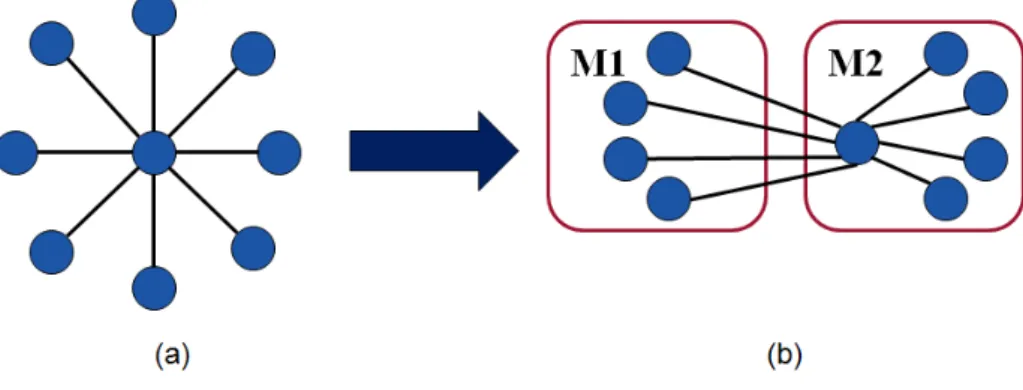
1.1 An example showing that placement of high degree nodes may generate large number inter-partition edges. (a) a high degree node and (b) nodes equally distributed among two servers [1]. . . 2 1.2 An example showing why min-edge cuts problem is different than minimum
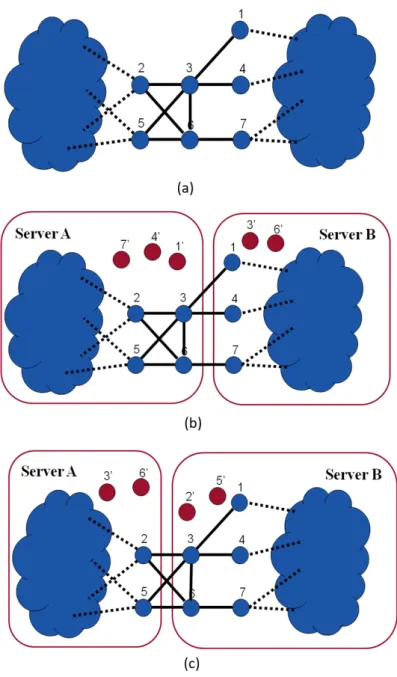
replica problem. The cloud in the figure represent communities, blue nodes represent the master copies of users and red nodes represent the replicas. (a) initial social graph with two communities, (b) the graph partitioned into two components by cutting minimum number of edges and (c) the graph partitioned into two components using minimum number of replicas [2] . . . 4 1.3 (a) Sketch of an initial graph distributed across two servers, (b)
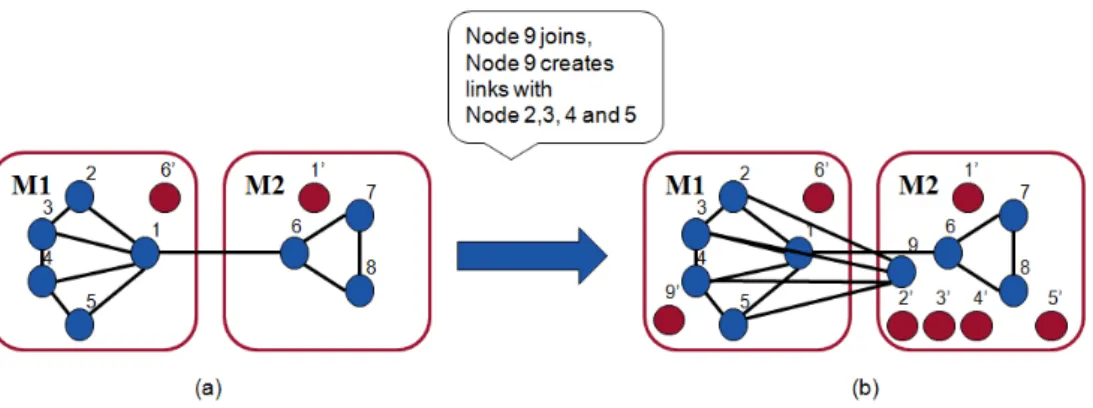
Distri-bution of nodes and replicas after node addition and link creation using SPAR, i.e., SPAR requires five additional replicas to achieve data locality. 5 1.4 (a) Sketch of an initial graph distributed across two servers, figure (b)
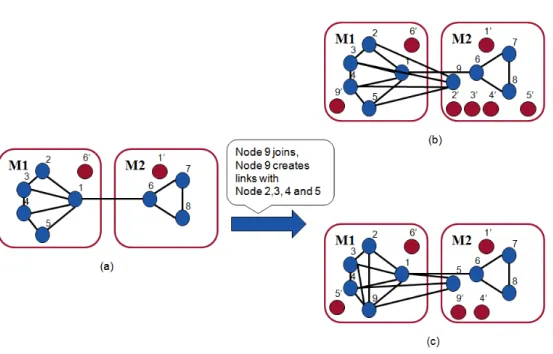
and (c) shows the distribution of nodes and replicas after node addition and link creation using SPAR and the proposed algorithm respectively, i.e., SPAR requires 5 additional replicas and our algorithm requires 3 additional replicas. . . 7
3.1 (a)initial network with three servers storing a social graph and a new edge is created between node 1 and 6, (b) network configuration after node 1 moves to server M3, (c) network configuration with no node movements, and (d) network configuration after node 6 moves to server M1 (copied from [2]). . . 19
4.1 Middleware integrated into three-tier web architecture . . . 24
5.1 replication overhead for different length of random walks for random peer selection withk=16 andf=2. . . 31 5.2 swap count and replication overhead for different values of noise delta for
synthetic clusterized graph withk=16 andf=2. . . 33 5.3 swap count and replication overhead for different values of noise delta for
synthetic highly clusterized graph withk=16 andf=2. . . 33 5.4 swap count and replication overhead for different values of noise delta for
synthetic clusterized graph with four clusters withk=16 andf=2. . . 34
5.6 swap count and replication overhead for different values of noise delta for snap facebook graph withk=16 andf=2. . . 35 5.7 swap count and replication overhead for different values of alpha for
syn-thetic clusterized graph withk=16 andf=2. . . 36 5.8 swap count and replication overhead for different values of alpha for snap
facebook graph withk=16 andf=2. . . 37 5.9 swap count and replication overhead for different values of exponential
rate of change of temperature, for synthetic clusterized graph with sixteen clusters withk=16 andf=2. . . 38 5.10 swap count and replication overhead for different values of exponential rate
of change of temperature, for facebook dataset from SNAP withk=16 and f=2. . . 38 5.11 swap count and replication overhead for different values of Initial
Temper-ature with synthetic clusterized graph withk=16 andf=2. . . 39 5.12 swap count and replication overhead for different values of Initial
Temper-ature with synthetic highly clusterized graph withk=16 andf=2. . . 40 5.13 swap count and replication overhead for different values of Initial
Temper-ature for synthetic low clusterized graph withk=16 andf=2. . . 40 5.14 swap count and replication overhead for different values of Initial
Temper-ature for synthetic power law graph withk=16 andf=2.. . . 41 5.15 swap count and replication overhead for different values of Initial
Temper-ature for SNAP facebook graph withk=16 andf=2. . . 41 5.16 ratio of replication overhead for our algorithm and random partitioning
for different number of iterations using synthetic graphs withk=16 and f=2. . . 42 5.17 ratio of replication overhead for our algorithm and random partitioning
for different number of iterations using real world graphs withk=16 and f=2. . . 42
6.1 Comparison of replication overhead of our algorithm, random partitioning, SPAR and JA-BE-JA for different datasets withk = 16 andf = 2.. . . . 44 6.2 Replication overhead for different fault tolerance replicas, i.e., f = 0, 2
withk=16. . . 45 6.3 Replication overhead for different datasets and different number of servers
withf = 2. . . 47 6.4 Replication overhead versus number of iterations for SNAP Facbook graph
withf = 2 andk=16. . . 48 6.5 Replication overhead versus number of iterations for WSON Facbook graph
withf = 2 andk=16. . . 49 6.6 Replication overhead versus number of iterations for SNAP Twitter graph
Acronyms and Abbreviations
OSNs Online Social NetworksSA Simulated Annealing
DHTs Distributed Hash Tables
SPAR Social Partitioning and Replication
JA-BE-JA Distributed Graph Partitioning Algorithm
SHA Simple Hash Algorithm
APG Activity Prediction Graph
CHAPTER
1
Introduction
Social networks have gained tremendous popularity in the last decade and most of today’s popular web services are related to social networks [3]. Along with social network providers, many companies have used social networks to build various gaming and business applications [4]. The most popular On-line Social Networks (OSNs), e.g., Facebook, Youtube and Twitter, attract millions of users and generate petabytes of data every day [5, 4, 6]. In or-der for OSN services to run smoothly unor-der high workloads, OSN service providers are required to rely on large geo-distributed data centers. However, this acts as a barrier for small and medium enterprises to enter the OSN service market, since only well established OSN providers can afford to run large data centers. Such companies require efficient and low cost solutions to deal with OSNs and build applications. The main research interest of our work is to understand structural properties and patterns of OSNs and pro-pose an efficient algorithm that can be utilized to store and process OSN data.
The deployment of OSNs on huge data centers requires data to be par-titioned into independent components in order to place the data on set of autonomous servers. Such partitions help to utilize the network bandwidth efficiently and reduce the inter-server traffic, as it places the group of strongly connected users on the same server and dependent queries, e.g., new feeds of a user, where it has to fetch data from all the neighbors, can be resolved locally from any server. However, OSNs mostly have to deal with connected data, which represent the relationships and interactions of OSN users with their friends and acquaintances. OSNs exhibit strong community structure, which is reflected in the social data that OSN providers have to store and process [7, 8]. The existence of community structure makes it difficult to split and distribute the data across multiple machines, thus creating challenges for management and scalability. There are several companies, e.g., Twitter and Facebook, which redesigned their infrastructure several times to satisfy user demands [2]. Other companies like Friendster, which were unable to adapt and scale, were moved out of business.
1.1
Motivation
OSNs deal with social graphs, where links are created among users based on relationships and acquaintances. Such networks exhibit small-world proper-ties [9] and are capable of spreading information widely and rapidly. OSNs follow a power-law degree distribution, which means that an OSN graph con-tains huge number of users with low social degrees and concon-tains small number of users with high social degrees [5, 4, 6]. Such power law degree distribution makes it difficult to partition the graph into equal sized clusters and requires special attention for placement of high degree nodes [1]. Figure 1.1 gives an example where placement of high degree node on two servers generates large number of inter-partition edges. Moreover, in OSNs, 80% of all information accesses remain within a one-hop neighborhood in the social network topology [5], and we can achieve high data locality and better utilization of network resources by replicating neighbors that are one-hop away. In our work, we benefit from the structural properties of OSNs and propose an approach for deployment of OSNs that provides high availability and guarantees data lo-cality for one-hop neighbors through replication.
Figure 1.1: An example showing that placement of high degree nodes may generate large number inter-partition edges. (a) a high degree node and (b) nodes equally distributed among two servers [1].
A conventional way to handle high workload and satisfy user demands is to upgrade existing hardware. Such vertical scaling techniques are expensive and not feasible to handle petabytes of data [2]. An economical solution to handle the high workload is to rely on horizontal scalability utilizing higher number of cheap commodity servers. Horizontal scalability requires data to be partitioned into small components so that it can be distributed among multiple machines. However, OSNs deal with strongly connected data that is created based on relationships among users. It exhibits a strong community structure, where users are densely connected within the communities. The existence of strong community structure makes it difficult for OSN providers to partition and distribute the data across multiple machines.
1.1. Motivation 3
Currently, most of the OSN providers utilize key-value stores, where ran-dom partitioning is used to split the data across multiple machines. Specifi-cally, Cassandra [10] that is an open source distributed database, which pro-vides structured key-value store with tunable consistency. It uses Chord [11] like ring structure for network topology and leverages consistent hashing to assign users to a machine in the ring. The consistent hashing function takes the user-id and generates address of a server, using a hash function like SHA-1. Such hash functions are oblivious to the underlying relationship structure of OSNs and place the data related to a single user on different servers. For example, if a useru has a set of neighbors, the data of neighbors is likely to be placed on different servers based on the hash values. An update of user
u will require pushing relevant messages to the servers hosting its neighbors. Such distribution will generate high server traffic due to highly inter-connected workload and may not work effectively in the case of OSNs.
In the past few years, researchers have started taking interest in man-agement and scalability of OSNs, as typical queries in OSNs are usually de-manding and usually require to accumulate data from more than one user [2, 12, 13]. For example, a read query for a user u may require the infor-mation of all the friends who have their birthdays in the next month and such queries may require accumulating data from more than one machine and are expensive in terms of network bandwidth. Recently, researchers have targeted the problem related to management and scalability of OSNs from different perspectives. Some solutions have been proposed targeting the one-hop neighborhood [2, 12, 14], as it accounts for 80% of information accesses across OSNs [5]. One-hop neighborhood represents information and updates related to friends that are directly connected to a user. Researchers have shown that we can reduce the network traffic through replication for the neighbors that are directly connected to a user [2]. Moreover, few solutions suggest utilizing activity based graphs instead of social graphs for replica-tion of OSN users in a distributed environment [15, 16, 17]. Activity based graphs are created based on user activities and interaction in OSNs and help in reducing the replication overhead. Such graphs represent user relationships more efficiently compared to social graphs, as users do not interact with all of their connections [6]. Researchers have also considered using graph partition-ing algorithms to partition the social graph into equal-sized clusters and then placing the independent clusters on different machines to efficiently utilize the network bandwidth [18, 19]. However, graph partitioning solutions may not work efficiently, in case of OSN graphs, due to existence of power law degree distribution in OSN graphs.
Figure 1.2: An example showing why min-edge cuts problem is different than minimum replica problem. The cloud in the figure represent communities, blue nodes represent the master copies of users and red nodes represent the replicas. (a) initial social graph with two communities, (b) the graph partitioned into two components by cutting minimum number of edges and (c) the graph partitioned into two components using minimum number of replicas [2]
1.1. Motivation 5
In our work, we compare our algorithm with to two state of the art tech-niques JA-BE-JA [18] and SPAR [2], which are described below. JA-BE-JA is a distributed balanced graph partitioning algorithm, which continuously keeps the social graph partitioned into equal size clusters. It is a gossip based algorithm, which periodically adjusts the partitions utilizing the local infor-mation at every node and places the connected nodes together. JA-BE-JA efficiently partitions the graphs into equal size groups and reduces the edge-cuts between the partitions. We utilize replication in order to achieve data locality for connected neighbors that reside on different servers, which means that for any useru, we create the copy of its master on all the servers that has its directly connected neighbors. JA-BE-JA provides better partitioning for the graphs by minimizing the edge cuts between the partitions and gen-erates low replication overhead in case of no fault tolerance, i.e., there is no replication in the system to provide resilience against failures and the only replication in the system is to achieve data locality. However, replication overhead increases with the increase in replication factor, as the algorithm does not take into account the replicas while partitioning the social graph. Figure 1.2 illustrates how minimizing the edge-cut is not equivalent to min-imizing the number of replicas. In particular, Figure 1.2 (b) shows that the minimum edge-cut will cut three edges and require five nodes to be replicated in order to achieve data locality. However, in case of minimizing the number of replicas in Figure 1.2 (c), the algorithm partitions the graph by cutting four edges, resulting in four replicas. In our work, we modify the cost function of JA-BE-JA in order to minimize the number of replicas, instead of minimizing the number of edge-cuts between the partitions.
Figure 1.3: (a) Sketch of an initial graph distributed across two servers, (b) Distribution of nodes and replicas after node addition and link creation using SPAR, i.e., SPAR requires five additional replicas to achieve data locality.
SPAR [2] addresses the problem of partitioning the social graph to pro-vide scalability for OSNs. It guarantees data locality for connected neighbors, utilizing the social graph structure and creating eventually consistent replicas across servers. Data locality ensures that the data required by a user is always
present on a local server and the algorithm does not have to access any other server to resolve a query. SPAR creates replicas for neighbors that reside on other servers, so that it can access the information related to neighbors locally using the replicas. Each user data is stored in a system in the form of single master and set of replicas. Replicas are eventually consistent copies of the user master, which means that it is possible that replicas do not have the updated information corresponding to the user. SPAR improves network and CPU performance by distributing the workload equally among servers. SPAR uses a heuristic based on greedy optimization for placement of users and its replicas, which we describe below.
In SPAR, when a new user u joins the network, it is assigned to a server with least number of users (masters). In case of link creation between user
u and any nodex, the algorithm first checks if nodes are co-located, i.e., ei-ther nodes exist on same server or nodes have master-slave relationships on different servers. The algorithm does not require performing any operation if nodes are co-located. However, if nodes are not co-located, algorithm evalu-ates three different configurations, i.e., (a) no movement of users, (b) useruis assigned to the server of userx, and (c) userx is assigned to the server of user
u. The algorithm greedily chooses the configuration that yields the minimum number of replicas. Moreover, it requires a load balancing condition to ensure that the workload is distributed equally among all the servers, which could restrict optimal assignment of the nodes to the servers. SPAR is a sequen-tial algorithm, which may become inefficient for huge networks, dealing with millions of nodes and billions of edges (e.g., Facebook, Twitter), as it does not take into account the global picture of the social graph. In our work, we address this problem and utilize a distributed algorithm that can take into ac-count the global picture of a graph while distributing the nodes across servers.
Figure 1.3 shows a graph partitioned between two servers. Later, node 9 joins the network and creates links with nodes 2, 3, 4 and 5. Figure 1.3 (b) shows how SPAR places the new user in the existing network. When node 9 joins the network, SPAR places the node 9 on server M2 as it contains fewer number of masters. In case of link creation between node 9 and node 2, the algorithm chooses configuration (a) and creates replicas of node 9 on server M1 and creates replica of node 2 on server M2. The algorithm chooses the same configuration for other new links maintaining the load balancing constraint across the servers. In particular, it shows that 5 additional replicas are required to maintain data locality. This behavior of SPAR is due to the fact that the nodes in SPAR are processed sequentially without taking into account the global picture. Moreover, the existence of load balancing constraint may not allow choosing optimal configuration for placement of nodes, hence, resulting in additional replication overhead.
1.2. Contributions 7
Figure 1.4: (a) Sketch of an initial graph distributed across two servers, figure (b) and (c) shows the distribution of nodes and replicas after node addition and link creation using SPAR and the proposed algorithm respectively, i.e., SPAR requires 5 additional replicas and our algorithm requires 3 additional replicas.
1.2
Contributions
In this thesis, we propose a gossip based partitioning and replication middle-ware that deploys a social graph on top of data-stores with the goal of reduc-ing number of replicas across servers. Like SPAR [2], our algorithm benefits from the social behavior of users in OSNs, i.e., 80% of user accesses remain within a one-hop neighborhood [5], and provides data locality for one-hop neighbors. The algorithm follows a node centric approach, where each node periodically selects a neighbor and share information about the replicas that are required for their existence on their servers. Users exchange their servers if the server exchange will result in overall less number of replicas in the sys-tem. We assume that every node is an independent processing unit and is capable of executing the algorithm utilizing the local information. Our al-gorithm is a heuristic-based solution that minimizes the number of replicas across the system. We prevent our algorithm from becoming stuck in a lo-cal optima by employing a simulated annealing technique [20]. Figure 1.4 (c) illustrates that our proposed algorithm requires lower number of replicas compared to SPAR. We implement our algorithm and compared its perfor-mance with de-facto random partitioning, state-of-the-art solution SPAR and a distributed graph partitioning algorithm called JA-BE-JA. We performed extensive experiments with different social networks graphs, replication fac-tors and different number of servers. Results show that our approach reduces the replication overhead four times as compared to de-facto random
partition-ing and reduces the replication overhead by factor of two compared to SPAR in case of high clusterization in the social graph. Moreover, we demonstrate that our algorithm in capable of handling dynamic nature of OSNs and pro-vides better scalability using a distributed algorithm instead of a centralized one.
1.3
Structure of the Thesis
We divide our work in chapters. In chapter 2 we discuss the related work of the thesis. Chapter 3 describes the problem statement, formulates the optimization problem for minimizing number of replicas and discusses the existing scalability models that we implement in our thesis. Further, Chapter 4 describes our algorithm and and its architecture. In chapter 5, we discuss the datasets that we use in our experiments and tune different parameters for experiments. Chapter 6 discusses the evaluation of the algorithm. Finally, chapter 7 concludes the thesis and suggests future work directions.
CHAPTER
2
Related Work
2.1
Enterprise Solutions
Most of the modern OSN providers rely on Distributed Hash Tables (DHTs) [21] and noSQL databases [22], which provide horizontal scalability by ran-domly partitioning and placing the data on multiple servers. Morever, many companies have implemented customized solutions to handle high workload that is generated by OSNs. For example, Twitter in its early days, imple-mented Gizzard [23], which uses range partitioning to distribute the data across cluster. Facebook developed Cassandra [10], which provides high scal-ability and good performance with tunable consistency. Amazon implemented Dynamo [24], a highly available key-value store, to store user shopping carts. Such data-stores promise high scalability, due to their distributed design, and randomly partition and distribute the data across the network [22]. However, such solutions do not take care of social structure in OSN graph and poorly partition the data, which may place the connected users on different servers. As a result, processing a single query may require gathering data from mul-tiple machines and utilize high network bandwidth. Therefore, Key-Value stores can lead to poor performance and may generate high inter-server traf-fic [2].
Data distribution is a trivial way to achieve better performance and avail-ability for most of the applications. Various distributed databases, i.e., MySQL, Bayou [25] are available that provides high availability and eventual consis-tency for the data. Similarly distributed file systems, i.e., Ficus [26], Coda [27] promises high availability through replication. All such systems distribute the data randomly among the servers and have to gather the information from multiple servers, which may make such systems inefficient for OSNs. Graph databases provide an attractive solution for deployment of social graphs [28]. However, graph databases are designed for complex data and do not promise high scalability for large scale dynamic graphs [29]. Moreover, many cloud providers like Amazon and Google AppEngine lend auto scaling services for deployment of web applications [30]. Such services allow the application to
scale automatically depending on the workload, but they require applications to be stateless and data to be independent. However, OSNs contain connected data and such frameworks are not the optimal choice in case of large scale OSNs.
2.2
Graph Partitioning
An alternative way to deploy OSNs on any data-store is to partition the data into disjoint components and place the disconnected components on different servers to reduce the communication overhead. The existence of strong com-munity structure in OSNs makes it difficult to partition the data, as users usually belong to more than one community [31]. Large amount of research has been dedicated to graph partitioning during the last decades [32, 33, 34]. However, most of these algorithms work with offline graphs, and they are in-sufficient for OSNs, which exhibit a dynamic behavior [2]. Additionally, these algorithms require the global view of the graph, hence making such algorithm not feasible for large scale OSNs. Recently, Fatemeh et al. [18] proposed a distributed graph partitioning algorithm called JA-BE-JA, which takes the global picture of the graph into account and partitions the graph into equal sized clusters while minimizing the edge-cuts between the partitions. How-ever, such partitioning algorithms minimize the edge-cut between partitions (as we discussed in the previous chapter), and might not be efficient in reduc-ing the replication overhead [2].
Moreover, Yang et al. [19] proposed Sedge, a Self Evolving Distributed Graph Management system that minimizes the inter-server traffic, which is generated during graph query processing in a cluster environment. Sedge uses offline and online partition schemes to partition the graph and reduce the inter-server traffic. The offline partitioning initially partitions the graph and distributes it to the workers across the cluster. For online partitioning, Sedge introduces a two-level partition management architecture with com-plimentary primary partitions and dynamic on-demand secondary partitions, which adapts in real time depending on the workload. Complimentary par-titioning repartitions the graph that is partitioned in the offline parpar-titioning part. It partitions the graph in a way that inter-partition edges become the internal edges of any of the partition. Further, Sedge creates on-demand secondary partitions by replicating the portion of primary partitions that con-tains the intensive workload. Using such partitioning schemes can reduce the inter-server communication for dynamic graphs. However, such algorithm will remain in transition due to dynamic nature of OSNs and will require intensive processing to handle the OSN workload.
2.3. One-hop Neighborhood 11
2.3
One-hop Neighborhood
Pujol et al. [35] proposed a replication scheme considering one-hop neigh-borhood for scaling online social networks. Further, they continued their work and proposed a middleware called SPAR [2], which utilizes the social topology of OSN users to distribute a social graph in a distributed environ-ment. SPAR operates on top of data-stores, i.e., MySQL, and Cassandra, and provides scalability for OSNs. It aims to provide data locality for one-hop neighbors by creating eventually consistent replicas of users across the servers. Such replication can help to resolve a query locally from any server. It improves the system performance and reduces the inter-server traffic by paying the replication cost (see chapter 3 for description of SPAR).
Some researchers have also put forward procedures for efficient replication that can help to reduce the network traffic in a distributed cluster. S-CLONE [12] proposes a social based replication scheme for OSN providers with fixed budget of disk space. It suggests to take into account the social relationship of users while replicating for fault tolerance, by creating replicas on the server with maximum number of neighbors. S-CLONE divides its replication proce-dure into two phases, i.e., (a) Replicate phase, (2) Adjust phase. In the first phase, the algorithm greedily places the replicas of a node on a server with maximum number of neighbors. In the second phase, the algorithm adjusts the number of replicas in the system to maintain the fault tolerance condition, i.e., there should always be f replicas in the system to recover in the case of failure. Such algorithm reduces the network traffic as replication improves the data locality. Similarly, Nguyen et al. [36] suggested to preserve social locality in data replication for OSNs, as it helps in improving the performance and data locality of the system.
2.4
Activity Based Models
Further, unlike SPAR [2] that provides data locality for every user, Yuan et al. [15] proposed to partition the network in time domain. The proposed approach was influenced by the study of Wilson et al. [6], that claims that users do not interact with all of its friends or neighbors and for majority of users, 20% of their friends account for 70% for interactions. The proposed algorithm provides data locality for frequent or “active” users, who have ex-changed messages recently. It uses activity prediction graph (APG) that keeps the updated data in all the partitions that are likely to be accessed by users. The author preferred two-hop neighborhood instead on 1-hop neighborhood, as it cover major portion of accessed data. In the experimentd authors showed that partitioning on the two-hop provide data locality for at least 19% of the queries. Chen et al. [37] and Huang et al. [16] in their works also proposed a similar strategy to use interaction graph instead of the social graph for data replication for deployment of OSNs. However, activity network evolves rapidly and to exploit the strong time correlation, the algorithm needs to be
adaptive and dynamic, as the data is OSNs has strong time dependence [17]. Such requirements make the algorithm CPU intensive, as it has to maintain an updated APG at very small time scale.
Mondal et al. [38] proposed a complete in-memory, distributed graph data management system that can support processing of large scale dynami-cally changing graphs and uses disk as a backup storage. In their work, they proposed aggressive replication of nodes in the graph to handle low latency queries. Further, they have investigated three different replication schemes targeting communication overhead and storage requirement in the system. The first replication scheme is a hybrid, adaptive replication policy that per-forms eager or lazy replication by creating a predictive model of node-level read-write frequencies. The second scheme uses a clustering-based approach to reduce the cost of replication across the network. In this scheme the al-gorithm group together nodes with similar access pattern. The last proposed scheme uses a fairness criterion to guide the replication decisions in the net-work. The fairness criteria states that at least τ ≤1 neighbors are present on the local server. In our work, we propose a simple partitioning strategy, where we partition the graph by minimizing the number of replicas across the servers.
2.5
Regional Servers
Witie et al. [39] proposed a different approach to improve the network per-formance by exploiting the locality for interest for OSN users. As most of the information accesses in OSNs are within a geographical region, authors proposed to use TCP proxies and caching in a distributed architecture to makes the queries processed through regional servers. Such deployment of regional servers will improve responsiveness and efficiency of an OSN service. It reduces overall cost of network bandwidth and workload on central servers, as most of the queries can be resolved through the regional servers.
2.6
Distributed Graph Processing Frameworks
Recently, researchers have started showing much interest in development of distributed graph processing frameworks to simulate large scale graphs, i.e., Google Pregel [40], GraphLab [41, 42] , GraphChi [43] and PowerGraph [1]. All these graph-parallel abstractions consist of a sparse graph G=(V,E) and a vertex program that simulates on each vertexv∈V in parallel. Pregel [40] is a bulk synchronous message passing abstraction in which all vertex programs run simultaneously to achieve maximum parallelism and communicates with each other through message passing. Each vertex program consists of several steps, i.e., (1) receiving messages from all the neighbors, (2) processing those messages, and (3) sending messages to all the neighbors. A barrier is imposed between steps in order to ensure that all programs finish their processing
be-2.6. Distributed Graph Processing Frameworks 13
fore executing a new step. Pregel also introduces commutative associative message combiners that merge the messages originating from the same vertex to reduce the network traffic.
GraphLab [41] is an asynchronous distributed shared memory abstraction in which all vertex programs communicate using a shared memory. GraphLab ensures serializability by blocking the neighboring vertex programs to exe-cute simultaneously and schedule such programs to exeexe-cute in the future. Moreover, GraphChi [43] is a disk based graph processing framework that is capable of processing large graphs with billions of edges on a single ma-chine. It uses a parallel sliding window to break the graph into small parts and process those small parts in memory. PowerGraph [1] combines the best features of Pregel [40] and GraphLab [41], and proposes GAS decomposition, i.e., Gather, Apply and Scatter, to factor vertex programs over edges. It bor-rows data graph and shared memory concept from GraphLab. From pregel, it acquires commutative, associative gather concept. It supports both the high parallel bulk-synchronous Pregel model and computationally efficient asyn-chronous GraphLab model. It also introduces the concept of delta caching to cache the results from previous iterations that can be used in future iter-ations. All these frameworks provide perfect platform to simulate algorithm on large scale graphs containing billions of nodes and edges. Keeping the recent trend in mind we propose a gossip based algorithm that can easily be simulated using such frameworks. Implementations of our algorithm on these frameworks is left as a future work.
CHAPTER
3
Problem Description
3.1
Problem Statement
In this section, we define the requirements that should be addressed by a solution in order to achieve scalability for OSNs. Moreover, we define the minimum replica problem that can be used to store OSNs in any data stor-age system. Finally, we discuss the existing models that we implement for comparison with our algorithm.
3.1.1 Requirements
Following are the set of requirements that our algorithm needs to address:
• availability: OSNs consist of users and their relationships, where users interact with each other and receive updates within their group of friends and communities. Such networks are also used for advertise-ment and product related services to distribute the information across the group of users. Any service that is developed with the goal of stor-age and processing for OSN information should be able to provide high availability for its users.
• data locality: The system should be able to provide data locality for users in hop neighborhood, which means that data related to one-hop neighbors should be present in the local server. Such data locality will help to respond user queries locally without accessing any other server. To achieve data locality, we create copies of user master, which are called replicas. There can be two types of replicas in the system, i.e., (1) data locality replicas, (2) faulte tolerance replicas. Data locality replicas improve the network performance by creating local copies of the neighbors that are used to access neighbor information locally from any server. Other replicas that are present for fault tolerance, make system resilient against failure and helps to recover user information in case of failures.
• fault tolerance: The system should be able to cope with machine failures, which means that the system should have store user information at different places where it can recover the information in case of failure. A storage system usually achieves fault tolerance using f replicas of a user, which are stored randomly across the network.
• k-way partitioning: Let G=(V,E) denotes an undirected social graph with V vertices representing the users and E edges, which represent relationships among users. Letk be the total number of servers to host the social graph. We need to divide the social graph intok independent partitions, where eachv∈V is assigned exactly to one of thek servers.
• load balance: A balanced partition means that each partition share almost equal amount of workload, so that no partition gets overloaded and can end up as a bottleneck in the network. Such partitioning al-lows system to achieve better utilization of resources and minimize the response time for read and write queries.
• distributed algorithm: Decentralized algorithms are popular to han-dle high workload and provide scalability for different applications. Such systems are capable of handling dynamic nature of applications, i.e., high churn rate, and self management in case of failure. Keeping the stable nature of decentralized systems in mind, we want the algorithm to work in a distributed manner that each system in the network can execute algorithm with only local information. Such conditions help algorithm to process large scale dynamic graphs, which are impossible to process on a single machine.
• stablility: The system should be resilient to churn and different dy-namicity of OSNs. It should be able to handle high churn rates, where users continuously joins and leaves the network. Similarly, the system should be stable to provide data locality for the new connections that are formed between users, without affecting the network topology of the existing system.
• replication overhead: As discussed previously, our algorithm will use replication in order to achieve data locality and fault tolerance for users. It promises consistency for a single master copy of a users and perform all updated read and writes to that master copy. The algorithm updates all the replicas of a user eventually and promises eventual consistency for the replicas. To minimize the replication overhead, the algorithm should achieve data locality and fault tolerance using the minimum number of replicas across the network.
3.1.2 Formulation
We can now formulate the problem as an optimization problem of minimizing the number of replicas across the network. We model the problem using an
3.1. Problem Statement 17
undirected graph G = (V, E), where V are the vertices and E are the edges connecting those vertices. In addition, we have k servers to place those ver-tices, where each vertexi∈V should be placed on any of thek servers. For every user, each of his neighbors should exist on the same server either as a master or as a replica.
Suppose mij denotes a binary decision variable which is equal to one, if
master of user i ∈ V resides on server j ∈ 0· · ·k−1. Similarly, we have a binary decision variable rij for replica of a user, which is equal to one, if replica of useri∈V exists on server j ∈0· · ·k−1. We need to ensure that every edge e(i, l) ∈ E, where i, l ∈ V, follows the data locality requirement and the system has minimumf number of replicas corresponding to each user for fault tolerance. We can write the optimization problem as follows.
minimize X i X j rij subject to X ∀j mij = 1 ,∀i∈V (3.1)
mij ≤mlj+rlj + 1 ,∀i, l∈V,∀j,∀e(i,l)∈E
(3.2) X ∀i mij =X ∀i mi(j+1)+ ,∀j ∈0. . .k−1 (3.3) X ∀j rij ≥f ,∀i∈V (3.4) We need four different constraints to fulfill the requirements for the system.
• Constraint (3.1) ensures that every user has exactly one master on the servers.
• Constraint (3.2) ensures the data locality condition that for every edge, information should exist on the local server, either as master or replica.
• Constraint (3.3) ensures the load balancing condition among all the servers. It guarantees that each server handles almost equal number of masters, where the workload may vary depending on the coefficient of variation () [44], which is the ratio of standard deviation to the mean (of the server sizes). This condition makes sure that when a new user joins the network, it is assigned in a way that workload is equally distributed among all the servers. As replicas are eventually consistent, we only put the constraint on the master copy of a user.
• Constraint (3.4) ensures the fault tolerance condition that at least f
number of replicas of every user should exist in the system.
However, the mentioned optimization problem is an NP-Hard problem and can not be solved using linear programming. [2].
3.2
Existing Scalability Models
In the Chapter 2, we discussed existing solutions that can offer scalability for OSNs. In this section we describe in details two of the solutions that we consider and implement in our thesis for comparison with our algorithm.
3.2.1 SPAR
SPAR is a social partitioning and replication middle-ware that was proposed by Pujol et al. [2] to provide scalability for OSNs. It utilizes social graph structure and guarantees data locality for one-hop neighbors through replica-tion. SPAR stores users as a master and creates copy of those master, called replicas, across the network to maintain the local semantics, i.e., required information related to a user and its direct neighbors should be local to any server. Such local semantics ensures that the algorithm does not require fetch-ing information from any other machine on the network. It helps in achievfetch-ing high network performance and efficient bandwidth utilization. Moreover, it facilitates developers to build their applications as it is developed on top of a single machine.
SPAR focuses on providing data locality while creating minimum number of replicas across the network. It uses a heuristic based on greedy optimiza-tion that utilizes the local informaoptimiza-tion at every node. SPAR algorithm is triggered by six different operations, i.e., node addition/removal, edge addi-tion/removal and server addiaddi-tion/removal. In SPAR, when a new node joins a network it is assigned to a partition with fewest number for masters and required number of replicas are created for fault tolerance across the network. In case of node removal, master and all replicas are removed and all the neigh-bors of the user are updated.
For edge additions, algorithm begins by checking if the nodes are collo-cated, i.e., either masters of both nodes are on same server or both nodes have master-slave relationship on their servers. If the nodes are not collocated, al-gorithm evaluates three different configurations, i.e., i.e., (a) no movement of users, (b) first user is assigned to the server of second user, and (c) opposite of configuration (b). Further, the algorithm selects the configuration that yields minimum number of replicas. To demonstrate edge addition, we can look at Figure 3.1 (a), where a small social graph is distributed across three servers. Further, an edge is created between node 1 and node 6. As both nodes are not collocated, algorithm will evaluate three different configurations. Figure
3.2. Existing Scalability Models 19
3.1 (c) represents the first configuration, where no master will move from its server and it requires two additional replicas. Figure 3.1 (b) represents the second configuration where node 1 moves from server M1 to server M3. In this scenario the algorithm requires two more replicas to maintain the data locality, as replicas of node 2, 3 and 4 will be created on server M3 and replica of node 5 will be removed from server M1. Further, 3.1 (d) shows the third configuration, where node 6 moves from server M3 to M1 and it will remove one replica as it will not require the replica of node 5 on server M3. The algorithm in this scenario will choose the third configuration, as it results in minimum number of replicas.
Figure 3.1: (a)initial network with three servers storing a social graph and a new edge is created between node 1 and 6, (b) network configuration after node 1 moves to server M3, (c) network configuration with no node movements, and (d) network configuration after node 6 moves to server M1 (copied from [2]).
SPAR imposes a load balancing constraint across the network, so that the workload is distributed across multiple machines. The load balancing constraint may restrict the move mentioned in above example, as third con-figuration will result in no workload on server 3 and may possibly choose first configuration to balance the workload. For edge removal, SPAR removes the edge and the replicas while maintaining thef replicas for fault tolerance. We will not discuss the server addition and removal, as we do not consider server addition and removal in our work.
3.2.2 JA-BE-JA
We also consider using a graph partitioning algorithm to split the social graph in equal size partitions. Such partitioning algorithms can help to find clus-ters in a graph, which can be placed on independent servers to reduce the inter-server traffic. In our work, we considered a distributed graph partition-ing algorithm called JA-BE-JA that is proposed by Fatemeh et al. [18]. It is a gossip based heuristic algorithm that partitions social graphs into equal size clusters using the local information at every node. It utilizes simulated annealing and helps to achieve load balance among servers. In JA-BE-JA, each node of the graph is considered as an independent processing unit. As a gossip based algorithm, each node in the graph selects a neighbor and gossip about its neighbors on the same server. Depending on the information, nodes may exchange their servers and place itself close to its neighbors. In our work, we used JA-BE-JA to split the social graph and create replicas for the nodes that are not local, so that we maintain data locality for all one-hop neighbors.
JA-BE-JA follows a local search algorithm, where each node initially se-lects a color uniformly at random. The color of a node and its neighbors define the energy of a node, i.e., if a node and most of its neighbors have same color, it will have low energy. Each node in the social graph tries to acquire low energy by moving to the same server with its neighbors. For ex-ample, supposecp indicates the color of node p and Np denotes the neighbor
of node p. We can define xp(c) as the number of neighbors of node p having
the same color c. Two nodes p and q with colors cp and cq only exchange
their servers if they satisfy equation 3.6, whereαis a parameter of the energy function [18].
xp(c) ={q ∈Np :cq=c} (3.5)
xp(cq)α+xq(cp)α> xp(cp)α+xq(cq)α (3.6)
To achieve clusterization, each node periodically selects another node from the graph using one of the peer selection strategies, i.e., Local, Random and Hybrid. Local search selects any of the direct neighbors from a node. For random peer selection, it uses a random walk of fixed length to get a distant neighbor and hybrid peer selection is a combination of both local and random search in which algorithm initially selects a direct neighbor and calculate the pair-wise benefit for server exchange. In case, when the algorithm does not achieve a better placement, it tries to select a distant neighbor to perform the server exchange. After peer selection, both nodes calculate their energy and exchange their servers if it results in lower energy for both the nodes. As JA-BE-JA is a local search algorithm, it is probable that the algorithm may get stuck in local optima. To avoid local optima it uses simulated annealing technique. Each node in the graph execute the same algorithm and achieve the optimal placement after the fixed number of iterations. We perform the experiments to tune different parameters for JA-BE-JA and details regarding
3.2. Existing Scalability Models 21
CHAPTER
4
Gossip-based Partitioning and
Replication Middleware
In previous chapter, we defined requirements of the system and illustrated a minimum replica problem that can be used to fulfill the requirements. In this chapter we present our heuristic, that fulfill aforementioned require-ments. Our heuristic is a gossip-based partitioning and replication algorithm, in which nodes perform gossip in order to reduce the number of replicas across the system. It is a dynamic local search algorithm, which periodically adjusts the partitions utilizing the local information at every node. In this chapter, we discuss the system design and different operations that we used in our algorithm.
4.1
System Design
We propose a gossip-based local search algorithm that runs on top of data-stores and efficiently places the users across the system. The algorithm aims to provide high availability for OSN users while compromising consistency for replicas. It periodically executes and adjusts the partitions in order to reduce the number of replicas. We assume that each user in the network is an independent processing unit, e.g., in case of 100,000 users and 10 servers, each server will act on behalf of 10,000 users. Our approach is capable of exe-cuting in both distributed and central environment and is capable of handling millions of users and connections.
4.1.1 Architecture
Figure 4.1 shows the integration of the proposed middleware in a three-tier web architecture, which is influenced by the architecture of SPAR. The mid-dleware is implemented on top of data-stores, e.g., Cassandra or MySQL, and can only be triggered by an application. It contains a directory service that is used by applications to communicate with middleware and to get the address of a specific user on the data-store. Applications can use the specific drivers,
like MySQL driver or Cassandra API, to interact with the data-store and can parse all the queries locally from any server. The middleware takes the responsibility of placement of users and their replicas, thus managing the dis-tributed architecture and providing transparent scalability to the application.
Figure 4.1: Middleware integrated into three-tier web architecture
4.2
System Operations
In this section we discuss different operations that are used by our algorithm to achieve its goal of minimizing the number of replicas across the system.
4.2.1 Gossip Protocol
In our work, we propose a gossip-based protocol in which nodes communi-cate with each other to achieve a common goal of minimizing the number of replicas. Gossip protocols play an important role in modern large-scale dis-tributed systems. Recently, gossip-based protocols have achieved popularity in peer-to-peer community due to its scalablity, simplicity and robustness. In gossip-based protocols information spread in the same way as rumors are spread in a society. Such protocols are also called epidemic protocols as the information spread in a similar to viral infection among group of people. The frequencies of interaction for topology management in gossip-based protocols
4.2. System Operations 25
are less compared to other messages so that the communication cost is low. Such protocols can be used in various applications like message broadcasting, overlay management, aggregations, and clustering. As OSNs exhibit small world properties [9], it helps gossip-based protocols to spread the information widely and rapidly and make gossip protocols an attractive choice for OSNs.
4.2.2 Peer Selection
Each node in the network executes a gossip-based algorithm, where it peri-odically selects a peer to perform a server exchange. This server exchange helps nodes to move to the servers that can reduce the number of replicas in the system. We used three different schemes, i.e., 1) Local, 2) Random and 3) Hybrid, for peer selection and are mentioned below:
• Local: In local peer selection, the algorithm selects any of the direct neighbor of a user uniformly at random.
• Random: Different algorithms exists to get the random view of a graph, starting from a node without having knowledge of the complete graph. For example, there are different algorithms that perform ran-dom walks based on Markov Chains [45]. These algorithms start from a node and walk random number of steps along the edges, and returns the last visited node. In our algorithm, we used random walk of fixed length to select a distant neighbor in the social graph.
• Hybrid: Hybrid selection policy is a combination of local and ran-dom selection policy. In this method the algorithm first selects a direct neighbor and tries to calculate the pair-wise benefit. In case of no gain, algorithm selects a distant neighbor using a random walk to perform the server exchange [18].
4.2.3 Cost Function
In this section, we discuss the cost function that algorithm uses to calculate the cost of a node on a server. The cost of a user on any server is represented by the number of replicas that the node requires to maintain the data locality. We have two different cost function to calculate the cost, i.e., 1) cost on the server where user already exists and 2) cost for the new server. Suppose we have a graph G = (V,E), and the algorithm randomly selects a nodep∈V. Node p has multiple copies across the servers (0...k-1), i.e., master copy sp
and set of replicasSp0. As graph G represents a social graph, node p may have set of neighborNp. Below mentioned functions are used to calculate the cost
of a node on its existing server.
L(s) = X
i∈Np
ai(s) = 0 if si = s 1 otherwise (4.2) bi(s) = 0 if L(s)>1 1 otherwise (4.3) X(s) = X i∈Np ai(s)∗bi(s) (4.4)
Equation 4.1 calculates the sum of neighbors of a node that exists as a master on a servers. Equation 4.2 denotes a decision variable, which is equal to 1 if a useri exists on servers as a replica. Equation 4.3 denotes a decision variable, which is equal to 1 if no neighbor of useri has more than one master on server
s. Equation 4.4 denotes the cost function that is the sum of all the neighbors that exists as a replica and has no other neighbor as master on the same server. These equations will calculate the cost of a node if it already exists on a server. For cost of a node on a new server, the algorithm counts the neighbors that do not exist on a new server, either as master or a replica.
4.2.4 Simulated Annealing
Our algorithm continuously keeps the social graph partitioned into equal size clusters. To avoid the algorithm getting stuck into local optima, we used sim-ulated annealing technique [20]. Simulated annealing is a metaheuristic that is used to solve the global optimization problem of finding a global optima in a large search space. It works in a way that it introduces a noise into the sys-tem so that the syssys-tem can perform moves that are not allowed in the normal condition and escape from the local optima. The noise eventually fades out from the system depending on the cooling rate (δ) and the algorithm again converges to the value close to the global optima. We performed experiments (see chapter 5) to set up parameters for simulated annealing, i.e., cooling rate (δ) and initial temperature (To). For cooling rate, we used two different types
of schemes, i.e., (1) constant and (2) exponential. Cooling rate is directly propotional to the convergence time of the algorithm and can be varied de-pending on the requirements.
4.3
Algorithm
4.3.1 Greedy Algorithm
The algorithm initiates by taking an input graph in the form of edge list and distributes the users equally among k servers. When a new node joins the network, the algorithm assigns it to the server with minimum number of masters and creates the required number of replicas across the servers, for fault tolerance. In case of edge addition, the algorithm checks if both nodes
4.3. Algorithm 27
Algorithm 1Peer Selection
Require: any nodepin the graph has following methods:
• getLocalPeer(p): returns any neighbor of node p uniformly at random. • getDistantPeer(p): return a distant neighbor using random walk.
1: procedureselectPeer(p)
2: neighbor←getLocalP eer(p)
3: if swap(p, neighbor)6=T ruethen
4: neighbor←getDistantP eer(p)
5: swap(p, neighbor) 6: end if 7: Tr←Tr−δ 8: ifTr<1then 9: Tr←1 10: end if 11: end procedure
Algorithm 2Swap Servers
Require: any nodepin the graph has following methods: • getCost(p): get cost for nodepon its server
• getCost(p, server): get cost for nodepon new servers
1: procedureSwap(p, q)
2: up(sp)←getCost(p)
3: uq(sq)←getCost(p)
4: up(sq)←getCost(p, sq)
5: uq(sp)←getCost(p, sp)
6: ifup(sq) +uq(sp) + 2<(up(sp) +uq(sq))∗Trthen
7: move(p, sq) 8: move(q, sp) 9: returnT rue 10: else 11: returnF alse 12: end if 13: end procedure
Algorithm 3Move a node
Require: any nodepexists on serversprequires methods:
• isMaster(p, s): returns True if master of nodepexists on servers • insertMaster(p, s): creates master of nodepon servers
• replicaExists(p, s): returns True if replica of nodepexists on servers • insertReplica(p, s): creates a replica of nodepon servers
• deleteReplica(p, s): removes the replica of nodepfrom servers
1: procedureMove(p, sq)
2: for allneighbor∈Npdo
3: ifisM aster(neighbor, sp)then
4: insertReplica(neighbor, sq)
5: else
6: ifisM aster(neighbor, sq)6=T ruethen
7: insertReplica(neighbor, sq) 8: end if 9: end if 10: end for 11: ifreplicaExists(p, sq)then 12: deleteReplica(p, sq) 13: insertM aster(p, sq) 14: else 15: insertM aster(p, sq) 16: end if 17: end procedure
exist on the same server and in case of different servers algorithm creates their replicas to maintain data locality.
4.3.2 Server Exchange
Our proposed algorithm is a periodic algorithm in which each node period-ically selects a neighbor to perform gossip. After the peer selection, both the user and its selected neighbor calculates the number of replicas that are required for data locality on their servers. For example, suppose node A, which has its master on server1 and nodeB, which has its master on server
2, are two nodes in the graph and node A selects node B for the server ex-change. The algorithm utilizes the cost function (which we discuss above) to calculate number of replicas for both the nodes A and B to exists on both the servers 1 and 2. The nodes only exchange their servers in case of server exchange resulting in lower number of replicas. Our algorithm uses equation 4.7 to decide if it has to perform the server exchange between nodep and q. The equation calculates the cost of both the nodes on their existing and new servers. Moreover, the equation also contains an additional parameter ( ad-just), which accounts for the required replicas of the nodes on their existing server in case of their movement to the new server. Algorithms 1, 2 and 3 show algorithms for peer selection, swapping servers and moving node from one server to another server respectively.
adjust(p, q) = 0 if e(p, q)∈E t(p, sp, sq) +t(q, sq, sp) otherwise (4.5) t(i, sp, sq) = 0 L(sp)>0and L(sq)>0 1 L(sp)>0and L(sp) = 0 (4.6) Xp(sp) +Xq(sq) +adjust(p, q)> Xp(sq) +Xq(sp) p, q∈N (4.7)
CHAPTER
5
Tuning Parameters
5.1
Datasets
We used three different type of datasets in our experiments, i.e., 1) Facebook Graphs, 2) Twitter Graph and 3) Synthetic Graphs.
1. Facebook Graph
Facebook is among the top most OSNs, with user base of 1,110 million [46]. Facebook users are more connected than Orkut users, e.g., 37% of Facebook users have more than 100 friends, compared to 20% for Orkut [6]. However, both these networks show small world properties and follow power-law so-cial degree distribution. For our experiments we used two different facebook graphs. We took the first graph from Stanford Large Network Dataset Collec-tion [47], which contains 4,039 nodes and 88,234 edges. We took the second graph from Online Social Networks Research @The Max Planck Institute of Software Systems [48], which contains 60,290 nodes and 1,545,686 edges.
2. Twitter Graph
Twitter differs from other OSNs in network topology. Instead of relationship twitter users follow each other. Twitter social graph does not show power-law distribution for social degrees, have a short effective diameter and show very low reciprocity [49]. For our experiments, we took the twitter graph from Stanford Large Network Dataset Collection [47], which contains 81,306 nodes and 1,768,149 edges.
3. Synthetic Graph
We have generated five different synthetic graphs, which are described below.
• clustered graph (Synth-C): This graph contains of 2000 nodes, in-dexed from 1 to 2000. Each nodes has 10 different neighbors and the graph is divided into sixteen clusters, where each node connects to a node inside its cluster with 75% probability.
• highly clustered graph (Synth-HC): This graph is similar to Synth-C, in terms of number of nodes, clusters and node degree. However, in this graph each node connects with a node inside its cluster with 95% probability.
• clustered graph (Synth-LC): This graph contains 1000 nodes and generated on the same pattern like Synth-C graph, expect that there exist four clusters in this graph, instead of sixteen.
• highly clustered graph (Synth-LHC): It is a highly synthesized graph of 1000 nodes with four clusters, where each nodes connects to a node inside its cluster with 95% probability. Each node in the graph connects with 10 other nodes, which means that the average degree of the graph is 20.
• power-law graph (Synth-PL): we generated a power-law graph using Python Web Graph Generator [50]. Power Law graphs are random graphs with power law degree distribution, in which nodes connects to other nodes uniformly at random, while maintaining the power law degree distribution.
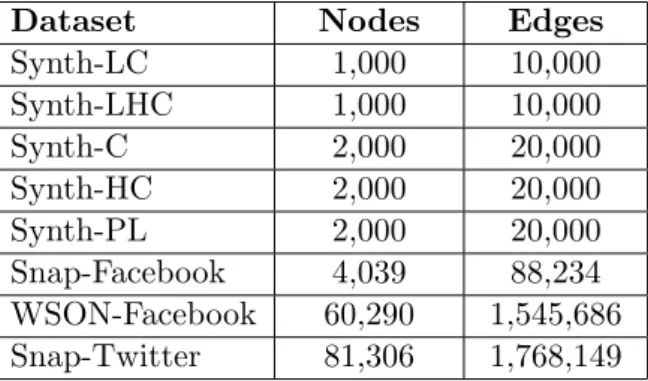
Table 5.1 summarizes all the graphs that we use in our experiments.
Dataset Nodes Edges
Synth-LC 1,000 10,000 Synth-LHC 1,000 10,000 Synth-C 2,000 20,000 Synth-HC 2,000 20,000 Synth-PL 2,000 20,000 Snap-Facebook 4,039 88,234 WSON-Facebook 60,290 1,545,686 Snap-Twitter 81,306 1,768,149
Table 5.1: Description of Datasets
5.2
Length of Random Walk
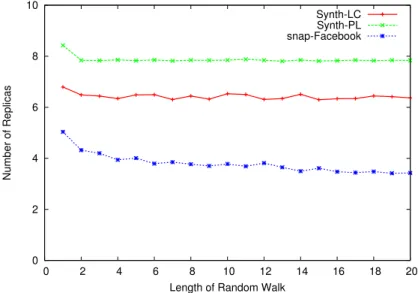
As discussed in chapter 4, our algorithm requires to perform random walk for random peer selection. In this experiment, we perform random walks for a different number of steps (m) and tune the length of random walks that can give us optimal results. We have used three different datasets (from the graphs mentioned above), and distributed the graphs on sixteen servers with replication factor of two. This experiment was performed without simulated annealing. Figure 5.1 shows the replication overhead for different size of random walks. As can be seen, random walk for length greater than six yields optimal results for peer selection. We can observe the replication overhead
5.3. Peer Selection 31
for three different datasets. The power law graph generates the maximum replication overhead compared to other graphs due to existence of randomness in the graph. The synthetic low clusterized graph generates high replication overhead, as the graph contains four clusters. Such distribution for graph with four clusters on sixteen servers generates many edge-cuts due to existence of randomness within the clusters. Facebook graph generates the minimum replication overhead due to existence of small world properties within the real world graphs, i.e., short average diameter and high clustering coefficient. We used six (m=6) as length of random walk for rest of the experiments. This experiment also validate the existence of small world properties in OSNs, as it proves that the existence of six degree separation among the OSN users.
0 2 4 6 8 10 0 2 4 6 8 10 12 14 16 18 20 Number of Replicas
Length of Random Walk
Synth-LC Synth-PL snap-Facebook
Figure 5.1: replication overhead for different length of random walks for random peer selection withk=16 andf=2.
5.3
Peer Selection
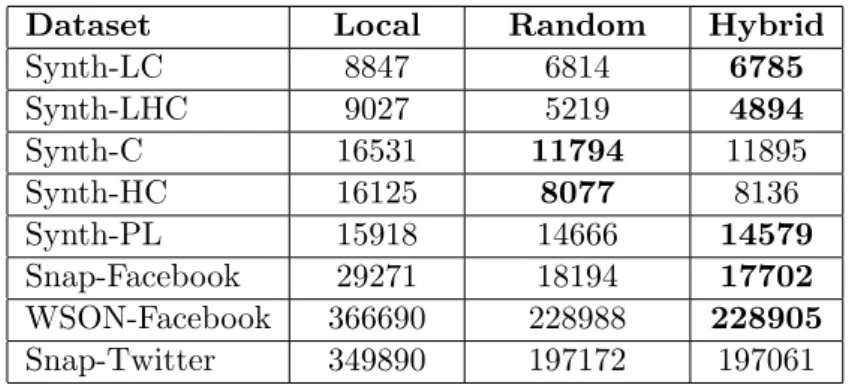
In this experiment, we compared different peer selection techniques that we discussed in chapter 4, i.e., 1) Local, 2) Random, and 3) Hybrid. Table 5.2 shows the replication overhead for the three schemes, using different datasets. For this experiment, datasets were distributed on sixteen servers with repli-cation factor of two. The algorithm achieves optimal results with hybrid peer selection policy, which is combination of local and random peer selection. However, improvements from random peer selection to hybrid peer selection are not very high. As local peer selection is not very expensive, we choose hybrid peer selection to perform further experiments.
Dataset Local Random Hybrid Synth-LC 8847 6814 6785 Synth-LHC 9027 5219 4894 Synth-C 16531 11794 11895 Synth-HC 16125 8077 8136 Synth-PL 15918 14666 14579 Snap-Facebook 29271 18194 17702 WSON-Facebook 366690 228988 228905 Snap-Twitter 349890 197172 197061
Table 5.2: Replication overhead for different peer selection strategies with
m=6,k=16 andf=2.
5.4
Simulated Annealing
In this section, we describe experiments that are performed to tune parame-ters for simulated annealing, i.e., (1) the cooling rate δ and (2) Initial Tem-perature.
5.4.1 Noise Delta
Constant Noise Delta
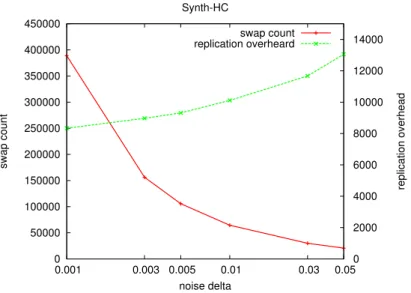
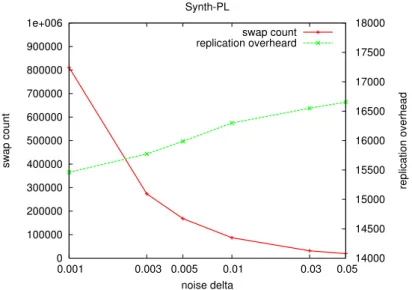
This experiment was performed for constant cooling rate (δ), i.e., the cool-ing rate [51]. Initially, noise is introduced in the system, which is removed from the system at a constant rate (δ), as described in the equation 5.1. In this experiment, we used different noise delta (δ) and compute the replica-tion overhead and number of swaps that are required in order to minimize the replication overhead. Swap count is directly proportional to the time re-quired for algorithm to reach the global optima. Figures 5.2, 5.3, 5.4, 5.5 and 5.6 show graphs for five different datasets, i.e., C, HC, Synth-LC, Synth-PL and Snap-Facebook. In this experiment, these graphs were distributed on sixteen servers with replication factor of two. As can be seen in the graphs that lower delta values generates lower replication overhead, but takes longer execution time and higher noise delta finishes the processing faster but generates higher replication overhead.
5.4. Simulated Annealing 33 0 100000 200000 300000 400000 500000 600000 700000 800000 900000 1e+006 0.001 0.003 0.005 0.01 0.03 0.05 0 5000 10000 15000 20000 swap count replication overhead noise delta Synth-C swap count replication overheard
Figure 5.2: swap count and replication overhead for different values of noise delta for synthetic clusterized graph withk=16 andf=2.
0 50000 100000 150000 200000 250000 300000 350000 400000 450000 0.001 0.003 0.005 0.01 0.03 0.05 0 2000 4000 6000 8000 10000 12000 14000 swap count replication overhead noise delta Synth-HC swap count replication overheard
Figure 5.3: swap count and replicatio