Automatic Translation of Biomedical Terms by Supervised Machine Learning
Vincent Claveau
IRISA-CNRS campus de Beaulieu 35042 Rennes, France [email protected]
Abstract
In this paper, we present a simple yet efficient automatic system to translate biomedical terms. It mainly relies on a machine learning approach able to infer rewriting rules from pair of terms in two languages. Given a new term, these rules are then used to transform the initial term into its translation. Since conflicting rules may produce different translations, we also use language modeling to single out the best candidate. We report experiments on different language pairs (including Czech, English, French, Italian, German, Portuguese, Spanish and even Russian); our approach yields good results (varying according to the considered languages) and outperforms existing ones for the French-English pair.
1. Introduction
In the biomedical domain, the international research frame-work makes knowledge resources such as multilingual ter-minologies and thesauri essential to carry out many re-searches. Such resources have indeed proved extremely useful for applications such as international collections of epidemiological data, machine translation (Langlais and Carl, 2004), and for cross-language access to medical pub-lication. This last application has become an essential tool for the biomedical community. For instance, the well-known PubMed document retrieval system gathers over 17 millions citations and processes about 3 millions queries a day (Herskovic et al., 2007)!
Unfortunately, up to now, little is offered to non-English speaking users. Most of the existing terminologies and document collections are in English, and the foreign or multilingual resources are far from being complete. For example, there are over 4 millions English entries in the 2006 UMLS Metathesaurus (Bodenreider, 2004), 1.2 mil-lion Spanish ones, 98 178 for German, 79 586 for French, 49 307 for Russian, and only 722 entries for Norwe-gian. Moreover, due to fast knowledge update, even well-developed multilingual resources need constant translation support. All these facts point up the need for automatic techniques to produce, manage and update these multilin-gual resources.
Within this context, we propose to present in this paper an original method to translate biomedical terms from one lan-guage to another. This method aims at getting rid of the bottleneck caused by the incompleteness of multilingual re-sources in most real-world applications. The new word-to-word translation approach we propose makes it possible to translate automatically a large class of simple terms (i.e., composed of one word) in the biomedical domain from one language to another. It is tested and evaluated on transla-tions within various language pairs (including Czech, En-glish, French, German, Italian Portuguese, Russian, Span-ish). Our approach relies on two major hypotheses:
• a large class of terms from one language to another are morphologically related;
• differences between such terms are regular enough to be automatically learned.
These two hypotheses, only stated for the biomedical do-main, make the most of the fact that, most of the time, biomedical terms share a common Greek or Latin basis in many languages, and that their morphological deriva-tions are very regular (Del´eger et al., 2007). These reg-ularities appear clearly in the following French-English examples: ophtalmorragie/ophthalmorrhagia, ophtalmoplas-tie/ophthalmoplasty,leucorragie/leukorrhagia...
The main idea of our work is that these regularities can be learnt automatically with well suited machine learning techniques, and then can be used them to translate new or unknown biomedical terms. We thus proposed a sim-ple machine learning approach allowing us to infer a set of rewriting rules; it only necessitates examples of pairs of terms that are translation of each other (different languages can be considered as source or target). The inferred rules operate at the letter level; once they are learnt, they can be used to translate new and unseen terms into the target language. It is worth noting that neither external data nor knowledge is required besides the gathering of examples of paired terms for the languages under consideration. More-over, these examples are simply taken from the multilingual terminologies that we aim at completing; thus, this is a fully automatic process.
After the description of related studies, Section 3. is dedi-cated to the description of the translation method and Sec-tion 4. gives some of its results for a pure translaSec-tion task.
2. Related work
was proposed. The main drawback of this approach was that it could only handle language pairs sharing the same alphabet and produced less reliable results than the one presented in this paper (see Section 4.3.). More recently, Langlais et al. (Langlais and Patry, 2007) proposed a very interesting approach to translate unknown words based on analogical learning. This technique seems promising and its use to translate biomedical terms is under study (Langlais et al., 2007).
Apart from these studies, related problems are often ad-dressed in the domain of automatic corpus translation. In-deed, the cognate detection task (cognates are pairs of words with close forms) (Fluhr et al., 2000,inter alia) relies on morphological operations (edit distance, longest com-mon sub-string...) sometimes very close to the rewriting rules we infer. Other studies are based on corpus-based analysis using statistical techniques or lexical clues (punc-tuation marks, digits...) in order to discover alignments —thus, possible translation relations— between terms in aligned corpora (Ahrenberg et al., 2000; Gale and Church, 1991; Tiedemann, 2004) or comparable corpora (Fung and McKeown, 1997b; Fung and McKeown, 1997a). Besides the problem of the lack of such specialized corpora, these approaches differ from ours in that their goal is to exhibit the translation of a word in a text (relationship problem) whereas we are addressing the problem of producing the translation of a term without other information (generation problem). Moreover, most of the times, these alignment techniques actually need pairs of terms that are translation of each other as a starting point (V´eronis, 2000, for a state-of-the-art).
More generally, statistical machine translation (Brown et al., 1990) addresses a close problem; of course, in our case, the sequence to translate is composed of letters and not words. Yet, the method we propose bears many similari-ties with the standard statistical approach that uses a trans-lation model and a language model (Brown et al., 1993). Nonetheless, the kind of data we manipulate implies im-portant differences. First, we are not concerned with the problem of reordering words, taken into account in the IBM models through the distortion parameter: indeed, the mor-pheme order (and thus the letter order) of our terms hardly varies from one language to another. Similarly, the fertility parameters or null words in these models, which are used to tackle the word-to-word translation exceptions, are not suited for our data. Such problems are indeed naturally handled by our inference technique which allows us to gen-erate rewriting rules translating not only letter to letter but also from a string of letter to another string of letter of dif-ferent length.
Studies on transliteration, for instance for Japanese (katakana) (Qu et al., 2003; Tsuji et al., 2002; Knight and Graehl, 1998, for example) or for Arabic (Al-Onaizan and Knight, 2002; AbdulJaleel and Larkey, 2003) bear lot of similarities with our approach. Indeed, some of the tech-niques used in this domain are very close to one we de-tail hereafter, but usually only concern the representation of foreign words (mainly named entities) in languages hav-ing a different alphabet than the source words. Most of these techniques include a step aiming at transforming the
term as a sequence of phonemes; they are said phonetic-based. Such techniques thus require external knowledge (letters-to-phonemes table, source-language phonemes to target-language phonemes table. . . ) which makes the ap-proach efficient but not portable to other pairs of languages. The technique we present is in fact similar to some exist-ing approaches developed in thespelling-basedframework (Al-Onaizan and Knight, 2002). In the existing studies about named-entity transliteration, the two translation di-rections are not considered as equivalent: one speaks about forward transliteration (for example, transliteration of an Arabic name into the Latin alphabet) andbackward translit-eration(retrieving the original Arabic name from its Latin transliteration). This distinction often implies differences in the techniques used (vowelization in Arabic for exam-ple); it is not relevant to our approach. Our technique is fully symmetric even if the performances may vary from one translation direction to the other.
Finally, let us mention the studies on computational mor-phology in which machine learning approaches have been successfully used to lemmatize (Erjavec and Dˇzeroski, 2004), to discover morphologic relations (Gaussier, 1999; Moreau et al., 2007) or to perform morphographemic anal-ysis (Oflazer and Nirenburg, 1999). The technique of rewriting rule inference presented in the next section falls within the scope of such studies.
3. Translation technique
The translation technique we propose here works in two steps. First, rewriting rules (see below for examples) are learnt from examples of terms that are translations of each other in the considered language pair. This set of rules is then used to translate any new term, but conflicting rules may produce several rivaling translations. In order to choose only one translation, we use a language model, learnt on the training data, and keep the most probable translation.
3.1. Rewriting rules
Our translation technique aims at learning rewriting rules (that can also be seen as transliteration rules). These rules, inferred from lists of bilingual term pairs (cf.Section 4.1.), have the following form:
hinput stringi → houtput stringi
In the remaining of this paper, we notera rewriting rule; Ris the list of every rule inferred during an experiment, input(r)andoutput(r)respectively refer to the input and output strings of the ruler.
Algorithm 1 gives an overview of our machine learning ap-proach. The first step is performed by the software DPalign
(http://www.cnts.ua.ac.be/∼decadt/?section=dpalign). It is
LPortuguese-English LEnglish-Russian
# c e t o s t e r ´o i d e s # # k e t o s t e r o i d s #
# a d e n o s i n e t r i p h o s p h a t a s e # #a d e n o z i n t r i f o s f a t a z a# # e l e c t r o p o r a c¸ ˜a o #
# e l e c t r o p o r a t i o n #
# h y d r o x y p r e g n e n o l o n e # #g i d r o k s i p r e g n e n o l o n # # e n c e f a l o g r a f i a #
# e n c e p h a l o g r a p h y #
# k e r a t o p l a s t y # #k e r a t o p l a s t i k a#
Table 1: Examples of alignment produced for two language pairs
Algorithm 1Inferring rewriting rules
1: align term pairs at the letter level, put the results inL
2: for allterm pair W1 inLdo
3: for allletter alignment of W1 in which the 2 letters differdo
4: find the best hypothesis of ruler in the search spaceE
5: addrto the set of rulesR
6: end for
7: end for
A list of paired terms is provided in input of DPalign; to each term, we add two characters#to represent the begin-ning and the end of the string of letters. The output listL then contains the paired terms aligned at a letter-level; Ta-ble 1 presents some examples for two language pairs (’ ’ means no character). Hereafter, the source term of pair p (respectively the target term of p) is written input(p)
(resp. output(p)); moreover, align(x, y)means that the sub-stringxis aligned with sub-stringy in the considered term pair.
For each difference between two aligned letters, our algorithm has to generate the best rewriting rule. Many rules are eligible: consider for exam-ple the difference i/y in the French-English word pair #opht almologie#/#ophthalmology #; some of the rewriting rules our algorithm could generate in this context arei→y, gi→gy,ie→y(note that we do not write the character), ologie#→ology#, and so on.
The score of a rule is computed from the listL; it is de-fined as the ratio between the number of times the rule can actually be applied and the number of times the premise of the rule matches a source term from the example list. Thus, formally, it is defined as:
score(r) =
|{p∈ L |input(r)⊆input(p)∧output(r)⊆align(input(r), p)}|
|{s∈ Linput|input(r)⊆s}|
where⊆represents the inclusion of character string (for example,abc⊆aabca).
3.2. Lattice of rules
In order to efficiently choose the best rule among these pos-sibilities, we define a hierarchical relation between rules.
Definition 1 (Hierarchical relation) Letr1andr2be two rules, then r1 º r2 ⇔ (input(r1) ⊆ input(r2) ∧
output(r1)⊆output(r2)).
Ifr1ºr2, thenr1is said more general thanr2. This
hier-archical relation defines a partial order in the search space E; thus, it makes it possible to order rules hierarchically in E, resulting in a lattice of rules.
Proof
Reflexivity.For any ruler, we obviously haveinput(r)⊆ input(r)∧output(r)⊆output(r), thusrºr.
Transitivity. Let r1, r2 and r3 be three rules such that
r1 º r2andr2 º r3. We haveinput(r1) ⊆ input(r2),
input(r2)⊆input(r3), thusinput(r1)⊆input(r3), and similarly we haveoutput(r1) ⊆ output(r3). Finally, we haver1ºr3.
Anti-symmetry. Let r1 and r2 be two rules such that
r1 º r2andr2 º r1. We haveinput(r1) ⊆ input(r2),
input(r2)⊆input(r1), thusinput(r1) =input(r2), and similarly we haveoutput(r1) = output(r2). Finally, we haver1=r2.
Thus, this relation defines a partial order. It is not a total order since we can haver1 andr2 such thatr1 6º r2 and
r26ºr1. ¤
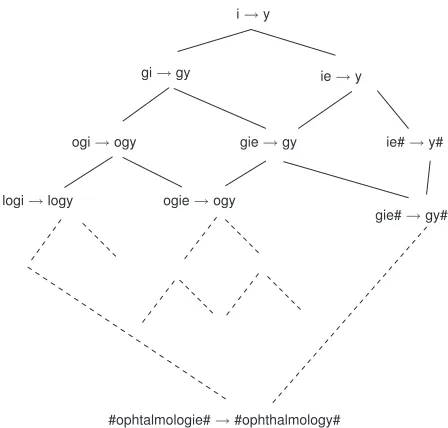
Figure 1 presents such a search space built from the differ-encei/yin the alignment#opht almologie#/#ophthalmology #.
i→y
ie→y gi→gy
ie#→y#
ogie→ogy
gie#→gy# gie→gy
ogi→ogy
logi→logy
#ophtalmologie#→#ophthalmology#
Figure 1: Search lattice E from the example i/y in
#opht almologie#/#ophthalmology #
oper-ator that generates more specialized rules from an existing one. Consider the ruler1 =i → yin the previous
exam-ple. This is the most general rule for the differencei/y in the alignment#opht almologie#/#ophthalmology #. After the computing of its score the algorithm will generate and score every rule that is immediately more specific, that is:
{r2|r1ºr2∧@r3s.t.r1Âr3Âr2}
The generation of these specific rules is simply done by adding the letter on the right (respectively on the left) from the input word of the paired term used as example to the input ofr1and adding the corresponding aligned letter to
the right (resp. to the left) of its output. Thus, by apply-ing this tor1 we have: g input(r1) → g output(r1)and
input(r1)e→output(r1) , that isgi→gyandie→y. The inheritance properties of the lattices and this special-ization operator make it possible to choose quickly the best rewriting rules for each example according to the score function which is consistent with the specialization op-erator. Indeed, computing the score is the most time-consuming task of our algorithm because it necessitates an-alyzing every word in the training setL. However, by con-sidering the hierarchical relation and the way hypothesis are generated, a big amount of time can be saved: for a term pair used as an example, consider two rulesr1andr2such
that r1 º r2. When computing the score ofr2, we have
for any word pairp: input(r1)⊆input(r2)⊆input(p), that is, if pis such that input(r2) ⊆ input(p)then nec-essarilypwas analyzed when computing the score ofr1.
Therefore, we do not need to examine every word ofLto compute the score ofr2but only those that were covered
by the denominator ofr1.
3.3. Using the rules and language modeling to translate
Every difference between two aligned letters in every term pair thus ends up with one rewriting rule chosen in the cor-responding lattice. All the rules are collected inR. Given a new term to translate, every rewriting rule ofRthat can be applied (i.e.rules inferred in the training set in which the in-put string corresponds to a sub-string of the term) is indeed applied. In case of conflicting rules (rules with the same or overlapping premise), all possibilities are generated. Thus, at this stage, a word can receive several concurrent transla-tions. Therefore, the second step of our approach consists in a post-processing technique in order, on the one hand, to select only one of these proposed translations, and on the other hand, to give the user a confidence factor for the result.
These two tasks are conjointly performed by assigning a probability to each possible translation according to a lan-guage model (LM). That is, with standard notations, for a wordwcomposed of the lettersl1,l2, ...,lm:
P(w) =
m
Y
i=1
P(li|l1, ..., li−1)
In practice, the probabilities P(li|...) are estimated from the list of output words used as examples in the first step, decomposed in n-grams of letters. As usual with language
modeling, to prevent the problem of unseen sequences, the probabilities are actually computed with a limited history, that is we only consider then−1previous letters:
P(w) =
m
Y
i=1
P(li|li−n+1, ..., li−1)
In the experiments presented below, we usen= 7letters. A simple smoothing technique is also used to provide more reliable estimations.
Intuitively, the LM aims at favoring translations that ”look like” correct words of the output language. Thus, among all the proposed translations, we only keep the one with the better LM score. Contrary to similar work in machine translation or transliteration, we do not include the score of the rewriting rules in this final score. Indeed, preliminary experiments tended to show that it performed worse than using only the LM score, especially when few examples were used.
This language modeling approach also enables to avoid some problems. As it was underlined by Claveau & Zweigenbaum (2005b), some words have similar forms but different Part-of-Speech or semantic role. If available, these additional pieces of information may avoid trans-lation errors. For example, a word in -ique in French may be translated in English in -ic if it is an adjec-tive (e.g. dynamique/dynamic) or in -ics if it is a noun (e.g. linguistique/linguistics). Similarly, a word in -logie in French may be translated in -logyif it concerns a science (biologie/biology) or in-logiaif it concerns a language disor-der (dyslogie/dyslogia). It is worth noting that this part-of-speech and semantic information, if available in the data, can easily be used with the language model: the probabili-ties estimated from the training data are simply conditioned to the information (Inf o hereafter) we want to consider, that is:
P(w, Inf o) =
m
Y
i=1
P(li|li−n+1, ..., li−1, Inf o)
4. Translation Experiments
This section presents some of the experiments we made with the translation technique previously described. We de-scribe the data, the experimental framework we used and finally the results obtained at this translation task.
4.1. Data
Two different kinds of data are used for these experiments. First, in order to compare our translation approach with previous work, we use the same French-English pairs of terms used in (Claveau and Zweigenbaum, 2005a), that is a list of terms taken from the Masson medical dictionary
(http://www.atmedica.com). The second set of data used
4.2. Experimental framework
In order to evaluate our results, we follow a standard proto-col. The word pair list is split into two parts: the first one is used for the learning process as described above (rule in-ference and language modeling), and the second one, set to contain 1000 pairs, is used as a testing set. Once the rules have been inferred and language modeling has been done, we apply them to every input word of the testing set. We then compare the generated translation with the expected output word; if the two strings exactly match, the transla-tion is considered as correct, in every other case, it is con-sidered as wrong.
The results are evaluated in terms of precision (percentage of correct translations generated). Nonetheless, since the LM gives a confidence factor to each translation, we can decide to keep only those with a LM score greater than a certain threshold. If this threshold is set high the precision may be high, but the number of words actually translated may be low, and conversely. Thus, in order to represent all the possibilities, results below are presented as graphs where each point corresponds to the precision and the per-centage of words translated for a certain LM score thresh-old.
4.3. Results
4.3.1. Translation between French and English
As a first experiment, we focus our attention on the French-English language pair with the help of the Masson data in order to compare these results to those of Claveau & Zweigenbaum (2005a). Figure 2 and 3 respectively present the precision graph of the French into English and English into French translation experiments. In close languages such as French and English, many specialized words are exactly the same. Thus, as a simple baseline, we compute the precision that would be obtained by a system systemat-ically proposing the input term as its own translation. We also indicate the best precision obtained by the transducer based technique exposed in (Claveau and Zweigenbaum, 2005a) within the same experimental framework and data. Whatever the translation direction, the two graphs show that our approach performs very well: for French into En-glish translations, it yields a precision of 85.4% when ev-ery word is translated, and 84.8% for English into French. In both cases, it represents a 10% improvement over the transducer-based approach (Claveau and Zweigenbaum, 2005a). Our technique clearly outperforms the baseline results, but it is also worth noting that about 25% of the biomedical terms are identical in French and English, which indicates that the two languages are close enough to make the learning task relatively easy.
Concerning the use of the language modeling, several things are noteworthy. First, without including the Part-of-speech information, the precision rates are a bit lower (82.6% for French to English and 84.8% for English to French). Secondly, if we choose the translation at random among all the generated ones instead of choosing the one with the best LM score, the precision rate falls to about 50% for both translation directions. Finally, if the good translation were always chosen (when it appears in the list of potential translations produced by the rewriting rules),
the precision would reach 90%. It means that the language model makes very few mistakes at choosing the final trans-lation among the different proposals. These facts clearly show the interest of using language modeling and, if avail-able, to include the Part-of-Speech information in it.
4.3.2. Computation time and performances vs. number of examples
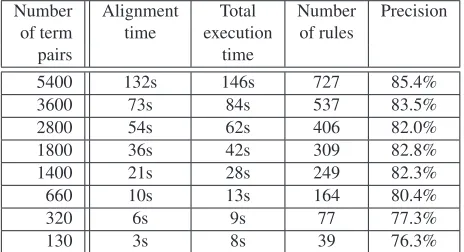
In the previous experiments all the available examples (i.e. all the paired terms but those kept for the test set) were used to infer the rewriting rules. Let us now examine the results and the computation time when this number varies. Table 2 displays the results we obtain when we keep dif-ferent number of examples to infer the rewriting rules and to learn the language model probabilities. In this table, we indicate the precision rate in the worst case (i.e.every trans-lation is kept), the number of rules that are inferred, as well as the computing time due to the alignment step and the to-tal inference time (including the alignment time). The ex-periments were carried out on a 1.5MHz Centrino Laptop running Linux, and the algorithm presented in Section 3.1. was entirely implemented in Perl.
Number Alignment Total Number Precision
of term time execution of rules
pairs time
5400 132s 146s 727 85.4%
3600 73s 84s 537 83.5%
2800 54s 62s 406 82.0%
1800 36s 42s 309 82.8%
1400 21s 28s 249 82.3%
660 10s 13s 164 80.4%
320 6s 9s 77 77.3%
130 3s 8s 39 76.3%
Table 2: Computation time and precision as a function of the number of term pairs used as examples
One can notice that the precision rates remain very good, even with very few examples ending up with few rules. This is particularly interesting since gathering such pairs of terms could be difficult for certain language pairs due to the lack of multilingual resources. Concerning the compu-tation time, the inference process is fast enough to process several language pairs in a minimal amount of time, thanks to our efficient search in the rewriting rule lattices. Yet, the whole process is slowed down by the alignment step for which the dynamic programming algorithm clearly consti-tutes a bottleneck.
4.3.3. Other language pairs
0 20 40 60 80 100
0 20 40 60 80 100
Precision
Percentage of words translated Inference of translation rules
Baseline precision
Figure 10: Performances of German into English translation
0 20 40 60 80 100
0 20 40 60 80 100
Precision
Percentage of words translated Rewriting rules
Baseline
Figure 11: Performances of translation from Russian into English
0 20 40 60 80 100
0 20 40 60 80 100
Precision
Percentage of words translated Rewriting rules Baseline precision
Figure 12: Performances of translation from English into Russian
These translation performances are surprisingly good given the apparent difficulty of the task. Of course, they are a bit lower than those of the other language pairs we examined but could be useful enough for many applications. It also proves if needed that most of the biomedical terms in Rus-sian are built from Cyrilic transliterations of the same Latin and Greek morphemes used in English, French or Italian...
4.3.5. Common causes of errors
Our translation technique automatically captures existing regularities between biomedical terms in different lan-guages. For this reason and unsurprisingly, when exam-ining the results in detail, it appears that the main cause of error is due to the lack of morphological links between the source and the target term. Obviously, this is more often the case for the Russian-English language pair, but still oc-curs for languages known to be close (e.g.asimiento/gripfor Spanish-Portuguese translation or embrochage/pinning for French-English). Besides these unavoidable errors, as al-ready discussed, some errors are also due to similar forms with different part-of-speech or semantic features; as it was shown for the French/English experiments, most of these errors could be avoided if we had at our disposal the Part-of-Speech of semantic information. After all, the experi-ments tend to show that these cases are rare enough to make our approach yield good precision rates (though they are variable according to the considered languages).
5. Concluding remarks and perspectives
The method presented in this paper makes it possible to translate efficiently simple biomedical terms between var-ious languages. It relies on a machine-learning technique inferring rewriting rules from examples of a list of bilin-gual term pairs and on a letter-based language modeling. These examples can be found easily in the existing –yet incomplete– multilingual terminologies; no other external knowledge or human intervention is needed. The approach is efficient and successful for translating unseen terms with a high precision, depending on the languages, and can thus be used to overcome problems due to incomplete multilin-gual language resources.Many perspectives are foreseen for this work including technical enhancements and applications of our translation approach and its use in a cross-language framework. For in-stance, the translation of complex terms (terms composed of more than one word) is currently closely examined.
These terms are widely used in the biomedical domain (for instance, 50% of the MeSH terminology are complex terms), and some of them are not compositional, meaning that they cannot undergo the word-by-word translation our approach proposes. Moreover, even compositional terms would certainly necessitate a syntactic analysis to identify the head-modifier relations and thus translate it accordingly to these dependency relations. Lastly, our translation sys-tem bears numerous similarities with the standard statistical machine translation approach based on a translation model and a language model (Brown et al., 1993). The parallel between the two approaches could lead to interesting in-sights. Concerning the applications, a cross-lingual infor-mation retrieval system in the biomedical domain using this translation approach to translate queries is being studied; first results are promising.
6. References
Nasreen AbdulJaleel and Leah S. Larkey. 2003. Statis-tical transliteration for English-Arabic cross language information retrieval. In Proceedings of the 12th In-ternational Conference on Information and Knowledge Management, CKIM’03, pages 139–146, New Orleans, United-States of America.
Lars Ahrenberg, Mikael Andersson, and Magnus Merkel, 2000. A knowledge-lite approach to word alignment, chapter 5, pages 97–138. In V´eronis (V´eronis, 2000). Yaser Al-Onaizan and Kevin Knight. 2002. Machine
transliteration of names in arabic text. InProceedings of ACL Workshop on Computational Approaches to Semitic Languages, Philadelphia, United-States of America. Olivier Bodenreider. 2004. The unified medical language
system (UMLS): integrating biomedical terminology. Nucleic Acids Research, 32(D267-D270).
Peter F. Brown, John Cocke, Vincent J. Della Pietra Stephen A. Della Pietra, Fredrick Jelinek, John D. Laf-ferty, Robert L. Mercer, and Paul S. Roossin. 1990. A statistical approach to machine translation. Computa-tional Linguistics, 16(2).
Peter F. Brown, Vincent J. Della Pietra, Stephen A. Della Pietra, and Robert L. Mercer. 1993. The mathematics of statistical machine translation: Parameter estimation. Computational Linguistics, 19(2).
Con-ference on Artificial Intelligence in Medicine, AIME 05, Lecture Notes of Computer Science, Aberdeen, Scot-land, UK. Springer.
Vincent Claveau and Pierre Zweigenbaum. 2005b. Traduc-tion de termes biom´edicaux par inf´erence de transduc-teurs. InActes de la conf´erence Traitement automatique des langues naturelles, TALN’05, Dourdan, France. Louise Del´eger, Fiammetta Namer, and Pierre
Zweigen-baum. 2007. Defining medical words: Transposing mor-phosemantic analysis from French to English. In Pro-ceedings of MEDINFO 2007, volume 129 ofStudies in Health Technology and Informatics, Amsterdam, Nether-lands.
Tomaˇz Erjavec and Saˇso Dˇzeroski. 2004. Machine learn-ing of morphosyntactic structure: Lemmatizlearn-ing un-known Slovene words. Applied Artificial Intelligence, 18(1):17–41.
Christian Fluhr, Fr´ed´erique Bisson, and F. Elkateb, 2000. Parallel text alignment using crosslingual information retrieval techniques, chapter 9. In V´eronis (V´eronis, 2000).
Pascale Fung and Kathleen McKeown. 1997a. Finding ter-minology translations from non-parallel corpora. In Pro-ceedings of the 5th Annual Workshop on Very Large Cor-pora, Hong Kong.
Pascale Fung and Kathleen McKeown. 1997b. A techni-cal word and term translation aid using noisy parallel corpora across language groups. Machine Translation, 12(1/2):53–87.
William A. Gale and Kenneth W. Church. 1991. Identify-ing word correspondences in parallel texts. In Proceed-ings of the 4th Darpa Workshop on Speech and Natural Language, pages 152–157, Pacific Grove, CA, United-States of America.
Eric Gaussier. 1999. Unsupervised Learning of Deriva-tional Morphology from InflecDeriva-tional Corpora. In Pro-ceedings of Workshop on Unsupervised Methods in Nat-ural Language Learning, 37thAnnual Meeting of the As-sociation for Computational Linguistics, ACL 99, pages 24–30, Maryland, United-States of America.
Jorge R. Herskovic, Len Y. Tanaka, William Hersh, and Elmer V. Bernstam. 2007. A Day in the Life of PubMed: Analysis of a Typical Day’s Query Log. Journal of American Medical Informatics Association, 14:212–220. Kevin Knight and Jonathan Graehl. 1998. Machine transliteration. Computational Linguistics, 24(4):599– 612.
Philippe Langlais and Michael Carl. 2004. General-purpose statistical translation engine and domain specific texts: Would it work? Terminology, 10(1):131–152. Philippe Langlais and Alexandre Patry. 2007.
Translat-ing unknown words by analogical learnTranslat-ing. In Proceed-ings of the 2007 Joint Conference on Empirical Meth-ods in Natural Language Processing and Computational Natural Language Learning (EMNLP-CoNLL), Prague, Czech Republic.
Philippe Langlais, Franc¸ois Yvon, and Pierre Zweigen-baum. 2007. What analogical learning can do for ter-minology translation? In Proceedings of
Computa-tional Linguisitics in Netherlands, CLIN’07, Nijmegen, Netherlands.
Korn´el Mark´o, Olena Medelyan Stefan Schulz, and Udo Hahn. 2005. Bootstrapping dictionaries for cross-language information retrieval. In Proceedings of the 28thInternational Conference on Research and Develop-ment in Information Retrieval, SIGIR 05, pages 528–535, Salvador, Brasil.
Fabienne Moreau, Vincent Claveau, and Pascale S´ebillot. 2007. Automatic morphological query expansion us-ing analogy-based machine learnus-ing. InProceedings of the 29thEuropean Conference on Information Retrieval, ECIR 2007, Roma, Italy.
Kemal Oflazer and Sergei Nirenburg. 1999. Practical boot-strapping of morphological analyzers. InProceedings of EACL Workshop on Computational Natural Language Learning, CONLL 99, Bergen, Norway.
Yan Qu, Gregory Grefenstette, and David A. Evans. 2003. Automatic transliteration for Japanese-to-English text re-trieval. InProceedings of the 26thInternational Confer-ence on Research and Development in information Re-trieval, SIGIR 03, Toronto, Canada.
Stefan Schulz, Kornel Mark´o, Eduardo Sbrissia, Percy No-hama, and Udo Hahn. 2004. Cognate Mapping - A Heuristic Strategy for the Semi-Supervised Acquisition of a Spanish Lexicon from a Portuguese Seed Lexi-con. In Proceedings of the 20th International Confer-ence on Computational Linguistics, COLING’04, pages 813–819, Geneva, Switzerland, aoˆut.
J¨org Tiedemann. 2004. Word to word alignment strategies. In Proceedings of the 20thInternational Conference on Computational Linguistics, COLING 04, pages 212–218, Geneva, Switzerland.
Keita Tsuji, B´eatrice Daille, and Kyo Kageura. 2002. Ex-tracting French-Japanese word pairs from bilingual cor-pora based on transliteration rules. InProceedings of the Third International Conference on Language Resources and Evaluation LREC’02, pages 499–502, Las Palmas de Gran Canaria, Spain, mai.
Mark S. Tuttle, David D. Sherertz, Nels E. Olson, Mark S. Erlbaum, D. Sperzel, Lauren Fuller, and Stuart J. Nel-son. 1990. Using Meta-1 – the 1st version of the
UMLS metathesaurus. InProceedings of the 14thannual Symposium on Computer Applications in Medical Care (SCAMC), Washington, D.C.
Jean V´eronis, editor. 2000. Parallel Text Processing. Kluwer Academic Publishers, Dordrecht.