Procedia Computer Science 78 ( 2016 ) 241 – 247
1877-0509 © 2016 The Authors. Published by Elsevier B.V. This is an open access article under the CC BY-NC-ND license (http://creativecommons.org/licenses/by-nc-nd/4.0/).
Peer-review under responsibility of organizing committee of the ICISP2015 doi: 10.1016/j.procs.2016.02.039
ScienceDirect
International Conference on Information Security & Privacy (ICISP2015), 11-12 December 2015,
Nagpur, INDIA
Developing a Novel Technique for Face Liveness Detection
Mr. Steven Lawrence Fernandes
a, Dr. G Josemin Bala
ba
Research Scholar, Dept. Electronics & Communication Engineering, Karunya University, Coimbatore, Tamil Nadu, India [email protected]
b
Professor, Dept. Electronics & Communication Engineering, Karunya University, Coimbatore, Tamil Nadu, India [email protected]
Abstract
Face recognition is an important tool in identifying a person. Due to existence of non-real faces, Spoofing attack weakens the Face Recognition process, which can be overcome byLiveness Detection. There are three approaches to perform liveness detection: by challenge and response based liveness detection technique, by face texture liveness detection and by joining two or more biometrics liveness detection. The existing techniques fail to give good results for Face Liveness Detection under unconstrained environment. Hence we have proposed Face Liveness Detection based on Image Quality Assessment (IQA) parameters. The proposed system is validated on a database having 70 images which are taken under unconstrained environment. © 2016 The Authors. Published by Elsevier B.V.
Peer-review under responsibility of organizing committee of the ICISP2015
Keywords: Face recognition; Spoofing attack; Liveness detection; Image Quality Assessment.
1. Introduction
In biometric authentication face recognition technology plays an important role to identify the person identity, but spoofing is a major cause for the failure if various face recognition systems1. By insertion of a photo/video/mask of an registeredindividual in front of the camera spoofing attack is performed during face recognition process 2-4.
To overcome this problem liveness detection is performed before face recognition 5-7. The liveness detection module adds an additional layer of security, it uses macro features of face mainly eye and mouth actions. The consistency of liveness module is tested by using photo/video/mask of aregisteredindividual.
* Corresponding author. Tel.: +91-9844760875; fax: +91-9449845959. E-mail address:[email protected]
© 2016 The Authors. Published by Elsevier B.V. This is an open access article under the CC BY-NC-ND license (http://creativecommons.org/licenses/by-nc-nd/4.0/).
There are three approaches to perform liveness detection: By utilizing challenge and response based liveness detection technique, by using face texture liveness detection and by joining two or more biometrics liveness detection. Based on the three approaches there are three existing methods which have been derived to perform liveness detection they are: Multispectral method, Client Identity Information Method, Single Image via Diffusion Speed Model.
2. Related work
Traditional method to perform liveness detection involves: Training process and Calculation of Mean, Covariance. Eigenvectors, Eigen face. '=PQ image is considered for training process, which is kept in a training database, where there are P number ofindividuals and eachindividual has Q images. Mean is calculated, Covariance is calculated to know the relationship between each features. Principal component such as Eigenvectors and Eigen face are calculated. This traditional approach was not found to be suitable to detect liveness in images under varying poses, hence three new methods been derived to perform liveness detection they are: Multispectral method, Client definite method, Single image via Diffusion speed model.
Authors in 1present Multispectral method for livenessdetection; here a monochrome camera captures the ambient light and an image. Xenon lamp illuminates the scene. In order to provide required energy at various spectrums we use full-spectrum active light.
ܫൌ ݐ ܮሺOሻܴሺOሻܶ
Oೌೣ
O ሺOሻܥሺOሻ݀Oሺͳሻ
The Table 1 shows True Positive Rate (TPR) and True Negative Rate (TNR) obtained using Multispectral method for liveness detection. Two orientations are considered: fontal face, 45° profile face. Among the two orientations 45°profile gives better results because in 45° viewpoint uniform hair styles are observed but in the front portion of face a change of hair styles consequence in numerous spatial scatterings of gradient values hence reducing the performance.
Table 1.Performance of Multispectral Method for Liveness Detection in Frontal and 45°Profile Face.
Orientations TPR (%) TNR (%)
Frontal face 94.3 98
45°profile face 100 99
Authors in 2 present Client-independent and Client-definite and methods for liveness detection. Client-definite method uses Probabilistic Graphical Model framework for anti-spoofing. Enrollment of samples for each of the clientsaremajor requirements of client definite anti-spoofing system. This information is utilized to create client definite model and train client-definite classifiers. Using enrollment samples a client-definite Support Vector Machine classifier is developed. Two protocols are used for testing: protocol and cross- protocol, intra-protocol algorithm is trained and tested using same intra-protocol but in cross-intra-protocol algorithm is trained using one protocol and tested on another protocol.
Authors in 3 presentsingle Image through diffusion model of speed which uses Logarithmic Total Variation (LTV) model. LTV model differ from previous Total Variation (TV) model. In LTV the diffusion speed of the local pattern also named as Local Speed Pattern (LSP)is given as input into to linear Support Vector Machine classifier which determines if the given face image is fake. This method works well illumination invariant face images. The performance of diffusion speed model was found to be reliable under varying lighting conditions in different indoor and outdoor environments. Table 3 compares the Human-targeted Translation Error Rate (HTER) value of Local Binary Pattern (LPB), Local Binary Patter + Local Discriminant Analysis (LBP+LDA), Local Binary Patter + Support Vector Machine (LBP+SVM) and Local Speed Pattern (LSP). From table 2 we find that HTER value for LSP is the minimum when compared to other techniques.
Table 2.Performance Comparison of LBP, LBP+LDA, LBP+SVM and LSP for Liveness Detection.
Methods Dev Test
ܮܤܲଷൈଷ௨ଶ ߯ଶ 31.24% 34.01%
ܮܤܲଷൈଷ௨ଶ ܮܦܣ 19.60% 17.17%
ܮܤܲଷൈଷ௨ଶ ܸܵܯ 14.84% 15.16%
LSP 13.72% 12.50%
All the 3 existing techniques fail to give good results for Face Liveness Detection under unconstrained environment. Hence we have proposed Face Liveness Detection based on Image Quality Assessment (IQA) parameters.
3. Proposed Method
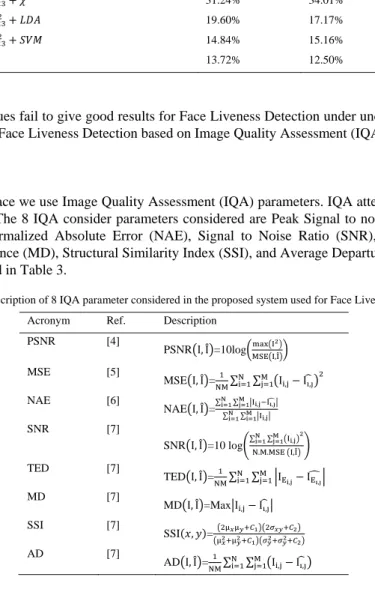
To detect liveness of face we use Image Quality Assessment (IQA) parameters. IQA attempts to assess the errors in the input face image. The 8 IQA consider parameters considered are Peak Signal to noise Ratio (PSNR), Mean Square error (MSE), Normalized Absolute Error (NAE), Signal to Noise Ratio (SNR), Total Edge Difference (TED), Maximum Difference (MD), Structural Similarity Index (SSI), and Average Departure (AD). Each of these 8 IQA parameters is defined in Table 3.
Table 3.Description of 8 IQA parameter considered in the proposed system used for Face Liveness Detection Acronym Ref. Description
PSNR [4] PSNR൫ǡ መ൯=10log൬୫ୟ୶൫୍ୗ൫୍ǡ୍መ൯మ൯൰ MSE [5] MSE൫ǡ መ൯=ଵ σ σ ൫୧ǡ୨െ నǡ ൯ ଶ ୨ୀଵ ୧ୀଵ NAE [6] NAE൫ǡ መ൯=σ σ ห୍ǡౠି୍หഠǡഡ ౠసభ ొ సభ σొసభσౠసభห୍ǡౠห SNR [7] SNR൫ǡ መ൯=10 logቆσ σ ൫୍ǡౠ൯ మ ౠసభ ొ సభ ǤǤୗ ൫୍ǡ୍መ൯ቇ TED [7] TED൫ǡ መ൯=ଵ σ σ ቚǡౠെ ቚഠǡഡ ୨ୀଵ ୧ୀଵ MD [7] MD൫ǡ መ൯=Maxห୧ǡ୨െ నǡ ห SSI [7] SSIሺݔǡ ݕሻ=൫ଶஜೣஜାభ൯൫ଶఙೣାమ൯ ൫ஜೣమାஜమାభ൯൫ఙమାఙమାమ൯ AD [7] AD൫ǡ መ൯=ଵ σ σ ൫୧ǡ୨െ నǡ ൯ ୨ୀଵ ୧ୀଵ
The activity diagram and class diagram are as in fig.1. The proposed schemecomprises of the following modules: • Query image
• Preprocess • Feature extraction • Classification.
Query image: Query image is an input face image whose liveness needs to be detected.
Preprocess: Gaussian filter is used to eliminate the noise in the input face image and it is resized.
Feature Extraction: In this process, we use Image Quality Assessment. We have considered 8 IQA parameters: Peak Signal to noise Ratio (PSNR), Mean Square error (MSE), Normalized Absolute Error (NAE), Signal to Noise Ratio (SNR), Total Edge Difference (TED), Maximum Difference (MD), Structural Similarity Index (SSI), Average Departure (AD).
Classification: Quadratic Discriminant Analysis (QDA) is used to categorize if a given input image is live or fake. QDA models the propensity of each class, as a Gaussian distribution.
4. Results and Discussion
To confirm the proposed system used for face liveness detection we have created a database which contains 70 photos. These photos contain genuine and imposter poster. The graphical representation of the various IQA parameters for 70 input images used for Face Liveness Detection is shown in fig. 2 to fig. 9. Fig. 10 shows step by step implementation of the proposed scheme used for face liveness recognition when the input image is a genuine photo. Fig. 11 shows step by step implementation of the proposed scheme used for face liveness recognition when the input image is an imposter photo. Demo version of the code along with input face images and results obtained for all the 70 images can be downloaded from https://goo.gl/aDhYyA.
Fig.2. PSNR values obtained for 70 input images from the proposed method
Fig.3. MSE values obtained for 70 input images from the proposed method Fig.1. Activity figure of the Proposed Scheme used for Liveness Detection.
End
Load input face image
Pre-process input face image
Apply Gaussian filter
Resize input face image
Extract feature from filtered face image
Apply Image Quality Assessment (IQA)
Classification using Quadratic Discriminant
PSNR, MSE, NAE, SNR, TED MD, SSI,
AD
Finding whether the input image is live or fake Start
Fig.4. NAE values obtained for 70 input images from the proposed method
Fig.5. SNR values obtained for 70 input images from the proposed method
Fig.6. TED values obtained for 70 input images from the proposed method
Fig.7. MD values obtained for 70 input images from the proposed method
Fig.8. SSI values obtained for 70 input images from the proposed method
F Fig.1 Step 1: syste Live Step 8 image Step 1: syste Live Step 8 image i
Fig.10. Step By Step
1. Step By Step Im : GUI of proposed em used for Face
eness Detection
: The given input is genuine image
: GUI of proposed em used for Face
eness Detection
: The given input is imposter image p Implementation o mplementation of the Step 2 select Livene Step paramete resized Step 2: image se Livene Step paramete resized
f the Proposed Syst
e Proposed Scheme : Input image ted for Face ess Detection
7: Find IQA ers for the input d, filtered, gray
: Input colour elected for Face
ess Detection
7: Find IQA ers for the input d, filtered, gray
tem used for Face L
used for Face Live Step 3: Di input Step 6: F image us Step 3: Di input Step 6: F image us p Liveness Detection w eness Recognition w isplay the selected
colour image
Filtering the input ing Gaussian 5x5
filter
isplay the selected colour image
Filtering the input ing Gaussian 5x5
filter
( )
when the input ima
when the input imag Step 4: C Step 5: R imag Step 4: C Step 5: R imag
age is genuine photo
ge is imposter photo Convert the input co
image to gray
Resizing the input ge to 300x300
Convert the input co image to gray
Resizing the input ge to 300x300
o
o olour
5. Conclusion
There are three approaches to perform liveness detection: By utilizing challenge and response based liveness detection technique, by using face texture liveness detection and by joining two or more biometrics liveness detection. Based on the three approaches there are three existing methods which have been derived to perform liveness detection they are: Multispectral method, Client Identity Information Method, Single Image via Diffusion Speed Model. All the 3 existing techniques fail to give good results for Face Liveness Detection under unconstrained environment. Hence we have proposed Liveness Recognitionof face based on Image Quality Assessment (IQA) parameters. In the proposed system we have considered eight IQA parameters: Peak Signal to noise Ratio (PSNR), Mean Square error (MSE), Normalized Absolute Error (NAE), Signal to Noise Ratio (SNR), Total Edge Difference (TED), Maximum Difference (MD), Structural Similarity Index (SSI), and Average Departure (AD) to find if a given input image is genuine or fake. The proposed system is validated on a database having 70 images which are taken under unconstrained environment. Table 4 compares the performance of Multispectral method, Client Identity Information Method, Single Image via Diffusion Speed Model and Proposed Method using IQA for Liveness Detection on 70 images taken under unconstrained environment. Table 4 shows that the proposed method using IQA gives better EER, FAR, FRR, HTER values when compared to existing methods for Face Live Detection.
Table 4. Performance Comparison of Multispectral method, Client Identity Information Method, Single Image via Diffusion Speed Model and Proposed Method using IQA for Liveness Detection on 70 images taken under unconstrained environment
Dev EER FAR Test FRR HTER
Multispectral method 24.96 14.98 7.23 18.34
Client Identity Information Method 13.94 11.96 14.78 21.98
Single Image via Diffusion Speed Model 17.43 9.23 6.27 11.23
Proposed Method using IQA 6.23 4.27 2.19 4.78
Acknowledgements
The proposed work was made possible because of the grant provided by Vision Group Science and Technology (VGST), Department of Information Technology, Biotechnology and Science & Technology, Government of Karnataka, Grant No. VGST/SMYSR/GRD-402/2014-15 and the support provided by Department of Electronics & Communication Engineering, Karunya University, Coimbatore, Tamil Nadu, India.
References
1. Yueyang Wang., XiaoliHao.,ChangqingGuo. A New Multispectral Method for Face Liveness Detection. In:2nd IARP Asian conference on Pattern Recognition; pp. 922--926; Naha (2013)
2. Chingovska,I., Rabello dos Anjos, A. On the Use of Client Identity Information for Face Antispoofing. IEEE Transaction on Information Forensics and Security; vol:10, pp.787--796 (2015).
3. Wonjun Kim., SungjooSuh., Jae-Joon Han. Face Liveness Detection From a Single Image via Diffusion Speed Model. IEEE Transactions on Image Processing; vol:24; pp.1057--2465(2015).
4. A. M. Eskicioglu and P. S. Fisher. Image quality measures and their performance.IEEE Trans. Commun.; vol:43,No. 12; pp.2959--2965, (1995).
5. S. Yao, W. Lin, E. Ong, and Z. Lu. Contrast signal-to-noise ratio for image quality assessment. in Proc. IEEE ICIP; pp. 397--400, (2005). 6. Z. Wang, A. C. Bovik, H. R. Sheikh, and E. P. Simoncelli. Image quality assessment: From error visibility to structural similarity.IEEE
Trans. Image Process; vol:13, No: 4; pp. 600--612, (2004).
7. M. G. Martini, C. T. Hewage and B. Villarini. Image quality assessment based on edge preservation.Signal Process., Image Commun., vol: 27, No: 8; pp. 875--882, (2012).