The impact of immediate and delayed error correction on
Iranian EFL learner’s self-efficacy
Farmani, Reyhane
Imam Reza International University, Mashhad, Iran ([email protected])
Akbari, Omid
Imam Reza International University, Mashhad, Iran ([email protected])
Ghanizadeh, Afsaneh
Imam Reza International University, Mashhad, Iran ([email protected])
Received: 26 September 2017 Revised: 9 October 2017 Accepted: 25 October 2017
Available Online: 14 November 2017 DOI: 10.5861/ijrse.2017.2001
ISSN: 2243-7703 Online ISSN: 2243-7711
OPEN ACCESS
Abstract
This research investigated the effect of immediate and delayed error correction on
self-efficacy of EFL learners to accept or reject the research hypothesis that, there is not any
significant difference between three group of immediate correction, delayed correction and
control group. This article was done on three groups with the population of 90 learners. The
errors which were made by three groups of delayed correction, immediate correction, and
control group were corrected in three different ways: with delay, immediately and with no
special method, respectively. A self-efficacy questionnaire and a language test were given to
three groups in the first session and the last session of the term to see the effect of different
kinds of error correction. The data of pre-test and post-test were analyzed using SPSS and one
way ANOVA was used. The results provided evidence for accepting the hypothesis and there
was no difference between three groups in terms of self-efficacy.
The impact of immediate and delayed error correction on Iranian EFL learner’s
self-efficacy
1. Introduction
Teachers make error correction for every English lesson. English students make a lot of errors in the process of learning a new language as everybody makes error in the process of learning. As a result, they should be corrected by their teachers and teachers are responsible to provide useful feedback for them (Tomkova, 2013). At first glance, the correction process seems simple but it is a complicated process that needs teachers' precise decision toward it. Feedback is useful and helpful according to many researchers (Lightbown & Spada, 1999). Feedback is helpful for students whether it is direct or indirect (Swain, 1985). Long (1990) believes that effective feedback make the learning process easy.
Many studies have been conducted on error correction in order to find the best method of giving feedback to learners. The time of error correction is so important in learning process. Teachers perform error correction instantly or with a time lag. If language teachers correct them with a delay, learners normally think they have made no errors and it may increase their self-efficacy. If teachers correct them instantly, this correction may discourage them and decrease their self-efficacy. This is exactly the turning point that the issue of self-efficacy is raised.
According to Bandura, Self-efficacy is described as judgment of individuals of their abilities to accomplish a given task with the skills that they have (Bandura, 1997). Bandura believes that self-efficacy influences effort, activities, and persistence of individuals (Bandura, 1977). Learners who have low level of self-efficacy for doing English task, they may avoid it; but those who believe they are capable to do it; they may have high level of self-efficacy. Despite the importance of errors, not enough empirical studies have yet been done to show the effect of error correction’s time on learning a foreign language. Research studies that focus on the time of error correction are extremely rare in comparison to the large number of studies that focus on error correction and also despite the importance of psychological factor, there is no study that pays attention to the effect of error correction on self-efficacy.
Varnosfadrani investigated the effects of immediate and delayed error correction on learners' pronunciation (Varnosfadrani, 2006). In addition, Rahimi and Dastjerd (2012) published an article discussing the impact of immediate and delayed error correction on EFL learners’ oral production. While, Cohen provides a very short account of the topics and classification of errors involved in error correction (Cohen, 1975). Lukmani (1972) published an article discussing the problems associated with the correction of pronunciation errors. Sanders (2005) emphasized on the effect of immediate feedback on learning on his thesis. Further, Quinn (2014) emphasized on delayed and immediate corrective feedback on passive errors on his thesis. As we can see from the above studies, there is no study that focuses on effect of immediate and delayed error correction on learner’s self-efficacy.
This study has two research questions as well as two corresponding research hypotheses:
Q1: Is there any significant difference between three groups in terms of self-efficacy?
Q2: Is there any significant difference between three groups in terms of language achievement?
H1: there is not any significant difference between three groups in terms of self-efficacy.
2. Materials and Methods
2.1 Participants
In this study, the researcher visited intermediate level classes and invited students to participate in the study. 106 students agreed to participate. Cambridge Placement Test was used to ensure about the homogeneity of the subjects. This test was used as a means of determining their proficiency level, whether to include/exclude students from this study. 16 learners whose scores were below the mean were excluded from the study. The participants in this study were 90 females at intermediate level aged 15 to 20 with the majority being between 15-17 years old, at one of the English language institutes in Shiraz, Iran. The remaining 90 learners were the subjects of our study. They were classified into three groups. The participants were divided into 3 groups of 30, 30 and 30 (one group= 30, one group 30, one group 30, group one is immediate group with 30 population, group two is delayed group with 30 population and group three is control group with no special method with population of 30). Then, they were randomly divided into experimental and control groups. The errors were corrected immediately for one group of experimental groups and they were corrected for another group of experimental group after finishing their speech and with delay. Control group was without any special method of correction (sometimes teacher corrected their error immediately and sometimes with a pause in the class).
2.2 Instruments
For this study, a self-efficacy questionnaire and an English proficiency test were used to elicit their level of self-efficacy and English proficiency. To assess the EFL learners’ level of self-efficacy, a Self- Efficacy questionnaire designed and standardized by Gahungu (2007) was employed. The questionnaire consists of 40 items with 5-point Likert-scale ranging from not sure to completely sure. Number one had a 0 point corresponding to not sure. Number two had a 1 point corresponding to somewhat unsure. Number three had a 2 point corresponding to kind of sure. Number four had a 3 point corresponding to very sure. Number five had a 4 point corresponding to completely sure.
Gahungu (2007) used K-R 21 test to estimate the reliability of the Self- Efficacy questionnaire and the result was .97. Also, he examined it by three expert reviewers for content and face validity. They also mentioned the strengths and weaknesses of the questionnaire, and suggested recommendations for improvement. In fact, they were selected due to their educational background and professional experience. They have taught second languages in secondary school and university settings. In addition to these characteristics, the first reviewer is a professor of educational research. The second reviewer is a former high school teacher and now professor of research. The third reviewer is a former high school teacher; she has also taught ESL in college, and currently she is a professor of Linguistics.
The questionnaire was translated to Persian by the researcher to make it easier for learners. Cronbach' alpha was used to examine the reliability of translated questionnaire.
Table 1
The reliability indices of self-efficacy questionnaire
Factor Number of Items Reliability
Self-efficacy 40 .88
As it can be seen in table 1, total reliability of the self-efficacy questionnaire with 40 items was calculated via Cronbach' alpha and the result was .88.
members, was the immediate correction group. Group B, which had 30 members, was delayed correction group and group C which had 30 members, was the control group with no special method. Feedback was different depending on whether participants were in the immediate or delayed condition. During the term, the teacher immediately corrected the errors for group A. If learners made errors, the teacher instantly corrected their error by giving the correct answers to them. On the other hand, group B members were allowed to continue even if they committed errors. Teacher corrected errors which were effective in their communication. Long explains that delayed correction referred to correction provided after the completion of the student's utterance and rejected delayed correction with a delay of merely 5 to 10 seconds (Long, 1977). So, group B error was corrected as Long (1977) mentioned.
The self-efficacy questionnaire was administered once in the first session of the term and secondly in the last session of the term to the same subjects to see whether the level of self-efficacy increase or decrease during the term. The questionnaire was given to participants and some points was mentioned and explained to them so that they could respond easily, although the questionnaire itself had some extra explanations and examples. Cambridge Proficiency Test for intermediate level was administered twice, firstly in the first session of the term which was the pre-test of this study and secondly in the last session of the term which was the post-test to the same subjects to see the learner's progress.
2.4 Data Analysis
The final results were analyzed using SPSS software. In analyzing the data, some statistical procedures were carried out in this study: one way ANOVA to see the effect of error correction on learner’s self-efficacy in three group before and after the term as well as to see the effect of error correction on learner’s language achievement in three group before and after the term.
3. Results
Q1: Is there any significant difference between three groups in terms of self-efficacy?
H1: there is not any significant difference between three groups in terms of self-efficacy.
To answer this question, one-way ANOVA was performed between the mean scores of the pre-test and post-tests before and after the treatment of the three groups.
Table 2
Descriptive statistics of Students' Self-Efficacy in three groups in pretest
Groups N Mean SD Min Max
immediate correction 30 106.77 25.75 53 156
delayed correction 30 111.60 27.57 8 157
control 30 106.93 26.45 47 145
Table 2 shows descriptive statistics of students' self-efficacy in three groups (immediate correction, delayed correction, control). As the scale is 5-likert from 0 to 4, the possible range of score for Total self-efficacy is between 0 and 160.
Table 3
Results of One Way ANOVA for Students' Self-Efficacy Level in Pre-test
Sum of Squares df Mean Square F Sig.
Between Groups 451.67 2 225.83 .319 .728
Within Groups 61566.43 88 707.66
As table 3 indicates, the results of one-way ANOVA shows that there is no significant difference in students' self-efficacy level in pre-test: F(2, 88) =.319, p=.726.
Table 4
Descriptive Statistics of Students' Self-Efficacy in Three Groups in post-test
Groups N Mean SD Min Max
immediate correction 30 115.57 20.05 79 156
delayed correction 30 108.27 19.44 63 146
control 30 108.60 27.43 35 155
Table 4 shows descriptive statistics of students' self-efficacy in three groups (immediate correction, delayed correction, control). As table 4 indicates, immediate correction group has the highest mean (115.56) and the delayed correction group has the lowest mean (108.26). So, the mean score of self-efficacy in group1 is higher than group 2 and group 3. It shows that learners of immediate correction group have higher levels of self-efficacy than the other two groups.
Table 5
Results of One-Way ANOVA for Students' Self-Efficacy Level in Post-test
Sum of Squares df Mean Square F Sig.
Between Groups 1019.36 2 509.68 .998 .373
Within Groups 44450.43 87 510.93
Total 45469.79 89
As table 5 showed that the results of the one-way ANOVA indicated that there was no significant difference between the mean scores of the three groups at the end of the term in post-test because: p-value = 0.373.
Q2: Is there any significant difference between three groups in terms of language achievement.
H2: there is not any significant difference between three groups in terms of language achievement.
Table 6
Descriptive Statistics of Students' Language Achievement in Three Groups in pretest
Groups N Mean SD Min Max
immediate correction 30 15.90 2.75 8 20
delayed correction 30 15.78 1.86 12 20
control 30 15.49 2.45 10 20
Table 6 shows descriptive statistics of students' Language Achievement in three groups (immediate correction, delayed correction, control). The possible range of score for the language achievement test is between 0 and 20.
Table 7
Results of One Way ANOVA for Students' Language Achievement Level in Pre-test
Sum of Squares df Mean Square F Sig.
Between Groups 2.65 2 1.32 .23 .794
Within Groups 493.85 88 5.67
Total 496.51 90
Table 8
Descriptive Statistics of Students' Language Achievement in Three Groups in post-test
Groups N Mean SD Min Max
immediate correction 30 16.72 1.34 13 19
delayed correction 30 16.53 2.11 11 20
control 30 15.48 2.16 10 20
Table 8 shows descriptive statistics of students' language achievement in three groups (immediate correction, delayed correction, control). As table 8 indicates, immediate correction group has the highest mean (16.72) and the control group has the lowest mean (15.48).
Table 9
Results of One Way ANOVA for Students' Language Achievement Level in Post-test
Sum of Squares df Mean Square F Sig.
Between Groups 26.57 2 13.29 3.66 .030
Within Groups 316.05 88 3.63
Total 342.62 90
The results of the one-way ANOVA indicated that there was a significant difference between the mean scores of the three groups at the end of the term in post-test because: p-value = 0.03.
Table 10
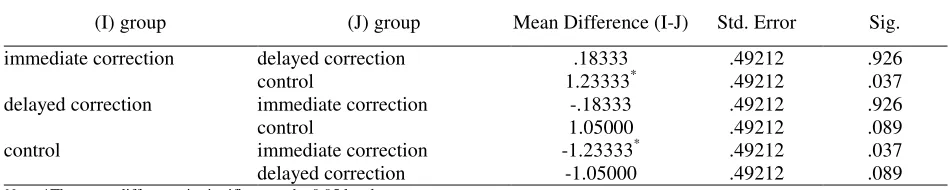
Scheffe’s test for the differences of Students' Language Achievement among three groups
(I) group (J) group Mean Difference (I-J) Std. Error Sig.
immediate correction delayed correction .18333 .49212 .926
control 1.23333* .49212 .037
delayed correction immediate correction -.18333 .49212 .926
control 1.05000 .49212 .089
control immediate correction -1.23333* .49212 .037
delayed correction -1.05000 .49212 .089
Note. *The mean difference is significant at the 0.05 level.
Table 10 shows Scheffe’s test for the differences of students' language achievement among three groups. As we see in the table 10 there is a significant difference between the immediate and control groups which are marked by asterisks.
4. Discussion
The results showed that there was no significant difference between three groups in terms of self-efficacy after the treatment. However, there was significant difference between three groups in terms of language achievement after the treatment. It showed that time of correction did not influence the self-efficacy of learners whether they are corrected immediately or with a delay but it affected learners' language achievement. As a result, language achievement of learners improves if they are corrected immediately. The results of our study are in line with Dawood's (2014) study that investigated the effects of grammatical error correction on EFL learners’ accuracy. The results showed that that learners’ accuracy in immediate error correction group improved positively.
study. He investigated on the effect of delayed versus immediate corrective feedback on orally produced passive errors in English. The results showed that error correction time did not affect learning English development.
So, teachers by using questionnaires, interviews, and observations should be aware of students' preference toward error correction. They should consider on the first hand the students' reaction to error correction, because some want to be corrected soon and some want to be corrected with pause and error correction depends on the students level and students' needs. Further research is needed to see whether it affects similarly for beginners or advanced learners.
5. References
Bandura, A. (1977). Self-efficacy: toward a unifying theory of behavioral change. Psychological review, 84(2), 191-215. https://doi.org/10.1037/0033-295X.84.2.191
Bandura, A. (1997). Self-efficacy: The exercise of control. New York: Freeman.
Cohen, A. D. (1975). Error correction and the training of language teachers. The Modern Language Journal, 59(8), 414-422. https://doi.org/10.2307/325488
Dabaghi, A. (1996). The effect of immediate and delayed correction on the performance of EFL learners
(Unpublished doctoral dissertation), Esfahan University, Esfahan.
Dawood, H. (2014). The impact of immediate grammatical error correction on senior English majors’ accuracy at Hebron University. International Journal of Foreign Language Teaching and Research, 2(7), 37-46. Gahungu, O. (2007). Strategy use, self-efficacy, and language ability: Their relationship (Unpublished doctoral
dissertation of Education), Northern Arizona University, Flagstaff, Arizona, U.S. Lightbown, P. M., & Spada, N. (1999). How languages are learned. Oxford University Press.
Long, M. (1977). Teacher feedback on learner error: Mapping cognitions. In H. D. Brown, C. Yorio & R. Crymes (Eds.), On TESOL’ 77: Teaching and learning English (pp. 278-294). Washington, D.C.: TESOL. Lukmani, Y. M. (1972). Motivation to learn and language proficiency. Language learning, 22(2), 261-273.
https://doi.org/10.1111/j.1467-1770.1972.tb00087.x
Quinn, P. (2014). Delayed versus immediate corrective feedback on orally produced passive errors in English
(Unpublished doctoral dissertation of Philosophy), University of Toronto, Toronto, Ontario, Canada. Rahimi, A., & Dastjerdi, H. V. (2012). Impact of immediate and delayed error correction on EFL learners’ oral
production: CAF. Mediterranean Journal of Social Sciences, 3(1), 45-54.
Sanders, M. (2005). The effect of immediate feedback and After Action Reviews (AARS) on learning, retention and transfer (Master's thesis). University of Central Florida, Orlando, Florida.
Swain, M. (1985). Communicative competence: Some roles of comprehensible input and comprehensible output in its development. Input in Second Language Acquisition, 15, 165-179.
Tomkova, G. (2013). Error correction in spoken practice (Doctoral dissertation). Masaryk University, Brno, Czech Republic.