Explainable Security for Relational Databases
Gabriel Bender
∗ Cornell University Ithaca, NY 14853, USA[email protected]
Łucja Kot
Cornell University Ithaca, NY 14853, USA[email protected]
Johannes Gehrke
Cornell University Ithaca, NY 14853, USA[email protected]
ABSTRACT
Companies and organizations collect and use vast troves of sensitive user data whose release must be carefully con-trolled. In practice, the access policies that govern this data are often fine-grained, complex, poorly documented, and dif-ficult to reason about. As a result, principals frequently request and are granted access to data they never use.
To encourage developers and administrators to use secu-rity mechanisms more effectively, we propose a novel secusecu-rity model in which all security decisions are formally explain-able. Whether a query is accepted or denied, the system returns a concise yet formal explanation which can allow the issuer to reformulate a rejected query or adjust his/her security credentials. Our approach has a strong formal foun-dation based on previously unexplored connections between
disclosure latticesandpolicy algebras. We build on this foun-dation and implement a disclosure control system that han-dles a wide variety of real SQL queries and can accommodate complex policy constraints.
“Smelling isn’t everything” said the Elephant. “Why,” said the Bulldog, “if a fellow can’t trust his nose, what is he to trust?”
“Well, his brains perhaps,” she replied mildly.
– C.S. Lewis,The Magician’s Nephew
Categories and Subject Descriptors
H.2 [Information Systems]: Database Management
Keywords
database security; view rewriting; access control
1.
INTRODUCTION
Over the past few decades we have seen the emergence of companies like Google and Facebook that collect and store
∗Work done while at the University of Washington
Permission to make digital or hard copies of all or part of this work for personal or classroom use is granted without fee provided that copies are not made or distributed for profit or commercial advantage and that copies bear this notice and the full cita-tion on the first page. Copyrights for components of this work owned by others than ACM must be honored. Abstracting with credit is permitted. To copy otherwise, or re-publish, to post on servers or to redistribute to lists, requires prior specific permission and/or a fee. Request permissions from [email protected].
SIGMOD’14,June 22–27, 2014, Snowbird, UT, USA. Copyright 2014 ACM 978-1-4503-2376-5/14/06 ...$15.00.
large amounts of personal user information. This data can be used to deliver highly relevant content to end users. It can also be used to match advertisements with users’ interests, thereby creating significant value for advertisers.
However, companies risk serious damage to their reputa-tions if they lose control over this data. Fine-grained per-missions provide better control over who can access what resources, and as a result, platforms such as Google An-droid and Facebook Apps have dozens of distinct permis-sions, each regulating access to a different resource or type of user data. Similarly, commercial solutions such as IBM LBAC [5] and Oracle VPD [6] give database administrators precise control over which principals can see which parts of a database. Such control is largely motivated by the Principle of Least Privilege [23], which states that principals should be granted the least permissions needed to do their jobs.
Unfortunately, this flexibility comes with a high cost: fine-grained permissions structures are inherently complex and difficult to reason about. To make matters worse, the doc-umentation for these permissions structures is often inac-curate or buggy. [8, 16] If a query fails due to insufficient permissions, the path of least resistance is to blindly request more permissions until the problem goes away. As a result, principals frequently violate the Principle of Least Privilege by acquiring permissions that they never use. [16]
In order to address this problem, we propose a new secu-rity model that is designed to ensure that all policy decisions are explainable. Instead of simply rejecting unauthorized queries, our system provides the issuer with concise expla-nation of why the queries were rejected and what additional permissions would need to be granted for a successful exe-cution. The principal can then refine the queries or request additional permissions based on the explanation. In addition to its ability to generate explanations, our approach provides
strong formal security guarantees, yet is able tohandle real SQL queries and security policies.
Before presenting our work in more depth, we introduce our system model, overview existing disclosure control ap-proaches, and justify why a new solution is needed.
1.1
Enforcing Security Policies
We begin with a generic architecture for access control that is applicable to many modern DBMSs. We clarify how ourexplainable model compares to traditional database se-curity models and identify concrete properties that should be satisfied by explanations for policy decisions.
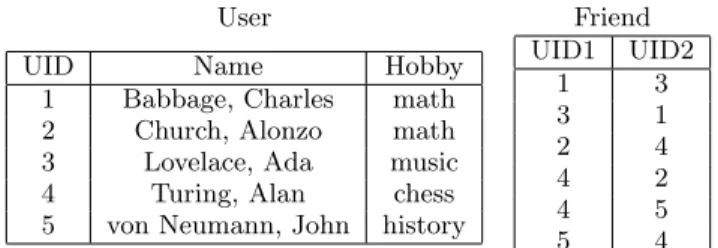
The example database shown in Figure 1 is based on the schema that Facebook exposes to third party app develop-ers through the Facebook Query Language (FQL) [3]. The
User Friend
UID Name Hobby
1 Babbage, Charles math
2 Church, Alonzo math
3 Lovelace, Ada music
4 Turing, Alan chess
5 von Neumann, John history
UID1 UID2 1 3 3 1 2 4 4 2 4 5 5 4 CREATE VIEW V1 AS
(SELECT name, hobby FROM User WHERE uid = 1); CREATE VIEW V2 AS
(SELECT name FROM User WHERE uid = 1); CREATE VIEW V3 AS
(SELECT U.uid, U.name FROM User U, Friend F WHERE U.uid = F.uid2 AND F.uid1 = 1);
Figure 1: Database and security views.
Database
Principal Reference
Monitor
Answers Queries Query Q Policy Check
𝐏 := views principal can access 𝑓: 𝑄, 𝐏 → or Answer
Denied
Figure 2: Disclosure control system model
schema contains two tables: User, which has a User ID
(UID), Name, and Hobby for each user in the dataset, and
Friend, which tracks friendship relations between users. The system controls disclosure of this data using a refer-ence monitor (RM) that enforces asecurity policy. At the time that the database schema is designed, a trusted sys-tem administrator defines a set ofsecurity viewsthat reveal known types of information about the dataset. All subquent policy decisions are made with the help of these se-curity views. In Figure 1,V1 reveals the UID, Name, and Hobby of User 1 (Charles Babbage) whileV2reveals his UID and Name but not his Hobby andV3reveals the UIDs and Names of his friends. In a real system, an analogous set of security views would be generated for each end user; appro-priate security views can easily be generated from templates defined by a human administrator. Many permissions used by Facebook [4] and Android [2] are essentially simple secu-rity views, though they are not formally defined in SQL.
The RM sits between the query evaluation engine and the principals who issue queries (Figure 2). When a principal issues a database queryQ, the RM performs a policy check in order to determine whether the query should be accepted or rejected. This policy check is divided into two steps.
In the first step, the RM computes the subsetPof the se-curity views to which the principal has been granted access. An untrusted third-party app running on Charles Babbage’s behalf might be permitted to see the contents ofV2but not ofV1orV3. In practice, this computation might be based on anAccess Control List(ACL), a set ofCredentialssupplied by the issuer, or aRole-Based security mechanism.
In the second step, the RM checks whether the views inP contain enough information to answer the principal’s
origi-nal query. The determination is made by apolicy function
f that takes Q and P as inputs and returns 0 or 1. If f returns 1 then the principal receives the query results; oth-erwise, the query is denied. The function f is said to be
database-dependent if its output can depend on the current state of the database, or database-independent otherwise. Our focus in this work is on database-independent policies; this ensures that neither policy decisions nor the correspond-ing explanations can leak potentially sensitive information about the current state of the database.
Ideally, f would be based on a simple mathematical cri-terion: it would determine whether the security views that the principal had access to contained enough information to answer Q. If so, f would output 1. Otherwise, it would output 0. In practice, however, f is typically a very crude and conservative algorithm.
In traditional implementations of view-based security, the onus is on the principal to write the query in terms of the views he or she can access. Let us return to Figure 1; sup-pose an app that has been granted access toV2but notV1
issues the following query:
SELECT name FROM V1;
This query will be rejected even though it only reveals in-formation that the app is allowed to access – specifically, it reveals the name of User 1, which can be computed fromV2. The function f is not data-derived [8]: it checks whether the principal is allowed to access all the views in the FROM
clause, but it does not account for the information that the query and the views reveal about the underlying database.
When the query is rejected it would be helpful for the RM to point out that the query can be rewritten usingV2– which the principal has access to – in the following manner:
SELECT name FROM V2;
Better yet, the reference monitor should be able to search for rewritings automatically, and use them – if found – whenever it enforces a policy or generates an explanation.
It is not that we are lacking a formal theory of disclosure or the ability to compute rewritings; in previous work [8] we introduced a formal framework for reasoning about in-formation disclosure in view-based security. However, this research is theoretical and does not deal with expressive real-world query languages and policies. In practice, explana-tions for rejected queries are often insufficient or nonexistent [20]. Even worse, systems such as Oracle’s Virtual Private Database [6] accept unauthorized queries and modify their execution semantics without users’ knowledge [22].
In summary, there is a fundamental connection between using a data-derived policy function f and the ability to provide explanations. Theoretical work shows how to com-pute data-derived functions f but does not extend to real-world systems; policy functions used in practice are not data-derived, which leads to poor explainability.
1.2
Our Contributions
In this paper, we introduce a novel instance of view-based security in which every policy decision made by the RM comes with aconcise,data-derived, andmathematically rig-orous explanation. Our work bridges the gap between exist-ing theoretical work on disclosure lattices [8] and the needs of practical systems which must deal with complex SQL queries and sophisticated security policies.
In our system, both policy decisions and explanations are based on Boolean formulas in apolicy algebra. Given a query Qwe can generate a formulaϕsuch thatP`ϕif and only if f(Q,P) = 1. For example, the query above would be associated with the policy formulaV1∨V2, indicating that a principal who is granted access to at least one ofV1andV2
should be authorized to execute the query. If the principal has access to V2but not V1then we can easily verify that
V2` V1∨V2, which means the query is allowed. The RM uses such formulas, which we refer to aspolicy formulas, to make policy decisions as well as to generate explanations.
The contributions of this paper are as follows. First (Sec-tions 3.1, 3.2) we provide a formal foundation for data-derived policies that connects disclosure lattices and policy algebras. Each query is associated with a policy formula which is automatically computed to reflect the true infor-mation disclosure byQ. To the best of our knowledge, our work is the first to discover and exploit the connection be-tween policy algebras and disclosure lattices.
Second (Section 3.3), we introduce explanations, which are mathematical objects that the RM can return to the principal together with its decision. The explanation, which concisely represents the permissions that contributed to the RM’s decision, gives principals whose queries were denied ac-curate guidance for reformulating their queries or requesting additional permissions.
Third, we show how our foundation can be used to build a security solution for real SQL (Section 4). We define a core language offilter-project queries that is simple enough to reason about in a mathematically sound manner but is expressive enough to capture a wide variety of real-world security policies. Next, we show how arbitrary SQL queries can be compiled to our core language. Due to the complex-ity of the SQL query language, the compilation process is necessarily conservative and may lead to unnecessary query denials. However, we can help developers address such de-nials by automatically identifying the parts of a query that were responsible for its rejection. We have fully implemented our solution; we explain the architecture and functionality of our prototype system.
Fourth, we present experimental results from an evalua-tion of our system on realistic workloads (Secevalua-tion 5).
2.
THEORETICAL BACKGROUND
This section presents the necessary theoretical background for our work, including in particular disclosure lattices [8].
2.1
Query Languages
The results in Section 3 are independent of any specific database query language. However, it is useful to show ex-amples in a concrete language to facilitate presentation. We therefore illustrate our results with conjunctive queries un-der bag semantics. We stress, however, that the same theo-retical framework is applicable to other query languages as well, including conjunctive queries under set semantics [8] and filter-project queries (formally defined in Section 4.2), which combine elements of both set and bag semantics.
A conjunctive query (or view) has the form
H:−B
where H is a relational atom and B a conjunction of re-lational atoms over database relations. H and B are the
head and body of the query, respectively. Each atom may
contain constants and variables. Any variables that appear in H must also appear in B. A distinguished variable is one that appears in the head of the query and anexistential
variable is one that appears only in the body. We say that two queries are equivalent if they return the same answer on every dataset. Classically, conjunctive queries are eval-uated under set semantics, which means that relations do not contain duplicates and duplicates are removed from the result of each query. However, we instead focus on conjunc-tive queries underbag semantics, where both relations and query answers can contain duplicates; bag semantics more accurately model the execution of real SQL queries. [13]
For the database schema from Figure 1, define
V1(n, h) :−U(1, n, h)
V2(n) :−U(1, n, h)
V3(u, n) :−U(u, n, h),F(1, u)
where U and F refer to the User and Friend relations re-spectively. Under bag semantics, the views V1,V2, andV3 correspond exactly to the viewsV1,V2, andV3in Figure 1. If the views were instead evaluated under set semantics then duplicate tuples would automatically be removed from the outputs ofV1,V2, andV3.
Just as in SQL, the output of a set of viewsVcan be used as the input to a queryQ. If every predicate referenced in the body ofQis a view inVthen we say thatQis arewriting using V. The following is a rewriting using{V1, V3}:
Q4(u) :−V1(n, h), V3(u, n)
The following queries arenot rewritings using{V1, V3}. The first body atom of each query directly references the User
relation rather thanV1orV3.
Q5(u) :−U(1, n, h), V3(u, n)
Q6(u) :−U(1, n, h),U(u, n, h
0
),F(1, u)
However, we can show thatQ4 andQ6return the same an-swer on every possible dataset. Since the body ofQ4just ref-erences views in{V1, V3}and the body ofQ6just references relations in the base schema, we say that Q4 is an
equiva-lent rewriting of Q6 using {V1, V3}. The existence of such a rewriting implies that the answers toV1 andV3 uniquely determine the answer toQ6 on any possible dataset.
2.2
Disclosure Orders
We now presentdisclosure orders [8], which formalize the intuition that some views (or sets of views) reveal more in-formation about the dataset than others. We treat views as formal objects drawn from some finite universe U. The relative amounts of information revealed by different sets of views can be compared using a binary relation that op-erates on subsets ofU. Intuitively, ifV andV0 are sets of views,V V0 means that the answers to all the views in Vare uniquely determined by the views inV0.
Definition 1. A disclosure orderis a binary relation
on subsets ofU such that (i) IfV⊆V0 thenVV0.
(ii) IfVV0 andV0V00 thenVV00. (iii) IfVV00andV0V00thenV∪V0V0.
The first axiom ensures that adding new elements to a set of views can only increase the amount of information it
reveals about the dataset. The second axiom is a standard transitivity condition. The third axiom ensures that upper bounds on information disclosure remain meaningful even when information is combined across multiple queries.
We next present three different examples of disclosure or-ders. In each case, we assume thatUis the set of conjunctive queries under bag semantics.1
(i) Set containment: VV0 if and only ifV⊆V0. (ii) View determinacy: VV0 if and only if the
an-swers to the views in V0 uniquely determine the an-swers to the views inVon every possible dataset. (iii) View rewriting: VV0 if and only if every view
inVhas a rewriting usingV0.
Although every disclosure order is a preorder (i.e., it is reflexive and transitive), disclosure orders are not generally partial orders. The reason is that two different views can reveal the same information. For instance, define
V7(u1, u2) :−F(u1, u2)
V8(u2, u1) :−F(u1, u2)
Intuitively, the views should reveal the same information about the dataset despite being unequal because the answer to each view can be computed from the other.
We are not aware of any efficient solution for checking dataset-independent view determinacy; under slightly differ-ent assumptions, it is an open question whether the problem is even decidable. [19] In contrast, checking set containment is trivial and checking whether an equivalent rewriting exists is NP-complete in the size of the input. [13] Since queries are typically quite small, this check is fast in practice.
2.3
Disclosure Lattices
Disclosure orders can be extended to disclosure lattices, which allow us to answer two basic questions. First, given two sets of viewsVandV0, whatcommoninformation is re-vealed both byValone and byV0alone? And second, what
combined information can be learned from looking at the answers to the views inVandV0together? By combining two sets of views, it is often possible to obtain information that cannot be learned by looking at either set on its own; this is the classic problem ofinformation combination [18].
We would like sets of views to form a lattice where the
greatest lower bound(GLB) ofVandV0 (denotedVuV0) represents the information that is common to the two sets
and the least upper bound (LUB) of V and V0 (denoted
VtV0) represents the combined information from the two sets. However, this is not quite right: ifwas a lattice order then it would need to be antisymmetric, so thatVV0and V0Vwould together implyV=V0. We have seen that disclosure orders need not satisfy this property.
To fix the problem, we define a new unary operator (⇓V): (⇓V) ={V ∈ U:{V} V}
Intuitively, (⇓V) contains every view inU whose answer is uniquely determined byV. We can use this new operator to obtain adisclosure latticewith the desired properties. [8]
1To ensure thatU is finite, we assume that queries are ex-pressed in a language with finitely many distinct symbols and that the size of every query is bounded above by a very large but arbitrarily selected constant.
V9(u, n, h) :−U(u, n, h) V10(u, n) :−U(u, n, h) V11(1, n, h) :−U(1, n, h) V12(h) :−U(u, n, h) V13(u1, u2) :−F(u1, u2) V14(1, u2) :−F(1, u2)
Figure 3: A set of security views
Theorem 1. LetU be a set of views, and let be a dis-closure order for U. Define I = {⇓ V : V ⊆ U }. Then
(I,)is a lattice; details are as follows:
• LUB:(⇓V)t(⇓V0) = ⇓(V∪V0).
• GLB:(⇓V)u(⇓V0) = (⇓V)∩(⇓V0).
• Top element>= (⇓ U) =U, bottom element ⊥= (⇓ ∅).
Data-derived policy functions can be expressed in terms of disclosure lattices. Suppose a principal who is authorized to see the contents of a set of security viewsPtries to exe-cute a queryQ. The query is permitted only when the views inPcontain enough information to answerQ, which is true precisely when{Q} P. Translated into the lattice above, the check is equivalent to one that requiresQto be answer-able using the combined information from all the views in P. Equivalently, we require that⇓ {Q} ⇓P.
3.
POLICIES AND EXPLANATIONS
Now that we have introduced disclosure lattices, we can move to the first two major contributions of our paper. First, we introducepolicy formulasthat explicitly represent which combinations of views a principal must have access to before executing a given query. We explain how to compute policy formulas that are data-derived. Next, we show how to use policy formulas to generate data-derived explanations for system decisions to allow or deny queries.
3.1
Policy Formulas
We start with a set ofsecurity views Vdefined by a
hu-man administrator. Each view in V roughly corresponds
to a singlepermission that a principal may or may not be granted. A policy formula is a Boolean formula in which every security view is treated as a variable. Policy formulas overVare formally defined using the BNF grammar
τ ::= 0 | 1 | V | (τ∨τ) | (τ∧τ)
where eachV is a security view inV. The constant 0 cor-responds to a policy in which a query’s execution is never permitted, while the constant 1 corresponds to a policy in which a query’s execution is always permitted.
Consider the set of security views in Figure 3. The policy formulaV9indicates that a principal must be granted access to the viewV9in order to execute a given query. The formula (V9∨V11) indicates that the principal must be granted access toeitherthe viewV9orthe viewV11. The formula (V9∧V14) indicates that the principal must be granted access to both
the viewV9 and the viewV14.
In general, a policy formula ϕ can be attached to any query Q (or more generally, any set of queries) over the
dataset; the formula is then used by the reference monitor to decide whether a given principal can executeQ. Given the set of security viewsPthat the principal is granted access to, the reference monitor (RM) checks whetherP ` ϕ. If so, the RM will allow the principal to executeQ; otherwise, the RM will deny the request. This check can be performed in linear time by recursively applying the following rules:
P`1 andP6`0
P`V if and only ifV ∈P
P`(ϕ∨ψ) if and only ifP`ϕorP`ψ
P`(ϕ∧ψ) if and only ifP`ϕandP`ψ It is important to realize that the check described above is agnostic to the question of how the views inPare computed. Consequently, the model is relevant even for systems that rely on role-based access control or similar schemes where the process of computingPcan be arbitrarily complicated.
3.2
Generating Data-Derived Formulas
We now show how to generate data-derived policy formu-las for database queries. Recall that a data-derived policy specifies that a principal with access to views inPcan re-ceive the answer to query Q if and only if {Q} P. As explained in the Introduction, most policies used in practice are not data-derived; we believe this is because checking directly whether{Q} Pmakes policy decisions computa-tionally expensive and tricky for humans to understand.
On the other hand, given a policy formula ϕ, checking
whether P ` ϕ is straightforward and can be performed
quickly even for large formulas. We therefore propose to encode data-derived policy functions using policy formulas. That is, we want a system that can take a queryQand com-pute a policy formulaϕsuch that, for any subsetPof the security views,P`ϕif and only if{Q} P. Intuitively,ϕ tells us precisely which combinations of the security views contain enough information to uniquely determine the an-swer toQ. For example, consider the query
Q15(h) :−U(1, n, h)
Given the security views defined in Figure 3, Q15 can be answered if the principal is granted access to at least one of the views V9 or V11. This is both a necessary and a sufficient condition. No other view except V12 reveals the Hobby field of theUserrelation, andV12 does not contain enough information to determine which hobby is associated with User 1. The policy formula forQ15is therefore
(V9∨V11)
The question arises whether it is always possible to com-pute the formulaϕwe desire. The answer isyes; there is a very deep connection between disclosure lattices and policy formulas. Given any set of queriesQover the dataset there is a policy formulaϕsuch thatP`ϕif and only if QP for every subsetPof the security views. Furthermore, it is possible to computeϕin a completely automated fashion.
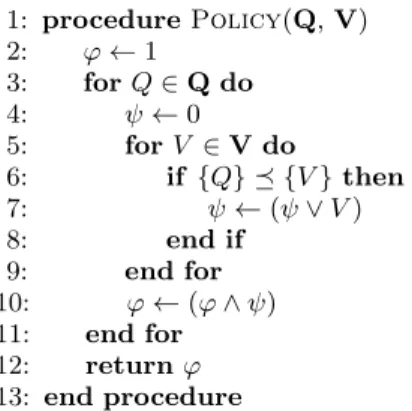
Efficiency, however, is another matter entirely. The num-ber of security views can be quite large, and the size of a policy formula can be exponential in the number of security views. We must limit policy formulas to a manageable size if they are to be used in practice. We can ensure that this is the case by requiring the universeU of possible views to bedecomposable. 1: procedurePolicy(Q,V) 2: ϕ←1 3: forQ∈Q do 4: ψ←0 5: forV ∈V do 6: if {Q} {V}then 7: ψ←(ψ∨V) 8: end if 9: end for 10: ϕ←(ϕ∧ψ) 11: end for 12: returnϕ 13: end procedure
Figure 4: Algorithm for computing data-derived policy formulas (decomposable case)
Formally,U is said to bedecomposable if for every query Q and all sets of views V andV0,{Q} V∪V0 implies
{Q} V or {Q} V0. Put another way, if neither V
alone norV0 alone contains enough information to answer Qthen the union of the two sets still will not contain enough information to answerQ.
Decomposability holds when we restrict our attention to the universeUsingle of single-atom conjunctive queries and views; it does not generally hold when applied to
multi-atom queries and views in the obvious way. We restrict
our attention to single-atom queries and views for now and explain how to handle a more general class of queries and views in Section 4.2.
When decomposability holds, it is possible to compute concise policy formulas for arbitrary queries. Given a set of queries Q and a set of security viewsV, the following formula allows us to compute the formula governingQ:
policy(Q) = ^ Q∈Q _ V∈V:{Q}{V} V
For any subset P of the security views, P ` policy(Q) if and only ifQP. Consequently, policy(Q) tells us exactly which combinations of the security views reveal enough in-formation to answer all the queries in Q. Furthermore, its size is polynomial in both the number of queries and the number of security views.
The algorithm in Figure 4 computes the policy formula for a set of queriesQwith respect to a collection of security viewsV. It begins by setting the policy formula to 1 (Line 2) – an empty set of queries should always be permitted. It then loops through the list of queries inQ(Lines 3-11), computes a separate policy formula for each query (Line 4-9), and returns the conjunction of all the resulting formulas (Line 12); the result is a policy formula over the views inV. The inner loop (Lines 4-9) computes the policy formula for a single query Q. It starts by setting the formula to 0 (Line 4) – if no security view contains enough information to answerQthen the query’s execution should be disallowed. It then loops through all the security views inVand takes the disjunction of all the views that contain enough information to answerQ(Lines 5-9).
For example, letQcontain the queries
Q16(1, n) :−U(1, n, h)
Q17(h) :−U(u, n, h)
and letVconsist of the views from Figure 3. Then policy({Q16}) =V9∨V10∨V11 policy({Q17}) =V9∨V12 and therefore
policy({Q16, Q17}) = (V9∨V10∨V11)∧(V9∨V12) For the other direction, given a policy formulaϕ, the re-cursive function disc(ϕ) defined below allows us to determine precisely what information about the dataset (represented as a point in the disclosure lattice I) can be obtained by executing only queries that are permitted byϕ:
disc(ϕ∨ψ) = disc(ϕ) u disc(ψ) disc(ϕ∧ψ) = disc(ϕ) t disc(ψ)
disc(V) = ⇓V In the example above,
disc((V9∨V10∨V11)∧(V9∨V12))
= (⇓V9 u ⇓V10 u ⇓V11) t (⇓V9 u ⇓V12) P ` ϕ implies disc(ϕ) P, but the converse does not always hold becausePcan be inconsistent. For instance, it is possible to grant a principal access toV9but notV10even though the former reveals strictly more information about the dataset than the latter. If we disallow such inconsisten-cies, the reverse implication holds as expected.
In summary, we have shown how to represent the secu-rity policy governing any query over the dataset as a data-derived policy formula. We do this by exploiting a deep connection between disclosure lattices that precisely quan-tify information disclosure and policy formulas that are easy for a reference monitor to evaluate. For every queryQ we compute a formula ϕ; the reference monitor makes policy decisions by evaluatingϕagainst the list of permissionsP that were granted to the principal. If the universe of queries is decomposable then policy formulas are guaranteed to be small and easy to reason about. However, it is possible to compute policy formulas for queries even when decompos-ability does not hold.
3.3
Explanations
Policy formulas are not just useful for enforcement; they can be used to generateexplanations, which are mathemat-ical objects that justify the RM’s policy decisions.
Explanations come in two varieties: why-so explanations
and why-not explanations. If the execution of a queryQ is authorized, a why-so explanation indicates which of the principal’s permissions were responsible for the positive au-thorization decision. If the execution ofQis not authorized, a why-not explanation indicates which additional permis-sions need to be granted before the query can be success-fully executed. Both types of explanations can be efficiently computed from policy(Q).
As before, letQdenote a set of queries,Vdenote a set of security views, and letP⊆Vbe the subset of the security views that a principal has been granted access to. A why-so explanation forQcharacterizes exactly which subsets ofP
contain enough information to answerQ. It can be obtained by replacing every view V in policy(Q) that the principal has not been granted access to with the constant 0. For example, supposeQ={Q16, Q17}, so that
policy(Q) = (V9∨V10∨V11)∧(V9∨V12)
If the principal is granted access to V9 and V10 then the why-so explanation forQw.r.t. {V9, V10}is
(V9∨V10∨0)∧(V9∨0) = (V9∨V10)∧(V9) =V9 indicating that V9 was solely responsible for the positive authorization decision. If the principal is instead granted access to{V10, V11, V12}, the why-so explanation forQis
(0∨V10∨V11)∧(0∨V12) = (V10∨V11)∧(V12) indicating that in order to answer the query, the principal would need access toV12 and at least one ofV10andV11.
If the RM’s authorization decision is negative, a why-not explanation identifies the additional permissions that would need to be granted in order to reverse the decision. A why-not explanation is obtained by replacing every view V in policy(Q) that the principalhasbeen granted access to with the constant 1. If
policy(Q) = (V9∨V10∨V11)∧(V9∨V12) then the why-not explanation forQw.r.t. {V10, V11}is
(V9∨1∨1)∧(V9∨V12) = 1∧(V9∨V12) = (V9∨V12) indicating that in order to execute the queries in Q, the principal would need to be granted additional access to at least one of the permissionsV9 andV12. Similarly, the why-not explanation forQw.r.t. {V12}is
(V9∨V10∨V11)∧(V9∨1) = (V9∨V10∨V11)∧1 = (V9∨V10∨V11)
indicating that the principal would need to be granted access to at least one of the views V9,V10, and V11 before all the queries inQcould be answered.
Why-so and why-not explanations are helpful to both the principal and the system administrator. From the adminis-trator’s perspective, if the principal holds some permissions that never show up in why-so explanations for his or her queries, this may be an indication that the principal is over-privileged and that those unused permissions should be re-voked. On the other hand, from the principal’s perspective, if a query is denied, the why-not explanation provides clear guidance on which additional permissions to request from the appropriate granting entity. With our data-derived pol-icy formulas, both kinds of explanations are straightforward to compute at query time.
4.
DISCLOSURE CONTROL IN PRACTICE
At this point we have given a theoretical foundation for computing data-derived policy formulas and explanations. We now introduce our system, which generates policy for-mulas and explanations for real SQL queries. In addition, our system can handle realistic security policies that are re-flective, which means that the policies governing tuples in one part of the database can depend on a different part of the same database. Such policies arise frequently in prac-tice. For instance, Facebook’s security policies distinguish
Security Views
(SQL) Query
(SQL)
SQL Compilation Policy Formula
Generation Policy Formula Security Views (Filter-Project) Set of Queries (Filter-Project)
Figure 5: Computing policy formulas – System Ar-chitecture
between queries that reveal information about friends of the current user and queries that reveal information about ar-bitrary users; the former may be permitted when the latter are disallowed. To express and enforce such a policy, the following security view is required:
SELECT U1.uid, U1.name FROM User U1 WHERE U1.uid IN (SELECT F1.uid2 FROM Friend F1 WHERE F1.uid1 = 1)
This security view contains a semijoin and as such cannot be handled efficiently by algorithms in previous work [8].
4.1
Overview
Our prototype system can handle a wide variety of fea-tures that arise in real SQL queries, including:
• Aggregate operators such asSUMandCOUNT.
• Algebraic expressions, equalities, and inequalities.
• Logical boolean connectives, includingAND,OR, andNOT.
• Nested subqueries including the EXISTSand INkeyword and set-comparisons operators such as X >= ANY (...). We also support correlated subqueries.
• JOIN ONandWHEREclauses.
• GROUP BYandHAVINGclauses.
• Left, right, and full outer joins.
• Null values,IS NULL, andIS NOT NULL.
• TheUNION,INTERSECT, andEXCEPTset operators.
• Temporary tables.
If additional SQL features are desired, it is possible to extend our implementation to support them.
Security views can also be defined using standard SQL syntax, but not all SQL features are supported. Every se-curity view must be expressible as a filter-project query. Roughly speaking, this means that each security view must be aSELECT-FROM-WHEREquery with semijoins but not inner or outer joins. While this is a nontrivial restriction, it is sufficient to capture many security constraints that arise in practice, including the Facebook friends query above.
Filter-project queries represent a sweet spot, as they are simple enough to reason about in a mathematically rigorous way but sophisticated enough to capture a wide range of real-world security policies.
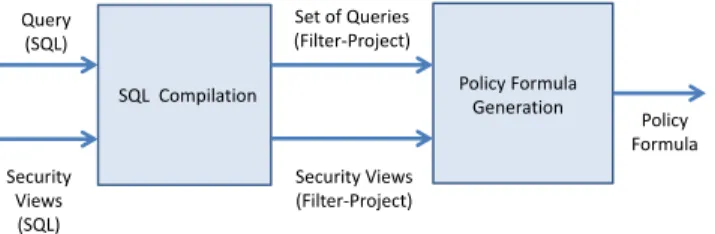
The high-level architecture of our system is shown in Fig-ure 5. Computing policy formulas is a two-stage process. First, queries issued by a principal are fed to a SQL proces-sor that compiles them into filter-project queries. Compi-lation is conservative: the compiled versions of the queries disclose at least as much information as the original SQL queries, and may reveal strictly more information in some
cases. This may cause the reference monitor to overestimate the information disclosed by and consequently reject certain legal queries. It will, however, ensure that illegal queries are never accepted. A policy formula therefore represents an upper bound on the information needed to answer a query.
Security views are similarly compiled into filter-project queries at initialization time; the compilation process for security views is lossless due to the restriction we imposed above. Once the compilation is complete, the system com-putes a policy formula for the compiled query using the algorithm from Figure 4. The entire pipeline is database-independent; policy formulas and explanations can reveal information about the database schema but cannot leak in-formation about the contents of the underlying database.
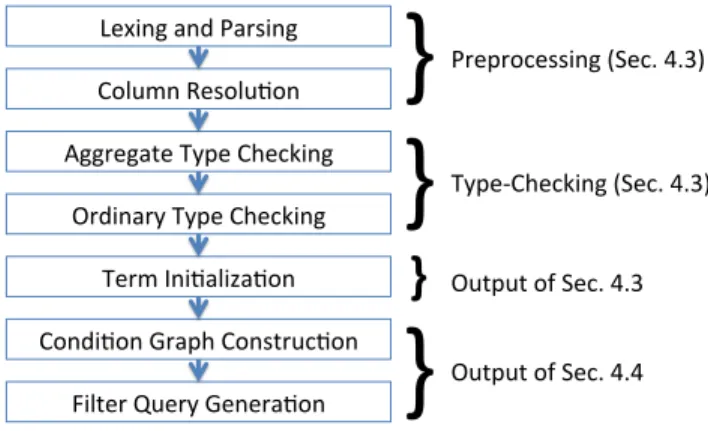
The remainder of this Section describes the architecture of our system in more detail. In Section 4.2 we formally intro-duce filter-project queries and describe how to compute pol-icy formulas and explanations for these queries. In Section 4.3 we discuss the early stages of our compilation pipeline, which output a collection of single-atom projection queries without equality constraints. In Section 4.4 we discuss the later stages of our compilation pipeline, which convert the single-atom projection queries to filter-project queries.
4.2
Filter-Project Queries
We now motivate and formalize filter-project queries, which serve as an intermediate representation within our system.
We begin by introducing some terminology, namelytables
and table instances. Tables are query-independent and be-long to the underlying database. Table instances, on the other hand, originate in the FROM clauses of SQL queries. Thus, a query containing a self-join has two table instances yet references just one table. The query
SELECT U1.uid, U1.name FROM User U1, Friend F1 WHERE F1.uid1 = 1 AND F1.uid2 = U1.uid
has two table instances: U1andF1.
The reference monitor’s job is determine whether the ex-ecution of a specified query should be permitted or denied. In our system, the RM ends up performing a separate policy check for each table instance in the query. This policy check takes into account two different types of information. First, whichcolumns in each table instance can affect the query’s output? And second, whichrows in each table instance can affect the query’s output?
The first question can be answered relatively easily. In the query above, the columnsuidandnameof the table instance
U1can affect the query’s output, and the columnsuid1and
uid2of the table instanceF1can affect the query’s output. The answer to the second question is more subtle. A row in F1can affect the query’s output if (i) F1.uid1 is equal to 1 and (ii) there is a row in the Userrelation whose uid
is equal to F1.uid2. Similarly, a row in U1 can affect the query’s output if there is a corresponding row in Friend
whoseuid1is equal to 1 and whoseuid2is equal toU1.uid. In order to encode the types of constraints described above, we define a class of queries calledfilter-project queries. These are related to the familiar select-project and select-project-join queries, but they are distinct from both.
A filter-project query contains a head atom H, a main body atom B (or just a body atom for short), and zero or morefilter atomsF1, F2, . . ., and is written as
When the set of filter atoms is empty, this is shortened to
H:−B
As the latter syntax implies, filter-project queries generalize single-atom conjunctive queries under bag semantics.
In our running example, the filter-project query forU1is
Q18(u, n) :−U(u, n, h)nF(1, u)
This encodes both the row-based constraints and the column-based constraints mentioned above. The distinguished vari-ables in the query’s head are bound to the columnsuidand
name of the User relation. And the tuples that appear in the query’s output are precisely those for whichU1is joined with a tuple of theFriendrelation that satisfiesuid1 = 1.
Similarly, the filter-project query associated withF1is
Q19(u) :−F(1, u)nU(u, n, h)
Notice that the answers to Q18 and Q19 jointly contain enough information to uniquely determine the answer to the original SQL query on any possible dataset.
The main atom of a filter-project query is evaluated under bag semantics, whereas the remaining atoms are evaluated under set semantics. The filter atoms of a query act as se-lection predicates in the sense that they can remove tuples from the query answer but cannot add new tuples. Further-more, only variables that appear in the query’s main body atom can be referenced in the query head.
In our running example,Q18is equivalent to the following SQL query:
SELECT U1.uid, U1.name FROM User U1 WHERE U1.uid IN (SELECT uid2 FROM Friend WHERE uid1 = 1)
andQ19 is equivalent to
SELECT F1.uid2 FROM Friend F1 WHERE F1.uid1 = 1 AND F1.uid2 IN (SELECT uid FROM User)
More generally, filter atoms in our query language corre-spond to semijoins in standard SQL.
We can now define adisclosure order (Section 2.2) that allows us to compare the information revealed by different filter-project queries. In contrast with the disclosure orders seen earlier, we order filter-project queries according to the amount of information that they disclose about theirmain body atoms. According to our criterion, the following query reveals strictly more information thanQ18above:
Q20(u, n) :−U(u, n, h)
The reason is thatQ18just reveals information aboutUsers who are friends of User 1, whereasQ20reveals information about every tuple in the User relation. The analysis de-pends only on the query definitions and is independent of the contents of the underlying dataset.
Restricting our attention to the information disclosed by queries’ main body atoms serves two purposes. First, it en-sures that the RM will perform exactly one policy check for each table instance in the original SQL query. For the SQL query above, the RM will perform one check to determine whether the execution ofQ18 is authorized and another to determine whetherQ19is authorized. If both are authorized then the SQL query will be accepted. Otherwise, the RM will be able to point to a specific table instance that was responsible for the failed authorization decision: U1 if the check forQ18fails andF1if the check forQ19 fails.
Lexing'and'Parsing' Column'Resolu3on' Aggregate'Type'Checking' Ordinary'Type'Checking' Term'Ini3aliza3on' Condi3on'Graph'Construc3on' Filter'Query'Genera3on' Preprocessing'(Sec.'4.3)' TypeHChecking'(Sec.'4.3)' Output'of'Sec.'4.3' Output'of'Sec.'4.4'
}'
}'
}'
}"
Figure 6: Query compilation pipeline A second advantage of this disclosure order is that it en-sures that the universe of filter-project queries is decompos-able even if the queries contain multiple filter atoms. Con-sequently, filter-project queries are compatible with the effi-cient policy formula generation and explanation algorithms from Section 3.
We can formalize our desired disclosure order usingquery homomorphisms[11, 13, 14]. In our disclosure order, it is the case that{Q18} {Q20}. Given filter-project queriesQand
Q0, the problem of determining whether{Q} {Q0}is NP-hard; however, queries are typically small in practice. Given sets of queries Q and Q0, we can check whether Q Q0 usingO(|Q| · |Q0|) comparisons between pairs of singleton queries; details are omitted due to space restrictions.
4.3
Preprocessing and Term Initialization
We now explain the early passes of our compiler, which transform an arbitrary SQL query into a set of projection queries, or single-atom conjunctive queries without constants or equality constraints. Although not particularly useful on its own, the pipeline will be extended in Section 4.4 in or-der to generate a collection of filter-project queries in the language described in Section 4.2
Our compiler begins by lexing and parsing the raw SQL queries using JSqlParser [1], an open-source query parsing library written in Java. We then execute a series of passes on the resultingabstract syntax tree (AST). Each pass cor-responds to a complete traversal of the AST. A complete depiction of the passes is seen in Figure 6.
Our running example focuses on the query
SELECT name FROM User U1, Friend F1 WHERE uid1 = 1 AND uid2 = uid
Preprocessing and column resolution: Parsing the raw SQL queries yields an AST representation as mentioned earlier. Once the AST is available, we identify table in-stances and perform column resolution. In our example, we identifyU1as a table instance associated with theUsertable andF1as a table instance associated with theFriendtable. Using information about the database schema, we infer that the columnsuidandnamebelong toU1whereas the columns
uid1anduid2belong toF1. (See Figure 7a.) When appli-cable, column resolution also takes into account information about the query’s nested structure.
(a) SELECT U1.name FROM User U1, Friend F1 WHERE F1.uid1 = 1 AND F1.uid2 = U1.uid (b) SELECT U1.name
FROM User U1 LEFT OUTER JOIN Friend F1 ON (F1.uid1 = 1 AND F1.uid2 = U1.uid) (c) SELECT U1.name
FROM User U1 FULL OUTER JOIN Friend F1 ON (F1.uid1 = 1 AND F1.uid2 = U1.uid) (d) SELECT U1.name
FROM User U1, Friend F1, Friend F2 WHERE F1.uid1 = 1 AND F1.uid2 = F2.uid1
AND F2.uid2 = U.uid
(e) SELECT U1.name FROM User U1 WHERE U1.uid IN (SELECT F1.uid2 FROM Friend F1
WHERE F1.uid1 = 1)
Figure 7: SQL queries handled by our system Type-checking: We perform aggressive type-checking on the AST in order to ensure that it corresponds to a semantically well-defined query. The motivation for per-forming type-checking is simple: we can’t reason about the disclosure of a query unless we understand its semantics. Our system performs two different kinds of type-checking.
Aggregate type-checking detects bad queries such as
SELECT SUM(SUM(U1.uid)) FROM User U1
that mix aggregate and non-aggregate expressions in illegal ways. Ordinary type-checking detects bad queries such as
SELECT * FROM User U1 WHERE U1.uid IN (SELECT F1.uid1, F1.uid2 FROM Friend F1)
that provide invalid inputs to built-in functions, operators, and predicates.
Term initialization: The next step is to convert the AST for a SQL queryQinto a collection of projection queries Q1,Q2, . . . ,Qnthat together reveal enough information to
uniquely determine the answer toQon any possible dataset. In Section 4.4 we will describe an extension to this pro-cess that converts the resulting projection queries into filter-project queries of the form described in Section 4.2.
The extraction proceeds as follows. First, we generate one query for each table instance inQ. For example, given any of the SQL queries from Figure 7a, Figure 7b, or Figure 7c, we generate two queries:QU1andQF1. The sole body atom
ofQU1references the Userrelation whereas the body atom
ofQF1references theFriendrelation.
We now determine which variables in our queries should be existential and which should be distinguished. A vari-able is marked as existential if the corresponding column is never referenced in the definition of Q, and is marked as distinguished in all other cases. This ensures that the out-put queries reveal all the columns needed to evaluate any arithmetic expression or inequality or logical predicate that appears inQ. We obtain the same values forQU1 andQF1
for all of the queries in Figures 7a, 7b, and 7c:
QU1(u, n) :−U(u, n, h) QF1(u1, u2) :−F(u1, u2) σ 1 U1 F1 σ 1 U1 F1 σ 1 U1 F1
(a) Two-way join (b) Left outer join (c) Full outer join σ 1 1 U1 F1 F2 σ U1 σ F1
(d) Three-way join (e) Nested subquery
Figure 8: Condition graphs for queries from Fig. 7
4.4
Generating Filter-Project Queries
The output of the compilation process described in Sec-tion 4.3 is a conservative upper bound on the informaSec-tion revealed byQ. However, it is missing information that is es-sential for driving policy decisions in practice. For instance, there is no way to know just by looking atQF1that the query
in Figure 7a only needs a list of friends of User 1 (Charles Babbage) rather than information about arbitrary tuples in the Friend relation. Similarly, there is no way to tell just by looking atQU1that the query only needs to access tuples
in the User relation that correspond to friends of User 1. In order to address these shortcomings, we build acondition graphthat allows us to determine which equality constraints and filter atoms should be added toQU1andQF1.
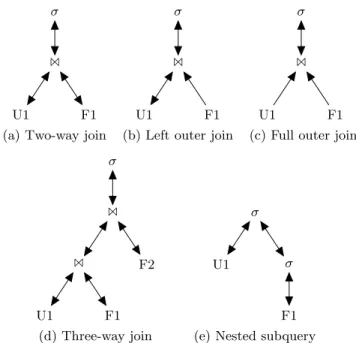
The condition graph for a queryQcontains one node (la-beledσ) for eachSELECT statement in the query, one node (labeled1) for each two-way join in the query’s logical eval-uation plan, and one node for each table instance defined by the query. Figures 8a through 8e show the condition graphs for the SQL queries from Figures 7a through 7e respectively. In many cases, condition graphs bear a deceptive resem-blance to expression trees in the Relational Algebra. How-ever, there are a number of important differences between the two. Edges in condition graphs can be unidirectional or bidirectional, and every condition graph must contain a
SELECT node at its root. Furthermore, the same nodes ap-pear in the graph regardless of whether we perform an inner join or an outer join. However, the directions of edges be-tween those nodes can change depending on the type of join we are dealing with (Figures 8a, 8b, and 8c). And finally,
SELECT nodes can have multiple children (Figure 8e). One child represents theFROMclause of the correspondingSELECT
statement, while the remaining children represent correlated subqueries that appear in the statement’sWHEREandHAVING
clauses. Temporary tables (not shown here) are handled in a similar manner to nested subqueries.
Once we have constructed the condition graph, we can determine which semijoin filter atoms should appear in each
of the output queries. Our criterion is based on reachability in the condition graph: a directed path from table instance R to table instanceS indicates that a tuple in R can only affect the query’s output if it can be joined with a tuple fromS. In our running example,QU1should contain a filter
atom forF1precisely when the node associated with F1is reachable from the node associated withU1in the condition graph. For the query in Figure 7a we obtain
QU1(u, n) :− U(u, n, h)nF(u1, u2)
QF1(u1, u2) :− F(u1, u2)nU(u, n, h)
The situation will be similar for the left outer join query in Figure 8b except thatQU1will not contain any filter atoms.
For the full outer join query in Figure 8c neitherQU1norQF1
will contain any filter atoms. An analogous criterion can be used for other types of queries, including those in Figures 8d and 8e from our running example.
The next step is to find equality constraints that should be added to QU1 and QF1. We begin by finding allSELECT
nodes that are reachable from the condition graph node
as-sociated with U1. We then check the WHERE and HAVING
clauses of the correspondingSELECTstatements for equality constraints that must hold for all tuples in the statements’ outputs. In the query from Figure 7a, we obtain two con-straints: (F1.uid1 = 1) and (F1.uid2 = U1.uid). When we integrate both constraints intoQU1we obtain the query
QU1(u, n) :− U(u, n, h)nF(1, u)
An analogous process can be performed withQF1to obtain
QF1(1, u2) :− F(1, u2)nU(u2, n, h)
The filter-project queriesQU1andQF1 comprise the output
of our extraction algorithm.
4.5
Summary and Extensions
Our system takes as input queries and security views ex-pressed in SQL, with the restriction that security views must be expressible as filter-project queries. It then compiles each input SQL query to a set of filter-project queries. Because the universe of filter-project queries is decomposable, the system can generate policy formulas and explanations using the efficient algorithms from Section 3.
The number of SQL features that our system is able to handle has gradually increased throughout the course of its development and can be further increased as needed. By default, our system errs on the side of overestimating infor-mation disclosure when new language features are added. For example, an earlier version of our system required a principal who wished to execute the query
SELECT uid FROM User U1
WHERE EXISTS (SELECT * FROM Friend F1)
to obtain permissions to access all of the columns in the
Friendrelation. The term initialization stage of our pipeline was subsequently extended with rules for handling selected columns inWHERE EXISTSsubclauses more precisely.
5.
EXPERIMENTAL EVALUATION
The goal of our experimental evaluation was three-fold. First, we wanted to verify that SQL queries containing a wide range of commonly used features could be correctly handled by the compiler discussed in Section 4. Second, we
wanted to determine whether the language of filter-project queries described in Section 4.2 was powerful enough to rep-resent a variety of practical security constraints. And third, we wanted to determine whether policy formulas could be generated quickly enough to be used in practical systems.
We implemented a prototype system in Java. Our system consisted of three main components: (i) a compiler for trans-lating SQL queries into filter-project queries, (ii) a module for representing and reasoning about filter-project queries, and (iii) a module for representing and evaluating policy formulas and generating why-so and why-not explanations. The implementation of our compiler consisted of just over 5,500 lines of Java code, while filter-project queries were im-plemented in about 1,000 lines, and policy formulas were implemented in 250.
For the first goal, we began by writing end-to-end tests for our compiler based on several dozen SQL queries taken from a standard undergraduate database textbook. (See Chapter 5 of [21].) We gradually added more tests over time to keep track of the border cases we encountered. At the time of publication, we had 110 of our 115 end-to-end tests running successfully, and the remaining five were rejected as being semantically invalid. Of these, three were rejected due to limitations of JSqlParser. The last two were valid accord-ing to the SQL standard, but were considered to be invalid by both MySQL and PostgreSQL. The results gave us con-fidence that our compilation-based approach to disclosure control could be successfully applied to a broad range of real-world SQL features.
For the second and third goals, we ran experiments on a database inspired by the one used by the Facebook Query Language (FQL). [3] The schema has a rich and diverse set of security requirements. For example, albums containing media such as photos and videos can be made visible to friends of the current user, to friends of friends, or to the public at large. The membership of a group can be made world-visible, can be restricted to members of that group, or can be completely hidden. Lists of attendees for events can similarly be made world-visible can be restricted to other at-tendees. All of these contingencies were accounted for using filter-project security views.
Our test database schema contained 18 relations with a grand total of 269 distinct columns – or an average of 15 columns per relation. We deliberately selected relations that had nontrivial security policies. The number of columns per relation ranged from two for theFriendrelation (which stores information about friendship relations between users) to 62 for the Applicationtable (which stores information about third-party Facebook Apps). We ended up defining a total of 75 security views. Equality constraints appeared in all but one of our security views; the exception was a view over theApplicationtable that listed certain types of publicly available information about Facebook Apps. Filter atoms appeared in 59 security views. Column projections were used in just four of the security views.
In addition to the qualitative experiments above, we also evaluated the performance of our prototype system. Our experiments were run on a workstation with two 4-core 2.13 GHz Intel Xeon processors and 50 GB of RAM. Our code was run on the OpenJDK 1.7 VM on Ubuntu 12.04.
Our experiments made use of a synthetic query gener-ator that worked by recursively stringing together prede-fined templates. Our use of templates allowed us to
gener-1 2 3 4 5 6 7 8 Number of threads 0 50 100 150 200 250 300 350 400 Time to process one million quer ies
(s) (v) Explain(iv) Compute formula (iii) Finish compilation (ii) Lex + parse (i) Generate
Figure 9: Performance for ordinary queries
ate realistic-looking queries whose joins and equality predi-cates encoded meaningful security-related constraints. Each of the queries we generated contained between one and six table instances; the median 2 and the mean was 2.5. The experiment focused exclusively on filter-project queries with equality constraints. Such queries are especially challeng-ing for our pipeline because they tend to yield filter-project queries with many filter atoms; experiments on other types of queries are available in a digital appendix.2
We measured the wall time needed to (i) randomly gen-erate queries, (ii) lex and parse them, (iii) extract filter-project queries from the parsed output, (iv) compute policy formulas from the resulting filter-project queries, and (v) generate a policy decision for each query, a why-so expla-nation for each permitted query, and a why-not explaexpla-nation for each denied query. Since each stage depended on the output of the previous stage, these measurements were cu-mulative: we measured the time for (i) alone, the time for (i) + (ii), and so on. We also varied the number of exe-cution threads between 1 and 8. All of our algorithms are trivially parallelizable, and the threads operated completely independently of each other. In each case, we measured the time needed to process 1,000,000 queries. All numbers are averaged across five runs; the variation across runs was less than one second in almost all cases.
The results are shown in Figure 9. As expected, through-put scaled nearly linearly with the number of cores. The analysis pipeline took a total of 366 seconds on a single core or 50 seconds on 8 cores. If we exclude the time needed to randomly generate queries, these numbers change to 333 and 44 seconds respectively. If we focus on the last three stages (which are where we claim algorithmic contributions), the numbers fall to 181 and 26 seconds respectively. All compu-tation was CPU-bound, and memory consumption ranged from 60 MB to 220 MB per thread. The time needed to perform policy checks and generate explanations was negli-gible compared to the rest of the system – about 3.5 seconds on a single core or 0.5 seconds on eight cores – and is barely visible in Figure 9. 2http://www.cs.cornell.edu/~lucja/Publications/ sigmod2014appendix.pdf 1 2 3 4 5 6 7 8 Number of threads 0 20 40 60 80 100 Time to process one million quer ies
(s) (v) Explain(iv) Compute formula (iii) Plug in parameters (ii) Lex + parse (i) Generate
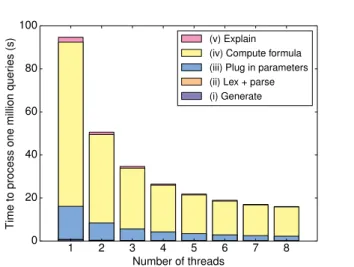
Figure 10: Performance for prepared statements Since query compilation time dominated the benchmark numbers in Figure 9, we speculated that throughput could be significantly improved by using prepared statements. The filter-project queries associated with prepared statements only needed to be calculated once (as a preprocessing step), and could retrieved on demand when the prepared ments were executed. Parameters passed to prepared state-ments at execution time could be substituted directly into the compiled filter-project queries, bypassing the need for a heavy-weight compilation step.
Results are shown in Figure 10. Our use of prepared state-ments yielded around a 3x improvement in overall through-put. The time spent on query generation, lexing and parsing was negligible, and the time needed to retrieve filter-project queries and plug in parameter values paled in comparison with the time needed to perform end-to-end query compila-tion. As a result, computation of policy formulas dominated the running time.
6.
RELATED WORK
Disclosure lattices, which we originally proposed in [8], generalize thelattice of information [18]. Our current work is geared towards real-world SQL queries and complex se-curity policies, while previous work focuses on conjunctive queries under set semantics and restricts security views to single-atom conjunctive queries.
Although there is a large body of work on enforcing access control policies throughview rewriting, we are not aware of any previous work in the database security literature on gen-erating human-readable explanations for policy decisions.
Access control mechanisms based on view rewriting can be
classified as Truman ornon-Truman. Non-Truman
mecha-nisms (e.g., [22]) analyze queries to determine whether they should be accepted or rejected; the principal who issues a query receives either an answer (if the query is accepted) or a denial (if the query is refused). Trumanmechanisms mod-ify queries’ execution semantics in order to ensure that they are consistent with an administrator-defined security policy; commercial Truman mechanisms include IBM LBAC [5] and Oracle VPD [6]. Our approach is non-Truman, but the use of filter-project security views is more commonly associated with Truman mechanisms (e.g., [12, 20]).
Our work has a strong connection to the problem ofquery pricing[17] proposed by Koutris et al. In the framework of query pricing, we are given a set of administrator-provided views (similar to oursecurity views), and a monetary price is assigned to each view. Given a queryQ, the goal of [17] is to find a subset of the views that contain enough infor-mation to answerQand whose total cost is minimal subject to that constraint. Their model of information disclosure is database-dependent, whereas ours is database-independent. The policy formulas computed by our system can be used to derive linear programs that solve adatabase-independent
variant of the query pricing problem. Details are omitted here due to space limitations.
Dwork’s Differential Privacy [15] provides a formal basis for privacy-preserving data publishing. Differential privacy assigns a numeric privacy cost to any possible query over the dataset, but does not provide meaningful feedback about
whose information is disclosed orwhat types of information are disclosed by a given query. In contrast, the policy formu-las and explanations generated by our system are specifically designed to answer these types of questions.
In [10], Brodsky et al. propose an algorithm for enumer-ating the facts that could be learned from a collection of database queries. Their work provides alower bound (ex-pressed as a set of facts) on the information disclosed by a set of queries. Our techniques place anupper bound on the permissions needed to answer a set of queries.
Ourpolicy algebrasare related to formalisms proposed for composable security policies (e.g., [9]) and general-purpose authorization logics (e.g., NAL [24] and SecPal [7]). Com-pared to these systems, our model is simpler, easier to rea-son about, and can be used to produce data-derived policy formulas. Constructive authorization logics such as NAL ensure that all positive authorization decisions are accom-panied by formal proofs that are in some sense analogous to ourwhy-so explanations. We are not aware of any direct analogues to ourwhy-not explanations.
7.
FUTURE WORK
In the future, we plan to extend our system to make it even more broadly useful. Notably, we plan to explore the problem of generatingdatabase-dependent explanations that make use of information about the current state of the database. We also plan to improve the usefulness of the ex-planations by suggesting concrete possible courses of action for the principal and ranking them according to an appro-priate metric.
7.1
Acknowledgments
This research was supported by the National Science Foun-dation under Grants IIS-1012593 and IIS-0911036, by the iAd Project funded by the Research Council of Norway, and by a Google Research Award. Any opinions, findings, conclusions or recommendations expressed in this paper are those of the authors and do not necessarily reflect the views of the sponsors.
8.
REFERENCES
[1] https://github.com/JSQLParser/JSqlParser.
[2] Android permissions.http://developer.android.
com/guide/topics/security/permissions.html. [3] Facebook query language.https:
//developers.facebook.com/docs/reference/fql/.
[4] Facebook query language (fql) reference.
https://developers.facebook.com/docs/reference/fql/. [5] Label-based access control (lbac) overview.
http://publib.boulder.ibm.com/infocenter/ db2luw/v9/index.jsp?topic=%2Fcom.ibm.db2.udb. admin.doc%2Fdoc%2Fc0021114.htm.
[6] Virtual private database.
http://www.oracle.com/technetwork/database/ security/index-088277.html.
[7] Moritz Y Becker, C´edric Fournet, and Andrew D Gordon. Secpal: Design and semantics of a decentralized authorization language.CSF, 2006. [8] Gabriel M Bender, Lucja Kot, Johannes Gehrke, and
Christoph Koch. Fine-grained disclosure control for app ecosystems.SIGMOD, 2013.
[9] Piero Bonatti, Sabrina De Capitani di Vimercati, and Pierangela Samarati. An algebra for composing access control policies.TISSEC, 2002.
[10] Alexander Brodsky, Csilla Farkas, and Sushil Jajodia. Secure databases: Constraints, inference channels, and monitoring disclosures.TKDE, 12(6):900–919, 2000. [11] Ashok K Chandra and Philip M Merlin. Optimal
implementation of conjunctive queries in relational data bases.STOC, 1977.
[12] Surajit Chaudhuri, Tanmoy Dutta, and S Sudarshan. Fine grained authorization through predicated grants.
ICDE, 2007.
[13] Surajit Chaudhuri and Moshe Y Vardi. Optimization of real conjunctive queries.SIGMOD, 1993.
[14] Sara Cohen. Equivalence of queries that are sensitive to multiplicities.VLDB, 2009.
[15] Cynthia Dwork. Differential privacy. InAutomata, languages and programming, pages 1–12. Springer, 2006.
[16] Adrienne Porter Felt, Erika Chin, Steve Hanna, Dawn Song, and David Wagner. Android permissions demystified.CCS, 2011.
[17] Paraschos Koutris, Prasang Upadhyaya, Magdalena Balazinska, Bill Howe, and Dan Suciu. Query-based data pricing.PODS, 2012.
[18] Jaisook Landauer and Timothy Redmond. A lattice of information.CSFW, 1993.
[19] Alan Nash, Luc Segoufin, and Victor Vianu. Views and queries: Determinacy and rewriting.TODS, 2010. [20] Lars E Olson, Carl A Gunter, and P Madhusudan. A
formal framework for reflective database access control policies.CCS, 2008.
[21] Raghu Ramakrishnan and Johannes Gehrke.Database
Management Systems. McGraw-Hill, Inc., New York, NY, USA, 3 edition, 2003.
[22] Shariq Rizvi, Alberto Mendelzon, Sundararajarao Sudarshan, and Prasan Roy. Extending query rewriting techniques for fine-grained access control.
SIGMOD, 2004.
[23] Jerome H Saltzer and Michael D Schroeder. The protection of information in computer systems.
Proceedings of the IEEE, 63(9):1278–1308, 1975. [24] Fred B Schneider, Kevin Walsh, and Emin G¨un Sirer.
Nexus authorization logic (nal): Design rationale and applications.TISSEC, 14(1), 2011.