Measures of Progress and GPRA Measures. We will report on the GPRA Measure of “Long Term Trainee Follow-up Survey and Annual Report” required for UCEDDs. To assess longer term outcomes a follow-up survey will be sent out at one, five, ten years after completion of the training. The data coordinator will train all staff and monitor the accuracy of the data entry into the NIRS system.
Organizational Capacity
Organizational Structure. The ability of a UCEDD to benefit the university, state, and nation is rooted in its administrative structure and relationship with the host university (Davison & Fifield, 1988). IHDD is fortunate in this regard, having developed an innovative, effective structure which is a direct outgrowth of unique characteristics of The University of Georgia. IHDD is a unit in the College of Family and Consumer Sciences (FACS); the IHDD Director reports to the Dean of that College, who, in turn, reports to the Provost of the University. The Provost is administratively responsible to the UGA President, who reports to the Georgia Board of Regents. The scope of IHDD is interdisciplinary and university-wide, influencing students, faculty, and curricula across academic departments. As a land-grant university, the tripartite mission of UGA, To teach, to serve, and to inquire into the nature of things, reflects the university’s commitment to pre-service education, public service/outreach, and research. The FACS college mission is to advance the well-being of individuals and families over their life span and strengthen communities through the generation and dissemination of knowledge, education of professionals, and provision of research-based programs. The mission of the university and college mirror the UCEDD core functions of pre-service education, outreach/community education, and research/dissemination. This facilitates the work of IHDD within the context of the college and university.
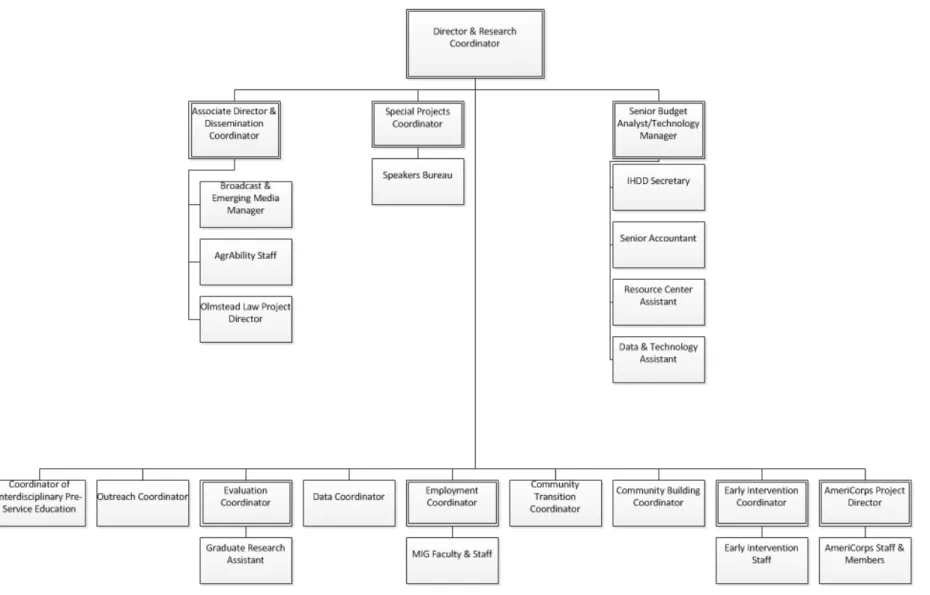
At IHDD, each of the four UCEDD core functions is administered by a designated coordinator (see Organizational Chart on p. 47). Designated coordinators also are appointed for evaluation and NIRS data. Long-term strategic planning for the UCEDD is accomplished in partnership with the CAC. The UCEDD Director and Associate Director meet quarterly with the CAC Executive Committee. Internal governance is achieved by the IHDD Executive Committee (Brightwell, Jinnah-Ghelani, Rugg, Crandell, Rackensperger, Grable, Coordinator of
Disability Studies/TBD, Outreach Coordinator/TBD) who meet every week with the Director to discuss progress toward objectives and to advise the Director concerning new initiatives, emerging issues, and other administrative and programmatic matters. These meetings serve as the primary arena for short- term planning, as well as, for resolution of problems and conflicts. Generally, decisions are reached through consensus building.
In addition, each week, the Director meets with the Senior Budget Analyst, Senior Accountant, and College Business Office Liaison for intensive review of the IHDD budget. Informal meetings related to budgetary and programmatic issues occur several times each week. The last week of each month, Project Directors, Core Function Coordinators, and the AUCD Evaluation and Data Coordinators meet with the Director and Associate Director to discuss progress on project objectives. The full IHDD faculty and staff meet once each semester. IHDD operates with a minimum of standing committees. The Interdisciplinary Faculty Committee, chaired by the Coordinator of Preservice Education, is charged with oversight of the Disability Studies Certificate programs and guides all aspects of pre-service education. The Alternative Formats Committee assures that all IHDD products are accessible to varied audiences. Other committees are appointed as needed.
Creating an Inclusive UCEDD. IHDD strives to be an inclusive, culturally diverse workplace. Over and above the University Affirmative Action Policy, IHDD reaches out to people with disabilities and their family members to fill key positions in the Institute. As needed, we provide flexible work schedules, physical accommodations, and other supports. Through our work in diverse communities across Georgia, IHDD faculty and staff create relationships that allow us to communicate information about position openings to members of culturally and linguistically diverse groups and to recruit new staff through the trust developed through these interpersonal associations. IHDD employs one staff member whose primary language is Spanish; other faculty/staff are bilingual. We believe that a diverse faculty and staff enrich IHDD and that self-advocates and family members bring important skills and personal experiences to the work of the Institute. We have been very successful in these efforts; over 20% of IHDD faculty/staff are people with disabilities or family members of individuals with disabilities; over a third of our faculty/staff are members of a racial minority group.
Status as an Independent Center. IHDD is an independent, interdisciplinary center administratively located in the College of Family and Consumer Sciences (see appended MOA). Consistent with the tripartite mission of the University of Georgia, IHDD engages in the four core functions as mandated by the DD Act.
Figure 1 – Diagram illustrating at the CORE are the issues we are addressing. Outer rings are Interdisciplinary Education /
CAC Input, Outreach / Cultural and Linguistic Diversity, Research / University & Community Partnerships, Dissemination /
Historical Context
Conceptual Framework. The IHDD mission and guiding philosophy, which opened this application, underlie the IHDD conceptual framework. The work centers on ending segregation and supporting ordinary lives that are characterized by individual and civil rights, inclusive education, employment, relationships, meaningful and valued social roles, and family support. IHDD takes a lifespan approach, fielding programs related to infants,
preschoolers, school-age children, adults, and senior citizens. All activities are planned in collaboration with the CAC, and the CAC evaluates whether IHDD is making satisfactory progress. The CAC also provides oversight as to the inclusion of people with disabilities in all aspects of the work of the Institute, as well as to the extent to which
IHDD programs and products are reflective of cultural and linguistic diversity. We celebrate and encourage diversity in our faculty and staff, as well as in the communities that we serve. We are committed to the concept that excellent pre-service training, outreach, technical assistance, dissemination, research, and program evaluation are inseparable components of our program. A detailed written plan for each core function is used to guide UCEDD activities. University students are invited to be actively involved in all IHDD programs and activities. People with disabilities and their families serve as teachers and as providers of outreach and technical assistance. IHDD achieves important outcomes by creating partnerships with a large number of groups, advocacy
organizations, agencies, and individuals with disabilities and their families. These collaborations allow IHDD to achieve change that goes far beyond what could be accomplished by IHDD faculty/staff alone.
IHDD Director. Zolinda Stoneman serves as the Director of IHDD and Research Coordinator (.10 Core; .90 other) (see appended vita). She is a tenured Professor of Child and Family Development and in 2003 was honored by receiving a University Professorship for her contributions to the research, service, and teaching missions of the University of Georgia. She has been awarded a Creative Research Medal from the University of Georgia and the Heart of Gold Award from the Atlanta Alliance on Developmental Disabilities. She has a strong record of achieving grant funding, has authored over 100 journal articles, book chapters, and other publications, and has devoted her career to children and adults with disabilities and their families.
Qualifications of Faculty and Staff Assigned to the UCEDD. IHDD is fortunate to have a strong, dedicated faculty and staff, including the following key personnel (source of funding is noted following each person:
proportion of core funding and funding from other sources; brief VITA are appended): Becky Brightwell, Associate Director and Dissemination Coordinator (1.0 other), has expertise in project management, budgeting, video and print production, and assistive technology; she administers the AgrAbility project. Tracy Rackensperger, Public Service Faculty and Data Coordinator (.64 Core; .36 Other), has expertise in qualitative research design, augmentative and alternative communication, and data management; she teaches IHDD 2001, Introduction to Disability. Doug Crandell, Public Service Faculty and Employment Coordinator (.15 Core; .85 Other), has directed
numerous large grants and contracts focusing on employment of people with disabilities, including workers with developmental disabilities, mental health disabilities, youth transitioning into the workforce, and veterans; he heads IHDD employment initiatives. Mary Rugg, Public Service Faculty and Early Intervention Coordinator (1.0 Other), has extensive experience in early intervention and early childhood education; she provides early intervention technical assistance across the state and directs projects using the Take A Look At Me portfolio. Hamida Jinnah-Ghelani, Research Scientist and Evaluation Coordinator (.58 Core; .42 Other), has expertise in both quantitative and qualitative research and in program evaluation; she oversees evaluation of IHDD programs and activities. Gillian Grable, Community Building Coordinator (.50 Core), has devoted her career to supporting people with disabilities to achieve valued social roles and meaningful community membership; she will be responsible for the community-building activities related to Central State Hospital and the disability festivals. Sue Jamieson, Olmstead Law Project Director (.20 Core), represented Lois Curtis and Elaine Wilson in their desire to live free in their communities; she will share her expertise in social justice law with law students across the country. Sally Carter, Community Transition Coordinator (.20 Core), has great expertise and experience in supporting people in moving from institutions to homes in Georgia communities; she will develop a series of policy papers and stories related to issues of medical and other forms of consent. Mary Wandera, AmeriCorps Program Director (1.0 Other), recruits and supervises AmeriCorps members engaged in disability support, and she teaches students about cultural issues related to disability and about the immigrant experience. Timothy Dowse (.34 Core; .66 Other), Broadcast and Emerging Media Manager, worked with the BBC and the Science Channel before coming to IHDD; he directs video production and oversees social media messaging.
IHDD currently has two open core function coordinator positions: Interdisciplinary Pre-service Education and Outreach. We have completed a national search for the Interdisciplinary Preservice Education Coordinator and have just made an offer to a highly qualified candidate. This position was vacated when our previous faculty member moved to another state. We are beginning the search for the Outreach Coordinator. This open position
was the result of reorganization of faculty roles within the Institute. We anticipate both positions beginning work August 1, 2012. Position descriptions for both coordinators are appended.
Maintaining Faculty and Staff and Allocating Staff Time. Most IHDD faculty and staff have time assigned to multiple funded projects. Core-funded personnel have time assigned to administration of one of the core functions or to UCEDD administrative tasks, in combination with time assigned to grant activities that complement those core-funded responsibilities. Past experience has taught us about the proportion of time needed to perform the UCEDD responsibilities funded by this grant, and assignments are made based on that past history. When faculty or staff are newly hired, their proportion of time on this core grant is highest. This allows them time during their first and second years to learn their responsibilities, learn about IHDD and the DD Act, and have the time to develop other funded projects. As they become more experienced in their roles within the UCEDD and as they generate funded projects in their areas of interest and expertise, percent time on this core grant is adjusted accordingly.
Budget
A detailed budget justification is provided with this application. No funds are being used to supplant funds that would otherwise be made available for activities related to the core functions of interdisciplinary preservice education, outreach, research, or dissemination.
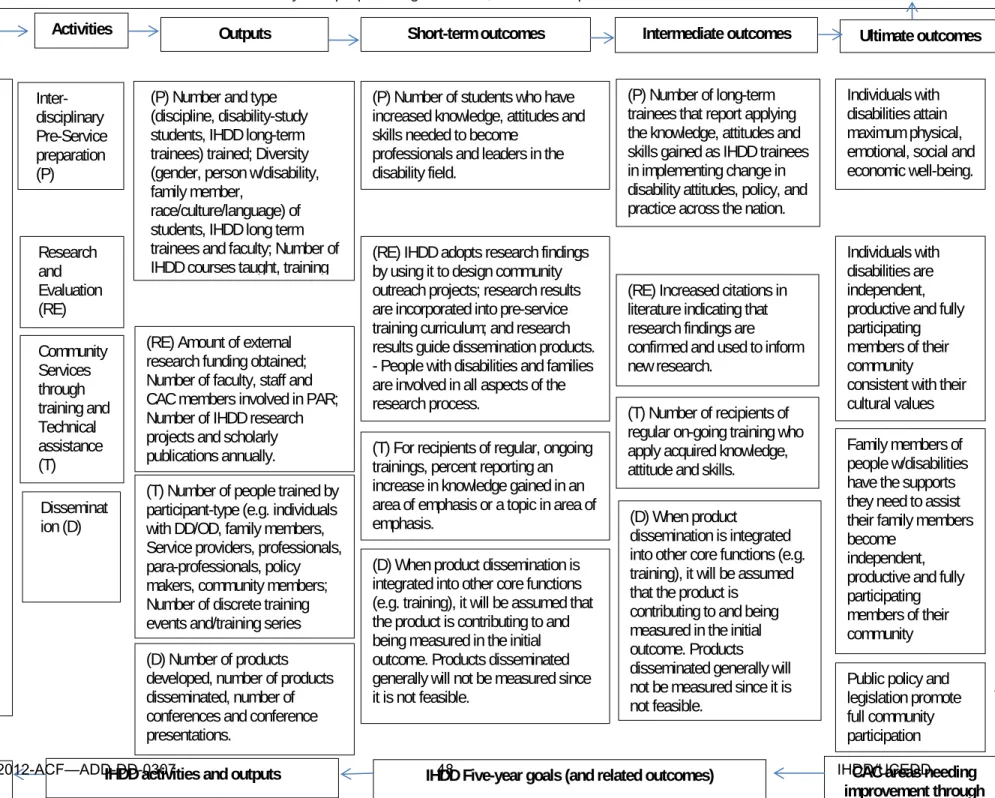
Table 1 – Logic Model
Inputs Activities Outputs Short-term outcomes Intermediate outcomes Ultimate outcomes
Funding CORE Federal State Other Contracts Gifts
Fee for service Staffing
Staff/faculty CAC input and
perspective Other
Collaborative partners Plans and goals Reporting and data systems Websites Equipment and supplies University resources AUCD support Physical Infrastructure (Space, equipment, supplies) Managerial Infrastructure (Business, financial) Inter-disciplinary Pre-Service preparation (P) Community Services through training and Technical assistance (T) Research and Evaluation (RE) Disseminat ion (D)
(P) Number and type (discipline, disability-study students, IHDD long-term trainees) trained; Diversity (gender, person w/disability, family member,
race/culture/language) of students, IHDD long term trainees and faculty; Number of IHDD courses taught, training
(P) Number of students who have increased knowledge, attitudes and skills needed to become
professionals and leaders in the disability field.
(P) Number of long-term trainees that report applying the knowledge, attitudes and skills gained as IHDD trainees in implementing change in disability attitudes, policy, and practice across the nation.
Individuals with disabilities attain maximum physical, emotional, social and economic well-being.
Individuals with disabilities are independent, productive and fully participating members of their community
consistent with their cultural values
Public policy and legislation promote full community participation Family members of people w/disabilities have the supports they need to assist their family members become
independent, productive and fully participating members of their community (RE) IHDD adopts research findings
by using it to design community outreach projects; research results are incorporated into pre-service training curriculum; and research results guide dissemination products. - People with disabilities and families are involved in all aspects of the research process.
(RE) Increased citations in literature indicating that research findings are confirmed and used to inform new research.
(RE) Amount of external research funding obtained; Number of faculty, staff and CAC members involved in PAR; Number of IHDD research projects and scholarly publications annually.
(T) Number of people trained by participant-type (e.g. individuals with DD/OD, family members, Service providers, professionals, para-professionals, policy makers, community members; Number of discrete training events and/training series (D) Number of products developed, number of products disseminated, number of conferences and conference presentations.
(T) For recipients of regular, ongoing trainings, percent reporting an increase in knowledge gained in an area of emphasis or a topic in area of emphasis.
(D) When product dissemination is integrated into other core functions (e.g. training), it will be assumed that the product is contributing to and being measured in the initial outcome. Products disseminated generally will not be measured since it is not feasible.
(T) Number of recipients of regular on-going training who apply acquired knowledge, attitude and skills.
(D) When product
dissemination is integrated into other core functions (e.g. training), it will be assumed that the product is
contributing to and being measured in the initial outcome. Products disseminated generally will not be measured since it is not feasible.
IHDD MISSION: IHDD works with others to create opportunities that will improve the quality of life for people with disabilities and their families. IHDD advances the understanding of the ability of all people through education, research and public service.
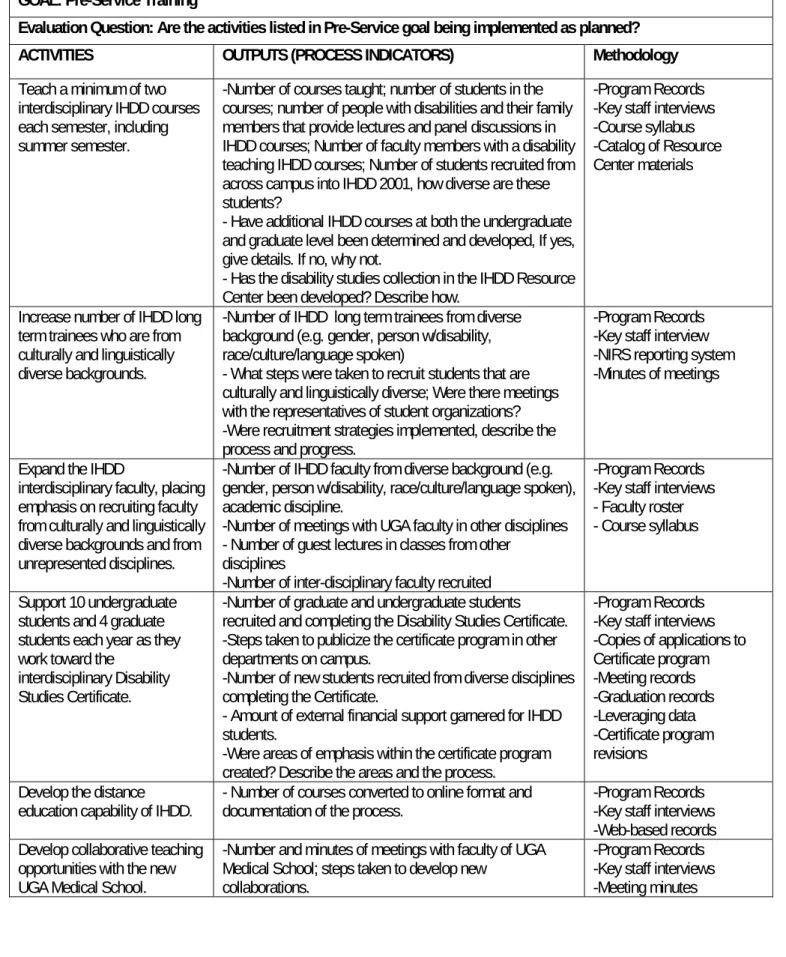
Table 2 – Formative Evaluation Data Collection Matrix GOAL: Pre-Service Training
Evaluation Question: Are the activities listed in Pre-Service goal being implemented as planned?
ACTIVITIES OUTPUTS (PROCESS INDICATORS) Methodology
Teach a minimum of two interdisciplinary IHDD courses each semester, including summer semester.
-Number of courses taught; number of students in the courses; number of people with disabilities and their family members that provide lectures and panel discussions in IHDD courses; Number of faculty members with a disability teaching IHDD courses; Number of students recruited from across campus into IHDD 2001, how diverse are these students?
- Have additional IHDD courses at both the undergraduate and graduate level been determined and developed, If yes, give details. If no, why not.
- Has the disability studies collection in the IHDD Resource Center been developed? Describe how.
-Program Records -Key staff interviews -Course syllabus -Catalog of Resource Center materials
Increase number of IHDD long term trainees who are from culturally and linguistically diverse backgrounds.
-Number of IHDD long term trainees from diverse background (e.g. gender, person w/disability, race/culture/language spoken)
- What steps were taken to recruit students that are culturally and linguistically diverse; Were there meetings with the representatives of student organizations? -Were recruitment strategies implemented, describe the process and progress.
-Program Records -Key staff interview -NIRS reporting system -Minutes of meetings
Expand the IHDD
interdisciplinary faculty, placing emphasis on recruiting faculty from culturally and linguistically diverse backgrounds and from unrepresented disciplines.
-Number of IHDD faculty from diverse background (e.g. gender, person w/disability, race/culture/language spoken), academic discipline.
-Number of meetings with UGA faculty in other disciplines - Number of guest lectures in classes from other
disciplines
-Number of inter-disciplinary faculty recruited
-Program Records -Key staff interviews - Faculty roster - Course syllabus
Support 10 undergraduate students and 4 graduate students each year as they work toward the
interdisciplinary Disability Studies Certificate.
-Number of graduate and undergraduate students recruited and completing the Disability Studies Certificate. -Steps taken to publicize the certificate program in other departments on campus.
-Number of new students recruited from diverse disciplines completing the Certificate.
- Amount of external financial support garnered for IHDD students.
-Were areas of emphasis within the certificate program created? Describe the areas and the process.
-Program Records -Key staff interviews -Copies of applications to Certificate program -Meeting records -Graduation records -Leveraging data -Certificate program revisions
Develop the distance
education capability of IHDD. - Number of courses converted to online format and documentation of the process. -Program Records -Key staff interviews -Web-based records Develop collaborative teaching
opportunities with the new UGA Medical School.
-Number and minutes of meetings with faculty of UGA Medical School; steps taken to develop new
collaborations.
-Program Records -Key staff interviews -Meeting minutes
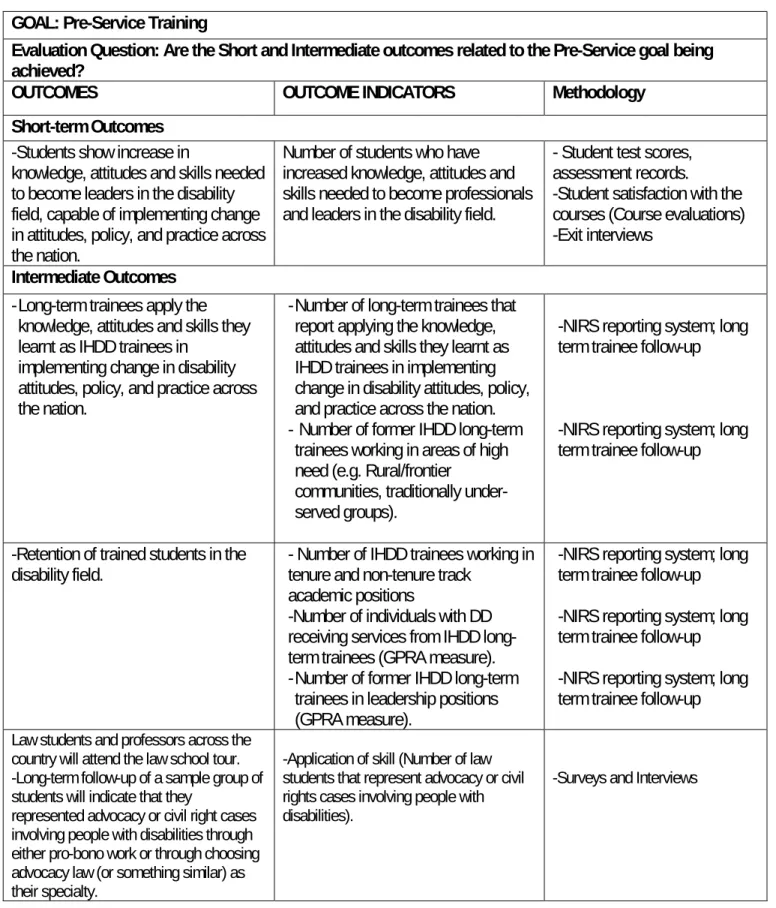
Table 3: Summative Evaluation Data Collection Matrix GOAL: Pre-Service Training
Evaluation Question: Are the Short and Intermediate outcomes related to the Pre-Service goal being achieved?
OUTCOMES OUTCOME INDICATORS Methodology
Short-term Outcomes -Students show increase in
knowledge, attitudes and skills needed to become leaders in the disability field, capable of implementing change in attitudes, policy, and practice across the nation.
Number of students who have increased knowledge, attitudes and skills needed to become professionals and leaders in the disability field.
- Student test scores, assessment records.
-Student satisfaction with the courses (Course evaluations) -Exit interviews
Intermediate Outcomes - Long-term trainees apply the
knowledge, attitudes and skills they learnt as IHDD trainees in
implementing change in disability attitudes, policy, and practice across the nation.
- Number of long-term trainees that report applying the knowledge, attitudes and skills they learnt as IHDD trainees in implementing change in disability attitudes, policy, and practice across the nation. - Number of former IHDD long-term
trainees working in areas of high need (e.g. Rural/frontier
communities, traditionally under-served groups).
-NIRS reporting system; long term trainee follow-up
-NIRS reporting system; long term trainee follow-up
-Retention of trained students in the
disability field. - Number of IHDD trainees working in tenure and non-tenure track academic positions
-Number of individuals with DD receiving services from IHDD long-term trainees (GPRA measure). - Number of former IHDD long-term
trainees in leadership positions (GPRA measure).
-NIRS reporting system; long term trainee follow-up -NIRS reporting system; long term trainee follow-up -NIRS reporting system; long term trainee follow-up Law students and professors across the
country will attend the law school tour. -Long-term follow-up of a sample group of students will indicate that they
represented advocacy or civil right cases involving people with disabilities through either pro-bono work or through choosing advocacy law (or something similar) as their specialty.
-Application of skill (Number of law students that represent advocacy or civil rights cases involving people with disabilities).