The Role of Ontologies in Data Integration
Isabel F. Cruz
Huiyong Xiao
ADVIS Lab
Department of Computer Science
University of Illinois at Chicago, USA
{
ifc
|
hxiao
}
@cs.uic.edu
Abstract
In this paper, we discuss the use of ontologies for data integra-tion. We consider two different settings depending on the system architecture: central and peer-to-peer data integration. Within those settings, we discuss five different cases studies that illustrate the use of ontologies in metadata representation, in global conceptualization, in high-level querying, in declarative mediation, and in mapping support. Each case study is described in detail and accompanied by examples.
1
Introduction
1.1
Data Integration
Data integration provides the ability to manipulate data transparently across multiple data sources. It is relevant to a number of applications including enterprise information integration, medical information management, geo-graphical information systems, and E-Commerce applications. Based on the architecture, there are two different kinds of systems: central data integra-tion systems [1, 3, 7, 10, 18, 22] and peer-to-peer data integraintegra-tion systems [2, 4, 5, 11, 16, 19]. A central data integration system usually has a global schema, which provides the user with a uniform interface to access informa-tion stored in the data sources. In contrast, in a peer-to-peer data integrainforma-tion system, there are no global points of control on the data sources (or peers).
Instead, any peer can accept user queries for the information distributed in the whole system.
The two most important approaches for building a data integration sys-tem are Global-as-View (GaV) and Local-as-View (LaV) [22, 17]. In the GaV approach, every entity in the global schema is associated with a view over the source local schema. Therefore querying strategies are simple, but the evolution of the local source schemas is not easily supported. On the contrary, the LaV approach permits changes to source schemas without af-fecting the global schema, since the local schemas are defined as views over the global schema, but query processing can be complex.
1.2
Data Heterogeneity
Data sources can be heterogeneous in syntax, schema, or semantics, thus making data interoperation a difficult task [6]. Syntactic heterogeneity is caused by the use of different models or languages. Schematic heterogene-ity results from structural differences. Semantic heterogeneheterogene-ity is caused by different meanings or interpretations of data in various contexts. To achieve data interoperability, the issues posed by data heterogeneity need to be elim-inated.
The advent of XML has created a syntactic platform for Web data stan-dardization and exchange. However, schematic data heterogeneity may per-sist, depending on the XML schemas used (e.g., nesting hierarchies). Like-wise, semantic heterogeneity may persist even if both syntactic and schematic heterogeneities do not occur (e.g., naming concepts differently). In this paper, we are concerned with solving all three kinds of heterogeneities by bridging syntactic, schematic, and semantic heterogeneities across different sources.
1.3
Semantic Data Integration using Ontologies
We call semantic data integration the process of using a conceptual repre-sentation of the data and of their relationships to eliminate possible hetero-geneities. At the heart of semantic data integration is the concept ofontology, which is an explicit specification of a shared conceptualization [13, 14].
Ontologies were developed by the Artificial Intelligence community to facilitate knowledge sharing and reuse [15]. Carrying semantics for particular domains, ontologies are largely used for representing domain knowledge. A
common use of ontologies is data standardization and conceptualization via a formal machine-understandable ontology language. For example, the global schema in a data integration system may be an ontology, which then acts as a mediator for reconciliating the heterogeneities between different sources. As an example of the use of ontologies on peer-to-peer data integration, we can produce for each source schema a local ontology, which is made accessible to other peers so as to support semantic mappings between different local ontologies.
1.4
Paper Overview
We review the use of ontologies on heterogeneous data integration systems. Based on existing approaches to ontology-based data integration and in par-ticular on our work on central and peer-to-peer data integration, we discuss how ontologies can be used to facilitate data interoperation and integration. In Section 2, we present an overview of the concept of ontology and of lan-guages that are used for representing ontologies. In Section 3, we give a high-level description of the use of ontologies in data integration. In the following two sections we discuss five case studies describing typical uses of ontologies. Three of those case studies relate to central data integration and are presented in Section 4. The other two case studies relate to peer-to-peer data integration and are presented in Section 5. We conclude in Section 6.
2
Ontologies
An ontology is a formal, explicit specification of a shared conceptualization
[13]. In this definition, “conceptualization” refers to an abstract model of some domain knowledge in the world that identifies that domain’s relevant concepts. “Shared” indicates that an ontology captures consensual knowl-edge, that is, it is accepted by a group. “Explicit” means that the type of concepts in an ontology and the constraints on these concepts are explic-itly defined. Finally, “formal” means that the ontology should be machine understandable.
Typical “real-world” ontologies include taxonomies on the Web (e.g., Ya-hoo! categories), catalogs for on-line shopping (e.g., Amazon.com’s product catalog), and domain-specific standard terminology (e.g., UMLS1 and Gene
Ontology2). As an online lexicon database, WordNet3 is widely used for discovery of semantic relationships between concepts.
Existing ontology languages include:
XML Schema. Strictly speaking, XML Schema is a semantic markup
lan-guage for Web data. The database-compatible data types supported by XML Schema provide a way to specify a hierarchical model.4 How-ever, there are no explicit constructs for defining classes and properties in XML Schema, therefore ambiguities may arise when mapping an XML-based data model to a semantic model.
RDF and RDFS. RDF (Resource Description Framework) is a data model
developed by the W3C for describing Web resources.5 RDF allows for the specification of the semantics of data in a standardized, interop-erable manner. In RDF, a pair of resources (nodes) connected by a property (edge) forms a statement: (resource, property, value). RDFS (RDF Schema)6 is a language for describing vocabularies of RDF data in terms of primitives such as rdfs:Class, rdf:Property, rdfs:domain, and rdfs:range. In other words, RDFS is used to define the semantic rela-tionships between properties and resources.
DAML+OIL. DAML-OIL (DARPA Agent Markup Language-Ontology
In-terface Language) is a full-fledged Web-based ontology language devel-oped on top of RDFS.7 It features an XML-based syntax and a layered architecture. DAML-OIL provides modeling primitives commonly used in frame-based approaches to ontology engineering, and formal seman-tics and reasoning support found in description logic approaches. It also integrates XML Schema data types for semantic interoperability in XML.
OWL. OWL (Web Ontology Language) is a semantic markup language for publishing and sharing ontologies on the Web. It is developed as a vocabulary extension of RDF and is derived from DAML+OIL.8 2http://www.geneontology.org 3http://www.cogsci.princeton.edu/∼wn/ 4http://www.w3.org/TR/xmlschema-2 5http://www.w3.org/TR/rdf-primer 6http://www.w3.org/TR/rdf-schema 7http://www.w3.org/TR/daml+oil-reference 8http://www.w3.org/TR/owl-ref
Other ontology languages include SHOE (Simple HTML Ontology Exten-sions),9 XOL (Ontology Exchange Language),10and UML (Unified Modeling Language).11
Among all these ontology languages, we are most interested in XML Schema and RDFS for their particular roles in data integration and the “Semantic Web” [12]. More specifically, XML Schema and RDFS use the same syntax and can be used for data modeling and ontology representation. But they have their own particular features in the sense that XML data has
document structure in terms of the nesting elements in an individual XML
document, whereas RDF data has domain structure formed by the concepts and relationships between concepts [11, 16]. We shall discuss this issue in detail in Section 4.
3
Ontologies for Data Integration
Ontologies have been extensively used in data integration systems because they provide an explicit and machine-understandable conceptualization of a domain. They have been used in one of the three following ways [23]:
Single ontology approach. All source schemas are directly related to a
shared global ontology that provides a uniform interface to the user [9]. However, this approach requires that all sources have nearly the same view on a domain, with the same level of granularity. A typical example of a system using this approach is SIMS [3].
Multiple ontology approach. Each data source is described by its own
(local) ontology separately. Instead of using a common ontology, local ontologies are mapped to each other. For this purpose, an additional representation formalism is necessary for defining the inter-ontology mappings. The OBSERVER system [18] is an example of this approach.
Hybrid ontology approach. A combination of the two preceding approaches
is used. First, a local ontology is built for each source schema, which, however, is not mapped to other local ontologies, but to a global shared ontology. New sources can be easily added with no need for modifying 9http://www.cs.umd.edu/projects/plus/shoe
10http://www.ai.sri.com/pkarp/xol/ 11http://www.uml.org/
existing mappings. Our layered framework [9] is an example of this approach.
The single and hybrid approaches are appropriate for building central data integration systems, the former being more appropriate for GaV systems and the latter for LaV systems. A hybrid peer-to-peer system, where a global ontology exists in a “super-peer” can also use the hybrid ontology approach [11]. The multiple ontology approach can be best used to construct
pure peer-to-peer data integration systems, where there are no super-peers. We identify the following five uses of ontologies in data integration:
Metadata Representation. Metadata (i.e., source schemas) in each data
source can be explicitly represented by a local ontology, using a single language.
Global Conceptualization. The global ontology provides a conceptual view
over the schematically-heterogeneous source schemas.
Support for High-level Queries. Given a high-level view of the sources,
as provided by a global ontology, the user can formulate a query without specific knowledge of the different data sources. The query is then rewritten into queries over the sources, based on the semantic mappings between the global and local ontologies.
Declarative Mediation. Query processing in a hybrid peer-to-peer system
uses the global ontology as a declarative mediator for query rewriting between peers.
Mapping Support. A thesaurus, formalized in terms of an ontology, can
be used for the mapping process to facilitate its automation.
In the following sections we discuss five case studies, which correspond to the above five uses. The three first case studies are in the context of centralized data integration systems (Section 4), while the last two are in the context of peer-to-peer data integration systems (Section 5). We base our discussion on our previous work [9, 10, 11, 24, 25].
4
Central Data Integration
In this section, we will describe three case studies of ontologies in the context of central data integration. To make the issues concrete, we use a running example involving two XML sources and demonstrate how to enable semantic interoperation between them.
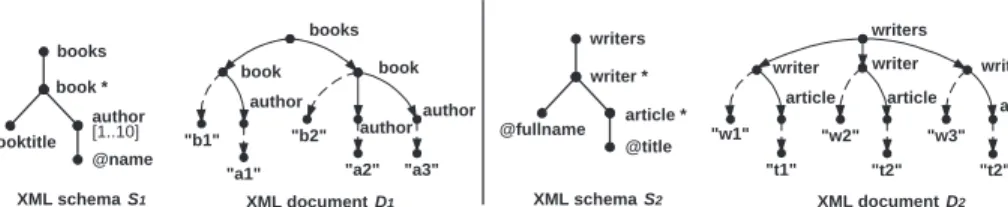
Example 1 Figure 1 displays two XML schemas (S1 and S2) and their
re-spective documents (D1 and D2), which are represented as trees. The two
XML documents conform to different schemas but represent data with similar semantics. In particular, both schemas represent a many-to-many
relation-ship between two concepts: book and author in S1 (equivalently denoted by
article and writer in S2). However, structurally speaking, they are
dif-ferent: S1 (book-centric schema) has the author element nested under the
book element, whereas S2 (author-centric schema) has thearticle element
nested under the writer element.
Semantically equivalent data elements, such as the authors of
publica-tion “b2”, can be reached using different XML path patterns, respectively for
schema S1 and schema S2:
/books/book[@booktitle="b2"]/author/@name and
/writers/writer[article/@title="b2"]/@fullname
where the contents in the square brackets specify the constraints for the search patterns. books book * author @booktitle @name writers article * @title @fullname writer * books book author "b1" book author "b2" "a1" "a3" writers writer article "w1" "w2" "t1" "a2" XML schema S1 XML document D1 "books.xml" writer writer article article "t2" "w3" "t2" [1..10] XML schema S2 XML document D2 "writers.xml" author
The example demonstrates that multiple XML schemas (or structures) can exist for a single conceptual model. In comparison, the schema or on-tology languages (e.g., RDFS, DAML+OIL, and OWL) that operate on the conceptual level are structurally flat so that the user can formulate a query from a conceptual perspective without considering the structure of the source [1, 7, 23, 10].
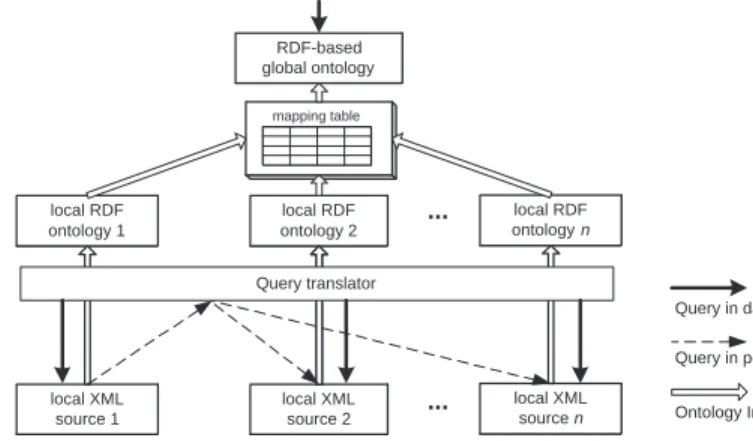
Figure 2 shows the architecture of a system that interoperates among
mapping table local XML source 1 local XML source 2 local XML source n RDF-based global ontology local RDF ontology n local RDF ontology 1 local RDF ontology 2 ... ... Query translator
Query in data-integration direction Query in peer-to-peer direction
Ontology Integration
Figure 2: An architecture for XML data integration.
schematically heterogeneous data sources [10]. The following three cases study in detail the principles embodied in this architecture.
Case Study 1 - Metadata Representation
As a first step for bridging across the heterogeneities of diverse local sources, alocal ontologymust be generated from each source database schema (e.g., relational, XML, or RDF). A local ontology is a conceptualization of the elements and relationships between elements in each source schema. To facilitate interoperation, those ontologies should be expressed using the same model. Furthermore, for the sake of correct query processing, the structure of source schemas and the integrity constraints (e.g., relational foreign keys) expressed on the schemas should be preserved in the local ontology. We choose RDFS to represent each local ontology.
In our approach, ontology generation from source schemas is accomplished
by model-based schema transformation [9]. In particular, the following
Relational Schema. Relations are converted into RDF classes and attributes into RDF properties, which are attached to the class corresponding to the relation to which the attributes belong. Foreign key dependencies between two relations are represented by two properties (corresponding to the two relations) sharing the same value in the target local ontology.
XML Schema. Complex-type elements are converted into RDF classes and
simple-type elements and attributes are converted into RDF properties. This transformation process encodes the mapping information between each concept in the local RDF ontology and the path to the corre-sponding element in the XML source. Nesting relationships between XML elements are represented using a meta-propertyrdfx:contains;rdfx stands for the namespace wherecontainsis defined. This meta-property enables the RDF representation of the XML nesting structure, by con-necting two RDF classes representing the two nesting XML elements.
Example 2 Following Example 1, Figure 3 shows the local RDF ontologies
S
1 and S2, which are generated respectively from the XML source schemas
S1 and S2. Book Author booktitle Books name rdfx:contains rdfx:contains Article Writer title Writers fullname rdfx:contains rdfx:contains
Local RDF ontology S1' Local RDF ontology S2'
rdfs:domain rdfs:domain rdfs:domain rdfs:domain
Figure 3: RDF-based local ontologies generated from XML schemas.
Case Study 2 - Global Conceptualization
To make the integration system accessible through the uniform interface of the global ontology, semantic mappings are established between the global ontology and the local ontologies. In our approach, this mapping process is accomplished during the construction of the global ontology, which is gener-ated by merging the local ontologies, for example, using a GaV approach.
We consider that each local ontology is merged into the global ontol-ogy, the target ontology. The process of ontology merging consists of several operations:
• Copying a class and/or its properties: classes and properties that do not exist in the target ontology are copied into it.
• Class Merging: conceptually equivalent classes in the local and target
ontologies are combined into one class in the target ontology.
• Property Merging: conceptually equivalent properties of a class in the
local and target ontologies are combined into one property in the target ontology.
• Relationship Merging: conceptually equivalent relationships from one
class c1 to another class c2 in the local and target ontologies are com-bined into a single relationship in the target ontology (i.e., an RDF property having c1 as its domain and c2 as its range).
• Class Generalization: related classes in the local and target ontologies
can be generalized into a a superclass. The superclass can be obtained by searching an existing knowledge domain (e.g., the DAML Ontology Library 12) or reasoning over a thesaurus.
We note that along with the above operations, semantic correspondences are established. For example, for each element pL in a local ontology, if there exists a semantically equivalent element pG in the global ontology, the two elements will be merged and a correspondence between pL and pG will be generated.
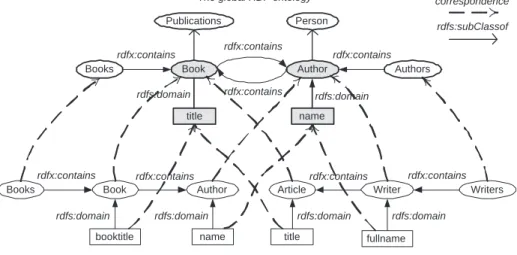
Example 3 Figure 4 shows the global RDF ontologies generated by merging
the local ontologiesS1 andS2 of Example 2. Note that the classes (properties)
represented in grey are merged classes (properties), and the classesBook and
Authorare also extended, withPublicationandPersonbeing their superclasses,
respectively.
Case Study 3 - Support for High-level Queries
Given a conceptual view of available information sources, the user may pose a query in terms of the global ontology. We say the query is a
high-level query if its formulation does not require awareness of particular source
schemas. The query is then reformulated by a rewriting algorithm into a 12http://www.daml.org/ontologies/
Book Author title Books Publications Person Authors name rdfx:contains rdfx:contains rdfx:contains rdfx:contains Book Author booktitle Books name rdfx:contains rdfx:contains Article Writer title Writers fullname rdfx:contains rdfx:contains
Local RDF ontology S1' Local RDF ontology S2'
rdfs:domain rdfs:domain rdfs:domain rdfs:domain
rdfs:subClassof
rdfs:domain rdfs:domain
correspondence The global RDF ontology
Figure 4: A conceptual view on local sources.
subquery for each source. The subqueries over sources are subject to the structure of source schemas, and may be expressed in a different language from that of the high-level query. An inference mechanism may be needed in the query rewriting, for example, when a concept involved in the query has super-concepts or sub-concepts.
In addition to handling high-level queries on the global ontology, a
bidi-rectional query translation algorithm is also supported [10] (see Figure 2).
In this case, we can translate a query posed against an XML source to an equivalent query against any other XML source.
Example 4 Suppose the user asks the query “Find the persons who have
written publication b2.” This query will be expressed in a RDF query
lan-guage such as RDQL. 13 First, Person has sub-concept Author, which
corre-sponds to two different concepts (Author and Writer) in two different RDF
local databases. Therefore the initial query will be rewritten as two sub-queries to those databases. In turn, those queries may be further rewritten using a XML query language incorporating the path expressions of Example 1 (unless the data was materialized under the RDF local ontologies). Using the
bidi-rectional query translation mechanism, a query involving the concepts Book
and Author in one source will be translated into a query involving Articleand
mapping table local XML schema Global RDF ontology
peer 1 super peer
mapping table local RDF schema mapping table peer n XML to RDF wrapper local XML schema peer i mapping table XML to RDF wrapper Query processing in data-integration fashion Query processing in hybrid P2P fashion Mapping process Q1 Q2n' Q2i' Q2 Q11' Q1i' Q1n'
Figure 5: The hybrid peer-to-peer architecture of PEPSINT.
Writer in another data source, by using the correspondences established by the
global ontology.
5
Peer-to-Peer Data Integration
We consider again the two XML sources of Figure 1. However, this time they are connected in a peer-to-peer architecture. We consider a hybrid peer-to-peer architecture with two types of peer-to-peers: super-peers containing the global RDF ontology, and peers each containing a data source and an ontology. Each peer represents an autonomous information system and connects to a super-peer via semantic mappings. Peer-to-peer data integration systems or frameworks include LRM (Local Relational Model) [5], Hyperion [2], Pi-azza [16], PeerDB [19], SEWASIE [4], and PEPSINT [11].
Case Study 4 - Declarative Mediation
The PEPSINT system is a hybrid peer-to-peer system whose architecture is shown in Figure 5. PEPSINT uses a GaV approach. The global ontology in a super-peer serves two functions: (1) It provides the user with a uniform high-level view of the data sources in the distributed peers, and (2) it serves as a a mediator for query translation from one peer to another. The former function is similar to the one described in Case Study 3. The latter function is discussed in detail here.
The user can pose a query against the local XML or RDF data source in any peer. Locally, the query will be executed on the local source to get alocal
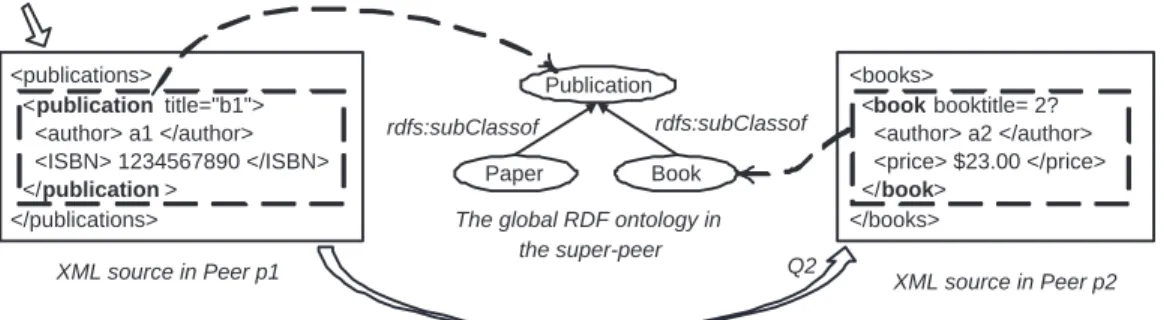
<publications> <publication title="b1"> <author> a1 </author> <ISBN> 1234567890 </ISBN> </publication > </publications> <books> <book booktitle= 2? <author> a2 </author> <price> $23.00 </price> </book> </books> Publication Paper Book rdfs:subClassof rdfs:subClassof
The global RDF ontology in the super-peer XML source in Peer p1
Q1: List all publications
Q2
XML source in Peer p2
Figure 6: Mediation for peer-to-peer query rewriting.
answer. Meanwhile, the source query is rewritten into a target query over
every connected peer. The query rewriting utilizes the global ontology, and the composition of mappings from the original peer to the super peer with mappings from the super-peer to the target peers. By executing the target query, each peer returns an answer to the original peer, called the remote
answer. The local and remote answers are integrated and returned to the
user at the site of the originating peer.
Example 5 Consider two XML sources, one in peer p1 and the other in
peer p2, and a global ontology expressed in RDF in a super-peer. As shown
in Figure 6, the global ontology consists of a class Publication and two
sub-classes Paper and Book. The Publication class is mapped to the publication
element of the XML source in p1, while the class Book corresponds to book
of the XML source in p2. An XML query Q1 on p1 involving publication will
be rewritten to a target query Q2 on p2 involving include book. The XML
fragments inside the dashed-line boxes are integrated and returned as answers.
Case Study 5 - Mapping Support
A thesaurus can be used for data integration to facilitate the automation of the schema mapping process [21, 9]. In particular, it can help discovering the semantic relationships between concepts in different schemas or ontologies. WordNet is an example of such a thesaurus. It consists of a network of terms and their semantic relations (e.g., synonym, hypernym, and hyponym). A term may have multiple senses, each being a synset.
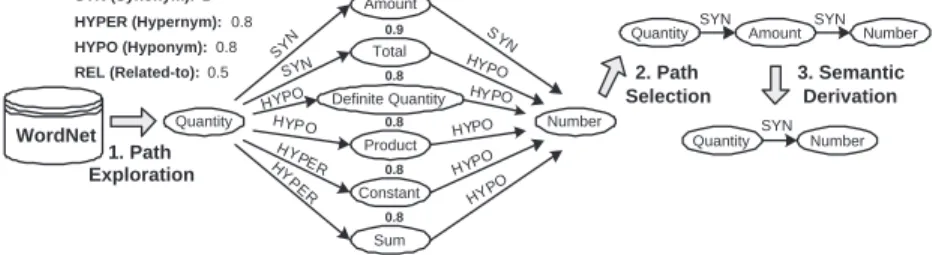
A thesaurus-based schema matching approach has been devised for peer-to-peer data integration [24]; this approach consists of the following three steps (as illustrated in Figure 7):
1. Path Exploration. Among the semantic relations between synsets
in WordNet, we choose those of synonymy, hyponymy/hypernymy (i.e., more specific/more general), and related-to, when enumerating the paths between two arbitrary concepts from different local ontologies in peers. As shown in Figure 7, six paths are found from Quantity toNumber.
2. Path Selection. When multiple paths are found between two
con-cepts, we choose the optimal path, which corresponds to the most likely se-mantic relation between the two concepts. For this purpose, semantic
simi-larities (i.e., the number above each path in the figure) are calculated for all
the paths. The calculation is implemented by assigning different semantic relations with differentweights (e.g., 1 for synonymy and 0.8 for hypernymy) and then taking the average of all the weights. The path with highest sim-ilarity is then chosen as the optimal path. If there is more than one such path, then the user’s intervention is needed.
3. Semantic Derivation. The last step is to derive the (direct)
se-mantic relationship, Sem, between the two concepts by reasoning on the se-mantic relations along the optimal path p between them. More specifically,
Sem(p) =Sem(pn) is computed based on the following recursive algorithm, where pn = (r1, r2, ..., rn), and ri(1≤i≤n) are the edges (semantic relations) along p.
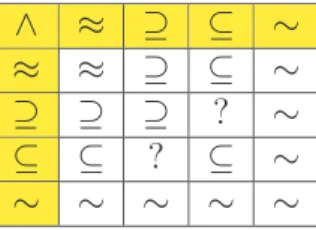
Sem(pn) =Sem(pn−1)∧Sem(rn), if n >1; (1)
Sem(pn) = ≈, ⊇, ⊆, or ∼, if n= 1. (2) In the above formulas, the symbols ≈, ⊇, ⊆, and ∼, respectively stand
SYN (Synonym): 1 HYPER (Hypernym): 0.8 HYPO (Hyponym): 0.8 REL (Related-to): 0.5 Amount Total Definite Quantity Product Constant Sum Quantity Number SY N SYN HYPO HYPO HYPE R HY PER S YN HYPO HYPO HYPO HYPO HYPO 1 0.9 0.8 0.8 0.8 0.8
QuantitySYN Amount SYN Number
Quantity Number SYN 2. Path Selection 3. Semantic Derivation WordNet 1. Path Exploration
for the semantic relation of synonymy, hypernymy, hyponymy, and related-to. The operation ∧ obeys the rules that are shown in Table 1.
∧ ≈ ⊇ ⊆ ∼ ≈ ≈ ⊇ ⊆ ∼
⊇ ⊇ ⊇ ? ∼
⊆ ⊆ ? ⊆ ∼
∼ ∼ ∼ ∼ ∼
Table 1: Inference rules for semantic relations: a white cell (at the intersec-tion of each pair of grey cells) contains the result of the operaintersec-tion on the relations in the two grey cells, and a question mark indicates that human intervention is needed.
6
Conclusions
The advent of XML has created a syntactic platform for Web data stan-dardization and exchange. However, XML has several problems. First of all, documents expressed in XML share the same syntax, but can be other-wise heterogeneous, for example by having different structures and naming conventions. Also, an XML document does not express the semantics of the elements or of the relationships among elements explicitly. Therefore, it is not a suitable language for metadata representation.
Ontologies provide an explicit and formal specification of a shared concep-tualization, and are able to facilitate knowledge sharing and reuse. We use ontologies expressed in RDFS, a semantically rich schema language, to bridge across syntactic, schematic, and semantic heterogeneities in data sources.
In this paper, we have presented five different case studies that illustrate the role that ontologies play in the process of data integration, in centralized and peer-to-peer architectures.
Related research includes research on ontology generation, ontology map-ping, and ontology evolution. An ontology can be generated manually using an authoring tool or (semi-)automatically from various knowledge sources (e.g., database schemas). Techniques used for ontology mapping, including ontology alignment and ontology merging [20, 8], overlap to a large extent with those techniques for schema matching [21]. Finally, ontology evolution, also called ontology versioning, involves changes on representation, structure,
and semantics of ontologies. Each step of such an evolution must ensure the consistency between the old version and the improved version of the ontol-ogy, just as if a database schema’s evolution must guarantee the consistency of the new schema with the data.
References
[1] B. Amann, C. Beeri, I. Fundulaki, and M. Scholl. Ontology-Based Inte-gration of XML Web Resources. In Proceedings of the 1st International
Semantic Web Conference (ISWC 2002), pages 117–131, 2002.
[2] M. Arenas, V. Kantere, A. Kementsietsidis, I. Kiringa, R. J. Miller, and J. Mylopoulos. The Hyperion Project: From Data Integration to Data Coordination. SIGMOD Record, 32(3):53–38, 2003.
[3] Y. Arens, C. A. Knoblock, and C. Hsu. Query Processing in the SIMS Information Mediator. In The AAAI Press, May 1996.
[4] S. Bergamaschi, F. Guerra, and M. Vincini. A Peer-to-Peer Informa-tion System for the Semantic Web. In Proceedings of the International
Workshop on Agents and Peer-to-Peer Computing (AP2PC 2003), July
2003.
[5] P. A. Bernstein, F. Giunchiglia, A. Kementsietsidis, J. Mylopoulos, L. Serafini, and I. Zaihrayeu. Data Management for Peer-to-Peer Com-puting: A Vision. In WebDB 2002, pages 89–94, 2002.
[6] Y. A. Bishr. Overcoming the semantic and other barriers to GIS inter-operability. International Journal of Geographical Information Science, 12(4):229–314, 1998.
[7] S. D. Camillo, C. A. Heuser, and R. dos Santos Mello. Querying Hetero-geneous XML Sources through a Conceptual Schema. In Proceedings of
the 22nd International Conference on Conceptual Modeling (ER 2003),
pages 186–199, 2003.
[8] I. F. Cruz, W. Sunna, and A. Chaudhry. Semi-Automatic Ontology Alignment for Geospatial Data Integration. In GIScience 2004, LNCS, pages 51–66. Springer Verlag, 2004.
[9] I. F. Cruz and H. Xiao. Using a Layered Approach for Interoperability on the Semantic Web. InProceedings of the 4th International Conference
on Web Information Systems Engineering (WISE 2003), pages 221–232,
Rome, Italy, December 2003.
[10] I. F. Cruz, H. Xiao, and F. Hsu. An Ontology-based Framework for Se-mantic Interoperability between XML Sources. InProceedings of the 8th International Database Engineering & Applications Symposium (IDEAS
2004), pages 217–226, July 2004.
[11] I. F. Cruz, H. Xiao, and F. Hsu. Peer-to-Peer Semantic Integration of XML and RDF Data Sources. In The 3rd International Workshop on
Agents and Peer-to-Peer Computing (AP2PC 2004), July 2004.
[12] S. Decker, S. Melnik, F. van Harmelen, D. Fensel, M. C. A. Klein, J. Broekstra, M. Erdmann, and I. Horrocks. The Semantic Web: The Roles of XML and RDF. IEEE Internet Computing, 4(5):63–74, 2000. [13] T. R. Gruber. A Translation Approach to Portable Ontology
Specifica-tions. Knowledge Acquisition, 5(2):199–220, 1993.
[14] T. R. Gruber and G. R. Olsen. An Ontology for Engineering Mathe-matics. InProceedings of the 4th International Conference on Principles
of Knowledge Representation and Reasoning (KR 1994), pages 258–269,
1994.
[15] N. Guarino. Formal Ontology and Information Systems. In Proceedings of the 1st International Conference on Formal Ontologies in Information
Systems (FOIS 1998), pages 3–15, 1998.
[16] A. Y. Halevy, Z. G. Ives, P. Mork, and I. Tatarinov. Piazza: Data Man-agement Infrastructure for Semantic Web Applications. In Proceedings
of the 12th International World Wide Web Conference (WWW 2003),
pages 556–567, 2003.
[17] M. Lenzerini. Data Integration: A Theoretical Perspective. In Pro-ceedings of the 21st ACM SIGACT-SIGMOD-SIGART Symposium on
Principles of Database Systems (PODS 2002), pages 233–246, Madison,
[18] E. Mena, V. Kashyap, A. P. Sheth, and A. Illarramendi. OBSERVER: An Approach for Query Processing in Global Information Systems based on Interoperation across Pre-existing Ontologies. In Proceedings of the 1st IFCIS International Conference on Cooperative Information Systems
(CoopIS 1996), pages 14–25, 1996.
[19] W. S. Ng, B. C. Ooi, K. L. Tan, and A. Zhou. PeerDB: A P2P-based System for Distributed Data Sharing. In Proceedings of the 19th
Inter-national Conference on Data Engineering (ICDE 2003), pages 633–644,
2003.
[20] N. F. Noy and M. A. Musen. PROMPT: Algorithm and Tool for Au-tomated Ontology Merging and Alignment. In Proceedings of the 17th National Conference on Artificial Intelligence and 12th Conference on
Innovative Applications of Artificial Intelligence (AAAI/IAAI 2000),
pages 450–455, 2000.
[21] E. Rahm and P. A. Bernstein. A Survey of Approaches to Automatic Schema Matching. VLDB J., 10(4):334–350, 2001.
[22] J. D. Ullman. Information Integration Using Logical Views. In Proceed-ings of the 6th International Conference on Database Theory (ICDT
1997), pages 19–40, 1997.
[23] H. Wache, T. V¨ogele, U. Visser, H. Stuckenschmidt, G. Schuster, H. Neumann, and S. H¨ubner. Ontology-Based Integration of Informa-tion - A Survey of Existing Approaches. In Proceedings of the IJCAI-01
Workshop on Ontologies and Information Sharing, 2001.
[24] H. Xiao and I. F. Cruz. RDF-based Metadata Management in Peer-to-Peer Systems. In The 2nd IST Workshop on Metadata Management in
Grid and P2P System (MMGPS 2004), 2004.
[25] H. Xiao, I. F. Cruz, and F. Hsu. Semantic Mappings for the Integration of XML and RDF Sources. InWorkshop on Information Integration on