Wright State University Wright State University
CORE Scholar
CORE Scholar
Browse all Theses and Dissertations Theses and Dissertations
2015
Ontology Pattern-Based Data Integration
Ontology Pattern-Based Data Integration
Adila Alfa KrisnadhiWright State University
Follow this and additional works at: https://corescholar.libraries.wright.edu/etd_all Part of the Computer Engineering Commons, and the Computer Sciences Commons
Repository Citation Repository Citation
Krisnadhi, Adila Alfa, "Ontology Pattern-Based Data Integration" (2015). Browse all Theses and Dissertations. 1632.
https://corescholar.libraries.wright.edu/etd_all/1632
This Dissertation is brought to you for free and open access by the Theses and Dissertations at CORE Scholar. It has been accepted for inclusion in Browse all Theses and Dissertations by an authorized administrator of CORE Scholar. For more information, please contact [email protected].
Ontology Pattern-Based Data Integration
A dissertation submitted in partial fulfilment of the requirements for the degree of
Doctor of Philosophy
By
ADILA ALFA KRISNADHI S.Kom., Universitas Indonesia, 2002 M.Sc., Technische Universit¨at Dresden, 2007
2015
Wright State University Dayton, Ohio, USA
WRIGHT STATE UNIVERSITY SCHOOL OF GRADUATE STUDIES
December 18, 2015 I HEREBY RECOMMEND THAT THE DISSERTATION REPARED UNDER MY SUPERVISION BY Adila Alfa Krisnadhi ENTITLED Ontology Pattern-Based
Data Integration BE ACCEPTED IN PARTIAL FULFILLMENT OF THE
REQUIREMENTS FOR THE DEGREE OF Doctor of Philosophy.
Pascal Hitzler, Ph.D. Dissertation Director
Michael L. Raymer, Ph.D.
Director, Computer Science and Engi-neering PhD Program
Robert E.W. Fyffe, Ph.D.
Vice President of University Research and Dean of Graduate School
Committee on Final Examination Pascal Hitzler, Ph.D Krzysztof Janowicz, Ph.D Krishnaprasad Thirunarayan, Ph.D Michelle A. Cheatham, Ph.D.
ABSTRACT
Krisnadhi, Adila Alfa. Ph.D. Department of Computer Science and Engineering, Wright State University, 2015. Ontology Pattern-Based Data Integration.
Data integration is concerned with providing a unified access to data residing at multiple sources. Such a unified access is realized by having a global schema and a set of mappings between the global schema and the local schemas of each data source, which specify how user queries at the global schema can be translated into queries at the local schemas. Data sources are typically developed and maintained independently, and thus, highly heterogeneous. This causes difficulties in integration because of the lack of interoperability in the aspect of architecture, data format, as well as syntax and semantics of the data.
This dissertation represents a study on how small, self-contained ontologies, called ontology design patterns, can be employed to provide semantic interoperability in a cross-repository data integration system. The idea of this so-called ontology pattern-based data integration is that a collection of ontology design patterns can act as the global schema that still contains sufficient semantics, but is also flexible and simple enough to be used by linked data providers. On the one side, this differs from existing ontology-based solutions, which are based on large, monolithic ontologies that provide very rich semantics, but enforce too restrictive ontological choices, hence are shunned by many data providers. On the other side, this also differs from the purely linked data based solutions, which do offer simplicity and flexibility in data publishing, but too little in terms of semantic interoperability.
We demonstrate the feasibility of this idea through the actual development of a large scale data integration project involving seven ocean science data repositories
from five institutions in the U.S. In addition, we make two contributions as part of this dissertation work, which also play crucial roles in the aforementioned data integration project. First, we develop a collection of more than a dozen ontology design patterns that capture the key notions in the ocean science occurring in the participating data repositories. These patterns contain axiomatization of the key notions and were developed with an intensive involvement from the domain experts. Modeling of the patterns was done in a systematic workflow to ensure modularity, reusability, and flexibility of the whole pattern collection. Second, we propose the so-called pattern views that allow data providers to publish their data in very simple intermediate schema and show that they can greatly assist data providers to publish their data without requiring a thorough understanding of the axiomatization of the patterns.
Contents
1 Introduction 1
1.1 Semantic Web and Data Integration. . . 1
1.2 Research Questions . . . 6
1.3 Dissertation Overview . . . 10
2 Semantic Web and Ontology Languages 12 2.1 The Web . . . 12
2.2 Semantic Web . . . 15
2.2.1 Data Interchange Layer. . . 16
2.2.2 Query Language: SPARQL . . . 19
2.3 Ontology Languages . . . 20
2.3.1 RDF Schema (RDFS) . . . 21
2.3.2 The Web Ontology Language (OWL) . . . 24
2.3.3 Datalog . . . 31
3 Data Integration 34 3.1 Data Integration in Databases . . . 34
3.1.1 Formal Definition of Data Integration . . . 34
3.1.2 Architecture of Data Integration Systems . . . 37
3.2 Ontology-based Data Integration . . . 40
3.3 Linked Data Integration . . . 47
4.1 Ontology Design Patterns . . . 50
4.1.1 General Definition . . . 50
4.1.2 Content Patterns . . . 54
4.2 Collection of Content Patterns for Global Schema . . . 56
4.3 Application Context: Oceanography Data Integration . . . 59
4.4 Collaborative Modeling Approach . . . 60
4.4.1 The Modeling Workflow . . . 60
4.4.2 Graphical Notation . . . 63
4.5 Selected Modeling Details . . . 64
4.5.1 Person . . . 65 4.5.2 Agent Role . . . 67 4.5.3 Cruise . . . 69 4.6 Discussion . . . 81 5 Pattern Views 86 5.1 Introduction . . . 86 5.2 Consumer View . . . 89 5.3 Producer View . . . 96
5.4 Expressing the Mapping in OWL and SPARQL . . . 100
5.5 Views for GeoLink Patterns . . . 103
5.6 Discussion . . . 105
6 Evaluation 107 6.1 Qualitative Evaluation: Rationale . . . 107
6.2 Data Collection Procedures . . . 108
6.3 Questions . . . 109
6.4 Participants’ Responses. . . 111
7 Conclusion 120
7.1 Summary . . . 120
7.1.1 Ontology Pattern-based Data Integration Framework . . . 120
7.1.2 Content Patterns for Ocean Science . . . 121
7.1.3 Pattern Views . . . 122
7.2 Future Work. . . 123
A GeoLink Pattern Collection 125 A.1 Agent . . . 126
A.1.1 Description . . . 126
A.1.2 Axiomatization . . . 126
A.1.3 Alignment Axioms . . . 126
A.2 Agent Role . . . 128
A.2.1 Description . . . 128 A.2.2 Axiomatization . . . 128 A.2.3 Alignment . . . 129 A.3 Event . . . 132 A.3.1 Description . . . 132 A.3.2 Axiomatization . . . 133 A.3.3 Alignment . . . 135 A.4 Person . . . 138 A.4.1 Description . . . 138 A.4.2 Axiomatization . . . 138 A.4.3 Alignment . . . 139
A.5 Personal Info Item . . . 141
A.5.1 Description . . . 141
A.5.3 Alignment . . . 143
A.6 Person Name . . . 145
A.6.1 Description . . . 145 A.6.2 Axiomatization . . . 145 A.6.3 Alignment . . . 147 A.7 Identifier . . . 149 A.7.1 Description . . . 149 A.7.2 Axiomatization . . . 149
A.8 Information Object . . . 151
A.8.1 Description . . . 151 A.8.2 Axiomatization . . . 152 A.8.3 Alignment . . . 154 A.9 Organization . . . 155 A.9.1 Description . . . 155 A.9.2 Axiomatization . . . 156 A.9.3 Alignment . . . 158
A.10 Funding Award . . . 162
A.10.1 Description . . . 162 A.10.2 Axiomatization . . . 163 A.10.3 Alignment . . . 165 A.11 Program . . . 168 A.11.1 Description . . . 168 A.11.2 Axiomatization . . . 169 A.11.3 Alignment . . . 170 A.12 Place . . . 173 A.12.1 Description . . . 173 A.12.2 Axiomatization . . . 173
A.12.3 Alignment . . . 174
A.13 Cruise . . . 176
A.13.1 Description . . . 176
A.13.2 Specific Vocabulary for Cruise . . . 177
A.13.3 Axiomatization . . . 178
A.13.4 Alignment . . . 185
A.14 Platform Pattern . . . 192
A.14.1 Description . . . 192
A.14.2 Axiomatization . . . 192
A.14.3 Alignment . . . 193
A.15 Vessel pattern . . . 194
A.15.1 Description . . . 194
A.15.2 Specific Nomenclature for Vessel pattern . . . 195
A.15.3 Axiomatization . . . 195
A.15.4 Alignment . . . 196
List of Figures
2.1 Semantic Web Layer Cake. (Original image from http://www.w3.org/
2001/sw/layerCake.png) . . . 16
2.2 RDF triples about the state of Ohio in XML. . . 19
2.3 RDF triples about the state of Ohio in N-Triple format. . . 19
2.4 RDF triples about the state of Ohio in Turtle format. . . 20
2.5 RDFS axiomatic triples for rdfs:domain, rdfs:range, rdfs:subPropertyOf, and rdfs:subClassOf, expressed in Turtle for-mat. . . 22
3.1 Data Integration Architecture (this author’s version of Doan et al.’s Fig. 1.4 [42]). The arrows refer to the direction of data flow. . . 38
3.2 Three ways ontologies are used in OBDI (this author’s version of Wache et al.’s Fig. 1[133]). Regular arrows indicate where vocabulary is used. Dotted arrows indicate mapping direction. . . 42
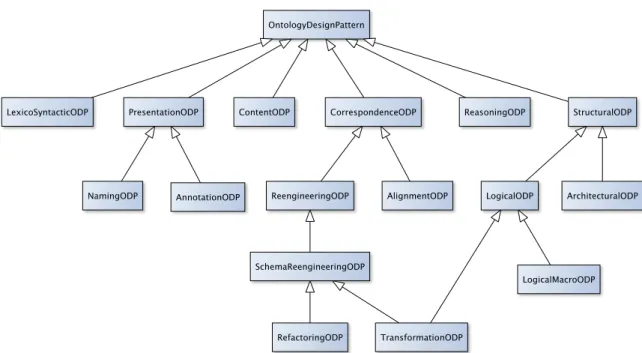
4.1 Different kinds of ontology design patterns . . . 53
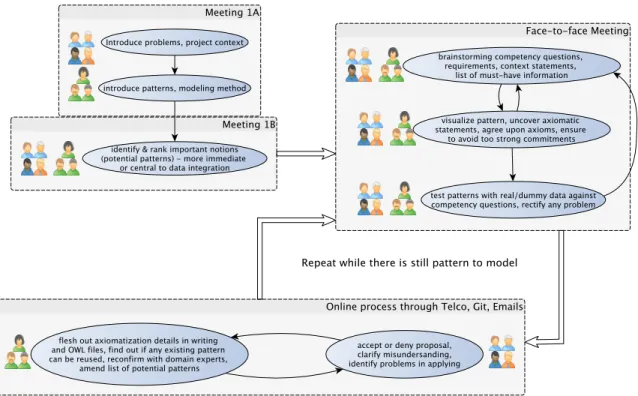
4.2 Modeling Approach . . . 61
4.3 Graphical Notation for a pattern . . . 64
4.4 Person pattern . . . 66
4.5 The Agent Role pattern . . . 68
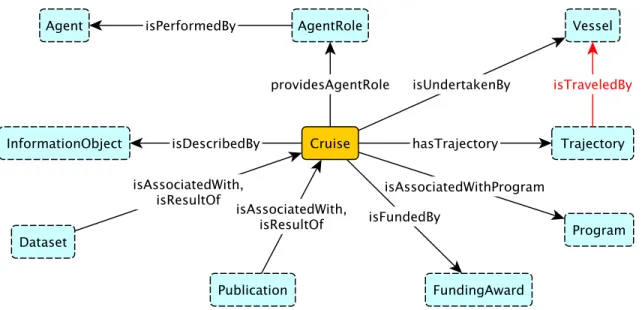
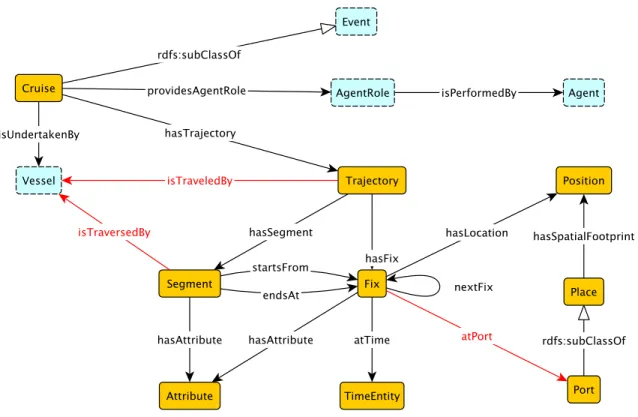
4.6 Overview of the Cruise pattern; the red arrow indicates a property implied by a property chain. . . 72
5.1 Dataset A: two simple RDF triples . . . 87
5.2 Dataset B: data conforming to the pattern in Fig. 5.3 . . . 87
5.3 Pattern O used by Dataset B – mixed turtle and DL syntax are used. . . 88
5.4 Possible schema V for Dataset A, that is also a view for Oin Fig. 5.3 . . 88
5.5 The red-colored, dotted line is a shortcut in the pattern, and correspond to the property hasWhitePlayerName. . . 90
5.6 Example of data based on GeoLink view . . . 103
5.7 View expansion example with CONSTRUCT statement applied to triples in Fig. 5.6. For simplicity, patterns are assumed to reside in the default namespace. . . 104
A.1 The Agent pattern . . . 126
A.2 Alignment of Agent to Agent Role . . . 127
A.3 The Agent Role pattern . . . 128
A.4 Agent Role aligned to Agent . . . 130
A.5 Agent Role aligned to OWL Time . . . 131
A.6 Event pattern . . . 132
A.7 Event aligned to Agent . . . 135
A.8 Event aligned to Agent Role . . . 136
A.9 Event aligned to Place . . . 136
A.10 Event aligned to OWL Time . . . 137
A.11 The Person pattern . . . 138
A.12 Person aligned with Agent . . . 139
A.13 Person aligned with Personal Info Item . . . 139
A.14 The Personal Info Item pattern . . . 141
A.15 Personal Info Item pattern aligned to Person pattern . . . 144
A.16 Personal Info Item pattern aligned to OWL Time ontology . . . 144
A.18 Person Name pattern aligned to Personal Info Item pattern. . . 147
A.19 Person Name pattern aligned to Personal Info Item pattern. . . 148
A.20 Identifier pattern . . . 149
A.21 Information Object pattern . . . 151
A.22 Information Object pattern aligned with Identifier pattern . . . 154
A.23 The Organization pattern . . . 155
A.24 The Organization pattern aligned to Agent pattern . . . 159
A.25 The Organization pattern aligned to Agent Role pattern . . . 159
A.26 The Organization pattern aligned to Person pattern . . . 160
A.27 The Organization pattern aligned to Information Object pattern . . . 161
A.28 The Funding Award pattern . . . 162
A.29 The Funding Award pattern aligned to Agent pattern . . . 165
A.30 The Funding Award pattern aligned with Agent Role pattern . . . 166
A.31 The Funding Award pattern aligned with Information Object pattern . . 167
A.32 The Funding Award pattern aligned with OWL Time . . . 167
A.33 The Program pattern . . . 168
A.34 The Program pattern aligned to Agent pattern . . . 171
A.35 The Program pattern aligned to Agent Role pattern. . . 171
A.36 The Program pattern aligned to Information Object pattern . . . 172
A.37 The Program pattern aligned to OWL Time . . . 172
A.38 The Place pattern stub . . . 173
A.39 The Place pattern stub aligned with Information Object pattern . . . 174
A.40 The Place pattern stub aligned with GeoSPARQL ontology. . . 175
A.41 The Cruise pattern overview . . . 176
A.42 The Cruise as Events: Trajectory and Agent Roles . . . 176
A.43 Cruise types . . . 177
A.45 Attributes for fixes in a cruise trajectory . . . 178
A.46 The Cruise micro-ontology alignment with Agent pattern . . . 185
A.47 The Cruise micro-ontology alignment with Agent Role pattern . . . 186
A.48 The Cruise pattern alignment with Event pattern . . . 187
A.49 The Cruise pattern alignment with Funding Award pattern . . . 188
A.50 The Cruise pattern alignment with Information Object pattern . . . 189
A.51 The Cruise pattern alignment with OWL Time ontology . . . 189
A.52 The Cruise pattern alignment with Place pattern . . . 190
A.53 The Cruise pattern alignment with Program pattern . . . 191
A.54 The Cruise pattern alignment with Vessel pattern . . . 191
A.55 Platform pattern . . . 192
A.56 The Platform pattern alignment with Information Object pattern . . . . 193
A.57 Vessel pattern . . . 194
A.58 Vessel property . . . 195
A.59 Vessel agent roles . . . 195
A.60 The Vessel pattern alignment with Agent pattern . . . 197
A.61 The Vessel pattern alignment with Agent Role pattern . . . 198
A.62 The Vessel pattern alignment with Information Object pattern . . . 198
A.63 The Vessel pattern alignment with OWL Time ontology . . . 199
List of Tables
2.1 OWL Notation for Class Expression . . . 27 2.2 OWL Axioms . . . 28
Acknowledgements
Alhamdulillah. All praises are due to Allah, the Lord of the Universe, the Most Compassionate, and the Most Merciful. He showered me with His countless blessings due to which I was able to complete this dissertation work.
Throughout my doctoral study, I have been very fortunate to receive support from many great people. First and foremost, I would like to extend my heartfelt gratitude to Dr. Pascal Hitzler who has been both a great advisor and mentor in study, research, and life. Finishing this dissertation work would have been impossible without his numerous suggestions, constructive critiques, and recommendations. Sessions with him were almost always about throwing ideas at each other, which I would fondly cherish all my life.
I would like to express my special appreciation to members of my dissertation com-mittee, Dr. Krzysztof Janowicz, Dr. Khrisnaprasad Thirunarayan, and Dr. Michelle Cheatham, for their valuable comments and suggestions to improve this dissertation work. A special mention goes to Dr. Krzysztof Janowicz for the invaluable discus-sions on Skype as well as during several occasion we were able to meet offline. A significant amount of ideas in this dissertation were inspired by those discussions.
My family has always been one of the key pillar of support in my life. My wife, Tuntas Margi Hartini, has been there for me both in my happiest and my most difficult moments. I could never count all the love, the prayers, the smiles, the kindness, and all other big and little things she did and keeps on doing for me, not just during the years of my doctoral study, but also the years before that, and hopefully, throughout the rest of my life. I am immensely grateful to my mother, Dyah Pamularsih, and
my father, Imam Soegito, also to my two brothers, Andika and Aditya, for their unconditional love, prayers, and support. I am also thankful for the support from the rest of extended family.
I would like to thank my colleagues at the Data Semantics Lab and the CSE Department of Wright State University for their support. I am also grateful with the support and encouragement from my Indonesian friends in Dayton and Columbus area. I also appreciate the support of the Faculty of Computer Science, Universitas Indonesia, with a special mention to Dr. Wisnu Jatmiko for his invaluable advice.
I owe a great deal to colleagues at the GeoLink project because this dissertation work relies critically on the application context and practical experience provided by the project. The GeoLink patterns would not have been realized without the intense collaborative effort expended by all of the project partners at the Woods Hole Oceanographic Institution, the Lamont-Doherty Earth Obsevatory at Columbia University, Marymount University, University of California Santa Barbara, and Con-sortium for Ocean Leadership. In particular, I would like to mention Adam Shepherd, Tom Narock, and Robert Arko for squeezing some spare time in their busy schedule to help me with the evaluation of the ideas of this dissertation.
My doctoral study has been funded by generous funding from several sources: Wright State University through the tuition waiver and various travel support; the US State Department and the Indonesian government through the Fulbright Indonesian Presidential Scholarship 2010-2013; and the US National Science Foundation (NSF) through the three projects, namely the NSF Project 1017225 “III: Small: TROn – Tractable Reasoning with Ontologies”, the NSF Award 1354778 “EAGER: Collabo-rative Research: EarthCube Building Blocks, Leveraging Semantics and Linked Data for Geoscience Data Sharing and Discovery”, and the NSF Award 1440202 “Earth-Cube Building Blocks: Collaborative Proposal: GeoLinkLeveraging Semantics, and Linked Data for Data Sharing and Discovery in the Geosciences”.
1
Introduction
1.1
Semantic Web and Data Integration
In their paper published almost fifteen years ago [12], Berners-Lee et al. argued that most of the Web content is intended for human consumption and unsuitable for machines to manipulate meaningfully. That is, there is no way for a machine to reliably understand that a particular web address is actually the homepage of a particular person, or a given hyperlink points to that person’s curriculum vitae. Their vision was to extend the Web into a form they call the Semantic Web where any piece of information available in it is equipped with a well-defined description of their meaning orsemantics, and thus, can be understood by machines without the need of a human involvement in interpreting the information. This would pave the way for machines to carry out more sophisticated tasks without needing a very high level of artificial intelligence.
Since Semantic Web is an extension of the Web, it retains its decentralized nature. Every information source can publish whatever information however the want. No single, overarching, global, centralized authority would be capable of managing all possible information sources on the Web. Nor would it be possible to force every information source to conform to such a centralized authority. Unsurprisingly, this gives rise to an extreme heterogeneity, even when every information source provides formal description explaining the semantics of the information it publishes. On the other hand, satisfying information needs of the users, be it a human or a machine, often requires combining information from multiple sources. In such a situation,
rather than expressing the information need directly at each information source, which may require the information need to be translated into a form that is suitable to the schema and constraints and the information source, users would of course benefit from an extra layer of abstraction that contains a unified view over the data and hides the translation from them.
The problem of providing users with a unified view over data residing in multiple data sources as illustrated above is not something that only became known when Semantic Web was coined. Traditionally, this problem is calleddata integration and it was originally studied in relational database [89]. Applications of data integration first emerged in the context of enterprise information systems [30, 62], which often have to deal with data scattered across multiple databases – a situation that can easily occur in a large enterprise. In recent years, however, data integration needs have appeared in a wide range of application domains beyond the context of enterprise information systems, for example, in life sciences [53], geosciences [104], life cycle analysis [38, 60], government sector [75], e-commerce [86], and many others.
In a data integration system, the unified view to the users is provided by a global schemadefined in a particular vocabulary using which users express queries about the data. Meanwhile, each data source involved in the integration is defined according to its own local schema, which is hidden from the users and may employ a different vocabulary from the global schema vocabulary. The integration is carried out through a set of mappings between the global and local schema, which allow the system to translate the query from a user into queries over each data source. These data sources may of course be located in separate geographical locations and belong to different organizations, and furthermore, might have been designed, developed, and maintained independently according to locally defined constraints from established business processes or organizational policies.
challenges [42, Section 1.2]. The first kind of challenges have to do with the lack of syntactic and architectural interoperability between the systems involved in a data integration effort. This lack of interoperability may be caused by differences in data formats, software and hardware constraints, access protocol, and query processing capabilities. Even when all the systems run on the same hardware platform and com-ply with the same data access standard, problems may still happen due to differences in local, vendor-specific software configurations.
The second kind of challenge concerns the structural and semantic heterogeneity in the data. More precisely, since each data source is independently developed and maintained, it is almost unavoidable that the schema developed for a particular data source would be different from schemas from the other data sources. The differences may lie in the use of distinct vocabularies, different levels of granularity in modeling the data, or conflicting conceptualization.
Meanwhile, the third kind of challenge is non-technical, and usually boils down to inability or unwillingness of the data owners to participate in a data integration effort. There are many reasons for this problem. For example, data owners may be unable to participate because their data sources simply do not possess relevant data required by the integration effort. Data owners may also be unwilling to participate because of the fear of unanticipated costs, the aversion toward data sharing, the reluctance to commit resources to make the integration happen, the worry that participating in the integration may entail major changes in the established management practices and policies, and the skepticism about the scalability of the integration itself [122]. Note that non-technical nature of these challenges, they are often no less hard than the technical challenges. Furthermore, they can also be caused by the inherent technical difficulties of realizing the data integration.
Those three challenges are exacerbated if we consider large scale (or even, Web-scale) integration involving a big and very diverse community of stakeholders in which
dozens of data sources have been established, a multitude of institutions are involved and no single stakeholder holds the sole authority over the whole community. De-velopment of a data integration solution for such a community cannot be done in top-down manner. Rather, a more natural way is to start small, i.e., by working with a small part of the community, and then gradually include more stakeholders over time. The desired solution not only needs to be effective, i.e., it works according to its intended purpose for data integration, but also flexible and easily extendible. Flexible here means that data sources still retain a high degree of independence both in technical and non-technical aspects. For example, this implies that data sources do not have to make drastic changes in their local schema design, nor do they have to significantly alter their established business processes just to participate in the data integration. Extendible means that joining (and also, leaving) the data integration does not necessitate costly changes to the whole framework.
Fortunately, Semantic Web offers some ingredient technologies, which we can use to push us toward overcoming the aforementioned challenges if one were to develop a data integration solution. In fact, although Berners-Lee et al. did not mention data integration explicitly in their paper [12], they alluded to it through the emphasis on linking data and the use of ontologies. The former corresponds to the Resource Description Framework (RDF) which became World Wide Web Consortium (W3C) standards [39,76,88], and today, it forms a core part of a suite of technology standards called Linked Data [13]. This suite not only contains standard syntax formats for data publishing, but also adopts the simplicity of HTTP1-based architecture and triple-based graph data model. Development of various software solutions, tools, and APIs around this technology suite in the last decade has allowed virtually everyone to publish data according to the Linked Data architecture relatively easily. All of these simplify the issue regarding the lack of syntactic and architectural interoperablity.
Meanwhile, the more challenging problem is concerned with semantic heterogene-ity. Even prior to the emergence of Semantic Web, ontology has been considered as a potential solution in addressing semantic heterogeneity problem. In data integration, ontologies play a role of global (and possibly, local) schema by formally defining vo-cabulary terms used by the application at hand. Since ontologies are designed with the purpose of knowledge sharing and improving semantic interoperability, it has been considered superior than relational database schema in dealing with semantic hetero-geneity. This motivated extensive research in ontology-based data integration [99, 125, 133]. In the beginning, there was a somewhat tacit understanding that generic, extensively axiomatized, monolithic, foundational ontologies would serve the need of an ontology-based system in the Semantic Web better [101, Chapter 3]. However, later research trends in Semantic Web appeared to move away from the focus on such monolithic ontologies toward Linked Data and very lightweight, sometimes semifor-mal, vocabularies [51,72]. Simplicity of Linked Data is very appealing for many data publishers and they do not even need to understand much of the semantics employed by ontology languages. This spurred an explosive growth on the number of linked datasets forming the so-called Web of Data [114].
The aforementioned shift was also fueled by the difficulties in employing founda-tional, monolithic ontologies. Indeed, Oberle already indicated that such ontologies are hard to design both conceptually and computationally, and furthermore, they typically make very specific ontological choices [101]. Unless one is very familiar with the ontologies, such choices may not be easy to understand because they may be buried within the complexity of the axiomatization, and even if they can be under-stood, they may impose too strict ontological commitments, which are not necessarily be accepted by the parties who are supposed to use the ontologies. In the context of cross-repository data integration involving multiple stakeholders, this can lead to an unsurmountable barrier for the success of the integration effort. On the other hand,
as argued by Jain et al., solely relying on Linked Data is not enough because too little schema information also causes problems in understanding and integrating different linked datasets [72].
The above difficulties concerning foundational ontologies motivated the idea of
ontology design patterns (ODPs), which are reusable solutions to some frequently oc-curring ontological modeling problem that emerges in different domains [15,49,109]. ODPs have emerged as a practical solution for engineering complex, foundational ontologies. The main idea is that one can expend less amount of effort in engineering an ontology if one can reuse small building blocks that recurring frequently when mo-deling the notions in the ontology. Furthermore, cognitive barrier in understanding the content of an ontology can be reduced if small, modular, easily understood parts can be identified. Interestingly, the use of ODPs as a basis for a flexible integration framework is hitherto still relatively unexplored. This thesis represents our investiga-tion in this direcinvestiga-tion, building upon earlier results in ontology-based data integrainvestiga-tion, and drawing from practical experience in the NSF2-funded GeoLink project3 (and its predecessor, the OceanLink project), a cross-repository data integration project for ocean science domain, which is part of NSF’s EarthCube program4.
1.2
Research Questions
Our discussion in the previous sections point to the benefits of both ontologies and Linked Data for data integration. However, it is relatively unexplored whether we can build a data integration system that employs both, while avoiding their pitfalls. This motivates the following cardinal research question.
2the U.S. National Science Foundation 3
http://www.geolink.org 4http://www.earthcube.org
Cardinal Research Question. Can we build a linked data integration framework that combines the benefits of both ontologies and Linked Data, while avoiding their pitfalls?
By the benefits of ontologies, we refer to strong, machine readable semantics that provides conceptual clarity and common modeling reference. The benefits of Linked Data refers to the simplicity and flexibility in publishing the data, already in an open and web-friendly way. The pitfalls of ontologies are their undesirable characteristics such as a high barrier for understanding their content, abstractions that are too far from the actual data, overly strict ontological commitments, so rigid that extendibility is impaired, and also, costly engineering effort. Finally, the pitfalls of Linked Data are too little shareable schema information that makes understanding the dataset difficult and causes true integration to be difficult to realize.
The intuition of the cardinal question above is thus a balancing act between two complementary aspects. To arrive at an answer, we can intuitively start from either side. The real bottleneck, however, is the ontology side of the question because we do not have a complete understanding on how to realize a framework that employs ontologies satisfying our desiderata above.
Main Research Question 1 What kind of ontologies are suitable as global schema for cross-repository data integration? Here, most suitable ontologies need to provide conceptual clarity through precise, machine readable semantics, but should not pos-sess undesirable characteristics as mentioned in the cardinal research question. If such kind of ontologies can be identified, how do we best engineer it?
As suggested in the previous section, a hint toward a possible answer to the above question was provided by ontology design patterns (ODPs). ODPs were conceived as building blocks for engineering more complex ontologies, hence they have been mostly used as such. Nevertheless, the versatility of ODPs means that their potential
transcends this original intent. In our case, we see ODPs as the core part of ontology-based linked data integration. One could certainly argue that this is just another case of ontology engineering, but in the literature, modeling of ODPs was rarely specifically intended as the main integrating component. Oberle et al. [102] employed ODPs indirectly for integration, that is, as parts of a foundational ontology with which the actual integration was conceived. Their application examples also did not include data integration, but rather, web service integration. Our proposed research is thus to explore the use of ODPs as the main integrating component leading to the following hypothesis.
Hypothesis 1. Ontology design patterns are suitable to be used as the global schema (i.e., the main integrating component) of a data integration involving hetero-geneous data sources and they bring the benefits of the traditional ontology-based approach while avoid its pitfalls.
We shall proceed by conducting a construction of ODPs for a data integration purpose based on a number of principles that we illustrate in Chapter 4. This con-struction is done in the context of the OceanLink and GeoLink projects, aimed at achieving what we hypothesized above. The result was a set of ODPs employed for an integration of several ocean science data repositories, which participate in the aforementioned projects.
It is generally very difficult to find sensible quantitative measures on the quality of ontologies. Hence as suggested by Oberle [101] who were faced with a similar chal-lenge, a qualitative assessment will be conducted. As part of this assessment process, data providers were asked to publish their data following Linked Data principles and use the ODPs as the basic vocabulary. Setting up a Linked Data repository is the simpler part of this task, and thus, in this thesis, we consider this of secondary
im-portance. The problematic part was establishing the connection between the data and the ODPs. We then study the feedback from the data providers
Feedback from the data providers indicated that application of ODPs still suffer some problems. The most cited one is that abstractions within the ODPs turn out to be still too far from the actual data, and this hinders the effort from the data providers to populate the ODPs with real data. This is formulated as the following research question.
Main Research Question 2. How do we address the gap between the abstraction within ODPs and the local conceptualization on the data providers’ side, so that data publishing can be done by retaining the simplicity and flexibility of Linked Data, retaining the simplicity, while keeping the benefits of semantic interoperability from ODPs?
To address this gap, we introduce the notion of pattern view, which is inspired from the notion of a view in databases. The idea is to create views to bridge the gap of abstraction between the ODPs and the data. This leads to the following secondary hypothesis.
Hypothesis 2. The pattern view can bridge the gap between the abstraction within ODPs and the local conceptualization of data providers such that the semantic in-teroperability of the ODPs as well as simplicity and flexibility of Linked Data are retained.
To test this hypothesis, we will first formulate a more rigorous definition of pattern view, study the connection of pattern view and ODPs, and as above, will again perform qualitative assessment. Moreover, by consolidating our results from verifying the two hypotheses above, we can formulate a principled approach in the use of ODPs for data integration.
1.3
Dissertation Overview
Parts of the work needed to realize our proposed research illustrated in the previous section have been conducted and published in a number of publications. This section summarizes our contribution from the research for this dissertation.
1. We will demonstrate the feasibility of establishing a flexible, cross-repository data integration by employing Linked Data and ODPs. Previous exercises that laid a groundwork for the principles followed by this approach were presented in Krisnadhi et al. [80,82, 83, 84, 85] and Vardeman et al. [126,127].
2. We will present a set of novel ODPs targeted for the ocean science domain that is suitable for data integration in that domain. This contribution has been presented in Krisnadhi et al. [80, 82, 83,84].
3. We will provide a novel definition of pattern views and an analysis on this notion in the context of Linked Data integration with ODPs. An initial effort toward this contribution has been presented in Krisnadhi et al. [81, 85] and Rodr´ıguez-Doncel et al. [112].
The remainder of this thesis thus proceeds as follows. In Chapter2, we provide a background on Semantic Web technologies, as well as ontology languages. For the lat-ter, we provide syntax and semantics of RDFS, OWL, and Datalog/Rule languages, which we use for modeling the ontology patterns. We then proceed to Chapter 3 where we present an overview of data integration problem, discuss how ontology and linked data can play a role in realizing a cross-repository data integration, as well as reveal some of the problems introduced when using them for data integration. This discussion motivates Chapter 4where we present our contribution of using ontology design patterns (ODPs) for data integration with an application on ocean science data repositories, including selected modeling details of the patterns. We also elaborate therein why Hypothesis 1 is partially affirmed. In Chapter5, we examine some of the
issues encountered during our attempt to realize an ODP-based data integration in the preceding chapter, i.e., issues that we need to solve to fully affirm Hypothesis 1, which is captured in Hypothesis 2. Next, we describe pattern view as an idea to solve these issues, thus representing half of Hypothesis 2. Chapter6presents a qualitative evaluation on the use of pattern view as part of ODP-based data integration frame-work. This complete the other half of Hypothesis 2, and by fulfilling Hypothesis 2, we fully verified Hypothesis 1. We then present our conclusion in Chapter7. In addition, this thesis also contains Appendix A in which we include details of all patterns we modeled for the data integration.
2
Semantic Web and Ontology
Languages
2.1
The Web
When Tim Berners-Lee proposed the (World Wide) Web in 1989, he intended it to be a kind of gigantic information system, which can act as a medium in which people and machines could communicate and shareany kind of information [10]. There were six criteria he suggested that the Web should be based on. The first was that in the Web, anyone should be able to link any object to any other object. This naturally would go beyond any kind of database systems since such systems would impose restrictions on the kind of associations one can make between particular objects. Secondly, it should be possible to create links between any two independent parts of the Web incrementally without resorting to expensive operations such as database merging. Third, using the Web should not be constrained on particular operating systems. Fourth, any information available on the Web should never be limited to particular platforms. Furthermore, future platforms should not be excluded in this regard. Fifth, how users model data on the Web mentally should not be restricted to a particular pattern. Finally, adding and modifying information on the Web should be easy to do by the user who is directly knowledgeable with it. These design criteria led to an architecture that was very generic, simple, flexible, and usable across the Internet. The architecture essentially consists of Uniform Resource Identifier (URI) and Hypertext Transfer Protocol (HTTP) as its basic components.
URI, URL, URN, and IRI
Any object that lives on the Web is called a resource. The design criteria of the web architecture places a lot of emphasis on links between resources. The first and main web resource format is hypertext, i.e., text that contains links to other web resources. Obviously, a link would need a way to say which object does it point to. This is achieved through a Uniform Resource Identifier (URI)1. A URI is simply a string that is used as an identifier of a resource on the Web. The syntax conforms to the following grammar as specified in RFC 3986 [11]:
URI = scheme ’:’ hier-part [ ’?’ query ] [ ’#’ fragment ]
For example, http://dase.cs.wright.edu/people/Adila-Krisnadhi is a URI identi-fying my webpage within the Data Semantics Lab’s website.
A URI can serve dual purposes. First, it can serve as a name of a resource in which case, it would be interpreted as aUniform Resource Name (URN). The second interpretation is that a URI also indicates the location of a resource. In this case, a URI is interpreted as aUniform Resource Locator (URL). Since a URI may indicate a location, it can be dereferenced or resolved, though the Web Architecture does not require every URI to be dereferenceable. That is, a resource can contain a link to another resource without providing a guarantee that the linked resource exists. In fact, each URI is treated as an opaque string and nothing about the object it references can be inferred solely using that string. Also, there is no guarantee of uniqueness with regards to an object’s URI. That is, it is possible that multiple URIs to refer to the same resource. Finally, it was later realized that URI, as defined in the standard, cannot be written using characters outside of US-ASCII character set, so it was generalized intoInternationalized Resource Identifier (IRI) whose only difference 1The letter ’U’ in URI, URN, and URL used to stand for ’Universal’, though nowadays both
with URI is the use of the UCS2, hence allowing one to use, e.g., Chinese characters to create an identifier [43]. The term ’URI’ though remains ubiquitous, and except in very special circumstances, when people talk about URI, they really mean IRI, i.e., the generalized form. Throughout this thesis, we also take this position and use the term ’URI’ to mean IRI.
HTTP
The HyperText Transfer Protocol (HTTP) [45] is a stateless data transfer protocol that allows a client (e.g., a web browser) to request a hypertext resource to a server and the server to respond to that request appropriately. The requested resource is identified by its URI, and HTTP specifies how it should be resolved. HTTP is particularly efficient in handling requests for hypertext resources, hence allowing for speedy traversal of links.
Web of Documents
The Web owes its success to the simplicity of architecture. Consuming information on the Web is easy: a user can simply run a web browser with a URI as an input, and a web resource is opened (assuming the URI is resolvable, of course). In a typical situation, the web resource is a hypertext document, marked-up using a standard mark-up language such as HTML3, which will be readily displayed by the browser. Navigating the links is now as simple as clicking the link and the browser will proceed by requesting the referenced resource to some appropriate web server and again, display it as soon as it receives a successful response. At the other end, publishing a hypertext document on the Web is also fairly easy and cheap. A basic HTML page is quite simple to create and plethora of tools are available to assist anyone creates a 2Universal Coded Character Set, colloquially known as Unicode. The latest version of the
standard is ISO/IEC 10646 [70]
hypertext document. One then only needs to put the document at a web server and makes it accessible with an appropriate URI. The ease of publishing and consuming web resources were in fact demonstrated by Tim Berners-Lee himself: when he put out the proposal for the World Wide Web, he immediately followed it with writing the first Web browser, Web server, and a Web page [37]. Together with openness of the technical standards underlying the Web, all of these spur countless innovations and explosive growth of the Web.
Nevertheless, a significant amount of information presentation on the Web is geared toward human consumption. Major Web standards such as HTML, CSS4, and JavaScript5 emphasize aspects concerning readability for human, human user expe-rience, and responsiveness to human interaction. Human-centric perspective implies that information are mostly organized into hypertext, or more generally, hypermedia documents, and the linking between them led to so-called Web of Documents. The problem with Web of Documents is that although a document does contain some degree of structure – some may even be quite well-structured, the data that may actually describe what the document is all about are most likely intermixed with text intended for presentation purposes. This makes it very difficult for a machine to “understand” the content of the document.
2.2
Semantic Web
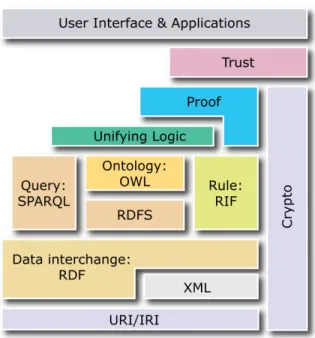
The idea of Semantic Web is Web of Data, i.e., linking data, instead of linking doc-uments. Semantic Web is not intended to replace or rebuild the Web, but rather, extend it with additional layers, depicted in Fig. 2.1, all of which are aimed at in-corporating machine-processable semantics into it, hence facilitate data sharing and
4Cascading Style Sheets,http://www.w3.org/Style/CSS/ 5The standardized version is called ECMAScript, see
http://www.ecma-international.org/ publications/standards/Ecma-262.htm
Figure 2.1: Semantic Web Layer Cake. (Original image from http://www.w3.org/ 2001/sw/layerCake.png)
reuse by people and most importantly by machines too. The first layer is URI/IRI, which is already part of the Web. Here, URIs really function as a name and it is not required to be dereferenceable. Also, as stated it in the preceding section, it is possible to have multiple URIs to reference the same resource. We briefly describe XML, RDF, and SPARQL in this section. RDFS, OWL, and RIF will be described in Section 2.3.
2.2.1 Data Interchange Layer XML
One of the first things one needs to have to enable data sharing is to agree upon a format. By the time Semantic Web was conceived, the Extensible Markup Language (XML) has been the de facto standard format for data exchange on the web. It was already widely used, compatible with HTML, and already on the way toward a W3C
Recommendation6. XML thus became a natural choice of a standard data exchange format for Semantic Web, and despite newer data formats were proposed later on, it remains a part of Semantic Web suite of standards to this day.
Technically, XML facilitates an encoding of data in a nested, tree-like structure. It is platform independent and extensible with the so-called XML Schema, which allows one to specify a restriction on the structure, and also, defines standard datatypes, such as numbers, strings, and dates. Note, however, that although XML Schema expresses a structure for data, it does not express the semantics of the data, i.e., how the data should be interpreted.
RDF
The Resource Description Framework (RDF) is a data model for representing meta-data on the Web [39]. It is a graph-based model and logically, can also be seen as an assertional language with a very lightweight semantics. RDF’s main feature is the ability to express a link between any two resources on the Web.
Every RDF statement is called an (RDF) triple, which is a tuple 〈s,p,o〉 wheres is either a URI or a blank node, p is a URI, and O is either a URI, a blank node or a literal. A triple containing no blank node is called ground. An (RDF) graph is a finite set of RDF triples. An RDF graph may be associated with a URI or a blank node. If so, such a graph is called anamed graph, while the associated URI or blank node is called the graph name. An (RDF) dataset is a nonempty set of RDF graphs where exactly one graph is unnamed and may be empty, and the remaining graphs are named graphs whose name is unique within the dataset. The unnamed graph in an RDF dataset is called the default graph.
Literals represent values such as numbers, strings, and dates. In RDF, a literal is always typed, and many of standard types for literals come from XML [105]. For 6Due to various reasons, there are actually two W3C Recommendations for XML, namely
example,"mystring", "7.5ˆˆxsd:decimal", and "trueˆˆxsd:boolean"7. The first one is an example of a simple literal, which is simply an abbreviation of the string literal "mystringˆˆxsd:string", while the latter two are the decimal number 7.5 and the Boolean value true. Blank nodes, on the other hand, are understood as existential variables in logic: a triple with blank node(s) indicates a relationship involving some unnamed resource(s).
Note that, despite being called a graph, an RDF graph is not strictly a graph in the usual definition in graph theory because there is no strict separation between the set of nodes and the set of edges. That is, within one RDF graph, a URI may appear both as a “node” (subject or object) and an “edge” (predicate). In fact, it is possible that one URI appears as the subject, predicate, and object of a triple simultaneously. RDF has a model theoretical semantics, which defines the notion of simple en-tailment and RDF entailment [61]. However, they amount almost nothing. Simple interpretation interprets every triple as an instance of a binary relation over resources. Simple entailment is essentially graph containment relation: a graph entails all its subgraphs and all graphs obtained from those subgraphs by replacing URIs or lit-erals with blank nodes. RDF entailment fixes semantics of litlit-erals, and assigns a restricted semantics tordf:type: any propertyp is related to rdf:Property through
therdf:type binary relation. That is, if〈s,p,o〉is in the graph, then the graph would
entail 〈p,rdf:type,rdf:Property〉.
An RDF graph or dataset is usually encoded in an RDF document, which is written in some RDF concrete syntax, orserialization. One example of RDF concrete syntax is XML, which was actually the only RDF serialization format that made it into a W3C Recommendation status for RDF 1.0 [76]. The later RDF 1.1 standards [39], besides XML [48] – Fig. 2.2, includes additional concrete syntaxes: N-Triples 7The string ’xsd:’ is called a namespace prefix, which is an abbreviation of aURI namespace.
In this particular case,xsd: stands forhttp://www.w3.org/2001/XMLSchema#, and thus the URI
xsd:decimalis an abbreviated form of http://www.w3.org/2001/XMLSchema#decimal. Syntax for namespace and namespace prefix is defined in a W3C Recommendation [19].
<?xml version="1.0" encoding="utf-8" ?> <rdf:RDF xmlns:rdf="http://www.w3.org/1999/02/22-rdf-syntax-ns#" xmlns:rdfs="http://www.w3.org/2000/01/rdf-schema#" xmlns:dbo="http://dbpedia.org/ontology/"> <rdf:Description rdf:about="http://dbpedia.org/ontology/capital"> <rdfs:subPropertyOf rdf:resource="http://dbpedia.org/ontology/administrativeHeadCity"/> </rdf:Description> <rdf:Description rdf:about="http://dbpedia.org/ontology/country"> <rdfs:subPropertyOf rdf:resource="http://www.ontologydesignpatterns.org/ont/dul/DUL.owl#hasLocation"/> </rdf:Description> <rdf:Description rdf:about="http://dbpedia.org/resource/Ohio"> <dbo:capital rdf:resource="http://dbpedia.org/reosurce/Columbsus,_Ohio"/> <dbo:country rdf:resource="http://dbpedia.org/resource/United_States"/> </rdf:Description> </rdf:RDF>
Figure 2.2: RDF triples about the state of Ohio in XML.
<http://dbpedia.org/resource/Ohio> <http://dbpedia.org/ontology/capital> <http://dbpedia.org/resource/Columbus,_Ohio> . <http://dbpedia.org/resource/Ohio> <http://dbpedia.org/ontology/country> <http://dbpedia.org/resource/United_States> . <http://dbpedia.org/ontology/capital> <http://www.w3.org/2000/01/rdf-schema#subPropertyOf> <http://dbpedia.org/ontology/administrativeHeadCity> . <http://dbpedia.org/ontology/country> <http://www.w3.org/2000/01/rdf-schema#subPropertyOf> <http://www.ontologydesignpatterns.org/ont/dul/DUL.owl#hasLocation> .
Figure 2.3: RDF triples about the state of Ohio in N-Triple format.
[27] – Fig. 2.3, N-Quads [26], Turtle [111] – Fig. 2.4, TriG [28], JSON-LD [119], and RDFa [63].
2.2.2 Query Language: SPARQL
SPARQL is a query language for querying and manipulating RDF data [117]. It is analogous to what SQL is for relational databases. It supports federated queries, and though it does not provide semantics to the dataper se, it supports simple graph en-tailment, and throughentailment regimes, also supports other entailments, e.g., RDF, RDFS, and OWL entailments. Every SPARQL (non-federated) query is run on an RDF dataset, which can be understood as a set of the form{G0,〈u1,G1〉, . . . ,〈un,Gn〉} where G0 is the default graph of the dataset (which always exists, though can be
@prefix : <http://dbpedia.org/resource/> .
@prefix rdfs: <http://www.w3.org/2000/01/rdf-schema#> . @prefix dbo: <http://dbpedia.org/ontology/> .
@prefix dul: <http://www.ontologydesignpatterns.org/ont/dul/DUL.owl#> <Ohio> dbo:capital <Columbus,_Ohio> ;
dbo:country <United_States> .
dbo:capital rdfs:subPropertyOf dbo:administrativeHeadCity . dbo:country rdfs:subPropertyOf dul:hasLocation .
Figure 2.4: RDF triples about the state of Ohio in Turtle format.
empty), and the rest are zero or more named graphs 〈ui,Gi〉 where ui is the graph name ofGi in the dataset.
For querying, SPARQL provides the following query operations: SELECT, CON-STRUCT, ASK, DESCRIBE, while for modifying RDF datasets, SPARQL provides the following update operations: LOAD, CLEAR, DROP, ADD, MOVE, COPY, CREATE, INSERT, and DELETE8. A basic component of a SPARQL query is graph pattern matching, which is essentially a form of conjunctive query.
2.3
Ontology Languages
There are different definitions of ontology depending on the context of the discussion. In knowledge acquisition and representation, the following definition from Gruber [54] is very often-cited: “An ontology is an explicit specification of conceptualization”. This definition predates the idea of Semantic Web with which the notion of ontology is now popularly associated. In fact, ontology has been a subject of study much earlier than that, e.g., in philosophy.
Gruber’s definition became prominent when it was realized that ontology plays an important role in achieving interoperability among knowledge-based systems [97]. In
this context, ontology’s role is enabling knowledge sharing and reuse. That is, ontol-ogy became the means by which different agents or systems can communicate. This is possible because every knowledge-based system, explicitly or not, subscribe to their own conceptualization about the world, i.e., some abstraction about the world that one wants to represent. Such a conceptualization contains entities and relationships between them, and ontology captures the part of conceptualization shared among the systems. As a result, ontology would contain terms and their definition, which are agreed upon by the parties who use the ontology.
Naturally, for an ontology to be usable by machines, one needs to employ an un-ambiguous, machine-processable, formal knowledge representation language to spell out the specification. No less importantly, the terms, orvocabulary, and their defini-tions have to bephysically shareable: an ontology has to beportable. This can only be done if the formal language used to write or serialize an ontology has some syntactic object that can be physically referred to, copied, and worked on. A further benefit of such formal languages, especially those based on formal logic, is that the vocabulary definition in an ontology can be checked for logical inconsistency. For some of these languages, there are even algorithms for automated reasoning that have been imple-mented in widely used tools. W3C Semantic Web standards such as RDF, RDFS, OWL, and RIF are examples for such languages.
In the following, we shall describe some of these languages. Note that RDF as a data model actually already facilitates knowledge representation. However, it has very little semantics and not much inference can be done with it. RDFS, OWL, and RIF build more semantics on top of RDF, and thus, are more powerful than RDF.
2.3.1 RDF Schema (RDFS)
RDF Schema (RDFS) [22] extends RDF with some lightweight knowledge modeling features. Notably, it introduces class as a new semantic construct. It also defines
rdf:type rdfs:domain rdfs:Resource ; rdfs:range rdfs:Class .
rdfs:domain rdfs:domain rdf:Property ; rdfs:range rdf:Property .
rdfs:range rdfs:domain rdf:Property ; rdfs:range rdf:Property .
rdfs:subPropertyOf rdfs:domain rdf:Property ; rdfs:range rdf:Property .
rdfs:subClassOf rdfs:domain rdfs:Class ; rdfs:range rdfs:Class .
Figure 2.5: RDFS axiomatic triples for rdfs:domain, rdfs:range,
rdfs:subPropertyOf, and rdfs:subClassOf, expressed in Turtle format.
a set of URIs as new vocabulary terms on top of existing RDF vocabulary, defines their semantics, as well as, extends the semantics of some of the RDF vocabulary. The new vocabulary terms represent special classes, special properties, and URIs for purposes such as modeling containers, reification, and extra-logical annotations. In addition to semantic conditions of RDF entailment, RDFS adds several other semantic conditions. In particular, every class, say c, is interpreted as the set of all resources identified byx such that〈x,rdf:type,c〉is in the graph. RDFS semantics also defines the notions of subclasses, subproperties, as well as domain and range of properties. The semantics conditions are easier to explain through entailment rules, and there are 13 of them defined in the RDFS semantics [61].
RDFS semantics asserts that all RDFS axiomatic triples are (implicitly) true in every RDF graph. The ones for the domain, range, subproperty, and subclass properties are given in Fig. 2.5. For example, the first two there state that the domain of rdf:type is rdfs:Resource and its range is rdfs:Class. The remaining (infinitely many) axiomatic triples omitted here are for properties used for RDF reification, containers (e.g., list), and annotations. So, letG0 be an RDF graph and G be the graph obtained by adding all RDFS axiomatic triples toG0. The following are most of the RDFS entailment rules; the entailment rules for literals, datatypes,
and rdfs:containerMembershipPropertyare omitted.
(rdfs2) If〈s,p,o〉,〈p,rdfs:domain,c〉∈G, thenG0 entails 〈s,rdf:type,c〉.
(rdfs4) If 〈s,p,o〉 ∈ G, then G0 entails 〈s,rdf:type,rdfs:Resource〉 and
〈o,rdf:type,rdfs:Resource〉.
(rdfs5) If 〈p,rdfs:subPropertyOf,q〉,〈q,rdfs:subPropertyOf,r〉 ∈G, then G0 entails
〈p,rdfs:subPropertyOf,r〉.
(rdfs6) If〈p,rdf:type,rdf:Property〉∈G, thenG0entails〈p,rdfs:subPropertyOf,p〉.
(rdfs7) If〈p,rdfs:subPropertyOf,q〉,〈s,p,o〉∈G, thenG0 entails 〈s,q,o〉.
(rdfs8) If〈c,rdf:type,rdfs:Class〉∈G,
thenG0entails 〈c,rdfs:subClassOf,rdfs:Resource〉.
(rdfs9) If〈c,rdfs:subClassOf,d〉,〈s,rdf:type,c〉∈G, thenG0entails 〈s,rdf:type,d〉.
(rdfs10) If 〈c,rdf:type,rdfs:Class〉∈G, thenG0 entails 〈c,rdfs:subClassOf,c〉.
(rdfs11) If 〈c,rdfs:subClassOf,d〉,〈d,rdfs:subClassOf,e〉 ∈ G, then G0 entails
〈c,rdfs:subClassOf,e〉.
From the above rules, we understood that for example, both subclass and subprop-erty relations are reflexive and transitive (rdfs5, rdfs6, rdfs9, rdfs10). So, with RDFS, one can express class hierarchy and property hierarchy, also reason about class mem-bership of individuals along the hierarchy because it propagates along the hierarchy. One can also infer class membership of an individual from the domain and range of properties.
RDFS also supports some form of metamodeling, e.g., deriving that
〈rdfs:Class,rdf:type,rdfs:Class〉 is entailed by any graph by applying rdfs3 rule
together with only the axiomatic triple 〈rdf:type,rdfs:range,rdfs:Class〉. This showed that the resource rdfs:Class is also a class. Similarly applying rdfs3 rule, the earlier axiomatic triple, and any triple 〈s,rdf:type,c〉 would allow us to infer
〈c,rdf:type,rdfs:Class〉, i.e., rdfs:Class is the set of all classes.
One thing to note here, which was also demonstrated in the previous paragraph, is that RDFS semantics does not partition the resources into disjoint categories of
individuals, classes, and properties. That is, a resource can belong simultaneously in any two or even all of those categories. In fact, the fact that the resourcerdfs:Class is a member of the set of all classes, which is the resourcerdfs:Classitself, constitute a well-known Russel’s paradox. Fortunately, in practice, one would not typically be interested in this kind of inference.
In terms of serialization, there is no difference between RDFS and RDF. RDFS only adds a set of new URIs whose meaning is as determined by RDFS semantics. Any RDFS document is an RDF document and thus any RDF serialization can be used for sharing RDFS ontology.
2.3.2 The Web Ontology Language (OWL)
Although RDFS does provide us with a way to specify some semantics on our data, it is still very limited. For example, one cannot use RDFS to infer, given two RDF triples stating that Dayton is a city in Ohio and Ohio is a state in the US, that Dayton is a city in the US. To support such an inference, a more expressive language is needed.
Semantic Web provides the Web Ontology Language (OWL) as a language that one can use to write and share ontologies. It defines constructs with a formal se-mantics for expressing logical assertions, over which, automated reasoning to derive entailments can be done. OWL was first standardized in 2004 [91]. The second ver-sion of the language, dubbed OWL 2, which is more expressive than the first, came out later in 2009 [103]. We provide the OWL 2 language definition below and simply refer to it as OWL. Note that our definition below does not provide the definition of every logical construct specified in OWL standards [96] because the omitted con-structs can be expressed by some combination of the concon-structs presented here and in the select few that cannot, they are never used in any of the modeling done in this thesis.
From a theoretical perspective, OWL is roughly a syntactic variant ofSR OIQ(D), which belongs to Description Logics (DLs), a rather prominent family of decidable fragments of first-order logic [6]. We shall use the more concise DL notation to introduce the language below.
A logical statement in an OWL ontology is calledaxiom. An axiom is syntactically formed of atomic symbols, literals and a number of logical constructs. Every atomic symbol is a URI that, unless stated otherwise, are not reserved by OWL. Since we are using DL notation, logical constructs will typically be written using special symbols, though the OWL standards use reserved keywords or URIs. For readability reason, we omit the full namespace of the URIs whenever it is not ambiguous.
Anatomic symbol is a URI that is either aclass, anobject property, adata property, anamed individual, or adatatype. Aliteral is either aplain literal, which is a simple string value, e.g., “abc”, or a typed literal, which is a string value that represents some lexical form of some concrete value whose type is the indicated datatype, e.g.,
“abc”ˆˆdatatypeURI where datatypeURI is a datatype URI. OWL also recognize the so-called anonymous individuals, which are identified by a local node ID, and not by URI, i.e., analogous to RDF blank nodes. OWL allows anonymous individuals to be used anywhere named individuals can be used. Throughout this thesis, however, we shall only use named individuals.
Note that the same URI occurring in different ontologies always represents the same entity (the same individual if the URI is an individual URI, the same class if it is a class URI, etc.). From atomic symbols and literals, we can additionally define
class expressions, and object property expressions, and data ranges.
An object property expression is an expression of the formR whereR is an object property, or S−, called the inverse of S, where S is some object property expression. OWL reserves two special object properties, owl:topObjectProperty, denoted with U, and owl:bottomObjectProperty, denoted with N, and both have fixed semantics
defined below. Likewise, we reserve two special data properties,owl:topDataProperty
and owl:bottomDataProperty, both with fixed semantics defined below.
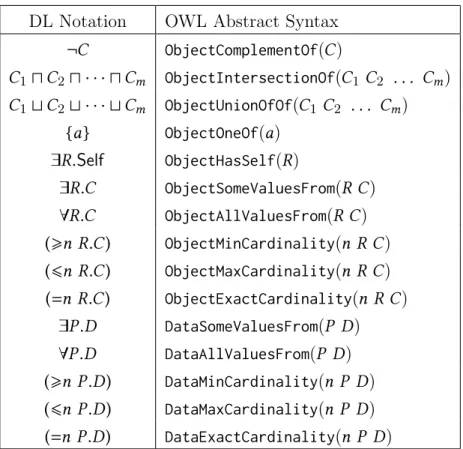
A class expression is an expression of one of the form below. The corresponding OWL abstract syntax [96] is given in Table 2.1.
• A where A is a class, including two predefined classes, owl:Thing, denoted by >, and owl:Nothing, denoted by⊥;
• class complement ¬C whereC is a class expression;
• intersectionC1u · · · uCm and unionC1t · · · tCm withm ≥2 and allC1, . . . ,Cm themselves class expressions;
• {a} wherea is a named individual;
• self-restriction ∃R.Self whereR is an object property expression;
• existential restriction∃R.C, universal restriction∀R.C, and number restrictions
(>n R.C), (6n R.C), (=n R.C) where n is a natural number, R is an object property expression andC is a class expression;
• existential restriction∃P.D, universal restriction∀P.D, and number restrictions
(>n P.D), (6n P.D), (=n P.D) wheren is a natural number,P is a data property and D is a data range.
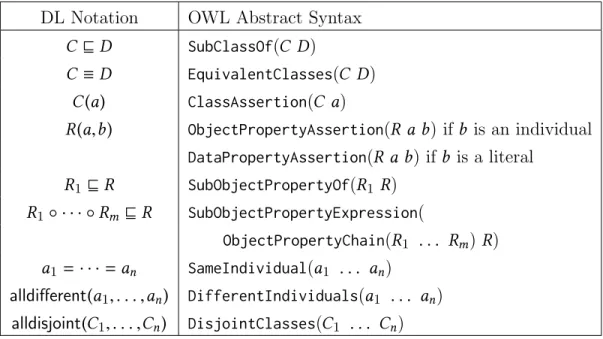
A data range is recursively defined as a k-ary datatype, or an intersection of data range, or a union of data range, or a complement of data range, or an enumeration of literals, or a datatype restriction. Throughout this thesis, however, we will only use unary datatypes, which are sufficiently represented as URIs. We refer the reader to OWL standards [95, 96] for more details on the syntax and semantics of data ranges. Having defined class expressions and property expressions above, we now define OWL axioms. An axiom is either
• asubclass axiom (i.e., class inclusion) of the formC v D; or
• aclass equivalence of the formC ≡ D; or
DL Notation OWL Abstract Syntax ¬C ObjectComplementOf(C) C1uC2u · · · uCm ObjectIntersectionOf(C1C2 . . . Cm) C1tC2t · · · tCm ObjectUnionOfOf(C1 C2 . . . Cm) {a} ObjectOneOf(a) ∃R.Self ObjectHasSelf(R) ∃R.C ObjectSomeValuesFrom(R C) ∀R.C ObjectAllValuesFrom(R C) (>n R.C) ObjectMinCardinality(n R C) (6n R.C) ObjectMaxCardinality(n R C) (=n R.C) ObjectExactCardinality(n R C) ∃P.D DataSomeValuesFrom(P D) ∀P.D DataAllValuesFrom(P D) (>n P.D) DataMinCardinality(n P D) (6n P.D) DataMaxCardinality(n P D) (=n P.D) DataExactCardinality(n P D)
Table 2.1: OWL Notation for Class Expression
• aproperty assertion of the formR(a,b); or
• an expression of the formR1◦ · · · ◦Rm v R wherem ≥ 1 — ifm = 1, we call it
subproperty axiom, otherwise it is called property chain axiom; or
• anindividual equality assertion a1 =a2 =· · ·=an withn ≥ 2; or • anindividual inequality assertion alldifferent(a1, . . . ,an) with n ≥ 2; or • aclass disjointness assertion alldisjoint(C1, . . . ,Cn) withn ≥ 2.
whereC,C1, . . . ,Cn, andD are any kind of class exressions;a,a1, . . . ,anare individuals; b is either a named individual or a literal; R is an object property expression if b is a named individual, otherwise (i.e., when b is a literal), R is a data property; and R1, . . . ,Rm and S are object property expressions. Note that there are other kinds of axioms in OWL that we omit here because either they can be expressed using the axioms we defined above or we do not use them throughout this thesis.
DL Notation OWL Abstract Syntax C v D SubClassOf(C D) C ≡ D EquivalentClasses(C D) C(a) ClassAssertion(C a) R(a,b) ObjectPropertyAssertion(R a b) ifb is an individual DataPropertyAssertion(R a b) ifb is a literal R1 vR SubObjectPropertyOf(R1 R) R1◦ · · · ◦Rm vR SubObjectPropertyExpression( ObjectPropertyChain(R1 . . . Rm)R) a1= · · ·=an SameIndividual(a1 . . . an) alldifferent(a1, . . . ,an) DifferentIndividuals(a1 . . . an) alldisjoint(C1, . . . ,Cn) DisjointClasses(C1 . . . Cn) Table 2.2: OWL Axioms
Semantics of axioms and expressions is defined in terms of interpretations and we mostly follow OWL 2 Direct Semantics [95] with some simplifications. An interpre-tation is a tuple I= (∆I,∆D,·I,·D) where
• ∆I and ∆D are pairwise disjoint nonempty sets called object domain and data domain, respectively;
• ·I is an object interpetation function such that:
– it maps every named individual a to an element aI ∈ ∆I, every class
expressionC to a setCI ⊆ ∆I, and every object property expression R to
a binary relation RI ⊆ ∆I×∆I; – >I = ∆I; ⊥I =∅;UI = ∆I×∆I; NI =∅; – (C1u · · · uCm)I =C1I∩ · · · ∩CmI; (C1t · · · tCm)I =C1I∪ · · · ∪CmI; – {a}I ={aI}; – (∃R.Self)I ={x ∈∆I |〈x,x〉∈RI} – (∃R.C)I = {x ∈ ∆I | ∃y: 〈x,y〉 ∈RI ∧y ∈CI} if R is an object property expression;
– (∀R.C)I = {x ∈ ∆I | ∀y: 〈x,y〉 ∈RI →y ∈CI} if R is an object property
expression;
– (>n R.C)I ={x ∈∆I | |{y |〈x,y〉∈RI∧y ∈CI}|>n}
– (6n R.C)I ={x ∈∆I | |{y |〈x,y〉∈RI∧y ∈CI}|6n} – (=n R.C)I ={x ∈∆I | |{y |〈x,y〉∈RI∧y ∈CI}|=n} • ·D is a data interpretation function such that:
– it maps every literall to an elementvD ∈ ∆D such thatv is the data value
ofl, every datatypeT to a subsetTD ⊆ ∆D, and every data propertyR to
a binary relation RD ⊆ ∆I×∆D; – (rdfs:Literal)D = ∆D;
– (owl:topDataProperty)D =∆I×∆D; (owl:bottomDataProperty)D =∅; – (∃R.T)D ={x ∈∆I | ∃y: 〈x,y〉∈RD∧y ∈TD} if R is a data property;
– (∀R.T)D ={x ∈∆I | ∀y: 〈x,y〉∈RD →y ∈TD} ifR is a data property; Note that each datatype represents set of data values such as strings or inte-gers. Examples of datatypes supported in OWL include numbers (e.g., owl:real,
xsd:decimal, etc.), strings (e.g., rdf:PlainLiteral, xsd:string, etc.), time instants
(e.g., xsd:dateTime, etc.), etc. Furthermore, each literal represents an actual data value within a particular datatype as indicated by the syntactic appearance of the literal itself.
An intepretation I satisfies (is a model of) an OWL axiom:
• C v D ifCI ⊆ DI;
• C ≡D ifCI =DI;
• C(a) ifaI ∈CI;
• R(a,b) if 〈aI,bI〉∈RI for object property expression R;
• P(a,b) if 〈aI,bD〉∈PD for data property P;
• R1 vR if RI1 ⊆RI;