Published by Canadian Center of Science and Education
A Case Study of College Students’ Attitudes toward Computer-Aided
Language Learning
Cao Wangru11 Henan Polytechnic University, Jiaozuo, Henan, China
Correspondence: Cao Wangru, 2001Century Avenue, Henan Polytechnic University, Jiaozuo City, Henan, 454000, China, Tel: 86-0391-3987778. E-mail: [email protected]
Received: April 23, 2016 Accepted: May 20, 2016 Online Published: May 30, 2016 doi:10.5539/hes.v6n3p1 URL: http://dx.doi.org/10.5539/hes.v6n3p1
Supported by Research Project of the Department of Humanity and Society in Henan Polytechnic University (SKGH2015-16).
Abstract
Nowadays computers are becoming smaller and more powerful, they are put into use in many areas, and one of the important implementations is the assistance with language learning, which is called CALL. In China, college English teaching has experienced lots of frustrations and difficulties. At the end of 20th century, the mode of CALL gradually appeared in China, but it was still immature and not systematic. At the beginning of 21th century that CALL was carried out extensively in China. During this period, many universities and colleges have tried experiments on online learning and many of them have got quite fruitful achievements. Henan Polytechnic University is one of them. After careful consideration, the university decided to adopt the English online learning system produced by Higher Education Press to carry out a comprehensive college English teaching reform in the non-English majors’ students, who are freshmen and sophomores. In the four academic semesters, students have 4 periods of classroom-based learning and another 2 periods of online learning every week. So far, the university has worked on the experiment for 10 years, and now, it is the high time to check the students’ attitudes toward English online learning. Only in this way can we get the valuable first-hand suggestions to improve online learning mode.
Keywords: autonomous study, English, online learning system, CALL
1. Introduction
As it is known that the development of language teaching theories has experienced Behaviorism, Cognitive Learning Theory and Constructivism. With the development of the society, the traditional teaching approach could not meet the requirement of Constructivism and many scholars and teachers try to create the real learning environment for learners. Meanwhile, advances in computer technology have motivated teachers to reassess the computer and consider it as a valuable tool for foreign language teaching and learning. Innovative software programs, authoring capabilities, compact disk technology, and elaborate computer networks are providing teachers with new methods of incorporating culture, grammar, and real language use in the classroom while students gain access to audio, visual and textual information about the language and the culture of its speakers (Higgins & Chris, 1993).
Since 1960s, computers have come into the field of language teaching. After a long time of exploration, CALL (Computer-Aided Language Learning) has appeared. Until 1990s, many scholars and teachers had found out that CALL could meet the requirement of the current Constructivism theory, a lot of schools carried out some reforms in language teaching, the importance of CALL became clearer and clearer. And CALL had done great contribution to experiential learning, motivation, enhanced student achievement, authentic material for study, great interaction, individualization, independence from a single source of information, global understanding (Lee, 2000). In addition, online learning became more and more popular, and the development of online learning system aroused the exploration of new concepts and new modes in teaching and learning.
In China, the college English teaching has a frustrating history. With the fast development of Chinese economy and more frequent and intensive cross-cultural exchanges, the significance of English is commonly recognized.
English, to some degree, is one of the basic factors that contribute China’s internationl competitiveness. Consequently, Chinese government has been paying lots of attention to English teaching. The effectiveness of traditional teaching method on reading and writing is undouted, but it helps little on listening and speaking. After a lot of setbacks, it comes to the flourishing state of today. Especially in July, 2007, the Ministry of Education in China had promulgated the revised version of College English Curriculum Requirements which caused many universities to carry out certain kinds of reform in English teaching. Due to the fast development of the increasing popularizing rate of computer and network, College English Curriculum Requirements holds that modern information technology should be fully made use of in the college English teaching. Concerning teaching mode, computer-assisted English teaching should be put into practice, and the teaching mode should be based on information technology, especially network which enables English teaching and learning more flexible and individualized. What’s more, learner autonomy should be emphasized based on the internet. With the implementation of this new-issued requirement, muti-media is adopted by more and more colleges for English teaching. Henan Polytechnic University is one of them.
In Henan Polytechnic University, the School of English has adopted the Experiencing English Center issued by the Higher Education Press to assist the college English teaching since 2006. In this experiment, there are 4 periods in multimedia classrooms every week and students go to Experiencing Center to study online automatically 2 periods a week. Just as Richards and Rodger state that changes in language teaching methods throughout history have reflected the changes of learners’ needs, such as a move toward oral proficiency rather than reading comprehension as the goal of language study (Richards & Rodger, 1986). So far, the college has worked on the experiment for 10 years. So, it is necessary to testify whether the learning mode meets the requirement of development.
This study is trying to find out students’ attitudes toward CALL in Henan Polytechnic University. In the study, questionnaires would be designed and sent to the selected subjects. After careful analysis, it will be easy to be recognized whether the learning mode in Henan Polytechnic University corresponds with Constructivism. Then students’ attitudes toward the learning mode and learning system will become clear. What’s more, the advantages and disadvantages of CALL in Henan Polytechnic University will be found out. What more important is that suggestions will be made to improve CALL in Henan Polytechnic University.
2. Literature Review
2.1 The Development of CALL
Computer-Assisted Language Learning (CALL) was brought into being in the early 1960s, and it is worldwide accepted by 1990s. CALL is the field concerning about the use of computers in second language acquisition (Hacken, 2003, Introduction, para. 1). CALL originates from CAI (Computer-Accelerated Instruction), a term that was first viewed as an aid for teachers. The philosophy of CALL puts a strong emphasis on student-centered lessons that allow the learners to learn on their own using structured and/or unstructured interactive lessons. These lessons carry two important features: bidirectional (interactive) learning and individualized learning. And CALL is not a method, but it is a tool that helps teachers to facilitate language learning process. CALL can be used to reinforce what has been learned in the classrooms. It can also be used as remedial to help learners with limited language proficiency (Wikipedia, 2009, Definition, para. 1). According to Levt, “CALL is the search for and study of applications of the computer in language teaching and learning” (Levt, 1997). From it, we can see that CALL is aimed to help learners to learn a foreign language more effectively and allow teachers to use it as a assisted tool by integrating computer into teaching process. Currently, CALL is usually perceived, in its narrow sense, as an approach to language teaching and learning where computer is applied as assistance.
Significant use of CALL began in the 1960s. Since then, the development of CALL software has followed the changes in teaching methodologies. As teaching methods changed to audio-lingual and communicative approaches, CALL software included simulations and more interactive programs (Vincent & Hah, 1996, para. 1). Based on the above, it can be seen that the development of CALL was intimately connected with learning theories and computer technology. According to these two factors, the history of development in CALL can be divided into three phases.
2.1.1 The First Phase of Development in CALL
This phase was from 1960s to 1970s. The advent of using computers in L2 instruction began in the 1960s with the hope that technology would serve as a capable and resourceful tool for more efficient L2 acquisition (Brantmeier, 2003). But technological limitations, until then, were just too limitative for language learning and were reduced to some very specific, small projects (Marquis, 2005).
In the aspect of learning theories, the practice of CALL was dominated by Behaviorism. Behaviorism is a theory of learning based upon the idea that all behaviors are acquired through conditioning and conditioning occurs through interaction with the environment (Wagner, n.d., para. 2). According to this theory, language learning was like any other kind of learning in that it involved habit formation. Habits were formed when learners responded to stimuli in the environment and subsequently had their responses reinforced so that they were remembered. Thus, a habit was a stimulus-response connection (Ellis, 2001, p. 31). In 1979, basing on the Behaviorism, Gagne and Briggs had proposed four principles for directing the CALL teaching design. These four principles are as follows: Contiguity, Repetition, Feedback and Reinforcement, Prompting and Fading.
2.1.2 The Second Phase of Development in CALL
The second phase was during the 1980s. In these ten years, a number of publications had tried to introduce, teach, support, and provide ideas to foreign language instructors on the use of computers in the classroom (Chapelle & Jamieson, 2009). In was not until the late 80s that CALL researchers put the stress more on language methodology and less on computer skills. As a result, there were interesting prototypes with considerable pedagogical improvements, though less user-friendly and computationally less demanding (Bangs & Cantos, 2004).
In the field of learning theories, the controversy between Cognitive Learning Theory and Constructivism became fierce. In this time, Cognitive Learning Theory was the dominating theory in teaching. Therefore, a lot of courseware was directed by it. Cognitive Learning Theory was a learning theory of psychology that attempts to illustrate human behavior by understanding the thought processes (Fritscher, n.d., Definition, para. 1). At that time, some scholars pointed out that the efficiency of CALL could be increased significantly if the interactive learning activities provided by CALL were identical with the learners’ internal process. Thus, researchers began to set up the activity sequence for CALL which was identical with the learners’ internal process.
In this phase, because of the fast development of computer technology, CALL changed greatly and the interactive modes between people and computers became diverse. Teaching information could be presented by the forms of pictures, text, radio and video, etc. And hypertext technology appeared in the organizational forms of information. This hyperlink technique would be beneficial to the learners’ associative thinking and learning forms were no longer linear.
2.1.3 The Third Phase of Development in CALL
This phase was from 1990s until now. The development of CALL entered a new stage. In 1992 the World Wide Web was launched, reaching the general public in 1993. The Web offered enormous potential in language learning and teaching, but it had some way to go before it caught up with the interactivity and speed of access offered by CD-ROMs or DVDs, especially when accessing sound and video files (Davies, 2002, Web-based CALL, para. 1). On one hand, Constructivism was put into use in the field of teaching. On the other hand, the use of network to assist teaching became more and more popular. These two factors had contributed greatly to the change of CALL. Constructivism emphasized that learners should be the center of teaching activities, they were the active agent of the teaching process. They actively processed the information and constructed meaning. In the meanwhile, they were no longer passively infused with knowledge by teachers. Furthermore, teachers were assistants to help learners construct meaning. They were no longer the center of teaching. What they needed to do was to help learners understand characteristics of things, laws and connection among things. Based on this theory, a lot of teaching approaches had been proposed, such as Random Access Instruction, Anchored Instruction and Scaffolding Instruction, etc. Thus, these teaching approaches had offered guidance for development of CALL.
Constructivism was formed and proposed before 1990s, but it was only put into practice after 1990s. This was because of the development of multimedia and network technology, especially the extensive use of Internet. The Internet offered learners good learning environments which were suitable to implement the Constructivism. This new approach generated autonomous learners, facilitating access to authentic materials towards collaborative and individualized learning (Pacheco, 2005). Besides, the economic development of China became faster and faster, it required more outstanding talents who not only had abundant knowledge but also had self-study ability and creative capability. The society laid more emphasis on the practical ability of English, and it needed talents to be able to communicate with foreigners in English. Therefore, listening and speaking ability became more and more important. In this situation, the social need for implementation of Constructivism in CALL became clearer and clearer.
The history of CALL suggests that the computer can serve a variety of uses for language teaching. It can be a tutor which offers language drills or skill practice; a stimulus for discussion and interaction; or a tool for writing
and research. With the advent of the Internet, it can also be a medium of global communication and a source of limitless authentic materials (Warschauer, 2009, Conclusion, para. 1).
2.2 Definition of Learner Autonomy
Although “learner autonomy” has gained universal attention in the domain of linguistics as well as education, it is still a slippery concept which can’t be precisely defined because there can be various definitions of learner autonomy from different angles. The debate about learner autonomy is still under way, based on which its definition is continuing to mature.
The concept of autonomy first enters the field of language teaching through the Council of Europe’s Modern Language Project established in 1971 (Benson, 2005, p. 8). One of the earliest and most frequently cited definitions of autonomy is given by Henri Holec (1981, p. 3), who describes autonomy as “the ability to take charge of one’s learning”, in the foundation document for the Council of Europe. Holec has been a major influence in the later debate about autonomy and still remains a prominent figure within the field of learner autonomy today. His initial definition has been considered as a starting point in much subsequent work in this area. Dickinson (1987, p. 11) accepts the definition of autonomy as a situation in their own learning program. Dickinson (1993, pp. 330-335) identifies five characteristics of independent learners:
1) They are able to understand what is being taught; 2) They are able to formulate their own learning objectives;
3) They are able to select and make use of appropriate learning strategies;
4) They are able to monitor their use of these strategies and to identify those inappropriate learning strategies for them;
5) They are able to self-access or monitor their own learning.
These definitions go some way towards clarifying the characteristics of autonomous language learner. To sum up, the autonomous learner takes a proactive role in the learning process, generating ideas and availing him or herself of learning opportunities, rather than simply reacting to various stimuli from the teacher. With the development of research, some holistic views of these definitions have been put forward. Benson and Voller (1997, p. 29) state that the term autonomy has come to be used in at least five ways:
1) For situation in which learner study entirely on their own;
2) For a set of skills which can be learned and applied in self-directed learning; 3) For an inborn capability which is suppressed by institutional education; 4) For the exercise of learners’ responsibility for their own learning; 5) For the right of learners to determine the direction of their own learning.
To sum up, learner autonomy has manifested itself in various ways from various angles. With the ongoing debate and practice about learner autonomy, we can get more scientific and more mature explanations about its definition.
3. Research Design and Methodology
In Henan Polytechnic University, at the very beginning of the first semester, all the freshmen will be divided into three levels (level A, level B and level C) according to their English scores in the National College Entrance Examination.
In the first year and the second year in our university, students have 4 periods of classroom-based learning and another 2 periods of online learning every week. At the first two periods of online learning, the administrator in the learning center will teach students to do the basic operation of computers and he will generally introduce the online learning software to students. In addition, the administrator will stay in front of the learning center during all periods of students’ online learning in each semester so that he can offer some help to students.
Experiencing English Center is an online learning system for autonomous study. When students log on this software, they will see three buttons (Integrated Course, Listening & Speaking and My Score) there. Because of financial problem, Henan Polytechnic University just bought the contents of Listening & Speaking, in other words, students’ online learning will just focus on oral and listening practice. According to students’ English level, college just requires that they finish four levels in four semesters, from level 1 to level 4. In each level, there will be a lot of units, and each unit will contain six parts: Vocabulary Task, Listening Task, Real World Listening, Listening Exercise, Speaking Exercise and Role-play. Vocabulary Task focuses on listening to some
new words and requires students to fill in blanks or choose the correct words. While Listening Task needs students to fill in sentences in the blanks by means of listening. And Real World Listening will offer some actual environmental conversations and requires students to fill in more complex information. Listening Exercise focuses on daily conversations between a man and a woman, and the tape scripts are incomplete, students need to fill in the missing words. During their listening, they can choose normal speed or slow speed. After students finish this part, their scores will be shown. In Speaking Exercise, a sentence will be read to the students first, then, it requires students use the microphones to record their own sentence. After students finish their speaking, one of three different faces will be shown to them to indicate the levels of their oral expression. And all these sentences come from the conversations in Listening Exercise. The last part in each unit is Role-play. There are two roles for students to choose, if a student chooses role A, then computer will play role B and vice versa. Students and computers will take turns to make sentences to form conversations. During this process, students’ voices will be recorded, and finally one of the three faces will be presented to indicate their levels. In the top right corner of this software, there are also three buttons: Dictionary, Help and Message. When students meet new words in this software, they can just click Dictionary to look up these new words. If they have some problems with the operation of this software, they can click Help to look for solutions for their problems. Students can also leave messages to administrator by clicking the button of Message.
In the classroom-based learning, basing on the textbooks, teachers will design some learning tasks for students. Students will usually carry out some learning activities in the forms of pair works, group works, role plays and presentations, etc. In this way, students’ cooperative learning would be enhanced. In the meanwhile, students could also ask some questions about the online learning.
3.1 Research Questions
There are four research questions in this essay.
1) Do the English teaching practice and the learning software in Henan Polytechnic University correspond with Constructivism? If they do, what are they?
2) What are students’ attitudes toward CALL and the Experiencing English Center: are they more positive than negative?
3) What aspects of the learning software do students find most effective and enjoyable? 4) What aspect does the learning software need improving?
3.2 Subjects
The subjects selected for this research are 31 freshmen in a class of level B in grade 2015 from the School of Information and Mathmatics in Henan Polytechnic University. There are several reasons for choosing them as subjects. First, they are freshmen, so they are more passionate for new things and feel more curious about online language learning mode. Second, since all of them are freshmen, so we can have a check with their former computer skills before they use the online learning system in college. Third, based on National College Entrance Examination and class classification, the English level of students in this class is in the middle of all students in Henan Polytechnic University, therefore their answers for questionnaires may be more typical than those of the students in upper or lower levels of English. Among these 31 students, there are 9 females and 22 males. During the research, 31 questionnaires were sent out to them, and all of the questionnaires have been handed in. Finally, the number of the valid questionnaires is 30, except one questionnaire in which student hasn’t given the correct number to each item.
Among these students, the highest score of English in the National College Entrance Examination is 106 and the lowest score is 75. Most of them thought their knowledge of computers is fair and 9 students own computers at home, and among them, the longest time for owning a computer is 10 years and shortest time is only two months. Among these 30 students, most of them use E-mail and World Wide Web a lot, but they use computers for Word Processing just a little, someone even reflect they never use computers for Word Processing. And there are 2 students who state they don’t like using computers to learn English at all, 8 students indicate just so so, 16 students express they like it and 4 students reveal they like it very much.
3.3 Instruments
This is not an experimental investigation, but it can be considered as an observational study. It’s a case study of software-based college English learning in Henan Polytechnic University. The case study was carried out in a class of level B in grade 2015 from the School of Information and Mathmatics.
3.4 Questionnaire
During this study, questionnaires have been designed and sent out to students in a class of level B in grade 2015 from the School of Information and Mathematics. Before sending questionnaires, the researcher had carefully explained every item in questionnaires to students. The questionnaire is made up of six sections. The first section includes 13 questions related to the students’ attitudes towards using computers to learn English. They are answered on a five-point scale with 5 being the highest score. Three of these questions are reverse coded. The other sections focus on how students reacted to the Experiencing English Center generally and to specific aspects of the learning system.
3.5 Observation
During the sixteen periods of online learning, the researcher has carried out structured observations to find out students’ degree of interest and engagement and their approaches of working with the learning system. The researcher has taken down what I observed in a notebook.
3.6 Messages
At the end of these sixteen periods of online learning, the researcher has collected messages left by students on the online learning system from administrator. From these messages, the researcher tries to analyze what is good or bad about this learning software and hardware, what are the advantages and disadvantages of using the software and what is the complaint made by students.
3.7 Statistical Tool
All the data collected from questionnaires are analyzed with the help of SPSS 18.0, by which mean scores of every item and percentages of some items in the questionnaires are calculated carefully. Through the comparison of mean scores or percentages, students’ attitudes toward online learning will be found out.
3.8 Research Procedures and Approaches
Design for the research is considered to be a working hypothesis, which can be verified and validated after each implementation and evaluation (Greene, n.d., Research and methodological approach, para. 4). Therefore, after considering other’s research design, researcher came up with the following steps: Firstly, preliminary questionnaires were sent out to them in the first period of English lessons to have a check with their personal data and former computer skills and their interest in CALL, etc. Secondly, after two months online learning, another kind of questionnaires was sent out to them. These questionnaires focus on students’ attitudes towards using computers to learn English and how students reacted to the Experiencing English Center generally and to specific aspects of the learning system. Thirdly, the data in questionnaires were collected and analyzed carefully with the help of SPSS, and the mean scores of some items in these six sections were calculated and compared with each other. After that, questions with highest and lowest mean scores were picked out and analyzed. Fourthly, the information from structured observations and the messages left by students on the online learning system would also be collected and combined with the analysis of questionnaires so that students’ attitudes toward CALL and some related information would be found out.
4. Results and Analysis
4.1 The Students’ Attitudes towards CALL
As can be seen in Section one of the questionnaire, it mainly focuses on students’ attitudes towards CALL. Therefore, it is necessary to calculate the mean score in the first section to find out whether students hold positive attitudes toward CALL.
The mean core for all items in the first section is 3.60, higher than a mean of 3 which refers to a neutral score. In addition, mean scores in 11 of the 13 items are higher than neutral. Only the mean scores in item 6 and 11 are a slightly lower than neutral.
Among all these items, the highest mean score is 4.15 which are given to the item 2 “I want to continue using a computer in my English classes”. Next highest scores are given to item 7, 12, 9, 5, 1, 10, 13 and 8 (see Table 1).
Table 1. Survey questions’ score
Survey Questions Means
2) I want to continue using a computer in my English classes. 7) Using a computer gives me more chances to practice English. 12) Computers make learning English more interesting.
9) Computers make people weak and powerless. 5) Computers keep me isolated from my classmates.
1) Learning English by using a computer gives me a feeling of accomplishment. 10) I feel more relaxed when I work alone with a computer.
13) I achieve more when I use a computer to learn English. 8) Computers are usually frustrating to work with.
4.15 4.025 3.975 *3.9 *3.825 3.625 3.625 3.625 *3.5 * Refers to when reverse coded.
The lowest score is given to item 11 “I can gain more chances to communicate with the teacher face to face when I work with a computer” and it only gets 2.8. In addition, item 6 is given 2.9 which are also under the neutral (see Table 2).
Table 2. Survey questions’ score
Survey Questions Means
11) I can gain more chances to communicate with the teacher face to face when I work with a computer.
6) I can learn English faster when I use a computer.
2.8 2.9 Basing on the information above, it is not difficult to be found that students’ attitudes towards CALL are positive. The reasons why Item 11 has been given the lowest score are that teachers are seldom present at the learning center and they need more communication with students in the classroom. Those weaknesses should be improved from now on. What’s more, item 6 has been given low scores, this is because students have just begun online learning for 8 weeks and they need a long time to get used to it. Furthermore, their original computer skills are just fair, which have been told in preliminary questionnaire in the last chapter. Lack of training and familiarity with computers and the Internet (on the part of both learners and teachers) can lead to frustration, instead of offering a motivating learning experience (Moras, 2001, using the Internet in ELT, para. 7). Therefore, all these factors will contribute to their poor operation and it is no wonder that item 6 has been given low scores. 4.2 Students’ Interest Level in Working with Experiencing English Center
In the structured observations, the researcher has carefully investigated the degree of engagement by students during online learning periods. The researcher has found out that students attended the classes actively and nobody has been ever absent from classes. During the classes, all the students can actively follow the native speakers and read loudly. When they met new words, they would always use the dictionary in the learning software to look up them. In the meanwhile, sometimes they would communicate with each other. In general, students feel enthusiasm for this learning mode and their interest level in working with Experiencing English Center is in a high degree.
Remarks and comments are combined and analyzed. The representative samples are shown as follows:
This learning system is pretty good. It can improve listening and speaking ability.This learning style is very new, I feel interested. It is good to hear the voice of native speakers. Role-play in this system is very useful.
However, there are also negative comments from students and the representative samples are shown as follows: The size of earphone is not suitable. Some computers always broke down. We need more time to do the exercises in the learning center. Teachers should tell students the skills for every part in order to improve learning results. Some questions in this system are too difficult. When taking the exam, a lot of students read loudly, I can hardly
hear the voice of the earphone. There is little fresh air in learning center and I feel choked. Using one period to finish one unit is very difficult. The quality of microphone is very poor and it is usually not able to record my voice.
The negative comments above mainly focus on three aspects: hardware, learning environment and time arrangement for online learning. These problems should not be neglected in future.
In the questionnaire, students were required to rate their interest in Experiencing English Center on a five-point scale. The mean score of this item is 3.475 which are higher than the neutral and as can be seen in Table 3, 62.5% of students have given it a rating of 4 or higher. Therefore, their interest level is very high.
Table 3. Students’ interest in the Experiencing English Center
Rating Students Number Percentage (%)
1 Very boring 3 7.5
2 Boring 3 7.5
3 Neutral 9 22.5
4 Interesting 22 55
5 Very interesting 3 7.5
Students’ evaluations of the Experiencing English Center.
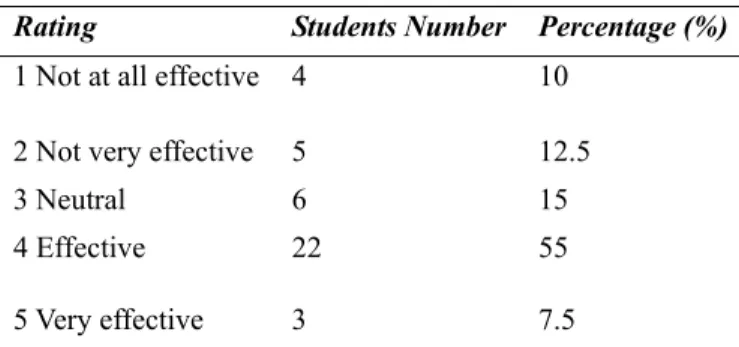
In the experiment, students were also required to evaluate the effectiveness of the Experiencing English Center. When students were required to give ratings to the effectiveness of this learning system as a whole, a lot of students have given high scores. The mean score for it is 3.375 which are higher than the neutral. As it can be seen in Table 4, the effectiveness of this learning system has been admitted by a lot of students.
Table 4. Students’ effectiveness of the Experiencing English Center
Rating Students Number Percentage (%)
1 Not at all effective 4 10
2 Not very effective 5 12.5
3 Neutral 6 15
4 Effective 22 55
5 Very effective 3 7.5
5. Conclusion and Suggestion
Firstly, after analyzing Constructivism and the English teaching mode in Henan Polytechnic University, it is obvious that using computers to assist teaching can satisfy the requirement of the curreent Constructivism, which is difficult for traditional teaching to realize. That is why CALL becomes so popular nowadays.
Secondly, in the classroom-based teaching, good material conditions do not ensure successful learning, and poor material conditions do not necessarily hinder it. More important for successful language teaching and learning are other, less tangible, conditions, for example, plenty of opportunities for learners to participate in class and an atmosphere in which they feel motivated to learn. Teachers can often do more about the intangible conditions than the material ones (Davies & Pearse, 2004, p. 12). In addition, students should become the center of teaching, while teachers are organizers, instructors, assistants and promoters for students. Activities like pair work, group work, role play and presentation should be the major forms of classroom-based teaching. In the meanwhile, teachers should not neglect giving the instructions on learning skills and dealing with students’ puzzles.
Thirdly, the quality of equipment is the basis for carrying out the autonomous learning smoothly. Otherwise, it will become a big obstacle to students. If students always complain about the equipment, they will lose interest in this teaching mode.
Fourthly, the design of learning software should be reasonable, suitable video clips, music, animation and pictures will certainly make students feel interested and help them understand the contents. In addition, the level of difficulty should be suitable to students’ learning level.
Fifthly, proper questionnaire is a good way to find out students’ attitudes towards certain teaching mode and teaching software. But subjects should be selected carefully and the questionnaires should be sent out in suitable time.
At last, data analysis should be in a scientific way and may need using some software, such as SPSS or Excel. In the end, three needs must be addressed to improve CALL evaluation. First, evaluation criteria should incorporate findings and theory-based speculation about ideal conditions for SLA. Second, criteria should be accompanied by guidance as to how they should be used; in other words, a theory of evaluation needs to be articulated. Third, both criteria and theory need to apply not only to software, but also to the task that the teacher plans and that the learner carries out (Chapelle, 2008, p. 52). The suggestions are benefical to improve the online learning system in our university.
References
Bangs, P., & Cantos, P. (2004). What can computer assisted language learning contribute to foreign language pedagogy. International Journal of English Studies, 4, 221-239.
Benson, P. (2005). Teaching and Researching Autonomy in Language Learning [M]. Beijing: Foreign Language Teaching and Research Press.
Benson, P., & Voller, P. (1997). Autonomy and Independence in Language Learning [C]. London: Longman. Brantmeier, C. (2003). Technology and second language reading at the university level: Informed instructors’
perceptions. The Reading Matrix, 3, 50-74.
Chapelle, C. A. (2008). Computer applications in second language acquisition. Cambridge: Cambridge University Press.
Chapelle, C. A., & Jamieson, J. (2009). Review of tips for teaching with CALL: Practical approaches to computer-assisted language learning. Language Learning & Technology, 13, 15-21.
Davies, G. (2002). CALL (computer assisted language learning). Retrieved December 3, 2009, from http://www.llas.ac.uk/resources/gpg/61#toc_5
Davies, P., & Pearse, E. (2004). Success in English teaching. Shanghai: Shanghai Foreign Language Education Press.
Dickinson, L. (1987). Self-instruction in Language Learning [M]. Cambridge: Cambridge University Press. Dickinson, L. (1993). Talking Shop: Aspects of Autonomous Learning [J]. ELT Journal, 4, 330-335.
Ellis, R. (2001). Second language acquisition. Shanghai:Shanghai Foreign Language Education Press.
Fritscher, L. (n.d.). Cognitive theory. Retrieved December 3, 2009, from
http://www.phobias.about.com/od/glossary/g/cognitivethedef.htm
Greene, C. N. (n.d.). Computer-assisted language learning (CALL) for dyslexic students. Retrieved December 3, 2009, from http://www.computing.dcu.ie/~cgreene/Final_ICCHP06.pdf
Hacken, P. T. (2003). Computer-assisted language learning and the revolution in computationallinguistics. Retrieved December 3, 2009, from http://www.linguistik-online.de/17_03/
Higgins, & Chris. (1993). Computer-assisted language learning: Current programs and projects. ERICDigest. Retrieved December 3, 2009, from http://www.ericdigests.org/1993/language.htm
Holec, H. (1981). Autonomy and Foreign Language Learning [M]. Oxford: Pergamon Press.
Lee, K. U. (2000). English teachers’ barriers to the use of computer-assisted language learning. Retrieved December 3, 2009, from http://www.iteslj.org/Articles/Lee-CALLbarriers.html
Marquis, R. C. (2005). Language teaching methodologies in computer-assisted language learning: A prospective review. Distances, 7.
Michael, L. (1997). Context and conceptualization. New York: Oxford University Press
Moras, S. (2001). Computer-assisted language learning (Call) and the Internet. Retrieved December 3, 2009, from http://www.telus.net/linguisticsissues/CALL.html
Pacheco, A. Q. (2005). web-based learning: A challenge for foreign language teachers. Actualidades investigativas en educacion, 5, 1-25.
Richards, J. C., & Rodgers, T. S. (1986). Approaches and methods in language teaching Cambridge. Cambridge University Press.
Vincent, E., & Hah, M. (1996). Strategies employed by users of a Japanese computer assisted language learning (CALL) program. Retrieved December 3, 2009, from http://www.ascilite.org.au/ajet/ajet12/vincent.html
Wagner, K. V. (n.d.). What is Behaviorism? Retrieved December 3, 2009, from
http://www.psychology.about.com/od/behavioralpsychology/f/behaviorism.htm
Warschauer, M. (2009). Computer assisted language learning: An introduction. Retrieved December 3, 2009, from http://www.ict4lt.org/en/warschauer.htm
Wikipedia. (2009). Computer-assisted language learning. Retrieved December 3, 2009, from http://www.en.wikipedia.org/wiki/Computer-assisted_language_learning
Copyrights
Copyright for this article is retained by the author, with first publication rights granted to the journal.
This is an open-access article distributed under the terms and conditions of the Creative Commons Attribution license (http://creativecommons.org/licenses/by/3.0/).