1
1
Managing the Sales
Forecasting Process
A company thought it had a forecasting problem. Many of its products were “slow movers, with spikes.” This is that daunting forecasting problem where 4 units sell one week, 3 the next, 5 the next, 10,000 the next, 3 the next, 6 the next, 20,000 the next, 1 the next, and so on. The spikes seem to be impossible to forecast (come in different-size spikes, at irregular times, not related to promotional events) and cause huge supply chain disruptions (expedited production and overtime or excessive inventory to meet the order; disruption to supplier operations resulting in higher procurement costs; or outsourcing the large orders resulting in lost margins).
This company manufactures numerous lighting products, but one of its slow movers with spikes is called a ballast. A ballast is a little transformer that takes electrical energy and converts it into an energy beam that passes through a fluorescent bulb. Without the ballast, a fluorescent bulb does not work.
One source of independent demand (defined later in this chapter) is the individual “do-it-yourselfer,” who replaces ballasts when they wear out at home. We now have a slow mover that sells one at a time as a replacement for ballasts already in use as they wear out. As this independent demand impacts the ordering policies of the various home supply stores in this company’s
supply chain, we get the fairly smooth, slow-moving component of derived demand (also defined later in this chapter) that the company experiences.
However, there is another source of independent demand for ballasts. The owners of a large office building decide to retrofit all the ballasts in their build-ing. This is a return on investment (ROI) decision, because old ballasts use more electricity to light the fluorescent bulb than new ballasts do; that is, at some point, the cost of replacing the ballasts can be justified on the basis of the savings in electric bills. The office building in question has 10,000 ballasts that need to be replaced. When the building owner decides to retrofit the ballasts in the building (generally in connection with some other renovations), an electri-cal contractor is chosen to do the job, who then works with the other contractors involved in the renovation to decide when to start the ballast retrofitting part of the overall project, usually weeks or months in the future.
Unfortunately, the electrical contractor does not tell the company about the independent demand for 10,000 ballasts until the week before they are needed. Because it typically takes this company 3 weeks to fill an order of this size, the company incurs higher supply chain costs (expedited production costs, costs of higher inventory levels, spot market procurement costs, outsourcing produc-tion to higher cost alternatives) associated with expediting a large order, and the company makes far less (if any) money on this large order.
By recognizing that the demand impacting this company was derived demand (derived from the contractor’s ordering policies), not independent demand, the company shifted its emphasis from forecasting the spikes in inde-pendent demand to demand planning for the derived demand. The result was a new demand planning policy in this supply chain; the company now offers con-tractors a 3% price discount on any orders in excess of 10,000 that are placed with the company five or more weeks before they are needed. This is a consider-able savings for the contractors (3% off an order of 10,000 units, each of which typically costs more than $20!) and results in increased sales for the company.
More importantly, however, this company turned the unplanned large spikes hitting their operations systems into demand that could be planned weeks before needed. Under the new demand planning system, the company knows about spikes (that take 3 weeks to fill) 5 weeks in advance. This means that instead of expedited production, overtime, higher procurement costs, and unwanted, expensive outsourcing of production, the company can actually produce the products to fill the order anytime during the 5 week window, usually in slack production times. This “smoothing out” of the production scheduling system saves this company millions of dollars every year—all with increased market share among the contractors. This would not have been possible without the realization that the demand the company was trying to forecast was actually derived demand that could be planned.
Much like the example just given, this book is about much more than just techniques. In fact, it is about more than just sales forecasting. It is about three management activities in any supply chain: demand management, demand planning, and sales forecasting management.
A DEMAND MANAGEMENTAPPROACH TO SALES FORECASTING
The role of sales forecasting changes depending upon the position in the supply chain that a company occupies. Any supply chain has only one point of independent demand: the amount of product demanded (by time and location) by the end-use customer of the supply chain.Whether this end-use customer is a consumer shopping in a retail establishment or online (B2C), or a business buying products for consumption in the process of conducting its business operations (B2B), these end-use customers determine the true demand for the product that will flow through the supply chain.
The company in the supply chain that directly serves this end-use customer directly experiences this independent demand. All subsequent companies in the supply chain experience a demand that is tempered by the order fulfillment and purchasing policies of other companies in the supply chain. This second type of supply chain demand is called derived demand, because it is not the independent demand of the end-use customer, but rather a demand that is derived from what other companies in the supply chain do to meet their demand from their immediate customer (i.e., the company that orders from them).
The derived demand for one company is often the dependent demand of their customers. Dependent demandis the demand for the component parts that go into a product. Often called bill of materials (BOM) forecasting, this is usually demand that is dependent upon the demand for the product in which it is a component. The exception is when different amounts of a component part go into different versions of the product and is, thus, a special kind of forecasting called statisti-cal BOM forecasting. For example, the manufacturer of a large telecom-munications switch may have 50 different component parts that can go in each switch, with the number of each component included varying from 0 to 5, depending upon the customer order. Thus, the independent demand of customers for the switch, and the independent
demand of customers for various switch configurations (and their resulting BOM), must be forecast to determine the dependent demand for each component part.
It is important to note that only one company in any given supply chain is directly impacted by independent demand. The rest of the companies in the supply chain are impacted by derived and/or depen-dent demand. Equally important, the techniques, systems, and processes necessary to deal with derived and dependent demand are quite different from those of independent demand.
Recognizing the differences between independent, dependent, and derived demand, recognizing which type of demand impacts a particular company, and developing techniques, systems, and processes to deal with that company’s particular type of demand can have a profound impact on supply chain costs and customer service levels. We first explore the implications of independent and derived demand, followed by a model of the demand management function in supply chain management. We will then move on to the topic of sales forecasting management.
Derived Versus Independent Demand
Figure 1.1 depicts a traditional supply chain, with a retailer serving the end-use customer, a wholesaler supplying the retailer, a manufac-turer supplying the wholesaler, and a supplier providing raw materials to the manufacturer. The source of independent demand for this supply chain is 1,000 units for the planning period. However, the retailer (as is typically the case) does not know this with certainty. In fact, the retailer has a reasonably good forecasting process and fore-casts end-use customer demand to be 1,000 units for the planning period. Because the forecast has typically experienced +/−10% error in the past, the retailer places an order to its supplier (the wholesaler) for 1,100 units (i.e., 1,000 units for expected demand and 100 units for safety stock to meet expected forecasting error). It is critical to notice in this simple example of a typical, unmanaged supply chain that the demand the wholesaler experiences is 1,100 units, not 1,000.
The wholesaler, in turn, has a reasonable forecasting system (note that the wholesaler is not forecasting end-use customer independent demand, but is inadvertently forecasting retailer-derived demand), and forecasts the demand impacting the wholesaler at 1,100 units. Again, the wholesaler believes the forecasting error to be approximately
+/−10%, so the wholesaler orders 1,100 plus 10% (or 1,210 units) from the manufacturer. If the manufacturer and the supplier both assume the same +/−10% forecasting error, then each adds 10% to its orders to their suppliers. Note that we are assuming here, for simplicity’s sake, that there is no BOM. If there were, the logic would still hold, but the illustration would become unnecessarily complicated.
As Figure 1.1 illustrates, simple failure to recognize the difference between independent demand (which needs to be forecast) and derived demand (which can be derived and planned)—even in a sup-ply chain where forecasting error is only +/−10%—adds greatly to the safety stock carried in the supply chain. In fact, because each member of the supply chain only needed 1,000 units to meet the actual demand, plus 100 units for the potential forecasting error, this particular supply chain is carrying 705 too much inventory ((210–100) + (331–100) + (464–100) = 705), or a 16.0% supply chain wide inventory overstock ((705/4,400) = 16.0%) for the actual end-use customer demand. Inventory carried for Total Demand Error (Safety Stock) in this supply chain is 1,105 (100+210+331+464), or 110.5% of actual end-use customer demand!
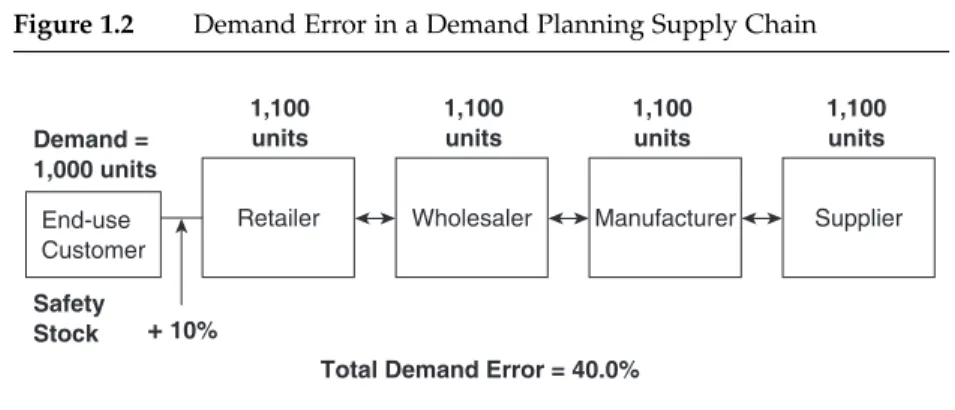
This example allows us to introduce the supply chain concept of demand planning, which is the coordinated flow of derived and dependent demand through companies in the supply chain.Demand planning is illus-trated in the Figure 1.2 supply chain. End-use customer demand is the same as in Figure 1.1, and the retailer’s faith in its forecast (+/−10%) is unchanged. What has changed, however, is that the other companies in
End-use Customer Demand = 1,000 units Retailer 1,100 units + 10% Wholesaler 1,210 units Manufacturer 1,331 units + 10% Supplier 1,464 units + 10% + 10% Safety Stock
Total Demand Error (Safety Stock) = 110.5% Figure 1.1 Demand Error in a Traditional Supply Chain
the supply chain are no longer even attempting to forecast the demand of their customers. Rather, each member of the supply chain receives point-of-sale (POS) demand information from the retailer, and the retailer’s planned ordering based upon this demand. Combined with knowledge of the time-related order flows through this supply chain, each company can plan its processes (including orders to its suppliers). The result is that each member of the supply chain carries 1,100 units in inventory—a system-wide reduction in inventory of 13.81% from 5,105 (i.e., 1,100 for the retailer, 1,210 for the wholesaler, 1,331 for the manufacturer, and 1,464 for the supplier) to 4,400 (i.e., 1,100 each for the retailer, wholesaler, manufacturer, and supplier). More importantly, the inventory carried for forecasting error (safety stock) drops from 1,105 to 400 (from total demand error of 110.5% to 40.0%)—for a reduc-tion of total demand error inventory (safety stock) of 63.8% ((1,105–400)/1,105).
Notice, however, that the inventory reductions are not uniform across the supply chain. Whereas the supplier has a reduction in safety stock of 78.4% (from 464 to 100), the retailer experiences no reduction. In fact, the further up the supply chain, the greater the safety stock reduction. This illustrates a paradox of demand planning in any sup-ply chain—the very companies that are most needed to implement supply chain demand planning (i.e., implementation of systems to share with suppliers real-time POS information held by retailers) have the least economic motivation (i.e., inventory reduction) to cooperate. This leads us to the concept of demand management.
Demand managementis the creation across the supply chain and its markets of a coordinated flow of demand.Much is implied in this seemingly
End-use Customer Retailer 1,100 units + 10% Safety Stock Wholesaler 1,100 units Manufacturer 1,100 units Supplier 1,100 units
Total Demand Error = 40.0% Demand =
1,000 units
simple definition. First, the traditional function of marketing creates demand for various products, but often does not share these demand creating plans (such as promotional programs) with other functions within the company (forecasting, in particular), much less with other companies in the supply chain.
Second, the role of demand management is often to decrease demand. This may sound counter-intuitive, but demand often exists for company products at a level management cannot realistically (or profitably) fulfill. Demand management implies an assessment of the profit contribution of various products and customers (all with capac-ity constraints in mind—including the capaccapac-ity of all components in the BOM), emphasizing demand for the profitable ones, and decreas-ing demand (by lessendecreas-ing marketdecreas-ing efforts) for the unprofitable ones. Finally, as we mentioned earlier, considerable supply chain savings can result from demand planning, but the rewards are not always con-sistent with the need to obtain collaboration from all companies in the supply chain. Thus, an aspect of demand management is supply chain relationship management,which is the management of relationships with supply chain partners to match performance with measurements and rewards so that all companies in the supply chain are fairly rewarded for overall sup-ply success (measured as cost reduction and increased customer satisfaction).
A Model of Supply Chain Demand Management
This leads us to an overall model of the role of demand manage-ment, demand planning, and sales forecasting management in the supply chain. Figure 1.3 illustrates these roles. Supply chain manage-ment has many aspects, only one of which is demand managemanage-ment. As previously illustrated, demand management encompasses the tradi-tional marketing functions, along with the coordination of marketing activities with other functions in the company and the supply chain. However, the traditional demand creation role of marketing is tem-pered in demand management by a desire to coordinate the flow of demand across the supply chain (demand planning) and creating incen-tives for supply chain partners to help manage those flows (supply chain relationship management). Demand planning is concerned with the coordination across the supply chain of derived and dependent demand. Sales forecasting management (which is the primary focus of this book, but within the overall perspective of Figure 1.3) is concerned with the independent demand that occurs in any supply chain.
Sales forecasting management is about the management of the sales forecasting function within an organization. It is about recognizing that, although the function is typically called sales forecasting, we are really trying to forecast demand—that is, we want to know what our customers demand so we can plan on achieving sales at or near that level.
Sales forecasting involves the proper use of various techniques, both qualitative and quantitative, within the context of corporate infor-mation systems, to meet the myriad of needs of the sales forecast users and to manage this entire process. To manage these multidimensional aspects, we have to understand each in turn and the management structures in which sales forecasting must operate. These will be the topics of this book. Before going any further, however, we should understand exactly what we mean by sales forecasting and the area with which it is often confused, planning.
Supply Chain Management Marketing / Supply Chain Relationship Management Demand Management Demand Planning Sales Forecasting Management Figure 1.3 Demand Management in Supply Chain Management
For the purposes of this book, we will define a sales forecast as a projection into the future of expected demand, given a stated set of environmental conditions. This should be distinguished from opera-tional plans, which we will define as a set of specified managerial actions to be undertaken to meet or exceed the sales forecast. Examples of operational plans include production plans, procurement plans, and distribution plans. Both the sales forecast and the opera-tional plans should be distinguished from the sales target, which we will define as sales goals that are established to provide motivation for sales and marketing personnel.
Notice that our definition of a sales forecast does not specify the technique (quantitative or qualitative), does not specify who develops the forecast within the company, nor does it include managerial plans. The reason for this is many companies confuse the functions of forecasting, planning, and target-setting. Operational plans for the level of sales to be achieved should be based upon the forecast of demand, but the two management functions should be kept separate. Similarly, target-setting should be done with a realistic assessment of expected future demand in mind, and this assessment comes from the sales forecast. In other words, the functions of planning and target-setting should be informed by forecasts of demand, but should not be confused with sales forecasting.
Notice that these definitions imply different performance measures for sales forecasts than for operational plans. Because the purpose of sales forecasting is to make projections of demand given a set of speci-fied environmental assumptions, one of the key measures of sales fore-casting performance is accuracy of the forecast, and one of the key methods to explain variances in accuracy is how the environment varied from the one defined. This explanation is not intended to excuse forecast inaccuracy; rather, it is meant to help us understand the business environment and forecast more accurately in the future.
In contrast, the goal of operational plans is not accuracy, but rather to effectively and efficiently meet forecasted demand. In addition, while forecasts are meant to be accurate, targets are meant to be met or exceeded. A mistake made by many companies is to con-fuse the sales forecast, where the objective is accuracy, with the sales target, where the objective is to at least meet, and hopefully exceed, the goal or quota. In other words, companies should never be guilty of confusing forecasting with the firm’s motivational strategy.
IN SALES AND OPERATIONS PLANNING (S&OP)
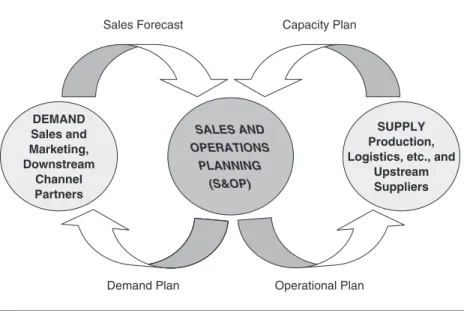
In many companies, sales forecasting is an integral part of a critical process for matching demand and supply that is sometimes referred to as Sales and Operations Planning (S&OP). Figure 1.4 offers a simplified picture of how sales forecasting contributes to the S&OP process. As seen in Figure 1.4, an enterprise can be thought of as consisting of two primary functions: a demand function and a supply function. Demand is the responsibility of sales and marketing. In many companies, the sales organization is responsible for generating and maintaining demand from large end-user customers, or from wholesale or retail channel partners. Marketing is usually responsible for generating and maintaining demand from end consumers. Supply is the responsibility of a number of functions, including manufacturing, procurement, logistics or distribution, human resources, and finance. It is also the responsibility of a variety of suppliers, who must provide raw materi-als, component parts, and packaging. The S&OP process provides a “junction box” where information can flow between the demand side and the supply side of an enterprise.
As shown in Figure 1.4, critical input to the S&OP process is the sales forecast, which is, as defined above, the projection into the future of expected demand. The sales forecast should originate in the demand side of the enterprise, because it is the demand side of the enterprise (i.e., sales and marketing) that is responsible for generating demand and that should have the best perspective on what future demand will be. In addition to the sales forecast, which originates in the demand side of the company, another critical input to the S&OP process is a capacity plan. Acapacity plan is a projection into the future about what supply capabilities will be, given a set of environmental assump-tions. This input is provided by the supply side of the enterprise and documents both long- and short-term supply capabilities. The process that occurs inside the S&OP process—the junction box—is the match-ing of future demand projections (i.e., the sales forecast) with future supply projections (i.e., the capacity plan).
Out of the S&OP process come two critical plans, the operational plan and the demand plan. As discussed above, the operational plan consists of manufacturing plans, procurement plans, distribution plans, and human resource plans. These various operational plans can be short-term in nature, such as a monthly production schedule. They
can be long-term in nature, such as extended contracts for raw materi-als, or even plans to expand manufacturing capacity. The other critical plan that emerges from the S&OP process is the demand plan, which involves sales and marketing making plans about what should be sold and marketed and when, given the supply capabilities of the firm. As mentioned above, demand plans may involve suppressing demand for products or services that are capacity constrained, or shifting demand from low-margin products to high-margin items.
Other authors have discussed how to effectively manage the S&OP process within organizations (see, for example, Lapide 2002), and such discussion is beyond the scope of this book. It is important, however, to understand the critical role that sales forecasting plays in the overall planning activities of the firm. Without accurate and cred-ible estimates of future demand, it is imposscred-ible for organizations to effectively manage their supply chains.
WHY IS A SALES FORECAST NEEDED?If we can simply set a sales goal and expect marketing and sales to exceed it, why do we even need a sales forecast in the first place? This
SALES AND OPERATIONS PLANNING (S&OP) SUPPLY Production, Logistics, etc., and
Upstream Suppliers DEMAND Sales and Marketing, Downstream Channel Partners
Sales Forecast Capacity Plan
Operational Plan Demand Plan
is a question many managers ask and often answer incorrectly (i.e., we do not need a forecast), to their eventual sorrow.
The correct answer is that every time we develop a plan of any kind, we first make a forecast. This is true of individuals, as well as profit and non-profit companies, government organizations, and in fact, any entity that makes a plan. It can be as simple as planning what we will wear tomorrow. When we decide to lay out wool slacks and a sweater for the next day, we are forecasting that the weather will be cool. If we add an umbrella to our ensemble, we are forecasting rain. The plan was predi-cated upon the forecast, whether we consciously thought about it or not. This is not much different from a company making financial plans based on expected sales and the costs of meeting those sales. The trick is to not get caught in the trap of making “inadvertent sales forecasts.” Inadvertent sales forecasts are made when we are so intent on devel-oping the plan that we simply assume what sales will be, rather than giving any concentrated thought and analysis to the market conditions that will be necessary to create this level of sales.
One great example of such an inadvertent forecast came from a manufacturer in the grocery products industry. The owner of the com-pany explained to us that the sales plan called for an increase in sales of 5% for the next year. However, we had also been told that this industry in this country was not growing and that any attempt to grab market share from the competition was only met by counter moves that caused greater promotional expenditures, but no shift in market share. “Wait a minute,” we said to the owner. “How can industry size not change, market share not change, but sales grow? It does not take a math major to figure out that this is not going to work.” The answer was that management would simply have to motivate everyone to work harder to achieve the (mathe-matically impossible) plan. Of course, it is obvious what happened—no amount of motivation can overcome an impossible situation, and the sales plan was not achieved. It was not achieved because it was based on an inadvertent and uninformed forecast. This is also a classic example of management confusing forecasting, planning, and target-setting. In this case, no reasonable forecastwould predict a 5% increase in sales. The 5% increase should have been seen for what it was—a stretch goal.
Let’s look at one more example. A large regional distributor of food products to restaurants develops an elaborate annual profit plan. Hundreds of person-days go into the development of this plan, but it always starts with such comments as, “We need profits to increase next year by 6%. Let’s figure out how much sales have to be to achieve that
goal.” Notice that the term “goal” sneaked into that quote. Where these executives should have started was to ask about market and environ-mental conditions facing the company during the planning horizon and what levels of sales could be expected based upon these condi-tions. The plan then becomes one of determining what marketing and sales efforts will be necessary to meet and exceed these projections to a level necessary to achieve the profit plan. The plan cannot drive the forecast; it has to be the other way around.
Thus, one of our goals in this book it to help managers see the importance of the sales forecast as input to their plans and to under-stand how these sales forecasts can and should be developed. To do this, as a first step we should talk about the sales forecast needs of the primary managerial functions within an organization. In other words, what do marketing, sales, finance/accounting, production/purchasing, and logistics each need from the sales forecast as input to their plans? To answer this question, we will first define the related concepts of sales forecasting level, time horizon, time interval, and form—mainly because different management functions require different levels, hori-zons, intervals, and forms of sales forecasts.
The sales forecasting levelis the focal point in the corporate hierar-chy where the forecast is needed. A corporate forecast, for instance, is a forecast of overall sales for the corporation. The sales forecasting time horizongenerally coincides with the time frame of the plan for which it was developed. If, for instance, we continue the example just given, a corporate plan may be for the next two years and, thus, we need a sales forecast for that two-year time horizon. The sales forecasting time inter-val generally coincides with how often the plan is updated. If our two-year corporate sales plan must be updated every three months (not an unusual scenario), we can say the level is corporate, the horizon is two years, and the interval is quarterly. The sales forecasting form is what needs to be forecast or planned. Some functions need to know what physical units are to be produced and/or shipped, while other func-tions need to know the dollar equivalents of these units, and other functions need to plan based upon total pounds or cubic volume. These constitute the forms a sales forecast (and a plan) can take.
Sales Forecasting Needs of Marketing
Marketing is typically concerned with the success of individual products and product lines the company offers to its customers. This
concern usually manifests itself in annual plans (updated monthly or quarterly) of marketing efforts for new and existing products. The marketing plans, in turn, usually involve projected product changes, promotional efforts, channel placement, and pricing. To develop these plans, marketing needs sales forecasts that take these various efforts into account and project sales (typically in dollars) at the product and product line level for an annual time horizon and with monthly or quarterly intervals.
Sales Forecasting Needs of Sales
Sales, as a management function, is typically concerned with setting goals for the individual members of the sales force and moti-vating those salespeople to exceed these goals. The territories of sales-people can be defined in numerous ways (geographically, by industry, by customer, by product, and so on), and it is this definition that helps define the sales forecasting level for a particular sales function.
The horizon and interval are largely defined by the time frame of the compensation plan. If, for instance, certain salespeople receive their commissions based upon quarterly sales and the sales manager must plan for the next four quarters, the horizon will be one year and the interval will be quarterly. At the very least, most companies’ sales management functions need sales forecasts (in dollars) at the territory level, with typical horizons of one or two years and monthly or quarterly intervals.
Sales Forecasting Needs of Finance/Accounting
Among other responsibilities, finance (with input from the accounting function) is charged with the job of projecting cost and profit levels and capital needs, based upon a given sales forecast. These “profit plans” are typically annual intervals and can extend anywhere from 1 year to 5 years. Although individual product sales are an input to this planning process (because costs of different prod-ucts may vary), the concern with the profit plan is typically at the corporate or divisional level. Thus, the sales forecasting needs of finance are typically dollar sales at the corporate, to division, to product line level; the horizon is typically one to five years; and the interval is quarterly or monthly (depending on how often the plan is updated).
Sales Forecasting Needs of Production/Purchasing
Production and purchasing must concern themselves with two very different unit forecasts, one long term and one very short term. The long-term forecast is used for planning the development of suppliers and plant and equipment, which can take several years. Because these long-term plans are dependent upon the mixture of sales of products to be made in the plant, the forecast must be at the individual product level (often in forecasting terminology referred to as stock keeping units [SKUs]). The horizon is dependent upon the time it takes to bring new suppliers, plant, and equipment on line and, thus, can range from one to three years. The interval for updating these forecasts is typically quarterly.
The short-term production/purchasing forecast is based upon the needs of the production planning schedule, which can range from one to six months (depending upon the raw materials purchasing order cycle) and needs a specific detail of which products to produce. Thus, this short-term production/purchasing sales forecast is at the SKU level, has a horizon seldom greater than six months, and has intervals ranging from daily to monthly.
Sales Forecasting Needs of Logistics
Because it is the responsibility of logistics to move the products (SKUs) that production creates to the specific locations where they will be demanded, logistics needs sales forecasts at the SKU by location (often termed SKUL) forecast level. The horizons for these forecasts are also two-fold: one for the long-term plan and one for the short-term plan. The long-term plan is needed to develop the storage facilities in various locations (thus, forecasts in units and cubic volume) and the transportation equipment to move the products between these facilities (thus, forecasts in weight). Again, the horizon is determined by the time it takes to bring these facilities on line. A large chemical company, for instance, needs an 18-month planning horizon to contract the construction of new rail cars to move its various products. Thus, the long-term logistics plan has as input a forecast with an 18-month horizon.
Across companies, these long-term horizons can range from monthly for rented facilities or contract carriage to several years for customized facilities or transportation equipment built specifically for the company. Because both are often used, the interval is typically
monthly. Because the plans are influenced by specifically what is moved and where, the level is product by location (SKUL).
Short-term logistics plans are concerned with specific decisions of what products to move (expressed in units, cube, and weight) to what locations and when. Thus, the sales forecast has a horizon defined by the order cycle time from the plant to the facility and, thus, can be extremely short-term (often monthly, weekly, or in some extreme cases, daily forecasts). The intervals for updating these forecasts are also typically at the monthly or weekly (and sometimes even daily) level.
SUMMARY: ORGANIZATIONALSALES FORECASTING NEEDS
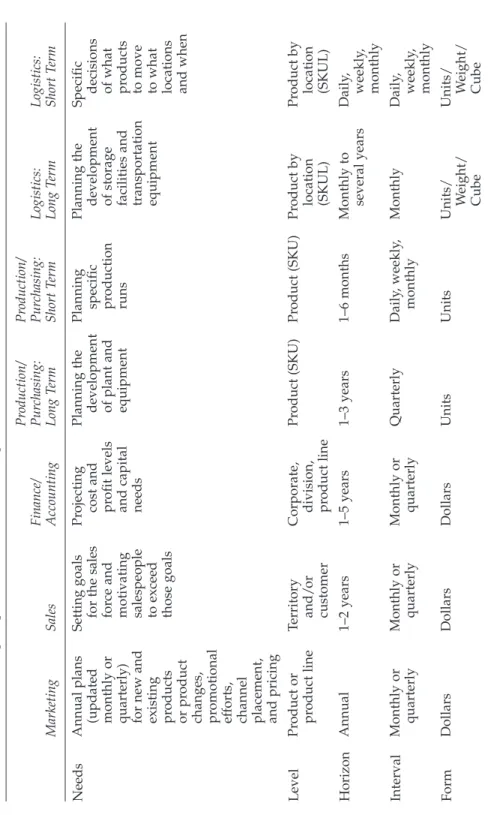
As Table 1.1 illustrates, not only are sales forecasts needed as input to all the plans of the organization, but different functions within the organization have very different needs from the sales forecast as input to their plans. It is the purpose of the book to help the reader understand these different needs and how advanced companies solve these disparate needs through the sales forecasting management tools of techniques, systems, management approaches, and performance measurement.
THE TOOLS OF SALES FORECASTING MANAGEMENTJust as any modern management function must use state-of-the-art techniques to get the job done, such as available information systems, the latest in managerial processes and approaches to managing the function, and methods of measuring and rewarding performance, so must sales forecasting management. Although we briefly review each of these areas here, we devote much more attention to each in later chapters.
Sales Forecasting Techniques
A myriad of forecasting techniques exists and is available to the sales forecasting manager. In fact, it often seems that too many techniques are available and that the choice decision can border on information over-load (at last count, there were over 70 different time series techniques
17
Logistics: Short T
erm
Specific decisions of what pr
oducts
to move to what locations and when
Pr
oduct by location (SKUL)
Daily , weekly , monthly Daily , weekly , monthly Units/ W eight/ Cube Logistics: Long T erm
Planning the development of storage facilities and transportation equipment Product by location (SKUL) Monthly to several years Monthly Units/ W
eight/ Cube Pr oduction/ Pur chasing: Short T erm Planning specific pr oduction runs Pr oduct (SKU) 1–6 months Daily , weekly , monthly Units Pr oduction/ Pur chasing: Long T erm
Planning the development of plant and equipment Product (SKU) 1–3 years Quarterly Units
Finance/ Accounting Projecting cost and pr
ofit levels
and capital needs
Corporate, division, pr
oduct line
1–5 years Monthly or quarterly Dollars
Sales Setting goals for the sales for
ce and
motivating salespeople to exceed those goals
T
erritory and/
o
r
customer
1–2 years Monthly or quarterly Dollars
Marketing Annual plans (updated monthly or quarterly) for new and existing pr
oducts
or pr
oduct
changes, promotional efforts, channel placement, and pricing
Pr
oduct or product line
Annual Monthly or quarterly Dollars
Needs Level Horizon Interval Form
T
able 1.1
For
ecasting Requir
ements of V
alone). Such a scenario often causes decision makers to give up any hope of understanding the full field of techniques and consistently use only one or two with which they are familiar, whether those techniques are appropriate for the forecasting situation or not.
Fortunately, this scenario can be considerably simplified. To under-stand the sales forecasting technique selection process, the sales fore-casting manager needs to understand the characteristics of a relatively small set of groups of techniques, and realize in what situations each group of techniques works best. Once the technique group has been chosen, selection of the specific technique to use is a much more straightforward decision—a decision that can be influenced by a great deal of research that has looked at which techniques are most often used and when they work best (Mentzer & Kahn, 1995).
The common categories for sales forecasting techniques are based upon whether the technique uses subjective or statistical analysis; whether endogenous data (a forecasting term that means only using the history of sales, not any other factors that may explain changes in sales) or exogenous (a forecasting term meaning the use of other data, such as price or promotional changes, competitive actions, or economic measures, to explain the changes in sales) data are analyzed; and whether these data are actually analyzed by the forecaster or simply input to a technique for calculation of the forecast. These characteristics of forecasting techniques lead to three broad categories of sales fore-casting techniques: time series (both fixed-model and open-model technique categories), regression (also called correlation, and incor-rectly called causal, techniques), and judgmental (also called qualita-tive or subjecqualita-tive techniques). We will briefly discuss each here, but much more detail on each category and the specific techniques within each category will be discussed in later chapters.
Open-Model Time Series Techniques. Open-model time series (OMTS) techniques—Box-Jenkins, for example—build a forecast model after analyzing sales history data to identify its existing pat-terns (because only sales history is examined, OMTS are considered endogenous techniques). OMTS techniques are based on the interrela-tionship of four data patterns: level, trend, seasonality, and noise. Level
is a horizontal sales history, or what sales patterns would be if there was no trend, seasonality, or noise. Trendis a continuing pattern of a sales increase or decrease, and that pattern can be a straight line or a curve. Seasonality is a repeating pattern of sales increases and
decreases, such as high sales every summer for air conditioners, high sales of agricultural chemicals in the spring, or high sales of toys in the fall. The point is that the pattern of high sales in certain periods and low sales in other periods repeats itself every year. Noise is random fluctuation—that part of the sales history that a time-series technique cannot explain. This does not mean that the fluctuation could not be explained by regression analysis or judgment, it means that the pattern has not happened consistently in the past, so the time series technique cannot pick it up and forecast it.
OMTS techniques analyze the data to determine which patterns exist and then build an appropriate forecast equation. This is in con-trast to fixed-model time series (FMTS) techniques that have fixed equations that are based upon a prioriassumptions that certain patterns do or do not exist in the data. Although much academic research has been conducted with OMTS, these techniques have been of little use in business because of their complexity and limited incremental accuracy over FMTS or subjective techniques (Mentzer & Kahn, 1995).
Most OMTS forecasting techniques require extensive training and considerable analysis time. Throughout the analysis, numerous subjective decisions must serve as input to the model. Thus, the accuracy of the forecast is largely influenced by the abilities of the user. Many periods of sales history (often more than 48 data periods) are required to obtain usable results. Because of these factors, OMTS techniques are used when substantial sales history, but little exoge-nous data, is available, personnel are well trained in the use of the technique, and only when a limited number of forecasts are to be made. Because, for these reasons, OMTS techniques have seen so little applicability in sales forecasting, we will spend little time discussing them later in the book.
Fixed-Model Time Series Techniques. In short-range (horizons of less than six months) product forecasting, rapid changes in sales and the large number of forecasts needed often dictate the use of a simple, yet adaptable, technique. Fixed-model time series (FMTS) forecasting techniques can be effectively used in such instances. FMTS techniques use the same four patterns (level, trend, seasonality, and noise) as OMTS techniques. However, FMTS techniques arrive at a forecast by assuming that one or more of these patterns exist in a previous sales history and by projecting these patterns into the future. Exponential smoothing is a common FMTS technique.
FMTS techniques are often simple and inexpensive to use and require little data storage. Many of the techniques also adjust very quickly to changes in sales conditions and, thus, are appropriate for short-term forecasting. FMTS techniques, however, will probably be less accurate than correlation analysis if the forecaster uses a FMTS technique that assumes data patterns do not exist that are, in fact, in the sales history. Simple exponential smoothing assumes, for example, that the sales history consists of only level and noise. If trend and seasonality exist in the sales history, simple exponential smoothing will consistently err in its forecast.
As we mentioned earlier, more than 70 different FMTS techniques exist. However, a discussion of less than ten of these techniques will give the manager the necessary grasp of how these techniques work and which to use in any given situation. We concentrate on these representative techniques in Chapter 3, Time Series Techniques.
Regression (Correlation) Analysis.Correlation analysis is a statistical approach to forecasting that seeks to establish a relationship between sales and exogenous variables that affect sales, such as advertising, product quality, price, logistics service quality, and/or the economy. Past data on exogenous variables and sales data are analyzed to deter-mine the strength of their relationship (for instance, every time the price goes up, sales of the product go down is a strong negative rela-tionship). If a strong relationship is found, the exogenous variables can then be used to forecast future sales. Corporate, competitive, and economic variables can be used together in a correlation analysis fore-cast, thus giving it a broad environmental perspective. Correlation analysis can also provide statistical value estimates of each variable. Thus, variables contributing little to the forecast can be dropped.
Correlation analysis is potentially one of the most accurate fore-casting techniques available, but it requires a large amount of data. These large data demands also make correlation analysis slow to respond to changing conditions. Understanding the advantages and disadvantages of correlation analysis helps to clarify when it is more use-ful, as in longer-range (greater than six-month time horizon) corporate-level forecasts for which a large amount of data on exogenous variables is readily available.
Qualitative (Subjective) Techniques. The previously discussed tech-niques (open-model time series, fixed-model time series, and correlation
analysis) are based upon the idea that historical demand may follow some patterns, and the goal of the technique is to identify and numeri-cally document those patterns, then project those patterns into the future. However, it is often the case that the future will not look exactly like the past. For example, there may be no historical demand data available, as is the case with new products. There may also be new conditions that arise, such as a changing competitive landscape or changes in distribution patterns, that make previous demand patterns less relevant. Thus, there is a need for qualitative, or subjective, fore-casting techniques. Subjective techniques are procedures that turn the opinions of experienced personnel (e.g., marketing planners, sales-people, corporate executives, and outside experts) into formal forecasts. An advantage of subjective techniques is that they take into account the full wealth of key personnel experience and require little formal data. They are also valuable when little or no historical data are available, such as in new product introductions.
Subjective forecasting, however, takes a considerable amount of key personnel time. Because of this drawback, subjective techniques are typically used as a part of long-range, corporate-level forecasting, or for adjustment purposes in short-range, product forecasting. For example, the forecast committee of one auto parts manufacturer with whom we have worked meets once a quarter to subjectively generate a three-year forecast and once a month to subjectively adjust the product forecasts by product line (for instance, all product forecasts in a particular product line may be raised by 3%). Individual product forecasts by inventory location, however, are left to an appropriate FMTS technique determined by the forecast managers. Individual product forecasts by the forecast committee would be a waste of valuable executive time.
Sales Forecasting Systems
This dimension of sales forecasting management encompasses the computer and electronic communications hardware and software used to develop, analyze, and distribute sales forecasts. It includes the storage, retrieval, and transfer of all information related to sales forecasting.
Systems sophistication can range from individual analyses of isolated databases, often called “islands of analysis,” to fully elec-tronically, integrated analysis and communication tools that facilitate development of the sales forecast. At the lower end of this scale,
companies have a number of separate information systems that are not interconnected. As a result, information that is transferred from one functional area to another is transferred via printed reports and often is not in a format nor sufficiently complete for what is needed by the receiving area. This information must be manually input to the receiv-ing function’s computer system and augmented by additional infor-mation from numerous sources. Because the systems are disjointed and complex, few people outside the information technology (IT) function understand the functionality of the systems.
At the more sophisticated end of this scale are companies with system-user interfaces that access a common data warehouse and where users in the various functional areas developing and using the sales forecasts have a complete understanding of the functionality of the systems. Companies at this end of the scale have implemented data exchange protocols, ranging from simple EDI to web-enabled interfaces, that facilitate forecasting collaboration with both key customers and suppliers.
Sales Forecasting Managerial Process and Approaches
The management of sales forecasting is concerned with how we organize and how we efficiently and effectively conduct the business of developing and using sales forecasts.
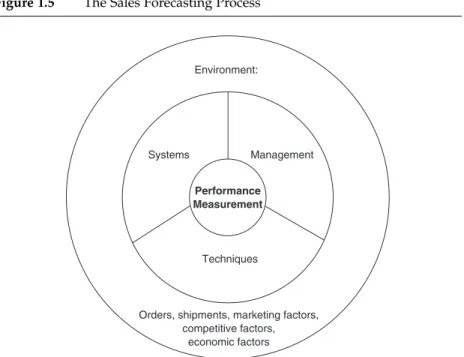
The Sales Forecasting Process. Figure 1.5 illustrates the components of the sales forecasting process. Linking the environmentin which the sales forecasting process exists and the resultant sales forecasting performanceare sales forecasting management, systems, and tech-niques. Sales forecasting management encompasses the approach taken to manage the sales forecasting process (discussed later in this section). Sales forecasting techniques encompass the selection between the time series, regression, and qualitative alternatives discussed in Chapters 3, 4, and 5, respectively. Sales forecasting systems (discussed in Chapter 6) are the analysis and communications templates that are laid over the sales forecasting management processes. How skill-fully a company coordinates this sales forecasting process ultimately determines the success of the sales forecasting function.
On the outer ring of Figure 1.5 is the environment in which the demand for the company’s products—and, consequently, the uncer-tainty faced by the sales forecasting function—exists. As one of the
questions that we address later in this chapter indicates, this environ-ment also encompasses the availability of a history of orders, ship-ments, or demand—that is, the data that can be used to help determine sales forecasts. The state of the economy and the level of competition in the industry and the supply chain, as well as possible competitive responses to company marketing policies (e.g., advertising) are also factors that impact the sales forecasting process.
Sales Forecasting Management Approaches. Based on our research and experience with hundreds of companies, we have found that com-panies typically organize their sales forecasting function in one of four ways: the independent approach, the concentrated approach, the negotiated approach, or the consensus approachto sales forecasting management.
Furthermore, we have also found that the efficiency and effective-ness of a company’s sales forecasting organization depends on the degree of functional integration that exists within the company. The components of functional integration are defined as Forecasting C3—
Communication, Coordination, and Collaboration. Communication is Performance Measurement Management Systems Techniques Environment:
Orders, shipments, marketing factors, competitive factors,
economic factors Figure 1.5 The Sales Forecasting Process
the written, verbal, and electronic information shared between the functional areas. Coordination is the formal structure and required meetings between two or more functional areas. Collaboration is an orientation among functional areas, and between a company and its key customers, toward common goal setting (in this case, common sales forecasting performance goals). The four managerial approaches, along with the degree of functional integration each approach entails, will now be discussed regarding the implications of these two concepts for the success of a company’s sales forecasting function.
Companies that use the independentapproach to sales forecasting tend to be quite naïve in their approach to organizing their sales fore-casting function. Each functional department in the company develops a sales forecast geared to its specific requirements; for example, finance develops a corporate-level dollar forecast 1 to 5 years out; production develops 6-month product item (SKU) forecasts for production sched-uling; logistics develops monthly product/location (SKUL) forecasts for distribution planning; and so forth.
The problem with this approach is not necessarily that each depart-ment develops a forecast in the format that fits its particular require-ments; rather the problem is the lack of functional integration that characterizes this approach. With the independent approach to sales forecasting management, there is little, if any, communication, no coor-dination, and no collaboration among the functional areas regarding the forecasting process. The lack of communication prevents input into each department’s forecasting process from perspectives other than their own, thereby hindering each department’s effort to develop an accurate forecast. How can production or logistics possibly develop an accurate forecast for their production or distribution planning with-out being aware of marketing’s promotional schedule? Even more important, however, is the fact that the absence of coordination and collaboration among the departments developing separate forecasts hinders the departmental sales forecasts from being used as a contri-bution to the planning functions in various departments and as an aid to corporate-level planning.
The concentrated form of sales forecasting organization assigns forecasting responsibility to one department, e.g., logistics or market-ing. This managerial approach at least partially addresses the commu-nication and coordination aspects of functional integration more effectively than the independent managerial approach. Oral, written, and, sometimes, electronic communications generally take place
among the various departmental users of the sales forecast developed by the responsible department, and these communications provide information that can be incorporated into the official forecast. Furthermore, formal meetings are frequently scheduled, or there is some structure in place for distributing the official forecast to all departments. However, this managerial approach does not address the collaboration aspect of functional integration, as evidenced by the fact that the forecast developed by the responsible department is heavily biased by that department’s forecasting and planning requirements. If logistics is the department responsible for developing the sales fore-casts, the forecasts will be at the SKUL level, with a time horizon of one month to several years, and daily, weekly, or monthly updating inter-vals. If marketing develops the sales forecasts, they will be in product/ brand dollars or product line dollars, with a yearly time horizon and monthly or quarterly updates.
Furthermore, we have found that sales forecasting concentrated in marketing tends to lead to capacity unconstrained forecasts. In other words, marketing tends to develop forecasts that are solely based on market demands and does not consider the capacity constraints of the production and/or logistics systems. Conversely, sales forecasting concentrated in an operations area (production or logistics) tends to develop forecasts that are based upon capacity constraints and ignores the demands of the company’s markets. The problem with either form of concentration is that, because of the lack of collaboration among departments, the orientation of the sales forecasts tends to ignore information from other departments, and the form of the official sales forecast ignores the requirements of some departments. Therefore, this managerial approach seldom provides effective input to all the planning processes.
A company that uses a negotiated approach to manage its sales forecasting process develops sales forecasts in each functional depart-ment, then assembles representatives from each department during each forecasting interval to negotiate an official sales forecast for each forecasting level and horizon. In terms of functional integration, the negotiated approach overcomes some of the bias problems of the con-centrated approach by encouraging communication and, particularly, coordination among departments. However, because each department initially develops its own sales forecasts to bring to the negotiation process, there is no real collaboration in terms of the forecasting process; that is, the development of the sales forecasts is not guided by
common goals and information, but by the separate goals, information, and requirements of each individual department.
In addition, the negotiation process intrinsic to this approach is plagued with political pressures among departments that can bias the negotiated forecast. Remember, each department brings its own fore-cast to the negotiation process, a forefore-cast that was developed on the basis of its own requirements. Particularly when there is a power imbalance among departments that allows one or more departments to dominate the negotiation process, these separate orientations can bias the final forecasts.
In the consensusform of sales forecasting organization, a commit-tee consisting of representatives from each functional department, as well as a member designated to be in charge of the forecasting commit-tee, is responsible for developing sales forecasts using input from each department. A genuine consensus forecasting approach incorporates high levels of Forecasting C3—communication, coordination, and
col-laboration—by asking the forecasting committee to develop a common forecast (one that is based not on the individual forecasts of different departments, but rather on informational input from each department to develop a common forecast). This degree of functional integration can assist in overcoming the biased forecasts produced by the focus on individual departmental requirements in the concentrated form of sales forecasting organization. If commitment to common goals, i.e., collaboration, is sufficiently evolved, this can aid in overcoming the political problems that tend to bias forecasts developed under the nego-tiated form of sales forecasting organization. Companies contemplating this managerial approach should understand that it is resource inten-sive, in terms of both time and personnel. However, if a company has the resources to encourage the necessary functional integration, the consensus form of organization can result in superior sales forecasts.
Processes and Systems. Many companies with which we have worked have asked us to advise them on the sales forecasting system they should use. Invariably, when we are asked this question, we ask them to describe the management process by which the sales forecasts are developed. Often, there is no answer—the company is trying to develop a systems solution without an understanding of the management process! This is a backward approach to sales forecasting management. In many companies, there is no one person who understands the entire sales forecasting process. Many individuals understand bits and
pieces of the process, but few understand the entireprocess. Without such an understanding, it is not possible to design and implement a system to augment this process.
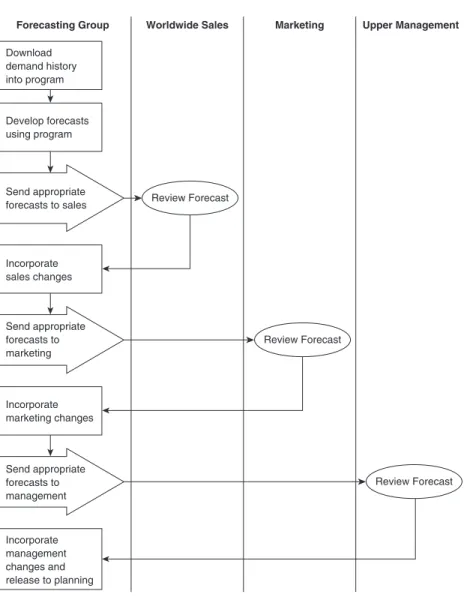
In fact, the sales forecasting system should be a communication and analysis framework (template) that can be laid over the sales fore-casting management process. The company has to define the process first. An example should help illustrate this concept.
One global manufacturer of industrial products with which we have worked has multiple product lines sold all over the world by a direct sales force. Many of these products are sold to customers in numerous industries. Thus, we may have a product that is sold by one salesperson in Australia to a particular industry and another salesperson in Europe who sells the same product for a different use in another industry. This has led to a worldwide sales force that specializes in certain products, in certain industries, and in certain geographic areas.
Given this multifaceted complexity of the sales forecasting environ-ment, the company wanted a system that allowed development of a quantitative forecast, with qualitative adjustment by geographic terri-tory by industry by the sales force, with adjustment by product line by marketing managers, and with overall planning adjustments by upper management. This led to a definition of their sales forecasting process that is illustrated in Figure 1.6. The process starts with a computer model-generated forecast. These sales forecasts are broken down by product, industry, and geographic territory and sent electronically to the sales force. Each salesperson is provided with a quarterly report of economic and market trends in their industry and asked to make adjustments to the quantitative forecasts. When adjustments are made, the salesperson is asked to electronically record the logic behind their adjustments.
The total of all sales force adjustments is electronically transmitted back to the forecasting group, where the totals are combined. Each marketing manager then receives the adjusted forecasts for his or her product lines and markets. Again, the marketing managers are asked to qualitatively adjust these forecasts and record their logic.
These forecast adjustments are received and compiled by the fore-casting group and transmitted to management for adjustment at the division level. Once the upper management adjustments are received, the forecasts are broken down to the level and horizon appropriate for each functional planning area and transmitted electronically for use in planning.
Notice that this process has laid over it the systems template to:
• Transmit all information electronically,
• Pull information necessary for the computer model forecasts from appropriate data sources within the company and the supply chain, Download demand history into program Develop forecasts using program Incorporate sales changes Incorporate marketing changes
Forecasting Group Worldwide Sales Marketing Upper Management
Incorporate management changes and release to planning Send appropriate
forecasts to sales Review Forecast
Send appropriate forecasts to marketing Review Forecast Review Forecast Send appropriate forecasts to management
• aggregate and disaggregate to the level and horizon needed at each step, and
• compare each forecast and adjustment with the actual demand once it is received.
Sales Forecasting Performance Measurements
Just what are the relevant performance measurements for the sales forecasting function? The obvious answer is accuracy, and the advan-tages and disadvanadvan-tages of various forms of measuring forecasting accuracy will be discussed in Chapter 2. However, Chapter 2 will also address the concept of multidimensional metrics of sales forecasting performance measurement. There is more to sales forecasting perfor-mance than just accuracy. For example, what about the inexpensive product that holds a monopoly position in its market (i.e., customers cannot get it anywhere else)? The cost of overstocking this product is low, and the potential to lose customers due to temporary unavailabil-ity is also low. Why should we spend much money on accurately fore-casting this product, when the penalties for inaccuracy do not exist? Although this example is rather extreme to make the point, the fact still remains that desired accuracy in sales forecasting should be weighed against the dimensions of the supply chain costs, the revenue-generating potential, and the customer satisfaction implications of inaccuracy. In the next chapter we will explore this topic further to provide clear-cut measures of all the dimensions of sales forecasting performance.
SALES FORECASTING MANAGEMENT QUESTIONSBefore we address any more aspects of sales forecasting management, however, there are numerous questions (listed in Table 1.2) that you should ask yourself about your company. How to find the answers to these questions is largely contained in the experience of the people within the company and in the remaining chapters of this book, but they must be answered for each company in its unique way, and they should be constantly re-examined while reading the remainder of this book. The answers to these questions should tell you much about how the sales forecasting function should operate to efficiently and effec-tively help your company conduct the business of developing and using sales forecasts.
Narrow or Broad Customer Base
The first question to ask is: Is your company’s customer base narrow or broad? A narrow customer base simply means the sales of the company (regardless of the unit or dollar volume) go to a relatively small number of customers. An example of a broad customer base is the consumer markets served by packaged goods manufacturers, while an example of a narrow customer base is that served by a manufacturer of specialized industrial components. One company with which we have worked produces a product that is only sold directly to automo-bile assembly plants in North America. Thus, even though this is a company with annual dollar sales in excess of $50 million, its customer base is only 56 customers (the number of automobile assembly plants in North America).
The narrower the customer base, the more likely a company can rely on direct customer contact information to produce more qualita-tively oriented sales forecasts. In the example just given, the sales fore-casting function calls the production scheduling department of each of its 56 customers each month and asks for the schedule of car produc-tion (which is sent by EDI). From this informaproduc-tion, a very accurate, qualitative sales forecast can be derived.
Contrast this example with a large manufacturer of consumer products that sells to all of the 65 million households in the United States. Such a broad customer base makes any appreciable customer contact impossible (even if we surveyed 1,000,000 homes, we would Table 1.2 Sales Forecasting Management Questions
1. Customer base narrow or broad?
2. Data characteristics (shipments/sales/demand, age, detail, external data, quality)?
3. Number of forecasts (horizons and intervals, products, channels, locations)?
4. Number of new products? 5. Regional differences? 6. Seasonality?
7. Sophistication of personnel (systems and forecasting) and systems? 8. Sales forecasting budget?
still have only contacted about 2% of our customers!) and causes more reliance on quantitative forecasting (i.e., time series and regression) techniques. Thus, the narrower the customer base, the more a company can rely on direct customer contact qualitative techniques (discussed in Chapter 5), and the broader the customer base, the more reliance will be placed upon quantitative techniques (Chapters 3 and 4), with qual-itative adjustments.
Data Characteristics
The second set of questions concerns the type, availability, and quality of data:
1. What data are available to your company for use in the fore-casting function? Specifically, do you have data available on shipment history, order history, and/or end consumer demand (e.g., point of sale data)?
2. How old are the data (i.e., how many weeks, months, or years are contained in the data)?
3. At what level of detail are the data?
4. What data external to your company can you obtain to facilitate sales forecasting (i.e., external factors that might impact product demand for use in a regression model)?
5. How accurate are the available data?
Sales, Shipments, and Demand. The answer to the first question determines what we will forecast. It is important to distinguish between sales, shipments, and demand. Although called sales forecast-ing, this function is really about forecasting demand. Demandis what our customers would buy from us if they could; salesis our ability to accept orders from our customers; and shipmentsis what our operations system can actually deliver to our customers. Suppose, for example, that demand for one of our products next month is 10,000, but our salespeople (due to uncertainty about delivery time commitments) can only confirm 9,000 units in actual sales. Suppose, further, that our production/logistics system can only produce and deliver 7,500 units of those ordered (sold). If our information system only collects and records shipments, our historical record of this month will show
shipments of 7,500 units, and nothing else! What will be lost is the fact that we actually sold 1,500 units more, and could have sold 2,500 units more, if the capacity to produce and deliver had been available. With only this shipments history available to the forecasting function, we will continue to forecast “demand” to be 7,500 units per month, never recognize the lost sales each month, and never increase capacity to capture this extra true demand. However, if the only data we have is a history of what we have shipped in the past, this is the data we will have to use until more meaningful demand data can be gathered—but the commitment should be immediately made to begin gathering this more accurate sales and demand data.
Data Age.How much historical data are available largely defines the sales forecasting techniques that can be used. If less than one year of data are available, only the more simplistic fixed-model time series techniques (FMTS) are going to work—any time series technique that considers seasonality needs at least two years of data (so it can identify two complete seasonal patterns) to begin forecasting effectively. Open-model time series techniques (OMTS) typically need at least four years of data, while regression typically needs at least five periods of data for each variable in the regression equation (so if we had sales as one vari-able, and advertising, price, and trade promotions as the three indepen-dent variables, we would need at least 4 variables times 5, or 20 periods of data). Of course, many companies have such a short life cycle for their products that many of these techniques are simply never practical.
Data Level.The level of detail of the data refers to the planning detail required. If we are forecasting annual dollar sales by product line for a marketing plan, data at the same level and time horizon are fine. However, if we also need weekly unit forecasts by SKUL, annual prod-uct line data will be of little help. Because we need sales forecasts for a number of different functional plans, data at the level of detail corresponding to each of these planning needs is necessary.
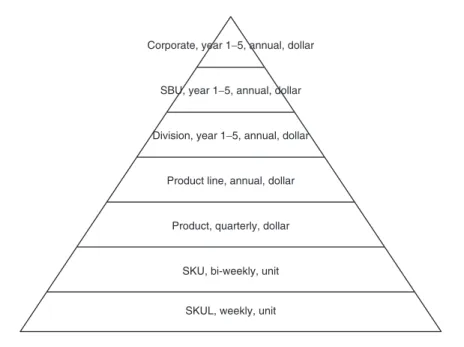
This level of detail is called the forecasting hierarchy, and is defined as all the planning levels and time horizons/intervals at which forecasts are needed. Figure 1.7 illustrates one such forecasting hierar-chy for a company with which we have worked. In this company, the logistics function needs forecasts by week, by stock keeping unit by location (SKUL); the production and purchasing functions needs fore-casts bi-weekly, by stock keeping unit; the sales function needs dollar
sales by product by quarter; the marketing function needs annual dollar sales for the next year by product line and for the next five years by division; and finance needs annual dollar sales for the next five years by strategic business unit (SBU) and for the overall corporation. The data detail required for developing a forecast for each of these functions must match each planning level, horizon, and interval. The figure is drawn as a triangle to represent the number of forecasts that are required at each level of the hierarchy. Many more forecasts are required at the SKUL level than at the SKU level, more at the SKU than at the product level, and so on.
External Data Availability.Finally, the availability of data on factors external to the actual sales history determines whether or not regres-sion analysis can be used. If the only data available are concerned with sales, shipments, or demand history, there is no information on which to build a regression model. To complete the variable selection stage discussed in Chapter 4, historical data on factors such as price, advertising, trade and consumer promotions, economic activity, and competitive actions (for just a few examples) must be available.
Corporate, year 1−5, annual, dollar
SBU, year 1−5, annual, dollar
Division, year 1−5, annual, dollar
Product line, annual, dollar
Product, quarterly, dollar
SKU, bi-weekly, unit
SKUL, weekly, unit Figure 1.7 Example of a Forecasting Hierarchy