Calhoun: The NPS Institutional Archive
Theses and Dissertations Thesis Collection
2008-12
Implementation and utilization of Section 1206 of the
National Defense Authorization Act for FY2006 and beyond
Wickline, Samuel J.
Monterey California. Naval Postgraduate School http://hdl.handle.net/10945/3729
NAVAL
POSTGRADUATE
SCHOOL
MONTEREY, CALIFORNIA
THESIS
IMPLEMENTATION AND UTILIZATION OF SECTION 1206 OF THE NATIONAL DEFENSE AUTHORIZATION
ACT FOR FY2006 AND BEYOND
by
Samuel J. Wickline December 2008
Thesis Advisor: Richard Doyle
Second Reader: Don Summers
REPORT DOCUMENTATION PAGE
Form Approved OMB No. 0704-0188
Public reporting burden for this collection of information is estimated to average 1 hour per response, including the time for reviewing instruction, searching existing data sources, gathering and maintaining the data needed, and completing and reviewing the collection of information. Send comments regarding this burden estimate or any other aspect of this collection of information, including suggestions for reducing this burden, to Washington headquarters Services, Directorate for Information Operations and Reports, 1215 Jefferson Davis Highway, Suite 1204, Arlington, VA 22202-4302, and to the Office of Management and Budget, Paperwork Reduction Project (0704-0188) Washington DC 20503.
1. AGENCY USE ONLY (Leave
blank)
2. REPORT DATE
December 2008
3. REPORT TYPE AND DATES COVERED
Master’s Thesis
4. TITLE AND SUBTITLE:
Implementation and Utilization of Section 1206 of the National Defense Authorization Act for FY2006 and Beyond
6. AUTHOR(S) Wickline, Samuel J.
5. FUNDING NUMBERS
7. PERFORMING ORGANIZATION NAME(S) AND ADDRESS(ES)
Naval Postgraduate School Monterey, CA 93943-5000
8.PERFORMING ORGANIZATION REPORT NUMBER
9. SPONSORING / MONITORING AGENCY NAME(S) AND ADDRESS(ES)
N/A
10. SPONSORING / MONITORING AGENCY REPORT NUMBER 11. SUPPLEMENTARY NOTES The views expressed in this thesis are those of the author and do not reflect the official
policy or position of the Department of Defense or the U.S. Government.
12a. DISTRIBUTION / AVAILABILITY STATEMENT Approved for public release; distribution is unlimited
12b. DISTRIBUTION CODE
13. ABSTRACT (maximum 200 words)
Section 1206 of the 2005 National Defense Authorization Act established a new program giving DOD the authority to spend up to $200M to train and equip foreign militaries to undertake counterterrorism or stability operations. This is the first major DOD authority for training and equipping other military forces. DOD previously trained and equipped foreign military forces through State Department programs considered cumbersome and ineffective. In FY2006, DOD and the State Department were given about $100 million for nine projects involving 15 countries, projects directed, administered and supervised by the Defense Security Cooperation Agency. In some cases, Section 1206 has proven effective in countering terrorist activity in countries receiving assistance. Opponents of the policy argue that it inappropriately gives DOD power to affect foreign policy. In the last three years, DOD has bypassed State Department approval on some projects that may have been in the interest of national security but not foreign policy. Opponents of the policy want assurance that DOD is held accountable for how they implement Section 1206 and that Section 1206 projects are in accordance with U.S. foreign policy. However, when terrorists hide among the local population, the military must interact with civilians blurring the line between defense and foreign policy.
15. NUMBER OF PAGES
75
14. SUBJECT TERMS
Section 1206
Global Train and Equip Authority
16. PRICE CODE 17. SECURITY CLASSIFICATION OF REPORT Unclassified 18. SECURITY CLASSIFICATION OF THIS PAGE Unclassified 19. SECURITY CLASSIFICATION OF ABSTRACT Unclassified 20. LIMITATION OF ABSTRACT UU
NSN 7540-01-280-5500 Standard Form 298 (Rev. 2-89)
Approved for public release; distribution is unlimited
IMPLEMENTATION AND UTILIZATION OF SECTION 1206 OF THE NATIONAL DEFENSE AUTHORIZATION ACT FOR FY2006 AND BEYOND
Samuel J. Wickline
Captain, United States Marine Corps B.S., United States Naval Academy, 2003
Submitted in partial fulfillment of the requirements for the degree of
MASTER OF SCIENCE IN MANAGEMENT
from the
NAVAL POSTGRADUATE SCHOOL December 2008
Author: Samuel J. Wickline
Approved by: Richard Doyle Thesis Advisor
Don Summers Second Reader
Terry Rea, Acting Dean
ABSTRACT
Section 1206 of the 2005 National Defense Authorization Act established a new program giving DOD the authority to spend up to $200M to train and equip foreign militaries to undertake counterterrorism or stability operations. This is the first major DOD authority for training and equipping other military forces. DOD previously trained and equipped foreign military forces through State Department programs considered cumbersome and ineffective. In FY2006, DOD and the State Department were given about $100 million for nine projects involving 15 countries, projects directed, administered and supervised by the Defense Security Cooperation Agency. In some cases, Section 1206 has proven effective in countering terrorist activity in countries receiving assistance. Opponents of the policy argue that it inappropriately gives DOD power to affect foreign policy. In the last three years, DOD has bypassed State Department approval on some projects that may have been in the interest of national security but not foreign policy. Opponents of the policy want assurance that DOD is held accountable for how they implement Section 1206 and that Section 1206 projects are in accordance with U.S. foreign policy. However, when terrorists hide among the local population, the military must interact with civilians blurring the line between defense and foreign policy.
TABLE OF CONTENTS
I. INTRODUCTION...1
A BACKGROUND ...1
B. SCOPE AND METHODOLOGY ...2
1. Scope...2
2. Methodology ...2
C. ORGANIZATION OF STUDY ...2
II. THE NEED FOR SECTION 1206 ...5
A. INTRODUCTION...5
B. OVERVIEW OF THE STATE DEPARTMENT’S FOREIGN MILITARY SALES AND FINANCING PROGRAM ...6
1. Origins and Evolution of FMS and FMF...7
2. Issues ...8
C. OVERVIEW OF THE STATE DEPARTMENT’S INTERNATIONAL MILITARY EDUCATION AND TRAINING PROGRAM ...8
1. Origins and Evolution ...9
2. Activities...9
3. Issues ...9
D. FLEXIBILITY OF SECTION 1206...10
E. LEGISLATIVE ORIGIN...10
F. CHAPTER SUMMARY...12
III. THE 1206 PROCESS...13
A. SECTION 1206 PROCESS ...13
1. Conditions...13
2. DOD and State Department Cooperation...13
3. Defense Security Cooperation Agency Role in Section 1206 Authority...14
4. Congressional Notification ...14
5. Project Submission...15
B. THE PERSPECTIVE OF THE EUROPEAN COMMAND ...15
C. THE PERSPECTIVE OF THE UNDER SECRETARY OF DEFENSE FOR POLICY ...18
D. CHAPTER SUMMARY...20
IV. OPPOSITION ARGUMENT AND ISSUES ...21
A. INTRODUCTION...21
B. TESTIMONY OF DR. GORDON ADAMS ...21
C. EMBASSY LEVEL IMPLEMENTATION ISSUES...24
D. CHAPTER SUMMARY...25
V. LEGISLATIVE EVOLUTION OF SECTION 1206 ...27
B. THE PERSPECTIVE OF THE SECRETARY OF DEFENSE ...27
C. REPORT TO CONGRESS ...29
D. LEGISLATIVE MODIFICATIONS FROM FY2007 TO FY2009...30
1. FY2007 ...30
2. FY2009 ...31
E. CHAPTER SUMMARY...31
VI. THE IMPLEMENTATION OF SECTION 1206 ...33
A. INTRODUCTION...33
B. OPERATIONAL IMPACTS OF SECTION 1206 FUNDED PROJECTS IN LEBANON ...33
1. Background ...34
2. Section 1206 Usage...35
3. Operational Impact...36
a. M113 Spare Parts...36
b. 2.5 Ton Truck Delivery ...37
c. Helicopter Repair and Maintenance ...37
d. Small Arms Ammunition ...38
e. Communications Equipment ...38
C. OPERATIONAL IMPACTS OF SECTION 1206 FUNDED PROJECTS IN PAKISTAN...38
1. Background ...39
2. Section 1206 Usage...39
3. Operational Impact...40
a. Night Helicopter Operations...40
b. Body Armor ...40
c. Maintenance and Repair ...41
d. Gunship Support ...41
D. OPERATIONAL IMPACTS OF SECTION 1206 FUNDED PROJECTS IN YEMEN ...41
1. Background ...42
2. Section 1206 Usage...42
3. Operational Impact...43
a. Equipment for Border Forces...43
b. Maintenance Support...44
E. OPERATIONAL IMPACTS OF SECTION 1206 FUNDED PROJECTS IN SÃO TOME AND PRINCIPE...44
1. Background ...44 2. Section 1206 Usage...45 3. Operational Impact...45 a. Ability to Observe ...45 b. Ability to Identify...46 c. Ability to React ...46 F. CHAPTER SUMMARY...46
VII. SUMMARY AND CONCLUSION ...47
B. CONCLUSION ...48
C. AREAS FOR FURTHER RESEARCH...48
APPENDIX A ...49
APPENDIX B ...51
APPENDIX C ...55
APPENDIX D ...57
BIBLIOGRAPHY ...59
LIST OF TABLES
Table 1. FY2006 Lebanon 1206 Cases ...35
Table 2. FY2007 Lebanon 1206 Cases ...36
Table 3. FY2006 Pakistan 1206 Cases...39
Table 4. FY2007 Pakistan 1206 Cases...40
Table 5. FY2006 Yemen 1206 Cases...42
Table 6. FY2007 Yemen 1206 Cases...43
I. INTRODUCTION
A BACKGROUND
Section 1206 of the National Defense Authorization Act for Fiscal Year 2006 gave the President authority to spend DOD funding to build the partnership security capacity of foreign military and security forces. Section 1206 was to be used by the DOD to better respond to certain urgent needs and emerging threats.1
Section 1206, commonly referred to as Global Train and Equip Authority, provides the President the authority to direct the Secretary of Defense to conduct or support programs to build the capacity of foreign military forces to perform counterterrorism operations or to participate in or support military and stability operations in which U.S. armed forces participate.2
Section 1206 authorizes funding to be used for training, supplies and equipment and is funded within the DOD operations and maintenance account. Section 1206 of the National Defense Authorization Act for Fiscal Year 2006 is significant because it is the first major DOD authority to be used expressly to train other military forces.3
Section 1206 funding has become a somewhat controversial DOD foreign assistance program. Many believe that Section 1206 gives the DOD too much power, and that the authority should lie within the State Department. One argument states that Section 1206 has only dealt with a few isolated emergency requirements, and that most of the funding has been used for projects that could have been supported via the normal budget process for State funded security assistance programs.4 Another issue with
1 Nina M. Serafino, The Department of Defense Role in Foreign Assistance: Background, Major Issues, and Options for Congress. CRS Report for Congress. August 25, 2008. p. 73.
2 Ibid., p.74.
3 Nina M. Serafino, Section 1206 of the National Defense Authorization Act for FY2006: A Fact Sheet on Department of Defense Authority to Train and Equip Foreign Military Forces. CRS Report for Congress. June 3, 2008. p. 1.
4 Nina M. Serafino, The Department of Defense Role in Foreign Assistance: Background, Major Issues, and Options for Congress. CRS Report for Congress. August 25, 2008. p. 76.
Section 1206 is that private contractors are primarily used to conduct the training. Analysts question why the program rests with the DOD if U.S. troops are not actually conducting the training. However, the main argument against Section 1206 is that it is a step toward the militarization of civilian authority, arguing that it gives the DOD the power to affect foreign policy.5
B. SCOPE AND METHODOLOGY
1. Scope
The primary objective of this thesis is to identify the policy and implementation issues surrounding Section 1206. In addition, I will also discuss the policy objectives of Section 1206, its legislative evolution, the key players involved, and the impact that it has had globally.
2. Methodology
To address the objective of this thesis, I studied the legislation that gave rise to and subsequently modified Section 1206 in the House and Senate defense authorization bills for FY2006, 2007, and 2009. I also reviewed reports for Congress, testimony to Congress and Government Accountability Office reports. In addition, I researched many news articles and governmental reports that address the topic of Global Train and Equip Authority.
C. ORGANIZATION OF STUDY
To address Section 1206, I first reviewed the State Department programs that preceded Global Train and Equip Authority. These programs laid the foundation for Section 1206, but were also the reason the authority was created. The next topic discussed the flexibility of Section 1206 compared to the State Department programs.
5 Nina M. Serafino, The Department of Defense Role in Foreign Assistance: Background, Major Issues, and Options for Congress. CRS Report for Congress. August 25, 2008. p. 77.
Section 1206 was created to fill the gaps of its predecessor programs. To round off the first section, the legislation that established Section 1206 of the FY2006 National Defense Authorization Act was discussed.
The next section of the thesis discusses the process of Section 1206. It examines what agencies are involved with the authority and how they interact. Testimony by the Commander of U.S. European Command and the Undersecretary of Defense for Policy is presented discussing the authority’s values to global security.
The third section of the thesis will examine the issues raised by opponents of Global Train and Equip Authority. Section 1206 receives opposition because it is the first major DOD program that is authorized to conduct security assistance. Testimony by Dr. Gordon Adams of American University and a Senate Foreign Relations Committee report examine the authority and discuss legislative and implementation issues.
The next section of the thesis discusses the legislative evolution of Section 1206. The section begins with testimony by the Secretary of Defense discussing the positive elements of the authority and asking Congress to make the authority permanent and more robust. The section also examines the modifications in the legislation in the FY2007 and FY2009 defense authorization bills.
The last section of the thesis details the ground-level impact that Section 1206 has had. Four specific projects were chosen—Lebanon, Pakistan, Yemen, and São Tome and Principe—and examined by the types of materials they were granted and the impact it had on their security.
II.
THE NEED FOR SECTION 1206
A. INTRODUCTION
To understand why Section 1206 is needed, it is important to first understand the environment that was in play prior to its existence. During the Cold War, the U.S. put in place programs led by the State Department to help build partners and train foreign forces. These programs, still in place today, take years from inception to execution. In that era and until September 11, 2001, the long lead time was not as important as it became after 9/11.
In the post September 11, 2001 world, the ability to respond to emergent threats quickly became very important. Section 1206 allows the State Department and DOD to cooperate and put into action Global Train and Equip initiatives in a relatively short period of time. Global Train and Equip Authority helps build foreign partner capacity, which is critical to U.S. security. Building foreign partner capacity reduces stress on U.S. forces by training foreign forces to handle conflicts on their own, which may prevent U.S. military interventions in the future. Also, foreign forces can be more effective in their own country than U.S. forces, because they have a deeper understanding of the language and culture. The U.S. military does not have the reach to deny terrorists sanctuary everywhere in the world, so building partners helps deny terrorists areas to work. Also, terrorists occupy spaces in many countries with which the U.S. is at peace, so it is vital that the U.S. work with these countries to reduce terrorist safe havens.6
Global Train and Equip Authority is considered by Combatant Commanders to be the single most important tool for building partner operational capacity, shaping the environment and countering terrorism outside of Iraq and Afghanistan.7
6 DOD FY 2009 Budget Request Summary Justification. February 4, 2008. p. 101. 7 Ibid., p. 102.
B. OVERVIEW OF THE STATE DEPARTMENT’S FOREIGN MILITARY SALES AND FINANCING PROGRAM
U.S. Foreign Military Sales (FMS) is the principle vehicle through which the U.S. government makes sales of weapons and associated equipment and training to friendly foreign nations.8 Basically, a purchasing country enters into a contract specifying the price to be paid for the military equipment being obtained. The U.S. government then procures the items from a U.S. manufacturer and pays the manufacturer with the payment from the purchasing country. Foreign Military Financing (FMF) permits loans or forgiven payments to countries that may have problems paying for needed weapons and military equipment.9
The annual budget justification for FMS and FMF is formulated primarily by the State Department, with specific input on specific country accounts provided by the DOD. DOD handles the implementation of the FMS cash and credit.10
The State Department has the primary responsibility of determining which nations are to receive assistance based on national policy. The Arms Export Control Act (AECA) specifies which conditions must be met for a country to be eligible to purchase defense articles from the United States. The President also determines a country’s eligibility based on national security interests. Also, countries that enter into a contract give binding commitments to use the articles for self defense and are not allowed to sell items to third parties without the consent of the U.S. government.11
The responsibility of for implementing FMS programs rest with the Defense Security Cooperation Agency (DSCA). The DSCA Security Assistance Officers who manage the programs on the ground are located in the U.S. embassies.12
8 Nina M. Serafino, The Department of Defense Role in Foreign Assistance: Background, Major Issues, and Options for Congress. CRS Report for Congress. August 25, 2008. p. 53.
9 Ibid., p. 53. 10 Ibid., p. 53. 11 Ibid., p. 53. 12 Ibid., p. 54.
1. Origins and Evolution of FMS and FMF
FMS began during the Cold War, primarily to help the allies of the U.S. rebuild their military defenses after World War II. The U.S. had three core rationales for military assistance:
To enhance the ability of allied and friendly countries to defend themselves against external aggression or internal subversion by Communist or unfriendly forces.
To enhance bilateral security relationships to deter aggression against allied and friendly nations.
To express tangible U.S. support for political actions of allied and friendly nations that the United States sought to encourage.13
Over time, our European allies grew stronger and they stopped receiving military aid and started paying cash for major weapons systems through FMS. Since the Cold War, FMS and FMF have been instrumental in supporting U.S. national security interests. When FMS began, only the more industrialized allies of the United States participated in it, while the Military Assistance Program (predecessor to FMF) gave aid to the less affluent countries. Most of the countries that used to receive aid now pay cash for military purchases, which include Turkey, Greece, South Korea, the Philippines and Taiwan.14
Today, the principle goals of FMS remain the same, but the number of purchasing countries has increased. This increase has been significant in Middle Eastern countries, especially those that produce oil.15
13 Nina M. Serafino, The Department of Defense Role in Foreign Assistance: Background, Major Issues, and Options for Congress. CRS Report for Congress. August 25, 2008. p. 54.
14 Ibid., p. 54. 15 Ibid., p. 55.
The primary countries to receive FMF in the last thirty years are Egypt and Israel. In FY2006, Egypt and Israel received approximately $1.3 billion and $2.3 billion, respectively. Additionally, both countries had their repayments waived by the U.S. government.16
2. Issues
There have not been any significant problems with the management of FMS or FMF between the State Department and DOD over the years. The delineation of responsibility and authority is clear, and implementation has generally worked smoothly. Both departments would agree that more funding is necessary to provide articles to countries with limited financial resources.17
In the past few years, DOD has argued that FMS/FMF lack the flexibility to respond to rapidly changing environments. An FY2009 budget document stated that traditional security assistance (including FMS/FMF) takes three to four years from concept to execution.18 DOD indicates that this lead time is too long to meet emerging threats.
C. OVERVIEW OF THE STATE DEPARTMENT’S INTERNATIONAL MILITARY EDUCATION AND TRAINING PROGRAM
The International Military Education and Training Program (IMET) falls under the policy authority of the State Department and is implemented by the DOD through the DSCA. IMET provides opportunities for foreign military personnel to attend a variety of U.S. military educational institutions and training courses. The policy decisions
regarding which countries will be eligible for IMET programs lie primarily with the State Department, with input from the DOD.19
16 Nina M. Serafino, The Department of Defense Role in Foreign Assistance: Background, Major Issues, and Options for Congress. CRS Report for Congress. August 25, 2008. p. 55.
17 Ibid., p. 55. 18 Ibid., p. 55. 19 Ibid., p. 56.
1. Origins and Evolution
IMET was formed as an outgrowth of the Military Assistance Program, and was to provide exclusively for various forms of military training to friendly foreign nations. In 1990, the changing political-military environment warranted a new direction for the traditional IMET program. Congress noted that there was a need for a program to bring an increased emphasis on enhancing the skills and professionalism of civilian and military leaders of foreign nations. Therefore, Expanded IMET (E-IMET) was formed. E-IMET was focused on training foreign civilian and military officials in managing and administering military establishments and budgets; creating and maintaining effective military judicial systems and military codes of conduct, including observance of
internationally recognized human rights; and fostering greater respect for the principle of civilian control of the military.20
2. Activities
The IMET program funds a variety of training programs conducted by the DOD. These include the various war colleges in the DOD that focus on national security policy and the politico-military aspects of defense policies and programs. Another major category of IMET is the professional military education sector. There are numerous courses available for professional military education. Some of these are the U.S. Army Infantry School, the Air Force Institute of Technology and the service command and staff colleges. E-IMET also offers courses in the United States. These include the Defense Resource Management Institute, the Center for Civil-Military Relations and the Naval Justice School.21
3. Issues
As with FMS/FMF, there have not been any significant problems between the State Department and DOD over the division of management tasks associated with
20 Nina M. Serafino, The Department of Defense Role in Foreign Assistance: Background, Major Issues, and Options for Congress. CRS Report for Congress. August 25, 2008. p. 56.
IMET. Again, there is a clear delineation of responsibilities and authorities, and implementation has worked smoothly. However, the DOD argued that IMET—as with FMS/FMF—lacks the flexibility to respond to rapidly changing environments.22
D. FLEXIBILITY OF SECTION 1206
Because FMS/FMF and IMET were created during the Cold War, they are not an optimal fit for the current operational environment. Traditional security assistance— FMS/FMF and IMET—takes between three and four years from concept to execution. Global Train and Equip Authority allow a response to urgent and emergent threats or opportunities in six months or less.23
Under traditional security assistance programs, a country receives roughly the same amount of assistance from year to year, unless there are new needs and changes to the strategic environment. However, FMS/FMF and IMET are not efficient in reacting to emergent requirements. With Global Train and Equip programs, countries must compete for funds and priority goes to the countries with the highest security interests to the U.S. Therefore, there is no entitlement that countries receive any funding, so competitiveness drives flexibility as well.24
E. LEGISLATIVE ORIGIN
In 2005, as part of its FY2006 budget submission, DOD requested Global Train and Equip Authority.25 Neither the House nor the Senate had provided for Global Train and Equip Authority in the original bills passed by their respective Armed Services Committees. However, Senator Inhofe, the second ranking member of the Senate Armed Services Committee, proposed an amendment to the National Defense Authorization Act
22 Nina M. Serafino, The Department of Defense Role in Foreign Assistance: Background, Major Issues, and Options for Congress. CRS Report for Congress. August 25, 2008. p. 58.
23 DOD FY 2009 Budget Request Summary Justification. February 4, 2008. p. 103. 24 Ibid., p. 103.
25 Nina M. Serafino, The Department of Defense Role in Foreign Assistance: Background, Major Issues, and Options for Congress. CRS Report for Congress. August 25, 2008. p. 73.
for FY2006 for “military activities of the Department of Defense, for military construction, and for defense activities of the Department of Energy” for “building the partnership security capacity of foreign military and security forces.”26
The amendment to the bill gave the President the authority to build the capacity of partner nations to “disrupt or destroy terrorist networks, close safe havens, or participate in or support United States, coalition, or international military or stability operations.”27 The President was allowed to provide equipment, supplies, services, training, and funding to support the capacity building process. The amendment called for $750 million per fiscal year to fund the program with a requirement that Congress was to be notified at least seven days prior to initiation of a capacity building program. The bill authorized armies, guard, border security, civil defense, infrastructure protection, and police forces to be trained or equipped.28
The bill was passed by the Senate with only a few modifications to the Inhofe amendment. The bill proposed that Congress be notified at least 15 days prior to a project’s initiation, vice seven from the amendment. Also, the bill proposed that Section 1206 should follow the authorities and limitations in the Foreign Assistance Act of 1961.29
There was no similar provision for Global Train and Equip Authority in the House Armed Services Committee bill. In the Conference Report on defense authorization, further modifications to this authority were made. The report pointed out that in the past this type of authority had always been performed by the Department of State. The Conference Report further defined the capacity building programs and made it clear that the United States had to be a participant in each project. The report limited the resources that could be applied to the program to equipment, supplies, and training. The provision also required that the Secretary of Defense jointly formulate with the Secretary of State any program conducted under the authority. The report limited the authority to
26 United States Congress. Senate. S.1042. SA 2432. 27 Ibid.
28 Ibid.
two years, and required the President to submit a report to Congress explaining the strengths and weaknesses of the current laws governing building partnership capacity.30 The report also stated that the authority was a pilot program and reauthorization depended on the report to Congress from the President. Following the passage of the Conference Report, Section 1206 became law.
F. CHAPTER SUMMARY
This chapter discussed the need for Global Train and Equip Authority, as well as its legislative origin. FMS/FMF and IMET are traditional State Department programs on which Section 1206 is loosely based. FMS/FMF and IMET were formed towards the beginning of the Cold War to handle a Cold War environment. Section 1206 is more flexible and intended to provide more capability to deal with the urgent threats that the U.S. faces in a post Cold War environment.
30 United States Congress. House. National Defense Authorization Act for Fiscal Year 2006. Conference Report.
III.
THE 1206 PROCESS
A. SECTION 1206 PROCESS
1. Conditions
The Section 1206 Process is meant for DOD and State Department cooperation in coordinating and conducting Global Train and Equip programs. Section 1206 requires that programs under its authority observe and respect human rights, fundamental freedoms and the legitimate civilian authority within that country. Global Train and Equip Authority cannot be used to provide assistance that is prohibited by any other provision of law. The authority also may not be used to provide assistance to a country that is prohibited from receiving such assistance by any other provision of law.31
Under Section 1206, the President may direct the Secretary of Defense to conduct programs to support a foreign country’s national military forces to aid them in conducting counterterrorist operations or participate in or support military and stability operations in which U.S. Armed Forces are a participant. The authority allows funding to be used for equipment, supplies and training. The FY2006 National Defense Authorization Act allowed the Secretary of Defense to use up to $200,000,000 of funds available for defense-wide operation and maintenance to conduct and support activities directed by the President under the limitations of Section 1206.32
2. DOD and State Department Cooperation
Global Train and Equip Authority must by jointly approved by the DOD and State Department. Section 1206 of the FY2007 John Warner National Defense Authorization Act delegated approval authority from the President to the Secretary of Defense with
31 Nina M. Serafino, Section 1206 of the National Defense Authorization Act for FY2006: A Fact Sheet on Department of Defense Authority to Train and Equip Foreign Military Forces. CRS Report for Congress. June 3, 2008. p. 2.
Secretary of State concurrence. DOD and State Department officials interpret the term “concurrence” to mean that the Secretary of Defense and the Secretary of State must approve all projects.33
3. Defense Security Cooperation Agency Role in Section 1206 Authority
The Defense Security Cooperation Agency (DSCA), as with FMS/FMF and IMET, is the management agency that provides security cooperation between the U.S. and foreign nations. The DSCA has security assistance officers at embassies that implement Section 1206 programs in the same way that other traditional State Department funded security assistance programs are implemented. The DSCA establishes terms and conditions of equipment transfers and provides fiscal oversight. At the embassy the security assistance officer is the point of contact to ensure delivery and proper use by the recipient country.34
4. Congressional Notification
The President is directed to provide a written copy to Congress of any directives given to the Secretary of Defense to conduct or support Global Train and Equip programs. No fewer than 15 days prior to a project occurring, the Secretary of Defense in coordination with the Secretary of State is required to submit to the congressional defense, foreign affairs, and appropriations committees a notice of the fundamentals of the project to be undertaken.35
Additionally, Congress directed the President to submit a report one year from the date of enactment examining the following issues:
33 Section 1206 Security Assistance Program—Finding on Criteria, Coordination, and Implementation. Government Accountability Office Report. February 28, 2007. p. 2.
34 Section 1206 Security Assistance Program—Finding on Criteria, Coordination, and Implementation. Government Accountability Office Report. February 28, 2007. p. 3.
The strengths and weaknesses of the Foreign Assistance Act of 1961, the Arms Export Control Act, and any other provision of law related to the building of the capacity of foreign governments or the training and equipping of foreign military forces.
The changes, if any, that should be made to the Foreign Assistance Act of 1961, the Arms Export Control Act, and any other relevant provision of law that would improve the ability of the United States Government to build the capacity of foreign governments or train and equip military forces.
The organizational and procedural changes, if any, that should be made in the State Department and DOD to improve their ability to conduct programs to build the capacity of foreign governments or to train and equip military forces.
The resources and funding mechanisms required to assure adequate funding.36
5. Project Submission
A normal Section 1206 submission follows this basic template:
Combatant Commander/Chief of Mission initiates request and completes proposal template.
Combatant Commander/Chief of Mission coordinates with their DOD/State Department counterpart and submits proposal through their chain-of-command. The Joint Staff, DOD, and State Department review and prioritize all proposals. The DSCA assesses executability and verifies cost estimates.
The Office of the Secretary of Defense Comptroller determines funding availability.
Proposals go to the Secretary of Defense and Secretary of State for approval. Upon approval, the proposals are submitted to the President.
Congress is notified within 15 days of execution of the project.37
B. THE PERSPECTIVE OF THE EUROPEAN COMMAND
During his April 7, 2006 testimony of General James L. Jones, then Commander of U.S. European Command, to the House Armed Services Committee regarding capacity building of foreign nations military’s, it was made clear what Global Train and Equip
36 National Defense Authorization Act for Fiscal Year 2006. H.R. 1815. 37 Sattler, LGEN John F. The View from the Joint Staff. (PP)
Authority could accomplish in the European Command area of responsibility. General Jones began his testimony by placing the funding and authority related to Section 1206 within the larger context of security cooperation in his area of responsibility:
When I testified before this committee last month, I stated that we based our strategies on the principle that it is much more cost-effective to prevent conflicts than it is to stop one once it’s started. I cannot overstate the importance of our theater security cooperation programs as the centerpiece to securing our Homeland from the irregular and catastrophic threats of the 21st Century. EUCOM’s programs represent a proactive approach to building partnership capacity with the intent of enabling emerging democracies to defend their homeland, defeat terrorist extremists, develop common economic and security interests, and respond to health crises such as potential pandemic influenza outbreaks.38
General Jones continued by speaking about the changing security landscape that has evolved since the end of the Cold War. The increasingly inter-connected world that we live in has compelled the U.S. to develop new strategies to deal with present day challenges and threats. The U.S. cannot afford to use the security cooperation tools developed for the Cold War environment. General Jones stated that three essential elements must be achieved in this security environment to be successful:
..timely intervention to unanticipated challenges that will help mitigate or prevent crises that are harmful to U.S. interests; the need to work closely with our friends and allies to enhance regional security; and institutional innovations that contribute to comprehensive coordination throughout the interagency and within the framework of the international community.39
General Jones believes that Global Train and Equip Authority will be the catalyst to security cooperation reform. He states that all of the Combatant Commanders are using a new approach by focusing on and addressing threats at their inception, which is called “Phase Zero.” Combatant Commanders are trying to eliminate conditions favorable to
38Gen James L. A. Jones, A Commander’s Perspective on Building the Capacity of Foreign Countries Military Forces. April 7, 2006. p. 1.
terrorist networks in their areas of responsibility. To combat these conditions, they are conducting counterterrorist operations and participating in or providing support to military and stability operations in which the U.S. is a participant.40
During his testimony, General Jones highlighted two European Command initiatives that would greatly benefit from Global Train and Equip Authority. The first initiative was the Gulf of Guinea Maritime Security Initiative. General Jones explained that the Gulf of Guinea has an ungoverned maritime environment that is easy for terrorists and criminals to operate. The coastal area is nearly 2,000 nautical miles long and largely uncontrolled, and corruption in the local, regional and national governments make the problem worse. The region lacks significant maritime and coastal security forces, and is not able to provide a deterrent to prevent criminal and malicious acts in the area. At the same time, in a parallel effort, the issues of poor governance, lack of legal infrastructure, and pervasive corruption must be addressed.41
The second initiative General Jones proposed was the Trans-Sahara Counterterrorism Initiative (TSCTI). TSCTI is the long-term interagency plan to combat terrorism in trans-Saharan Africa using the full range of political, economic, development and security tools. TSCTI was created due to concern about Islamic terrorist organizations operating in the Sahel region of Africa. The approach to combat these terrorist organizations is to build indigenous capacity and facilitate cooperation between the governments of the Sahel region. If this initiative is left unattended, political instability in Africa could require reactive and repeated interventions that could have a large price tag. However, for a small investment upfront to address the problem proactively, TSCTI has the potential to produce significant results.42
40 Gen James L. Jones, A Commander’s Perspective on Building the Capacity of Foreign Countries Military Forces. April 7, 2006. p. 1.
41 Ibid., pp. 4-5. 42 Ibid., pp. 5-6.
General Jones concluded his testimony as follows:
Section 1206 funding and authorities are important steps toward creating the kind of flexible, responsive, interagency programs we need for the 21st Century. These efforts support the long-term strategic objectives of the Global War on Terrorism by building understanding and consensus on the terrorist threat, laying foundations for future “coalitions of the willing,” and extending our country’s security perimeter.43
C. THE PERSPECTIVE OF THE UNDER SECRETARY OF DEFENSE FOR POLICY
The Honorable Eric Edelman, Under Secretary of Defense for Policy, also addressed the House Armed Services Committee on April 7, 2006. In the beginning of Mr. Edelman’s testimony, he referred to the National Security Strategy and the Quadrennial Defense Review. He pointed out that the National Security Strategy called for a transformation of America’s national security institutions and for strengthened alliances to defeat terrorism and prevent attacks against the U.S. The Quadrennial Defense Review stated that the ability of the U.S. to work with allies to influence the global environment is necessary in defeating terrorist networks. Mr. Edelman went on to say:
Sending our troops into harm’s way without competent partner military and security forces significantly increases the risks they face. The existence of capable, competent partners reduces stress on our military, as many Global War on Terrorism tasks are best accomplished by and with partner nations who know the local geography, language, and culture.44
Mr. Edelman went on to point out that it costs $90,000 to sustain a U.S. troop in theater, whereas it only costs $11,000 to support an Afghan troop or $40,000 for an Iraqi troop.45
43 Gen James L. Jones. A Commander’s Perspective on Building the Capacity of Foreign Countries Military Forces. April 7, 2006. p. 7.
44 Edelman, Eric. Testimony before the House Armed Services Committee on Train and Equip Authority. April 7, 2006.
He added that building partnership capacity was essential in reducing ungoverned areas, thus depriving terrorist organizations areas to operate. “The train and equip authorities created during the Cold War,” he said, “are ill-suited to the adaptive, asymmetric, non-state threats we face today.”46
Mr. Edelman noted that in October 2001, the President announced support for training Georgian forces to close terrorist safe havens along its borders. To do this, the U.S. used funds from seven different U.S. sources in two agencies as well as allied contributions. It took seven months to begin staff level training, nearly a year to begin tactical training, and the four battalions did not stand up until two and half years from inception. However, once the battalions were active they made significant contributions.47
Mr. Edelman praised the vision of Congress to initiate the Section 1206 Authority, but he listed the following challenges:
Section 1206 is limited to national military forces, when a variety of security and non-national military forces are on the front lines.
The authority comes from defense-wide operations and maintenance funds, which is a small portion of DOD operations and maintenance funds.
The authority is limited by numerous foreign assistance restrictions, and there is no waiver option for critical national security issues.
The authority is limited to $200 million, when the demand for projects is much higher than that.
The authority requires Presidential certification for each specific country, which is a time consuming process that detracts from the speed in which projects can be executed.
46 Eric Edelman. Testimony before the House Armed Services Committee on Train and Equip Authority. April 7, 2006.
After discussing the challenges, Mr. Edelman reported that DOD and the State Department had developed changes to the Global Train and Equip Authority and submitted them to Congress for consideration.48
Mr. Edelman closed his remarks by discussing the nature of the strategic environment:
In the wake of the Soviet Union’s collapse, fragile states were viewed primarily as a humanitarian issue. However, we now recognize fragile states and ungoverned areas as potential breeding grounds for terrorism and safe havens for global terrorist organizations. 1206 authority helps us address this reality by leveraging and coordinating the strengths of the Departments of State and Defense to build partnership capacity, win the Global War on Terrorism, and protect the lives of our active duty, reserve, and National Guard servicemen and women.49
D. CHAPTER SUMMARY
This chapter discussed the Section 1206 process and the need for it from the perspective of the commander of U.S European Command and the Undersecretary of Defense for Policy during the middle of FY2006. These two key players testified about the benefits of the authority as well as areas that could be modified to make the authority better. Section 1206 Authority has regulations and conditions that must be met, just like any other authority. Section 1206 projects are worked cooperatively between the DOD and Department of State, and approved projects are managed by the DSCA, who establishes the terms and conditions of transfers and provides fiscal oversight.
48 Eric Edelman. Testimony before the House Armed Services Committee on Train and Equip Authority. April 7, 2006.
IV.
OPPOSITION ARGUMENT AND ISSUES
A. INTRODUCTION
Since its inception, Section 1206 has been one of the most controversial DOD foreign assistance programs. The most widely argued point is that Global Train and Equip Authority gives DOD too much influence on foreign policy. Training and equipping the world’s armies is a major foreign policy decision. Whenever the U.S. decides to train and equip a foreign military, it is perceived as an endorsement of that military and a reflection of how the U.S. projects its power. Also, strengthening a military has the ability to affect the balance of power within a region or country.
In addition to foreign policy, there are also issues with how Section 1206 is implemented at the embassy level. For example, embassies have complained about the lack of communication concerning projects, and analysts question DOD use of contractors to conduct projects.
B. TESTIMONY OF DR. GORDON ADAMS
Dr. Gordon Adams, a Professor of International Studies at American University and a former OSD Comptroller, testified before the Senate Committee on Foreign Relations on April 24, 2008 concerning the national security toolkit. Dr. Adams pointed out that since 2001 there has been a continual expansion of security and foreign assistance programs being carried out through the DOD and that many of the programs parallel existing Department of State programs.50 It is also a growing concern that U.S. foreign assistance within DOD has grown from 7 percent in 1998 to nearly 22 percent in 2005.51
50 Gordon Adams. Rebalancing and Integrating the National Security Toolkit. April 24, 2008. p. 13. 51 Ibid., p. 14.
Dr. Adams noted that the DOD has sought permanent authority under Title 10 of the U.S. Code for Section 1206, has asked for increased funding authority, and wants to waive the restrictions of the Foreign Assistance Act. Dr. Adams asked the Foreign Relations Committee to look closely at programs such as Section 1206 before making them permanent, arguing that:
While it is understandable that DOD would focus on combating terrorist organizations, the central direction of U.S. foreign and national security policy is not the responsibility of the Defense Department. It is the responsibility of the White House and the Department of State.52
Dr. Adams also discussed the down-side risks of the increased role of DOD in foreign affairs. First, continuing the trend imposes a severe cost on the military. It expands their roles and missions when they are already fighting two wars and stretched thin. The governance and economic development of countries is not a military mission and requires additional operations, requirements and training of our forces. Also, the funding comes from DOD operating funds that compete for other initiatives that could support the troops in the field.53
Second, assuming that only the military has the funding and organization to carry out programs such as Section 1206 has the effect of further weakening the civilian toolkit that currently exists. The State Department’s development and diplomatic tools have been weakened by fiscal neglect and inattention, so expanding the military’s role makes the weaknesses of the civilian tools a self-fulfilling prophecy by becoming less organized, funded or staffed for the responsibilities they should have.54
Third, assigning programs such as Section 1206 to DOD reduces their visibility to Congress. Section 1206 makes up less than one percent of the approximate half trillion dollar DOD budget. Therefore, it will not receive the amount of oversight it would were it in the less robust International Affairs budget.55
52 Gordon Adams. Rebalancing and Integrating the National Security Toolkit. April 24, 2008. p. 14. 53 Ibid., p. 15.
54 Ibid., p. 15. 55 Ibid., p. 15.
Fourth, and possibly the most serious, using DOD to perform security assistance programs puts a uniformed face on U.S. international engagement. This expanded military role is not always viewed benignly outside the U.S. A growing foreign assistance role for our military could send the wrong message, one that could prove to be counter-productive in the long term.56
Dr. Adams went on to say that the DOD is a key implementer of security assistance, and they should continue to fill that role. However, they should be filling the role “under the policy direction and budget planning of America’s foreign policy agencies, which are responsible for and attentive to the overall relationship between the U.S. and the recipient country.”57 He also said the military’s role in security assistance should be limited to “short-term, humanitarian, emergency-based, and in areas where the security environment does not permit civilian operations.”58
Dr. Adams proposed that Global Train and Equip Authority should fall under the existing FMF program. An option for providing more flexible train and equip support would be to provide it through a drawdown—a special allocation of funds—by the President on the recommendation of the Secretary of State. Dr. Adams noted that this was a simple fix that would increase the flexibility of FMF and allow projects to be executed on shorter notice. Dr. Adams further argued that programs like Section 1206 should be a State Department responsibility because “the initiative should lie with the department that has responsibility for our overall relationship with other countries and can set the desirability of a T&E program in the framework of our broader strategic and foreign policy purposes.”59 Dr. Adams stated that in the end, foreign/security assistance requires a balance of DOD and State Department responsibilities. Currently, the balance
56 Gordon Adams. Rebalancing and Integrating the National Security Toolkit. April 24, 2008. p. 15. 57 Ibid., p. 16.
58 Ibid., p. 16. 59 Ibid., p. 17.
resides with the DOD, and it is critical for the State Department to get the balance back and provide the broader policy oversight for which the State Department should be responsible.60
C. EMBASSY LEVEL IMPLEMENTATION ISSUES
Global Train and Equip Authority has specific language in the bill that governs the conditions for its uses. However, due to a lack of oversight and coordination the authority was misused. In FY2006, only 5 of 14 proposals that were submitted to the State Department and DOD for review by combatant commands were coordinated with the ambassadors and embassy teams. In 9 of the 14 proposals, coordination took place before the State Department or DOD notified Congress.61 In the case of the Trans-Sahara Counter Terrorism Initiative, one embassy was not notified that it was to receive assistance until after the President announced it in May 2006. The ambassador subsequently opposed the assistance and prevailed. In the Gulf of Guinea initiative, the embassy team that covers Sao Tome and Principe did not know that its participation was being considered until late into the process. In this case, the ambassador supported the mission. In a third case, Equatorial Guinea, a problematic country that is a strategic point in the Gulf of Guinea, was on the original presidential list of Section 1206 countries before it was removed due to congressional scrutiny.62
There was also concern about using Section 1206 funding to train and equip nations with human rights violations. In 2006 and 2007, Global Train and Equip Authority was used to provide the Sri Lankan military with nearly $14 million. During this time frame, the Sri Lankan government was accused of supporting a non-governmental force known as the Karuna group that regularly attacked civilians. Simultaneously, the U.S. Congress was developing language to restrict security assistance to Sri Lanka. In 2007, Chadian security forces received $6 million in Global
60 Gordon Adams. Rebalancing and Integrating the National Security Toolkit. April 24, 2008. p. 17. 61 Section 1206 Security Assistance Program—Findings on Criteria, Coordination, and
Implementation. Government Accountability Office Report. February 28, 2007. p. 3.
62 U.S. Congress. Senate. Committee on Foreign Relations. Embassies as Command Posts in the Anti-Terror Campaign. December 15, 2006. p. 12.
Train and Equip Authority to create a light infantry rapid reaction force. At the same time, according to Amnesty International, those security forces were engaged in extrajudicial killings, politically motivated disappearances, rape, the use of child soldiers, and battles with a rebel armed group.63
Another issue deals with the appropriate mix of military and civilian foreign assistance. In the Caribbean, there is a threat of terrorists trafficking humans and equipment via boat/ship to the U.S. To mitigate this, the Dominican Republic received approximately $7.5 million in Section 1206 funding in FY2006 for interceptor boats and maritime communications systems and training, and $800,000 in U.S. funds went towards public diplomacy.64 In this case, the majority of the funding was used to fix a problem in the short term and only a small amount of funding was provided to fix the long term problem. The issue lies with how the U.S. divides its foreign/security assistance resources.
Others oppose Section 1206 because the program relies heavily on private contractors.65 The argument is that if Section 1206 is inherently defense related it should be conducted by military service members. In turn, if it can be solely conducted by private contractors then the State Department should be able to control the authority.66
D. CHAPTER SUMMARY
This chapter discussed the range of issues concerning Section 1206 from the policy level to the embassy/ground level. To some critics, Section 1206 is seen as contributing to a trend of militarization of diplomatic functions. Other opposition to Section 1206 stems from problems of implementation at the embassy level concerning communication and coordination between combatant commanders and embassy teams.
63 U.S. Defense Department’s Global “Train and Equip” Authority Lacks Critical Safeguards. Amnesty International. May 2008.
64 U.S. Congress. Senate. Committee on Foreign Relations. Embassies as Command Posts in the Anti-Terror Campaign. December 15, 2006. p. 12.
65 Nina M. Serafino. The Department of Defense Role in Foreign Assistance: Background, Major Issues, and Options for Congress. CRS Report for Congress. August 25, 2008. p. 77.
V.
LEGISLATIVE EVOLUTION OF SECTION 1206
A. INTRODUCTION
As a new piece of legislation and a pilot program, Section 1206 received much attention from Congress. At the same time, the Secretaries of Defense and State were looking at ways to optimize the way Global Train and Equip Authority could be utilized. This chapter describes the requests from the two Secretaries and the actual modifications that Congress agreed to.
B. THE PERSPECTIVE OF THE SECRETARY OF DEFENSE
On April 15, 2008, Secretary of Defense Robert M. Gates addressed the House Armed Services Committee regarding the challenges facing our national security apparatus. At the beginning of his testimony, he spoke about the flexibility of the Global Train and Equip Authority, the authority’s ability to respond to emerging threats and opportunities, and the how it has become a model for interagency cooperation.67
Secretary Gates then addressed the opposition to Section 1206, explaining why the authority should rest with the DOD and the State Department. He stated that, “In my view, building partner capacity is a vital and enduring military requirement--irrespective of the capacity of other departments—and its authorities and funding mechanisms should reflect that reality.”68 He then made the caveat that Section 1206 must be implemented in close coordination with the Department of State.69 Noting the military’s previous lack of interest in programs like FMF, Gates indicated that large amounts of capacity building would be necessary to fulfill the mission of the military when FMF began. After 9/11, military planners understood that America’s security was reliant upon the security of her partners. Secretary Gates stated, “As borne out by Afghanistan, Iraq, and in other
67 Robert M. Gates. Testimony to the House Armed Services Committee. April, 15. 2008. 68 Ibid.
theaters large and small, success in the war on terror will depend as much on the capacity of allies and partners in the moderate Muslim world as on the capabilities of our own forces.”70
Secretary Gates noted that in the past, there was a reasonable degree of certainty about the adversary that U.S. forces would face. However, the last 25 years have shown that threats can emerge from anywhere. At the same time, our resources and forces have and will remain finite, even considering the personnel plus-ups of the Army and Marine Corps. To fill this gap, he said, “we must help our allies and partners to confront extremists and other potential sources of global instability with their borders.”71 He added that this type of work takes years, and it needs to begin before festering problems turn into crises that require military intervention causing substantial financial, political, and human cost.72
Secretary Gates then noted that Section 1206 was not a duplicate of, or substitute for, how the State Department conducts FMF. “Historically,” Gates noted, “the FMF account has been used by State to build relationships and nurture access over a period of many years.”73 The primary benefits of Section 1206 will be seen in10 to 15 years, he added, but immediate impacts have already been made. Examples include:
Providing urgently needed parts and ammunition for the Lebanese Army to defeat a serious Al Qaeda-affiliated terrorist threat in a Palestinian refugee camp.
Supplying helicopter spare parts, night-vision devices, and night-flight training to enhance the ability of Pakistani Special Forces to help fight Al Qaeda terrorists in the Northwest Territories.
Setting up cordons run by partner nations in waters surrounding Indonesia, Malaysia, and the Philippines that, over time, will reduce the risk of terrorism and piracy in Southeast Asia.74
70 Robert M. Gates. Testimony to the House Armed Services Committee. April, 15. 2008. 71 Ibid.
72 Ibid. 73 Ibid. 74 Ibid.
In rega
e ploit their vulnerabilities or look for ways to co-opt them.76
C. REPORT TO CONGRESS
issues identified by Congress, and
ents to Section 1206 of the
50 million. ecurity forces.
Secretary Gates then asked Congress to extend Section 1206, because it was due to expire at the end of the fiscal year. He also asked that Congress make the authority permanent because building partner capacity is an enduring DOD mission. He asked to increase the funding authority to $750 million per fiscal year, which was a reflection of combatant commander requirements. He also requested that Section 1206 not be limited to “military forces” and should include “security forces.” He argued that forces abroad come under many different names and categories, but they often look like our own military forces. Secretary Gates commented, “The Department [DOD] does not seek to train “beat cops,” but we cannot impose our institutional arrangements on our partners.”75
rds to Section 1206, Secretary Gates concluded:
It is also important to remember that our competitors, antagonists, and potential adversaries are not standing still when it comes to extending their influence through security assistance. If we don’t build the capacity of our own partners, then others may either x
The report to Congress that was required by the language in Section 1206(f) of the 2006 National Defense Authorization Act was delegated to the Secretary of State by the President. The document addressed all of the
specifically addressed changes to Section 1206.77
The Secretary of State asked for the following amendm FY2007 National Defense Authorization Act:
Increase the funding level from $300 million to $7 Allow assistance to non-military s
75 Robert M. Gates. Testimony to the House Armed Services Committee. April, 15. 2008. 76 Ibid.
Enable training of forces to participate in or support military and stability Build the capacity of security forces in a county when U.S. forces are deployed in
authority to the President or the Secretary of State under existing waiver authorities or upon determining that it is in the national security interests
ity to meet time-sensitive requirements to build the capacity of foreign
D. LEGISLATIVE MODIFICATIONS FROM FY2007 TO FY2009
f State, to notify Congress in writing of any Global Train and Equip programs they
Elimination of the sunset clause.
operations that are consistent with the security interests of the U.S.
large-scale stability operations in that country. Allow waiver
of the U.S. 78
The Secretary of State stated the proposed changes would increase the U.S. Government’s abil
security forces.79
1. FY2007
In the John Warner National Defense Authorization Act for FY2007, there were four major modifications to Section 1206 from the previous year. The first modification placed the Secretary of Defense (with concurrence from the Secretary of State) in charge of Global Train and Equip Authority instead of the President.80 The next modification increased the funding authority from $200 million to $300 million and allowed the funding to come from the operations and maintenance account—a much bigger account than the previously authorized defense-wide operations and maintenance account.81 The third modification directed the Secretary of Defense, in coordination with the Secretary o
78 Report to Congress: Section 1206(f) of the 2006 National Defense Authorization Act. July 3, 2007. 79 Ibid.
80 John Warner National Defense Authorization Act for Fiscal Year 2007. H.R.5122. 81 Ibid.
intended to conduct.82 In the previous year’s bill this was conducted by the President. The last modification extended the authority of the program by one year, which gave it a termination date of September 30, 2008.83
2. FY2009
In the Duncan Hunter National Defense Authorization Act for Fiscal Year 2009, there are three primary modifications. The first modification added the authority to build the capacity of a foreign country’s maritime security forces to conduct counterterrorism operations, whereas before only national military forces were included in the authorization.84 The next modification increased the funding level from $300 million to $350 million per fiscal year and allowed programs that cross one fiscal year to use funding from the fiscal year in which the program was initiated.85 The last modification extended the authority three years, which gave it a termination date of September 30, 2011.86
E. CHAPTER SUMMARY
This chapter discussed the Secretary of Defense’s perspective on Global Train and Equip Authority, the report to Congress from the Secretary of State that was directed from the FY2006 National Defense Authorization Act, and the actual modifications to the FY2006 National Defense Authorization Act in the FY2007 and FY2009 Acts.
82 John Warner National Defense Authorization Act for Fiscal Year 2007. H.R.5122. 83 Ibid.
84 Duncan Hunter National Defense Authorization Act for Fiscal Year 2009. S.3001. 85 Ibid.
VI.
THE IMPLEMENTATION OF SECTION 1206
A. INTRODUCTION
Between FY2006 and FY2008, Global Train and Equip Authority has been used in over thirty countries, to include all of the U.S. Combatant Commands. Over fifty Section 1206 projects totaling more than $500 million have given many countries and regions counterterrorism capabilities they could not have afforded to procure on their own. (For more information refer to Appendices A, B and C).
In February 2008, the Office of Global Security Affairs in the Office of the Secretary of Defense requested an assessment of Section 1206 programs to be conducted by the Center for Naval Analysis (CNA).87 The assessment was to cover the operational impact of Section 1206 funded projects in selected countries and an “evaluation of the alignment between 1206 programs and broader national goals.”88 To collect data for this study, CNA conducted background research leveraging government, academic, and media sources, and consulted military and civilian subject matter experts in the Washington, D.C. area.89
B. OPERATIONAL IMPACTS OF SECTION 1206 FUNDED PROJECTS IN LEBANON
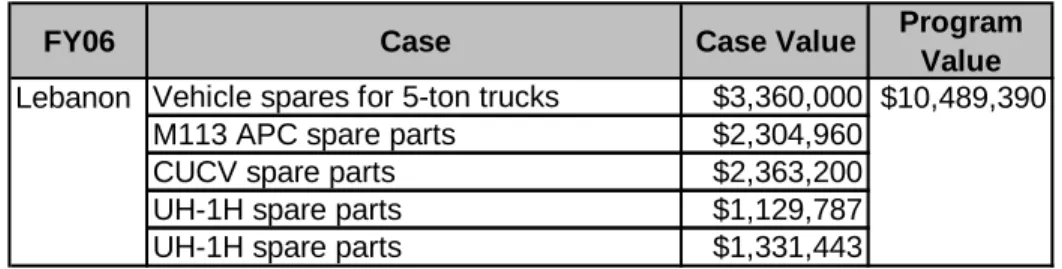
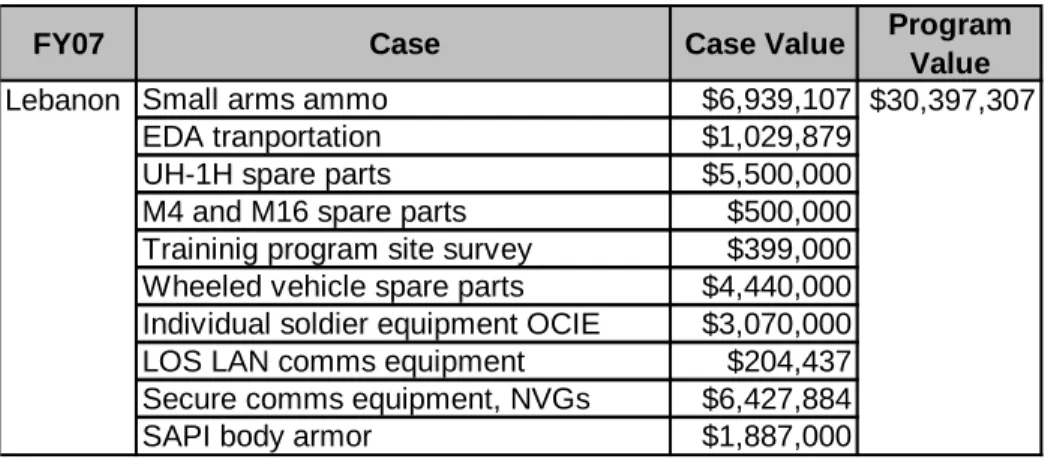
The Section 1206 projects for Lebanon in FY2006 and FY2007 have focused on providing trucks, vehicle spare parts, aircraft spare parts, small arms, secure communications and body armor to the Lebanese Armed Forces (LAF).90
87 Eric Thompson. Assessments of the Impact of 1206-funded Projects in Selected Countries: Lebanon, Pakistan, Yemen, São Tome and Principe. July 2008. p. 5.
88 Ibid., p. 5. 89 Ibid., p. 5. 90 Ibid., p. 11.
1. Background
In April 2005, Syrian forces withdrew from Lebanon turning the security of the country over to the LAF. However, the LAF was not prepared to conduct this mission due to inadequate forces and aging equipment as a result of Lebanon’s isolation from the international community, because of the Syrian domination of the Lebanese government. In fact, the U.S. had not provided security assistance to Lebanon since 1989.91
In July 2006, Israel began a 33-day air and ground attack against Hezbollah and suspected Hezbollah infrastructure in Lebanon. The United Nations Security Council passed a resolution that called for the deployment of Lebanese forces into southern Lebanon to assure Lebanese sovereignty, to ensure Israeli security, to assert control over areas previously held by Hezbollah, and to disrupt smuggling across the Syrian border. The Combined Border Force (CBF) was created, comprised of LAF and other forces. The CBF’s mission is to secure the border region to prevent the flow of weapons to non-state actors, which include Hezbollah and other terrorist organizations.92
In May 2007, Fatah al-Islam, an Islamist terrorist organization that had operated near the Nahr Al-Barid Palestinian refugee camp in Northern Lebanon, attacked a Lebanese Army unit guarding the camp. The LAF responded by attacking the camp to flush out the Al-Qaeda linked organization. The LAF suffered over 2,000 casualties in the three month battle.93
The LAF has an extremely limited budget. An estimated 90-95 percent of their defense budget goes to wages and benefits of active duty and retired soldiers.94 Also political turmoil, conflict and terrorist attacks have combined to squelch tax revenue. Therefore, there is limited funding available for acquisition, training, and operations and maintenance.
91 Eric Thompson. Assessments of the Impact of 1206-funded Projects in Selected Countries: Lebanon, Pakistan, Yemen, São Tome and Principe. July 2008. p. 11.
92 Ibid., p. 12. 93 Ibid., p. 12. 94 Ibid., p. 12.