Master’s thesis ·30hec · Advanced level
Environmental Economics and Management – Master’s Programme Agricultural Economics and Management - Master’s Programme
How does debt capital affect member
commitment in agricultural
cooperatives?
- A case study of Chinese agricultural cooperatives
Supasiri Luangsangthong Hao Zhang
How does debt capital affect member commitment in agricultural cooperatives? - A case study of Chinese agricultural cooperatives
Supasiri Luangsangthong Hao Zhang
Supervisor: Jerker Nilsson, Swedish University of Agricultural Sciences, Department of Economics
Examiner: Karin Hakelius, Swedish University of Agricultural Sciences, Department of Economics
Credits: 30 hec Level: A2E
Course title: Degree Project in Business Administration Course code: EX0536
Programme/Education: Environmental Economics and Management, Master’s Programme and Agricultural Economics and Management,
Master’s Programme
Faculty: Faculty of Natural Resources and Agricultural Sciences Place of publication: Uppsala
Year of publication: 2013
Name of Series: Degree project/SLU, Department of Economics No: 769
ISSN 1401-4084
Online publication
Acknowledgements
A special thank to our Professor Jerker Nilsson for his guidance, suggestion and encouragement.
Summary
There is an increasing number of agricutural cooperative management in acquiring more debt capital in order to compensate member equity and achived higher growth. At the same time, exposing the cooperative to higher financial risks indicate that the member interests are being replaced for other priority interests. Once the members do no have incentives to involve in cooperative governance due to their small investment correlation to the total capital base of the cooperative, they no longer consider themselves as real owners and consequently the free rider problem emerge. When the member perceived that benefits could also arrive from borrowed money and other capital sources instead of their own investing money, a decrease of their contribution as well as their less involvement in participate the governance of cooperative will occur. Inspried by the importance of member commitment and the great potentials of debt capitals, our prime focus of this study is whether the acquisition of debt capital has some influences on member commitment in agricultural cooperatives.
The empirical approach consisted of the theorical framework of the social capial theory, the property right theory and the agency theory. The data gathered from the phone interviews with seven representative managers of Chinese agricultural cooperatives and are used to test the hypotheses in which correspond to the aim. Debt capital’s effects on member commitment are measured by five indicators consisted of members’ willingness to invest, level of member control, superiority of members’ interests, members’ benefit from their cooperatives and level of social capital. The choice method is qualitative with explanation and example from cooperatives participated while the set of open-end type of question is used for the phone interview.
Based on interviews with cooperative members from Zhejiang province, we found that debt capital can have both positive and negative impacts on level of member commiment by influencing cooperatives’ financial performance, members’ willingness to invest, member control, member interests and level of social capital in cooperatives.
Table of Contents
1. INTRODUCTION ... 1 1.1PROBLEM BACKGROUND ... 1 1.2PROBLEM AND AIM ... 2 1.2.1 Variables ... 2 1.2.2 Problem analysis ... 2 1.3APPROACH ... 61.4VALUE OF THE RESEARCH ... 6
1.5STRUCTURE OF THE STUDY ... 7
2. BACKGROUND INFORMATION ... 8
2.1THE AGRICULTURAL COOPERATIVE MOVEMENT IN CHINA ... 8
2.2RECENT DEVELOPMENT IN THE AGRICULTURAL COOPERATIVE MOVEMENT IN CHINA ... 9
3. THEORY ... 12
3.1PROPERTY RIGHTS THEORY ... 12
3.2AGENCY THEORY ... 12
3.3SOCIAL CAPITAL THEORY ... 14
3.4THEORETICAL CONCLUSION ... 15 3.5HYPOTHESES ... 17 4. METHODOLOGICAL ISSUES ... 20 4.1CHOICE OF METHOD ... 20 4.2SELECTION OF INTERVIEWEES ... 20 4.3THE INTERVIEWS ... 20 4.4SUMMARY ... 21
5. EMPIRICAL FINDINGS AND ANALYSIS ... 22
5.1INTRODUCTION ... 22 5.2HYPOTHESIS 1 ... 22 5.3HYPOTHESIS 2 ... 25 5.4HYPOTHESIS 3 ... 27 5.5HYPOTHESIS 4 ... 30 5.6HYPOTEHESIS 5 ... 34 6. CONCLUSIONS ... 37 REFERENCES ... 40
Figures
Figure 1. Illustration of theoretical conclusion based on Property rights theory ... 15 Figure 2. Illustration of theoretical based on Agency theory ... 16 Figure 3. Illustration of theoretical conclusion based on Social capital theory ... 16
Tables
Table 1. Names of interviewees, positions and name of their cooperatives ... 21 Table 2. Summary of the results of the hypotheses ... 36
1. Introduction
1.1 Problem Background
Agricultural cooperative is a special form of private business that is important for a big number of farmers around the world. By bonding farmers together, such cooperatives have helped farmers to stand up to large business corporations, which has improved farmers’ wellbeing. During the modernization of agricultural cooperatives, these member-driven organizations have been facing all kinds of challenges from powerful competitors and unstable markets. In order to survive such an increasingly harsh environment, agricultural cooperatives are eager to acquire more capital and grow larger. As a result of these changes, remaining ownership and control in the hands of the cooperatives’ members and therefore keeping the members committed becomes a new challenge for the managements of the agricultural cooperatives (Royer and Rogers 1998; Cook and Chaddad, 2000 Karlsson). According to Dunn (1988), cooperative businesses should be controlled by the members of the cooperative. Such member control has been one of the most fundamental principles that cooperatives, including agricultural cooperatives, needed to follow in order to ensure that members’ interests will be prioritized. Concerning the ownership and organizational structure in cooperatives, obtaining a well functioning and democratic member control has been a tough task for all cooperatives. Agency theory explains that this problem could be a consequence of information asymmetry, which has been a common phenomenon among cooperative businesses.
In recent years, an increasing number of managements of agricultural cooperatives have started to acquire more debt capital in order to compensate member equity and achieve higher growth. Considering the risk-averse nature of farmer members of agricultural cooperatives, exposing the cooperative to higher financial risks indicates that the members’ interests are being sacrificed for other higher interests. At the same time, we have seen many cases where cooperatives have failed in maintaining a well-functioning democratic member control system. As Nilsson (2009) has shown, in line with the classical organizational psychology, such undermined member control leads to weakened commitment towards the cooperative among the members.
In many cases, members simply do not have incentives to participate in the governance of the cooperative once their investments only account for a very small part of the total capital base of the cooperative. The members no longer see themselves as real owners of the cooperative. Consequently, the cooperative will face more free-rider problems when the members believe that they can be benefited from using the borrowed money or other capital sources instead of investing their own money in the cooperative. In turn, such a decrease of member contribution of capital has resulted in even less power for the members to participate in the governance of the cooperative.
Based on this background, it could be assumed that acquisition of debt capital might have some negative influences on member commitment in agricultural cooperatives. In order to learn more about such a relationship, an empirical study containing seven agricultural cooperatives is conducted in this thesis. The aim of this study is to explain how acquisition of debt capital influences the level of member commitment in agricultural cooperatives.
1.2 Problem and Aim
1.2.1 VariablesOur aim in this study is to explain how debt capital influences members’ commitment to their agricultural cooperatives. The dependent variable that will be investigated in this study is level of member commitment in agricultural cooperatives. The independent variable that we chose to focus on in our study is debt capital, which we believe is a strong variable that has interesting influences on members’ commitment to their cooperatives. Certainly, except the amount of debt capital, the level of member commitment in a cooperative can be affected by other factors such as characteristics of members, cooperatives and industries. These characteristics are not considered in this study.
1.2.2 Problem analysis
Agricultural cooperative
A co-operative is a collectively owned and democratically controlled enterprise that individuals can join voluntarily in order to improve their economic and social conditions. An agricultural cooperative, also called in China a “farmer specialized cooperative”, is a cooperative that is specially engaged in producing agricultural products. Every person who is able to use a cooperative’s services has right to join the cooperative, independent of gender, social or political factors. All members of a cooperative are supposed to control the organization by participating in decision-making and setting policies. A cooperative should also be organized in a democratic manner so all members have to contribute to the capital basis of the cooperative and therefore have control over it. Another feature that characterizes cooperatives is the independency of the organization and its self-help nature by which the cooperative should be controlled by the members. Such democratic control of members exposes to higher risk to be undermined once the cooperative joins contracts with other actors such as governments or external capital providers (ICA, 1995).
Agricultural cooperatives, as all other types of businesses, need capital to finance their operations and investments. Because of the characters of such member-driven cooperative business organization, capital acquisition has always been a tough problem. Agricultural cooperatives without enough capital are not able to provide good services to members or to grow in modern market economies. Traditionally, agricultural cooperatives have been relying mainly on equity capital provided by the members, such as member shares, member fees and income from market sale. Nowadays, capital from non-member financiers has become much more crucial for the cooperative. Sources of such external capital include for example investor owned companies, grants from government, other donors or debt capital from banks and private financiers.
Capital formation in cooperatives
“The difference in objectives between cooperatives and IOFs stemming from the dissimilarity in ownership structure suggests a number of distinctions in both the business and the financial strategies of cooperatives.” (Condon; Cotterill; LeVay; Parliament, Lerman, and Fulton; Staatz 1987) Business activities and operations in an agricultural cooperative can be
financed by equity capital or debt capital, or a combination of these two forms of capital. Capital formation in cooperatives is regarded as a means of increasing member participation and control” (COPAC, 1995).
The sources where cooperative can obtain capital from can be divided into two categories, internal and external. External capital formation arises when cooperatives recived debt or equity from sources outside of the cooperative such as government, non-member investors, cooperative banks, commercial banks etc. Equity capital is the risk capital, or net worth of the organization and it represents the members' ownership in the total assets of the organization. In balance sheet terms, equity is total assets less total liabilities. Cooperative equity comes in two forms, allocated and unallocated. Allocated equity is assigned proportionally to members and unallocated equity is not.
Traditionally, most cooperatives raise equity capital by requiring members to make direct investments in the cooperative business. It is most often used when a new member joins the cooperative and he or she has to make a purchase of equity carrying a voting right. Members’ financial contribution in the form of direct investment is also needed for acquiring additional member equity when the cooperative needs to strengthen its financial condition. Such member equity could also be seen as a demonstration of member commitment. Sometimes, there are also possibilities to allow non-members to make direct investments as a way to supplement member equity. These investments, usually in the form of preferred stock, often pay a favorable dividend, but do not usually provide a voting right. Additionally, equity capital can also be raised by income surplus generated from selling outputs.
It is desirable for the cooperatives to have a larger share of equity capital compare to the amount of debt capital in the cooperative. A strong member equity base is an important factor that indicates that the cooperative is financially strong and it gives the members more power to control the operation of the cooperative. Unfortunately, members in agricultural cooperatives have very often difficulties to make investments that are large enough to obtain an adequate equity base in their cooperatives. Even though there are other methods that may be used to obtain equity such as retaining earnings; it is common that agricultural cooperatives suffer from starving equity basis.
Shortage of equity in cooperatives will have undesirable influences on financial performance and growth in the cooperatives (Schrader, 1989). In order to meet the cooperatives’ capital needs, cooperatives may try to use an increased portion of debt capital to compensate for the shortage of equity capital. Debt capital refers to the money borrowed from a lender that the principal and interest need to be repaid at a certain time. A large proportion of debt in the capital structure represents high financial risks for any business, including cooperatives. Failure in paying back the borrowed money can lead to that lenders taking over control of the cooperative. Considering the fact that many farmer-members join cooperatives to reduce risks of their farming activities, an acquisition of debt capital might make members worried and suspicious whether their cooperative is still working for the members’ interests. Additionally, a large debt results in high interest costs, which negatively affect the profitability of the business (Peterson and Cobia, 2000). Members’ interests might be neglected when trying to pay back the loans and interests.
However, although both banks and private financiers in many cases provide the cooperatives opportunities to borrow money, not all cooperatives fulfill the requirements for the loans in the form of collaterals, personal guarantees or historical profits. A number of previous studies
concluded that cooperative firms tend to have little debt capital (Lerman, 1993). Such behavior could be attributed to that the lending institutions usually feel uncomfortable with the cooperatives’ ownership structure. In fact, many investor-owned firms also have the same problems when trying to borrow money or obtain higher owner (member) equity. The solution that they often use is to obtain equity from investors outside the firm. Traditionally, such non-member equity has not always been considered by cooperatives and potential investors as an appropriate capital source for cooperatives.
When a cooperative uses capital generated by members and retained earnings as its primary capital source, the cooperative does not face any problems with debt risks of not being able to pay back the money. On the other hand, it has been suggested that a capital accumulation of very much internal capital and very little debt capital could lead to unnecessarily high capital cost. An overuse of institutional capital, which refers to the collectively owned non-refundable capital, could also result in emergence of perverse incentives (Murray, 1983). However, Mcbride (1986) claims that there are many examples of successful agricultural cooperatives using a well-balanced mixture of member equity and debt capital.
Debt capital in cooperatives
Based on the effects that different capital sources could have on the performance of the cooperatives, there is a qualitative dimension of different types of capital. The quality of certain type of capital source is determined by the so-called “cooperative power” which indicates such capital’s ability to strengthen member participation and control in the cooperative (COPAC, 1995). According to Von Pischke (1993), those forms of capital that are attached with conditions and terms that demands a strong member commitment should be perceived as capital of high quality.
Generally, capital from internal sources such as revolving fund has better quality than debt capital and other external capital since the members are involved as investors and no influences from non-members financiers. According to Eze (1990), the more involved the members feel they are in the development of the cooperative, the easier for the cooperative organization to achieve efficiency. Unfortunately, most forms of loans from banks and private financiers will give the lenders either formal or informal power to influence the decision-making in the cooperative. As a consequence of that, at the same time as the debt capital helps the cooperative to enlarge investment, the member control and participation in the cooperative will be weakened.
Except that, it is very likely that the non-member financiers will try to influence the decisions in a way that maximizes their own benefits which obviously violates the members’ interests and therefore the cooperative principles. Such a degradation of member control in the governance of the cooperative will have negative impact on the members’ commitment to the cooperative (Österberg and Nilsson, 2009). Thereafter, the mutual effect between member control and commitment will make the members even less engaged to spend time and efforts to involve in the governance of the cooperative and a vicious spiral arises (Bijman, 2011). Another type of external capital is grants and it is perceived as the external capital with lowest quality due to the high risk for creating cost inefficiency and dependency in the cooperative.
Member control and commitment in cooperatives
The level of member commitment indicates members’ preference to maintain a member relationship with the cooperative and continue doing business with it when there are other business options available (Fulton, 1999). As mentioned before, agricultural cooperatives are formed to enhance farmer-members’ wellbeing, which means that cooperatives have to provide services that are desired by the members. In order to achieve that, a democratic governance system is crucial in which members can control the cooperative and support those decisions that are beneficial for them (Bhuyan, 2007; Gray & Kraenzle, 1998). Once such member control is implemented and members start having influence on decisions, it is easier for them to be committed and supportive to the decisions made by managers of the cooperative (Nilsson, 2009). Level of member control in a cooperative can be the single most important factor that affects member commitment (Österberg and Nilsson, 2009). Together with other important conditions, member commitment in cooperatives needs to be maintained in order to achieve long-term success (Anderson & Henehan, 2005; Staatz, 1989).
Considering the fact that members can have different roles in the cooperative, a strong member commitment can be crucial in many different ways (Österberg and Nilsson, 2009). Committed members are more likely to use their rights to make sure that qualified candidates will be elected in the board and the management and the board performs at a high standard and serves the interests of the members. Members with high commitment are usually better at understanding decisions from the managers and therefore willing to support them.
As mention before, most agricultural cooperatives highly rely on their members’ financial contributions as a crucial internal capital source. Hence, level of member commitment in cooperative will influence the internal capital formation and therefore the financial power of the cooperative (ibid). According to Reynolds (1997), those members lacking commitment to the cooperative are usually not committed to the decisions made by the board either and a lack of such support and understanding between members and the board will make the implementation of those decisions become more complicated.
Unfortunately, as agricultural cooperatives’ business and member base grow larger, many cooperatives experience a decreased level of member commitment in their organizations (Bhuyan, 2007; Fulton, 1995; Lang and Fulton, 2004; Fulton and Giannakas, 2007). This trend is expected to be exacerbated due to rapidly increasing pressures on future economic performance. Members’ commitment to their cooperative might be influenced by many different factors. For instance, the larger the members’ investments in the cooperative, the greater commitment members will have toward their cooperative.
Member commitment could also be dependent on other characteristics of members such as age, education and communication with the organization. Characteristics of the cooperative such as type of cooperative, formation of capital base, debt to equity ratio, level of economic returns to farmer-members and how cooperative revolves equity also have systematic impact on the level of member commitment (Trechter, 2002). Despite an undermined member control, if an external capital formation can lead to higher economic returns to farmer-members, members’ commitment to the cooperative may be positively influenced.
This dilemma will probably not occur if the cooperatives make sure that decision power over new investments would not be switched to debt providers. On the other hand, if the same level of control will be retained with the members after receiving funds from non-member
financiers, they will not have confidence that their money will be spent well. Consequently, an organizational structure where a high member control is strictly prioritized will give outside financiers little incentives to invest money and will lead to unfavorable terms on outside equity compare to those faced by conventional firms (Hendrikse and Veerman, 2001).
Aim of the study
Member commitment in agricultural cooperatives has been a frequently discussed topic. A large number of studies have been conducted in this area. Capital formation of agricultural cooperatives has also been focused in many studies considering its importance for agricultural cooperatives.
In China, many studies have argued for debt capital’s potential to stimulate the development of agricultural cooperatives in China. Debt capital has become more and more considered and promoted as one of the most important capital sources that can provide Chinese agricultural cooperatives with opportunities to improve their performances and achieve higher growth. However, despite such substantiated importance of member commitment and debt capital for cooperative businesses, we could not find any studies that explain how debt capital would affect member commitment in agricultural cooperatives.
The discussions above can be summarized into a more specified statement of the aim of this study:
The aim of this thesis is to clarify how debt capital in agricultural cooperatives affects member commitment in these cooperatives.
1.3 Approach
This study concerns whether debt capital has an influence on member commitment to the cooperatives. The background information provides the basic understanding of agricultural cooperatives in China and the theoretical framework gives the knowledge for an analysis of the finding from the interviews.
The empirical data in this study are gathered from interviews with representative managers of Chinese agricultural cooperatives. Data are used to test five theoretically derived hypotheses. After the data is analyzed in relation to the hypotheses conclusions are presented which correspond to the hypotheses and the purpose.
1.4 Value of the research
Much research has been focused on the difficulties, importance and approaches of external capital formation in general in agricultural cooperatives. With inspirations from these interesting studies, we hope that our research could improve the understanding of how the cooperatives´ member commitment could be affected by acquisition of debt capital in an agricultural cooperative. The findings could be useful for the managers and members in agricultural cooperatives once they face the question whether they should raise the level of debt capital in the cooperative. For those who have decided to do so, we hope that our
findings could make it easier for them to prepare for the possible effects on the cooperative caused by the acquisition of debt capital. Additionally, the findings should also be valuable for outside actors, which provide debt capital to agricultural cooperatives such as commercial banks, cooperative banks, private lenders and government authorities. An improved understanding of debt capital`s effects on level of member commitment in the cooperative could enable these important outside actors to provide financial supports in a more sufficient way.
1.5 Structure of the study
This section provides a brief overview of the structure of this study.
Chapter 1 provides a formulation and an analysis of the aim and problem in this study and chapter 2 gives background information about the agricultural cooperatives in China. In the third chapter, the theories and the hypotheses will be presented followed by a discussion of the connections between them. The method of data collection and the test of the hypotheses will be discussed in chapter 4. Chapter 5 consists of a presentation and analysis of the empirical data followed by the chapter 6 in which the conclusions of this study will be presented and discussed.
2. Background information
2.1 The agricultural cooperative movement in China
Farmer cooperative organizations have been created quietly in rural areas in China since the 1980s and have started growing afterward. Chinese farmer co-operatives have been developing rapidly since the 2000s especially when the promulgation of Farmer Specialized Co-operative Law in 2007 (Xu and Wu, 2009). China has more than 150,000 agricultural cooperatives which consist of 38,780,000 members of which 34,860,000 members are farmers. These farmer cooperative members accounted for 13.8% of total number of national farmers in China (Ministry of Agriculture China, 2008).
Farmer cooperatives have been constantly increasing in number following the Law of Farmer Co-operatives was declared in 2007. In accordance with the National Industrial and Commerce Bureau’s statistics, the number of registered farmer cooperatives was 440,000 by mid 2011 representing 20 million rural households. However, the number of farmer cooperatives will not yet stop growing considering the low persentage of the total population of farmers that has engaged in cooperative enterprises so far. According to taxation registration, cooperatives can be characterized as many types of firms, for instance, private partnership firm, co-operative-shareholding enterprises, limited liability companies, individual households, collective enterprises. Some scholars suggested that the real figure of cooperatives in China should be observed from the cooperative registrations (Yuan, 2001). The development of Chinese farmer cooperatives has undergone three phases. During the mid of 1980s to the mid of 1990s, the establishment of household contract system and rural specialized households improved the technical and information services that were available to
the farmers. Naturally, the cooperative professional organization has also established. In the
late 80s to early 90s, Farmers have joined the market in accordance with an objective requirement of China’s rural economic reform and development of market economy in which the professional association has provided member involved services, for instance warehousing and distribution (Ministry of Agriculture China, 2008).
The cooperatives in China have had a period of rapid transformation and development during the latest two decades. Cooperative businesses have been receiving more and more attention and support from the government and other public actors. As the cooperatives in many other developing countries, the cooperatives in China have been facing capital shortage problems during the transformation. This dilemma has constantly been a hinder for the cooperatives to grow and make greater contributions to the transformation of agriculture and rural developments in China. However, even though internally generated capital is often perceived as having higher quality than debt capital, previous research indicate that an increasing number of agricultural cooperatives in China have started making efforts to implement more modern and innovative strategies to mobilize capital from external sources to finance their activities and growth. However, managers in Chinese agricultural cooperatives have discovered the potentials and possibilities associated with debt capital sources. Additionally, political and economic efforts have been made to help cooperatives to overcome difficulties when borrowing money from banks. Hence, the proportion of debt capital in the total capital portfolio of agricultural cooperatives is expected to remain increasing.
In the late 1990s, China’s agriculture and rural economy has experienced a new stage of development where the agricultural products have yielded a surplus after a long period of food shortages, difficulties in selling agricultural products and slow growth of farmers’ income. Government solved such difficulty by supporting farmers to voluntarily engage in cooperatives and professional associations. These specialized cooperatives have been involved in various activities from fruits and vegetables, livestock, aquaculture, forestry, agricultural services, transportation, grain and oil crops, water reservation, resource development, and handicraft production (ibid).
After the declaration of Farmers’ Professional Cooperative Law in October 31, 2006, the farmer cooperatives were constructed in accordance to the new law implying such things as the improvement of internal management, strengthening democratic, open up markets for agricultural products, and constantly improving the service features (ibid).
The concept of agricultural cooperative in China is the consequence of prolonged process of political and economic development to boost income and ensure food security for people. The government started off the policy with the commune system where later converted to collective system in which expecting farmer members to deliver food for the state. To meet the demand for freedom of action and decision making, the collectives gradually transformed into agricultural cooperatives (Prakash, 2002). The agricultural cooperatives in China can be divided into professional cooperatives and professional associations (Chinese Ministry of Agriculture, 2008). The most fundamental difference between these two types of organization is that the professional associations have to be nonprofit organizations.
2.2 Recent development in the agricultural cooperative movement in
China
According to the development after China’s market become more open and the reformation of institutional framework for farmers; Chinese government has improved the new version of cooperative development. Over the reform process in China, a continuous great change process has taken place in the rural economy and farmer cooperatives. Farmers have voluntarily joined the cooperative organization with the aim of developing the economy and operate under the basis of ‘from the farmer, by the farmer and for the farmer’ (Prakash, 2002). The emergence and development of professional cooperative organization become gradually necessary during the changing from traditionally planned economic system into socialist
marketing economic system. The reformation of marketing mechanism and procurement of
agricultural products allowed the farmers to interact with market more easily. Further, such mechanism helps farmers adopt the new technologies faster, stocking of pre and post harvest to secure against risks, improve the production system to maximize resource and to raise income (ibid).
The process of development has now established more professional economic organization of farmers where they can earn higher income by the introduction of higher technology. The new forms of agricultural cooperatives after the reformation of the market maintain the autonomous rights of farmers where they can play various professional roles following their wills and becoming more professional. The organization structure and management is democratic and more independent in the decision-making processes. Cooperatives offer
extended services required by farmer-members and profit distributed among members. Thus, all of these positive changes lead to an increased standard of living (ibid).
There are some major progresses and noticeable achievements made by Chinese farmer cooperatives and Government:
1) The establishment of the Law of the People’s Republic of China on Farmers’ Specialized
Cooperatives in October 31, 2006 is the major change. The law allows the legal persons of
farmer cooperatives to establish dominant positions in the market. The regulated organization and conducts ensure the members’ democratic rights and their legitimate interests.
In order to ensure a smooth establishment of the new legal system, other legislations have been implemented such as “Regulations on the registration of farmers' specialized cooperatives by the State Council and the “Regulations on the accounting systems in farmers’ specialized cooperatives in January 1, 2008 by Ministry of Finance (Ministry of Agriculture China, 2008). After the promulgation and implement of the Law, a good environment and development has been established among the agricultural cooperatives, which is the indicator of that China has entered the new stage of development following the new law.
2) The State Council has exerted the great effort to the construction and development of farmer cooperatives and gradually enhanced the policy support system. The central authorities have deployed the new series of development on the specific requirement and also set up the specific policy measurements to support the finance, taxation, credit, land, electricity, personal, and clear policy to respond the rapid growing of farmers’ specialized cooperatives (ibid).
3) In 1994, the Ministry of Agriculture has carried out a demonstration program for farmer cooperatives allowing them to improve the democratic management through this trial study as well as providing the guidance for implementation of standardized industrial products and services. The program has been first launched in Anhui and Shanxi. Furthermore, 100 demonstration programs have been established in Zhejiang and other provinces during 2002-2003. From 2004 to 2008, 633 farmer cooperatives have implemented for the construction of demonstration projects supported by the Ministry of Agriculture under the Central Government. These demonstration programs were carried out in province, city, and county levels. The strong impacts of these demostration programs as well as the local policies have enhanced the cooperatives’ capacity in production, technology, processing, warehouse, distribution and other services (ibid).
4) The farmer cooperatives differentiated more from other business forms in several ways: the operation of standardized production and unified service has enhanced the market position of cooperatives. The level of farmer income has increased through the adjustment of agricultural structure and the potential from internal organization. In terms of industrial management, the introduction of “one village one product” and “one product a community” has increased the bargaining position of farmers. The democratic management system has been strengthened under “one person, one vote” decision making among members. Overall, the farmer cooperatives strengthened their role as the leader of rural development in China (ibid).
5) Farmer cooperatives have enhanced their public recognition and reputation for past 50 years through the corporation with the Ministry of Agricultural. Various types of Chinese Media continued to promote the economic strength of cooperative organizations and its strong
reputation. The 5th China International Agricultural Product Trade fair in 2007 was the good example of the collaboration of 47 Chinese specialized cooperatives with both domestic and foreign merchants to stimulate the market demand and social expansion (ibid).
6) Concerning members’ involvement of capital in their cooperative, the national regulations on cooperatives in China have no rigid requirement that members must own shares or other forms of financial contributions. Even though such regulations have been blamed for causing liability limitations, they have helped a big number of farmers with weak economic conditions to join an agricultural cooperative. Additionally, the national regulation does not require the cooperatives to have a minimum amount of capital in order to be registered.
Except the national regulation on agricultural cooperatives, which was implemented in 2007, many provinces have had different regulations on their local cooperatives. In some provinces that are more developed economically such as Zhejiang Province, the regulation requires that all members have to own shares in their cooperative and no less than 50% of the total shares must be owned by the members. In order to uphold the principle of democratic control in the cooperatives, another limitation that has been commonly used is that an individual member is not allowed to own more than 20% of the shares in the cooperative.
In order to face the scarcity of capital in rural parts of China, non-member capital has been promoted as another important capital source for the development of agricultural cooperatives. Non-member capital refers to capital such as loans, subsidies and donations. Both the local governments and central government have encouraged the involvement of non-member capital in agricultural cooperatives, not least by simplifying the cooperatives’ application procedures of bank loans and other financial services. Furthermore, the newly implemented political directives have resulted in an increasing number of village banks that are more specialized in providing financial support to local cooperatives. In addition to that, agricultural cooperatives are also benefited from preferential taxation regulations.
Thanks to the lessons learned from international cooperatives and the national political reforms such as the implementation of the national cooperative law, agricultural cooperatives have transformed to one of the most successful enterprise forms in rural areas of China.
3. Theory
3.1 Property rights theory
Property rights theory was developed by Grossman and Hart (1986) and it is also referred to as incomplete contracting theory. Property rights theory is based on the assumption that no contracts can be perfectly complete because of asymmetric information which means that when some of the participants in a contract or transaction have certain information that is not accessible for other parties. According to Sykuta and Chaddad (1999:72), another argument for that no contracts can be perfectly complete is that individiuals' rationalities are affected by the limited information they have and their time limitations when making decisions. A property right is defined as the capacity to control or use a resource or asset and properly defined property rights are necessary for all kinds of cooperation (Demsetz, 1967). The core idea of property rights theory is that properly defined ownership could provide a solid foundation for the cooperative members to create, maintain and increase the assets of the cooperative. Cook (1995) claims that property rights are fundamental for cooperatives to reach sustainability and maintain a high level of member control in the organizations.
Theoretically, an individual member will only be interested and permitted to control the part that he or she has ownership of. It means that members’ incentive and willingness to participate in the control of their cooperative is partly determined by the level of their ownership in the cooperative. However, the member owners of a cooperative wish to have the control over the cooperative based on the size of the share that they own in order to ensure that their personal interests will be prioritized in the best way. Unfortunately, although each member owns his or her own share of the total invested capital, the member has no right to control and make decisions over it (Nilsson & Björklund, 2003). Such vaguely defined property rights in agricultural cooperatives lead to a more complex decision-making process where members usually have different interests which cause conflicts and governance problems in cooperatives. Consequently, special expertise in handling intra-organizational conflicts is vital for cooperative managers in order to achieve internal stability among their members.
Compared to the small cooperatives with limited ability to get loans and simple organization structure; this problem might be more common in big and complex cooperatives where significant amount of non-member capital, such as debt-capital from banks or private lender, is involved. Once debt capital has been injected into the capital base of the cooperative, members’ financial contribution, which indicates their ownership of the cooperative, will decrease relative to the increased total capital base. Consequently, members become less important financially and their incentives and also power to control the cooperative will also decrease which might in turn have negative impacts on member commitment. Additionally, when non-member capital lenders require and are given control over the cooperative, member control will be weakened even more. A low member participation in the governance of the cooperative leads to domination of managers in decision making processes in which the members’ interests might not be the first priority (Burt & Wirth, 1990; Hind, 1997; 1999).
3.2 Agency Theory
When an individual or organization, the so-called “agent”, acts on behalf of another who is called “principal”. The conflict arises when the objective of the agent is different from the
principle and also when the agents do not work for the interests of the principle but themselves (Alchian and Demsetz, 1972; Royer, 1999; Sykuta and Chaddad, 1999). All organizations in which ownership and control are separated will, more or less, have principal-agent problems since the principal and the principal-agent have different interests (Cook, 1995). In a cooperative context, the principal can be the member and their board of directors is the agent (ibid). When the members who are also the owners and control the cooperative have different goals, the problem of principle-agent is likely to happen. The agent’s responsibilities are normally described in the contract between the agent and the principal where it commands an
agent to act in the principal’s interests. Since the contract cannot be perfectly defined “there
are opportunities for shirking due to moral hazard and imperfect observability” (Royer, 1999: 50).
The major point of agency theory is on incentive and measurement problems where the
risk-sharing assumption can also not be ignored. Sykuta and Chaddad (1999:2) suggested “most
applications of agency theory focus on the incentive vs. risk- sharing trade-off of contracts aimed at aligning the interests of the agent with those of the principal.” Thus, this theory is very concerned with institutional structure of cooperatives since the manager (employed manager) may not represent the best interests of the principal (cooperative owner-member). The challenging point is, hence, to develop the ownership and capital structure for lowering the agency costs (Fama, 1980; Fama and Jensen, 1983).
The principal-agent problems further raise member dissatisfaction. Richards et al. (1998:32) argued that cooperatives have more experience of agency problems than investor own firms (IOFs) because of the lack of “capital market discipline, a clear profit motive, and the transitive nature of ownership.” Since there is no market for cooperative equity, the monitoring from members of their mangers is likely to be less as opposed to investor own firms. Another difficulty for cooperatives is whether to design the incentive schemes to match with personal objectives of managers with those of cooperatives. Richards et al. (1998), using the data from a survey of cooperative members in Alberta, Canada, found out that managers mainly focus on the social role of cooperatives neither emphasizing the profit issue such as higher prices, return on equity, nor quality of service. These members seemed to be dissatisfied with their cooperative managers’ performance.
According to the agency theory, there are several problems that are likely to arise when the ownership is separated from the governance of the business. One of the problems is called the free-rider problem, which refers to those situations when a person enjoys the benefits generated by common resources without making proportional contributions in order to create and maintain such resources. Since all the assets in cooperatives are collectively owned, every member has access to all the assets built up collectively. On the other hand, the members who quit the cooperative are not allowed to take those assets in the cooperative that these members have created. Such characteristics of cooperatives many times encourage the members to act as a free rider simply because members want to get as much benefits as possible from the cooperative while minimizing the level of their personal contributions.
In addition to that, the members of a cooperative and its management have in many cases different, sometimes contradictory, demands on the business. Such differences will cause the so-called horizon problem, which consists of pressure from the members in order to increase the current patronage refund rather than to make expensive investments for more long-term benefits. Horizon problems are difficult to avoid, especially for large cooperatives, because the individual members’ planning horizon is dependent on a complicated combination of
factors such as their age, experience, values, etc. On the other hand, management teams in cooperatives plan their strategies and decisions based on the time that they will be elected and employed. As long as the members and the managers have different time perspectives, the development of the cooperative will be inhibited since not all members’ interests can be optimized.
3.3 Social capital theory
Like other types of capital, social capital is productive and makes it possible to achieve goals that would not be possible in its absence (Coleman 1990). Social capital consists of social networks and norms of reciprocity and trustworthiness (Putman, 2000). Social capital is important in all kinds of inter-personal and inter-organizational relationships because its ability to reduce the risks that the actors in a relationship would behave deceitfully.
The existence of social capital in a relationship can be indicated by the level of trust. Both in social life and business contexts, the more trust the partners have on each other, the easier it is to cooperate without having high transaction costs. There are different kinds of transaction costs. For example, the costs for reaching appropriate agreements between the parties involved and also the cost of monitoring another party in order to make sure that it acts
according to the agreed contract (Malone, Yates, and Benjamin, 1987). In other words, an
investment of financial capital might not lead to expected results if social capital is not strong enough (Nilsson, Svendsen & Svendsen, 2012). In addition to the ability to reduce transactional costs, social capital generates high decision flexibility, which in turn improves productivity and growth (Gabre-Madhin, 2001). According to Gilson (2003), the organizations with relatively high social capital are usually more efficient than those with low social capital.
“The cooperative spirit is widely accepted as the main force of the cooperative.” (Dnes and
Foxall, 1981). This can be interpreted as cooperative’s social capital. Social capital may be
regarded as another crucial production factor in agricultural cooperatives in addition to traditional ones such as human and physical capital (Coleman, 1988). The term “social capital” has been defined differently depending on the context in which the term is used. Considering that this study is focused on agricultural cooperatives, social capital is in this study defined as a set of resources such as values, norms, trust and loyalty that are accumulated over time in the cooperative through social relationships, which facilitates the completion of goals (Leenders and Gabbay, 1999).
Valentinov (2003) claims that agricultural cooperatives are much more dependent on social capital compared to other types of organizations. Agricultural cooperatives are designed as a network that connects and gathers farmers to better coordinate resources and achieve common goals. These farmer members are voluntarily gathered instead of running their own farms individually. Therefore, social capital will always be one of the keys to connect and maintain these individual farmers as a united entity working for common goals. Even though managers in an agricultural cooperative might achieve favorable short-term results by making their own decisions, the success is difficult to be maintained in the long run without the members participating in the cooperative system. An active member participation in the cooperative operation provides better opportunities for the management to build up close relationships, including loyalty and trust, with farmer members which in turn results in higher social capital.
Social capital can be important for agricultural cooperatives in different aspects. A high level of social capital in an agricultural cooperative means that the members are more likely to comply with agreements and trust each other, which in turn contributes to reduced transactional costs. A lack of trust between managers and members leaves the members no choices other than spending valuable resources on formal agreement and monitoring whether the managers are acting according to the contract. As an owner and investor of the cooperative, each individual member’s commitment to the cooperative is based on the expectation and belief that he or she can benefit from the collective actions.
Unfortunately, it is not always easy for the cooperative members to feel completely confident about that their interests will be prioritized since most decisions will be made by a small number of managers. In order for the cooperatives to minimize such possible agency problems caused by information asymmetry, social capital in the form of trust, especially between farmer members and the managers or board, will be significantly important. Only after the trust has been built up among members, their commitment will be stimulated and maintained in the agricultural cooperatives. Without such trust and confidence in the management, the managers’ decisions are less likely to be supported and member commitment could be negatively affected.
The level of social capital in a cooperative could also be indicated by the level to which farmer members are willing to contribute capital in different forms to the cooperative (Sexton and Iskow, 1988). Additionally, a good relationship and trust between members are the social capital that is highly necessary in order to avoid conflicts between members; since they all expect to benefit by the same collective actions as each of them may have different interests at the same time. When agricultural cooperatives operate to achieve long-term goals, social capital in the form of loyalty makes sure that the members remain supportive and committed when the cooperative facing temporary losses even without explicit contracts.
As has been mentioned before, the free-rider problem weakens the members’ incentives to invest in their agricultural cooperatives. According to Paldam and Svendsen (2000), such free-riding problems could be reduced by building up strong social capital, which requires close communications and active participations between members and managers.
3.4 Theoretical conclusion
Based on the theoretical discussion above, following figures are constructed to illustrate the key elements of the theories and the theoretical conclusion. Each figure is followed by a description that explains the figure.
Property rights theory
Non-member Debt capital
Asymmetric information , Members’ ownership
Member control
Based on the property rights theory, we assume that an increased level of non-member debt capital in agricultural cooperatives might lead to weakened member control considering increased asymmetric information and decreased member-ownership.
Agency theory
Non-member Debt capital
External interests and impacts Member control
Priority of members’ interests
Figure 2: Illustration of theoretical based on Agency theory
When non-member debt capital increases, external lenders take over a bigger control of the cooperative and members have less control over their cooperative. It means that external interests will have bigger impacts on the cooperative and members’ interest becomes a lower priority.
Social capital theory
Non-member Debt capital
Member control and interests
Members’ participation in the governance Communication between members and managers
Social capital
Members’ willingness to invest
Member commitment
Figure 3: Illustration of theoretical conclusion based on Social capital theory
Once member control and priority of members’ interests become negatively affected as the first two figures illustrated, level of social capital is likely to be weakened considering
decreased member participation and communication between members and managers. As a consequence of that, members’ commitment to their cooperative will be undermined.
3.5 Hypotheses
In accordance with the theoretical discussion and conclusion above, debt capital’s effects on member commitment in agricultural cooperatives will be measured by five indicators including members’ willingness to invest, level of member control, superiority of members’ interests, members’ benefits from their cooperative, level of social capital.
The following hypotheses are constructed based on the theoretical discussion and conclusion above:
Hypothesis 1
The more non-member debt capital an agricultural cooperative has, the less financial contributions the members will make to the cooperative.
As debt capital accounts for a bigger part of the total capital basis, the farmer members will perceive that their role as financiers has become weakened and less important for the cooperative. The member might prefer to enjoy benefits generated by borrowed money instead of taking more risks by investing their own money. Debt capital means in many cases higher risks for the agricultural cooperatives and these cooperatives are often said to be risk-averse (Hendrikse, 1998). In such situations, the members will be even more frightened of investing more money if they think that the repayment risks and other terms attached to the loans might lead to an increased uncertainty to the cooperative’s long term success, especially for those members who joined the cooperative to reduce the risks of his or her overall agricultural operation. Whether the members think that the debt capital will be used to finance risky projects and strategies such as market integrations (Nilsson 2012) also influence the level of members’ concern caused by the debt capital. Additionally, an increased level of influences from non-member lenders might also lead to weakened incentives for the members to invest as a result of the members being more uncertain that their interests will be the main priorities of the cooperative.
Hypothesis 2
The more debt capital an agricultural cooperative has, the more benefits members will get from their cooperative.
An increased level of financial capital gives managers extra financial strength so more investment opportunities could be considered. As the cooperative grows, the members might be more satisfied considering the benefits generated by a bigger scale of business, improved services and increased incomes. Such an increased level of satisfaction has positive impact on the social capital in the cooperative.
Hypothesis 3
The more non-member debt capital an agricultural cooperative has, the lower is the level of member control (participation) in the cooperative.
In order to provide desirable services and improve the members’ wealth, it is very important that the members actively take part in the governance of the cooperatives (Bhuyan, 2007; Gray & Kraenzle, 1998). As the financial capital grows bigger, the management tends to make the control over the cooperative even more centralized to the CEO and managers. Consequently, the members will have more difficulties to present their interests in the governance of the cooperative. In addition, property rights theory says that a member is only interested to care about the part that he owns. Once each member’s investment in the cooperative accounts for a smaller part of the total capital basis, the members’ will have less motivations to spend time and resources to practice member control by actively seeking information, electing qualified directors and attending meetings. Thus, the more debt being involved the lower is the level of member control in the cooperative.
Hypothesis 4
The more non-member debt capital an agricultural cooperative has, the less the cooperative will be perceived as working for the interests of the members
As a consequence of the influences from debt capital providers and members’ weakened incentives, an increased non-member debt capital undermines the members’ control of the cooperative. Without being able to influence the decisions, the members lose their incentives and motivations to actively share and participate in the governance of the cooperative. In turn, the power to make decisions will be increasingly concentrated on the non-member financiers and management in which the members’ interests might not always be prioritized or understood in the first place.
Additionally, the management of the cooperative might need to reconsider and adjust the operation and strategy of the cooperative in order to make repayments and follow other loan covenants. Such concerns and changes might be, at least interpreted by the members, restricting the managerial flexibility and sacrificing the interests of the members. Also, a stronger capital basis might also arouse the management’s ambition to expand the business instead of offering the members better payments and services.
According to Staatz (1987) and Hendrikse (1998), most of the members invest in agricultural cooperatives to reduce the risks in their farming activities. Considering the risks embedded in the cooperatives’ acquisition of debt capital and fast expansion, the members who involve in the cooperative to reduce the risks would not be committed to the management’s decisions. These risk-averse members will think that the goals that the management works for are totally contradictory to their own interests.
Hypothesis 5
The more non-member debt capital an agricultural cooperative has, the less social capital this cooperative will have
The amount of social capital is dependent on the level of trust, member participation, relationships and other social factors. As it has been mentioned before, an increased portion of debt capital might have, in different aspects, negative effects on the involvement of members in the governance. A lack of such member participation and involvement blocks one of the most important communication channels that should be used to exchange opinion and information in order to achieve higher social capital in the form of understanding and trust between the members and the managers. Except that, the trust between the managers and the members might also be suffering considering the increased risk that other interests will be prioritized over the members’ interests. For those members who joined the cooperative in order to reduce the risks of their overall farming activities, their trust and commitment to the management would be seriously damaged if they perceive the acquisition of debt capital as unacceptably risky.
4. Methodological issues
4.1 Choice of method
In order to test the hypotheses in the previous chapter, the empirical data used in this study was collected via phone interview method in April 2012. The interviews were carried out with seven cooperatives from Zhejiang province, China.
The choice of method that we could use in this study such as Internet survey and online questionaire was limited by a low usage of Internet and other computer based communication tools among the managers and farmers in rural areas of China. Due to the time and budget limitation, the phone interview method was used to collect qualitative data. We believed that a qualitative method, which means more explicit explanations and examples, would help us to better understand the topic that our study is focused on. Although the phone interview does not provide the same quality of empirical data as the face-to-face interviews, the authors do believe that the data collected via this method was important to this study.
4.2 Selection of interviewees
Initially, our supervisor, Jerker Nilsson, introduced us to a Chinese Professor from Zhejiang Province, China. Later, we were in touch with him via email. A Chinese professor futher introduced us different types of external capital that are commonly used by Chinese cooperatives and kindly provided us the list of 18 Chinese agricultural cooperatives from Zhejiang, China. The list consisted of names of the cooperatives, contact persons, and their phone numbers. These cooperatives were contacted via phone (Skype) and asked for an interview with one of their managers and a member representative.
After contacting all 18 cooperatives, managers from seven cooperatives were willing to be our interviewees but none of them provided us possibility to interview a member representative from their cooperatives. Seven other cooperatives rejected our interview, neither with the managers nor with the members. Unfortunately, we were not able to contact with four cooperatives because of invalid contact information. The reasons that the managers gave us for why interviews with members were denied were that the absolute majority of the managers in the cooperatives are also members of it. In addition, most of these managers are engaged in highly identical farming activities as members without managerial duties. The managers from all seven cooperatives were confident that they had deep insights and understandings about their members’ standing points and therefore able to represent their members in our interviews. However, we suspected that the lack of information from non-manager members might make our results less reliable and representative and because of that, we made several changes and reformulated some of the interview questions. These changes mean that the managers were not only asked for answering our questions based on their own views but also what they think the members’ opinions are. By doing so, we hope that we can, to a certain extent, compensate the lack of information from non-manager members.
4.3 The interviews
Each of our five hypotheses, as presented in chapter 3, is tested by a set of open-ended questions. Some of these open-ended questions are expected to provide answers that can be
used in the analysis of more than just one hypothesis. Without changing the purpose of the questions, these 5 sets of questions were mixed and asked in an order that we thought would be least inconvenient for the interviewees to give more explicit answers. Despite this, we would not be surprised if some of the managers chose to avoid sharing the information that would negatively affect the reputation of their cooperative. All the phone interviews were made in Chinese Mandarin and were implemented with a question guide containing short questions about the background of the cooperative and more open-ended questions concerning debt capital and member commitment. The original question guide for the interviews is found in the fifth chapter and the appendix.
Each interview lasted for about 30 minutes. In the beginning of the call, interviewees were informed about the aim of the thesis as well as an introduction about ourselves. In addition, each interviewee was asked for permission for recording their responses. Out of seven cooperatives that were willing to participate in our study, five did not mind that their names would be mentioned in the paper. So, five agricultural cooperatives will be referred to by using their names and two other one as cooperative A and B. All seven cooperatives are listed in Table 1. Two mobile phones have been used as voice recorder. Most of the calls have been made during office hour 15.00-16.00 on weekdays (+7 GST time) in China. After all the interviews, the recorded answers were translated by the same author into English and further used for discussion and analysis in the following chapters.
Table 1: Names of interviewees, positions and name of their cooperatives
Qi Long Li Manager Fu Yang Hu Yuan Chicken Cooperative
Xue Sheng Wang CEO Hang Zhou Ban Shan Fruit Cooperative
Gen Fa Wang Manager Jian De San Du Saffron Cooperative
Chong Gen Zhang CEO Tong Xiang Dong Jia vegetable Cooperative
Liu Sheng Yan CEO Jia Xing Wan Hao vegetable Cooperative
Manager A Manager Fruit and vegetable Cooperative
Manager B CEO Vegetable Cooperative
4.4 Summary
In this study, we used a qualitative approach in the collection of empirical data. We made phone interviews with seven agricultural cooperatives from Zhejiang province in China. During the interviews, we used a question guide containing short background questions and open-ended questions. The interviews were made with chief executive officers and, in three cases, other top managers in the cooperatives.
All the interviews were made in Chinese Mandrine and each interview lasted for about 30 minutes. Two of our seven intervees required to be anonymous when presenting their answers in this thesis.
5. Empirical findings and analysis
5.1 Introduction
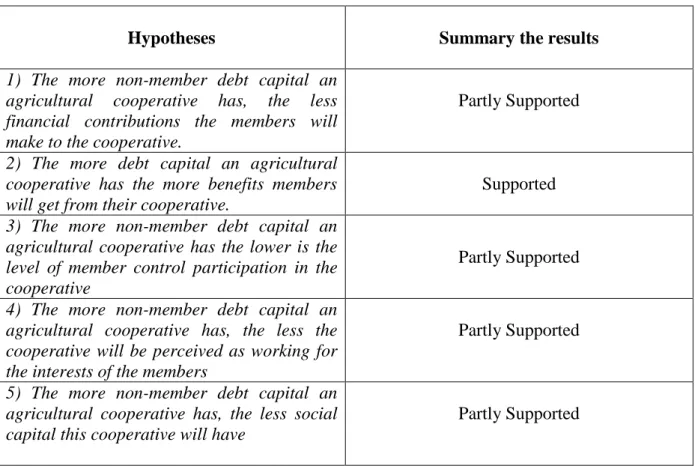
This chapter includes a presentation and analysis of the empirical findings from the interviews as described in Chapter 4. The presentation and analysis follow the same structure and order as the five hypotheses listed in Chapter 3. Firstly, each of the hypotheses will be once again declared and briefly explained followed by a presentation of the interview questions that were used to test the hypothesis. After that, the answers from the different cooperative managers, which are relevant to connect to the hypothesis, will be presented and analyzed. In the end of each section that concerns one hypothesis, whether the hypothesis was supported by the empirical data or not will be discussed. Bases on the analysis of the interview answers, a summary of the results from the five hypotheses will be presented in table 2 in the end of this chaper.
5.2 Hypothesis 1
The more non-member debt capital an agricultural cooperative has, the less financial contributions the members will make to the cooperative.
This hypothesis concerns the relationship between members’ willingness to invest capital in the cooperative and the cooperative’s acquisition of debt capital. It was assumed that the members would be less willing to invest in the cooperative once the cooperative starts using debt capital. The interview questions that are asked to test this hypothesis are:
1. What are the incentives for the farmers to join your cooperative?
2. Are there any members being concerned about that the cooperative might have
difficulties to make repayments and fulfill other terms of the loans?
3. Do the lenders’ influence on the cooperative business affect the members’ willingness
to make financial contributions to the cooperative?
4. How do you think the cooperative’s dependence on the members’ investments has
changed after acquiring debt capital?
5. How often have the members made investments in the cooperative compared to the
time without debt capital?
Most interviewees claimed that their cooperative became much less dependent on the capital provided by the farmer members after the acquisition of debt capital. The loans are much larger than the member capital in the form of member shares and member fees. Two interviewees even said that their cooperatives’ businesses would not be affected if some members want to quit the cooperative and withdraw their shares from the cooperative. Only one of the cooperative’s representative that were interviewed still raises funds from their members regularly and there have not been significant changes concerning members’ attitudes towards investing in the cooperatives. One comment that was frequently mentioned by the interviewees was that the loans became easier and easier to get once the relationship with the lender was established.