УДК 81’32
CHARACTER-BASED DEEP LEARNING MODELS FOR TOKEN AND SENTENCE SEGMENTATION
Alymzhan Toleu1,2, Gulmira Tolegen1,2, Aibek Makazhanov1, 1National Laboratory Astana, 53 Kabanbay Batyr ave.,
Astana, 010000, Kazakhstan
2Tsinghua University, Department of Computer Science and Technology, Beijing, 100084, China
In this work we address the problems of sentence segmentation and tokenization. Informally the task of sentence segmentation involves splitting a given text into units that satisfy a certain defi nition (or a number of defi nitions) of a sentence. Similarly, tokenization has as its goal splitting a text into chunks that for a certain task constitute basic units of operation, e.g. words, digits, punctuation marks and other symbols for part of speech tagging. As seen from the defi nition, tokenization is an absolute prerequisite for virtually every natural language processing (NLP) task. Many of so called downstream NLP applications with higher level of sophistication, e.g. machine translation, additionally require sentence segmentation. Thus both of the problems that we address are the very basic steps in NLP and, as such, are widely regarded as solved problems. Indeed there is a large body of work devoted to these problems, and there is a number of popular, highly accurate off the shelf solutions for them. Nevertheless, the problems of sentence segmentation and tokenization persist, and in practice one often faces certain diffi culties whenever confronted with raw text that needs to be tokenized and/or split into sentences. This happens because existing approaches, if they are unsupervised, rely heavily on crafted rules and lexicons, or, if they are supervised, rely on extraction of hand-engineered features. Such systems are not easy to maintain and adapt to new domains and languages because for those one may need to revise the rules and feature defi nitions.
In order to address the aforementioned challenges, we develop character-based deep learning models which require neither rule nor feature engineering. The only resource required is a training set, where each character is labeled with an IOB (Inside Outside Beginning) tag. Such training sets are easily attainable from existing tokenized and sentence-segmented corpora, or, in absence of those, have to be created (but the same is true for rules, lexicons, and hand-crafted features). The IOB-like annotation allows us to solve both tokenization and sentence segmentation problems simultaneously casting them as a single sequence-labeling task, where each character has to be tagged with one of four tags: beginning of a sentence (S), beginning of a token (T), inside of a token (I)
and outside of a token (O). To this end we design three models based on artifi cial neural networks: (i) a fully connected feed forward network; (ii) long short term memory (LSTM) network; (iii) bi-directional version of LSTM. The proposed models utilize character embeddings, i.e. represent characters as vectors in a multidimensional continuous space.
We evaluate our approach on three typologically distant languages, namely English, Italian, and Kazakh. In terms of evaluation metrics we use standard precision, recall, and F-measure scores, as well as combined error rate for sentence and token boundary detection. We use two state of the art supervised systems as baselines, and show that our models consistently outperform both of them in terms of error rate.
Keywords: Token and Sentence Segmentation; Neural Networks; Deep Learning. СИМВОЛЬНЫЕМОДЕЛИГЛУБИННОГООБУЧЕНИЯ ДЛЯГРАФЕМАТИЧЕСКОГОАНАЛИЗА АлымжанТолеу1,2, ГульмираТолеген1,2, АйбекМакажанов1 1НациональнаяЛабораторияАстана, пр. Кабанбайбатыра 53, Астана, 010000, Казахстан 2УниверситетЦинхуа, ФакультетКомпьютерныхНаук иТехнологий, Пекин, 100084, КНР [email protected] В настоящей работе мы рассматриваем задачу графематического анали-за, а именно проблемы сегментации текста на предложения и токены. Сег-ментация текста по предложениям рассматривается как задача нахождения отрывков текста, удовлетворяющих одному или нескольким определениям предложения. Сегментация на токены (токенизация) – задача разбиения текста на операционные единицы, т.е. слова, цифры, знаки препинания и пр. Токенизация является базовой задачей обработки естественного языка (ОЕЯ). Большинство прикладных задач ОЕЯ, отличающихся относитель-ной сложностью, например машинный перевод, нуждаются в сегментации входного текста по предложениям. Таким образом, обе рассматриваемые нами задачи являются основополагающими для ОЕЯ, и, как следствие, счи-таются в достаточной степени решенными. Действительно, опубликовано немало исследований по данной тематике, и существуют готовые решения широкого применения с хорошей точностью. Тем не менее, проблемы гра-фематического анализа в большинстве случаев остаются открытыми, и на практике с ними приходится сталкиваться каждый раз, когда появляется необходимость в работе с необработанным текстом, т.е. не разбитым на предложения и токены. Это происходит потому, что существующие
под-ходы основаны либо на словарях и правилах (необучаемые), либо на извле-чении вручную заданных признаков (обучаемые). Такие подходы тяжело адаптировать к новым языкам/жанрам, так как это требует переопределе-ние словарей, правил и признаков. Для снятия вышеупомянутых ограничений мы разработали символьные модели глубинного обучения, которые не нуждаются в определении правил или признаков. Единственное в чем есть необходимость – это обучающая выборка, в которой каждый символ помечен IOB меткой. Подобные обу-чающие выборки легко получить из имеющихся сегментированных и токе-низированных корпусов. В случае отсутствия последних обучающую вы-борку придется создавать вручную, как в прочем, и словари и правила для других методов. Использование IOB разметки позволяет решать обе задачи одновременно, как одну задачу разметки последовательности, цель которой присвоить каждому символу одну из четырех меток: начало предложения (S), начало токена (T), тело токена (I), или пробел (O). Для решения данной задачи мы разработали три модели, основанные на искусственных нейрон-ных сетях: (1) поступательная сеть; (2) LSTM сеть; (3) двунаправленная LSTM сеть. Разработанные модели используют символьные вложения, т.е. представления символов в виде векторов в многомерном пространстве. Мы оцениваем наш подход на трех типологически отдаленных языках: английском, итальянском и казахском, используя стандартные метрики точности, покрытия, F-меры и процента ошибки. Для сравнения мы ис-пользуем две широко распространённые системы графематического анали-за, и показываем, что обе уступают нашим моделям по метрике процента ошибки. Ключевыеслова: Графематический анализ; нейронные сети; глубин-ное обучение. 1. Introduction
Let us begin by a quick recap of defi nitions. Sentence segmenta-tion, aka sentence boundary detecsegmenta-tion, is a problem of segmenting a text into sentences for further processing; and tokenization is a prob-lem of segmenting a text into chunks that for a certain task constitute basic units of operation (e.g. words, digits, etc.). At a fi rst glance the problems seem trivial; after all, most written languages use special symbols to terminate sentences and whitespaces to delimit words. This is however not always the case.
First, although for many languages sentence fi nal punctuation con-sists of a period (dot), a question and an exclamation mark, some lan-guages use different sets of symbols (Brown, 2017). Second,
regard-less of symbols used as delimiters in any given language, chances are that those symbols have other functions as well, e.g. periods (dots) may be used in abbreviations, initials or in numbers as decimal points. Third, sentence and token defi nitions depend on the task at hand. For instance, while sentence segmentation may not be needed and a simple whitespace tokenization may be enough for a bag of word-based docu-ment classifi cation, for parsing one may need to consider multiple sen-tence utterances in direct speech as a part of a host sensen-tence (sensen-tences in a sentence) and count clitics (syntactic words usually delimited with hyphens and apostrophes, but not whitespaces) as separate tokens. Thus, to solve sentence and token segmentation problems one cannot blindly segment texts at the occurrences of certain symbols, and has to resort to a more sophisticated approach.
Fig. 1. An Example of an IOB-labeled text in English, Italian, and Kazakh In this work we cast the token and sentence segmentation (TSS) problems as a single sequence labeling task and propose artifi cial neu-ral network-based solutions, namely three character-based deep learn-ing models. Unlike much of the previous work, our approach requires neither rule nor feature engineering. The only resource required is a training set, where each character is labeled with an IOB (Inside Out-side Beginning) tag. Performing TSS jointly and using IOB-like for-mat is not, in itself, a novelty, Evang et al. (2013) have implemented this approach in their CRF-based system called Elephant. However, unlike Elephant, our models make use of character embeddings, i.e. map characters into continuous vector space, and make no use of pre-defi ned features. Experiments show that our models achieve top per-formance for Kazakh language, for which TSS evaluation has never been carried out before. In order to show that the proposed models can achieve competitive results we compare them to a popular TSS system
Punkt (Kiss and Strunk, 2006) and the aforementioned Elephant sys-tem, which is considered the state-of-the-art. For this experiment we use publically available data sets for English and Italian languages.
2. Related Work
Existing systems for token and sentence boundary detection are based on hand written rules, unsupervised and supervised learning ap-proaches. Rule-based systems (Grefenstette, 1999; Jurafsky and Mar-tin, 2008; Dridan and Oepen, 2012) utilize hand-written rules, fi xed lists of abbreviations and other lexical items to detect sentence bound-aries. As a result such approaches are hard to maintain and not easy to adapt to new languages (Silla Jr. and Kaestner, 2004) or domains.
Unsupervised learning systems do not require specifi c hand-cod-ed regular expressions and annotathand-cod-ed training data. Mikheev (2002) presented an unsupervised approach for sentence boundary detection, proper name identifi cation and abbreviation detection. The proposed system achieved respective error rates of 1.41% and 0.65% on WSJ and Brown corpora. The author concluded that the most crucial factor for sentence segmentation was detection of abbreviations and prop-er names. A similar system called Punkt was proposed by Kiss and Strunk (2006). The approach here has two detection stages: abbrevia-tion detecabbrevia-tion and token-based classifi cation. This system reached high accuracy, rivaling handcrafted rule-based and unsupervised systems. Compared with Mikheev’s system, Punkt’s error rates on WSJ and Brown corpora were 1.65% and 1.02%, respectively.
Supervised learning approaches utilize hand-engineered features, such as POS tags, tokens neighboring potential sentence boundaries, abbreviation lists, letter case (lowercase, uppercase), etc. These systems utilized maximum entropy models (Reynar and Ratnaparkhi, 1997) and conditional random fi elds (Fares et al., 2013). Many works have shown that conditional random fi eld (CRF) is the most popular model for sequence labeling tasks (Lafferty et al., 2003; Tolegen et al., 2016).
Evang et al. (2013) presented a CRF-based TSS system – Elephant that uses a single character as a basic unit of operation. The system uses several features, such as Unicode categories, Unicode charac-ter codes, and combination of the two, as well as the 10 most active outputs of learned hidden states of a deep learning model as one fea-ture category. Unlike our approach, Elephant uses the discrete feafea-tures
rather than distributed embedding features. Numerous works on deep learning for NLP have shown the advantage of embeddings that tend to capture meaningful information and reduce task-specifi c features engineering.
3. Method
3.1 IOB labeling
In order to jointly learning one model for two tasks, we adopted IOB tagging scheme to identify the boundaries of the tokens and sen-tences. An example is given in Fig. 1. The tags S and T denote the beginnings of sentence and token boundaries respectively. Inside of a token is labeled I, and outside as O. Passages included in “<” and ”>” denote segmented sentences. In the given example whenever tokens and sentence boundaries are not preceded by an outside character (O) they are underlined.
3.2 A general neural network
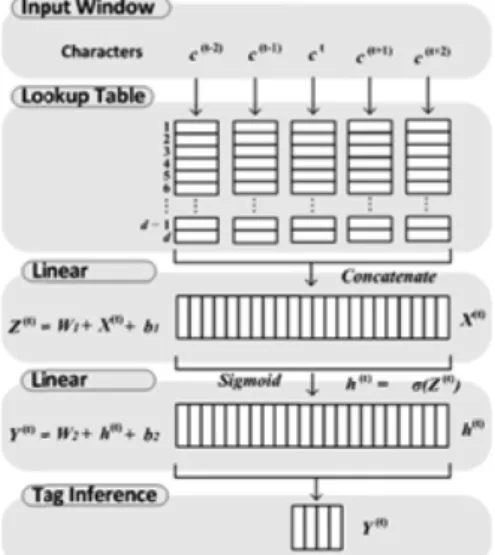
We introduce a general neural network model (Collobert et al., 2011) for token and sentence boundaries detection. The model is usu-ally characterized by three specialized layers: (i) a character look-up table layer that extracts a window of character’s embeddings from a character parameter matrix; (i) a general hidden layer; (iii) one output layer that is used to compute normalize scores for labels. The model architecture is shown on Fig. 2 and in what follows we refer to this model as NN.
Character look-up table. Let C be the list of characters derived
from training data, d be the dimension of character embeddings, be the matrix of character’s embeddings. Suppose that a string s is made up of a sequence of characters [c1,…,cl], where l is the length of string. Then the character-level representation of s of is given by the matrix Q, where the j-th column of matrix Q corresponds to the character embedding for Cj. We use a sliding window approach to get
a fi xed sized w (a hyper-parameter) window of character embeddings around current character. Each character in the window is fi rst passed through the look-up operation which produces a matrix of character embeddings that can be viewed as a w×d-dimensional vector x by con-catenating each column vector, which can be fed into the next layers.
Hidden layer. The embedding of characters x∈Rw×d is extracted from the look-up table and is fed into a hidden layer which performs non-linear transformation followed by an element-wise activation function σ such as tanh, and the computation of this layer is:
h = σ(W1x + b1) (1)
where W1∈ RH1×wd is the parameter, b1∈ RH1×1 is a bias term, h∈ RH1 is
hidden units, H1 is dimension of hidden layer.
The output layer is fi nally added on the top of the hidden layer for scoring boundary labels:
Score (x,T,θ) = softmax(W2h + b2) (2)
where Score(x,y,θ)∈R|T|×1 is a score of labels that computed by neural
network with parameters θ = {Q,W1,b1,W2,b2}, |T| is the number of tags. The parameters of models are initialized to small random num-bers and automatically trained the by back-propagation algorithm.
3.3 Bi-directional LSTMs
Recently, LSTM neural networks have shown great promise in many NLP tasks (Greff et al., 2015; Ling et al., 2015; Toleu et al.,
2017) including language modelling, part-of-speech tagging etc. The architecture of LSTM consists of a set of recurrently connected states that can be viewed as memory blocks. Each block contains certain self-connected memory cells and three gates: input, output and forget gate. The gates provide continuous analogues of write, read and reset operation for the cells.
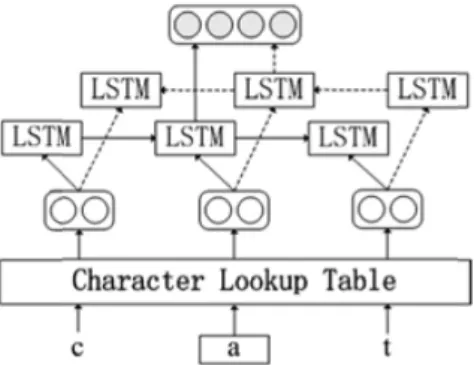
In order to examine the effectiveness of LSTM network for TSS, we use a model to predict each boundary label using LSTM. The ar-chitecture of our LSTM-based network is a variant that was described by Graves and Schmidhuber (2005), and is frequently cited in the lit-erature.
Given a string made up of a sequence of characters , we encode each character into a vector representation then feed into our LSTM-based models, computing the forward hidden state and the backward hidden state. Both hidden states are concatenated into a single vector and fed into the output layer. In what follows we refer to this model as bi-LSTM, the model only uses the forward hidden states as LSTM. The architecture of the model is shown on Fig. 3.
4. Experiments
4.1. Data sets
The experiments were conducted on three datasets: (i) Kazakh texts from Kazakh corpus (Makhambetov et al., 2013) and UD tree-bank (Makazhanov et al., 2015); (ii) English newswire texts taken from the Groningen Meaning Bank, GMB (Basile et al., 2012); (iii) Italian texts from the PAIS`A corpus (Borghetti et al., 2011). Each dataset was split into three parts: a training set, a validation set, which is used for early stopping to select the best model and for optimizing the hyper-parameters, and a test set used for the fi nal evaluation. Kazakh data needed additional processing as it was not IOB-labeled. We have performed an automatic IOB labeling based on existing token and sentence segmentations. Table 1 provides sta-tistics on the domains of the texts and data quantities in terms of numbers of sentences and tokens.
Fig. 3. Architecture of bi-LSTM-based model Table 1. Characteristics of the data sets
Language Domain # sentences # tokens
Kazakh web/various 4 360 96,760
English newswire 2 886 64,443
Italian web/various 42 674 869,095
4.2. Model setup
We implement all neural network models using Java programming language and use the same hyper-parameters in all of three models: 35 for character level embeddings with random initialization, 9 for window size, 100 hidden states. We run 300 epochs on training and development sets, and select one model that is optimized on evalua-tion over the development set. The selected model is applied to the test set for the fi nal evaluation. We used the CoNLL evaluation script to report, accuracy, precision, recall and F-measure over the token and sentence boundary labels.
4.3. Results
As it can be seen from Table 2, a general neural network model (NN) achieves a perfect 100 on all metrics, and clearly outperforms LSTM-based models in the task of sentence boundary detection for English language. One possible explanation is that the model NN has a window (the size is 9) to capture some corresponding characters and
predict a label to the centered one character, in this case, the prediction is made by conditioning on the left and right 4 characters. As our pre-liminary experiments showed that taking a smaller or larger window size, it harms the model performance on the sentence boundary label, but for token boundary, it does not have a signifi cant effect.
Table 2. Evaluation results for English
Sentence segmentation Tokenization
Models Precision Recall F-measure Precision Recall F-measure
NN 100 100 100 99.92 99.82 99.87
LSTM 99.34 99.34 99.34 99.94 99.86 99.90
bi-LSTM 99.67 99.34 99.50 99.95 99.86 99.90
On the other hand, the LSTM-based models achieve marginal im-provement of the NN model in tokenization. In general all of the three models achieve near perfect results on the English data set.
Table 3.Evaluation results for Italian
Sentence segmentation Tokenization
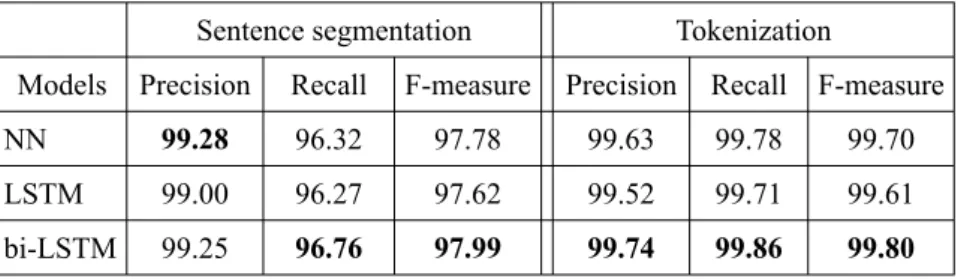
Models Precision Recall F-measure Precision Recall F-measure NN 99.28 96.32 97.78 99.63 99.78 99.70 LSTM 99.00 96.27 97.62 99.52 99.71 99.61 bi-LSTM 99.25 96.76 97.99 99.74 99.86 99.80
As shown in Table 1, the size of the Italian data set is more than ten times larger than that of English and eight times larger than that of Kazakh. It is interesting to see the performance of neural network models for token and sentence boundary detections given larger train-ing data. As evident from Table 3, the bi-LSTM model benefi ted the most from the abundance of data and was second to the NN model only in terms of precision of sentence segmentation. In general for the Italian language sentence segmentation turned out to be less accurate compared to English, but tokenization is still at the acceptable 99.8% in terms of F-measure.
From Table 4 one can observe that for Kazakh language the NN model detects sentence boundaries more accurately even though the other models use the same context window size (from the preliminary experiments, we observed that all of the LSTM-based models gave lower results without using a context window). This model has the highest recall in the tokenization task. As we have learned from the experiment on Italian, LSTM-based models are more sensitive to the size of training data, and thus maybe performing lower on a relatively small data set. In general all of the models exhibit a signifi cantly lower performance on Kazakh data set. This can be explained by the fact that a large portion of this data set came from the Web (cf. Table 1), a noto-riously noisy source. While the Italian data set contains certain amount of Web texts as well, this data set as a whole is much larger than the Kazakh one. Thus, we speculate that the fact that the data set was noisy and small may have hindered the performance of the models.
Table 4. Evaluation results for Kazakh
Sentence segmentation Tokenization
Models Precision Recall F-measure Precision Recall F-measure NN 92.70 99.44 95.95 99.74 99.44 99.59 LSTM 92.43 97.95 95.11 99.58 99.43 99.50 bi-LSTM 92.20 99.25 95.60 99.82 99.40 99.61
Table 5.Comparison with other systems
English Italian
Models (F-measure)Sentence Sent. + Tok.(error rate) (F-measure)Sentence Sent. + Tok.(error rate)
Punkt 98.51 – 98.34 –
Elephant 100 0.27 99.51 0.76
NN 100 0.05 97.78 0.12
LSTM 100 0.03 97.62 0.13
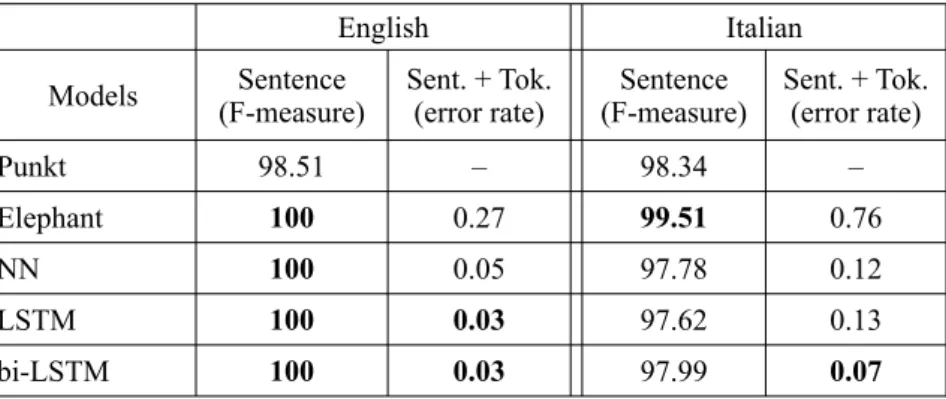
In order to assess the performance of our models relative to exist-ing systems we compare the performance of our models to the results reported by Evang et al. (2013) for their system Elephant and for an-other popular TSS system, Punkt (Kiss and Strunk, 2006). That is to say, we do not actually run and evaluate those systems. Instead we run our systems on the data that were used in the original experiment (Evang et al., 2013) and compare the results to the ones reported in that original experiment. The comparison is carried out in terms of F-measure of sentence boundary detection and combined (sentence and token segmentation) error rate. The results of the comparison are given Table 5.
As it can be seen, for English all of the models achieve a perfect F-measure of 100% on the sentence segmentation task, except Punkt that performs at 98.51%. When it comes to the combined TSS error rate our LSTM-based models achieve the lowest score of 0.03, improving 9 times over the state-of-the-art system, Elephant. When it comes to sentence boundary detection for Italian, however, our models are out-performed by both of the baseline systems. Here Elephant achieves a very strong F-measure of 99.51%, Punkt yields 98.34%, and the best of our models, bi-LSTM, performs at a decent 97.99%. Nevertheless, as it was the case with English, in terms of error rates for both token and sentence segmentation, our models perform much better, yielding the scores of 0.12, 0.13, 0.07 for NN, LSTM and bi-LSTM (without using any external features) respectively. Here the best performing model, bi-LSTM, improves almost 11 times over Elephant, whose error rate was 0.76. These results indicate that character-based deep learning models are better at modeling token boundary detection and also give very competitive results for sentence segmentation.
5. Conclusion
We have presented character-based deep learning models for joint token and sentence boundary detection. The main advantage of our approach is that it does not require any manual rule and feature engi-neering, and as such, is easy to maintain and adapt to new languages/ domains. We have carried out both an absolute and comparative evalu-ation of our models on three languages (Kazakh, English and Italian). Our experiments showed that the proposed models achieve competi-tive results when compared to the state-of-the-art systems.
Acknowledgements
This work has been supported by the Committee of Science of the Ministry of Education and Science of the Republic of Kazakhstan under the targeted program O.0743 (0115PK02473), and by the Nazarbayev University under the research grant №129-2017/022-2017.
REFERENCES
1. Valerio Basile, Johan Bos, Kilian Evang, and Noortje Venhuizen. 2012. Developing a large semantically annotated corpus. In LREC 2012, pages 3196–3200, Istanbul, Turkey.
2. Claudia Borghetti, Sara Castagnoli, and Marco Brunello. 2011. I testi del web: una proposta di classifi cazione sulla base del corpus PAISA`. InM. Cerruti, E. Corino, and C. Onesti, editors, Formale e informale. La variazione di re gistro nella comunicazione elettronica, pages 147–170. Carocci, Roma.
3. Brown T. Julian. Punctuation. https://www.britannica.com/topic/ punctuation. Last accessed 09.09.2017.
4. Ronan Collobert, Jason Weston, Leon Bottou, Michael Karlen, Koray Kavukcuoglu, and Pavel Kuksa. 2011. Natural Language Processing (Almost) from Scratch. Journal of Machine Learning Research, pages 2493–2537.
5. Rebecca Dridan and Stephan Oepen. 2012. Tokenization: Returning to a long solved problem – a survey, contrastive experiment, recommenda-tions, and toolkit –. In ACL2012 (Volume 2: Short Papers), pages 378–382, Jeju Island, Korea. Association for Computational Linguistics.
6. Kilian Evang, Valerio Basile, Grzegorz Chrupała, and Johan Bos. 2013. Elephant: Sequence Labeling for Word and Sentence Segmentation. In EMNLP 2013, pages 1422–1426, Washington, USA.
7. Murhaf Fares, Stephan Oepen, and Zhang Yi. 2013. Machine learning for high-quality tokenization – replicating variable tokenization schemes. In CICLING 2013, pages 231–244.
8. Graves, A, Liwicki, M, Fernandez, S, Bertolami, R, Bunke, H, and Schmidhuber, J. A Novel Connectionist System for Improved Uncon-strained Handwriting Recognition. IEEE Transactions on Pattern Analysis and Machine Intelligence, 31(5), 2009.
9. Klaus Greff, Rupesh Kumar Srivastava, Jan Koutn´ık, Bas R. Steunebrink, and Jurgen Schmidhuber. ¨ 2015. LSTM: A Search Space Odyssey. CoRR abs/1503.04069.
10. Gregory Grefenstette. 1999. Tokenization. In Hans van Halteren, edi tor, Syntactic Wordclass Tagging, pages 117–133. Kluwer Academic Publishers, Dordrecht.
11. Daniel Jurafsky and James H. Martin. 2008. Speech and Language Pro cessing. An Introduction to Natural Language Processing, Computational Linguistics, and Speech Recognition. Prentice Hall, 2nd edition.
12. Kiss, Tibor, and Jan Strunk. 2006. Unsupervised multilingual sen-tence boundary detection. Computational Linguistics 32.4, pages 485–525
13. John D. Lafferty, Andrew McCallum, and Fernando C.N. Pereira. 2001. Conditional random fi elds: Probabilistic models for segmenting and labeling sequence data. In ICML ’01, pages 282–289.
14. Wang Ling, Chris Dyer, Alan W. Black, Isabel Trancoso, Ramon Fermandez, Silvio Amir, Lus Marujo, and Tiago Lus. 2015. Finding Function in Form: Compositional Character Models for Open Vocabulary Word Representation. In EMNLP2015, pages 1520–1530.
15. Makazhanov A., Sultangazina A., Makhambetov O., Yessenbayev Z. 2015. Syntactic Annotation of Kazakh: Following the Universal De-pendencies Guidelines. A report. TurkLang 2015, pages 338–350.
16. Makhambetov O., Makazhanov A., Yessenbayev Z., Matkarimov B., Sabyrgaliyev I., Sharafudinov A. 2013. Assembling the Kazakh Language Corpus. In EMNLP2013, pages 1022–1031.
17. Andrei Mikheev. 2002. Periods, capitalized words, etc. Computational Linguistics, 28(3):289–318.
18. Carlos N. Silla Jr. and Celso A. A. Kaestner. 2004. An analysis of sentence boundary detection systems for English and Portuguese docu-ments. In CICLing 204, pages 135–141.
19. Toleu, Alymzhan and Tolegen, Gulmira and Makazhanov, Aibek. 2017. Character-Aware Neural Morphological Disambiguation. In Proceedings of ACL 2017, pages 666–671,Vancouver, Canada.
20. Gulmira Tolegen, Alymzhan Toleu, and Zheng Xiaoqing. 2016. Named Entity Recognition for Kazakh Using Conditional Random Fields. In Pro ceedings of TurkLang 2016, pages 122–129.
21. Jeffrey C. Reynar and Adwait Ratnaparkhi. 1997. A maximum entropy approach to identifying sentence boundaries. In Proceedings of ANLP97, pages 16–19.