Dimensionality reduction in decentralized networks by
Gossip aggregation of principal components analyzers
J´
erˆ
ome Fellus, David Picard, Philippe-Henri Gosselin
To cite this version:
J´
erˆ
ome Fellus, David Picard, Philippe-Henri Gosselin. Dimensionality reduction in
decentral-ized networks by Gossip aggregation of principal components analyzers. European Symposium
on Artificial Neural Networks, Computational Intelligence and Machine Learning, Apr 2014,
Bruges, Belgium. pp.171-176, 2014.
<
hal-00985721
>
HAL Id: hal-00985721
https://hal.archives-ouvertes.fr/hal-00985721
Submitted on 30 Apr 2014
HAL
is a multi-disciplinary open access
archive for the deposit and dissemination of
sci-entific research documents, whether they are
pub-lished or not.
The documents may come from
teaching and research institutions in France or
abroad, or from public or private research centers.
L’archive ouverte pluridisciplinaire
HAL
, est
destin´
ee au d´
epˆ
ot et `
a la diffusion de documents
scientifiques de niveau recherche, publi´
es ou non,
´
emanant des ´
etablissements d’enseignement et de
recherche fran¸
cais ou ´
etrangers, des laboratoires
publics ou priv´
es.
Dimensionality reduction in decentralized networks by
Gossip aggregation of principal components analyzers
Jerome Fellus1, David Picard1and Philippe-Henri Gosselin1,2∗
1- ETIS - UMR CNRS 8051 - ENSEA - Universite de Cergy-Pontoise 2- Inria, Texmex project, Campus de Beaulieu, Rennes, France
Abstract. This paper considers dimensionality reduction in large decentralized networks with limited node-local computing and memory resources and unreliable point-to-point connectivity (e.gpeer-to-peer, sensors or ad-hoc mobile networks). We propose an asynchronous decentralized algorithm built on a Gossip consensus protocol that perform Principal Components Analysis (PCA) of data spread over such networks. All nodes obtain the same local basis that span the global principal subspace. Reported experiments show that obtained bases both reach a consensus and accurately estimate the global PCA solution.
1
Introduction
Real-world data is usually captured in a high-dimensional space. Observations being generally noisy and highly correlated, they often embed a much lower-dimensional hid-den structure. Dimensionality reduction aims at transforming high-dimensional inputs into low-dimensional representations that best retain this structure, easing tasks such as classification, clustering or visualization. In this paper, we focus on Principal Com-ponents Analysis (PCA [1]) which is a well-known linear approach to dimensionality reduction.
Like most statistical learning tools, PCA was formulated for centralized setups where all data is available at a single location. This assumes that the solution can be computed by a single machine and that all intermediary results fit in main memory. However, this assumption is unrealistic in most applicative fields that deal with many vectors of very high dimension. For instance, in biomedical, multimedia, or remote sensing applications, these vectors grows up to millions of values. Besides, along with the democratization of connected devices, data tends to originate from an increasing number of distributed sources with reasonable computing capacity, immersed in large unreliable networks without any central coordination. In contrast to usual centralized PCA, we propose to take advantage of this context to perform a decentralized large scale PCA.
Previous works on decentralized PCA includes a Gossip-based power iteration method to extract principal components one by one when each node holds one vector, using random matrix sparsifications to optimize communication costs [2]. Decentral-ized implementations of Orthogonal Iteration where also proposed either when data fol-low a Directed Acyclic Graphical model (DAG) [3], or when seeking the eigenvectors of the network graph adjacency matrix [4]. Aggregation of Mixtures of Probabilistic Principal Components [5] can also be used in conjunction with the Gossip likelihood
maximization framework proposed in [6] to perform a simple PCA. However, none of these methods deal with numerous vectors of very high dimension spread over the network, without any prior knowledge about their distribution.
The main contribution of this paper is a decentralized algorithm that allows all nodes of a network, each one holding a local dataset, to compute PCA over the complete data with reduced local computations and communication cost. It is based on the integration of a dimensionality reduction step into an asynchronous Gossip consensus estimation protocol. Our decentralized approach shows performances that almost equals a central-ized PCA run over the complete distributed data.
The paper is organized as follows: after formally defining our problem, we intro-duce our asynchronous Gossip protocol. We then apply it to covariance estimation and integrate our in-loop dimensionality reduction step. We present experimental results before concluding the paper with some remarks and perspectives.
2
Problem statement
Given a network G of N nodes, each node iholding a sampleXi = [x
(i) 1 . . .x
(i)
ni],
x(ji)∈ RD, our goal is to compute the global PCA solution onX= [X1. . .XN]only using node-local computations. In a typical high-dimensional setup,∀i, ni ≪ D. In addition, four constraints must be respected:
C1. Minimal data exchange- Samples cannot be exchanged between nodes. C2. Asynchrony- Nodes must communicate without any coordination. C3. Decentralization- All nodes and links must play the same role.
C4. Consensus- All nodes must get the same local solution to ensure that reduced representation are expressed with the same basis across the network.
The global PCA solution is an orthonormal basisU˜ = [u1. . .uq],uk ∈RDthat projects the input sampleXinto the q-dimensional subspace that retain the maximal variance inX. U˜ is shown to contain theqleading eigenvectors of the sample covari-ance matrixC= n1XXT −µµT, whereµ= n1XT1is the sample mean [1].µandC cannot be computed at a particular node as they involve the locally unknown full sam-pleX. However, they can be computed as the distributed weighted averages of local sample meansµi= n1iXTi 1and local uncentered covariance matricesCi=n1iXiXTi :
µ= 1 nX T1= 1 n N X i XTi1=P1 ini N X i niµi (1) C= 1 nXX T−µµT = 1 n N X i XiXTi −µµ T = 1 P ini N X i niCi−µµT (2)
3
Gossip-based averaging
Among the numerous approaches to distributed weighted averaging, Sum-Weight Gos-sip protocols is a decentralized solution that meets the above-mentioned require-ments [7]. Let each nodei hold a couple(ωi,vi)wherevi lies in a vector spaceV
andωi ∈ R. Sum-Weight protocols estimate the weighted average P1 iωi
PN
i ωivi
by assigning to each nodeia sumsi ∈ V and a weightwi ∈ R, with initial values
si(0)≡ωiviandwi(0)≡ωi. All nodes repeatedly send their current sum and weight
to randomly selected peers, while updating them according to incoming values. To respect asynchrony and decentralization, nodes are shipped with independent Poisson emission clocks and selects targets independently at random. The t-th message ex-changed on the network thus affects one random sendersand one random receiverr. As shown in [7], for any nodei,w1isiconverge to the desired weighted average.
ss(t+ 1) = 1 2ss(t) ws(t+ 1) = 1 2ws(t) (3) sr(t+ 1) =sr(t) + 1 2ss(t) wr(t+ 1) =wr(t) + 1 2ws(t). (4) ∀i, lim t→∞ 1 wi(t) si(t) = 1 P iwi(0) X i si(0) = 1 P iωi X i ωivi (5)
Moreover, convergence to the consensus is exponential provided thatGhas a sufficient conductance [8]. In this case, the number of message exchanges required to achieve a given estimation error scales logarithmically with the number of nodes.
4
Basic approach : Gossip Late PCA
As weighted averages,µandCcan be estimated using the above-defined protocol, by defining node-local estimatesai(t),Bi(t)and weightswi(t)such that:
ai(0) =XT1 Bi(0) =XiXTi wi(0) =ni (6)
We now apply the Gossip protocol defined by Eq.(3-4) toai(t),Bi(t)andwi(t). From these estimates, we can get a covariance estimateCi(t):
Ci(t) = Bi(t) wi(t) −ai(t)ai(t) T wi(t)2 (7) Note that initial estimatesCi(0)are the covariance matrices of their correspondingXi. The limit in (5) shows that each ai(t)
wi(t) tends to the global meanµand eachCitends to the global covariance matrixC:
∀i, lim t→∞ ai(t) wi(t) = P iX T i 1 P ini = P iniµi P ini =µ lim t→∞ Ci(t) = P iBi(0) P iwi(0) −µµT = 1 n X i XiXTi −µµ T =C (8)
Once each node gets a sufficiently accurate estimate forC, the final PCA result can be computed locally at any nodeiby eigendecomposition ofCi, keeping theqleading eigenvectors as the node-local reduced basis. We call this strategylate PCA. Unfortu-nately, updating estimatesBi using Eq.(3) requires transmission ofD×Dmatrices, which is incompatible with our constrained networking context. We thus propose to reduce matricesBiby means of local PCAbeforetheir transmission.
Algorithm 1 Emission Procedure ai←XTi1; Gi←XTi Xi; wi←ni (Vi,Li)←eigendecompose(Gi) Ui←XiViΛ −1 2 i loop j←randomNeighbor(i) (ai,Li, wi)← 12(ai,Li, wi) Send(ai,Ui,Li, wi)toj end loop
Algorithm 2 Reception Procedure loop Upon receiptof(aj,Uj,Lj, wj) ai←ai+aj ; wi ←wi+wj Q0←Ui fort∈[0, max t[do (Qt+1,Rt+1)← QR(UiLiUTiQt+UjLjUTjQt) end for
Ui←Qmax t; Li ←diag(Rmax t)
end loop
5
Proposed approach : Early Gossip PCA
In contrast tolate PCA, which first estimates the full covariance and then computes its principal subspace, we propose anearly PCAapproach that integrates dimensionality reduction into the Gossip update rule Eq.(3). To transmitBsfrom nodesto noder,s first diagonalizeBs, keeps theqleading eigenpairs and sends this reduced version tor, which reconstructsBsand adds it to its ownBr. Consequently, the size of exchanged messages falls toO(qD)for a desired subspace dimensionq. Even though some spec-tral features may be lost in this reduction process, we argue that this loss, cumulated over time, will be close to the loss induced bylate PCA. We still face the issue thatBi areD×Dand might not fit in node-local memory. But because data is distributed, it is likely thatni ≪D. This in mind, two algebraic properties ofBisolve our problem: Firstly, explicit computation of the initialBi (Algorithm 1) is not required as its eigendecompositionBi=UiLiUTi can be obtained by diagonalizing theni×niGram matrixXT iXi=ViΛiVTi . Indeed, sinceB2i =XiXTi XiXTi =XiViΛiVTi XTi = (XiViΛ −1 2 i )Λ2i(XiViΛ −1 2 i )T and(XiViΛ −1 2 i )T(XiViΛ −1 2 i ) =I, we get: Ui =XiViΛ −1 2 i and Li=Λi (9)
We then compute, store and diagonalizeXT
iXi (which isni×ni) instead ofXiXTi (which isD×D) and obtainUiandLiwith no additional storage cost.
Secondly, when processing an incoming message, explicit reconstruction of re-ceivedBs(t)is also unneeded, as we only wantUr(t+1)Lr(t+1)Ur(t+1)T to span theq-principal subspace ofBs(t)+Br(t). SinceBs(t)andBr(t)respectively come as Us(t)Ls(t)Us(t)T andUr(t)Lr(t)Ur(t)T, we can findUr(t+1)andLr(t+1)using Orthogonal Iteration (as in [4]). Starting from anyD×qbasisQ0, and denoting by
QR(·)the economy QR decomposition, we iteratively compute
Qτ+1Rτ+1=QR((Bs+Br)Qτ) =QR(UsLs(UTsQτ) +UrLr(UTrQτ)) (10)
After a few iterations,Qτbecomes an orthonormal basis for theq-principal subspace of Bs(t)+Br(t), with corresponding eigenvalues on the diagonal ofRτ. Thus,Q∞gives
Ur(t+1)and the diagonal entries ofR∞, denoted bydiag(R∞), giveLr(t+1). Observe that we never store anyD×Dmatrix but ratherD×qones. Sinceq≪D, all needed
1500 500
0
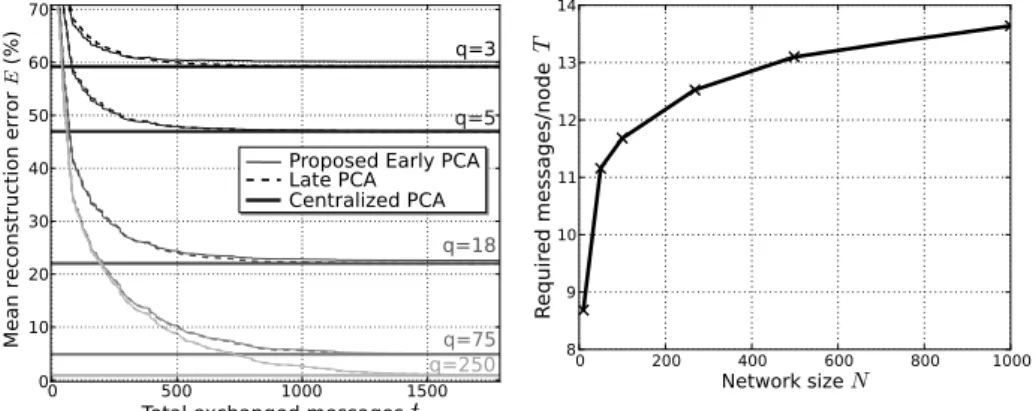
Total exchanged messages t 0 M ea n rec o n s tru c ti o n erro r E (%) 10 20 30 40 50 60 70 1000 q=3 q=5 q=18 q=75 q=250 Late PCA Centralized PCA Proposed Early PCA
Fig. 1: Mean covariance reconstruction error for early, late and centralized PCA forq={3,5,18,75,250}, from black to light-gray. 0 200 400 600 800 1000 Network size N 8 9 10 11 12 13 14 T R eq u ir ed mes s a g es /n o d e
Fig. 2: Average number of messages per node required to converge against net-work sizeN
entities now fit in node memory. This results in two concurrent emission and reception procedures run independently at each node, presented in Algorithm 1 and Algorithm 21. EachD×q matrixUi then converge to the same consensus orthonormal basisU that span the principal subspace ofXXT. Finally, a basis for XXT −µµT can be locally computed at each node by applying Eq.(10) to(UiLiUTi +
1
w2
i
µiµTi). All local bases then project local data onto the same consensus global principal components.
6
Experimental results
In this section, we present an experimental evaluation of our proposal on the MNIST [9] handwritten digits training set, which contains 60000 grayscale images of28×28 pix-els, that is,D = 784. As both classical PCA and our method estimateq-dimensional bases for the principal subspace of the sample covariance, they are compared in terms of the normalized Euclidean errorEof covariance reconstruction. As the numbertof ex-changed messages and the network sizeNimpact the quality of our Gossip estimation, this error is measured as a function oftandN:
EN(t) = 1 NkXXTkF N X i XX T −U i(t)Li(t)Ui(t)T F (11)
Results forq = {3,5,18,75,250} and network sizeN = 100are gathered and compared withlate PCAand centralized PCA in Figure 1. We observe that all nodes obtain bases that are asymptotically very close to a centralized solution, with an expo-nential convergence with respect tot. The impact of network size is shown in Figure 2 1When implementing our method, care should be taken that iterations of Algorithm 1 and Algorithm 2 be
forq = 50by measuring the average number of messages per node required to con-verge,i.e, the lowestTsuch that∀t > T,|E(t
N)−E(
t−1
N )|<0.01%.Tappears to scale logarithmically withN. This means that our method is suitable for very large networks.
7
Conclusion
We presented a decentralized algorithm to solve PCA when data is spread over a (poten-tially large) network. Based on a randomized Gossip consensus protocol, our method takes into account asynchrony and unreliability of such network, with parsimonious usage of computational and communication resources. The distributed nature of the process has a very low impact on the accuracy of extracted principal components, and all nodes reach a consensus on their projections.
Perspectives include a theoretical convergence analysis and an adaptive selection strategy forqto achieve a bounded reconstruction error with variable-sized bases. Our interest currently focuses on assessing performances of our method in large scale con-texts, such as web-scale distributed multimedia retrieval.
References
[1] Harold Hotelling. Analysis of a complex of statistical variables into principal components.
Journal of educational psychology, 24(6):417, 1933.
[2] Satish Babu Korada, Andrea Montanari, and Sewoong Oh. Gossip PCA. InProceedings of the ACM SIGMETRICS joint international conference on Measurement and modeling of computer systems, pages 209–220. ACM, 2011.
[3] Zhaoshi Meng, Ami Wiesel, and Alfred O Hero. Distributed principal component analysis on networks via directed graphical models. InAcoustics, Speech and Signal Processing (ICASSP), 2012 IEEE International Conference on, pages 2877–2880. IEEE, 2012. [4] David Kempe and Frank McSherry. A decentralized algorithm for spectral analysis.Journal
of Computer and System Sciences, 74(1):70–83, 2008.
[5] Pierrick Bruneau, Marc Gelgon, and Fabien Picarougne. Aggregation of probabilistic PCA mixtures with a variational-bayes technique over parameters. InPattern Recognition (ICPR), 2010 20th International Conference on, pages 702–705. IEEE, 2010.
[6] Afshin Nikseresht and Marc Gelgon. Gossip-based computation of a gaussian mixture model for distributed multimedia indexing. Multimedia, IEEE Transactions on, 10(3):385–392, 2008.
[7] Franck Iutzeler, Philippe Ciblat, and Walid Hachem. Analysis of sum-weight-like algorithms for averaging in wireless sensor networks. CoRR, abs/1209.5912, 2012.
[8] Devavrat Shah.Gossip algorithms. Now Publishers Inc, 2009.
[9] Yann LeCun, L´eon Bottou, Yoshua Bengio, and Patrick Haffner. Gradient-based learning applied to document recognition.Proceedings of the IEEE, 86(11):2278–2324, 1998.