Research Article
Metric Learning Method Aided Data-Driven Design of
Fault Detection Systems
Guoyang Yan,
1Jiangyuan Mei,
1Shen Yin,
1and Hamid Reza Karimi
21Research Institute of Intelligent Control and Systems, Harbin Institute of Technology, Heilongjiang 150001, China 2Department of Engineering, Faculty of Engineering and Science, The University of Agder, 4898 Grimstad, Norway
Correspondence should be addressed to Shen Yin; [email protected] Received 15 December 2013; Accepted 22 January 2014; Published 10 March 2014 Academic Editor: Xudong Zhao
Copyright © 2014 Guoyang Yan et al. This is an open access article distributed under the Creative Commons Attribution License, which permits unrestricted use, distribution, and reproduction in any medium, provided the original work is properly cited. Fault detection is fundamental to many industrial applications. With the development of system complexity, the number of sensors is increasing, which makes traditional fault detection methods lose efficiency. Metric learning is an efficient way to build the relationship between feature vectors with the categories of instances. In this paper, we firstly propose a metric learning-based fault detection framework in fault detection. Meanwhile, a novel feature extraction method based on wavelet transform is used to obtain the feature vector from detection signals. Experiments on Tennessee Eastman (TE) chemical process datasets demonstrate that the proposed method has a better performance when comparing with existing methods, for example, principal component analysis (PCA) and fisher discriminate analysis (FDA).
1. Introduction
Due to the fact that industrial systems are becoming more complex, safety and reliability have become more critical
in complicated process design [1–3]. Traditional
model-based approaches, which require the process modeled by the first principle or prior knowledge of the process, have become difficult, especially for large-scale processes. With significantly growing automation degrees, a large amount of process data is generated by the sensors and actuators. In this framework, the data-based techniques are proposed and developed rapidly over the past two decades. Data-driven fault diagnosis schemes are based on considerable amounts of historical data, which take sufficient use of the information provided by the historical data instead of complex process
model [4,5]. This framework can simplify the design
pro-cedure effectively and ensure safety and reliability in the
complicated processes [6]. Many fault diagnosis techniques
have been used in the complicated industrial systems [7–9].
In this framework, PCA [10] and FDA [11] are regarded as
the most mature and successful methods in real industrial applications.
PCA aims at dimensionality reduction, which captures the data variability in an efficient way. In PCA method, process variables are projected onto two orthogonal sub-spaces by carrying out the singular value decomposition on the sample covariance matrix. And cumulative percent
variance [12] is the standard to determine the number of
principal components. To detect the variability information in two orthogonal subspaces, the squared prediction error
(SPE) statistic [13] and the 𝑇2 statistic [14] are calculated.
PCA is a sophisticated method. However, PCA determines the lower dimensional subspaces without considering the
information between the classes. FDA [15] is a linear
dimen-sionality reduction technique. It has advantages over PCA because it takes into consideration the information between different classes of the data. The aim of FDA is to maximize the dispersion between different classes and minimize the dispersion within each class by determining a group of transformation vectors. In FDA method, three matrices are defined to measure dispersion. The problem of determining a set of linear transformation vectors is equal to the problem
of solving generalized eigenvalues [16]. However, FDA has
difficulty in dealing with online applications. Motivated by
Volume 2014, Article ID 974758, 9 pages http://dx.doi.org/10.1155/2014/974758
Input:𝑥𝑘: a given data sets of𝑛points,𝑠: set of pairs of data in same
categories,𝐷: set of pairs of data in different categories,𝐻0: a given
matrix,𝑠: a given upper bound,𝑏: a given lower bound,𝛽: the slack
variable
Output:𝐻: the target Mahalanobis matrix (1)𝐻=𝐻0,𝜆 (𝑖, 𝑗) = 0
(2)𝑚 (𝑖, 𝑗) = 𝑠when(𝑖, 𝑗) ∈ 𝑆,𝑚 (𝑖, 𝑗) = 𝑏when(𝑖, 𝑗) ∈ 𝐷 (3) Repeat until convergence:
(3.1) Pick a pairs of data(𝑥𝑖, 𝑥𝑗)𝑡∈ 𝑥𝑘
(3.2)𝑙(𝑖, 𝑗)𝑡= 1when(𝑖, 𝑗)𝑡∈ 𝑆,𝑙(𝑖, 𝑗)𝑡= −1when(𝑖, 𝑗)𝑡∈ 𝐷 (3.3)𝑔𝑡= (𝑥𝑖− 𝑥𝑗)𝑇𝐻𝑡(𝑥𝑖− 𝑥𝑗) (3.4)𝑘𝑡= 𝑙(𝑖, 𝑗)𝑡⋅min(𝜆(𝑖, 𝑗)𝑡,𝑙(𝑖, 𝑗)𝑡 2 ( 1 𝑔𝑡 − 𝛽 𝑚(𝑖, 𝑗)𝑡)) (3.5)𝜇𝑡= 𝑘𝑡 1 − 𝑘𝑡𝑔𝑡 (3.6)𝑚(𝑖, 𝑗)𝑡+1= 𝛽𝑚(𝑖, 𝑗)𝑡 𝛽 + 𝑘𝑡𝑚(𝑖, 𝑗)𝑡 (3.7)𝜆(𝑖, 𝑗)𝑡+1= 𝜆(𝑖, 𝑗)𝑡−min(𝜆(𝑖, 𝑗)𝑡,𝑙(𝑖, 𝑗)𝑡 2 ( 1 𝑔𝑡 − 𝛽 𝑚(𝑖, 𝑗)𝑡)) (3.8)𝐻𝑡+1= 𝐻𝑡+ 𝜇𝑡𝐻𝑡(𝑥𝑖− 𝑥𝑗) (𝑥𝑖− 𝑥𝑗)𝑇𝐻𝑡 Return:𝐻
Algorithm 1: Learning Mahalanobis matrix by iterative algorithm.
the aforementioned studies, in this paper, we proposed a fault detection scheme based on metric learning which has been used extensively in the pattern classification problem. The purpose of metric learning is to learn a Mahalanobis distance
[17] which can represent an accurate relationship between
feature vector and categories of instances. The model focuses on the divergence among classes, instead of extracting the principal components. Meanwhile, the Mahalanobis distance learned from the historical data can be utilized in online detection without real-time update. So, metric learning is more suitable than PCA and FDA for fault diagnosis theo-retically.
In practice, selecting an appropriate metric plays a crit-ical role in recent machine learning algorithms. Because the scale of the Mahalanobis distance has no effect on the performance of classification, Mahalanobis distance is the most popular one among numerous metrics. Besides, Mahalanobis distance takes into account of the correlations of different features which can build an accurate distance model. A good metric learning algorithm should be fast and scalable. At the same time, a good metric learning algorithm should emphasize the relevant dimensions while
reducing the influence of noninformative dimensions [18]. In
this paper, we adopt information-theoretic metric learning (ITML) algorithm to learn Mahalanobis distance function
[19]. In ITML algorithm, the distances between similar pairs
are bounded in a small given value, while the distances between dissimilar pairs are required to be larger than a large given value in the algorithm. The algorithm is expressed as a particular Bregman optimization problem. To avoid overfitting problem, a method based on LogDet divergence to regularize the target matrix to a given Mahalanobis matrix
t f(t) Ψ(t) Ψ(t − k) Ψ(t − 2k) Ψ(t − 3k) Ψ(t/2)
Figure 1: Dilating and shifting of wavelet function.
is adopted. It is necessary to remark that a feature extraction method based on wavelet transform is proposed to do the data preprocessing of the algorithm.
The remainder of this paper is organized as follows.
In Section 2, we give background knowledge of ITML.
Then, wavelet transform is described in Section3. Section4
illustrates TE process [20] and gives the experimental results
on TE process dataset to demonstrate the good effect of the proposed algorithm. Finally, we draw conclusions and point
out future directions in Section5.
2. Related Work
ITML is a metric learning algorithm without eigenvalue com-putations or semidefinite programming. And the strategy of
Sample 0 500 0 0.5 1 Va lu e (a) 0 500 120 120.5 121 Sample Va lu e (b) 0 500 0 200 400 Sample Va lu e (c) 0 500 1 1.5 2 Sample Va lu e (d) 0 500 0 0.1 0.2 Sample Va lu e (e) 0 500 0 50 100 Sample Va lu e (f) 0 500 20 40 60 Sample Va lu e (g) 0 500 20 40 60 Sample Va lu e (h) 0 500 0 50 100 Sample Va lu e (i) Figure 2: Observations of fault 12 in the TE process.
regularizing metric in ITML is to minimize the divergence between the target matrix and a given matrix.
Given a dataset{𝑥𝑘}with𝑥𝑘 ∈ 𝑅𝐷,𝑘 = 1, 2, . . . , 𝑛. The
Mahalanobis distance between𝑥𝑖and𝑥𝑗 can parameterized
by a matrix𝐻as follows:
𝐷𝐻(𝑥𝑖, 𝑥𝑗) = (𝑥𝑖− 𝑥𝑗)𝑇𝐻 (𝑥𝑖− 𝑥𝑗) . (1)
In ITML, pair constraints are used to represent the
rela-tionship of data in the same or different categories. If𝑥𝑖and𝑥𝑗
are in the same categories, the Mahalanobis distance between
them should be smaller than a given value 𝑠. Similarly,
if 𝑥𝑖 and 𝑥𝑗 are in different categories, the Mahalanobis
distance between them should be larger than a given value𝑏.
The purposeof the ITML is to find a matrix𝐻 ∈ 𝑅𝐷×𝐷which
satisfies the following pair constraint sets:
𝐻 ∈ 𝑅𝐷×𝐷,
s.t.𝐷𝐻(𝑥𝑖, 𝑥𝑗) ≤ 𝑠 (𝑖, 𝑗) ∈ 𝑆,
𝐷𝐻(𝑥𝑖, 𝑥𝑗) ≥ 𝑏 (𝑖, 𝑗) ∈ 𝐷,
(2)
where𝑆and𝐷represent the set of pairs of data in the same
and different categories, respectively.
It deserves pointing out that there will be not only one
matrix𝐻 ∈ 𝑅𝐷×𝐷which satisfies all the constraints. To ensure
the stability of the metric learning, the target matrix𝐻 is
0 10 20 0 0.5 1 Va lu e Sample (a) Va lu e Sample 0 10 20 0 200 400 (b) Va lu e Sample 0 10 20 0 500 1000 (c) Va lu e Sample 0 10 20 0 2 4 (d) Va lu e Sample 0 10 20 0 0.2 0.4 (e) Va lu e Sample 0 10 20 0 50 100 (f) Va lu e Sample 0 10 20 0 50 100 (g) Va lu e Sample 0 10 20 0 50 100 (h) Va lu e Sample 0 10 20 0 100 200 (i) Figure 3: Results of the wavelet transform.
and𝐻0can be expressed as a type of Bregman matrix
diver-gence [21] as follows:
𝐷𝜙(𝐻, 𝐻0) = 𝜙 (𝐻) − 𝜙 (𝐻0) −tr((∇𝜙 (𝐻0))𝑇(𝐻 − 𝐻0)) ,
(3)
in which tr(𝐻)denotes the trace of matrix𝐻and𝜙(𝐻) is
a given strictly convex differentiable function that plays a determinant role in the properties of the Bregman matrix divergence. Taking the advantages of different differentiable
functions into account,𝜙(𝐻)is chosen as𝑙𝑜𝑔(det(𝐻)). And
the corresponding, Bregman matrix divergence 𝐷𝜙(𝐻, 𝐻0)
is called LogDet divergence. According to the further gen-eralization, the LogDet divergence keeps invariant when
performing the invertible linear transformation𝐾, expressed
as [22]
𝐷LD(𝐻, 𝐻0) =tr(𝐻𝐻0−1) −log(det(𝐻𝐻−10 )) − 𝑛,
𝐷LD(𝐻, 𝐻0) = 𝐷LD(𝐾𝑇𝐻𝐾, 𝐾𝑇𝐻0𝐾) .
(4)
The metric learning problem can be translated into a LogDet optimization problem as follows:
min
𝐻≥0 𝐷LD(𝐻, 𝐻0) ,
s.t. tr(𝐻 (𝑥𝑖− 𝑥𝑗) (𝑥𝑖− 𝑥𝑗)𝑇) ≤ 𝑠 (𝑖, 𝑗) ∈ 𝑆,
tr(𝐻 (𝑥𝑖− 𝑥𝑗) (𝑥𝑖− 𝑥𝑗)𝑇) ≥ 𝑏 (𝑖, 𝑗) ∈ 𝐷.
(5)
It is worth pointing out that distance constraints
𝐷𝐻(𝑥𝑖, 𝑥𝑗) ≤ 𝑠 are equivalent to the linear constraints
tr(𝐻(𝑥𝑖 − 𝑥𝑗)(𝑥𝑖 − 𝑥𝑗)𝑇) ≤ 𝑠. To guarantee the existence
of the feasible solution to (5), Kulis proposed an iterative
algorithm which introduce slack variable in it [21]. In this
way, an iterative equation to update the Mahalanobis distance function is found as follows:
𝐻𝑡+1= 𝐻𝑡+ 𝜇𝐻𝑡(𝑥𝑖− 𝑥𝑗) (𝑥𝑖− 𝑥𝑗)𝑇𝐻𝑡, (6)
where 𝜇 is a parameter mentioned in Algorithm 1. In the
algorithm, the slack variable𝛽balanced the satisfaction of
C FI FI FI FI FI LI SC PI FI FI FI FI FI JI TI TI TI TI LI LI PI PI TI Reactor Condenser CWR CWR Stripper Compressor Purge Vap/liq separator Stm Cond Product 1 2 3 4 5 6 7 8 9 1 10 11 12 A D E XA XB XC XD XE XF Anal yzer CWS CWS XA XB XC XD XE XF XG XH XD XE XF XG XH Anal yzer Anal yzer
Figure 4: The Tennessee Eastman chemical process.
100 200 300 400 500 600 700 800 900 0 500 1000 1500 T 2 Sample (a) 100 200 300 400 500 600 700 800 900 0 0.5 1 SP E Sample ×10−4 (b) Figure 5: The classification accuracy of fault 1 dataset for PCA method.
Mahalanobis matrix𝐻based on the given matrix𝐻0, we can
classify the data usingk-nearest neighbor classifier to realize
failure diagnosis.
3. Fault Diagnosis Using ITML
In the data-driven fault diagnosis system based on the ITML, the system is sensitive to values of the datasets. However, the faults are reflected in vibration amplitude or variation tendency in certain situations. Wavelet transform performs multiscale analysis to the dataset by dilating and shifting the wavelet functions. It transforms the discrepancies of vibration amplitude or variation tendency into the discrepancies of values.
Wavelet functions are localized in time and frequency. Wavelet transform has two main advantages. Firstly, the
analysis window changes itself rather than other complex exponential. Secondly, the duration of the analysis window is not fixed. The wavelet functions are created from the wavelet mother function, by dilating and shifting the window.
The wavelet mother function 𝜓(𝑡) is a function with zero
mean which has limited duration and salutatory duration and
amplitude. The wavelet functions can be express as [23]
𝜓𝑎, 𝑏(𝑡) = 1
√𝑎𝜓 (
𝑡 − 𝑏
𝑎 ) , (7)
where𝑎is scaling factor and𝑏is translation factor, with𝑎, 𝑏 ∈
𝑅,𝑎 ≥ 0. Through increasing the scaling factor𝑎, the wavelet
function is expanded and is conducive to analysis signals with low frequency and long duration. Correspondingly, by
reducing the scaling factor𝑎, the wavelet function is shrunk
5 10 15 20 25 30 35 40 45 0.7 0.75 0.8 0.85 0.9 0.95 1 Classifica ti o n acc urac y Order of model (a) FDA method
5 10 15 20 25 0.7 0.75 0.8 0.85 0.9 0.95 1 Classifica ti o n acc urac y kth nearest neighbor (b) ITML method
Figure 6: The classification accuracy of fault 1 dataset for 2 methods. (a) The experimental results based on FDA method. (b) The experimental results based on ITML method.
and short duration. By changing the translation factor𝑏, the
wavelet functions can realize the traversal along the time axis to get the information of time domain. The wavelet transform can study different scale features and information of time
domain which can be expressed as in Figure1.
The wavelet transform aims at getting a linear combina-tion of the wavelet funccombina-tions to describe the features in the signal. The value of the wavelet transform is generated by different scaling factors and translation factors. The wavelet
transform is defined as [23]
WT𝑎, 𝑏= 1
√𝑎∫𝑅𝑥 (𝑡) 𝜓
∗(𝑡 − 𝑏
𝑎 ) 𝑑𝑡. (8)
Wavelet transform performs multiscale analysis to the dataset which is conducive to the results of ITML. In order to verify this, a wavelet transform to the dataset of TE process is
constructed. TE process is introduced in Section4. Selecting
the corresponding 20 consecutive observations of the 9 variables of fault 12 dataset in the TE process randomly, the
results of the wavelet transform are shown in Figures3and4.
The red lines in Figures2and3represent the value of
fault-free dataset and the blue lines represent the value of fault 12 dataset.
The results of wavelet transform show that features in the signal are converted into the discrepancies of values. Wavelet transform performs well in doing the feature extraction of the ITML.
4. Experimental Results
4.1. Dataset. The designed method of the data-driven fault
diagnosis system proposed in this work is applied on the Tennessee Eastman chemical process.
TE process is a chemical plant using as an industrial benchmark process; the schematic flow diagram and
instru-mentation of which are shown in Figure4[24]. TE process
gets two products from four reactants. All the 52 variables
Table 1: Manipulating variables in TE plant.
Variable number Variable name
XMV (1) D feed flow (stream 2)
XMV (2) E feed flow (stream 3)
XMV (3) A feed flow (stream 1)
XMV (4) A and C feed flows (stream 4)
XMV (5) Compressor recycle valve
XMV (6) Purge valve (stream 9)
XMV (7) Separator pot liquid flow (stream 10)
XMV (8) Stripper liquid product flow (stream 11)
XMV (9) Stripper steam valve
XMV (10) Reactor cooling water flow
XMV (11) Condenser cooling water flow
contained in the process are 11 control variables and 41
measurement variables, respectively, as listed in Table1[16]
and Table2[16].
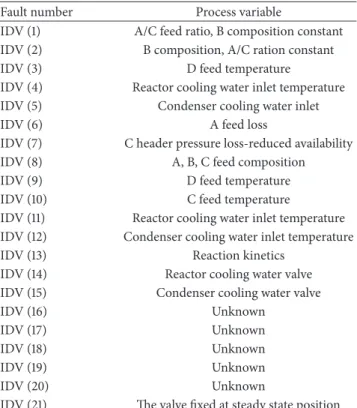
20 process faults and a valve fault are defined in TE
process, as shown in Table 3 [16]. In the work of Chiang
et al. [15], a widely used dataset of TE process is given.
To copy the measurements of 52 variables for 24 hours, 22 training datasets are contained in the dataset corresponding to the fault-free operating condition and 21 fault operating conditions. Simultaneously, 22 test datasets are contained in the dataset, in which the measurements of 52 variables for 48 hours are collected. It is worth pointing out that the faults in the 22 test datasets are added after 8 simulation hours. The sampling time of both of 22 training datasets and 22 test datasets is 3 minutes.
4.2. Performance Comparing with Classical Methods. To
demonstrate the advantages of the proposed fault detection method, we compare it to two classical1 methods, PCA and FDA. We carried out experiments on the dataset of TE
Table 2: Measured variables in TE plant.
Variable number Variable name
XMEAS (1) A feed (stream 1)
XMEAS (2) D feed (stream 2)
XMEAS (3) E feed (stream 3)
XMEAS (4) A and C feed (stream 4)
XMEAS (5) Recycle flow (stream 8)
XMEAS (6) Reactor feed rate (stream 6)
XMEAS (7) Reactor pressure
XMEAS (8) Reactor level
XMEAS (9) Reactor temperature
XMEAS (10) Purge rate (stream 9)
XMEAS (11) Product separator temperature
XMEAS (12) Product separator level
XMEAS (13) Product separator pressure
XMEAS (14) Product separator underflow (stream 10)
XMEAS (15) Stripper level
XMEAS (16) Stripper pressure
XMEAS (17) Stripper underflow (stream 11)
XMEAS (18) Stripper temperature
XMEAS (19) Stripper steam flow
XMEAS (20) Compressor work
XMEAS (21) Reactor cooling water outlet temperature
XMEAS (22) Separator cooling water outlet temperature
XMEAS (23) Component A (stream 6)
XMEAS (24) Component B (stream 6)
XMEAS (25) Component C (stream 6)
XMEAS (26) Component D (stream 6)
XMEAS (27) Component E (stream 6)
XMEAS (28) Component F (stream 6)
XMEAS (29) Component A (stream 9)
XMEAS (30) Component B (stream 9)
XMEAS (31) Component C (stream 9)
XMEAS (32) Component D (stream 9)
XMEAS (33) Component E (stream 9)
XMEAS (34) Component F (stream 9)
XMEAS (35) Component G (stream 9)
XMEAS (36) Component H (stream 9)
XMEAS (37) Component D (stream 11)
XMEAS (38) Component E (stream 11)
XMEAS (39) Component F (stream 11)
XMEAS (40) Component G (stream 11)
XMEAS (41) Component H (stream 11)
process and the classification accuracy of𝑘-nearest neighbor
is chosen to evaluate the performance of classification. The experiments are conducted on 6 datasets in the TE process, fault-free dataset, fault 1 dataset, fault 2 dataset, fault 4 dataset, fault 6 dataset, and fault 7 dataset, respectively. The feature extraction method of the datasets of TE process is selected as wavelet transform. To balance the performance of the feature extraction with the amount of delay, every 7 consecutive samples are collected to do a wavelet transform.
Table 3: Process faults in TE plant.
Fault number Process variable
IDV (1) A/C feed ratio, B composition constant
IDV (2) B composition, A/C ration constant
IDV (3) D feed temperature
IDV (4) Reactor cooling water inlet temperature
IDV (5) Condenser cooling water inlet
IDV (6) A feed loss
IDV (7) C header pressure loss-reduced availability
IDV (8) A, B, C feed composition
IDV (9) D feed temperature
IDV (10) C feed temperature
IDV (11) Reactor cooling water inlet temperature
IDV (12) Condenser cooling water inlet temperature
IDV (13) Reaction kinetics
IDV (14) Reactor cooling water valve
IDV (15) Condenser cooling water valve
IDV (16) Unknown
IDV (17) Unknown
IDV (18) Unknown
IDV (19) Unknown
IDV (20) Unknown
IDV (21) The valve fixed at steady state position
The slack variable used to avoid the overfitting problem is set
as𝛽 = 10−3and all results presented are the average over 10
runs. The experimental results of fault 1 dataset are given in
Figures5and6.
Figure 5 shows the result of fault detection of fault 1
dataset for PCA method when fault occurs in both of the two orthogonal subspaces, which can be successfully detected
by𝑆𝑃𝐸and𝑇2statistics. And the fault detection accuracy of
fault 1 dataset for PCA method is 0.99. PCA method provides a satisfactory fault detection rate, but it cannot estimate fault types because it determines the lower dimensional subspaces without considering the information between the
classes. Figure6(a)indicates that the classification accuracy
of FDA method float in line with the order of model and the
classification accuracy are not totally satisfactory. Figure6(b)
illustrates that the ITML method gives higher fault detection rate than FDA method and it remains stable for different
𝑘th nearest neighbor. Furthermore, ITML method takes
advantages of PCA method that it can estimate fault types directly.
Experimental results are summarized in Figure 7 and
these results reveal that ITML method is more robust than PCA and FDA. Considering the ability of estimating fault types directly, ITML method achieves the best classification accuracy across all datasets. And the performance and effec-tiveness of the wavelet transform based feature extraction are demonstrated by the results of the experiment.
Fault 1 Fault 2 Fault 4 Fault 6 Fault 7 0.8 0.85 0.9 0.95 1 Classifica ti o n acc urac y Fault type PCA FDA ITML
Figure 7: The classification accuracy of 5 different datasets for 3 methods.
5. Conclusion
In this paper, we proposed a fault detection scheme based on information-theoretic metric learning. ITML performs well in learning Mahalanobis distance function. In the proposed framework, the feature vector is firstly extracted by applying wavelet transform. After that, we apply the ITML algorithm in fault detection method to improve fault detection accuracy and estimate fault types. Comparing with the fault detection schemes based on PCA and FDA, experiments on TE process dataset demonstrate that the proposed method is more robust. The performance and effectiveness of the wavelet transform-based feature extraction are demonstrated by the results of the experiments at the same time.
Conflict of Interests
The authors declared that there is no conflict of interests regarding the publication of this paper.
Acknowledgments
The authors acknowledge the support of China Postdoc-toral Science Foundation Grant no. 2012M520738 and Hei-longjiang Postdoctoral Fund no. LBH-Z12092.
References
[1] Z. Xudong, Z. Lixian, S. Peng, and L. Ming, “Stability and stabilization of switched linear systems with mode-dependent
average dwell time,”IEEE Transactions on Automatic Control,
vol. 57, no. 7, pp. 1809–1815, 2012.
[2] Z. Xudong, Z. Lixian, S. Peng, and L. Ming, “Stability of switched positive linear systems with average dwell time
switch-ing,”Automatica, vol. 48, no. 6, pp. 1132–1137, 2012.
[3] Z. Xudong and L. Xingwen, “Improved results on stability of
continuous-time switched positive linear systems,”Automatica,
2013.
[4] S. Yin, S. Ding, A. Haghani, H. Hao, and P. Zhang, “A compar-ison study of basic datadriven fault diagnosis and process monitoring methods on the benchmark Tennessee Eastman
process,”Journal of Process Control, vol. 22, no. 9, pp. 1567–1581,
2012.
[5] S. Yin, X. Yang, and H. R. Karimi, “Data-driven adaptive
observ-er for fault diagnosis,”Mathematical Problems in Engineering,
vol. 2012, Article ID 832836, 21 pages, 2012.
[6] S. Yin, H. Luo, and S. Ding, “Real-time implementation of
fault-tolerant control systems with performance optimization,”IEEE
Transactions on Industrial Electronics, vol. 64, no. 5, pp. 2402– 2411, 2014.
[7] R. Dunia, S. J. Qin, T. F. Edgar, and T. J. McAvoy, “Use of principal component analysis for sensor fault identification,”
Computers and Chemical Engineering, vol. 20, pp. 713–718, 1996. [8] S. Yin, S. X. Ding, A. H. A. Sari, and H. Hao, “Data-driven monitoring for stochastic systems and its application on batch
process,”International Journal of Systems Science, vol. 44, no. 7,
pp. 1366–1376, 2013.
[9] S. Yin, G. Wang, and H. Karimi, “Data-driven design of robust
fault detection system for wind turbines,”Mechatronics, 2013.
[10] I. T. Jolliffe, Principal Component Analysis, Springer, Berlin,
Germany, 1986.
[11] R. O. Duda, P. E. Hart, and D. G. Stork,Pattern Classification,
Wiley-Interscience, New York, NY, USA, 2001.
[12] D. Zumoffen and M. Basualdo, “From large chemical plant data to fault diagnosis integrated to decentralized fault-tolerant
con-trol: pulp mill process application,”Industrial and Engineering
Chemistry Research, vol. 47, no. 4, pp. 1201–1220, 2007. [13] J. E. Jackson and G. S. Mudholkar, “Control procedures for
re-siduals associated with principal component analysis,”
Techno-metrics, vol. 21, no. 3, pp. 341–349, 1979.
[14] N. D. Tracy, J. C. Young, and R. L. Mason, “Multivariate control
charts for individual observations,”Journal of Quality
Tech-nology, vol. 24, no. 2, pp. 88–95, 1992.
[15] L. H. Chiang, E. L. Russell, and R. D. Braatz, “Fault diagnosis in chemical processes using Fisher discriminant analysis, discrim-inant partial least squares, and principal component analysis,”
Chemometrics and Intelligent Laboratory Systems, vol. 50, no. 2, pp. 243–252, 2000.
[16] L. H. Chiang, E. L. Russell, and R. D. Braatz,Fault Detection and
Diagnosis in Industrial Systems, Springer, London, UK, 2001. [17] S. Xiang, F. Nie, and C. Zhang, “Learning a mahalanobis
dis-tance metric for data clustering and classification,”Pattern
Rec-ognition, vol. 41, no. 12, pp. 3600–3612, 2008.
[18] L. Meizhu and B. Vemuri, “A robust and efficient doubly
reg-ularized metric learning approach,” inComputer Vision—ECCV
2012, pp. 646–659, Springer, Berlin, Germany, 2012.
[19] J. V. Davis, B. Kulis, P. Jain, S. Sra, and I. S. Dhillon,
“Informa-tion-theoretic metric learning,” inProceedings of the 24th
Inter-national Conference on Machine learning (ICML ’07), pp. 209– 216, ACM, June 2007.
[20] J. J. Downs and E. F. Vogel, “A plant-wide industrial process
con-trol problem,”Computers and Chemical Engineering, vol. 17, no.
3, pp. 245–255, 1993.
[21] B. Kulis, M. Sustik, and I. Dhillon, “Learning low-rank kernel
matrices,” inProceedings of the 23th International Conference on
[22] J. V. Davis and I. Dhillon, “Differential entropic clustering of
multivariate gaussians,”Advances in Neural Information
Proc-essing Systems, vol. 19, p. 337, 2007.
[23] T. A. Ridsdill-Smith,The Application of the Wavelet Transform to
the Processing of Aeromagnetic Data, The University of Western Australia, Crawley, Australia, 2000.
[24] S. Yin,Data-Driven Design of Fault Diagnosis Systems, VDI,
Submit your manuscripts at
http://www.hindawi.com
Hindawi Publishing Corporation
http://www.hindawi.com Volume 2014
Mathematics
Journal ofHindawi Publishing Corporation
http://www.hindawi.com Volume 2014 Mathematical Problems in Engineering
Hindawi Publishing Corporation http://www.hindawi.com
Differential Equations
International Journal of
Volume 2014
Hindawi Publishing Corporation
http://www.hindawi.com Volume 2014 Hindawi Publishing Corporationhttp://www.hindawi.com Volume 2014
Hindawi Publishing Corporation
http://www.hindawi.com Volume 2014
Mathematical PhysicsAdvances in
Complex Analysis
Journal ofHindawi Publishing Corporation
http://www.hindawi.com Volume 2014
Optimization
Journal ofHindawi Publishing Corporation
http://www.hindawi.com Volume 2014
Combinatorics
Hindawi Publishing Corporation
http://www.hindawi.com Volume 2014 International Journal of
Hindawi Publishing Corporation
http://www.hindawi.com Volume 2014
Journal of
Hindawi Publishing Corporation
http://www.hindawi.com Volume 2014
Function Spaces
Abstract and Applied Analysis
Hindawi Publishing Corporation
http://www.hindawi.com Volume 2014 International Journal of Mathematics and Mathematical Sciences
Hindawi Publishing Corporation http://www.hindawi.com Volume 2014
The Scientific
World Journal
Hindawi Publishing Corporationhttp://www.hindawi.com Volume 2014
Hindawi Publishing Corporation
http://www.hindawi.com Volume 2014
Discrete Dynamics in Nature and Society
Hindawi Publishing Corporation
http://www.hindawi.com Volume 2014
Hindawi Publishing Corporation
http://www.hindawi.com Volume 2014
Discrete Mathematics
Journal ofHindawi Publishing Corporation
http://www.hindawi.com Volume 2014 Hindawi Publishing Corporationhttp://www.hindawi.com Volume 2014