COPYRIGHT NOTICE
FedUni ResearchOnline
https://researchonline.federation.edu.au
This is the peer-reviewed version of the following article:
Bashar, K. and M. Murshed (2018). Texture Based Vein Biometrics for Human Identification: A
Comparative Study. 42nd IEEE Computer Software and Applications Conference, COMPSAC
2018, IEEE Computer Society.
Which has been published in final form at:
https://doi.org/10.1109/COMPSAC.2018.10297Copyright © 2018 IEEE. Personal use of this material is permitted. Permission from IEEE must
be obtained for all other uses, in any current or future media, including reprinting/republishing
this material for advertising or promotional purposes, creating new collective works, for resale
or redistribution to servers or lists, or reuse of any copyrighted component of this work in other
works.
Texture Based Vein Biometrics for Human
Identification: A Comparative Study
Md. Khayrul Bashar
Faculty of General Educational Research, Ochanomizu University,
Tokyo, Japan.
Manzur Murshed Faculty of Science and Technology
Federation University Australia Melbourne, Australia.
Abstract— Hand vein biometric is an important modality for
human authentication and liveness detection in many applications. Reliable feature extraction is vital to any biometric system. Over the past years, two major categories of vein features, namely vein structures and vein image textures, were proposed for hand dorsal vein based biometric identification. Of them, texture features seem important as it can combine skin micro-textures along with vein properties. In this study, we have performed a comparative study to identify potential texture features and feature-classifier combination that produce efficient vein biometric systems. Seven texture features (HOG, GABOR, GLCM, SSF, DWT, WPT, and LBP) and three multiclass classifiers (LDA, ESVM, and KNN) were explored towards the supervised identification of human from vein images. An experiment with 400 infrared (IR) hand images from 40 adults indicates the superior performance of the histogram of oriented gradients (HOG) and simple local statistical feature (SSF) with LDA and ESVM classifiers in terms of average accuracy (> 90%), average Fscore (> 58%) and average specificity (>93%). The decision-level fusion of the LDA and ESVM classifier with single texture features showed improved performances (by 2.2 to 13.2% of average Fscore) over individual classifier for human identification with IR hand vein images.
Keywords—IR hand vein images, texture features, supervised classification, and decision-level fusion.
I. INTRODUCTION
In Computer Science, Biometric Authentication is the
science of identifying a person based on the physiological and/or behavioral characteristics; these characteristics are known as biometrics. Biometric has recently attracted considerable attention as a new authentication approach against traditional ones such as ID cards, passwords, Personal Identification Numbers (PIN) etc. Biometric traits are not stolen or forgotten compared with traditional ones. Practical authentication systems using fingerprints, face, iris, etc. have been commercially available and used in access control, ATM, etc. K. Ito et al. [1] identified several special features as
biometric traits such as: Universality, Uniqueness,
Permanence and Measurability.
Vein pattern recognition technology has recently drawn significant attention as it has unique features with liveness property. The commonly used vein patterns come from the hand, wrist, or finger and is carried out by using near-infrared imaging. When a user is placed on a scanner, a near infrared light maps the vein locations. Vein patterns are displayed as
black lines, while remaining part shows up as white. Fujitsu, Japan has built an authentication system based on palm vein patterns with a reliability of 100% [22]. However, in terms of exploring biometric applications, little research has been done to determine if vein measures can determine specific human attributes such as gender, age or liveness etc.
To explore various applications from border management, e-commerce, online banking to healthcare services, we need to explore strong feature extraction techniques. Over the past years, mainly two paradigm of features extraction methodologies were explored: vein pattern segmentation [2-7] and texture feature extraction from vein images [8]. To our view, the later could give more generalized representation of vein characteristics, which can use information of veins and adjacent tissues. However, no systematic investigation on texture features and/or feature-classifier combination has been performed so far. Moreover, various applications might require integrating vessel line features with texture features. In this study, we therefore investigated seven texture features, namely Histogram of Oriented Gradients (HOG), Gabor descriptor (GABOR), Gray Level Co-occurrence Matrix (GLCM), Simple Local Statistical Features (SSF), Discrete Wavelet Transform (DWT), Wavelet Packet Transform (WPT), and Local Binary Pattern (LBP) with three classifiers: the error correcting output code support vector machine (ESVM), K nearest neighbor (KNN), and linear discriminant analysis (LDA) to identify the feature strength along with the system efficiency.
The rest of the paper is given in the subsequent sections. Section-II elaborates the system and various methods for texture feature extraction. It also includes an explanation for adopted classification methods and a fusion principle. Section-III details human identification results and evaluates the performances of classifiers and their fusion principle. A comparative study of various texture features and classifiers was also performed in this section including the discussion. Finally, the study is concluded through Section-IV.
II. SYSTEM AND METHODS
A. Overview of Identification System
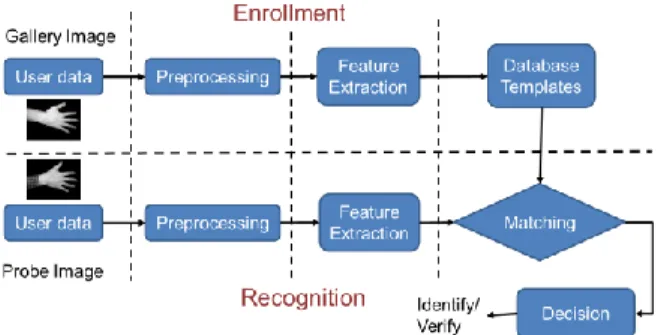
An overview of the general biometric identification system is shown in Fig. 1. It consists of two phases: (i) Enrollment and (ii) Recognition. Hand vein infrared (IR) images are first
preprocessed for geometry correction and ROI extraction. The removal of noise and artifacts and enhancement of image microstructures have been performed using median, wiener and Gaussian filtering. Various methods are then applied for texture feature extraction, which constructs database templates in the enrollment phase. Classifiers are learned using database templated corresponding to the training sets for adult human subjects. In the recognition phase, hand vein images from the testing set are similarly processed to obtain feature vectors, which are then tested against the learned classifiers for identity prediction.
Figure 1. Overview of Biometric System
In our study, we chose seven different texture descriptors (GABOR, HOG, GLCM, SSF, DWT, WPT, and LBP) and three multiclass classifiers (LDA, ESVM, KNN) for supervised identification of humans from their hand vein images. A database of infrared (IR) dorsal hand vein images, which were captured via an ETIP 7320 P-Series Infrared Camera is chosen for our study [9].
B. Preprocessing
Dorsal infrared (IR) hand images in the database have position differences, low contrast with noise and artifacts. Fingers in the images are roughly rightward. Moreover, we like to use middle part of dorsum of hand for biometric processing. We therefore applied a modified version of [10] to extract position invariant ROI using finger valleys in the vein images. Two valleys between index finger and mid-finger and between ring finger and last finger were used for geometry correction and ROI extraction. The rectangle bounded by the lines joining selected valleys and their perpendicular points construct aligned ROI for further processing.
Median, wiener and Gaussian filtering are then applied to the geometry corrected ROI. These steps reduce noise and artifacts and produces images with enhanced features (e.g., Fig.2). For our database, we empirically selected 3×3, 7×7 and 5×5 filter masks for the three filters, respectively.
(a) (b)
Figure 2. (a) ROI Hand Vein Image and (b) Corresponding Enhanced ROI Image
C. Feature Extraction
Feature is extracted from ROI image using non-overlapping square region to emphasize local characteristics of veins and associated tissues, especially for HOG, GLCM, and SSF features. The size of the block is empirically selected to 32 × 32 in this study.
1) Gabor Filters: To characterize the texture of dorsal veins, IR images are convolved with Gabor filters [11-13]. Gabor function models quite well the receptive field profiles of cortical simple cells, therefore, Gabor feature can capture the salient visual properties such as the spatial localization, orientation selectivity, and spatial frequency characteristic. It is basically a Gaussian modulated complex sinusoid in the spatial domain, where it can be defined as
22 22
1
1
,
exp
exp
2
.
2
x y2
x yx
y
h x y
j
Fx
In the above Eq. are the spreads of 2D Gaussian, F is the
spatial frequency of sinusoid. The x-axis of the Gaussian is assumed to have the same orientation as the frequency. A detail description of above will be found in [12]. In our implementation, we used the real part of the filter. Three spatial frequencies for the sinusoid (i.e., 4, 8, and 16) and four
orientation bandwidths (00, 450, 900, and 1350) were also
chosen for the decomposition of vein images in our study.
2) Histogram of Oriented Gradients (HOG): It is based on evaluating well-normalized local histograms of image gradient orientations in a dense grid, successfully used in many applications including human motion detection in the video [14, 15]. The basic idea is that local object appearance and shape can often be characterized rather well by the distribution of local intensity gradients or edge directions even without precise knowledge of the corresponding gradients or edge positions. HOG implementation involves four major steps, namely (a) Preprocessing, (b) Gradient Computation, (c) Orientation Binning, (d) Normalization and description blocks. After preprocessing, 1-D centered and point discrete derivative mask is applied for gradient computation. Orientation binning is performed by combining four histograms from 8x8 non-overlapping adjacent cells that construct descriptor blocks. For simplicity, we choose rectangular cells and computed histogram using channels that are evenly spread over 0 to 180 degrees using unsigned gradients. The local histograms are contrast-normalized by calculating “energy” over larger spatial regions, called block, which is selected 32 × 32 in this study. Please refer to [15] for detail description.
3) Gray-Level Co-occurrence Matrix (GLCM): It is a popular approach that can extract the second order statistical properties of patterns from imaging data. We choose this approach because it simulates the behavior of human visual system and can extract texture features more reliably, especially for micro-textures that are similar to those in the fibroblasts [16-19]. This matrix counts the co-occurrence
frequency of a gray-level i at position (x, y), with gray-level j
that occurs at
x
x y
,
y
.
Mathematically, the GLCMfor an image I(x, y) of size (M, N), parameterized by orientation
and offset parameters, given by:
tan
1
y
x
and2 2
d
x
y
parameters, is given by
1 11,
,
, ;
,
0,
.
M N x yif I x y
i
C
i j d
and I x
x y
y
j
Otherwise
Here
C
i j d
, ;
is a square matrix whose size isdetermined by the maximum gray level in the image. Offset
and orientation parameters
d
,
characterizes the pixeldisplacement and the orientation for which the co-occurrence matrix is calculated. Although GLCM has 14 features, we
computed four features, namely Energy, Contrast,
Homogeneity, and Correlation in our research [16]. To minimize the computational burden for GLCM feature, we reduced the highest value of ROI image to 100 and used the maximum pixel spacing of 50 in our study.
4) Discrete Wavelet Transform (DWT): Discrete wavelet
transforms (DWTs) analyze signals and images into progressively finer octave bands. This multiresolution analysis enables to detect patterns that are not visible in the raw data. We applied the Mallat’s pyramid algorithm with Daubechies db3 to generate subbands from preprocessed ROI image. Then, mean and standard deviation from each subband coefficients are computed as texture feature. Please refer to [20] for detail description.
5) Wavelet Packet Transform (WPT): Wavelet packets
provide a family of transforms that partition the frequency content of images into progressively finer equal-width intervals. It is a generalization of wavelet decomposition that offers a richer signal analysis. Wavelet packet atoms are waveforms indexed by three parameters: position, scale, and frequency. For a given orthogonal wavelet function, we generate a library of bases. Each of these bases offers a particular way of coding images, preserving global energy, and reconstructing exact features. The packet tree is generated by decomposing approximation and detail subbands using Daubechies db3 wavelet. Initial tree was refined. Please refer to [20, 21] for detail description.
6) Simple Statistical Features (SSF): Image histograms reflect the intensity differences among different subjects. These histogram distributions led to the analysis of all dorsal hands to confirm these results. Every pixel grey level in the hand vein images is directly related to the intensity, which indicated the absorption activity of NIR light. For simplicity, six basic statistical parameters of intensities from all dorsal hands were extracted. These parameters were: maximum, minimum, mean, median, mode and standard deviation. H. Zheng et al. used similar statistical parameters for
discriminating young and older subjects using dorsal hand vein images [22].
7) Local Binary Pattern (LBP): It is an efficient texture operator which labels the pixels of an image by thresholding the neighborhood of each pixel and considers the result as a binary number. It can be seen as a unifying approach to the traditionally divergent statistical and structural models of
texture analysis. A useful extension to the original operator is
the so-called uniform pattern, which can be used to reduce the length of the feature vector and implement a simple rotation invariant descriptor. In our study, we used non-uniform version and chose 8 neighbors around every pixel in an image. A detail explanation of the approach can be found in [23].
D. Classification and Fusion
Classification is the process to check the identity of input hand vein images to feature templates of the persons that were stored in the database. In this study, we performed the identification of human subjects using multiclass ESVM, LDA and KNN classifiers. An investigated on the “Decision-Level Fusion” strategy was also performed using LDA and ESVM classifiers with each of the texture features [24]. Two classifiers were fused by using logical AND operation on the produced decisions by the two classifiers.
1) ESVM
It is a multiclass model, which uses SVM classifier to solve multiclass problem [25-26]. It requires a coding design, which determines the classes that the binary learners train on, and a decoding scheme, which determines how the results (predictions) of the binary classifiers are aggregated. We used non-linear SVM with radial basis function, i.e., RBF as kernel function for ESVM classifier. However, we used default values for kernel and regularization parameters as used in the MATLAB software.
2) LDA
Linear Discriminant Analysis (LDA) is a linear method for multi-class classification problems. Unlike logistic regression, it works well for multiclass problems even with fewer samples and well separated classes. It assumes Gaussian distribution of data and consists of its (data) statistical properties, calculated for each class. For a single input variable, this is the mean and the variance of the variable for each class. For multiple variables, this is the same properties calculated over the multivariate Gaussian, namely the means and the covariance matrices. These statistical properties are estimated from training set of vein images and plug into the LDA equation to make predictions. LDA makes predictions by estimating the probability that a new set of inputs belongs to each class. The class that gets the highest probability is the output class and a prediction is made. The model uses Bayes Theorem to estimate the probabilities. Please refer to [27] for further information.
3) KNN
It is a non-parametric method used for classification and
regression [28]. In both cases, the input consists of the k closest
training examples in the feature space. The output is a class membership. An object is classified by a majority vote of its neighbors, with the object being assigned to the class most
common among its k nearest neighbors, where k is a positive
integer. If k = 1, then the object is simply assigned to the class
of that single nearest neighbor. In our experiment, we used k=7 for KNN implementation.
III. EXPERIMENTAL EVALUATION
In our experiment, a public dataset was chosen, namely Technocampus Hand Image Database [9]. We chose this dataset as it maintains uniform conditions for hand regions, and images have sufficient resolution. A set of 400 IR vein images from 40 adults, each having 10 images, has been chosen. Image resolution is 640 × 480. 60% of images per person (a total of 240 images) was used for training the classifiers, while the rest 40% (i.e., 160 images) was used for testing the classifier. Six
evaluation parameters, namely Precision or Positive Predictive
Value (PPV), Sensitivity or True Positive Rate (TPR),
Specificity, Accuracy, and Fscore, were used for performance analysis of classifiers and comparative study among different texture features.
,
,
,
,
2
,
TP
PPV
TP
FP
TP
TPR
TP
FN
TN
Specificity
TN
FP
TP TN
Accuracy
TP TN
FP
FN
PPV TPR
Fscore
PPV
TPR
where TP, TN, FP and FN are the true positive, true negative,
false positive and false negative, respectively.
A. Results and Analysis
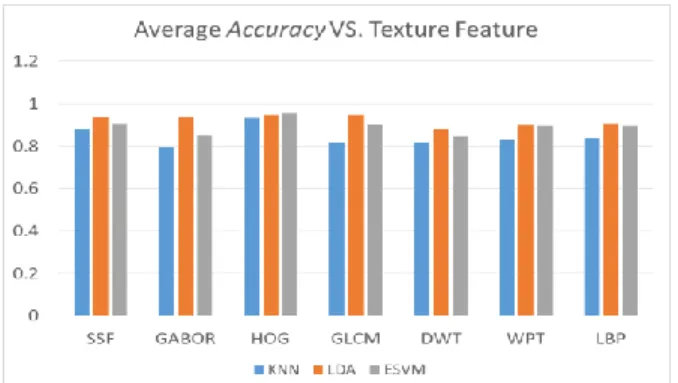
Experimental results of the proposed identification system are evaluated against above parameters. Figures 3-5 showed
the plots for average identification Accuracy, average Fscore,
and average specificity for human identification. Results (Fig.3) showed that the LDA and ESVM classifiers produce 85% or above average classification accuracy with each of the seven texture feature. In contrast, the KNN performance is less stable as it produces above 85% accuracy with SSF and HOG features, while accuracy falls with GABOR, GLCM, WPT, LBP, and DWT features. Another point is that both HOG and SSF features produce higher accuracy with all the three classifiers. This observation indicates that gradient based feature (e.g., HOG) and local statistical features perform better than other features. This seems logical as the tree-like vein structures could well correlates with the local statistical and gradient-based features.
Figure 3. Average identification Accuracy plot against various texture features
The average Fscore plot in Fig. 4 showed that the highest
score (74.5%) was obtained by HOG feature with ESVM classifier, while the same produced 63.5% with LDA and 59.9% with KNN classifiers. It also showed that the KNN obtains the lowest Fscore values (27.3% ~ 59.9%), while the LDA showed steady high Fscore (47.8% ~ 66.9%) for almost all features (except HOG). Similar findings were observed with the average specificity plot in Fig. 5.
Figure 4. Average Fscore plot against various texture features
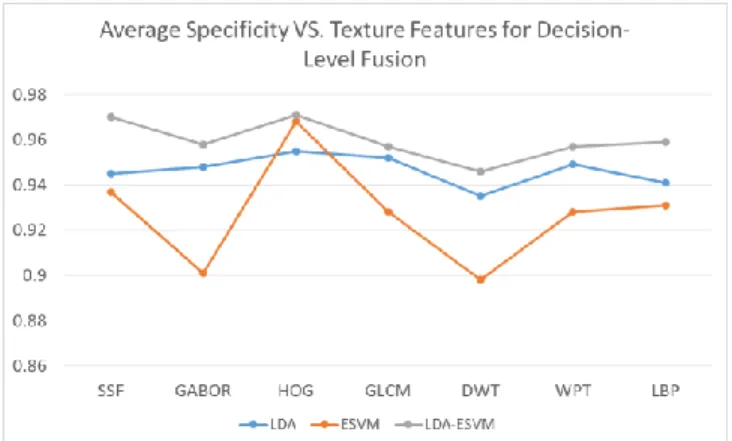
Once again the HOG feature produced the highest average specificity (96.8%) with ESVM classifier, while the LDA produces high average specificity with almost all features. The overall average (over feature axis) specificity and corresponding standard deviations for the three classifiers were (i) LDA (94.6%, 0.006779), (ii) ESVM (92.7%, 0.023507), and (iii) KNN (90.4%, 0.027559).
This observation showed that the linear LDA outperformed nonlinear ESVM classifier with most texture features (except HOG) and LDA has less fluctuations compared to ESVM or KNN. One possible reason is that texture features for vein images have linear relationship with the LDA classifier output. Another possibility is the lack of parameter tuning (e.g. kernel and regularization parameters) for ESVM classifier.
B. Comparative Analysis
In order to understand if the identification accuracy improves with a single feature, we investigated “Decision-Level Fusion” strategy. LDA and ESVM were chosen for fusion study due to their promising individual performances. Figures 6 and 7 showed the results of the adopted fusion method. The line plots of the average Fscore and average Specificity clearly showed that the decision-level fusion technique produces improved performance for all texture features. The top three texture features that produced the
highest average Fscore values in fusion case were: (i) HOG
(76.7%), (ii) SSF (75%), and (iii) GLCM (72.3%) (Fig. 6). The corresponding scores with ESVM and LDA were (74.5%, 58.3%, 42.9%) and (63.5%, 65.7%, 66.9%), respectively. The HOG feature with single classifier produces almost comparable performance (Figs. 6 and 7) with that of the fused case. This observation once again reiterated the best performance of HOG feature among all. The oriented gradient-based HOG feature better captures the discriminatory attributes of hand veins than other features. Note that both HOG and SSF features were computed locally from 32 × 32 non-overlapping blocks in our study. It can therefore be concluded that the local features are more effective than global features (e.g., LBP) for hand vein characterization.
GLCM also produced good Fscore comparable to that by the
HOG feature indicating the importance of second order statistics for characterizing vein properties.
Figure 6. Comparison of average Fscore against various texture features with decision-level fusion strategy.
Figure 7. Comparison of average Specificity against various texture features with decision-level fusion strategy.
C. ROC Analysis
The performance evaluation of the system was also performed using Receiver Operating Characteristics (ROC) analysis. Due to time limitation, we did analysis using simple Euclidean Distance (ED) classifier with the training and testing feature vectors for each type of texture descriptor. After normalizing the distances from 0 to 1, 2000 thresholds were generated. False Acceptance Rate (FAR) and False Rejection Rate (FRR) are then computed against each threshold. The point at which both curves cross each-other, i.e., the point at which FAR=FRR, is called equal error rate (EER). Figure 8 shows an example FAR VS. FRR plot for the HOG feature, which produces EER=29.1% at a decision threshold of 0.264.
Figure 8. FAR VS. FRR plot for HOG feature with Euclidean distance classifier.
With ED classifier, the lowest and the highest EER values, obtained by HOG and WPT features were 29.1% and 39.1%, respectively. Future study will be performed for ROC analysis of other classifiers used in this study.
C. Discussion
A study on the hand vein images has been performed to justify the strength of texture features and fusion strategy. Seven frequently used texture features were considered. Parameters for them were manually fixed. Better justification of parameters will be done in the future study. More classifiers including the deep learning methods will also be explored. Although not included in this report, we found performance boosting can be done by using a good image enhancement method.
During ESVM implementation, we used default values for the regularization and kernel parameters in MATLAB software. More parameter tuning will be explored in the future study. At present, we did a brief ROC analysis using ED classifier. More ROC analysis will also be performed.
IV. CONCLUSION
We have performed a comparative study on hand-vein biometrics using seven texture features (HOG, GABOR, GLCM, DWT, WPT, SSF, and LBP) with three supervised multiclass classifiers (LDA, ESVM, and KNN). An experiment with 400 infrared (IR) hand images from 40 adult persons showed promising performance (average accuracy) of the HOG (93.2%, 94.6%, and 95.9%), SSF (88.2%, 93.4%, and 90.5%), and GLCM (81.8%, 94.6%, 90.0%) features with the KNN, LDA and ESVM classifiers, respectively. The decision-level fusion of two better classifiers (LDA and ESVM) with individual texture features showed improved performances (average Fscore and average specificity) for almost all features. The fused classifier (LDA-ESVM) performed 2.2% and 13.2% Fscore improvement compared to the individual ESVM and LDA classifiers using HOG feature. The SSF feature, on the other hand, showed 16.7% and 9.3% improvement of the same parameter. Future studies will be performed with more features, more classifiers, and more images to establish the best feature-classifier combination for vein biometrics.
ACKNOWLEDGMENT
The author would like to thank all collaborators and colleagues who contributed throughout the preparation of this manuscript. This work is partly supported by the Leading project of the Ochanomizu University, Japan.
REFERENCES
[1] K. Ito and T. Aoki, “Recent Advances in Biometric Recognition,” ITE Trans on MTA, Vol. 6, No. 6, pp. 64-80, 2018.
[2] B. Subramaniam and S. Radhakrisnan, “Multiple features and classifiers for vein based biometric recognition”, Biomedical Research, Special Issue, pp. S8-S13, 2018.
[3] D. Human, R. Zhang, Y. Yin, et al., “Local feature approach to dorsal hand vein recognition by centroid-based circular key-point grid and fine-grained matchting,” Image and Vision Computing, vol. 58, pp. 266 – 277, 2017.
[4] D. Zhang, Wai-Kin Kong, J. You, and M. Wong. Online palmprint identification. IEEE Trans. Pattern Analysis and Machine Intelligence, vol. 25, no. 9, pp.1041 – 1050, September, 2003.
[5] A. Kumar and D. Zhang, “Personal authentication using multiple palmprint representation,” Pattern Recogn., vol. 38, pp.1695 – 1704, October 2005.
[6] A. Queslati, N. Feddaoui, and K. Hamrouni, “Identity Verification Through Dorsal Hand Vein Texture Based NSCT Coefficients”, in Proc. IEEE/ACS 14th Int. Conf. on Computer Systems and Applications, October 30 to November 03, 2017.
[7] I. Irving et al, “Hand vein infrared image segmentation for biometric recognition,” Research in Computing Science, vol. 80, pp. 55 – 66, 2014.
[8] J. A. Unar, W. C. Seng, and A. Abbasi, “A Review of Biometric Technology alongwith trends and prospects”, Pattern Recognition, vol. 47, pp. 2673 – 2688, 2014.
[9] M. Faundez-Zanuy, J. Mekyska, X. Font-Aragonés, “ A new hand image database simultaneously acquired in visible, near-infrared and thermal spectrums,” Cognitive Computation, vol. 6, no. 2, pp. 230 -240, 2014. [10] M. Yakno et al., “New Technique for Larger ROI Extraction of Hand
Vein Images,” in Proc. 2015 Int. Conf. Biosignal Analysis, Processing, and Systems (ICBAPS), pp. 82 – 87, DOI: 10.1109 / ICBAPS. 2015. 7292223.
[11] Z. Wang, B. Zhang, W. Chen and Y. Gao, “A Performance Evaluation of Shape and Texture based Methods for Vein Recognition”, in Proc. First Int. Congress Image and Signal Processing (CISP 2008), vol. 2, pp. 659-661, 2008.
[12] D. A. Clausi and H. Deng, “Design-Based Texture Feature Fusion Using Gabor Filters and Co-occurrence Probabilities,” IEEE Trans. Image Process, vol. 14, no. 7, July 2005.
[13] A. K. Jain, S. Prabhakar and L. Hong, "A Multichannel Approach to Fingerprint Classification", IEEE Trans. Pattern Anal. and Mach. Intell., vol.21, no.4, pp. 348-359, 1999.
[14] Md. Khayrul Bashar, “Analyzing Orientation Patterns of Human Skin Fibroblasts Using Image Gradient Information,” in Proc. 39th Int. Conf. IEEE EMB Society, 2017.
[15] N. Dalal and B. triggs, “Histograms of oriented gradients,” in Proc IEEE Conf. Comp. Vision and Pattern Recog., vol. 1, pp. 886 – 893, June 25-28, 2005.
[16] Md. Khayrul Bashar, Kei Hashimoto et al., “Quantification of Interaction between human skin fibroblasts and collagen by image texture analtysis,” Journal of Bioinformatics and Neurooscience (JBINS), vol. 1, no. 1, pp. 31 – 37, December 2015.
[17] T. A. Pham, “Optimization of Texture Feature Extraction Algorithm,” M. Sc. Thesis, Computer Engineering, Delft University of Technology, The Netherlands, 2010.
[18] M. E. Shokr, “Evaluation of Second-Order Texture Parameters for Sea Ice Classification From Radar Images,” Journal of Geophysical Research, vol. 96, no. C6, pp. 10,625 – 10,640, June 1991.
[19] D. A. Clausi, “An analysis of co-occurrence texture statistics as a function of gray-level quantization,” Can. J. Remote Sensing, vol. 28, no. 1, pp. 45 – 62, 2002.
[20] S. Mallat, “A theory for multiresolution signal decomposition: the wavelet representation,” IEEE Pattern Anal. and Mach. Intell., vol. 11, no. 7, pp. 674–693, 1989.
[21] Coifman, R.R.; M.V. Wickerhauser (1992), "Entropy-based algorithms for best basis selection," IEEE Trans. Inf. Theory, vol. 38, 2, pp. 713– 718.
[22] H. Zheng, “Static and Dynamic Analysis of Near Infrared Dorsal Hand Vein Images for Biometric Applications,” A Ph. D thesis, The University of Central Lancashire, September 2017.
[23] T. Ojala, M. Pietikäinen, and T. Mäenpää, “Multiresolution Gray-scale and Rotation Invariant Texture Classification with Local Binary Patterns,” IEEE Trans. Pattern Analysis and Machine Intelligence vol. 24, no. 7, pp. 971-987, 2002.
[24] G. Kaur et al., “Fusion in Multimodal Biometric System: A Review,”
Indian Journal of Science and Techmnology, vol. 10, no. 28, DOI: 10.17485/ijst/2017/v10i28/114382, July 2017.
[25] G. Armano, C. Chira, N. Hatami, “Error-Correcting Output Codes for Multi-Label Text Categorization,” in Proc. Third Italian Info. Retrieval Workshop (IIR) , pp. 26 – 37, 2012.
[26] B. Li and C. Vogel, “Improving Multiclass Text Categorization with Error-Correcting Output Coding and Sub-class Partitions,” Canadian AI 2010, vol. LNAI 6085, pp. 4–15, 2010.
[27] G. James et al., An Introduction to Statistical Learning: with Applications in R. New York : Springer, 2017, Chapter 4, p. 138. [28] N. S. Altman, “An introduction to kernel and nearest-neighbor
nonparametric regression,” The American Statistician, vol. 46, no. 3, pp. 175 – 185, 1992 (published online in February, 2012).