2010
Processes that influence biodiversity, ecosystem
functioning, and stability in grasslands
Forest Isaac Isbell Iowa State University
Follow this and additional works at:https://lib.dr.iastate.edu/etd Part of theEcology and Evolutionary Biology Commons
This Dissertation is brought to you for free and open access by the Iowa State University Capstones, Theses and Dissertations at Iowa State University Digital Repository. It has been accepted for inclusion in Graduate Theses and Dissertations by an authorized administrator of Iowa State University Digital Repository. For more information, please [email protected].
Recommended Citation
Isbell, Forest Isaac, "Processes that influence biodiversity, ecosystem functioning, and stability in grasslands" (2010).Graduate Theses and Dissertations. 11537.
Processes that influence biodiversity, ecosystem functioning, and stability in grasslands
by
Forest Isaac Isbell
A dissertation submitted to the graduate faculty in partial fulfillment of the requirements for the degree of
DOCTOR OF PHILOSOPHY
Major: Ecology and Evolutionary Biology Program of Study Committee: Brian Wilsey, Major Professor
W. Sue Fairbanks W. Stan Harpole
Matt Liebman Kirk Moloney
Iowa State University Ames, Iowa
2010
TABLE OF CONTENTS
LIST OF FIGURES iii
LIST OF TABLES iv
ABSTRACT v
CHAPTER 1. General Introduction 1
Conceptual Context 1
Dissertation Organization 13
CHAPTER 2. Species interaction mechanisms maintain grassland plant species
diversity 18 Abstract 18 Introduction 19 Methods 23 Results 28 Discussion 32 Acknowledgements 36
CHAPTER 3. Biodiversity, productivity, and the temporal stability of productivity:
patterns and processes 42
Abstract 42 Introduction 43 Methods 47 Results 53 Discussion 56 Acknowledgements 60
CHAPTER 4. Changing from native grasslands to exotic grasslands or pastures
decreases niche partitioning and facilitation 64
Abstract 64 Introduction 65 Methods 69 Results 76 Discussion 80 Acknowledgements 83
CHAPTER 5. Increasing native, but not exotic, biodiversity enhances ecosystem
functioning in ungrazed and intensely grazed grasslands 92
Abstract 92 Introduction 93 Methods 97 Results 103 Discussion 106 Acknowledgements 111
CHAPTER 6. General Conclusions 117
Summary 117
Caveats 118
Future Research 119
REFERENCES 131
iii
LIST OF FIGURES
Figure 1.1 Synthesis of concepts from four ecological fields 16
Figure 1.2 Comparing mechanisms 17
Figure 2.1 Temporal trends 39
Figure 2.2 Relationships across years 40
Figure 2.3 Path analysis results 41
Figure 3.1 Temporal stability 61
Figure 3.2 Mechanisms by which biodiversity increased temporal stability 62
Figure 3.3 Species interactions 63
Figure 4.1 Temporal trends 88
Figure 4.2 Niche overlap in aboveground space 89
Figure 4.3 Monoculture biomass and yielding behavior for each species 90
Figure 4.4 Path analysis results 91
Figure 5.1 Ecosystem functioning 114
Figure 5.2 Effects of grazing or origin treatments depended on species composition 115 Figure 5.3 Effects of grazing or origin treatments depended on species identity 116
Figure 6.1 Summary of all results 127
Figure 6.2 Other relationships within this framework 128
Figure 6.3 Direct and indirect effects of global ecosystem changes 129
LIST OF TABLES
Table 2.1 Characteristics of the perennial grassland species used in this study 37
Table 2.2 Repeated measures analysis results 38
Table 4.1 The native and exotic species used in this experiment 84
Table 4.2 Relative biomass of four plant functional groups 85
Table 4.3 Results from the repeated measures analyses 86
Table 4.4 Biodiversity, complementarity effects, and selection effects 87
Table 5.1 The native and exotic perennial grassland species used in this experiment 112
v
ABSTRACT
Biodiversity is rapidly declining worldwide, and this may lead to subsequent declines in ecosystem functioning and stability. Here I consider whether: (i) stabilizing species
interactions, such as niche partitioning and facilitation, promote biodiversity, ecosystem functioning, and stability, and (ii) global ecosystem changes influence biodiversity, ecosystem functioning, and stability by destabilizing species interactions.
In Chapters 2 and 3, I report results from studies that used long-term data from a grassland biodiversity experiment to identify the mechanisms that promoted biodiversity, productivity, and the temporal stability of productivity. Stabilizing species interactions that favored rare species promoted productivity and temporal stability. Stabilizing species interactions that favored unproductive species promoted biodiversity and temporal stability.
In Chapters 4 and 5, I report results from a new experiment that tested whether intense grazing influenced biodiversity, ecosystem functioning, and stability by favoring common and productive species, especially in exotic species mixtures. Stabilizing species interactions maintained biodiversity and promoted ecosystem functioning in ungrazed native species mixtures. However, species interactions were destabilized, and ecosystem
functioning was decreased, in both exotic and intensely grazed mixtures.
In conclusion, these results suggest that: (i) stabilizing species interactions that favor rare and unproductive species can simultaneously promote biodiversity, ecosystem
functioning, and temporal stability in grasslands; and (ii) changing from native grasslands to exotic grasslands or pastures can decrease ecosystem services by destabilizing species interactions.
CHAPTER 1. General Introduction
Conceptual Context
Biodiversity declines are ubiquitous (Pimm et al. 1995), will likely continue (Sala et al. 2000), and may lead to subsequent declines in ecosystem functioning and stability (recently reviewed in Naeem et al. 2009). These changes may diminish human wellbeing by decreasing the services that ecosystems provide for people (Millennium Ecosystem
Assessment 2005, Worm et al. 2006, Naeem et al. 2009, Sachs et al. 2009). Current
restoration strategies are unable to fully restore the biodiversity and ecosystem functioning observed in intact ecosystems (Sluis 2002, Martin et al. 2005, Polley et al. 2005, Benayas et al. 2009), suggesting that ecologists and conservationists have an incomplete understanding of the processes that promote and threaten ecosystem conservation (Jordan III et al. 1987). Although previous theoretical and empirical studies have identified numerous mechanisms that could maintain biodiversity (reviewed by Grace 1999, Chesson 2000, Chase and Leibold 2003, Silvertown 2004), ecologists and conservationists rarely know which of these
mechanisms actually maintains biodiversity at any particular time and place (Tilman 2007). Therefore, further investigation is needed to improve understanding, conservation, and restoration of natural ecosystems.
The concepts considered here are broadly relevant. Biodiversity includes the richness (number), evenness (equity of relative abundance), and composition (identity) of alleles, species, and functional groups (Stirling and Wilsey 2001, Wilsey et al. 2005a, Diaz et al. 2006). Diversity is one of the most ubiquitous concepts in the natural and social sciences,
2
with applications in communication networks, ecology, economics, geography, linguistics, psychology, sociology, and urban planning (McDonald and Dimmick 2003). Interestingly, there is evidence that people not only value particularly charismatic species (Andelman and Fagan 2000), but also have an appreciation for both species richness and species evenness (Lindemann-Matthies et al. 2010). Ecosystem functioning includes all pools and fluxes of matter and energy in an ecosystem (Hooper et al. 2005). Primary productivity has been one of the most commonly considered ecosystem functions (Balvanera et al. 2006), in part because it integrates across numerous ecosystem functions at multiple trophic levels
(McNaughton et al. 1989). For this discussion, stability includes the invariability, resistance, and resilience of ecosystem functioning (MacArthur 1955, McNaughton 1977, Pimm 1984); however, the concept can also be discussed more generally (Elton 1958, Ives and Carpenter 2007). Diversity—stability relationships have been extensively explored in both ecosystems and financial systems (May et al. 2008). There is considerable evidence that sustainable development and human wellbeing depend on ecosystem conservation (Millennium Ecosystem Assessment 2005, Sachs et al. 2009), defined here as the maintenance of biodiversity, ecosystem multifunctionality, and stability (Balvanera et al. 2006, Hector and Bagchi 2007, Gamfeldt et al. 2008).
Grassland plant communities have been used as model ecosystems for studying biodiversity maintenance (reviewed by Grace 1999), biodiversity—ecosystem functioning relationships (reviewed by Loreau et al. 2001, Hooper et al. 2005, Balvanera et al. 2006, Cardinale et al. 2006), biodiversity—stability relationships (reviewed by Hooper et al. 2005, Balvanera et al. 2006), and global ecosystem changes (e.g., Reich et al. 2001, Gill et al. 2002, Knapp et al. 2002, Shaw et al. 2002, Harpole and Tilman 2007, Clark and Tilman 2008,
Hautier et al. 2009, Wilsey et al. 2009). Grasslands are one of the most extensive biomes worldwide (Olson et al. 2001), and often exhibit high local species diversity (e.g., Martin et al. 2005, Wilsey et al. 2005b). Plants are particularly relevant for biodiversity maintenance because animal diversity can directly depend on plant diversity (Siemann et al. 1998,
Novotny et al. 2006). Furthermore, biodiversity can be accurately measured and manipulated in plant communities because plants are sessile. Plants are particularly relevant for ecosystem functioning because a large proportion of the matter and energy in terrestrial ecosystems flows through plants (McNaughton et al. 1989).
A large body of literature suggests that contemporary biodiversity declines may lead to subsequent declines in ecosystem functioning and stability (reviewed by Loreau et al. 2001, Loreau et al. 2002, Hooper et al. 2005, Balvanera et al. 2006, Cardinale et al. 2006, Worm et al. 2006, Naeem et al. 2009). Specifically, studies have found that ecosystem
functioning can depend on the richness (e.g., Naeem et al. 1994, Hector et al. 1999, Tilman et al. 2001), evenness (e.g., Wilsey and Potvin 2000, Wilsey and Polley 2004, Kirwan et al. 2007, Wittebolle et al. 2009), and composition (e.g., Hooper and Vitousek 1997, Tilman et al. 1997, Bruno et al. 2006) of species, and on genetic (e.g., Cadotte et al. 2008) and
functional (e.g., Tilman et al. 1997, Marquard et al. 2009) diversity. Similarly, contemporary biodiversity declines may also lead to declines in stability because stability can depend on the richness (Tilman and Downing 1994, Tilman 1996, Yachi and Loreau 1999, Lehman and Tilman 2000, Tilman et al. 2006, van Ruijven and Berendse 2007, Loreau and de Mazancourt 2008, van Ruijven and Berendse 2010) and composition (e.g., Polley et al. 2007, van Ruijven and Berendse 2007) of species, and is also predicted to depend on species evenness (Doak et al. 1998, Hillebrand et al. 2008).
4
Human actions have resulted in several changes on a global scale that are thought to drive contemporary changes in biodiversity, ecosystem functioning, and stability (Chapin et al. 2000, Benayas et al. 2009). In particular, land use changes, exotic species invasions, nutrient enrichment, and climate change are often considered some of the most ubiquitous and influential global ecosystem changes (Vitousek et al. 1997a, Wilcove et al. 1998, Chapin et al. 2000, Sala et al. 2000, Foley et al. 2005, Benayas et al. 2009). Unfortunately, the mechanisms by which these global ecosystem changes influence biodiversity and ecosystem properties, and the non-additive effects of multiple drivers, are often unclear (Sala et al. 2000, Levine et al. 2003). This greatly reduces the ability to predict future changes in
biodiversity and ecosystem properties (Sala et al. 2000, Hooper et al. 2005). Therefore, more studies that manipulate multiple global ecosystem changes (e.g., Reich et al. 2001, Shaw et al. 2002), and determine the mechanisms involved (e.g., Seabloom et al. 2003, Hautier et al. 2009, Wilsey et al. 2009), are needed.
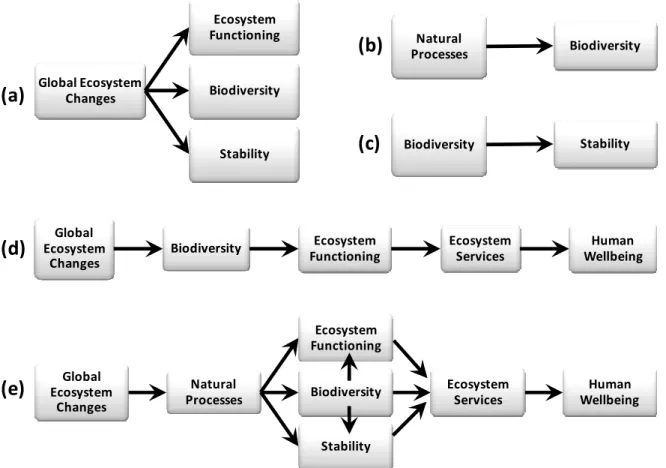
A synthesis across four ecological fields may increase our ability to understand, conserve, and restore ecosystems by developing a framework for considering the influence of natural and anthropogenic processes on biodiversity, ecosystem functioning, and stability. Global change ecology has focused on the effect of global ecosystem changes on
biodiversity, ecosystem functioning, and stability (reviewed by Vitousek et al. 1997a, Vitousek et al. 1997b, Chapin et al. 2000, Foley et al. 2005) (Fig. 1.1a). Maintenance of biodiversity research has focused on the effects of natural processes on biodiversity
(Hutchinson 1959, Grace 1999, Chesson 2000, Silvertown 2004, Tilman 2007) (Fig. 1.1b). Biodiversity—stability research has focused on the effects of biodiversity on various measures of stability (MacArthur 1955, Elton 1958, May 1973, McNaughton 1977, Pimm
1984, McCann 2000, Cottingham et al. 2001, Hooper et al. 2005, Balvanera et al. 2006, Ives and Carpenter 2007, Griffin et al. 2009) (Fig. 1.1c). Biodiversity—ecosystem functioning research has focused on the effects of biodiversity on ecosystem functioning, and how this relationship mediates the effects of global ecosystem changes on human wellbeing (reviewed by Loreau et al. 2001, Loreau et al. 2002, Hooper et al. 2005, Balvanera et al. 2006,
Cardinale et al. 2006, Worm et al. 2006, Naeem et al. 2009) (Fig. 1.1d). Combining the relationships explored in each of these four fields produces an inclusive framework (Fig. 1.1e), which is congruent with other previously proposed conceptual frameworks (Rapport et al. 1998, Chapin et al. 2000). Here I use this inclusive framework to consider two novel questions. What natural processes promote biodiversity, ecosystem functioning, and stability? Do global ecosystem changes influence biodiversity, ecosystem functioning, and stability by altering these natural processes?
What natural processes promote biodiversity, ecosystem functioning, and stability?
The natural processes that are predicted to promote biodiversity, ecosystem functioning, and stability have commonly been considered separately, but are quite congruent. First, I will briefly review previous results from three ecological fields (i.e., biodiversity maintenance, biodiversity—ecosystem functioning, and biodiversity—stability) which have separately explored these natural processes. Second, I will focus the discussion on the natural processes that are common to all three ecological fields: stabilizing species interactions. Third, I will clarify how this mechanistic synthesis might bolster ecological understanding, conservation, and restoration.
6
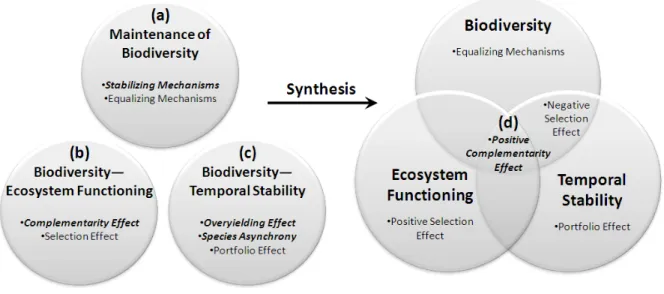
Theoretical and empirical studies have identified two classes of mechanisms that can maintain biodiversity: stabilizing and equalizing mechanisms (Chesson 2000) (Fig. 1.2a). The vast number of mechanisms that can potentially maintain biodiversity (Grace 1999, Chesson 2000, Hubbell 2001, Chase and Leibold 2003, Silvertown 2004, Clark et al. 2007, Tilman 2007) can be combined into two general classes of mechanisms (Chesson 2000). Stabilizing mechanisms maintain biodiversity by maximizing negative intraspecific interactions relative to negative interspecific interactions; and equalizing mechanisms
maintain biodiversity by minimizing fitness differences between species (Chesson 2000). For example, stabilizing mechanisms include spatiotemporal niche partitioning (e.g., MacArthur 1958, Fargione and Tilman 2005), resource partitioning (e.g., McKane et al. 2002), natural enemy partitioning (e.g., Petermann et al. 2008), and interspecific facilitation (e.g., Cardinale et al. 2002, Gross 2008). Neutral coexistence (Bell 2000, 2001, Hubbell 2001) can be viewed as a special case of this framework, where there are no stabilizing mechanisms and no fitness differences between species (Adler et al. 2007). Stabilizing and equalizing mechanisms have successfully explained temporal changes in biodiversity in annual plant species mixtures (Harpole and Suding 2007, Levine and HilleRisLambers 2009).
Theoretical and empirical studies have identified two classes of mechanisms that can promote ecosystem functioning in diverse ecosystems: complementarity and selection effects (Loreau 2000, Loreau and Hector 2001) (Fig. 1.2b). A positive complementarity effect indicates species interactions that result in niche partitioning or facilitation (Loreau and Hector 2001). A negative complementarity effect indicates chemical or physical interference among species in a mixture (Loreau and Hector 2001). A positive or negative selection effect occurs when the most or least productive species in monoculture, respectively, overyield the
most in mixture (Loreau and Hector 2001). In other words, a negative selection effect indicates that the least productive species in monoculture benefitted the most from species interactions in mixture. Previous studies have found that ecosystem functioning is often promoted more by complementarity than by selection effects (Loreau and Hector 2001, Cardinale et al. 2007, Fargione et al. 2007, Stachowicz et al. 2008, Marquard et al. 2009, van Ruijven and Berendse 2009).
Theoretical and empirical studies have also identified mechanisms that can promote stability in diverse ecosystems (Fig. 1.2c). In particular, the mechanisms that influence the temporal invariability of community productivity (henceforth, temporal stability) have been extensively explored both theoretically and empirically (MacArthur 1955, McNaughton 1977, Tilman 1996, Yachi and Loreau 1999, Lehman and Tilman 2000, Tilman et al. 2006, van Ruijven and Berendse 2007, Loreau and de Mazancourt 2008). Theory predicts that biodiversity can increase temporal stability via overyielding, species asynchrony, and portfolio effects (Yachi and Loreau 1999, Lehman and Tilman 2000, Loreau and de Mazancourt 2008). Any mechanism that increases temporal stability (µ/σ) must do so by increasing the mean productivity (µ), decreasing the temporal variance in productivity (σ2), or both. The overyielding effect increases temporal stability when mixture productivity exceeds the expected value based on productivity in monocultures, because this increases the mean relative to the variance of productivity (Lehman and Tilman 2000). Species asynchrony increases temporal stability when species fluctuations are not perfectly synchronized,
because this decreases the variance relative to the mean productivity (Lehman and Tilman 2000, Loreau and de Mazancourt 2008). Species fluctuations can range from perfect
8
species is completely compensated by an increase in the biomass of another, to perfect synchrony, where temporal stability is minimized because all species increase and decrease together (Loreau and de Mazancourt 2008). The special case of independent species
fluctuations is in the center of this range. The portfolio effect increases temporal stability, even when species fluctuate independently, by statistical averaging (Doak et al. 1998, Tilman et al. 1998). Previous studies have found that species richness can increase temporal stability via all three of these classes of mechanisms (Lehman and Tilman 2000, Tilman et al. 2006, van Ruijven and Berendse 2007).
Interestingly, stabilizing species interactions that favor rare species are predicted to promote biodiversity, ecosystem functioning, and some types of stability (Fig. 1.2).
Stabilizing mechanisms (Chesson 2000), complementarity effects (Loreau and Hector 2001), overyielding effects (Lehman and Tilman 2000), and species asynchrony (Loreau and de Mazancourt 2008) all result from negative frequency-dependent natural processes that favor rare species over common species. These processes occur when interspecific interactions are more favorable than intraspecific interactions. For example, species interactions are
stabilizing when interspecific resource competition is less than intraspecific resource competition (McKane et al. 2002, van Ruijven and Berendse 2005), interspecific apparent competition is less than intraspecific apparent competition (Holt 1977, Harpole and Suding 2007, Chesson and Kuang 2008), interspecific facilitation is greater than intraspecific facilitation (Callaway 1995, Cardinale et al. 2002, Bruno et al. 2003, Brooker et al. 2008, Gross 2008), or some combination of these mechanisms (Temperton et al. 2007, Petermann et al. 2008). Numerous previous studies have found evidence that stabilizing species
McKane et al. 2002, Wills et al. 2006, Harpole and Suding 2007, Lankau and Strauss 2007, Petermann et al. 2008, Levine and HilleRisLambers 2009), ecosystem functioning (e.g., Loreau and Hector 2001, Cardinale et al. 2007), and temporal stability (Lehman and Tilman 2000, Tilman et al. 2006, van Ruijven and Berendse 2007, Loreau and de Mazancourt 2008). Previous studies have considered these relationships separately; however, it may be useful to consider these relationships together.
The proposed conceptual framework hypothesizes that stabilizing species interactions can promote ecosystem conservation. This is not to say that biodiversity, ecosystem
functioning, and temporal stability will be positively correlated at all spatiotemporal scales (Mittelbach et al. 2001, Polley et al. 2007), but rather that stabilizing species interactions may promote ecosystem conservation at a local scale. This is a novel hypothesis because although ecosystem conservation requires maintenance of biodiversity, ecosystem multifunctionality, and stability (Balvanera et al. 2006, Hector and Bagchi 2007, Gamfeldt et al. 2008), previous studies have rarely considered how natural or anthropogenic processes influence all three of these factors (Srivastava and Vellend 2005, Ives and Carpenter 2007). Current management strategies are often effective, but insufficient, for restoring biodiversity and ecosystem services (Benayas et al. 2009). Furthermore, many current conservation strategies, such as protecting biodiversity hotspots (Myers et al. 2000), are reactive or passive (Brooks et al. 2006) and effective but insufficient (Bruner et al. 2001). I propose that it may be possible to proactively predict the future consequences of contemporary global ecosystem changes by considering how these changes are currently influencing species interactions.
10
Do global ecosystem changes influence biodiversity, ecosystem functioning, and stability by altering these natural processes?
Global ecosystem changes such as land use changes, exotic species invasions,
nutrient enrichment, and climate change are influencing biodiversity, ecosystem functioning, and stability worldwide. However, surprisingly few studies have considered whether the influences of global ecosystem changes can generally be understood or predicted by
considering their effects on stabilizing species interactions. First, I will describe two changes that are common in grasslands worldwide. Second, I will explain why these two global ecosystem changes should be considered together. Third, I will explain how these two global ecosystem changes may influence biodiversity, ecosystem functioning, and stability by destabilizing species interactions.
Intense livestock grazing and exotic species are particularly common in grasslands worldwide. Managed livestock grazing is currently the most extensive type of land use worldwide, covering more than 25% of earth’s terrestrial surface (Asner et al. 2004). Moderately intense grazing can promote biodiversity (Collins et al. 1998, Olff and Ritchie 1998, Jackson 1999) and ecosystem functioning (Milchunas and Lauenroth 1993,
McNaughton et al. 1997). However, managed livestock grazing often decreases biodiversity and ecosystem functioning (reviewed by Milchunas and Lauenroth 1993, Asner et al. 2004) because it is often ten times more intense than grazing in unmanaged systems (Oesterheld et al. 1992) and prevalent in marginal climatic and edaphic regions (Asner et al. 2004).
The conversion of native to exotic-dominated ecosystems can also be considered a global ecosystem change (Vitousek et al. 1997a, Mack et al. 2000, Hobbs et al. 2006,
Seastedt et al. 2008). Exotic ecosystems are often less diverse than native ecosystems, and often contain novel combinations of non-coevolved species (Christian and Wilson 1999, Seabloom et al. 2003, Hobbs et al. 2006, Seastedt et al. 2008, Hejda et al. 2009, Wilsey et al. 2009). The conversion of native to exotic-dominated ecosystems can also alter ecosystem functioning (Vitousek et al. 1997a, Mack et al. 2000, Hobbs et al. 2006, Liao et al. 2008, Seastedt et al. 2008, Wilsey et al. 2009), because exotic species can alter resource availability, trophic interactions, and disturbance regimes (reviewed by Vitousek 1990, D'Antonio and Vitousek 1992, Liao et al. 2008).
Common garden field experiments can help determine whether exotic species are drivers or passengers of change in communities and ecosystems. It is often unclear whether the observed differences between native and exotic ecosystems (Hobbs et al. 2006, Seastedt et al. 2008) are explained by: (i) differences between natives and exotics (drivers of change) (Vitousek 1990, Wilsey et al. 2009), (ii) other confounding factors such as resources or grazing that often differ between native and exotic ecosystems (passengers of change) (Gurevitch and Padilla 2004, Didham et al. 2005, MacDougall and Turkington 2005), or (iii) both exotic species and grazing (Kimball and Schiffman 2003). Common garden experiments allow comparisons between natives and exotics, while controlling for potentially
confounding variables (Wilsey et al. 2009). Using this approach in a previous study, we found greater productivity and more rapid biodiversity declines in exotic than in native species mixtures (Wilsey et al. 2009). Further study is needed to determine whether these species origin effects interact with grazing (Sala et al. 2000).
The effects of intense grazing and changing from native to exotic ecosystems should be considered together because they often occur together, and could have non-additive
12
effects on ecosystem functioning. Exotic grassland species that were introduced by humans or favored by disturbance are often abundant when there is intense livestock grazing
(D'Antonio and Vitousek 1992, Kimball and Schiffman 2003, Asner et al. 2004).
Furthermore, many previous studies have found that intense livestock grazing can facilitate the spread of exotic species (Chaneton et al. 2002, Keeley et al. 2003, Kimball and
Schiffman 2003, Best and Arcese 2009). These studies suggest that the extent of exotic ecosystems, and the consequences of changing from native to exotic ecosystems, may partly depend on the presence and intensity of grazing. New experiments are needed to quantify the additive or non-additive effects of grazing and plant species origin.
Intense grazing may decrease biodiversity and ecosystem functioning by decreasing the complementarity effect, especially in exotic grasslands. The complementarity effect quantifies stabilizing species interactions that favor rare species, such as niche partitioning and facilitation (Loreau and Hector 2001). These stabilizing species interactions can promote biodiversity (reviewed by Chesson 2000) and ecosystem functioning (reviewed by Cardinale et al. 2007). Many plant species that evolved in grazing ecosystems exhibit tolerance
mechanisms that allow them to be resilient after defoliation (McNaughton 1983, Wilsey et al. 1997). When grazing is intense and non-selective, these tolerance mechanisms may increase the synchrony of species growth in space and time, and thus decrease spatiotemporal
resource partitioning (Fuhlendorf and Engle 2001). Furthermore, the complementarity effect can be reduced in exotic ecosystems, presumably because exotic species lack the
evolutionary history of interaction which can lead to niche partitioning and facilitation in native communities (Wilsey et al. 2009). Thus, decreased complementarity mechanisms in
intensely grazed exotic grasslands may result in decreased biodiversity and ecosystem functioning.
Intense grazing may decrease biodiversity and increase ecosystem functioning by increasing the selection effect, especially in exotic grasslands. The selection effect quantifies species interactions that favor productive species (Loreau and Hector 2001). Dominance by productive species can decrease biodiversity (Gaudet and Keddy 1988, Keddy and Shipley 1989, Wilsey et al. 2009) by destabilizing species interactions (Wilsey et al. 2009), but can also promote ecosystem functioning (Loreau and Hector 2001, Wilsey and Polley 2004, Cardinale et al. 2007). Intense grazing may favor highly productive species because resilient plants can tolerate grazing (McNaughton 1979, 1983, Wilsey et al. 1997, Fuhlendorf and Engle 2001). Exotic species have frequently been nonrandomly selected and introduced for particular uses (Mack et al. 2000, Mack and Lonsdale 2001), including forage production. Consequently, exotic species can exhibit greater aboveground productivity (Wilsey and Polley 2006, Wilsey et al. 2009), and increased resilience after intense grazing (Simoes and Baruch 1991, Kimball and Schiffman 2003, Best and Arcese 2009), than ecologically or phylogenetically similar native species. Thus, increased dominance by productive species in intensely grazed exotic grasslands may result in decreased biodiversity and increased
ecosystem functioning.
Dissertation Organization
In Chapter 2, I report on a study in which we bridged and extended maintenance of biodiversity theory and biodiversity—ecosystem functioning theory to identify natural
14
processes that maintain biodiversity in experimental grassland plant communities (Isbell et al. 2009b). We used long-term data from a grassland biodiversity experiment to test whether grassland plant diversity can be maintained by two classes of mechanisms: (i) equalizing mechanisms, which decrease asymmetric competition by decreasing fitness differences between species, and (ii) species interaction mechanisms, which favor rare and unproductive species. Additionally, we tested whether increasing species richness and evenness enhanced aboveground productivity. This study was novel because it demonstrated how theoretical biodiversity maintenance mechanisms could be identified and quantified using existing data from biodiversity experiments.
In Chapter 3, I report on a study in which we incorporated biodiversity—stability theory into the framework that was developed in Chapter 2. This allowed us to identify natural processes that promoted biodiversity, productivity, and temporal stability in experimental grassland plant communities (Isbell et al. 2009a). We tested whether: (i) stabilizing species interactions that favored rare species promoted biodiversity, productivity, and temporal stability; and (ii) stabilizing species interactions that favored unproductive species promoted biodiversity and temporal stability, but decreased productivity.
Additionally, we tested whether increasing species richness and evenness enhanced temporal stability. This study was novel because it identified species interactions that promoted
biodiversity and ecosystem services; and because it was the first experimental test of evenness—stability relationships.
In Chapter 4, I report on a study in which we incorporated global ecosystem changes into the framework that was developed in Chapters 2 and 3. This allowed us to consider the mechanisms by which intense grazing influenced biodiversity in native and exotic grasslands.
We tested whether: (i) intense livestock grazing and exotic plant species synergistically drive declines in biodiversity, and (ii) intense livestock grazing decreases biodiversity by
destabilizing species interactions, especially in exotic grasslands. This study was novel because it was the first experimental test of the potential synergistic effects of intense livestock grazing and exotic plant species, and because it considered whether the future consequences of global ecosystem changes can be understood by determining their current effects on species interactions
In Chapter 5, I report on a study in which we considered the consequences of converting species-rich native grasslands to species-poor exotic grasslands or pastures. We tested whether: (i) intense grazing influenced ecosystem functioning differently in native and exotic ecosystems, and (ii) biodiversity—ecosystem functioning relationships depended on grazing or species origin. This study was novel because it considered native and exotic grassland species separately when testing the effects of intense grazing or changing
biodiversity on ecosystem functioning. Additionally, this study uniquely considered whether increasing biodiversity could enhance ecosystem functioning under intense livestock grazing.
In Chapter 6, I summarize and synthesize the results included in the previous
chapters, and discuss several caveats and promising directions for future research. Tables and figures are included at the end of each chapter. All references are included after Chapter 6.
16
Figure 1.1 Synthesis of concepts from four ecological fields (a-d) to develop an inclusive
framework (e). Arrows represent causal relationships. (a) Global change ecology has focused on the effect of global ecosystem changes on biodiversity, ecosystem functioning, and
stability. (b) Maintenance of biodiversity research has focused on the effects of natural processes on biodiversity. (c) Biodiversity—stability research has focused on the effects of biodiversity on stability. (d) Biodiversity—ecosystem functioning research has focused on the effects of biodiversity on ecosystem functioning, and how this relationship mediates the effect of global ecosystem changes on human wellbeing (Naeem et al. 2009). (e) An
inclusive framework that combines the previously described relationships may increase our ability to understand, conserve, and restore ecosystems.
Global Ecosystem Changes Ecosystem Functioning Biodiversity Stability Natural Processes Biodiversity Biodiversity Stability Global Ecosystem Changes Biodiversity Ecosystem Functioning Ecosystem Services Human Wellbeing Global Ecosystem Changes Natural Processes Ecosystem Functioning Biodiversity Ecosystem Services Human Wellbeing Stability
(a)
(b)
(c)
(d)
(e)
Figure 1.2 Comparing mechanisms predicted to promote biodiversity (a), ecosystem
functioning (b), and temporal stability (c) elucidates mechanisms that promote ecosystem conservation (d). Mechanisms in bold and italicized on the left are explained by negative frequency-dependent processes that can be consolidated and quantified by the
complementarity effect. Note that species interactions that favor highly productive species are predicted to promote ecosystem functioning, but species interactions that favor
18
CHAPTER 2. Species interaction mechanisms maintain grassland plant
species diversity
A paper published in Ecology
Forest I. Isbell1*, H. Wayne Polley2, and Brian J. Wilsey1
Abstract
Development of theory has outpaced experimental tests for most maintenance of diversity mechanisms. Here we demonstrate how data from biodiversity-ecosystem functioning experiments can be used to determine the mechanisms that maintain plant species diversity. We hypothesized that grassland plant diversity is maintained by two classes of mechanisms: (1) equalizing mechanisms, which reduce asymmetric competition by reducing differences in monoculture biomass production among species in mixture, and (2) species interaction mechanisms, which increase overyielding by increasing niche partitioning and facilitation among species in mixture. Specifically, equalizing mechanisms reduce the coefficient of variation in monoculture biomass production among species in mixture. Species interaction mechanisms increase species overyielding in mixture, especially for low biomass species. We tested these predictions with a seven-year data set from an experiment that varied grassland plant species evenness and richness. We used path analysis to model effects of these mechanisms on annual and multiyear changes in diversity. We found that diversity was frequently maintained by species interaction mechanisms and was infrequently maintained by
1Department of Ecology, Evolution, and Organismal Biology, Iowa State University, Ames, Iowa 50011, USA 2USDA-ARS, Grassland, Soil and Water Research Lab, Temple, Texas 76502, USA
equalizing mechanisms. Species interaction mechanisms maintained diversity by allowing the species that produced the least biomass in monoculture to benefit the most from species interactions in mixture. Equalizing mechanisms infrequently maintained diversity because asymmetric competition infrequently resulted in competitive exclusion. We propose that this mechanistic framework be used to better understand the specific processes that influence diversity.
Introduction
Biodiversity is rapidly declining worldwide (Pimm et al. 1995, Chapin et al. 2000). Declines are predicted to continue (Sala et al. 2000), and to reduce ecosystem functioning (Loreau et al. 2001, Hooper et al. 2005). Currently, we cannot restore the levels of diversity and productivity observed in remnant ecosystems, including grasslands (Sluis 2002, Martin et al. 2005, Polley et al. 2005). To conserve and restore diversity and ecosystem functioning, we need to determine the mechanisms that maintain diversity. Thus far, development of theory has outpaced experimental tests for most maintenance of diversity mechanisms.
Asymmetric competition theory predicts that diversity will decline when species differ in biomass production (Gaudet and Keddy 1988, Keddy and Shipley 1989). Species that produce the most biomass when grown alone are predicted to competitively exclude species that produce the least biomass when grown alone. Pairwise species competition experiments have provided some support for this theory (e.g., Gaudet and Keddy 1988, Keddy and Shipley 1989), but there have been few tests of the theory at realistically high levels of diversity. Here we refer to mechanisms that maintain diversity by reducing
20
asymmetric competition as equalizing mechanisms. These mechanisms are related to Chesson’s (2000) equalizing mechanisms, which maintain diversity by minimizing average fitness differences among species; however, our equation is not identical to his. Following predictions of competition theory, we use differences in the biomass production of species grown alone as an index of the potential influence of equalizing mechanisms on the relative biomass production of these species in mixture. Differences among species are quantified as the coefficient of variation in monoculture biomass production (CVMB) among species
currently present in a given mixture. Chesson’s (2000) equation for equalizing mechanisms is precise, in that it includes multiple theoretical growth parameters, but is also restrictive, in that it can only be calculated for two-species mixtures. The CVMB can be interpreted as a measure of the variation among the carrying capacities of the species in a mixture, and can be calculated for a mixture with any number of species. For example, the CVMB for a four-species mixture would be large if the four-species vary greatly in monoculture biomass production. In contrast, the CVMB would be zero if all four species produced the same amount of biomass in monoculture. Thus, we predict that equalizing mechanisms, manifest as low CVMB, maintain diversity by reducing asymmetric competition.
Additionally, maintenance of diversity may depend on species interactions that are only observable in species mixtures. Another body of theory predicts that diversity is maintained by species interactions that promote overyielding (Vandermeer 1981, Loreau 2004). Species overyield when interspecific interactions are less detrimental or more favorable than intraspecific interactions. That is, a species overyields when there is less competition or when there are more positive interactions in mixture than in monoculture. Vandermeer (1981) showed that the general Lotka—Volterra conditions for overyielding are
the same as those for coexistence between two species. Since that time, these ideas have been further developed by others (Chesson 2000, Kokkoris et al. 2002, Loreau 2004). For
example, Chesson’s (2000) stabilizing mechanisms are those that maintain diversity by increasing negative intraspecific interactions relative to negative interspecific interactions. Here we refer to mechanisms that maintain diversity by increasing overyielding as species interaction mechanisms. Quantifying these mechanisms requires biomass data from monocultures and mixtures.
Species interaction mechanisms can be quantified with Loreau and Hector’s (2001) additive partition of the net biodiversity effect. A positive net biodiversity effect occurs when mixture biomass production exceeds its expected value based on species’ biomass production in monoculture (Loreau and Hector 2001). Loreau and Hector (2001) additively partitioned the net biodiversity effect into complementarity and selection components. The
complementarity effect quantifies the average species overyielding. A positive or negative complementarity effect respectively indicate that species produce more or less biomass in mixture, on average, than expected (Loreau and Hector 2001). A positive complementarity effect can occur when there is niche partitioning or facilitation among species in mixture (Loreau and Hector 2001, Cardinale et al. 2002, Fargione et al. 2007). A negative
complementarity effect can occur when there is chemical or physical interference among species in mixture (Loreau and Hector 2001, Polley et al. 2003). The selection effect indicates if species overyielding is correlated with monoculture biomass production. A positive selection effect occurs when species that produce the most biomass in monoculture (i.e., high biomass species) overyield the most in mixture (Wilsey and Polley 2004). A negative selection effect occurs when species that produce the least biomass in monoculture
22
(i.e., low biomass species) overyield the most in mixture (e.g., Polley et al. 2003, Fargione et al. 2007). Thus, a negative selection effect occurs when species interactions compensate for asymmetric competition by favoring low biomass over high biomass species.
We predict that species interaction mechanisms will maintain diversity by: (1)
increasing the complementarity effect, because this occurs when there is niche partitioning or facilitation, and (2) decreasing the selection effect, because this occurs when overyielding is greater among low than high biomass species. Negative selection effects have been reported in numerous biodiversity—ecosystem functioning experiments (e.g., Loreau and Hector 2001, Polley et al. 2003, Fargione et al. 2007). A negative selection effect indicates that low biomass species, which are often rare, benefit most from species interactions in mixture. There is empirical evidence that maintenance of diversity can be promoted by a rare species advantage (Wills et al. 2006) or a common species disadvantage (Harpole and Suding 2007). Thus, maintenance of diversity may also be promoted by a negative selection effect.
Equalizing mechanisms could have both direct and indirect effects on diversity. We predict that the CVMB will have a negative direct effect on diversity, because it reflects variation in species traits that results in asymmetric competition. However, CVMB also may indirectly affect diversity via the complementarity and selection effects either positively or negatively. Consider that the differences in species traits that increase asymmetric
competition may also increase niche partitioning. For example, if deeply rooted species produce more aboveground biomass than shallowly rooted species, then asymmetric competition theory would predict that the deeply rooted species would outcompete the shallowly rooted species. However, the partitioning of belowground niche space might instead facilitate maintenance of diversity (Fargione and Tilman 2005). This would result in a
positive indirect effect of the CVMB on diversity via the complementarity effect. Additionally, asymmetric competition theory assumes that high biomass species
competitively exclude low biomass species when high biomass species overyield and low biomass species underyield (Keddy and Shipley 1989). This would result in a negative indirect effect of the CVMB on diversity via a positive selection effect.
Wilsey and Polley (2004) established field plots in which richness and evenness of grassland plant species were varied. Here we use data from this experiment to test if temporal changes in diversity can be explained by: (1) equalizing mechanisms, which reduce
asymmetric competition by decreasing the CVMB, and (2) species interaction mechanisms, which increase overyielding of species in mixtures by increasing the complementarity effect, and which increase overyielding of the low biomass species in mixtures by decreasing the selection effect. We tested these hypotheses with a path analysis model that included the direct and indirect effects of the CVMB on diversity.
Methods
Experimental design
Seedlings were grown in a greenhouse, and 96 equal-sized seedlings were
transplanted into each of 75 (1 by 1 m) field plots. This allowed us to vary initial species evenness (high or realistically low) and richness (2, 4, and 8 species) in 36 species mixture plots in a factorial design. The experiment was planted 19-25 April 2001 at the Grassland, Soil, and Water Research Lab, Temple, Texas. The species composition of mixtures was determined by random draw from a pool containing 13 perennial species in Texas grasslands
24
(Table 2.1). There were six random draws to determine species compositions for each of the three mixture species richness treatments (i.e., 18 species compositions). For each randomly determined species composition we established two levels of evenness (i.e., 36 total mixture plots) by varying the planted relative abundance of all species. In the high evenness
treatment, abundance and biomass were equally distributed among species (48 individuals each in 2-species mixtures, 24 each in 4-species mixtures, and 12 each in 8-species
mixtures). The realistically low evenness treatment was based on a geometric distribution of species, which produced rank-abundance slopes of approximately -0.30 (64:32 in 2-species, 51:26:13:6 in 4-species, and 47:24:12:6:3:2:1:1 in 8-species mixtures). Three replicate monocultures for each of the 13 species were planted (39 total monoculture plots). The maximum species richness treatment value is within the range of species richness values observed at this spatial scale in nearby formerly-plowed grasslands (Wilsey and Polley 2003). The evenness treatments had rank-abundance slopes that are within the range of different grassland types in the area (Wilsey and Polley 2004). Treatments were randomly assigned within three blocks, each with 25 plots. See Wilsey and Polley (2004) for other design and site details.
Aboveground net primary productivity
Aboveground net primary productivity (ANPP) was estimated annually from 2001 through 2007 by clipping biomass in all plots, sorting by species, drying, and weighing. Peak biomass is an acceptable method for estimating ANPP in this region because aboveground plant tissues die during the winter season. To account for temporal changes in species
richness, we calculated the CVMB for each mixture plot using only the monoculture biomass values of the species present at peak biomass harvest. For example, if one species became locally extinct in a 4-species mixture before the 2003 peak biomass harvest, then the 2003 CVMB would be calculated from the monoculture biomass values for the three species that were present at harvest in 2003. The complementarity and selection effects were calculated for each mixture plot within each year using Loreau and Hector’s (2001) additive partition of the net biodiversity effect (∆Y):
(
RY M)
S M RY S Y = ∆ + cov ∆ , ∆ , (1)where S is species richness, ∆RY is the change in relative yield, and M is monoculture biomass production. In Eq. 1, the first (average) term on the right side of the equation is the complementarity effect and the second (covariance) term is the selection effect. The ∆RY was calculated as the difference between the observed and expected relative yields. The observed relative yield for species i was calculated as Yoi/Mi, where Yoi and Mi are the
observed mixture and monoculture yields for species i, respectively. The expected relative yield was taken as the relative biomass at planting for year 1 and as the relative biomass measured at harvest during the year preceding calculations for subsequent years (Loreau and Hector 2001). The complementarity and selection effects were square root-transformed to meet assumptions of analyses, but retain original positive or negative signs (Loreau and Hector 2001). We did not include one forb species, Oenothera speciosa, in our calculations for years 2 through 7 because it was lost from all plots during year 2.
Simpson’s diversity (D) was calculated for each plot, where D = 1 / Σ pi2 and pi is the
relative biomass of species i. Simpson’s diversity was used because it has a lower standard deviation than other frequently used diversity indices, and it is independent of the number of
26
individuals sampled (Lande 1996, Lande et al. 2000). To test for the influence of equalizing and species interaction mechanisms on diversity, relative change scores were calculated and analyzed. This controlled for the range of initial diversity treatment levels. The relative change in Simpson’s diversity (∆D) was calculated as:
(
Df Di)
DiD= −
∆ , (2)
where f indicates final time (years 1 through 7) and i indicates initial time (years 0 through 6). Year 0 corresponds to planted values and years 1-7 correspond to peak biomass harvests. For annual ∆D, f = i + 1, and for multiyear ∆D, f = i + x, where x is the number of growing seasons over which the change score was calculated.
Temporal trends
Temporal trends were analyzed for Simpson’s diversity, ∆D, aboveground net primary productivity (ANPP), complementarity effect, selection effect, and CVMB by using the SAS PROC MIXED repeated measures analysis described by Littell et al. (1998). An autoregressive (AR[1]) correlation structure was chosen by using the Akaike Information Criteria, and was used for analysis of all variables. Our treatment structure was modeled as a randomized-block split-plot ANOVA with richness effects in the main plot (using rep[block x richness] as the error term), and with evenness effects and interactions in the sub-plot. Degrees of freedom were calculated with the Kenward-Roger approximation. We tested for linear and quadratic relationships between response variables and richness, using contrasts with coefficients based on planted richness values. We also tested for linear and quadratic
temporal trends in these response variables, using contrasts with coefficients based on the year of harvest.
We tested for inter-annual relationships between these mechanisms and diversity by correlating mean annual values, averaged across all mixture plots. We correlated mean annual ∆D with mean annual complementarity effect, selection effect, and CVMB.
Mechanisms maintaining diversity
We tested two specific predictions of asymmetric competition theory. First, we used path analysis to test the prediction that maintenance of diversity depends only on species performance in monoculture. Path analyses can range from exploratory analyses, where the initial hypothesized model is loosely based on theory and is modified to improve the fit between model and data, to confirmatory analyses, where a single model that is based on prior theoretical knowledge is tested with data (Grace 2006). We conducted a confirmatory path analysis of a single model that was based on maintenance of diversity theory. Second, we determined the proportion of mixture plots in which the species that produced the most biomass in monoculture had the greatest relative biomass in mixture to test the prediction that all mixtures eventually will be dominated by the high biomass species.
We also used path analysis to determine the influence of equalizing and species interaction mechanisms on diversity at the plot level. Multiple regression was used to test for nonlinearity, but quadratic terms were never significant (all P > 0.05), allowing us to model linear effects. We then used path analysis to model the direct effects of the CVMB,
28
annual and multiyear ∆D. Standardized linear regression coefficients are presented to allow comparison of the relative influence of these effects on ∆D. In all models, values for the CVMB, complementarity effect, and selection effect were based on data from peak biomass harvests one growing season after time i (see Eq. 2). For example, to determine how the selection effect affected diversity during the second growing season (i.e., annual ∆D during year two), we modeled the relationship between the selection effect calculated from year two peak biomass data and ∆D where f = 2 and i = 1 in Eq. 2.
To test if these mechanisms could predict multiyear changes in diversity, we used multiyear ∆D as the response variable in the path analysis, using all possible combinations of multiyear change scores (i.e., time intervals). That is, for seven-year ∆D, we could only use one set of change scores: f = 7 and i = 0. For six-year ∆D, we were able to use two sets of change scores: f = 7 and i = 1; f = 6 and i = 0, and so on.
Results
Temporal trends
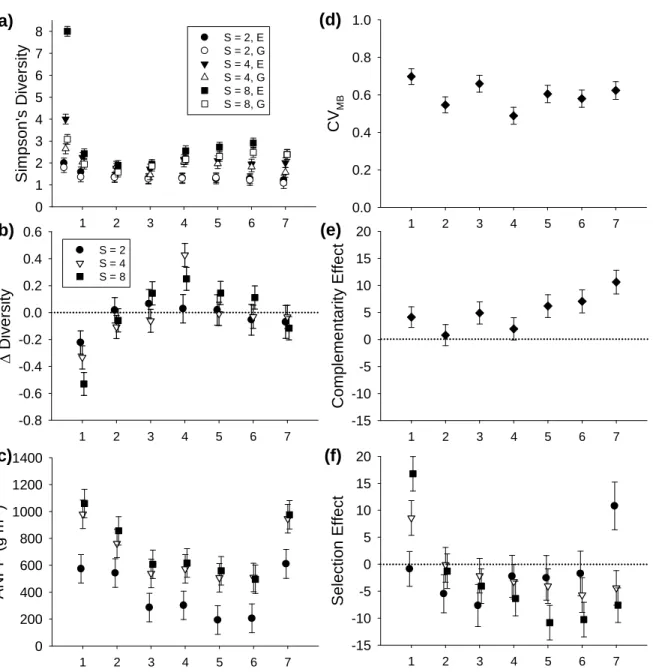
Simpson’s diversity changed in these mixture plots during the first seven growing seasons (Fig. 2.1a). These changes were due to changes in both species richness and species evenness. Richness declined an average of 27% in mixture plots, and 75% of mixture plots (27 of 36) lost at least one species, from planting to peak biomass harvest in 2007. Temporal fluctuations in Simpson’s diversity depended on the planted richness and evenness treatments (Table 2.2). The greatest declines in diversity occurred in the highest diversity treatments during the first growing season (Fig. 2.1a, b). Simpson’s diversity decreased in all treatments
during the first growing season (i.e., all year 1 annual ∆D LS-means were nonzero P < 0.05), increased in 4- and 8-species mixtures during year 4 (both P < 0.01), and otherwise did not change (all other P > 0.05; Fig. 2.1a, b). Simpson’s diversity was a positive linear function of the species richness treatment in years 3, 4, 5, 6, and 7 (P < 0.05 for all linear richness
contrasts).
Temporal fluctuations in aboveground net primary productivity (ANPP) depended on the species richness treatment (Table 2.2). Nevertheless, ANPP consistently increased with the species richness treatment (Fig. 2.1c). ANPP increased log-linearly with the species richness treatment in all years (P ≤ 0.05 for all log-linear richness contrasts).
The CVMB fluctuated over time during these seven growing seasons (Table 2.2). However, it did not generally increase or decrease during this time interval (P > 0.05 for linear and quadratic time contrasts) (Fig. 2.1d).
The complementarity effect increased linearly (P < 0.001 for linear time contrast) over time during these seven growing seasons (Table 2.2, Fig. 2.1e). The complementarity effect was not significantly different from zero in years 2 and 4 (both P > 0.1), but was positive in all other years (all P < 0.05; Fig. 2.1e). The untransformed complementarity effect ranged from −275.9 g m-2 in one 8-species, low evenness mixture in year 5 to 1382.6 g m-2 in one 4-species, low evenness mixture in year 7.
Inter-annual variation in the selection effect depended on the species richness treatment (Table 2.2). The selection effect decreased exponentially over time in 2- and 8-species mixtures (P < 0.01 for both quadratic time contrasts), and decreased linearly over time in 4-species mixtures (P = 0.001 for linear time contrast) during these seven growing seasons (Fig. 2.1f). The selection effect increased (i.e., became more positive) linearly with
30
richness treatment in year 1 (P = 0.007), marginally decreased (i.e., became more negative) linearly with richness treatment in years 5 (P = 0.086) and 6 (P = 0.100), and decreased linearly with richness in year 7 (P = 0.035). In 2-species mixtures, the selection effect was marginally negative in year 3 (P = 0.052), positive in year 7 (P = 0.016) and not significant in other years (all other P > 0.1; Fig. 2.1f). In 4-species mixtures the selection effect was positive in year 1 (P = 0.009), marginally negative in year 6 (P = 0.079), and not significant in other years (all other P > 0.1; Fig. 2.1f). In 8-species mixtures the selection effect was positive in year 1 (P < 0.001), not significant in years 2 and 3 (both P > 0.1), marginally negative in year 4 (P = 0.051), and negative in years 5, 6, and 7 (all P < 0.05; Fig. 2.1f).
Mechanisms maintaining diversity
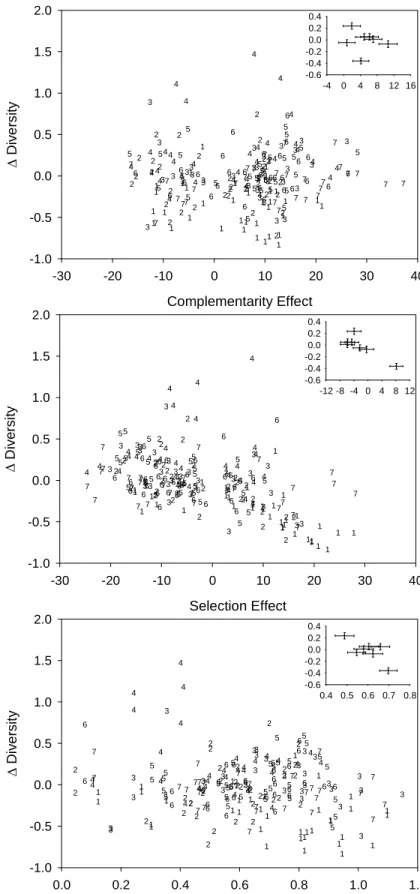
Inter-annual changes in diversity were correlated with both equalizing and species interaction mechanisms. As predicted, the mean annual ∆D was negatively correlated with the mean annual CVMB (r =−0.76, P = 0.047) and selection effect (r = −0.86, P = 0.013) (Fig. 2.2). Contrary to our prediction, however, the mean annual ∆D was not positively associated (r = −0.15, P = 0.756) with the mean annual complementarity effect (Fig. 2.2).
Path analysis indicated that equalizing mechanisms infrequently affected diversity. The CVMB had a negative direct association with annual ∆D only in year 7 (Fig. 2.3). In contrast, the CVMB had a positive indirect association with annual ∆D in year 3 (Fig. 2.3). That is, greater CVMB reduced diversity during year 7, but increased diversity during year 3 by promoting a more negative selection effect. The CVMB was never associated with
by the species that produce the most biomass in monoculture was not supported, because this was only observed in 57% of our mixture plots seven growing seasons after planting.
Path analysis indicated that effects of species interaction mechanisms on diversity differed among years. As predicted, diversity was frequently maintained by species interaction mechanisms. That is, the selection effect had a direct negative association with annual ∆D during years 1, 2, 3, and 5 (Fig. 2.3). Additionally, the selection effect had a direct negative association with two-, three-, four-, five-, and six-year changes in diversity
(standardized regression coefficients: two-year, -0.48; three-year, -0.41; four-year, -0.38; five-year, -0.29; six-year, -0.30; all P < 0.05). Contrary to our prediction, however, the complementarity effect was not positively associated with annual (Fig. 2.3) or multiyear (P > 0.05 for all standardized regression coefficients) changes in diversity.
The fit between the data and the path model, which was based on theory, was acceptable. That is, the departure of the data from the model was not significant at the P = 0.05 level for 12 of the 13 change in diversity path models tested (year 1 annual: χ2 = 0.36, P = 0.55, R2 = 0.44; year 2 annual: χ2 = 6.451, P = 0.01, R2 = 0.44; year 3 annual χ2 = 0.15, P = 0.70, R2 = 0.36; year 4 annual: χ2 = 0.47, P = 0.49, R2 = 0.11; year 5 annual: χ2 = 0.09, P = 0.77, R2 = 0.31; year 6 annual: χ2 < 0.01, P = 0.96, R2 = 0.04; year 7 annual: χ2 = 0.74, P = 0.39, R2 = 0.23; two-year: χ2 = 0.03, P = 0.85, R2 = 0.23; three-year: χ2 = 0.03, P = 0.86, R2 = 0.17; four-year: χ2 = 0.04, P = 0.84, R2 = 0.15; five-year: χ2 = 0.04, P = 0.84, R2 = 0.11; six-year: χ2 = 0.04, P = 0.84, R2 = 0.11; seven-year: χ2 = 0.04, P = 0.84, R2 = 0.05).
32
Discussion
We found that diversity was frequently maintained by species interaction mechanisms that favor low-biomass species by decreasing the selection effect, and was infrequently maintained by equalizing mechanisms that reduce asymmetric competition by decreasing the CVMB. Species interaction mechanisms maintained diversity by allowing the species that produced the least biomass in monoculture to benefit the most from species interactions in mixture. Equalizing mechanisms, manifest as low CVMB, directly contributed to diversity maintenance during only one year, but indirectly contributed to a decline in diversity during another year by increasing the selection effect.
Asymmetric competition theory predicts that changes in diversity can be explained by species traits, such as biomass production, that are observable in monoculture (Gaudet and Keddy 1988, Zobel 1992). This theory predicts that mixtures will be dominated by the species that produce the most biomass in monoculture. We found limited evidence for these predictions. Only 57% of our mixture plots were dominated by the highest biomass species seven growing seasons after planting. Additionally, the CVMB was directly associated with declines in diversity during only one of seven years, and was never indirectly associated with a decline in diversity.
An alternative body of theory predicts that changes in diversity can be explained by differences between intraspecific interactions, which are observable in monoculture, and interspecific interactions, which are only observable in mixture. This theory predicts that overyielding promotes maintenance of diversity (Vandermeer 1981, Loreau 2004). We found considerable evidence for this theory, and our results additionally demonstrate that
maintenance of diversity depends on which species (i.e., low or high biomass) overyield most.
Many studies have quantified the complementarity and selection effects to determine their influence on productivity (reviewed by Hooper et al. 2005, Cardinale et al. 2007). In contrast, we tested whether these effects are related to changes in diversity. The consistently strong influence of the selection effect on diversity suggests that species interaction
mechanisms deserve further study. In year 1, the selection effect was positive because the high-biomass species overyielded more than low-biomass species in most mixture plots (Wilsey and Polley 2004), and diversity declined. In subsequent years, the selection effect became increasingly negative, especially in high species richness treatment plots, because the low biomass species overyielded more than high biomass species. This stabilized diversity.
We suggest that the selection effect is ecologically important because it indicates which species (i.e., high or low biomass) benefit most from species interactions in mixture. Negative selection effects have been reported in several other experiments (Loreau and Hector 2001, Polley et al. 2003, Fargione et al. 2007). For example, Polley et al. (2003) found a negative selection effect when the lowest biomass species developed a canopy before other species. Similarly, Zhang and Zhang (2007) found that the order of species arrival affected the sign and strength of the selection effect. Based on these combined results, we hypothesize that diversity is commonly maintained by negative selection effects.
Surprisingly, we found no relationship between the complementarity effect and changes in diversity in this study, although the complementarity effect quantifies niche partitioning and facilitation (Loreau and Hector 2001), which are thought to maintain
34
that underyielding species are at higher risk for local extinction (Isbell et al. 2008). Although we did not include legumes in our experiment due to their rarity in this system (Wilsey and Polley 2004), plant species were from multiple functional groups (Table 2.1) and varied in root biomass at different depths (Wilsey and Polley 2006). Thus, it is possible that niche partitioning and facilitation were sufficient to maintain diversity in most mixtures. Interestingly, negative complementarity effects have rarely been reported in diversity— productivity studies (Cardinale et al. 2007). This suggests that niche partitioning and facilitation often compensate for competitive interactions. Although we cannot rule out the possibility that extremely negative complementarity effects result in declines in diversity, this is not likely a common phenomenon.
The framework presented here bridges and extends theory from two previously disparate fields: maintenance of diversity and biodiversity—ecosystem functioning. Previous studies have considered the mechanisms by which diversity influences productivity. Some of these studies have found a positive net biodiversity effect that increases with species richness (Hooper et al. 2005). Additionally, the sign and magnitude of the net biodiversity effect is often explained by the complementarity effect (Loreau et al. 2001, Cardinale et al. 2007). Together, these studies suggest that the contemporary declines in species diversity may result in declines in productivity because of reduced niche partitioning and facilitation. Uniquely, our study considers the feedback influences of these mechanisms on diversity. While others have found that diversity influences productivity via the complementarity effect or the selection effect (e.g., Loreau et al. 2001, Wilsey and Polley 2004, Roscher et al. 2005), here we found that the complementarity effect and the selection effect had different feedback influences on diversity. Diversity can increase productivity via a positive complementarity
effect or a positive selection effect. During the first growing season of our experiment, when diversity increased productivity primarily via a positive selection effect (because the
complementarity effect was comparatively small), diversity declined. That is, there was a negative feedback from productivity to diversity. In contrast, diversity did not change later in our experiment, when diversity increased productivity primarily via a positive
complementarity effect, and the selection effect was smaller and negative. That is, there was a positive feedback from productivity to diversity, because of a negative selection effect. Together, these recent studies and our results suggest that productivity is increased by species interactions that increase niche partitioning and facilitation, and that diversity is maintained by species interactions that favor low biomass species. Interestingly, very similar temporal trends in the complementarity and selection effects have been observed in other experiments (e.g., Cardinale et al. 2007, Fargione et al. 2007). The analysis presented here can be applied to other diversity-productivity data to determine the generality of our results.
Our framework can be used to determine how specific processes such as changes in land use, exotic species invasions, climate change, and nutrient enrichment influence diversity and productivity. For example, exotic species may drive declines in diversity by affecting species interaction mechanisms. In many cases, we do not know if exotic species directly drive declines in diversity (Wilcove et al. 1998, Wilsey et al. 2009), or are merely associated with other confounding factors that drive declines in diversity (Gurevitch and Padilla 2004). In this study, the mean annual biomass of planted exotic species was positively correlated with the mean annual selection effect, averaged across all treatments (r = 0.82, P = 0.025, data not shown). Thus, because the selection effect can be positively related to
36
reducing species interaction mechanisms. We encourage development of new studies to consider how the processes that drive declines in diversity operate within this mechanistic context.
Acknowledgements
A grant from the National Science Foundation (DEB-0639417) to BJW helped to fund this work. We thank Katherine Jones, Chris Kolodziejczyk, and Kyle Tiner for help with planting and sampling of field plots. We thank Deb Peters, Michel Loreau, and an anonymous
Table 2.1 Characteristics of the perennial grassland species used in this study. Species Photosynthetic Pathway Growth Form Origin Schizachyrium scoparium C4 Grass Native
Sporobolus asper C4 Grass Native
Bothriochloa saccharoides C4 Grass Native Bouteloua curtipendula C4 Grass Native Sorghastrum nutans C4 Grass Native Bothriochloa ischaemum C4 Grass Exotic Paspalum dilatatum C4 Grass Exotic
Panicum coloratum C4 Grass Exotic
Nassella leucotricha C3 Grass Native Ratibida columnifera C3 Forb Native
Oenothera speciosa C3 Forb Native
Salvia azurea C3 Forb Native
Echinacea purpurea C3 Forb Native
38 Table 2.2 Repeated measures analysis results for Simpson’s diversity index, annual relative change in Simpson’s diversity (∆D),
ln-transformed aboveground net primary productivity (ANPP), the complementarity effect (COM), the selection effect (SEL), and
the coefficient of variation in monoculture biomass (CVMB).
Simpson’s Diversity Annual ∆D ln ANPP COM SEL CVMB
Block F2,13 = 0.61 F2,90 = 0.02 F2,13 = 0.06 F2,12 = 0.46 F2,13 = 1.58 F2,6 = 1.25 Richness (R) F2,13 = 39.51*** F2,98 = 0.16 F2,13 = 6.77** F2,12 = 2.46 F2,13 = 0.29 F2,6 = 5.33* Evenness (E) F1,51 = 32.34*** F1, 98 = 1.11 F1, 33 = 1.34 F1, 32 = 0.01 F1, 45 = 0.08 F1, 34 = 0.45 R x E F2,51 = 9.99*** F2,98 = 0.26 F2,,33 = 3.69* F2,,32 = 1.54 F2,,45 = 1.39 F2,,34 = 0.37 Year (Y) F7,187 = 58.05*** F6,149 = 14.71*** F6,155 = 33.44*** F6,140 = 3.07** F6,130 = 8.87*** F6,127 = 4.22*** Y x R F14,196 = 13.70*** F12,156 = 2.03* F12,164 = 1.82* F12,146 = 0.46 F12,140 = 3.76*** F12,135 = 0.52 Y x E F7,187 = 17.57*** F6,148 = 0.57 F6,155 = 0.88 F6,139 = 0.55 F6,129 = 0.33 F6,125 = 0.09 Y x R x E F14,196 = 8.68*** F12,156 = 0.48 F12,164 = 0.46 F12,145 = 0.78 F12,139 = 0.62 F12,133 = 0.14 Note: The complementarity and selection effects were square root-transformed to meet assumptions of analyses, but retain original positive or negative