Brain Storm Optimization for Energy-Saving Routing
Algorithm in Wireless Sensor Networks
Samson Hansen Sackey1, Junfeng Chen1, Samuel Nartey Kofie1, Ninjerdene Bulgan1
1 College of IOT Engineering, Hohai University, 213022, Changzhou, China
DOI: 10.29322/IJSRP.9.05.2019.p8930
http://dx.doi.org/10.29322/IJSRP.9.05.2019.p8930
Abstract- There are vast application ideas in Wireless sensor networks (WSNs) but their prime disadvantage is that the energy of nodes are limited and energy cannot be supplied. Most traditional routing protocols encounter complications in WSNs. In recent times, thorough study of brain storm optimization (BSO) algorithms has been applied in many fields and now we use it to solve routing problems. Initially, the low energy adaptive clustering hierarchy (LEACH) is considered using fundamental operations and then optimized using BSO to extend the lifetime of the WSN. The proposed routing algorithm relies on a novel fitness which considers energy and distance. The outcome of LEACH is evaluated and compared; obtained result shows that the proposed approach performs more effectively.
Index Terms- Wireless Sensor Networks, Brain Storm Optimization, Routing Algorithm.
1. Introduction
A Wireless Sensor Network (WSN) interconnect wirelessly following an ad hoc configuration through a network of tiny embedded devices called sensors. They are located strategically inside a physical medium and are able to interact with it. As a result, the sensor calculates it needed limits from its surroundings and delivers the detected information [4]. The sensor node sends message to the entire network but however the network topology can be altered continuously and the nodes are likely to fail. However, we should keep in mind that nodes should be independent and repeatedly they will be ignored. This kind of device (sensor node) has limited power, low computational capacities and inadequate memory. Although scalability is the most considered problem in WSNs, their connection strategy for communication and the limited energy to supply the device. Energy efficiency is an important topic in wireless sensor network, which can boost the network for the next months need or even years without liability [2]. Most of the work in energy saving routing only focus on path detection technique based on the largest energy level, the lowest energy consumption, or the minimal hop [3]. These methods can reduce energy consumption in terms of optimization, its dense environment and the high risk group jamming which also should consider the energy-aware routing. Because it will not only affect delay and packet loss of the network performance but then also one of the most significant reasons which leads to extreme energy consumption.
optimization problems [9]. The sensor network model illustrated in Fig.1 consist of one base station and a number of sensor nodes deployed over a large topographical area. All the sensors and the base station can either be stationary or moving. Data are transferred from sensor nodes to the sink through a direct or clustered communication pattern.
Fig.1 An Example of Direct and Clustered WSN
The essential contributions of this paper are summarized as follows:
i. We applied the modified brain storm optimization algorithm to create the routing structure. ii. We derive a fitness function for the system considering energy and distance.
iii. We use the BSO-LEACH for the routing structure to compare the LEACH algorithm.
The remaining part of this paper is organized as follows. Summary of related work is described in section 2. In section 3, the Modified Brain Storm Optimization Algorithm is comprehensively explained. Wireless sensor network energy-saving routing using BSO-LEACH is presented in Section 4. Section 5 basically presents the simulation and results considered in the communication structure. Finally, the conclusion is drawn in Section 6.
2. Related Work
In [5], the cluster based WSN architecture defined an effective way to optimize the energy consumption by implementing an energy efficient scheme amongst the participating nodes for major events such as design of the hierarchical structure on the consistent interval and the data communication from a node to the base station. In the stated quality of service specification (QSS), the result of the proposed work are connected with the one acquired through the existent low energy adaptive clustering hierarchy (LEACH) and the deterministic stable election protocols (D-SEP). The total progress gain achieved by the proposed work is 31% for LEACH and 10% for D-SEP at specified QSS. In [19], firefly algorithm was applied in solving routing problems. Additionally, a fitness function based on residual energy, node degree and distance was used. In [20], shortest path routing protocol involves an address forwarding in the network. Genetic algorithm through superiority theory is used to achieve energy efficient routing by means of minimizing the path length and thus maximizing the life of the network.
In the field of Computational Intelligence (CI), many algorithms have been inspired from different swarms including insects, animals, and birds. Nature inspired artificial intelligence (AI) methods based software approaches presents a reasonable and quick solution for performance optimization of WSNs [25, 26, 27, 28, 29]. Ant colony optimization algorithm (ACO) have been suggested based on the improvement of LEACH protocol consisting of cluster-heads and sink nodes in a direct communication [21, 22]. The methodology whereby cluster formation and routing is conducted in WSN have been outlined based on genetic algorithm [23]. These algorithms are far and wide utilized in explaining numerous of optimization problems. Increasing the battery life of WSNs is important in enhancing the implementation of WSN. Therefore, in [24] genetic algorithm have been implemented independently on energy models for data communication of WSNs with the objective to find out the optimal energy consumption conditions. BSO concentrates on the cluster centers and allocates them the uppermost priority, it could fall in local optima like any other swarm algorithm. The modified version of BSO proposed is entitled Fuzzy Brain Storming Optimization (FBSO) algorithm [7]. Moreover, the BSO and FBSO have been applied in Wireless Sensor Networks (WSNs) for the Energy Topology Control (ETC) problem. The problem is formed to fit the BSO and FBSO algorithms requirements.
3. Modified BSO Algorithm: A Brief Introduction
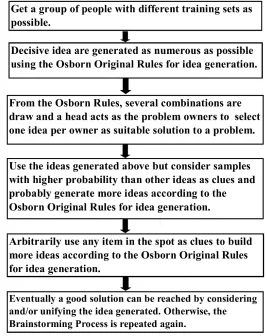
In brain storming optimization algorithm [10], the solutions are separated into several clusters. The next iteration always retains the best solution from the previous solution. However, new individuals have the tendency to be created based on one or two individuals in clusters. The usage of a solution becomes superior when the new individual is nearby to the best solution. In Fig. 2, a distinctive brainstorming process is presented. In Osborn’s Rules, the four rules tries to better ideas by generating more of them, never criticize any idea produced, unusual ideas are always welcomed and finally stand the tendency to combine and improve ideas. The total population is related to every sensor node and per individual idea in the BSO is the node. In the bounds of the solution space, an individual idea is at random set to a suitable starting condition. A population size of n is considered when a fixed number of n ideas are generated for owners to pick good ideas from.
During each generation, all the ideas are first grouped into k clusters using k-means clustering approach, and then the paramount one in each cluster is selected as the cluster center. Rarely, a randomly selected center is substituted with a new generated idea with a probability of preplace, keeping the swarm from local optimum. Firstly, BSO selects one or two clusters randomly with predetermined likelihood in place of ideas generated by other ideas. The uppermost superiority is known to be the cluster center chosen, if not, select another idea in the cluster. On the other hand, if a new idea is created based on ideas generated by other ideas, it can be written as
𝑦𝑦𝑖𝑖𝑖𝑖𝑛𝑛𝑛𝑛𝑛𝑛=𝑦𝑦𝑖𝑖𝑖𝑖𝑜𝑜𝑜𝑜𝑜𝑜+𝜉𝜉𝜉𝜉(𝜇𝜇,𝜎𝜎) (1)
Else, if a new dependent idea is generated by two existing individuals, the resulting solution is formulated as
𝑦𝑦𝑖𝑖𝑖𝑖𝑛𝑛𝑛𝑛𝑛𝑛=𝑦𝑦𝑖𝑖𝑖𝑖𝑜𝑜𝑜𝑜𝑜𝑜+𝜉𝜉𝜉𝜉(𝜇𝜇,𝜎𝜎)
Fig 2. The Brainstorming Process
where 𝑦𝑦𝑖𝑖𝑖𝑖𝑛𝑛𝑛𝑛𝑛𝑛 and 𝑦𝑦𝑖𝑖𝑖𝑖𝑜𝑜𝑜𝑜𝑜𝑜 are the 𝑗𝑗𝑗𝑗ℎ dimension of 𝑖𝑖𝑗𝑗ℎ individual of 𝑦𝑦𝑛𝑛𝑛𝑛𝑛𝑛 and𝑦𝑦𝑜𝑜𝑜𝑜𝑜𝑜, respectively; with mean 𝜇𝜇 and variance 𝜎𝜎 the Gaussian random value is given as 𝜉𝜉(𝜇𝜇,𝜎𝜎); 𝜔𝜔1 and 𝜔𝜔2 are weight values of the two ideas, respectively; and 𝜉𝜉 is an regulating factor slows down the convergence speed as the evolution goes, which can be expressed as
𝜉𝜉=𝑟𝑟𝑟𝑟𝑟𝑟𝑟𝑟 ∗ 𝑙𝑙𝑙𝑙𝑙𝑙𝑙𝑙𝑖𝑖𝑙𝑙 �0.5∗𝐼𝐼𝑚𝑚𝑚𝑚𝑚𝑚−𝐼𝐼𝑐𝑐𝑚𝑚𝑐𝑐𝑐𝑐
𝑘𝑘 � (3)
where 𝑟𝑟𝑟𝑟𝑟𝑟𝑟𝑟 is a random value between 0 and 1. The 𝐼𝐼𝑚𝑚𝑚𝑚𝑚𝑚 and 𝐼𝐼𝑐𝑐𝑚𝑚𝑖𝑖𝑛𝑛 is the maximum number of iteration and current minimum number of iteration respectively. The 𝑙𝑙𝑙𝑙𝑙𝑙𝑙𝑙𝑖𝑖𝑙𝑙 is a logarithmic sigmoid transfer function, and such form is positive for global search at the start of the evolution and improves local search ability when the process is approaching to the end. Moreover, 𝑘𝑘 is a defined to be a parameter for varying slopes of the 𝑙𝑙𝑙𝑙𝑙𝑙𝑙𝑙𝑖𝑖𝑙𝑙 function. The newly generated idea is weighed, and if the fitness value is more suitable than the current idea, the old idea will be replaced by new one. Once the newly generated idea is created, it is then considered. Afterwards, the crossover operation is conducted and the best idea among the group is selected to update the old one. Mostly, the described process above is repeated up to 𝑟𝑟 new individuals have been created to finish one generation. The iteration stops if and only if the maximum number of iterations is reached. To end, the outcome of the final solution to the problem is weighed to be the optimal idea.
4. WSN Routing Based on BSO-LEACH
In data communication, next hop receives and aggregates data then transmitted to the BS. Therefore, higher residual energy next-hop should be optimal as possible, where 𝐸𝐸𝑖𝑖 represents the energy of each sensor and 𝐸𝐸𝐶𝐶𝑖𝑖 represents the total residual energy of all the sensor nodes within the cluster and 𝑝𝑝 represents the number of nodes in the cluster. So, our first objective with respect to residual energy is 𝐹𝐹1 minimized as:
𝐹𝐹1=∑ 𝐸𝐸𝑐𝑐𝐸𝐸
𝐶𝐶𝑐𝑐 𝑝𝑝
𝑐𝑐=1 (4)
The euclidean distance in the middle of the cluster center (CC) and its members and from the CC to the BS should be minimum so that it uses less amount of energy. And so, it’s crucial to reduce the distance between CC and BS, where
𝑙𝑙𝑖𝑖 is the source node, 𝐶𝐶𝐶𝐶𝑖𝑖 is the cluster center and 𝐵𝐵𝐵𝐵 is the base station. However, this has the tendency to improve
the network lifetime. So, the second objective with respect to distance is 𝐹𝐹2 minimized as:
𝐹𝐹2=∑ [𝑜𝑜𝑖𝑖𝑑𝑑(𝐶𝐶𝐶𝐶𝑜𝑜𝑖𝑖𝑑𝑑(𝑑𝑑𝑐𝑐,𝐶𝐶𝐶𝐶𝑐𝑐)
𝑐𝑐,𝐵𝐵𝐵𝐵)+(𝑑𝑑𝑐𝑐,𝐶𝐶𝐶𝐶𝑐𝑐)] 𝑝𝑝
𝑐𝑐=1 (5)
The fitness function can be calculated using the formula given in equation 8. The Residual energy 𝐹𝐹1 and Euclidean distance 𝐹𝐹2 is given in equation 6 and 7 respectively.
𝐹𝐹𝑖𝑖𝑗𝑗𝑟𝑟𝐹𝐹𝑙𝑙𝑙𝑙𝑉𝑉𝑟𝑟𝑙𝑙𝑉𝑉𝐹𝐹:𝐹𝐹=𝐹𝐹1+𝐹𝐹2 (6)
The LEACH protocol arranges its sensor nodes hierarchically in clusters, together with a cluster head (CH) for each [30]. The CH of the LEACH is elected starting with a probability which is defined by a random number chosen between 0 and1. The task of CH alternates all the sensors to avoid a single sensor node draining all its battery. The threshold 𝑇𝑇𝑛𝑛 is given in equation 7 which is matched up to the preferred random number.
𝑇𝑇𝑛𝑛=�
𝜌𝜌
1−𝜌𝜌∗(𝑟𝑟∗𝑚𝑚𝑜𝑜𝑜𝑜𝜌𝜌1), 𝑖𝑖𝑖𝑖𝑟𝑟𝑛𝑛𝑛𝑛 0, 𝑂𝑂𝑗𝑗ℎ𝐹𝐹𝑟𝑟𝑤𝑤𝑖𝑖𝑙𝑙𝐹𝐹(7)
where 𝜌𝜌 is the desired percentage of CCs, 𝑟𝑟is the current round, and 𝑛𝑛 is the set of nodes that have not been cluster-heads in the last 1/𝜌𝜌 rounds.
The operation of LEACH protocol consists of several rounds with two phases in each [31]: Set-up Phase and Steady Phase. The algorithm for LEACH protocol is analyzed by the following procedures.
Step 1: Setup Phase- In the early phases, each potential node stand the probability to be picked spontaneously to become a cluster head (CH). The CH picking stage for the nodes is taken into accounts. The CH is chosen depending on the threshold value𝑇𝑇𝑛𝑛. The advertisement phase is when the CHs alert their neighboring node with an advertisement packet that they are now CHs. The non-CH nodes with the strongest signal strength is taken by the advertisement packet. Then in the cluster setup phase, the ordinary member nodes alert the CH that they are now a member to that cluster with "join packet" having their own IDs making use of CSMA. Later in the cluster-setup sub phase, the CH have an objective knowledge of the number of member nodes and their IDs. Conditionally, intra-cluster members receive messages, the CH produces a TDMA schedule, proceeds by taking a random CSMA code, and then forwards the TDMA table to cluster members. The steady-state phase follows next.
Algorithm for routing: Steps to find out proximate optimum route;
Step 1. Initialize the node 𝜉𝜉𝑖𝑖= {∀𝑖𝑖, 1≤ 𝑖𝑖 ≤ 𝐵𝐵𝑚𝑚, 𝐵𝐵𝑚𝑚 is 𝑚𝑚 potential number of solutions (nodes), maximum iterations𝐼𝐼𝑚𝑚𝑚𝑚𝑚𝑚, Pro1, Pro2, Pro3, and number of cluster.
Step 2. Cluster 𝑚𝑚 solutions into 𝑙𝑙 clusters.
Step 3. Compute the fitness value of each node in the cluster using equation 6.
Step 4. Rank outcomes in each cluster and set the best one as cluster center.
Step 5. New Node Generation:
i. With probability Pro1, replace the selected clusters with randomly generated nodes.
ii. With probability Pro2, randomly pick a cluster; otherwise pick two clusters.
iii. With probability Pro3, pick the cluster center(s) and go to (iv); otherwise chose other nodes from the previously selected clusters; those node(s) represent the old nodes
iv. Generate new node using equation 1; then go to Step v.
v. Evaluate the newly initiated nodes and the old ones; then elect the best node to replace the old one, if any.
vi. If p nodes are updated, go to step 6; otherwise, go to (i).
Step 6. If the current number of iterations <𝐼𝐼𝑚𝑚𝑚𝑚𝑚𝑚, go to Step 3.
Step 7. Evaluate the current solutions and then terminate.
The energy model considered in [11, 12] has the function of calculating energy loss of all other sensor nodes in the network. The two channel propagation models used are the free space (𝑟𝑟2 power loss) for direct transmission and the multipath fading channel (𝑟𝑟4 power loss) for packet transmission via multihop. Therefore, the energy drained for this transmission with 𝑙𝑙-bit packet over distanced 𝑟𝑟 is calculated as:
𝐸𝐸𝑇𝑇𝑚𝑚(𝐿𝐿,𝑟𝑟) =�𝐿𝐿 ∙ 𝐸𝐸𝑛𝑛𝑜𝑜𝑛𝑛𝑐𝑐+𝐿𝐿 ∙ 𝜀𝜀𝑓𝑓𝑑𝑑𝑟𝑟
2, 𝑟𝑟<𝑟𝑟 0
𝐿𝐿 ∙ 𝐸𝐸𝑛𝑛𝑜𝑜𝑛𝑛𝑐𝑐+𝐿𝐿 ∙ 𝜀𝜀𝑚𝑚𝑚𝑚𝑟𝑟4, 𝑟𝑟 ≥ 𝑟𝑟0 (8)
where 𝜀𝜀𝑓𝑓𝑑𝑑 is free space energy loss, 𝜀𝜀𝑚𝑚𝑚𝑚 is multipath energy loss, 𝑟𝑟 is distance between source node and destination node, and 𝑟𝑟0 is the threshold distance:
𝑟𝑟0=�𝜀𝜀𝜀𝜀𝑚𝑚𝑝𝑝𝑓𝑓𝑓𝑓 (9)
The energy spent for the radio to receive this message is found in equation (10) where 𝐸𝐸𝑛𝑛𝑜𝑜𝑛𝑛𝑐𝑐 implies the energy dissipated per bit to run the transmitter or the receiver circuit. It is influenced by factors like filtering, modulation, digital coding and spreading of the signal.
𝐸𝐸𝑅𝑅𝑅𝑅(𝐿𝐿,𝑟𝑟) =𝐿𝐿 ∙ 𝐸𝐸𝑛𝑛𝑜𝑜𝑛𝑛𝑐𝑐 (10)
5. Simulation and Results
BSO Parameters Value LEACH Parameters Value Deployment Size 100m∗100m Node deployment Random Total Nodes 100 BS Location 50∗50 Number of iterations 200 Initial Energy 1J Number of ideas 50 Packet size 500bytes Number of clusters 5 𝑟𝑟𝑜𝑜 30m Prob. of renewing the cluster center,Pro1 0.4 𝐸𝐸𝑛𝑛𝑜𝑜𝑛𝑛𝑐𝑐 50nJ/bit Prob. of choosing one center,Pro2 0.4 𝜀𝜀𝑓𝑓𝑑𝑑 10pJ/bit/m2
Prob. of picking the cluster center,Pro3 0.2 𝜀𝜀𝑚𝑚𝑚𝑚 0.0013pJ/bit/m4
[image:7.612.94.504.260.518.2]Table 1. Node distribution Parameters
Figure 4 displays the residual energy versus number of iterations for the LEACH and BSO-LEACH protocols. The two protocols showed a steady fall of energy, but LEACH has a consistent decrease with the number of iterations until iteration 180 because it maintains the same members in each cluster and a new CC is selected only if the current one
Fig 4: Residual energy against number of iterations
ran out of energy, unlike the BSO-LEACH which usually change the clusters. This difference leads to more control packets, therefore it can be concluded that more energy is consumed on the part of LEACH. When comparing LEACH and BSO-LEACH, we show that LEACH consumes more energy than BSO-LEACH because more data is sent to the BS and massive amount of control packets especially to discover the CCs.
Fig 5: Data packets received at BS against number of iterations
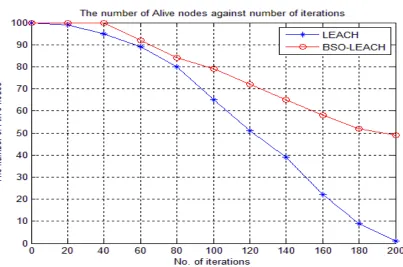
Fig 6: The number of alive nodes against number of iterations
[image:8.612.102.505.380.647.2]shows decrease suddenly after 40 iterations as compared to the LEACH protocol. Apart from the BSO-LEACH, we can realize that there is immediate loss of nodes when half of the nodes are already not alive.
6. Conclusion
This paper compares LEACH protocol and BSO-LEACH protocol considering their cluster formation and cluster center formation. Here, the BSO algorithm and the normal LEACH algorithm were used to solve energy saving problems in WSNs. After continues cluster center replacement, the energy of the node falls to minimum limit. The BSO-LEACH algorithm efficiently helped in saving the nodes energy in each iteration for a longer lifetime. Therefore, the cluster center with higher energy connects better to the base station. During the very last cluster center replacement, the energy of the entire network drops to a certain point. At the end, it was seen that the BSO-LEACH algorithm performed a little actively than the traditional LEACH algorithm.
References
[1] S. Cheng, Y. Shi, Q. Qin, S. Gao, “Solution Clustering Analysis in Brain Storm Optimization Algorithm”, in IEEE Symposium on Swarm Intelligence (SIS), pp. 111-118, 2013.
[2] R. Nallusam, K. Duraiswamy, D.A. Muthukumar, C. Sathiyakumar, “Energy efficient dynamic shortest path routing in wireless ad hoc sensor networks using genetic algorithm”, In: Proceedings of IEEE ICWCSC 2010, vol 1. Chennai, pp 73–79, 2010.
[3] M. El-Semary, A. Aly, M. Mohamed Mostafa, “Path energy weight: a global energy aware routing protocol for wireless sensor networks”, in: Proceedings of IEEE WD, vol 12. Venice, pp 695–698, 2010.
[4] S. Sendra, J. Lloret, M. Garcia, J.F. Toledo, “Power saving and energy optimization techniques for Wireless Sensor Networks,” Journal of Communications, vol. 6, No. 6, Sept 2011.
[5] R. Mishra, V. Jha, R.K. Tripathi, A.K. Sharma, “Energy Efficient Approach in Wireless Sensor Networks Using Game Theoretic Approach and Ant Colony Optimization,’’ Wireless Pers. Commun., 95:3333–3355, 2017.
[6] V. Kulkarni, V. Raghavendra, V. Ganesh Kumar, "Particle swarm optimization in wireless-sensor networks: A brief survey." IEEE Transactions on Systems, Man, and Cybernetics, Part C (Applications and Reviews) 41.2: 262-267, 2011.
[7] R. A. Rabie, “Fuzzy Brain Storming Optimization (FBSO) Algorithm”. Int. J. Intelligent Engineering Informatics, Vol. 10, No. 150, 2017.
[8] P. Li, H. Nie, L. Qiu, R. Wang, “Energy optimization of ant colony algorithm in wireless sensor network,” in International Journal of Distributed Sensor Networks, Vol. 13(4), 2017.
[9] Y. Shi, “Brain storm optimization algorithm,” in Proc. 2nd Int. Conf. on Swarm Intelligence, pp. 303-309, 2011. [10] Z. Zhan, J. Zhang, Y. Shi, H. Liu, ‘A Modified Brain Storm Optimization,’’ in WCCI IEEE World Congress on Computational Intelligence, June, 2012.
[11] H. Wendi Rabiner, C. Anantha, B. Hari, “Energy-efficient communication protocol for wireless microsensor networks”. In System sciences, 2000. Proceedings of the 33rd annual Hawaii international conference on, pages IO-pp. IEEE, 2000.
[12] N. A. B. A. Aziz, A. W. Mohemmed, and B. S. Daya Sagar, “Particle swarm optimization and Voronoi diagram for wireless sensor networks coverage optimization,” in Proceedings of theInternational Conference on Intelligent and Advanced Systems(ICIAS ’07), pp. 961–965, IEEE, Kuala Lumpur, Malaysia, November 2007.
[14] S. Tyagi, N.A. Kumar, “A systematic review on clustering and routing techniques based upon LEACH protocol for wireless sensor networks”. Journal of Network and Computer Applications, 36, 623–645, 2013.
[15] P. Kuila, K. P. Jana, “An energy balanced distributed clustering and routing algorithm for wireless sensor networks”, In: Parallel, distributed and grid computing (PDGC 2012), IEEE Xplore, pp. 220–225, 2012.
[16] J.Y. Chang, P.H. Ju, ”An energy-saving routing architecture with a uniform clustering algorithm for wireless body sensor networks”, Future Generation Computer Systems 35 pg. 128–140, 2014.
[17] Z. Ren, L. Wang, H.J. Lei,” A Study on Energy-saving Routing Algorithms for Wireless Sensor Networks Based on Particle Swarm Optimization” Second International Conference on Instrumentation & Measurement, Computer, Communication and Control, 2012.
[18] C. Vimalarani, R. Subramanian, and S. N. Sivanandam,” An Enhanced PSO-Based Clustering Energy Optimization Algorithm for Wireless Sensor Network”, the Scientific World Journal Volume, 2016.
[19] L. Praven, G. Isha, B. Haider, “FARW: Firefly Algorithm for Routing in Wireless Sensor Networks”, 3rd Int'l Conf. on Recent Advances in Information Technology (RAIT), 2016.
[20] V. K. Singh, Vidushi Sharma, “Elitist Genetic Algorithm based Energy Efficient Routing Scheme for Wireless Sensor Networks”, International Journal of Advanced Smart Sensor Network Systems, Vol. 2, No. 2, pp. 15-21, 2012. [21] W. Yu, Z.Y. Wu, “A Novel Ant Colony Optimization Routing Algorithm in Wireless Sensor Network”, Ninth International Conference on Intelligent Information Hiding and Multimedia Signal Processing, 2013.
[22] T. L. Lin, Y. S. Chen, H. Y. Chang, “Performance Evaluations of an Ant Colony Optimization Routing Algorithm for Wireless Sensor Networks”, Tenth International Conference on Intelligent Information Hiding and Multimedia Signal Processing, 2014.
[23] S. K. Gupta, P. K. Jana, “Energy Efficient Clustering and Routing Algorithms for Wireless Sensor Networks: GA Based Approach’’, Wireless Pers Commun 83:2403–2423, 2015.
[24] S. K. Jha, E. M. Eyong, “An energy optimization in wireless sensor networks by using genetic algorithm” Telecommun Syst, 2017.
[25] A. Norouzi, A. H. Zaim, “Genetic algorithm application in optimization of wireless sensor networks. The Scientific WorldJournal, 2014, 1–15, 2014.
[26] A. Peiravi., H. R. Mashhadi, S. H. Javadi, “An optimal energy-efficient clustering method in wireless sensor networks using multi-objective genetic algorithm”, International Journal ofCommunication Systems, 26(1), 114–126, 2013.
[27] A. M. Zungeru, K. P. Seng, L. M. Ang., C. W. Chong, “Energy efficiency performance improvements for ant-based routing algorithm in wireless sensor networks”. Journal of Sensors, 2013, 1–17, 2013.
[28] B. Zeng, Y. Dong, “An improved harmony search based energy-efficient routing algorithm for wireless sensor networks”, Applied Soft Computing, 41, 135–147, 2016.
[29] N. Zhu, A. V. Vasilakos, “.A generic framework for energy evaluation on wireless sensor networks. Wireless Networks”, 22(4), 1199–1220, 2016.
[30] S. A. Sodari, R. Ouni, “Reliable and energy-efficient multi-hop LEACH-based clustering protocol for wireless sensor networks”, Sustainable Computing: Informatics and Systems 20 pg. 1–13, 2018.
First Author – Samson Hansen Sackey, Graduate Student, Hohai University, College of IoT Engineering, 213022, China, [email protected]
Second Author – Junfeng Chen, University Lecturer, Hohai University, College of IoT Engineering, 213022, China
Third Author – Samuel Nartey Kofie, Graduate Student, Hohai University, College of IoT Engineering, 213022, China, [email protected]