University of Cape Town
NATURAL LANGUAGE INTERFACE TO RELATIONAL
DATABASE:
A SIMPLIFIED CUSTOMIZATION APPROACH
TRESOR MVUMBI
SUPERVISED BY:
DR. MARIA KEET
CO-SUPERVISED BY:
PROF. ANTOINE BAGULA
DISSERTATION PRESENTED FOR THE DEGREE OF MASTER OF SCIENCE
IN THE DEPARTEMENT OF COMPUTER SCIENCE
UNIVERSITY OF CAPE TOWN
The copyright of this thesis vests in the author. No
quotation from it or information derived from it is to be
published without full acknowledgement of the source.
The thesis is to be used for private study or
non-commercial research purposes only.
Published by the University of Cape Town (UCT) in terms
of the non-exclusive license granted to UCT by the author.
Plagiarism Declaration
I know the meaning of plagiarism and declare that all the work in the dissertation, save for that which is properly acknowledged, is my own.
__________________________ Tresor Mvumbi
April 2016
Abstract
Natural language interfaces to databases (NLIDB) allow end-users with no knowledge of a formal language like SQL to query databases. One of the main open problems currently investigated is the development of NLIDB systems that are easily portable across several domains. The present study focuses on the development and evaluation of methods allowing to simplify customization of NLIDB targeting relational databases without sacrificing coverage and accuracy. This goal is approached by the introduction of two authoring frameworks that aim to reduce the workload required to port a NLIDB to a new domain. The first authoring approach is called top-down; it assumes the existence of a corpus of unannotated natural language sample questions used to pre-harvest key lexical terms to simplify customization. The top-down approach further reduces the configuration workload by auto-including the semantics for negative form of verbs, comparative and superlative forms of adjectives in the configuration model. The second authoring approach introduced is bottom-up; it explores the possibility of building a configuration model with no manual customization using the information from the database schema and an off-the-shelf dictionary. The evaluation of the prototype system with geo-query, a benchmark query corpus, has shown that the top-down approach significantly reduces the customization workload: 93% of the entries defining the meaning of verbs and
adjectives which represents the hard work has been automatically generated by the system; only 26 straightforward mappings and 3 manual definitions of meaning were required for customization. The top-down approach answered correctly 74.5 % of the questions. The bottom-up approach, however, has correctly answered only 1/3 of the questions due to insufficient lexicon and missing semantics. The use of an external lexicon did not improve the system's accuracy. The bottom-up model has nevertheless correctly answered 3/4 of the 105 simple retrieval questions in the query corpus not requiring nesting. Therefore, the bottom-up approach can be useful to build an initial lightweight configuration model that can be incrementally refined by using the failed queries to train a top-down model for example. The experimental results for top-top-down suggest that it is indeed possible to construct a portable NLIDB that reduces the configuration effort while maintaining a decent
Acknowledgements
I would like to acknowledge and thank Dr. Maria Keet for supervising this work. Each meeting with you has been a great source of treasure. Thank you for being available, for your insightful guidance and encouragements.
I would like to thank Prof. Antoine Bagula for co-supervising this work. Thank you for your countless and valuable feedbacks. Special thank for always doing your best to make yourself available for meetings, sometimes till late and/or over Skype.
I would like to thank all the friends from the ISAT lab. I loved and will miss the time spent together. I am grateful for the relaxed and friendly environment where I have been given a chance to present several times the work progress. The insights received from these lab meetings have greatly contributed toward improving this dissertation.
Thank to my family and friends in both South Africa and back home (Democratic Republic of Congo) for the love and support while studying. You are too many to mention; please find in these words the expression of my profound gratitude. Special thanks to my parents Donatien Vangu Lukelo and Concilie Cigoha Limba for the unconditional and carrying love.
i
Table of contents
Chapter 1 Introduction ... 1
1.1 Natural language interfaces to databases ... 1
1.2 Problem statement and motivation... 2
1.3 Research questions ... 2
1.4 Scope ... 2
1.5 Methodology ... 3
1.6 Overview of the thesis ... 3
Chapter 2 Background ... 5
2.1 Natural Language Interface to Databases ... 5
2.1.1 Approaches to natural language processing ... 5
2.1.2 Phases of linguistic analysis ... 6
2.1.3 Design and architecture of NLIDB ... 7
2.1.4 NLIDB portability ... 9
2.1.5 NLIDB evaluation ... 12
2.2 Approaches toward domain portable NLI to RDB ... 14
2.2.1 Early attempts to transportable NLIDB ... 14
2.2.2 NLIDB using a semantic graph as domain knowledge model ... 16
2.2.3 Portable NLIDB based on semantic parsers ... 18
2.2.4 Empirical approaches toward portable NLIDB ... 19
2.2.5 NLIDB based on dependency grammars ... 20
2.3 Literature review synthesis ... 21
Chapter 3 Design of the authoring system ... 23
3.1 Design objectives and system architecture ... 23
3.2 Design of data structures for configuration ... 24
3.2.1 Data structure for the database schema ... 24
3.2.2 Data structure for adjectives ... 24
3.2.3 Data structure of verbs ... 25
3.2.4 Representation of meaning in the configuration... 25
3.3 Design of the top-down authoring approach ... 26
3.3.1 Lexicon element harvesting ... 27
3.3.2 Steps in system configuration with top-down approach ... 28
3.4 Design of the bottom-up authoring approach ... 32
Chapter 4 Design of the query processing pipeline ... 34
ii
4.2 Lexical analysis ... 36
4.2.1 Part of speech tagging... 36
4.2.2 Lemmatization ... 36
4.2.3 Named entity recognition ... 36
4.3 Syntactic analysis ... 40
4.4 Semantic analysis ... 40
4.4.1 Heuristic rules to build the select part of the intermediary query ... 41
4.4.2 Construction of the query part of the intermediary query ... 43
4.5 SQL Translation ... 48
4.5.1 Construction of the intermediary SQL query ... 48
4.5.2 Construction of the final SQL query ... 51
Chapter 5 Experiment design ... 55
5.1 Material and experiment design ... 55
5.2 Experiment 1 – evaluation of the top-down approach ... 57
5.3 Experiment 2 – evaluation of the bottom-up approach ... 58
5.4 Experiment 3 – Evaluation of the processing pipeline... 59
5.5 Experiment 4 – comparison of the result to other systems ... 59
Chapter 6 Experiment results and discussion ... 61
6.1 Experimental results ... 61
6.1.1 Result evaluation of the top-down approach ... 61
6.1.2 Result evaluation of the bottom-up approach ... 62
6.1.3 Result evaluation of the processing pipeline ... 64
6.1.4 Result comparison with other systems ... 65
6.2 Result discussion ... 66
6.2.1 Top-down evaluation ... 66
6.2.2 Bottom-up evaluation ... 67
6.2.3 Processing pipeline evaluation ... 67
6.2.4 Comparison with other systems ... 68
Chapter 7 Conclusion ... 70
7.1 Contributions ... 70
7.2 Future work ... 71
iii
List of tables
Table 1 – Comparison of approaches to natural language processing ... 6
Table 2 – Confusion matrix defining the notions of true positives, false positives, false negatives and true negatives (Manning et al., 2008) ... 12
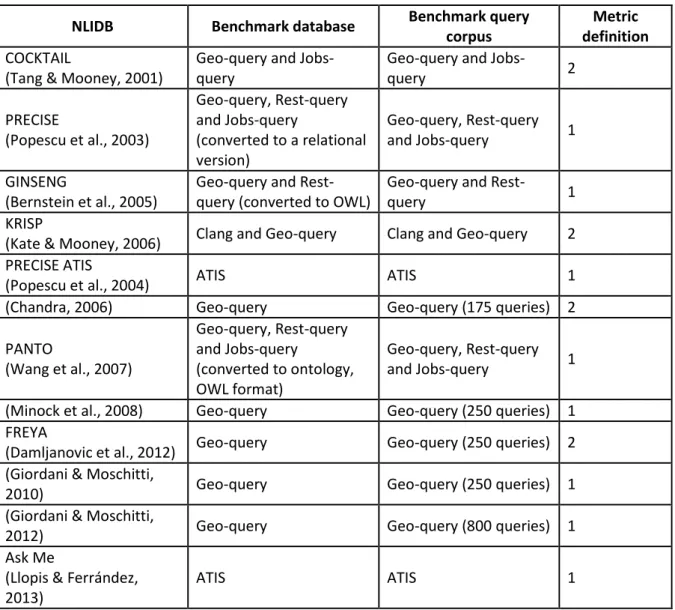
Table 3 – List of NLIDB and their benchmark database, sample query corpus and evaluation metric definition ... 13
Table 4 – Comparison of TEAM with other early transportable systems (Grosz et al., 1987) ... 16
Table 5 – Example of semantic frames for the relation “teach” and “register” (Gupta et al., 2012) ... 21
Table 6 – Example of query and their corresponding intermediary queries ... 41
Table 7 – List of rules to retrieve the select part of the logical query ... 41
Table 8 – Final list of triple groups corresponding to the query: “what states have cities named dallas ?’ ... 44
Table 9 – List of rules used to generate logical queries ... 45
Table 10 – proportions of the training and testing set used for evaluation ... 58
Table 11 – List of systems the top-down result is compared to ... 60
Table 12 – Average precision and recall for each experiment... 61
Table 13 – Average number of manual and automatic configuration entries... 61
Table 14 – List of terms produced by bottom-up model (the external terms from WordNet are highlighted) ... 63
Table 15 – List of column’s synonyms missing in the bottom-up model ... 64
Table 16 – Sources of errors in the processing pipeline ... 64
Table 17 – Result of NLIDB from Group A ... 65
Table 18 – Result of NLIDB from Group B ... 66
Table 19 – Experiment A results ... 77
Table 20 – Experiment B results ... 77
Table 21 – Experiment C results ... 78
Table 22 – Experiment D results ... 78
Table 23 – Experiment E results ... 78
iv
List of figures
Fig 1 – Generic architecture of a syntactic parser ... 8
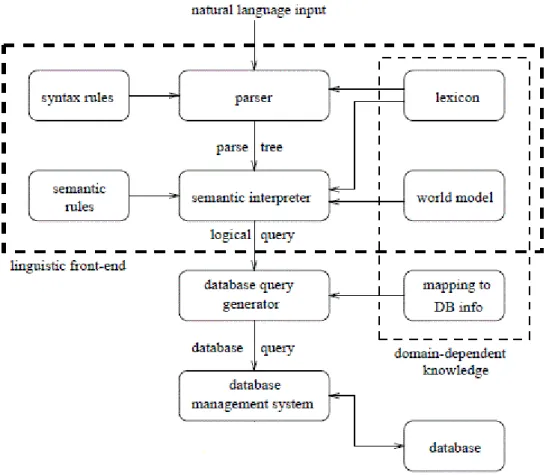
Fig 2 – Generic architecture of NLIDB combining syntactic and semantic parsing (Androutsopoulos et al, 1995) ... 9
Fig 3 – Definitions of precision and recall ... 13
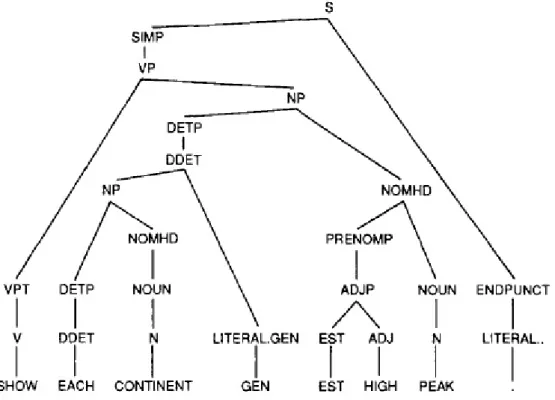
Fig 4 – Example of parse tree from TEAM (Grosz et al., 1987) ... 14
Fig 5 – Translation of logical query to SODA query in TEAM (Grosz et al., 1987) ... 15
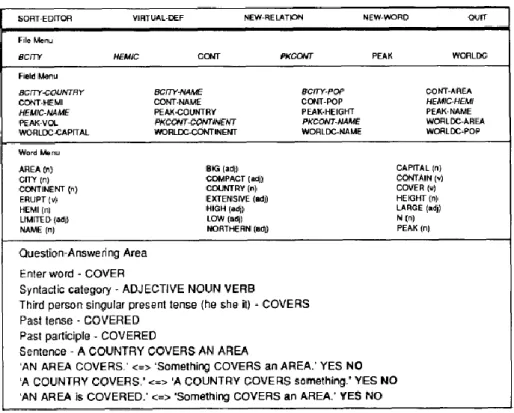
Fig 6 – System customization screen in TEAM: acquisition of a new verb ... 15
Fig 7 – Example of semantic graph structure (G. Zhang et al., 1999) ... 17
Fig 8 – Semantic graph structure of (Meng & Chu, 1999) ... 18
Fig 9 – Example of subgraph corresponding to a query about runaways and aircrafts (Meng & Chu, 1999) ... 18
Fig 10 – Tailoring operation in (Minock et al., 2008) ... 19
Fig 11 – Parse tree of a natural language query and its SQL query (Giordani & Moschitti, 2010) ... 20
Fig 12 – Example of dependency tree from the Stanford dependency parser ... 20
Fig 13 – Architecture of authoring system with top-down and bottom-up approach ... 24
Fig 14 – Structure of the database model in memory ... 24
Fig 15 – Data structure of a verb... 25
Fig 16 – Typed dependency graph for query “what is the longest river ?” ... 28
Fig 17 – Typed dependency graph for query “which state has the longest river?” ... 28
Fig 18 – User interface mapping nouns to database columns ... 29
Fig 19 – User interface capturing adjective information ... 29
Fig 20 – User interface capturing meaning for adjectives and verbs ... 31
Fig 21 – Processing pipeline from natural language query to SQL ... 34
Fig 22 – System’s architecture ... 35
Fig 23 – Processing pipeline user interface ... 35
Fig 24 – Structure of a token ... 36
Fig 25 – Structure of named entities... 37
Fig 26 – Visualization of the typed dependency query for “John loves Marie” ... 40
Fig 27 – Steps in join construction ... 51
Fig 28 – Construction of a database graph from a database schema ... 51
Fig 29 – Entity-relationship model of geo-query ... 56
v
Code listings
Listing 1 – Context-Free Grammar defining the subset of SQL used to define semantics during system
configuration ... 26
Listing 2 – Noun harvesting algorithm ... 27
Listing 3 – Adjective harvesting algorithm ... 27
Listing 4 – Verb harvesting algorithm ... 28
Listing 5 – Algorithm constructing the comparative form of adjective ... 30
Listing 6 – Algorithm constructing the superlative form of adjective ... 30
Listing 7 – Algorithm generating the SQL conditional expression for the negative form of a verb ... 31
Listing 8 – Algorithm generating the SQL conditional expression for the superlative form of an adjective ... 32
Listing 9 – Algorithm generating the SQL conditional expression for the comparative form of an adjective ... 32
Listing 10 – Algorithm constructing the configuration automatically through bottom-up approach .. 33
Listing 11 – Named entity recognition algorithm ... 37
Listing 12 – Algorithm grouping triples from the typed dependency query ... 43
Listing 13 – Algorithm that constructs intermediary queries ... 45
Listing 14 – Algorithm merging intermediary queries element ... 46
Listing 15 – Merging rules for two intermediary queries ... 47
Listing 16 – Algorithm translating the intermediary query to intermediary SQL ... 49
Listing 17 – Algorithm processing binary functions ... 49
Listing 18 – Algorithm processing unary functions ... 49
Listing 19 – Algorithm processing term ... 50
Listing 20 – Algorithm generating a graph from a database schema ... 52
Listing 21 – Algorithm retrieving the list of tables to be joined ... 52
Listing 22 – Algorithm generating the joins from the paths between nodes representing table to join ... 53
Listing 23 – Algorithm generating the FROM clause ... 53
1
Chapter 1
Introduction
Spoken natural languages are used by humans to verbally communicate with each other. Japanese, English, French and Chinese are examples of natural languages. Natural languages contrast with artificial languages which are constructed by humans; examples of artificial languages include programming language and database query languages. The field of computer science interested in analysing natural language is called Natural Language Processing (NLP).
Tamrakar & Dubey (2011) define Natural Language Processing as a “theoretically motivated range of computational techniques for analysing and representing naturally occurring texts at one or more levels of linguistic analysis for the purpose of achieving human-like language processing for a range of tasks or applications”. NLPs’ objective is to perform language processing. The NLP field in the early days targeted to achieve Natural Language Understanding (NLU), but this goal has not been achieved yet (Kumar, 2011) and current works focus toward developing efficient theories and techniques for natural language processing. NLP research focuses on particular applications with narrowed
purposes; this include among others:
- Information retrieval (IR) aims to mine for an interesting piece of information from large corpus of text;
- Machine translation (MT) aims to achieve automatic language translation;
- Natural Language Interfaces (NLI) aim to develop human-computer interfaces enabling users to interact with the computer through natural languages.
NLP borrows a lot from computational linguistics; as it studies languages from a computational perspective (Kumar, 2011). Natural Language Interfaces constitute a subfield of NLP, aiming to simplify human-computer interactions by enabling computers to process commands and produce results in natural language. Natural Language Interfaces to databases (NLIDB) is the most popular sub-domain of NLI.
Natural Language Generation (NLG) is also a sub-domain of NLI focusing on automatic generation of natural language. A NLG module can be included in a NLI to allow the system to produce results in natural language.
1.1
Natural language interfaces to databases
Information plays a crucial role more than ever in our nowadays organizations (Sujatha, 2012). The Internet is growing at a fast rate, creating a society with a higher demand for information storage and access (Range et al, 2002). Databases are the de facto tool to store, manage and retrieve large amount of data. Unsurprisingly, they are used in various application areas in multiple organizations (Nihalani et al, 2011). Databases use a formal query language to communicate; currently, Structured Query Language (SQL) is the norm and standard way to interact with relational databases, but it is difficult for non-domain experts to learn and master. Graphical interfaces and form-based interfaces improve data analysis (Calvanese et al, 2010) and are easier than formal languages but still
constitute artificial languages that require some training to be properly used by casual users (Panja & Reddy, 2007). One of the most convenient means for casual users to ask questions to databases is to use natural language they are accustomed to (Freitas & Curry, 2014).
2
Research in Natural Language Interface to Databases aims to develop intelligent and easy to use database interfaces by adopting the end user’s communication language (Sujatha, 2012). A NLIDB is "a system that allows the user to access information stored in a database by typing requests
expressed in some natural language" (Androutsopoulos et al, 1995). NLIDB systems receive users' inputs in natural language (text or speech) and translate them into commands in a formal language (like SQL or MDX, for DataWarehouse) that can be processed by a computer. This approach greatly simplifies the interaction between the system and user, since there is no need to learn and master a formal query language (Sharma et al, 2011).
1.2
Problem statement and motivation
Full understanding of natural language is a complex problem in artificial intelligence that is not completely solved yet. There are still a lot of challenges that need to be addressed before developing a fully usable natural language interface that can accept arbitrary natural language constructions. The main open problems include system portability, disambiguation, and management of user expectation. This research addresses the first problem.
Natural language interfaces often require tedious configuration to be ported to new domains. The early works on NLIDB have been tailored to interface a particular knowledge domain or application; examples include LUNAR (Woods et al, 1972) and LADDER (Hendrix & Sacerdoti, 1978). The natural language processing literature contains several works aiming to build highly portable NLIDB with various levels of success. However, a review of the literature reveals a trade-off between portability and coverage. Highly portable systems tend to have a limited coverage while systems achieving high accuracy tend to be hard to customize and maintain. This research addresses the problem of bridging the gap between portability and coverage while avoiding the loss of accuracy.
1.3
Research questions
This research addresses the challenge of simplifying customization of NLIDB without negatively impacting the linguistic coverage and accuracy of the system. The study hypothesizes the feasibility of a portable NLIDB design targeting a relational database whose configuration requires only the knowledge of database and the subject domain without sacrificing the system coverage and accuracy. The following research questions are investigated:
- Is the exploitation of an unannotated corpus of sample questions combined with automatic generation of configuration for negative form of verbs, comparative and superlative form of adjective an effective approach to reduce the workload required to customize a NLIDB targeting relational databases?
- Is it viable to use the database schema and an off-the-shelf dictionary as the only source of configuration data for an authoring system requiring no manual customization?
1.4
Scope
The NLIDB design in this research work will use SQL as the formal language to query relational databases. Additionally, the system will support only English natural language questions that are assumed to be free of spelling or grammar errors. And finally, the parser engine is based on symbolic approach as the parsing method of natural language questions. This research will explore two authoring approaches aiming to reduce the workload needed to customize a NLIDB system. The first approach is called top-down, it assumes the existence of a list of sample questions before
3
customization framework based on mapping harvested elements to either database objects or their corresponding semantics. The second customization method is called bottom-up, it explores the feasibility of porting a NLIDB to a new database without any manual customization, using only the database schema and WordNet (a public external dictionary) as source of configuration information.
1.5
Methodology
The present research project is based on the computer science experimental methodology which consists of identifying “concepts that facilitate solutions to a problem and then evaluate the solutions through construction of prototype systems”(Dodig-Crnkovic, 2002). In this research, we propose a design and evaluation of an experimental prototype called NALI which aims to simplify NLIDB customization. The experimental research has been completed in two main phases which are the prototype design and its evaluation. The waterfall model has been used to implement the prototype. The development cycle went through the following five phases: requirement gathering, design, development, testing, and evaluation.
A system based evaluation method, i.e., an intrinsic evaluation, has been selected to evaluate the experimental prototype. This choice is firstly motivated by the fact this research aims to contribute mostly on improving the efficiency and performance of NLIDB customization. System based
evaluations allow assessing quantitatively the system’s performance in controlled environments while user based or extrinsic evaluations are better suited to assessment of qualitative features like user perception of the system (Woodley, 2008). A system evaluation will secondly allow easily comparing the result with similar systems that are mostly evaluated through a system based approach as well.
The prototype was evaluated with geo-query1, a corpus of sample questions, and its related
database (Tang & Mooney, 2001). We built a gold SQL result in order to automate the evaluation of the correctness of the responses returned by the system. The metrics2 used to evaluate and
compare the system performance are precision and recall. The tests were run in a computer with the configuration below:
- Hardware configuration: processor Intel(R) Core(TM) i7-2630QM CPU @ 2.00 GHz with 16 GB of RAM;
- Software configuration: Windows 7 Professional, PostgreSQL 9.4, Java version 1.7.
The experimental results are recorded in several html files that are kept in folders labelled with the date and time of the experiment. The configuration data used for evaluation were recorded in a file and can be used to re-run the experiments.
1.6
Overview of the thesis
The remainder of this thesis is structured as follows:
Chapter 2 gives some context and background on natural language processing and natural language interface to databases. The related work section focuses on research aiming to simplify the task of customization and the chapter concludes with a synthesis of the current state of the art and open problems.
1 The motivations for choosing geo-query are presented in section 5.1. 2 The definitions for precision and recall are presented in section 5.1.
4
Chapter 3 presents the design of top-down and bottom-up approaches and describes the data structures and algorithms used for both methods.
Chapter 4 presents the design of the processing pipeline for NALI and describes each of the main phases of query processing, namely lexical analysis, syntactic analysis, semantic analysis and SQL translation.
Chapter 5 describes the material and design of experiments used to evaluate the methods proposed in Chapter 3 and Chapter 4.
Chapter 6 presents the experiment results followed by a discussion and interpretation of the outcomes.
Chapter 7 concludes the thesis with a presentation of the main contributions and possible future work.
5
Chapter 2
Background
This chapter presents a context to NLIDB with a focus on the approaches toward easily customizable systems and the related work. The first section draws a bigger picture on approaches and techniques used by NLIDBs to process natural language inputs and concludes with a discussion on the problem of NLIDB portability. The second section looks closely at the approaches used in the literature to simplify NLIDB customization and reviews in depth the research projects whose objectives and approaches are similar to the present research. The chapter concludes with a summary of the related literature.
2.1
Natural Language Interface to Databases
NLIDBs allow non-technical users to query databases using natural language sentences. To achieve this, a NLIDB needs to process natural language input and produce a formal query like SQL to query a database. The next sections present the approaches used to process natural language, the levels of linguistic analysis, the main architectures of NLIDB and finally a discussion on portable NLIDBs.
2.1.1
Approaches to natural language processing
There are three main approaches to achieve natural language processing: symbolic, statistical and connectionist approach (Pazos et al., 2013). Symbolic and statistical approaches have been used in the early works in the NLP field, while connectionist approaches are relatively recent. Research conducted between 1950 and 1980 focused on development of symbolic theories and
implementations. The symbolic approaches are based on in-depth analysis of linguistic properties and sentence grammatical structures. This analysis uses a set of well-formed rules predefined by a human expert. Statistical approaches are based on analysis of large text corpora to automatically develop an approximated general model of linguistic phenomena. There is no need, therefore, to manually create rules or world knowledge. Statistical approaches require large datasets of text corpora as their primary source of evidence. Statistical methods regained popularity in the 1980’s, thanks to the broader availability of computational resources. Like in the statistical approaches, the connectionist approach develops generalized models from large text samples. Connectionism uses an artificial neural network (ANN) to model language features. The ANN is constituted of
interconnected simple processing units called neurons. The knowledge is stored as weights associated to connections between nodes. Like in the statistical approaches, the connectionist approach develops generalized models from large text samples. We compiled in Table 1 a summary of the similarities and differences between approaches.
The symbolic approaches have the advantage of being simple to implement; however, their functionalities are limited by the quality and quantity of rules defined. Statistical and connectionist methods are more flexible and can learn through training; but this learning depends on the
effectiveness of the training corpus (Pazos et al., 2013). Hybrid NLPs aim to complementarily use the strengths of all approaches to effectively address NLP problems. An example of a hybrid system can be found in (Mamede et al, 2012).
6
Table 1 – Comparison of approaches to natural language processing
Symbolic approach Statistical approach Connectionist approach Data collection Prior data collection
not compulsory
Requires large text corpora to build the model Model building Performed manually
by a linguistic expert
A statistical model is built from text corpora
A connectionist model is built from large text corpora
Rules Manually defined
beforehand Rules built automatically from statistical models Individual rules typically cannot be recognized, they are hidden in the neural network
Robustness Fragile when
presented with
unusual, incomplete or ill-formed inputs
More robust than symbolic approach, provided that the training dataset is large enough
Robust and fault tolerant; deals efficiently with incomplete and noisy input (as the system knowledge is spread across the network) Flexibility Based on well
formatted rules produced by human experts. Lack therefore flexibility, as the expert inputs are required for any adaptation
More flexible than symbolic, require a new dataset for training to adapt
Very flexible, can adapt by updating the link weights in real time, using examples provided
Suitable tasks Can handle implementation of higher levels (discourse and pragmatic analysis). Suitable for tasks where linguistic phenomena are well known and steady (does not change often) like natural language interfaces
Suitable for task where linguistic phenomena are not well known and subject to frequent evolutions. Example: machine translation, information retrieval, etc. Can only deal with lower level analysis (morphological, lexical and semantic analysis)
2.1.2
Phases of linguistic analysis
The processing of natural language can be achieved in several levels focusing on different aspects of language analysis. This paragraph gives a brief summary of each of these analysis levels.
Phonological analysis: phonology refers to the study of sounds and the way they are organized to
7
Morphological analysis: this level deals with the componential nature and structure of words. Words
are composed of morphemes, which represent the smallest units of meaning. For instance, the word “interaction” is composed of three different morphemes: “inter” (the prefix), “act” (the root) and “ion” (the suffix). The meaning of morphemes is the same for all the words, making it possible to understand any given word by breaking it into its constituents (Aronoff & Fudeman, 2011).
Lexical analysis: also referred to as tokenization, is the process of breaking a stream of characters
into meaningful unit elements (i.e. words) called tokens (Bird et al, 2009).
Syntax analysis: the syntax represents the structure of a language. For natural language, the syntax
defines the order, connections, and relationships between words. The ensemble of syntax rules forms the language grammar (Nigel, 1987). Syntactic analysis, referred to sometimes as parsing is the process of analyzing a text structure to determine if it respects a given formal grammar. Context Free Grammars (CFG) is the most used grammar in syntactic analysis (Kumar, 2011).
Semantic analysis: this level deals with possible meanings of natural language inputs, by analyzing
interactions in the word-level meanings within a sentence (Kumar, 2011). This level includes also disambiguation of words with several possible interpretations, in order to ideally keep only one final meaning for the sentence. A computational representation or knowledge representation is needed to model, store and process sentence meaning (Kumar, 2011). First Order Logic or another logic language can be used as a formal representation model to represent sentence meaning.
Discourse analysis: James Paul Gee (2005) defines discourse analysis as “the study of
language-in-use”. At this level, the meaning of several sentences is analyzed to draw an overall sense, while semantic analysis focuses on the meaning of a single sentence.
Pragmatic analysis: at this level, external contextual knowledge is introduced to refine the discourse
meaning (Kumar, 2011). For example, a mobile handset NLP being queried “What’s the weather like today ?” can use pragmatic analysis to “understand” that the current geographical position is needed to answer the query, and obtain it through GPS.
Currently, there are significantly more NLP systems implementing the four lower levels of analysis. This can be explained by the fact not all NLP actually need to analyze text at higher levels. In addition, lower levels have benefited from extensive research work. Lower level analysis is done by applying rules on small units: morphemes, words, and sentences. Higher levels, especially pragmatic analysis, often require extensive external world knowledge to perform efficiently.
2.1.3
Design and architecture of NLIDB
There are three approaches used to design NLIDB: pattern-matching, syntax-based systems, and semantic grammar systems.
Pattern-matching: systems were used in some of the early NLIDB. The input is matched with a set of
predefined patterns. Only the questions defined in the patterns can be interpreted. Following is an example of pattern definition borrowed from (Androutsopoulos et al, 1995):
Pattern: ... "capital" ... <country>.
Action: Report Capital of row where Country = <country>.
This rule searches for the word "capital", followed by <country> which represents a word appearing in the list of countries in a database table. If this condition is matched, the system returns the content of column "Capital" where "Country" = <country>. This technique has the advantage that it
8
is simple: the rules are simple to write, no elaborate parsing module is needed, and as a result the system is easy to implement. One important disadvantage of a pattern-matching technique is that it can lead to a wrong answer when a query matches the wrong rule (Androutsopoulos et al, 1995).
Syntax-based systems: have a grammar that describes all the possible syntactic structures of queries
(Androutsopoulos et al, 1995). The user’s query is analyzed (parsed) syntactically and the resulting parsing tree is mapped to an intermediary language (see Fig 1), that will be translated into the database query language. LUNAR (Woods et al., 1972) is an early example of NLIDB using this approach. The parser can produce more than one parse tree for a given natural language; a syntax-based system needs in this case to resolve the ambiguity.
Fig 1 – Generic architecture of a syntactic parser
Semantic grammar systems: are similar to syntax-based systems in the sense that the input is also
parsed to generate a parse tree. The difference lies in the fact that the leaf nodes represent semantic concepts instead of syntactic concepts. Semantic knowledge refers to the target domain and is hard-wired into the semantic grammar (Androutsopoulos et al, 1995). Semantic grammar is a standard approach used in several NLIDB implementations (Knowles, 1999). The query in natural language is parsed to generate a model or representation of the meaning of the sentence which will be translated into SQL or any targeted database query language. A semantic parser can be
complementarily used with a syntactic parser to perform semantic analysis (see Fig 2). In the architecture illustrated in Fig 2, the domain-dependent knowledge is contained in the lexicon, world model, and mapping to DB modules. The domain-independent knowledge is contained in the syntax rules (used by the lexical parser) and semantic rules (used by the semantic parser). The semantic interpreter produces a logical query that is translated to the final database query by the query generator module.
9
Fig 2 – Generic architecture of NLIDB combining syntactic and semantic parsing (Androutsopoulos et al, 1995)
The drawback of semantic grammar systems is the difficulty to port them to different application domains (Pazos et al., 2013). Customization requires the development of a new grammar for each new configuration. Other samples of semantic grammar based systems can be found in (Nguyen & Le, 2008) and (Minock et al., 2008).
2.1.4
NLIDB portability
Early NLIDBs were designed to interface a specific database and for only one given knowledge domain (lunar geology for LUNAR, for example). From the 1980’s, research focused more on portability; the aim being to create NLIDBs that can easily adapt to a database with a different universe of discourse or even new natural language. The following sections discuss challenges related to NLIDB portability and methods developed to address the problem.
2.1.4.1
Domain portability
NLIDBS are often designed to answer questions within a particular domain (example: weather forecast, train service, etc.). A domain portable NLIDB is designed in such a way that the system can be configured easily for use in several subject domains (Androutsopoulos et al, 1995). The challenge here is to construct an effective linguistic model that includes new words and concepts pertaining to the new domain. The configuration task has to be performed by system developers, knowledge engineers or users. The quality of the linguistic model used has a tight effect on the correctness of the system. However, designing and building a model to be used by a NLI system often requires certain knowledge of computational linguistics, an understanding of the database structure and finally expertise in the formal language to query the target data source. Therefore, customizing NLI
10
has historically been the responsibility of a few experts. The previous situation resulted into costly system customization which hindered development and wide adoption of NLI. In response to this problem, recent research trends in NLI investigate how to reduce the effort and expertise required for building linguistic models needed to customize systems to new domains. The following
paragraphs describe the various strategies developed that simplify customization to new domains. Simple authoring systems
Simple authoring systems focus on minimizing the effort required to adapt the system to new domains by building a user-friendly authoring (or customization) interface that does not require expertise in computational linguistics. The project TEAM (Transportable English database Access Medium) is among the first NLIDB applying this strategy (Grosz, Appelt, Martin, & Pereira, 1987). Customizing TEAM requires some general knowledge of computer systems and the target database; the user is not required to have a background in computational or formal linguistics. System
customization is performed by adding new verbs, adjectives and synonyms of existing words through the customization module. ORAKEL (Cimiano, Haase, Heizmann, & Mantel, 2008) is a more recent example of an easy to customize NLI. ORAKEL first auto-constructs the lexicon from the ontology targeted; this helps to simplify the task of customization which consists of mapping lexicon terms to relations specified in the ontology domain. Most of the NLIDB systems integrating a user-friendly authoring module we reviewed interface with ontologies; the relatively few systems targeting relational databases are presented in section 2.2. Further examples of NLIDB targeting ontologies with a user-friendly authoring module can be found in (Lopez et al. , 2005) and (Bernstein et al., 2005).
Interactive natural language interfaces
The interactive approach advocates building systems with a concise model and interactively cooperating with the end-user to customize the system. Consequently, systems based on this paradigm will often have a very small or no domain specific entries in the model. This design choice results in a more generic linguistic model that is easily portable to new domains.
NALIR is an interactive NLIDB to relational databases that translates natural language questions to SQL (F. Li & Jagadish, 2014). NALIR integrates a limited set of possible interactions with the user in order to assist incrementally building complex natural language questions. The interface supports advanced SQL features such as aggregations, sub-queries and queries joining multiple tables. The system also provides a natural language feedback to the user, explaining how the query was interpreted. Ambiguities in the questions are dealt with by letting the user select the correct interpretation from a list of multiple possible answers.
FREyA (Damljanovic, Agatonovic, & Cunningham, 2012) is an interactive NLI to ontologies that relies on clarification dialogs with the end user to parse queries. FREyA compared to NALIR has the advantage of learning from previous user choices to self-train and improve its model, thereby reducing the need for subsequent clarification dialogs. However, NALIR can support more complex queries compared to FREyA. Both FREyA and NALIR do provide feedbacks to user about queries’ interpretations. Another example of an interactive natural language interface can be found in (Li et al, 2007).
Automatic acquisition of the linguistic model
Automatic acquisition consists of automatically constructing the model required for query parsing. One approach consists of auto-extracting the information required to build the model from the
11
meta-data describing a data source structure or directly from the actual data. A second approach consists of training the NLI using a corpus of annotated or non-annotated data.
Kaufmann et. al (2007) presents NLP-Reduce, a natural language interface to the Semantic Web. NLP-Reduce extracts properties from the Semantic Web to build the lexical dictionary automatically. This initial dictionary is completed by retrieving word synonyms from WordNet (Miller, 1995), an external lexical dictionary on the Web.
Freitas & Curry (2014) propose a NLI over heterogeneous linked data graphs. The system uses a large text corpus to auto-build a semantic model for the graph based on statistical analysis of co-occurring words. The lexical dictionary is extracted from an unannotated text corpus instead of an external source like with NLP-Reduce. The semantic model built allows users to express questions to the graph without prior knowledge of the underlying structure.
An example of a NLI trained with a labelled corpus is presented in (Zettlemoyer & Collins, 2012) and a NLI project based on unsupervised learning can be found in (Goldwasser et al, 2011).
Controlled natural language interfaces
A controlled natural language is a sub-set of natural language that uses a limited set of grammar rules that allows a subset of possible phrase constructions. One way of building an easily portable NLI consists of restricting the system to a controlled natural language that can be fully supported. NLyze (Gulwani & Marron, 2014) is an example of a NLI using a controlled natural language called DSL (Domain-Specific Language) to interrogate a tabular spreadsheet. Queries written with DSL use a restricted grammar (i.e. “sum the totalpay for the capitol hill baristas”) (Gulwani & Marron, 2014) but the system can be ported to any spreadsheet without the need for customization. Ginseng (Bernstein et al., 2005) uses a “quasi-natural language” to query semantic Web data sources. To cope with the necessity to first teach the user the restricted language (as the case with NLyze), Ginseng proposes a guided input interface which gives suggestions and auto-completion of the query in real-time. A project similar to Ginseng based on ontologies can be found in (Franconi et. al, 2010).
2.1.4.2
DBMS portability
A DBMS-independent NLIDB should be easily customizable to work with various underlying database management systems (Androutsopoulos et al, 1995). When SQL (the standard query language for RDBMs) is supported, it is trivial to port the NLIDB to any SQL-based DBMS. In the case of a
completely new DBMS query language, only the module that translates logical intermediate queries to database queries must be rewritten. If the NLIDB architecture does not include an intermediary language, extensive modifications may be required to successfully support the new RDMS query language. Examples of NLIDBs designed to support multiple database management systems can be found in (Cimiano et al, 2008) (Hendrix et al., 1978), (Hinrichs, 1988) and (Thompson & Thompson, 1983). Most of the works on DBMS portable NLI are from the 70’s and 80’s. More recent works use ontologies to aggregate data from different sources (RDBMS, XML or Web, for example). Therefore, integrating different database models is done through an integration layer before involving the natural language interface. In consequence, there is a greater focus on developing domain independent NLIs instead of DBMS portable systems.
12
2.1.4.3
Natural language portability
The vast majority of research in NLP focuses on English. A natural language independent NLIDB should be easily customized to work with a new natural language. This task is complex and difficult, as it requires the modification in almost every level of the NLIDB architecture. A possible approach to create multilingual NLP is to design syntactic and semantic parser modules loosely coupled to the overall architecture. This approach allows plugging new language modules without changing the entire system. Another approach consists of using machine translation (can be an external module) to first translate the query to a target natural language. Examples of system designed to work with various natural language can be found in (Zhang et al, 2002), (Jung & Lee, 2002) and (Wong, 2005).
2.1.5
NLIDB evaluation
There is currently no generally accepted evaluation framework or benchmark for NLIDB (Pazos et al., 2013). NLIDB evaluation can focus on several facets, the most common found throughout the literature are result’s accuracy, system’s performance, and usability. The assessment of usability often involves user testing. The assessment of system’s accuracy is the most used approach in NLIDB evaluation; it is typically performed by testing a system prototype with a set of queries from a benchmark corpus.
The most commonly used benchmark databases are geo-base, rest-base and job-base; all developed by L. Tang and R. Mooney (Tang & Mooney, 2001). The three databases are implemented in Prolog and have a simple structure (maximum 8 entity classes). When used to evaluate a NLI targeting a relational database, the databases need to be converted into a relational version. Mooney
additionally provides three benchmark query corpora, one for each database. The questions from Mooney’s corpora present a high degree of logical complexity and contains arguably the most challenging questions among publicly available corpora (Pazos et al., 2013). The second most used database is ATIS; which is a relational database containing information on airline flights (Hemphill et al., 1990). The ATIS database structure is more complex compared to Mooney’s; it has 27 tables and 123 columns. ATIS is provided along with the largest corpus but most of the questions are repetitive using the same grammatical structures with different values (Pazos et al., 2013).
There are no benchmark metrics globally accepted throughout the field to assess NLIDBs. The two most common metrics are precision and recall whose meaning reflects the definition in information retrieval (Manning et al., 2008) (Table 2 helps clarify the definition of precision and recall in
information retrieval). And again, there is no consensus on the definition of recall; the two definitions found in the literature (see Table 3) are presented in Fig 3.
Table 2 – Confusion matrix defining the notions of true positives, false positives, false negatives and true negatives (Manning et al., 2008)
Relevant Non relevant
Retrieved True positives False positives
Not retrieved False negatives True negatives
Table 3 gives a list of NLIDB along with the benchmark corpus, database and metric definition used for their evaluation.
13 Definition 1 (the most prevalent definition in NLIDB field)
Recall=#(retrieved items) #(relevant items)=
#true positive+#false positive #true positive+#false negative
Definition 2 (the standard definition in information retrieval)
Recall=#(relevant items retrieved) #(relevant items) =
#true positive
#true positive+#false negative
Definition of precision
Precision=#(relevant items retrieved) #(retrieved items) =
#true positive
#true positive+#false positive Fig 3 – Definitions of precision and recall
Table 3 – List of NLIDB and their benchmark database, sample query corpus and evaluation metric definition
NLIDB Benchmark database Benchmark query
corpus
Metric definition COCKTAIL
(Tang & Mooney, 2001)
Geo-query and Jobs-query
Geo-query and
Jobs-query 2 PRECISE (Popescu et al., 2003) Geo-query, Rest-query and Jobs-query (converted to a relational version) Geo-query, Rest-query and Jobs-query 1 GINSENG (Bernstein et al., 2005)
Geo-query and Rest-query (converted to OWL)
Geo-query and
Rest-query 1
KRISP
(Kate & Mooney, 2006) Clang and Geo-query Clang and Geo-query 2 PRECISE ATIS
(Popescu et al., 2004) ATIS ATIS 1
(Chandra, 2006) Geo-query Geo-query (175 queries) 2
PANTO (Wang et al., 2007) Geo-query, Rest-query and Jobs-query (converted to ontology, OWL format) Geo-query, Rest-query and Jobs-query 1
(Minock et al., 2008) Geo-query Geo-query (250 queries) 1 FREYA
(Damljanovic et al., 2012) Geo-query Geo-query (250 queries) 2 (Giordani & Moschitti,
2010) Geo-query Geo-query (250 queries) 1
(Giordani & Moschitti,
2012) Geo-query Geo-query (800 queries) 1
Ask Me
(Llopis & Ferrández, 2013)
14
2.2
Approaches toward domain portable NLI to RDB
This section reviews NLI to relational databases using approaches similar to the present research work; the common problems and strategies used to solve them are presented as well; and finally the strengths and weaknesses of diverse approaches similar to this research are discussed.
2.2.1
Early attempts to transportable NLIDB
TEAM (Grosz et al., 1987) is a foundational earlier work that addressed in the most exhaustive way the challenges related to transportable NLIDBs. The TEAM project hypothesized that if a NLI is built in a sufficiently well-principled way, the information required to customize it can be provided by a user with general expertise about computer systems and the particular database, but without special knowledge on computational linguistics. This hypothesis is still used in recent works on portable NLIDB (Cimiano et al., 2008) (Minock et al., 2008). The TEAM’s architecture comprises two major modules: DIALOGIC and Schema Translator. The DIALOGIC’s module leverages Paxton’s parser (Paxton, 1974) and also performs a few basic programmatic functions and quantifier scope
resolution. Fig 4 shows a parse tree corresponding to the query “Show each continent's highest peak”. The schema translator module first translates the parse tree to a first-order logic query, then translates the logical query to SODA (the formal language to query the underlining database). Fig 5 shows an example of the translation process.
Fig 4 – Example of parse tree from TEAM (Grosz et al., 1987)
To verify its core hypothesis, TEAM developed a user-friendly authoring system that required from the user only a general knowledge on computers and understanding of the targeted database. The system pre-included a domain-independent knowledge base. Customization consisted of completing domain related knowledge including synonyms for database objects, new verbs, and their meaning. Fig 6 shows the screen for acquiring new verbs; which is performed in a question-response fashion to guide the user through customization. As illustrated below, TEAM collects the base form of the verb along with the conjugated forms.
15
Fig 5 – Translation of logical query to SODA query in TEAM (Grosz et al., 1987)
16
TEAM offered support for aggregation functions and methods to handle superlative and comparative forms of adjectives, but did not support more advanced features like nesting and sorting. To simplify handling superlative and comparative forms of adjectives, TEAM includes two additional parameters into its lexicon: firstly a link to a predicate that quantifies the adjective (e.g. the field
‘montainLength’ for ‘big mountain’) and secondly a ‘scale direction’ for the predicate (e.g. positive for tall and negative for short). TEAM did not undergo a systematic testing (Grosz et al., 1987); this
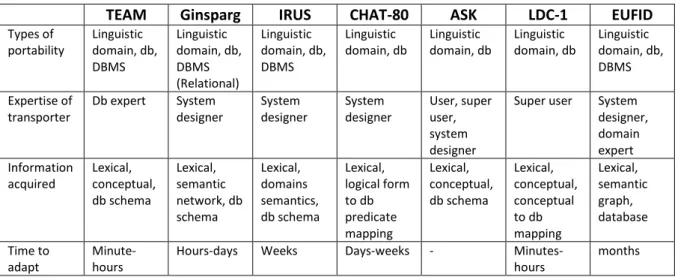
makes it hard to have a clear idea of the actual performances of the system. Table 4 presents a comparison of TEAM with other early portable NLIDB.
Table 4 – Comparison of TEAM with other early transportable systems (Grosz et al., 1987)
TEAM Ginsparg IRUS CHAT-80 ASK LDC-1 EUFID
Types of portability Linguistic domain, db, DBMS Linguistic domain, db, DBMS (Relational) Linguistic domain, db, DBMS Linguistic domain, db Linguistic domain, db Linguistic domain, db Linguistic domain, db, DBMS Expertise of transporter Db expert System designer System designer System designer User, super user, system designer
Super user System designer, domain expert Information acquired Lexical, conceptual, db schema Lexical, semantic network, db schema Lexical, domains semantics, db schema Lexical, logical form to db predicate mapping Lexical, conceptual, db schema Lexical, conceptual, conceptual to db mapping Lexical, semantic graph, database Time to adapt Minute-hours
Hours-days Weeks Days-weeks - Minutes-hours
months
In the above table:
a system designer: refers to a user with a general knowledge of computer systems who received a
training to customize the system;
a super user: refers to an advanced end user who is more knowledgeable in computer systems; a domain expert: refers to a simple user or super user with expertise in the target domain
knowledge.
2.2.2
NLIDB using a semantic graph as domain knowledge model
Barthélemy et al (2005) defines a semantic graph as “a network of heterogeneous nodes and links” containing semantic information. The semantic graph structure is used in the literature to model the domain knowledge. The semantic graph is used for its intuitive structure that makes it easy to build and extend even by a user with no background in computational linguistics. EUFID (Templeton & Burger, 1983) is among the earliest NLIDB to use semantic graph to model the domain knowledge. The semantic graph structure in (Zhang et al., 1999) (see Fig 7) has the particularity of including weights to the links to express their strength or likelihood. During query analysis, the system first searches for key terms in the user’s input (like concepts in the semantic graph, database attributes, and values). The query is therefore viewed as a set of unconnected semantic graph nodes. The system uses the information from the semantic graph to build several possible subgraphs by including links between disconnected nodes. The weights of the links in the domain model are used to compute a ranking for each subgraph. The highest ranked subgraph is selected and translated into the final query. The system supports aggregation, but not nesting. The NLIDB has not been
17
thoroughly evaluated: the test consisted of running 30 queries from an unsaid number of candidates which all have been correctly answered. It is, therefore, hard to clearly evaluate the real capability of the system.
Fig 7 – Example of semantic graph structure (G. Zhang et al., 1999)
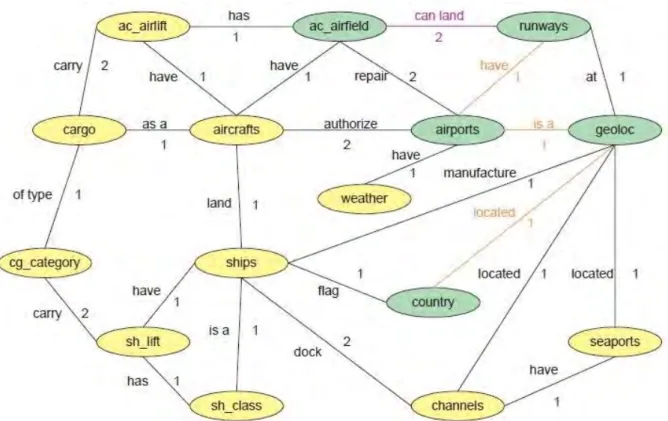
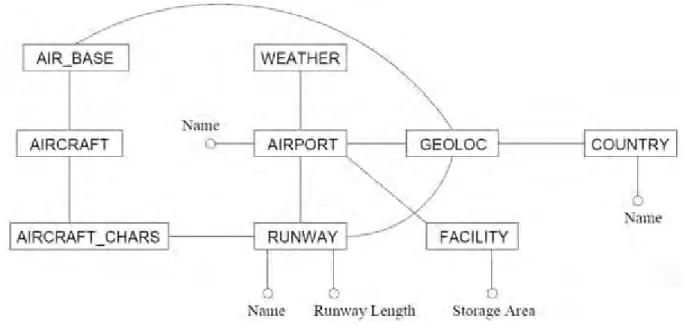
Meng & Chu (1999) also present a portable NLIDB targeting a SQL database which uses a semantic graph to model the domain’s knowledge. The graph’s structure in (Meng & Chu, 1999) is composed of nodes (representing database tables), database attributes, and links (see Fig 8). The squares represent the tables and circles represent the database attributes. The system in (Meng & Chu, 1999) retrieves from the natural language input three components: the query topics, the select list and the query constraints. A query topic corresponds to a subgraph of the semantic graph containing the keywords found in the user’s query. This subgraph allows retrieving joins between tables
automatically (Fig 9 shows an example of subgraph). The query constraints are retrieved using values from the database found in the query (translated to “sourceColumn = ‘valueFound’”).And finally, any other column mentioned in the query but not part of constraints are assumed to be part of the select clause. The information gathered in query topics, select list, and query constraints are used to build the final SQL query.
18
Fig 8 – Semantic graph structure of (Meng & Chu, 1999)
Fig 9 – Example of subgraph corresponding to a query about runaways and aircrafts (Meng & Chu, 1999)
The approach used in (Meng & Chu, 1999) uses only the semantic graph as the source of information describing the domain knowledge in order to translate natural language questions to SQL; no
additional grammar is required. However, the prototype built supports only simple SELECT FROM WHERE queries and there is no evaluation of the system available to assess its performance.
2.2.3
Portable NLIDB based on semantic parsers
Semantic parsers include production rules that can translate a natural language query to a formal query in a meaning representation language like first-order logic. NLIDBs based on this approach are relatively straightforward to develop.
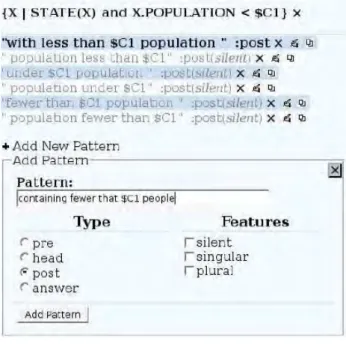
Minock et al. (2008) present a good example of a portable NLI to SQL using a semantic parser that is defined with Lambda Synchronous Context-Free Grammar. The parser maps the user query to a variant of Codd’s tuple calculus which includes higher order predicates like “LargestByArea”. The system’s objective is to allow an everyday technical team member to build a robust NLI. A lot of attention has been put on constructing a user-friendly authoring module based on light annotations. The system customization is completed in three steps: naming, tailoring and defining. The naming phase provides synonyms to database attributes, joins, and facts from the database. Tailoring consists of mapping patterns from the natural language query to their corresponding concepts expressed in tuple calculus (see illustration in Fig 10). Finally, the defining phase allows adding more definitions to the system using natural language. An example of a possible definition borrowed from (Minock et al., 2008) is “define a ‘major’ state as a state with more than 1 million people”.
19
Fig 10 – Tailoring operation in (Minock et al., 2008)
To evaluate the system, two subjects had been requested to customize the system by manually tailoring 100 random queries from the geo-query corpus (Tang & Mooney, 2001). The subjects, who were undergraduate students with a background in databases, have taken two hours to customize the system. The accuracy yielded on various testing set varied between 80% and 90%. However, it must be noted that the prototype included complex concepts in the parser in the form of higher order predicates. For example, the semantics for all the superlative forms were pre-loaded, this alone can explain the high accuracy observed.
Another example of portable NLI to SQL based on a semantic parser can be found in (Nguyen & Le, 2008) where the system uses a domain-independent semantic grammar and can be used with no customization.
An important drawback with semantic parsers is that the use of rigid production rules makes the system less robust against noise and unknown structures. The empirical methods presented in the next section address this problem.
2.2.4
Empirical approaches toward portable NLIDB
An empirical approach allows training a model using a corpus and therefore the NLI is generic and portable. Empirical approaches are gaining importance in NLP again with much recent research work focusing on statistical approaches to process natural languages. This trend is explained by the high complexity of language making it difficult to capture a full range of natural language contexts and their corresponding semantic concepts when using a limited set of predefined rules (Kate & Mooney, 2006).
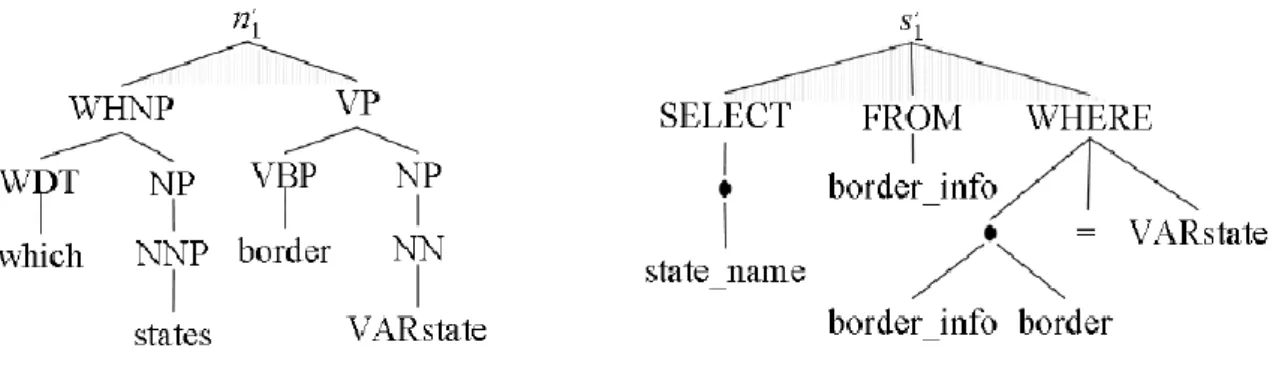
Giordani & Moschitti (2010) use machine learning algorithms to train a semantic parser that translates natural language queries to SQL. The training is achieved using Support Vector Machines (SVM), a supervised learning method (Smola & Vapnik, 1997). The training set used is composed of a set of pairs 𝑃 = 𝑁 × 𝑆 where N represents the set of parse trees of natural language queries parsed with Charniak’s syntactic parser (Charniak, 2000) and S represents the set of parse trees of the corresponding SQL query. Fig 11 shows an example of a pair (𝑛𝑖, 𝑠𝑖). An experiment with a model
20
Fig 11 – Parse tree of a natural language query and its SQL query (Giordani & Moschitti, 2010)
KRIPS is a more generic system based on machine learning that is trained with pairs composed of the natural language queries and their corresponding formal queries in a given Meaning Representation Language (MRL) (Kate & Mooney, 2006). The system accepts any MRL that can be defined with a deterministic Context-Free Grammar (CFG) in order to ensure that each MRL query will have a unique parse tree.
Statistical approaches offer the advantage of being more robust to noise (sentence with typos, for example) and uncertainty (like unseen grammatical structures). The main drawback of this approach is the need to build a large annotated corpus with questions related to the subject domain for customization. This task is especially costly when correct formal queries (like SQL or first-order logic) need to be manually produced.
2.2.5
NLIDB based on dependency grammars
Dependency grammars (DG) are the fruits of developments in syntactic theories. The work of Tesnière (1959) greatly contributed to the development of DG. The focus in DG is on the analysis of dependency relationships between words in the sentence with the verbs being the structure center of the dependency trees. Fig 12 illustrates the dependency tree generated by the Stanford
dependency parser (De Marneffe et al., 2006) for the query “Which states border the state with the most rivers?” from geo-query corpus (Tang & Mooney, 2001).
Fig 12 – Example of dependency tree from the Stanford dependency parser
Giordani & Moschitti (2012) presents a NLIDB to SQL based on dependency grammar that uses the Stanford parser. The system uses the metadata in the RDMS describing the database as source of synonyms to build its lexicon. The prototype supports complex queries, including nesting,
aggregation, and negation. For each query, up to 10 possible results ranked by their relevance are produced. The experimental result with geo-query showed that 81% of the responses ranked as the best answers are correct. The accuracy increases to 92% for the 3 first responses and 99% for the 10 best results. An intermediary MRL was not used; the system relies on a custom made algorithm (see (Giordani & Moschitti, 2012) for details) which analyses the dependency parse tree and produces the final SQL. The result obtained shows the potential power of dependency parsers. However, the
21
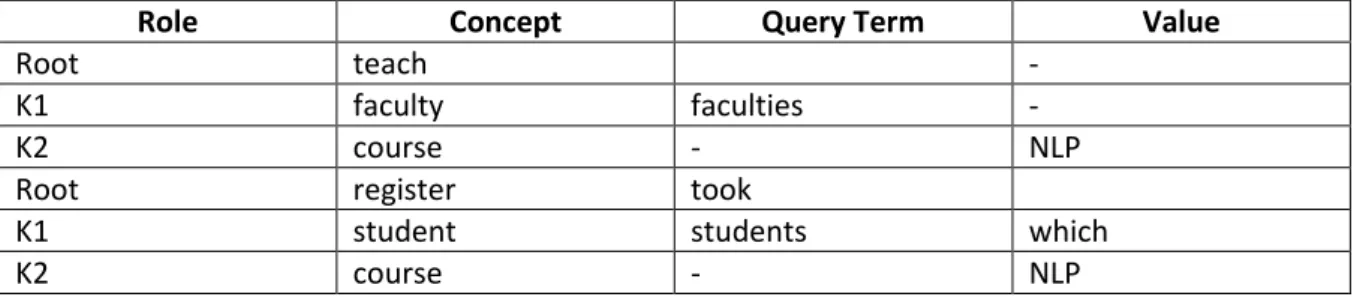
prototype does not feature an authoring module to customize the system. The only input used is the metadata in the RDBM. Therefore, additional semantic rules to support special cases are directly hard coded in the engine. This approach makes the system less portable. A similar work can be found in (Gupta et al., 2012), where the authors present a NLIDB to SQL using a dependency framework called "Computational Paninian Grammar” which used the Stanford Typed Dependency (STD) parser (De Marneffe et al., 2006) in the background. The semantic analysis here consists of mapping elements from the dependency tree to the domain’s conceptual model retrieved from the database schema. The mapping rules are encoded in the semantic frames (see an example in Table 5). Each verb has a role “root” and is associated to his subject and object that have the roles K1 and K2. The concepts are mapped to their query terms and possible values they can have.
Table 5 – Example of semantic frames for the relation “teach” and “register” (Gupta et al., 2012)
Role Concept Query Term Value
Root teach -
K1 faculty faculties -
K2 course - NLP
Root register took
K1 student students which
K2 course - NLP
The interest of the semantic frames approach is that it offers a simple and straightforward framework that simplifies expressing semantic mapping rules.
2.3
Literature review synthesis
The overall area of NLP research remains very experimental. Even though there are several usable commercial systems available, unrestricted use of natural language is still an open problem. Sujatha (2012) points out the following general open problems that still require extensive research:
- NLIDB portability: involves development of NLIDB that can easily adapt to multiple domains, underlying RDMS and natural languages;
- Error reporting and handling: give to the user a clear explanation when a query cannot be handled to help him/her adapt his/her questions;
- Disambiguation when large domains are considered.
The last two decades have witnessed interest in developing easily portable NLI. However, most of the works focus on NLI targeting ontologies, but there is relatively less work on portable NLI targeting relational databases.
The review of portable NLI to relational databases shows a trade-off between portability and coverage. Highly portable systems tend to achieve a relatively smaller coverage and accuracy. For example, systems using a semantic graph like in (G. Zhang et al., 1999) and (Meng & Chu, 1999) use a domain knowledge model that is intuitive and easy to build by a user with no expertise in
linguistics. As a consequence, the system built is easily portable. However, the model’s simplicity prevents expressing advanced concepts which results in lower coverage. A similar difficulty is found in (Gupta et al., 2012), where the use of semantic frames simplifies customization while also hindering the system’s coverage.
22
Approaches ensuring coverage of complex queries require an important effort for customization. The approaches reviewed yielding interesting coverage include NLIDB based on semantic grammars and empirical approaches. As a general rule of thumb, semantic parser based systems are required to include a very large set of rules to achieve a decent accuracy (Pazos et al., 2013). This translates into increased customization work. The authoring module plays a key role for semantic parser based systems; as a user-friendly customization module can positively impact the system’s portability. The system in (Minock et al., 2008) uses Codd’s tuple calculus to define semantic production rules. In consequence, a background in computational linguistics is required which limits the number of potential users capable to set up the system. The systems based on empirical approaches such as in (Giordani & Moschitti, 2010) and (Kate & Mooney, 2006) are promising and can support very complex query constructions. However, they do require important upfront work to build the training corpus. The accuracy achievable is directly dependent on the size and quality of the training corpus.
The literature shows that nowadays parsing techniques (both syntactic and semantic) when supplied with enough production rules can achieve a remarkable accuracy (recall above 90%) with English. The problem resides in building an exhaustive model with little customization effort and expertise. Finally, the literature review shows a lack of supporting experimental results for portable NLI targeting relational databases; this was the case for most the systems reviewed. A recent review of the state of the art in NLIDB (Pazos et al., 2013) emphasise the urgent need for more annotated corpora of sample queries in diverse domains.
23
Chapter 3
Design of the authoring system
The review of the literature shows that it is presently possible to achieve good results when the correct quantity and quality of production rules are provided. However, constructing an effective linguistic model requires both time and expertise. This research contributes toward firstly the reduction of the workload needed to customize NLIDB and secondly retaining a decent system coverage. Chapter 3 presents an authoring system which addresses simplification of customization; the coverage aspect is addressed in chapter 4. The authoring systems presented in this chapter produce a configuration model that is used by the processing pipeline presented in chapter 4 (see Fig 21). The first section presents the design objectives and system architecture. Following is the presentation of data structures used in the design. The third and fourth sections present the top-down and bottom-up authoring approaches.
3.1
Design objectives and system architecture
The authoring system design has the objective of reducing the workload involved when configuring a NLIDB system to a new domain. Two authoring approaches are proposed to attempt achieving this objective. The architecture of the configuration module proposed is illustrated in Fig 13.
The first authoring approach proposed is called top-down; it investigates the possibility to use a pre-existing corpus of questions to simplify configuration. A corpus of questions contains actual terms used by end-users to reference the concepts modelled in the database. The top-down authoring approach explores the possibility of minimizing the customization workload by pre-harvesting key terms (nouns, adjectives, and verbs) from a sample corpus so that the configuration work is reduced to mapping the terms found to database concepts and their corresponding meaning. The use of sample corpus to support customization is found in the literature mainly with empirical systems (Giordani & Moschitti, 2010) (Kate & Mooney, 2006) (Chandra, 2006) (Tang & Mooney, 2001). Most of the related work reviewed uses an annotated corpus in order to train a statistical model.
Manually annotating a corpus is a costly task; we propose with top-down design to use the sample corpus as-is and avoid the annotation workload. The top-down approach does not use the corpus to train automatically a new configuration model as with statistical approaches; but pre-harvests terms in order to construct a lightweight configuration framework. The top-down attempts to further reduce the work load by automatically including the configuration for negative form of verbs, superlative and comparative form of adjectives.
The second authoring approach presented is called bottom-up; it explores the possibility of auto-building completely a model with no manual customization. The bottom-up approach automatically retrieves the configuration information from the database schema and from WordNet. The
exploitation of an external lexicon to automatically include new terms has been successfully used to improve accuracy in several works mainly targeting ontologies (Wang et al., 2007) (Palaniammal & Vijayalakshmi, 2013) (Ramachandran & Krishnamurthi, 2014) (Paredes-Valverde et al., 2015). Bottom-up investigates the effectiveness of this approach with a relational database.
24
Fig 13 – Architecture of authoring system with top-down and bottom-up approach
3.2
Design of data structures for configuration
The authoring system for both top-down and bottom-up approaches generates configuration data which includes a representation of the database schema, the list of adjectives and verbs along with their respective meanings. The next sections present the data model for each component of the configuration.
<