by Philippe Moutot, Alexander Jung
and Francesco Paolo Mongelli
OCCASIONAL PAPER SERIES
NO 79 / JANUARY 2008
THE WORKINGS OF
THE EUROSYSTEM
MONETARY POLICY
PREPARATIONS AND
DECISION-MAKING –
SELECTED ISSUES
In 2008 all ECB publications feature a motif taken from the €10 banknote.
O C C A S I O N A L P A P E R S E R I E S
N O 7 9 / J A N U A R Y 2 0 0 8
by Philippe Moutot, Alexander Jung and
Francesco Paolo Mongelli
1THE WORKINGS OF
THE EUROSYSTEM
MONETARY POLICY
PREPARATIONS AND
DECISION-MAKING –
SELECTED ISSUES
This paper can be downloaded without charge from http://www.ecb.europa.eu or from the Social Science Research Network electronic library at http://ssrn.com /abstract_id=1005946.
© European Central Bank 2008 Address Kaiserstrasse 29 60311 Frankfurt am Main, Germany Postal address Postfach 16 03 19 60066 Frankfurt am Main Germany Telephone +49 69 1344 0 Website http://www.ecb.europa.eu Fax +49 69 1344 6000
All rights reserved. Any reproduction, publication or reprint in the form of a different publication, whether printed or produced electronically, in whole or in part, is permitted only with the explicit written authorisation of the ECB or the author(s).
The views expressed in this paper do not necessarily refl ect those of the European Central Bank.
ISSN 1607-1484 (print) ISSN 1725-6534 (online)
C O N T E N T S
CONTENTS
ABSTRACT 4 NON-TECHNICAL SUMMARY 5 1 INTRODUCTION 7 2 THE FACTORS UNDERPINNING
MONETARY INTEGRATION AND THE
EUROSYSTEM 9
2.1 General factors underpinning
monetary integration 9
2.2 Critical components for the success of a central banking
system in a monetary union 1 2
3 THE DESIGN(ING) OF THE EUROSYSTEM 1 4
3.1 The creation of the Eurosystem 1 4
3.2 A decentralised structure and
centralised decision-making 1 7
3.3 Establishing the Eurosystem’s
committee structure 1 9
3.4 Other sources of cohesion for encouraging best practice and
team spirit 2 3
4 MONETARY POLICY BY COMMITTEES: GENERAL RATIONALE, PRACTICE AND
THE ECB’S CHOICES 2 4
4.1 The decision-making bodies of
the ECB 2 4
4.2 The role of monetary policy
committees 2 7
4.3 The monetary policy decision-making process
and regional diversity 3 1
4.4 An international comparison of
monetary policy committees 3 3
5 THE WORKINGS OF THE EUROSYSTEM’S COMMITTEES AND SUBSTRUCTURES 3 8
5.1 The role of the Eurosystem’s
committees 3 8
5.2 Interaction between the ECB and
the NCBs 3 9
5.3 The preparation of monetary
policy decisions 4 2
5.4 Preparation for euro area
enlargement 4 8
6 CONCLUSIONS 5 1 ANNEXES
1 The benefi ts of central bank
independence 5 3
2 The role of transparency 5 5
3 Organisational principles for the
Eurosystem 5 7
REFERENCES 58 EUROPEAN CENTRAL BANK OCCASIONAL
ABSTRACT
The ECB’s monetary policy has received considerable attention in recent years. This is less the case, however, for its regular monetary policy preparation and decision-making process. This paper reviews how the factors usually considered as critical for the success of a central banking system and the federal nature of the Eurosystem are intertwined with its overall design and the functioning of its committee architecture. In particular, it examines the procedures for preparing monetary policy decisions and the role of the decision-making bodies and the committees therein. We suggest that technical committees, involving all national central banks (NCBs), usefully contribute to the regular processing of a vast amount of economic, fi nancial and monetary data, as well as to the consensus building at the level of the Governing Council. A federal organisational structure, including a two-tier committee structure with the Executive Board taking the lead in preparing the monetary policy decisions and the Governing Council in charge of the decisions with collective responsibility for them, as well as committee work at the various hierarchical levels, contributes to the effi ciency of the ECB’s monetary policy decision-making, and thereby facilitates the maintenance of price stability in the euro area. A fully-fl edged committee structure has also contributed to the smooth integration of non-euro area Member States into the Eurosystem’s monetary policy decision-making process.
JEL classifi cation: E42, E58, F33 and F42 Keywords: European economic and monetary integration, monetary arrangements, central banks and their policies.
S U M M A R Y NON-TECHNICAL SUMMARY
With the launch of the euro in January 1999, responsibility for the single monetary policy in the euro area was transferred to a supranational central banking system: the Eurosystem. It comprises the European Central Bank (ECB) and the national central banks (NCBs) of those EU Member States that have adopted the euro. The Eurosystem is led by a decision-making body, the Governing Council of the ECB, which is in charge of formulating the monetary policy of the euro area and sets the necessary guidelines for the implementation of its decisions.
The monetary policy of the ECB has received considerable attention in recent years. This is less the case, however, for the regular monetary policy preparations and the decision-making process. This paper explains the workings of the Eurosystem’s monetary policy process and the role that decision-making bodies and Eurosystem committees play therein. In this paper, we also look at the evolution of and the economic rationale underlying the Eurosystem’s structure, as well as explain its federal nature. To start with, the founders of EMU faced the challenge of having no historical blueprint for designing a supranational monetary union among sovereign states. Yet some historical lessons from other past monetary arrangements provided some important underpinning, such as that time is an essential element in the establishment of a monetary union, and that monetary unions are always subject to heterogeneity, in the presence of which sustainable convergence is essential. In addition, several success factors in central banking were taken into account during the designing of the Eurosystem, including the critical role of central bank independence and a clear policy goal (i.e. price stability) based on a constitutional mandate.
The blueprint for the Eurosystem was laid down in the Maastricht Treaty and the Statute of the European System of Central Banks and of the European Central Bank. A structure based on centralised decision-making and decentralised
implementation was chosen. Within the Eurosystem, the euro area NCBs perform almost all the Eurosystem’s operational tasks. On the one hand, this federal structure is effective as a number of these tasks need an underlying regional and national infrastructure that has already been established by NCBs. On the other hand, a centralised agreement by the Governing Council of the ECB on monetary policy and other Eurosystem-wide matters ensures that decisions are timely and effi cient.
Monetary policy decision-making in the Eurosystem is based on a two-tier “hub-and-spoke” committee structure, with the Executive Board of the ECB taking the lead in preparing the monetary policy decisions and the Governing Council in charge of the decisions with collective responsibility for them. This hub-and-spoke structure ensures both timely monetary policy decision-making and regional involvement, and at the same time avoids the unnecessary duplication of tasks. Monetary policy decisions are based on the ECB’s monetary policy strategy. In this regard, the Executive Board plays a special role, because its members take the lead in the monetary policy preparations and, as members of the Governing Council, vote on the monetary policy decisions.
Overall, our international comparison suggests that there are many similarities between the decision-making bodies of the ECB and the monetary policy committees of other central banks but also notable differences in terms of the specifi c circumstances applying to the Eurosystem’s structure. The optimal size of a monetary policy committee depends on various factors, such as the size of the currency area. At the same time, the size of the technical committees may exceed that of the policy committees as their main focus is on gathering information.
While today monetary policy decisions around the world are taken by a central bank committee (with rare exceptions), the Eurosystem exhibits an important distinguishing feature. The federal
structure of the Eurosystem assigns an important role to the technical committees and sub-committees at the various hierarchical levels in terms of assisting the main decision-making body (i.e. the Governing Council). Technical committees in the Eurosystem process a vast amount of economic, fi nancial and monetary data, information and indicators as input to the deliberations of the Executive Board and the Governing Council of the ECB. The close cooperation between ECB and NCB staff within such committees enables consensus to be reached on the underlying assumptions for monetary policy decisions. Hence, the Eurosystem’s committee structure allows for a large degree of regional involvement in the preparation of monetary policy decisions. Working through the Eurosystem’s committees and its substructures boosts the effi ciency of the deliberations of the Governing Council which sets interest rates based on consensus. This is crucial for the smooth functioning of the monetary policy process, as the decision-making bodies would otherwise spend a considerable amount of time agreeing on the assumptions. This conclusion-based approach to monetary policy-making thus contributes to the fulfi lment of the Eurosystem’s tasks, and ultimately to the maintenance of price stability in the euro area.
The effective level of interaction between the ECB and the NCBs in the three phases of the monetary policy decision-making process – namely preparation, decision, implementation
– of course varies. However, in view of the federal structure of the Eurosystem, the NCBs play an important role. We take the Eurosystem staff macroeconomic projections as an example in order to illustrate the workings of the Eurosystem’s technical committees when it comes to preparing timely and high-quality contributions for the main decision-making body, the Governing Council. While the staff projections represent an important contribution to the Governing Council’s monetary policy decisions, the Governing Council does not interfere in the production process of these projections, which remain the sole responsibility of Eurosystem staff.
The cooperation in the Eurosystem that is achieved through the technical committee structure fosters operational effi ciency and contributes to the realisation of a “system identity” and the sharing of common values. Furthermore, the fully-fl edged committee structure has contributed to the smooth integration of the non-euro area Member States into the Eurosystem’s monetary policy decision-making process. Hence, the current structure is facilitating successive enlargements.
“... to make all men work together, to show them that, beyond their divergences or over and above frontiers, they have a common interest.”
Jean Monnet
1 INTRODUCTION
With the launch of the euro on 1 January 1999, responsibility for the single monetary policy in the euro area was transferred to a supranational central banking system: the Eurosystem. It comprises the European Central Bank (ECB) and the national central banks (NCBs) of those EU Member States that have adopted the euro (and that make up the euro area).1 It is led by a
decision-making body, the Governing Council of the ECB, which is in charge of formulating the monetary policy of the euro area and sets the necessary guidelines for the implementation of its decisions.2
The ECB’s monetary policy has received considerable attention in recent years.3 This is
less the case, however, for the regular monetary policy preparations and the decision-making process. Academics and policy-makers have now become more interested in the role of monetary policy committees, especially since the publication of novel research by Blinder (2004 and 2006).4 Against a background of the history
of the Eurosystem and the economic rationale for its development, the present paper explains the functioning of Eurosystem’s monetary policy process and the role of decision-making bodies and Eurosystem committees therein to a wider audience. In particular, it reviews how the factors usually considered as critical for the success of a central banking system, as well as the federal nature of the Eurosytem, are intertwined with its overall design and the functioning of its committee architecture, with a special focus on the procedures for preparing monetary policy decisions and on the role of committees therein. The paper suggests that the Governing Council reaches decisions in a manner consistent with international standards on the functioning of monetary policy committees and that the participation of NCBs in technical committee
work at various levels is indispensable for the processing and assessment of a wide range of economic, fi nancial and monetary indicators. The latter is also instrumental in the consensus building on monetary policy decisions at the level of the Governing Council, and thereby facilitates the accomplishment of the primary objective of price stability. The existence of a committee structure at the technical level for all functional areas, with participation from delegates from the ECB and the NCBs, also facilitates the integration of non-euro area Member States into the Eurosystem’s monetary policy process.
Four aspects stand out when analysing the
workings of the Eurosystem. First, the
European path to Economic and Monetary Union (EMU) is unique in history, as it has been based on the concept of a single market for sovereign countries. This is quite different from most monetary unions in the past, in which the prior creation of a political union (a nation state) paved the way for the establishment of a single market with homogenous conditions for enterprises and households.
Second, the Eurosystem has a federal structure, which requires, as far as possible, a decentralised set-up. For example, when designing the ECB, responsibility for a number of tasks was kept at the national level and combined with centralised (i.e. supranational) monetary policy
decision-Although the Eurosystem only became operational in 1998, its 1
individual national central banks were established much earlier: for example, the Banque de France was established in 1800, De Nederlandsche Bank in 1814, the Nationale Bank van België/ Banque Nationale de Belgique in 1850, the Banco de España in 1856, the Banca d’Italia in 1893 and the Deutsche Bundesbank in 1957.
The NCBs from those EU Member States that do not yet belong 2
to the euro area participate in the European System of Central Banks (ESCB) but not in the Eurosystem. To help the reader we sometime use the term Eurosystem where the Treaty mentions the ESCB: that because in practice Eurosystem is meant. This point has been demonstrated in numerous publications by 3
researchers, ECB watchers, the ECB, CEPR, and several other research institutions. See ECB (2004a) and ECB (2006a). Policy-makers interest in the subject started with the speech 4
“Come with me to the FOMC” by former Federal Open Market Committee (FOMC) Governor Meyer (1998), followed by speeches by FOMC Governor Olson (2004) and the Bank of Japan’s Deputy Governor Muto (2007). Norges Bank organised a workshop on Monetary Policy Committees in 2007.
making. This mix of centralised and decentralised elements mirrors the principle of decentralisation, as included in the Statute of the European System of Central Banks and of the European Central Bank (hereinafter referred to as the Statute of the ESCB), and as implied by the ownership structure of the ECB (i.e. the NCBs are the shareholders of the ECB). The NCBs are independent with regard to their tasks, but are an integral part of the Eurosystem at the same time (see Article 14.3 of the Statute of the ESCB).
Third, European integration has evolved in stages, and it is still evolving. After the Treaty of Rome had been signed in 1957, it was several decades before a single market was established, as the national economies needed ample time to adjust to the changing market structures. The process of monetary integration has also only been gradual, following the creation of the “snake” in 1972 and the European Monetary System (EMS) with an exchange rate mechanism in 1979 and the signing of the Maastricht Treaty in 1992.
Fourth, there have been advancements in economic and monetary theory that have had implications for the wider appreciation of currency unions and best central banking practices (e.g. the enhanced role of central bank independence, transparency and improved accountability standards). For instance, the debate on the optimum currency area (OCA) theory 5 led the European Commission to
adopt the “One Market-One Money” approach in the 1980s (see Emerson et al (1989)) and paved the way for an overall improved assessment of the benefi ts of currency unions in relation to the costs in terms of the loss of autonomy over domestic monetary policy.
The paper is organised as follows. Section 2 describes the specifi c factors underpinning monetary integration and the critical components for the success of a central banking system in a monetary union. Section 3 reviews the Eurosystem’s design, including its evolution and committee structure. Section 4 discusses the roles of the Governing Council and the Executive Board of the ECB and compares them with the monetary policy committees of other central
banks. Section 5 examines the main features of the workings of technical committees and their role in assisting the monetary policy process of the Eurosystem. Section 6 concludes. Some arguments and issues that support our discussion are presented in a set of boxes and annexes.
See the seminal contributions of Mundell (1961), McKinnon 5
(1963) and Kenen (1969). An OCA is defi ned on the basis of several properties, including trade openness, the mobility of labour and other factors of production, price and wage fl exibility, diversifi cation in production and consumption, similarity in infl ation rates and infl ation preferences, and fi nancial integration. Sharing these OCA properties – among countries wanting to form a monetary union – reduces the usefulness of nominal exchange rate adjustments among them by reducing the impact of some types of shock or by facilitating the adjustment thereafter. For recent surveys, see De Grauwe (2005), Mongelli (2005) and Tavlas (2002).
UNDERPINNING MONETARY INTEGRATION AND THE EUROSYSTEM 2 THE FACTORS UNDERPINNING MONETARY
INTEGRATION AND THE EUROSYSTEM
At the outset, the founders of EMU faced a key challenge: there was no historical blueprint for designing a supranational monetary union involving several sovereign countries. A single monetary policy without a nation state had to be built on new foundations. In this respect, it was helpful to take into account lessons learnt from other monetary unions and from “best” central banking practices concerning monetary policy preparations and decision-making.
2.1 GENERAL FACTORS UNDERPINNING MONETARY INTEGRATION
The Treaty of Rome entails a “functional” integration process that is contingent on progress in terms of economic integration
(see Chart 1). This was to be an entirely new path towards monetary union. Differences in national situations needed to be taken into account when designing the central bank structure in order to minimise the likelihood of tensions arising from safeguarding national interests.
A degree of decentralisation and NCB involvement in the decision mechanism of EMU seemed to be indispensable. In European monetary history, there have been only a few examples of monetary union without political union that have proved sustainable over the long term. In the past, such frameworks were typically applied to a combination of one large and one (or more) smaller country/countries, in which the large country usually dominated. Examples include the currency unions between Switzerland and Liechtenstein, France and Monaco, and Italy and the Vatican State, plus San Marino. As for
Chart 1 Economic, monetary and political integration
a) Political integration as the driver of economic and monetary integration POLITICAL INTEGRATION MONETARY INTEGRATION Economic and monetary integration Political integration starting point ECONOMIC INTEGRATION
b) “Functional” integration process (underlying the Treaty of Rome, 1957) POLITICAL INTEGRATION
MONETARY INTEGRATION
Economic integration starting point Economic integration, then exerts pressuretowards monetary integration, and political integration
the relatively recent currency union between Belgium and Luxembourg, its functioning was very much determined by the inclusion of the Belgium franc in the EMS, which was then superseded by EMU. Such monetary unions generated signifi cant benefi ts for the smaller partners (that saved on minting costs and acquired better access to fi nancial markets). From an organisational standpoint, there were few lessons to be learnt. However, some general lessons could be learnt from past monetary unions when the monetary constitution for EMU was drafted.6
First, political union has generally preceded economic and monetary union in most monetary union (see Chart 1a). Three often cited examples are the US monetary union of 1789, the Italian monetary union of 1861 and the pan-German currency union that was created following political unifi cation in 1876. In these cases, the adoption of a common currency was an important vehicle for enhancing the unity of the new nation states. Political unions also dissolve.
Monetary history suggests that monetary unions typically break down as a result of political forces, seldom collapsing as a result of economic factors or fi nancial crises. In the past, monetary unions between sovereign nation states were most vulnerable to political events, such as war, political disunity or political disintegration with other areas. For example, the break-up of the Soviet Union, Yugoslavia and Czechoslovakia into two or more independent nation states led to the creation of new currencies and new central banks.
See Bordo and Jonung (2003), Capie and Wood (2003), 6
Krugman and Obstfl ed (2000), Baldwin and Wyplosz (2006), and Eichengreen and Sussman (2000). There were also other lessons that do not play a direct role in our discussion, including the fact that mo&st monetary unions are supported by some form of a public risk-sharing facility through a federal budget (such as in the United States).
Box 1
THE EVOLUTION OF THE FEDERAL RESERVE SYSTEM
The dollar was introduced at roughly the same time as the United States were founded in 1789. Throughout much of the 19th century, however, exchange rates between individual states in the United States underwent a series of de facto fl uctuations due to the excessive use of paper money of differing quality and the lack of an accepted currency in the form of gold and silver. A system of national banks was therefore instituted by the 1863 National Banking Act and was in operation until 1913. However, a series of banking panics (in 1873, 1893 and 1907) led to the creation of a more centralised banking system. In 1913, the Federal Reserve System was established by Congress which passed the Federal Reserve Act and placed it in charge of monetary policy. Against the background of severe banking panics in the United States, the Act of 1913 required monetary policy-makers to provide an “elastic currency” (meaning that the Federal Reserve System should help to avoid fi nancial crises). Incorporating lessons learnt from the Great Depression, the Employment Act of 1946 included the Federal Reserve System in the government’s obligation to prevent future recessions. The Great Infl ation of the 1970s led to an amendment of the Federal Reserve Act in 1977, and the fi rst explicit recognition of price stability as a goal for the central bank as part of a “dual mandate”.1
1 As stated in Section 2A of the Federal Reserve Act: “The Board of Governors of the Federal Reserve System and the Federal Open Market Committee shall maintain long run growth of the monetary and credit aggregates commensurate with the economy’s long run potential to increase production, so as to promote effectively the goals of maximum employment, stable prices, and moderate long-term interest rates”. The mandate is interpreted as meaning that the role of the Federal Reserve System is to keep infl ation low and stable.
UNDERPINNING MONETARY INTEGRATION AND THE EUROSYSTEM
Second, time is an essential component of a monetary union and is sometimes underestimated. There are at least two ways
of looking at it. Prior to the successful
establishment of a monetary union, monetary integration requires time – several decades in the case of EMU – to secure a level of sustainable convergence suffi cient to underpin a single currency. In order to prepare a sound institutional framework for monetary union, substantial lead times are normally required. However, this aspect may be subject to limitations: monetary union in Europe was a project with a clear end date for its realisation, i.e. the construction of EMU had to advance along a calendar set by international treaties and agreements, but the timetable was subordinate to the fulfi lment of the convergence criteria. After the establishment of a monetary union, the process of monetary, economic and political integration continues. Some historians have fl agged that, even in a large currency area with a federal structure like that of the United States, the functioning of the central banking system has improved as it has evolved. The Federal Reserve System’s experience suggests that, even when supported
by political union and a sound institutional framework, the securing of monetary unity and a single market across all regions of a monetary union may be subject to important challenges.
Third, monetary unions will always face a degree of heterogeneity, making sustainable economic convergence an essential factor for their sustainability. As shown by the example of the Federal Reserve System (see Box 2.1), it would be unwise from an economic and political viewpoint to ignore the forces that the diversity of regional contexts could unleash in terms of the way a monetary union functions internally. The founders of EMU were aware of the possibility that heterogeneity could lead to economic divergence, in particular when monetary policy is no longer available as an independent instrument for addressing regional developments. They
placed considerable emphasis on achieving
and maintaining a high degree of economic convergence in prices and other economic and fi scal variables prior to the start of EMU. To make (nominal) convergence a binding requirement, in view of potential subsequent enlargement, these criteria were laid down in the Maastricht Treaty. The United States were split into 12 Federal Reserve districts that did not coincide with individual states or even groupings of states (in fact, many states are apportioned to two or more geographical districts). This geographical organisation of the Federal Reserve System was the result of a compromise to balance the interests of the banks in the heartland against the interests of the New York fi nancial community. Sustainable central banking systems are capable of adapting to and exploiting changes in the economic environment. For example, Regional Reserve Banks in the United States maintained the right to set discount rates independently for around 20 years. During this period, the institutional structure functioned as long as all Regional Reserve Banks and the Federal Reserve Board were willing to accept the leadership of the Governor of the New York Bank. When the Great Depression hit the US economy, however, the time was ripe for new institutional reforms that could settle regional monetary policy disagreements for the longer term. The Board’s weak position stemmed from the fact that it did not take the lead in the system, but instead functioned mainly as a supervisory review body (Friedman and Schwartz (1963)). This led to the founding of the Federal Open Market Committee (FOMC) in 1933 with the limited mandate of making recommendations on open market operations (which the Federal Reserve System had been using since the 1920s). However, it soon became clear that deeper reforms were needed to address the structural problems in decision-making. The Banking Act of 1935 then led to a complete reorganisation of the Federal Reserve System. It made the FOMC the decision-making body in charge of monetary policy for the United States as a whole (mainly based on open market operations), while the regional Federal Reserve Banks’ autonomy was limited to setting discount rates.
According to the hypothesis of endogeneity of OCA criteria (also known as the “Rose effect”), the creation of EMU was to bring the euro area countries more in line with the OCA criteria, i.e. foster greater convergence.7 Successful monetary
unions are also capable of maintaining sustainable convergence of key economic variables, particularly infl ation rates. Otherwise, lasting infl ation differentials that are not explained by catching-up processes could become destabilising for a monetary union. Taken at face value, they would imply changes in the competitiveness of industries at the international level. In the absence of corrective actions, however, this might, in turn, lead to the loss of domestic production capacity and welfare losses in terms of the misallocation of production factors.
2.2 CRITICAL COMPONENTS FOR THE SUCCESS OF A CENTRAL BANKING SYSTEM IN A MONETARY UNION
In designing a blueprint for the Eurosystem, it was also important to incorporate a number of critical components for the success of central banking, as identifi ed by the experience of central banks with a strong record in delivering price stability. We briefl y review several – but by no means all – of the Eurosystem’s “building blocks”.
a. Modern monetary theory has fl agged the critical role of central bank independence. It is widely seen as a prerequisite for the successful pursuit of price stability (see Kydland and Prescott (1977), Barro and Gordon (1983), Alesina and Summers (1993) and the recent survey by Arnone et al. (2007)). Central bank independence is consistent with the existence of a decentralised operational framework for monetary policy, whereby decisions on a single short-term interest rate are made centrally, and it also leaves scope for a central bank to evolve over time. It should have, and has in most cases, constitutional rank. The studies on central bank independence were infl uential in that more attention was devoted to the issue in political cycles. Over past decades far-reaching reforms of monetary constitutions around the world aiming at increasing central
bank independence have been undertaken. All euro area NCBs were made fully independent at the time of Stage One of EMU. Annex 1 provides a further discussion and brief analysis of this subject.
b. Central banks should have a clear policy goal based on a constitutional mandate. Central bank mandates have evolved over time (see the example of the US in box 2.1). Over the last two decades, the conclusion that has emerged from the academic debate, and that is widely shared by policy-makers, is that focusing monetary policy on the goal of price stability is its best possible assignment,
reflecting the comparative advantages
between policy instruments and policy objectives (see Federal Reserve Bank of Kansas City (1996)). Actual practices or operational concepts may, however, vary somewhat across major industrial countries.8
c. Most central banks around the world have accepted the importance of high standards in terms of transparency and clarity.
Transparency is an attribute with several facets touching upon the diverse actions (and activities) of the Eurosystem. Its aim is to render monetary policy more effective by ensuring that the public understands the monetary policy objective, as well as the preparation and decision-making processes behind it. However, transparency is not an end in itself (see Annex 2).
Rose (2000) specifi ed the conditions under which endogeneities 7
are likely to emerge. By studying the effects of several currency unions that have occurred over the past 25-30 years, Rose and Frankel (1997) show that monetary integration can lead to a signifi cant deepening of trade. The implications for EMU are that the euro area may turn into an OCA, even if it was not one before, or “countries which join EMU, no matter what their motivation may be, may satisfy OCA properties ex-post even if they do not ex-ante!” For an overview see De Grauwe and Mongelli (2005) and Artis (2003).
Since the early 1990s, many central banks have adopted explicit 8
infl ation targets. In some instances, the monetary constitution only stresses the importance of price stability as the primary objective, without clarifying its meaning or, as is the case for the Federal Reserve System, the general view has evolved that price stability is a precondition for the achievement of other objectives.
UNDERPINNING MONETARY INTEGRATION AND THE EUROSYSTEM
d. Modern central banks have chosen to be accountable to citizens for their monetary policy. This helps monetary policy to better anchor infl ation expectations and enhance its credibility. Accountability is the legal and political obligation of a central bank to explain and justify its decisions to citizens and their elected representatives. High standards in terms of accountability provide the necessary checks and balances for an independent central bank that performs its tasks in a democratic society. The process of accountability requires the existence of a binding mandate against which a central bank’s actions can be assessed. Accountability normally takes the form of a dialogue that involves elected representatives (i.e. Parliament, Government) and the central bank. In a wider sense, accountability
includes a broad range of offi cial
communications by the central bank in which it explains to the general public how it achieves its policy goal.9
Against this background, the ECB has been made subject to 9
several “ex post” reporting obligations. See ECB (2002) for a discussion of the current practices of central banks with regard to accountability.
3 THE DESIGN(ING) OF THE EUROSYSTEM
On the basis of the above lessons and critical components, a blueprint for the institutional design of the Eurosystem was developed gradually. The Maastricht Treaty established the legal elements guaranteeing the independence of the Eurosystem, as well as the choice of price stability as its primary objective. It also stressed that the principle of decentralisation should be applied wherever possible. In practice, this means centralised decision-making and the decentralised implementation of monetary policy. In this section, we describe how the evolution and organisational structure of the Eurosystem has taken into account these lessons and critical components.
3.1 THE CREATION OF THE EUROSYSTEM
Monetary cooperation in Europe has gathered pace over time. Early approaches in monetary coordination date back to the activities of the Committee of Governors of the central banks of the Member States of the European Economic Community (hereinafter referred to as “Committee of Governors”), which was founded in 1964 and used to meet in Basel.10 One of its major initiatives
was represented by the Werner Report of 1970, which formulated European governments’ aim to establish a common currency in Europe. Implementation of the report’s recommendations were initially hindered by shocks hitting the European economy, stemming from severe oil price shocks and the collapse of the Bretton-Woods system, and which had resulted in a lack of suffi cient policy coordination and convergence among Member States. Other attempts at exchange rate cooperation in Europe followed: in 1972, after the demise of the Bretton Woods system, the “Snake”, an exchange rate arrangement for European countries, was created. Upon the establishment of the EMS in 1979 – with its Exchange Rate Mechanism (ERM) – monetary cooperation became closer among several European countries and links between several NCBs were strengthened (accounts of the evolution of these arrangements are provided in Scheller (2006), as well as in Zilioli and Selmayr (1999)). The aim was to reduce the disruptive
impact of sizeable exchange rate devaluations and to regulate changes in parities.
A fresh impulse came when the nature of monetary cooperation in Europe switched from a loose to a closer coordination of monetary policies. In June 1988, the European Council appointed a Committee chaired by Jacques Delors to propose concrete steps leading to EMU. The resulting Delors Report specifi ed a timetable by which EMU could be achieved in three stages (see Chart 2) and proposed key elements for the institutional design of the (future) Eurosystem (see Committee for the Study of Economic and Monetary Union (1989)). This was followed by further negotiations among Member States which resulted in the signing of Europe’s monetary constitution, the Maastricht Treaty, on 7 February 1992.
Stage One of EMU coincided with the liberalisation of capital movements in Europe. In its blueprint for the ESCB, which took into account the experience of the NCBs and strongly infl uenced the Maastricht Treaty, the Committee laid down the main principles for creating a European central bank. Member States would only be able to participate in EMU if they showed a high degree of lasting convergence, as confi rmed by the fulfi lment of four economic criteria (on infl ation, long-term interest rates,
fi scal debt and defi cit, and exchange rates). The relevant provisions of the Maastricht Treaty stipulated the setting-up an independent central bank with the primary objective of price stability (see Box 2). The Eurosystem’s institutional framework for monetary policy took into account the main elements of the existing frameworks of the NCBs prior to its establishment, and aimed at implementing best practice.
The establishment of the European Monetary Institute (EMI) as a temporary body at the beginning of 1994 marked the start of the Stage Two of EMU. Responsibility for the conduct of monetary policy in the EU remained the preserve of the national authorities. The two main tasks
See Scheller (2004), Deutsche Bundesbank (2005) and 10
OF THE EUROSYSTEM
of the EMI were (i) to strengthen central bank cooperation and monetary policy coordination (including the assessment of progress in the fi elds of economic and legal convergence), and (ii) to make the preparations required for the establishment of the ESCB, for the conduct of the single monetary policy and for the creation of a single currency in Stage Three of EMU. Under the blueprint for the Eurosystem, the EMI was also required to carry out preparatory work on the regulatory, organisational and logistical framework necessary for the ESCB, and on the future monetary and exchange rate relationships between the euro area and other EU countries (see EMI (1995)), covering:
• the defi nition of the concepts and framework for conducting the single monetary policy and the preparation of the ESCB’s operational rules and procedures;
• the implementation of a single foreign exchange policy;
• the promotion of effi cient cross-border payments;
• the collection and harmonisation, where necessary, of reliable and timely statistics to support the conduct of monetary policy; • the supervision of the technical planning
for the printing and issuing of a European banknote;
• the harmonisation of accounting rules and NCB standards, as well as the setting-up of an adequate information systems architecture for the ESCB.
Chart 2 The three stages of EMU
Complete freedom for capital transactions Increased cooperation Free use of the ECU (European
Currency Unit, forerunner of the €) Improvement of economic
convergence Start of preparatory work for
Stage Three Maastricht Treaty enters into
force (7 February 1992)
STAGE ONE
1 July 1990 Establishment of the
European Monetary Institute (EMI) Ban on the granting of central
bank credit to the public sector Increased coordination of monetary policies Strengthening of economic convergence NCBs become fully independent, with price stability as their primary
objective Preparatory work for
Stage Three
STAGE TWO
1 January 1994 Irrevocable fixing of conversion
rates
Introduction of the euro in 11 EU Member States Foundation of the Eurosystem
and transfer of responsibility for the single monetary
policy to the ECB Entry into effect of the intra-EU
exchange rate mechanism (ERM II) Entry into force of the Stability
and Growth Pact
STAGE THREE 1 January 1999
Box 2
THE EUROSYSTEM’S INDEPENDENCE AND FOCUS ON PRICE STABILITY
The institutional framework of the Eurosystem guarantees central bank independence as the main device for protecting monetary policy from political infl uence, thus facilitating the conduct of monetary policy in the pursuit of price stability. Article 108 of the Treaty establishing the European Community (hereinafter referred to as “the Treaty”) lays down the principle of central bank independence for the Eurosystem. When exercising the powers and carrying out the tasks and duties conferred upon them, neither the ECB nor the NCBs, nor any member of their decision-making bodies, are allowed to seek or take instructions from Community institutions or bodies, from any government of a Member State or from any other body. The Community institutions and bodies and the governments of the Member States also have to respect this principle and must not seek to infl uence the members of the ECB’s decision-making bodies. As the NCBs also had to comply with this requirement, it was necessary to harmonise the national monetary constitutions prior to EMU in order for the Eurosystem (and each NCB) to become independent.
Other provisions of the Maastricht Treaty further reinforce the independence of the Eurosystem with regard to personal, functional and fi nancial independence. Personal independence provides the members of the Governing Council with the necessary security of tenure and helps avoid any confl icts of interest. Functional independence provides the Eurosystem with all the instruments it needs to perform its functions. Article 101 of the Treaty prohibits any provision whereby the ECB or NCBs could grant credit to the public sector using “overdraft facilities or any other type of credit facility”. Financial independence
ensures that Eurosystem has the economic means to fulfi l its mandate. The ECB and the NCBs have their own budget, and the ECB’s capital is fully subscribed and paid up by the NCBs.
The overriding importance of price stability for the monetary policy decision-making process and for communication is captured in the ECB’s mission statement: “The European Central Bank and the national central banks together constitute the Eurosystem, the central banking system of the euro area. The main objective of the Eurosystem is to maintain price stability: safeguarding the value of the euro. We at the European Central Bank are committed to performing all central bank tasks entrusted to us effectively. In so doing, we strive for the highest level of integrity, competence, effi ciency and transparency” (see the ECB’s website).
In line with the consideration that price stability should be the main goal of monetary policy, Article 105(1) of the Treaty states that “the primary objective of the ESCB [and by extension the Eurosystem – ] shall be to maintain price stability” and that “without prejudice to the objective of price stability, the ESCB [and by extension the Eurosystem] shall support the general economic policies in the Community with a view to contributing to the achievement of the objectives of the Community as laid down in Article 2”. In this respect, Article 2 of the Treaty assigns, inter alia, the following tasks to the Community: a high level of employment, sustainable and non-infl ationary growth, a high degree of competitiveness and convergence of economic performance. The Treaty thus establishes a clear hierarchy of objectives for the Eurosystem and assigns overriding importance to maintaining price stability. The Treaty
OF THE EUROSYSTEM
The EMI Council agreed on a master plan as a guiding instrument for the organisation, monitoring and assessment of the related activities carried out by various areas involving experts from the EMI and the NCBs.
On 1 January 1999, the third and fi nal stage of
EMU commenced with the introduction of the
euro in the 11 qualifying EU Member States, the establishment of the Eurosystem and the transfer of responsibility for the conduct of monetary policy to the ECB. At this time, the Stability and Growth Pact (Regulation 1466/97) was already in place and the intra-EU exchange rate mechanism (ERM II) came into force.
3.2 A DECENTRALISED STRUCTURE AND CENTRALISED DECISION-MAKING
In defi ning the appropriate structure for a central banking system, there are important a priori trade-offs to be considered, in particular that between the benefi ts of decentralisation and the speed of decision-making (decisiveness). On the
one hand, a decentralised set-up is benefi cial in terms of information gathering and taking into account all relevant aspects for the discussion. On the other hand, it can generate information asymmetries between the centre and the regions, thus requiring increased coordination efforts by the centre. By contrast, a centralised structure ensures timely and effi cient decision-making and implementation, but may disregard full involvement of the regions.
Decentralisation presents a number of tangible benefi ts for the Eurosystem and for any other central banking system that is responsible for a “large” currency area (in terms of economic activity and the number of citizens). It implies a diffusion of power that makes it more diffi cult for outside pressures to be brought to bear on a central bank and hence contributes to its credibility. A regional presence helps a central bank to communicate its policy message, possibly in various languages, and to gather anecdotal and specialised information on regional economies. Such information gathering left it to the Governing Council of the ECB to render this goal operational, thereby allowing for both goal independence and instrument independence (see Zilioli and Selmayr (1999), Wynne (1999) and Fisher (1995)).1 By contrast, many infl ation-targeting central banks do
not enjoy goal independence, as they are subject to specifi c legislative mandates that set an infl ation target. It is standard practice, however, for central banks to have instrument independence, giving them the freedom to choose which instruments they use to pursue their goals.
Price stability is a precondition for sustained economic growth and job creation. Thus, the best contribution the ECB’s monetary policy can make to economic growth and the level of employment, is to guarantee price stability. The Treaty mandate had to be interpreted at the start of EMU. To provide an operational defi nition of price stability, the Governing Council of the ECB announced the following quantitative defi nition of price stability: “Price stability shall be defi ned as a year-on-year increase in the Harmonised Index of Consumer Prices (HICP) for the euro area of below 2%” (see ECB (1998)). The ECB’s defi nition of price stability is a lasting quantifi cation of the primary objective of the single monetary policy and is in line with the defi nitions adopted by most NCBs in the euro area prior to Stage Three of EMU. When adopting the broad economic policy guidelines in July 1995, ECOFIN indicated that a value of 2% would be the maximum rate of infl ation compatible with price stability.
1 A central bank whose monetary policy goals are not defi ned precisely is said to have goal independence, i.e. it has the scope to set its own goals.
and dissemination are particularly important when the regional economies are fairly heterogeneous. The diversifi cation of research within a system of central banks brings a variety of analytical perspectives to policy deliberations and contributes to a better understanding of the transmission of monetary policy in an increasingly complex economy. Moreover, decentralisation can enhance competitive forces within the central banking system, as well as stimulate innovativeness.
Goodfriend (2000) observes that, taking the
Federal Reserve System as an example, a
decentralised system needs a strong centre, with suffi cient staffi ng levels to support monetary policy-makers (see also Box 2.1). The Chairman should have the appropriate leadership skills to encourage diverse views in the policy committee and to build a consensus for decisive and timely policy actions. At the same time, the Chairman should exploit diversity and promote decisiveness. Like the Federal Reserve System, most central banks in the world have chosen a structure with a strong centre in charge of monetary policy decisions, but there may be a different degree of regional participation with regard to other tasks. In this respect, the Deutsche Bundesbank’s structure prior to EMU largely resembled that of the Federal Reserve System, consisting of two layers: a strong centre and several independent regional central banks. The Presidents of the regional central banks were members of the monetary policy decision-making body (together with the members of the Board at the center). This system, however, assigned the regional central banks key tasks in the implementation of monetary policy, including monetary policy operations, domestic payment systems and banknotes.11 Both systems served as practical
examples when studying the costs and benefi ts of a high degree of decentralisation as part of the development of the Eurosystem’s structure. For the Eurosystem setting up a decentralised structure approach was the only thinkable approach. The Statute of the ESCB emphasises the principle of decentralisation. According to Article 12.1 of the Statute of the ESCB, “the
ECB shall have recourse to the NCBs, to the extent deemed possible and appropriate, to carry out operations which form part of the Eurosystem”. The principle of decentralisation makes it necessary for the Eurosystem to evaluate the extent to which decentralisation of its tasks is feasible and desirable. An example of the decentralisation of tasks is the operational framework of the Eurosystem. The NCBs perform almost all the Eurosystem’s operational tasks. EMU has also been built with great respect for national sovereignty. The important role of the NCBs in the Eurosystem is not comparable with the sharing of tasks in the decentralised Federal Reserve System. Bonzom and Barontini (2007) point out that decentralisation has additional benefi ts in the specifi c case of the euro area. As in the above example of the Deutsche Bundesbank, the NCBs are not only in charge of the implementation of monetary policy, but they are also involved in the process of monetary policy preparation, in particular in the Eurosystem staff macroeconomic projections. They provide expertise for all central bank functions.
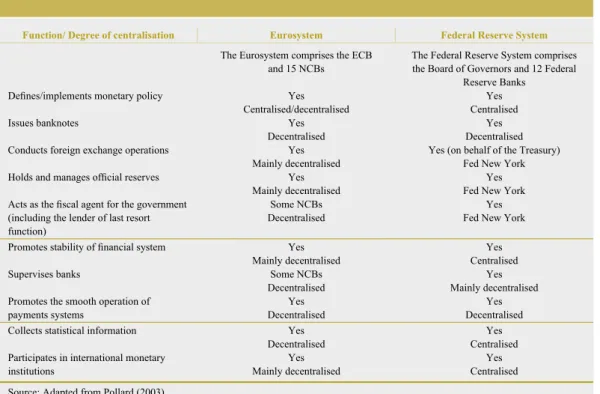
According to Article 105(2) of the Treaty, the basic tasks of the Eurosystem include defi ning and implementing the monetary policy of the euro area, conducting foreign exchange operations, holding and managing the offi cial foreign reserves of the Member States, and promoting the smooth operation of payment systems. The scope of the functions and tasks of the Eurosystem is similar to that of other central banks, such as the Federal Reserve System (see Table 1). These institutional frameworks are very similar in terms of the functions carried out by the central bank, but differ in terms of the degree of centralisation. For instance, the
fi scal agent function and banking supervision function are more clearly assigned within the Federal Reserve System. It is also worth noting that, within the Eurosystem, the NCBs may differ slightly in terms of the scope of their tasks (e.g. only some NCBs are genuinely
See König (1999). Independence at the regional level was 11
guaranteed by the central bank law, and the Presidents of the regional offi ces were appointed by the Federal President, based on a proposal by the upper House of Parliament (Bundesrat).
OF THE EUROSYSTEM
responsible for banking supervision), although they are all responsible for core tasks, such as the implementation of monetary policy.
The mix between decentralisation and centralised elements in the Eurosystem may evolve further. Moreover, the decentralised set-up of the Eurosystem does not imply that the ECB’s monetary policy decision-making process focuses on regional aspects or is subordinated to regional interest groups.12 With a view to ensuring the
singleness of monetary policy, monetary policy decisions are made centrally by the Governing Council of the ECB. The Executive Board of the ECB, with the help of ECB staff, is in charge of preparing the meetings of the Governing Council in order to ensure an effi cient process. The involvement of the NCBs boosts the effi ciency of the process, as a number of Eurosystem tasks require the existence of a national infrastructure, which the NCBs contribute to the Eurosystem-wide infrastructure.
3.3 ESTABLISHING THE EUROSYSTEM’S COMMITTEE STRUCTURE
The building of a supranational central bank also necessitated a review of the working arrangements that had been set up since the establishment of the Committee of Governors in 1964. For this purpose, the Committee of Governors and its sub-committees in 1990 prepared a draft of the Statute of the ESCB. Then, with the ratifi cation of the Maastricht Treaty in 1992 and the establishment of the EMI in 1994, links between NCBs became more systematic and the need to coordinate decentralised activities and supranational decision-making was addressed. The EMI Council, as the main decision-making body of the EMI, decided
Monetary policy decisions must be based on a clear euro area 12
perspective. A clear euro area focus is a central element of the ECB’s monetary policy strategy. Moreover, members of the Governing Council act in person and not as national representatives. See ECB (2004a), p. 12.
Table 1 Central banking functions
Function/ Degree of centralisation Eurosystem Federal Reserve System
The Eurosystem comprises the ECB and 15 NCBs
The Federal Reserve System comprises the Board of Governors and 12 Federal
Reserve Banks
Defi nes/implements monetary policy Yes
Centralised/decentralised
Yes Centralised
Issues banknotes Yes
Decentralised
Yes Decentralised
Conducts foreign exchange operations Yes
Mainly decentralised
Yes (on behalf of the Treasury) Fed New York
Holds and manages offi cial reserves Yes
Mainly decentralised
Yes Fed New York Acts as the fi scal agent for the government
(including the lender of last resort function)
Some NCBs Decentralised
Yes Fed New York
Promotes stability of fi nancial system Yes
Mainly decentralised
Yes Centralised
Supervises banks Some NCBs
Decentralised
Yes Mainly decentralised Promotes the smooth operation of
payments systems
Yes Decentralised
Yes Decentralised
Collects statistical information Yes
Decentralised
Yes Centralised Participates in international monetary
institutions
Yes Mainly decentralised
Yes Centralised Source: Adapted from Pollard (2003).
not to change the organisational structure established under the Committee of Governors (see Chart 3), as it had proved to be an effective means of coordinating tasks, processing input from various sources and building consensus among participants. Within this framework, committees, sub-committees and working groups composed of NCB experts – similar to the Committee of Governors – were key players. With the support of the staff of the EMI, these committees took the lead in conceptual work, such as the design of the monetary policy framework.
A two-tier monetary policy committee structure, comprising two main decision-making bodies, the Governing Council and the Executive Board of the ECB, had to be set up, as the existing committee structure was not designed for monetary policy decision-making, but for coordinating monetary policy among sovereign Member States. The experience of other central banks, such as the Federal Reserve System and the Deutsche Bundesbank suggested that, in a geographically dispersed region, monetary policy decision-making would be more effi cient if a monetary policy hub-and-spoke committee structure were in place.13 This is because such
structures minimise the costs of gathering and sharing information and facilitate consensus building. In this regard, Article 112 of the Treaty and Articles 10 and 11 of the Statute of the ESCB provided for the creation of the Executive Board, which acts as the “hub” of the system and takes the lead in the preparation of monetary policy decisions, and for the creation of the Governing Council, which decides on monetary policy based on its overall assessment of the economic situation. In this respect, NCB governors act as the “spokes” of the system. In view of the success of the structure established by the Committee of Governors and the EMI, it was natural to use the existing architecture for defi ning working relations and taking decisions in the system and to refi ne it where necessary; the mandates of the technical committees had to be modifi ed in order to refl ect their new role within the general structure of
the central banking system. Today, committees are in charge of coordinating the Eurosystem’s tasks that involve the NCBs. According to Article 9 of the Rules of Procedure of the ECB, Eurosystem/ESCB committees are “to assist in the work” of the decision-making bodies of the ECB.14 Membership of the committees
is usually restricted to staff of the Eurosystem central banks.
However, the NCBs of the Member States which have not yet adopted the euro take part in the meetings of a committee whenever it deals with matters that fall within the fi eld of competence of the General Council.15 Where
appropriate, other competent bodies, such as national supervisory authorities in the case of the Banking Supervision Committee, may also be invited. Work at various levels contributes to shaping views and building consensus within the Eurosystem. In terms of expertise or technical advice, the structure of committees and sub-committees provides valuable input in terms of expertise or technical advice to the deliberations of the ECB’s decision-making bodies through letters and reports.
The current committee structure has evolved over time since the establishment of the Committee of Governors, as illustrated by the comparison shown in Charts 3-5. At present, there are committees operating (or touching upon) most functional areas of the work of the Eurosystem (see Chart 5), including the Monetary Policy
See, for example, Berk and Bierut (2007). 13
Eurosystem/ESCB committees report to the Governing Council 14
via the Executive Board. Note, according to the Rules of Procedure of the ECB, “the Banking Supervisory Committee shall not be obliged to report via the Executive Board whenever it acts as a forum for consultation on issues which are not related to the supervisory functions of the ESCB as defi ned in the Treaty and in the Statute.”
The General Council is the third decision-making body of the 15
ECB, in addition to the Governing Council and the Executive Board. The General Council has no responsibility for monetary policy decisions in the euro area, and hence will not be discussed further here. It carries out those tasks inherited from the EMI in relation to the introduction of the euro in the EU Member States that have not yet adopted the euro (e.g. the Convergence Report) which do not fall under the responsibility of the Governing Council. The General Council is composed of the President and the Vice-President of the ECB and the Governors of the NCBs of the (27) EU Member States.
OF THE EUROSYSTEM
Chart 3 The structure of the Committee of Governors
Committee of
Governors Secretariatand
Economic Unit Committee of Alternates Foreign ExchangePolicy Sub-Committee Monetary Policy Sub-Committee Banking Supervisory Sub-Committee Working Group on EC Payments Systems Working Group on Statistics Working Group on Accounting Issues Working Group on Information Systems Working Group “European Banknote”
Source: Committee of Governors (1993).
Chart 4 The committee structure of the EMI
Committee of Alternates EMI Council Financial Committee
Foreign Exchange Policy Sub-Committee Monetary Policy Sub-Committee Banking Supervisory Sub-Committee Working Group on EU Payment Systems
Working Group on the European Banknote Working Group on Statistics Working Group on Accounting Issues Working Group on Information Systems Working Group of Legal Experts TARGET Audit Group Source: EMI (1997).
Committee (MPC) 16, the International Relations
Committee (IRC), the Market Operations Committee (MOC), the Statistics Committee (STC), the Payment and Settlement Systems Committee (PSSC), the Banking Supervision Committee (BSC), the Banknote Committee (BANCO), the Internal Audit Committee (IAC), the External Communications Committee (ECCO), the Legal Committee (LEGCO), the Accounting and Monetary Income Committee (AMICO), the Budget Committee (BUCOM), and the Human Resource Conference (HRC). In addition, these committees operate a variety of working groups or task forces. The number of committees has grown somewhat in light of the
additional tasks to be performed by the Eurosystem. For instance, HRC, IAC and ECCO were newly created to provide the Governing Council with expertise in the fi elds of human resources, internal governance and external communication respectively.
The Monetary Policy Sub-Committee (MPSC) of the EMI made an important contribution to the preparation of the monetary policy framework
Note, while the genuine monetary policy committee of the ECB 16
which is the Governing Council, the term Eurosystem MPC refers to a technical committee comprising high-level experts from the ECB and the NCBs.
Chart 5 The committee structure of the Eurosystem
Governing Council Executive Board Accounting and Monetary Income Committee International Relations Committee Human Resources Conference Legal Committee Internal Auditors Committee Information Technology Committee Statistics Committee Banking Supervision Committee Market Operations Committee Monetary Policy Committee Payment and Settlement Systems Commitee Budget Committee Banknote Committee Eurosystem/ESCB Communications Committee
OF THE EUROSYSTEM
and strategy of the ECB. When the ECB was founded, the tasks covered by the MPSC were split between the Eurosystem Monetary Policy Committee (MPC) and the Market Operation Committee (MOC). Today, the Eurosystem MPC assists the Eurosystem in terms of the single monetary policy and the exchange rate policy of the euro area, contributing, inter alia, to the assessment of issues relating to the conduct of monetary policy in the euro area; the review of the underlying tools for assessing current economic, monetary and fi nancial; the preparation of a set of economic projections concerning the euro area as a whole (see next section); the exchange of views and information on the economic, monetary and fi nancial situation from a euro area perspective; the assessment of the overall performance of the operational monetary policy framework of the Eurosystem. The MOC has taken over the task of the EMI’s Foreign Exchange Policy Sub-Committee (FXPSC), which was to prepare discussions on exchange rate arrangements. It also assists the Eurosystem in the implementation of the single monetary policy, including monetary policy operations, foreign exchange transactions, the management of the ECB’s foreign reserves and the operation of ERM II. With regard to exchange rate matters, there is some overlap between the activities of the MOC, the IRC and the MPC. The IRC assists the Governing Council in all matters related to international cooperation and policy coordination, and acts as a forum for the exchange of views on these issues. The MPC, however, provides input on the potential implications for monetary policy.
3.4 OTHER SOURCES OF COHESION FOR ENCOURAGING BEST PRACTICE AND TEAM SPIRIT
In 2005, the Governing Council of the
ECB agreed on a mission statement for the
Eurosystem, as well as on a set of common values and organisational principles to promote a shared identity and successful team work among all members of the Eurosystem. The six common values agreed for the ECB are: competence, effectiveness and effi ciency, integrity, team
spirit, transparency and accountability, and working for Europe. The nine organisational principles include: participation, cooperation, transparency and accountability, distinguishing Eurosystem activities, cohesion and unity, exchange of resources, effectiveness and effi ciency in decision-making, cost effi ciency, measurement and methodology, as well as exploit synergies and avoid duplications (see Annex 3 for a more detailed description). Committee chairpersons also seek to ensure that an atmosphere of trust prevails among committee members, and aim to foster a participatory team spirit. In line with the aims of the Eurosystem’s mission statement, the committee structure contributes to good governance and helps the Eurosystem to perform its tasks effectively and effi ciently in a spirit of cooperation and teamwork. In this regard, it is important to pursue an approach that clearly defi nes roles and responsibilities for all members of the Eurosystem.
4 MONETARY POLICY BY COMMITTEES: GENERAL RATIONALE, PRACTICE AND THE ECB’S CHOICES
A unique feature of the Eurosystem is that the decision-making bodies of the ECB and the Eurosystem’s committees include members from each euro area country and that voting is based on consensus, thus enabling the full diversity of views and experiences across regions to be incorporated. However, this means that the preparations and discussions on monetary policy need to be structured in such a way that timely monetary policy decisions can be made. Our discussion takes into account the fact that the delegation of monetary policy decisions to a committee like the Governing Council is a feature shared by many central banks today. Decision-making by committees is widely seen as best practice in monetary policy, because committees have a comparative advantage in capturing the plurality of views and in information gathering, and, in the case of the Eurosystem, they ensure consistency across countries and time. Following a federal, decentralized approach, no other decision-making process was thinkable. Blinder (2006) describes “monetary policy by committees” as a “quiet revolution” in central banking. Similarly, Vandenbusche (2006) suggests that committees could enhance the effectiveness of monetary policy.
This section considers the impact of the Eurosystem’s federal structure on the preparation and adoption of monetary policy decisions and explains how monetary policy decisions are made in practice.17 In order to explain and assess
the choices made in setting up the decision-making bodies of the ECB, we provide an international comparison of practices adopted by monetary policy committees and address the implications of cultural and economic diversity in the euro area for the monetary policy decision-making process.
4.1 THE DECISION-MAKING BODIES OF THE ECB
Monetary policy in the Eurosystem is based
on a collective decision-making system
(see Articles 107 and 110 of the Treaty). This applies to the main decision-making bodies (the Governing Council, the Executive Board and the General Council of the ECB) and, in practice, to the Eurosystem’s committees and their substructures.
The Governing Council consists of the (15) governors of the euro area NCBs and the six members of the Executive Board. Its main responsibilities include formulating monetary policy for the euro area, as well as adopting the guidelines and taking the decisions necessary to ensure the performance of the tasks entrusted to the Eurosystem. It is, however, also the decision-making body for the other tasks of the ESCB. When making monetary policy decisions, the Governing Council acts by simple majority. Each member of the Governing Council has one vote; in the event of a tie, the President shall have the casting vote (see Article 10.2 of the Statute of the ESCB).18 This democratic element
of monetary policy aims to better anchor legitimacy of monetary policy in the regions, to facilitate communication with a heterogeneous public and to ensure that the regions participate appropriately in monetary policy decision-making. In practice, however, the Governing Council practices consensus voting. The size of the Governing Council depends on the number of euro area countries. Article 10.2 of the Statute of the ESCB sets the maximum number of voting rights at 21 (i.e. 15 governors and the six Executive Board members should have a voting right (see Box 3)).
See also Bonzom and Barontini (2006) on the implications of the 17
federal structure at the NCB level.
Article 10.2 of the Statute of the ESCB states: “Each member 18
of the Governing Council shall have one vote. As from the date on which the number of members of the Governing Council exceeds 21, each member of the Executive Board shall have one vote and the number of governors with a voting right shall be 15. The latter voting rights shall be assigned and shall rotate … Save as otherwise provided for in this Statute, the Governing Council shall act by a simple majority of the members having a voting right. In the event of a tie, the President shall have the casting vote.”