Working Paper/Document de travail
2011-4
Counterfeit Quality and Verification in a
Monetary Exchange
Bank of Canada Working Paper 2011-4
February 2011
Counterfeit Quality and Verification in a
Monetary Exchange
by
Ben S. C. Fung and Enchuan Shao
Currency Department Bank of Canada
Ottawa, Ontario, Canada K1A 0G9 [email protected] [email protected]
Bank of Canada working papers are theoretical or empirical works-in-progress on subjects in economics and finance. The views expressed in this paper are those of the authors.
Acknowledgements
The authors would like to thank Jonathan Chiu, Mei Dong, Yiting Li, Guillaume Rocheteau, Shouyong Shi, Steve Williamson, Randy Wright, and seminar participants at the Bank of Canada, Canadian Economic Associations Annual Conferences, Federal Reserve Bank of Chicago Summer Money Macro Workshop, Midwest Macroeconomic Meetings, Workshop in Tsinghua University, University of Iowa for their comments and useful discussions. The authors alone are responsible for all errors and omissions.
Abstract
Recent studies on counterfeiting in a monetary search framework show that counterfeiting does not occur in a monetary equilibrium. These findings are inconsistent with the observation that counterfeiting of bank notes has been a serious problem in some countries. In this paper, we show that counterfeiting can exist as an equilibrium outcome in a model in which money is not perfectly recognizable and thus can be counterfeited. A competitive search environment is employed in which sellers post offers and buyers direct their search based on posted offers. When sellers are uninformed about the quality of the money, their offers are pooling and thus buyers can extract rents by using counterfeit money. In this case, counterfeit notes can coexist with genuine notes under certain conditions. We also explicitly model the interaction between sellers’ verification decisions and counterfeiters’ choices of counterfeit quality. This allows us to better understand how policies can affect counterfeiting.
JEL classification: D82, D83, E42, E50 Bank classification: Bank notes
Résumé
De récentes études réalisées à partir d’un cadre monétaire de prospection montrent que la contrefaçon de billets n’existe pas en situation d’équilibre monétaire. Cette conclusion va à l’encontre de ce qui s’observe dans certains pays où la contrefaçon a été un problème de taille. Les auteurs montrent que le faux-monnayage peut faire partie de l’équilibre d’un modèle à l’intérieur duquel les billets, faute d’être parfaitement identifiables, risquent d’être contrefaits. Le modèle utilisé s’appuie sur un cadre de prospection concurrentielle dans lequel les vendeurs publient des offres qui aiguillent les acheteurs. Quand les vendeurs ne connaissent pas la qualité des billets, ils ne différencient pas leur offre selon les acheteurs, ce qui permet à ces derniers de tirer un bénéfice de l’emploi de faux billets. Dans ce cas de figure, la coexistence des billets contrefaits et des billets authentiques est possible à certaines conditions. Les auteurs formalisent par ailleurs en détail la relation entre la décision des vendeurs de vérifier l’authenticité des billets et le choix de la qualité des contrefaçons opéré par les faussaires. Cette démarche permet de mieux comprendre comment les politiques parviennent à influer sur la contrefaçon.
Classification JEL : D82, D83, E42, E50 Classification de la Banque : Billets de banque
1 Introduction
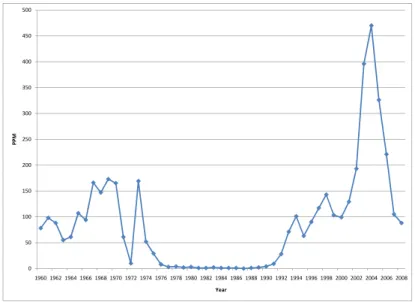
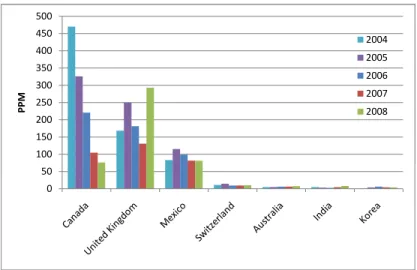
As the sole provider of currency in Canada, the Bank of Canada aims to supply bank notes that Canadians can use with condence. In the early 2000s, however, there was a sharp increase in counterfeit bank notes in Canada, rising to a peak of almost 500 counterfeit notes detected per million notes in circulation (PPM) in 2004 from well below 100 for most of the 1990s (see Figure 1). This increase in counterfeiting could threaten the public's condence in bank notes. In response, the Bank of Canada focused its eorts on developing bank notes that are dicult to counterfeit, promoting the deterrence of counterfeiting by law enforcement and prosecutors, promoting the routine verication of bank notes by retailers, and withdrawing worn notes and more vulnerable older-series notes from circulation. As a result, counterfeiting has declined considerably since 2004 and is now back down to the pre-2000 level.1Figure 2 shows
that counterfeiting is also a problem in some countries such as the United Kingdom and Mexico but not at all a problem in others such as Australia and Korea.
200 250 300 350 400 450 500 PPM 0 50 100 150 1960 1962 1964 1966 1968 1970 1972 1974 1976 1978 1980 1982 1984 1986 1988 1990 1992 1994 1996 1998 2000 2002 2004 2006 2008 Year
Figure 1: Counterfeiting Activities in Canada since 1960
What have caused the rise in counterfeiting and the subsequent decline? Why have some countries experienced a more serious counterfeiting problem than others? What measures are eective in reducing counterfeiting? Given that anti-counterfeiting mea-sures are costly to implement, how important is it to continue to invest in these measures when counterfeiting has subsided? Do macroeconomic variables such as
1For a brief discussion of the Canadian experienc of counterfeiting, see for example Bank of
100 150 200 250 300 350 400 450 500 PPM 2004 2005 2006 2007 2008 0 50 100 150 200 250 300 350 400 450 500 PPM 2004 2005 2006 2007 2008
Figure 2: No. of counterfeit notes detected in selected countries
ination have any eects on counterfeiting? How costly is counterfeiting to society? These questions are of interest to policy makers and academics. In order to address these questions, one approach is to develop a monetary model in which counterfeit-ing arises endogenously. Such a model should incorporate relevant decisions such as counterfeiting, verication, and government policy. This paper contributes to such an approach by studying a search model of money in which money is not perfectly recognizable and thus can be counterfeited. We show that counterfeiting can ex-ist as an equilibrium outcome and characterize the conditions under which such an equilibrium will exist. In addition, we would like to examine how policies will aect counterfeiting.2
The literature on theoretical models of counterfeiting of bank notes is relatively small. In recent years, a few papers have studied counterfeiting in the context of mon-etary search models.3 For example, Kultti (1996) studies the conditions under which
a monetary equilibrium can be sustained by extending the search models of Kiyotaki and Wright (1993) while Green and Weber (1996) look at how the introduction of new issue of bank notes aect counterfeiting. Cavalcanti and Nosal (2007) argue that
2For example, Green and Weber (1996) examine whether a policy of introducing a new style of
currency that is harder to counterfeit but not immediately to withdraw from circulation all of the old issues would be able to reduce counterfeiting. Monnet (2005) studies whether ination would reduce the value of counterfeiting activities.
3Another strand of literature studies counterfeiting using game-theoretical models, for example,
it is optimal to tolerate counterfeiting when transactions are dicult to mornitor and their values are small. Nosal and Wallace (2007) show that counterfeiting is only a threat and does not exist in a monetary equilibrium. However, such a threat could potentially result in the collapse of a monetary equilibrium if the cost of counter-feiting is suciently low. Li and Rocheteau (2008), with a basic set up similar to Nosal and Wallace, argue that despite the threat of counterfeiting there always exists a monetary equilibrium. However, the threat of counterfeiting will instead aect real allocations and thus social welfare. In the base model, Li and Rocheteau also nd no monetary equilibrium with counterfeiting.4 However, the experiences in Canada
discussed above and in other countires suggest that counterfeiting is more than just a threat. Indeed, many countries have experienced a rapid increase in counterfeiting of bank notes followed by a gradual decline over the last decade or so. To explain such a phenomenon, it requires a model in which counterfeiting of bank notes exists as an equilibrium outcome.
Our model diers from existing models of counterfeiting in several aspects. First, money is divisible as in Lagos and Wright (2005). In Kultti (1996), Cavalcanti and Nosal (2007) and Williamson (2002), however, money is indivisible and thus counter-feit notes can improve welfare by acting as private money in alleviating the money shortage problem. In Canada and other industrialized countries, however, money shortage is less likely to be an issue. Second, the market structure in our model is such that sellers post their oers to buyers and thus buyers can direct their search based on the posted oers.5 Unlike Nosal and Wallace, and Li and Rocheteau, buyers
cannot signal to the sellers their types. In this case, there will always be a monetary equilibrium. Third, buyers have to pay a cost to produce counterfeit notes, and in the extended version of our model a higher quality counterfeit note is more costly to produce. In turn, higher quality counterfeit notes are more dicult for the seller to detect. In addition, sellers can invest in a verication technology that can detect counterfeit notes with a probability. If a seller does not invest in the technology, she will not be able to tell between genuine and counterfeit notes. The seller's decision may or may not be known to the buyer. Thus it allows us to explicitly model the interaction between counterfeiters and sellers.
We begin with a baseline model of counterfeiting which is very similar to Nosal and Wallace (2007), except that we consider divisible money and competitive search. Buyers decide whether to produce counterfeits or not at a cost. Sellers will receive a signal which will inform them whether the notes they will receive are genuine or counterfeit at some positive probability. We then characterize the conditions under which a monetary equilibrium with counterfeiting will exist in such an environment. We nd that counterfeiting can exist in a monetary equilibrium if the cost of producing
4Li and Rocheteau consider two extensions in which counterfeiting can exist in equilbrium. 5Competitive search is also a more realistic description of most transactions at the retail level.
A buyer usually can observe the price listed for the goods or services she wants to buy and then decides which store to go to.
counterfeits is suciently low. Next we consider an extension to the baseline model in which a counterfeiter decides on counterfeit quality and a seller decides whether to verify the notes they receive or not. Such decisions will inuence the probability that the signal is informative. A buyer's decision regarding counterfeiting is always private information. However, a seller's verication choice may or may not be observable. In these cases, the conditions for the existence of counterfeiting in equilibrium are related to the money growth rate and the cost of verication. We also nd that a higher rate of ination tends to reduce counterfeiting. This is consistent with the observation that counterfeiting is less likely to be a serious problem in high ination countries and that countries experencing a high level of counterfeiting, such as Canada and the United Kingdom, have relatively low and stable ination. Interestingly, we nd that a higher cost of verication tends to reduce counterfeiting. This seems counterintuitive. The reason for this result is that when the cost of verication is higher, a seller will enter the market only if there is a higher fraction of buyers using genuine money so that he can make enough money by selling to a buyer.
The rest of the paper is organized as follows. The next section describes the model environment. In Section 3, we consider the baseline mode of counterfeiting in a competitive search environment and derive conditions under which counterfeiting can exist in a monetary equilibrium. In Section 4, we consider an extension which include decisions regarding counterfeit quaility and verication. We rst cosider the case that the seller's verication decision is public information. We again derive conditions under which counterfeiting can exist in a monetary equilibrium and then study how changes in ination and the cost of verication will aect counterfeiting and the quantities traded. In Section 5, we allow the seller's verication decision to be private information and study whether the results in the previous section will be aected. Section 6 concludes.
2 The Environment
The basic economic environment is similar to Rocheteau and Wright (2005). Time is discrete and runs forever. Each period is divided into two sub-periods, day and night, during which the market structure diers. During the day, there is a Walrasian market characterized by competitive trading, while at night there is a search market characterized by bilateral trading. There is a continuum of innitely-lived agents who dier across two dimensions. First, they have private information on some of their own characteristics that will be described in detail later. Second, they belong to one of two groups in the search market, called buyers and sellers. We normalize the measure of buyers to 1. In the Walrasian market all agents produce and consume but in the search market a buyer can only consume and a seller can only produce. This specication on agents' trading roles in the search market generates a lack-of-double-coincidence-of-wants problem. Therefore, barter is ruled out. All meetings are assumed to be anonymous which precludes credit. These frictions make a medium of
exchange essential in the search market.
Goods are perishable while (genuine) at money is storable and thus money can potentially be used as a medium of exchange. Money is perfectly divisible and its stock at time t is given by Mt . The money stock grows at a constrant gross rate
γ, so that Mt+1 = γMt. New money is injected (γ > 1) or withdrawn (γ < 1) via
lump sump transfers to all agents in the Walrasian market. We restrict attention to policies whereγ ≥β, where β ∈(0,1)is the discount factor, since it is easy to check
that there is no equilibrium otherwise. To examine what happens whenγ =β, which
is the Friedman rule, we can take the limit of equilibria asγ →β.
Money is perfectly recognizable in the Walrasian market but imperfectly recog-nizable in the search market. The recognizability problem of at money gives a buyer an incentive to produce counterfeits and extract more surplus in the bilateral trade. Buyers can produce counterfeited notes in any quantity at a cost and this decision is private information. In any trade meeting, the trading pair will receive a signal regarding the quality of the money used by the buyer. With probabilityπ, ths signal
reveals the type of money used by the buyer and with probabiliy 1−π, the signal
is uninformative. We will consider two dierent cases regarding this signal. In the rst case, the baseline model, the probabily of this signal being informative is exoge-nous, as in Nosal and Wallace (2007). This case is important because no counterfeit equilibrium is found when the buyer makes a take-it-or-leave-it oer to the seller. It is thus of interest to study whether counterfeiting can exist in equilibrium under a dierent trading mechanism such as competitive search. In the second case, the prob-ability depends on the actions of the counterfeiters and the sellers. More specically, counterfeiters can choose a level of the quality of counterfeit notes that aectπ while
sellers can choose their verication eort that will inuence π. In this case, we can
study the inteaction between the counterfeiter's decision regarding quality and the seller's decision regarding verication. As such, we can assess how anti-counterfeiting policies will aect counterfeiting. We will describe the second case in more detail below.
The counterfeiters can choose the quality level of the counterfeit notes produced. Higher quality notes are more costly to produce but they are less likely to be detected by the seller than lower quality ones. Let h ∈ [0,+∞) denote the quality level of
counterfeits chosen by a buyer. Thus the probability π is a function of the quality h
such thatπ =π(h)andπ0(h)<0. Denoteg(h)the cost that a buyer pays to produce
counterfeits of quality h. Assume that g : R+ → R+ is an increasing and convex
function and satises g(0) = 0. It is important to note that the cost of producing
counterfeits depends on the quality but not the quantity produced. Counterfeits are assumed to be 100% disintegrated or conscated at the end of each period as in Nosal and Wallace (2007). As a result, there is no incentive for sellers to produce or pass counterfeits.
A seller can choose to verify a buyer's money holding in a bilateral meeting by paying a xed utility costL to invest in a verication technology or to exert a
veri-cation eort. In this case,π >0, and the public signal reveals the quality of a buyer's
holding of money according to the following probability6:
(
π(h) if the buyer produces counterfeits,
π(H) otherwise.
With the complementary probability 1−π the seller is uninformed. Here H is the
economy-wide counterfeit quality. In equilibrium h = H. If the seller chooses not
to verify, he will receive no information about the type of money held by the buyer, i.e. π = 0 regardless of the quality of the counterfeit notes. In other words, a seller
that does not verify will be completely uninformed regarding whether the notes are counterfeit or genuine. In what follows, we describe the environment based on the case where the probability π depends on the counterfeiter's choice on counterfeit
quality and the seller's decision on verication.
Letε∈ {0,1}denote the public signal that a seller receives, whereε= 1 indicates
that the seller is informed and ε= 0 indicates the opposite. Notice that detection is
always imperfect and the detection probability depends on the quality of counterfeits but not the quantity. The function π : R+ → [0,1] is decreasing and convex. Let
a ∈ {y, n} be the action that the seller will take where a = y means that the seller
chooses to verify whilea=nimplies he does not. The seller's action may or may not
be observed by all other agents.7 We will rst consider the case whereais observable,
and then later we will relax this assumption to allowato be private information. The
corresponding cost with respect toa is therefore f(a) =
(
L, if a =y
0, if a =n .
The instantaneous utility of a seller at date t is Uts =v(xt)−yt−qt−f(at),
6There are two detection probabilities contingent on whether a buyer produces counterfeits or
not. If a buyer produces counterfeits, the seller's detection probability will depend on the individual's quality level of counterfeits. In the case of a buyer who holds only genuine money, however, the detection probability cannot depend on the individual's quality level of counterfeits since the buyer does not produce counterfeits. To be consistent with the assumption of imperfect recognizability of money, it is natural to assume that the detection probability is related to economy-wide counterfeit quality when a seller meets with a genuine money holder. Of course, in equilibrium these two probabilities are equal.
7Sometimes, retailers will install a device such as an ultra violet light to verify the bank notes
and place them in a location where they are visible to buyers. Or a buyer may observe a cashier in a store verifying notes received in a transaction. In these cases, the buyer knows that the seller will likely verify. In other cases, the buyer does not know whether the seller will verify either because the buyer cannot observe how other transactions are done or because the seller does not know if the seller has installed any machine that helps verication.
where xt is the quantity consumed and yt is the quantity produced during the day,
qt is production at night. Lifetime utility for a seller is P
∞
t=0β
tUs
t. We assume that
v0(x)>0,v00(x)<0for allx, and there existsx∗ >0such thatv0(x∗) = 1. Similarly,
the instantaneous utility of a buyer is
Utb =v(xt)−yt+u(qt)−g(ht)I{i=c},
where qt is the quantity consumed at night and I is the indicator function which is
equal to 1 if the buyer chooses to produce counterfeits (i=c)or 0 if the buyer holds
only genuine money (i=g). Lifetime utility for a buyer isP∞
t=0β
tUb
t. Assume that
u(0) = 0, u0(0) = +∞, u0(q) > 0, and u00(q) < 0. There exists q and q∗ > 0 such
that u(q) = q and u0(q∗) = 1.
The terms of trade are determined in the competitive search market in the spirit of Moen (1997) and Rocheteau and Wright (2005). Each seller decides whether to incur a cost to verify before entering the search market. Prior to the search process, each seller simultaneously posts an oer that species the terms at which buyers and sellers commit to trade. Specically, an oer is a schedule {qi
ε, diε} specifying the
quantity tradedqi
ε and the total monetary payment diε conditional on the realization
of the verication signal ε and the buyer's type i.8 (In principle, the oers can be
dierent across dierent types of sellers. We will discuss oers in detail when we describe the equilibrium concepts.) Buyers then observe all the posted oers and direct their search towards those sellers posting the most attractive oer. The set of sellers posting the same oer and the set of buyers directing their search towards them form a sub-market. In each sub-market, buyers and sellers meet randomly according to the matching function discussed below. When a buyer and a seller meet, the buyer decides to either accept the oer and commit to the terms it species, or abandon all trade. If the oer is accepted, the signal is realized and the buyer purchases qi
ε units
for diε dollars.
The probability that a buyer and a seller are paired o is independent of the buyer's or seller's type. To focus on the informational frictions and to avoid unnec-essary complications, we assume that individuals experience at most one match and that matching is ecient, meaning that the short-side of the market is always served in each sub-market. The probability that a buyer matches a seller is then
αb(θj) = min 1, θ−j1
, (1)
where θj is the ratio of buyers over sellers in sub-market j, or the market tightness.
Similarly, the probability that a seller matches a buyer is
αs(θj) = min (1, θj). (2) 8The oer does not include the amount of counterfeits because counterfeits have no value and
CM DM Sellers choose ver-ification efforts Buyers’ decision on counter-feiting Monetary trans-fers Centralized trade and choice of money balances Sellers post offers Buyers search di-rectly Random match-ing Verification Bilateral trade
Figure 3: Timing of Events in a period
The timing of events in a period is summarized in Figure 3.9At the beginning of
each period, money is transferred from or back to the government. After that, buyers decide whether to produce counterfeits or not and if so, what quality of counterfeits to produce. This decision is private information. Sellers decide whether to verify or not the money used by the buyer by investing in the verication technology. This decision may or may not be observable and we will consider both cases below. After that, sellers post their oers for the night market. Then the Walrasian market opens in which agents consume and produce as well as adjust their money balances. When night falls, the Walrasian market closes, and the competitive search market opens. Sub-markets are formed as a result of the competitive search process. When a buyer and a seller meet in a sub-market, the buyer hands in his holdings of money to the seller. If the seller has invested in verication, she will receive a signal. She will become informed or not depending on the signal that she receives. The pair trades according to the pre-specied terms of trade: the payment is made; the seller produces; and the buyer consumes. After matches are terminated, all agents learn the type of their money holdings and all counterfeits disintegrate.
Remark 1. In the bilateral trading, once the buyer has surrendered his money hold-ings to the seller for verication, he does not have an incentive to take them back and replace any genuine money with counterfeits, even if he now learns that the seller cannot verify. It is because by doing so, he is signaling to the seller that the bank notes he is now giving the sellers are fake. Clearly no trade will occur since sellers never accept counterfeits knowingly. Therefore, once buyers have accepted the oer,
9Here we consider the case where the probability of the signal being informative depends on the
actions of the buyers and sellers. For the baseline case where the probability is exogenous, there will not be decisions on counterfeit quality and verication.
they will leave whatever money that they held on the table. This immediately implies that if a buyer decides to produce counterfeits with quality h >0, he will not spend
any genuine notes in the search market, i.e., genuine notes and counterfeits are not combined together as a payment. The reason is that combining genuine and coun-terfeit notes does not increase the chance that councoun-terfeits can pass through as the probability of detection depends on the quality but not the quantity of counterfeits. Since the buyer has already incurred the sunk cost of producing counterfeits, the above strategy is strictly dominated by holding the same amount of genuine notes but producing no counterfeits (or counterfeits with quality h = 0). Hence, we can
further restrict the strategy space for buyers such that they will not hold a portfolio of genuine and counterfeit notes. In other words, if a buyer produces counterfeit notes, he will use only counterfeits to buy goods in the search market.
3 Counterfeiting in Competitive Search
Here we consider a counterfeiting setup similar to Nosal and Wallace (2007), except that we consider competitive search as the trading mechanism instead of the buyer making a take-it-or-leave it oer. We abstract from the counterfeiter's decision re-garding quality of counterfeits. Thus a buyer can produce counterfeit notes in any quantity at a xed cost g > 0. We also abstract from the seller's verication
deci-sion and assume that the seller will always receive a signal about the quality of the buyer's notes. With probability π, the seller knows whether the money is genuine or
counterfeit, while with probability 1−π, the seller is uninformed. Since counterfeit
notes are 100% conscated by the government at the end of each period, Lemma 1 states that the only possible oer is pooling.
Lemma 1. . When sellers are informed, there is no trade between a seller and a counterfeiter, i.e. qc
1 = 0. When sellers are uninformed, there is no separating oer, i.e. q0g =q0c=q0.
Lemma 1 contrasts our model with Guerrieri et al. (2010) in the sense that the equilibrium in our model involves pooling. The reason is that the sorting assumption in Guerrieri et al. (2010) does not hold here.10
Let Pt be the fraction of genuine money holders in the economy and Wtb(mt) be
the value function of a buyer who enters the Walrasian market at time t holdingmt
units of money.11 Since the buyer needs to choose whether to produce a counterfeit
10Note that the trade surplus in a match (given the buyer's decision on counterfeiting) when the
seller is uninformed is: u(q0)−βφd0/γfor the genuine money holder, andu(q0)for the counterfeiter.
There is no way for the seller to post an oer(q0, d0)to screen buyers since a counterfeiter can always
duplicate the strategy of a buyer holding genuine money.
11To simplify the notation, we suppress all aggregate state variables but a money holding into a
or not, his value function at the start of each period is Wtb(mt) = max pt [ptW g t (mt) + (1−pt)Wtc(mt)], (3)
where Wg and Wc represent the value functions of being a holder of genuine money
or a counterfeiter respectively, andpis the choice on counterfeits (or holding genuine
money). In equilibrium p=P. The optimal decision on P must satisfy
P = 1 if Wg > Wc, P = 0 if Wg < Wc, P ∈(0,1) if Wg =Wc. (4) Denote the buyer's value function of carrying mˆt dollars into the search market
of periodt byVtg( ˆmt)if he uses only genuine notes, or Vtc( ˆmt) otherwise. Similarly,
Ws
t (mt)andVts( ˆmt)are the corresponding value functions for the seller. Let the price
of the consumption good in the Walrasian market be normalized to 1 and denote the price of a dollar in units of consumption in period t by φt. The value of the agent
j ∈ {s, g, c}in the Walrasian market is Wtj(mt) = max xt,yt,mˆt v(xt)−yt+Vtj( ˆmt) , (5) s.t. xt+φtmˆt=yt+φt(mt+τt), (6)
where τt is the nominal monetary transfers to (or from) the agent.12
Because utility is quasi-linear, the budget constraint (6) can be substituted into the objective function (5), so that the problem simplies to
Wtj(mt) = max xt,mˆt v(xt)−xt−φt( ˆmt−mt−τt) +Vtj( ˆmt) . (7)
Thus, it follows that forj ∈ {s, g, c}
1. the optimal choice of xt is independent of mt with v0(xt) = 1, so xt =x∗;
2. the optimal choice of mˆt is also independent of mt, and is determined by
max-imizingVtj( ˆmt)−φtmˆt;
3. the value functions Wtj(mt) are linear inmt and can be rewritten as
Wtj(mt) = Wtj(0) +φtmt.
The value functions of buyers and sellers at night depend on the submarket they visit in equilibrium, and on the money holdings they take into this sub-market. All agents have rational expectations regarding the number of buyers will be attracted by
12The choices ofx
each oer that sellers post, and thus about the market tightness in each sub-market. Sellers have beliefs on the fraction of genuine money holders in each sub-market. The set of oers posted in equilibrium must be such that sellers have no incentives to post deviating oers. Therefore, a sub-market is characterized by the fraction of genuine money holders P, a market tightness θ, and an oer {qεi, diε}. Let Ω be the
set of all sub-markets that are active in equilibrium. An elementω ∈Ωis then a list
ω = {P, θ,{qi
ε, diε}}. Competition between sellers on posting will force the value of
all active sub-markets to be equal.
Given Lemma 1 and that all the sellers are identical, it is obvious that there is only one active sub-market at night. Thus we can write down the value function for the sellers at night as
Vts( ˆmt) = αs(θt)Pt " π −q1t+βWts+1( ˆmt+d1t) + (1−π) −q0t+βWts+1( ˆmt+d0t) # +αs(θt) (1−Pt) (1−π) (−q0t) +βWts+1( ˆmt) + (1−αs(θt))βWts+1( ˆmt) , = αs(θt)Pt " π(−q1t+βφt+1d1t) + (1−π) (−q0t+βφt+1d0t) # +αs(θt) (1−Pt) [(1−π) (−q0t)] +βφt+1mˆt+Wts+1(0) . (8) With probabilityαs(θ
t), a seller will meet with a potential buyer. Conditional on
a successful match, the seller will meet a buyer with genuine money with probability
Pt. With probability 1−Pt, the seller will meet with a counterfeiter and will suer
a loss in the case when he is uninformed. Notice that to derive (8), we use the fact that Ws
t+1( ˆmt) is linear with slope φt+1. Combining (7) and (8), the optimal choice
of mˆt solves
max
ˆ
mt≥0(βφt+1−φt) ˆmt.
The solution exists if and only if the ination rate φt/φt+1 > β. In this case mˆt = 0
and the seller will not carry money to the search market because he cannot derive any benet from holding money.
money, Vtg( ˆmt) = αb(θt) " π u(q1t) +βWtb+1( ˆmt−d1t) + (1−π) u(q0t) +βWtb+1( ˆmt−d0t) # + 1−αb(θt) βWtb+1( ˆmt) = αb(θt) " π(u(q1t)−βφt+1d1t) + (1−π) (u(q0t)−βφt+1d0t) # (9) +βφt+1mˆt+Wtb+1(0) s.t. d1t ≤ mˆt, (10) d0t ≤ mˆt. (11) And if he is a counterfeiter, Vtc( ˆmt) = max ht −g+αb(θt) (1−π)u(q0t) +βWtb+1( ˆmt) = max ht −g+αb(θt) (1−π)u(q0t) +β φt+1mˆt+Wtb+1(0) . (12)
Here, the counterfeiter can extract information rent from a seller who is uninformed about the quality of his notes. Again, combining (7) and (12) shows that the coun-terfeiter carries no genuine money to the search market.
Plug the value functions at night into the value function at the beginning of the day, the daytime values for buyers and sellers can be rewritten as follows:
Wtb(mt) = v(x∗)−x∗+φt(mt+τt) +βWtb+1(0) + maxp
t
[ptStg + (1−pt)Stc],
Wts(mt) = v(x∗)−x∗+φt(mt+τt) +βWtb+1(0).
Next we can write down the expected trade surpluses of an agent at night as
Stg = αb(θt) " π(u(q1t)−βφt+1d1t) + (1−π) (u(q0t)−βφt+1d0t) # −(φt−βφt+1) ˆmt, Stc = αb(θt) (1−π)u(q0t)−g, Sts = αs(θt) Pt π(−q1t+βφt+1d1t) + (1−π) (−q0t+βφt+1d0t) −(1−Pt) (1−π)q0t .
In terms of the surpluses, condition (4) on P can be rewritten as
P = 1 if Sg > Sc, P = 0 if Sg < Sc, P ∈(0,1) if Sg =Sc. (13)
We conne our attention to symmetric steady state equilibrium where the real money balance remains constant. Thus, φt+1Mt+1 =φtMt implies that the ination
rate equals the money growth rate: φt/φt+1 =γ. LetS
j
be the equilibrium expected surplus at night for j ∈ {s, g, c}. We dene the competitive search equilibrium as
follows.
Denition 1. A competitive search equilibrium consists of value functions Wb and
Ws, a set Ω, Sg, Sc, Ss , an aggregate state P, a price φ, and the buyer's decision
on p, such that, for all ω∈Ω,
1. Symmetry: p=P.
2. The buyers' optimal choice of P must satisfy (13).
3. All genuine money holders attain the same expected surplus Sg ≥0.
4. All counterfeiters attain the same expected surplus Sc≥0.
5. Free entry implies sellers' expected surplus equal to 0. 6. The list ω solves the following program:
Ss = max θ,q0,q1,d0,d1,mˆ αb(θ) π u(q1)−β φ γd1 + (1−π) u(q0)−β φ γd0 − γ−β γ mφˆ t , (14) s.t. d0 ≤ m,ˆ (15) d1 ≤ m,ˆ (16) Sc = αb(θ) (1−π)u(q0)−g, (17) Sy = αs(θ) P π βφ γd1−q1 + (1−π) βφ γd0−q0 −(1−P) (1−π)q0 = 0. (18)
Conditions 1 to 5 are straightforward. Since the same type of buyers have identical payo functions, they must attain the same expected surplus. Given that sellers are free to enter any one of the active submarkets, in equilibrium the expected surplus of a seller must be zero. Condition 6 results from a combination of optimal behavior and competition among sellers when they post oers. According to this condition, sellers
cannot post oers that attract more genuine money holders without making himself worse o. Since there are innitely many counterfeiters entering the submarket as well, each sellers takes Sc as given. Sellers also realize that the ratio θ is going to
adjust endogenously so that (17) and (18) hold.
To characterize the equilibrium, we rst state the following lemma to describe two properties of the program in (14) to (18).
Lemma 2. The optimal payments are uniform and satisfy: d0 =d1 = ˆm.
The intuition is rather simple. Since carrying genuine money is costly owing to ination, buyers will carry just enough money when entering the search market to cover their largest possible payment. If the two payments are dierent, then there exists a linear combination of the two payments which satises all the constraints. However, a buyer can now carry less money under the new payments and thus is better o. Therefore the two payments cannot be dierent.
Lemma 3. Buyers and sellers trade with probability one in any active submarket:
θ =αb(θ) = αs(θ) = 1.
This lemma is a direct corollary of the assumption regarding the matching process. Note also that there is only one active submarket. If θ >1, for example, then not all
buyers will be matched while all sellers will be matched for sure. Consider a decrease in θ, due to say entry of additional sellers. Then buyers will now have a higher
matching probability. It is possible to nd another pair of quantities that satisfy all constraints while oering a higher quantity of goods when genuine money is used and a lower quantity if sellers are uninformed. Obviously, buyers who use genuine money are better o in this case as they have a higher probability of matching and a higher quantity of goods traded. Therefore, θ > 1 cannot be sustained. Similar arguments
apply to the case of θ <1.
We can further simplify the program using Lemma 2 and 3 to show the rst proposition regarding the property of posted prices in equilibrium.
Proposition 1. In any monetary equilibrium with counterfeiting, q0 ≤ q∗∗ < q for any P ∈(0,1), where q∗∗= arg maxqu(q)−γ/(βP)q.
The intuition behind Proposition 1 is as follows. By Lemma 2, a seller will charge the same amount of payment whether he is informed or not. However, if the seller cannot recognize the quality of the buyer's money holding, he must produce less than (or post higher price than in) the case when he is informed, in order to compensate for the risk that he may receive counterfeit notes.
Proposition 1 is a necessary condition for the existence of monetary equilibrium with counterfeiting. It implies that the set of submarkets is complete in the sense that there is no protable deviation for sellers to open another submarket which only attracts genuine money holders. The condition in Proposition 1 rules out any incentives for sellers to deviate from the pooling equilibrium. A seller will deviate
from a pooling contract only if he can attract buyers using genuine money but not counterfeiters. Thus the only potential deviation is to oer a lower q0 and d0 in an attempt to attract buyers with genuine money since counterfeiters care only about the quantity of goods traded. However, given Proposition 1 and the concavity of
u(q), any such oers will make the buyer using genuine money straightly worse o
if the seller wants to make at least zero prots.
Since the counterfeiter's surplus must be non-negative, the immediate corollary implies that g < (1−π)u(q∗∗) in counterfeiting equilibrium. The next proposition
characterize a sucient condition for the existence of monetary equilibrium with counterfeiting.
Proposition 2. A monetary equilibrium with counterfeiting exists if
g < γ
βq1−πu(q1). (19)
where q1 satisesu0(q1) = γ/β.
According to Proposition 2, as long as the cost of producing counterfeits is su-ciently low, a monetary equilibrium with counterfeiting will exist. This result is in contrast to the one found in Nosal and Wallace (2007) where counterfeiting is merely a threat to the monetary economy: if the cost of producing counterfeits is low, then no trade will take place, while if the cost is high, no one will produce counterfeits. What is driving our results is the dierent pricing mechanism used in our study. The non-existence of counterfeiting in Nosal and Wallace is due to the fact that a gen-uine money holder can always signal her type through the oer she makes. While in our case, sellers post oers so that buyers cannot signal the quality of their money holding via their oers. More importantly, if sellers are uninformed about the quality of the money used by buyers, the oers must be pooling since counterfeits have no value. Therefore counterfeiters can extract rents and sellers will accept counterfeits only when they cannot recognize the quality of the money used.13
4 The seller's verication decision is known
In the previous section, we have shown that counterfeiting can exist as an equilibrium outcome under competitive search. In the next two sections, we consider the case where the probability of the signal about the quality of the buyer's money being
13Although our result involves pooling oers, a monetary equilibrium can still exist. This is not
the case in Guerrieri et al. (2010) where they show that a pooling oer will cause the asset market to shut down. The main reason why trades can happen in our model but not in their example is that the principal (seller) in our model always has some positive probability of knowing the agent's (buyer) type which guarantees trades to take place. While in Guerrieri et al. (2010), the principal has no information about the agent's type at all, and thus the absence of trade surplus results in no trade.
informative is endogenous. That is, the probability depends on the quality of the counterfeits and the seller's decision on verication. In this case, we can study how public policies will aect counterfeiting. In general, a seller's verication decision may or may not be known to others. In this section, we look at the case where this decision is public information and we will consider the other case in the next section. Again, there is no separating oer when sellers are uninformed. Since sellers can choose to verify the money they receive or not and such a decision is known to everybody. Thus, buyers know the type of sellers that they will meet and sellers have beliefs on the fraction of genuine money holders in each sub-market. The set of oers posted in equilibrium must be such that sellers have no incentives to post deviating oers. Therefore, a sub-market is characterized by seller's type a, the fraction of
genuine money holders Pa, a market tightness θa, and an oer {qεi, diε}a. Let Ω be
the set of all sub-markets that are active in equilibrium. An element ω ∈ Ω is then
a list ω={a, Pa, θa,{qiε, diε}a}. Competition between sellers on posting will force the
value of all active sub-markets to be equal. The following lemma shows that the only active sub-market at night is where the sellers choose to invest in the verication technology: a=y.
Lemma 4. The only active sub-market in equilibrium is the one where a=y.
Note that Lemmas 2 and 3 will continue to hold. Given these lemmas, we can write down the value function for the sellers at night as
Vts( ˆmt) = max{Vty( ˆmt), Vtn( ˆmt)} where Vn t ( ˆmt) =βWts+1( ˆmt) =β φt+1mˆt+Wts+1(0) , and Vty( ˆmt) = −L+αs(θt)Pt " π(Ht) −q1t+βWts+1( ˆmt+d1t) + (1−π(Ht)) −q0t+βWts+1( ˆmt+d0t) # +αs(θt) (1−Pt) (1−π(ht)) (−q0t) +βWts+1( ˆmt) + (1−αs(θt))βWts+1( ˆmt) , = −L+αs(θt)Pt " π(Ht) (−q1t+βφt+1d1t) + (1−π(Ht)) (−q0t+βφt+1d0t) # +αs(θt) (1−Pt) [(1−π(ht)) (−q0t)] +β φt+1mˆt+Wts+1(0) . (20)
If a seller chooses not to verify, she will attract only the buyers who have produced counterfeit notes of the lowest quality. Not willing to accept counterfeits since they will completely disintegrate at the end of the period, the seller will not trade at all. When a seller exerts an eort in verication, he will have to pay a cost L. With
probability αs(θt), he will meet with a potential buyer. Conditional on a successful
1−Pt, the seller will meet with a counterfeiter and will suer a loss in the case when
he is uninformed.
Similarly, the value functions for a buyer at night are, if he is holding genuine money, Vtg( ˆmt) = αb(θt) " π(Ht) u(q1t) +βWtb+1( ˆmt−d1t) + (1−π(Ht)) u(q0t) +βWtb+1( ˆmt−d0t) # + 1−αb(θt) βWtb+1( ˆmt) = αb(θt) " π(Ht) (u(q1t)−βφt+1d1t) + (1−π(Ht)) (u(q0t)−βφt+1d0t) # (21) +βφt+1mˆt+Wtb+1(0) s.t. d1t ≤ mˆt, (22) d0t ≤ mˆt. (23) and if he is a counterfeiter, Vtc( ˆmt) = max ht −g(ht) +αb(θt) (1−π(ht))u(q0t) +βWtb+1( ˆmt) = max ht −g(ht) +αb(θt) (1−π(ht))u(q0t) +β φt+1mˆt+Wtb+1(0) . (24) It can be shown easily that the counterfeiters and sellers carry no genuine money to the search market. The optimal choice ofhis given by the following rst order condition,
which equates the marginal cost to the marginal benet of increasing counterfeit quality:
g0(ht) = −π0(ht)u(q0t)αb(θt). (25)
Plug the value functions at night into the value function at the beginning of the day, the daytime values for buyers and sellers can be rewritten as follows:
Wtb(mt) = v(x∗)−x∗+φt(mt+τt) +βWtb+1(0) + maxp t [ptStg + (1−pt)Stc], Wts(mt) = v(x∗)−x∗+φt(mt+τt) +βWtb+1(0) + max{0, S y t}.
Here Sj, j ∈ {g, c, y}, represents the expected trade surpluses of an agent at night
which can be written as
Stg = αb(θt) " π(Ht) (u(q1t)−βφt+1d1t) + (1−π(Ht)) (u(q0t)−βφt+1d0t) # −(φt−βφt+1) ˆmt, Stc = αb(θt) (1−π(ht))u(q0t)−g(ht), Sty = αs(θt) Pt π(Ht) (−q1t+βφt+1d1t) + (1−π(Ht)) (−q0t+βφt+1d0t) −(1−Pt) (1−π(ht))q0t −L.
Denition 2. A competitive search equilibrium consists of value functions Wb and
Ws, a set Ω, Sg, Sc, Sy , aggregate states P and H, a price φ, and individuals
deci-sions on p and h, such that, for all ω ∈Ω,
1. Symmetry: p=P and h=H.
2. The buyer's optimal choice of P must satisfy (13).
3. The quality of counterfeits should satisfy (25).
4. All genuine money holders attain the same expected surplus Sg ≥0.
5. All counterfeiters attain the same expected surplus Sc≥0.
6. Free entry implies seller's expected surplus equal to 0. 7. The list ω solves the following program:
Sg = max θ,q0,q1,d0,d1,mˆ αb(θ) π(H) u(q1)−β φ γd1 + (1−π(H)) u(q0)−β φ γd0 − γ−β γ mφˆ t ,(26) s.t. d0 ≤ m,ˆ (27) d1 ≤ m,ˆ (28) Sc = αb(θ) (1−π(H))u(q0)−g(H), (29) Sy = αs(θ) P π(H) βφ γd1−q1 + (1−π(H)) βφ γd0−q0 −(1−P) (1−π(H))q0 −L = 0. (30)
Since the counterfeiters can choose a quality of counterfeits to produce, we have the additional condition 3 regarding the quality of counterfeits. We also restate Proposition 1 below as Proposition 3 since the proof is slightly dierent in this case. Proposition 3. In any monetary equilibrium with counterfeiting, q0 ≤ q∗∗ < q for any P ∈(0,1), where q∗∗= arg maxqu(q)−γ/(βP)q.
Next we are going to characterize the conditions under which a monetary equilib-rium exists.
Proposition 4. A monetary equilibrium exists if and only if (γ, L)∈A, where A≡ (γ, L)∈[β,+∞)×(0,+∞) π(0) u(q1)− γ βq1 ≥ γ βL , (31) and q1 satises u0(q1) = γ β. (32)
Moreover, a monetary equilibrium with counterfeiting exists if and only if (γ, L) ∈ int(A).
Essentially, Proposition 4 says that if the ination rate and the verication cost are not too high, there exists a monetary equilibrium in which both genuine and counterfeit money coexist. If the verication cost is too high, for example, sellers are not willing to invest in verication and thus remain uninformed about the quality of notes received from buyers. In this case, there will be no monetary equilibrium. Result 1. Suppose(γ, L)∈int(A), for any givenL, there is a monetary equilibrium
with counterfeiting such that 1. dP/dγ >0 for given q0;
2. dq0/dγ <0 for given P.
Result 1 says that a higher money growth rate and thus ination will increase the share of buyers using genuine money and lower the quantity traded when the seller is uninformed. Thus higher ination tends to reduce counterfeiting.
Result 2. Suppose (γ, L)∈int(A), for any given γ, there is a monetary equilibrium
with counterfeiting such that 1. dP/dL >0 for givenq0;
2. dq0/dL <0 for given P.
Result 2 says that a higher cost of verication for the seller leads to a higher share of buyers using genuine money and a lower quantity traded when the seller is uninformed. The latter result is rather straightforward. For a given fraction of buyers using genuine money, a seller must reduce the quantity traded when uninformed in order to oset the higher cost of verication. The former result, however, appears to be counter-intuitive as one would expect a higher cost of verication will result in fewer verication and thus more counterfeiting. Since counterfeit notes are worthless to the sellers, they can gain from trade only if the buyer uses genuine money. If a seller does not verify, only counterfeiters will be attracted to the submarket. Therefore, a higher cost of verication implies that there must be more buyers using genuine money in order to entice sellers to participate in the decentralized market.
Finally, we look at the policy that makes bank notes more dicult to counterfeit. To do that, assume the cost function takes the form g(h) = δg0(h) where g00 > 0,
g000 >0andδ >1is the policy parameter that represents the security features of bank
notes. That is, a higher δ implies more security features of a bank note and thus it
is more dicult to counterfeit. The following proposition shows the two sided eects of such a policy.
Result 3. For any given (γ, L)∈int(A), the eect of a change in δ is
1. dP/dδ >0for given H;
2. dP/dδ <0for given q0.
According to Result 3, increasing the cost of counterfeiting, by for example adding more security features to a bank note, does not necessarily reduce counterfeiting. For a given quality of counterfeits, an increase in the cost of producing the given quality while not changing the probability of detection, will make producing counterfeit notes less protable. As a result, there will be less buyers producing counterfeit notes and thus the fraction of buyers using geniune money increases. If q0 is given, in response to an increase in the cost of producing counterfeits, buyers using counterfeit notes will lower the quality of counterfeits. Given that buyers can still get the same q0, a lower quality of counterfeits results in more counterfeiting and thus a lower fraction of buyers using genuine money. Thus a higher cost of counterfeiting for givenq0 leads to more counterfeiting.
The implication of Results1 to 3 is that a single anti-counterfeiting measure may not be able to reduce counterfeiting. It is thus more eective by combining dierent anti-counterfeiting measures such as adding more security features and lowering the cost of verication.
5 The seller's verication decision is private
infor-mation
Now we consider the case when the seller's decision on verication is not public information. We will show that the basic results in the previous section remain unchanged. In addition, it is now possible to fully pin down the equilibrium outcome. In order for the seller to truthfully reveal whether he is informed or not, there should be no gain by pretending to be uninformed when indeed he is informed and vice versa. Thus we have the following incentive compatibility constraint:
π(q0−P q1) =L. (33)
Proposition 5. In any pooling monetary equilibrium with counterfeiting, P q1 ≤q0 ≤
A pooling monetary equilibrium exists if and only if (γ, L)∈B, where B ≡ (γ, L)∈[β,+∞)×(0,+∞) πu(q1)− γ βq1+g ≥ γ β L π u L π +q1 π0+g0 = 0 , (34)
and q1 satises (32). Moreover, monetary equilibrium with counterfeiting exists if and only if (γ, L)∈int(B).
Again, proposition 5 says that if the ination rate and the verication cost are not too high, there exists a monetary equilibrium in which both genuine and counterfeit money coexist. Note that the additional equation 33 allows us to determine all the variables in the model.
Assumption 1. For anyq∈(0, q∗], −qu00/u0 >1−π∗, whereπ∗ =π(H(q∗))satises
u(q∗)π0(H) +g0(H) = 0.
Next we examine the eects of changes in the ination rate, cost of verication and cost of producing counterfeit notes on the fraction of buyers using genuine money and the quality of counterfeit notes produced.
Result 4. Under assumption 1, the pooling equilibrium with counterfeiting has the following properties:
1. dP/dγ >0, and dH/dγ <0;
(a) dP/dL > 0, anddH/dL <0;
(b) dP/dδ <0, and dH/dδ >0.
Note that these results are fairly similar to those in Results 1 to 3. One major dierence, however, is that these results now hold in general rather than for any given values of some of the variables.
6 Conclusion
In this paper, we have constructed a monetary search model in which money is not perfectly recognizable and thus can be counterfeited at a cost. We show that, under certain fairly general conditions, a monetary equilibrium with counterfeiting will exist. This result is more consistent with the observation that in recent years some countries, such as Canada and the United Kingdom, have experienced high levels of counterfeiting of bank notes. Our model diers from other existing search model of counterfeiting by using a competitive search environment rather than the typical random search setup. In such an environment, buyers cannot signal to sellers
whether they are using genuine money or not. Thus the resulting pooling equilibrium allows the use of both genuine and counterfeit notes. We also model explicitly the interaction between the seller's verication decision and the buyer's choice of quality of counterfeits. We nd that a combination of anti-counterfeiting measures is more eective in reducing counterfeiting than any single measure.
It would be of interest to relax some of the assumptions in our model; for example, counterfeit notes cannot circulate across periods because they disintegrate or are conscated completely at the end of the period. Under this assumption, sellers will accept counterfeits only unknowingly because counterfeits have no value. In practice, however, counterfeit bank notes tend to circulate for a short while before they are detected and sent to law enforcement agencies. This is especially true since most central banks do not process the notes in circulation every period and some central banks also delegate note processing to nancial institutions. In this case, sellers may accept counterfeit notes knowingly because counterfeit notes could have value in exchanges if other agents are willing to accept them as well. In future extensions, it would be of interest to consider the case that the central bank determines the rate of conscation of counterfeits and how that decision aects counterfeiting.
A Appendix
A.1 Proof of Lemma 1
Proof. Sellers do not produce in exchange for a counterfeit because by assumption, counterfeits have no future values. If there exists a separating contract when sellers are uninformed, it implies that qg0 6= qc
0. If q
g
0 > q0, then a counterfeiter will alwaysc prefer the contract for genuine money holders since a counterfeiter can produce any amount of counterfeited money of the same quality at the same cost. Ifq0g < q0c, then
a seller can oer q00, where q0g < q00 < q0, and attract all the buyers holding genuinec
money. Therefore, when sellers are uninformed, there will not be a separate oer.
A.2 Proof of Lemma 2
Proof. First notice that either one of the liquidity constraints in (15) and (16) must bind and mˆ = max{d0, d1}. Then by contradiction, suppose d0 6= d1 for any oer
{(q0, d0),(q1, d1)} in equilibrium. Take dˆ= πd1 + (1−π)d0 < max{d0, d1} = ˆm. Consider another oer where the same amount of goods are produced, but the required payments ared00 =d01 = ˆd. It is easy to check that this oer satises all the constraints
from (15) to (18), but makes the genuine money holder better o because he can choose mˆ0 = ˆd < mˆ. That is the genuine money holder can save on the cost of
carrying money, a contradiction.
A.3 Proof of Lemma 3
Proof. Suppose θ >1 in equilibrium for any {q0, q1, d}. This implies that αb(θ)<1 and αs(θ) = 1. Consider an arbitrary θ0 ∈ (1, θ) such that αb(θ0) > αb(θ). Fix the
same paymentd, we can nd a pair(q00, q10)together withθ0 to satisfy constraints (15)
to (18). Specically, this can be done by choosing q00 and q10 to satisfy Sc = αb(θ0) (1−π)u(q00)−g,
0 = P πq10 + (1−π)q00 +P φ(β/γ)d−L.
Thus we can nd q00 and q01 such that q0 > q00 and q1 < q1. By doing so, the genuine0 money holder can gain sinceαb(θ0)πu(q0
1)> αb(θ)πu(q1)and all other terms remain the same in (14). Because θ0 is arbitrary, this contradicts that the claim thatθ > 1
is optimal.
Next suppose θ < 1 in equilibrium which implies that αb(θ) = 1 and αs(θ)<1.
Similar argument can be applied: for given arbitrary θ0 ∈ (θ,1), we can nd d0 < d
and (q0, q1)are xed so that all the constraints hold but the genuine money holder is strictly better o, a contradiction.
A.4 Proof of Proposition 1
Proof. Using Lemmas 2 and 3, and substituting (18) into (14), the maximization problem can be rewritten as
max q0,q1 πu(q1)− γ βPq1+ (1−π) [u(q0)− γ βPq0] s.t. Sc= (1−π)u(q0)−g.
Letq∗∗= arg maxq{u(q)−(γ/βP)q}for any given P ∈(0,1). q∗∗ must satisfy
u0(q∗∗) = γ βP > γ β =u 0 (q1).
By the concavity ofu, it must be true that q1 > q,∗∗ andu(q1)−(γ/β)q1 > u(q∗∗)−
(γ/βP)q∗∗.
Suppose on the contrary that q0 > q∗∗ for any given P ∈ (0,1) in equilibrium. We will show that if a seller deviates from (q0, q1) by oering(q00, q
0
1) such that q
0
0 =
q0 −ε and q01 = q1, for any arbitrary small ε > 0, he will attract all the genuine money holders by making the buyers using genuine money better o and those using counterfeits worst o. In this case, P = 1 in his submarket and this leads to a
contradiction. Obviously q00 < q0 results in a lower counterfeiter's surplus. Next, consider the eect of such a deviation on buyers holding genuine money. Since q0 >
q00 > q∗∗, it implies that u(q0)− γ βPq0 < u(q 0 0)− γ βPq 0 0 < u(q ∗∗ )− γ βPq ∗∗ < u(q1)− γ βq1.
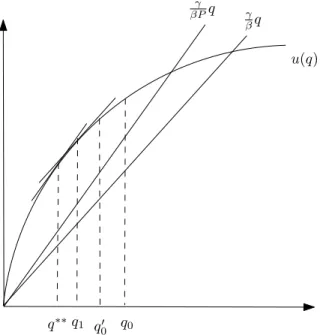
The inequalities hold because of the concavity ofuas well. See Figure4 for illustration.
Then we have the following results for the surplus of genuine money holders.
Sg = π u(q1)− γ βq1 + (1−π) u(q0)− γ βPq0 , < π u(q10)− γ βq 0 1 + (1−π) u(q00)− γ βPq 0 0 , = Sg0.
Therefore, the oer(q00, q01)will make the holder of genuine money better o and the
holder of counterfeits worse o which contradicts (q0, q1) being an equilibrium.
Sg = π u(q1)− γ βq1 + (1−π) u(q0)− γ βPq0 , < π u(q10)− γ βq 0 1 + (1−π) u(q00)− γ βPq 0 0 , = Sg0.
u(q) γ βq γ βPq q1 q∗∗ q0 0 q0
Figure 4: Properties of function u
Therefore, the oer(q00, q01)will make the holder of genuine money better o and the
holder of counterfeits worse o which contradicts (q0, q1) being an equilibrium.
A.5 Proof of Proposition 2
Proof. The decision on counterfeiting requires that the monetary equilibrium with counterfeiting exists if and only ifSg =Sc. Thus we have
P π u(q1)− γ βq1 +P g−(1−π)γ βq0 = 0. (35)
The rst order condition pins downq1 byu0(q1) =γ/β. Next we will show that there exists a pair (P, q0) satisfying equation (35). Denote the LHS of (35) by ∆ (P, q0). From Proposition 1, we know that q0 ∈ [0, q∗∗(P)] in equilibrium. When q0 = 0,
∆ (P, q0)>0for any P ∈(0,1). It suces to show that there exists aP ∈(0,1)such that ∆ (P, q∗∗(P)) < 0. Then we can conclude from the mean value theorem that
there is a q0 ∈[0, q∗∗(P)]such that ∆ (P, q0) = 0.
When P = 0, it implies thatq∗∗(P) = 0, and∆(P, q∗∗(P)) = ∆ (0,0) = 0.
When P = 1,q∗∗(P) =q1, by condition (19) it implies
∆(P, q∗∗(P)) = ∆ (1, q1) = πu(q1)−
γ
βq1+g <0.
A.6 Proof of Lemma 4
Proof. Suppose by contradiction that there exists an active submarket with a = n.
This implies that uninformed sellers produce for genuine money. But then, buyers can gain by paying with counterfeits of the lowest quality because they know for sure that sellers cannot verify, a contradiction.
A.7 Proof of Proposition 3
Proof. Using the fact that d0 =d1 = ˆm and αb =αs = 1, the problem (14) to (18), can be rewritten as max q0,q1 π(H)u(q1) + (1−π(H))u(q0)− γ βP [L+P π(H)q1+ (1−π(H))q0] (36) s.t. Sc= (1−π(H))u(q0)−g(H). (37) The objective function is obtained by substituting (18) into (14) and eliminating the payment mˆ. The rst order conditions for q1 and q0 are
u0(q1) = γ β, (38) u0(q0) = γ βP(1 +λ), (39)
where λ is the Lagrange multiplier of (37).
Suppose on the contrary thatq0 > q1 for any givenP ∈(0,1)in equilibrium. (38) and (39) implies that 1/[P (1 +λ)]<1<1/P. We will show that if a seller deviates
from (q0, q1) by oering (q00, q10) such that q00 =q0−ε and q01 =q1, for any arbitrary smallε >0, he will attract all the genuine money holders by making the buyers using
genuine money better o and those using counterfeits worst o. In this case, P = 1
in his submarket and this leads to a contradiction.
First, we consider the eect of such a deviation by the seller on counterfeiters. From (25) since H is a function of q0 and dH/dq0 > 0, H(q00) < H(q0). Hence
π(H(q00))> π(H(q0)). Thus this results in a lower counterfeiter's surplus.
Second, consider the eect of such a deviation on buyers holding genuine money. Letq∗∗= arg maxq{u(q)−(γ/βP)q}for any given P ∈(0,1). q∗∗ must satisfy
u0(q∗∗) = γ βP > γ β =u 0 (q1).
By the concavity ofu, it must be true that q1 > q∗∗ and u(q1)−(γ/β)q1 > u(q∗∗)−
(γ/βP)q∗∗. Sinceq0 > q00 > q1, it follows that q0 > q00 > q1 > q∗∗ and thus
u(q0)− γ βPq0 < u(q 0 0)− γ βPq 0 0 < u(q ∗∗ )− γ βPq ∗∗ < u(q1)− γ βq1.
The inequalities hold because of the concavity of u as well. See Figure 4 for
illustra-tion. Then we have the following results for the surplus of genuine money holders.
Sg = π u(q1)− γ βq1 + (1−π) u(q0)− γ βPq0 − γ βPL, < π u(q10)− γ βq 0 1 + (1−π) u(q00)− γ βPq 0 0 − γ βPL, < π0 u(q10)− γ βq 0 1 + (1−π0) u(q00)− γ βPq 0 0 − γ βPL, = Sg0.
Therefore, the oer(q00, q01)will make the holder of genuine money better o and the
holder of counterfeits worse o which contradicts (q0, q1) being an equilibrium.
A.8 Proof of Proposition 4
Proof. A monetary equilibrium exists only if P > 0, i.e., some buyers would prefer
to use genuine money. This requires thatSg ≥Sc . From (33) and (5), it means that Sg−Sc=π(H) u(q1)− γ βq1 +g(H)− γ βP (1−π(H))q0− γ βPL≥0, (40)
where q1 satises (32). Notice that from (25), H can be solved as a function of q0, and more importantly dH/dq0 > 0 and H(0) = 0. Thus, let ∆ : R+ → R+ be a function of q0 which represents the left hand side of (40):
∆ (q0) = π(H(q0)) u(q1)− γ βq1 +g(H(q0))− γ βP (1−π(H))q0− γ βPL.
Clearly ∆is dierentiable. For any q0, d∆ dq0 = π0H0 u(q1)− γ βq1 +g0H0 − γ βP (1−π) + γ βPπ 0 H0q0, = π0H0 u(q1)− γ βq1 − u(q0)− γ βPq0 − γ βP (1−π).
The second equality uses the fact thatg0 =−u(q0)π0 from (25). Since q1 is the maxi-mum ofu(q)−γ/βqandP ≤1,(u(q1)−γ/βq1)>(u(q0)−γ/βq0)≥
u(q0)−βPγ q0
. Because π0 <0 and H0 >0, we conclude that d∆/dq0 <0.
Suciency. If q0 = 0, then Sc = 0. Suppose ∆ (0) = π(0) (u(q1)−γ/βq1)−
γ/βL≥0, thenSg ≥0and thus P = 1.By the continuity of ∆ it is possible to nd
Necessity. Obviously, if ∆ (0) < 0, then for any q0, ∆ (q0) < ∆ (0) < 0 which violates condition (40).
The sucient and necessary conditions for the existence of a monetary equilibrium with counterfeiting is Sg =Sc which implies
P π(H) u(q1)− γ βq1 +P g(H)− γ β (1−π(H))q0 = γ βL, (41)
for someP ∈(0,1). Denote left hand side of (41) by ∆ (˜ q0, P). Taking the derivative of∆˜ with respect toq0 andP, we can see that∆˜ is strictly decreasing inq0and strictly
increasing in P, hence ∆ (0˜ ,1) = max(q0,P)∆ (˜ q0, P). Notice that ∆ (˜ q0,0) < γ/βL
for any q0 > 0, if ∆ (0˜ ,1) > γ/βL, then by the mean value theorem, we can nd
(q0, P)in the open neighborhood of(0,1)such that (41) holds and equilibrium exists. When ∆ (0˜ ,1) ≤ γ/βL, no monetary equilibrium with counterfeiting exists because
˜
∆ (q0, P)<∆ (0˜ ,1)≤γ/βLfor all P <1.
A.9 Proof of Results 1 and 2
Proof. The equilibrium conditions for the monetary equilibrium with counterfeiting are summarized by equations (41), (32) and (25). For given q0, rewrite (41) as
P π(H(q0)) u(q1)− γ βq1 +g(H(q0)) = γ β [L+ (1−π(H(q0)))q0]. (42)
Notice from (25), H is xed for given q0, so is π and g. If γ increases, the right
hand side of (42) rises. By the concavity of u, the term inside the bracket of the left
hand side of (42) decreases as γ ↑. Therefore to keep the equality of (42), P must
go up. Similarly, if L goes up, P will rise as well. We establish that dP/dγ >0 and
dP/dL >0.
For given P, totally dierentiate (42), we have dq0 dγ = P πq1+L+ (1−π)q0 βnπ0h0hP u(q 1)− γβq1 −P u(q0)− γβq0 + (1−P)γβq0 i − γβ(1−π)o < 0 and dq0 dL = γ β n π0h0hP u(q 1)− γβq1 −P u(q0)− γβq0 + (1−P)γβq0 i − γβ(1−π)o < 0
A.10 Proof of Result 3
Proof. Rewrite equation (25) asδg00 (H) =−π0(H)u(q0). For givenH, q0 is increas-ing in δ, while for given q0, H is decreasing in δ. Therefore, dP/dδ > 0 is derived
immediately from (42) for any given H. However if q0 is xed, from (42) we obtain
dP dH =− π u(q1)− γβq1+g π0hPu(q 1)−γβq1 −P u(q0)− γβq0 + (1−P)γβq0 i >0. dP dH =− π0hPu(q1)−γβq1 −P u(q0)− γβq0 + (1−P)γβq0 i πu(q1)− γβq1 +g >0. Hence dP/dδ <0.
A.11 Proof of Proposition 5
Proof. The pooling outcome must satisfy the seller's incentive compatibility con-straint (33). Since L≥0, it requires that q0 ≥P q1 for given P. q0 ≤q1 follows from Proposition 1.
The pooling equilibrium exists if and only ifSg ≥Scand the seller has no incentive
to break the pooling oer. This implies
P π u(q1)− γ βq1 +P g− γ β (1−π)q0 ≥ γ βL, (43) π(q0 −P q1) = L, (44)
where q1 satises (32). P < 1 and the rst inequality becomes = if Sg = Sc. Replaceq0 in (43) using (44), we have
πP πu(q1)− γ βq1+g ≥ γ βL. (45)
The rst order condition onH suggests u L π +P q1 π0+g0 = 0. (46)
Therefore, (45) and (46) consist of a sucient and necessary condition for the ex-istence of pooling equilibrium. We want to show that conditions in set B at (34)
satises (45) and (46). Obviously, if(γ, L)∈B, the above condition is automatically
satised by settingP = 1, i.e., monetary equilibrium without counterfeiting. For the
case P <1, it requires that
πP πu(q1)− γ βq1+g = γ βL. (47)
Because from (46), H can be written as a function of P, the left hand side of (47)
can be written as a function of P as well. Denote it as ∆ (P). We want to prove
that ∆ (P) = γ/βL has a solution for some P ∈ (0,1). Since ∆ (0) < γ/βL and
∆ (1)> γ/βL if (γ, L)∈int(B), using the mean value theorem, there is aP ∈(0,1)
such that Equation (47) holds.
A.12 Proof of Result 4
Proof. The equilibrium conditions for a pooling outcome can be written as
P π(H)u(q1)− γ βq1+g(H) − γ β L π(H) = 0, (48) u0(q1)− γ β = 0, (49) π0(H) g0(H) + 1 u L π(H) +P q1 = 0, (50)
by collecting (32), (43) and (46). Let F (P, q1, H) be the left hand side of the above equation system. γ and L are the parameters. The derivative matrix of F with
respect to(γ, L) is D(γ,L,δ)F = −P βq1− L βπ − γ βπ g0 −1 β 0 0 0 − u0(q0) u2(q 0)π − π0 δ2g0 0 ,
where q0 =L/π+P q1, and g0 =g/δ. While the Jacobian matrix of the system with respect to(P, q1, H)is D(P,q1,H)F = πu(q1)− γβq1+g P πu0(q1)− γβ P (π0u(q1) +g0) + βπγL2π 0 0 u00(q1) 0 −u0(q0) u2(q 0)q1 − u0(q0) u2(q 0)P u0(q0)π0L u2(q 0)π2 − π00g0−π0g00 g02 . The determinant of D(P,q1,H)F is det D(P,q1,H)F = u00(q1) πu(q1)− γ βq1+g u0(q0)π0L u2(q 0)π2 −π 00g0−π0g00 g02 + P (π0u(q1) +g0) + γL βπ2π 0 u0(q0) u2(q 0) q1 .
From (48), πu(q1)− γβq1+g >0. And from (50),