IIRA European Congress 2010 Copenhagen, 28 June – 1 July 2010
External and internal flexicurity
1Thomas Bredgaard, Associate Professor, Ph.D. Flemming Larsen, Associate Professor
Centre for Labour Market Research (CARMA)
Department of Economics, Politics and Administration Aalborg University Denmark Ph. +45 9940 2605 Fax: +45 9815 5346 [email protected] [email protected] ABSTRACT
In a remarkably short time, flexicurity has emerged on the global scene as one of the most popular concepts for labour market reforms. In this article we test the boundaries of the relevance of the flexicurity concept by comparing two extreme cases of national labour market regimes, the Danish combination of external flexibility and security with the Japanese combination of internal flexibilities and securities. We stretch the concept to its limits by inquiring whether flexicurity is a viable policy strategy for the challenges facing the Japanese employment system.
INTRODUCTION
The concept of flexicurity – the contraction of flexibility and security – was first coined in the Neth-erlands in the mid-1990s as a policy strategy to improve the working conditions of temporary agency workers (Wilthagen & Tros 2004). After some years of quiet existence, the concept came to the attention of Danish policymakers and academics. In Denmark, it was realised that flexicurity provided a suitable catchphrase to encapsulate specific characteristics of the Danish labour market model (the combination of easy access to hire and fire with a generous unemployment benefit sys-tem and active labour market policies – in other words the “golden triangle”) (Danish Ministry of Labour 1999; Madsen 1999, 2003, 2004). In subsequent reports, the International Labour Organi-sation (ILO) pointed to Denmark as a good example (Auer 2000; Auer & Cazes 2003), and the OECD in its 2004-edition of Employment Outlook canonised the Danish “golden triangle” as an example of best practice (OECD 2004: 97ff.).2
With the adoption of a common set of principles on flexicurity in 2007, the European Council made flexicurity centrepiece in European policymaking in social and employment policies. As a political concept flexicurity provide a convenient compromise between the former antagonisms between Anglo-Saxon and continental European countries (flexibility versus social security), and still permits a clear European position distinct from US-type capitalism (Antoniades 2008). In order to include every EU member state within the framework of flexicurity, the concept of flexicurity is stretched
1
This study was made possible by the generous support of the Foreign Researcher Invitation Program of the Japan Institute for Labour Policy and Training (JILPT), Tokyo, Japan (http://www.jil.go.jp/english/).
2 On the genealogy of the flexicurity concept, see Bredgaard, T., F. Larsen & P.K. Madsen: “Flexicurity: In
beyond the original Dutch and Danish origins, although the inspiration is still clear. During the cur-rent economic crisis, the European Council have insisted on holding on to the principles of flexicu-rity. Flexicurity is still seen as the right approach to modernise labour market and ensure a suc-cessful recovery (DG Employment 2009: 45).
In this article we test flexicurity as an analytical concept for country comparisons and as a political strategy for labour market reforms. This is done by comparing two extreme cases; Danish external flexicurity and Japanese internal flexicurity. The Danish employment system has often been ana-lysed as a (best) case of flexicurity, while the Japanese case has not so far been explicitly inter-preted as a case of flexicurity.3 The main question is whether flexicurity, and especially the particu-lar Danish version of flexibility and security, is a relevant and viable solution to the current chal-lenges confronting the Japanese employment system. The article introduces a new distinction be-tween external and internal flexicurity, which is often neglected in the debate and literature on flexicurity.
In the following, we proceed by defining flexicurity and the distinction between its internal and ex-ternal dimensions. Then we briefly present the main elements of the Danish case of flexicurity. The main objective is then to provide a fresh account of the Japanese employment system from a flexicurity perspective.
THE FLEXICURITY FRAMEWORK
It should be noted that the idea of flexicurity is relatively new, both as a political strategy and as a research field. To put it simplistically, economists have often tended to take a one-sided view of the positive implications of flexibility for labour markets, enterprises and employees, and have tended to perceive income and job security as barriers to competitiveness and economic growth. On the other hand, labour market, social policy and labour law researchers have usually focused more on the positive implications of job and income security for redistribution and welfare, and they have rarely taken into account its consequences for the flexibility of labour market or enterprises (Bredgaard et. al 2005).
The main idea of the flexicurity concept is that flexibility and security are not contradictory but mu-tually supportive. Flexibility is not the monopoly of employers, just as security is not the monopoly of employees. Flexicurity goes beyond a simple trade-off and includes virtuous as well as vicious circles of flexibility and security (Leschke et. al 2006).
In Japan, for example, the lifetime employment practice may induce employees to be loyal to the employer and the employer to invest in firm-specific human capital, thereby increasing functional flexibility. Alternatively, in the Danish case, high levels of income and employment/employability security provided by government taxation may promote workers to take greater risks on the exter-nal labour market, thereby creating higher job mobility. But the relationship between flexibility and security can also be vicious; for instance when hire and fire policies lead to high job insecurity, under-investments in human capital and lower effective demand.
Besides from the win-win combination of flexibility and security another reason for the popularity of the flexicurity concept is its all-embracing and ambiguous character (Barbier 2007). Different actors and organisations can mould the concept to fit their own interpretations and interests. This feature makes flexicurity difficult to define, and it should not come as a surprise that there are different definitions of the concept. Here we will only refer to the three most commonly accepted definitions
3
Without using the concept explicitly Araki (2007a, 2007b) provides an excellent overview of flexibility and security in Japan from a labour law perspective. Similarly, Passet (2003) has provided a succinct description of the traditional Japanese employment system and its current challenges.
in the academic literature: flexicurity as a policy strategy, as a state of affairs on the labour market and as an analytical concept (cf. Wilthagen & Tros 2004; Bredgaard et. al 2005).
Flexicurity as a policy strategy emphasises that attempts to enhance flexibility and security must be deliberate, synchronical and targeted at weaker groups. Even if the European Commission also define flexicurity as a political strategy, it has so far been difficult to identify actual flexicurity strate-gies beyond the original Dutch context. The second definition, as a certain state of affairs or condi-tion on the labour market, opens up for cross-country comparisons of the flexibility-security nexus. In this definition Wilthagen and Tros (2004: 170) maintain that flexibility and security is a trade-off (or zero-sum game). On the one hand labour markets and companies call for increased flexibilities to enhance competitiveness and productivity, while workers with a relatively weak position, on the other hand, should be compensated with high quality labour market participation and social inclu-sion. As mentioned above, we prefer to analyse the flexibility-security nexus by including virtuous as well as vicious circles (positive sum and negative sum game). The consequences of different combinations of flexibility and security are, therefore, open to empirical enquiry. Thirdly, the flexicu-rity concept can be defined as an open analytical framework to analyse configurations and devel-opments in flexibility and security and to compare national labour market systems. This is the defi-nition we will rely on in the following. A clearer distinction between internal and external dimensions of flexibility and security will be introduced.
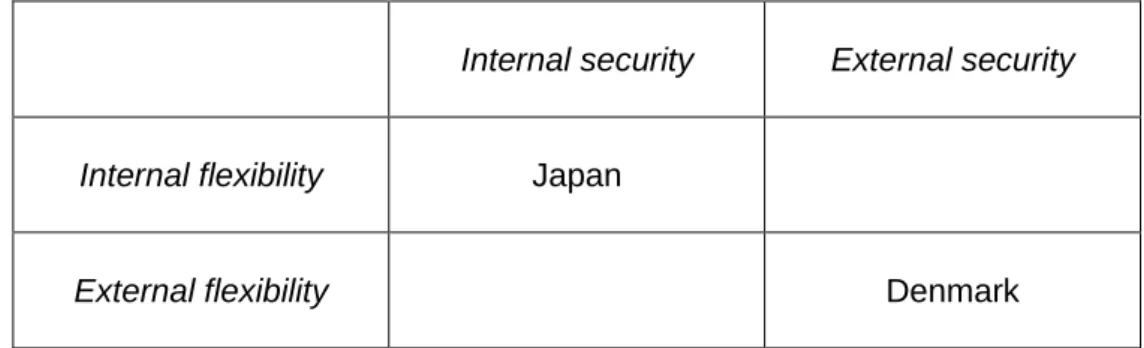
There have been – and still are - major differences between the Japanese and Danish employment system and labour market, which are taken as a starting point for our research. While the Danish employment system is oriented towards the external labour market, the Japanese employment system has traditionally been oriented towards the internal labour market. These different start-points are illustrated in table 1 below.
Table 1: Idealised combinations of flexibility and security in Japan and Denmark
Internal security External security
Internal flexibility Japan
External flexibility Denmark
Internal flexibility include working time flexibility (overtime, short-time, and part-time work), func-tional flexibility (internal job changes, transfers, change of functions and tasks, flexible work or-ganisation, and on-the-job learning), and wage flexibility (pay systems, bonuses, outsourcing). Externalflexibility refers to numerical flexibility on the external labour market (job-job mobility, tem-porary layoffs, fixed term contracts, temp agency work, atypical employment etc.). Internalsecurity includes the securities managed and provided by employers and companies in internal labour mar-kets. This is typically expressed as job security (like employment protection for permanent and atypical workers, including procedures for dismissal, notice period, severance pay), but it may also include income/social security of the employer and corporations and combination securities (like company leave policies). Finally, external security refers to the type of securities managed and financed by the central government (the public budget) like active labour market policies, public funded income and social security, and general rights and transfers for continuing vocational train-ing.
First we describe the main elements of the Danish case of flexicurity. Then we proceed to analyse the Japanese case of flexicurity; the traditional combination of job security and internal flexibility in life-time employment, the current challenges of the labour market model, and suggestions for pos-sible reform paths to take.
THE DANISH CASE OF FLEXICURITY
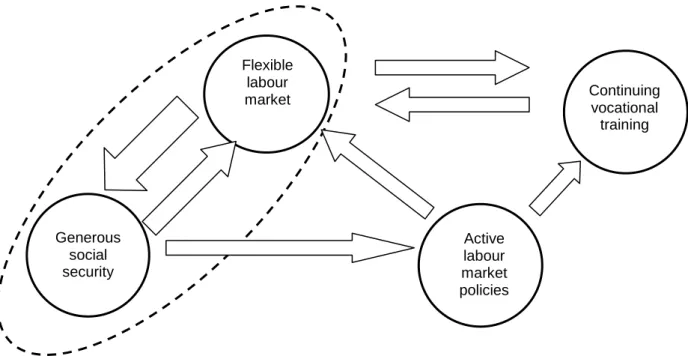
The Danish combination of external flexibility and security is often depicted as a so-called “golden triangle”. This illustration, however, tend to neglect the important and independent role played by adult continuing vocational training (CVT). We, therefore, prefer to depict the Danish employment system as a parallelogram, cf. figure 1 below.
Figure 1: The Danish case of flexicurity
The flexibility of the labour market is indicated by high job turnover and low average tenure. Those who are mobile on the labour market often experience a shorter or longer spell of unemployment, and enter into the second corner of the parallelogram (generous social security). Unemployment benefits have a long duration (4 years) and generosity (up to 90% replacement rate). If unemploy-ment benefits are exhausted, means tested social assistance is available. To avoid disincentive effects, there are stringent criteria for demonstrating availability to search for and take up vacant jobs as well as strict sanctions for refusal to participate in activation programs.
Active labour market policies has two important functions; to motivate the unemployed to find work unassisted (deterrence effect), and to qualify those who cannot find employment on their own (qualification effect). While the labour market reforms of the 1990s were mainly focussed on the qualification effect (combining individual job plans with education and training), the reforms of the 2000s has mainly focussed on the deterrence effect (work first policies combined with making work pay). This changing focus can partly be explained by the economic upturn and labour shortages experienced from the mid-1990s. In both decades, Denmark has had the most expensive labour market policy in the OECD area.
There are a number of unique preconditions of this Danish version of flexicurity, which makes it impossible to replicate in other countries. Despite the numerous labour markets reforms of the last
Flexible labour market labour market Generous social security Active labour market policies Continuing vocational training
two decades, the main characteristics of the unemployment benefit system, the social assistance system and unemployment protection legislation have remained stable for a number of decades. The easy access to hire and fire dates more than a century back, and has remained almost un-changed (except for white-collar workers that were granted extra protection in 1938). Similarly, the unemployment benefit system has its roots in the private unemployment insurance funds ( ar-bejdsløshedskasser) that were constructed by the trade unions in the early 1900s. In 1969 the system took its present form when the central government took over the main financing of the sys-tem on the condition that the unemployment insurance funds accepted a state licensing syssys-tem and abided to implement the new unemployment insurance legislation. Simultaneously, a public employment service was constructed.4 Since financing of the unemployment benefit system was taken over by public budget, this system exempted employers from compensating redundant em-ployees. In effect, the hiring and firing costs of Danish businesses have remained low in interna-tional comparison. In 1976 the social assistance system was systematically reformed as a last safety net provided by the municipalities by local taxation and government reimbursement.
The active labour market policy dates back to the labour market reform of 1994 and subsequent initiatives. This 1994 labour market reform marked a significant shift from a passive to an active labour market. The trade unions in particular made concessions by accepting shorter eligibility periods for unemployment benefits, and the abolishment of the right to regain eligibility to unem-ployment insurance by participating in activation measures. In return, intensified and individually tailored activation policies were replacing passive income support. The government and social partners thereby compromised to replace almost lifelong income security to a higher degree of employment security, the latter combined with motivational elements such as tightening the rules for work availability and the duty of activation. As mentioned above, the labour market reforms of the 2000s have focussed on increasing effective labour supply by introducing work first and making work pay policies. This has changed the balance in active labour market policies, but not the basic complementarity between flexibility and security.
Finally, continuing vocational training for adults (CVT) plays an important role in the functioning of the Danish employment system. A specific institutional characteristic is that CVT is provided for both the employed and the unemployed. Like the unemployment benefit system, the social part-ners plan and administer the CVT system, even if the state government is the main financer. This financing system externalises the costs of training and education from the firms, and indirectly serves as a government subsidy to the competitiveness of Danish industry. Partly as a result of this and the extensive entitlements for participation in CVT, Denmark has for a number of years ranked among the top performers in Europe in relation to participation in CVT activities (Eurostat 2005; OECD 2005). Since the CVT system is predominantly financed by the public budget, CVT activities are more likely to provide general rather than firm-specific skills and more likely to bee transferable on the external labour market. Also, by allowing unemployed workers to improve their general skills during economic downturns, firms are in a better position to compete once the economy improves. This balance between external flexibility and security is preconditioned on a delicate balance of mutual trust between the government and the social partners; i.e. the government trust that the social partners are capable of regulating the labour market by voluntary collective agreements, they trust in their ability to compromise and implement policies with societal coverage, and they invite them to participate in preparation and implementation of relevant decisions. This is not to imply that conflicts do not exist nor that the actors have common interests, but that the viability of
4
From august 2009, the responsibilities of the PES have been devolved to the municipalities. Municipal jobcenters are now fully responsible for financing and servicing all types of unemployed (including recipients of unemployment insurance). A sophisticated financing model has been constructed so that the central gov-ernment refunds most of the expenditures for unemployment benefits and activation programs.
flexicurity builds on a high level of social capital and trust necessary to make negotiated combina-tions of flexibility and security (Bredgaard et. al 2006).
FLEXICURITY IN JAPAN
In the following we apply the flexicurity framework to characterise the relationship between different forms of flexibility and security in Japan. First, we describe the internal security provided through the tradition of long-term or life-time employment, and its current challenges. Second, we describe the variety of internal flexibilities of Japanese corporations, and how these have been stretched to their limits since the recession of the 1990s. Finally, we describe the relative lack of external secu-rities (social security and active labour market policies), and the growing problems of unemploy-ment, non-regular workers, and job insecurity. Empirically, we will rely on existing research reports and data material.5
Internal security: The practice of life time employment
Traditionally, the Japanese labour market model has been characterised by the practice of long-term or life-time employment for the regular workforce, consensual labour-management relations, and high working-time and functional flexibility within large internal labour markets (Araki 2007a; Passet 2003; Kato 2001). In the 1980s, the Japanese production and employment system was held up as best practice and a model that Europe could learn from, particularly by combining job security with a high degree of (internal) flexibility. However, the burst of the so-called “bubble economy” in the 1990s, and the recession and stagflation following in its wake, put Japan under pressure for labour market reforms. This pressure for reform has become even more pronounced with the global financial crisis, rising unemployment rates and increasing labour market dualism, where non-regular workers with lower wages and weaker social protection accounts for one-third of those in employment (OECD 2008; JILPT 2009).
The main axis of flexibility and security in Japan is constructed around the practice of life-time em-ployment. Life-time employment provides high (albeit informal) job security, where job stability and low external numerical flexibility is traded off against high internal flexibility. The internal flexibility consists of in-house mobility within jobs and across tasks, on the job training and retraining, senior-ity wages and working-time flexibilsenior-ity. Traditionally, the Japanese employment system has created job stability and maintenance of employment within firms.6
After World War II when Japan was in economic and material ruin, economic security and protec-tion of minimum standards of living was the highest priority of the government (Araki 2002). Al-though Japanese firms developed flexible mass production and quality circles based on American organisational models, other procedures, such as job evaluation and the lay-off system, were not adopted due to their incompatibility with Japanese traditions and norms. Instead of legal enforce-ment, employers and enterprises developed internal enforcement mechanisms based on long-term
5
In addition we conducted interviews with senior researchers at the Japan Institute for Labour Policy and Training and with representatives of the human resources division of the IT-company Sorun Corporations and the labour relations division of Toyota. In 2007 our initial findings were presented at a seminar at the JILPT and to the councilor for the Minister of Health, Labour and Welfare.
6
Similarly, more than 90% of Japanese labour unions are enterprise-based. Enterprise unionism is a system in which unions are established within an individual company. Unions organise all employees in the same company irrespective of their job and profession. By implication collective agreements only cover the individ-ual company (cf. Araki 2007b).
labour relations and joint labour-management consultation. This means that even during down-turns, corporations have refrained from dismissing employees.7
Lifetime employment is not a contractual state. It is not codified in employment protection legisla-tion or collective agreements, but is rather an informal and mutual expectalegisla-tion between employers and workers. On the basis of these informal practices, the courts gradually accumulated case laws that restricted the right of dismissal by requiring employers to provide “just cause”. A dismissal that lacks objectively rational grounds and is considered socially inappropriate is regarded an abusive exercise of the right and is therefore invalid.8 In 1979, courts further established stringent rules for economic dismissals. Four conditions must be met before regular employees can be dismissed:
1. The employer should be faced with compelling and unavoidable necessity for dismissals 2. The employer should have made every effort to avoid dismissals (e.g. transfers to affiliated
companies, terminating employment of temporary and part-time workers, facilitating early retirement, reducing overtime and suspending new hires)
3. The employer shall consult with trade union representatives and employees before dis-missals
4. The employer shall establish reasonable standards and apply them fairly when selecting workers for dismissal.
In cases of unjust dismissal, employers are not only obliged to pay wages during the whole period of dismissal, but even to reinstate the dismissed employee. Since 2000, several district courts have changed the interpretation of these four requirements to make it easier to dismiss regular workers. Rather than insisting that all four requirements shall be met, the courts should consider if a dis-missal is abusive even if for instance unions have not been consulted (Araki 2002, 2007).
The informal expectations and formal difficulties of dismissals is the backbone of the lifetime em-ployment system. Despite difficulties in measuring the coverage of persons in lifetime emem-ployment, Ono (2006) estimates that roughly 20% of the labour force can be defined as lifetime workers (i.e. workers who were employed immediately after school graduation, and has never been employed by another firm than the current one). This average covers substantial differences by gender, firm size, and education level. For instance, the proportion of lifetime workers among male university graduates in large firms is around 55%. The probability that male workers in government remains in the same job is 65%. The fact that only around one in five workers can be classified as lifetime employees does not mean that the remaining are non-regular fixed-term workers. Around 70% of the workforce is employed in full-time open-ended contracts.
With the recession of the 1990s, however, the proportion of standard workers declined from 80% in 1991 to 70% in 2003. In absolute numbers, standard workers declined by 2 million, while the num-ber of non-standard workers expanded by 6.1 million (Ono 2006). Since 2003, the decline in stan-dard (regular) workers has continued, and the share of non-regular workers climbed to 33.7% in late 2007 (equivalent to more than 17 mil. persons). Despite the dramatic increase in non-regular workers there is still limited evidence of a serious erosion of the practice of life-time employment (Kato 2001; Ono 2006). Rather, the burden of economic adjustment has fallen disproportionately on younger and middle-aged employees with short tenure, particularly women (cf. next section). The recession starting in the early 1990s with low economic growth and increasing open unem-ployment put the lifetime emunem-ployment system and the internal flexibility buffers under severe pres-sure. It became increasingly difficult to maintain and guarantee internal job security without the
7
Despite the fact that most Japanese employers will refrain from dismissals, the current global financial crisis has resulted in open unemployment increasing from 4.1 % to 5.4 % between January and June 2009.
8
steady economic growth that traditionally characterised Japanese society. The main priority of Japanese employers was – and still is - to maintain job stability at the core of the labour market (among middle-aged and older male workers), while allowing fluctuation at the margins of the la-bour market (especially among young persons and women in non-regular employment). This im-plies a stronger bifurcation of the labour market with increasing social and economic disparities. Internal flexibility
A variety of internal flexibility measures are substituting dismissals, including limitations of overtime hours, reassignment of employees, restraint in or discontinuation of hiring new employees and loaning or transferring employees to affiliated companies. During the recession, the need to reduce wage costs by other means than dismissals severely strained the internal flexibility system, and resulted in wage cuts, reduction of (paid) working hours, and fewer promotions. In the following, we will briefly examine changes in the main types of internal flexibility that occurred as a reaction to the recession of the 1990s as well as the current financial crisis.
Working time flexibility: In general, working hours are fluctuating with the business cycle. During a recession, working time for core workers is reduced to avoid dismissals (especially overtime hours), and during economic booms working time is increased. For instance, after the global finan-cial crisis hit Japan in mid-2008, non-scheduled hours worked in manufacturing has been reduced by about 50 %. Despite the legal shift in 1987 towards a five-day and 40 hours working week, ac-tual working hours has remained extremely long in Japan. In 2002, the proportion of workers work-ing more than 50 hours a week was 28% in Japan compared to 20% in the United States, 15% in the United Kingdom, 5% in Denmark, and 1.4% in the Netherlands (cf. Messenger 2004 quoted in Ogura 2006). Workers are subject to unlimited overtime once labour and management reach an agreement allowing overtime. Even if there is an upper limit of 360 hours per year, there are no sanctions for violating this limit. The overtime premium is extremely low compared by international standards, and there is a high level of unpaid overtime (Japan Labour Review 2006). Finally, there is a low take-up of annual paid leaves and holidays.
Wage flexibility: Wages are determined by length of service, age and educational background. It can be understood as a method of deferring payment of wages that provides employees with an incentive to remain employed with the same company for a long time. In principle, wages are set below marginal productivity for those who have been employed for a relatively short time, while wages are offered above marginal productivity for those who have been employed for a longer time. This seniority-based wage system means that wages are not determined by the work per-formed or job content. The wages remain the same even if a worker is internally transferred to a different job or the content of the job is altered. The Japanese seniority wage system is unique since it covers not only white-collar workers, but also blue-collar workers. This has traditionally contributed to reduce wage and income disparities. In contrast to Denmark, companies in Japan are more prone to keep labour excess during an economic downturn. Instead downward wage flexibility and reductions in working hours is the most important buffers to economic fluctuations. Since the recession of the 1990s, companies are moving towards a performance-based wage sys-tem. With the ageing of the workforce and the postponement of mandatory retirement age from 60 to 65 years, the seniority wage system would result in substantial increases in personnel cost (Ya-maguchi 2004). One important consequence is that the implicit contract of setting wages below marginal productivity for newly recruited workers in return for wage above marginal productivity for more experienced workers is broken. The impact of this could be higher job-insecurity for the younger employees, having no assurance of longer term benefits when accepting a low starting salary, as well as senior workers losing earned privileges by serving the same employer for life.
Functional flexibility: As indicated, functional flexibility is also an important pillar of the lifetime em-ployment system. It consist of a range of different measures: transfers between job functions and
tasks (both horizontally and vertically), internal job changes, flexible work organisation, multiple skills of the employees, and on-the-job training. In general, the system works as follow: Newly re-cruited graduates are typically trained by experiencing different types of work in several depart-ments within a company or corporate group (multiple skills). Through such broad job rotation, com-panies can evaluate employee‟s performance and determine the type of work for which they are best suited. These assignments and transfers are carried out together with the management of seniority-based promotions as well as internal competition. In general, an employment contract usually will not specify concrete conditions of employment, which makes functional adaptations possible. Companies adapts to economic downturns by freezing new hires and retiring older work-ers. Before they reach mandatory retirement age, older workers are separated from their employ-ers and transferred to other companies (so-called Shukko or Tenseki).9 In 2003, the number of new graduates hired had fallen by 53% compared to 1997. This contributed to the rise in the un-employment rate to 10 % for young people aged 15-24 years (OECD 2005). This made it difficult for young workers to change job functions and move up in the job hierarchy. There were also fewer opportunities for on-the job training because of the lack of time and money. Therefore, life-time employment became less attractive for younger workers.
To sum up, the response of Japanese companies to the crises in the 1990s as well as the current financial crisis has been cost-containment by applying internal flexibility devices rather than exter-nal flexibility (dismissals). In effect, the core of the life-time employment system seems to be en-dangered, namely the trust in the informal guarantees of life-time job security. In fact, the feeling of job-insecurity is increasing and is among one of the highest in the world (Passet 2003; Boyer 2006). This feeling of lacking job security is also related to the dual labour market structure and the increasing use of external numerical flexibility.
External security: Income and employment security
The system of lifetime employment and internal flexibility is mirrored in a system of low external security. Since the practice of lifetime employment used to deliver job security there was no press-ing need for a pervasive system of external social security or employment security. Labour market policies have been few and put in place mainly to maintain job stability by subsidising job mainte-nance (Passet 2003).10 The outcome is protection of insiders and labour market policies acting as auxiliary policies concerning short-term work, training and transfers between jobs. The low priority on transfers and services to the unemployed is clear from the fact that Japan has one of the lowest expenditures on labour market policies among OECD-countries (OECD 2009). 70-80% of govern-ment revenues for unemploygovern-ment benefits and active labour market policies come from contribu-tory benefits. Premiums for unemployment benefits are collected 50% from employers and 50% from employees, while premiums for labour market policies are collected entirely from employers. This heavy dependence on premiums makes labour market policy sensitive to the fluctuations of the business cycle. During recession when unemployment increases the premiums of employers increase as well, which makes it difficult to break a vicious circle, and provides companies with strong incentives to avoid dismissals. The level of unemployment benefits is also markedly differ-ent in Japan and Denmark.11 The duration of unemployment insurance is 90-360 days in Japan
9
Shukko refers to transfers to another company while maintaining the workers status with the original com-pany. Tenseki refers to transfers to another company dissolving the employment relation with the original company (cf. Araki 2002:132).
10 Since 1975, the employment adjustment subsidy has played a central role in Japan‟s employment policy.
Enterprises in designated industries striving to maintain employment during a downturn are eligible to the subsidy that is granted as partial payment of wages to cover temporary leave allowances or to subsidize training of employees.
11
OECD calculates historical time series and summary measures on the gross replacement rate in percent-age of former wpercent-age showing that in Japan the gross replacement rate has been almost constant around 10%
and there is no last resort safety net after exhaustion.12 Finally, it should be noted that there are strict conditions for eligibility, which is indicated by the fact that the ratio of benefit receipt to total unemployed was only around 1/3 at the end of the 1990s (Passet 2003).13 In that respect, the low priority on active labour market policies and government-financed unemployment benefits is con-sistent with the practice of lifetime employment.14
The Japanese employment system characterised by internal security and internal flexibilities was efficient in the period after World War II. Unemployment rates remained low until the recession of the 1990s, and the employment system provided high job security and stability for regular workers. However, with the collapse of the bubble economy in the early 1990s, Japans long-term employ-ment practice and employemploy-ment policies have faced significant challenges.
From 1990 and until the early 2000‟s the unemployment rate more than doubled. The Japanese employment system was not well-adapted to climbing unemployment. First, external social security was not geared to deal with the problems of reintegrating unemployed people into employment or compensating them for loss of income. Second, unemployment especially affected women and young people. As youth unemployment was climbing there was also a growing incidence of young people in precarious employment (so-called freeters)15 and outside the labour market and educa-tion system (so-called NEET).16 The lack of job-openings and increasing youth unemployment was clearly related to the strong job protection for middle-aged and older workers (Gender 2001). Many young people had no other choice than to find non-regular work, although they would prefer regular standard work. Women were also severely affected by the economic recession. Many women found it difficult to return to their former positions after childbirth, and were pushed into non-regular jobs. The result is an M-shaped labour force participation curve (peaking at the 25 to 29 age group and in the 45 to 49 age group).17 In fact, it is argued that the flexible adjustments of working hours and functions of the lifetime employment system are not conducive to women‟s labour force
throughout the period from the 1960s to 2003. In comparison, gross replacement rates in Denmark has in-creased from around 20% in the early 1960s to 65% in 1995, and then declining to 50% in 2003 (cf. OECD 2006: Tax-Benefit Models, see www.oecd.org).
12
The duration of unemployment benefit entitlements increases with age and years of contribution, and also depends on the reason for unemployment (voluntary job leavers have shorter benefit duration than involunta-ry dismissed or disabled persons).
13
It is also worth noting that Japanese enterprises finances the retirement pension system of their workers paid in proportion to the number of years of service at a specific company and depending on the reason for retirement (voluntary versus mandatory or company requested retirement). Again, this retirement system promotes the longtime employment system.
14
Since the mid-1980s, the government has, however, implemented plans to reduce job disparities between prime-age male workers on the one hand, and the female labour force, the young, middle-aged and older workers on the other hand. The largest programs pays either wage subsidies to increase job opportunities for disabled and older workers, who are referred by the public employment service, or pays subsidies to enterprises continuing to employ workers beyond retirement age. There are also smaller employment pro-grams for depressed regions and employment in SMEs (cf. Passet 2003: 198-99).
15
Freeters are people between the age of 15 and 34 who lack full time employment or are unemployed, excluding housewives and students. They may also be described as underemployed or freelance workers. These young people do not start a career after high school or university but instead usually live as singles with their parents and earn some income from low skilled and low paid jobs. The low income makes it difficult to start a family, and the lack of qualifications makes it difficult to start a career at a later point in life. The number of freeters has risen from 500.000 in 1982 to 2.010.000 in 2006.
16
NEET is a contraction of Not in Employment, Education or Training. It includes the non-labor force popula-tion aged between 15 and 34 years, and those who neither do housework, nor attend school. Their numbers has risen from 400.000 in 1985 to 640.000 in 2005 (JILPT 2006).
17
Moreover, since women have shorter tenure than most men there is a substantial gender wage gap (full-time regular female employee earn 35% less than her male counterpart on average). Women also account for 70% of non-regular workers, who earn considerably less than regular workers.
ticipation (Morozumi 2006). Combined with the lack of childcare facilities, part-time work becomes the solution to reconcile work and family obligations.
The major increase in the number of non-regular workers (part-time, fixed term and dispatched workers) is found among women and young workers. Regulations for hiring and firing temporary employees are relatively liberal. There are no legal restrictions on concluding or renewing a fixed-term contract (except that the fixed-term may not exceed three years). The non-renewal of fixed-fixed-term contracts provides an important source of external numerical flexibility for Japanese companies. Part-time workers (less than 35 hours a week) also provide important external flexibility – as well as cost-reductions - for employers. On an hourly basis, part-time workers are paid only 40% the wages of full-time workers (OECD 2005). Finally, the regulations of dispatch workers (defined as a person who work for a client company but is hired out from a contracting company acting as his/her employer) has been liberalized since the mid-1980s, especially after the 1999 revisions (Araki 2002).
In sum, the recession of the 1990s changed the (internal flexicurity) balance towards more internal flexibility at the expense of job security (and the other security elements in this like seniority-wage, upward functional mobility, etc.). This has created a growing feeling of job insecurity. The labour market became bifurcated into a segment of core workers protected by the continuing practice of lifetime employment, and a growing segment of non-regular workers that are providing companies with numerical flexibility with little or no security attached. This segmentation creates increasing economic disparities and poverty. Especially young people, women and older workers are vulner-able to this situation. Facing the challenges of an ageing society and the future need to increase the participation on the labour market in general, this development is in need to be altered. The question is how. One possible way could be to consider new combinations of flexibility and secu-rity, which is the point of departure in our conclusions.
CONCLUSIONS
In the post-war period, the Japanese employment system combining lifetime employment and in-ternal flexibilities in large inin-ternal labour market created a competitive labour market model with high employment levels (especially for male breadwinners), job stability and low unemployment rates. The lack of flexibility on the external labour market was compensated by an elaborate sys-tem of internal flexibilities (working time flexibility, functional flexibility and wage flexibility).
As the Japanese economy felt into a prolonged recession in the 1990s it also called into question key elements of this Japanese employment system; the practice of lifetime employment, seniority pay system and internal promotion system. The steady economic growth and a constant influx of new graduates which were important preconditions of the lifetime employment system became increasingly difficult to maintain. In order to avoid dismissals, but maintain competitiveness and reduce costs, Japanese companies stretched internal flexibility buffers to their limits. To avoid the automatic increases in salaries (also in the light of a rapidly greying workforce) the seniority-wage system was supplemented with a performance-related pay system honouring merits and capabili-ties, while wage increases remained low or even negative. Overtime work was reduced to save labour costs. Downsizing and restructuring was also achieved by transfers of redundant workers to subsidiaries and affiliated companies. Further, companies refrained from hiring young graduates and opportunities for promotions diminished.
Despite the extensive use of internal flexibility buffers, job stability became difficult to maintain and the use of external numerical flexibility increased. Since the 1990s, there has been a steady in-crease in recruitment of non-regular workers. Non-regular workers increasingly perform the exter-nal numerical flexibility, which cannot be performed by regular workers and, thus, function as shock absorbers to protect regular workers from fluctuating economic circumstances. Non-regular work is
remunerated on a much lower level than regular work, which is one of the main explanations for increasing wage and income disparities in Japan. Furthermore, the job security (wages, bonuses, working conditions, transitions to regular employment) and income security (entitlements to unem-ployment insurance, health insurance, and retirement allowances) of non-regular workers is inferior to that of regular workers. Reluctance to hire new regular workers triggered rising unemployment; especially for young people. Even those young people who manage to enter the labour market were increasingly hired as non-regular workers, and tended to rotate between non-regular jobs. Thus, the youngest generations were hit the hardest by the restructuring and downsizing of Japa-nese corporations, and are to a certain extent not granted access to lifetime employment guaran-tees and job security. The main priority of Japanese companies has been to maintain lifetime em-ployment and job stability for the core of the labour market (especially male middle-aged workers). Downsizing and restructuring instead resulted in increasing fluctuation at the margins of the labour market, especially among young persons and women in non-regular employment. The result is increasing social and economic disparities. This new and more unbalanced combination of flexibil-ity and securflexibil-ity (especially external flexibilflexibil-ity without or with limited external securflexibil-ity) has resulted in an increasing feeling of job insecurity, even among core workers.
There are a number of structural challenges confronting the Japanese labour market which makes a return to the traditional balance between internal flexibilities and securities unlikely. First, the labour force structure is changing drastically because of increased longevity and declining birth rates (fewer younger and more aged workers). The predicted labour shortages will compel Japa-nese employers to fully utilize the labour reserve of young people, women and older workers, who have not fully participated in the labour market so far. Especially women and older workers will probably prefer more diversified and flexible work patterns to reconcile work and family life rather than traditional lifetime employment. Younger workers also seem to have a less negative attitude towards changing jobs on the external labour market compared to older workers. Second, Japa-nese industries are facing intensified global competition on the world market. This will probably lead to an era of slower economic growth, and constant needs to restructure, rationalize and downsize corporations. The traditional job security and lifetime employment will be increasingly difficult to maintain under such external conditions of intensified competition and slow economic growth. However, this does not imply a definitive departure from the core elements of internal flexi-bility and job security, but rather the need to modify some elements of the Japanese employment system in order to maintain its unique qualities.
Policy options towards a new balance between flexibility and security
From this starting point there are at least three different paths towards labour market reforms in Japan: Unprotected mobility, normalisation of non-regular work and protected mobility.
Unprotected mobility: To keep up the existing flexicurity balance for core workers at the internal labour market and respond to the pressure on internal flexibility, as well as the need for external flexibility, one option is to make it even easier to make numerical adjustments by using non-regular workers. Deregulation would then be the answer. Since the 1980s, deregulation has been given high political priority in Japan to open up its domestic market for foreign competition. This deregu-lation drive also spilled over to labour law and employment reforms. Japan‟s inactive external la-bour market and lala-bour laws were blamed for hindering structural reforms and restructuring of companies (Araki 2002: 221). Deregulation would make it easier to hire and fire non-regular work-ers. The level of protection for temporary workers is, nonetheless, already in the lower half of OECD countries, so there might not be much to gain from further deregulation. In any case, further deregulation would result in an even more unbalanced and dual labour market between insiders with strong job protection and outsiders with unregulated working conditions and insufficient job and income protection. This structural imbalance would unevenly affect young people, women and older workers, and might discourage them from increasing their participation and employment
rates. While the traditional combination of internal flexibility and security for the core segment on the labour market might be maintained, the increasing numbers of non-regular workers and unem-ployed persons would only experience flexibility and no (or low) security. As mentioned earlier, the main message of the literature on flexicurity is that flexibility and security are mutually supportive; that is, income, job and employment security are necessary preconditions for a well-functioning and flexible labour market for non-regular workers with possibilities for transitions into regular em-ployment.
Normalisation of non-regular work: The second option is to rebalance flexibility and security for non-regular workers by increasing their job security, income security and employment security. Let us recall the Dutch approach to flexicurity. Not unlike the current Japanese situation, the Nether-lands in the mid-1990s had developed a segmented labour market divided between regular work-ers with high job protection and an insecure labour market for atypical workwork-ers performing external numerical flexibility. The main idea of the 1999 legislation on temp agency workers was the nor-malisation of non-regular work (among other things by setting a maximum period for temp work contracts and granting rights to a permanent contract after three consecutive temporary contracts). In the Japanese case, this would imply enhancing the security of the non-regular workers, and thereby combining the existing flexibility for these groups outside the core labour market with new types of (external) securities. Such a flexicurity balance would improve opportunities for transitions from non-regular into regular work, and turn around the tendency of increasing economic dispari-ties in Japanese society. The challenge is the creation of two kinds of flexicurity: one for the inter-nal labour market (with job-security and interinter-nal flexibility) and another for the exterinter-nal labour mar-ket (with numerical external flexibility and external employment and income security). While it is possible to enhance the income security of non-regular workers, it is more difficult to secure em-ployment if the external labour market only serves as “buffer” for the core labour market, and if there are a low number of transitions between non-regular and regular employment. If that is to be achieved, we are moving towards the third and most pervasive option, namely transforming inter-nal flexicurity towards exterinter-nal flexicurity; that is protected mobility.
Protectedmobility: The third approach to labour market reform requires a rebalancing of traditional flexibility and security in Japan, and a systematic activation of the external labour market. Inspira-tion can be found in the Danish approach to flexicurity by combining a more mobile labour market for core (regular) workers with an extensive active labour market and educational policies for peo-ple in transition between jobs, and income security for non-regular as well as regular workers. We are well aware of the difficulties in exporting the Danish version of flexicurity. One of the challenges in learning from the Danish case of flexicurity is the complexities involved in moving from one con-figuration of levels of flexibility and security to another. This will typically involve one of the parties (especially core workers) accepting some form of increased flexibility (and thus uncertainty) in their working life in order to receive compensation in the form of improved security provided by employ-ers or the government (especially employment security and income security). For the core workemploy-ers this obviously implies the risk of being hijacked by accepting more external flexibility without gain-ing the reward in the form of increased (employment and income) security. Mutual trust created by historical experiences with bargaining processes and maybe supported by some form of govern-ment guarantee seems necessary. Here Japan may have an advantage in its longstanding tradi-tion of joint labour-management consultatradi-tion and cooperative relatradi-tions in the industrial relatradi-tions system. Another challenge in transferring Danish flexicurity lessons is that higher public spending on income security or policies providing more employment security might be hampered by fear of increasing deficits on the public budgets. Such worries may be countered by pointing to the fact that public spending are investments that will be repaid through the longer term growth stimuli from a more flexible labour market. The composition of labour market expenditures could also be shifted away from providing subsidies for job maintenance towards active labour market policies aimed at reintegrating the unemployed (including public vocational training systems, individualised counsel-ling, reintegration plans, and wage subsidy schemes for the unemployed). The objective of this
would ultimately be to improve the functioning of the external labour market and improve transi-tions from unemployment to employment, which would also benefit non-regular workers (especially women and younger people).
One important, albeit rather general, lesson to learn from the Danish case of flexicurity is evidently that an extensive welfare state with high levels of both taxes and social expenditures is not incom-patible with a dynamic and well-functioning labour market. The high degree of flexibility on the Danish labour market is thus supported indirectly through a number of welfare state services, which could serve as inspiration for welfare reforms in Japan:
- Adequate and public child care systems: A well-developed system of childcare is important for creating security for working parents and thus for a flexible supply of especially younger women on the labour market.
- Building public vocational training systems: A comprehensive public system for adult education and training will make it easier to develop flexicurity arrangements, which involves employment security in the upgrading of skills of unemployed workers or workers at risk of unemployment. Public vocational training systems should be geared to provide transferable rather than firm-specific skills and competencies for both unemployed and employed persons, which will im-prove the functioning of the external labour market, and ensure a constant re-qualification of the workforce in the light of intensified global competition on the unskilled and labour-intensive parts of the labour market.
- Improving income and social security systems: Social security is a precondition of job mobility on the external labour market. High income replacement for unemployment increases the risk-willingness of workers, and tends to increase job mobility on the labour market.
These general lessons of the Danish case of flexicurity might be used – not as a blueprint – but as inspiration and guiding principles for current welfare and labour market reforms in Japan. The main objective of such reforms would be to identify a more efficient and equitable combination of flexibil-ity and securflexibil-ity where high-qualflexibil-ity and secure transitions in and out of the external labour market complements the productivity and competitiveness of Japanese enterprises.
References
Antoniades, A. (2008): Social Europe and/or global Europe? Globalization and flexicurity as de-bates on the future of Europe, Cambridge Review of International Affairs, vol. 21, pp. 327-346. Araki, T. (2002): Labour and Employment Law in Japan, Tokyo: The Japan Institute of Labour. Araki. T. (2007a): Changing employment practices, corporate governance, and the role of labour law in Japan. Comparative Labour Law and Policy Journal, 28 (3), 251-282.
Araki T. (2007b): A Comparative analysis of Security, Flexibility, and Decentralized Industrial Rela-tions in Japan, Comparative Labour Law and Policy Journal, 28(3), 443-454.
Auer, P. (2000): Employment revival in Europe. Labour market success in Austria, Denmark, Ire-land and the NetherIre-lands, Geneva: ILO.
Auer, P. & S. Cazes (eds.) (2003): Employment stability in an age of flexibility. Evidence from in-dustrialized countries, International Labour Office, Geneva.
Auer, P. (2007): In search of optimal labour market institutions, pp. 67-99 in H. Jørgensen & P.K. Madsen, eds. Flexicurity and Beyond – Finding a New Agenda for the European Social Model, Copenhagen: DJØF Publishing
Barbier, J.C. (2007): From political strategy to analytical research and back to politics, a sociologi-cal approach of flexicurity, pp. 155-189, H. Jørgensen & PK. Madsen, eds. Flexicurity and Beyond
– Finding a New Agenda for the European Social Model, Copenhagen: DJØF Publishing.
Boyer, R. (2006): Employment and Decent Work in the Era of „Flexicurity‟, DESA Working Paper No. 32.
Bredgaard, T., F. Larsen & P.K. Madsen (2005): The Flexible Danish Labour Market – A Review, Aalborg: CARMA Research Paper 2005:01
Bredgaard, T., F. Larsen & P.K. Madsen (2006): Opportunities and challenges for flexicurity – the Danish example, Transfer – European Review of Labour and Research, 12(1), 61-83
Council of the European Union (2007): Towards Common Principles of Flexicurity – Council
Con-clusions, Brussels, 6 December 2007, SOC 523, ECOFIN 503
DG Employment (2009): Employment in Europe 2009, Brussels: European Commission, Director-ate-General for Employment, Social Affairs and Equal Opportunities.
Eurostat (2005): Lifelong learning in Europe, Statistics in focus, Populations and Social conditions, 8/2005.
Gender, Y. (2001): A Nagging Sense of Job Insecurity: The New Reality Facing Japanese Youth, Tokyo: I-House Press
Japan Labour Review (2006): Special Edition: Current Situation of Work Hours and Vacations in Japan, 3(3)
JILPT (2006): Labour situation in Japan and analysis: General overview 2006/2007, Tokyo: Japan Institute for Labour Policy and Training.
JILPT (2009): Statistical Information, Japan Institute for Labour Policy and Training, April 2009 Kato, T. (2001): The End of Lifetime Employment in Japan?: Evidence from National Surveys and Field Research, Journal of the Japanese and International Economies, Vol. 15, pp. 489-514. Leschke, J., G. Schmid & D. Griga (2006): On the Marriage of Flexibility and Security: Lessons from the Hartz-reforms in Germany, Berlin: Wissenschaftszentrum, Discussion Paper 2006-108. Madsen, P.K. (1999): Denmark: Flexibility, security and labour market success, Employment and Training Papers No. 53, ILO, Geneva
Madsen, P. K. (2003): Flexicurity through labour market policies and institutions in Denmark, in P. Auer and S. Cazes (eds.) Employment stability in an age of flexibility. Evidence from industrialized countries, Geneva: ILO, 59-105.
Madsen, P. K. (2004) „The Danish model of „„flexicurity”: experiences and lessons‟, Transfer, 10 (2), 187-207.
Madsen, P. K. (2005) „The Danish road to flexicurity: Where are we. And how did we get there?‟, in T. Bredgaard and F. Larsen (eds.) Employment policy from different angles, Copenhagen: DJØF Publishing
Ministry of Labour (1999): Arbejdsmarkedsreformerne – en status. Copenhagen: Arbejdsministe-riet.
M. Morozumi (2006): Special protection, equality, and beyond: Working life and parenthood under Japanese labour law, Comparative Labour Law and Policy Journal, 27(4): 513-532.
OECD (2004) Employment Outlook 2004, Paris: OECD. OECD (2005) Employment Outlook 2005, Paris: OECD. OECD (2005): OECD Economic Surveys: Japan, Paris: OECD
OECD (2008): Economic survey of Japan 2008, Paris: OECD. JILPT (2009): Main Labour Eco-nomic Indicators,
OECD (2009): Employment Outlook 2009, Paris: OECD
Ono, H. (2006): Lifetime Employment in Japan: Concepts and Measurements, SSE/EFI Working
Paper Series in Economics and Finance, No. 624, march 2006.
Passet, O. (2003): Stability and change: Japan‟s employment system under pressure, P. Auer & S. Cazes, eds. Employment stability in an age of flexibility – evidence from industrialized countries, Geneva: ILO.
Wilthagen, T. and F. Tros (2004) The concept of „„flexicurity”: A new approach to regulating em-ployment and labour markets, Transfer, 10 (2), 166-187.
Ogura, K. (2006): Contemporary working time in Japan- Legal system and reality, Japan Labour Review, Vol. 3, No. 3, pp. 5-23.
Yamaguchi, K. (2004): The State and Change in “Lifetime Employment” in Japan: From the End of the War through 1995, Research Institute of Economy, Trade and Industry, Research-Review, 2004/11.