Building Governance and
Anti-Corruption in the Philippines’
Conditional Cash Transfer Program
1
Jehan Arulpragasam, Luisa Fernandez, Yasuhiko Matsuda,
Rosechin Olfindo, and Matt Stephens
21. Background
The Philippines is implementing a Conditional Cash Transfer (CCT) program, which is called the
Pantawid Pamilyang Pilipino Program (4Ps). CCT program provides cash to poor households as
long as the beneficiary households comply with the conditions of the program. Health grants are provided for beneficiary households with children 0-14 years old and/or with pregnant women with the conditions that all children 0-5 years old and the pregnant women visit health centers and receive services according to Department of Health (DOH) protocol, all children 6-14 years old undergo de-worming protocol at schools, and the household grantees (mainly women) attend family development sessions at least once a month. Education grants are provided for beneficiary households with children 6-14 years old with the conditions that the children are enrolled in primary or secondary school and maintain a class attendance rate of 85 percent every month.3
Launched in February 2008, the 4Ps has now become one of the largest anti-poverty and social protection programs in the Philippines. Following the successful implementation of CCT programs
in other countries, the Philippines’ Department of Social Welfare and Development (DSWD) pilot-tested the 4Ps to 6,000 beneficiary households in four municipalities and two cities in 2007, with a planned target of 20,000 households. Since then, the 4Ps has expanded significantly in coverage and scale. The economic crises that hit after the program launching, such as the food and fuel price shock in mid-2008 and the global financial crisis towards the end of the year, prompted the government to scale-up the program to cover 376,000 households. As of January 2011, the 4Ps has about 1 million beneficiary households located in 782 cities and municipalities in 81 provinces in all 17 regions in the Philippines. The program is expected to cover 2.3 million households by the end of 2011.
Practical experience from other countries suggests that CCT programs present particular implementation challenges from a governance and anti-corruption perspective. CCT programs
are administratively complex by nature as the operation covers several sectors, are usually large
1 The Governance and Anti-Corruption (GAC) in CCT was financed by Australian Agency for International Development
(AusAID) GAC Externally Funded Output (EFO).
2 World Bank Office Manila, the Philippines. For questions and clarifications about this note, please email to
3 The health grant is PhP500 (US$11) per month per household. The education grant is PhP300 (US$7) per month per child
in the household, up to a maximum of three children, and is provided for 10 months during the year. More information on the 4Ps can be found on the 4Ps website, http://pantawid.dswd.gov.ph/.
The Philippine Social Protection Note series aims to disseminate experiences, good practices, and key findings from the Philippines on the topics related to social protection. It aims to broaden the dialogue on social protection and stimulate public engagement in moving forward the policy agenda. The views expressed here are those of the authors and do not necessarily reflect those of the World Bank.
Public Disclosure Authorized
Public Disclosure Authorized
Public Disclosure Authorized
Public Disclosure Authorized
Building Governance and Anti-Corruption in the Philippines’ Conditional Cash Transfer Program
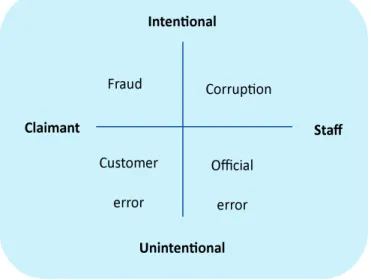
gible beneficiaries to garner political support, staff accept-ing illegal payments from eligible or ineligible beneficiaries, or diversion of funds to ghost beneficiaries or other illegal channels. Figure 1 illustrates how an interaction between a claimant and a program staff can be classified as error, fraud, or corruption depending on their intentions. 5 Based on the
experience of CCT programs in other countries and from the implementation of 4Ps so far, the risks of EFC are most like-ly to emerge in the following areas: targeting, registration, compliance monitoring, payment systems, and procurement of service contracts (Table 1).
Moreover, weaknesses in supply and demand side capacities could severely restrict achievement of program outcomes.The 4Ps requires significant administrative capac-ity of DSWD and, if controls and accountabilcapac-ity mechanisms in the department are weak, the 4Ps implementation can open opportunities for corruption. Moreover, the rapid scale up of the 4Ps may pose challenges that were not obvious during the pilot stage. DSWD handles several other social protec-tion programs, emergency assistance and community devel-opment programs in addition to 4Ps that could put a strain to the limited number of technical staff, thereby increasing the risk of error. Challenges also exist on the demand side of the program, such as lack of knowledge on how the pro-gram operates and the propro-gram’s eligibility criteria, which could increase the likelihood of manipulation of beneficiaries by say, having them pay a portion of grants to a local chief executive.
5 This definition and the illustration of EFC in Figure 1 are taken from
Grosh et al (2008).
in scope, and involve voluminous financial transactions. Multiple actors are involved in the process, which cut across municipal, regional, and national levels. These factors make CCT programs prone to risk of error, fraud, and corruption, resulting in leakages. Experiences with CCT programs in other countries, however, suggest that preventive measures can
be devised to minimize leakages and thus enhance impact.
In particular, having sufficient control and accountability mechanisms is critical to minimize and manage political and administrative risks associated with CCT programs.
The importance of establishing governance and anti-corruption measures in 4Ps is particularly acute given the country context. The 4Ps operates in a political environment
where there is high degree of corruption and where policy-making is highly politicized.4 Government offices are marred
by corruption allegations and government programs, big or small in terms of budget, are plagued by incidences of bribes. Because it involves cash transfers in such a political environment, the 4Ps has been particularly scrutinized by opposition, public, civil society and press as potentially a “political gimmick” by the Arroyo administration, having been launched before the national elections. Moreover, the 4Ps had to stand up to the standard criticism of cash transfer programs that it was a “dole out” rather than a development program. It is because of this context that embedding governance and anti-corruption element to the 4Ps was additionally critical for its integrity, success, and sustainability.
2. The Risks of Error, Fraud, and Corruption in
Implementing the 4Ps
Error, fraud, and corruption (EFC) can reduce the develop-ment impact of a CCT program by reducing the amount of benefits that go to the poor and by eroding program integ-rity. Error is an unintentional violation of program or benefit
rules that results in the wrong benefit amount being paid or in payment to an ineligible applicant. Fraud occurs when a
claimant deliberately makes a false statement or conceals or distorts relevant information regarding program eligibility or level of benefits. Corruption commonly involves manipu-lation of beneficiary rosters, for example, registering
ineli-4 The Worldwide Governance Indicators 2009 estimates the Philippines
to have a Control of Corruption unit of -0.710, which is lower than its Southeast Asian neighbors (Singapore, 2.261; Malaysia, 0.021; and Thailand, -0.230; with higher values corresponding to better governance outcomes). Likewise, the Corruption Perceptions Index 2010 of Transparency International estimates the Philippines to have a score of 2.4, which is also lower than its neighbors (Singapore, 9.3; Malaysia, 4.4; and Thailand, 3.5).
Recognizing these issues, DSWD, in collaboration with the World Bank, incorporated elements of governance and anti-corruption in the implementation of 4Ps. Since the program’s
inception, DSWD has worked closely with the World Bank in putting in place the systems required to successfully implement the 4Ps. Drawing from its experience with the more mature CCT programs particularly in Latin America and the Caribbean, the World Bank provided technical assistance to DSWD with funding from the Australian Agency for International Development (AusAID). The technical assistance included
Targeting
Inclusion and exclusion errors; households may provide false information to be eligible for the CCT grants (fraud); government officials or politicians may implement 4Ps in favored areas even if they do not satisfy the poverty criteria to gain political support or financial gain (corruption).
Registration Politicians may register supporters or exclude opponents; households may not report updated status to keep eligibility for receiving the CCT grants.
Compliance monitoring
Schools and health centers may not report non-compliance of the beneficiaries with the conditionalities; fraud may occur in filling up of compliance verification forms; management information systems may be inadequate to handle compliance data resulting to intentional or unintentional error; compliance monitoring may overburden schools and health centers resulting in errors.
Payment systems
Cash grants are paid directly to the beneficiaries using cash cards. However, for areas that do not have automated teller machines (ATMs), bank officials may charge illegal fees to beneficiaries to access over-the-counter payments.
Procurement of service contracts
Inappropriate or inadequate specifications and terms of reference for procurement may open up window for corruption; delays in procurement may occur, which could result in errors (in encoding, processing forms, etc.).
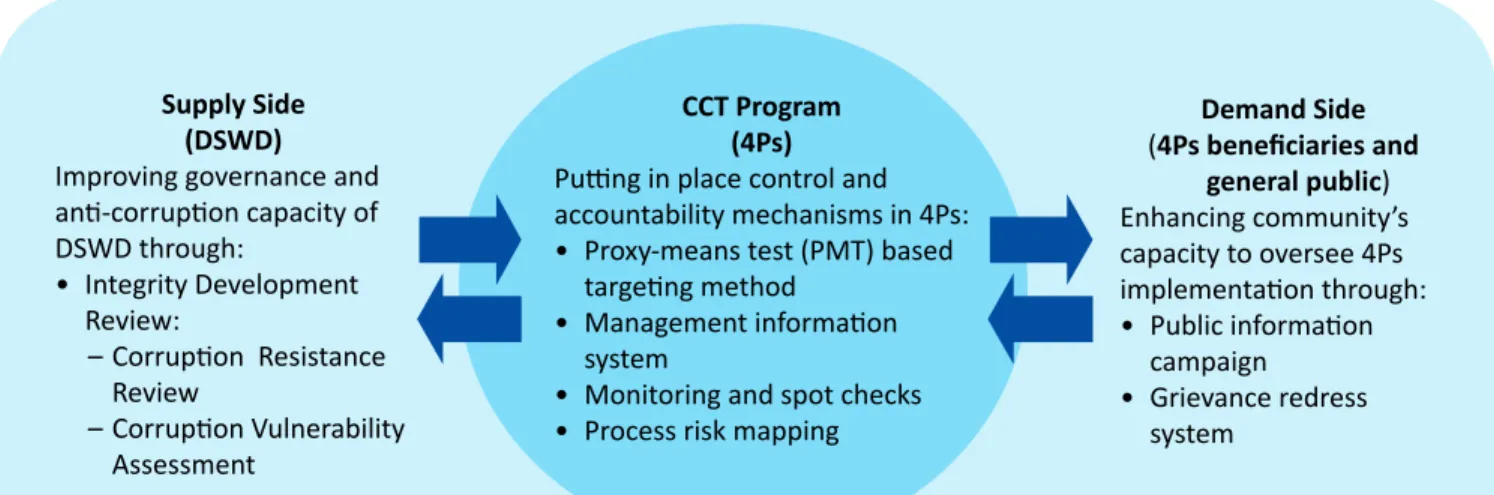
under taking activities that integrate control and accountability mechanisms in the technical design and administrative features of the 4Ps as well as those help improve DSWD’s governance and anti-corruption capacity and enhance the community’s capacity to oversee program implementation. The strong ownership of the governance and anti-corruption agenda by the DSWD senior officials and technical staff has significantly contributed to the successful initial roll out of the 4Ps while mitigating the risk of EFC.
Figure 2. Embedding Governance and Anti-Corruption Measures in 4Ps
Supply Side (DSWD)
Improving governance and anti-corruption capacity of DSWD through: • Integrity Development Review: – Corruption Resistance Review – Corruption Vulnerability Assessment CCT Program (4Ps)
Putting in place control and accountability mechanisms in 4Ps: • Proxy-means test (PMT) based
targeting method
• Management information system
• Monitoring and spot checks • Process risk mapping
Demand Side (4Ps beneficiaries and general public) Enhancing community’s capacity to oversee 4Ps implementation through: • Public information campaign • Grievance redress system
Building Governance and Anti-Corruption in the Philippines’ Conditional Cash Transfer Program
3. Governance and Anti-Corruption (GAC)
Measures in 4Ps
The GAC measures undertaken for 4Ps supported the program’s core technical design and the activities that enhance the program’s supply and demand side capacities.
Figure 2 illustrates the GAC measures undertaken for 4Ps, which can be classified under three components: 1) CCT Program
(4Ps), which included activities that supported the integration of risk-mitigating measures within core program design such as proxy means test (PMT) - based targeting system, management information system, monitoring and spot checks, and process risk mapping; 2) Demand Side, which supported activities that aim to enhance the capacity of beneficiaries and the general public to oversee the program implementation through public information campaign and grievance redress system; and
3) Supply Side, which supported the strengthening of DSWD’s governance and anti-corruption capacity through an Integrity Development Review. The rest of this paper describes the activities undertaken under each of these components and their significance from a GAC perspective.
3.1. CCT Program: 4Ps
Proxy Means Test
DSWD created a household targeting system, which is the National Household Targeting System for Poverty Reduction (NHTS-PR). With technical support from the World Bank,
DSWD designed the NHTS-PR and set up the institutional structure needed to manage its implementation, including the NHTS-PR’s Project Management Office and the Operations Manual that outlines all the implementation details of the targeting system. The NHTS-PR includes the national database of poor households and a specialized Management Information System (MIS) to support its operations. To guarantee data quality, DSWD worked in partnership with the World Bank in improving data entry application, cleaning of the database for possible errors and duplicities, checking the consistency of information in the database, and running validation routines to control quality. These activities are undertaken to avoid errors that could affect the households’ PMT score, thereby minimizing targeting errors.6
The 4Ps uses the PMT-based targeting system to select the beneficiary households and geographic targeting to select the poor areas in the Philippines. The PMT is a widely
used method to objectively determine whether or not a
6 For example, duplicities in the household roster increase the household
size, which could affect eligibility.
household is poor. This is done by statistically estimating the household income based on relevant proxy variables that are highly correlated with welfare status and discriminate
between poor and rich households. This includes household
composition, education, socio-economic characteristics, housing conditions, access to basic services, assets, tenure status, and variables to incorporate regional variation. The household is classified as poor if the estimated income is below the poverty threshold, and non-poor otherwise.7
The PMT is combined with geographic targeting to identify the poor areas in the Philippines. The selection starts with identifying the poorest provinces based on poverty incidence according to the latest Family Income and Expenditure Survey (FIES). Within these provinces, the poorest municipalities and cities are selected based on the poverty incidence of Small Area Estimates (SAEs) at the municipal level. In areas with low poverty incidence and cities, “pockets of poverty” are defined based on data from the Presidential Commission on the Urban Poor and social indicators at the local or barangay level. As of January 2011, the NHTS-PR database contains about 10.2 million households where 4.7 million households were identified as poor using the PMT.
The objective and transparent methodology in selecting the beneficiaries and 4Ps areas helps ensure that the resources go to the intended beneficiaries, thereby minimizing exclusion and inclusion errors. Most social protection programs in the
Philippines, particularly the most significant ones in terms of budget, suffer from high leakages.8 An efficient targeting
system would enhance the government’s ability to design programs to support poor households. The lack of objective targeting had resulted in the proliferation of transfer programs which tend to have their own targeting systems. For many of these programs, the criteria for geographic and/or household targeting are not transparent or standardized. As a result, program targeting has been used for political purposes. This has tended to weaken the general credibility of government programs aimed at targeting the poor, and assessments of these programs show high under-coverage of the poor and high leakage to the non-poor.
7The poverty thresholds used are the official provincial poverty
thresholds published by National Statistical Coordination Board (NSCB) in: http://www.nscb.gov.ph/poverty.
8 For instance, it is estimated that about 41 percent of the untargeted
rice subsidy of the National Food Authority (NFA) goes to non-poor (World Bank, 2010).
Household Information
Stores information from the Household Assessment Form (HAF), PMT results processed by the targeting MIS, and information on eligible households provided by the 4Ps MIS. From the household information, this module produces cross tables or queries and helps check for duplicities of beneficiary households.
Registration
Validates the information provided by households at the assessment stage. As some eligible households may have reported false information, the registration of the beneficiaries’ information is done at assemblies, where household information contained in the database is verified for accuracy. This module produces the final list of registered beneficiary households.
Updates
Gathers, validates, reports, and records the changes that have occurred on the status or condition of any member of the beneficiary household while under the program as well as all other relevant information that could change the eligibility of the household. This module has all the validation routines according to the rules established in the Operations Manual of 4Ps as well as different levels of checking veracity of the updates presented.
Compliance Verification System (CVS)
Serves as a monitoring system for verifying compliance of conditionalities reported by schools and health centers nationwide, controlling payments to beneficiary households, and generating managerial reports and progress indicators. This module links payments of grants to compliance of conditionalities.
Payments
Controls and produces payments to beneficiaries based on reports of compliance and updated household information. The grants are paid directly from the government to the designated accounts of the beneficiaries through the Land Bank of the Philippines (LBP), a government depository bank. The grants can be withdrawn using cash cards (through ATM) or through over-the-counter transaction in LBP branches.
Grievance Redress System (GRS)
Captures, resolves, and analyzes grievances from beneficiaries and non-beneficiaries about the program. This module includes the process of filing and following-up on complaints such as generating forms for complaints, updating and processing the information, assigning a tracking number to every complaint as well as the person responsible for solving it, and producing reports of complaint resolution.
Management Information System (MIS)
To ensure the quality of information that flows in all stages of the 4Ps implementation process, an MIS handles the database and all data processing requirements for the 4Ps. Experience from other countries indicates that MIS is
the backbone of CCT programs. The MIS for 4Ps manages all flows of information at different levels—national, regional, and municipal levels, and is guided by the Operations Manual for the 4Ps.9 The MIS makes use of information and
9 The MIS is an integrated web-based system connected through a dedicated
network between 17 DSWD’s regional offices and its National Project Management Office (NPMO). The MIS software was developed using open source applications following the guidelines of government agencies in the Philippines.
communications technology that handles all data processing requirements and maintains the database for 4Ps, which could be prone to unintentional human error if done manually. The MIS for 4Ps is designed to include six integrated modules
as shown in Table 2.
Given the importance of MIS in automating the processes in 4Ps implementation, DSWD worked with international experts in developing the MIS. As the Philippines ventured
into the CCT program with no experience in this type of programs, DSWD worked closely with international experts on CCT programs and MIS in designing the flows of operations for its own MIS modules such as the Updates, CVS, and GRS; drafting of the forms for compliance monitoring, Updates, and GRS; and preparing the respective modules for Updates, CVS, and GRS for pilot-testing. This has been made possible
Building Governance and Anti-Corruption in the Philippines’ Conditional Cash Transfer Program
with the financial and technical support from donor agencies such as the World Bank and AusAID. The modules of the MIS were developed to produce automated reports, such as non-attendance reports from compliance verification system, and to update the database to make payments accordingly. Given the load of data that flows between processes and the level of technical details necessary to implement the 4Ps, these refinements helped DSWD in ensuring that the MIS can effectively support the operations of the 4Ps. As of December 2010, all software needed to operationalize the modules of the MIS became fully operational. Nonetheless, DSWD is continuously developing the system to ensure data security.
Spot Checks
Monitoring and “spot checks” are conducted to further improve the internal quality control and correction mechanisms in the 4Ps. One of the good practices emerging
from the Latin American experience on CCT programs is to conduct periodic third-party ex-post reviews of the key aspects of the program design and implementation (spot checks). Spot checks are rapid evaluation instruments that seek to determine quality, effectiveness and efficiency of the program such as design, operational management, institutional structure, payments, and the monitoring system. Spot checks provide information about the execution of the different processes of the program, which can serve as the basis for a deeper analysis of the program operation at different levels and among the
stakeholders involved.10 Beyond its technical merits, spot
checks are a key to enhancing the governance, transparency, and accountability of the 4Ps as they validate the range of players involved in the program delivery. Spot checks can also deter fraud and corruption as regional offices may fear being subjected to a spot check in the future. DSWD has adopted a methodology for spot checks for 4Ps, which was developed jointly with the World Bank. The spot check methodology includes interviews with 4Ps beneficiaries, Parent Leaders,
Municipal Links, health providers, school teachers, banks, local
governments, regional offices, central office, as well as review of health facility records and school attendance records.11
10 For instance, a survey conducted by World Bank on attendance
indica-tors for health and education revealed the way the schools and health centers keep records.
11 The methodology was pilot-tested in February to May 2010 in Northern
Samar to assess some of the major steps in the 4Ps process such as compliance with conditionalities, payment process, process of updates, education and health services provision, knowledge of beneficiaries about the program, among others. By November 2010, DSWD started do-ing full spot checks every 6 months to monitor performance of the 4Ps.
Process Risk Mapping
A Process Risk Mapping (PRM) exercise helped to identify and plug vulnerability leaks in key stages of 4Ps implementation. The PRM identified and highlighted
decision-points where program implementers at the national and sub-national levels have a high degree of discretion, unguided by project procedures. Conducted jointly with the World Bank in the four pilot areas in 2008, the PRM for 4Ps mapped out decision-making points step-by-step for geographic selection, household targeting, registration, compliance monitoring, and payment. Wide discretion opens up the potential for fraud or corruption. The findings of the PRM exercise served as inputs in devising measures to mitigate the risks in implementing the 4Ps. The review of 4Ps implementation experience in the pilot phase identified points of vulnerability in the program delivery chain. The exercise found that most of the potential problems were attributed to the rapid scale-up of the program relative to the implementing capacity of DSWD and the readiness of systems in place to operationalize the 4Ps. Significant attention has since been placed on strengthening the staffing of key areas of program implementation.
3.2. Demand Side: Beneficiaries and
General Public
Strategic CommunicationsDSWD conducted activities to build support of the public and key opinion-makers for the 4Ps and ensure that information to support project implementation reached beneficiaries and relevant government staff. With assistance from the
World Bank, DSWD formulated a strategic communications plan outlining activities targeted for various groups, including 4Ps beneficiaries, non-government organizations, civil society, and media, among others. In terms of building public support, the plan includes orientation sessions on 4Ps to strategic audiences and channels for communications such as workshops, television appearances by key DSWD officials, posters and flyers, websites, etc. On the operational side, the plan supported specific behaviors, for instance: to ensure parental awareness of the CCT program conditionalities; to discourage pawning of the beneficiaries’ cash cards (or ATM cards); to encourage the submission of grievances; to prevent municipal and city mayors from adding new conditions; and to stop bank staff from charging fees for cash withdrawals. Social marketing for 4Ps is intended to promote public acceptance and win the support of key players to successfully implement the program on a broader and more sustainable scale. The plan is yet to be implemented by
having initially been subjected to strong public criticism. Indeed the initial push on the communications strategy can be assessed as having been notably successful.
Grievance Redress System (GRS)
The GRS aims to capture, resolve, and analyze grievances about the 4Ps. The GRS design for 4Ps includes a grievance
database, which tracks the nature, origin, location and status of complaints such as targeting errors, payment irregularities, fraud, and corruption. With World Bank’s technical support, DSWD drafted the GRS Manual, which is a comprehensive guide for consistent handling of complaints. As stated in the manual, multiple channels can be used to submit grievances—through the Municipal Link; direct to 4Ps offices; via an SMS hotline, email, letter, and fax; and drop boxes at the barangay level. Simple GRS forms have been developed for wide distribution to beneficiaries, Parent Leaders, Municipal Links, Barangay Captains, government officials and local NGOs. DSWD has established a two-person Grievance Redress Unit at the Central Level and designated grievance redress staff at the regional level to resolve complaints within a set timeframe stipulated in the GRS Manual. The Grievance Redress Unit is charged with preparing regular reports for DSWD management on the volume and status of grievances as a means of identifying systemic vulnerabilities in project implementation or design. In addition, there are communications programs (brochures, posters, training, etc) to educate the public and program staff on the existence of the GRS.
3.3. Supply Side: DSWD
Integrity Development Review (IDR)
To help mitigate potential governance risks, DSWD conduct-ed an IDR with a view to strengthening its department-wide control and accountability mechanisms. Along with the mas -sive scale up of the program, government resources that go to 4Ps also increased significantly.12 Managing this increase
and a project of the scale of the 4Ps has naturally strained the capacity of the department’s integrity systems. Fur-thermore, the size and nature of the 4Ps has raised DSWD’s profile, including among parties who might wish to exploit
12 According to DSWD, the total budget allocated for 4Ps In 2008 was
about P1.3 billion. As the program expanded, the budget increased to P8.3 billion in 2009, P10 billion in 2010, and P21 billion in 2011.
ruption resistance mechanisms.13 The IDR applies two review
tools—the Corruption Resistance Review (CRR) and the Cor-ruption Vulnerability Assessment (CVA).14 The World Bank,
together with a number of Philippine government agencies, worked to refine and revise the existing IDR assessment and survey tools to be more evidenced-based, objective, and aligned the functions of the agency. Although a number of vulnerabilities were identified requiring management action, the IDR results were positive for DSWD.
4. Lessons Learned
Building a governance and anti-corruption element in the implementation of 4Ps has imparted several lessons: • It has been essential to take into account and embed GAC
considerations throughout the design of 4Ps. The work
has revealed the known fact that CCT programs intrinsically need strong GAC elements. The GAC activities undertaken have been critical to getting such a large program rapidly off the ground with success, especially in the challenging governance context of the Philippines. Moreover, it was precisely some of the GAC elements described above that
made the program more acceptable to the populace that
has been generally skeptical of the intent of government
programs.
• Strong ownership of the GAC agenda at the highest levels of DSWD, and in particular the Secretary, was key to successfully embedding GAC measures in 4Ps.
The centrality of close, regular senior input from the government has been a significant factor in building GAC into the 4Ps program design. Technical discussions between the World Bank team and DSWD were fruitful as they lead to concrete actions.
13 The IDR methodology was originally developed by the Development
Academy of the Philippines (DAP) in collaboration with the Philippines’ Office of the Ombudsman (OMB), drawing partially on tools formulat-ed by the Independent Commission Against Corruption (ICAC) of New South Wales, Australia and the US Office of Budget and Management.
14 The CRR provides a quick scan of integrity building and corruption
pre-vention measures used by the agency in its policies and operations, cov-ering a range of different institutional functions such as procurement, financial management, human resource management and internal au-dit Meanwhile, the CVA provides an assessment of the existing risks and vulnerabilities to corruption or fraud with respect to specific organiza-tional functions or processes.
Building Governance and Anti-Corruption in the Philippines’ Conditional Cash Transfer Program
• Targeted communication has been integral in winning public support for the program. The program came under
heavy criticism by influential opinion-makers early on, but now it has become the Government’s flagship anti-poverty program. The strong public support for the program can help minimize the incentives for EFC, given the challenges in the local environment where 4Ps operates. The concerted actions under the strategic communication component of this task at the right time were critical in overcoming the early hurdle of skepticism and designing the communication strategy.
• DSWD’s commitment to integrity enables the agency to face the implementation challenges of 4Ps. Despite the
rampant corruption in the government, DSWD is among the government agencies that are committed to integrity.15
Maintaining adequate controls and mechanisms that can minimize corruption while implementing the 4Ps is crucial. This corresponds to the general interest of DSWD management to keep DSWD’s reputation as one of the best performing and least corrupt agencies in the government.
• Most GAC activities were mainstreamed through the 4Ps operations. The GAC measures did not operate
in isolation, but were delivered in parallel with the development of the program’s Operations Manuals and, therefore, mainstreamed through the operations and
generated impact.
15 Since 2006, DSWD has consistently ranked at the top, among national
government agencies, in Pulse Asia’s quarterly polls measuring public awareness and agency performance. DSWD was rated higher than 99 other government agencies in terms of compliance with requirements of the 2008 Integrity Development Action Plan—the government’s score card for rating agency corruption prevention, deterrence and investigation efforts. Moreover, the Presidential Anti-Graft Commission has recognized DSWD above all others for achievement in integrity development and anti-corruption efforts since 2007.
References
Department of Social Welfare and Development (2009a), Operations Manual for the National Household Targeting for Poverty Reduction.
Department of Social Welfare and Development (2009b), Operations Manual for the Pantawid Pamilyang Pilipino Program.
Department of Social Welfare and Development (2010), “Pantawid Pamilyang Pilipino Program”, available: http://pantawid.dswd.
gov.ph/
Fernandez, L. (2009), “Targeting Mechanism Used to Select Beneficiaries for the Pantawid Pamilyang Pilipino Program,” Social Welfare and Development Journal, 3(1): 11-16.
Grosh, M., del Ninno, C., Tesliuc, E. and Ouerghi, A. (2008), For Protection and Promotion: The Design and Implementation of Effective Safety Nets, World Bank, Washington, DC.
National Statistical Coordination Board (2010), Poverty Statistics, available: http://www.nscb.gov.ph/povery
National Statistics Office (2006), Family Income and Expenditures Survey, public use file.
Stephens, M. (2009), “Governance and Anti-Corruption in the Pantawid Pamilyang Pilipino Program,” Social Welfare and Development Journal, 3(1): 27-34
Transparency International (2010), Corruption Perceptions Index 2010, available: http://www.transparency.org/policy_research/ surveys_indices/cpi/2010/results
World Bank (2007), “Control and Accountability Mechanisms in Conditional Cash Transfer Programs: A Review of Programs in Latin America and Caribbean,” Operational Innovations in Latin America and The Caribbean, 1(1).
World Bank (2009a), Department of Social Welfare and Development Integrity Development Review 2009 Integration Report, draft.
World Bank (2009b), Governance Matters 2009: Worldwide Governance Indicators, 1996-2008, available: http://info.worldbank. org/governance/wgi/index.asp
World Bank (2010c), “Philippines: Fostering More Inclusive Growth”, available: http://go.worldbank.org/2FY5ZEWCV0