Notification of data breaches under the
continuous disclosure regime
Rouhshi Low,
*Mark Burdon
†and Paul von Nessen
‡ Consumer personal information is now a valuable commodity for most corporations. Concomitant with increased value is the expansion of new legal obligations to protect personal information. Mandatory data breach notification laws are an important new development in this regard. Such laws require a corporation that has suffered a data breach, which involves personal information, such as a computer hacking incident, to notify those persons who may have been affected by the breach. Regulators may also need to be notified. Australia currently does not have a mandatory data breach notification law but this may be about to change. The Australian Law Reform Commission has suggested that a data breach notification scheme be implemented through the Privacy Act 1988 (Cth). However, the notification of data breaches may already be required under the continuous disclosure regime stipulated by the Corporations Act 2001 (Cth) and the Australian Stock Exchange (ASX) Listing Rules. Accordingly, this article examines whether the notification of data breaches is a statutory requirement of the existing continuous disclosure regime and whether the ASX should therefore be notified of such incidents.I Introduction
The increased collection of personal information for business purposes has been a key requisite of e-commerce systems. Personal information is now a valuable asset that is prized by both corporations and by identity theft criminals. The acquisition of personal information by unauthorised third parties has therefore taken on a much greater prominence including an increased media and legal interest in the reporting of data breaches. Data breaches involving the unauthorised disclosure of personal information can take several forms.1 For example, computer hacking incidents that take advantage of ineffective information security measures,2the misappropriation
* Lecturer, School of Accountancy, Queensland University of Technology.
† PhD Candidate/Research Associate, Faculty of Law/Information Security Institute, Queensland University of Technology.
‡ Professor, Business Law and Taxation, Monash University and Consultant, McCullough Robertson Lawyers. The authors gratefully acknowledge funding from Australian Research Council Grant DP0879015 ‘A new legal framework for identifying and reporting Australian data breaches’.
1 See discussion at Part VB below for an overview of existing taxonomies.
2 See, eg, Federal Trade Commission,CardSystems Solutions Settles FTC Charges, Federal Trade Commission, Washington DC, 2006, at <http://www.ftc.gov/opa/2006/ 02/cardsystems_r.htm> (accessed 23 April 2010); J Pereira, ‘Breaking The Code: How Credit-Card Data Went Out Wireless Door — In Biggest Known Theft, Retailer’s Weak Security Lost Millions of Numbers’,The Wall Street Journal, New York, 4 May 2007, A1.
of personal information by employees,3 the theft of computer equipment or storage media,4 the improper decommissioning of storage media5 or the inadvertent publication of personal information.6 In total, over 341 million records containing personal or sensitive person information have been disclosed in the United States since 2005.7
US state-based legislatures have responded to these failures by developing a new subset of law, data breach notification law, that encompasses elements of privacy law, corporate governance and the newly burgeoning information security law.8 These laws attempt to minimise the potential risk of identity theft arising from data breaches and were required because corporations were reluctant to notify data breaches either to potentially affected individuals or regulatory authorities.9 The primary reason why organisations declined to notify was the negative publicity that would be generated from the breach and the concomitant potential damage to stock prices and to corporate reputation.10
The first data breach notification law, implemented in California, had an
3 See, eg, Computer Security Institute and Federal Bureau of Investigation, ‘Computer Crime and Security Survey’, Computer Security Institute and Federal Bureau of Investigation, Washington, 2006.
4 See, eg, Department of Veterans Affairs Office of Inspector General, ‘Review of Issues Related to the Loss of VA Information Involving the Identity of Millions of Veterans’, Department of Veterans Affairs, Canberra, 2006.
5 See, Treasury Inspector General for Tax Administration, ‘The Internal Revenue Service is Not Adequately Protecting Taxpayer Data on Laptop Computers and Other Portable Electronic Media Devices’, Treasury Inspector General for Tax Administration, Washington DC, 2007.
6 See, eg, Nj.Com,NJ Accidentally Reveals Personal Data of 28K Unemployed Residents, New Jersey, 2009, at <http://www.nj.com/news/index.ssf/2009/05/3k_unemployed_ nj_residents_may. html> at 9 June 2009 (accessed 20 July 2010).
7 Privacy Rights Clearinghouse, A Chronology of Data Breaches, Privacy Rights Clearinghouse, San Diego, 2009, <http://www.privacyrights.org/ar/Chron DataBreaches.htm#CP> (accessed 21 March 2010).
8 See eg, T J Smedinghoff, ‘Trends in the Law of Information Security’ (2005) 17(1)
Intellectual Property & Technology LJ1.
9 See, eg, Assembly Committee on Business and Professions, ‘Hearing Note SB1386’, Assembly Committee on Business and Professions, California, 2002, regarding background to the development of the Californian law and the basis for its implementation.
10 See, eg, Computer Security Institute and Federal Bureau of Investigation, above n 3. Studies also confirm a negative effect on share price but this is not a uniform result of data breaches. See A Acquisti, A Friedman and R Telang, ‘Is There a Cost to Privacy Breaches? An Event Study’, Paper presented at the 27th International Conference on Information Systems, Milwaukee, USA, 2006; K Campbell et al, ‘The Economic Cost of Publicly Announced Information Security Breaches: Empirical Evidence from the Stock Market’ (2003) 11(3)Jnl of Computer Security431; K M Gatzlaff and K Mccullough, ‘The Effect of Data Breaches on Shareholder Wealth’ (2010) 13(1)Risk Management and Insurance Review61; R Hasan and W Yurcik, ‘Beyond Media Hype: Empirical Analysis of Disclosed Privacy Breaches 2005–2006 and a DataSet/Database Foundation for Future Work’, Paper presented at the The Workshop on the Economics of Securing the Information Infrastructure, Washington DC, 23 October 2006; M Ishiguro et al, ‘The Effect of Information Security Incidents on Corporate Values in the Japanese Stock Market’, Paper presented at the The Workshop on the Economics of Securing the Information Infrastructure, Washington DC, 23 October 2006; K Kannan, J Rees and S Sridhar, ‘Market Reactions to Information Security Breach Announcements: An Empirical Analysis’ (2007) 12(1) International Jnl of Electronic Commerce69. See also discussion at Part VC below regarding US studies in relation to share price loss.
imminent effect in exposing the number and scale of data breaches involving corporations registered in that state. Data breach notification laws quickly spread throughout other US state legislatures and a number of bills have been put forward at the federal level but no law has yet been implemented.11In 2008, the Australian Law Reform Commission (ALRC) released its final report reviewing the operation of Australian privacy law under the Privacy Act 1988 (Cth). In relation to data breach notification, the report concluded that there was general support for the introduction of a mandatory national data breach notification scheme in Australia.
However, it is possible that notification of data breaches to the Australian Stock Exchange (ASX) may already be required under the continuous disclosure regime founded under the Corporations Act 2001 (Cth) and the ASX Listing Rules. The continuous disclosure obligations under the Corporations Act and the Listing Rules require a corporation to inform the ASX of information where the corporation is or becomes aware of any information concerning it which could materially affect its share price or the value of its securities.12 It is possible that this regime could already apply to data breaches and notification would consequently be required to the ASX. This article will therefore examine whether the notification of data breaches is required by the continuous disclosure regime under the Corporations Act and Listing Rules and, if so, whether it is an appropriate regime for the notification of data breaches in Australia.
Part II of the article provides an overview of data breach notification law including Australian developments. Part III provides a brief overview of the legislative development of the continuous disclosure regime in Australia and outlines the legal framework currently in operation. Part IV identifies the requirements that must be met under the Corporations Act and the Listing Rules in order to attract the continuous disclosure obligations. Part V investigates whether data breaches fall within these requirements so as to require notification of such incidents to the ASX. Finally we conclude the article in Part VI by contrasting the fundamentally divergent purposes of continuous disclosure and data breach notification which suggests that the former is not an appropriate regulatory vehicle for the notification of security breaches involving consumer personal information.
II Data breach notification law and Australian
developments
Although forms of mandatory data breach notification existed prior to the development of US state-based laws,13 the inception of these laws are normally associated with the United States, particularly the rapid proliferation of state-based laws that started with California in 2003. The first data breach notification law, Californian Civil Code § 1798.29(a), has been widely used as
11 See B St Amant, ‘Misplaced Role of Identity Theft in Triggering Public Notice of Database Breaches’ (2007) 44 Harvard Jnl on Legislation 505 regarding details of US Federal proposals.
12 ASX Listing Rule 3.1 and Corporations Act s 674.
13 See E Preston and P Turner, ‘The Global Rise of a Duty to Disclose Information Security Breaches’ (2004) 22John Marshall Jnl of Computer & Information Law457 at 465.
a model by other US state legislatures.14 The Californian law requires any Californian business which has suffered a data breach of unencrypted and computerised personal information, and which entails an unauthorised acquisition by another person, to notify Californian residents about the incident. The purpose of Californian Civil Code § 1789.29 is consequently directly linked to the mitigation of identity theft. The law was intended to provide a degree of protection for persons who may have been adversely affected by a data breach by giving them an opportunity to mitigate themselves from the negative consequences flowing from the breach, such as losses occurring from identity theft.15
Affected individuals are to be notified within a timeframe that is expedient and without reasonable delay.16 However, some states have also instigated specific deadlines.17Some states also require law enforcement agencies to be notified of any security breach and other states also require notification to credit reference agencies.18A case in point is the notification requirements of the Interagency Guidelines.19 These are guidelines developed by several Federal Government agencies involved in financial regulation that inform financial institutions about how and when to notify a breach which also require notification to regulatory authorities.20Virtually all state-based laws have exceptions that allow organisations to delay the notification of a data breach under certain circumstances, such as whether notification would impede a criminal or civil investigation.21 Different laws also apply to different types of organisations.22
Notification can also take different forms. Almost all state laws expect that
14 See a list of all US state-based laws at National Conference of State Legislatures,State Security Breach Notification Laws, National Conference of State Legislatures, Washington DC, 2009, <http://www.ncsl.org/IssuesResearch/TelecommunicationsInformation Technology/SecurityBreachNotificationLaws/tabid/13489/Default.aspx> (accessed 4 May 2010).
15 T J Smedinghoff, ‘Security Breach Notification — Adapting to the Regulatory Framework’ (2005) 21(12)The Review of Banking & Financial Services1.
16 See, eg, S C Honeywill, ‘Data Security and Data Breach Notification for Financial Institutions’ (2006) 10 North Carolina Banking Institute 269 at 300, regarding the importance of timely notification; S L Markus, ‘Unfair Warning: Breach Notificaiton in the FCC’s Enhanced Telephone Records Safeguards’ (2008) 18Cornell Jnl of Law and Public Policy247 at 262 detailing reasons for the need for timely notification.
17 See F J Garcia, ‘Data Protection, Breach Notification, and the Interplay between State and Federal Law: The Experiments Need More Time’ (2007) 17(3) Fordham Intellectual Property, Media & Entertainment LJ693 at 709 outlining different approaches; M Turner,
Towards a Rational Personal Data Breach Notification Regime, 19, 2006, at <http://www.infopolicy.org/files/downloads/data_breach.pdf> (accessed 20 August 2010) outlining the rationale of expedient notification.
18 See J Heitzenrater, ‘Data Breach Notification Legislation: Recent Developments’ (2008) Winter 2008–09I/S: A Journal of Law and Policy for the Information Society661 at 672 regarding a brief overview of law enforcement notification.
19 Office of the Comptroller of the Currency et al, ‘Interagency Guidance on Response Programs for Unauthorized Access to Customer Information and Customer Notice’, Office of the Comptroller of the Currency et al, Washington DC, 2005.
20 See P M Schwartz and E J Janger, ‘Notification of Data Security Breaches’ (2007) 105(5)
Michigan L Rev916, regarding application of the guidelines. 21 See, eg, Garcia, above n 17, at 708.
22 See M G Bingisser, ‘Data Privacy and Breach Reporting: Compliance with Varying State Laws’(2008) 4(3)Shidler Jnl of Law, Commerce & Technology1.
notification should be provided in writing, either by letter, or by email, as long as an individual has consented to receive notification by email and as long as it is in accordance with federal law.23 However, breached organisations can also provide substitute notice in situations where the cost of providing individual notice amounts to a certain sum or involves a certain number of persons, such as $US250,000 or 500,000 persons respectively under the Californian law.24In these circumstances, breached organisations can post a conspicuous notice on their website and notify all major state-wide media outlets about the breach.25
Some data breaches are exempt from notification. If breached information is publicly available then it is already deemed to be in the public domain so there is little risk of identity theft materialising from the breach.26A general exemption also exists relating to ‘good faith acquisitions’ of personal information by an employee or agent of the breached organisation. Furthermore, state-based data breach notification laws generally only require notification for unencrypted forms of personal information.27The Californian law does not define encryption.28Other states have attempted to further extend the boundaries of the Californian encryption exemption to include further elements.29 Other states have also attempted to define encryption but have done so in different ways to different effect.30
Accordingly, there are variations between different state-based laws but the major difference regards the statutory obligation that triggers notification. Two forms of notification trigger have been identified: acquisition-based and risk-based.31The former requires notification where personal information has been acquired or believed to have been acquired without authorisation. Accordingly, corporations are required to notify individuals regardless of whether there has actually been an unauthorised acquisition or whether there is no risk arising from the data breach.32 Risk-based triggers, on the other hand, only require notification where the breached corporation has identified a risk arising from the data breach. It should also be noted that different standards exist as to what triggers notification under a risk-based trigger. Some state laws have higher or lower standards and require a reasonable
23 Smedinghoff, above n 8, at 1.
24 See, eg, CAL CIV CODE § 1789.29(a)(3) (West 2003). 25 See, eg, CAL CIV CODE § 1789.29(a)(3)(B)&(C) (West 2003).
26 T H Skinner, ‘California’s Database Breach Notification Security Act: The First State Breach Notification Law is Not Yet a Suitable Template for National Identity Theft Legislation’ (2003) 10(1)Richmond Jnl of Law & Technologyat [19].
27 See Honeywill, above n 16, at 298 supporting the purpose of an encryption exemption. 28 Skinner, above n 26, at [46].
29 S Lee, ‘Breach Notification Laws: Notification Requirements and Data Safeguarding Now Apply to Everyone, Including Entrepreneurs’ (2006) 1(1)Entrepreneurial Business LJ125 at 130, highlighting the addition of further statutory terms.
30 See, eg, M Burdon, J Reid and R Low, ‘Encryption Safe Harbours and Data Breach Notification Laws’ (2010) 26(5)Computer Law & Security Review520.
31 M E Jones, ‘Data Breaches: Recent Developments in the Public and Private Sectors’ (2007) 3I/S: A Journal of Law and Policy for the Information Society555.
32 F H Cate, Information Security Breaches: Looking Back and Thinking Ahead, 2008, <http://www.hunton.com/files/tbl_s47Details/FileUpload265/2308/Information_
likelihood that harm may arise33where others require a significant or material real risk of identity theft34or a reasonable likelihood of substantial economic loss.35The purpose of a higher trigger is to reduce the potential of ‘notification fatigue’36caused by unnecessary notification.
Despite differences regarding notification triggers, the underlying premise of all state laws is to give an opportunity to individuals to protect themselves from identity theft risks arising potentially from a data breach.37Data breach notification laws were also developed to encourage corporations to employ effective forms of personal information protection through the notion of ‘reputational sanction’.38 The embarrassment factor has been a significant regulatory tool to counteract the lack of market-based incentives aimed at enhancing corporate information security measures. In effect, the negative publicity that arises from notification is an incentive for organisations to invest in information security and thus avoid the detrimental impact on share price that can result through notification.39As such, data breach notification laws have both anex anterole through the encouragement of information security measures and anex post role through notification.40
Data breach notification laws have been implemented throughout the world41 including the newly updated e-Privacy Directive42 in the European Union. It is therefore not surprising that similar developments have been put forward in Australia. In 2007, the Australian Democrats put forward a private members’ bill to amend the Privacy Act and to include a mandatory data breach notification obligation.43 Furthermore, in 2008, the Federal Privacy Commissioner released voluntary data breach notification guidelines that are
33 See ALASKA STAT § 45.48.010 (Michie 2009); ARK CODE ANN § 4-110-105 (Michie 2005); FLA STAT § 817.5681 (2005); LA REV STAT ANN §§ 51:3071 (West 2005). 34 See KAN STAT ANN §§ 50-7a01 (2006); MD CODE ANN §§ 14-3501 (2008); MASS GEN
LAWS 93H § 1 (2007); MICH COMP LAWS § 445.72 (2007); OHIO REV CODE ANN § 1349.19 (West 2005); R I GEN LAWS § 11-49.2–1 (2005); UTAH CODE ANN §§ 13-42-101 (2006); WIS STAT § 895.507 (2006).
35 See ARIZ REV STAT § 44-7501 (2007).
36 See Schwartz and Janger, above n 20, at 916; Cate, above n 32, p 12. 37 See Smedinghoff, above n 8, at 4.
38 Schwartz and Janger, above n 20, at 913.
39 See AusCERT, ‘Australian Crime & Security Survey’, AusCERT, Queensland, 2006, p 35 regarding a government survey that confirmed corporate entities chose not to inform about data breaches in fear of detrimental publicity. But see Acquisti, Friedman and Telang, above n 10 and Kannan, Rees and Sridhar, above n 10, at 69 for research findings which questions the general corporate belief regarding the severe and negative impact on share price for notifying organisations.
40 S Romanosky and A Acquisti, ‘Privacy Costs and Personal Data Protection: Economic and Legal Perspectives’ (2009) 24(3)Berkeley Technology LJ1061.
41 See A Maurushat, Data Breach Notification Law Across the World from California to Australia, 2009, <http://law.bepress.com/unswwps/flrps09/art11/> (accessed 20 March 2010) for an overview of international developments.
42 Directive of the European Parliament and of the Council amending Directive 2002/22/EC on universal service and users’ rights relating to electronic communications networks and services, Directive 2002/58/EC concerning the processing of personal data and the protection of privacy in the electronic communications sector and Regulation (EC) No 2006/2004 on cooperation between national authorities responsible for the enforcement of consumer protection laws.
aimed to help organisations on how to respond effectively to a data breach.44 Of more significant importance, is the ALRC’s review of Australian privacy law45which recommended the implementation of an Australian data breach notification scheme through the Privacy Act.
The ALRC identified data breach notification as a prominent issue in its 2007 Discussion Paper.46The commission noted that data breach notification law was becoming increasingly topical throughout the world. A brief overview of the US rationale for data breach notification was identified as identity theft mitigation and the lack of market incentives for notification was further outlined.47A theoretical framework founded on Solove’s conceptualisation of data misuse problems48 in conjunction with general approaches to regulation as specified by Baldwin and Cave was put forward.49The ALRC appeared to be heavily influenced by Solove’s data abuse pyramid50 which attempts to categorise situations of data misuse, data leaks and data insecurity.51Misuses feature at the apex of the pyramid and represent intentional acts to defraud through the use of personal information. Leaks occupy the middle tier and entail situations where personal information has been improperly released. Finally, at the bottom, insecurity entails breaches that arise through inadequate information security measures. The ALRC noted that there was currently no obligation to report data leaks and this lack of regulatory oversight could increase the risks of identity theft to individuals.52Accordingly, notification would assist to minimise damage caused by a breach.53More importantly, in terms of this article, the ALRC also noted that data breach notification could be used as a mechanism to correct market failures:
Even more broadly, notification of security breaches can play an important role in keeping the market informed of the privacy practices of organisations. As Baldwin and Cave suggest, ‘competitive markets can only function properly if consumers are sufficiently well informed to evaluate competing products’. In the absence of notification, a data breach causes an ‘information inadequacy’, as the organisation knows that there has been an unauthorised acquisition of an individual’s personal information, but the individual affected does not. Thus, until the individual is notified of a security breach, there may be inadequate information in the market for individuals to evaluate the different personal information-handling practices of organisations. Notification can provide insight into an organisation’s security
44 Office of the Privacy Commissioner, ‘Guide to Handling Personal Information Security Breaches’, Office of the Privacy Commissioner, Canberra, 2008.
45 ALRC, For Your Information: Australian Privacy Law and Practice, Australian Law Reform Commission, Canberra, 2008.
46 ALRC, ‘Review of Australian Privacy Law,’ Discussion Paper 72, Australian Law Reform Commission, Canberra, 2007, pp 1293–1316.
47 Ibid, p 1296.
48 D J Solove, ‘The New Vulnerability: Data Security and Personal Information,’ in M J Radin and A Chander (Eds),Securing Privacy in the Internet Age, Stanford University Press, California, 2005.
49 R Baldwin and M Cave,Understanding Regulation: Theory, Strategy, and Practice, Oxford University Press, Oxford, 1999.
50 Solove, above n 48. 51 ALRC, above n 46, p 1309. 52 Ibid, p 1310.
practices and help inform the market about the vulnerabilities or weaknesses of a particular organisation compared to others.54
At the point of final reporting in 2008, data breach notification was seen by the ALRC as being consistent with the general aims of the Privacy Act and would therefore encourage agencies and organisations ‘to be transparent about their information-handling practices’.55 The main focus of notification is the mitigation of potential harms arising from a data breach as opposed to the punitive elements of reputational sanction.56 The notification trigger recommended is:
An agency or organisation is required to notify the Privacy Commissioner and affected individuals when specified personal information has been, or is reasonably believed to have been, acquired by an unauthorised person and the agency, organisation or Privacy Commissioner believes that the unauthorised acquisition may give rise to a real risk of serious harm to any affected individual.57
The notification trigger proposed by the ALRC is therefore a risk-based rather than an acquisition-based trigger. The ALRC confirmed that fears of notification fatigue were real and that a higher trigger would reduce such concerns and corporate compliance burdens.58A higher triggering threshold would allow corporations to conduct a risk-based assessment to decide whether the unauthorised acquisition could give rise to ‘a real risk of serious harm to an individual’.59 There is also a clear departure from the US state-based laws because the risk-assessments of ‘serious harm’ is not restricted to identity theft harms but can also cover wider privacy concerns regarding the unauthorised disclosure of personal information. The ALRC’s risk-based trigger therefore would require corporations to decide themselves when a data breach would trigger notification and to develop individualised standards about what constitutes ‘a real risk of serious harm in the context of their own operations’.60
However, the notification assessment is not purely administered from a self-regulatory perspective because the ALRC also suggested an oversight mechanism. The ALRC contended that it would be ‘preferable’ for organisations to consult with the Privacy Commissioner regarding notification to individuals. Under the proposal, the Privacy Commissioner would also be granted powers to force corporations to notify in situations where the Commissioner believes that the data breach gives rise to a real risk of serious harm to individuals, but the corporation does not. These powers are also supplemented by the Commissioner’s ability to impose civil penalties against corporations that have failed to notify the Commissioner about a reportable data breach or where corporations disregard data breach provisions. In reply to the ALRC’s proposal, the Australian Government has indicated that the issue of data breach notification would be addressed in a second tranche of
54 Ibid, p 1311. 55 Ibid, p 1688. 56 Ibid, p 1689. 57 Ibid. 58 Ibid, p 1691. 59 Ibid, p 1690. 60 Ibid, p 1691.
proposed measures planned for 2010.61 It seems likely therefore that a data breach notification scheme could be introduced in Australia during the next couple of years.
III The continuous disclosure regime
The continuous disclosure obligations in Australia are currently contained in both the Corporations Act and the Listing Rules. In order to assure an efficient,62 fair,63 and transparent64 securities market65 (particularly the secondary market in securities), continuous disclosure obligations were originally introduced through the Listing Rules, operating as a contractual agreement between the ASX and the entities listed on the ASX.66
In June 1991, the Commonwealth Attorney-General, Mr Michael Duffy, requested the Companies and Securities Advisory Committee (CASAC) to examine the need for a statutory based continuous disclosure regime in Australia.67 CASAC reported that a statutory based system of continuous disclosure would promote confidence in the integrity of the Australian capital markets.68 The committee recommended the introduction of statutory based continuous disclosure requirements for disclosing entities would have a number of specific benefits.69CASAC indicated that, in its view, continuous disclosure would:
• Overcome the inability of general market forces to guarantee adequate and timely disclosure by disclosing entities;
• Encourage greater securities research by investors and advisors, thereby ensuring that securities prices more closely, and quickly, reflect underlying economic values;
61 See Cabinet Secretary Special Minister of State,Report on Australian Privacy Law and Practice, Cabinet Secretary Special Minister of State, Canberra, 2008, at <http://www. smos.gov.au/media/2008/mr_262008_joint.html> (accessed 14 June 2010).
62 See J C Coffee Jr, ‘Market Failure and the Economic Case for a Mandatory Disclosure System’ (1984) 70Virginia L Rev717; E F Fama, ‘Efficient Capital Markets: A Review of Theory and Empirical Work’ (1970) 25(2)The Jnl of Finance383; See also M Blair and I Ramsey, ‘Mandatory Corporate Disclosure Rules and Securities Regulation’ in G Walker, B Fisse and I Ramsay (Eds),Securities Regulation in Australia and New Zealand, 2nd ed, LBC Information Services, Sydney, 1998.
63 M Kahan, ‘Securities Laws and the Social Costs of “Inaccurate” Stock Prices’ (1992)Duke LJ977; M Blair, ‘The Debate over Mandatory Corporate Disclosure Rules’ (1992) 15(1)
UNSWLJ177.
64 Continuous disclosure reduces the opportunities for trading with information dissymmetry. See L Semann, M Freeman and M Adams, ‘Is Insider Trading a Necessary Evil for Efficient Markets?: An International Comparative Analysis’ (1999) 17C&SLJ220.
65 The International Organisation of Securities Commissions in itsObjectives and Principles of Securities Regulation, IOSCO, Madrid, May 2003, at <http://www.iosco.org/ library/pubdocs/pdf/IOSCOPD154.pdf> (accessed 19 October 2010) has indicated that securities regulation generally has three objectives: (1) protection of investors; (2) ensuring that markets are fair, efficient and transparent, and (3) reduction of systemic risk. 66 This contract also had statutory recognition: See s 777 of the Corporations Law 1991 and
Corporations Act 2001.
67 CASAC, ‘Report On An Enhanced Statutory Disclosure System’, CASAC, Sydney, 1991, p 1.
68 Ibid. 69 Ibid.
• Ensure that equity and loan resources in the Australian market are more effectively channelled into appropriate investments, and that funds are withheld or withdrawn from poorly performing disclosing entities. This will promote capital market efficiency;
• Assist debt holders in monitoring the performance of disclosing entities and thereby determine whether, or when, to exercise any right to withdraw or reinvest their loan funds, or convert debt to equity;
• Act as a further, or substitute warning device for holders of charges over corporate assets, that breaches in covenants may have taken place, or the risk of default has increased;
• Assist potential equity or debt holders of disclosing entities to better evaluate their investment alternatives;
• Lessen the possible distorting effects of rumour on securities prices; • Minimise the opportunities for insider trading or similar market abuses; • Improve managerial performance and accountability by giving the market
more timely indicators of corporate performance;
• Encourage the growth of information systems within disclosing entities. This assists directors in their decision-making and compliance with their fiduciary duties; and
• Reduce the time and costs involved when preparing takeover and prospectus documents.70
As these objectives indicate, the articulated purposes underlying continuous disclosure in Australia, rather than being expressed primarily as consumer protection,71were predominantly to assure that the market itself operated in a fair, efficient and transparent way.72
Following this recommendation, amendments were made to the Corporations Act by the Corporate Law Reform Bill 1993 (Cth) which was enacted as the Corporate Law Reform Act 1994 (Cth). The Corporate Law Reform Act commenced on 4 September 1994 and the continuous disclosure provisions were introduced into the Corporations Act as ss 1001A, 1001B, 1001C and 1001D. These amendments provided statutory backing for the disclosure obligations under the ASX Listing Rules.73The Financial Services Reform Act 2001 (Cth), which commenced operation on 11 March 2002, replaced s 1001D of the Corporations Act with s 674 in a new Ch 6CA. Thus at present, the continuous disclosure provisions are contained in Ch 6CA of the Corporations Act.74
The provisions of Ch 6CA impose obligations on disclosing entities to disclose information where the entity becomes aware of information that is not generally available that has a material effect on the price or value of the
70 Ibid, p 7.
71 Although it is clear that such a market would enhance consumer protection. See F H Easterbrook and D R Fischel, ‘Mandatory Disclosure and the Protection of Investors’ (1984) 70Virginia L Rev669.
72 See also G Golding and N Calfus, ‘The Continuous Evolution of Australia’s Continuous Disclosure Regime’ (2004) 22C&SLJ385.
73 Ibid, at 385; M Nehme, M Hyland and M Adams, ‘Enforcement of Continuous Disclosure: The Use of Infringement Notice and Alternative Sanction’ (2007) 21Aust Jnl of Corp Law
112; J Coffey, ‘Enforcement of Continuous Disclosure in the Australian Stock Market’ (2007) 20Aust Jnl of Corp Law301, and A Zandstra, J Harris and A Hargovan, ‘Widening the Net: Accessorial Liability for Continuous Disclosure Contraventions’ (2008) 22Aust Jnl of Corp Law51.
entity’s securities.75 Only disclosing entities are subject to the continuous disclosure obligations under the Corporations Act.76 Disclosing entities are entities where the securities of the entity are ‘Enhanced Disclosure (ED) securities’.77 Securities in a class of securities issued by a body corporate, where the body corporate is included in the official list of a prescribed financial market and the market’s listing rules apply to the body in relation to that class of securities, are ED Securities.78
The Corporations Act distinguishes between listed and unlisted disclosing entities. A disclosing entity is a listed disclosing entity if all or any ED securities of the entity are quoted ED securities79 and an unlisted disclosing entity is a disclosing entity that is not a listed disclosing entity.80 Different disclosure requirements apply depending on whether the entity is a listed or unlisted disclosing entity.81 The focus of this article is on listed disclosing entities whose securities are listed on the ASX, which is a prescribed financial market.82 An infringement of the continuous disclosure requirements under the Corporations Act can lead to criminal and civil sanctions.83Liability can also extend to a person who is involved in a listed entity’s failure to disclose.84 As noted above, the continuous disclosure obligations in the Corporations Act is located in Ch 6CA. Section 674(2) provides that if the information is not generally available and it is information that a reasonable person would expect, if it were generally available, to have a material effect on the price or value of ED securities of the entity, the entity must notify the market operator of that information. However, s 674(2) only applies when the provisions of the listing rules of a listing market in relation to that entity require the entity to notify the market operator of information about specified events or matters.85 Thus the source of the continuous disclosure obligation under the Corporations Act is the Listing Rules of the market operator, which for the purposes of this article, is the ASX. Chapter 3 of the Listing Rules sets out the continuous disclosure requirements that an entity must satisfy. Listing Rule 3.1 provides:
Once an entity is or becomes aware of information concerning it that a reasonable person would expect to have a material effect on the price or value of the entity’s securities, the entity must immediately tell ASX that information.86
75 Corporations Act s 674. 76 Corporations Act s 111AP. 77 Corporations Act s 111AC(1).
78 Corporations Act ss 111AD and 111AE(1). 79 Corporations Act s 111AL(1).
80 Corporations Act s 111AL(2).
81 R P Austin and M Ramsay,Ford’s Principles of Corporations Law, LexisNexis, Sydney, 2010, at [10.290] and [10.350] and CASAC, ‘Report On Continous Disclosure’, CASAC, Sydney, 1996, at 2.6.
82 The ASX is a ‘prescribed financial market’: Corporation Regulations 2001 (Cth) reg 7.1.01(a).
83 Corporations Act s 674(2). 84 Corporations Act s 674(2A). 85 Corporations Act s 674(1). 86 Listing Rule 3.1.
Listing Rule 3.1A then goes on to provide that a corporation is not required to disclose if each of the qualifications listed in Listing Rule 3.1A are satisfied. So to come under the disclosure obligations under the Listing Rules, the following requirements must be met:
(1) There must be information;
(2) The entity is aware of the information; and
(3) A reasonable person would expect the information to have a material effect on the price or value of the entity’s securities; and
(4) None of the qualifications listed in Listing Rule 3.1A apply.
If there is an obligation to disclose under Listing Rule 3.1 and the exceptions in Listing Rule 3.1A do not apply, then s 674(2) takes effect and disclosure of information, where the information is not generally available, and where a reasonable person would expect the information to have a material effect on price or value the entity’s securities, is required. The requirements of s 674(2) thus mirror Listing Rule 3.1 with the exception of the requirement for ‘generally available information’.87
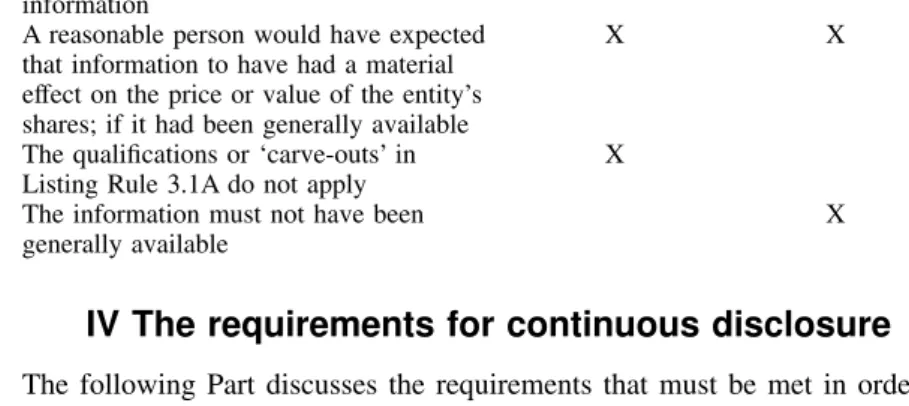
In short, an entity is required to disclose information if there is an obligation to do so under Listing Rule 3.1. If there is an obligation to disclose under Listing Rule 3.1 and the information to be disclosed is not generally available within the meaning of s 674(2), then the entity has infringed the disclosure requirements under the Corporations Act. The table below lists the requirements to Listing Rule 3.1 and s 674.
Table 1 — ASX and Corporations Act Requirements
Requirements Listing Rule 3.1 Section 674(2)
There must have existed ‘information’ X X The entity must have been aware of that
information
X X
A reasonable person would have expected that information to have had a material effect on the price or value of the entity’s shares; if it had been generally available
X X
The qualifications or ‘carve-outs’ in Listing Rule 3.1A do not apply
X The information must not have been
generally available
X
IV The requirements for continuous disclosure
The following Part discusses the requirements that must be met in order to attract the disclosure obligations under the Listing Rules and the Corporations Act. Each requirement is discussed below and Part V will then examine87 As stated above, this requirement is found in Corporations Act s 674(2) which provides that if the ‘information is not generally available and is information that a reasonable person would expect, if it were generally available, to have a material effect on the price or value of ED securities of the entity, the entity must notify the market operator of that information in accordance with those provisions’.
whether the occurrence of a data breach will meet these requirements, thereby attracting an obligation to disclose under the Listing Rules and the Corporations Act.
A Information
Neither the Listing Rules nor the Corporations Act define what is meant by ‘information’.88The note to Listing Rule 3.1 provides that ‘information’ may include information necessary to prevent or correct a false market. It gives examples as to the types of information that would require disclosure if found to be material under Listing Rule 3.1. These include:
• A change in the entity’s financial forecast or expectation; • Giving or receiving a notice of intention to make a takeover; and • A change in accounting policy adopted by the entity.89
A publication by the ASX in 2002 describes price or value sensitive information as including ‘information about such things as earnings, mergers, acquisitions, joint ventures, changes in assets, new products or discoveries, developments regarding customers or suppliers and changes in control of management’.90 Further guidance as to what may constitute information can be obtained from two recent cases on the continuous disclosure obligations provisions of the Corporations Act and the Listing Rules. They are Jubilee Mines NL v Riley91andASIC v Fortescue Metals Group Ltd.92
InJubilee Mines NL v Riley, the plaintiff was a junior exploration company and during the period 1992 and 1993 its focus was on exploring its tenements for gold. Mr Crossley, Jubilee’s managing director, and Mr Cooke, a geologist, were responsible for Jubilee’s day to day operations. In 1994, Western Mining Company (WMC) advised Jubilee that it had inadvertently drilled on Jubilee’s neighbouring tenement and the drilling data was provided to Jubilee. The geologist, Mr Cooke, reviewed the information provided by WMC. His views were that the prospect of proving an economic nickel deposit on Jubilee’s tenement was remote and given Jubilee’s financial position and its focus, which was on gold, further exploration on the tenement was not appropriate.93 The geologist discussed his views with the managing director and in light of the geologist’s views, the managing director decided that the information received from WMC was not of any interest or significance to Jubilee and there was no requirement to disclose receipt of the data to the ASX.94 However in 1995, Mr Crossley resigned as managing director of Jubilee and was replaced by a Mr Harmanis.
88 Jubilee Mines NL v Riley (2009) 253 ALR 673; 226 FLR 201; [2009] WASCA 62; BC200901632 at [159].
89 ASX Listing Rule Ch 3, 302.
90 ASX, ‘Continuous Disclosure: The Australian Experience’, ASX, Sydney, 2002, at 4.2. 91 (2009) 253 ALR 673; 226 FLR 201; [2009] WASCA 62; BC200901632.
92 (2009) 264 ALR 201; 76 ACSR 506; [2009] FCA 1586; BC200912077. Apart from these two cases, there is limited case law on the continuous disclosure provisions of the Corporations Act and the Listing Rules. This point was observed both in Martin CJ’s judgment and McLure’s judgment inJubilee Mines NL v Riley(2009) 253 ALR 673; 226 FLR 201; [2009] WASCA 62; BC200901632 at [52] and [152].
93 Jubilee Mines NL v Riley (2009) 253 ALR 673; 226 FLR 201; [2009] WASCA 62; BC200901632 at [10]–[11].
In 1996, further discussions were held between WMC and Jubilee in relation to the tenement and the drill hole results. Following from these discussions, on 11 June 1996 Jubilee provided an announcement to the ASX disclosing the inadvertent drilling of the tenement by WMC and announcing that ‘significant potential exists for both massive and disseminated nickel sulphides’.95 The announcement further advised that Jubilee intended to undertake further drilling work to explore the mineralisation.96Riley, who had Jubilee shares allocated to a trust under his control, had caused the trust in 1994 to progressively sell all of its shares in Jubilee. By 1995, all the shares were sold.97 Riley argued that Jubilee breached the Listing Rules and the Corporations Act by not promptly disclosing the exploration results received from WMC. Master Sanderson of the WA Supreme Court awarded Riley damages of $1,856,000 plus interest of $1,005,133.33. Jubilee Mines appealed and the WA Court of Appeal upheld Jubilee’s appeal from Master Sanderson’s decision.98
On appeal, Jubilee argued that information for the purposes of the continuous disclosure obligations included the assessment by Jubilee’s geologist of the prospectivity of the tenement, the nature of Jubilee’s then current activities and its financial capacity.99 Riley argued that evaluative matters were not part of the ‘information’ for the purposes of the Listing Rule and Corporations Act.100
Martin CJ in the Court of Appeal delivered the main judgment with which Le Miere AJA agreed. McLure JA delivered a separate judgment. Both Martin CJ and McLure JA held that information included Jubilee’s decision not to undertake further drilling.101Justice McLure said that information must include ‘all matters of fact, opinion and intention’102so that an expert opinion on the significance of the WMC Information would be a part of the information concerning Jubilee of which Jubilee’s executive officers (Cooke and Crossley) were aware.103Her Honour came to this conclusion based on the purpose of the continuous disclosure regime, which is a fully informed market,104noting that:
where share price sensitivity depends upon the company having an expert assessment of core information and business decisions are made based on that expert assessment, the disclosure of only the core information . . . may be misleading.105 This interpretation of ‘information’ in Jubilee Mines was adopted by Gilmour J inASIC v Fortescue Metals Group Ltd. InFortescue, Gilmour J observed that information is a ‘concept of very broad import’ and can include
95 Ibid, at [20]. 96 Ibid, at [19]–[20]. 97 Ibid, at [6]. 98 Ibid. 99 Ibid, at [158]. 100 Ibid, at [157]. 101 Ibid, at [110]–[113] and [191]. 102 Ibid, at [161]. 103 Ibid, at [160]. 104 Ibid, at [162]. 105 Ibid, at [162].
both fact and opinion.106Jubilee MinesandFortescueare the leading cases on the continuous disclosure requirements under the Listing Rules and the Corporations Act and if their approach is adopted, it appears that information can include a combination of both fact and opinion.
B Awareness of information
The concept of awareness is central to the operation of the continuous disclosure regime.107 Listing Rule 3.1 requires an entity to be aware of information before it is required to disclose that information to the ASX. According to Listing Rule 19.12:
an entity becomes aware of information if a director or executive officer has, or ought reasonably to have, come into possession of the information in the course of the performance of their duties as a director or executive officer of that entity. Thus inJubilee Minesboth Cooke and Crossley were held to be the executive officers of Jubilee and therefore Jubilee was taken to be aware of the information coming into the possession or ought reasonably to have come into the possession of Cooke or Crossley in the performance of their duties.108
C Material effect on the price or value
The obligation to disclose only arises if the information is information which a reasonable person would expect to have a material effect on the price or value of its securities. Section 677 sets out the test for material as follows: for the purposes of section 674 and 675 a reasonable person would be taken to expect information to have a material effect on the price or value of ED securities of a disclosing entity if the information would, or would be likely to, influence persons who commonly invest in securities in deciding whether or not to acquire or dispose of the ED securities.
The effect of this test in s 677 is to create terminological differences between the Corporations Act and the Listing Rule.109 The requirement under the Listing Rule is for the information to have a material effect on the price or value of the securities whereas s 677 deems110information to have that effect if it would or would be likely to influence common investors. This raises the question:Must information have a material effect on price or value or is it suffıcient that the information would or would be likely to influence common investors?
This issue was dealt with extensively inJubilee Mines111and the judgment
106 (2009) 264 ALR 201; 76 ACSR 506; [2009] FCA 1586; BC200912077 at [253]. 107 ASX, above n 90, [2.1].
108 (2009) 253 ALR 673; 226 FLR 201; [2009] WASCA 62; BC200901632 at [43]. 109 ASIC v Fortescue Metals Group Ltd (No 5)(2009) 264 ALR 201; 76 ACSR 506; [2009]
FCA 1586; BC200912077 at [232] and [236];Jubilee Mines NL v Riley(2009) 253 ALR 673; 226 FLR 201; [2009] WASCA 62; BC200901632 at [165].
110 Section 677 has been described by both Gilmour J inASIC v Fortescue Metals Group Ltd (No 5)(2009) 264 ALR 201; 76 ACSR 506; [2009] FCA 1586; BC200912077 at [232], and Martin CJ inJubilee Mines NL v Riley(2009) 253 ALR 673; 226 FLR 201; [2009] WASCA 62; BC200901632 at [57], as a deeming provision.
inJubilee Mineswas considered by Gilmour J inFortescue.112Martin CJ in
Jubilee Minesheld that s 1001D did not require the information to have a ‘material’ effect on the share price.113 His Honour noted that:
The effect of the section was to obviate the need to address the question of whether a reasonable person would be taken to expect a ‘material’ effect on price to be produced by deeming that question to be answered in the affirmative if the information would, or would be likely to, influence persons who commonly invest in the relevant securities in deciding whether or not to subscribe for, or buy or sell those securities.114
Thus according to Martin CJ, if information had the characteristic defined in s 1001D,115it should be taken as information falling within the scope of the Listing Rules.116Otherwise there would be inconsistency between the Listing Rules and ss 1001A and 1001D because the Listing Rules required notification only when there was a reasonably expected material impact on share price or value whereas ss 1001A and 1001D would require notification whenever the information would, or would be likely to, influence common investors.117
InFortescue, Gilmour J preferred the approach taken by Martin CJ: I would construe ‘information’ which ‘would, or would be likely to influence’ common investors in deciding whether to acquire or dispose of securities as information, for the purposes of Listing Rule 3.1, that a reasonable person would expect to have a material effect on the price or value of the securities. This is merely an approach to the construction of the words ‘material effect on the price or value of the entity’s securities’ in Listing Rule 3.1 which provides harmony with the provisions of ss 674 and 677 of the Act.118
In terms of whether the information would, or would be likely to influence persons who commonly invest in securities, ASIC inFortescuesubmitted that the test for ‘influence’ in s 677 should be that of a:
common sense test for the court upon a consideration of the primary facts although assistance may be derived from experts who professionally buy and sell shares in large tranches and make investment decisions of the kind contemplated by s 677.119 This submission was accepted by Gilmour J inFortescue.120As to who might constitute ‘persons who commonly invest in securities’, inJubilee Mines, it was decided in the trial case and not challenged on appeal that a person who commonly invested in securities of the kind in question, which in Jubilee’s case was shares of a junior mining explorer, were traders who would be
considered the previous ss 1001A and 1001D but the observations are still relevant as the provisions are substantially the same. See theRevised Explanatory Memorandum for the Financial Services Reform Bill 2001 (Cth).
112 (2009) 264 ALR 201; 76 ACSR 506; [2009] FCA 1586; BC200912077. 113 (2009) 253 ALR 673; 226 FLR 201; [2009] WASCA 62; BC200901632 at [34]. 114 Ibid, at [34].
115 Section 1001D is the predecessor to s 677 which defines material effect.
116 Jubilee Mines NL v Riley (2009) 253 ALR 673; 226 FLR 201; [2009] WASCA 62; BC200901632 at [54]–[62].
117 Ibid, at [60]–[61].
118 (2009) 264 ALR 201; 76 ACSR 506; [2009] FCA 1586; BC200912077 at [238]. 119 Ibid, at [482].
looking to derive profit from an increase in share price, not long term investors seeking dividend terms.121The issue is therefore likely to be decided on a case-by-case basis.
D Exceptions or carve outs under Listing Rule 3.1A
There is no obligation to disclose under the Listing Rule if the exceptions under Listing Rule 3.1A apply. According to the ASX Guidance Note 8, the intention of this exception is ‘to protect the legitimate commercial interests of listed entities in those circumstances where market integrity is not adversely affected’122 and only operates so long as the integrity of the market is not undermined.123To come within the ambit of Listing Rule 3.1A, the entity must satisfy all of the three requirements in Listing Rules 3.1A.1, 3.1A.2 and 3.1A.3.
A requirement of Listing Rule 3.1A.1 is that a reasonable person would not expect the information to be disclosed. According to ASX Guidance Note 8, ‘a reasonable person would not expect information to be disclosed if the result would be unreasonably prejudicial to the entity’.124In deciding this, the needs of the market and the interests of the entity will be considered by the ASX.125 While the use of the word ‘reasonable’ indicates an objective test, the Guidance Note observed that because ‘market practices and expectations can evolve, what is considered “reasonable may also change”’.126Furthermore, Listing Rule 3.1A.2 requires that the information is confidential and the ASX has not formed the view that confidentiality is lost. According to the Listing Rules, ‘confidential’ means confidential as a matter of fact.127 The ASX Guidance Note 8 provides further guidance stating that confidentiality has the sense of ‘secret’128because ‘the information is in the possession of only those who will not trade in the entity’s securities and there is control over the use of the information’.129
The Listing Rules also provide that an entity may give information to third parties in the ordinary course of its business and activities and continue to satisfy 3.1A2 provided the entity retains control over the use and disclosure of the information.130 Information will lose its confidentiality status if the information, or part of it, becomes known either selectively or generally, whether inadvertently or deliberately.131 If information becomes known by others in circumstances where the entity does not retain control of its use and disclosure, Listing Rule 3.1A2 is not satisfied, regardless of whether the entity or a third party disclosed the information.132The example provided is ‘where there is a rumour circulating or media comment about the information and the
121 (2009) 253 ALR 673; 226 FLR 201; [2009] WASCA 62; BC200901632 at [122] and [163]. 122 ASX Guidance Note 8, at [28].
123 Ibid, at [30]. 124 Ibid, at [31] and [33]. 125 Ibid.
126 Ibid.
127 ASX Listing Rule Ch 3, 303. 128 ASX Guidance Note 8, at [34]. 129 Ibid, at [34].
130 ASX Listing Rule Ch 3, 303. 131 Ibid.
rumour or comment is reasonably specific, this will generally indicate that confidentiality has been lost’.133Confidentiality can be lost even if the entity has entered into confidentiality arrangements and/or the information has come from a source other than the entity.134 Loss of confidentiality can also be indicated by otherwise unexplained changes to the price of the entity’s securities, or by reference to the information in the media or analysts’ reports.135The ASX Guidance Note provides that the ASX will take all the circumstances of each case into account when determining if there is a loss of confidentiality.136
A third requirement exists under Listing Rule 3.1A.3, namely, that the information must be of the type in one of the following categories. If it is not or it loses that character, then Listing Rule 3.1A.3 is not satisfied. The relevant categories are whether the information type:
• Would lead to a infringement of a law if disclosed; • Concerned an incomplete proposal or negotiation;
• Comprised matters of supposition or is insufficiently definite to warrant disclosure;
• Generated for the internal management purposes of the entity; and • A trade secret.137
The final requirement arises under Listing Rule 3.1B. Even if the previous three obligations of Listing Rule 3.1A are satisfied, there may still be a requirement to disclose. Listing Rule 3.1B provides that if the ASX considers that there is or is likely to be a false market in an entity’s securities and asks the entity to give it information to correct or prevent a false market, the entity must give the ASX the information needed to correct or prevent the false market. According to the Listing Rules, the ASX would consider that there is or is likely to be a false market in the entity’s securities in the following circumstances:
• The entity has information that has not been released to the market, such as in the situation where all of the limbs of the exception in Listing Rules 3.1A.1, 3.1A.2 and 3.1A.3 are satisfied; and
• There is reasonably specific rumour or media comment in relation to the entity that has not been confirmed or clarified by an announcement by the entity to the market; and
• There is evidence that the rumour or comment is having, or the ASX forms the view that the rumour or comment is likely to have an impact on the price of the entity’s securities.138
The example provided by the ASX Guidance Note 8 is where an entity may have information that it has not disclosed because the exception in Listing Rule 3.1A applies.139Comment about the information or part of it might then be made through the media or other sources. However, the comment is
133 Ibid.
134 ASX Guidance Note 8, at [34]. 135 Ibid, at [35].
136 Ibid.
137 Listing Rule 3.1A.3. 138 ASX Listing Rule Ch 3, 303. 139 ASX Guidance Note 8, at [44].
inaccurate or only partly accurate, so that even though confidentiality has not been lost, the inaccurate or partly accurate comment might result in a false market in the entity’s securities.140
E Generally available information
The difference between Listing Rule 3.1 and s 674(2) is the requirement for ‘generally available information’. Listing Rule 3.1 does not require information to be generally available for the obligation to arise. Rather, the ASX Guidance Note 8 observes that ‘the fact that information is generally or electively available is not an excuse for failing to disclose it under Listing Rule 3.1’.141 The effect is that under Listing Rule 3.1, all price or value sensitive information needs to be disclosed. In contrast, in order to contravene the disclosure requirements under the Corporations Act, s 674(2) requires the information to have the characteristic of not being generally available. This difference was considered by CASAC in its report on continuous disclosure in 1996.142The Advisory Committee supported this distinction because it found that:
it would be difficult to justify imposing civil and/or criminal liability on listed entities and their involved officers merely for failing to comply with the continuous disclosure Listing Rule, where that information was in the public domain and was available to investors and the market generally.143
Section 676(2) provides that information is generally available if: (a) It consists of readily observable matter; or
(b) Without limiting the generality of paragraph (a), both of the following subparagraphs apply:
(i) it has been made known in a manner that would, or would be likely to, bring it to the attention of persons who commonly invest in securities of a kind whose price or value might be affected by the information; and
(ii) since it was made known, a reasonable period for it to be disseminated among such persons has elapsed.
Section 676(3) further provides that information is also generally available if it consists of deductions, conclusions or inferences made or drawn from information referred to in s 676(2)(b)(a) or information made known as mentioned in s 676(2)(b)(i).
NeitherJubilee MinesnorFortescueexamined what is meant by ‘generally available’. In Jubilee Mines, Martin CJ did not discuss the requirement of information not being generally available, his Honour simply noted that in that case, the information was of that character.144Guidance may be obtained from insider trading cases where the term ‘generally available’ is used for insider
140 Ibid.
141 ASX Guidance Note 8, at [25].
142 CASAC, ‘Report on Continuous Disclosure,’ Companies and Securities Advisory Committee, Sydney, 1996, at 3.29.
143 Ibid, at 3.30.
trading offences. In R v Firns145 the meaning of ‘generally available’ was considered in relation to whether a decision of the Supreme Court of Papua New Guinea announced in open court was generally available in that it consisted of readily observable matter.146 The majority view was that information is ‘readily observable’ regardless of how many people actually observe the relevant information.147Accordingly, the number of persons who actually observe the information is irrelevant148and ready observability is not to be tested from the stance of a hypothetical person within Australia.149If the majority in R v Firnsis followed, it could mean that information could be considered to be a readily observable matter and thus is generally available even if no one has actually observed it. With these requirements in mind, Part V explores whether a data breach could be considered to be information requiring disclosure under the Listing Rules and the Corporations Act.
V Are data breaches required to be notified under the
continuous disclosure regime?
Trying to ascertain whether any particular data breach will subject a corporation to the continuous disclosure obligations would be similar to the process applying to disclosure of other types of information. Accordingly, concluding whether disclosure of a data breach is required under the Listing Rules and the Corporations Act, will not always be clear cut. United States research indicates that the critical element in triggering the continuous disclosure obligation — that the disclosure of the data breach will have material effect upon share price or value — varies from corporation to corporation.150The likely impact upon share price depends upon a number of factors including the:
• Extent of the data breach;
• Likely liabilities which will arise as a result of the breach;
• Likely loss of confidence in the corporation’s systems as a result of the data breach; and
• Nature of the corporation’s business (for example, whether secure data collection storage is essential to the corporation’s business or, at the other extreme, is merely an insignificant aspect of that business). These various elements, discussed in more detail below, will be relevant in determining whether the knowledge of the actual data breach is, once revealed to the public, likely to affect the corporation’s future business. These matters will have a direct bearing upon whether investors would discount the price of shares in the corporation as a result of the fact that a data breach has occurred. Ascertaining how investors collectively will react to such news has proved to be difficult in the United States,151and is likely to be so in Australia as well. We now examine whether a data breach incident would be required to be
145 R v Firns(2001) 51 NSWLR 548; 161 FLR 294; [2001] NSWCCA 191; BC200102551. 146 Ibid, at [3] and [52].
147 Ibid, at [77]. 148 Ibid, at [77]. 149 Ibid, at [81] and [88].
150 In relation to the impact of disclosure generally, see nn 62ff.
notified under the continuous disclosure regime of the Corporations Act and the Listing Rules as applied inJubilee MinesandFortescue.
A Would a data breach be classed as information?
Given the broad interpretation of information adopted in Jubilee Minesand
Fortescue, it is likely that a data breach would be considered to be ‘information’ within the meaning of the Listing Rules and the Corporations Act.
B Would a corporation be aware of a data breach?
While it seems likely that a data breach could amount to information given the broad approach adopted inJubilee Mines and Fortescue Metals, it is much less apparent whether the breached corporate entity would be deemed to be aware of a data breach. This reflects the technological, legal and social complexities inherent in data breaches regarding a director’s or executive officer’s ability to possess information about a data breach during the course of the performance of their duties. If they are aware, then the entity is taken to be ‘aware’ of the information, and must disclose the information about a data breach incident immediately to the ASX. However, whether a director or executive officer would or should know that a data breach has occurred is likely to depend on the circumstances of the data breach as some incidents are very different in nature to others.
The situations that constitute a data breach can vary and can include a number of different scenarios involving the unauthorised acquisition of personal information. Various taxonomies of data breach classifications have been developed. Garcia, for example, groups different types of data breaches into four categories based on the inadequate actions of breached entities. Garcia’s taxonomy therefore covers negligent acts by the breached organisation, criminal actions perpetrated against the breached organisation, ineffective security practices and the loss of control of personal information through the theft or loss of an organisation’s computer or media storage equipment, particularly laptops.152 The US Government’s Government Accountability Office (GAO) reviewed a number of data breaches and adduced a broad taxonomy that involved data breaches involving intentional actions relating to identity theft crimes153and those involving negligent or accidental losses.154Finally, Curtin and Ayers, focus less on the ineffective
corporations involved in data breaches as the global extent of data breaches becomes known. In this regard see J Chandler, ‘Negligence Liability for Breaches of Data Security’ (2008) 23
Banking & Finance Law Review223 at 228:
Presumably the stock market will react less and less as it learns that the punishment from consumers is mild and decreasing. These predictions may be supported by evidence of market behaviour.
152 Garcia, above n 17, at 714–23.
153 United States Government Accountability Office, ‘Personal Information: Data Breaches Are Frequent, but Evidence of Resulting Identity Theft Is Limited; However, the Full Extent Is Unknown’, GAO-07-737, 2007, p 19 which include hacking incidents, employee theft, theft of physical equipment and acts of deception.
154 Ibid. These can include the loss of laptops or hardware, loss of tapes, unintentional exposure on the internet and improper disposal of data.
actions of breach organisations and examine the situations in which personal information has been lost through a ‘failure of controls’.155Curtin and Ayers focus on controls is a helpful taxonomical base because it does not explicitly or implicitly attempt to apportion blame upon a breached organisation, unlike taxonomies based on negligent actions, and it therefore categorises data breaches based on textual descriptions of actual data incidents. The taxonomy highlights that corporations are more likely to be aware of some incidents and less likely to be aware of others while indicating the areas where directors should be aware of control failures.
The issue of control failures is therefore a prominent factor in relation to the awareness levels required by corporations as different types of data breaches will engender different awareness requirements. For example, the most significant US data breach to date involved a computer hacking incident that involved the TJX Corporation, which is the parent company of some of the largest retailers in the United States. In 2007, identity theft criminals penetrated the TJX system and retrieved without authorisation the details of approximately 94 million credit cards.156 TJX failed to comply with the Payment Card Industry (PCI) Data Security Standard (PCI-DSS),157 illustrated by the collection of an unnecessary amount of personal information that was unencrypted. Moreover, the unauthorised intrusion was made possible because TJX transferred personal and payment information between retailers using a wireless network that was not sufficiently protected. The wireless network was encrypted with wired equivalent privacy (WEP) security protocols that were known to be ineffective and prone to vulnerabilities. A team of sophisticated identity theft criminals was able to access the communications system from which they gained entry to TJX’s corporate headquarters and were able to retrieve credit card and other personal information.158 It is believed the intruders had access to TJX’s database systems for 18 months before they were detected.159
Potentially more disturbing for corporations is that data thefts can also involve employees. Fidelity National Information Services, a financial processing service, reported that a former employee at one of its subsidiary companies, who was a senior database administrator, misappropriated 2.3 million records that included personal and credit card information.160The employee then sold details of the personal records to a number of direct
155 C M Curtin and L T Ayres,Using Science to Combat Data Loss: Analyzing Breaches by Type and Industry, 2009, <http://web.interhack.com/publications/breach-taxonomy> (accessed 29 April 2010), p 13.
156 G Berg, M Freeman and K Schneider, ‘Analyzing the TJ Maxx Data Security Fiasco: Lessons for Auditors’ (2008) 78(8)The CPA Journal34 at 36.
157 Payment Card Industry Security Standards Council, Payment Card Industry (PCI) Data Security Standard Version 1.2.1, Payment Card Industry Security Standards Council, Delaware, 2009.
158 Berg, Freeman and Schneider, above n 156, at 34.
159 J Pereira, ‘Breaking The Code: How Credit-Card Data Went Out Wireless Door In Biggest Known Theft, Retailer’s Weak Security Lost Millions of Numbers’,The Wall Street Journal, New York, 4 May 2007, A1.
160 See Fox News,2.3M Records Containing Credit Card, Bank Account Information Stolen, Financial Processing Company Says, 2007, <http://www.foxnews.com/ story/0,2933,287862,00.html> (accessed 23 April 2010), and A Greenberg, The