SENSITIVITY TO THERMONUCLEAR REACTION RATES IN MODELING THE ABUNDANCE ANOMALIES OF NGC 2419
J.R. Dermigny1,2and C. Iliadis 1,2
1Department of Physics & Astronomy, University of North Carolina, Chapel Hill, NC 27599-3255, USA
2Triangle Universities Nuclear Laboratory, Durham, NC 27708-0308, USA
ABSTRACT
Abundance anomalies in globular clusters provide strong evidence for multiple stellar populations within each cluster. These populations are usually interpreted as distinct generations, with the currently observed second-generation stars having formed in part from the ejecta of massive, first-generation “polluter” stars, giving rise to the anomalous abundance patterns. The precise nature of the polluters and their enrichment mechanism are still unclear. Even so, the chemical abundances measured in second-generation stars within the globular cluster NGC 2419 provide insight into this puzzling process. Previous work used Monte Carlo nuclear reaction network calculations to constrain the temperature-density conditions that could reproduce the observed abundances, thereby placing robust limits on the origins of the polluter material. The effect of individual reaction rates on these conditions has not been studied, however. Thus, we perform an exhaustive sensitivity study on the nuclear physics input to determine which reactions have the greatest impact on these predictions. We find that the30Si(p,γ)31P,37Ar(p,γ)38K,38Ar(p,γ)39K, and39K(p,γ)40Ca reactions are all critical in determining the temperature-density conditions, and ultimately, the origin of the polluter material. We conclude with recommendations for future experiments.
Keywords:globular clusters: general — globular clusters: individual (NGC 2419) — stars: abundances — stars: Population II — nuclear reactions
1. INTRODUCTION
Many aspects of globular cluster formation and evo-lution are unknown. These stellar aggregates were once thought to house only a single stellar population, how-ever, recent photometric analysis suggests that they in-stead harbor multiple, chemically distinct populations. This is indicated by the presence of discrete tracks in a color-magnitude diagram (Villanova et al. 2007;Piotto et al. 2007) and significant star-to-star variations in the abundances of light elements (e.g., C, N, O, Na, Mg, Al). These signatures cannot be attributed to a single stel-lar generation formed from inhomogeneous interstelstel-lar matter. Therefore, theories for globular cluster forma-tion now assume multiplegenerations of stars, i.e., first and second generation (D’Ercole et al. 2008; Carretta et al. 2010). The second generation is thought to form from the highly processed ejecta of the first-generation “polluter” stars, giving rise to the abundance variations observed today. The details of this self-enrichment sce-nario, including the nature of the polluters, are still
clear.
NGC 2419 is a massive, metal-poor globular cluster in the Milky Way outer halo which is now emblematic of the self-enrichment phenomenon. Photometric analysis of this cluster by Cohen et al. (2011), Cohen & Kirby
(2012), and Mucciarelli et al. (2012) revealed a popu-lation of red giants with an unprecedented depletion in magnesium ([Mg/Fe]≈ −1)1. This depletion is coupled to a strong enhancement in potassium ([K/Fe] ≈ 2), giving rise to a Mg-K anticorrelation within NGC 2419. The origin of this anticorrelation is not yet clear. Of par-ticular interest are the evolutionary time-scales involved, the identity of the polluter stars, and the enrichment mechanism. Once understood, these characteristics may shed new light on globular cluster and galaxy formation as well as provide a means to distinguish between com-peting models of self-enrichment.
With this potentially substantial impact on our
un-1 According to common convention, abundances are given as
[A/B]≡log10(NA/NB)?−log10(NA/NB), whereNiare number abundances of elementsAandBobserved in a star (?) or the sun (); while the quantity [A/B] is unitless, differences between two values are expressed in units of dex (“decimal exponent”).
derstanding of globular clusters, enrichment scenarios for NGC 2419 have been studied extensively. First,
Ventura et al. (2012) explored the possibility that the severe Mg depletion was caused by high temperature burning within first-generation asymptotic giant branch (AGB) and super asymptotic giant branch (super AGB) stars. In their model, the second generation formed di-rectly from the ejecta of the first-generation stars. They found that the chemical abundances of the enriched ma-terial could be made to agree with the observations pro-vided both model parameters and thermonuclear reac-tion rates were fine-tuned. Later, Iliadis et al. (2016) broadened the scope of this investigation. They used Monte Carlo nuclear reaction network calculations to constrain the physical conditions that could give rise to the observed abundances. They found a correlation be-tween stellar temperature and density values that pro-vided a satisfactory match between simulated and ob-served abundances. In comparing these conditions with stellar models, they found that low-mass stars, AGB stars, massive stars, and super-massive stars are un-likely to account for the abundance anomalies. Super AGB stars and classical novae, involving either carbon-oxygen or carbon-oxygen-neon white dwarfs, could be the pol-luters. However, the authors emphasized the need for improved stellar models before drawing firm conclusions. The thermonuclear reaction rates used to carry out these studies are based on experimental measurements and theoretical calculations. Some rates are only known to within a factor of 10, owing to the uncertainty in their nuclear physics input. Therefore, reaction rate uncertainties must be considered for the most robust predictions. Iliadis et al. (2016) already demonstrated that these uncertainties affect the range of plausible pol-luter sites. They found that the allowed region of the temperature-density parameter space widens consider-ably when the impact of reaction rate uncertainties are considered. In this work, we determine which reactions contribute to this broadening, with the ultimate goal of constraining the parameter space. In doing so, we aim to refine the list of polluter candidates.
In Section 2, we describe the nucleosynthesis model used to study this anomalous globular cluster. We then explore the effect of varying the reaction rate uncertain-ties and identify reactions critical to reproducing the observed abundances in Section 3. In Section 4, we re-view the nuclear physics input to reaction rate calcula-tions. Recommendations for future experiments follow. Finally, a summary is given in Section 5.
2. METHODS
In this work, we adopt the methodology ofIliadis et al.
(2016) to explore possible self-enrichment scenarios in NGC 2419. For a thorough exposition, we refer the
reader to that work. Below, we review the salient fea-tures of our model.
2.1. Polluter Model
The adopted model aims to reproduce the observed abundances of NGC 2419 by simulating its formation history. This comprises three major episodes. First, the first stars form following primordial nucleosynthe-sis. These stars contribute metals to the proto-cluster gas, bringing the overall metallicity to the currently ob-served value of [Fe/H] =−2.09±.02 (Mucciarelli et al. 2012). The first-generation globular cluster stars then form from this material. Later, the most massive of these stars will evolve quickly and explode as type II su-pernovae. Others will evolve more slowly, giving rise to the anomalous chemical enrichment. Sometime during their evolution, these first-generation stars eject part of their matter into the intracluster gas. Finally, the cur-rently observed second-generation stars form from this polluted material, thereby inheriting the nucleosynthetic signatures of both pre-enrichment material and the first-generation stars.
The situation described above is reproduced in our simulations, albeit with simplifications. For instance, for the composition of the proto-cluster gas, we adopted the results of a one-zone chemical evolution model for the Milky Way halo. This model is an updated ver-sion of Goswami & Prantzos(2000), which reproduces, with some minor adjustments, the reported abundances of field stars of the same average metallicity as NGC 2419 (see the Appendix of Iliadis et al. (2016) for de-tails). Further, to keep our results as general as pos-sible, we did not adopt any particular stellar evolution model. Instead, we used a nuclear reaction network to process stellar material in a single zone with constant temperature and density.
The nuclear reaction network follows the evolution of 213 nuclides, ranging from p, n, 4He, to 55Cr. We adopted the thermonuclear reaction rates linking these nuclides (2373 total) from STARLIB (Sallaska et al. 2013). This library provides the rate probability density function at temperatures from 10 MK to 10 GK. This unique feature will be discussed further in Section2.2.
The simulated stellar evolution occurs as follows. First, the proto-cluster, or “pristine” gas, is processed at constant temperature, T, and density, ρ, using the nuclear reaction network. The evolution is halted after a variable amount of hydrogen, ∆XH ≡XH
i −X
given by:
Xmix=
Xproc+f Xpris
1 +f (1)
whereXprocandXprisdenote the mass fractions of the reaction network output (i.e., processed matter) and the initial composition (i.e., pristine matter), respectively. The elemental abundances ofXmix(i.e., Mg, K, Ca, Ti, Si, Sc, and V) are then compared with those of the ob-served, extreme population. For these stars, we adopt the same abundance conditions as Iliadis et al.(2016), which is based on the scatter in the data and abundance uncertainties of individual stars. These are given by 1.3
< [K/Fe]< 2.0, -1.5 < [Mg/Fe] <-0.8, 0.1 < [Ca/Fe]
<0.7, -0.2< [Ti/Fe]<0.7, 0.4<[Si/Fe] <1.1, 0.4 <
[Sc/Fe]<1.3, and -0.2<[V/Fe]<0.6. If there is agree-ment for any value of f, then the physical conditions used in the simulation represent plausible conditions for the nucleosynthesis of the polluter material.
Since this approach is so simple, we must exercise cau-tion in interpreting the results. An important limitacau-tion of our simulation is that hydrodynamical mechanisms such as convection are absent. In a realistic scenario, the burning region is continuously mixed with fresh (unpro-cessed) material, replenishing the hydrogen available for burning while diluting the byproducts. Compared with the single-zone process adopted in this work, it would re-quire a much longer burning period to achieve the same abundance levels. For this reason, any constraints we obtain on the amount of hydrogen consumed or equiva-lently, the duration of burning, are not meaningful. In-stead, we focus on the temperature and density, since these parameters determine which nucleosynthesis path-ways are operating, and ultimately, the elements synthe-sized. By repeating this simulation many times, the ac-cumulated temperature and density conditions provide valuable constraints on the origin of this material.
2.2. Reaction Rate Uncertainties
In our simulations, the elemental abundances of the polluter material depend on the interplay between thou-sands of reactions. Iliadis et al.(2016) showed that when reaction rate uncertainties were taken into account, the range of physical conditions that could reproduce the observed abundances broadened significantly. This im-plies that, for one or more reactions, the rate uncertainty is large enough to have a substantive effect on the out-come of the simulation. Identifying these reactions will lead to more robust theories for the origin of the pol-luter material, as these important reactions can then be carefully studied in nuclear physics laboratories.
We study the influence of both the statistical and sys-tematic contributions to the reaction rate uncertainties. The uncertainties adopted by STARLIB comprise the statistical component and any known systematic effects.
These vary widely from reaction to reaction, owing to differences in the mechanism of the reaction (i.e., non-resonant versus non-resonant reaction) as well as the avail-ability of experimental data. For the majority of the reactions relevant to this study, the rates have been rived using the experimental Monte Carlo formalism de-scribed inLongland et al.(2010). Using this method, the uncertainty is determined by considering statistical and known systematic uncertainties of the nuclear physics input, e.g., resonance energies and strengths, partial widths, and resonant S-factors, from physically moti-vated probability densities. Experimental Monte Carlo rates are available for only 64 reactions in the target mass range from A = 14 to A = 40. For reaction rates taken from other sources, such as the NACRE compi-lation (Angulo et al. 1999), uncertainties are evaluated on a case-by-case basis. Theoretical Hauser-Fechbach rates are adopted from the TALYS computer program (Koning et al. 2004) in the instances where there are no reliable, experimentally determined reaction rates. For these rates, STARLIB adopts a conservative factor un-certainty of 10.
What is of main interest is not the magnitude of these rate uncertainties but rather the knowledge of the full probability distributions. Accordingly, for each reaction STARLIB provides two temperature-dependent quanti-ties,µandσ, which describe the rate probability density as a log-normal distribution,
f(x) = 1
σ√2π
1
xe
−(lnx−µ)2/(2σ2), (2)
whereµandσdetermine the location and width of the distribution. To sample the reaction rates, we follow the procedure detailed inIliadis et al. (2015). First, a random number, pi, is generated from a Gaussian dis-tribution with a mean of zero and standard deviation of unity. Sampleiof reaction ratey is then given by
yi=ymed(f.u.)pi, (3)
whereymed andf.u.are the median value and the factor uncertainty. These quantities are given by eµ and eσ, respectively (Longland 2012).
We must also consider the possibility that unknown
has the effect of scaling the probability distribution of this reaction rate by a factorα. In the next section, we use both of these methods as a means to explore the rate sensitivities in our nuclear reaction network calculations.
3. RESULTS
We begin by reproducing the results of Iliadis et al.
(2016), as they serve as a convenient baseline for com-parison. We adopted their recommended initial compo-sition and assumed fixed thermonuclear rates (i.e., dis-regarding any uncertainties). For each network simula-tion, we varied the temperature,T, density,ρ, and final hydrogen abundance,XH
f , using a Monte Carlo routine. We performed 1×10⁵of these network simulations, twice the amount used in the earlier work, to ensure that the parameter space was thoroughly sampled. At the con-clusion of each one, the mixtures of the “pristine” and “processed” matter were compared against the observed abundances for mixing fractions of f = 1000 (i.e., al-most purely pristine matter), 100, 30, 10, 3, 1.0, 0.1, 0.05, 0.02, and 0.0 (i.e., purely processed matter). For conditions that gave a satisfactory fit to the abundances, the parameters are plotted as red dots in the top panel of Figure 1. The width of this distribution indicates, for a given density, the range of temperatures capable of producing the abundances of all the relevant elements in NGC 2419.
Next, we repeat this procedure while also varying the reaction rates according to their rate probability dis-tribution in STARLIB. Each reaction rate in the net-work was sampled using Eq.3. In the case of correlated reactions, i.e., forward and reverse reaction pairs, the rates were sampled together in order to preserve reci-procity. The results are plotted as blue dots in Figure1. The degree of broadening due to the reaction rate un-certainties is substantial, particularly at low densities. To assess this effect quantitatively, these simulations were repeated with a fixed density of ρ = 100 g/cm3. Those that reproduced the measured abundances were then binned according to their temperature. These are shown in the bottom panel of Figure1. Using this rep-resentation, we define the degree of broadening asδ, the difference in temperature between the 16th and 84th percentiles of the distribution. At this density, the cu-mulative effect of varying all reaction rates results in
δvr(100 g/cm 3
) = 19.0 MK. When expressed as a fac-tor increase over the results obtained with the recom-mended rates (i.e., their median values), which gives
δmr(100 g/cm 3
) = 11.0 MK, we find thatδvr/δmr = 1.73. This number indicates the increase in scatter of the tem-perature values at fixed density. To determine which of the individual reaction rate uncertainties have the great-est impact on the nucleosynthesis, we now consider the broadening due to each reaction.
10−1 100 101 102 103 104
120 160 200 240
0 150 300
120 160 200 240
ρ=100 g/cm3
D
en
si
ty
(g
/c
m
3)
C
ou
nt
s
pe
rb
in
Temperature (MK)
Figure 1. (Top) Constant temperature-density conditions that reproduce measured abundances in NGC 2419. Red dots result from runs with fixed reaction rates, while blue dots result from runs with varying rates. (Bottom) The projection of acceptable solutions onto the temperature axis. Note that the red histogram has been scaled to 30% of its original height for comparison pur-poses.
10−1 100 101 102 103
0.9 1 1.1 1.2 1.3 1.4 1.5 37Ar(p,γ)38K
38Ar(p,γ)39K 30Si(p,γ)31P
C
ou
nt
s
δ/δmr
Figure 2. Broadening of the (fixed-density) temperature con-ditions, δ/δmr, due to the uncertainty of each reaction in our network, as listed in STARLIB. Note that the values for 37Ar(p, γ)38K,38Ar(p, γ)39K, and30Si(p, γ)31P lie to the far-right
of the centroid.
For each reaction in our network, we performed 2×10⁴ simulations where we sampled only the corresponding reaction rate. All other reaction rates remained fixed at their recommended values. The parameters T and
XH
f were varied as before, while ρ remained fixed at 100 g/cm3. From the accepted samples, the tempera-ture values were then used to measure the broadening for each reaction.
en-sure that these results were not affected by this reduc-tion, this process was repeated for a select few reactions using 1×10⁵ simulations, a fivefold increase. For each of these reactions, the higher statistics results were in agreement to within 3%, demonstrating that 2×10⁴ net-work simulations per reaction is sufficient. The distribu-tion of all the measuredδ/δmrvalues, the factor increase over the result obtained using the recommended (me-dian) rates, is shown in Figure2. They appear normally distributed with a mean of 0.99 and standard deviation of 0.03. This suggests that the majority of the reaction rates are known to sufficient accuracy with regard to the nature of the polluter material, since their uncertainties have a negligible contribution to the broadening. There are three outliers, with values ofδ/δmr = 1.12, 1.15 and 1.41, corresponding to the37Ar(p, γ)38K,38Ar(p, γ)39K, and 30Si(p, γ)31P reactions, respectively. Their signifi-cant influence on the width of the temperature distri-bution demonstrates that these reactions play a promi-nent role in determining which stellar conditions, i.e., temperature and density, are capable of reproducing the observed abundances.
Next, we explore whether the allowed T −ρ condi-tions are sensitive to unknown systematic effects, i.e., those not included in STARLIB. In addition to the three reactions identified above, we also included in this test those which are important to the synthesis and destruc-tion of both magnesium and potassium. These include the reactions comprising the Ne-Na and Mg-Al nucle-osynthesis chains (Rolfs & Rodney 1988), as well as the Ar-K chain (Iliadis et al. 2016) and the reaction, 39K(p, γ)40Ca. For each of these reactions, we performed a series of 1×10⁵network simulations where their corre-sponding rates were given an artificial systematic effect. The rates of these reactions were varied in two steps. First, they were sampled within their STARLIB uncer-tainty. Each rate sample was then multiplied by the fixed variation factor, α, representing the contribution of some unknown effect (see Section 2.2). The factors considered here were 1/10, 1/5, 5, and 10. All other re-actions were varied within their STARLIB uncertainties.
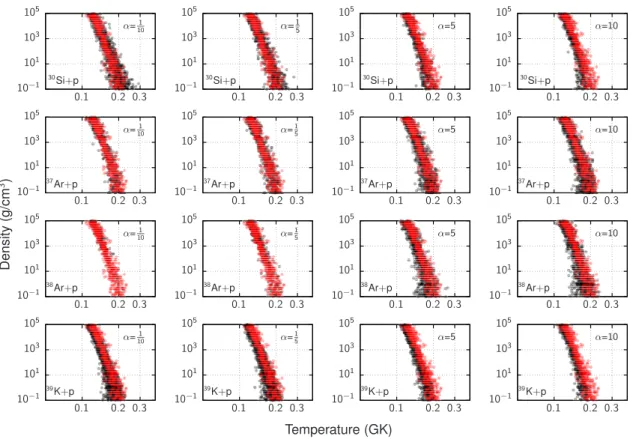
Figure3shows the sampled parameter space for each simulation, where the rows correspond (from top to bot-tom) to the30Si(p, γ)31P,37Ar(p, γ)38K,38Ar(p, γ)39K, and 39K(p, γ)40Ca reactions. For all of the other reac-tions considered, the effect of the variation was found to be much less impactful. The variation factor α is dis-played in the top right-hand corner of each plot. The case with no artificial systematic effect, i.e., α = 1, is shown in the foreground (red dots) for comparison. The effect on the broadening of the temperature and den-sity conditions (black dots) reveals their sensitivity to the magnitude of each reaction rate. For instance, when
the 30Si(p, γ)31P reaction rate is increased by a factor of 5, we find that theT −ρ scatter becomes narrower, with the high-temperature edge receding at any given density. The simulated abundances at these conditions (e.g., T = 170 MK, ρ = 100 g/cm3, XH
f = 0.50) are found to be depleted in silicon when compared with the
α = 1 case, with a net reduction of ≈ 1.3 dex. This indicates that the narrowing is caused by the onset of silicon depletion via30Si(p, γ)31P.
Adjustments to the37Ar(p, γ)38K,38Ar(p, γ)39K, and 39K(p, γ)40Ca reaction rates reveal a similar effect on the potassium abundance. Note that as both the 37Ar(p, γ)38K and 38Ar(p, γ)39K reaction rates are in-creased, the T −ρ scatter increases, with newly viable conditions appearing on the low-temperature side. For the 38Ar(p, γ)39K reaction, the difference between the leftmost and rightmost plot is particularly stark. Un-der the same test conditions as before, the elemental potassium abundance increases by≈1.0 dex when this reaction is varied fromα= 1/10 to 10 times its recom-mended value. The succeeding reaction,39K(p, γ)40Ca, has the opposite effect of depleting potassium by≈0.8 dex. This is made apparent by comparing theα= 1/10 and 10 cases, where it can be seen that the high-temperature conditions no longer satisfy the abundance constraints when the rate is increased.
These results demonstrate that systematic effects in these key reaction rates affect the predicted temperature and density conditions that forged the polluter material. Finally, we explore the possibility that all four of these reactions have unknown contributions and look at their combined effect on these conditions. We also consider how this affects which potential polluter sites (e.g., clas-sical novae, AGB stars, super AGB stars) are thought to reproduce the observed abundances. A complete discus-sion of these candidates is given inIliadis et al.(2016). Their findings are summarized in Section1.
10−1 101 103 105
0.1 0.2 0.3
D en si ty (g /c m 3) Temperature (GK)
30Si+p
α=1 10
10−1 101 103 105
0.1 0.2 0.3
30Si+p
α=1 5
10−1 101 103 105
0.1 0.2 0.3
30Si+p
α=5
10−1 101 103 105
0.1 0.2 0.3
30Si+p
α=10
10−1 101 103 105
0.1 0.2 0.3
37Ar+p
α=1 10
10−1 101 103 105
0.1 0.2 0.3
37Ar+p
α=1 5
10−1 101 103 105
0.1 0.2 0.3
37Ar+p
α=5
10−1 101 103 105
0.1 0.2 0.3
37Ar+p
α=10
10−1 101 103 105
0.1 0.2 0.3
38Ar+p
α=1 10
10−1 101 103 105
0.1 0.2 0.3
38Ar+p
α=1 5
10−1 101 103 105
0.1 0.2 0.3
38Ar+p
α=5
10−1 101 103 105
0.1 0.2 0.3
38Ar+p
α=10
10−1 101 103 105
0.1 0.2 0.3
39K+p
α=1 10
10−1 101 103 105
0.1 0.2 0.3
39K+p
α=1 5
10−1 101 103 105
0.1 0.2 0.3
39K+p
α=5
10−1 101 103 105
0.1 0.2 0.3
39K+p
α=10
Figure 3. Sensitivity of the temperature-density conditions to the influence of unknown systematic effects in the reaction30Si(p, γ)31P (first row),37Ar(p, γ)38K (second row),38Ar(p, γ)39K (third row), and39K(p, γ)40Ca (fourth row). The variation factors (α= 1/10, 1/5, 5, 10) applied to each reaction rate are shown increasing from left to right. The temperature and density combinations that provide an acceptable match between simulated and observed abundances are shown as black dots. The case with no artificial systematic effect (α= 1) is shown as red dots, for comparison.
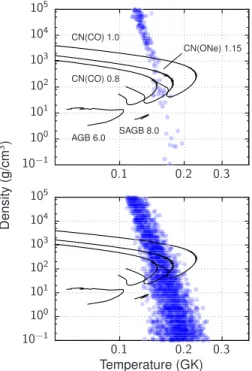
extending over a region 100 MK wide at lower densities. In order to place the most stringent constraints on the origin of the polluter material, minimal scat-ter in the acceptable temperature and density condi-tions is preferable. Since this scatter is dependent on the 30Si(p, γ)31P, 37Ar(p, γ)38K, 38Ar(p, γ)39K, and 39K(p, γ)40Ca reaction rates, our conclusion is that these reactions are critically important to identifying the ori-gin of the polluter material. In the next section, we review the nuclear input data used in the calculation of their thermonuclear rates.
4. NUCLEAR REACTION RATES
The total thermonuclear rate (in units of cm3 mol−1 s−1) for a reaction involving two nuclei (0 and 1) in the entrance channel at a given temperature is given by
NAhσvi01=
3.7318×10¹⁰
T93/2 r
M0+M1 M0M1
×
Z ∞
0
Eσ(E)e−11.605E/T9dE
(4)
where the center-of-mass energy,E, is in units of MeV, the temperature, T9, is in GK (T9 ≡ T /109 K), the atomic masses,Mi, are in u, and the cross section,σ, is in barn (1 b≡10−24cm2), andN
A denotes Avogadro’s
constant. The cross section is determined by resonant and non-resonant contributions to the reaction. Spe-cialized formulations of Eq.4have been derived to treat these separately. These can be found, for example, in
Iliadis(2015) and are not repeated here.
For the 37Ar(p, γ)38K, 38Ar(p, γ)39K, 30Si(p, γ)31P, and 39K(p, γ)40Ca reactions, the cross section is dom-inated by narrow, isolated resonances. In this case, the one-level Breit-Wigner formula can be substituted into Eq. 4. This integral can be solved numerically if all partial widths (e.g., Γp, Γα, Γγ) are known for a given resonance. Frequently, resonances are so narrow that their cross section cannot be obtained experimen-tally. Instead, all that is measured is the resonance strength, ωγ, which is proportional to the resonance integral. When using Eq. 4, uncertainties in the ex-perimental nuclear physics data, such as the resonance location and strength, introduce a combined uncertainty to the reaction rate. In the following, we explore the nu-clear physics input that gives rise to the estimated total uncertainty listed in STARLIB for these four reactions.
4.1. 37Ar(p, γ)38K and38Ar(p, γ)39K
10−1
100
101
102
103
104
105
0.1 0.2 0.3
AGB 6.0 SAGB 8.0 CN(CO) 0.8
CN(ONe) 1.15 CN(CO) 1.0
10−1
100
101
102
103
104
105
0.1 0.2 0.3
D
en
si
ty
(g
/c
m
3)
Temperature (GK)
Figure 4. Temperature and density combinations that provide an acceptable match between simulated and observed abundances are shown as black dots superimposed over temperature-density tracks for carbon-oxygen and oxygen-neon classical novae (“CN”) (Iliadis et al. 2016), AGB (Karakas 2010), and super AGB (Do-herty et al. 2014) models. (Top) The30Si(p, γ)31P,37Ar(p, γ)38K, 38Ar(p, γ)39K, and39K(p, γ)40Ca reactions rates have been mul-tiplied by 5, 1/5, 1/5, and 5, respectively. (Bottom) The variation factors are 1/5, 5, 5, and 1/5 respectively.
These reactions, along with several others, comprise a nucleosynthesis chain for potassium production. This chain begins with proton capture on36Ar and proceeds to the stable isotope 39K via the reaction sequence 36Ar(p, γ)37K(β+ν)37Ar(p, γ)38K(β+ν)38Ar(p, γ)39K. We are particularly interested in these two reaction rates at the temperatures investigated in Section 3, where this reaction sequence is the predominant pro-ducer of potassium. These temperatures range from 120 to 240 MK, with the corresponding center-of-mass energies of the interacting nuclei ranging from 100 to 500 keV.
First, we will consider the37Ar(p, γ)38K reaction. The target nuclide,37Ar, is a short-lived cosmogenic isotope, with a half-life oft1/2= 35.001(19) days (Cameron et al.
2012). A measurement of this reaction via either pro-ton (a direct measurement) or 3He bombardment (an indirect measurement) is prohibitively difficult. An at-tractive alternative is to measure the kinematic inverse, 1H(37Ar,γ)38K, using radioactive ion beam methods, however, no such experiment has been attempted yet. Since there is scant empirical data on the resonances in this reaction, STARLIB adopts theoretical estimates based on the nuclear reaction model code, TALYS ( Kon-ing et al. 2004;Goriely et al. 2008), for the reaction rate. TALYS calculates nuclear cross sections using
experi-mental information when available. Otherwise, various local and global input parameters are used to represent the nuclear structure properties, optical potentials, level densities,γ-ray strengths, and fission properties. A com-parison between experimental and TALYS cross sections provided inSallaska et al.(2013) suggests that the dis-crepancies for low-mass nuclei (A<50) could be as large as a factor of 10. While an experimentally determined rate would certainly be preferable, we recommend the use of the TALYS rate until more reaction data is made available.
Next, we will look at the available nuclear data for the38Ar(p, γ)39K reaction. The strengths and energies of 99 resonances, ranging from the lowest, directly ob-served resonance at Elab
R = 896.5 keV to ElabR = 2400.6 keV, were measured by H¨anninen (1984). They also calculated the first experimentally derived thermonu-clear rate for this reaction. This rate was intended for use in modeling explosive oxygen burning, and conse-quently it was only applicable to temperatures in the range of T = 0.7−4.7 GK. Later, this rate was re-evaluated for STARLIB bySallaska et al. (2013) using the Monte Carlo reaction rate formalism presented in
Longland et al.(2010). This was the first experimental rate calculation for the full range of stellar temperatures. The STARLIB rate incorporates the effect of several resonances in the 100−500 keV range. The correspond-ing compound levels have been identified uscorrespond-ing indirect reactions and are listed in Table1along with their avail-able measured properties. Experimental data on the level properties for these states is limited. This is ev-idenced by the ambiguous spin-parity assignments and also the scarcity of partial width measurements. For instance, the proton partial width, Γp, has only been derived for the state at Ex= 6548 keV. Theγ-ray par-tial width has been determined for several other states via lifetime measurements (Nolan et al. 1981; Moreh et al. 1988). However, without the complementary pro-ton partial width, the precise contribution of these levels to the reaction rate is unknown.
Table 1. 38Ar(p, γ)39
K Reaction Data
EcmR a
Ex 2Jπ Γp(eV) Γγ (eV)c
120(2) 6501(2) (3,5)+ 0.0077(28)
147(2) 6528(2) (1−7+) 0.0050(33)
167(2) 6548(2) 7− 7.5(3.8)×10−13b
272(2) 6653(2) (3,5)+ 0.019(11)
305(2) 6686(2)
359(2) 6740(2) (3,5)+ 0.19(4)d
437(3) 6818(3) (3,5)+ 0.14(4)d
447(2) 6828(2)
Note— Nuclear data on low-energy resonances in the
38Ar(p, γ)39K reaction. The spin-parity assignments and
partial widths are listed for each resonance, when available.
a
The information shown for each of these states is used in the rate evaluation inSallaska et al.(2013).
bBased on spectroscopic factors (Kn¨opfle et al. 1974) c
FromNolan et al.(1981), unless otherwise stated.
dFromMoreh et al.(1988).
resonances. All three exhibit a large degree of uncer-tainty owing to the lack of experimental data for their proton partial widths (Table 1). Therefore, new mea-surements would significantly reduce the uncertainties of the38Ar(p, γ)39K reaction rate.
4.2. 39K(p, γ)38Ca
The potassium synthesized by the Ar-K nucleosyn-thesis chain is susceptible to destruction through the 39K(p, γ)40Ca reaction. In Section 3, we found that varying the thermonuclear rate for this reaction pro-duced a marked change in the range of the plausible temperature and density conditions of the polluter ma-terial. This effect warrants a closer look at the nuclear physics input to the reaction rate.
The rate adopted in this work is based on the recent evaluation presented inLongland(2017), which uses the Monte Carlo reaction rate formalism ofLongland et al.
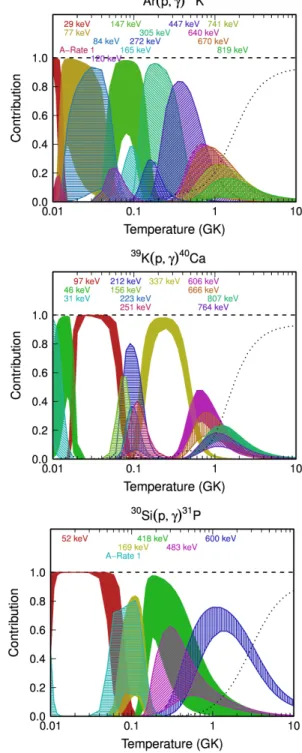
(2010). For a comprehensive overview of this reaction and the available nuclear data, we refer the reader to this work and the references therein. We note here that the lowest-lying, directly observed resonance is at ElabR = 622.2 keV (Kikstra et al. 1990). Information on the compound levels between 100 and 500 keV is therefore limited to indirect measurements. Of the 15 resonances observed in this range, the proton partial width, Γp, has been estimated only for the EcmR = 97, 223, and 337 keV resonances (Seth et al. 1967; Cage et al. 1971; Fuchs et al. 1969). Their estimated rela-tive contributions to the reaction rate are illustrated in the middle panel of Figure 5alongside other important resonances. The key feature of this plot is that the 337-keV resonance (solid green band) is the main contributer to the 39K+p reaction at temperatures in the range of
Figure 5. Individual contributions from resonances and non-resonant amplitudes to the total reaction rate at given temper-atures for the reactions38Ar(p, γ)39K (top),39K(p, γ)40Ca (mid-dle), and30Si(p, γ)31P (bottom). Contributions were calculated using the STARLIB reaction rates. The vertical width of each band indicates the Monte Carlo uncertainty of the contribution at a fixed temperature and corresponds to a coverage probability of 68%. Numbers at the top denote center-of-mass energies of given resonances. ‘A-Rate 1’ refers to the non-resonant (direct capture) rate contribution. The dotted line at higher temperatures indi-cates the aggregate contribution of higher lying resonances.
simula-tions is largely determined by the width of this single resonance. Therefore, in addition to the resonances sug-gested for38Ar(p, γ)39K reaction, we also recommend a direct measurement of the EcmR = 337 keV resonance in 39K(p, γ)40Ca to further our understanding of the ob-served potassium enrichment in NGC 2419.
4.3. 30Si(p, γ)31P
Silicon synthesis and destruction varies precipitously in the 100−200 MK temperature range. At the lower-end (< 140 MK), silicon is primarily made up of the isotope28Si. In this regime, destruction via proton cap-ture is sufficiently slow, allowing the elemental abun-dance of silicon to increase steadily by way of the 27Al(p, γ)28Si reaction. At higher temperatures, 28Si is more efficiently converted to 30Si via the sequence 28Si(p, γ)29P(β+ν)29Si(p, γ)30P(β+ν)30Si. At temper-atures above about 160 MK, the accumulated 30Si is rapidly consumed via the 30Si(p, γ)31P reaction, reduc-ing the silicon abundance to sub-solar values. By vary-ing this rate in Section3, we found that the onset of this depletion affects the simulated temperature and density conditions of the polluter material. For this reason, a more precise estimation of the30Si(p, γ)31P reaction rate is necessary.
The most recent experimental rate was published in
Longland et al. (2010) using the Monte Carlo reac-tion rate formalism. For stellar temperatures between
T = 120−240 MK, the rate is determined by five res-onances in the Ecm
R = 100−500 keV range. Only two of these have been measured previously. The strength of the EcmR = 482.7 keV resonance was measured di-rectly by Kuperus et al. (1959). To date, this is the lowest-lying, directly observed resonance in this reac-tion. For the Ecm
R = 439.1 keV resonance, the pro-ton partial width, Γp, was determined indirectly via the30Si(3He, d)31P reaction (Vernotte et al. 1990). The other three resonances, Ecm
R = 144.3, 169.1, and 418.1 keV, have not yet been measured. Their fractional con-tributions to the total rate are illustrated in the bot-tom panel of Figure 5. The Ecm
R = 418.1 keV state is shown to have the largest contribution (50-100%). A direct measurement of this resonance would therefore allow for a more precise determination of the reaction rate at these temperatures.
5. SUMMARY
We reported here on a sensitivity study of the phys-ical conditions that reproduce the abundance anoma-lies measured in NGC 2419. Using the methodology first presented inIliadis et al.(2016), we obtained tem-perature and density combinations that simultaneously satisfy the observed abundances of Mg, Si, K, Ca, Sc, Ti, and V. By varying each thermonuclear
reac-tion rate within its probability distribureac-tion funcreac-tion, as listed in STARLIB, we found that the 37Ar(p, γ)38K, 38Ar(p, γ)39K, and30Si(p, γ)31P reactions are important in determining a more confined range of these condi-tions.
We then applied artificial systematic effects to the rates to explore the possibility that the acceptable tem-perature and density conditions were sensitive to un-known errors in the nuclear physics input. We adjusted the rates from 1/10 to 10 times their recommended value and found this resulted in a substantive change in the acceptable solutions, with each rate changing the range of stellar temperatures required to produce the observed abundances. In addition to the three reactions already identified, we also found that the 39K(p, γ)40Ca reac-tion produced a marked change in these condireac-tions. To further test the influence that systematic effects could have, we then simulated two scenarios in which all four of these reactions rates were given artificial systematic effects. In the first scenario, we adjusted each rate by a factor of either 5 or 1/5 to promote silicon synthesis and deter potassium production. In the second scenario, we did the opposite. In comparing these two simulations we found that these minor rate adjustments changed the outcome of our simulations dramatically, leading either to significantly improved (first scenario) or worse (sec-ond scenario) constraints on the temperature and den-sity conditions. This suggests that new reaction rate measurements should lead to more robust predictions.
Finally, we discussed the available nuclear structure data for the30Si(p, γ)31P,37Ar(p, γ)38K,38Ar(p, γ)39K, and 39K(p, γ)30Ca reactions. Resonances important to the reaction rates at temperatures of 120−240 MK have not been measured directly to date. Thus, we recom-mend their study as a means to refine the list of plausible polluter candidate sites in the cluster NGC 2419.
REFERENCES Angulo, C., Arnould, M., Rayet, M., et al. 1999, Nuclear Physics
A, 656, 3
Cage, M., Johnson, R., Kunz, P., & Lind, D. 1971, Nuclear Physics A, 162, 657
Cameron, J., Chen, J., Singh, B., & Nica, N. 2012, Nuclear Data Sheets, 113, 365
Carretta, E., Bragaglia, A., Gratton, R. G., et al. 2010, Astronomy and Astrophysics, 516, A55
Cohen, J. G., Huang, W., & Kirby, E. N. 2011, ApJ, 740, 60 Cohen, J. G., & Kirby, E. N. 2012, ApJ, 760, 86
D’Ercole, A., Vesperini, E., D’Antona, F., McMillan, S. L. W., & Recchi, S. 2008, Monthly Notices of the Royal Astronomical Society, 391, 825
Doherty, C. L., Gil-Pons, P., Siess, L., Lattanzio, J. C., & Lau, H. H. B. 2014, Monthly Notices of the Royal Astronomical Society, 446, 2599
Fuchs, H., Grabisch, K., & R¨oschert, G. 1969, Nuclear Physics A, 129, 545
Goriely, S., Hilaire, S., & Koning, A. J. 2008, Astronomy and Astrophysics, 487, 767
Goswami, A., & Prantzos, N. 2000, A&A, 359, 191 H¨anninen, R. 1984, Nuclear Physics A, 420, 351
Iliadis, C. 2015, Nuclear Physics of Stars, 2nd edn. (Weinheim: Wiley-VCH)
Iliadis, C., Karakas, A. I., Prantzos, N., Lattanzio, J. C., & Doherty, C. L. 2016, ApJ, 818, 98
Iliadis, C., Longland, R., Coc, A., Timmes, F. X., & Champagne, A. E. 2015, Journal of Physics G: Nuclear and Particle Physics, 42, 034007
Karakas, A. I. 2010, Monthly Notices of the Royal Astronomical Society, 403, 1413
Kikstra, S. W., Van Der Leun, C., Endt, P. M., et al. 1990, Nuclear Physics A, 512, 425
Kn¨opfle, K., Doll, P., Mairle, G., & Wagner, G. 1974, Nuclear Physics A, 233, 317
Koning, A. J., Hilaire, S., & Duijvestijn, M. 2004, TALYS: A Nuclear Reaction Program, NRG-report 21297/04.62741/P Kuperus, J., Smulders, P., & Endt, P. 1959, Physica, 25, 600 Longland, R. 2012, Astronomy & Astrophysics, 548, A30 Longland, R. 2017, in preparation
Longland, R., Iliadis, C., Champagne, A., et al. 2010, Nuclear Physics A, 841, 1
Moreh, R., Sandefur, W. M., Sellyey, W. C., Sutton, D. C., & Wildenthal, B. H. 1988, Phys. Rev. C, 37, 2428
Mucciarelli, A., Bellazzini, M., Ibata, R., et al. 2012, Monthly Notices of the Royal Astronomical Society, 426, 2889 Nolan, P. J., Al-Naser, A. M., Behbehani, A. H., et al. 1981, J.
Phys. G: Nucl. Phys., 7, 189
Piotto, G., Bedin, L. R., Anderson, J., et al. 2007, ApJ, 661, L53 Rolfs, C., & Rodney, W. 1988, Cauldrons in the Cosmos: Nuclear
Astrophysics (University of Chicago Press)
Sallaska, A. L., Iliadis, C., Champange, A. E., et al. 2013, ApJS, 207, 18
Seth, K. K., Biggerstaff, J. A., Miller, P. D., & Satchler, G. R. 1967, Physical Review, 164, 1450
Ventura, P., D’Antona, F., Criscienzo, M. D., et al. 2012, ApJ, 761, L30
Vernotte, J., Khendriche, A., Berrier-Ronsin, G., et al. 1990, Phys. Rev. C, 41, 1956