Prevalence of Atrial Fibrillation and
Antithrombotic Therapy in Hemodialysis
Patients: Cross-Sectional Results of the
Vienna InVestigation of AtriaL Fibrillation
and Thromboembolism in Patients on
HemoDIalysis (VIVALDI)
Oliver Ko¨ nigsbru¨ gge1, Florian Posch1,2, Marlies Antlanger3, Josef Kovarik4,
Renate Klauser-Braun5, Josef Kletzmayr5, Sabine Schmaldienst6, Martin Auinger7, Gu¨ nther Zuntner8, Matthias Lorenz9, Ella Grilz1, Gerald Stampfel1, Stefan Steiner1,
Ingrid Pabinger1, Marcus Sa¨emann3, Cihan Ay1,10*
1 Clinical Division of Hematology and Hemostaseology, Department of Medicine I, Medical University of
Vienna, Vienna, Austria, 2 Department of Medicine, Clinical Division of Oncology, Medical University of Graz, Austria, 3 Clinical Division of Nephrology, Department of Medicine III, Medical University of Vienna, Vienna, Austria, 4 Department of Medicine VI, Wilhelminenspital, Vienna, Austria, 5 Department of Medicine III, Donauspital, Vienna, Austria, 6 Department of Medicine I, Kaiser-Franz-Josef-Spital, Vienna, Austria,
7 Department of Medicine III, Hietzing Hospital, Vienna, Austria, 8 Department of Medicine I, Rudolfstiftung
Hospital, Vienna, Austria, 9 Vienna Dialysis Center, Vienna, Austria, 10 Department of Medicine,
Thrombosis and Hemostasis Program, McAllister Heart Institute, University of North Carolina at Chapel Hill, Chapel Hill, NC, United States of America
Abstract
Background
Atrial fibrillation (AF) adds significant risk of stroke and thromboembolism in patients on hemodialysis (HD). The aim of this study was to investigate the prevalence of AF in a popu-lation-based cohort of HD patients and practice patterns of antithrombotic therapy for stroke prevention in AF.
Methods
The Vienna InVestigation of AtriaL fibrillation and thromboembolism in patients on hemodial-ysis (VIVALDI), an ongoing prospective observational cohort study, investigates the preva-lence of AF and the risk of thromboembolic events in HD patients in Vienna, Austria. We analyzed cross-sectional data of 626 patients (63.4% men, median age 66 years, approx. 73% of HD patients in Vienna), who provided informed consent. A structured interview with each patient was performed, recent and archived ECGs were viewed and medical histories were verified with electronic records.
a1111111111 a1111111111 a1111111111 a1111111111 a1111111111 OPEN ACCESS
Citation: Ko¨nigsbru¨gge O, Posch F, Antlanger M,
Kovarik J, Klauser-Braun R, Kletzmayr J, et al. (2017) Prevalence of Atrial Fibrillation and Antithrombotic Therapy in Hemodialysis Patients: Cross-Sectional Results of the Vienna
InVestigation of AtriaL Fibrillation and Thromboembolism in Patients on HemoDIalysis (VIVALDI). PLoS ONE 12(1): e0169400. doi:10.1371/journal.pone.0169400
Editor: Juei-Tang Cheng, Chang Jung Christian
University, TAIWAN
Received: August 1, 2016
Accepted: November 27, 2016
Published: January 4, 2017
Copyright:©2017 Ko¨nigsbru¨gge et al. This is an
open access article distributed under the terms of theCreative Commons Attribution License, which permits unrestricted use, distribution, and reproduction in any medium, provided the original author and source are credited.
Data Availability Statement: Austrian law
prohibits public availability of health-related personal data. Data are available upon reasonable request, submitted to Silvia Koder (silvia. [email protected]).
Funding: Support was provided by O¨ sterreichische
Results
The overall prevalence of AF was 26.5% (166 patients, 71.1% men, median age 72 years) of which 57.8% had paroxysmal AF, 3.0% persistent AF, 32.5% permanent AF, and 6.6% of patients had newly diagnosed AF. The median CHA2DS2-VASc Score was 4 [25th-75th per-centile 3–5]. In multivariable analysis, AF was independently associated with age (odds ratio: 1.05 per year increase, 95% confidence interval: 1.03–1.07), male sex (1.7, 1.1–2.6), history of venous thromboembolism (2.0, 1.1–3.6), congestive heart failure (1.7, 1.1–2.5), history of or active cancer (1.5, 1.0–2.4) and time on HD (1.08 per year on HD, 1.03–1.13). Antithrombotic treatment was applied in 84.4% of AF patients (anticoagulant agents in 29.5%, antiplatelet agents in 33.7%, and both in 21.1%). In AF patients, vitamin-K-antago-nists were used more often than low-molecular-weight heparins (30.1% and 19.9%).
Conclusions
The prevalence of AF is high amongst HD patients and is associated with age, sex, and dis-tinct comorbidities. Practice patterns of antithrombotic treatment indicate a lack of consen-sus for stroke prevention in HD patients with AF.
Introduction
Atrial fibrillation (AF) is a common cardiac arrhythmia that affects 1–2% of the general popu-lation, and increases the risk of stroke [1,2]. In patients with end-stage renal disease (ESRD) receiving hemodialysis (HD), AF is an underestimated comorbidity. Although it is recognized as a causal factor for thromboembolic ischemic stroke and is associated with increased mortal-ity in HD patients [3,4], stroke prevention using antithrombotic agents is complicated by an excessive risk of bleeding in ESRD patients [5]. In the general population, stroke prevention in AF with oral anticoagulation with vitamin-K-antagonists (VKA) can reduce the incidence of stroke by 60% [6]. However, in HD patients there is currently no clear evidence for how to achieve stroke prevention [7], and large differences exists in the current practice for use of antithrombotic agents in HD patients [8].
The reported prevalence of AF in HD patients is 3.8 to 27% [9–14]. This large variability in AF prevalence may be explained by regional differences [8], but may also be biased by the dif-ferent study designs and data capture methods. The overall higher prevalence of AF compared to the general population is hypothesized to be associated with the HD procedure itself,[15] which can lead to an increase of cardiac dimensions and decrease of ejection fraction, resulting in AF development [12]. Thus, the prevalence of AF in HD patients may depend upon hemo-dialysis-specific patient characteristics as well as on treatment modalities.
In this population-based cohort of HD patients, we investigated the prevalence of AF, ana-lyzed the association of AF with clinico-epidemiological factors, and collected data on practice patterns of antithrombotic treatment strategies applied in HD patients for stroke prevention in AF.
Patients and Methods
The Vienna InVestigation of AtriaL fibrillation and thromboembolism in hemDIialysis patients (VIVALDI) is a cohort study with aims to gather population-based epidemiologic data on the prevalence of AF, thromboembolic events and use of antithrombotic treatments in
IP [https://www.oenb.at/Ueber-Uns/
Forschungsfoerderung/Jubilaeumsfonds.html] and O¨ sterreichische Gesellschaft fu¨r Innere Medizin (Austrian Society for Internal Medicine) Joseph-Skoda-Prize 2014 awarded to CA [http://www.
oegim.at/aktuell/preise/josef-skoda-projektfoerderungspreis.html]. The funders had no role in study design, data collection and analysis, decision to publish, or preparation of the manuscript.
Competing Interests: The authors have declared
HD patients and prospective data on the incidence of stroke and thromboembolism, as well as the incidence of new AF, bleeding, hospitalization, cardiovascular events, thrombotic shunt complications, and mortality. The study consists of a cross-sectional baseline investigation and a prospective observational evaluation of study outcomes and has approval of the local ethics committees. VIVALDI is conducted in accordance with the declaration of Helsinki and its later amendments.
Patient treated at the seven major HD centers in the city of Vienna, Austria, were eligible for recruitment. The study cohort was recruited between April 2014 and July 2015. Patients aged 18 years or above, with an independent diagnosis of ESRD requiring long-term ambula-tory HD treatment, able to provide signed and dated informed consent, and willing to comply with all study procedures were eligible for inclusion. Patients were excluded, if they were preg-nant, lactating, suspected of pregnancy, incapable to consent, hospitalized as an in-patient, or serving a prison term at the time of enrolment. The steps of patient enrolment and corre-sponding patient numbers are provided inFig 1. Out of approximately 860 patients receiving HD in Vienna (population of 1.7 million in 2014–2015), Austria, 814 (94.6%) were personally approached and 626 patients (~73% of the total HD population in the city) met the inclusion criteria and consented to participate. The prospective observation period is still ongoing.
A trained study investigator interviewed each patient individually and recorded demo-graphics, medical histories and HD parameters using the REDCap electronic data capture tools hosted at the Medical University of Vienna, Department of Medicine I, Clinical Division of Hematology and Haemostaseology [16]. Data quality was verified with treating nephrolo-gists and the medical documentation of the participating dialysis centers. Cause of ESRD was established from the medical records at the dialysis center and classified according to catego-ries of the Austrian Dialysis and Transplantation Registry [17]. A diagnosis of AF was recorded for symptomatic or asymptomatic AF in any one of the following (1) signs of AF on a recent 12-lead resting ECG within one month of recruitment, (2) documented AF episode during previous ECGs conducted routinely or in case of arrhythmia at the dialysis centers, or (3) recorded diagnosis of AF in medical records. Recently diagnosed AF was defined as recent new diagnosis of AF, where a specific type had not been established. Paroxysmal AF is recur-rent self-terminating AF. Persistent AF is long-lasting AF that requires termination by cardio-version. In permanent AF, patients do not return to sinus rhythm or attempt cardioversion [18]. Time on HD was calculated as the sum of the current HD treatment period and periods of HD treatment before renal transplant in patients where applicable. Inter-dialytic weight gain was calculated as the difference between pre-dialysis weight and target dry body weight. A history of venous thromboembolism only includes non-catheter-associated deep vein throm-bosis and pulmonary embolism.
Statistical methods
Results
Study population
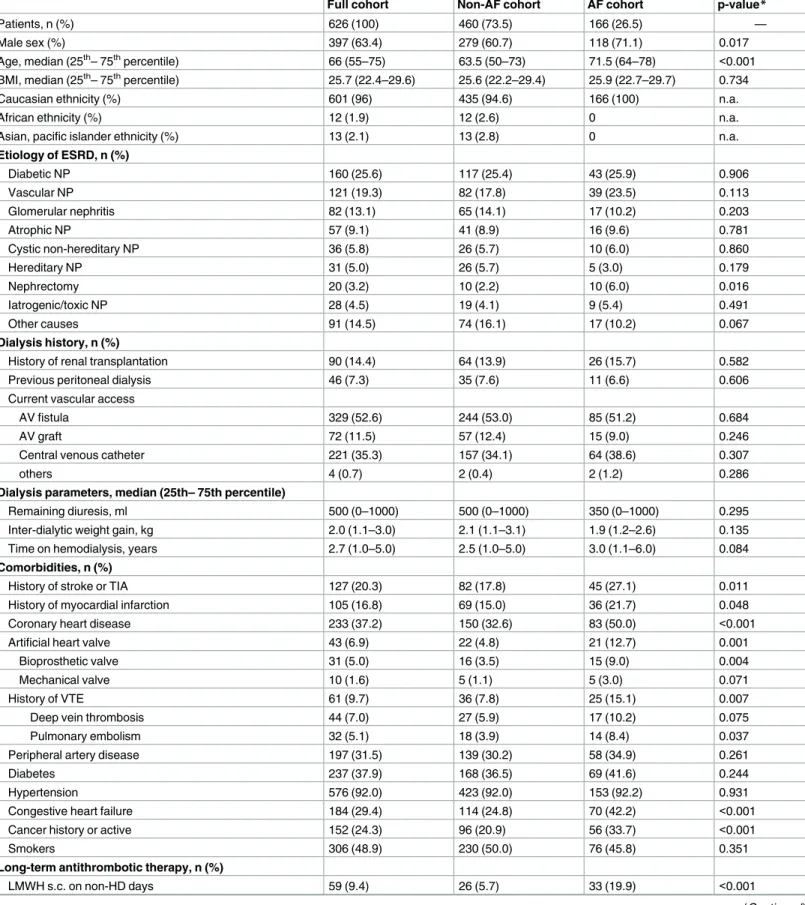
A total of 626 patients were recruited into the study, of which 397 (63.4%) were men. The median age was 66 years (25thto 75thpercentile 55–75) and the median BMI was 25.7 kg/m2 (22.4–29.6). Diabetic nephropathy was the most frequent cause for ESRD (25.6%) followed by vascular nephropathy (19.3%). Further baseline characteristics of the study cohort are pro-vided inTable 1.
Fig 1. Flow chart of the patient recruitment.
Table 1. Characteristics of the study population at baseline.
Full cohort Non-AF cohort AF cohort p-value*
Patients, n (%) 626 (100) 460 (73.5) 166 (26.5) —
Male sex (%) 397 (63.4) 279 (60.7) 118 (71.1) 0.017
Age, median (25th– 75thpercentile) 66 (55–75) 63.5 (50–73) 71.5 (64–78) <0.001 BMI, median (25th– 75thpercentile) 25.7 (22.4–29.6) 25.6 (22.2–29.4) 25.9 (22.7–29.7) 0.734
Caucasian ethnicity (%) 601 (96) 435 (94.6) 166 (100) n.a.
African ethnicity (%) 12 (1.9) 12 (2.6) 0 n.a.
Asian, pacific islander ethnicity (%) 13 (2.1) 13 (2.8) 0 n.a.
Etiology of ESRD, n (%)
Diabetic NP 160 (25.6) 117 (25.4) 43 (25.9) 0.906
Vascular NP 121 (19.3) 82 (17.8) 39 (23.5) 0.113
Glomerular nephritis 82 (13.1) 65 (14.1) 17 (10.2) 0.203
Atrophic NP 57 (9.1) 41 (8.9) 16 (9.6) 0.781
Cystic non-hereditary NP 36 (5.8) 26 (5.7) 10 (6.0) 0.860
Hereditary NP 31 (5.0) 26 (5.7) 5 (3.0) 0.179
Nephrectomy 20 (3.2) 10 (2.2) 10 (6.0) 0.016
Iatrogenic/toxic NP 28 (4.5) 19 (4.1) 9 (5.4) 0.491
Other causes 91 (14.5) 74 (16.1) 17 (10.2) 0.067
Dialysis history, n (%)
History of renal transplantation 90 (14.4) 64 (13.9) 26 (15.7) 0.582
Previous peritoneal dialysis 46 (7.3) 35 (7.6) 11 (6.6) 0.606
Current vascular access
AV fistula 329 (52.6) 244 (53.0) 85 (51.2) 0.684
AV graft 72 (11.5) 57 (12.4) 15 (9.0) 0.246
Central venous catheter 221 (35.3) 157 (34.1) 64 (38.6) 0.307
others 4 (0.7) 2 (0.4) 2 (1.2) 0.286
Dialysis parameters, median (25th– 75th percentile)
Remaining diuresis, ml 500 (0–1000) 500 (0–1000) 350 (0–1000) 0.295
Inter-dialytic weight gain, kg 2.0 (1.1–3.0) 2.1 (1.1–3.1) 1.9 (1.2–2.6) 0.135
Time on hemodialysis, years 2.7 (1.0–5.0) 2.5 (1.0–5.0) 3.0 (1.1–6.0) 0.084
Comorbidities, n (%)
History of stroke or TIA 127 (20.3) 82 (17.8) 45 (27.1) 0.011
History of myocardial infarction 105 (16.8) 69 (15.0) 36 (21.7) 0.048
Coronary heart disease 233 (37.2) 150 (32.6) 83 (50.0) <0.001
Artificial heart valve 43 (6.9) 22 (4.8) 21 (12.7) 0.001
Bioprosthetic valve 31 (5.0) 16 (3.5) 15 (9.0) 0.004
Mechanical valve 10 (1.6) 5 (1.1) 5 (3.0) 0.071
History of VTE 61 (9.7) 36 (7.8) 25 (15.1) 0.007
Deep vein thrombosis 44 (7.0) 27 (5.9) 17 (10.2) 0.075
Pulmonary embolism 32 (5.1) 18 (3.9) 14 (8.4) 0.037
Peripheral artery disease 197 (31.5) 139 (30.2) 58 (34.9) 0.261
Diabetes 237 (37.9) 168 (36.5) 69 (41.6) 0.244
Hypertension 576 (92.0) 423 (92.0) 153 (92.2) 0.931
Congestive heart failure 184 (29.4) 114 (24.8) 70 (42.2) <0.001
Cancer history or active 152 (24.3) 96 (20.9) 56 (33.7) <0.001
Smokers 306 (48.9) 230 (50.0) 76 (45.8) 0.351
Long-term antithrombotic therapy, n (%)
LMWH s.c. on non-HD days 59 (9.4) 26 (5.7) 33 (19.9) <0.001
AF prevalence
A diagnosis of AF was recorded in 166 patients (26.5%). AF patients were predominantly men (71.1%) with a median age of 71.5 years (64–78). In 59.6% of patients with AF, AF developed after commencing HD treatment, while 40.4% had AF before ESRD. AF was present in 93 patients (56%) as paroxysmal AF, in 5 patients (3%) as persistent AF, in 53 patients (32%) as permanent AF, and in 15 patients (9%) as recently diagnosed or unknown type of AF.
The prevalence of AF rose with increasing age, from 8.4% (14/166) in patients aged younger than 55 years, 22.0% (29/132) in those aged 55–64 years, 31.4% (55/175) in those aged 65–74 years, and 41.7% (68/163) in patients aged75 years (Fig 2).
The prevalence of AF was 23.7% (40/169) in patients with1 year of time on HD, 27.0% (31/115) with 1 to 2 years of time on HD, 19.0% (16/84) with 2 to 3 years time on HD, 27.7% (18/65) with 3 to 4 years time on HD, 30.0% (15/50) with 4 to 5 years of time on HD and 32.2% (46/143) with more than 5 years time on HD (Fig 2).
The distribution of AF for the baseline parameters sex, age, time on HD, a history of stroke or transient ischemic attack (TIA), coronary heart disease, venous thromboembolism (VTE), artificial heart valves, active or history of cancer, and congestive heart failure had significant trends in the Wilcoxon-Mann-Whitney U test and chi-squared test (Table 1). In univariable logistic regression, these factors were associated with the presence of AF (Table 2).
In multivariable logistic regression with covariates identified as potentially associated with AF prevalence, male sex, increased age, history of VTE, cancer, and congestive heart failure were identified as independently associated with increased risk of AF diagnosis (Table 2). After excluding patients with AF diagnosed chronologically before ESRD for a second model of 559 patients, increased time on HD was associated with the presence of AF (Table 3).
Risk evaluation for stroke and bleeding in AF patients resulted in a median CHA2DS2-Vasc
Score of 4 (25thto 75thpercentile 3–5) and a median HAS-BLED Score of 4 (3–4). A strong indication for anticoagulation was given in 159 patients (95.8% of AF patients) who had a CHA2DS2-Vasc2.
Anti-thrombotic therapy
The frequencies of antithrombotic medications in mono- and combination therapy are given inTable 4.
For the dual pathway therapy in the full cohort, LMWH use was preferred over VKA (5.1% versus 4.2%, p = 0.013). The new generation P2Y12 inhibitors, ticagrelor and prasugrel, were not used in dual pathway antithrombotic therapy and direct oral anticoagulants were not used in any patient.
Table 1. (Continued)
Full cohort Non-AF cohort AF cohort p-value*
20 mg o.d. 4 (0.6) 2 (0.4) 2 (1.2) <0.001
40 mg o.d. 39 (6.2) 18 (3.9) 21 (12.7) <0.001
60 mg o.d. 11 (1.8) 5 (1.1) 6 (3.6) <0.001
80 mg o.d. 5 (0.8) 1 (0.2) 4 (2.4) <0.001
Vitamin K antagonist 77 (12.3) 27 (5.9) 50 (30.1) <0.001
Antiplatelet agent 345 (55.1) 254 (55.2) 91 (54.8) 0.930
Table legend: AF–atrial fibrillation, BMI–body-mass-index, NP–nephropathy, AV–arteriovenous, TIA–transient ischemic attack, VTE–venous
thromboembolism, LMWH–low-molecular-weight heparin, o.d.–once daily*Mann-Whitney U test or chi2p-value for non-AF cohort versus AF cohort.
In the AF group, 84 patients (50.6%) received anticoagulation treatment. 50 patients (30.1%) were orally anticoagulated with VKA, 33 patients (19.9%) received LMWH on non-HD days for long-term stroke prevention. One patient (0.6%) received fondaparinux in the same indication. Fifty-six patients (33.7%) received antiplatelet agents instead of anticoagu-lants for stroke prevention. Twenty-six AF patients (15.6%) received no antithrombotic ther-apy at all, except the anticoagulation during HD sessions. There was no association of CHA2DS2-VASc scores with use or non-use of anticoagulation therapy (p = 0.938) (Fig 3).
Fig 2. Prevalence of atrial fibrillation in patients with increasing age and time on hemodialysis.
Patients with higher HAS-BLED scores were less likely to receive anticoagulation therapy (p = 0.019) (Fig 4).
Discussion
Patients with ESRD are at approximately 6-fold increased risk of stroke and systemic embo-lism compared to the general population [19–21]. One of the main culprits suspected of increasing the risk of stroke in ESRD patients is AF. In the cross-sectional evaluation of our population-based cohort study of 626 HD patients in Vienna, we found a 26.5% prevalence of AF.
Previous studies have determined the prevalence of AF in HD patients between 3.8 and 27% [9–13]. Studies with retrospective design or based on large insurance claims databases estimated a prevalence between 10 and 15% [13,14,22], while studies with prospective, patient-level data tended to find a higher prevalence of AF [11,12]. Prevalence rates derived from patient-level cohort studies can be suspected of selection bias, especially if a large number of centers contributes only few patients each, potentially over-representing AF patients. Never-theless, from our findings we have to assume that the prevalence of AF is underestimated in large population-level cohorts. The data gathered in our investigation is entirely constituted of patient-level data, derived from personal patient interviews, structured review of the detailed medical records at the dialysis centers, and objective verification of AF based on standardized criteria. According to estimates from the Austrian Registry of Dialysis and Transplantation yearly report of 2013 [23], the cohort in our study covers ~ 73% of the population of HD patients in the city of Vienna (population 1.7 million).
Table 2. Factors associated with prevalence of atrial fibrillation Model 1 (N = 626).
Characteristics Univariable OR (95%CI) p Multivariable OR (95% CI) p
Male sex 1.60 (1.09–2.34) 0.017 1.73 (1.13–2.63) 0.011
Age, per year 1.05 (1.04–1.07) <0.001 1.05 (1.03–1.07) <0.001
Time on HD, per year 1.02 (0.98–1.06) 0.370 1.03 (0.99–1.08) 0.135
Stroke/TIA 1.71 (1.13–2.60) 0.011 1.36 (0.86–2.13) 0.188
Coronary heart disease 2.07 (1.44–2.97) <0.001 1.41 (0.95–2.10) 0.091
Artificial heart valve 2.88 (1.54–5.40) 0.001 1.80 (0.91–3.56) 0.094
VTE 2.09 (1.21–3.60) 0.008 1.99 (1.11–3.59) 0.022
Congestive heart failure 2.21 (1.52–3.22) <0.001 1.66 (1.10–2.51) 0.015
Cancer history/active 1.93 (1.30–2.86) 0.001 1.55 (1.02–2.36) 0.042
doi:10.1371/journal.pone.0169400.t002
Table 3. Model 2 of factors associated with atrial fibrillation, excluding patients with a diagnosis of atrial fibrillation before occurrence of ESRD (N = 559).
Characteristics Univariable OR (95%CI) p Multivariable OR (95%CI) p
Male sex 1.92 (1.18–3.14) 0.009 2.18 (1.28–3.70) 0.004
Age, per year 1.05 (1.03–1.06) <0.001 1.05 (1.03–1.07) <0.001
Time on HD, per year 1.06 (1.02–1.11) 0.003 1.08 (1.03–1.13) 0.001
Stroke/TIA 1.56 (0.93–2.60) 0.090 1.14 (0.66–1.98) 0.631
Coronary heart disease 2.03 (1.31–3.14) 0.002 1.41 (0.87–2.27) 0.160
Artificial heart valve 2.24 (1.02–4.89) 0.043 1.44 (0.62–3.34) 0.400
VTE 1.94 (1.00–3.75) 0.049 1.89 (0.93–3.85) 0.081
Congestive heart failure 1.59 (0.99–2.53) 0.052 1.24 (0.75–2.03) 0.403
Cancer history/active 1.65 (1.02–2.68) 0.043 1.21 (0.72–2.03) 0.481
In the general population and HD patients alike, AF is a disease of the elderly and is more frequent in men than in women [1,10,14]. In our cohort, the prevalence AF in patients 75 years of age and older reached over 40% and male sex was independently associated with 1.7-fold increased odds of AF diagnosis.
In search of other characteristics that may be associated with AF development in HD patients, we investigated the time on HD expressed as in HD age years. The risk of an AF diag-nosis increased by 8% for every year a patient spent on HD treatment. We were further able to show that congestive heart failure was associated with AF diagnosis. Further cardiovascular conditions, which are generally considered risk factors for the development of AF, such as cor-onary heart disease, hypertension or valvular diseases, were not associated with AF. This may prove difficult in an HD cohort enriched with higher frequencies of comorbidities than the general population. It may be a specific characteristic of HD cohorts that recognized factors associated with AF in the general population may not apply. Surprisingly however, the risk of an AF diagnosis was independently increased in patients with a history of VTE. We ruled out a confounding relationship of catheter-associated or shunt-related thrombosis by only includ-ing non-catheter DVT and PE in the analysis. The interpretation of this novel relationship between a history of VTE and AF in HD patients will certainly require prospective analysis. The prevalence of AF was further associated with presence or history of malignancy. A causal connection through cardiotoxic cancer-therapy would have to be examined in a randomized trial setting. Prospective observational data could reveal if shared risk factors lead to confound-ing of the relationship between cancer and AF.
The high risk of stroke and bleeding in ESRD patients on HD and a complex risk profile including many risk factors for thromboembolic complications warrants a specific risk evalua-tion for AF patients on HD. The CHADS2, CHA2DS2-VASc, and HAS-BLED Scores, predict
the risk of stroke and bleeding in the general population based on epidemiologic distribution of risk factors [24–26]. These risk evaluation approaches also have validity in HD patients [27– 29], but because of the higher frequencies of risk factors amongst HD patients, these scores may lose the ability to distinguish between truly high and low risk patients. On the CHA2DS2
-VASc scale 95.8% of the patients with AF in this cohort reached indication for continuous anticoagulation. Strict adherence to these generally established risk scores may lead to more aggressive anticoagulation treatment in HD patients. More recently, evidence from a
Table 4. Practice patterns of antithrombotics in patients on HD.
Antithrombotic therapy Full cohort, count (% of N = 626)
AF cohort, count (% of N = 166)
Vitamin-K-antagonist 77 (12.3) 50 (30.1)
Monotherapy 51 (8.1) 35 (21.1)
Combination with antiplatelet agent 26 (4.2) 15 (9.0) Triple therapy (VKA + clopidogrel
+ aspirin)
3 (0.5) 0
Low-molecular-weight heparin 59 (9.4) 33 (19.9)
Monotherapy 27 (4.3) 14 (8.4)
Combination with antiplatelet agent 32 (5.1) 19 (11.4) Triple therapy (LMWH + clopidogrel
+ aspirin)
6 (1.0) 4 (2.4)
Antiplatelet 345 (55.1) 91 (54.8)
Monotherapy 286 (45.7) 56 (33.7)
Dual antiplatelet therapy 50 (8.0) 11 (6.7)
No antithrombotic 203 (32.4) 26 (15.6)
Taiwanese nationwide cohort indicated that the risk of stroke in HD patients with AF may be overestimated [3] and that ethnicity may be a risk modifying factor. Cohorts of HD patients with AF are further never untreated cohorts, as the majority of patients receive LMWH during HD sessions to prevent clotting in the dialysis tubes.
There is currently no consensus on the appropriate use of antithrombotic agents for stroke prevention in HD patients. This is because patients on HD were excluded from trials on stroke prevention and not all results from non-randomized clinical studies show the same benefit of anticoagulation treatment for AF patients [30–34]. The treatment practices in our cohort showed 30.1% of AF patients receiving oral anticoagulant with VKA and 19.9% receiving LMWH on non-HD days for stroke prevention. Treatment practices from different cohorts had 25 to 58% use of VKA in AF patients, indicating that the prescription is very dependent on local preferences [8,28,34–38]. Due to renal elimination, LMWHs are essentially contraindicated in
Fig 3. Distribution of patients with AF across CHA2DS2-VASc Scores and frequency of corresponding anticoagulation treatment.
patients with a creatinine clearance<30ml/min [39]. However, in the absence of evidence for a clear benefit of VKA in stroke prevention for AF, LMWH in prophylactic dose given on non-HD days may be an option in some cases of patients with very high risk of stroke. Despite lack of evidence for LMWH treatment as long-term stroke prevention in AF, almost 20% of AF patients in our cohort received this treatment. Over 50% of both AF and non-AF patients in this cohort received antiplatelet agents and treating physicians chose a cautious approach with LMWH over VKA in patients with indication for dual pathway antithrombotic therapy and tended to decide against anticoagulation in patients with higher HAS-BLED scores.
The present study has limitations in need of acknowledgment. The recruited cohort has a rel-atively small sample size, compared to national or insurance-claims registry studies and may thus be biased for the true prevalence of AF and associated medical conditions. However, this
Fig 4. Distribution of patients with AF across HAS-BLED Scores and frequency of corresponding anticoagulation treatment.
study was designed to capture an entire regional population of HD patients. We performed a cross-sectional analysis of 626 HD patients from the seven major HD centers in the city of Vienna and avoided a selection bias by recruiting a representative sample of approximately 73% of the regional HD population. The study design further ensured that the AF diagnosis derived from patient-level data, according to reproducible criteria for diagnosis. Asymptomatic, parox-ysmal AF may, however, have been underdiagnosed. Since the HD centers are all within the city limits of Vienna, our cohort may represent a largely urban population and may therefore differ from more rural areas. Previous studies on Austrian populations of HD patients had similar demographic characteristics but lower prevalence rates of AF and lower use of VKA anticoagu-lants [22,36]. The risk of stroke and mortality associated with AF may lead to a decreased preva-lence of AF in patients with long time on HD, otherwise known as healthy user bias. We cannot exclude that this form of selection bias may have led to further underestimation of the AF preva-lence in our current analysis.
In conclusion, we confirmed that the prevalence of AF is high amongst ESRD patients on chronic hemodialysis. Prevalence data from retrospective and registry cohorts may underesti-mate the burden of AF in ESRD patients. The use of antithrombotic agents for stroke preven-tion in AF in our cohort indicates a lack of consensus for ideal antithrombotic therapy and therapy-guiding risk evaluation for thromboembolic complications and bleeding in HD patients may require more HD-specific risk factors.
Acknowledgments
The authors would like to acknowledge all clinical collaborators who assisted in patient recruitment at the dialysis centers.
Author Contributions
Conceptualization: OK FP MS IP CA.
Data curation: OK.
Formal analysis: OK.
Funding acquisition: IP OK CA.
Investigation: OK EG GS S. Steiner.
Methodology: OK FP MS CA.
Project administration: CA.
Resources: JK RKB JK S. Schmaldienst GZ MA ML MS IP.
Software: OK FP.
Supervision: IP CA.
Validation: OK FP.
Visualization: OK.
Writing – original draft: OK.
References
1. Go A, Hylek E, Phillips K. Prevalence of diagnosed atrial fibrillation in adults. JAMA. 2001; 285: 2370– 2375. PMID:11343485
2. Schnabel RB, Yin X, Gona P, Larson MG, Beiser AS, McManus DD, et al. 50 year trends in atrial fibrilla-tion prevalence, incidence, risk factors, and mortality in the Framingham Heart Study: a cohort study. Lancet. 2015; 386: 154–162. doi:10.1016/S0140-6736(14)61774-8PMID:25960110
3. Shih C-J, Ou S-M, Chao P-W, Kuo S-C, Lee Y-J, Yang C-Y, et al. Risks of Death and Stroke in Patients Undergoing Hemodialysis With New-Onset Atrial Fibrillation: A Competing-Risk Analysis of a Nation-wide Cohort. Circulation. 2016; 133: 265–272. doi:10.1161/CIRCULATIONAHA.115.018294PMID:
26680239
4. Genovesi S, Vincenti A, Rossi E, Pogliani D, Acquistapace I, Stella A, et al. Atrial fibrillation and morbid-ity and mortalmorbid-ity in a cohort of long-term hemodialysis patients. Am J Kidney Dis. 2008; 51: 255–262. doi:10.1053/j.ajkd.2007.10.034PMID:18215703
5. Molnar AO, Bota SE, Garg AX, Harel Z, Lam N, McArthur E, et al. The Risk of Major Hemorrhage with CKD. J Am Soc Nephrol. 2016;27: ePub ahead of print.
6. Hart RG, Halperin JL. Atrial Fibrillation and Thromboembolism: A Decade of Progress in Stroke Preven-tion. Ann Intern Med. 1999; 131: 688–695. PMID:10577332
7. January CT, Wann LS, Alpert JS, Calkins H, Cleveland JC, Cigarroa JE, et al. 2014 AHA/ACC/HRS guideline for the management of patients with atrial fibrillation: A report of the American college of cardi-ology/American heart association task force on practice guidelines and the heart rhythm society. Circu-lation. 2014; 130: e199–e267. doi:10.1161/CIR.0000000000000041PMID:24682347
8. Wizemann V, Tong L, Satayathum S, Disney A, Akiba T, Fissell RB, et al. Atrial fibrillation in hemodialy-sis patients: clinical features and associations with anticoagulant therapy. Kidney Int. 2010; 77: 1098– 106. doi:10.1038/ki.2009.477PMID:20054291
9. Ohsawa M, Tanno K, Okamura T, Yonekura Y, Kato K, Fujishima Y, et al. Standardized Prevalence Ratios for Atrial Fibrillation in Adult Dialysis Patients in Japan. J Epidemiol. 2016; 26: 272–6. doi:10. 2188/jea.JE20150077PMID:26804038
10. Atar I, KonaşD, Ac¸ikel S, Ku¨lah E, Atar A, BozbaşH, et al. Frequency of atrial fibrillation and factors related to its development in dialysis patients. Int J Cardiol. 2006; 106: 47–51. doi:10.1016/j.ijcard. 2004.12.048PMID:16321665
11. Genovesi S, Pogliani D, Faini A, Valsecchi MG, Riva A, Stefani F, et al. Prevalence of atrial fibrillation and associated factors in a population of long-term hemodialysis patients. Am J Kidney Dis. 2005; 46: 897–902. doi:10.1053/j.ajkd.2005.07.044PMID:16253730
12. Vazquez E, Sanchez-Perales C, Garcia-Garcia F, Castellano P, Garcia-Cortes M-J, Liebana A, et al. Atrial fibrillation in incident dialysis patients. Kidney Int. 2009; 76: 324–30. doi:10.1038/ki.2009.185
PMID:19494800
13. Wetmore JB, Ellerbeck EF, Mahnken JD, Phadnis MA, Rigler SK, Spertus JA, et al. Stroke and the “Stroke Belt” in Dialysis: Contribution of Patient Characteristics to Ischemic Stroke Rate and Its Geo-graphic Variation. J Am Soc Nephrol. 2013; 24: 2053–2061. doi:10.1681/ASN.2012111077PMID:
23990675
14. Winkelmayer WC, Patrick AR, Liu J, Brookhart MA, Setoguchi S. The increasing prevalence of atrial fibrillation among hemodialysis patients. J Am Soc Nephrol. 2011; 22: 349–57. doi:10.1681/ASN. 2010050459PMID:21233416
15. Buiten MS, de Bie MK, Rotmans JI, Gabree¨ls BA, van Dorp W, Wolterbeek R, et al. The dialysis proce-dure as a trigger for atrial fibrillation: new insights in the development of atrial fibrillation in dialysis patients. Heart. 2014; 100: 685–90. doi:10.1136/heartjnl-2013-305417PMID:24670418
16. Harris PA, Taylor R, Thielke R, Payne J, Gonzalez N, Conde JG. Research Electronic Data Capture (REDCap)—A metadata driven methodology and workflow process for providing translational research informatict support. J Biomed Inform. 2009; 42: 377–81. doi:10.1016/j.jbi.2008.08.010PMID:
18929686
17. Stel VS, van Dijk PCW, van Manen JG, Dekker FW, Ansell D, Conte F, et al. Prevalence of co-morbidity in different European RRT populations and its effect on access to renal transplantation. Nephrol Dial Transplant. 2005; 20: 2803–2811. doi:10.1093/ndt/gfi099PMID:16188902
18. Camm a J, Kirchhof P, Lip GYH, Schotten U, Savelieva I, Ernst S, et al. Guidelines for the management of atrial fibrillation: the Task Force for the Management of Atrial Fibrillation of the European Society of Cardiology (ESC). Eur Heart J. 2010; 31: 2369–429. doi:10.1093/eurheartj/ehq278PMID:20802247 19. Seliger SL, Gillen DL, Longstreth WT, Kestenbaum B, Stehman-Breen CO. Elevated risk of stroke
20. Wang HH, Hung SY, Sung JM, Hung KY, Wang JD. Risk of stroke in long-term dialysis patients com-pared with the general population. Am J Kidney Dis. 2014; 63: 604–611. doi:10.1053/j.ajkd.2013.10. 013PMID:24290244
21. Go AS, Chertow GM, Fan D, McCulloch CE, Hsu C. Chronic kidney disease and the risks of death, car-diovascular events, and hospitalization. N Engl J Med. 2004; 351: 1296–305. doi:10.1056/
NEJMoa041031PMID:15385656
22. Wiesholzer M, Harm F, Tomasec G, Barbieri G, Putz D, Balcke P. Incidence of stroke among chronic hemodialysis patients with nonrheumatic atrial fibrillation. Am J Nephrol. 2001; 21: 35–9. PMID:
11275630
23. Kramar R. O¨ sterreichisches Dialyse- und Transplantationsregister. In: Jahresbericht 2013 [Internet]. 2015 [cited 8 Mar 2016]. Available:www.nephro.at/oedr2013/oedr2013.htm
24. Gage BF, Waterman AD, Shannon W, Boechler M, Rich MW, Radford MJ. Validation of Clinical Classifi-cation Schemes Results From the National Registry of Atrial Fibrillation. 2015; 285: 2864–2870.
25. Lip GYH, Nieuwlaat R, Pisters R, Lane DA, Crijns HJGM. Refining clinical risk stratification for predicting stroke and thromboembolism in atrial fibrillation using a novel risk factor-based approach: The Euro Heart Survey on atrial fibrillation. Chest. 2010; 137: 263–272. doi:10.1378/chest.09-1584PMID:
19762550
26. Pisters R, Lane DA, Nieuwlaat R, De Vos CB, Crijns HJGM, Lip GYH. A novel user-friendly score (HAS-BLED) to assess 1-year risk of major bleeding in patients with atrial fibrillation: The euro heart survey. Chest. 2010; 138: 1093–1100. doi:10.1378/chest.10-0134PMID:20299623
27. Chao T-F, Liu C-J, Wang K-L, Lin Y-J, Chang S-L, Lo L-W, et al. Incidence and prediction of ischemic stroke among atrial fibrillation patients with end-stage renal disease requiring dialysis. Heart Rhythm. 2014; 11: 1752–9. doi:10.1016/j.hrthm.2014.06.021PMID:24952148
28. Friberg L, Benson L, Lip GYH. Balancing stroke and bleeding risks in patients with atrial fibrillation and renal failure: the Swedish Atrial Fibrillation Cohort study. Eur Heart J. 2015; 36: 297–306. doi:10.1093/ eurheartj/ehu139PMID:24722803
29. Yang H, Chen Y-H, Hsieh T-F, Chuang S-Y, Wu M-J. Prediction of Mortality in Incident Hemodialysis Patients: A Validation and Comparison of CHADS2, CHA2DS2, and CCI Scores. PLoS One. 2016; 11: e0154627. doi:10.1371/journal.pone.0154627PMID:27148867
30. Winkelmayer WC, Liu J, Setoguchi S, Choudhry NK. Effectiveness and safety of warfarin initiation in older hemodialysis patients with incident atrial fibrillation. Clin J Am Soc Nephrol. 2011; 6: 2662–2668. doi:10.2215/CJN.04550511PMID:21959598
31. Shen JI, Montez-Rath ME, Lenihan CR, Turakhia MP, Chang TI, Winkelmayer WC. Outcomes after warfarin initiation in a cohort of hemodialysis patients with newly diagnosed atrial fibrillation. Am J Kid-ney Dis. 2015; 66: 677–688. doi:10.1053/j.ajkd.2015.05.019PMID:26162653
32. Shah M, Avgil Tsadok M, Jackevicius CA, Essebag V, Eisenberg MJ, Rahme E, et al. Warfarin use and the risk for stroke and bleeding in patients with atrial fibrillation undergoing dialysis. Circulation. 2014; 129: 1196–203. doi:10.1161/CIRCULATIONAHA.113.004777PMID:24452752
33. Carrero JJ, Evans M, Szummer K, Spaak J, Lindhagen L, Edfors R, et al. Warfarin, kidney dysfunction, and outcomes following acute myocardial infarction in patients with atrial fibrillation. JAMA. 2014; 311: 919–28. doi:10.1001/jama.2014.1334PMID:24595776
34. Chan KE, Lazarus JM, Thadhani R, Hakim RM. Warfarin use associates with increased risk for stroke in hemodialysis patients with atrial fibrillation. J Am Soc Nephrol. 2009; 20: 2223–2233. doi:10.1681/ ASN.2009030319PMID:19713308
35. Olesen JB, Lip GYH, Kamper A-L, Hommel K, Køber L, Lane DA, et al. Stroke and bleeding in atrial fibrillation with chronic kidney disease. N Engl J Med. 2012; 367: 625–35. doi:10.1056/
NEJMoa1105594PMID:22894575
36. Knoll F, Sturm G, Lamina C, Zitt E, Lins F, Freista¨tter O, et al. Coumarins and survival in incident dialy-sis patients. Nephrol Dial Transplant. 2012; 27: 332–7. doi:10.1093/ndt/gfr341PMID:21771750 37. Genovesi S, Rossi E, Gallieni M, Stella A, Badiali F, Conte F, et al. Warfarin use, mortality, bleeding and
stroke in haemodialysis patients with atrial fibrillation. Nephrol Dial Transplant. 2015; 491–498. doi:10. 1093/ndt/gfu334PMID:25352571
38. Wetmore JB, Mahnken JD, Mukhopadhyay P, Hou Q, Ellerbeck EF, Rigler SK, et al. Medication Usage in Dialysis Patients. Am J Kidney Dis. 2011; 58: 73–83. doi:10.1053/j.ajkd.2011.02.387PMID:
21621889