EXAMINING THE COMPONENTS OF ORGANIZATIONAL EFFECTIVENESS IN INTERCOLLEGIATE ATHLETICS
Brendan B. Heitz
A thesis submitted to the faculty of the University of North Carolina at Chapel Hill in partial fulfillment of the requirements for the degree of Master of Arts in the Department of Exercise
and Sport Science (Sport Administration).
Chapel Hill 2018
ABSTRACT
Brendan B. Heitz: Examining the Components of Organizational Effectiveness in Intercollegiate Athletics
(Under the direction of Erianne Weight)
Many consider organizational effectiveness the most critical dependent variable in all organizational analyses. The purpose of this study is to examine the components of
organizational effectiveness in intercollegiate athletic departments, determine the best model of fit, and create a foundation grounded in the practical application which merges the theory with the reality. Ten individuals having carried the title of athletic director, or senior level
administrator at the Power 5 level were selected to participate in this study. After examining the theoretical research and the four major models that have been developed over time, it was clear the fourth model, the multiple-constituency model, and its synthesis of the earlier three models is the best fit for this industry. This study contributes to the literature by delineating the core
TABLE OF CONTENTS
LIST OF TABLES ... vii
LIST OF FIGURES ... viii
CHAPTER 1: INTRODUCTION ...1
STATEMENT OF PURPOSE ...6
RESEARCH QUESTIONS ...6
CHAPTER 2: REVIEW OF LITERATURE ...7
INTRODUCTION ...7
ORGANIZATIONAL EFFECTIVENESS: THE THEORY ...7
ORGANIZATIONAL EFFECTIVENESS: THE MODELS ...10
THE GOALS MODEL ...10
THE SYSTEM-RESOURCE MODEL ...11
THE PROCESS MODEL ...12
MULTIPLE-CONSTITUENCY MODEL ...12
ORGANIZATIONAL EFFECTIVENESS IN SPORT RESEARCH ...14
TRENDS IN CATEGORICAL MEASURES IN INTERCOLLEGIATE ATHLETICS ...17
CHAPTER 3: METHODS ...19
PARTICIPANTS ...19
DATA COLLECTION/PROCEDURES ...19
DATA ANALYSIS ...21
PARTICIPANT DESCRIPTIVE STATISTICS ...23
INTERVIEW RESULTS ...24
FACTORS TO DEFINE ORGANIZATIONAL EFFECTIVENESS ...25
“INHERENTLY PARADOXICAL”: COMPETING FACTORS OF ORGANIZATIONAL SUCCESS ...26
THE BIFURCATED FOCUS: DETERMINING THE PRIME BENEFICIARY...27
CHAPTER 5: DISCUSSION ...29
THE MODEL OF BEST FIT ...30
THE OUTPUTS: THE EASILY MEASURABLE ...31
THE INPUTS: TENSIONS IN INTERCOLLEGIATE ATHLETICS ...34
THE THROUGHPUTS: STUDENT ATHLETE EXPERIENCE ...37
THE BIFURCATED FOCUS: WHO IS THE PRIME BENEFICIARY? ...39
SUMMARY ...41
LIST OF TABLES
TABLE 1: SPORTS RESEARCH ON ORGANIZATIONAL EFFECTIVENESS AND
THE METRICS USED ...16
TABLE 2: DESCRIPTIVE STATISTICS OF INTERVIEW PARTICIPANTS ...24 TABLE 3: COMMON AREAS IN WHICH SUCCESS IS MEASURED IN
INTERCOLLEGIATE ATHLETICS ...26 TABLE 4: COMMON COMPETING FACTORS AND SOURCES OF TENSION
IN ORGANIZATIONAL EFFECTIVENESS ...27 TABLE 5: THE EFFECTS OF VARIOUS STAKEHOLDER GROUPS AND
LIST OF FIGURES
FIGURE 1: THE MODELS OF ORGANIZATIONAL EFFECTIVENESS ...10 FIGURE 2: A CONCEPT MAP OF THE MULTIPLE-CONSTITUENCY MODEL OF
CHAPTER 1 INTRODUCTION
Intercollegiate athletics is a unique system with a variety of goals. The National Collegiate Athletic Association (NCAA), the largest intercollegiate athletic governing body, aims to “maintain intercollegiate athletics as an integral part of the educational program and the athlete as an integral part of the student body” according to its basic purpose, Bylaw 1.3.1 (NCAA Division I Manual, 2016). Article 2 of the NCAA Manual includes the “Principles for Conduct” and includes topics such as gender equity, sound academic standards, and compliance.
While athletic performance is likely the most visible aspect of the NCAA and its member institutions, their stated goals go far beyond winning on-field championships and include many aspects of student-athlete welfare and educational experiences. For this reason, it is important to not only understand the goals athletic departments have off the field but to properly judge them for their accomplishment or failure of reaching these goals. To seek out these goals, it is
important to first understand the values behind these programs but once identified also find a suitable way to measure the effectiveness towards reaching these goals.
These values are stated throughout institutional athletic department mission statements and philosophies. The University of Oklahoma states in its philosophy that it “promotes
excellence in athletics without compromising excellence in academics or integrity in its commitment to rules or conduct” (soonersports.com). The University of North Carolina at Chapel Hill recently created strategic plan titled “Carolina Leads” which lists their priorities as
conference and 10 nationwide finish, 3) Athletic Achievement – A 3 conference and top-10 nationwide finish, and 4) Administrative Engagement – A relentless pursuit of resources and structures necessary for success (Carolina Leads Strategic Plan, 2015). Stanford University, widely considered one of the top athletic departments in the nation uses the four principles of Teach, Lead, Win and Serve (gostanford.com). Each of these athletic departments’ mission statements emphasize success and excellence off the playing surface even more than they preach winning championships.
However, when it comes to looking at the success of these schools, each school appears to be judged almost exclusively by the on-field success of their sponsored sport programs. The most common measure of success for sport programs is their respective top-25 polls often released on a weekly basis throughout the competitive season or their conference finish.
These ranking organizations are not the only way people judge the on-field success of teams. More often than not, fans have an idea about a team’s chance of conference and national success prior to the start of the season. Sometimes just exceeding these expectations is a way to increase chatter and attendance, and lead to a season that is defined as successful.
One way that athletic departments are able to judge their on-field success is through a metric known as the Learfield Director’s Cup. The Director’s Cup, a system designed to measure
the ten most successful male and female sports at each institution and assign points based upon their finish, is a more comprehensive measure of institutional athletic success that has grown over the years in public awareness (NACDA.com). However, one qualm about this metric has been that at the Division I level only two institutions have ever won—North Carolina in the Cup's inaugural year of 1993–1994, and Stanford every year since. A comparison of Learfield Director’s Cup finishes from year to year, however, is a good measure of all-sport success over
time for individual institutions. It should be noted another system, the Capital One Cup, exists but with its tiered scoring structure and awarding of points to only the top 10 finishers has garnered it more criticism than praise (Smith, 2011).
to 2 per athlete receiving athletic financial aid) is added up and divided by the possible number of points, then multiplied by 1,000 to give a final score, with a score of 1000 being perfect (NCAA.org). If the four-year average APR score drops below 930 (denoting a roughly 50% graduation rate), teams are deemed ineligible for postseason NCAA competition (NCAA.org). Additionally, the APR system is devised with a three-tier penalty system that places increased focus on academics and restrictions on athletics (NCAA.org). Level one reduces practice time to 16 hours over five days (vs 20 hours over six days) and a four-hour increase on academic
priorities. A level two penalty includes practice and competition reductions, and a level three penalty could include coaching suspensions, financial aid reductions, and restricted NCAA membership (NCAA.org).
The Learfield Director’s Cup, individual team rankings, and APR are popular measures
Another area of integrity that is important for athletic departments is maintaining a low level of NCAA violations. According to NCAA.org the NCAA violation structure, last refined in 2013, is made of four levels:
Level I – Severe Breach of Conduct Level II – Significant Breach of Conduct
Level III – Breach of Conduct
Level IV – Incidental Issues
Clearly, Level I is the most severe, and is reserved for violations that threaten the integrity of the intercollegiate model as outlined in the NCAA bylaws. Level II violations are next in severity and are violations that provide more than a minimal advantage, but less than a substantial advantage over an institutions peers. Level III are violations isolated, provide a minimal advantage and are no more than an impermissible benefit, while Level IV inadvertent and isolated incidents mostly technical in nature (“New Violation Structure: Structure Focuses on Conduct that Threatens Integrity of College Sports,” 2013).
Athletic success, academic success, social responsibility, and integrity are all commonly stated core values of NCAA athletic departments. While there are individual metrics that can measure these in isolation, it is important to be able to measure an organization and its success in a holistic manner encompassing each of these values. Most organizations undergo internal review processes to measure themselves up to their goals and values. One such option of review is undergoing an analysis involving the Organizational Effectiveness. Many consider
Statement of Purpose
The purpose of this study is to examine the components of Organizational Effectiveness in intercollegiate athletic departments, determine the best model of fit, and create a foundation grounded in the practical application which merges the theory with the reality.
Research Questions
1. What components should be considered as measures of Organizational Effectiveness according to athletic administrators?
2. How are the variables of Organizational Effectiveness from RQ 1 related to the variables found in the literature?
3. What tensions do athletics departments experience in their drive to be effective? 4. How do the different stakeholder groups of an athletic department affect the definition
CHAPTER 2
REVIEW OF LITERATURE Introduction
This study is meant to examine the measures of organizational effectiveness in intercollegiate athletics departments. The intent is to use the organizational effectiveness literature as well as a survey of senior athletic administrators to create a foundational set of measures that can be used by athletic department personnel and researchers alike to properly gauge the organizational effectiveness of an individual department. Organizational effectiveness is a critical tool for evaluating and measuring an organization and can be used in the field of intercollegiate athletics. The theory of organizational effectiveness has been developed and refined for over 40 years. It has been discussed in many different fields and has a grounded set of models that are widely used. The development and utility of each of these models will be
discussed. Within sport management, the concept has been utilized in various international studies since 1986. Finally, some of the more developed measures of success utilized in
organizational effectiveness and intercollegiate athletics literature will be discussed as they may be used in this study. The target is to use established measures as well as measures that emerge through interviews with practitioners to establish a defined foundation for intercollegiate athletics department organizational effectiveness measurement.
Organizational Effectiveness: The Theory
link for papers that have followed. Cameron (1978) points out organizational effectiveness differs widely based upon constituencies, levels of analysis, aspects of the organization, and other factors. Thus, organizational effectiveness is not a unitary concept. According to Cameron (1978), effectiveness in one domain does not necessarily relate to effectiveness in another, but instead multiple domains that are operationalized in different ways. This model of organizational effectiveness suggested by Cameron has become one of the most widely referenced and suitable models used in studies about higher education (Ashraf, 2012).
Cameron (1978) provided a foundation to address the “conceptual disarray” in
organizational effectiveness literature (Connolly, Conlon, & Deutsch, 1980). There were four main problems: (1) inadequacy of identifying indicators of effectiveness, (2) over-reliance on single indicators and an ignoring of relationships among multiple indicators, (3) under-specified models, and (4) an over-generalization among dissimilar organizations (Cameron, 1986b; Goodman, Atkin, & Schoorman, 1983). In this 1986 paper, Cameron addressed these problems, identified their deficiencies and began to bring some merit back to an overloaded and loosely defined field of study. Cameron (1986b) notes that in studies that have ambiguity in regards to the criteria being used for organizational effectiveness some form of bounding must be done to limit the scope of the assessment. These constraints give a solid definition to deciding what criteria and perspectives are being used in the assessment.
Addressing these issues, Cameron (1986a) argued “organizational effectiveness is
inherently paradoxical,” and that to actually be an effective organization one must possess qualities that are contradictory in nature. Without the tension brought about by opposing
idea of paradox highlights is that there may be criteria used to measure success that appear contradictory in nature, yet without one another one may go unchecked and be more harmful than a smaller presence of both criterion. An example of this may be a singular goal such as profit carrying too large a focus without some other, contradictory measure (personnel
development) to keep the organization in balance. Cameron presents three principles of paradox that summarize the relationship among organizational effectiveness and paradox: (1) extremity in any criterion of effectiveness creates linearity and dysfunction, (2) paradox need not be resolved to be adaptive — synthesis is desirable but not required, and (3) paradoxes are paradoxical (Cameron, 1986a). Paradoxical measures must be taken into account during any organizational effectiveness study, and not shied away from due to this conflicting nature.
Organizational Effectiveness: The Models
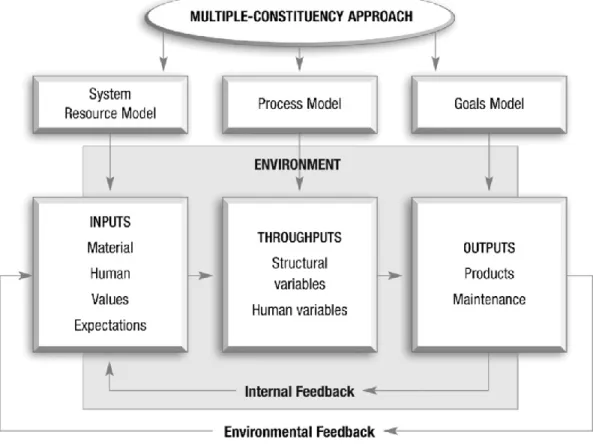
Figure 1. The Models of Organizational Effectiveness (Chelladurai, 2013).
The amount of literature available on organizational effectiveness is immense. Years of study has led to the development of many complexities within the concept (Cameron, 1978; Campbell, 1977; Connolly et al., 1980; Perrow, 1977; Price, 1968; Steers, 1977; Yuchtman & Seashore, 1967). These complexities have been refined into four widely accepted, different, but compatible models of effectiveness: the goals model, the system-resources model, the process model, and the multiple-constituency model (Figure 1; Chelladurai, 1987, 2013).
The Goals Model
manner that the effectiveness of the organization can be examined by progress towards these goals (Seashore, 1983). These goals can vary, come from different constituents or stakeholders, and can be fluid over time. This fluidity is one critique of the model, as goals may change in priority very quickly and thus be poorly measurable (Seashore, 1983). This goals model is focused on the outputs of an organization and requires some agreed upon set of goals that the people of the organization are committed to fulfilling (Ashraf, 2012). The goals model is partially suitable for analyzing effectiveness, but it struggles to stand on its own as an organization cannot purely be judged by its results.
The System-Resource Model
The next model that is widely discussed is the system-resource model or a perspective based upon resources (inputs), rather than goals. According to Yuchtman and Seashore (1967), who proposed this model, the effectiveness is defined as the ability of an organization to exploit its environment for the acquisition of scarce and valuable resources. For this model, one looks at the ability to acquire resources that lead to the goods and services it produces (Ashraf, 2012). Another perspective on this model is the organization is an “intact behaving entity, autonomous
except for interdependence with an environment in the form of information and energy exchanges” or an autonomous organization that relies on its environment for obtaining of
The Process Model
The third model focuses on what happens between the inputs and the outputs, the throughput processes. In this model, the emphasis of effectiveness is focused on the logic and consistency that govern these throughput processes and these processes are the key structures that must be in place to successfully convert the inputs to the desired outputs (Pfeffer, 1977; Steers, 1977). Another way to view this is that organizations develop distinctive ways to use resources for systemic integrity and goal attainment; these ways can be measured and assessed in their ability to accommodate a wide range of information or resources and for effectiveness judgment (Seashore, 1983). This model seeks out defining effectiveness based upon whether an organization has rational, goal-oriented, frictionless internal processes (Chelladurai, 2013). The previous two models look at resources and results; this model looks at internal health and efficiency, the ability of an organization to function with the resources it has to produce the results it seeks to create, and a lack of stress or strain on the system (Ashraf, 2012).
Multiple-Constituency Model
The final model, the multiple-constituency model, while viewed as a fourth individual model is more of a combination of the previous three (Chelladurai, 2013). According to Connelly et al. (1980) the question “how well is entity X performing” is contingent upon who is asked that question. The answer given by a stockholder may differ from that of an employee who still differs from that of the CEO. The criteria by which evaluation of an organization are weighted on can vary greatly based upon the individuals or groups that make up these constituencies, and no single evaluation criterion or set of criteria is the “correct” one (Connolly et al., 1980). As
their examination of different parts of an organization (inputs, throughputs, outputs). Connolly et al. (1980) argue effectiveness should be considered as a plural concept, or effectivenesses, which would incorporate these models together (Chelladurai, 1987). Additionally, the above three models are theoretically linked and highly correlated when organizations are viewed as open systems based on the inputs, throughputs, and outputs (Chelladurai & Haggerty, 1991). It is evident that this model is more comprehensive than the previous three, and that unless an organization’s effectiveness is to be viewed in a narrow view (goals-only, resource-only, or process-only), it is likely this model is the most comprehensive and best option to be used.
It is important to note that this model is based on the idea of an organization having multiple stakeholders who approach the idea of effectiveness from differing perspectives. The issue, however, is which of these perspectives should be used? One possible perspective is that of the powerful constituencies (e.g. donors, board of directors), however, this ignores the
perspective of the “real” benefactors of the organization due to their lack of power (Chelladurai,
1987). There are many beneficiaries and stakeholders whose perspectives can be taken into account and it is important to use several of them when identifying the measures of input, throughput, output with the multiple-constituency model. It is also important to identify one special group. According to Blau and Scott (1962), there may be many groups who benefit from the activities of an organization, but just one group’s benefit is the primary reason why the organization exists. This “prime beneficiary” must be identified, acknowledged, and given
range of measures that account for the important factors at all three stages of effectiveness (inputs, throughputs, outputs), and ensure we focus back on the prime-beneficiary of this organization, the student-athlete.
Organizational Effectiveness in Sport Research
This idea of Organizational Effectiveness and its application to sport found its way into the literature as early as 1984 with the development of the Scale of Athletic Priorities (SAP) to examine the operative goals of intercollegiate athletic departments (Chelladurai, Inglis, & Danylchuk, 1984). This scale was developed in three stages: (1) conceptual generation with small focus group feedback, (2) empirical verification via a student-sent survey, (3) stability, applicability, and test-retest verification to a new sample of administrators and a second student sample (Chelladurai et al., 1984). With a goal to identify priorities in intercollegiate athletics the authors settled on nine operative goals with 36 total subsample items and created what was one of the earliest measures of effectiveness in sport, in this case, a goals-oriented set of measures (Chelladurai et al., 1984). While not specifically quoted as a study on organizational
organizational effectiveness (Frisby, 1986). Frisby (1986) concluded that the variables were moderately correlated and thus the models are interrelated and if combined would be able to “more adequately represent the complexities of organizational effectiveness in a sport setting”
thus becoming an early adopter of the use of multiple models for sport organizational effectiveness research (p. 98).
College athletics began to see an increase in scrutiny in the late 1980’s and with that the role of the athletic director as a leader began to change (Branch Jr., 1990). In a study on the topic of athletic director leader behavior Branch Jr. (1990) sought to understand the ability of this behavior to be a predictor for organizational effectiveness. Adapting Mott’s (1972) effectiveness
criteria originally created for use in educational studies, Branch Jr. created the Perceived Index of Athletic Organizational Effectiveness (PIAOE). The criteria Branch Jr. elected to use to measure this were ability to be productive (quality and quantity), operational efficiency, adaptation to changes prescribed by internal and external constituencies, and flexibility in handling crises (Branch Jr., 1990). This measure intends to determine the ability of an
organization to mobilize its center of power in achieving goals and reacting to change (Branch Jr., 1990). This study is another example, along with Chelladurai’s 1984 study, of the adoption of organizational effectiveness into college sport research. The path of these seminal approaches, however, was not carried forth in the further development of the topic in sport research as sport literature began to turn its focus towards using a multitude of variables, or measures, and ascribing them to one or more of the models of organizational effectiveness (see Table 1). For example, in Rocha & Turner (2008)four different variables were used to measure organizational effectiveness: athletic achievement, graduation rates, social performance, and financial
equity, and rules compliance. Many additional studies have been published with a wide range of measures used. The studies and their measures are as follows:
Table 1. Sports Research on Organizational Effectiveness and the Metrics Used
Study Metrics Used
Putler & Wolfe, 1999; Wolfe & Putler, 2002
On-field success, graduation rates, NCAA violations, attendance, gender equity, # of sponsored teams, financial surplus or deficit
Smart & Wolfe, 2000
On-field success, student-athlete education, athletic program ethics, financial performance
Trail & Chelladurai, 2000
Goals: academic achievement, health/fitness, moral credibility, culture of diversity, careers, visibility/prestige, financial security, winning,
entertainment, national sport development Processes: social/moral education, academic eligibility, maintaining health/fitness, career
development, gender equity, attracting athletes, marketing process, promoting international sport, media relations,
selecting/retaining coaches,
performance/popularity based on resource distribution
Cunningham & Rivera, 2001
Athletic achievement, graduation rates (Also suggested: student-athlete satisfaction, ethical
behavior, revenue generation, recruiting quality athletes, scheduling quality
competition)
Cunningham, 2002
Athletic achievement, graduation rates, title IX compliance (Also suggested:
student-athlete satisfaction, revenue generation, ethical behavior)
Rocha & Turner, 2008
Athletic achievement, graduation rates, social performance, and financial performance (Also
suggested: ethics, scholarship allocation, recruiting budgets, operating budgets,
student-athlete satisfaction)
Ward Jr, 2015
university, promoting career/health/social development)
Won & Chelladurai, 2016
Athletic success, academic success, gender equity
Trends in Categorical Measures in Intercollegiate Athletics
Through an examination of these studies, there are some clear trends. To no surprise, one of the most frequent themes of measurement is athletic success. This theme is reflected using two different measures, with some authors using win-loss record, or win percentage (Putler & Wolfe, 1999; Smart & Wolfe, 2000; Trail & Chelladurai, 2000; Wolfe & Putler, 2002; Won &
Chelladurai, 2016), and others electing to use the Director’s Cup standings (Cunningham, 2002; Cunningham & Rivera, 2001; Rocha & Turner, 2008; Won & Chelladurai, 2016). The second theme of measurement is academic success. The clear measure in this category, widely used by the examined studies is graduation rate (Cunningham, 2002; Cunningham & Rivera, 2001; Putler & Wolfe, 1999; Rocha & Turner, 2008; Smart & Wolfe, 2000; Wolfe & Putler, 2002; Won & Chelladurai, 2016), however in a more recent study academic progress rate (APR) was used as it takes graduation rates into account for its formula (Ward Jr, 2015). Other measures that could fall into this theme of academic success are academic achievement and student-athlete careers (Trail & Chelladurai, 2000). The third major theme of measures is social/moral performance which covers a bit wider range of measures. One of the more prevalent measures in the literature was that of gender equity, most commonly recorded in the form of proportion of female athletes to females in the student body, but also just as a percentage of female athletes (Putler & Wolfe, 1999; Rocha & Turner, 2008; Ward Jr, 2015; Wolfe & Putler, 2002; Won & Chelladurai, 2016). Other studies looked at gender equity more broadly to include things such as scholarship
side of this theme most commonly referred to ethical behavior and NCAA violations (Putler & Wolfe, 1999; Smart & Wolfe, 2000; Ward Jr, 2015; Wolfe & Putler, 2002).
CHAPTER 3 METHODS
The purpose of this study is to examine the components (inputs, throughputs, and outputs) of Organizational Effectiveness in intercollegiate athletic departments. Beyond
examining the components, we also aim to determine the best model of fit and using this model create a foundation that merges the theory with the practical applications of organizational effectiveness in intercollegiate athletics. The goal is to overcome the conceptual disarray which often accompanies this topic, and create a centralized, focused description of organizational effectiveness as it pertains to intercollegiate athletics.
Participants
Ten individuals serving, or having served, in the role of athletic director, or senior level administrator at the Power 5 level were selected to take part in this study. The selected
individuals had varied backgrounds with differences in current conference affiliation, past industry experience, and current areas of oversight. Selection of the individuals was non-random via snowball sampling with the participant pool growing from suggestions following each conducted interview seeking diversity among several factors such as gender, role, and conference.
Data Collection/Procedures
Research: The Complexity of the Craft, 2012). Additionally, while the level of structure to interviews is often seen to give a trade-off between validity and reliability we intend to take some practices of the Delphi technique which seeks a convergence of opinion towards a consensus through multiple rounds of feedback to increase the validity of the study (Hsu & Sandford, 2007; Platt, 2012; The SAGE Handbook of Interview Research: The Complexity of the
Craft, 2012). Three questions were created using the current literature as a base for construction.
The key points of focus identified in the literature for discussion with the participants were the specific measures or factors used, the idea of organizational effectiveness as inherently
paradoxical, and the prime beneficiary. The three questions that were constructed are as follows:
1. What are the factors your athletics department uses to define success or effectiveness? 2. Organizational Effectiveness has been described as being “inherently paradoxical.” What
tensions, if any, do you feel play into your decision-making process due to competing factors, or the paradoxes?
3. College athletics has a bifurcated focus (that oriented towards the student-athlete and that focused externally towards fans). How do these different stakeholder groups and their definitions of success affect your athletic departments’ decisions ability to be effective?
Initially, each participant received an email asking for their participation in the study. Included in the email were the three questions, an ask for participation and to schedule an interview time, and names of any individuals they would refer if they did not wish to take part. Each interview was recorded for reference in the remainder of the study. At the conclusion of the interview, participants were reminded that once all interviews had been completed, they would receive an email summary of the findings seeking follow-up feedback on their behalf sharing their
on narrowing towards a clear and focused definition of the components practitioners view as integral to the organizational effectiveness of an intercollegiate athletic department., while also maintaining the diversity of responses sought by a diverse group.
Additionally, the literature will be reviewed to take stock of what measures have been most popularly used in past studies involving organizational effectiveness and sport. A list will be compiled denoting how often certain categories, and more specific measures, have been used in the literature as well as with which model of organizational effectiveness the study was following. This will provide us with both the formal theoretical background constructed through the literature, as well as a current outlook from active practitioners in the field.
Data Analysis
Analysis of qualitative data is quite different than that utilized for quantitative data. After the collection of the data is complete, coding must ensue to group the data into common themes (Charmaz, 2014). Coding is a way to move beyond the concrete statements of an interview into a more analytic interaction of the data (Charmaz, 2014). After the interviews are complete, initial coding will take place from the interview notes. Any necessary clarification or verification can be conducted through a re-listening of all or parts of the interviews. Key themes occurring across several interviews will be summarized into a clear and concise description using the coding. This will be broken down among each of the three main questions asked during the interviews. After the initial coding, broadly following the Delphi technique, a summary of the now analyzed data will be sent back out to all participants for a secondary step of participation providing another layer of feedback and increasing the validity of the data. Any feedback will be taken and used to further refine these thematic summaries until a more refined consensus is constructed
Upon finalizing the thematic summaries, interview data will be compared to the
CHAPTER 4 RESULTS
The purpose of this study is to bring together the understanding of organizational effectiveness and how it has been defined in the literature to date with the way it is understood and used in the day to day operations of an athletic department. To do this, the literature was combed and summarized in Chapter 2 starting broad and narrowing. The review of the literature began with the history of the theoretical conceptualization of organizational effectiveness. It narrowed into a description of the four major models that have been accepted as appropriate perspectives on the organizational effectiveness theory. From there the focus shifted to how it has specifically been written about, and what models have been used, in sport research. It was this portion of the literature that was summarized in Table 1 identifying which measures or factors were used and referenced in each study. The results of the review of the literature takes place in Chapter 2 in the subsections titled “Organizational Effectiveness in Sport Research” and “Trends in Categorical Measures in Intercollegiate Athletics.” The following summarizes the ten
interviews which were conducted. Participant Descriptive Statistics
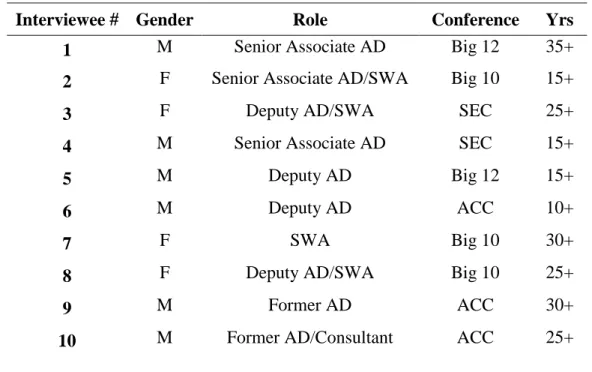
served 10+ years as an athletic director, four are senior women administrators, four are deputy athletic directors, and three serve in the role of a senior associate athletic director. Then ten interviewees combine for nearly 250 years of experience in intercollegiate athletics with over half of that time spent in a senior level position or higher.
Table 2. Descriptive Statistics of Interview Participants
Interviewee # Gender Role Conference Yrs
1 M Senior Associate AD Big 12 35+
2 F Senior Associate AD/SWA Big 10 15+
3 F Deputy AD/SWA SEC 25+
4 M Senior Associate AD SEC 15+
5 M Deputy AD Big 12 15+
6 M Deputy AD ACC 10+
7 F SWA Big 10 30+
8 F Deputy AD/SWA Big 10 25+
9 M Former AD ACC 30+
10 M Former AD/Consultant ACC 25+
Interview Results
Interviews were conducted over the phone with all 10 participants and ranged from 23 to 37 minutes in duration. Three primary questions (see Chapter 3) were asked of each interviewee. Discussions that followed each question were unique and branched in different directions based on each individual, their areas of expertise, and personal passions. As these conversations played out with each individual, themes became apparent. However, due to the nature of these
shared below in both written summary and tables organized by each question asked in the interview.
Factors to Define Organizational Effectiveness
Eight of ten interviewees discussed three main areas of success, academic success, academic success, and moral success with four interviewees mentioning a possible fourth area. The first two main themes, academic and athletic success, are fairly straightforward with a variety of metrics used to help define success or effectiveness. Some of the most common measures utilized by departments are GPA, APR, and graduation rates (academic); Director’s Cup standings, conference finishes, and win-loss records (athletic) among a wide variety of possible measures. Not all measures are created equal with some as hard numbers that are static and unchanging year to year, for example, the APR numbers which a team must remain above to stay eligible for postseason competition. Other measures are static neither year to year nor team to team with 60% of interviewees directly discussing this variability. An example of this would be in GPA, where a department-wide goal may be set, but it may vary among the different sport teams. Another example would be the expected competitive success among different teams based on the resources they receive. While these first two areas, academic and athletic success, were unanimous across the interviewees as categories to define success or effectiveness the third area while clear in the broad sense, was a little more variable in how it was defined and what
success, the lack of a single correct definition, and the variability that is likely to be seen from one school to another.
Table 3. Common Areas in which Success is Measured in Intercollegiate Athletics
Interviewee #
Theme 1 2 3 4 5 6 7 8 9 10 %
The three main areas of defining success are: Academic Success, Athletic Success,
and Social Success
0.8
Hard numbers, or floors, are utilized to define academic success in categories
such as GPA, APR, GSR, etc.
0.6
Many of the goals are mobile both year to year as well as team to team. There are many goals that can also be mobile based
upon the success seen in other areas.
0.6
Success is highly complex and complicated to define. There is no single
formula, and this definition will likely vary greatly from one place to another
0.5
A fourth category or metric was discussed that fell outside the three main areas of
measuring success.
0.4
Social Success: A goal to reach a
threshold in community service hours 0.3
*Shaded boxes represent when a participant discussed the theme listed
“Inherently Paradoxical”: Competing Factors of Organizational Success
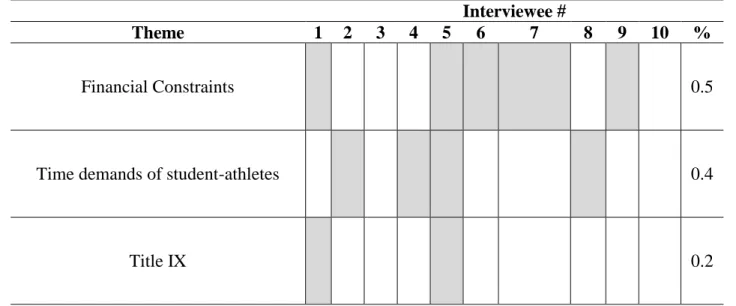
tensions they did not feel they affected the departments’ ability to be successful or effective. Five interviewees discussed funding or financial strains as the largest harbinger of tensions within the decision-making process. The next most common tension, time demands, was shared by 40% of the respondents. Lastly, Title IX, the aforementioned federal civil rights law, was mentioned by two interviewees as being a source of tension that plays a role in long-term, big picture decision making. Digging into time demands, interviewees specifically shared about the delicate balance between academics and athletics. These time demands were presented in both the day to day demands faced by student-athletes, as well as those faced around competition dates, specifically that of postseason competitions with extended travel times.
Table 4. Common Competing Factors and Sources of Tension in Organizational Effectiveness
Interviewee #
Theme 1 2 3 4 5 6 7 8 9 10 %
Financial Constraints 0.5
Time demands of student-athletes 0.4
Title IX 0.2
*Shaded boxes represent when a participant discussed the theme listed
The Bifurcated Focus: Determining the Prime Beneficiary
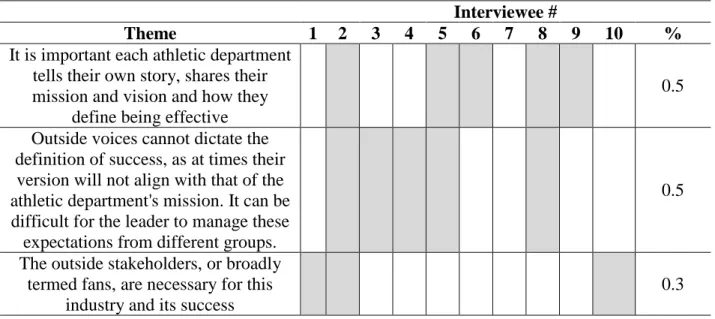
success. One interviewee discussed how sometimes the stakeholder perspectives do not align, and the goals of those outside the organization can often be more focused on simple goals such as win/loss record rather than looking at a more holistic picture that includes the quality of inputs and effectiveness of processes. Another interviewee shared their perspective on the difficult nature of an athletic director or department to effectively manage the internal and external stakeholders, and often any one skillset will not translate to all groups. Three interviewees acknowledged the necessity and importance these stakeholders carry in support for the student-athletes in many different ways, and thus the importance of understanding their visions of success or effectiveness.
Table 5. The Effects of Various Stakeholder Groups and Their Definitions of Success
Interviewee #
Theme 1 2 3 4 5 6 7 8 9 10 %
It is important each athletic department tells their own story, shares their mission and vision and how they
define being effective
0.5
Outside voices cannot dictate the definition of success, as at times their
version will not align with that of the athletic department's mission. It can be difficult for the leader to manage these
expectations from different groups.
0.5
The outside stakeholders, or broadly termed fans, are necessary for this
industry and its success
CHAPTER 5 DISCUSSION
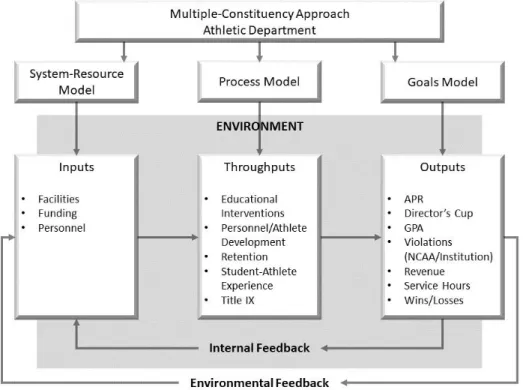
This study was developed to examine the components of organizational effectiveness, and specifically how this broad term fits into the intercollegiate athletics industry. After examining the theoretical research behind organizational effectiveness and the four different models that have been developed over time, it was clear that the 4th model, developed after the previous three (Goals, System-Resource, and Process) and its synthesizing of each of those three models was the best fit for this industry (Connolly et al., 1980; Pfeffer, 1977; Price, 1972; Scott, 1977; Seashore, 1983; Steers, 1977; Yuchtman & Seashore, 1967). After examining the literature on organizational effectiveness in sport research coupled with interviews with practicing
intercollegiate athletic professionals the desired use of the multiple-constituency model for intercollegiate athletics was supported. Throughout these interviews it was evident that the way those working in athletics define themselves as effective makes use of the inputs (personnel, facilities, revenue), throughputs (student-athlete experience, personnel development, Title IX, NCAA violations), and outputs (GPA, Director’s Cup, community service hours, etc.) of the
The Model of Best Fit
The study of organizational effectiveness has gone through an extensive timeline of growth and refinement (Chelladurai, 2013). During this time, three major models were
constructed each focusing on a different aspect of an organization (Pfeffer, 1977; Price, 1972; Scott, 1977; Steers, 1977; Yuchtman & Seashore, 1967). As the literature continued to grow people began to question the ability of any one of these models to stand on its own and began to examine the possibility of there being a theoretical model that uses parts of all three previously constructed models (Connolly et al., 1980; Seashore, 1983). This model came to be known as the multiple-constituency model of organizational effectiveness, and it involves not just looking at the goals, the processes, or the resources of an organization individually as a way to judge its effectiveness, but to actually merge all three together into a more robust examination
(Chelladurai, 1987; Connolly et al., 1980; Seashore, 1983). As the interviews played out, one of the most clearly defined themes from the first question revolved around this exact idea. When asked how they define success words like “holistic,” “totality,” and “complex” were used to
describe the very difficult task of quantifying and judging what they do. As these conversations moved forward, it was evident this is the case because defining success isn’t as simple as looking at a few straightforward metrics such as Director’s Cup finish, average GPA, or NCAA
violations. While these measurables are used as part of the holistic or complex approach to determining effectiveness, they cannot stand alone, therefore the goals model, an output focused method of defining effectiveness doesn’t suffice as a model for intercollegiate athletics.
system-resource model of effectiveness as a standalone model to judge organizational effectiveness in an organization. As conversations carried on through the first question of the interview, it became quite clear none of the singular-focused models of effectiveness would be proper for examining organizational effectiveness in intercollegiate athletics. Therefore, if a full examination of an organization’s effectiveness is the goal, the multiple-constituency model is the best, most desirable model to use (Figure 2). Focused studies could utilize any of the three individual models, but these cannot possibly be comprehensive and all-encompassing studies of the organization.
Figure 2. A Concept Map of the Multiple-Constituency Model of Organizational Effectiveness in Intercollegiate Athletics.
The Outputs: The Easily Measurable
results are generally simple to understand and interpret. Table 1 summarizes the wide range of metrics used in the literature to date. However, there has not been a clear set of metrics put forward to define organizational success within intercollegiate athletics. One purpose of this study was to address this gap in the literature.
Comparing previous research with our interviews, there are two very clear areas that many of these metrics fall into academic success, and athletic success. Some of the common metrics used in the literature for academic success are GPA and graduation rates, with APR being added in the later studies once it was created in 2003. For athletic success, win-loss record and the Learfield Director’s Cup were commonly cited metrics. In discussions with each of the interviewee’s, many listed similar metrics such as Director’s Cup finish and titles won, both
conference and national. However, many stated it went well beyond these hard numbers. One Power 5 Deputy AD had an interesting take on the use of these metrics saying it was because “these are existing metrics that are metrics in and of themselves, they become items we talk
about” showing how these are easy metrics to track (Interviewee #6). The use of these metrics is the best snapshot the general public can get on the success of athletic departments.
Recently, media scrutiny of any information about college athletics has seemed to grow exponentially. Not only are revenues and expenses available through the Equity in Athletics Data Analysis (EADA) database managed by the U.S Department of Education, but USA Today puts out a report annually citing this source in an all-encompassing summary (it should be noted schools may have different reporting procedures). Schools regularly put out stories on their websites citing their department-wide GPAs, and individual school or conference websites paired with a basic google search make finding championship information, win-loss records, and
accessible to the public that provides APR breakdowns for all Division I institutions and their individual sports dating back to its inception for the 2004-2005 season. All of this shows how accessible these goal or output metrics are. This does not mean that these are the only things that should define effectiveness nor are there certain numbers that universally define success in these metrics. During one interview, a Senior Woman Administrator stated at her current school while those metrics are used to measure part of their success the numbers are “nimble” and they “look at the totality of everything” at that this can vary from team to team (Interviewee #2).
Particularly, these metrics may vary from team to team based upon the level of resource
investment (e.g., fully funded sport) or the stage in the lifespan of the current coach (Recent hire vs. established coach). So, while these metrics are accessible statistics to define success among the public perception, athletic departments and their senior leadership understand their mission requires a much deeper self-evaluation.
While many people compare these metrics between schools and their biggest on-field rivals that may not be the group to which the athletic department compares themselves. Many schools look at their performance relative to their institutional past or among a much smaller group of peer institutions, who may share similarities in a variety of different ways. An example of this was shared by one interviewee who said his school looks at their director’s cup standing
The Inputs: Tensions in Intercollegiate Athletics
In Cameron’s (1986a) Effectiveness as Paradox, he discusses the inherent nature of
effectiveness being paradoxical as the ability to be successful in one area or another can be contradictory. Another example of this can be found in an essay by David Sedaris (author, playwright, and comedian) where he shares a story about the “Four Burner Theory” (Sedaris, 2009). In this we are asked to picture a four-burner stove with each of the four burners
It was clear that many interviewees did not feel as if tensions existed between academics, athletics, and social successes but tension rather came from inputs, or resources, and ever-present desire to grow their resource pool. Contrary to popular belief, much of an athletic department’s
budget does get reinvested into the student-athlete. In a report put out by the Knight Commission, this money is invested either directly via scholarships and cost of attendance checks or indirectly through game expenses, facilities, equipment, support staff, and much more. It’s balancing how to spread the money around these categories where the athletic administrators
feel the greatest strain. It is understood there is a wide range of revenue production for schools across all levels of college athletics, and each faces their unique challenges, but none would say they wouldn’t be happy with increased funding to reinvest into the athletes. So, to refer back to
our metaphor, the focus for intercollegiate athletic departments is not on which burner to turn down for the sake of another, but they are looking to increase the size of the gas line. Athletic administrators seem to fight the idea of paradox in organizational effectiveness; they refuse to let one area suffer at the expense of another as they strive for excellence in all things.
Interestingly enough, two interviewees who work in athletic departments with either one of the largest budgets or most successful football programs nationally gave a perspective very different than the others, but one that still showed the tensions a school’s financial situation
could bring to bear. The first, with one of the most successful football programs of the last decade mentioned how many of the tensions that may be felt are mitigated due to the success of the football program. This mitigation was expressed in two ways, the first being the increase in financial resources due to the football teams’ success. However, more interestingly, it was mentioned how “the success of the last few seasons has helped to ease the tension” noting that if
begin to question the allocation of resources (Interviewee #6). The second administrator, working at a school in the Top 10 nationally for both revenues and expenses, stated: “I don’t think we have those conflicts” when prompted to discuss tensions, and later summarized that their departments’ fiscal responsibility leaves them with no tensions (Interviewee #7). Given the
financial realities in intercollegiate athletics, these answers are likely outliers rather than the norm as it comes to tensions. While fiscal responsibility may be a key part of their ability to minimize, or not have tensions, it is quite clear this is also driven by the pure size of the budget.
Along with financial tensions, the academic balance was cited by interviewees as another prominent source of tension faced by athletic departments. One school, which functions on a quarter system, rather than semesters, constantly faces the balance of exams with postseason competition time. Due to the system, they are on, they face this conflict more often than schools which function on the semester system, and this provides increased challenges in the athletic-academic balance student-athletes must navigate. However, this administrator adamantly emphasized that academics come first, and the administration “does everything they can to try and remove any roadblock that might stand in the way” while embracing the uniqueness of their institution (Interviewee #8). Another administrator noted that “first and foremost they are
students and it’s incumbent upon us to hire coaches that will keep that at the forefront of their mind and not put sports before books” (Interviewee #4).
applied (Chelladurai, 1987). These tensions can come from anywhere and the environment within which the industry functions can be a major factor in where the tensions are felt.
Currently, big-time college athletics is in the midst of what many call an “arms race” which has only increased the financial tensions (A Call to Action: Reconnecting College Sports and Higher
Education, 2001; Fort, 2016; Weight, Navarro, Huffman, & Smith-Ryan, 2014). In
intercollegiate athletics, it would be wrong to judge the effectiveness of an organization just based upon inputs. The financial resources of an athletic department can come via public or private funding and based upon the larger institution in which an athletic department is a part, purely judging effectiveness across the industry based upon inputs would not suffice. This would be a very poor model to discuss organizational effectiveness and is likely why this model has not been widely used on its own when discussing intercollegiate athletics in the literature thus far. The inputs certainly cannot be ignored for the role they play in the effectiveness of an athletic department, but they also cannot stand on their own.
The Throughputs: Student-Athlete Experience
The third model that makes up the encompassing multiple-constituency model focuses on the processes or throughputs of the organization. Throughout each interview, one theme
routinely emerged as one of the most important items to be judged for departmental
effectiveness. This theme was suggested by a few interviewees as a possible fourth area in which departments can look to define their effectiveness, and from others, it seemed to be a string tying the three main areas together. One interviewee put this theme quite well when stating “a new
metric we are discussing and working to accomplish is trying to measure the experience”
mentioned throughout the literature, although Trail & Chelladurai’s (2000) work on the goals
and processes of intercollegiate athletics comes closest to encompassing this.
For years athletic departments have utilized exit surveys as a way to receive feedback from graduating student-athletes on their experience while in school. This information is utilized as a means to review many aspects of the student-athletes’ time on campus. Questions range from academics to coaches, to resources and much more. In what seems to be the hardest thing to quantify, athletic departments are constantly trying to understand and measure this “experience.” This experience is a process, a throughput of the organization, but is quite difficult to study and understand. Any academic discussion on organizational effectiveness in intercollegiate athletics would be remiss to not discuss the student-athlete experience.
The issue that now faces those in academia, and those in practice every day, is finding how to define and measure this. In Cameron’s (1986a) article focusing on paradox, he discusses
how the indicators of effectiveness are often too narrow or too broad, and this is a warning we should heed as we aim to define and measure the student-athlete experience. The NCAA states they are “dedicated to the well-being and lifelong success of college athletes,” and if this belief is
upheld, athletic departments, therefore, exist for the student-athlete first and foremost
easy metrics, the tensions from limited inputs, both are important in defining the effectiveness of an organization, but so are the processes that make up the experience. At the end of the day, when aiming to define success and to discuss organizational effectiveness, an athletic department needs to focus on all aspects of their organization. Utilizing a model that focuses on just the inputs, throughputs, or outputs will only tell part of the story. For a truly holistic view, all these factors must be considered, analyzed for how they are intertwined, and mined for ways to constantly improve.
The Bifurcated Focus: Who is the Prime Beneficiary?
In agreement with Blau and Scott (1962) and Chelladurai (1987), each organization has one primary group for which they exist. For a medical device company, this could be hospitals, for a law firm it could be people in need of legal assistance, for intercollegiate athletics it is the student-athlete. In its current form, college athletics exists to be a “vital part of the educational system” and aims to maintain “the athlete as an integral part of the student body” (NCAA
Manual). Therefore, it seems fairly clear the prime beneficiary of this industry, intercollegiate athletics which is governed by the NCAA, is the student-athlete.
Above we have discussed the three models that make up the multiple-constituency model of organizational effectiveness. Individuals become involved with an organization for a variety of reasons, which then play a role in how each of these constituents will evaluate the
that exists in college athletics. The bifurcated focus is the inward focus on the student-athlete and the outward external focus on the fans and the community and can often be seen in many athletic department strategic plans. Toward this purpose, participants were asked how these different stakeholder groups, and the bifurcated focus, affect the athletic department’s ability to be
effective. Primarily, there are many strong voices inside and out of an athletic department that feel some sense of power and control over the decisions being made by the department. These stakeholders must be managed, and their perspectives on success aligned with that of the athletic department’s leadership. However, these two groups are not necessarily mutually exclusive as one interviewee put it: “If we don’t have one, it makes it impossible for us to serve the other”
(Interviewee #1). Ultimately while all parties may be necessary and may come to the front step of the organization via different avenues their focus needs to be on the student-athlete
experience, no matter how much money they’ve donated, who they may be connected to, or their
role in the department.
In the interviews with the athletic administrators, the theme that consistently arose from this question was focused on “sharing your story” and not letting others define it for you. One interviewee called college athletics a “co-curricular experience” and how internally they may
more than 20-30 competitions per year. It is not wrong to acknowledge the bifurcated focus which exists in college athletics. An athletic department does serve the public. They put on upwards of 200 events every year where they welcome the community onto campus, into their facilities, and there are certain expectations that should be met. However, when defining what is a success, the focus once again falls back onto the prime beneficiary and making decisions that first and foremost keep that group in mind.
Summary
The inputs, throughputs, and outputs are very heavily intertwined in college athletics. You cannot adequately asses the performance of an athletic department by looking at just one of the three models of effectiveness. The athletic administrators all felt the literature hit the right metrics, and it was clear among these practitioners there is no set standard on how to look at the metrics. Additionally, voices were fairly unified when it came to the application of the theory. Tensions and paradox do exist and are certainly at play in the organization's ability to be effective. When a prime beneficiary is identified, and a unified organization exists, aligned in their mission, the tensions don’t occur in a way that feels sacrificial as all decisions are being
improve upon an ambiguous process. As we can begin to break this down, understand the
experience and improve the things that need it most, that is how an athletic department will truly be effective.
Looking forward there were some limitations to this study that can be alleviated with future studies. The interview participants for this study all currently or most recently worked at what are considered Power 5 schools. These Power 5 athletic departments are 65 of the most financially supported departments in the nation. By discussing organizational effectiveness with other groups that make up college athletics a more holistic and wide-ranging perspective can be provided. These groups include schools that make up the Group of 5, or the five next largest conference, FCS schools, non-Football DI schools, and schools that participate in Division II and Division III. While future research focused on the other groups that make up Division I will be beneficial, we believe it could be highly beneficial to conduct this study with Division II, and Division III administrators as the role athletics plays at their universities is quite different than that at the Division I level. Additionally, employing different methods of data collection and analysis could provide a more robust understanding of how organizational effectiveness is utilized in practice. One such method is conjoint analysis. Conjoint analysis will allow the research to avoid some of the inherent bias that may come during an interview and will force respondents into choices that can be quite revealing as to where their organizational standards would fall when in direct conflict.
As mentioned above, another important future step is to define and understand the student-athlete experience. Cameron (1986a) provides 5 themes that had come forth in
3) a consensus on the best set of indicators is impossible to obtain, 4) different models of effectiveness are useful in different circumstances, and 5) organizational effectiveness is a problem-driven construct. In this paper, we discussed the importance of this topic (theme 1) and its difficulty in defining (theme 2). We also discussed the ranges of models used in the literature (theme 4). While we agree with theme three above, we also believe a foundational set of
indicators or measures can be obtained through a conversation with the practitioners. There is a high level of overlap to give us this foundation and moving forward we can look to refine this foundation. This is best seen in the current ambiguity of the student-athlete experience. While we do not believe there will be a single best way to measure the experience some boundaries can begin to be formed to create a common language. It is our goal that the work completed here has given a starting point in which future studies focused on organizational effectiveness in
REFERENCES
Ashraf, G. (2012). A review on the models of organizational effectiveness: A look at Cameron's model in higher education. International education studies, 5(2), 80.
Au, C. (1996). Rethinking organizational effectiveness: Theoretical and methodological issues in the study of organizational effectiveness for social welfare organizations. Administration
in social work, 20(4), 1–21.
Blau, P. M., & Scott, W. R. (1962). Formal organizations: A comparative approach: Stanford University Press.
Branch Jr., D. (1990). Athletic director leader behavior as a predictor of intercollegiate athletic organizational effectiveness. Journal of Sport Management, 4(2), 161-173.
A Call to Action: Reconnecting College Sports and Higher Education. (2001). Retrieved from
Knight Foundation Commission on Intercollegiate Athletics:
https://www.knightcommission.org/wp-content/uploads/2008/10/2001_knight_report.pdf Cameron, K. S. (1978). Measuring organizational effectiveness in institutions of higher
education. Administrative science quarterly, 604–632.
Cameron, K. S. (1986a). Effectiveness as paradox: Consensus and conflict in conceptions of organizational effectiveness. Management Science, 32(5), 539–553.
Cameron, K. S. (1986b). A study of organizational effectiveness and its predictors. Management
Science, 32(1), 87–112.
Cameron, K. S., & Whetten, D. A. (1983). Organizational effectiveness: A comparison of
multiple models. New York: Academic Press.
Campbell, J. P. (1977). On the nature of organizational effectiveness. New perspectives on
organizational effectiveness, 13, 55.
Carolina Athletics. (2013). Carolina Leads: A Strategic Plan for Carolina Athletics. Chapel Hill, NC.
Charmaz, K. (2014). Constructing grounded theory: Sage.
Chelladurai, P. (1987). Multidimensionality and multiple perspectives of organizational effectiveness. Journal of Sport Management, 1(1), 37-47.
Chelladurai, P. (2013). A personal journey in theorizing in sport management. Sport
Chelladurai, P., & Haggerty, T. (1991). Measures of organizational effectiveness of Canadian national sport organizations. Canadian journal of sport sciences= Journal canadien des
sciences du sport, 16(2), 126-133.
Chelladurai, P., Inglis, S., & Danylchuk, K. (1984). Priorities in intercollegiate athletics: Development of a scale. Research Quarterly for Exercise and Sport, 55(1), 74-79. Connolly, T., Conlon, E. J., & Deutsch, S. J. (1980). Organizational effectiveness: A
multiple-constituency approach. Academy of Management Review, 5(2), 211–218.
Cunningham, G. B. (2002). Examining the relationship among Miles and Snow's strategic types and measures of organizational effectiveness in NCAA Division I athletic departments.
International Review for the Sociology of Sport, 37(2), 159–175.
Cunningham, G. B., & Rivera, C. A. (2001). Structural designs within American intercollegiate athletic departments. The International Journal of Organizational Analysis, 9(4), 369– 390.
Forbes, D. P. (1998). Measuring the unmeasurable: Empirical studies of nonprofit organization effectiveness from 1977 to 1997. Nonprofit and voluntary sector quarterly, 27(2), 183-202.
Fort, R. (2016). College athletics spending: Principals and agents v. arms race. Journal of
Amateur Sport, 2(1), 119-140.
Frisby, W. (1986). Measuring the organizational effectiveness of national sport governing bodies. Canadian Journal of Applied Sport Sciences, 11(2), 94-99.
Goodman, P. S., Atkin, R. S., & Schoorman, F. D. (1983). On the demise of organizational effectiveness studies.
Goodman, P. S., & Pennings, J. M. (1977). New perspectives on organizational effectiveness: Jossey-Bass San Francisco.
Hsu, C.-C., & Sandford, B. A. (2007). The Delphi technique: making sense of consensus.
Practical assessment, research & evaluation, 12(10), 1-8.
Mott, P. E. (1972). The characteristics of effective organizations: HarperCollins Publishers. National Collegiate Athletic Association. (2016). NCAA Division I manual. Overland Park, KS:
NCAA.
New Violation Structure: Structure Focuses on Conduct that Threatens Integrity of College Sports. (2013). Retrieved from
Perrow, C. (1977). Three types of effectiveness studies. New Perspectives on Organizational
Effectiveness. San Francisco: Jossey-Bass, 96–105.
Pfeffer, J. (1977). Usefulness of the concept. In P. S. Goodman & J. M. Pennings (Eds.), New
perspectives on organizational effectiveness (pp. 132–143). San Francisco: Jossey-Bass.
Platt, J. (2012). The History of the Interview The SAGE Handbook of Interview Research: The
Complexity of the Craft: SAGE Publications.
Price, J. L. (1968). Organizational effectiveness: An inventory of propositions: Homewood, Ill: RD Irwin.
Price, J. L. (1972). The study of organizational effectiveness. The sociological quarterly, 13(1), 3–15.
Putler, D. S., & Wolfe, R. A. (1999). Perceptions of intercollegiate athletic programs: Priorities and tradeoffs. Sociology of Sport Journal, 16(4), 301-325.
Rocha, C. M., & Turner, B. A. (2008). Organizational effectiveness of athletic departments and coaches’ extra-role behaviors. Journal of issues in intercollegiate athletics, 1, 124–144.
The SAGE Handbook of Interview Research: The Complexity of the Craft. (2012). (J. F.
Gubrium, J. A. Holstein, A. B. Marvasti, & K. D. McKinney Eds.): SAGE Publications. Scott, W. R. (1977). Effectiveness of organizational effectiveness studies. In P. S. Goodman & J.
M. Pennings (Eds.), New perspectives on organizational effectiveness (pp. 63–95). San Francisco: Jossey-Bass.
Seashore, S. E. (1983). A Framework for an Integrated Model of Organizational Effectivness. In K. S. Cameron & D. A. Whetten (Eds.), Organizational Effectiveness: A Comparison of
Multiple Models (pp. 55–70). New York: Academic Press, Inc.
Sedaris, D. (2009, August 24, 2009). Laugh, Kookaburra. The New Yorker.
Smart, D. L., & Wolfe, R. A. (2000). Examining sustainable competitive advantage in
intercollegiate athletics: A resource-based view. Journal of Sport Management, 14(2), 133-153.
Smith, M. (2011). Cup's scoring irks college sports execs. Sports Business Journal, 13(44). Steers, R. M. (1977). Organizational effectiveness: A behavioral view: Goodyear Pub. Co. Title IX: Frequently Asked Questions. Retrieved from
Trail, G., & Chelladurai, P. (2000). Perceptions of goals and processes of intercollegiate athletics: A case study. Journal of Sport Management, 14(2), 154-178.
Ward Jr, R. E. (2015). Buried accomplishments: Institutional isomorphism in college athletics mission statements. International Journal of Sport Communication, 8(1), 18-45.
Weight, E., Navarro, K., Huffman, L., & Smith-Ryan, A. (2014). Quantifying the psychological benefits of intercollegiate athletics participation. Journal of issues in intercollegiate
athletics, 2014, 390-409.
Wolfe, R. A., & Putler, D. S. (2002). How tight are the ties that bind stakeholder groups?
Organization science, 13(1), 64-80.
Won, D., & Chelladurai, P. (2016). Competitive Advantage in Intercollegiate Athletics: Role of Intangible Resources. PloS one, 11(1), e0145782.