arXiv:1710.05854v1 [astro-ph.HE] 16 Oct 2017
Stefano Valenti,1 David, J. Sand,2 Sheng Yang,1,3
and
Enrico Cappellaro,3 Leonardo Tartaglia,1,2
and
Alessandra Corsi,4 Saurabh W. Jha,5 Daniel E. Reichart,6 Joshua Haislip,6 Vladimir
Kouprianov,6
Received ; accepted
ApJL in press (DOI: 10.3847/2041-8213/aa8edf )
1Department of Physics, University of California, 1 Shields Avenue, Davis, CA
95616-5270, USA
2Department of Astronomy/Steward Observatory, 933 North Cherry Avenue, Room
N204, Tucson, AZ 85721-0065, USA
3INAF Osservatorio Astronomico di Padova, Vicolo dellOsservatorio 5, I-35122 Padova,
Italy
4Physics & Astronomy Department, Texas Tech University, Lubbock, TX 79409, USA
0000-0003-3433-1492
5Department of Physics and Astronomy, Rutgers, TheState University of New Jersey,
Piscataway, NJ 08854, USA
6Department of Physics and Astronomy, University of North Carolina at Chapel Hill,
ABSTRACT
During the second observing run of the Laser Interferometer
gravitational-wave Observatory (LIGO) and Virgo Interferometer, a gravitational-gravitational-wave signal
consistent with a binary neutron star coalescence was detected on 2017 August
17th (GW170817), quickly followed by a coincident short gamma-ray burst
trig-ger by theFermi satellite. The Distance Less Than 40 (DLT40) Mpc supernova
search performed pointed follow-up observations of a sample of galaxies regularly
monitored by the survey which fell within the combined LIGO+Virgo
localiza-tion region, and the larger Fermi gamma ray burst error box. Here we report
the discovery of a new optical transient (DLT17ck, also known as SSS17a; it
has also been registered as AT 2017gfo) spatially and temporally coincident with
GW170817. The photometric and spectroscopic evolution of DLT17ck are unique,
with an absolute peak magnitude of Mr = -15.8 ± 0.1 and an r−band decline
rate of 1.1 mag/d. This fast evolution is generically consistent with kilonova
models, which have been predicted as the optical counterpart to binary neutron
star coalescences. Analysis of archival DLT40 data do not show any sign of
tran-sient activity at the location of DLT17ck down to r∼19 mag in the time period
between 8 months and 21 days prior to GW170817. This discovery represents
the beginning of a new era for multi-messenger astronomy opening a new path to
study and understand binary neutron star coalescences, short gamma-ray bursts
and their optical counterparts.
1. Introduction
The era of multi-messenger astronomy has truly begun. During the first Advanced
LIGO (aLIGO, Aasi et al. 2015) run (O1), two definitive gravitational wave (GW) events
were observed, corresponding to relatively massive black hole – black hole (BH-BH) mergers
of 36+25 M⊙ (GW150914; Abbott et al. 2016b) and 14+8 M⊙ (GW151226; Abbott et al.
2016a), respectively. These amazing discoveries were followed by a third event during the
second aLIGO run (O2), which was another massive BH-BH merger (Abbott et al. 2017,
31+19 M⊙). Each GW event was accompanied by a massive effort from the astronomical
community to identify an electromagnetic (EM) counterpart (see e.g. Abbott et al. 2016),
even though the likelihood of finding EM counterparts to BH-BH mergers is low. On the
other hand, GW events including at least one neutron star (NS; as either a NS-NS or NS-BH
coalescence) are expected to produce a variety of EM signatures. Chief among them in the
optical+near infrared regime is the so-called kilonova, resulting from the decay of r-process
elements produced and ejected during the merger process (for a review, see Metzger 2017).
In order to search for kilonovae, two general approaches have been proposed: 1)
wide-field searches of the aLIGO localization region (see e.g. Smartt et al. 2016) and 2)
narrow-field targeted searches of galaxies both at the predicted GW event distance and
within the sky localization region (e.g. Gehrels et al. 2016a). The D<40 (DLT40) Mpc
one-day cadence supernova search uses the second approach, targeting galaxies within the
GW localization region which are part of the main supernova search.
On 2017 August 17 (UT) a GW event was discovered by aLIGO and Virgo
(Acernese et al. 2015) observatories (LIGO-Virgo collaboration, hereafter LVC) which was
consistent with a neutron star binary coalescence with a low false alarm rate, at a distance
of D ∼ 40 Mpc (Goldstein et al. 2017, see Section 3 for further details). A potential
524666471). Soon after, multiple groups reported the detection of an optical counterpart
(AT 2017gfo/DLT17ck/SSS17a; we will refer to the counterpart as DLT17ck throughout this
work) which was subsequently identified as a true kilonova based on its fast spectroscopic
(Lyman et al. 2017) and photometric (Yang et al. 2017a) evolution. The apparent host
galaxy of DLT17ck is the normal early-type galaxy NGC 4993 (see Sadler et al. 2017).
In this paper we present the observations of the DLT40 team associated with the
kilonova DLT17ck, based on our ongoing one-day cadence search. The DLT40 team was
one of the initial groups reporting the discovery of the kilonova (Section 3), and based
on our light curve and an early spectrum, we show that DLT17ck resembles the expected
observables of a kilonova (Section 4). The DLT40 team also has a history of observations of
the NGC 4993 field during the year before the GW event (Section 5). We end the paper by
summarizing our results, and discussing prospects for electromagnetic counterpart searches
with small telescopes (Section 6).
2. DLT40 GW counterpart search
The Distance Less than 40 Mpc survey (DLT40; Tartaglia et al., in preparation) is a
one day cadence supernova search using a PROMPT 0.4m telescope located at Cerro Tololo
Inter-American Observatory (CTIO; Reichart et al. 2005). The survey goal is the early
detection and characterization of nearby SNe. DLT40 has been operational since 2016, and
observes ∼300–600 targeted galaxies on a nightly basis. A typical single-epoch integration
of 45 s reaches a limiting magnitude of r ≈ 19 mag with filterless observations. The field
of view of the PROMPT camera is 10×10 arcmin2, sufficient to map all but the nearest
galaxies in the search.
(GWGC; White et al. 2011), with further cuts made on recessional velocity (V < 3000
km/s, corresponding to D.40 Mpc), declination (Dec<+20 deg), absolute magnitude
(MB<−18 mag), and Milky Way extinction (AV<0.5 mag). For these galaxies, we strive for
a one-day cadence between observations to constrain the explosion epoch of any potential
SN.
The DLT40 pipeline is totally automated, with pre-reduced images delivered from the
telescope, ingested and processed in a few minutes. New transient candidates are detected
on difference images and are available for visual inspection within∼2-3 minutes of ingestion.
At the time of writing, DLT40 has discovered and confirmed 12 young SNe in the nearby
Universe, with initial results reported in Hosseinzadeh et al. (2017).
The DLT40 GW follow-up strategy was planned as a straightforward addition to the
core DLT40 supernova search. When a LVC gravitational wave event is announced, the
BAYESTAR sky map (Singer & Price 2016) is cross-matched with the DLT40 galaxy
sample. All DLT40 galaxies that are within the LVC localization area are selected for
high priority imaging in the nightly DLT40 schedule. Depending on the size of the LVC
localization area and the number of galaxies selected, we apply a spatial cut (between the
80-99% confidence localization contours of the LVC map) and/or a cut in luminosity to
select the galaxies with most of the stellar mass. This strategy broadly follows that laid out
by other LVC EM follow-up groups with narrow-field telescopes (e.g. Gehrels et al. 2016a).
Further details of our search strategy, and our other results from O2, will be presented in a
3. Discovery of DLT17ck
On 2017 August 17.528 UT, the LVC reported the detection of a gravitational-wave
nearly coincident in time (2 seconds before, Goldstein et al. 2017) with the Fermi GBM
trigger 524666471/170817529 located at RA=176.8◦
and DEC=-39.8◦
with an error of 11.6◦
(at 1σ). The LVC candidate had an initial localization of RA=186.62◦
, DEC=−48.84◦
and
a 1σ error radius of 17.45◦
(LIGO/Virgo Collaboration 2017a). The GW candidate was
consistent with a neutron star binary coalescence with false alarm rate of ∼1/10,000 years
(LIGO/Virgo Collaboration 2017a). The gravitational wave was clearly detected in the
LIGO detectors but was below threshold for the Virgo detector (LIGO/Virgo Collaboration
2017b). Despite this, the Virgo data were still crucial to further constrain the localization
of the event to only 31 deg2 (90% credible region). The luminosity distance was constrained
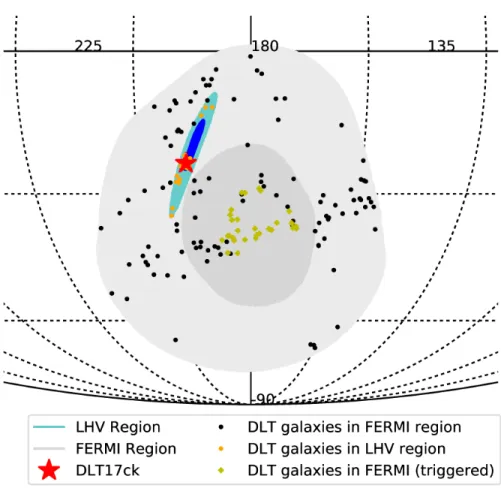
with LIGO data to be 40±8 Mpc (LIGO/Virgo Collaboration 2017b). In Figure 1 we show
a map of both the LIGO+Virgo and Fermi GBM localizations, which overlapped on the
sky. As part of the DLT40 search, we prioritized observations of 20 galaxies within the 99%
confidence area of the LVC error-box and with a cut in luminosity. Among the 23 galaxies
within the LIGO/Virgo error box, we selected the 20 galaxies within 99% of the cumulative
luminosity distribution. At the same time, we also selected the 31 most luminous galaxies
in the Fermi region of the coincident short GRB (see Figure 1). The 51 DLT40 galaxies
selected were then observed at high priority. In this work, we present the only transient we
detected within either the LVC or Fermi localizations: AT 2017gfo/DLT17ck (detected in
in NGC 4993).
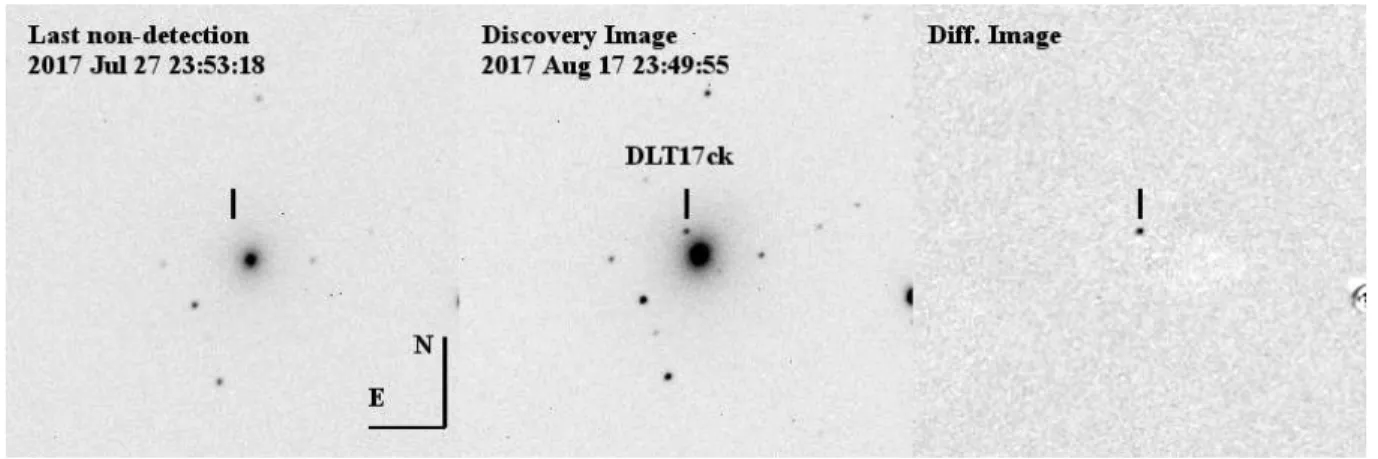
On 2017 August 17 23:49:55 UT (11.09 hours after the LVC event GW170817), we
detected DLT17ck, at RA=13:09:48.09 and DEC=-23:22:53.4.6, 5.37W, 8.60S arcsec offset
from the center of NGC 4993 (Yang et al. 2017b, see Figure 2). At the same time, DLT17ck
Arcavi et al. (2017a) and intensively observed by portions of the astronomical community
that signed a memorandum of understanding with the LVC. DLT17ck was not reported
to the internal (collaboration-wide) GCN by our team until a second confirmation image
was obtained on August 18 00:40:38 UT. The LVC GW region of GW170817 was also
observed in other windows of the EM spectrum, from radio to X-ray wavelengths. It
was recovered in the UV, optical, and near infrared. Deep X-ray follow-up observations
conducted with the Chandra observatory revealed X-ray emission from a point source
at a position consistent with that of the optical transient DLT17ck (Bartos et al. 2017b;
Fong et al. 2017; Troja et al. 2017). A radio source consistent with the position of
DLT17ck (Adams et al. 2017) was detected with the Karl G. Jansky VLA (Mooley et al.
2017; Corsi et al. 2017), at two different frequencies (≈ 3 GHz and ≈ 6 GHz). Marginal
evidence for radio excess emission at the location of DLT17ck was also found in ATCA
images of the field at similar radio frequencies (≈ 5 GHz; Bartos et al. 2017b). Finally,
neutrino observations were reported with one neutrino detected within the preliminary
LVC localization (Bartos et al. 2017a), though this was later established to be unrelated to
GW170817/DLT17ck (Bartos et al. 2017b).
4. DLT17ck: a new type of transient
Our discovery magnitude r = 17.46±0.03 mag at the distance of 39.5±2.6 Mpc
(distance modulus, µ=32.98±0.15 mag using the Tully-Fisher relation Freedman et al.
2001) and Milky Way reddeningE(B−V) = 0.109 mag (Schlafly & Finkbeiner 2011) brings
DLT17ck to an absolute magnitude of Mr =−15.8±0.1 mag. This magnitude is consistent
with that typically observed in faint CC SNe (Spiro et al. 2014) and brighter than that of
some kilonova models proposed so far. However, in the hours after the discovery, it became
dimmer, much faster than any other SN we ever observed. About 35 hours after GW170817,
DLT17ck had dimmed by almost a magnitude (Yang et al. 2017a). By day 5, DLT17ck was
already ∼ 4 magnitudes fainter than at discovery and disappeared below our magnitude
limit the day after. At the same time, DLT17ck remained detectable in the near-infrared
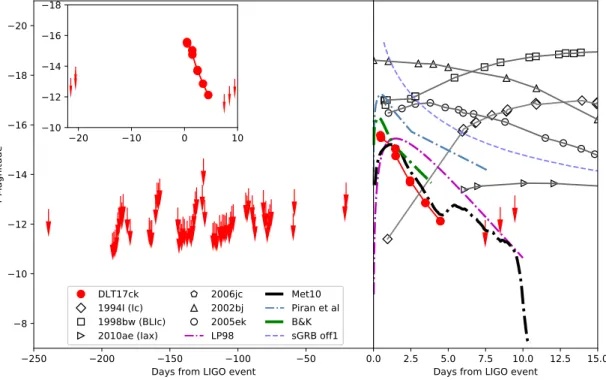
for a longer time. In Figure 3 (right panel), we compare the DLT40 light curve of DLT17ck
with those of the most rapid transients available in the literature. DLT17ck evolves faster
than any other known SN (gray points) and peaked probably between our discovery images
and our third detection (respectively 11 and 35 hours after GW170817)1.
Regardless of the energy source powering them, the light curves of astronomical
transients like supernovae and kilonovae are regulated by the same physics. At early times,
the photons released can not immediately escape due to the high optical depth. The photon
diffusion time depends on the ejecta mass, the opacity and the ejecta velocity (Arnett
1982). For kilonovae, the ejected mass has been predicted to be between 10−4
and 10−2
M⊙ depending on the lifetime of the hypermassive neutron star that forms at the moment
of coalescence. A longer lifetime corresponds to a larger ejected mass and a brighter and
longer-lasting optical electromagnetic counterpart (Kasen et al. 2013; Metzger 2017).
Because of the high neutron fraction the nucleosynthesis in the ejected material is
driven by the r-process, producing a significant fraction of lanthanide that dominates the
opacity. Because of a large uncertainty in lanthanide opacity, the ejecta opacity is not well
constrained; it should be between 1 and 100 cm2 g−1 (closer to 1 for ejecta with a small
amount of lanthanide elements; Metzger 2017). Finally, velocities in the range 0.1-0.3
times the speed of light are also expected (see Metzger 2017, and reference therein). Using
equation 5 from Metzger (2017),
1The possibility that DLT17ck is not related to GW170817, and exploded prior to the
tpeak ≡(
3Mk
4πβvc)
1/2
≈1.6d( M
10−2M
⊙
)1/2( v 0.1c)
−1/2
( k
1cm2g−1) 1/2
(1)
where β ≈ 3, M is the ejected mass, v is the expansion velocity, k the opacity and tpeak
is the time of the peak, we can give a a rough estimate of the ejected mass. Soon after
our first detection (11 hours after explosion), a few groups reported a flattening or slightly
increase of the luminosity (Wolf et al. 2017; Arcavi et al. 2017a), but our second detection
(35 hours after explosion) shows the object fading. We then assume Aug. 18.528 UT (24
hours after GW170817) as the epoch of the peak. We use an opacity of 1-10 cm2/g since
the early blue peak should not contain large amounts of lanthanide (Metzger 2017) and an
expansion velocity of 0.2 × c. With these values, we obtain an ejected mass of ≈ 3× 10⁻³
- 10−2 M⊙. However, the equation we used is an approximation and more careful models
are needed. Comparing the DLT40 light curve with several kilonova models (see Figure 3),
we found two models evolving as fast as DLT17ck which we describe below: The model by
Metzger et al. 2010 (Met10) assumes a radioactive powered emission and an ejected mass
of 10−2
M⊙, outflow speed of v = 0.1cand iron like opacity; the model by Barnes & Kasen
2013 (B&K) assumes an ejected mass of 10−3 M⊙, velocity of 0.1 c and a typical lanthanide
opacity. Both models are consistent with the ejected mass we computed above, and support
the kilonova interpretation.
Further evidence for the kilonova hypothesis comes from the analysis of DLT17ck
spectra. Spectroscopic observations were performed by Shapee et al. (2017) about 12 hrs
after GW170817, showing a blue and featureless continuum. This supports the idea that
DLT17ck was discovered young, although a blue and featureless continuum is also common
for young SNe II and GRB afterglows. The fast cooling of DLT17ck (and hence the
ESO Spectroscopic Survey for Transient Objects (ePESSTO Smartt et al. 2015) observed
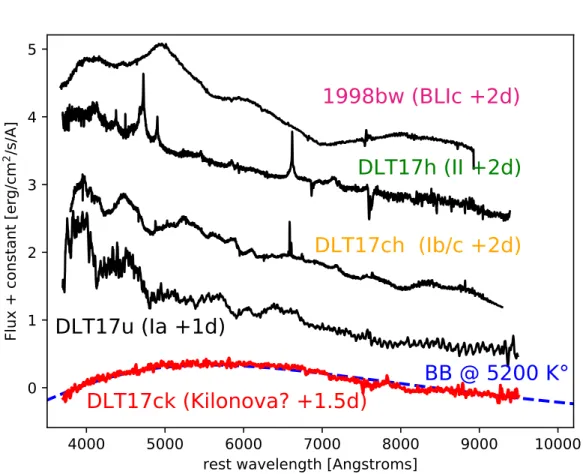
DLT17ck ∼ 35 hours after GW170817, reporting a featureless spectrum, with a much
redder continuum than that observed in SN spectra at similar phases (Lyman et al. 2017,
see Figure 4). A black-body fit to the spectrum revealed a temperature of ≈ 5200 K.
Considering a spherically symmetric explosion and a black body emission, the radius of the
kilonova should have expanded from the radius of a neutron star (few tenth 105 cm ) to
∼
7.3 × 1014 cm. Under homologous expansion this requires a velocity expansion of 0.2c.
5. Search for pre-discovery outbursts in historical data.
In the standard kilonova model, we only expect a bright electromagnetic signature
after coalescence. We can test this by looking at DLT40 observations taken before 2017
August 17. NGC 4993 is one of the galaxies monitored by the DLT40 supernova search,
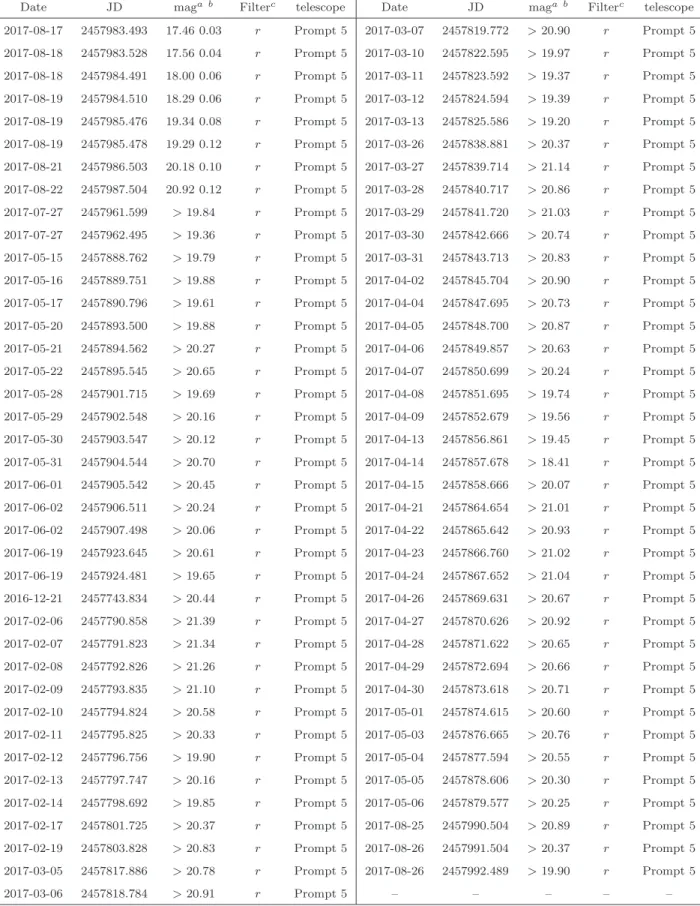
observed on average every 3 days from February 2017 to July 2017 (see Table 1). Our
images show no sign of an optical transient down to a limit of mr ∼19 mag (see Figure 3),
corresponding to Mr ∼ −14 mag at the adopted distance of NGC 4993. Similarly, the field
was also observed from 2013 to 2016 from La Silla QUEST on the ESO 1.0 meter telescope
with no detection to a limit ofR ∼ 18 mag (Rabinowitz & Baltay 2017).
The last DLT40 non-detection at the position of DLT17ck is on 2017 July 27th (21 days
before the LVC event) down to mr = 19.1 mag. Combining this limit with the extremely
fast timescale of the transient, its blue continuum in the early spectra, its rapid cooling,
and its photometric consistency with some kilonova models makes it extremely unlikely
DLT17ck can be explained by any kind of supernova unrelated to the GW/GRB event.
Rather, all the evidence favors that DLT17ck was discovered young, and is the optical
6. Summary and Future Prospects
In this paper, we presented the discovery of DLT17ck in the error region of the
LVC event GW170817 and the Fermi short GRB 524666471/170817529. DLT17ck is
characterized by a very fast optical evolution, consistent with some kilonova models and
with a small ejecta mass (102 - 10−3 M⊙). Spectroscopic observations conducted about 35
hrs after the explosion show a featureless continuum with blackbody temperature of 5200
K, confirming the fast evolution of DLT17ck compared to the evolution of other transients
like classical supernovae. In addition, it is also surprising that at such a low temperature,
no features are visible. We may speculate that this is the result of blending due to the
high velocity of the expanding ejecta. Given the coincidence with the LVC event and
the short Fermi GRB, it is likely the optical counterpart of the merging of two neutron
stars in a binary system. This event represents a milestone for astronomy, being the first
multimessenger event from which both photons and gravitational waves have been detected.
The unprecedented characteristics of DLT17ck raise a question as to the rates of such
objects. The daily cadence of the DLT40 search can help constrain the rates of kilonovae
and other rapidly-evolving transients. Details of rate measurements will be presented in
a dedicated paper (Yang et al., in preparation), while here we report some of the results
related to kilonovae. Using the galaxies within 40 Mpc that we have observed in the last
two years, and under the simplifying assumption that all kilonovae have a light curve similar
to DLT17ck, we find an upper limit (at 95% confident level) to the rate of kilonovae of
0.48+0−0..915 binary neutron stars (BNS) SNu2. For a Milky Way luminosity∼2×10¹⁰ L⊙, this
translates to an upper limit of 9 Galactic kilonovae per millennium. This limit is not too
stringent since it is two orders of magnitude larger than the Galactic rate of binary neutron
star coalescence of 24 Myr−1 estimated by Kim et al. (2015) from known neutron-star
binaries.
We can convert our luminosity-based kilonova rate to a volumetric rate using the local
luminosity density from Blanton et al. (2003). This gives a limit of 9.4±0.8×10⁻⁵kilonovae
Mpc−3
yr−1
. This is consistent with previous limits (<0.05 Mpc−3
yr−1
; Berger et al.
2013), that however were based on hypothetical parameters for the BNS optical light curve,
and is comparable to the volumetric rate of fast optical transients, 4.8 - 8.0 ×10⁻⁶ Mpc−3
yr−1
found by Drout et al. (2014).
Looking forward to the O3 LVC run, in 2018, it is useful to explore strategies to
detect EM counterparts of NS-NS mergers. DLT17ck was discovered independently by
several groups (eg. SWOPE and DLT40; Coulter et al. 2017 and Yang et al. 2017b), using
the approach of targeting nearby galaxies within the LVC region with small field-of-view
instruments (Gehrels et al. 2016a). Several wide-field searches were also able to identify
the transient (Allam et al. 2017; A. Mller 2017; Lipunov et al. 2017; Chambers et al. 2017),
but only after reports from the targeted searches. This was likely due to the challenge of
analyzing a large amount of data in a short period of time.
The small field-of-view strategy, and certainly our discovery, was successful because
GW170817/DLT17ck was extremely nearby. The short Fermi GRB associated with
DLT17ck is the closest ever discovered (see Berger 2014, for a review of short GRBs).
However, with the expected increase in sensitivity of the LVC detectors, in O3 the volume
where NS-NS mergers can be detected will reach 150 Mpc, increasing further to 200 Mpc
at full sensitivity (2019+; Abbott et al. 2016). At these distances galaxy catalogs are
incomplete (Smartt et al. 2016) and the sheer number of galaxies will likely favor wide-field
strategies. Nonetheless, because the Virgo horizon distance during O3 is predicted to be
65−115 Mpc (Abbott et al. 2016), the small field-of-view strategy may still be important
60 second exposures. Taking a more conservative limit of 18.5 mag, we would expect to be
able to see sources like DLT17ck out to 70 Mpc. Increasing the exposure time to reach a
depth of ∼ 20 mag would allow us to observe binary neutron star mergers in the full range
of the Virgo interferometer.
Research by DJS and L.T. l is supported by NSF grant AST-1412504 and AST-1517649.
AC acknowledges support from the NSF award #1455090. The work of SY was supported
Fig. 1.— The sky map region of the GW170817 LVC event using all three
gravitational-wave observatories (H1, L1, and V1) over-imposed on theFermi localization of GBM trigger
524666471/170817529. The DLT40 galaxies observed the first Chilean night after the LVC
trigger are marked in orange (galaxies within the LVC region) and in olive green (galaxies
within theFermi localization). The remaining black points are those DLT40 galaxies which
were within the Fermi localization but were not observed by our program. The red star
Table 1: Photometric Data for DLT17ck
Date JD maga b
Filterc
telescope Date JD maga b
Filterc
telescope
2017-08-17 2457983.493 17.46 0.03 r Prompt 5 2017-03-07 2457819.772 >20.90 r Prompt 5 2017-08-18 2457983.528 17.56 0.04 r Prompt 5 2017-03-10 2457822.595 >19.97 r Prompt 5 2017-08-18 2457984.491 18.00 0.06 r Prompt 5 2017-03-11 2457823.592 >19.37 r Prompt 5 2017-08-19 2457984.510 18.29 0.06 r Prompt 5 2017-03-12 2457824.594 >19.39 r Prompt 5 2017-08-19 2457985.476 19.34 0.08 r Prompt 5 2017-03-13 2457825.586 >19.20 r Prompt 5 2017-08-19 2457985.478 19.29 0.12 r Prompt 5 2017-03-26 2457838.881 >20.37 r Prompt 5 2017-08-21 2457986.503 20.18 0.10 r Prompt 5 2017-03-27 2457839.714 >21.14 r Prompt 5 2017-08-22 2457987.504 20.92 0.12 r Prompt 5 2017-03-28 2457840.717 >20.86 r Prompt 5 2017-07-27 2457961.599 >19.84 r Prompt 5 2017-03-29 2457841.720 >21.03 r Prompt 5 2017-07-27 2457962.495 >19.36 r Prompt 5 2017-03-30 2457842.666 >20.74 r Prompt 5 2017-05-15 2457888.762 >19.79 r Prompt 5 2017-03-31 2457843.713 >20.83 r Prompt 5 2017-05-16 2457889.751 >19.88 r Prompt 5 2017-04-02 2457845.704 >20.90 r Prompt 5 2017-05-17 2457890.796 >19.61 r Prompt 5 2017-04-04 2457847.695 >20.73 r Prompt 5 2017-05-20 2457893.500 >19.88 r Prompt 5 2017-04-05 2457848.700 >20.87 r Prompt 5 2017-05-21 2457894.562 >20.27 r Prompt 5 2017-04-06 2457849.857 >20.63 r Prompt 5 2017-05-22 2457895.545 >20.65 r Prompt 5 2017-04-07 2457850.699 >20.24 r Prompt 5 2017-05-28 2457901.715 >19.69 r Prompt 5 2017-04-08 2457851.695 >19.74 r Prompt 5 2017-05-29 2457902.548 >20.16 r Prompt 5 2017-04-09 2457852.679 >19.56 r Prompt 5 2017-05-30 2457903.547 >20.12 r Prompt 5 2017-04-13 2457856.861 >19.45 r Prompt 5 2017-05-31 2457904.544 >20.70 r Prompt 5 2017-04-14 2457857.678 >18.41 r Prompt 5 2017-06-01 2457905.542 >20.45 r Prompt 5 2017-04-15 2457858.666 >20.07 r Prompt 5 2017-06-02 2457906.511 >20.24 r Prompt 5 2017-04-21 2457864.654 >21.01 r Prompt 5 2017-06-02 2457907.498 >20.06 r Prompt 5 2017-04-22 2457865.642 >20.93 r Prompt 5 2017-06-19 2457923.645 >20.61 r Prompt 5 2017-04-23 2457866.760 >21.02 r Prompt 5 2017-06-19 2457924.481 >19.65 r Prompt 5 2017-04-24 2457867.652 >21.04 r Prompt 5 2016-12-21 2457743.834 >20.44 r Prompt 5 2017-04-26 2457869.631 >20.67 r Prompt 5 2017-02-06 2457790.858 >21.39 r Prompt 5 2017-04-27 2457870.626 >20.92 r Prompt 5 2017-02-07 2457791.823 >21.34 r Prompt 5 2017-04-28 2457871.622 >20.65 r Prompt 5 2017-02-08 2457792.826 >21.26 r Prompt 5 2017-04-29 2457872.694 >20.66 r Prompt 5 2017-02-09 2457793.835 >21.10 r Prompt 5 2017-04-30 2457873.618 >20.71 r Prompt 5 2017-02-10 2457794.824 >20.58 r Prompt 5 2017-05-01 2457874.615 >20.60 r Prompt 5 2017-02-11 2457795.825 >20.33 r Prompt 5 2017-05-03 2457876.665 >20.76 r Prompt 5 2017-02-12 2457796.756 >19.90 r Prompt 5 2017-05-04 2457877.594 >20.55 r Prompt 5 2017-02-13 2457797.747 >20.16 r Prompt 5 2017-05-05 2457878.606 >20.30 r Prompt 5 2017-02-14 2457798.692 >19.85 r Prompt 5 2017-05-06 2457879.577 >20.25 r Prompt 5 2017-02-17 2457801.725 >20.37 r Prompt 5 2017-08-25 2457990.504 >20.89 r Prompt 5 2017-02-19 2457803.828 >20.83 r Prompt 5 2017-08-26 2457991.504 >20.37 r Prompt 5 2017-03-05 2457817.886 >20.78 r Prompt 5 2017-08-26 2457992.489 >19.90 r Prompt 5 2017-03-06 2457818.784 >20.91 r Prompt 5 – – – – – (a) : Data has not been corrected for extinction.
Fig. 2.— Last non-detection (on the left), discovery image of DLT17ck observed on
2017-08-17 at 23:49:55 UT. The difference image is shown on the right, where DLT17ck is clearly
0.0 2.5 5.0 7.5 10.0 12.5 15.0 Da.s from LIGO event
−20 −18 −16 −14 −12 −10 −8
−250 −200 −150 −100 −50 Da.s from LIGO event
−20 −18 −16 −14 −12 −10 −8 r M ag n t ud e DLT17ck 1994I (Ic) 1998bw (BLIc) 2010ae (Iax) 2006jc 2002bj 2005ek LP98 Met10 Piran et al B&K sGRB off1 −20 −10 0 10
−18
−16
−14
−12
−10
Fig. 3.—Right panel: DLT40 light curve of DLT17ck (in red) over plotted with normal or
fast-evolving SNe (in gray). Several NS-NS merger models, scaled to a distance of 40 Mpc,
are shown as comparison from Li & Paczy´nski 1998 [LP98]; Metzger et al. 2010 [Met10];
Barnes & Kasen 2013 [B&K] and Piran et al. 2013 [Piran et al]. Left panel: We show the
detection limits in the position of DLT17ck in the 6 months before GW170817 and an inset
4000 5000 6000 7000 8000 9000 10000 rest
wavelength [Angstroms]
0
1
2
3
4
5
Flu
x +
co
nst
an
t [
erg
/cm
2
/s/
A]
DLT17u
(Ia +1d)
DLT17ch (Ib/c +2d)
1998bw (BLIc +2d)
DLT17h (II +2d)
DLT17ck (Kilonova? +1.5d)
BB @ 5200 K°
Fig. 4.— DLT17ck spectrum at 35 hours after the GW170817 compared with spectra of
young SNe at similar epochs. DLT17ck is cooling much faster than any previously observed
explosive transient. A blackbody fit indicates a temperature of≈5200 K. Data from: DLT17u
(FLOYDS), DLT17ch (SALT), DLT17h (SALT), DLT17ck (NTT), SN1998bw (Danish 1.54
telescope + DFOSC). The presence of an emission feature at ∼7800 ˚A is suspicious due to
REFERENCES
A. Mller, S. Chang, C. W. 2017, GRB Coordinates Network, 21542
Aasi, J., Abadie, J., Abbott, B. P.,et al. 2015, Classical and Quantum Gravity, 32, 115012
Abbott, B. P., Abbott, R., Abbott, T. D., et al. 2016a, Phys. Rev. Lett., 116, 241103
Abbott, B. P., Abbott, R., Abbott, T. D., et al. 2016, ApJ, 826, L13
Abbott, B. P., Abbott, R., Abbott, T. D., et al. 2016b, Phys. Rev. Lett., 116, 061102
Abbott, B. P., Abbott, R., Abbott, T. D., et al. 2016, Living Reviews in Relativity, 19, 1
Abbott, B. P., Abbott, R., Abbott, T. D., et al. 2017, Phys. Rev. Lett., 118, 221101
Acernese, F., Agathos, M., Agatsuma, K., et al. 2015, Classical and Quantum Gravity, 32,
024001
Adams, S. M., Kasliwal, M. M., & Blagorodnova, N. 2017, LIGO-Virgo GRB Coordinate
Network Circular, 21816
Allam, S., Annis, J., Berger, E., et al. 2017, GRB Coordinates Network, 21530
Arcavi, I., Howell, D. A., McCully, C., et al. 2017, Nature in press (DOI:
10.1038/na-ture24291)
Arnett, W. D. 1982, ApJ, 253, 785
Barnes, J., & Kasen, D. 2013, ApJ, 775, 18
Bartos, I., Countryman, S., Finley, C., et al. 2017a, GRB Coordinates Network, 21511
Bartos, I., Countryman, S., Finley, C., et al. 2017b, GRB Coordinates Network, 21568
Berger, E., Leibler, C. N., Chornock, R., et al. 2013, ApJ, 779, 18
Blanton, M. R., Hogg, D. W., Bahcall, N. A., et al. 2003, ApJ, 592, 819
Chambers, K. C., Huber, M. E., Smartt, S. J., et al. 2017, GRB Coordinates Network,
21553
Corsi, A., Hallinan, G., Mooley, K., et al. 2017, LIGO-Virgo GRB Coordinate Network
Circular, 21815
Coulter, D. A., Kilpatrick, C. D., Siebert, M. R., et al. 2017, Science in press
(DOI:10.1126/science.aap9811)
Drout, M. R., Chornock, R., Soderberg, A. M., et al. 2014, ApJ, 794, 23
Shapee B. J., et al. 2017, Science in press (DOI: 10.1126/science.aaq0186)
Fong, W., Margutti, R., & Haggard, D. 2017, LIGO-Virgo GRB Coordinate Network
Circular, 21786
Freedman, W. L., Madore, B. F., Gibson, B. K., et al. 2001, ApJ, 553, 47
Gehrels, N., Cannizzo, J. K., Kanner, J., et al. 2016a, ApJ, 820, 136
Goldstein, A., et al. 2017, ApJL in press (DOI: 10.3847/2041-8213/aa8f41)
Hosseinzadeh, G., Sand, D. J., Valenti, S., et al. 2017, ApJ, 845, L11
Kasen, D., Badnell, N. R., & Barnes, J. 2013, ApJ, 774, 25
Kim, C., Perera, B. B. P., & McLaughlin, M. A. 2015, MNRAS, 448, 928
Li, L.-X., & Paczy´nski, B. 1998, ApJ, 507, L59
LIGO/Virgo Collaboration. 2017b, GRB Coordinates Network, 21513
Lipunov, V., Gorbovskoy, E., V.G.Kornilov, et al. 2017, GRB Coordinates Network, 21546
Lyman, J., Homan, D., Maguire, K., et al. 2017, GRB Coordinates Network, 21582
Melandri, A., Campana, S., Covino, S., et al. 2017, GRB Coordinates Network, 21532
Metzger, B. D. 2017, Living Reviews in Relativity, 20, 3
Metzger, B. D., Mart´ınez-Pinedo, G., Darbha, S., et al. 2010, MNRAS, 406, 2650
Mooley, K., Hallinan, G., & Corsi, A. 2017, LIGO-Virgo GRB Coordinate Network Circular,
21814
Piran, T., Nakar, E., & Rosswog, S. 2013, MNRAS, 430, 2121
Rabinowitz, D., & Baltay, C. 2017, GRB Coordinates Network, 21599
Reichart, D., Nysewander, M., Moran, J., et al. 2005, Nuovo Cimento C Geophysics Space
Physics C, 28, 767
Sadler, E. M., Allison, J. R., Kaplan, D. L., Murphy, T., & on behalf of the
VAST collaboration. 2017, GRB Coordinates Network, 21645
Schlafly, E. F., & Finkbeiner, D. P. 2011, ApJ, 737, 103
Singer, L. P., & Price, L. R. 2016, Phys. Rev. D, 93, 024013
Smartt, S. J., Valenti, S., Fraser, M., et al. 2015, A&A, 579, A40
Smartt, S. J., Chambers, K. C., Smith, K. W., et al. 2016, ApJ, 827, L40
Troja, E., Piro, L., van Eerten, H. J, & Lien, A. 2017, Nature in press (DOI:
10.1038/nature24290)
White, D. J., Daw, E. J., & Dhillon, V. S. 2011, Classical and Quantum Gravity, 28, 085016
Wolf, C., Chang, S., & Muller, A. 2017, GRB Coordinates Network, 21560
Yang, S., Valenti, S., Sand, D., et al. 2017a, GRB Coordinates Network, 21579
Yang, S., Valenti, S., Sand, D., et al. 2017b, GRB Coordinates Network, 21531