ROOT-ASSOCIATED BACTERIAL COMMUNITIES AS
AN EXTENDED PHENOTYPE OF THE PLANT
Derek S. Lundberg
A dissertation submitted to the faculty of the University of North Carolina at Chapel
Hill in partial fulfillment of the requirements for the degree of Doctor of Philosophy in
the Curriculum for Genetics and Molecular Biology
Chapel Hill
2014
Approved by:
Jeffrey L. Dangl
Corbin D. Jones
John F. Rawls
iii
ABSTRACT
DEREK S. LUNDBERG: Root-associated bacterial communities as an extended
phenotype of the plant
(Under the direction of Jeff Dangl)
Land plants associate with a root microbiota distinct from the complex microbial
community present in surrounding soil. The microbiota colonizing the rhizosphere
(immediately surrounding the root) and the endophytic compartment (within the root)
contribute to plant growth, productivity, carbon sequestration and phytoremediation. In my
research I primarily wanted to test the hypothesis that plants that evolved to live in
environments with different challenges also evolved the ability to associate with a unique
microbiota as one means of overcoming these challenges. Despite great agronomic interest,
genetic principles governing the derivation of host-specific endophyte communities from soil
communities are poorly-understood.
I first used extensive sequencing of ribosomal 16S rRNA genes to characterize
bacterial populations from hundreds of roots of different genotypes of the model plant
Arabidopsis thaliana grown in two wild (non-native) soils from North Carolina. These results
demonstrated that soil type is the major determinant of the membership of the bacterial
community in the rhizosphere and the community living inside roots, and that the
developmental stage of the plant as well and the plant genotype actually have relatively
minor effects on the colonization behavior of major bacterial taxonomies.
Because in wild microbial communities bacteria with different genomic content may
share a similar 16S rRNA gene, and because of limitations in the 16S rRNA sequencing
iv
confidence to which Arabidopsis genotypes individual strains of bacteria associated. This
was a major limitation, because the presence or absence of specific bacterial genes may be
a strong determinant of potential host genotypes for a given symbiont. Therefore, I
developed technological improvements to increase the accuracy and depth of sequencing,
while meanwhile culturing individual strains of bacteria from roots and creating a gnotobiotic
system for growing plants in direct association with mixtures of cultured strains. Initial results
from this system demonstrate that we can culture a wide diversity of root-associated
bacteria and can successfully recolonize plants with complex but defined cocktails of
bacteria. Experiments to explore microbe-by genotype association in this gnotobiotic system
v
PREFACE
The part of the material in Chapter 1 that follows the heading “Developing
systems to study plant microbiota” is part of a review that was commissioned by, and
submitted to, the journal
Trends in Cell Biology
. It was ultimately rejected, largely
because the field was already saturated with reviews. The review was written after
the publication of the work in Chapters 2 and 3, and therefore discusses that work in
its current context. For the submitted review, I share authorship with Sarah L.
Lebeis, Sur Herrera Paredes, and Jeff Dangl. I contributed to and edited all sections
but wrote only the final review section entitled “The search for novel host factors
shaping the plant microbiome“, which involves recent conclusions and therefore is
truncated in Chapter 1 and continued in Chapter 4.
vi
into clean count tables (Scott). I thank Alice Smithlund, Maciej Gonek, Victoria
Madden, H. Schmidt, Matthias Rott and N. Zvenigorodsky for technical assistance,
Amyé Spor, Jason Peiffer and John F Rawls for discussions, and Cathy Herring for
access to Clayton field soil.
Chapter 3 was published in
Nature Methods
. I share co-first authorship with
Scott Yourstone. My intellectual contributions included assistance with template
tagging and PCR primer design, all wet-bench protocol design and execution of
protocols, Peptide Nucleic Acid design and statistical validation, all bioinformatics
downstream of MTToolbox processing, creating all figures with the exception of
some parts of Figure 3.6, and writing the manuscript. Scott Yourstone designed and
wrote MTToolbox, the efficient and user-friendly informatics pipeline. However, for
some analysis such as that in Figure 3.8, I reproduced key aspects of this pipeline
using my own inefficient code to make “consensus sequences” and “perfect
consensus sequences”, so I am familiar with most computational aspects of this
work as well.
vii
TABLE OF CONTENTS
LIST OF TABLES………..………...
ix
LIST OF FIGURES………
x
CHAPTER
I. INTRODUCTION………
1
Introduction……….
1
References………..
11
II. DEFINING THE CORE
ARABIDOPSIS THALIANA
ROOT MICROBIOME………... 19
Introduction………..
19
Main………..
20
Materials and Methods………..
29
Tables………...
43
Figures………..
46
References………..
88
III. PRACTICAL INNOVATIONS FOR
HIGH- THROUGHPUT AMPLICON SEQUENCING……….
93
Introduction………..
93
Main………..
93
viii
Figure-Specific Details………... 114
Figures………..……… 123
References……….. 156
IV. CONCLUSIONS AND FUTURE DIRECTIONS……….. 160
Limitations of current work……… 160
Future Directions………. 162
Figures………
170
ix
LIST OF TABLES
TABLE
2.1.
Mason Farm and Clayton soil micronutrient
analysis and GPS location………...
43
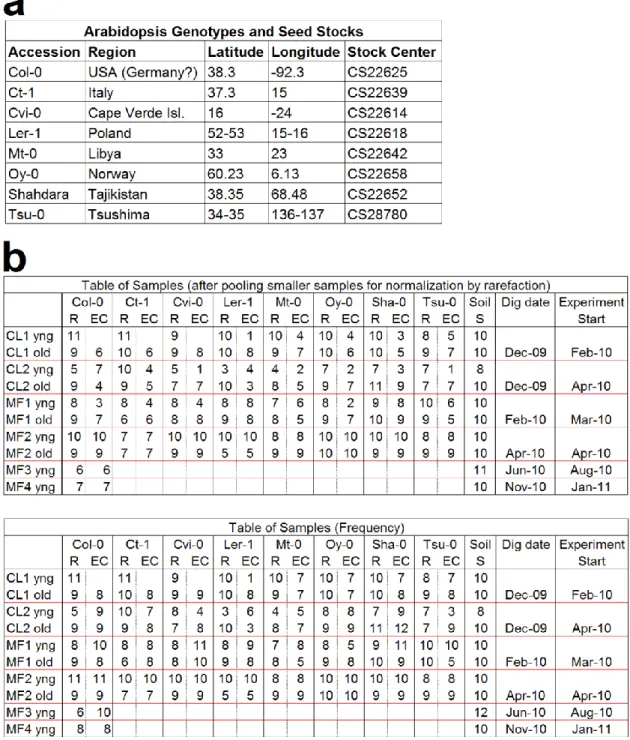
2.2.
Genotypes, seed stocks, and sample numbers………...
44
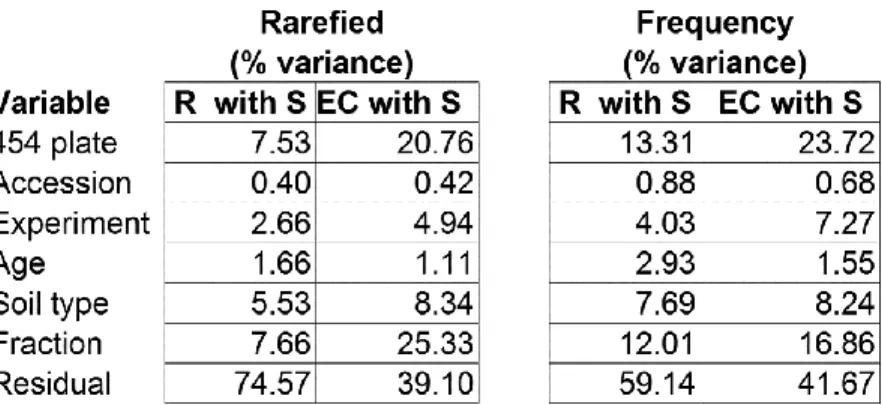
2.3.
Percent variance explained by each variable in
x
LIST OF FIGURES
FIGURE
2.1.
Harvesting Scheme………..
46
2.2.
Primer test and technical reproducibility………
48
2.3.
Informatics pipeline………...
53
2.4.
Sequencing statistics and quality………...
54
2.5.
Sample fraction and soil type drive the
microbial composition of root-associated
endophyte communities rarefied)………...
58
2.6.
Sample fraction and soil type drive the
microbial composition of root-associated endophyte
communities (frequency)………..……...
60
2.7.
OTUs identified from four independent biological
replicates are reproducible………..……
62
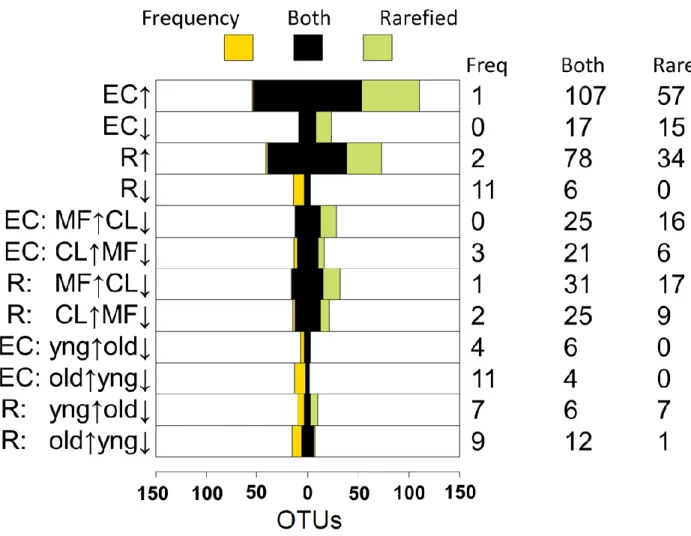
2.8.
OTUs that differentiate the endophyte compartment
and rhizosphere from soil rarefied)………
64
2.9.
OTUs that differentiate the endophyte compartment
and rhizosphere from soil (frequency)………...
67
2.10.
Dot Plots of Notable OTUs
(rarefied)………...…………..
70
2.11.
Dot Plots of Notable OTUs
(frequency)………...
72
2.12. Genotype-variable OTUs colored by sequence plate……….
74
2.13. CARD–FISH confirmation of Actinobacteria on roots……….
76
2.14.
Quantification of microbes in the three sample
fractions using CARD-FISH……….
78
xi
2.16. Test for PCR bias in pyrotagging………
82
2.17.
16S taxonomy classification at the family level is
robust to method………...
84
2.18.
Overlap of GLMM predictions between
rarefaction-normalized and
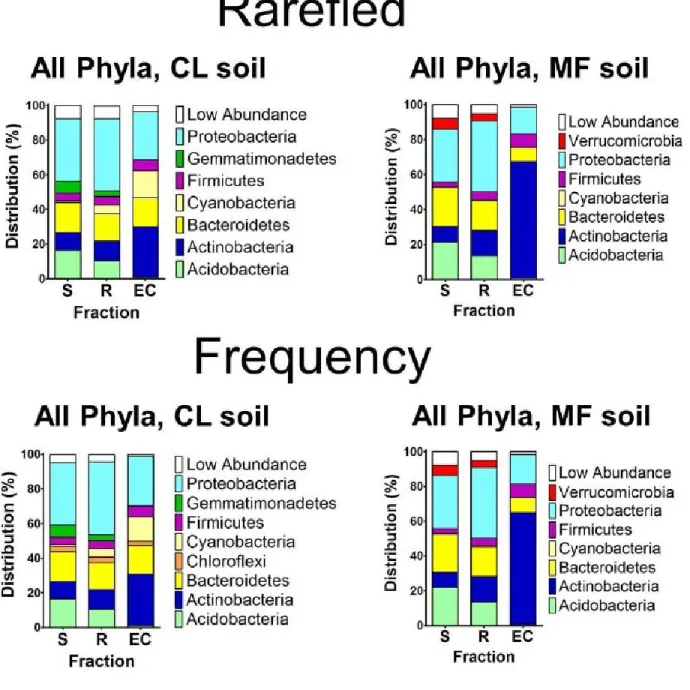
frequency-normalized OTU tables……….
86
2.19. Phyla in each sample fraction by soil type………
87
3.1.
Reference Map of the 16S rRNA gene……….. 123
3.2.
Schematic of molecular tagging - frameshifting
template tagging primers………. 124
3.3.
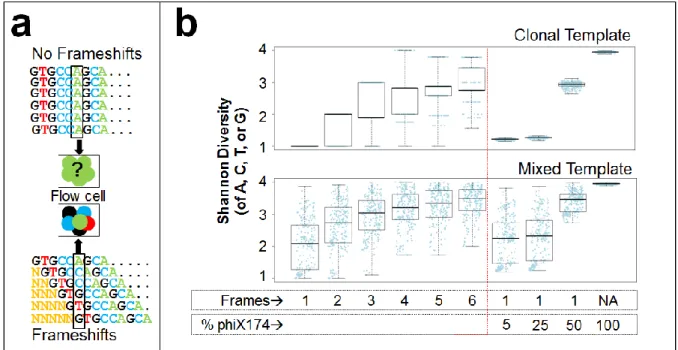
Frameshifting primers enhance library diversity……….. 126
3.4.
MiSeq run quality for Run A (setup run) and
Run B (primary run)……….. 127
3.5.
MiSeq run quality for Run C (our method) and
Run D (Earth Microbiome Project method)……….. 129
3.6.
Template Tagging, PCR, sequencing, and
Molecular Tag (MT) processing workflow………. 132
3.7.
A MT of 13 random bases is sufficiently unique……….. 135
3.8.
Molecular tagging reduces sequence error for a
clonal template……….. 137
3.9.
Molecular tagging lowers estimates of alpha
diversity and improves technical reproducibility……….. 139
3.10.
Beta diversity conclusions from our method vs.
the Earth Microbiome Project (EMP) method……….. 141
3.11. PNA schematic………. 143
3.12. Exhuastive search for PNA oligo candidates……… 144
3.13.
PNA specifically blocks amplification of
xii
3.14.
No bacterial OTU abundances are affected
by pPNA or mPNA……… 147
3.15.
No bacterial family abundances are affected
by pPNA or mPNA……… 149
3.16.
Diverse plant species for which the PNAs in this
study should block organelle V4 16S amplification………. 151
3.17.
Universal PCR primers can be used to amplify and
barcode other tagged templates………. 154
3.18. Primer linkers………. 155
4.1.
Re-colonization of Arabidopsis root endophytic
compartments in two different experimental systems………. 164
4.2.
Gnotobiotic calcined clay system………... 166
4.3.
Tagging construct for bacterial isolates ……… 167
CHAPTER 1
INTRODUCTION
INTRODUCTION
The plant microbiome (its collection of associated microbes) is an example of
Richard Dawkins’ ‘extended phenotype’ (Dawkins 1989). Plant genotype, both within and
between species, has been correlated with differences in the associated microbiome, with
consequent associations to plant growth, development, and performance. The productivity
of any plant community relies in part on the respective plant-associated microbiomes, which
are distinct from the microbiomes in surrounding soil. The microbiota is most simply viewed
as an extension of each plant’s genome; we do not know any plant genome’s full functional
capacity until we also know the functional capacity and assemblage drivers on its associated
microbiome.
Essentially all land plants grow in intimate association with a complex microbiota.
Microbes in both the phyllosphere and the rhizosphere can be either endophytic, epiphytic,
or closely associated. Examples of close microbial associates include those inhabiting the
fluid in pitcher plants, or those not touching roots but heavily influenced by root exudates in
the nearby soil. The host plant often relies on its root-associated metagenome to provide it
with critical nutrients (Bais et al. 2006), as minerals are often present in the soil in forms
inaccessible to plants. In other cases plant-associated microbes, such as Pseudomonads
(Mavrodi et al. 2006; Vacheron et al. 2013), can act as protectants against phytopathogens.
2
and to help plants withstand heat, salt, drought, and more (Bais et al. 2006; Rodriguez and
Redman 2008). Growth-promoting mutualistic bacteria associate with the phyllosphere as
well (Vorholt 2012; Whipps et al. 2008). The plant, in turn, cultivates its microbiome through
means such as adjusting the pH, reducing competition for beneficial microbes, and providing
an energy source, mostly in the form of carbon-rich exudates. Decaying dead roots are an
important contributor of carbon to the soil, and between 5-33% of all atmospheric carbon
fixed (depending on plant species and climate conditions) exits on living roots as exudates
(DeDeyn et al. 2008). Thus, the global plant-associated rhizosphere microbiome is a very
large carbon sequestration niche.
Studies have begun in a variety of systems to address the microbiome of various
crops such as maize (Chelius and Triplett 2001), rice (Erkel et al. 2006; Oliveira et al. 2009),
and other plants (Whipps et al. 2008). Understanding the causes of these differences could
be transformational in plant breeding and biotechnology, because there is the potential to
uncover a whole new suite of genes capable of improving plant yields in adverse conditions
through exploitation and manipulation of the innate (and/or adjusted) probiotic capacity of
soils and the natural environment. Additionally, rhizosphere microorganisms play a key role
in long-term sequestration of the carbon secreted by plant roots (DeDeyn et al. 2008),
meaning that understanding what plant gene products attract particular microbial
communities could help uncover a genetic component to climate change (Ryan et al. 2009).
Microbial community influences plant health. The best-known strategy of plants to
improve the uptake of phosphate, nitrogen and other minerals is to form symbioses with
arbuscular mycorrhizal (AM) fungi of the phylum Glomeromycota (Schuessler et al. 2001)
AM fungi associate intimately with host roots, growing inter- and intracellularly within the root
3
formation of extensive extraradical mycelia, which can lead to a 100-fold increase of the
nutrient absorbing surface of the root, thus allowing the plant to efficiently utilize minerals
and to exploit nutrient resources not available without symbiosis. AM symbiosis dates
back >400 million years (Remy et al. 1994) and coincided with plant colonization of land
(Heckman et al. 2001; Redecker et al. 2000), and most plant lineages associate with AM
fungi. Arabidopsis, like the majority of Brassicaceae, and like several other plant lineages,
has lost the association with AM fungi (Smith and Read 2010). Nevertheless, Brassicas like
Arabidopsis do manage to extract phosphorous from the soil using root hairs (Bates and
Lynch 2000) and perhaps associated microbes. Arabidopsis provides a valuable opportunity
to focus on a plant’s interaction with other important rhizosphere microorganisms in the
absence of the influence of AM fungi. Additionally, Arabidopsis is the reference system for
plant genetics, genomics, and molecular biology (Initiative 2000; Weigel 2012) .
The identification of plant genes associated with specific microbial community traits
will lead to the search for homologs or functional equivalents in mammalian species.
Multicellular eukaryotes evolved in a microbial world, hence the evolutionary conservation of
host-microbe interactions can be very ancient. Indeed, host responses to microbial
colonization are evolutionarily conserved between mammals and fish (Rawls et al. 2006). It
is conceivable that host responses to microbial colonization, and even host modulation of
surface microbial communities, are driven by processes or genes that are shared among
members of different plant phlya. Once identified, host genes important in shaping microbial
communities will constitute targets for intervention. Restructuring microbial communities is
likely to be desirable in agriculture for promoting plant health in particular soil and climate
4
Developing systems to study plant microbiota
In the simplest scenarios, microbes from surrounding environments (i.e. soil, water,
and air) colonize plants via a random process involving first come-first serve niche filling
together with inter-microbe competition to establish idiosyncratic communities on or inside
organs of each host. This scenario, though, is an unlikely mechanism for microbiota
colonization of the roots, especially given recent studies of poplar (Gottel et al. 2011),
Arabidopsis thaliana grown in multiple natural soils from two continents (Bulgarelli et al.
2012; Lundberg et al. 2012) and maize from five diverse North American fields (Peiffer et al.
2013). In these studies, whether plants are grown outdoors or in greenhouses or growth
chambers, specific bacterial taxa are reproducibly enriched inside the root as compared with
surrounding soils. Several generalities emerged from these studies: soils, as expected were
the most diverse environment, while the intimate zone of host-microbe contact inside the
root (putative endophytes) were significantly less diverse; the largest contributor to root
microbiome composition was the physical proximity to the plant; the second largest
contributor was the wild soil from which the community was recruited.
Recently, similar studies were carried out on above ground organs, the phyllosphere,
where reproducible colonization of a subset of bacterial taxa from the surrounding aerial
environment was shown in A. thaliana leaves (Maignien et al. 2014). However, the
importance of stochastic processes and early colonization events was shown to be a major
force shaping mature microbial communities in these leaves (Maignien et al. 2014) and also
in apple flowers sampled over developmental time (Shade et al. 2013). Despite large
genetic differences across hosts, organs sampled, surrounding environments and
experimental methods, consistent taxonomies are recurrently found in the rhizosphere
5
Peiffer et al. 2013; Schlaeppi et al. 2013) or phyllosphere (Delmotte et al. 2009; Maignien et
al. 2014; Rastogi et al. 2012) organs. Collectively, these results suggest that a core
microbiota is recruited from very diverse surroundings; environment-specific enrichments of
certain taxa suggest fine-tuning both on leaves and roots by the host, in combination with
environmental biotic and abiotic factors (Bulgarelli et al. 2013; Vorholt 2012).
Ecological processes shaping host-associated microbial communities
Seed dispersal is an important ecological process in plants and some
plant-associated microbes are known to be inherited via seeds. For instance, there is
long-standing evidence for seed-based inheritance of rhizobia in legume seeds (Ash 1949), and
recent studies suggest the existence of surprising microbial diversity in the seeds of maize
(Johnston-Monje and Raizada 2011) and spinach (Lopez-Velasco et al. 2013). Bacterial
seed coating can protect against pathogens (Hameeda et al. 2010; Wright 2005) and
promote plant growth (Jetiyanon et al. 2008). Seeds can also harbor bacterial (Gitaitis and
Walcott 2007), fungal (Biswas et al. 2013; Maruthachalam et al. 2013) and oomycete
(Testen et al. 2013) pathogens. Thus, understanding dispersion dynamics will ultimately
lead to better disease control strategies. Readily dispersed microbes might have a
competitive advantage over microbes that colonize after germination. These cases might
lead to “historically contingent” microbial communities where the early colonizers determine
the final community, mediated by microbe-microbe interactions, or by plant mechanisms
reinforcing the primacy of early colonizers. An alternative, but not exclusive, model proposes
that successions of microbial communities emerge over developmental time during the host
plant life cycle. Consistent with this hypothesis, different bacterial taxa preferentially colonize
6
growing annual A. thaliana, little difference in root bacterial community was noted at two
very different developmental stages, before and well after the metabolic switch in carbon
allocation (Lundberg et al. 2012), and poplar trees of different ages showed similar
communities (Gottel et al. 2011). To fully elucidate how the order of microbial colonization
affects the plant microbiome, it would be necessary to carry out studies with time series and
crossover designs; this type of design has already been used to establish the existence of
such “order effects” in the context of colonization of the mammalian gut (Lee et al. 2013).
Little is known about how greater differences in developmental time, or how annual versus
perennial life histories influence the assembly and long term stability of plant microbiota.
While increased dispersal from sources like soil, seed, or decaying leaf litter is
expected to increase diversity within individual plants, drift would counteract this effect and
perhaps add further heterogeneity because species represented by very low number of
individuals will have a high probability of undergoing local extinction due to stochastic
fluctuation. In the context of the endophytic compartment of the A. thaliana root and leaf,
drift might be particularly important given the relatively low estimates of a total of 105
endophytic bacterial cells per root system (Lundberg et al. 2012), and 104 cells/cm2 on the
leaf of the same species (Maignien et al. 2014) (though it should be noted that neither of
these estimates were from wild-grown plants). Given that hundreds of ribotypes were
detected on both organs, these results imply only tens to hundreds of individuals per
ribotype. From an ecological perspective, the health of a community can be viewed as its
ability to withstand and recover from perturbations, and low bacterial diversity in the
mammalian gut has been associated with susceptibility to perturbation (Virgin and Todd
2011) and disease (Turnbaugh et al. 2009). It is possible that diversity plays a similar role in
7
in microcosm reconstitution experiments is required to fully distinguish between cause and
effect.
Another process influencing microbiome composition is selection, by both abiotic (e.g.
drought, salinity, nutrient availability, etc.) and biotic (e.g. influence by the host or other
microbes) environmental components, which can occur due to any of these factors acting
directly on microbial species in the community, or be mediated by the plant host as it reads
and responds to its abiotic and/or biotic environment (Eisenhauer et al. 2013). It should be
noted that selection might act either at some microbial taxonomic level, at the gene level, or
both. For example legumes recruit nitrogen-fixing rhizobia to their roots only under nitrogen
deprivation conditions (Coronado et al. 1995), and remarkable host-genotypic specificity has
been found (Laguerre et al. 2003). Further, drought stress on the plant leads to an
enrichment of bacteria that produce 1-Aminocyclopropane-1-carboxylate (ACC) deaminase
(Marasco et al. 2012), which is known to reduce ethylene concentrations under stress
conditions; lowering ethylene levels helps plants recover from different abiotic stresses (Cao
et al. 2007). Despite this evidence, 16S rRNA gene-based experiments on samples from
plants grown in natural soils have provided little insight on the effect of abiotic factors on
community assembly, mainly because it has been impossible to disentangle the effect of
abiotic and biotic factors in these studies. Both microbe-microbe and plant-microbe
interactions might affect the ability of a specific microbe to colonize the host under different
environments. An association between herbivore behavior and root microbiome has been
suggested (Badri et al. 2013), and differences were found in bacterial networks constructed
from rhizosphere microbiomes of different plant hosts and across variable plant host
diversity (Bakker et al. 2013); however, it remains an open challenge to tie these
8
Contributions of immune system surveillance receptors in sculpting microbiomes
The repertoire of innate immune receptors that recognize and respond to
microbe-associated molecular patterns (MAMPs) allows for accurate sensing of changing microbial
environments. Although pattern recognition receptors (PRRs) have evolved separately in
plants and animals (Ausubel 2005; Ronald and Beutler 2010), the development of
analogous microbial perception systems at least twice points to their importance in the
lifecycle of both plants and animals. In addition, a large and divergent family of ‘disease
resistance proteins’ gives plants the ability to specifically recognize pathogen virulence
factors that overcome resistance and allow microbial colonization. The majority of plant
disease resistance proteins are NB-LRR proteins (nucleotide-binding site, leucine rich
repeats), which act as the primary intracellular receptors of the plant immune system
(Chisholm et al. 2006; Jones and Dangl 2006). Because host-associated microbial
communities are formed from the microbes present in the host’s environment, it is natural to
hypothesize that these resistance gene systems are particularly important in the broader
process of community assembly.
The search for novel host factors shaping the plant microbiome
Much is known about plant-genotype specificity governing disease resistance or
susceptibility to pathogens that threaten economically important crops; forward genetics to
exploit host genotypic diversity is well advanced for dissection of these binary interactions
(Dangl et al. 2013; Gururani et al. 2012). However, the influence of plant genotype on the
establishment of mutualistic interactions with populations of microorganisms is less
9
pathogenic phenotypes in agricultural settings. Notable exceptions, of course, are important
mutualists like arbuscular mycorrhizal fungi, which have broad host ranges and provide
nearly all agronomically relevant plants with phosphate in exchange for fixed carbon
(Bonfante and Genre 2010) and the deeply studied, typically host-specific nitrogen-fixing
rhizobia (Kondorosi et al. 2013). The extent of host specificity, if any, for individual members
or functional guilds derived from the larger plant microbiota is now an area of active
research. The hope is to uncover host loci affecting both general and specialized microbial
colonization by either widespread or soil-specific mutualists, respectively, as well as the
microbial genetic loci enabling them to communicate effectively with the host. The potential
agronomic and economical value of such genetic knowledge is huge, as it might enable
breeders to tailor plants to take advantage of particular types of microbial environments, or
to take advantage of artificially-supplied beneficial microbial treatments as probiotics.
To test and identify the contribution of plant genotype to the composition of a specific
microbiome, several groups grew different inbred plant genotypes in wild soils, under either
field conditions or in controlled environmental conditions, and then defined the microbial
community assembled on each host genotype by deep ribotyping (Bulgarelli et al. 2012;
Bulgarelli et al. 2013; Lundberg et al. 2012; Peiffer et al. 2013; Schlaeppi et al. 2013; Turner
et al. 2013). These studies revealed low variation in microbiota attributable to
plant-genotype, which may nonetheless be amenable to genetic dissection (Bulgarelli et al. 2012;
Lundberg et al. 2012; Peiffer et al. 2013). In cases where constructing experiments is not
possible, attempts have been made to separate covariates such as geographical location,
as for grape vineyards (Bokulich et al. 2013) and willow trees (Bell et al. 2013). As the
phylogenetic distance between the host genotypes compared decreases, especially when
comparing genotypes within a single plant species, it becomes theoretically possible to treat
10
or more members) as a phenotype, and to map these phenotypes to plant host loci, as has
been attempted in other systems (Bell et al. 2013; Benson et al. 2010; Srinivas et al. 2013).
It may ultimately be the case that, as with mycorrhizal fungi, many of the beneficial
members of the plant microbiome are generalists with the ability to colonize a wide range of
plant hosts (Moora et al. 2011). This is supported by the observation that the major enriched
bacterial taxa are the same across different species closely related to Arabidopsis thaliana
(~25M years of divergence) (Schlaeppi et al. 2013), and by the relatively subtle variation
observed so far between the microbiota of different plant genotypes within a species. It
could be that, for a plant, depending on microbial genes found only in a smaller set of
specific microbes might represent too great a survival risk, since these microbes might not
always be present. On the timescale of plant evolution there is a great deal of microbial
turnover, so the majority of plant recruitment mechanisms may need to work over relatively
wide groups of bacterial taxa, in order to associate with relatively common beneficial
microbial functions. As noted several times above, however, this is definitely not always the
case, as tight host specificity for some microbial associations is well documented. Whether
the apparent rarity of plant host specificity in microbiota assembly is truly as uncommon as it
appears to be based on 16S rRNA studies, or whether we are still merely blind to important
differences in the microbiota of genetically distinct plant hosts simply because 16S rRNA
11
REFERENCES
Ash CGaA, O.N. (1949) A Comparison of Methods Recommended for the Surface Sterilization of Leguminous Seed. Soil Science Society of America Journal 13(C): 279-283.
Ausubel FM (2005) Are innate immune signaling pathways in plants and animals conserved? Nature immunology 6(10): 973-979.
Badri DV, Chaparro JM, Zhang R, Shen Q, Vivanco JM (2013) Application of natural blends of phytochemicals derived from the root exudates of Arabidopsis to the soil reveal that phenolic-related compounds predominantly modulate the soil microbiome. The Journal of biological chemistry 288(7): 4502-4512.
Bais HP, Weir TL, Perry LG, Gilroy S, Vivanco JM (2006) The Role of Root Exudates in Rhizosphere Interactions with Plants and Other Organisms. Annual Review of Plant Biology 57(1): 233-266.
Bakker PA, Berendsen RL, Doornbos RF, Wintermans PC, Pieterse CM (2013) The rhizosphere revisited: root microbiomics. Frontiers in plant science 4: 165.
Bates TR, Lynch JP (2000) The efficiency of Arabidopsis thaliana (Brassicaceae) root hairs in phosphorus acquisition. American Journal of Botany 87(7): 964-970.
Bell TH, El-Din Hassan S, Lauron-Moreau A, Al-Otaibi F, Hijri M et al. (2013) Linkage between bacterial and fungal rhizosphere communities in hydrocarbon-contaminated soils is related to plant phylogeny. ISME J.
12
Biswas C, Dey P, Satpathy S, Sarkar SK, Bera A et al. (2013) A simple method of DNA isolation from jute (Corchorus olitorius) seed suitable for PCR-based detection of the pathogen Macrophomina phaseolina (Tassi) Goid. Letters in applied microbiology 56(2): 105-110.
Bodenhausen N, Horton MW, Bergelson J (2013) Bacterial communities associated with the leaves and the roots of Arabidopsis thaliana. PLoS One 8(2): e56329.
Bokulich NA, Thorngate JH, Richardson PM, Mills DA (2013) Microbial biogeography of wine grapes is conditioned by cultivar, vintage, and climate. Proc Natl Acad Sci U S A.
Bonfante P, Genre A (2010) Mechanisms underlying beneficial plant-fungus interactions in mycorrhizal symbiosis. Nature communications 1: 48.
Bulgarelli D, Rott M, Schlaeppi K, Ver Loren van Themaat E, Ahmadinejad N et al. (2012) Revealing structure and assembly cues for Arabidopsis root-inhabiting bacterial microbiota. Nature 488(7409): 91-95.
Bulgarelli D, Schlaeppi K, Spaepen S, Ver Loren van Themaat E, Schulze-Lefert P (2013) Structure and Functions of the Bacterial Microbiota of Plants. Annual Review of Plant Biology 64(1): 807-838.
Cao WH, Liu J, He XJ, Mu RL, Zhou HL et al. (2007) Modulation of ethylene responses affects plant salt-stress responses. Plant Physiol 143(2): 707-719.
Chelius MK, Triplett EW (2001) The Diversity of Archaea and Bacteria in Association with the Roots of Zea mays L. Microb Ecol 41(3): 252-263.
Chisholm ST, Coaker G, Day B, Staskawicz BJ (2006) Host-Microbe Interactions: Shaping the Evolution of the Plant Immune Response. Cell 124(4): 803-814.
13
Dangl JL, Horvath DM, Staskawicz BJ (2013) Pivoting the plant immune system from dissection to deployment. Science 341(6147): 746-751.
Dawkins R (1989) The extended phenotype : the long reach of the gene. Oxford ;New York: Oxford University Press, 1989.
DeDeyn GB, Cornelissen JHC, Bardgett RD (2008) Plant functional traits and soil carbon sequestration in contrasting biomes. Ecology Letters 11(5): 516-531.
Delmotte N, Knief C, Chaffron S, Innerebner G, Roschitzki B et al. (2009) Community proteogenomics reveals insights into the physiology of phyllosphere bacteria. Proc Natl Acad Sci U S A 106(38): 16428-16433.
Eisenhauer N, Dobies T, Cesarz S, Hobbie SE, Meyer RJ et al. (2013) Plant diversity effects on soil food webs are stronger than those of elevated CO2 and N deposition in a long-term grassland experiment. Proc Natl Acad Sci U S A 110(17): 6889-6894.
Erkel C, Kube M, Reinhardt R, Liesack W (2006) Genome of Rice Cluster I archaea--the key methane producers in the rice rhizosphere. Science 313(5785): 370-372.
Gitaitis R, Walcott R (2007) The epidemiology and management of seedborne bacterial diseases. Annual review of phytopathology 45: 371-397.
Gottel NR, Castro HF, Kerley M, Yang Z, Pelletier DA et al. (2011) Distinct microbial communities within the endosphere and rhizosphere of Populus deltoides roots across contrasting soil types. Appl Environ Microbiol 77(17): 5934-5944.
14
Hameeda B, Harini G, Rupela OP, Kumar Rao JV, Reddy G (2010) Biological Control of Chickpea Collar Rot by Co-inoculation of Antagonistic Bacteria and Compatible Rhizobia. Indian journal of microbiology 50(4): 419-424.
Heckman DS, Geiser DM, Eidell BR, Stauffer RL, Kardos NL et al. (2001) Molecular Evidence for the Early Colonization of Land by Fungi and Plants. Science 293(5532): 1129-1133.
Initiative AG (2000) Analysis of the genome sequence of the flowering plant Arabidopsis thaliana. Nature 408(6814): 796-815.
Jetiyanon K, Wittaya-Areekul S, Plianbangchang P (2008) Film coating of seeds with Bacillus cereus RS87 spores for early plant growth enhancement. Canadian journal of microbiology 54(10): 861-867.
Johnston-Monje D, Raizada MN (2011) Conservation and diversity of seed associated endophytes in Zea across boundaries of evolution, ethnography and ecology. PLoS One 6(6): e20396.
Jones JDG, Dangl JL (2006) The plant immune system. Nature 444(7117): 323-329.
Kondorosi E, Mergaert P, Kereszt A (2013) A paradigm for endosymbiotic life: cell differentiation of Rhizobium bacteria provoked by host plant factors. Annual review of microbiology 67: 611-628.
Laguerre G, Louvrier P, Allard MR, Amarger N (2003) Compatibility of rhizobial genotypes within natural populations of Rhizobium leguminosarum biovar viciae for nodulation of host legumes. Appl Environ Microbiol 69(4): 2276-2283.
15
Lopez-Velasco G, Carder PA, Welbaum GE, Ponder MA (2013) Diversity of the spinach (Spinacia oleracea) spermosphere and phyllosphere bacterial communities. FEMS microbiology letters 346(2): 146-154.
Lundberg DS, Lebeis SL, Paredes SH, Yourstone S, Gehring J et al. (2012) Defining the core Arabidopsis thaliana root microbiome. Nature 488(7409): 86-90.
Maignien L, Deforce EA, Chafee ME, Eren AM, Simmons SL (2014) Ecological Succession and Stochastic Variation in the Assembly of Arabidopsis thaliana Phyllosphere Communities. mBio 5(1).
Marasco R, Rolli E, Ettoumi B, Vigani G, Mapelli F et al. (2012) A drought resistance-promoting microbiome is selected by root system under desert farming. PLoS One 7(10): e48479.
Maruthachalam K, Klosterman SJ, Anchieta A, Mou B, Subbarao KV (2013) Colonization of spinach by Verticillium dahliae and effects of pathogen localization on the efficacy of seed treatments. Phytopathology 103(3): 268-280.
Mavrodi DV, Blankenfeldt W, Thomashow LS (2006) Phenazine Compounds in Fluorescent Pseudomonas Spp. Biosynthesis and Regulation. Annual review of phytopathology 44(1): 417-445.
Moora M, Berger S, Davison J, Öpik M, Bommarco R et al. (2011) Alien plants associate with widespread generalist arbuscular mycorrhizal fungal taxa: evidence from a continental-scale study using massively parallel 454 sequencing. Journal of Biogeography 38(7): 1305-1317.
16
Peiffer JA, Spor A, Koren O, Jin Z, Tringe SG et al. (2013) Diversity and heritability of the maize rhizosphere microbiome under field conditions. Proc Natl Acad Sci U S A 110(16): 6548-6553.
Rastogi G, Sbodio A, Tech JJ, Suslow TV, Coaker GL et al. (2012) Leaf microbiota in an agroecosystem: spatiotemporal variation in bacterial community composition on field-grown lettuce. ISME J 6(10): 1812-1822.
Rawls JF, Mahowald MA, Ley RE, Gordon JI (2006) Reciprocal Gut Microbiota Transplants from Zebrafish and Mice to Germ-free Recipients Reveal Host Habitat Selection. Cell 127(2): 423-433.
Redecker D, Kodner R, Graham LE (2000) Glomalean Fungi from the Ordovician. Science 289(5486): 1920-1921.
Remy W, Taylor TN, Hass H, Kerp H (1994) Four hundred-million-year-old vesicular arbuscular mycorrhizae. Proceedings of the National Academy of Sciences 91(25): 11841-11843.
Rodriguez R, Redman R (2008) More than 400 million years of evolution and some plants still can't make it on their own: plant stress tolerance via fungal symbiosis. J Exp Bot: 1109-1114.
Ronald PC, Beutler B (2010) Plant and animal sensors of conserved microbial signatures. Science 330(6007): 1061-1064.
Ryan P, Dessaux Y, Thomashow L, Weller D (2009) Rhizosphere engineering and management for sustainable agriculture. Plant and Soil 321(1-2): 363-383.
17
Schuessler A, Schwarzott D, Walker C (2001) A new fungal phylum, the Glomeromycota: phylogeny and evolution. Mycological Research 105(12): 1413-1421.
Shade A, McManus PS, Handelsman J (2013) Unexpected diversity during community succession in the apple flower microbiome. mBio 4(2).
Smith SE, Read DJ (2010) Mycorrhizal symbiosis: Academic press.
Srinivas G, Moller S, Wang J, Kunzel S, Zillikens D et al. (2013) Genome-wide mapping of gene-microbiota interactions in susceptibility to autoimmune skin blistering. Nature communications 4: 2462.
Testen AL, Jimenez-Gasco MD, Ochoa JB, Backman PA (2013) Molecular detection of Peronospora variabilis in quinoa seeds and phylogeny of the quinoa downy mildew pathogen in South America and the United States. Phytopathology.
Turnbaugh PJ, Hamady M, Yatsunenko T, Cantarel BL, Duncan A et al. (2009) A core gut microbiome in obese and lean twins. Nature 457(7228): 480-484.
Turner TR, Ramakrishnan K, Walshaw J, Heavens D, Alston M et al. (2013) Comparative metatranscriptomics reveals kingdom level changes in the rhizosphere microbiome of plants. ISME J 7(12): 2248-2258.
Vacheron J, Desbrosses G, Bouffaud M-L, Touraine B, Moënne-Loccoz Y et al. (2013) Plant growth-promoting rhizobacteria and root system functioning. Frontiers in plant science 4.
Virgin HW, Todd JA (2011) Metagenomics and personalized medicine. Cell 147(1): 44-56.
Vorholt JA (2012) Microbial life in the phyllosphere. Nature reviews Microbiology 10(12): 828-840.
18
Whipps JM, Hand P, Pink D, Bending GD (2008) Phyllosphere microbiology with special reference to diversity and plant genotype. Journal of Applied Microbiology 105(6): 1744-1755.
19
CHAPTER 2
Defining the core Arabidopsis thaliana root microbiome
1INTRODUCTION
Land plants associate with a root microbiota distinct from the complex microbial
community present in surrounding soil. The microbiota colonizing the rhizosphere
(immediately surrounding the root) and the endophytic compartment (within the root)
contribute to plant growth, productivity, carbon sequestration and phytoremediation (DeDeyn
et al. 2008; Rodriguez and Redman 2008; Van der Lelie et al. 2009). Colonization of the root
occurs despite a sophisticated plant immune system (Dodds and Rathjen 2011; Jones and
Dangl 2006), suggesting finely tuned discrimination of mutualists and commensals from
pathogens. Genetic principles governing the derivation of host-specific endophyte
communities from soil communities are poorly understood. Here we report the
pyrosequencing of the bacterial 16S ribosomal RNA gene of more than 600 Arabidopsis
thaliana plants to test the hypotheses that the root rhizosphere and endophytic compartment
microbiota of plants grown under controlled conditions in natural soils are sufficiently
dependent on the host to remain consistent across different soil types and developmental
stages, and sufficiently dependent on host genotype to vary between inbred
____________________
1Lundberg DS*, Lebeis SL*, Paredes SH*, Yourstone S*, Gehring J et al. (2012) Defining the core Arabidopsis thaliana root microbiome. Nature 488(7409): 86-90.
20
Arabidopsis accessions. We describe different bacterial communities in two geochemically
distinct bulk soils and in rhizosphere and endophytic compartments prepared from roots
grown in these soils. The communities in each compartment are strongly influenced by soil
type. Endophytic compartments from both soils feature overlapping, low-complexity
communities that are markedly enriched in Actinobacteria and specific families from other
phyla, notably Proteobacteria. Some bacteria vary quantitatively between plants of different
developmental stage and genotype. Our rigorous definition of an endophytic compartment
microbiome should facilitate controlled dissection of plant–microbe interactions derived from
complex soil communities.
MAIN
Roots influence the rhizosphere by altering soil pH, soil structure, oxygen availability,
antimicrobial concentration, and quorum-sensing mimicry, and by providing an energy
source of dead root material and carbon-rich exudates (Dennis et al. 2010; Marschner et al.
1986). The microbiota inhabiting this niche can both benefit and undermine plant health;
shifting this balance is of agronomic interest. Mutualistic microbes may provide the plant with
physiologically accessible nutrients and phytohormones that improve plant growth, may
suppress phytopathogens or may help plants withstand heat, salt and drought (Firáková et
al. 2007; Mendes et al. 2011). The rhizosphere community is a subset of soil microbes that
are subsequently filtered via niche utilization attributes and interactions with the host to
inhabit the endophytic compartment (EC)(Schulz et al. 2006). Although a variety of microbes
may enter and become transient endophytes, those consistently found inside roots are
candidate symbionts or stealthy pathogens (Hallmann et al. 1997; Schulz et al. 2006).
21
mycorrhizal fungi, implying that other microorganisms may fill this niche.
Microbial community structure differs across plant species (Hardoim et al. 2008;
Redford et al. 2010), and there are reports of host-genotype-dependent differences in
patterns of microbial associations (Inceoglu et al. 2011; Inceoglu et al. 2010). However, the
divergent methods used in those studies relied on small sample sizes and low-resolution
phylotyping techniques potentially confounded by off-target sequences and chimaeric
amplicons. We developed a robust experimental system to sample repeatedly the root
microbiome using high-throughput sequencing. Our results confirm many of the general
conclusions from earlier studies and, because of controlled experimental design and the
power of deep sequencing, provide a key step towards the definition of this microbiome’s
functional capacity and the host genes that potentially contribute to microbial association
phenotypes. Such plant genes would constitute major agronomic targets.
We used 454 pyrosequencing to sequence 16S ribosomal RNA (rRNA) gene
amplicons for DNA prepared from eight diverse, inbred A. thaliana accessions. Plants were
grown from surface-sterile seeds in climate-controlled conditions in two diverse soils,
respectively termed Mason Farm and Clayton (Table 2.1; detailed in Methods). For each soil,
we assayed multiple individuals from each A. thaliana accession grown from sterile seeds in
both soils across independent full-factorial biological replicates, in which all genotypes and
bulk soils (pots without a plant) for a given soil type were grown in parallel (Table 2.2). We
isolated separate rhizosphere and EC fractions from individual plant root systems (Fig. 2.1
and Table 2.2). We established 1114F and 1392R as our primer pair (Methods and Fig. 2.2).
Using an otupipe-based pipeline (http://drive5.com/otupipe/), we grouped sequences into
97%-identical operational taxonomic units (OTUs), reduced noise and removed chimaeras.
We determined technical reproducibility thresholds to conclude that OTUs defined by >25
22
2010; Gottel et al. 2011) (Figs 2.2 and 2.4). All data reported here are from one run of our
otupipe-based pipeline (Fig. 2.3).
Excluding additional control samples, we ribotyped 1,248 samples comprising 111
bulk soil, 613 rhizosphere and 524 EC samples, generating 9,787,070 high-quality reads
(Figs 2.3 and 2.4a–c). After removing plant-sequence-derived OTUs, we obtained a table of
usable OTU read counts per sample containing 6,387,407 reads distributed across 18,783
OTUs. We normalized this table of usable reads by rarefying to 1,000 reads per sample or,
alternatively, by dividing the reads per OTU in a sample by the sum of usable reads in that
sample, resulting in a table of relative abundances (frequencies). Using the 25 × 5 threshold,
we defined 778 measurable OTUs representing 54% (3,463,632) of the usable reads (Fig.
2.4c). The diversity of the 778 measurable OTUs in soil, rhizosphere and EC fractions
showed expected relative trends when compared with the diversity by fraction of all usable
OTUs (Fig. 2.4d).
We used principal coordinate analysis on pairwise, normalized, weighted UniFrac
distances between all samples, considering all usable OTUs, to identify the main factors
driving community composition (Fig. 2.5a and 2.6a). The first principal coordinate (PCo1)
revealed that the two bulk soils and their associated rhizospheres were differentiated from
the respective EC fractions. Soil type was the main factor in the second component (PCo2).
This pattern was recapitulated by hierarchical clustering of pairwise Bray–Curtis
dissimilarities considering only measurable OTUs (Fig. 2.5b and 2.6b). Samples harvested
at different developmental stages clustered together, indicating that this variable does not
have a major effect on overall community composition (Fig. 2.5 and 2.6a, b; yng versus old,
where yng refers to the time of appearance of an inflorescence meristem and old refers to
fruiting plants with greater than 50% senescent leaves). Additional control samples from the
23
underscored the reproducibility of these bacterial community profiles (Fig. 2.7). Together,
these data demonstrate that the interaction of diverse soil communities with plants
determines the assembly of the rhizosphere, leading to winnowed ECs, that the ECs from at
least these two diverse soils are very different from the starting soil communities and that
there is little difference in communities over host developmental time. We fitted a general
linear mixed model (GLMM) to samples from each set of plant fractions (rhizosphere or EC),
plus the bulk soil controls, to identify measurable OTUs whose abundances differ
significantly between plant and bulk soil as a result of soil type, developmental stage,
fraction and genotype (Methods). This approach allowed us to quantify the contribution from
each variable to the community composition (Table 2.3). Controlling for sequencing plate
effects, plant fraction is the most important factor; its effect is strongest for the EC,
consistent with our UniFrac and Bray–Curtis analyses. Soil type is less important, followed
by experiment, developmental stage and, finally, genotype, which had a small but consistent
effect.
Hierarchical clustering of sample groups considering 256 OTUs identified by the
GLMM to differentiate rhizosphere and EC from soil recapitulated the separation of EC from
soil and rhizosphere (Fig. 2.8A and Fig. 2.9A, left; compare with Fig. 2.5 and 2.6). Of these,
164 OTUs were enriched in EC samples (Fig. 2.8B, a; dark and light red bars), defining an A.
thaliana ‘EC microbiome’. Of these 164, 97 were enriched in EC samples from both soil
types (Fig. 2.8B, a; dark red bars), potentially representing a core EC microbiome. By
contrast, 67 of these 164 were enriched in EC to a greater extent in one soil than the other
(Fig. 2.8B, a; light red bars; Fig. 2.8B, b)). Importantly, 32 OTUs were depleted in EC
samples (Fig. 2.8B, a; blue bars). Some OTUs exhibited rhizosphere enrichment; these
significantly overlapped the EC-enriched OTUs (P < 10−16, one-sided hypergeometric test)
rhizosphere-24
specific enrichments were not also enriched in the EC. Hence, the A. thaliana EC
microbiome is enriched for both a shared set of OTUs commonly assembled across two
replicates from two diverse soils, and a set of OTUs that are assembled from each soil. We
assessed taxonomic distributions, first those of the 778 measurable OTUs in soil,
rhizosphere and EC fractions, and then those of the 256 EC-enriched and 32 EC-depleted
OTUs (Fig. 2.8A, 2.9A). Measurable OTUs were distributed across seven dominant phyla
(Fig. 2.8c and Fig. 2.9c) and contained ~50–70% of the usable reads in all fractions (Fig.
2.4c). Phyla distribution of the EC-enriched OTUs reflected that of the entire EC. Conversely,
the phyla distribution of the EC-depleted OTUs typically resembled that of the rhizosphere
fraction (Fig. 2.8C). The lower Shannon diversity of the EC fraction is consistent with
enrichment for a subset of dominant phyla. Specifically, the EC microbiome was dominated
by Actinobacteria, Proteobacteria and Firmicutes, and was depleted of Acidobacteria,
Gemmatimonadetes and Verrucomicrobia, when soil types were considered either together
or separately (Fig. 2.8C, Fig. 2.9C and Fig 2.19). Lower-order taxonomic analysis (Fig. 2.8D
and Fig. 2.9D) demonstrated that enrichment of a low-diversity Actinobacteria community in
the EC was driven by a subset of families, predominantly Streptomycetaceae.
Other phyla, such as Proteobacteria, were represented by both EC enrichments and
EC depletions at the family level (Fig. 2.8E and Fig. 2.9E). Strikingly, two
alphaproteobacterial families, Rhizobiaceae and Methylobacteriaceae, and two
gammaproteobacterial families, Pseudomonadaceae and Moraxellaceae, dominated the EC
population in their respective classes (Fig. 2.8F, α and γ, and Fig. 2.9F, α and γ). Equally
striking was the EC redistribution of particular alpha- and gammaproteobacterial families that
were common in soil and rhizosphere (Fig. 2.8F and 2.9F).
Specific OTUs, three from the family Streptomycetaceae and one from the order
25
2.11a–d). A few OTUs were either significantly enriched in rhizosphere but not in the EC
(Fig. 2.10e, f, and Fig. 2.11e, f), or were associated with one of the two developmental
stages (Fig. 2.10g, h, and Fig. 2.11g, h). Data in Figs. 2.8, 2.9, 2.10, and 2.11 demonstrate
that entire taxa at various levels are enriched in or depleted from the EC microbiome.
Additionally, rhizosphere taxa capable of colonizing the root vicinity are nonetheless
prevented from colonizing the EC. Several OTUs differentiated inbred A. thaliana
accessions. Genotype-dependent enrichments and depletions were significant but weak. To
identify accession-dependent effects specific to a soil type or a developmental stage, we
fitted a partial GLMM that modelled each genotype against bulk soil for each experiment or
developmental stage group, and tested the model’s predictions with a non-parametric
Kruskal–Wallis test corrected for multiple testing (Methods). We considered only those
significant accession-dependent effects that were present in the same direction in both
biological replicates. We further required that these OTUs have a consistent prediction in the
full GLMM, which narrowed the field to 12 OTUs (or 27 with frequency-normalized data). In
Fig. 2.10, we display relative abundances of two such OTUs, one for each soil type, both
Actinobacteria (Fig. 2.10i, j and Fig. 2.11i, j). That these enrichments were detected by the
full GLMM (which accounts for plate effects due to 454 sequencing), and were sequenced
over several plates (Fig. 2.13) supports a true genotype effect. Thus, a small subset of the
EC microbiome is likely to be quantitatively influenced by host-genotype-dependent
fine-tuning in specific soil environments. This could allow compensatory contributions of the EC
microbiome and host genome variation to overall metagenome function.
Because the rhizoplane is stripped during preparation of EC fractions, we confirmed
the presence of live bacteria on roots using catalysed reporter deposition and fluorescence
in situ hybridization (CARD–FISH) to whole Col-0 root segments (Eickhorst and Tippkötter
26
with probe HGC69a were visible on the surface of roots grown in Mason Farm soil, and
co-localized with a subset of the eubacterial signals using double CARD–FISH (Fig. 2.13b),
suggesting that their enrichment in EC fractions either comes from, or egresses through, the
rhizoplane. Similarly, we confirmed the rare presence on the rhizoplane of
Bradyrhizobiaceae (Fig. 2.14c), a family with members defined by the GLMM as more
abundant in Mason Farm rhizosphere than Mason Farm EC (Fig. 2.10f and Fig. 2.11f). We
enumerated the relative number of CARD–FISH signals on a set of filters made from equal
amounts of material harvested in the same way as were the samples processed for pyrotag
sequencing (Fig. 2.14a, b). We confirmed that Actinobacteria were found in higher
abundance, and that Bradyrhizobiaceae were present in lower abundances, in EC samples
than in the bulk soil and rhizosphere samples. We also noted that emerging lateral roots
were typically heavily colonized by a variety of bacteria (Fig. 2.14d) consistent with previous
observations (Chi et al. 2005). These results are PCR-independent support for our
sequencing methods.
We present a reduced-complexity, robust experimental platform with which to study
root microbiota. Our data, and similar conclusions presented in a companion publication
(Bulgarelli et al. 2012) using a similar platform, provide the deepest analysis available
regarding the principles of root microbiome assembly for any plant species. Remarkably, our
conclusions are very similar to those in Bulgarelli et al. and we identify phyla and family level
enrichments in the EC fraction that largely overlap with those reported in Bulgarelli et al. We
note three main differences between our study and that of Bulgarelli et al.: different soils
from a different continent, a different primer pair and a different portion of root harvested
(top 3 cm in Bulgarelli et al.; whole root here).
A subset of the soil bacterial population is typically enriched in rhizosphere samples
27
thrive there, recruited by biophysical and/or host-derived metabolic cues. We demonstrate
that the A. thaliana microbiome undergoes dramatic loss of diversity as the spatial level of
plant–microbe ‘intimacy’ further increases from the external rhizosphere to the intercellular
EC. Both common and soil-type-specific OTUs are established inside roots grown in diverse
soils. A small number of bacterial taxa, particularly the Actinobacteria family
Streptomycetaceae, and several Proteobacteria families, are highly enriched in the EC.
Actinobacteria are well known for production of antimicrobial secondary metabolites
(Firáková et al. 2007), and many proteobacterial families contain plant-growth-promoting
members. Conversely, several taxa (Acidobacteria, Verrucomicrobia and
Gemmatimonadetes, and various proteobacterial families) that are common in soil and
rhizosphere are depleted from the EC. This depletion suggests that these taxa are either
actively excluded by the host immune system, outcompeted by more-successful EC
colonizers or metabolically unable to colonize the EC niche. Our identification of a
limited-diversity EC facilitates detailed characterization of the isolates comprising the core A.
thaliana microbiome, which could facilitate the design of community-based plant probiotics.
Within the EC, we identified rare cases of quantitative variation in the enrichment of
specific bacteria at two developmental stages or by different host genotypes, consistent with
rare genotype-dependent associations noted in Bulgarelli et al. The former result suggests
that the EC microbiome is robust to the source–sink differences across these two
developmental stages, which may be related to the relatively high frequency of putative
saprophytes defined in Bulgarelli et al. The latter result suggests that host genetic variation
can drive either differential recruitment of beneficial microbes and/or differential exclusion. A
limited-diversity EC microbiome with common features suggests similar host needs across A.
thaliana, potentially extending to other plant taxa. These are probably fulfilled by
28
of genotype-specific endophyte associations in particular soils may signal interactions that
meet environment-specific host needs, balancing contributions of EC microbiome and host
genome variation to overall metagenome function. These two generalities suggest that the A.
thaliana root microbiome might assemble by core ecological principles similar to those
shaping the mammalian microbiome, in which core phylum level enterotypes provide broad
metabolic potential combined with modest levels of host-genotype-dependent associations
that individualize the metagenome (Arumugam et al. 2011; Spor et al. 2011). Isolation and
characterization of the microbes that define host-genotype-dependent associations, and
characterization beyond the 16S gene, should be particularly instructive in unravelling the
29
MATERIALS AND METHODS
General strategy
Seed sterility was verified by plating and deep-sequencing of homogenates from sterile seedlings (Fig. 2.15). We established seedling growth, harvesting and DNA preparation pipelines as detailed in the specific sections below. We defined the bacterial community within each soil, and the community associated with plant roots across a number of controlled experimental variables: soil type, plant sample fraction, plant age and plant genotype. For plant age, we harvested roots from two developmental stages: at the formation of an inflorescence meristem (yng) and during fruiting when ≥50% of the rosette leaves were senescent (old). The former represents plants at the peak of photosynthetic conversion to carbon, whereas the latter represents a stage well after the source–sink shift has occurred, marking the change in carbon allocation from vegetal to reproductive utilization (Masclaux et al. 2000). We prepared two microbial sample fractions from each individual plant: a rhizosphere (bacteria contained in the layer of soil covering the outer surface of the root system that could be washed from roots in a buffer/detergent solution), and EC (bacteria from within the plant root system after sonication-based removal of the rhizoplane; Fig. 2.1). We also collected control soil samples (soil treated in parallel, but without a plant grown in it).
Soil collection and analysis
30
Clayton (CL) soils at a soil:sand ratio of 2:1. Soil micronutrient analysis was performed on pure and 2:1 mixed soils by the University of Wisconsin soil testing labs.
Seed sterilization and germination
All seeds were surface-sterilized by a treatment of 1 min in 70% ethanol with 0.1% Triton-X100, followed by 12 min in 10% A-1 bleach with 0.1% Triton-X100, followed by three washes in sterile distilled water. Seeds were spread on 0.5% agar containing half-strength Murashige & Skoog (MS) vitamins and 1% sucrose. Seeds were stratified in the dark at 4 °C for one week, then germinated at 24 °C under 18 h of light for one week. Seed coat sterility was confirmed by lack of visible contamination on MS plates during germination, and also by absence of visible contamination after plating some of the whole seeds on KB, 1/10-strength LB and 1/10-strength ‘869’ bacterial growth media.
To address whether there were seed-borne microbes that might survive surface sterilization, one-week-old seedlings were taken from sterile MS plates and homogenized by aseptic bead beating under non-bacteriolytic conditions (three 3-mm glass balls per 2-ml tube, with 300-μl PBS, using a FastPrep from MP Bio at speed 4.0 m s−1 for 10 s). The homogenate was streaked onto 1/10-strength LB, 1/10-strength ‘869’ and KB media. No colonies were observed. To detect potential unculturable microbes, we pyrosequenced 16S amplicons from the same homogenates using bacteriolytic DNA preps from the genotypes Col-0, Cvi-0, Sha-0 and Tsu-0 (Fig. 2.15). Each accession was individually barcoded and sequenced with 1114F and 1392R, yielding 21,935, 20,747, 23,141 and 20,272 reads, respectively. A matching number of total reads was sampled from each accession using pooled data from the full experimental data set for comparative analysis. Thus, 86,095 high-quality reads were obtained from both non-sterile plants and sterile plants, the majority of which were chloroplast sequences. See Fig. 2.15 for results.
Seedling growth
31
open tweezers; no pressure was applied to the hypocotyl. Some pots were designated ‘bulk soil’ and were not given a plant. All pots, including bulk soil controls, were always watered from the top with a shower of distilled water (non-sterile) as an accessible proxy for rain water that avoids chlorine and other tapwater additives. Pots were spatially randomized and placed in growth chambers providing short days of 8 h light (800–1,000 lx) at 21 °C and 16 h dark at 18 °C. The use of short days was to help synchronize flowering time between A. thaliana genotypes and to facilitate robust rosette and root growth. After harvesting the floral transition developmental stage, remaining plants and bulk soils were moved from the growth chamber to 16-h days in the greenhouse to promote a more synchronized flowering and senescence for the senescent developmental stage.
Harvesting
Each plant was killed and harvested at one of two developmental time points: (1) at the floral transition and (2) after fruiting when senescence is well underway. We considered the floral transition to have begun when the shoot apical meristem was first apparent in five or more plants. Cvi-0, Sha-0 and Ct-1 occasionally flowered one to two weeks earlier under our conditions than the other A. thaliana genotypes. The senescence harvest began when five or more plants showed 50% or more yellow and/or brown rosette leaves (S. Levey 2005); this occurred approximately four to five weeks after transfer to the greenhouse. Senescence occurred in the same order as bolting (flowering).
Our maximum harvesting and processing capacity was 30 plants per day, meaning that each harvesting period for each full-factorial biological replicate (90 pots) lasted between one and two weeks. On each harvest day, we strove to represent all genotypes and at least one bulk soil to avoid potential confounding harvesting artefacts with genotype effects. Because we harvested as many pots each day as time allowed, we did not always harvest in multiples of our genotype number and did not have equal representation of each genotype on each harvest day.