“O ADMIRANDUS APIUM FERVOR!”
ALLEGORY AND THE BEE IN SOUTHERN ITALIAN EXULTET ROLLS
Erin Kate Grady
A dissertation submitted to the faculty at the University of North Carolina at Chapel Hill in partial fulfillment of the requirements for the degree of Doctor of Philosophy in the Department
of Art and Art History.
Chapel Hill 2020
ABSTRACT
Erin Kate Grady: "O admirandus apium fervor!" Allegory and the Bee in Southern Italian Exultet Rolls
(Under the direction of Dorothy Verkerk)
The Exultet rolls of southern Italy have long been recognized as beautiful and singular examples of the liturgical culture of the southern Italian region during the Middle Ages. The manuscript rolls contain the illustrated text of the Easter proclamation, the Exultet, sung each year at the Easter Vigil. Scholars have studied the text, musical notation, images, and physical properties of the Exultet rolls, focusing on different aspects of their content and construction. Even with the wealth of scholarship concerning the Exultet rolls, there is little work investigating the abundantly illustrated bees and their importance to a thematic and visual understanding of the Exultet. The bees are, perhaps, the most noticeable image running through the Exultet rolls, and they invite further investigation.
This dissertation examines the union of text and image in format of the rotulus. It investigates the prevalence of images containing female allegorical figures, representations of female-centered concepts, natural imagery, and depictions of bees, suggesting that these figures, in conjunction with the text of the Exultet, indicate the possibility of understanding the rolls as representations of changing approaches to female potency in the economy of salvation history. This study suggests that with changes to liturgical texts and practices attributable to the
ACKNOWLEDGEMENTS
Throughout my time in graduate school, I have been privileged to work with many
dynamic, supportive faculty. Steadfast gratitude goes to my advisor, Dr. Dorothy Verkerk, whose knowledge, guidance, encouragement, and sense of humor have sustained and uplifted me
throughout this project. Dr. Mary Pardo’s kind support and intellectual intensity have been a source of inspiration, and I will always be thankful for her wellspring of knowledge, contagious wanderlust, coffee conversations, and thoughtful contributions to this research. When I was at a crossroads years ago, it was Dr. Beth Mulvaney’s brilliant teaching that motivated and convinced me to pursue graduate study. I am grateful for her commitment to scholarship, her generous investment in my professional development as a teacher and scholar, for all the time we have spent in Italy together, and for the greatest gift of all—her friendship. I owe a debt of gratitude to Dr. Victoria Rovine for introducing me to the rich field of African art and for providing me with so many examples of masterful pedagogy at the postsecondary level. Many thanks, too, to Dr. Thomas Kelly, who has generously given of his time, whether in New York, via e-mail, or over coffee in Rome, to share his vast expertise and support my enthusiasm for Exultet rolls.
me find a balance between my graduate work and the teaching career that I love. Much gratitude also goes to Meredith College and its Office of International Programs, where I have been fortunate enough to teach on campus and assist with programs abroad.
There are not enough words to thank my parents for their support during my time in graduate school. Their cultivation of a colorful world filled with books, art, and music paved the way for my love of the humanities, and especially of art. I am also grateful to our family friends who have offered love and support to us both and tremendous care for Liz while I have been absorbed with school over the last six years: Eloise and Steve, Beth, Brooke, Amanda, Leila, Traci, Kelly, Robin, Cathy, and Denni. Your kindness and patience cannot be sufficiently praised. Liz and I are both thankful for the constant joy brought by our dear niece Ada, a strong woman in the making. I am also grateful for the friends and mentors who have left this life along the way: Anne Garrett, Mother Rose Marie Masserano, and, most of all, Steve Gaddis.
Beyond all others, my love and gratitude belong to my wife, Liz, whose unending encouragement, perpetual readiness to tackle any problem, and constant conviction that we would both make it through this process have been the source of any perseverance I can claim. Thank you, Lizzy, for keeping life on track, making sure that I could laugh at myself, and
TABLE OF CONTENTS
LIST OF FIGURES ... x
INTRODUCTION ... 1
CHAPTER ONE: THE EXULTET THROUGH TIME: SCHOLARLY QUESTIONS AND EXISTING WORK ... 7
Key Questions in Scholarship on the Exultet Rolls ... 7
Summary of Existing Scholarship ... 9
Structure and Purpose of Exultet Rolls ... 11
Art Historical Studies ... 14
Musicological Work on the Exultet Rolls and Beneventan Chant ... 18
Scholarship Concerned with Southern Italy, Benevento, and Montecassino ... 21
Conclusion ... 25
CHAPTER TWO: LITURGY AT THE CROSSROADS: THE EXULTET AS A MIRROR OF SOUTHERN ITALIAN CULTURE ... 27
Rotuli and Scrolls in the Medieval Mediterranean ... 28
Lombard Invasion and the Emergence of Beneventan Chant ... 32
Beneventan Chant: from Living Repertoire to Persistent Remnant ... 38
Words for Dispelling the Darkness: the Exultet’s Origin and Themes ... 43
The Shape of the Easter Vigil ... 48
The Exultet Rolls’ Form and Function ... 51
CHAPTER THREE: ALLEGORY AND IMAGE IN THE EXULTET ROLLS ... 63
Allegory as a Tradition of Christian Thought and Expression ... 63
Tellus, Lux, Caligo, and Ecclesia: the Exultet’s Female Allegorical Figures ... 65
The Roll as Female-Centered Format ... 89
Images Stretching Beyond Text ... 94
Nature and Natural Imagery ... 99
CHAPTER FOUR: THE POWERFUL PRESENCE OF THE BEE IN THE EXULTET ... 103
The Elegy of the Bees ... 104
The Bee in the Classical Imagination ... 106
Images of Bees in the Exultet Rolls ... 113
Bees and Their Hives ... 114
Bees and Workers Together ... 124
Bees and the Virgin Mary ... 129
CHAPTER FIVE: SHIFTING TEXTS AND SHIFTING NARRATIVES: BENEVENTAN TO FRANCO-ROMAN EXULTETS ... 136
The Beneventan and Franco-Roman Exultets: a Synopsis ... 136
Gregorian Reforms and the Suppression of the Beneventan Rite ... 142
Erasure, Preservation, and Regional Persistence ... 145
Shifting Imagery ... 148
Changing and Remaining Female Content in Text and Image ... 154
Gendered Language and Images in the Exultet ... 154
Light and Darkness ... 155
Tellus, Ecclesia, and the Natural World ... 158
Celebration of Female Virtue ... 162
Visions of Motherhood in the Exultet ... 164
The Feminine as Essential to the Divine ... 167
CONCLUSION ... 170
FIGURES ... 175
LIST OF FIGURES
Figure 1: Rome, Casanatense 724 (B I 13) 1, 957-984 ... 175
Figure 2: Rome, Casanatense 724 (B I 13) 2, after 969 ... 175
Figure 3: Pisa Exultet 2, 1059-1071 ... 176
Figure 4: Avezzano, c. 1057 ... 176
Figure 5: Rome, Casanatense 724 (B I 13) 3, 12th century ... 177
Figure 6: Manchester, John Rylands University Library, 2, 10th-11th century ... 177
Figure 7: Biblioteca Apostolica Vaticana, Vat. Lat. 9820, 981-987 ... 178
Figure 8: Biblioteca Apostolica Vaticana, Vat. Lat. 9820, 981-987 ... 179
Figure 9: Rome, Casanatense 724 (B I 13) 3, 12th century ... 180
Figure 10: Gaeta, Exultet 3, before 1130 ... 181
Figure 11: Salerno, mid-13th century ... 181
Figure 12: Biblioteca Apostolica Vaticana, Vat. Barb. Lat. 592, late 11th century ... 182
Figure 13: London, British Library MS Add. 30337, late 11th century ... 182
Figure 14: Montecassino, Codex Casinensis 132, 11th century, page 298 ... 183
Figure 15: Montecassino, Codex Casinensis 132, 11th century, page 276 ... 183
Figure 16: Bari, Exultet 1, mid-11th century ... 184
Figure 17: Biblioteca Apostolica Vaticana, Vat. Lat. 3784, 1060-1070 ... 185
Figure 18: Pisa, Exultet 2, 1059-1071 ... 186
Figure 19: Troia, Exultet 3, 12th century ... 186
Figure 20: Montecassino, Exultet 2, 1105-1110 ... 187
Figure 21: Manchester, John Rylands University Library, 2, 10th-11th century ... 188
Figure 23: Rome, Casanatense 724 (B I 13) 3, 12th century ... 189
Figure 24: Salerno, 13th century ... 190
Figure 25: Capua, 11th century ... 191
Figure 26: Gaeta, Exultet 2, 11th century ... 191
Figure 27: Gaeta, Exultet 3, 11th century ... 192
Figure 28: London, British Library MS Add. 30337, late 11th century ... 192
Figure 29: Bari, Exultet 1, 11th century ... 193
Figure 30: Troia, Exultet 3, 12th century ... 193
Figure 31: Pisa, Exultet 3, 1240-1260 ... 194
Figure 32: Velletri, possibly 13th century ... 195
Figure 33: Biblioteca Apostolica Vaticana, Vat. Barb. Lat. 592, late 11th century ... 196
Figure 34: London, British Library MS Add. 30337, late 11th century ... 196
Figure 35: Montecassino, Exultet 2, 1105-1110 ... 197
Figure 36: Pisa, Exultet 2, 1059-1071 ... 197
Figure 37: Gaeta, Exultet 1, 11th century ... 198
Figure 38: Bari, Exultet 2, 11th century ... 198
Figure 39: Biblioteca Apostolica Vaticana, Vat. Lat. 3784, 1060-1070 ... 199
Figure 40: Troia, Exultet 3, 12th century ... 199
Figure 41: Rome, Casanatense 724 (B I 13) 3, 12th century ... 200
Figure 42: Pisa, Exultet 2, 1059-1071 ... 200
Figure 43: London, British Library MS Add. 30337, late 11th century ... 201
Figure 44: Rome, Casanatense 724 (B I 13) 3, 12th century ... 201
Figure 46: London, British Library MS Add. 30337, late 11th century ... 202
Figure 47: London, British Library MS Add. 30337, late 11th century ... 203
Figure 48: Biblioteca Apostolica Vaticana, Vat. Lat. 9820, 981-987 ... 203
Figure 49: Troia, Exultet 1, 11th century ... 204
Figure 50: Gaeta, Exultet 2, 11th century ... 204
Figure 51: Troia, Exultet 2, 12th century ... 205
Figure 52: Gaeta, Exultet 3, 12th century before 1130 ... 205
Figure 53: Gaeta, Exultet 3, 12th century before 1130 ... 206
Figure 54: Rome, Casanatense 724 (B I 13) 3, 12th century ... 206
Figure 55: Paris, BNF Nouv. Acq., c. 1136 ... 207
Figure 56: Paris, BNF Nouv. Acq., c. 1136 ... 207
Figure 57: Montecassino, Exultet 2, 1105-1110 ... 208
Figure 58: Montecassino, Exultet 2, 1105-1110 ... 208
Figure 59: Montecassino, Exultet 2, 1105-1110 ... 209
Figure 60: Pisa, Exultet 2, 1059-1071 ... 209
Figure 61: Pisa, Exultet 2, 1059-1071 ... 210
Figure 62: Pisa, Exultet 2, 1059-1071 ... 210
Figure 63: Capua, 11th century ... 211
Figure 64: Troia, Exultet 3, 12th century ... 211
Figure 65: Troia, Exultet 3, 12th century ... 212
Figure 66: Salerno, 13th century ... 213
Figure 67: Bari, Exultet 2, 11th century ... 213
Figure 69: Biblioteca Apostolica Vaticana, Vat. Barb. Lat. 592, late 11th century ... 214
Figure 70: London, British Library MS Add. 30337, late 11th century ... 215
Figure 71: Naples, Exultet 1, 11th century ... 216
Figure 72: Montecassino, Exultet 1, 11th century ... 217
Figure 73: Gaeta, Exultet 1, 11th century ... 218
Figure 74: Biblioteca Apostolica Vaticana, Vat. Barb. Lat. 592, late 11th century ... 218
Figure 75: Salerno, 13th century ... 219
Figure 76: Pisa, Exultet 3, 1240-1260 ... 219
Figure 77: Pisa, Exultet 3, 1240-1260 ... 220
Figure 78: Pisa, Exultet 3, 1240-1260 ... 220
Figure 79: Troia, Exultet 3, 12th century ... 221
Figure 80: Troia, Exultet 3, 12th century ... 221
Figure 81: Troia, Exultet 3, 12th century ... 222
Figure 82: Troia, Exultet 3, 12th century ... 222
Figure 83: Troia, Exultet 3, 12th century ... 223
Figure 84: Troia, Exultet 3, 12th century ... 223
Figure 85: Troia, Exultet 3, 12th century ... 224
INTRODUCTION
“O admirandus apium fervor!” proclaims the Exultet as sung in medieval southern Italy. The proclamation sung every year during the vigil kept through the night before Easter praises the industry of the bees who make the wax that forms the Paschal candles and all the other candles that cast away the darkness of night. Beyond praising the bee, the Exultet celebrates much more, recounting the history of salvation in the long narrative arc that culminates with the day of Resurrection on Easter. The Exultet, in both its Beneventan and Franco-Roman forms, makes use of many rich allegorical and symbolic figures and images including the bee. With its full-throated praise of the bee, the Exultet opens a window on the changing interpretations of the Easter mysteries made manifest in text and images over time. Its employment of the bee as an allegorical figure for the Virgin Mary and the relationship of the female to the economy of salvation reflects the contrasts between the local churches and the Roman Church during a period of widespread ecclesiastical reform.
the Easter Vigil, the singing of the Exultet predates the production of any of the rolls and
represents a long history associated with the blessing of fire and of a Paschal candle as part of the annual liturgy.
All of the Exultet rolls contain some degree of decoration, and most include cycles of illustrations that correspond to specific passages from the Exultet text. The Exultet, both Beneventan and Franco-Roman, consists of exhortations for heaven and earth to rejoice at the splendor of the Resurrection, praise for God as the creator and savior, a poetic catalog of the bee’s virtues, and prayers for the spiritual and secular communities. The Franco-Roman Exultet also traces key moments from Old and New Testament history, including the sin of Adam and Eve, Passover and the crossing of the Red Sea, and the Resurrection, tying them together chronologically and typologically. The nuances of language in the Beneventan and Franco-Roman texts will be discussed at length later in this paper.
In addition to the text of the proclamation, the Exultet rolls include illustrations and musical notation. The combination of text, music, and illustration in the format of a roll for use during a single annual liturgical rite sets these manuscripts apart from other decorated books and documents of comparable age and place of origin. The interplay of text and images and the shifts in verbal and visual content over the course of changes in the southern Italian liturgical
landscape invites further investigation into the nature of the link between text and image and its communicative value concerning the local liturgy. The pervasive presence of female allegorical figures, imagery drawn from the natural world, and references to the classical tradition suggests the possibility of a female-centered aspect to the Easter narrative and its interpretation in
can be discerned in the celebration of the bees within the overarching scheme of salvation history recounted in the Exultet.
This dissertation suggests that the change from the Beneventan to the Franco-Roman Exultet text with the suppression of the Beneventan rite reflects an ideological shift as well. The intensity of the Beneventan Exultet’s female-driven imagery establishes a central role for the female in the economy of salvation, while the Franco-Roman Exultet with which it was replaced sets the female in a relationship of service to the process of salvation. Though the visual and textual evidence from the Exultets themselves bears out the claim that there was a shift in the tone and acceptability of expressions of female potency in these texts must remain a suggestion. With limited documentary sources surrounding the production of the Exultet rolls, it cannot be definitively proven that this kind of thinking was an underlying factor in the replacement of the Beneventan Exultet with the Franco-Roman Exultet text or a shift in visual imagery.
Nevertheless, the investigation of the Exultet rolls with a view to understanding what they might have communicated to their readers or viewers offers a new lens through which to view them and to find different visual and textual nuances.
image draw together the allegorical functions of text and image and embody the thematic pervasiveness of natural imagery in word and illustration.
The first chapter offers a general overview of historical and recent scholarship concerned with the Exultet rolls. Scholarship on the rolls extends from the nineteenth century to the present and comprises work from the areas of musicology, paleography, art history, and liturgy. The major works of scholarship across these fields will be considered in order to establish a sense of the foundational work that has been done concerning Exultet rolls. This chapter will demonstrate that there is still room in the existing scholarship for new readings and interpretations of the Exultet rolls.
The second chapter introduces the Exultet rolls in greater depth and situates them within the history of southern Italy and its regional church. Situating the production of the Exultet rolls within the wider development of Beneventan chant and its subsequent suppression gives context for the content of the Exultet and the changes it underwent with the introduction of the Franco-Roman text. A short survey of the origins of the Exultet as a part of the Easter Vigil and as a ritual text will be contextualized within the liturgical shape of the Easter Vigil and the use of the Paschal candle. The physical characteristics of the Exultet rolls will also be discussed in this chapter, though close study of their images will be reserved for a subsequent chapter.
The bees are the central focus of Chapter Four, and of this dissertation as a whole, which explores the associations of the bee with women and feminine virtue from Greek mythology to the time of the Exultet rolls’ production. The textual and visual treatment of bees and their association with the Virgin Mary builds a strong case for there being abundant meaning
embedded in the incorporation of a section as long as the Elegy of the Bees into the Exultet text. This chapter looks closely at the Exultet’s use of the bee both as an allegorical figure in itself and as a symbol for the Virgin Mary, focusing on ways in which the arrangement of the images as well as their content directs the reader’s or viewer’s attention to the allegorical figures and their interpretation.
The final chapter considers the shift from the Beneventan to the Franco-Roman Exultet, particularly in terms of the description and representation of female allegorical figures, the use of gendered language, and the explication of the bee’s virtues. This chapter frames the shift in approaches to the content of the Exultet as an outgrowth of the wider ideology of Church reform that was happening during the second half of the eleventh century. By tracing the changes in the use of female-centered language and images, particularly with relationship to bees and the Virgin Mary, it will become clear that the perceived role of female power in salvation history and in the Church also shifts away from a central place to a subservient one.
CHAPTER ONE: THE EXULTET THROUGH TIME: SCHOLARLY QUESTIONS AND EXISTING WORK
Though there is a significant quantity of scholarly material concerned with the nature, use, and content of the Exultet rolls, many unanswered questions and unexplored areas remain. This chapter will provide a snapshot of the current and historical scholarship on the Exultet rolls, establishing a sense of where there is still space for new scholarship and for this study in
particular. Though scholarship concerned with Classics, patrology, the history of the Easter liturgy, and the history of southern Italy will be referenced throughout this study, the sources concerned with those themes will be introduced thematically as they become pertinent rather than summarized in this chapter.
Key Questions in Scholarship on the Exultet Rolls
Several questions tend to appear repeatedly in the literature about Exultet rolls. Among these are questions of origins and dating, many of which have been definitively answered. In addition to these questions, scholars have also taken interest in the commission of the rolls, the secular and sacred authority figures named or depicted in them, and the choice of figures
included in the marginal decoration and the scenes of authorities. The representation of liturgical rites and the objects used during the Easter vigil also provides grounds for many scholarly inquiries concerned with the liturgy and the use of Exultet rolls in the Beneventan rite.
turned upside down to the reader of the text and musical notation.1 The question of why the images and text in these rolls are oriented so unusually has occupied many scholars, and several theories have been offered. Some, like Emilio Lavagnino, believe that the images are intended to be visible to the listening congregation, unfurled over the edge of the ambo as the deacon sings the Exultet.2 Others assert that the images were intended for the personal use of the bishop as the owner of the luxury manuscript, with their orientation away from the reader being a reminder that the images, like the roll itself, belonged not to the congregation or the lesser clergy, but to the Bishop.3 Most recent scholarship, with Thomas Kelly, rejects the idea that the images included in the rolls were meant to be viewed by those attending the liturgy. Scholarship concerned with the relationship of text and images, particularly that of Michael Camille and Herbert Kessler, also works against the idea of manuscript images generally being instructional tools for the populace.4 Though the reason for images reversed from text is a fascinating
question, it is not one that this dissertation will attempt to answer.
Another common question is why the format of the roll was chosen for the Exultet southern Italy during these centuries. Though theories of Byzantine influence and the prestige status of rolls have been advanced, there is, as yet, no definitive explanation for the choice of the
1 Twenty of the rolls, including the Pontifical and Benedictional rolls, have all or part of their images and text oriented differently.
2 Emilio Lavagnino, Storia dell'arte medioevale italiana (Torino: Unione tipografico-editrice torinese, 1945). Lavagnino is one among many scholars from the early part of the twentieth century who gravitated toward the idea of images as instructional tools for the people. This idea begins to disappear in scholarship from the 1970s onward.
3 Thomas Forrest Kelly, The Exultet in Southern Italy (New York: Oxford University Press, 1996), 196-199.
roll over the codex for this particular liturgical situation. Thomas Kelly discusses the practical aspects of this choice, situating the Exultet rolls among several other varieties of liturgical roll commonly used in southern Italian liturgical rites.5 Among other reasons, he sees the choice of the rotulus for the Exultet as a natural one for a sequence that really does not belong to the Sacramentary or the Missal. As a proclamation reserved for a single ritual moment of the
liturgical year a kind of text that does not fit conveniently into the category of tract, sequence, or any other standard type of liturgical component, the Exultet’s most logical placement in graduals or missals is not necessarily clear. While a codex would certainly be the most logical format for a collection of chants and texts for use throughout the year, as in a gradual or missal, the
singularity of the Exultet makes it an excellent candidate for an alternative format.
As will become evident, there is certainly a dearth of scholarly work concerned with the allegorical figures and the prevalent nature imagery that appears across the Exultet rolls as a manuscript group.
Summary of Existing Scholarship
When considering the nature and history of the Exultet rolls as material objects, liturgical books, artistic creations, and ritual objects, it is useful to consider the scholarly work that has been produced on each of these aspects. Though there is a sizable quantity of scholarship concerned with the Exultet rolls, much of it belongs to the nineteenth century or the first half of the twentieth.6 There are currently several scholars working on topics directly or indirectly related to the Exultet rolls, with a number of new publications made available between 2009 and
5 Kelly, The Exultet in Southern Italy, 194-210.
2014.7 The most recent publications focus either on a specific iconographic program within one or a few Exultet rolls or use the Exultet rolls as part of a larger study of southern Italian liturgical culture.8 Current and historical work on the Exultet rolls has been conducted by a wide variety of scholars working in fields like paleography, musicology, history, art history, and codicology. Each variety of scholarship brings differing nuances to the study of the manuscripts, yielding a rich body of scholarly work.
In the existing scholarship on Exultet rolls there are a variety of approaches to this body of manuscripts. For convenience, these methods of engaging with the rolls can be divided into art historical, musicological, and paleographic or historical. Most studies that include material about the Exultet rolls focus on individual rolls or small groups of rolls and address them thematically or from a single scholarly direction, often with minimal overlap among the many threads that comprise the history, use, and content of the Exultet rolls as complete historical objects.9 The following is a brief overview of the milestones of scholarship concerned with the Exultet rolls since the late nineteenth century, and does not pretend to be a comprehensive catalogue of all the literature related to the Exultet rolls and their cultural milieu.
The main areas of scholarship to be touched on in this chapter are as follows:
Considering the structure and purpose of the rolls, what are the main qualities of the Exultet rolls
7 Lucinia Speciale and Nino Zchomelidse have recent publications from 2009 and 2014, respectively. Kelly’s The Role of the Scroll is more recent (2019) but is not primarily about the Exultet rolls. See below for full citations and descriptions of specific articles and books.
8 Lucinia Speciale, “Apocalisse e liturgia: il ciclo dell’Exultet,” in Musica e liturgie nel medioeve bresciano (secoli XI-XV), Atti dell’incontro nazionale di studio Brescia 3-4 Aprile 2008 (Brescia: Fondazione civiltà bresciana, 2009), 585-611; Nino M. Zchomelidse, Art, Ritual, and Civic Identity in Medieval Southern Italy (University Park, Pennsylvania: The Pennsylvania State University Press, 2014).
as material objects and how were they deployed in liturgical situations? Concerning work on iconography in general, what aspects of the iconography have been under-studied? Considering work on music and text, focusing on the transition from Beneventan to Franco-Roman, where do the Exultet rolls maintain or revise the text, and can anything be known about the manner of their use during the transitional period?
Structure and Purpose of Exultet Rolls
A distinguishing feature of the Exultet rolls is that they are all constructed as rotuli, made to be read continuously from one end to the other. More details concerning the material aspects of the Exultet rolls will be offered in the next chapter, but it is worth noting here that their measurements, both in length and in width vary substantially
The material properties of the Exultet rolls are detailed meticulously in the 1936 catalogue by Myrtilla Avery, The Exultet Rolls of South Italy, in which she provides not only images of all the manuscripts’ miniatures, but also detailed descriptions of their dimensions and content.10 Avery’s focus is primarily art historical, with the illustrations often described in much greater detail than the script or notation. She addresses the structural aspects of the rolls, which includes not only their physical construction but also the arrangement of their miniatures and the orientation of musical notation and text. She includes fairly comprehensive descriptions of the illustrations, with impressive linguistic renderings of the color that could not come through in a catalogue of black and white photographic plates. The Exultet Rolls of South Italy offers a solid foundational descriptive repository that aids the reader in identifying common figures, recurring liturgical illustrations, and details such as scripts and textual types. Other articles that Avery published venture a bit further into criticism, but generally are in keeping with the scholarly
approaches common to the first half of the twentieth century.11 This is reflective of the
scholarship on which Avery herself relied, focused more on the codicological properties of the manuscripts than on the implications of their structure and content.
Among the earlier scholars that Avery cites are Emile Bertaux and Henry Marriott Bannister.12 These scholars focus on practical aspects of the Exultet rolls, too, with detailed analyses of the texts of certain rolls and the layout and iconographic content of others. None of these early works constitutes a fully art historical approach to the Exultet rolls. Instead, they provide practical analysis of specific details and properties that lays the groundwork for future scholars’ work on other aspects of the manuscripts. Though the work does not fully reproduce all of the Exultet rolls photographically, it is a remarkable resource in that it was the only means available for seeing all of the Exultet rolls at once until the 1994 exhibition catalogue, Exultet.13 Recalling that most of the Exultet rolls are even now not readily accessible in museums or in digital formats and that Avery’s was the only comprehensive photographic publication concerned with these manuscripts until the exhibition catalogue published in 1994, the importance of these early studies to more recent scholarship must not be understated. Where Avery’s catalogue provided a largely descriptive set of notes for the body of Exultet roll manuscripts, the 1994
11 Myrtilla Avery, “The Barberini Exultet Roll in the Vatican Library,” in Casinensia (Monte Cassino: 1929), 243-246.
12 Emile Bertaux, L'art dans l'Italie méridionale (Paris: A. Fontemoing, 1904); Henry Marriott Bannister, "The ‘Vetus Itala’ Text of the ‘Exultet’,” The Journal of Theological Studies 11, no. 41 (1909): 43-5.
13 Guglielmo Cavallo, Giulia Orofino, and Oronzo Pecere, Exultet: Rotoli Liturgici Del
catalogue offers more nuanced essays for each roll and includes liturgical, art historical, and musicological essays on the manuscripts as a group.14
Regarding the liturgical use and practical deployment of the Exultet rolls as ritual objects, most scholarship is either quite early or fairly recent. Among the early works concerned with the liturgical use of Exultet rolls is Henry Marriott Bannister’s early twentieth-century article, "The ‘Vetus Itala’ Text of the ‘Exultet.’”15 This article deals not primarily with the rolls themselves, though they are often mentioned, but with the history of certain liturgical rites and practices associated with the Exultet in southern Italy. Bannister discusses the development of the blessing of wax and of the Easter candle. Though not fully concerned with the Exultet rolls as a genre, Lucinia Speciale’s book, Montecassino e la Riforma Gregoriana: l'Exultet Vat. Barb. lat. 592, takes a close look at the transition from Beneventan to Roman rite liturgy as expressed in the production of one Exultet roll, Vat. Barb. Lat. 592.16 This book makes use of a specific Exultet roll as the driving force for a study in liturgical history, incorporating aspects of art historical inquiry as well.
Most recently, Nino Zchomelidse has studied the Exultet rolls in the context of southern Italian liturgical furnishings, objects, and spaces. In Art, Ritual, and Civic Identity in Medieval Southern Italy, she devotes most of a chapter to the question of how the imagery in the Exultet rolls connects with or enhances the symbolic meaning of the liturgical acts associated with the
14 Ibid. This volume includes essays and analytical commentary by Guglielmo Cavallo, Paolo Delogu, Thomas Forrest Kelly, Marco Palma, Carlo Bertelli, Beat Brenk, Valentino Pace, Lucinia Speciale, Francesco Magistrale, Anna Rosa Calderoni Masetti, Giulia Orofino, and Antonia d’Aniello. Many of these authors also have separate publications related to the Exultet rolls and southern Italian art.
15 Henry Marriott Bannister, "The ‘Vetus Itala’ Text of the ‘Exultet.’”
Exultet.17 She considers the idea of physical movement of the scrolls through liturgical ritual. She, too, discusses the shift from Beneventan to Franco-Roman texts for the Exultet, reiterating the parallel between the replacement of the Beneventan Rite with the Roman. Zchomelidse goes into the Byzantine origins of some of the liturgical imagery included in the Exultet rolls, the use of rolls in Byzantine liturgy, and points of connection between the Beneventan and Byzantine liturgies. Her method moves between the liturgical and art historical aspects of the Exultet rolls and their original context and use, paving the way for studies that extend this multidimensional approach to the ritual as well as the visual lives of the manuscript rolls.
Art Historical Studies
Under the umbrella of art historical studies of the Exultet rolls fall many articles and monographs concerned with the images in the manuscripts and their iconographic provenance and significance. Among these are many articles and books that focus on small groups of Exultet rolls or include specific rolls in larger examinations of southern Italian medieval art or
Beneventan art in general. Interest in iconographic elements is common, with a number of studies undertaking detailed analyses of a few rolls at a time. Among earlier articles of this type are studies of the Barberini Exultet, close examinations of rolls from Troia and Bari, and articles that focus on a particular aspect of the iconography. To the best of my knowledge, no
comprehensive overview of the Exultet rolls’ iconography as a complete manuscript group exists beyond the catalogue descriptions of Avery and the 1994 Exultet catalogue.
Among the early scholars of the rolls’ images are Émile Bertaux and Emilio Lavagnino. Bertaux’s work, L'art dans l'Italie méridionale, offers a survey of the major works of art in
southern Italy from the late sixth century through the late thirteenth century.18 This work, like Lavagnino’s Storia dell'arte medioevale italiana, situates the Exultet rolls in a broader panoply of southern Italian art, considering not only manuscripts, but also architecture, mural painting, mosaic, sculpture, and panel painting.19 These works serve the function of identifying the features of the Exultet rolls that tie them to the general artistic landscape from which they
emerged. More recent scholarship that takes a more stylistic than iconographic approach includes work by Hans Belting, namely Studien zur beneventanischen Malerei.20 As a wide-ranging study of Beneventan painting, the Exultet rolls figure less prominently in this work than frescoes and other wall paintings from the region. Nevertheless, this book offers insight into the stylistic components shared by the Exultet rolls and other painted artwork in southern Italy.
Gerard Burian Ladner is another important scholar of the rolls’ iconography. In "The 'Portraits' of Emperors in Southern Italian Exultet Rolls and the Liturgical Commemoration of the Emperor," he looks closely at the iconography of secular leadership represented in the Exultet rolls.21 Though subsequent scholarship has not always agreed with some of his conclusions, Ladner’s detailed attention to both the images and the text in the rolls that he analyzes brings details to the fore that are otherwise easily overlooked.22
18 Emile Bertaux, L'art dans l'Italie méridionale. 19 Lavagnino, Storia dell'arte medioevale italiana.
20 Hans Belting, Studien Zur Beneventanischen Malerei (Wiesbaden: Steiner, 1968).
21 Gerard Burian Ladner, "The 'Portraits' of Emperors in Southern Italian Exultet Rolls and the Liturgical Commemoration of the Emperor," Speculum 17, no. 2 (1942): 181-200.
Later in the twentieth century, significant work on the Exultet rolls was published by Guglielmo Cavallo. In addition to several articles, Cavallo’s book, Rotoli Di Exultet dell’Italia Meridionale. Exultet 1, 2, Benedizionale dell'Archivio Della Cattedrale di Bari. Exultet 1, 2, 3 dell'Archivio Capitolare Di Troia, provides detailed investigation of five related Exultet and Benedictional rolls.23 In this book, Cavallo assesses earlier arguments in favor of the rolls’ peculiarity of orientation of images to text as a consideration of the assembled faithful and he also offers criticism of some prior attempts to date the manuscripts with which he is concerned. More importantly, he attempts to establish Byzantine origins for both the use of the roll for the Exultet and iconographic tradition of Tellus and the Elegy of the Bees.24 As a contributing author to Cavallo’s book, Carlo Bertelli, a formidable art historian in his own right, provides
commentary on the Troia Exultet 3. Bertelli has many other publications on southern Italian medieval art and early Renaissance art in general.25 Cavallo and Bertelli also provided essays for the 1994 catalogue, offering additional insights into both individual Exultet rolls and the
figurative cycles that cut across the body of manuscripts in general.
Another notable scholar of the Exultet rolls, particularly the ones in Pisa, is Anna Rosa Calderoni Masetti. Her 1989 study of the Beneventan Exultet roll in Pisa, L’Exultet
“Beneventano” del Duomo di Pisa, provides a detailed analysis of the manuscript, focusing
23 Guglielmo Cavallo, Rotoli di Exultet dell’Italia Meridionale. Exultet 1, 2, Benedizionale dell'Archivio Della Cattedrale di Bari. Exultet 1, 2, 3 dell'Archivio Capitolare di Troia (Bari: Adriatica, 1973).
24 While I am not convinced that either of these attributions to Byzantine influence are accurate, his assertions represented a degree of departure from the earlier scholarship.
mainly on the images and their content.26 She provides useful information about the iconographic provenance of the images reproduced in the book. Masetti also engages with the eighteenth- and nineteenth-century scholarship that touches on the Pisa roll, identifying possible discrepancies between these early scholars and her own research.
More recent iconographic studies have included thematic analysis. A notable example of this is Lucinia Speciale’s article, “Apocalisse e liturgia: il ciclo dell’Exultet,” in which she discusses the iconographic program of Vat. Lat. 9820 as fundamentally apocalyptic. Though concerned with a single roll, Speciale’s way of reading the manuscript’s images is potentially applicable to other rolls as well. In another article, “Scrivere per immagini: I rotoli dell’Exultet,” Speciale explores the relationship between text and images in the Exultet rolls in a general way, asserting that the images in the Exultet rolls are so closely tied to the text that “the transposition of the written word into the figure…takes on the evidence of a paradigm.”27 She identifies the Exultet rolls as different from other medieval text-image relationships, indicating that the Exultet rolls’ images are more than simple illustrations. According to this approach, they might even function as vehicles for deeper textual meaning in themselves.
Even though it has already been mentioned more than once, the value of the catalogue Exultet: Rotoli Liturgici Del Medioevo Meridionale to iconographic study of the Exultet rolls is worth noting again. Throughout the essays for each of the Exultet rolls reproduced in Exultet, notable additions to the art historical literature on these manuscripts abound. Rather than listing
26 Anna Rosa Calderoni Masetti, Cosimo D. Fonseca, and G. L. Cavallo, L’Exultet “beneventano” del Duomo di Pisa (Galatina, Congedo Publ., 1989).
all of the contributors and summarizing their arguments, the material pertinent to the discussion in succeeding chapters will be cited there. With its nearly complete reproductions of all the rolls, this is, perhaps, the single most important book for anyone wanting a comprehensive view of the illustrations as well as the texts.
Thematically, the areas most often studied appear to be the Exultet rolls’ representation of liturgical rites and objects, the representation of secular and sacred authorities, and the biblical narrative illustrations. The allegorical figures, the monograms containing Christ in Majesty, and the depiction of bees and beekeeping all receive scholarly attention from time to time, but there are, to the best of my knowledge, no comprehensive studies of iconographic themes that cut across the majority of the Exultet rolls.
Musicological Work on the Exultet Rolls and Beneventan Chant
The most prominent work of recent scholarship taking a musicological approach to the Exultet rolls is Thomas Forrest Kelly’s The Exultet in Southern Italy. In this book, Kelly draws attention to the fact that the iconography and construction of the Exultet rolls have been studied fairly often, but that music and text are generally less thoroughly examined.28 He frames his analysis in terms of liturgy and ritual, and spends a great deal of time on the textual and musical variations among the Exultet rolls. His analyses include detailed attention to the meter of the Beneventan Exultet text as well as its content, allowing him to hypothesize a date range for the composition of the proclamation’s text. A well-known scholar of the Beneventan liturgy and its chant, Kelly offers practical insights that are often absent from art historical studies. This serves as a source of added dimensionality for the Exultet rolls, continually pointing out the liturgical and textual parts of the manuscripts that are easy to lose in art historical studies that treat the
visual snapshot of the images in isolation. Kelly’s extensive work on the sources and
characteristics of Beneventan chant are of inestimable value for understanding the context in which the Exultet rolls would have fit into the regional liturgical traditions of southern Italy. In establishing a clear picture of the evolution and distinctive qualities of Beneventan chant and liturgy, the studies The Beneventan Chant and The Sources of Beneventan Chant allow the musical content of the Exultet rolls to be understood as part of a larger tradition of chant notation and composition.29 Kelly’s books and articles not only offer a meticulous approach to the details of Beneventan chant and notation, but also offer insight into the ritual use and the decoration of the Exultet rolls and other Beneventan rite manuscripts.30
In conversation with Kelly’s work, additional musicological studies concerned at least in part with Beneventan chant and liturgy are also important. Among these are David Hiley’s Western Plainchant: A Handbook and Willi Apel’s Gregorian Chant.31 These volumes are most useful for understanding the wider historical development of chant and its notation across several centuries and a broad geographical area. Hiley gathers and presents basic information on genres of chant, modes and notation, and regional chant styles across Europe, thus providing
29 Thomas Forrest Kelly, The Beneventan Chant (New York: Cambridge University Press, 1989); Thomas Forrest Kelly, The Sources of Beneventan Chant (Farnham: Ashgate Variorum, 2011). 30 Kelly’s contributions to the study of Beneventan chant are too numerous to adequately list here. In addition to the monographs already cited, his main publications include, but are not limited to: Thomas Forrest Kelly, Capturing Music: The Story of Notation (New York: W. W. Norton & Company, 2015); Thomas Forrest Kelly, Chant and Its Origins (Farnham, England: Ashgate, 2009); Thomas Forrest Kelly, Oral and Written Transmission in Chant (Farnham, England; Burlington, VT: Ashgate, 2009); Thomas Forrest Kelly, Paléographie musicale: Les témoins manuscrits du chant bénéventain. Vol. 21 (Lang, 1992); Thomas Forrest Kelly, The Ordinal of Montecassino and Benevento: Breviarium Sive Ordo Officiorum, 11th Century (Fribourg: Academic Press Fribourg, 2008).
background helpful for contextualizing Kelly’s highly detailed and technical analyses of
Beneventan chant. In addition to their richness in general information, Hiley’s and Apel’s books provide extensive bibliographies for further resources about chant and liturgy.
Among the most recent musicological works on Beneventan chant is Luisa Nardini’s Interlacing Traditions: Neo-Gregorian Chant Propers in Beneventan Manuscripts.32 Building on
the work of Thomas Kelly, Nardini explores the body of tenth- through thirteenth-century Beneventan chant repertoire with a view to understanding patterns of transmission and composition in the Beneventan region. She considers the interaction of many traditions in the production of Beneventan chant, including Byzantine, Gallican, Roman, and Ambrosian. Given her assessment that the neo-Gregorian chants included in the Beneventan repertoire comprise a composite rather than a single regional tradition, Nardini’s study reinforces the importance of the Beneventan area as a cultural crossroads.
Concerning the interplay of chant and liturgy, two essays in Chant, Liturgy, and the Inheritance of Rome serve not to analyze the Exultet itself, but to examine the shape of the Easter vigil liturgy in Rome and in the Beneventan rite from a musical standpoint.33 Thomas Kelly’s “The Paschal Vigil in Medieval Rome” exposes the complexities of understanding a single day’s liturgy through manuscript sources, reminding one that the reconstruction of medieval liturgical practices, even within a limited geographical space, is a highly complex pursuit.34 Emma
32 Luisa Nardini, Interlacing Traditions: Neo-Gregorian Chant Propers in Beneventan Manuscripts (Toronto: Pontifical Institute of Mediaeval Studies, 2016).
33 Joseph Henry Dyer, Chant, Liturgy, and the Inheritance of Rome: Essays in Honour of Joseph Dyer, edited by Daniel J. DiCenso and Rebecca Maloy (London: Henry Bradshaw Society, 2017).
Hornby’s “Melodic Style and the Transmission of the Beneventan Easter Vigil Canticles” works similarly, tracing the provenance and musical evolution of the four tracts included in the
Beneventan Easter Vigil liturgy.35 Neither of these essays treat the Exultet directly, but both serve to highlight the complexity of understanding liturgical practices from centuries past.
Scholarship Concerned with Southern Italy, Benevento, and Montecassino
As part of the contextualization of the Exultet rolls and their place within southern Italian art, liturgy, and culture, scholarship on Benevento and its politics and liturgy and works on the Abbey of Montecassino and its scriptorium are of high value. This category of scholarship is vast, so only works that directly relate to this dissertation will be addressed here. The major scholars whose work is discussed in this section fit into both paleographic and art historical categories.
Since southern Italy’s manuscript tradition is inextricably linked to its regional script, paleographic scholarship is useful for understanding the evolution of Beneventan scripts and its use in southern Italy. Though not all are directly related to the Exultet rolls, a wide range of scholarship on Beneventan script and its use in southern Italy is available, beginning with Elias Avery Lowe’s The Beneventan Script and its later companion volumes Scriptura Beneventana.36 These works, though not specifically concerned with the Exultet rolls, offer useful background on the origin and development of the hand in which most of the Exultet rolls are written. Lowe
DiCenso and Rebecca Maloy (London: Henry Bradshaw Society, 2017), 143-188. 35 Emma Hornby, “Melodic Style and the Transmission of the Beneventan Easter Vigil Canticles,” in Joseph Henry Dyer, Chant, Liturgy, and the Inheritance of Rome: Essays in Honour of Joseph Dyer, edited by Daniel J. DiCenso and Rebecca Maloy (London: Henry Bradshaw Society, 2017), 217-244.
provides a detailed history of the Beneventan script, tracing it to its earliest appearance in the eighth century and identifying the precursors to the later version of the Beneventan scripts used in the Exultet rolls.37 Lowe’s work on the identification of specific styles of Beneventan script along with his comprehensive list of manuscripts significant to Beneventan paleography are of tremendous value for understanding the evolution of Beneventan writing and its use in southern Italy.38 The companion work, Scriptura Beneventana, provides photographic facsimiles of leaves from many of the manuscripts that Lowe references in his earlier book. Taken together, these books provide foundational information not only about how to read Beneventan script, but also about the length and nature of the historical use of Beneventan script in southern Italian
manuscripts.39
A relatively recent work on the manuscripts of Montecassino is Francis Newton’s The Scriptorium and Library at Monte Cassino, 1058-1105.40 In this book, Newton builds on Lowe’s work and makes additions and corrections to Lowe’s lists of Beneventan manuscripts. In some cases, Newton addresses discrepancies of dating or of place of origin and in others he makes additions to the catalogue of manuscripts written in the Beneventan hand. Newton focuses on the period often called the Golden Age of Montecassino, the period from the late eleventh through twelfth centuries when Abbots Theobald and Desiderius held the leadership of the monastery.
37 Lowe, The Beneventan Script, 112-125. 38 Elias Lowe, Scriptura Beneventana.
39 The Beneventan script is rather challenging to read, with its complex system of ligatures and abbreviations. Lowe’s work is essential for being able to understand the differences among Exultet texts as well as for reading other related manuscripts and facsimiles. Additionally, several of the Exultet rolls datable by the names included in their commemorations figure into Lowe’s history of the Beneventan hand.
Newton looks closely at the manuscript output traceable to each Abbot’s tenure, uncovering nuances of periodization that are otherwise easily missed. He also identifies master scribes, demonstrating the stylistic changes associated with each. In his examination of the methods and practices of production in the scriptorium, Newton adds nuanced analyses of the development of the script and the changes and corrections made to it over time. Newton’s work provides an invaluable trove of information about what types of books emerged from the scriptorium at Montecassino, situating the Exultet rolls produced there in a more comprehensive context.
In a similar vein, Virginia Brown’s work offers additional depth and detail in the study of Beneventan manuscripts. With articles ranging a nearly forty-year span, Brown provides
paleographic work on manuscripts not included in the lists of Lowe and Newton. In a series of five articles, “A Second New List of Beneventan Manuscripts,” Brown provides evidence for manuscripts from collections around the world to be added to the catalogue of Beneventan manuscripts.41 These substantial articles provide lists of manuscripts sorted by current repository and give notes that include measurements, state of conservation, and contents. Though they are not directly related to the Exultet rolls, these lists, along with Brown’s other work, add to the sense of the wide reach of books in the Beneventan script beyond their places of origin in southern Italy.
Within the last twenty years or so, Giulia Orofino has added significantly to the
scholarship concerning manuscripts produced at Montecassino. Her multivolume work, I codici decorati dell'archivio di Montecassino, looks closely at all of the decorated and illustrated
manuscripts from the eight through tenth centuries (volume 1) and from before and during the Abbatial reign of Theobald (volumes 2.1 and 2.2).42 In these volumes, Orofino offers a
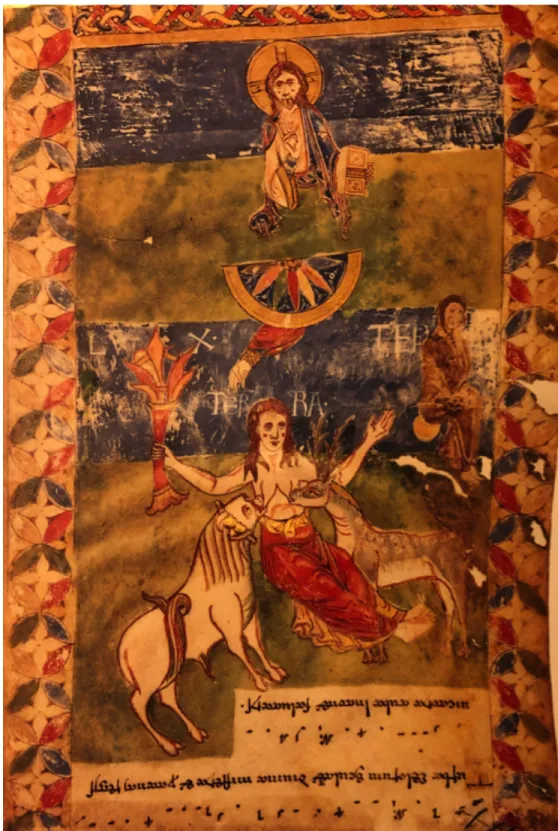
descriptive catalogue of all the images in the manuscripts that she discusses. She provides not only visual analysis, but also comprehensive details regarding the manuscripts themselves. For the study of the Exultet rolls in particular, this study is useful in its close attention to iconography employed by the scribes and illuminators of the Montecassino scriptorium. Given the detailed information in Orofino’s work, several antecedents to images repeated in Exultet rolls appear to be a part of the Montecassino tradition, including the figures of Tellus in an early manuscript of Rabanus Maurus’ De rerum naturis (Cod Cas 132). In addition to her books and articles, Orofino is also a contributor of analytical material for the 1994 Exultet catalogue.43
Regarding the history of Montecassino itself, both as an independent entity and in
relationship to the rest of southern Italy, Herbert Bloch’s Monte Cassino in the Middle Ages is an invaluable resource.44 Based on meticulous research of primary source documents as well as extensive secondary scholarship, Bloch’s work gives a detailed and highly nuanced portrait of the monastery as a part of the southern Italian, Roman Catholic, and Mediterranean worlds of the Middle Ages. Bloch also provides insights into the use of Byzantine artists and styles in the reconstruction of the monastery and the decoration of the buildings when the Abbey was reconstructed in the tenth century.
42 Giulia Orofino, I Codici Decorati Dell’archivio Di Montecassino (Roma: Istituto poligrafico e Zecca dello Stato, 1994).
43 Cavallo et al., Exultet. Giulia Orofino contributed essays for the Montecassino Exultets 1 and 2, the Capua Exultet, and Naples (Mirabella Eclano) Exultets 1 and 2.
Conclusion
As is evident from the preceding short survey of major scholarship, there have not yet been any large-scale studies that draw together the material, liturgical, musical, textual, and visual aspects of the Exultet rolls as a group of manuscripts. The catalogue, Exultet: Rotoli Liturgici Del Medioevo Meridionale, comes the closest, providing both codicological and art historical information as well as full photographic reproductions of all the rolls. Nonetheless, this catalogue comprises numerous essays by different scholars and so does not fully address the similarities and differences in text and iconography across the Exultet rolls as a unified
manuscript tradition. While excellent scholarship on individual rolls, small groups of rolls, and themes across the manuscript group exist, there seems to be room to add to the body of historical and current work.
dissertation will suggest that the bees in text and image offer a new lens for reading and understanding the Exultet rolls in their historical context.
The body of current scholarship leaves room for close consideration of the many ways in which the Exultet rolls can be read. Questions that remain and will be addressed in this
CHAPTER TWO: LITURGY AT THE CROSSROADS: THE EXULTET AS A MIRROR OF SOUTHERN ITALIAN CULTURE
In format, liturgical use, and content, the Exultet rolls are completely singular as a manuscript group and represent the innovative and autonomous regional traditions of Benevento that persisted long after the high point of Beneventan chant development and long after Rome sought to homogenize Catholic ritual practices in the region in 1081. Used only at the height of the Easter Vigil celebration, these rotuli contain text and illustrations encompassing biblical narrative, ritual practice, female allegorical figures, and imagery drawn from the natural world. The life story of the Exultet rolls begins with the development of a local ritual tradition in southern Italy and encompasses the manuscripts’ persistence in representing deeper theological and liturgical meaning than would be possible through text alone.
This chapter will consider the place of rolls and scrolls in Mediterranean Europe during the Middle Ages and explore the rise and fall of Beneventan chant and liturgy in southern Italy from the sixth century through the fourteenth. Through a thematic introduction to the text and images contained in the Exultet rolls, it will become clear that they have much more to tell us beyond the shape of the Easter liturgy and the content of the Easter story. The Exultet rolls, through their union of text and image, lead their readers to a deeper set of signs and symbols than those commonly associated with the Easter mysteries, namely a nature-driven and
Rotuli and Scrolls in the Medieval Mediterranean
While the Exultet rolls are unique and played an important role in the liturgical life of the medieval Mediterranean, they were not the only rolls in use at the time. Rotuli or scrolls came in all sizes and were used for a wide range of purposes, from charters and diplomas to necrologies, genealogies, chronicles, and theatrical or choral parts. Smaller rolls often served the function of amulets or personal prayers and charms for individual devotion.45 Most Christian books and liturgical materials were in the codex format from about the fourth century, so while liturgical rolls were by no means prolific or common, some were indeed used in the Catholic churches of Italy and Western Europe and were contemporary with the production of the Exultet rolls. 46 All of the Exultet rolls are characterized as rotuli, long membranes of vellum or parchment written and decorated vertically and rolled onto an umbilicus (wooden cylinder) for storage and
portability. The membranes were generally glued together or woven together with thong or narrow pieces of the same material as the sheet. Rotuli are distinguishable from scrolls mainly in their orientation, as scrolls run horizontally with text perpendicular to the umbilicus while rotuli generally have text that runs parallel to it.
It is tempting to look at the Exultet rolls of Southern Italy as derivative of rotuli from the Byzantine world, where most rolls were liturgical, with the oldest extant ecclesiastical rolls dating back to the sixth century and their more proper modern successors dating mainly from the eight century and later. While the rotuli may appear similar at first glance, Thomas Kelly notes that the use of liturgical rolls in the Byzantine church does not necessarily indicate that the
45 Thomas Forrest Kelly, The Role of the Scroll: An Illustrated Introduction to Scrolls in the Middle Ages (New York: W.W. Norton, 2019), 19.
Exultet roll tradition was influenced or inspired by the Byzantine.47 Instead, he asserts that the use of the liturgical roll did not become widespread in Byzantine practice until the eleventh century, well into the height of Exultet roll production in Southern Italy. While Byzantine rolls are laid out like Exultet rolls, then, in a vertical fashion and often with illumination, these qualities are insufficient for direct comparison and cannot be used to argue that the Exultet rolls emerge from a Byzantine tradition. In fact, there is no directly comparable type of roll between the Byzantine liturgical tradition and the Western Exultet roll, as there is no directly comparable ritual in Byzantine Easter worship. Gerstel explores the possible place of liturgical rolls in the Byzantine church by examining how they are represented in the painted decoration of church apses, and this research determines that there does not appear to be a direct link between their use in the Byzantine rite and in the Western European Church. 48
It is believed that the earliest surviving liturgical rolls of the medieval Mediterranean come from the seventh century and were used for particularly solemn rites or for specific prayers. Kelly cites literary references made to these rolls or even depictions of rolls in art to corroborate that they were often used in the liturgical life of the Church as prayers for Mass or for rites of exorcism. Unfortunately, these kinds of rolls no longer exist. There are, however, quite a number of rolls used for other liturgical functions to be found around Italy, most dating from no earlier than the tenth century.49
47 Kelly, The Exultet in Southern Italy, 20-21.
48 Sharon EJ Gerstel, "Liturgical scrolls in the Byzantine sanctuary,” Greek, Roman, and Byzantine Studies 35, no. 2 (1994): 195-204.
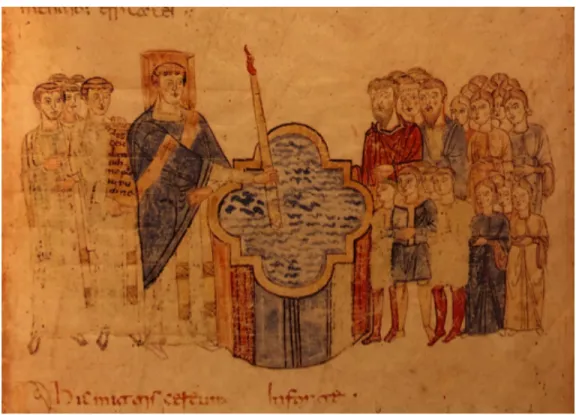
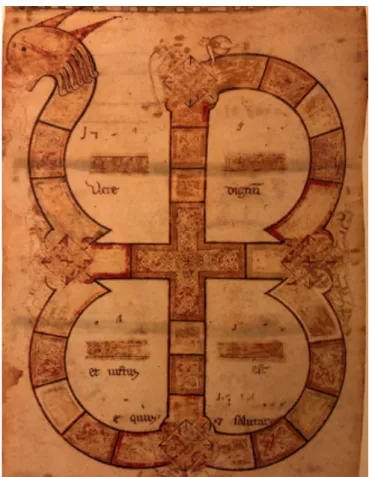
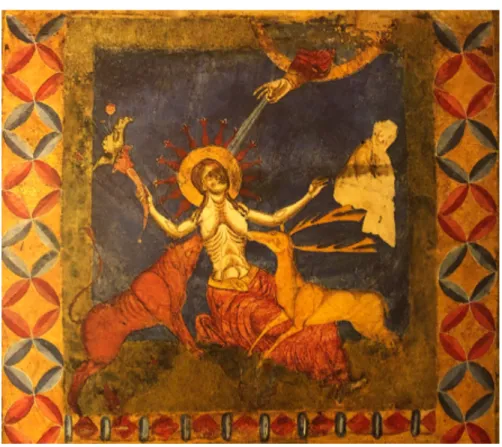
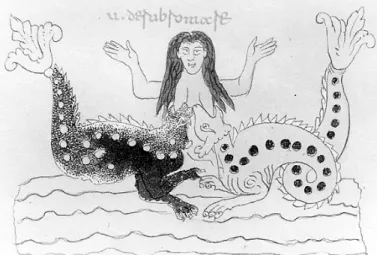
In the Ambrosian rite native to Milan, liturgical rolls were used with some regularity, though none that remain are directly comparable to the Exultet rolls in use or content.50 Among the rolls related to the Exultets are several pontifical and benedictional rolls that contain ritual prayers and detailed illustrations of both the rites and biblical narratives. Two such rolls that are closely tied to the Exultet roll group are part of the Biblioteca Casanatense collection in Rome. Casanatense 724 (B I 13) 1 and 724 (B I 13) 2 contain texts and illustrations associated with the Easter liturgy. (Figures1, 2) These manuscripts offer possible insight into the manner of the Exultet rolls’ use, which will be discussed at greater length below.
While the use of liturgical rolls for everyday liturgical celebrations was fairly common in the seventh and eighth centuries, by the ninth century, their function began to shift. The use of rolls for the Ordinary of the Mass declined, and rather than being put to practical use in the medieval West, rolls became more symbolic than functional in most liturgical contexts, but this was not the case for the Exultet rolls which are notable for their purpose being both functional and solemn.
Apart from liturgical contexts, rolls and scrolls depicted in medieval art often represent the content of a book or evoke authoritative or traditionally respected text, as in the case of Old Testament prophets represented holding scrolls. The association of the scroll with revered figures and the Old Law situates the figure holding it in a readable historical setting. The long arc of history represented in art that includes both Old Testament and New Testament figures is appropriately reflected by the continuous line of the roll. In this sense, an Old Testament scroll could be understood by a Christian reader or viewer as unfurling in both directions—to the
beginning of creation at one end and toward the promised fulfillment of prophecies at the other. The timeline points in both directions, reinforcing the idea that the God revealed in the sacred texts is without beginning or end.
Even secular rolls participate in this idea of potential perpetuity. Genealogical rolls, while making practical use of the vertical line available in this format, are also fundamentally hopeful records that detail the roots and branches of family lines that could conceivably go on
indefinitely. The tracing of family lines down multiple generations in a format that allows them to be visually unbroken is a powerful way of keeping records while at the same time asserting those lines’ longevity. The recitation and preservation of genealogies certainly predates the use of rolls for such purpose, but the resonance of the roll’s uninterrupted surface with the uninterrupted line of a family or nation is hard not to see.51 In a similar fashion, rolls containing legal codes or pronouncements might have been understood as more important and more permanent than the same content written on leaves or in small codices might have. With respect to legal documents, rolls could be used for practical expediency to contain short documents and carry them easily, but they could also lend a certain gravitas to the documents by visually aligning them with the works of poets, philosophers, kings, and prophets.
Throughout medieval Europe, rolls could be used to show genealogical or historical continuity, to enmesh the bearer of an amulet or magic roll into the unbroken stream of salvation history or the communion of saints, or to situate a legal pronouncement within a larger political or diplomatic tradition. All of these examples are instances in which the roll format signifies something greater than itself, insisting that the content of the roll be aligned with a longer and
more revered tradition than that to which any roll could lay claim on its own. The very nature of the roll, as a continuous object without predetermined page limits or the spatial constraints of a codex, demands that its reader acknowledge its particularity. The insinuation of solemnity or importance of the contents goes hand in hand with the selection of the roll as a format. As can been seen with the Exultet rolls, the roll is never an everyday item, but rather a special and elevated book reserved for a special function or occasion. The Exultet rolls emerged out of the complex and tumultuous history of Southern Italy to assume their special and central role in the Easter Vigil of the Beneventan rite.
Lombard Invasion and the Emergence of Beneventan Chant
Situating the Exultet rolls appropriately in time and space begins with the 6th century Lombard invasion in Italy, which presented a turning point that would inform the development of political and liturgical life in southern Italy for centuries to come. As a result of the Lombard presence in southern Italy, the city of Benevento became an important political and cultural center, and a place foundational to the liturgical tradition out of which the Exultet rose and flourished over several centuries.
The centuries following the collapse of the Roman Empire saw numerous occupying groups invade the Italian peninsula. Among these were the Lombards, a Northern European group who migrated south from Scandinavia and gained control of most of the Italian peninsula by the end of the sixth century.52 Encountering lands significantly depopulated as a result of the Gothic wars that took place from 535-554 between the Byzantine Empire and the Ostrogoths occupying Italy, the Lombards were in a position of strength as they began to pour into the
region from 568 and further destabilize local infrastructure. According to Pope Gregory the Great, the Lombard invasion contributed to the destruction of Italian towns and cities:
Wild hordes of Lombards unleashed from their own native land descended on us. The population of Italy, which had grown vast, like a rich harvest of grain, was cut down to wither away. Cities were sacked, fortifications overthrown, churches burned, monasteries and cloisters destroyed. Farms were abandoned, and the countryside, uncultivated,
became a wilderness. The land was no longer occupied by its owners, and wild beasts roamed the fields where so many people had once made their homes.53
While Pope Gregory’s account may have been accurate, the effects of the invasion were not uniform across Italy. Not all cities and towns suffered direct attacks, some were taken over with little or no bloodshed, and some localities still under Imperial rule felt the invasion’s effects more through governmental and social shifts than by violence.54 Though certainly not a benevolent invading force, they were a powerful one. As the Lombards settled in Italy, they established territorial areas ruled by chieftains often referred to as duces by the remaining Romans.55 During the early decades of Lombard presence, the much-weakened Western Roman empire managed to maintain control of small areas near Rome and Ravenna in addition to a few other outposts, but were no match for the strength of the invaders overall.56 Eventually, the Lombards and their principalities would become largely Christian, though in some regions parts of the pagan heritage of the invaders would persist.
53 Gregory the Great, Dialogues, Book III.38.
54 Paul the Deacon, Historia Langobardorum, Book II.10. Whether Paul the Deacon’s
characterization of the Lombard invasions as more by invitation than by force can be believed is a separate question, but the invasion was certainly not a single organized conquest accomplished entirely by violence.
55 Adrian Keith Goldsworthy, How Rome Fell: Death of a Superpower (New Haven: Yale University Press, 2009), 398.