Orally Administered Penta-Ethyl Ester Prodrug of DTPA for the Decorporation of Americium-241
Katsuhiko Sueda
A dissertation submitted to the faculty at the University of North Carolina at Chapel Hill in partial fulfillment of the requirements for the degree of Doctor of Philosophy in the UNC Eshelman
School of Pharmacy
Chapel Hill 2014
Approved by:
Ramprakash Govindarajan Michael Jay
iii ABSTRACT
Katsuhiko Sueda: Orally Administered Penta-Ethyl Ester Prodrug of DTPA for the Decorporation of Americium-241
(Under the direction of Michael Jay)
Diethylenetriaminepentaacetic acid (DTPA) is an intravenously administered chelating agent that is used to facilitate the elimination of 241Am from contaminated individuals. Despite its long history of use in chelation therapy, its optimal dose has not been clearly established. To evaluate the potential of DTPA to bind 241Am under biological conditions, in vitro binding studies were conducted in rat, beagle, and human plasma. Dose-response curves for DTPA were established, and DTPA was determined to be most efficient in human plasma and least efficient in rat plasma. These results suggest that species differences must be considered when
translating the efficacy of DTPA from animals to humans.
The oral delivery of DTPA is challenged by its permeability-limited bioavailability, limiting its utility in mass casualty emergencies. To overcome this limitation, a prodrug strategy using the penta-ethyl ester of DTPA was explored. Initial assessments of the prodrug identified favorable physicochemical properties for oral delivery. Consistent with the measured pKa values, the prodrug exhibited pH-dependent solubility and lipophilicity of a weak base that is suitable for absorption. Caco-2 permeability assay confirmed the improved epithelial transport of the prodrug over DTPA. From in vitro assessments, the prodrug appeared to be sufficiently stable against premature hydrolysis during gastrointestinal transit.
iv
v
TABLE OF CONTENTS
LIST OF TABLES ... viii
LIST OF FIGURES ... ix
CHAPTER 1: INTRODUCTION ... 1
Tables ... 9
CHAPTER 2: SPECIES-DEPENDENT EFFECTIVE CONCENTRATION OF DTPA FOR CHELATION OF 241AM ...10
Introduction ...10
Materials and Methods ...12
Results ...14
Discussion ...16
Conclusion ...19
Tables ...20
Figures ...21
CHAPTER 3: PHYSICOCHEMICAL CHARACTERIZATION OF A PRODRUG OF A RADIONUCLIDE DECORPORATION AGENT FOR ORAL DELIVERY ...23
Introduction ...23
Experimental Methods ...26
Results ...30
vi
Conclusion ...38
Tables ...40
Figures ...43
CHAPTER 4: ORALLY ADMINISTERED DTPA PENTA-ETHYL ESTER FOR THE DECORPORATION OF 241AM ...47
Introduction ...47
Materials and Methods ...50
Results ...54
Discussion ...58
Conclusion ...62
Tables ...64
Figures ...66
CHAPTER 5: SUMMARY ...72
APPENDIX 1: CACO-2 PERMEABILITY OF DTPA PENTA-ETHYL ESTER ...75
Introduction ...75
Methods ...75
Results ...78
Discussion ...79
Tables ...81
Figures ...82
APPENDIX 2: INTRAVENOUS ADMINISTRATION OF DTPA PENTA-ETHYL ESTER ...84
vii
Methods ...84
Results ...85
Discussion ...86
Tables ...88
Figures ...89
viii
LIST OF TABLES
Table 1 Stability constants of DTPA ... 9
Table 2 Stability constants of 241Am ... 9
Table 3 Lipophilicity of DTPA esters ... 9
Table 4 Logistic equation parameters and EC90 of DTPA for 241Am binding ...20
Table 5 Solubility of DTPA penta-ethyl ester at room temperature ...40
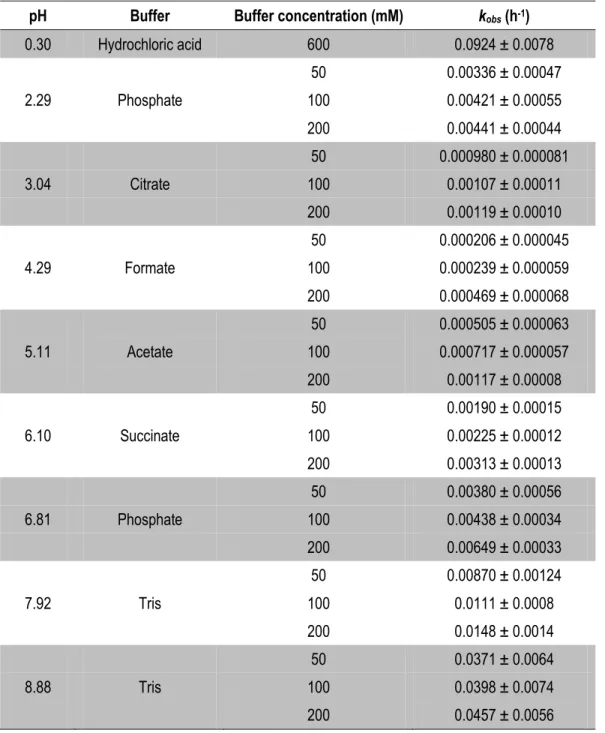
Table 6 Observed rate constants for the hydrolysis of DTPA penta-ethyl ester ...41
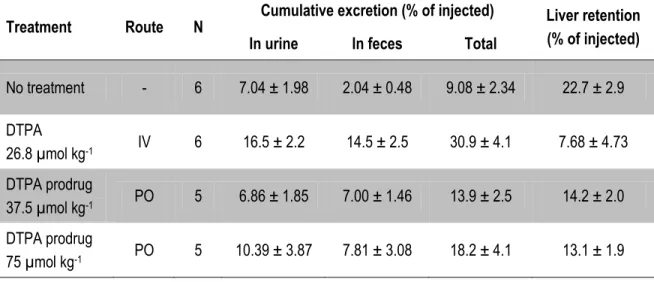
Table 7 Excretion and liver retention of 241Am after a single dose treatment...42
Table 8 Tissue distribution of 14C from the PO administration of [14C]DTPA prodrug ...64
Table 9 Tissue distribution of 241Am after treatment with DTPA penta-ethyl ester ...65
Table 10 Transport flux and permeability in Caco-2 cells ...81
ix
LIST OF FIGURES
Figure 1 The competitive binding of 241Am by DTPA and plasma proteins ...21
Figure 2 The effective concentration of DTPA after an IV bolus injection ...22
Figure 3 Synthesis of DTPA penta-ethyl ester ...43
Figure 4 Rheological profile of DTPA penta-ethyl ester at increasing shear rate ...43
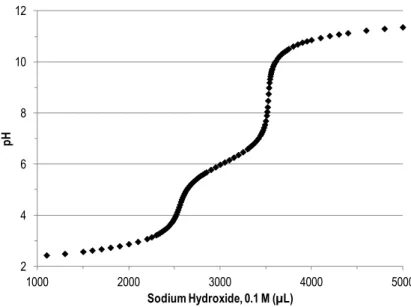
Figure 5 Titration of DTPA penta-ethyl ester with sodium hydroxide ...44
Figure 6 pH-dependent aqueous solubility of DTPA penta-ethyl ester ...44
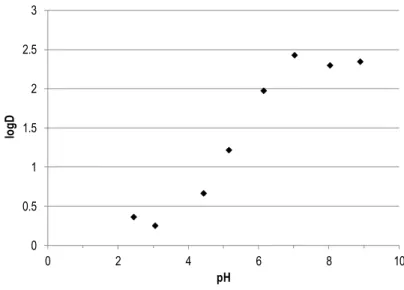
Figure 7 logD of DTPA penta-ethyl ester ...45
Figure 8 pH-rate profile of DTPA penta-ethyl ester hydrolysis at 37°C...45
Figure 9 General acid- and base-catalyzed hydrolysis of DTPA penta-ethyl ester ...46
Figure 10 Total daily excretion of 241Am after a single dose treatment ...46
Figure 11 Plasma concentration of 14C from the PO administration of [14C]DTPA prodrug ...66
Figure 12 Urinary excretion of 14C from the PO administration of [14C]DTPA prodrug ...67
Figure 13 Systemic exposure and urinary excretion of 14C within sampling intervals from the PO administration of [14C]DTPA prodrug ...68
Figure 14 Urine composition from the PO administration of DTPA penta-ethyl ester...69
x
Figure 16 Cumulative urinary excretion of 241Am by treatment groups ...71 Figure 17 Effect of DTPA penta-ethyl ester concentration on transport
flux in Caco-2 cells ...82 Figure 18 Composition of DTPA esters in the receiver compartment ...83 Figure 19 Plasma concentration of 14C from the IV administration of
[14C]DTPA prodrug ...89 Figure 20 Urinary excretion of 14C from the IV administration of
[14C]DTPA prodrug ...90 Figure 21 Fecal excretion of 14C from the IV administration of [14C]DTPA
1
CHAPTER 1: INTRODUCTION
The growing threat of nuclear terrorism in the United States has become a priority concern for national security in recent years; yet, few medical treatments against these threats are available. Currently, only six medications to treat radiation exposure are available in the Strategic National Stockpile (SNS), a national repository that provides access to medicines in the event of a medical crisis. Moreover, these medications are not suited to treat the broad range of exposures and injuries that may result from the widespread release of radioactive materials or attacks with radiological weapons. To increase the availability of medical
countermeasures against such threats, a research program has been established by National Institute of Allergy and Infectious Disease to accelerate and promote the development of new products (1;2). With the support of this program, this project is intended to develop an improved therapeutic agent that can facilitate the removal of internalized radioactive contaminants from the body.
2
Diethylenetriaminepentaacetic acid, or DTPA, is the most widely used chelating agent for metal detoxification. It is a polyaminocarboxylate ligand that possesses five carboxylic acids and three tertiary amines for a total of eight potential coordination sites, which gives it the ability to bind a broad range of metals with high affinity. The binding constants for some biologically-relevant metal ions are listed in Table 1 (5-8). In addition to its use as a therapeutic, DTPA is used in medical applications for diagnostic purposes as a carrier for metals that serve as contrast agents for magnetic resonance imaging (9). Beyond its medical use, DTPA is used to isolate metal ions for various other industrial applications, including uses in food, cosmetics, agriculture, textile, and paper/pulp manufacturing (10;11).
For chelation therapy, DTPA is FDA-approved as Ca-DTPA and Zn-DTPA to treat contaminations involving plutonium, americium, and curium. Ca-DTPA and Zn-DTPA are administered intravenously at a 1 g daily dose of the tri-sodium salts (12;13). Upon injection, DTPA distributes readily in blood, where the calcium and zinc ions are exchanged for
transuranic elements with higher binding affinity. DTPA itself is excreted rapidly in the urine by glomerular filtration (14-16), and the renal excretion of metals can be enhanced by binding them with DTPA. The blood serves as the primary site of action for capturing the radionuclides, and DTPA undergoes minimal protein binding and metabolic change in the body (14-16). The high affinity of DTPA for metal binding also contributes to its toxicity, mostly associated with the depletion of essential metals such as zinc, manganese, and magnesium (17).
3
accumulate in the body for long periods (18-20). Over time, cells at the accumulation site may be exposed to significant doses of radiation, causing damage to the genetic contents and increasing the likelihood of producing cancer (18). The decay process also emits low energy γ-rays of 0.059 MeV (19), which is utilized in this work to assay for 241Am using a gamma
scintillation detector.
Americium is a synthetic element, and 241Am is produced by neutron irradiation of 239Pu to form 241Pu, which decays to 241Am (19). In its purified form, it is used at low levels in ionization smoke detectors and has applications for thickness and radiographic measurements (19). It is found most abundantly in spent nuclear fuel as a byproduct of uranium and plutonium
processing. Widespread exposure to this radioisotope can occur as a result of release from nuclear reactor facilities or detonation of nuclear devices. Terrorists can potentially gain access to this radionuclide by raiding nuclear waste facilities, and in combination with conventional explosives, spread the radionuclide in the form of radiological dispersal devices, or ‘dirty bombs.’ Whether the release is deliberate or accidental, 241Am can spread in the form of particles or dust and enter the body by breathing, eating, or drinking contaminated materials.
The most probable routes of contamination with 241Am are ingestion, inhalation, or uptake through wounds. Once absorbed into the blood, greater than 90% of the 241Am resides in the plasma fraction, where it binds to plasma proteins, such as transferrin, albumin, α- and β-globulins, and other endogenous small molecular weight ligands (6;21-23). Some key
endogenous ligands and their corresponding stability constants for 241Am are listed in Table 2 (6;7;20). Soon thereafter, 241Am is translocated to the skeleton and liver from where it is excreted slowly with elimination half lives of 50 and 2.5 years, respectively (18;20). Due to the tendency for 241Am to accumulate in these tissues, these organs are particularly at risk of radiological toxicity.
4
for DTPA, though alternative sites for decorporation likely exist (24). DTPA binds to 241Am with high affinity, possessing a stability constant of 1026.2 M-1. In blood, the high affinity for 241Am enables DTPA to compete with endogenous ligands and direct the elimination of the
contaminant. Empirical evaluations have been used to propose that a DTPA:actinide molar ratio of 106:1 may be required for effective decorporation (25). However, the effectiveness of DTPA diminishes with time after contamination as 241Am deposits into tissues (26). The hydrophilic nature of DTPA limits its ability to gain access to the tissue compartments and facilitate the removal of radionuclides from these deposition sites. For treatments such as DTPA that have limited ability to facilitate decorporation from intracellular compartments, immediate treatment is needed to intercept the radionuclide before tissue deposition.
The efficacy of DTPA has been studied extensively in animal models, most commonly in rats and beagles (16;27). A standard efficacious dose for intravenous administration has been established as 30 µmol kg-1 (16). A single, IV bolus injection of DTPA at the standard dose in rats administered 1 h after IV contamination with 241Am citrate resulted in the cumulative 14 day urinary decorporation of approximately 43% of the injected 241Am, compared to 11% in the control group (24). Meanwhile, delivery of DTPA by inhalation also has been shown to provide significant therapeutic benefits. However, the rationale for the standard dose, regardless of the delivery route, is not clearly evident based on a review of published reports, and the selection appears to be mostly driven by empirical assessments (25).
5
on estimates of the absorbed 241Am dose, the chelation therapy was thought to have prevented 99% of the internalized 241Am from depositing in the organs (28;29). The therapy during the first month included 1 g doses administered every 8 h and thereafter, once daily injections continued for years (29). Remarkably, no toxicity was observed (29). Nonetheless, as this was not a controlled clinical study, opportunities to improve the therapy may exist.
In addition to understanding the in vivo behavior of DTPA, various factors associated with the contamination must also be considered when designing an appropriate therapeutic regimen. The route of contamination is an important consideration as it can affect the rate of entry into the systemic circulation and lead to differences in the availability of the contaminant in the blood for chelation by DTPA. Additionally, factors such as solubility, charge, particle size, and chemical form of the contaminant can also affect the absorption rate from the point of entry (18;30;31). For example, moderately soluble 241Am nitrate can be absorbed relatively quickly, while poorly soluble 241Am dioxide may be retained for long periods in the lungs or wounds (17). Since the blood is the primary site for chelation, the attributes of the radionuclide and its
biokinetics in the blood must be considered in order to maximize the therapeutic benefits. While the efficacy of DTPA has been demonstrated over the years, as a product of the SNS, its method of administration significantly limits its utility in medical emergencies (2). Such treatments require a trained medical professional for administration making it difficult to provide prompt or repetitive treatments in mass casualty situations. A product that can be administered orally and distributed in bulk supply for self-administration would alleviate these issues.
6
To overcome this limitation, a prodrug strategy is proposed. Prodrugs can be created by incorporating hydrophobic moieties to the parent compound, yielding a more lipophilic molecule (33). The increased lipophilicity could allow for improved permeation through the intestinal epithelium and increased uptake into the systemic circulation. The use of a prodrug strategy to overcome permeability-limited absorption is an established practice, and prodrugs represent approximately 5-7% of the pharmaceutical drugs on the market today (34). Barring significant efflux or first-pass clearance effects, a prodrug may be delivered more efficiently than with the permeability-limited parent drug. Once absorbed, prodrugs generally rely on metabolism to transform into the active parent form and ultimately elicit a therapeutic effect.
Alternative approaches to increase the bioavailability of DTPA, such as the use of nanoparticles or permeation enhancers, have been proposed by other groups (35;36). Size reduction, particularly to the sub-micron range, may enable uptake by transcytosis mechanisms for transcellular transport. Permeation enhancers may disrupt membranes or efflux effects to increase transcellular transport or open tight junctions of the epithelium to increase paracellular transport. However, toxicity becomes a concern with these approaches as they can also
increase uptake of undesired molecules. In the end, these strategies fail to address the poor intrinsic property of DTPA that limits its oral absorption and thus, only marginal increases in bioavailability were expected.
7
strategy to enhance the oral bioavailability of DTPA has not been reported. Furthermore, ester prodrugs beyond the complexity of double esters have not been commercialized (38).
A prodrug must undergo biotransformation to convert to the therapeutically active form. In the case of a carboxylic acid ester prodrug, the activation is a hydrolysis reaction that produces an alcohol and a carboxylate and relies on chemical and/or enzymatic catalysis. Esterases are a family of enzymes that promote the in vivo hydrolysis of ester-containing molecules, including carboxylic acid ester prodrugs (39). They are found extensively throughout the body, including the compartments along the oral absorption pathway. The highest enzyme activity is generally found in the liver, the primary site of xenobiotic metabolism (39). Among the esterases, carboxylesterases are most widely recognized for catalyzing the hydrolysis of
carboxylic acid esters (39-41). They are particularly efficient at catalyzing the hydrolysis of carboxylic esters but can also contribute to the metabolism of many structurally diverse
molecules (39-41). In the case of DTPA penta-ethyl ester, carboxylesterases may be the most important catalyst in its biotransformation to DTPA.
The penta-ester form of DTPA was chosen for this work primarily to maximize the
lipophilicty. In addition to the five carboxylic acid groups, DTPA possesses three tertiary amines, which are also ionizable. Lipophilicity estimation using ClogP, as shown in Table 3 (42),
revealed significant increases in ClogP with each ester addition. As a general rule of thumb, a molecule with a logP value of 2-3 is considered to possess a good balance between solubility and lipophilicity for oral delivery (43). Based on this assessment, the lower degrees of
8
The lipophilicity assessments with ClogP were also confirmed based on previously reported in vivo studies with the mono-, di-, and penta-ethyl esters of DTPA. These studies involved the intraperitoneal injection of these esters for the intracellular delivery of DTPA to hepatocytes for plutonium decorporation (44;45). These investigations found that the DTPA penta-ethyl ester enhanced plutonium decorporation from the liver, but the mono- and di-ester forms had no enhanced effects compared to DTPA treatment. It was hypothesized that the partially esterified forms of DTPA lacked sufficient lipophilicity to penetrate the membranes of the hepatocytes to facilitate intracellular decorporation. Based on empirical and in vivo
9 Tables
Table 1 Stability constants of DTPA Metal ion log K (M-1)
Mg2+ 9.3
Ca2+ 10.7
Mn2+ 15.5
Zn2+ 18.6
Co2+ 19.3
Ni2+ 20.1
Cu2+ 21.5
Cr3+ 22.1
Cm3+ 23.0
Am3+ 26.2
Fe3+ 27.8
Pu4+ 29.5
Table 2 Stability constants of 241Am Ligand log K (M-1)
Acetate 2.0
Lactate 2.4
Glycine 4.1
Cysteine 4.2
Oxalate 4.8
Glutamate 5.6
Carbonate 5.8
Aspartate 6.1
Citrate 8.6
Transferrin 10.4
Table 3 Lipophilicity of DTPA esters
Molecule ClogP
DTPA -2.9
DTPA mono-ethyl ester -2.4
DTPA di-ethyl ester -1.9
DTPA tri-ethyl ester 0.3
DTPA tetra-ethyl ester 2.5
10
CHAPTER 2: SPECIES-DEPENDENT EFFECTIVE CONCENTRATION OF DTPA FOR CHELATION OF 241AM1
Introduction
The growing threat of nuclear terrorism and the heightened awareness of the potential for nuclear accidents have renewed the interest in the development of medical treatments to prevent and treat radiation exposure. Among the drugs of interest is
diethylenetriaminepentaacetic acid (DTPA), a chelating agent used as a first-line treatment for individuals that have been contaminated with transuranic radionuclides (46). With a long history as an effective decorporation agent, DTPA is made available in the United States Strategic National Stockpile for use in medical emergencies as the calcium and zinc chelates of DTPA (Ca- and Zn-DTPA). However, the utility of Ca- and Zn- DTPA is constrained by the need for intravenous (IV) administration, which requires trained medical personnel for treatment and limits their accessibility in mass-casualty situations. To overcome this limitation, alternative formulations and delivery strategies with DTPA are being sought (35;36;47;48), with the potential to expand the use of DTPA under the United States Food and Drug Administration (FDA) Animal Rule.
The FDA Animal Rule permits the approval of drugs using animal efficacy data when human efficacy trials are neither ethical nor feasible. This is an important policy for the development of decorporation agents such as Ca- and Zn-DTPA, since human trials are
restricted to subjects of accidental contamination for ethical reasons. Despite the long history of
1
11
DTPA for use in radionuclide decorporation, its proven efficacy is still mostly limited to studies conducted in animal models. Of the animal models, rat and dog (beagle) represent the most commonly used species, and an IV bolus dose of 30 µmol kg-1 has been established as the standard efficacious dose (16;27). The same weight-normalized dose is also used in humans, yet an understanding of the optimal dose and blood levels in humans for therapeutic effect has not been clearly established (30). An empirical analysis of existing data has been used to suggest that a DTPA:actinide molar ratio of 106:1 in plasma may be required for effective decorporation (25). However, as existing human efficacy data are from uncontrolled studies, uncertainties in the physicochemical form of the radionuclide, route of exposure, and extent of contamination make it difficult to fully characterize the effect of the chelation therapy (49). While the use of the animal models has played a pivotal role in demonstrating the potential of DTPA for chelation therapy, further work is needed to evaluate the relationship between the animal models and humans for optimizing efficacy.
In an effort to better understand the suitability of animal models for human efficacy predictions, in vitro experiments were conducted to characterize the binding of 241Am by DTPA in the plasma of rat, beagle, and human. DTPA forms stable chelates with 241Am, possessing a high stability constant of 1026.2 M-1 (6). Plasma represents the primary site of action for DTPA and contains endogenous ligands that can compete with DTPA for the formation of 241Am complexes. In blood, greater than 90% of the 241Am resides in the plasma component (whole blood minus blood cells), with approximately 30% bound to the iron-transport protein,
12
support the development of alternative DTPA products within the framework of the FDA Animal Rule.
Materials and Methods
The competition between plasma proteins and DTPA for the binding of 241Am in blood was characterized by in vitro experimentation. Various concentrations of DTPA were reacted with 241Am in rat, beagle, and human plasma before separation and assay. All samples were prepared using fixed volumes of the constituents by combining 385 µL of plasma, 8 µL of DTPA solution, and 7 µL of 241Am solution. The concentrations of DTPA and 241Am were altered by adjusting their stock concentrations. Plasma with sodium heparin (Lampire Biological
Laboratories, Pipersville, PA) were filtered through a 0.45µm pore size polypropylene
membrane with a borosilicate glass fiber pre-filter before use. The DTPA stock solutions were prepared by dissolving crystalline DTPA (Thermo Fisher Scientific, Morris Plains, NJ) in 10 mM sodium phosphate buffer at pH 7.4, and diluting with de-ionized water as needed. Following its addition to plasma, the final concentrations of DTPA were 1.67–53.4 µM in rat plasma, 1.67– 26.7 µM in beagle plasma, and 0.84–26.7 µM in human plasma. Commercially available Ca- and Zn-DTPA (Heyl Chemisch-Pharmazeutische Fabrik GmbH & Co. KG, Berlin, Germany) were used and diluted in a similar manner with de-ionized water before use. The 241Am stock solutions were prepared by diluting 241AmCl3 in 1 M hydrochloric acid (Eckert & Ziegler Isotope Products, Valencia, CA) with 1% citrate acid solution. The addition of 241Am citrate to the mixture of DTPA and plasma in the final addition step yielded a concentration of 3 nM in the reaction mixture. In cases where lower 241Am levels were used, the 241Am citrate stock solution was diluted with de-ionized water before addition to the reaction mixture.
13
devices fitted with an Ultracel 3K membrane (Millipore, Billerica, MA) and centrifuged at 14,000 ×g for 0.5 h to extract protein-bound 241Am. A bicinchoninic (BCA) assay was used to confirm that ultrafiltration successfully removed the proteins in the filtrates during preliminary work. Filtrates from the filter devices were transferred to Pierce Strong Cation Exchange Spin Columns (Thermo Fisher Scientific, Rockford, IL) that had been pre-conditioned with 0.8 M ammonium hydroxide and water to separate positively charged 241Am species from negatively charged DTPA-bound 241Am. After centrifuging the spin columns at 2,000 ×g for 5 min, the initial eluents were collected as the DTPA-bound 241Am fraction. The positively charged 241Am species retained on the column were subsequently eluted with two 400 µL aliquots of 1 M nitric acid by centrifuging at 2,000 ×g for 5 min each. This separation method was validated by replacing plasma with 25 mM 4-(2-hydroxyethyl)piperazine-1-ethanesulfonic acid (HEPES) or carbonate buffers at pH 7.4 and performing the chromatography in the presence and absence of DTPA. The 241Am content in each sample fraction was measured by gamma scintillation counting (Perkin Elmer Model 2470 Gamma Counter, Waltham, MA). Background-corrected radioactivity was quantified over 30 min using a 40-80 keV energy window to measure the 59.7 keV photon emission associated with 241Am decay.
Dose-response curves were constructed by calculating the fraction of total 241Am that was bound to either DTPA or plasma proteins. The sigmoidal regression profiles were
generated by Gauss-Newton non-linear least squares regression analysis using Statistica 8.0 (StatSoft, Tulsa, OK). The regression applied the logistic equation (50),
where a describes the slope as the curve approaches the asymptote, b is the inflection point, c
is the asymptote, and x is the concentration of DTPA that corresponds to y, the fraction of bound 241Am. The EC
14
that was approaching the asymptote and did not appear to be distinguishable from the
asymptote based on the variability of the data. The same regression analysis was applied to the data for 241Am-protein binding; however, a transformation was applied to yprotein such that,
where y’ was used for the regression analysis. Subsequent reversal of the transformation produced the final binding curves.
Results
The suitability of the separation method was confirmed during preliminary work as follows. The ultrafiltration step was used to isolate the protein-bound 241Am species and cation-exchange chromatography was used to separate the negatively charged 241Am-DTPA
complexes from positively charged 241Am species. Specifically, a BCA assay showed that only 0.6% of the proteins were present in the filtrate after ultrafiltration of the plasma mixture, confirming the successful removal of proteins from the plasma. To evaluate the separation of the 241Am species by cation-exchange chromatography, similar binding experiments were performed in the presence and absence of DTPA while replacing plasma with HEPES and bicarbonate buffers. In the absence of DTPA, only 2% of the input 241Am was detected in the initial eluent from the chromatographic separation. In contrast, when DTPA was present, approximately 85% of the 241Am was measured in the eluent. 241Am in solution exists in the +3 oxidation state (19), and the effect of DTPA on the elution of 241Am is consistent with the expectation that 241Am forms a negatively charged complex with DTPA at physiological pH. These preliminary results confirmed that the separation method could adequately separate 241
Am bound by proteins from those chelated with DTPA.
15
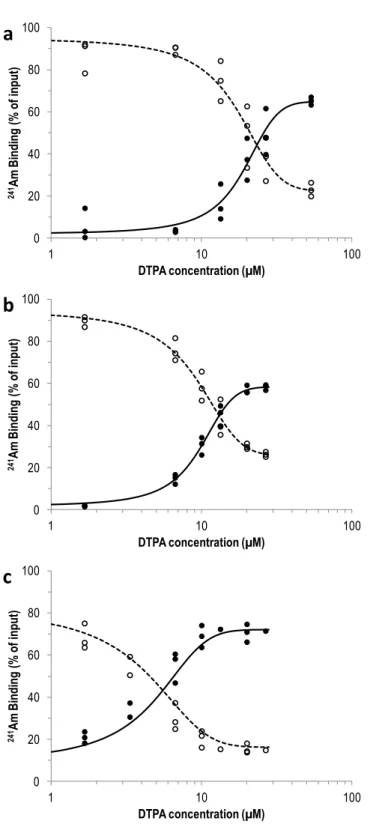
sigmoidal 241Am binding profiles, indicative of a competitive binding relationship. The logistic equation parameters for the DTPA regression models are summarized in Table 4. The models achieved goodness of fit (R2) of greater than 0.92 in all cases. While some residual loss of sample occurred during the separation and transfer steps, greater than 90% of the total input 241Am was recovered. Of the total 241Am recovered, less than 10% corresponded to the low molecular weight, positively charged 241Am species. These were considered to be associated with the small organic and inorganic ligands of low 241Am affinity that are present in blood, such as chlorides, carbonates, citrates, aspartates, and glutamates (6). The least-squares linear regression fits on these data exhibited slopes approaching zero, indicating that they essentially remained unchanged with increasing DTPA concentration.
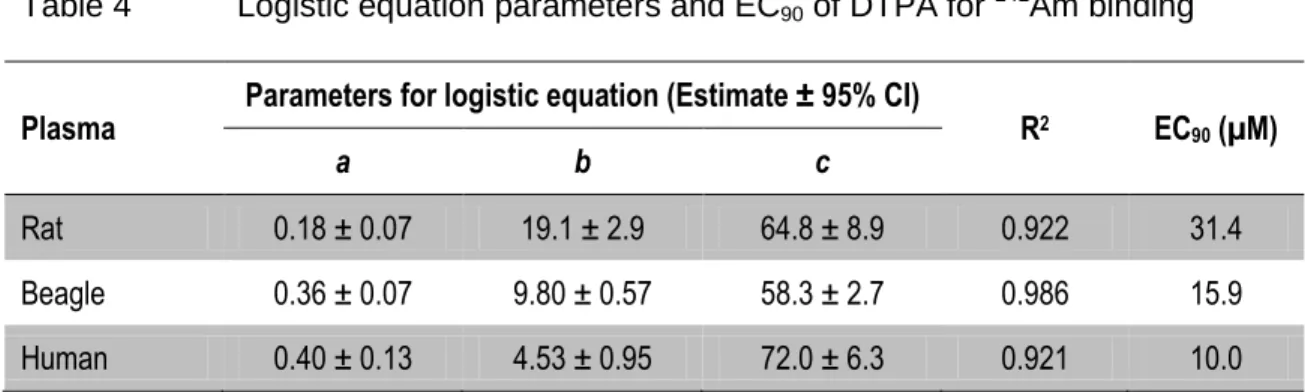
A comparison of the dose-response curves in rat, beagle, and human plasma reveals species differences in the efficiency of DTPA to bind 241Am. A simple comparison of the dose response curves in Figure 1 reveals that higher concentrations of DTPA are required in rat and beagle plasma than in human plasma to achieve equivalent levels of 241Am chelation. To more precisely define the species differences, the EC90 of DTPA in each plasma system were
16
Additional studies were conducted in human plasma to evaluate the effects of variables such as 241Am concentration, incubation time, and DTPA complex. When lower concentrations of 241Am (0.8 nM) were used, the results did not appear to be significantly different from those reported with 3 nM 241Am. This was not unexpected as the concentrations of both DTPA and plasma proteins were in great excess relative to 241Am under these conditions. In another study, the reaction mixtures were processed after 1.5 and 18 h incubations. Despite the longer
reaction times, the results did not exhibit differences from data after 0.5 h incubation, suggesting that the 241Am-DTPA complexation approaches equilibrium rapidly.
The input DTPA was also replaced with commercially available Ca- and Zn-DTPA preparations in the human plasma system. Both calcium and zinc are endogenous metal ions that are present in plasma at concentrations of approximately 10-3 and 10-5 M, respectively, and exhibit affinity for DTPA with stability constants of 1010.9 and 1018.6 M-1, respectively (52).
However, both DTPA complexes exhibit very rapid metal exchange rates in favor of 241Am (52). Thus, as expected, the use of these forms of DTPA did not significantly alter the 241Am binding behavior based on the comparison of dose-response curves. The lack of differences is likely the result of the significantly higher affinity of DTPA for 241Am, 1026.2 M-1, over calcium and zinc ions.
Discussion
17
rat and beagle animal models to predict the efficacy of DTPA for 241Am decorporation in humans.
The species differences in the effective concentration of DTPA are presumably due to differences in their plasma composition; however, the mechanisms underlying these species differences remain unknown. Plasma is a complex matrix containing numerous endogenous ligands and metals that can interfere with 241Am-DTPA complexation. Transferrin and albumin are considered to be the two major endogenous ligands that can compete with DTPA for 241Am (22;23), while endogenous metals, such as iron, may compete with 241Am for the binding site of DTPA. Since these components are known to differ in plasma concentration depending on species (20), additional studies were conducted to explore the effects of these components on the dose-response curves. In one study, plasma was replaced with aqueous buffers containing isolated transferrin and albumin from rat and human serum at physiologically-relevant
concentrations to compare the species-specific plasma protein affinity for 241Am in the presence of DTPA. As an alternative mechanism, the effect of iron as a competing metal for 241Am was investigated by adding ferric citrate or ferric chloride to human plasma at various concentrations. However, these studies did not reveal significant shifts in the distribution of 241Am that account for the large differences that were observed in the different plasma systems. Taking into consideration the complexity of plasma composition and the collective effects that the endogenous ligands and metals can have on interaction between DTPA and 241Am, these univariate approaches may be inadequate and developing a mechanistic understanding is proving to be challenging.
18
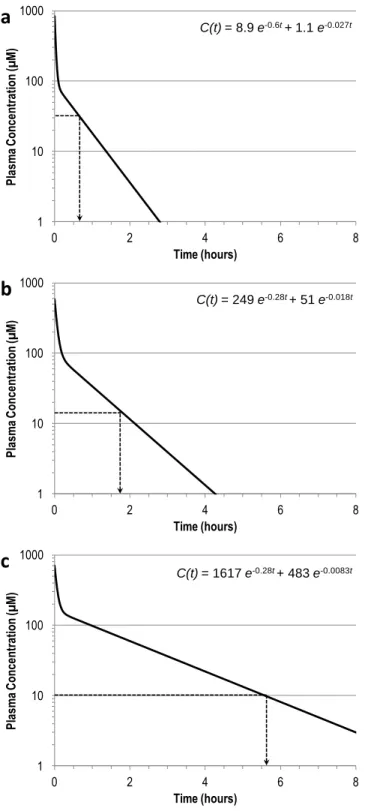
the EC90 of DTPA was examined in the context of the previously established pharmacokinetic profiles in the different animal models. Following an IV bolus injection of DTPA in humans, the plasma concentration profile is expressed as the sum of two exponential components with rate constants of 0.28 and 0.0083 min-1 (53). At the current standard dose of 30 µmol kg-1 in a 70 kg human subject with a plasma volume of 3 L, the plasma concentration of DTPA is sustained above EC90 for approximately 5.6 h after an IV bolus injection. This interpretation is graphically depicted in Figure 2a (53). Similar assessments for the animal models estimated the effective duration of DTPA to be 40 min in rats and 1.7 h in beagles, also shown in Figure 2b-c (53). Beyond these times, the DTPA concentration is too low to overcome the competition with endogenous ligands for 241Am binding, and the effectiveness of DTPA is significantly reduced. This suggests that the optimal treatment regimen is unique to each species and that increasing the dosing frequency from the current once-daily IV bolus injection may be beneficial to sustain optimal DTPA blood levels. Consistent with this proposal, the use of multiple injections and infusion therapies with DTPA has been demonstrated to improve the therapeutic benefit in animal models (54;55).
A limitation of this type of assessment on the plasma profile of DTPA, however, is that the chelation is assumed to occur only in the plasma compartment. While DTPA is primarily distributed in the extracellular fluids, studies have indicated that DTPA may also gain entry into cells of soft tissues, contributing to delayed or long term decorporation effects (24). Thus, an assessment of the plasma compartment alone does not account for the complete mechanism of decorporation. A more accurate model for decorporation should also consider the migration of DTPA between the extracellular and intracellular compartments.
19
treatment commences as soon as possible after contamination (26). However, both 241Am and its DTPA chelate follow complex biokinetics, making it difficult to establish predictive models for decorporation (30). The chemical speciation of internalized 241Am and its route of contamination are also key variables that affect its rate of absorption into the bloodstream (31). The route of contamination can influence the rate at which the radionuclide migrates into the blood; for example, contamination via wound or ingestion can result in slower entry into the systemic circulation than by inhalation or IV injection. Furthermore, in the case of wound contamination, the chemical form dictates the solubility of the 241Am species, thereby affecting the rate of uptake into the blood and its retention at the wound site. A slow or prolonged release of 241Am from the wound site may necessitate the use of more frequent or extended treatments of DTPA to capture the radionuclide during its translocation. While the effective concentration of DTPA in blood is only one aspect of the overall decorporation process, the in vitro assessment presented in this work provides a basis for exploring further improvements in the current DTPA dosing regimen.
Conclusion
20 Tables
Table 4 Logistic equation parameters and EC90 of DTPA for 241Am binding
Plasma Parameters for logistic equation (Estimate ± 95% CI) R2 EC90 (µM)
a b c
Rat 0.18 ± 0.07 19.1 ± 2.9 64.8 ± 8.9 0.922 31.4
Beagle 0.36 ± 0.07 9.80 ± 0.57 58.3 ± 2.7 0.986 15.9
Human 0.40 ± 0.13 4.53 ± 0.95 72.0 ± 6.3 0.921 10.0
21 Figures
Figure 1 The competitive binding of 241Am by DTPA and plasma proteins
The competitive binding of 3 nM 241Am by DTPA (●, solid line) and plasma proteins (○, dotted line) after 0.5 h incubation at 37 °C in (a) rat, (b) beagle, and (c) human plasma
0 20 40 60 80 100
1 10 100
241 Am Bi ndi ng (% of input )
DTPA concentration (µM)
a
0 20 40 60 80 1001 10 100
241 Am Bi ndi ng (% of input )
DTPA concentration (µM)
b
0 20 40 60 80 1001 10 100
241 Am Bi ndi ng (% of input )
22
Figure 2 The effective concentration of DTPA after an IV bolus injection
The plasma concentration of DTPA after a 30 µmol kg-1 IV bolus injection (solid line) and the effective duration (dotted line) in (a) rat, (b) beagle, and (c) human; data adapted from (53)
1 10 100 1000
0 2 4 6 8
Pl as m a Conc ent ra tion (µ M ) Time (hours)
a
C(t)= 8.9 e-0.6t + 1.1 e-0.027t1 10 100 1000
0 2 4 6 8
Pl as m a Conc ent ra tion (µ M ) Time (hours)
b
C(t)= 249e-0.28t + 51 e-0.018t1 10 100 1000
0 2 4 6 8
Pl as m a Conc ent ra tion (µ M ) Time (hours)
c
23
CHAPTER 3: PHYSICOCHEMICAL CHARACTERIZATION OF A PRODRUG OF A RADIONUCLIDE DECORPORATION AGENT FOR ORAL DELIVERY2
Introduction
Diethylenetriaminepentaacetic acid (DTPA) is a polyaminocarboxylate ligand with eight potential coordination sites which makes it effective at binding a broad range of metal ions with high affinity. In medical applications, the tri-sodium salts of calcium- and zinc-DTPA (Ca-DTPA and Zn-DTPA) are the agents of choice to treat individuals contaminated with isotopes of the transuranic elements americium (Am), curium (Cm), and plutonium (Pu) (12;13). These α-particle emitters accumulate rapidly in the skeleton and liver where they are retained with biological half-lives of up to 50 years (18;56). Administration of Ca-DTPA and Zn-DTPA is by intravenous (IV) injection whereupon they are rapidly distributed to the extracellular fluids and exchange their calcium and zinc ions for the higher-affinity radioactive metals (14;57;58). Chelation reduces the tissue distribution of the radionuclides and facilitates their elimination via urinary excretion (24). A single 30 µmol kg-1 IV bolus dose of Ca-DTPA administered 1 h after contamination has the potential to remove as much as 45% of internalized 241Am from
contaminated rats after one day as compared to only 10% in a control group (24). Similar beneficial effects have been demonstrated with Pu and Cm in animal models (16;59;60). The efficacy of DTPA in humans has been demonstrated in victims of accidental contamination, most notably from the Hanford Americium Accident (29). With the growing concern of nuclear
2
24
terrorism, Ca- and Zn-DTPA are integral components of the United States Strategic National Stockpile as countermeasures against radiological threats.
Despite the effectiveness of the DTPA products, the need for parenteral administration is a major limitation for use in a mass causality situation. Immediate treatment after contamination is of upmost importance for effective chelation therapy (26;60). However, the treatment requires a trained medical professional for administration, posing a logistical challenge for treating
patients quickly and repeatedly. This is of particular concern in emergency scenarios such as the release of radioactivity from nuclear power and waste facilities, or by an act of nuclear terrorism including detonation of an improvised nuclear device or a radiological dispersal device (‘dirty bomb’). The costs of manufacturing and maintaining the sterile DTPA products are also undesirable. In contrast, oral dosage forms are generally easier to produce and are convenient forms of non-invasive treatments that allow for rapid distribution and self-administration.
However, DTPA is a highly ionizable, hydrophilic molecule that is poorly absorbed from the gastrointestinal tract; in rats, bioavailability has been estimated to be 3% (32).
In order to improve the oral delivery of DTPA, a prodrug strategy was pursued. The use of prodrugs to overcome permeability-limited absorption is an established practice in drug design, and carboxylic acid esters represent one of the most common forms of prodrugs
(34;37;38). In the case of DTPA, the five carboxylic acid groups are ideal sites for esterification to mask the ionizable groups and render a more lipophilic molecule. Although lipophilic ester prodrugs of DTPA have been studied to improve the intracellular delivery of DTPA after parenteral injections (44;45), none have been used for the purpose of oral bioavailability enhancement. It is hypothesized that an appropriately designed ester prodrug of DTPA will readily absorb into the bloodstream and be metabolized to the therapeutically active form by enzymatic hydrolysis during first-pass metabolism.
25
injections of the mono-, di-, and penta-ethyl esters of DTPA were investigated to enhance the uptake of DTPA into hepatocytes for the intracellular decorporation of plutonium (44;45). These studies revealed that while the penta-ethyl ester enhanced the intracellular decorporation of plutonium, the mono- and di-ester forms had no enhanced effects compared to conventional DTPA. This suggested that partial esterification using short alkyl side chains may be
inadequate to sufficiently increase lipophilicity for enhanced membrane permeability. However, when more hydrophobic side chains (C12 and C22) were used to form the mono-ester of
triethylenetetramine, a chelator similar in structure to DTPA, the modification significantly improved americium decorporation from the liver following oral administration (61;62). This indicated that the formation of a single ester with a long alkyl chain can sufficiently increase lipophilicity to enhance cell membrane penetration.
In addition to lipophilicity, the molecular weight of the prodrug and toxicity of the alcohol moiety liberated from ester metabolism were considered in the prodrug selection. Larger aliphatic alcohols are more hydrophobic but are also generally more toxic (63). Thus, while esters with shorter alkyl side chains can yield smaller prodrug molecules that release alcohols of lower toxicity, multiple ester substitutions were considered to be necessary to significantly increase lipophilicity over DTPA. Alternatively, a prodrug with longer alkyl chains on the esters may require fewer substitutions for lipophilicity enhancement but, the viability of this type of prodrug may be limited by its large size and toxicity. Following an initial screening of various DTPA prodrugs for their radionuclide decorporation efficacy (64), the penta-substituted ethyl ester prodrug of DTPA was ultimately chosen for further development.
26
identify formulation strategies to support progression into in vivo bioavailability and detailed efficacy studies.
Experimental Methods
Synthesis and Identification
27 Viscosity
DTPA penta-ethyl ester is a slightly viscous liquid at room temperature. The viscosity and fluid behavior were characterized using a TA Instruments AR-G2 rheometer equipped with a 60 mm diameter cone and plate assembly at 25°C. Testing was performed by varying the shear rate over a range of 0.1-1,000 s-1. With each change in shear rate, steady state was achieved before the shear stresses and viscosities measurements were recorded.
Ionization Constant
The dissociation constants for the conjugate acids of the three tertiary amines of DTPA penta-ethyl ester were determined by potentiometric titration. DTPA penta-ethyl ester was first dissolved to a concentration of 2.5 mM in a 0.01 N hydrochloric acid solution and 0.1 N sodium hydroxide was added as the titrant. A pH measurement was obtained with each titrant addition using a Fisher Scientific Accumet AB15 Plus pH meter with AccupHast (Ag/AgCl reference) glass electrode. The solution at the end of titration was assayed by HPLC-ELSD to confirm that DTPA penta-ethyl ester remained intact.
Solubility
28 Lipophilicity
The pH-dependent partition coefficients were determined by measuring the partitioning of DTPA penta-ethyl ester between 1-octanol and aqueous buffers. Phosphate (pH 2 and 7), citrate (pH 3), formate (pH 4), acetate (pH 5), succinate (pH 6), and tris (pH 8 and 9) buffers were prepared at 200 mM concentration (I = 0.6 M with sodium chloride). An octantol:aqueous buffer volumetric ratio of 1:4 was used to prepare the sample mixtures. Following the addition of DTPA penta-ethyl ester, the samples were gently mixed on a rotisserie-style shaker for approximately 24 h at room temperature. Thereafter, the two immiscible phases of the samples were separated by centrifugation. Sample aliquots were obtained from each phase and the DTPA penta-ethyl ester content in each phase was measured by HPLC-ELSD.
Chemical and Enzymatic Degradation Rate
The effect of pH on the degradation rate of DTPA penta-ethyl ester was evaluated by monitoring the loss of the DTPA penta-ethyl ester prodrug over time. Phosphate (pH 2 and 7), citrate (pH 3), formate (pH 4), acetate (pH 5), succinate (pH 6), and tris (pH 8 and 9) buffers were prepared at concentrations of 50, 100, and 200 mM (I = 0.6 M with sodium chloride). DTPA penta-ethyl ester was initially prepared as a stock solution in acetonitrile before diluting the stock to a 5% concentration with each buffer. The starting concentration of DTPA penta-ethyl ester in the reaction mixture was 1.1 mM. The buffers were pre-heated in a 37°C oven before use, and the reaction mixtures were stored in sealed glass vials in the same oven for the duration of the experiment. At various time intervals, the reaction mixtures were assayed by HPLC-ELSD for DTPA penta-ethyl ester content. The reactions were carried out until at least 25% loss of the prodrug was observed.
29
Pharmacopeia (65). The prodrug was dissolved in the pre-heated simulated fluids, and the reaction mixtures were maintained at 37°C in a water bath for the duration of the study. As before, the samples were periodically tested by HPLC-ELSD for DTPA penta-ethyl ester content.
241Am Decorporation
30
activity using a gamma counter (Perkin Elmer Model 2470 Gamma Counter). The
measurements were background-corrected and counted over one minute using a 10-1000 keV energy detection window. The activity associated with the injected dose of 241Am was also determined, and the decorporation results were reported as a percentage of the injected dose.
Results
Identification
The product of the synthetic reaction was a clear, light yellow, slightly viscosity liquid with a density of 1.14 g mL-1. The chromatographic analysis identified a primary eluting peak with 99.4% peak area. Analyses by 1H-NMR, MS, and elemental analysis confirmed the material to be the penta-ethyl ester form of DTPA. 1H-NMR (400 MHz, CDCl3): δ 4.14 (m, 10H), 3.57 (s, 8H), 3.47 (s, 2H), 2.81 (m, 8H), 1.26 (t, 15H). MS: m/z calculated 534.3; found 534.7. Elemental analysis: calculated C 54.02, H 8.12, N 7.87; found C 53.34, H 8.03, N 7.76.
Viscosity
31 Ionization Constant
Analysis of the titration curve identified three pKa values corresponding to the conjugate acids of the three tertiary amines. The titration curve is shown in Figure 5. The first derivative of the titration curve was used to identify two equivalence points, which were subsequently used to identify the three pKa values. The ionization constants were determined to be 2.93, 6.05, and 10.87. HPLC assay of the solution at the end of titration confirmed that greater than 80% of the starting DTPA penta-ethyl ester remained.
Solubility
The apparent solubility of DTPA penta-ethyl ester was measured in aqueous buffers of pH 4-8 after 2.5, 5, and 24 h at room temperature. The measured solubility values did not change over time, and the pH-dependent solubility profile at 24 h appears in Figure 6. Below pH 6, the solubility was determined to increase log-linearly with decreasing pH, a profile that is consistent with a weak base possessing a pKa of 6.05. The solubility at low pH conditions, despite the use of high buffer concentrations, could not be measured as the buffer capacity was exceeded due to the high solubility of the prodrug. The solubility at high pH conditions also could not be measured experimentally due to rapid degradation of the compound.
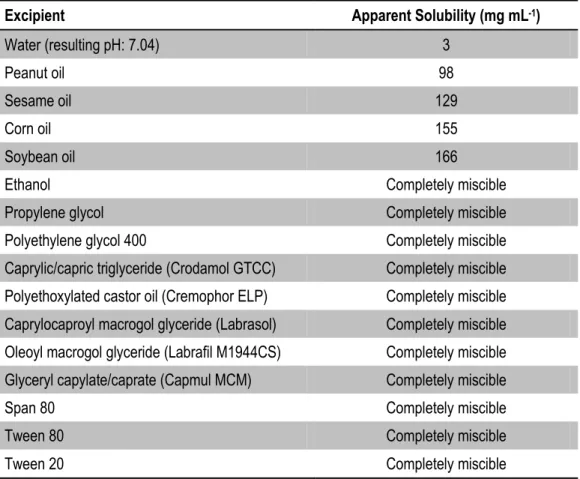
The apparent solubility of DTPA penta-ethyl ester was also measured in various lipids and organic solvents, listed in Table 5, to identify excipients for formulation development. The solubility of the prodrug was limited in solvents possessing highly polar (water) and highly non-polar (vegetable oils) properties. In contrast, solvents of more moderate non-polarity (co-solvents and surfactants) were completely miscible with DTPA penta-ethyl ester at all ratios.
Lipophilicity
32
lipophilicity increases with increasing pH, a trend that is expected for an ionzable weak base. Over this pH range, the logD values span a wide range from -0.2 to 2.3, suggesting that pH significantly influences the lipophilicity of this prodrug molecule.
Chemical and Enzymatic Hydrolysis Kinetics
Esters are labile bonds that are prone to chemical and enzymatic hydrolysis (38). The pH-dependent chemical stability was evaluated by incubating dilute samples of DTPA penta-ethyl ester in aqueous buffers of varying pH at 37°C and assaying for prodrug content over time. At all conditions, the loss of DTPA penta-ethyl ester followed pseudo-first order kinetics, and the observed rate constants (kobs) were calculated by least squares regression analysis. The
observed rate constants are summarized in Table 6. Buffer catalysis was observed at all pH conditions; thus, the adjusted rate constant (kadj) was determined by plotting the observed rate constants as a function of buffer concentration and extrapolating the linear regression to zero buffer concentration. The pH-degradation rate profile using the adjusted rate constants is shown in Figure 8 and shows a V-shaped profile with the prodrug being most stable at approximately pH 4.0-4.5.
The reaction scheme in Figure 9 is a proposed model for the hydrolysis associated with the different ionized species of the prodrug. The reactions involve the acid-catalyzed hydrolysis of the triprotic form (kH), acid-catalyzed hydrolysis of the diprotic form (k’H), base-catalyzed hydrolysis of the diprotic form (k’OH), and base-catalyzed hydrolysis of the monoprotic form
(k’’OH). The non-linear regression model used to fit the pH-rate profile is given by the equation:
33
M-1, and k’’OH = 4101 h-1 M-1 by regression analysis (R2 = 0.999) using the experimentally measured pKa values. The analysis reveals that the hydrolysis of the DTPA penta-ethyl ester is facilitated by general acid- and base-catalyzed reactions.
The degradation of DTPA penta-ethyl ester also followed pseudo-first order kinetics in SGF and SIF. The observed rate constants at 37°C were 0.028 h-1 in SGF (pH 1.18) and 0.0059 h-1 in SIF (pH 6.48). The rate constants were similar to those observed in the pH-rate profile at the corresponding pH, as shown in Figure 6. Furthermore, altering the enzyme concentrations did not affect the degradation kinetics (data not shown). These results suggest that these digestive enzymes have minimal effects on the hydrolysis kinetics of DTPA penta-ethyl ester.
241Am Decorporation
The efficacy of orally administered DTPA penta-ethyl ester was evaluated in rats contaminated intravenously with 241Am. The decorporation of 241Am over seven days is summarized in the total daily excretion profile of Figure 10. The treatment effects, most prominently with DTPA, are apparent in the first three days after treatment. Thereafter, no enhanced decorporation effects are observed over the control group. An examination of the cumulative 241Am excretion data after three days, shown in Table 7, confirms that total decorporation was significantly improved with both DTPA and DTPA penta-ethyl ester
34 Discussion
DTPA penta-ethyl ester is an ionizable weak base with measured pKa values of 2.93, 6.05, and 10.87. The pKa values suggest that this molecule remains predominantly ionized over the physiological pH range, a factor that may contribute to reduced oral absorption potential. The ionization scheme is considered to occur in a manner consistent with DTPA: 1) the central amine is first to ionize; 2) the second ionization occurs on one of the outer amines, triggering the proton on the central nitrogen to move to the opposing outer amine due to electrostatic
repulsion; and 3) the final ionization occurs on the vacated central amine (66). The pKa values for the amines of DTPA were reported to be 4.65, 8.45, and 10.02 based on NMR analysis (66). The first two pKa values of the amines of the prodrug are lower than those reported for DTPA due to the lower electron withdrawing ability of the ester groups compared to carboxylic acids (67). Each ester group contributes to lowering the pKa value of the amines with the reduction being most apparent in the second ionization, presumably due to the proton shift necessary for that ionization step.
The pH-dependent properties of solubility and lipophilicity were generally consistent with the measured ionization constants. The profiles show that as pH decreases, aqueous solubility of DTPA penta-ethyl ester increases and lipophilicity decreases. Moreover, as pH decreases below pH 6, a log-linear solubility increase is observed, confirming the pKa value of 6.05. However, similar analyses could not be applied to the two extreme pKa values due to instability of DTPA penta-ethyl ester or inability to control pH. A more careful examination of solubility closer to these conditions may be useful to further define the pH-solubility profile. Nonetheless, aqueous solubility was not considered to be a critical aspect in evaluating oral delivery potential since the DTPA penta-ethyl ester is a liquid and thus, dissolution is not a limiting factor in the absorption process.
35
small molecules of moderate lipophilicity in the unionized form (68;69). Despite the ionization potential, the prodrug partitions favorably into the non-polar octanol phase at physiological pH conditions. The lipophilicity profile shows that logD exceeds 2 at pH greater than 6, a pH condition that resembles the intestinal lumen. Considering that absorption of ingested molecules occurs predominately in the intestines, the lipophilicity profile suggests that this prodrug may be a good candidate for oral absorption. Compared to DTPA with a ClogP of -2.9 (42), the prodrug exhibits significantly higher lipophilicity, which is expected to contribute to increased intestinal permeability and absorption.
A study on the degradation rate of the prodrug in aqueous solution determined that the stability is highly pH-dependent. Over the pH range of 2 to 8, the degradation half-lives ranged from 3.6 to 297 days. As unabsorbed drugs are excreted from the gastrointestinal tract
generally within one day (70), the prodrug appears to be sufficiently stable against pH effects to avoid premature degradation. In vitro stability evaluations in SGF and SIF also revealed that degradation was not accelerated by the presence of pepsin and pancreatin, digestive enzymes known to possess esterase activity (71;72). This provides additional supporting data that the prodrug is sufficiently stable to avoid extensive degradation in the gut lumen prior to absorption.
To support the in vitro assessment of the prodrug’s oral delivery potential, a preliminary
efficacy study was conducted. The 241Am decorporation study showed that oral treatments of DTPA penta-ethyl ester enhanced 241Am elimination compared to the control group, suggesting that the prodrug is capable of being delivered orally. Moreover, the therapeutic effect appears to be dose-dependent, with higher doses exhibiting higher decorporation. Although the orally administered prodrug was less effective than the intravenously administered DTPA at
36
supporting evidence that DTPA penta-ethyl ester may be a viable prodrug for decorporation therapy.
Based on the liquid nature of DTPA penta-ethyl ester, a possible formulation strategy may be to develop an oral solution or a liquid-filled capsule dosage form. The solubility screening in various solvents revealed that the prodrug favors solvents that are neither extremely polar nor extremely non-polar. Solvents that are non-polar (e.g., medium chain triglyceride) to moderately polar (e.g., polyethylene glycol 400 and propylene glycol) exhibited complete miscibility with the prodrug and may be best suited as diluents to support a liquid formulation. However, protic solvents may be incompatible with the prodrug due to their potential to participate in hydrolysis or trans-esterification reactions. In addition, many of the excipients that are highly miscible with the prodrug possess amphiphilic properties, which may be useful to facilitate emulsification in a lipid-based delivery system. The addition of emulsifiers may help to form colloidal dispersions that can shield the prodrug from premature chemical and enzymatic degradation in the gut lumen. The emulsifiers may also be useful to support a self-emulsified drug delivery system (SEDDS), which can enhance bioavailability by entrapping the lipophilic drug in micellar or mixed micellar structures that facilitate the transfer of drug to the enterocytes across the unstirred water layer (73;74). Despite the high lipophilicity of the prodrug, approaches to enhance bioavailability may still be necessary to minimize pill burden,
considering that the injectable Ca- and Zn-DTPA products are administered at a relatively high 1 g daily dose and the decorporation study showed lower efficacy of the prodrug at comparable doses.
In addition to treatment convenience, an orally administered prodrug of DTPA may have the benefit of eliciting a protracted exposure, thereby improving therapeutic effect. While the IV administration of DTPA has the advantages of complete bioavailability and rapid onset,
37
infusion approaches have been proposed (54;55); however, these are still limited by the inconvenience of the treatment, particularly in a mass casualty situation. In contrast, orally administered drugs follow an indirect path to the systemic circulation, and the entry of the drug into the bloodstream is not instantaneous. The slower absorption process or the need for metabolic activation may be favorable in extending the duration in which the drug enters the bloodstream, thereby reducing the impact of the rapid elimination. The oral delivery approach may also allow for opportunities to modulate the absorption rate and duration by implementing modified release drug delivery systems.
Other factors related to the contaminating radionuclide, such as its chemical form and the route of contamination, can influence the biokinetics of the radionuclide and are important considerations in identifying the optimal therapeutic regimen (31). Less soluble forms of the radionuclide or contamination via inhalation or through wounds can result in slower entry of the radionuclide into the systemic circulation (54). Therefore, IV administration of DTPA, with its subsequent rapid elimination kinetics, may not be the ideal treatment to counteract the slow influx of the radionuclide into the blood. Studies in animal models have shown that radionuclide decorporation under these scenarios may be enhanced when repetitive injections or infusion therapies of DTPA are implemented (54;55). As nuclear terror attacks pose threats of
contamination primarily via inhalation or wounds, an orally bioavailable decorporation agent with prolonged effects may be advantageous for overall efficacy and convenience.
Even with sufficient absorption, the prodrug ultimately needs to undergo metabolic activation to liberate the therapeutically active DTPA molecule. Carboxyesterases are expected to be the primary enzymes contributing to the bioactivation of this multi-ester prodrug.
Esterases are present in various compartments along the absorption pathway, including the intestinal epithelium, plasma, and hepatocytes (39;40;75). Incomplete metabolism could lead to reduced efficacy, although the partially hydrolyzed DTPA esters may form chelates with
38
effect. Since esterases are prevalent in the liver, significant metabolism in the liver is expected. On one hand, metabolism in the hepatocytes could sequester DTPA in the intracellular
compartment, reducing the amount available in the blood. On the other hand, as Pu, Am, and Cm tend to accumulate in the liver, this prodrug could be beneficial to facilitate decorporation from the intracellular compartment of hepatocytes. Although DTPA has been linked to some intracellular decorporation (24), its effects are considered to have a relatively small contribution to overall decorporation, limited by its inability to cross cell membranes. Thus, a lipophilic prodrug of DTPA with intracellular activity may serve to complement the effects of the current DTPA treatment for enhanced radionuclide decorporation. Defining the sites and extent of metabolism will be crucial to assess the oral delivery and advance this prodrug for further development.
Conclusion
The physicochemical properties of DTPA penta-ethyl ester suggest that it is a promising molecule for oral delivery. Consistent with the measured pKa values, the prodrug exhibits pH-dependent solubility and lipophilicity properties that are representative of a weak base and favorable for oral absorption. Despite the ionization potential over the physiologically relevant pH conditions, the logD measurements indicate that the prodrug may be well-suited for membrane permeability in the intestines, the primary site of absorption for most ingested molecules. In vitro stability studies suggest that the prodrug is sufficiently stable against
39
40 Tables
Table 5 Solubility of DTPA penta-ethyl ester at room temperature
Excipient Apparent Solubility (mg mL-1)
Water (resulting pH: 7.04) 3
Peanut oil 98
Sesame oil 129
Corn oil 155
Soybean oil 166
Ethanol Completely miscible
Propylene glycol Completely miscible
Polyethylene glycol 400 Completely miscible
Caprylic/capric triglyceride (Crodamol GTCC) Completely miscible
Polyethoxylated castor oil (Cremophor ELP) Completely miscible
Caprylocaproyl macrogol glyceride (Labrasol) Completely miscible
Oleoyl macrogol glyceride (Labrafil M1944CS) Completely miscible
Glyceryl capylate/caprate (Capmul MCM) Completely miscible
Span 80 Completely miscible
Tween 80 Completely miscible
41
Table 6 Observed rate constants for the hydrolysis of DTPA penta-ethyl ester
Observed rate constants for the loss of DTPA penta-ethyl ester in aqueous buffers at 37°C; data expressed as mean ± 95% confidence interval
pH Buffer Buffer concentration (mM) kobs (h-1)
0.30 Hydrochloric acid 600 0.0924 ± 0.0078
50 0.00336 ± 0.00047
2.29 Phosphate 100 0.00421 ± 0.00055
200 0.00441 ± 0.00044
50 0.000980 ± 0.000081
3.04 Citrate 100 0.00107 ± 0.00011
200 0.00119 ± 0.00010
50 0.000206 ± 0.000045
4.29 Formate 100 0.000239 ± 0.000059
200 0.000469 ± 0.000068
50 0.000505 ± 0.000063
5.11 Acetate 100 0.000717 ± 0.000057
200 0.00117 ± 0.00008
50 0.00190 ± 0.00015
6.10 Succinate 100 0.00225 ± 0.00012
200 0.00313 ± 0.00013
50 0.00380 ± 0.00056
6.81 Phosphate 100 0.00438 ± 0.00034
200 0.00649 ± 0.00033
50 0.00870 ± 0.00124
7.92 Tris 100 0.0111 ± 0.0008
200 0.0148 ± 0.0014
50 0.0371 ± 0.0064
8.88 Tris 100 0.0398 ± 0.0074
42
Table 7 Excretion and liver retention of 241Am after a single dose treatment
Excretion and liver retention of 0.3 nmol 241Am administered by IV injection after three and seven days, respectively, following a single dose treatment in rats; data expressed as mean ± 95% confidence interval
Treatment Route N Cumulative excretion (% of injected) Liver retention (% of injected) In urine In feces Total
No treatment - 6 7.04 ± 1.98 2.04 ± 0.48 9.08 ± 2.34 22.7 ± 2.9
DTPA
26.8 µmol kg-1 IV 6 16.5 ± 2.2 14.5 ± 2.5 30.9 ± 4.1 7.68 ± 4.73
DTPA prodrug
37.5 µmol kg-1 PO 5 6.86 ± 1.85 7.00 ± 1.46 13.9 ± 2.5 14.2 ± 2.0
DTPA prodrug
43 Figures
Figure 3 Synthesis of DTPA penta-ethyl ester
Figure 4 Rheological profile of DTPA penta-ethyl ester at increasing shear rate y = 0.175x
R² = 1.00
0.01 0.1 1 10 100 1000
0.1 1 10 100 1000
Sh
ea
r S
tr
es
s
(P
a)
44
Figure 5 Titration of DTPA penta-ethyl ester with sodium hydroxide
Figure 6 pH-dependent aqueous solubility of DTPA penta-ethyl ester 2
4 6 8 10 12
1000 2000 3000 4000 5000
pH
Sodium Hydroxide, 0.1 M (µL)
1 10 100 1000
4 5 6 7 8
So
lu
bi
lit
y
(m
g
m
L
-1)
45 Figure 7 logD of DTPA penta-ethyl ester
Figure 8 pH-rate profile of DTPA penta-ethyl ester hydrolysis at 37°C Experimental values (●) and non-linear regression fit (dotted line)
0 0.5 1 1.5 2 2.5 3
0 2 4 6 8 10
lo
gD
pH
-5 -4 -3 -2 -1
0 2 4 6 8 10
lo
g
kadj
(h
-1)
46
Figure 9 General acid- and base-catalyzed hydrolysis of DTPA penta-ethyl ester
Reactions include acid-catalyzed hydrolysis of the triprotic form (kH), acid-catalyzed hydrolysis
of the diprotic form (k’H), base-catalyzed hydrolysis of the diprotic form (k’OH), and
base-catalyzed hydrolysis of the monoprotic form (k’’OH)
Figure 10 Total daily excretion of 241Am after a single dose treatment
0 5 10 15 20 25
1 2 3 4 5 6 7
D ai ly E xc re tion (% of inj ec te d)
Days After Treatment
no treatment
26.8 µmol kg-1 DTPA by IV
37.5 µmol kg-1 DTPA prodrug by PO
75 µmol kg-1 DTPA prodrug by PO
Data expressed as mean + SD