Oceans of Data
Proceedings of the 44th Conference on
Computer Applications and
Quantitative Methods in Archaeology
Edited by
Archaeopress Publishing Ltd Summertown Pavilion
18-24 Middle Way Summertown Oxford OX2 7LG
www.archaeopress.com
ISBN 978 1 78491 730 2 ISBN 978 1 78491 731 9 (e-Pdf)
© Archaeopress and the authors 2018
Language Editing: Rebecca Cannell Cover Design: Bjarte Einar Aarseth
All rights reserved. No part of this book may be reproduced, or transmitted, in any form or by any means, electronic, mechanical, photocopying or otherwise, without the prior written permission of the copyright owners.
Printed in England by Oxuniprint, Oxford
Foreword ...v
I
ntroductIon ...1 Oceans of Data: Creating a Safe Haven for Information ...3Christian-Emil ORE
Theorising the Digital: A Call to Action for the Archaeological Community ...11 Sara PERRY and James Stuart TAYLOR
o
ntologIesands
tandards ...23 Is that a Good Concept? ...25George BRUSEKER, Maria DASKALAKI, Martin DOERR, and Stephen STEAD
Sculptures in the Semantic Web Using Semantic Technologies for the Deep Integration of
Research Items in ARIADNE ...33 Philipp GERTH, Dennis Mario BECK, Wolfgang SCHMIDLE, and Sebastian CUY
Formalization and Reuse of Methodological Knowledge on Archaeology across European Organizations...45 Cesar GONZALEZ-PEREZ, Patricia MARTÍN-RODILLA, and Elena Viorica EPURE
Linked Open Data for Numismatic Library, Archive and Museum Integration ...55 Ethan GRUBER
Sustainability = Separation: Keeping Database Structure, Domain Structure and Interface Separate ...63 Ian JOHNSON
Systematic Literature Review on Automated Monument Detection: A Remote Investigation on
Patterns within the Field of Automated Monument Detection ...69 Karl Hjalte Maack RAUN and Duncan PATERSON
Bioarchaeology Module Loading…Please Hold. Recording Human Bioarchaeological Data from
Portuguese Archaeological Field Reports ...85 Ana Lema SEABRA, Filipa Mascarenhas NETO, and Cristina BARROSO-CRUZ
Methodological Tips for Mappings to CIDOC CRM ...89 Maria THEODORIDOU, George BRUSEKER, and Martin DOERR
An Ontology for a Numismatic Island with Bridges to Others...103 Karsten TOLLE, David WIGG-WOLF, and Ethan GRUBER
Integrating Analytical with Digital Data in Archaeology: Towards a Multidisciplinary Ontological
Solution. The Salamis Terracotta Statues Case‑Study ...109 Valentina VASSALLO, Giusi SORRENTINO, Svetlana GASANOVA, and Sorin HERMON
F
Ieldandl
aboratoryd
atar
ecordInganda
nalysIs ...119 Integrated Methodologies for Knowledge and Valorisation of the Roman Casinum City ...121Michela CIGOLA, Arturo GALLOZZI, Leonardo PARIS, and Emanuela CHIAVONI
A Multidisciplinary Project for the Study of Historical Landscapes: New Archaeological and
Physicochemical Data from the ‘Colline Metallifere’ District ...135 Luisa DALLAI, Alessandro DONATI, and Vanessa VOLPI
From Survey, to 3D Modelling, to 3D Printing: Bramante’s Nymphaeum Colonna at Genazzano ...147 Tommaso EMPLER and Adriana CALDARONE
Towards a National Infrastructure for Semi‑Automatic Mapping of Cultural Heritage in Norway ...159 Martin KERMIT, Jarle Hamar REKSTEN, and Øivind Due TRIER
ii
Experiments in the Automatic Detection of Archaeological Features in Remotely Sensed Data
from Great Plains Villages, USA ...173 Kenneth L. KVAMME
Interpolating 3D Stratigraphy from Indirect Information ...185 Lutz SCHUBERT, Ana PREDOI, and Keith JEFFERY
Closing a Gap with a Simple Toy: How the Use of the Tablet Affected the Documentation
Workflow during the Excavations of the Rozprza Ring–Fort (Central Poland) ...197 Jerzy SIKORA and Piotr KITTEL
Supercomputing at the Trench Edge: Expediting Image Based 3D Recoding ...207 David STOTT, Matteo PILATI, Carsten MEINERTZ RISAGER, and Jens-Bjørn Riis ANDRESEN
Semi‑Automatic Mapping of Charcoal Kilns from Airborne Laser Scanning Data Using Deep Learning ...219 Øivind Due TRIER, Arnt-Børre SALBERG, and Lars Holger PILØ
Documenting Facades of Etruscan Rock‑Cut Tombs: from 3D Recording to Archaeological Analysis ...233 Tatiana VOTROUBEKOVÁ
a
rchaeologIcalI
nFormatIons
ystems...243 Fasti Online: Excavation, Conservation and Surveys. Twelve Years of Open AccessArchaeological Data Online ...245 Michael JOHNSON, Florence LAINO, Stuart EVE, and Elizabeth FENTRESS
DOHA — Doha Online Historical Atlas ...253 Michal MICHALSKI, Robert CARTER, Daniel EDDISFORD, Richard FLETCHER, and Colleen MORGAN
Digital Archives — More Than Just a Skeuomorph ...261 Emily NIMMO and Peter MCKEAGUE
When Data Meets the Enterprise: How Flanders Heritage Agency Turned a Merger of
Organisations into a Confluence of Information ...273 Koen VAN DAELE, Maarten VERMEYEN, Sophie MORTIER, and Leen MEGANCK
gIs
ands
patIala
nalysIs ...285 Crossroads: LCP — Model Testing and Historical Paths During the Iron Age in the North–EastIberian Peninsula (4th to 1st Centuries BC) ...287 Joan Canela GRÀCIA and Núria Otero HERRAIZ
Boundaries of Agrarian Production in the Bergisches Land in 1715 AD ...299 Irmela HERZOG
Geometric Graphs to Study Ceramic Decoration ...311 Thomas HUET
Vertical Aspects of Stone Age Distribution in South–East Norway ...325 Mieko MATSUMOTO and Espen ULEBERG
3d
andV
IsualIsatIon ...337 Emerging Technologies for Archaeological Heritage: Knowledge, Digital Documentation, andCommunication ...339 Martina ATTENNI, Carlo BIANCHINI, and Alfonso IPPOLITO
New Actualities for Mediterranean Ancient Theaters: the ATHENA Project Lesson ...353 Carlo BIANCHINI, Carlo INGLESE, and Alfonso IPPOLITO
Archaeology and Augmented Reality. Visualizing Stone Age Sea Level on Location ...367 Birgitte BJØRKLI, Šarūnas LEDAS, Gunnar LIESTØL, Tomas STENARSON, and Espen ULEBERG
A 3D Digital Approach for the Study and Presentation of the Bisarcio Site ...389 Paola DERUDAS, Maria Carla SGARELLA, and Marco CALLIERI
The Role of Representation in Archaeological Architecture ...399 Mario DOCCI, Carlo INGLESE, and Alfonso IPPOLITO
Digital Archaeological Dissemination: Eleniana Domus in Rome ...409 Tommaso EMPLER
On Roof Construction and Wall Strength: Non‑Linear Structural Integrity Analysis of the Early
Bronze Age Helike Corridor House ...421 Mariza Christina KORMANN, Stella KATSAROU, Dora KATSONOPOULOU, and Gary LOCK
An Exploratory Use of 3D for Investigating a Prehistoric Stratigraphic Sequence ...433 Giacomo LANDESCHI, Jan APEL, Stefan LINDGREN, and Nicolò DELL’UNTO
Les gestes retrouves: a3D Visualization Approach to the Functional Study of Early Upper
Palaeolithic Ground Stones ...447 Laura LONGO, Natalia SKAKUN, Giusi SORRENTINO, Valentina VASSALLO, Dante ABATE, Vera TEREHINA, Andrei SINITSYN, Gennady KHLOPACHEV, and Sorin HERMON
Enhancing Archaeological Interpretation with Volume Calculations. An Integrated Method of
3D Recording and Modeling ...457 Giulio POGGI and Mirko BUONO
3D Spatial Analysis: the Road Ahead ...471 Martijn VAN LEUSEN and Gary NOBLES
c
omplexs
ystemss
ImulatIon ...479 Weaving the Common Threads of Simulation and Formation Studies in Archaeology ...481Benjamin DAVIES
Evolving Hominins in HomininSpace: Genetic Algorithms and the Search for the ‘Perfect’ Neanderthal .495 Fulco SCHERJON
An Agent‑Based Approach to Weighted Decision Making in the Spatially and Temporally
Variable South African Paleoscape ...507 Colin D. WREN, Chloe ATWATER, Kim HILL, Marco A. JANSSEN, Jan C. DE VYNCK, and Curtis W. MAREAN
t
eachInga
rchaeologyInthed
IgItala
ge ...523 Archaeological Education for a Digital World: Case Studies from the Contemporary and Historical US ....525Anna S. AGBE-DAVIES
Teaching Archaeology or Teaching Digital Archaeology: Do We Have to Choose? ...533 Sylvain BADEY and Anne MOREAU
DOMUS: Cyber‑Archaeology and Education ...541 Alex DA SILVA MARTIRE and Tatiana BINA
Digital Data Recording at Circus Maximus: A Recent Experience ...547 Alessandro VECCHIONE and Domenica DININNO
Introduction
There is no question that digital technologies are transforming both archaeology and education. What does it then mean to teach archaeology in a digital world? This paper begins with two key premises: 1) archaeological education extends beyond the university walls to embrace the needs of a wider public; and 2) archaeology is an integrated discipline that includes the analysis of not only material culture, but also texts and other modes of human expression. In other words, education is not only about what happens in a classroom for people identified as ‘students,’ and
archaeology embraces an extensive range of evidence left by people in the distant, or not-so-distant, past. With this expansive view of archaeological education in mind, three case studies are used to illustrate the ways in which archaeology and digital technology can intersect with pedagogy.
Computer technology is not new for archaeological education. For example, I remember distinctly the simulated excavation software ‘Adventures in Fugawiland’ that the professor of my Methods in Archaeology course used to supplement our textbooks and lectures, more than 25 years ago. And yet, according to Karsten Lambers and Hans Kamermans (Lambers and Kamermans, 2016), pedagogical themes had not been discussed at a Computer Applications and Quantitative Methods in Archaeology conference for many years, until the recent revival in Siena in 2015. This is in stark contrast to the close link between digitally-enabled research and digital pedagogy that has emerged under the rubric of ‘the Digital Humanities’ (e.g. Gold,
2012). Why the difference; is it because our research is so bound up with computers, with the digital, that they are taken for granted? Many of our colleagues in literature and art history are only now discovering, for example, the joys of big data and the challenges of visualization. They are just beginning to explore the ways in which the digital turn can transform research. As archaeologists, we may find that it is precisely the pedagogical component that connects a Digital Archaeology to the Digital Humanities, distinguishing it from archaeology-as-usual (Watrall, 2016).
One aspect of digital technology that has already advanced archaeological research, as opposed to education, is the way that it makes the primary data of archaeology so readily available, for both accomplished and novice researchers. But these data can be used for teaching as well as research. Learning-by-doing is an incredibly effective and compelling pedagogical strategy (Blum, 2016). This is no surprise for anyone who has ever taught an archaeological field school or laboratory class. We ought to harness digital resources and technologies to infuse all of our educational efforts with opportunities for what it is now fashionable to call ‘active learning.’ Why restrict such a powerful pedagogical tool for use only in specialised ‘methods’ classes geared towards archaeologists-in-training? As with a trowel in a field school or a microscope in a laboratory class, novices need extensive guidance to use the digital tools that we deploy in archaeological research. I have found that even digital natives have a lot to learn about the digital world. The good news is that archaeology can be a vehicle for teaching them
Archaeological Education for a Digital World:
Case Studies from the Contemporary and Historical US
Anna S. AGBE-DAVIES
University of North Carolina at Chapel Hill [email protected]
Abstract
This paper takes as its premises that 1) archaeological education extends beyond the university walls to embrace the needs of a wider public, and 2) archaeology is an integrated discipline that includes the analysis of not only material culture, but also texts and other modes of human expression. The author discusses initiatives to use digital technologies and techniques to ‘teach’ ‘archaeology’ in the broadest sense of both words. Examples include using digital archaeological data from DAACS.org to teach analytical processes and the scientific method, the class-sourcing/crowdsourcing of archival transcription using FromThePage. com, and building websites to teach both archaeological content and digital literacies. Much of what some now call the Digital Humanities is not new to archaeology, but we will do well to embrace technological and methodological innovations in the realm of education, just as we have in our research.
Keywords: pedagogy, digital technology, historical archaeology
Mieko Matsumoto and Espen Uleberg (eds) 2018. CAA2016: Oceans of Data
526
M. Matsumoto and E. Uleberg (eds). CAA2016: Oceans of Data
skills and knowledge that matter well beyond the narrow world of professional archaeology.
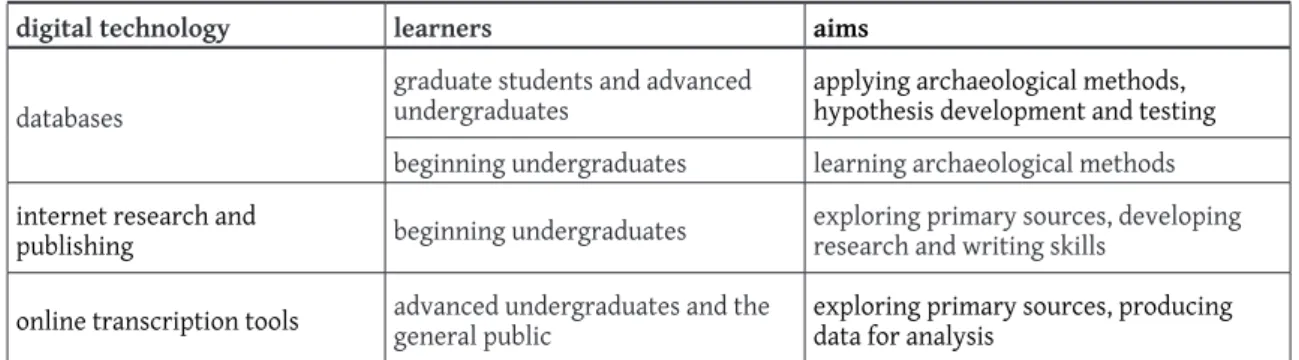
With that orientation to the underlying ideas of the paper, I will now turn to the three examples from my own teaching. Each involves a different data set, a different set of learners, and different aims; each of which must be taken into account when teaching archaeology in the digital age (see Table 1). First, I will briefly compare each example in terms of digital technologies and general learning goals. I will then turn to a detailed comparison of the interactions learners have with these technologies. I conclude with a qualitative discussion of the pedagogical outcomes that learners and archaeologists might anticipate experiencing in the wider digital world.
The digital technologies
The digital technologies that archaeologists employ are many and varied. Some have little application in teaching scenarios beyond instruction that is designed to meet the needs of archaeologists-in-training. Here, I briefly describe the digital technologies and data that I use in both research and teaching, before turning to a discussion of how these digital materials can be used for specific educational ends.
The first example uses the Digital Archaeological Archive of Comparative Slavery (DAACS), an online database of information from (at the time of writing) 72 individual slave quarter sites at 32 plantations throughout the US southeast and the Caribbean.1 It provides downloadable data for comparative analyses to anyone with an Internet connection. It also promotes a set of standards for data recording and especially artefact cataloguing. I use these data extensively in my own research, and several sites where I have excavated are included in the Archive. More to the point, I use data from DAACS to illustrate archaeological concepts and techniques in my classes, and as raw material for projects executed by the students themselves. Their level of expertise has ranged
1 www.daacs.org
from graduate students specialising in the archaeology of the African diaspora to undergraduates enrolled in a general education course to fulfil their laboratory science requirement (for more, see Agbe-Davies et al., 2014). The shared aim across these populations is to create scenarios in which students can apply the methods they have been learning about in the course, compare their own findings with those that they encounter in their assigned readings, and confront the vagaries of real — as opposed to simulated — data. In the second case, students in my research seminar for first year undergraduates use and create web resources for learning about life in 20th century black Chicago; specifically at the site of the Phyllis Wheatley Home for Girls, where I conducted archaeological excavations from 2006 to 2009. The aim of these seminars is to “offer an introduction to the intellectual life of the university and focus on how scholars pose problems, discover truths, resolve controversies, and evaluate knowledge”.2 In the class, students use primary data — both archival and archaeological — to produce different genres of electronic texts, including webpages, wikis, timelines, and data visualizations. These activities also provide an opportunity for them to evaluate information that they find online as well as how to cite and give credit appropriately.
The final case involves crowdsourcing the transcription of archival texts, which has so far been piloted to a ‘crowd’ of students in my classes, but is ultimately intended for the Internet at large. The data come from a collection of store account books archived at my university (Cameron Family Papers, 1757–1978) and pertaining to a nearby plantation called Stagville,3 where I have begun archaeological investigations. Recently, my efforts have been aimed toward developing a tool for online transcription of these records that opens the process up to a wide audience. FromThePage is a tool that until recently was designed for the crowdsourced transcription of texts such as
2 http://fys.unc.edu/ 3 www.stagville.org
digital technology learners aims
databases graduate students and advanced undergraduates applying archaeological methods, hypothesis development and testing beginning undergraduates learning archaeological methods
internet research and
publishing beginning undergraduates exploring primary sources, developing research and writing skills
online transcription tools advanced undergraduates and the general public exploring primary sources, producing data for analysis
A.S. AGBE-DAVIES: Archaeological Education for a Digital World
diaries and letters (Brumfield and Agbe-Davies, 2015). It serves up the manuscripts online and facilitates the editorial process.4
Learners meet applications
Archaeology as data
Teaching with the DAACS database, the greatest challenges are not archaeological, but technological and general. By the time activities and assignments are introduced, we have usually spent several weeks learning about, for example, frequency seriation (Dethlefsen and Deetz, 1966), mean ceramic dates (South, 1978), and Harrington histograms of pipe-bore sizes (Harrington, 1954). The students have heard lectures on the techniques and read research reports or articles which use the techniques to interpret archaeological sites. Rather than stopping here, students next have the opportunity to apply these techniques to see how/ if/when they can be used in testing an archaeological hypothesis. Thus, a hands-on teaching strategy need not depend on the physical presence of actual artefact assemblages.
One benefit of working with data from the archive is the access one has to many more samples than one could expect to provide from one’s own excavation materials or curation facility. And there are fewer curatorial concerns. It is not possible for a novice to accidentally separate artefacts from their correct archaeological context; one can set up ‘collections’ with greater ease and speed than is possible with physical collections. The benefit that I find most pedagogically compelling, though, is that one can concentrate on bigger-picture methodological topics without having to assume (or develop) fundamental skills like identifying artefacts and interpreting stratigraphy. Even people who cannot distinguish among fragments of earthenware, stoneware, and porcelain can still create tables comparing proportions of these categories and, with some knowledge of their different uses, develop interpretations based on their findings. Of course, when it is possible for students to mainline data in this way, it makes sense to impose a tightly-structured scaffolding of assignments to ensure that they do not become overwhelmed. Many students need significant guidance on how to translate an understanding of principles into the application of those principles to actual data.
For general education science students, I gave tightly-structured laboratory assignments with specific instructions on what patterns to look for and how to analyse them. For example, I provided them with pre-downloaded pipe-bore data for them to compare with
4 http://fromthepage.com/
J.C. Harrington’s classic histograms and then to insert into Lewis Binford’s dating formula. Upper-division archaeology and anthropology majors have much more latitude to select their own datasets and problems. However, they are required to draft several research proposals and submit draft tables, charts, or visualizations for assessment before they begin their projects in earnest. This process ensures that they get frequent feedback on their ideas, while still having significant opportunities for creativity.
For both generalist and specialist undergraduates, spreadsheet techniques in Excel — the program which dominates the U.S. market — were unfamiliar to many students. These digital natives were tough to wean from their smart phone calculators and convince that it was simpler and less error-prone to use the tools embedded in the very tables that contained their downloaded data, instead of calculating totals, averages, and percentages by hand.
So the key challenge for teaching both groups was to prevent the digital technology — for example, the steps of the downloading process, or unfamiliarity with spreadsheets — from getting in the way of learning about the scientific method and about archaeology. For true novices, this meant providing limited assignments and detailed step-by-step instructions. For undergraduates in upper level classes, this meant significant individualised feedback specific to each person’s project. The latter kind of pedagogy is difficult to scale up and use with large classes.
Archaeology and media literacy
In my First Year Seminar, students use (and create) both primary and secondary sources in a digital format. For example, students used library technology to search for and download articles from the Chicago Defender, a major newspaper that published stories and announcements about the Phyllis Wheatley Home for Girls. They then used SharePoint to enter information about the content of those articles into a database, recording, for instance, whether a story referred to the residents of the Home or the women who sponsored it, or if it included an appeal for donations to fund the Home’s work. Later groups of students used these same articles to create a timeline of events associated with the Home using a web tool called TimeMapper.5 Another group used the text analysis software MAXQDA to analyse the ‘Women’s Page’ of the Defender to understand social expectations for African American women in the mid-1920s. Similar efforts to identify cultural patterns focused on oral history interviews, analysed using the web tool Voyant.6 Throughout, moving back and forth
528
M. Matsumoto and E. Uleberg (eds). CAA2016: Oceans of Data
between genres — in terms of both the sources and the assignments they complete — provokes students to think about ‘media’ in new ways.
Such activities teach them about how archaeologists and other researchers use the primary archival record to produce and present new knowledge about the past. On the artefact side, members of the class have produced qualitative as well as quantitative studies. For several terms running, each student would be assigned an artefact, such as one of the fragments of Pepsi bottles shown in Figure 1, and then tasked with tracking down information about it for publication to our class wiki. In such an instance, the student would find out about the manufacture of the object itself (what technologies were used to shape and label the bottle?), as well as its uses (how was soda produced and consumed in the early 20th century?), and specific relevance to the site (what does evidence of ‘soft drinks’ mean when recovered from a Home dedicated to instilling good, Christian influences in its residents?). As we go, we discuss sources of archaeological information on the Internet and how one might distinguish reputable sources from dubious ones. In other years, students created content for the class wiki by analysing assemblages of artefacts, identifying minimum numbers of vessels for example, or comparing artefact distributions for different areas of the site.
In all of these activities, students create pretty good content. Some of course do the bare minimum, but every year I am impressed by the lengths to which some students will go in pursuit of information about an artefact’s manufacturer, or in an attempt to find every last mending piece of a fragmented vessel. I also appreciate the students’ creativity in organising ideas and designing the final product when freed from the linear structure of a ‘paper.’ These kinds of assignments are much more interesting to read and
grade than a standard 5-paragraph essay or a research paper based on secondary sources. Students respond enthusiastically to the idea that they are not just telling the professor something she already knows, but are in fact producing new knowledge for the group, the professor, future researchers, and other stakeholders, including the current owner of the Home.7 In tracking down data and presenting the results of their analyses, students are developing digital literacies, even as they learn to ‘read’ material culture.
Archaeology and the crowd
Archaeologists, because our research is so labour-intensive, likely need little convincing of the value of crowdsourcing.8 Crowdsourcing is not only an effective means of getting work done — for example compiling a regional database of projectile points (White and Agbe-Davies, 2016) — it is also an effective pedagogical tool (Smith, 2014). It teaches users about the primary material being studied and about the methods used to analyse such material. For the last two years I have been experimenting with having students in my classes transcribe 19th century manuscripts, specifically, account books from plantation stores in operation before and after the U.S. Civil War. The students are merely the first wave of the ‘crowd’ as my intention is to open the process up online to the wider public as is being done so successfully by large institutions such as the Smithsonian,9 but also by smaller research groups such as the Colored Conventions Project.10
In the case of the transcription activities, the challenges that learners face are material-specific; primarily the difficulty of reading handwritten 19th century texts with unfamiliar abbreviations, vocabulary, and accounting conventions. The strangeness of the texts highlights their material qualities. The fact that they cannot be readily understood forces users to think about them as constructions rather than direct and transparent representations of some past truth. And so, learners need guidance in how to analyse and extract meaning from texts as surely as they do with artefacts. With these challenges in mind, at first I wanted the digital technology to be as low-effort as possible. Google spreadsheets work (up to a point). With columns and rows, they mimic the structural organisation of an account book. For a collaborative project, the
7 The field project was developed collaboratively with the Home’s
current owner (Agbe-Davies, 2010).
8 One of the term’s originators describes crowdsourcing as ‘the act of
a company or institution taking a function once performed by employees and outsourcing it to an undefined (and generally large) network of people in the form of an open call. The crucial prerequisite is the use of the open call format and the large network of potential laborers’ (Howe, 2006).
9 https://transcription.si.edu/ 10 http://coloredconventions.org/
A.S. AGBE-DAVIES: Archaeological Education for a Digital World
sheets have the added benefit of being easily sharable. Because the sheets are used only for transcription and not quantitative analysis, technical facility with spreadsheets — other than navigation within one — is irrelevant.
However, as the project expands beyond students in my classes to a larger audience of learners, the materiality of the texts becomes a different kind of issue. Physically housed in an archive, the potential size of the crowd would be limited to those who could go to the texts. A solution to this problem is the web tool FromThePage. It has a steeper learning curve. The user renders the text using simple wiki mark-up (which makes it a compromise between the clunkiness of a spreadsheet and the complexity of TEI11 encoding). However, it allows the transcriber to render the text in a way that more closely resembles the original manuscript, and enables mark-up that can be used in later analysis. Users may also download content (their own transcriptions and others’) for their own use.
In addition to producing valuable data, engaging novices in the transcription of archival texts yields other, pedagogical, benefits. The transcription process engenders close readings of the material, revealing nuances that are easily missed when working with pre-prepared transcripts. Transcription also gives learners a window onto the transformations that occur in pursuit of knowledge about the past: how observations of primary sources become data on their way to becoming evidence in arguments about the past; as well as the role of researchers in those transformations.
Conclusion: why does a digital archaeology pedagogy matter?
Part of the challenge for teaching archaeology in the digital age is to think creatively and critically about what a given digital technology is good for. DAACS, for example, offers an extensive data set with which students can learn to set up, and pursue the answers to, research questions. It also serves as a model for developing data structures of one’s own. In the case of my First Year Seminar students, MAXQDA is an extraordinarily powerful text analysis tool, but over time it became clear that it is not well-suited to group work, nor is it good for students who are still trying to learn basic social science concepts or arguments. Voyant is more suited to their abilities, aims, and inclinations. And I have already discussed the relative merits of using Google spreadsheets vs. FromThePage for the transcription of manuscript account books. As we all know, just because something is digital, doesn’t make it better. Digital
11 The Text Encoding Initiative (TEI) is ‘a consortium which
collectively develops and maintains a standard for the representation of texts in digital form’ (http://www.tei-c.org/index.xml).
technologies, just like archaeological methods, need to be suited to the task at hand.
Likewise, we as archaeologists need to have deliberate conversations about the point of teaching archaeology. In other words, what is archaeology good for? What do we expect people to learn and why? What is the place of archaeology in a 21st century university curriculum, or in a 21st century society (Little and Shackel, 2007)? For university students who may not become archaeologists themselves, does the field have a higher purpose than merely broadening their experience?
It could be, simply, that ‘archaeology’ is the hook that gets students to learn important 21st century skills like generating and using statistical data, writing clearly, and critically analysing social systems. Developing a testable hypothesis was a major challenge for many of my students. Several seniors confessed that they had never been asked to think in this way in their entire college careers. I would be surprised if more than one or two of the students in my most recent class for advanced undergraduates went on to graduate school in archaeology, let alone took up archaeology as a profession, but each of them has now learned how to structure an argument, identify primary data with which to test that thesis, and discuss his or her results. We could think even more broadly. Maybe the point of teaching archaeology in the digital era is to undermine naïve ideologies of progress, modernity, and the naturalness of consumerism. Archaeology introduces people to bygone ways of being-in-the-world and shows us the roots of our own present. Such perspectives could go a long way towards helping creative people to imagine alternatives to the social challenges they see around them. Or perhaps teaching people about archaeology aims to preserve the archaeological record. We want the woman on the street to know some of the things archaeologists have discovered about the human past so that when she has the opportunity to purchase looted artefacts, she walks away. Digital tools have been deployed in both of these projects. They represent important goals, and there are others we could discuss (see e.g. Dawdy, 2009, and responses).
530
M. Matsumoto and E. Uleberg (eds). CAA2016: Oceans of Data
are legacies of the traditional, pre-digital era, practices we could dispense with and perhaps replace with more efficient or effective ones. Should 3D reconstructions of excavation units replace hand-drawn plans and sections? Set in our ways, as humans tend to be, we might not see the benefit of a shift. I for one have lingering scepticism about the benefits of born-digital field recording. However, the archaeologist-in-training who comes into the field when such techniques are part of the collective toolkit, if she is adequately trained in
the point of recording depositional data, may have all kinds of new ideas about how to do it.
Although many archaeologists work in university settings, not all archaeological teaching is directed at university students. Digital technologies can be used to support pedagogy out in the world as well as inside the classroom, and are certainly not restricted to the digital presentation of archaeological content. Archaeological teaching includes creating learning experiences using digital archaeological data. It can also mean opportunities for retrieving, manipulating, and creating digital media. Archaeological pedagogy can open the discipline up to the crowd, providing access to new primary sources and the tools to make use of them. It should be clear that, even when teaching the specific kind of learner known as a university student, we should be open to the possibility that ‘archaeology’ may not always be the most important thing that we are teaching. It is this expansive view of what it means to teach archaeology that will enable the discipline to thrive in an increasingly digital world.
Acknowledgements
Many thanks to Karsten Lambers and Hans Kamermans for the invitation to participate in the session ‘Teaching archaeology in the digital age’, and to the other participants in the session for a lively and eye-opening discussion. I am grateful for the insights of Sara DePasquale, Lisa Fischer, and Danielle Spurlock, and three anonymous reviewers whose comments improved the paper substantially.
References
Agbe-Davies, A.S. (2010) ‘Archaeology as a tool to illuminate and support community struggles in the Black Metropolis of the twentieth and twenty-first centuries’, Public Archaeology, 9 (4), pp. 171–193. doi: 10.1179/175355310X12880170217571.
Agbe-Davies, A.S., Galle, J.E., Hauser, M.W., and Neiman, F.D. (2014) ‘Teaching with digital archaeological data: a research archive in the university classroom’,
Journal of Archaeological Method and Theory, 21 (4), pp. 837–861. doi: 10.1007/s10816-013-9178-3.
Blum, S.D. (2016) “I love learning; I hate school” An anthropology of college. Ithaca: Cornell University Press.
Brumfield, B.W. and Agbe-Davies, A.S. (2015) ‘Encoding account books relating to slavery in the U.S. South’ [Paper presentation]. MEDEA. Modelling semantically Enriched Digital Edition of Accounts. First meeting in Regensburg, October 22–24, 2015. Available at: http:// medea.hypotheses.org/182 (Accessed: 26 April 2017).
Cameron Family Papers (1757–1978) ‘Bulk 1770-1894’, in the Cameron family papers #133. Southern Historical Collection, Wilson Library, University of North Carolina at Chapel Hill.
Dawdy, S.L. (2009) ‘Millennial archaeology: locating the discipline in the age of insecurity’, Archaeological Dialogues, 16 (2), pp. 131–142. doi: 10.1017/ S1380203809990055.
Dethlefsen, E. and Deetz, J. (1966) ‘Death’s heads, cherubs, and willow trees: experimental archaeology in colonial cemeteries’, American Antiquity, 31 (4), pp. 502–510. doi: 10.2307/2694382.
Gold, M. (2012) Debates in the digital humanities. Available at: http://dhdebates.gc.cuny.edu/ debates?data=toc-open (Accessed 12 May 2017). Harrington, J.C. (1954) ‘Dating stem fragments of
seventeenth and eighteenth century clay tobacco pipes’, Quarterly Bulletin of the Archaeological Society of Virginia, 9 (1), pp. 10–14.
Howe, J. (2006) Crowdsourcing: a definition. Available at: http://crowdsourcing.typepad.com/cs/2006/06/ crowdsourcing_a.html (Accessed: 23 December 2015).
Lambers, K. and Kamermans, H. (2016) ‘Teaching archaeology in the digital age. UISPP official sessions’ [Session abstract] CAA2016. Exploring Oceans of Data. Proceedings of the 44th Conference on Computer Applications and Quantitative Methods in Archaeology, Oslo 29. March–1.April 2016. Available at: http://2016. caaconference.org/programme/sessions/ (Access-ed: 23 June 2016).
Little, B.J. and Shackel, P.A. (eds) (2007) Archaeology as a tool of civic engagement. Lanham, MD: Alta Mira Press. Smith, M.L. (2014) ‘Citizen science in archaeology’,
American Antiquity, 79 (4), pp. 749–762. doi: 10.7183/0002-7316.79.4.749.
South, S. (1978) ‘Pattern recognition in historical archaeology’, American Antiquity, 43 (2), pp. 223–230. doi: 10.2307/279246.
Watrall, E. (2016) ‘Archaeology, the digital humanities, and the “big tent”’, in Gold, M.K. and Klein, L.F. (eds)
A.S. AGBE-DAVIES: Archaeological Education for a Digital World
White, E.C. and Agbe-Davies, A.S. (2016) ‘Sharing the wealth: crowd sourcing texts and artifacts’ [Paper presentation]. SHA 2016 — A Call to Action: the past and future of historical archaeology. 49th Annual Conference on Historical and Underwater Archaeology. Society