Christina M. Kimsey. Gender Bias and Stereotypes in Dystopian Young Adult Literature. A Master’s Paper for the M.S. in L.S degree. April, 2011. 44pages.Advisor: Sandra Hughes-Hassell
The research published on gender roles in young adult fiction is more limited than that of children’s literature, but no less important to study for its potential impact on
adolescence. Dystopian literature for young adults is growing increasingly popular. This study used content analysis to examine fifteen dystopian novels for young adults for the presence of gender bias and stereotypes based on sixteen predefined characteristics. Gender Schema Theory, the idea that children learn gender roles from society, is used as a basis for defining gender stereotypes. Results were coded to detect trends in gender stereotypes present in the sample. No gender bias was identified in the sample.
Characters of both genders displayed traits against their stereotypical norm. An analysis of these observations will hopefully illuminate how gender roles are portrayed in dystopian fiction for young adults.
Headings:
Science Fiction
Young adults’ literature
by
Christina M. Kimsey
A Master’s paper submitted to the faculty of the School of Information and Library Science of the University of North Carolina at Chapel Hill
in partial fulfillment of the requirements for the degree of Master of Science in
Library Science.
Chapel Hill, North Carolina April 2011
Approved by
Introduction
A boy risks his life scavenging sunken ships to survive in a world destroyed by oil consumption. A young midwife must hand over her first three deliveries every month to the Enclave to help preserve the human race. Another young boy discovers he is a clone created in a society in which drug wars have destroyed the country. One young girl is forced to marry her perfect genetic match. All of these descriptions are examples of dystopias illustrated in recent young adult literature.
Dystopian literature is often defined as fiction that explores the opposite of utopia and presents an alarmingly unpleasant imaginary world, usually of the projected future (“Dystopia,” 1990). Hintz & Ostry (2003) compare utopias and dystopias:
We use ‘utopia’ a more familiar term for the reader, to signify a nonexistent society that is posited as significantly better than that of the reader. It strives toward perfection, has a delineated social system, and is described in reasonable specific detail. Dystopias are likewise precise descriptions of societies, ones in which the ideals for improvement have gone tragically amok (p. 3).
Readwritethink.org, a joint effort to provide instructional materials between The National Council of Teachers of English and the International Reading Association, defines a dystopia as “a futuristic, imagined universe in which oppressive societal control and the illusion of a perfect society are maintained through corporate, bureaucratic,
technological, moral, or totalitarian control” (2011).
utopia or dystopia is analyzed for the reader, and its components enumerated… dystopias are far more common in young adult literature” (p. 9). They continue, discussing why dystopias are fitting for adolescents: “Indeed, dystopia can act as a powerful metaphor for adolescence. In adolescence, authority appears oppressive, and perhaps no one feels more under surveillance than the average teenager” (Hintz & Ostry, 2003, p. 9).
The dystopian genre is increasingly popular with young adult readers (Miller, 2010). Last year, Suzanne Collins’ final installment of the Hunger Games, Mockingjay, sold close to four hundred and fifty thousand copies in its first week (“Mockingjay,” 2010) and topped many bestseller lists. Other popular dystopian titles that have appeared on the New York Times bestseller list last year include James Dashner’s The Maze Runner and Catherine Fisher’s Incarceron (“Children’s Books,” 2010a; “Children’s Books,” 2010b).
With the ever-growing popularity of the dystopian genre, and the unique
perspectives the genre brings, it is important to study the effect the literature might have on adolescents. Learning a masculine or feminine social role is an important task of adolescence (Havinghurst, 1972). Since adolescence is a time of identity searching it is also a likely time when environmental elements, such as literature or the media, affect self-perception (Graber & Brooks-Gunn, 1996).
Gender roles are often researched and studied in conjunction with literature. According to the Oxford Dictionary of Psychology, one definition of a gender role is “a set of behavior patterns, attitudes, and personality characteristics stereotypically
well. One popular theory developed by Bem (1981) is referred to as Gender Schema Theory. Gender Schema Theory asserts that children learn gender roles from society and that the sex roles they learn from society they then mold into gender schemas that they attribute to themselves (Bem, 1981, p. 355).
The purpose of this research was to analyze the current representation of gender in dystopian fiction for young adults. Knowing what the view of gender is in the genre may show how the gender of characters is portrayed in the literature. Academically the research touches on sociology, gender studies, library and information science, and literature studies. Looking at a specific set of gender stereotypes in literature will counter or reinforce theories in the world of gender studies and sociology. Additionally, looking at dystopian novels for young adults on any level will expand the sparse research on the topic. Passages from the text will be studied to answer the research question, how are gender roles portrayed in dystopian young adult fiction?
Literature Review
Gender Schemata Theory
such as books they read as sources to build their gender schemas, the formation of their schema can have long-term implications. Bem explains,
The child also learns to evaluate his or her adequacy as a person in terms of the gender schema, to match his or her preferences, attitudes, behaviors, and personal attributes against the prototypes stored within it. The gender schema becomes a prescriptive standard or guide (Kagan, 1964; Kohlberg, 1966) and self-esteem becomes its hostage. Here, then, enters an internalized motivational factor that prompts the individual to regulate his or her behavior so that it conforms to the culture’s definitions of maleness and femaleness (p. 355)
Thus, Gender Schema Theory emphasizes the way children absorb many different inputs into their gender schema, including books.
Gender Roles in Fiction for Children
The 1960s saw an increased interest in the study of gender roles in children’s literature among other media (Paterson, 1990). The rise in interest is sometimes attributed to the women’s movement of the 1970s (Turner-Bowker, 1996). Since that time there has been a shift from concentration on the study of female stereotypes to that of male stereotypes (Bereska 2003; Harper, 2007). However, most of the research so far has been about gender role stereotypes in books for younger children (Diekman & Murner, 2004; Hamilton et al., 2006; Kortenhaus, 1993; Turner-Bowker, 1996).
females are supposed to act” (p.70). Researchers and educators often note the effect that picture books will have, not just on the view children have of themselves, but also the contexts in which they view others in society (Kortenhaus & Demarest, 1993; Turner-Bowker, 1996). Fox (1993) notes:
Texts are important influences that shape us by reflecting the politics and values of our society… they define what it is to be female or male in our society. Books provide role models: from this, children learn what behavior is acceptable for them, for their peers, and for adults around them (as cited in Turner-Bowker, 1996, p. 463).
Added to the noted reasons to study gender roles in literature for younger children is the effect texts have on development. When discussing gender bias in picture books, Hamilton, Anderson, Broaddus & Young (2006) stated, “stereotyped portrayals of the sexes and under representation of female characters contribute negatively to children’s development, limit their career aspirations, frame their attitudes about their future roles as parents and even influence their personality characteristics” (p. 757). Whether studying gender stereotypes in children’s literature for reasons of identity formation or
development, the emphasis on the importance of recognizing stereotypes is common across studies (Diekman & Murnen, 2004; Hamilton et al., 2006; Koretenhaus & Demarest, 1993; Turner-Bowker, 1996).
The study of gender stereotyping in picture books has been addressed from many viewpoints. Kortenhaus & Demarest’s (1993) work looks at gender role stereotyping in picture books from a historical perspective. The purpose of their research was to compare gender role stereotyping with two previous studies on the same topic. One previous study was on sex-role socialization in picture books for preschoolers (Weitzman, 1972), and the other sex-role stereotyping in Caldecott Award winning children’s literature (1984).
and 25 Caldecott medal winners and honorees, spanning from the 1940s to 1980s. Books were analyzed for gender roles depicted, activities undertaken by male and female
characters, and frequency of different characteristics including the representation of gender in the book’s title and gender of main character. The findings suggested an increase in the number of female characters in children’s literature, but little change in regards to sexism. The study showed boys are generally still categorized as “instrumental and independent,” while girls are typically characterized as nurturing and often in need of help from boy characters (Koretenhaus & Demarest, 1993, p. 226). Echoing the need for awareness of stereotypes in children’s literature, the researchers call for an increased effort on the part of publishers and authors “to provide children with literature that more closely parallels the roles of males and females in contemporary society” (Koretenhaus &Demarest, 1993, p. 231).
and 1990s did not reveal reduced sexism (Hamilton et al., 2006).
Diekman & Murnen (2004) studied sexism in books that are recommended as non-sexist. They hypothesized that sexism would be present even in non-sexist books because sexism is still manifested in society. Their view of sexism consisted of several main aspects including social roles and personality characteristics. Results from their study were similar to previous studies in that the role depiction of characters was still stereotyped. The authors state, “These findings provide evidence that even books praised as nonsexist portrayed at best a narrow vision of gender equality, in which women adopt male-stereotypic attributes and roles” (Diekman & Murnen, 2004, p. 381). They also express their hope that teachers and parents will take gender stereotyping into
consideration when selecting materials, so that children are exposed to a wide range of gender-roles.
Another specified study of picture books involved the evaluation of character descriptors that demonstrate gender stereotypes. Like Diekman & Murnen (2004),
Turner-Bowker (1996) looked at several aspects of gender stereotyping such as character prevalence, characters’ roles and actions, and characters’ emotions. Turner-Bowker (1996) used Caldecott medal and honor books, choosing a selection of thirty books published between 1984 and 1994. Unlike Kortenhaus and Demarest (1993), Turner-Bowker (1996) found that the number of females in central roles had increased in Caldecott books. Interestingly, the researcher did not find an increase in female
Other studies have looked at children’s literature and texts from an educational perspective (Paterson & Lach, 1990). Paterson & Lach (1990) considered cognitive and affective development when researching gender stereotypes in children’s literature. The authors analyzed a sample of approximately half of the picture books recommended by Horn Book for the years 1967, 1977, and 1987. The first two samples were found to have equal number of male and female characters. In the 1987 study, girls were “slightly more likely than boys to appear as the main character in folk, fantasy, and adventure stories” (p. 190). The authors recognized that since they selected books from a publication that is likely to recommend books with less gender stereotyping; their results are not necessarily true across all picture books. However, they assert that their research demonstrates that gender stereotypes have not decreased enough to be considered “statistically meaningful” (Paterson & Lach, 1990, p.185). Additionally, they also believe their study shows that gender stereotypes do influence cognitive development, self-concept, and the potential for achievement based on gender-role perceptions. Though some difference was found between these results and previous studies, the impact and importance of gender stereotypes in children’s literature is still a focal point.
Gender Roles in Literature for Young Adults
adolescent literature can play a significant role in the emotional and mental health of an adolescent” (as cited in Jacobs, 2004, p. 19). Additionally, adolescence and therefore, literature written for adolescents present some developmental changes and issues not present in childhood. Harper (2007) states, “The focus on adolescence means that budding sexuality and the body can be a significant aspect of the narrative and to the analysis in ways that children’s literature would not” (p. 512). Although researchers such as Harper (2007) recognize the importance of evaluating literature for gender role
stereotypes, especially in a learning setting, few studies have been conducted on this topic in young adult literature (Turner-Bowker, 1996).
Deaux & Kite (1993) note the importance of studying gender stereotypes and adolescent development stating, “The acquisition of gender stereotypes is a continuing process, representing a gradual increase in the amount of complexity of information, as the child grows older” (as cited in Turner-Bowker, 1996, p.462). The study of gender stereotypes in literature for young adults, like that of literature for children, has varied in scope.
Some studies focused specifically on one gender or the other, for instance, “books for boys” (Bereska, 2003) or masculinity (Bean & Harper, 2007; Harper, 2007).
Another study of masculinity in young adult fiction is Bean and Harper’s (2007) study that focused on character traits and the activities of male characters. The authors analyzed three young adult novels for typical gendered performances among males in the novels and pointed out when behavior deviated from the norm. They noted a “relatively small number of pages devoted to alternative representations of masculinity outside the norms of tough-guy poses and violence” (Bean & Harper, 2007, p. 27). The exceptions to typical male behavior were often made in private and were an important addition, since those pages were often the only deviation of gender role stereotypes. The authors pointed out a need for more study of masculinity in young adult novels.
Harper (2007) also studied masculinity in young adult fiction but in a different manner. She analyzed masculinity in books about female characters, wanting to study the particular view of masculinity that “girls’ books” might have in particular. Harper made a point to note the importance of studying the content of a text, “the gendered
performances of individual characters … cannot always be so easily divided as feminine or masculine according to their sex” (p. 510). A detailed analysis of five young adult novels identified where gendered performances followed the norms or broke them, going beyond just counting number of male and female characters. The conclusion of the paper focused on the importance of recognizing gender roles and stereotypes in the classroom. The detailed analysis of the texts helps future researchers to understand the importance of specific actions of characters in regards to their gendered performances.
2009-2010 Middle School Battle of the Books list and the Middle School Novel List from the Wake County Public Library System. One hundred ninety four books were coded to examine gender bias of main character and stereotypes of males and females. Only 27 books from the Battle of the Books list were examined for gender characteristics.
Character’s stereotypes in the sample were determined by using Evans and Davies (2000) list of gender traits.
West (2010) discovered more male main characters than female characters in both samples. Her results showed that more male characters were found to be panicky, a typically feminine trait, though it also had the lowest incidence among character traits. Additionally, the masculine traits of aggressive and competitive were demonstrated nearly twice as much among male characters than female characters. There were also some traits that female characters demonstrated more than male characters. The feminine traits of nurturing and understanding were coded almost twice as much among female characters, while affectionate was over twice as much. West’s study observed a slight gender bias among main characters. She also discovered that male and female characters were demonstrating personality traits of both genders, but masculine traits were slightly higher. There was a lack of male characters demonstrating feminine traits. In her study, female characters demonstrated male characteristics, but male characters typically did not deviate from their stereotypical norm (West, 2010).
Little research was found concerning gender roles in fantasy or science fiction specifically, and what was found concentrated on female stereotypes (DuMont, 1993; Forrest, 1993). In a study on the search for gender fair genres, Forrest (1993) notes,
traditionally been a genre in which women escape the standard cultural roles. Portrayals of passive females can certainly be found; nevertheless, readers are often offered a chance to experience what females could be instead of what they are. (p. 38).
Forrest (1993) examined nine novels for her study. She noted that she used more than one reviewing source, availability, and popularity as a part of her selection criteria, along with her personal experience. Only a few titles are highlighted in-depth, for reasons such as varying roles among characters, characters that act as strong role models and characters that develop “facets of themselves” not commonly accepted (Forrest, 1993, p.39). She also made a point of providing a list of 19 titles that help develop a positive view of females in a library collection.
characters defined mainly by intelligence increased from 24% to 64% in 1990, while the number described in terms of physical beauty decreased in the same decade. Following the content analysis of her selection is a discussion of books that were classified as the best and worse in terms of gender stereotypes. DuMont concludes that science fiction and fantasy for young adults is becoming slightly less “sexist” (p. 21).
The rise in female characters in fantasy can be traced to the 1980s (DuMont, 1993). Then the early 1990’s saw wide commercial success with women as fantasy heroines (Forrest, 1993). Today, fantasy novels with female main characters often top the bestseller list (“Book Buzz,” 2010; “Children’s Books,” 2010; “Mockingjay,” 2010), making it a popular genre among young adults.
Dystopias are often considered to be part of the Fantasy or Science Fiction genre. The dystopian genre in general may allow for more variation in typical character roles regardless of gender, since the societies included in most of the books are much different than reality. With the increasing popularity of the genre, it is important to understand the role the literature might play in the identity and cognitive development of adolescents.
Methodology
characters observed in their study were male and 46% were female. Their results showed that overall males were represented as more aggressive, argumentative and competitive than females. Females, on the other hand, were depicted as more adventurous than male characters. They were also more likely to be affectionate, emotionally expressive, nurturing, panicky and tender. Interestingly, the numbers of males displaying
stereotypical feminine traits such as nurturing were not that different from the number of females displaying those traits, however, males were less likely than females to be affectionate, emotional, or passive (Evans and Davies, 2000).
Content analysis is appropriate for this study because it allows the researcher to examine artifacts, in this case dystopian young adult fiction. Krippendorf (2004) defines content analysis as “a research technique for making replicable and valid inferences from texts to the contexts of their use” (p.18). More specifically, this study will use both manifest and latent content analysis. Manifest content observes the visible, surface content while latent content is the underlying content (Babbie, 2004, p. 319). Berg (2001) states, “latent content… requires an interpretive reading by the researcher, who interrogates the symbolic meaning of the data in order to uncover its deep structural meaning” (p. 10). Manifest content will be an observation of the gender of main
characters. The latent content approach to this study will be interpreted, categorized and counted using the characteristics defined by Evans and Davies (2000).
Sample
Editor’s Choice Books for Youth lists from 2001 -2010, Booklist Core Collection: Dystopian Fiction for Youth published in 2009, and the Young Adult Library Services Association Best Books for Young Adults lists from 2000 -2011. These lists were chosen because they are compiled by reputable sources and are often used by teachers and
librarians as selection tools. Forty-two titles thought to be dystopian novels were initially chosen from the lists (see Appendix B). The criteria for being defined as dystopian were taken from the definitions used in the introduction of this paper and compared to the synopsis and reviews found for each of the books in the Children’s Literature Comprehensive Database.
To further narrow the selection, books that, at the time of this research study, were part of a series were excluded from the selection. Books that were intended for an adult audience were also removed from the selection, as were books that, upon further Table 1: Study Sample
Title Author Date Publisher
The Diary of Pelly D Adlington, L.J 2005 Greenwillow Books/ Harper Collins
Feed Anderson, M.T. 2002 Candlewick
Ship breaker Bacigalupi, Paolo 2010
Little, Brown Books for Young Readers
The Unnameables Booream, Ellen 2008 Harcourt
Matched Condie, Ally 2010 Penguin
For the Win Doctorow, Cory 2010 Tor Teen Little Brother Doctorow, Cory 2008 Tor Teen
The House of the Scorpion Farmer, Nancy 2002 Athenaeum/Simon & Schuster
Siberia Halam, Ann 2005
Wendy Lamb Books/ Random House
Birthmarked O'brien, Caragh M 2010 Roaring Brook Press/ Macmillan The Last Book in the
Universe Philbrick, Rodman 2000 Blue Sky Press/Scholastic Fever Crumb Reeve, Philip 2010 Scholastic
How I Live Now Rosoff, Meg 2004
Wendy Lamb Books/Random House
The Forest of Hands and
research, were deemed to not be dystopian in nature. The remaining list of titles included fifteen novels. These novels, which are listed in Table 1, formed the sample for this study.
Categories and Coding
Each novel was coded twice. The first coding focused on the gender of the main character or characters of each book. The main character was defined as the character or characters around which the plot and narration revolved. Many times the main character was also the narrator.
For the second coding, each novel was read and the main character, or characters, were evaluated using the 16 gender characteristics defined by Evans and Davies (2000). Using Bem’s (1981) theory of gender schema and Richardson’s (1983) guidelines for the evaluation of elementary readers, Evans and Davies developed a list of 16 gender traits, eight masculine and eight feminine (p. 260). For each trait they included a definition for clarification. The list of characteristics is shown in Table 2.
Note, a trait was only marked if it matched the given definition of the trait provided by Evans and Davies (2009). For instance, in The Forest of Hands and Teeth (Ryan, 2009), the main character Mary could be considered to be panicky when exploring Table 2: Gender Personality Traits with Definitions
Personality Traits Definition
Masculine traits
Aggressive Actions and motives with intent to hurt or frighten; imparts hostile feelings
Adventurous Actively exploring the environment, be it real or imaginary
Argumentative Belligerent; verbally disagreeable with another
Assertive Taking charge of a situation, making plans and issuing instructions
Competitive Challenging to win over another physically or intellectually
Decisive Quick to consider options/situation and make up mind
Risk-taker Willing to take a chance on personal safety or reputation to achieve a goal
Self-reliant Can accomplish tasks or handle situations alone with confidence
Feminine Traits
Affectionate Openly expressing warm feelings; hugging, touching, holding
Emotionally expressive Allowing feelings to show, including temper tantrums, crying, or laughing
Impetuous Quick to act without thinking of the consequences; impulsive
Nurturing Actively caring and aiding another’s development, be it physically or emotionally
Panicky Reacting to situation with hysteria; crying, shouting, running
Passive Following another’s lead and not being active in a situation
Tender Handling someone with gentle sensitivity and consideration
an underground tunnel, “My entire body shakes now, whether from fear or the sweat soaking my thin gown I don’t know” (p. 102). However, this type of panic or fear did not match the Evans and Davies (2000) definition of panicky, “crying, shouting, running”, so it was not coded as panicky. Additionally, instances of others describing an event in which a character demonstrated a characteristic were not counted. Instead, the main character being evaluated must have demonstrated the traits.
Validity and Reliability
Latent content analysis is generally of high validity but low reliability. This study is based on the design of a previous study aiding in validity. In most content analysis, the text is coded by more than one person to ensure the reliability of the coding. For this study, time only allowed the coding to be done by one person, thus increasing the
potential for subjectivity. While the coder attempted to judge the presence or absence of each trait, it is possible that a trait was skipped or misinterpreted. Additionally, the fact that the books varied in length and style further complicated the coding.
the characters whole. The use of another coder or a second coding would aid in reliability but time did not allow a second reading.
The validity of the study is also dependent on the selection of books included in the study. Books were selected from sources that I deemed reputable, so some bias is present in the initial selection of text. Books on the selected lists may not be representative of the most recent dystopian fiction for young adults, thus making the results generalizable to recommended books, but not all books. Finally, my interpretation of the genre of dystopia may not be the same as for others. Each reader might evaluate the books included in the selection as belonging to a different genre. Hopefully, following the definitions
eliminated some variance of what a ‘dystopia’ is.
Results
Gender of Main Character
Twenty-four main characters were identified in the sample of 15 books. Characters ranged in age and circumstance. The settings for the 15 books also varied widely. Unexpectedly, there were 12 male characters and 12 female characters, making the representation of each gender an even 50/50 split, indicating no gender bias of the sex of main character. When broken down by selection source, Booklist’s selections had 12.5% more male characters than female. VOYA had 11.2% more males than females. YALSA’s selected books contained the closest amount at only 5.8% more male
authors wrote female characters more at a 2:1 female to male ratio, while male authors wrote male characters more at a 1.5:1 male to female ratio.
Gender Traits: Males and Females
Each main character was evaluated to observe instances of Evans and Davies (2000) personality traits. They describe eight traits as stereotypically male attributes including adventurous, aggressive, argumentative, assertive, competitive, more likely to be risk-takers and self-reliant. Eight other traits they defined as being stereotypically feminine including affectionate, emotionally expressive, impetuous, nurturing, panicky, passive, tender, and understanding. A chart showing the names of the main characters identified in each book, and their coded traits is included in Appendix B.
As shown in Figure 1, the overall distribution of masculine traits to feminine traits for all of the characters, whether male or female, was 56.2% masculine traits to 43.8% feminine traits.
Figure 1: Overall Distribution of Observed Traits
56% 44%
Masculine Traits Feminine Traits
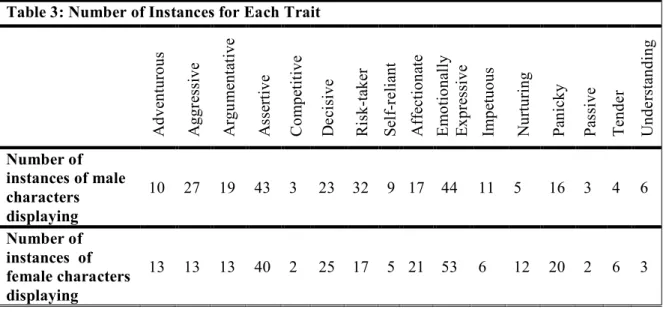
expressive, nurturing, panicky and tender. The number of instances each trait was displayed by either a male or female main character is shown in Table 3.
Table 3: Number of Instances for Each Trait
A dv en tu ro us A gg res si ve A rg umen tat iv e A ss ert iv e Co mp et it iv e D eci si ve Ri sk -t ak er Sel f-rel ian t A ffect io nat e E mo ti on al ly E xp res si ve Imp et uo us N urt uri ng Pan ick y Pas si ve T en de r U nd ers tan di ng Number of instances of male characters displaying
10 27 19 43 3 23 32 9 17 44 11 5 16 3 4 6
Number of instances of female characters displaying
13 13 13 40 2 25 17 5 21 53 6 12 20 2 6 3
Eight of the male characters were coded as having 27 instances of aggressive behavior, whereas only eight of the female characters were counted as having 13 instances, making males 35% more aggressive than females. This data corresponds to a 2.08:1 ratio and aligns with the findings from the study conducted by Evans and Davies (2000). Male characters were also coded as being more argumentative than their female counterparts. Eight male characters from the selected books had 19 separate instances of being argumentative, whereas the female characters only demonstrated 13 instances, making males 18.8% more argumentative than females and equaling a 1.46:1 ratio.
trait according to Evans and Davies (2000) and in this study male characters were 30.6% more likely than female characters to be risk-takers. Nine male characters had 32
instances of risk-taking, or 65.3%, compared to six female characters who were marked as having only 17, or 34.7%, creating a 1.9:1 ratio of males to females.
Similarly, male characters were more self-reliant in the books studied. Four male characters were marked nine times as being self-reliant, whereas three female characters were marked five times. Therefore, 64.3% of males in the books were self-reliant
compared to 35.7% of the females, or a 1.8:1 ratio. No trait was counted for all 12 male characters.
Table 4: Number of Male Characters Exhibiting Each Trait n=12
Adventurous 5 Affectionate 5
Aggressive 8 Emotionally Expressive 10
Argumentative 8 Impetuous 6
Assertive 11 Nurturing 4
Competitive 2 Panicky 8
Decisive 8 Passive 1
Risk-Taker 9 Tender 2
Self-reliant 4 Understanding 6
Seven female characters were coded 21 times as being affectionate, 55.3%, compared to five male characters with 17 affectionate occurrences, 44.7%, making female characters 10.6% more affectionate and equaling a 1:1.2 ratio. Similarly, females were 9.3% more likely to be emotionally expressive. Twelve female characters were coded 53 times as being emotionally expressive and ten male characters were, creating a 1:1.2 ratio. Emotionally expressive was the only trait to have all twelve female characters marked.
Females were coded with one typical male trait, being adventurous. While fewer females were adventurous, four compared to five, female characters were counted 13 times compared to 10. Female adventurousness made up 57% and male adventurousness equaled 43%, or a 1:1.3 ratio. Table 5 provides an overview of the data described above.
Table 5: Number of Female Characters Exhibiting Each Trait n=12
Adventurous 4 Affectionate 7
Aggressive 8 Emotionally Expressive 12
Argumentative 7 Impetuous 5
Assertive 11 Nurturing 7
Competitive 2 Panicky 8
Decisive 7 Passive 2
Risk-Taker 6 Tender 4
Self-reliant 3 Understanding 3
Two personality traits were coded as having less than a 5% difference between male and female characters, assertiveness and decisiveness. Eleven male characters and eleven female characters were coded as assertive. Forty-three different cases for the male characters and 40 for the female characters, making male characters only 3.6% more assertive than females, or a 1.08:1 ratio, the narrowest difference between of all the traits. Decisiveness was only slightly higher percentage-wise with eight male characters having 23 instances of being decisive, or 47.9% and seven female characters having 25 instances with 52.1%. Making females slightly more decisive at a 4.2% difference and a 1:1.09 ratio.
compared to three for females. The differences between each masculine and feminine traits are shown in Figure 2.
Gender Traits: Characters
The only character to express all eight of the characteristics generally associated with his/her gender was Daisy in How I Live Now (Rosoff, 2004). None of the male characters were coded as having all eight of the masculine traits or all eight of the feminine traits.
Discussion
Gender Bias
Though the books chosen for this study were not randomly selected, the distribution of the gender of the main characters was 50/50, suggesting that there is no gender bias in the characters represented in dystopian young adult literature. However, due to the fact that the lists used to select the dystopian books for this research were of mixed type and genre, it is more likely that the even number of male and female characters is a random occurrence.
new insight in to her character; “I think my first memory of my mom is her carrying me on her shoulders through the mall. She would constantly be whispering jokes to me, little jokes between the two of us” (Anderson, 2002, p. 225). This passage demonstrates the change in the narrator’s point of view, changing from Titus to Violet. Violet is considered a main character because of the addition of her first person perspective and because her actions lead Titus to thoughts and actions he would not otherwise consider.
The Diary of Pelly-D (Adlington, 2005) is similar, in that one character is a narrator in an unconventional way. Tony-V, a boy living in a dystopian future finds the diary of a girl named Pelly-D, narrated in first person that gives Tony-V new insight into what has happened to his world. Pelly-D is telling her story as it happens, just as Tony-V is reading it making her a main character as well.
Other books are actually told from multiple narrator perspectives like For the Win by Cory Doctorow (2010). Chapters switch back and forth between different characters, focusing on their thoughts and actions when the narration switches, creating multiple main characters that come together throughout the story to meet a final goal.
Gender Stereotypes
sub-class human, because he is a clone. Matteo not only faces a difficult childhood because of his clone status, but also faces some unique challenges later when he runs away from his childhood home, encountering the full brunt of the reality of the war-torn society that he has been sheltered from.
Another example is Mary in the Forest of Hands and Teeth (Ryan, 2009). Mary’s society is years after a sickness wiped out much of the population and created zombie-like people called “the unconsecrated” (Ryan, 2009). Her town has been isolated by a series of fences, and to Mary’s knowledge there is nothing beyond the fences but forest (Ryan, 2009). Both of these examples provide circumstances for the characters to exhibit character traits they might not have if the books had been set in a “real” world.
While there was some deviation from stereotypical traits in the results, it is perhaps surprising that male characters had more feminine traits than female characters had masculine traits. Males were more impetuous, passive and understanding than female characters, all traits that are typically feminine traits (Evans & Davies, 2000). Being emotionally expressive was a trait expected to be a feminine one, but there were a
surprising number of male characters that were classified as emotionally expressive. This might have something to do with the way Evans and Davies (2000) define being
Instead of Nailer’s emotions either being sad or scared, his reactions show him either being happy or, as in the passage above, arguably laughing at another’s expense.
The high number of emotional expressiveness instances in the books studied might also be due to the fact that many of the dystopia novels presented emotional situations for their main characters such as trauma, death, stress, oppression, torture and terror. All of Marcus’ instances of being emotionally expressive in Little Brother
(Doctorow, 2008), for example, were when he was crying. However, terrorists bomb and invade his city, he is taken to prison and tortured, his friend is beaten and presumed dead, all events that put him in an emotionally charged stressful situations, meaning that he is more likely to cry than a character that is not in such an intense emotional situation.
Female characters were shown to be more adventurous than male characters, perhaps because of their desire (and need) to explore their sometimes dire or oppressive circumstances. Sloe, the main character in Siberia (Halam, 2005), for example, is raised in a prison camp, then sent to a military school, and then flees only to be confronted with different pursuers and attackers. Her situation makes her more likely to actively
investigate her environment for a way out of the situation in which she finds herself. Female characters were also much more nurturing than male characters. That said, aligning with gender stereotypes, they were also given more opportunities to be
Risa, having grown up in a group home has had more experience with taking care of others, perhaps giving her an unfair tendency to take on a nurturing role.
The next highest percentage for a feminine trait was tenderness, with female characters being 20% more tender than male characters. However, female characters only had two more instances of being tender than male characters. Tender was a difficult trait to code because of its subjectivity. Evans and Davies (2000) defined “tender” as handling someone with gentle sensitivity and consideration. Connor in Unwind (Shusterman, 2007) has the most instances of tenderness among the male characters. For example, in a moment with Risa, “He moves his hand across her cheek, wiping away a tear with his finger” (Shusterman, 2007, p. 322).
confidence and resolve that she did not show before discovering her world was not as it seemed (O’Brien, 2010). It could be claimed that many teens act in rebellious manners, giving many teen characters the opportunity to be assertive, but Gaia’s society pushes her to do so.
One of the most decisive characters is Cassia in Matched (Condie, 2010). Cassia must actively disobey the rules and teachings of her society, sometimes having to act quickly with a major decision. In Cassia’s fictional future, teens are paired with their ideal genetic match and then must marry them. Cassia finds that her match might have been a mistake, and she falls in love with a boy not allowed to be in the matching system, making her challenge the world she has grown up in and take actions to disobey it
(Condie, 2010). When faced with sending the boy she loves to an early death or a far away job Cassia thinks,
labor to succeed in virtual worlds, is a stowaway in a shipping container across the Pacific Ocean (Doctorow, 2010). Leonard’s plan to reach his friends in China is a dangerous one, making his most coded trait risk-taker as well, with seven separate cases of risk-taking behavior.
Some of the largest percentage differences were comprised of a small number of actual instances. For instance, three passive traits were coded for male characters and two for female characters, making the numerical difference one trait. However, the percentage difference is 20%. To truly look at the differences in characteristics a larger number of books would need to be coded to generate more data.
It can be argued that dystopias might allow the main characters in the stories to express characteristics outside of their gender norm, but it could also be argued that they have no more advantage over characters in science fiction or fantasy to demonstrate non-stereotypical behavior. Each book could be broken down and analyzed to see if the society itself lent itself to aiding characters having gender traits in either direction. However it is safe to say that the books studied had some surprising results.
Summary and Conclusion
The study of gender in young adult literature spans genres (Jenkins, 1993), but is lacking in the popular genres of science fiction and fantasy (DuMont, 1993; Forrest, 1993). Dystopian young adult literature is a growing and increasingly popular genre with teens (Miller, 2010). Gender role stereotypes, male or female, have not yet been studied in this genre, and as popularity rises it is important to see if it follows the same patterns as other literature. This study set out to observe a selection of dystopian novels for young adults for prevalence and patterns of gender roles.
The study focused on bias and stereotypes of both male and female characters. There was an equal representation of each gender, unlike prior studies which typically showed a bias towards male main characters (Hamilton et al., 2006; West, 2010). Turner-Bowker’s (1996) study an found an increase in female characters, along with Paterson & Lach (1990) who also found a slight increase in female main characters. This study might indicate that the bias towards male main characters, at least in dystopian fiction, is
lessening.
than females exhibited male traits (Evans & Davies, 2000), results which were also observed in this study.
Gender personality traits laid out for the study were designed by Evans and Davies (2000), and divided into eight masculine traits and eight feminine traits. Male characters had higher instances of five of those traits. Female characters also exhibited five of the eight feminine traits more than male characters. However, sometimes characters did deviate from their stereotypical norm. Male characters showed higher instances of three feminine traits, and female characters had one masculine trait in which they had higher numbers than male characters. Finally, two traits were only 5% apart indicating little statistical difference. If the differences in stereotypes were because of the dystopian setting of the books or the definitions set by Evans and Davies (2000) is hard to determine with such a small sample.
References
Babbie, E R. (2004). The practice of social research. Belmont, CA: Wadsworth Thomson Learning.
Bean, T., & Harper, H. (2007). Reading men differently: Alternative portrayals of masculinity in contemporary young adult fiction. Reading Psychology, 28(1), 11-30. doi: 10.1080/02702710601115406
Bem, S. (1981). Gender schema theory: A cognitive account of sex typing. Psychological Review, 88(4), 354-364.
Bereska, T. (2003). The changing boys' world in the 20th century: Reality and 'fiction'. The Journal of Men's Studies, 11(2), 157-174.
Berg, B L. (c2001). Qualitative research methods for the social sciences. Boston: Allyn and Bacon.
Book Buzz: Sun sets on 'Twilight,' for now - USAToday.com. (2010, October13). USA Today. Retrieved October 12, 2010 from
http://www.usatoday.com/life/books/news/20101014buzz14STN.htm
Children's books - List - NYTimes.com. (2010a, February 19). The New York Times . Retrieved September 22, 2010, from
http://www.nytimes.com/2010/02/28/books/bestseller/bestchildren.html
Children's books - List - NYTimes.com. (2010b, September 17). The New York Times . Retrieved September 22, 2010, from
http://www.nytimes.com/2010/09/26/books/bestseller/bestchildren.html
Crabb, P., & Bielawski, D. (1994). The social representation of material culture and gender in children's books. Sex Roles, 30(1/2), 69-79. Retrieved from Academic Search Premier database. doi:10.1007/BF01420740
Daly, B. (1989). Laughing `with,' or laughing `at' the young-adult romance. English Journal, 78(6), 50. Retrieved from Academic Search Premier database. Deaux, K. & Kite, M. (1993). Gender stereotypes. In F. L. Denmark, & M. A. Paludi
(Eds.),Psychology of women: A handbook of issues and theories (pp.107-139). Westport, CT: Greenwood.
Diekman, A. B., et. al., Learning to be little women and little men: The inequitable gender equality of nonsexist children's literature. Sex Roles v. 50 no. 5/6 (March 2004) p. 373-85. doi: 10.1023/B:SERS.0000018892.26527.ea
DuMont, Mary J. (1993). “Images of women in young adult science fiction and fantasy, 1970, 1980, and 1990: a comparative content analysis.” Voice of Youth Advocates 16: 11-15+
http://www.oxfordreference.com.libproxy.lib.unc.edu/views/ENTRY.html?subv w=Man&entry=t113.e2404
Evans, L., & Davies, K. (2000). No sissy boys here: A content analysis of the
representation of masculinity in elementary school reading textbooks. Sex Roles, 42(3/4), 255-270. Retrieved from Academic Search Premier database.
Forrest, L. A. (1993). Young adult fantasy and the search for gender-fair genres. Youth Services in Libraries, Fall 1993: 37-42.
Fox, M. (1993). Politics and literature: Chasing the isms from children's books. The \ Reading Teacher, 46, 654-658.
Gill, Sam D. “Young adult literature for young adult males.” ALAN Review 26 (1999): 61-63.
Gender role. (2009). A Dictionary of Psychology. Oxford University Press. Oxford Reference Online. Oxford University Press. Retrieved September 22, 2010 http://www.oxfordreference.com.libproxy.lib.unc.edu/views/ENTRY.html?subv w=Main&entry=t87.e3416
Graber, J., & Brooks-Gunn, J. (1996). Transitions and turning points: Navigating the passage from childhood through adolescence. Developmental Psychology, 32(4), 768-776.
Hamilton, M., Anderson, D., Broaddus, M., & Young, K. (2006). Gender stereotyping and under-representation of female characters in 200 popular children’s picture books: A twenty-first century update. Sex Roles, 55(11-12), 757-765. doi: 10.1007/s11199-006-9128-6
Education, 30(2), 508-530. Retrieved from PsycINFO database.
Havighurst, R. J. (1972). Developmental tasks and education (3rd ed.). New York, NY: David McKay Co.
Jacobs, K. (2004). Gender issues in young adult literature. Indiana Libraries, 23(2), 19. Jenkins, C. (1998). From queer to gay and back again: Young adult novels with
gay/lesbian/queer content, 1969-1997. Library Quarterly, 68(3), 298. Retrieved from Academic Search Premier database.
Kagan, J. Acquisition and significance of sex-typing and sex role identity. In M. L. Hoffman & L. W. Hoffman (Eds.), Review of child development research (Vol.1). New York: Russell Sage Foundation, 1964.
Kohlberg, L. A cognitive-developmental analysis of children's sex-role concepts and attitudes. In E. E. Maccoby (Ed.), The development of sex differences. Stanford, Calif.: Stanford University Press, 1966.
Kortenhaus, C., & Demarest, J. (1993). Gender role stereotyping in children's literature: An update. Sex Roles, 28(3-4), 219-232. doi: 10.1007/BF00299282
Krippendorf, K. (2004). Content Analysis: An introduction to its methodology (2nd ed). Thousand Oaks, CA: Sage.
Louie, B. (2001). Why gender stereotypes still persist in contemporary children’s
literature. In S. S. Lehr, Beauty, brains, and brawn; the construction of gender in children's literature. (pp. 142 – 151). Portsmouth, NH: Heinemann.
Miller, L. (2010). Fresh hell. What’s behind the book in dystopian fiction for young readers? The New Yorker. Retrieved October 22, 2010, from
http://www.newyorker.com/arts/critics/atlarge/2010/06/14/100614crat_atlarge_m
iller
'Mockingjay' sells more than 450,000 copies in first week. (n.d.). Publishers Weekly. Retrieved September 22, 2010, from http://www.publishersweekly.com/pw/by topic/childrens/childrens-book-news/article/44359-mockingjay-sells-more-than 450-000copies-in-first-week.html
Paterson, S., & Lach, M. (1990). Gender stereotypes in children's books: Their prevalence. Gender & Education, 2(2), 185. Retrieved from Academic Search Premier database.
Turner-Bowker, D. (1996). Gender stereotyped descriptors in children's picture books: Does `curious Jane' exist in literature?. Sex Roles, 35(7/8), 461-488.
Young Adult Books Discussed
Adlington, L. J. (2005). The diary of Pelly D. New York: Greenwillow Books. Anderson, M. T. (2002). Feed. Cambridge, MA: Candlewick Press.
Bacigalupi, P. (2010). Ship breaker. New York: Little, Brown. Booraem, E. (2008). The unnameables. Orlando [Fla.: Harcourt. Condie, A. B. (2010). Matched. New York: Dutton Books. Doctorow, C. (2010). For the win. New York: Tor.
Doctorow, C. (2008). Little brother. New York: Tom Doherty Associates.
Farmer, N. (2002). The house of the scorpion. New York: Atheneum Books for Young Readers.
Halam, A. (2005). Siberia: A novel. New York: Wendy Lamb Books. O'Brien, C. M. (2010). Birthmarked. New York: Roaring Brook Press.
Philbrick, W. R. (2000). The last book in the universe. New York: Blue Sky Press. Reeve, P. (2010). Fever Crumb. New York: Scholastic Press.
Rosoff, M. (2004). How I live now. New York: Wendy Lamb Books. Ryan, C. (2009). The forest of hands and teeth. New York: Delacorte Press. Shusterman, N. (2007). Unwind. New York: Simon & Schuster Books for Young
Appendix A: Initial Selection of Books
Title Author Date VOYA Booklist YALSA Other
The Diary of Pelly D Adlington, L.J 2005 Core 2006
Feed Anderson, M.T. 2002 2002 2002 2003
The Keepers of the Flame Armstrong, Jennifer 2002 2002 Series
The Kindling Armstrong, Jennifer 2002 2002 2002 Series
The Kiln Armstrong, Jennifer 2003 2003 Series
Shipbreaker Bacigalupi, Paolo 2010 2011
Exodus Bertagna, Julie 2008 Core
The Unnamables Booream, Ellen 2008 2008
Bloodsong Burgess, Melvin 2005 Core 2008 Series
Hunger Games Collins, Suzanne 2008 2008 2008 Series
Catching Fire Collins, Suzanne 2009 2009 2010 Series
Mockingjay Collins, Suzanne 2010 2010 Series
Matched Condie, Ally 2010 2011
For the Win Doctorow, Cory 2010 Core
Little Brother Doctorow, Cory 2008 2007 2008 2009
The House of the Scorpion Farmer, Nancy 2002 2002 2002 2003
The Dirt Eaters Foon, Dennis 2003 2003 Series
The Sky Inside Dunkle, Clare B 2008 Core Series
The Walls Have Eyes Dunkle, Clare B 2009 Core Series
The memory of fire Foy, George 2000 2000 Adult
Siberia Halam, Ann 2005 2005 2006
Hole in the Sky Hautman, Pete 2001 2001 P.A.
Dreamhunter Knox, Elizabeth 2006 2007 Series
The Declaration Malley, Gemma 2007 2007 Core Series
The knife of never letting go Ness, Patrick 2008 2008 2009 Series
The Ask and the Answer Ness, Patrick 2009 2009 Series
Monsters of Men Ness, Patrick 2010 2010 Series
Birthmarked O'brien, Caragh M. 2010 2011
Life as We Knew it Pfeffer, Susan Beth 2006 2007 2007 Series
The Last Book in the Universe Philbrick, Rodman 2000 2000 2001
A Darkling Plain Reeve, Philip 2007 2007 Series
Mortal Engines Reeve, Philip 2003 2004 Series
Predator's gold Reeve, Philip 2003 2005 Series
Fever Crumb Reeve, Philip 2010 2009 2010 2010
How I Live Now Rosoff, Meg 2004 2004 2005
The Forest of Hands and Teeth Ryan, Carrie 2009 2010
Unwind Shusterman, Neal 2007 Core 2008
Specials Westerfeld, Scott 2006 2006 Series