Exploring Climate Change as an Opportunity for the reintegration of Environmental Health and Environmental Protection as a Field of Practice
By
Kelli D. Stamper
A Master’s Paper submitted to the faculty of the University of North Carolina at Chapel Hill
in partial fulfillment of the requirements for the degree of Master of Public Health in
the Public Health Leadership Program
Chapel Hill 2013
Advisor Signature
Date
Second Reader Signature
ABSTRACT
This paper explores climate change as an opportunity for the field of environmental
health & protection (EHP) to address the divide it has suffered since the early 1970’s, when
diversification of EHP functions at the federal, state, and local levels led to the organizational
and functional separation of environmental protection functions from environmental public
health. Although this resulted in the creation of the Environmental Protection Agency and a
broadening of the EHP system, it has also created fragmentation and gaps that negatively
impact the ability of the system to effectively identify, respond to, and address emerging and
increasingly complex issues.
Climate change is emerging as perhaps the most important public health issue of the 21st
century. By many accounts, the US is already experiencing the impacts in the forms of extreme
weather events and precipitation variances. Projected impacts will likely threaten the
fundamental systems that support life and health; water, air food, ecosystems, affecting human
health both directly and indirectly. Recognizing the need to address fragmentation and current
silo-approaches to EHP issues, academia, public health leaders, practitioners, and professional
organizations have worked to identify and implement strategies to strengthen the capacity of the
EHP system. Climate change creates considerable greater urgency for systems change to ensure
the capacity of the EHP system to adequate plan for and respond to such global EHP threats.
Understanding, planning for, and taking action towards climate change mitigation and
adaptation will require a comprehensive and integrated environmental health and protection
approach. Along with the challenges and barriers that exist, climate change also provides
opportunities to redefine the EHP field, to affect organizational and workforce changes, and to
meet this and future environmental health challenges. The purpose of this paper is to review
literature about and to recommend action for the reintegration of environmental health and
environmental protection as a field of practice to prepare for and address climate change.
INTRODUCTION
Note that within this paper, environmental health and protection (EHP) will be used to refer to
the environmental protection and environmental public health components of the environmental
health field as a system.
Environmental health services and sanitation have been the backbone of public health in the
United States since 1798 (CDC, 2003). The 20th century saw incredible gains in disease control
and reduction in the areas of environmental health and protection (EHP), resulting in substantial
quality of life improvements (CDC, 2003). However, by the middle of the 20th century,
perceptions about man’s relationship to the environment were changing. The 1960s and 70s was
a time of growing national public awareness and focus on environmental protection; a shift from
the traditional perspective of controlling the environment for the protection and use of man to
protecting the environment from man (McNeill, 2001; Gordon, 1998a). This was in recognition
of the negative impact human activities could have on the environment and of the complexity of
many EHP issues (McNeill, 2001; Gordon, 1998a).
Until that time, at a national level, environmental health and protection activities were
largely carried out by the US Public Health Service. With the transition of many of those
programs to the EPA, states and counties soon followed suite (Johns Hopkins, 2008). This
resulted in organizational and functional divides between environmental protection and
environmental public health programs. Environmental protection programs have tended to enjoy
located at the state and local level have experienced steady resource declines. At the same time,
the EHP field was experiencing a break in the link to public health, with more and more
practitioners coming from technical backgrounds that lacked a public health focus. What
resulted has been described as an EHP system at a crossroads and severely challenged to meet
today and tomorrows EHP challenges (Gordon, 2008; CDC, 2001).
Climate change has emerged as possibly the most important public health issue of the 21st
century and certainly one with global health implications. Academia, EH professional
organizations, and EH leaders have focused much attention of the past several decades to
identifying the needs of the profession, and to developing and implementing strategies to meet
them. Much of this work has focused on identifying core competencies, improving academic
curricula, targeting capacity building at individuals and state and local agencies, and on
influencing policy related to EHP. Significant voids in leadership, organizational divides, and
the need for a systems approach have also been widely recommended to strengthen the system to
ensure it is capable of meeting EHP challenges of today and the future (Gordon, 1998 & 2008;
Orians et al., 2009)
Climate change, despite the challenges it poses, also provides an opportunity for the
reintegration of environmental health and protection. Climate change is a complex, multifaceted
issue. Expertise and strategies for reducing the factors that contribute to climate change, as well
as promoting strategies that help populations plan for and adapt to climate change, will
necessitate a comprehensive, multidisciplinary and interdisciplinary approach. To provide a
comprehensive approach would require components of the EHP to functionally operate more
closely, in a more integrated way to address ecological and human health protection issues
and implement climate change policy, EHP participation to ensure that such policies consider
climate change impacts from an EHP approach is critical. Otherwise, EHP functions continue to
be carried out in a fragmented approach, rather than comprehensively. A comprehensive
approach would link the health of the environment to human health and help to implement
strategies that are framed by a broad, public health perspective. Climate change mitigation and
adaptation strategies offer opportunities in other areas of EHP. For example, efforts to mitigate
the impacts of climate change through reducing greenhouse gas emissions can result in reducing
overall volumes of traffic. Such initiatives may result in improved biking and walking paths,
which increase physical activity, promote safer communities, and reduce motor vehicle related
injuries.
LITERATURE REVIEW
20th Century EH Successes
Data published by the CDC in the MMRW (1999) identifies the increase in life
expectancy in the US to have been 30 years since 1900, with 25 of those years of life gained due
to improvements in public health. Many of those tremendous public health successes that
resulted in increased life expectancy and increased the standard of living for millions were in the
field of environmental health and protection through the reduction and control of disease and
injury (McNeill, 2001; Orians, Rose, Hubbard, Sarisky, Reason, Bernichon, Liebow, Skarpness,
& Buchanan, 2009). Improved sanitation, food safety, vector control, and water quality,
traditional environmental public health focus areas had significant impacts on public health and
The Organizational Divide of EHP
Despite these successes, by the late 20th century the, public health system in the U.S. was
described as fragmented, neglected, and a system of siloes, with no one entity in charge and
programs organizationally divided (Shalauta, Burke, Gordon, Stern, & Tran, 1999; Resnick,
Zablotsky & Burke, 2009). This echoes the conclusion of the 1988 Institute of Medicine report
in describing the complexity and fragmentation of the nation’s public health system. At a
national level, through the first half of the 20th century, the US Public Health Service (PHS) was
responsible for a broad range of public health related issues and served as the primary federal
agency for environmental health and protection (Parascandola, n.d.). The success of the PHS’s
Malaria Control Program in the control and prevention of malaria, dengue, and typhoid fever
resulted in its conversion of the program into the Centers for Disease Control (CDC) in 1946.
Parascandola’s history of the PHS (n.d.) details the transition of programs such as air and
water pollution and solid waste from the PHS to other departments and agencies. Many
programs were ultimately assigned to the Environmental Protection Agency (EPA) when it was
established in 1970. In describing the organizational makeup of environmental health in the US,
Gordon (1998) describes this period of transition of environmental health and protection
responsibilities from the PHS to the EPA and a host of other departments and agencies
(radiological health, occupational safety, housing, and pesticides) as a response to growing
skepticism by both Congress and public health leaders that the PHS had the commitment to both
adequately prioritize environmental health and to deal with the growing public and political
demand for action on emerging environmental health issues (Gordon, 1998 & 2008; Berg, 2005).
Similar organizational shifts followed at the state and local levels (Gordon, 2008). Historically,
within public health, over several decades these responsibilities have been divided and assigned
across many agencies and levels of government (Johns Hopkins, 2008; Gordon, 2008). A 2008
report by the Johns Hopkins School of Public Health identified only 5 states that operate
combined environmental protection and environmental health programs. In all others,
environmental protection is organizationally and functionally divided from public health (Johns
Hopkins, 2008).
The Fragmentation of EHP
This division of environmental health functions to a host of various agencies and entities
at local, state, county, federal, and tribal levels has resulted in a complex environmental health
network and the lack of a clear organizational structure with no one entity in charge (Johns
Hopkins, 2008). Responsibilities are divided among federal, state and local agencies, all with
significant variances in resources, authority, capacity (Johns Hopkins, 2008). The Pew
Environmental Health Commission (2000) identified these gaps in the system of EHP and the
lack of organizational structure as negatively influencing efforts to reduce and prevent acute and
chronic diseases, including those linked to environmental conditions such as asthma, lung
cancer, and birth defects.
Gordon (1998) identifies the failure of leaders in public health to recognize that
environmental health is not just the activities practiced by health departments, but is a profession
practiced by many in the field of environmental health and protection. Environmental health
professionals includes those educated and trained in the field and practice of environmental
health and are the minority by far, working primarily in health departments at the state or local
level (Gordon, 1998). The majority of those working in the field of environmental health are
environmental health professionals. Thus, most professionals working in EHP have backgrounds
other than in public health, including those working in local and state health departments. This
has served to further the perception within and outside the EH profession that environmental
public health is separate from environmental protection, when in fact, they are parts of the same
whole (Gordon, 1998, 2006, 2008).
Practitioners recognized that fragmentation has resulted in a lack of operational
collaboration and standardization between components of the EHP system. They further
recognize that this vertical, or silo approach. “…makes it hard to communicate a coherent vision
of environmental health” (Berg, 2005, pg. 11). EHP becomes defined by the organizational
setting in which it is performed and the specific defined or adopted functions (inspections,
permitting) carried out, rather than by a comprehensive definition of EHP. Gordon and Stern
(1998) argue that the term environmental health & protection is a multidisciplinary field of
practice, rather than a profession, and thus should be called environmental health and protection
EHP) spell it out here to convey this and to eliminate the perception of separation between the
environment and human health that the separate terms or organizational structure promotes. This
term also better communicates environmental health and protection as a component of public
health, regardless of where the responsibilities for activities and functions lie (Gordon and Stern,
1998). They define the goal of EHP as …”to ensure an environment that will provide optimal
health and safety, ecological well-being, and quality of life for this and future generations”
(Gordon & Stern, 1998, pg. 3).
Gordon (2008) discusses the failure of the US EHP system to overcome the fragmentation
that resulted from diversification of EHP functions to modernize to a more comprehensive,
as having the potential to devastate ecosystems and create serious EH problems. He asserts the
importance of local EH agencies in responding, with an emphasis on the importance of acting as
leaders or being left behind. Gordon specifically urges public health and EH leaders to:
promote major improvements in environmental health and protection through leadership and the communication of a comprehensive vision for EHP;
embrace the comprehensive field of EHP practice and build two-way bridges across organizational divides to improve practice;
understand and embrace program marketing;
engage in lobbying and public policy advocacy efforts as a role of leadership;
education and workforce development for EH practitioners, regardless of organizational identify that trains ands and prepares individuals for the scope and breadth of EHP.
develop a global warming prevention guide; and
leading efforts to restructure health focused programs to be more organizationally aligned and administered to improve effectiveness and reduce redundancy.
Berg (2005) goes further in characterizing the fragmentation of the EHP system as not
just organizational, but philosophical and territorial. This article refers to environmental public
health and environmental protection as not just different components of the continuum that is the
field of EHP, as others have described (Gordon, 2008), but as two separate fields. Tensions
resulted from the need to compete for resources, support, and recognition (Berg, 2005).
The Philosophical Divide
Participants in Berg’s article characterize an outcome of the diversification of the various
EHP programs, for example water and air quality, as a series of siloes, much as the organizations
themselves became, protective of what was viewed as their purview and often philosophically at
odds. These motivations drove the environmental movement and the creation of the EPA. They
movement as spiritual, focused on protecting nature for its own sake. The environmental
movement increasingly viewed EHP as part of the establishment and in business with industry,
and thus, part of the problem. Berg describes a key disconnect between EP and EH as a “better
safe than sorry” approach (environmental movement) versus a “show me the science” (traditional
public health approach). This philosophical divide is further described by Berg (2005) as the
environmental movement operating from a belief that science may not be advanced enough to
capture or identify risk to the environment or human health in time to prevent significant harm or
exposure. On the other hand, traditional public health is grounded in science as a basis for
decision making and action.
Interviews with local and state EH practitioners indicated that environmental protection
priorities can seem to place more importance on “…the health of the environment that the health
of humans” (Berg, 2005, pg. 2) and that the lack of value placed on science creates mistrust.
Conversely, the environmental protection participants indicated frustration with the reliance on
science to link cause and effect, rather than a precautionary principle approach, when science can
often lag far behind technology and chemical production (Berg, 2005). The article discusses the
divide between the “show me the science” and the precautionary principle approach (Berg,
2005). The precautionary principle supports putting the burden of proof on scientific evidence
that the activity or product is not harmful, rather than the current approach, which requires a
burden of scientific evidence to prove harm before an activity or product will be regulated
(Raffensperger, Schettler, & Myers, 2000).
According to Raffensperger, Schettler, & Myers, (2000), the precautionary principle
offers an alternative approach to our current regulatory approach, which is failing to prevent
human health problems. The authors argue that the precautionary principle not only offers a
different approach to regulation, but a framework for changing how we make decisions about
activities that pose the risk of serious threat to human or environmental health. Smith (2000)
agrees, arguing further that a precautionary approach must be integrated into decisions on
environmental health policy. Berg (2005) concludes that the precautionary principle approach is
prevention focused the same as the public health practitioners’ approach, just viewed from a
different lens. If seen in this light, the goal is the same and provides an EHP leadership
opportunity to work together for that common goal (Berg, 2005).
In the past several decades, disease outbreaks, disaster response, climate change, and
terrorism are examples of new and complex public health issues that have challenged the system
and highlighted gaps in workforce competencies, infrastructure, organizational structure and
leadership that limit the ability of EH to adequately address these emerging issues (Orians, et al.,
2009; APHA 2011). Through surveys of EH practitioners to evaluate the effectiveness of
community-based EH initiatives, Orians et al. (2009) found that many perceived local health
agencies to be reactionary, operating in silos, working in disconnect from the community, and
importantly, lacking “…effective linkages among environmental health, environmental
protection, and public health” (pg. 876).
Systems Thinking
Efforts within public health over the past century have included better understanding
relationships between risks factors and disease, and identifying better processes for protecting
the public’s health, based on those relationships and interconnectedness (Leischow & Milstein,
2006). Seeing the interconnectedness, the relationships between the parts is to see something as
Systems thinking is an approach to public health problems that has been applied more
widely in industry and the social sciences until recently. It involves looking at the
interconnections and system as a whole and recognizes the necessity of a multidisciplinary
approach to understand causes and solutions. ““Simply put, a system is an organized collection
of parts (or subsystems) that are highly integrated to accomplish an overall goal. The system has
various inputs, which go through certain processes to produce certain outputs, which together,
accomplish the overall desired goal for the system” (“Systems thinking”, (n.d.). Arndt (2011),
described challenges to improving environmental health practice within the Indian Health
Service’s (IHS), Division of Environmental Health Services (DEHS) which provides services to
federally recognized American Indian/Alaska Natives in the US and includes a focus on
providing traditional sanitation practices instead of a broader, more comprehensive and systems’
thinking approach.
In recent years, the interconnectedness of issues and the necessity to compromise to
balance environmental quality and human health interests has been recognized (APHA, 2011;
Gordon, 2008; Orians et al., 2009). The public health approach is a framework for the
systematic approach to identifying public health issues, their risk and protective factors, and
evidence-based strategies for prevention. There are inherent benefits to a functionally connected
and integrated working partnership of EP and EH which include linking the protection of the
environment to human health and using a public health approach to address EHP issues. The
reemergence of community health focused programs such as CDC’s Protocol for Assessing
Community Excellence in Environmental Health (PACE EH) and the involvement of community
and grassroots organizations partnering with EHP programs are hallmarks of this paradigm shift
projects detailed by EHP practitioners as including a reconnection with environmental protection
programs to create stronger networks for EHP planning. The prevention approach of
environmental health was described as a first cousin of the precautionary approach of
environmental protection; closely aligned in purpose (prevention) and a basis for rebuilding
bridges to create a more effective and broad based EHP system (Berg, 2005).
Education, Training, and Competencies for the EHP Workforce
Shalauta, Burke, Gordon, Stern, & Tran (1999) attribute the crossroads of the practice of
EHP, in part, to the lack of adequate training for professionals in EHP. They detail the findings
and recommendations of the Crossroads Colloquium, a forum of EHP leaders who came together
in an effort to identify training needs and strategies for the profession. Today’s EHP workforce
is comprised of professionals and technicians from a wide variety of educational, professional,
and work backgrounds due to the multidisciplinary nature of the field itself. As suggested by
others writing on the topic, the lack of adequate technical and non-technical training, as well as
the absence of public health training and backgrounds in much of the workforce, has contributed
to individuals and systems that fail to approach EHP from the public health perspective and as a
continuum across environmental public health and environmental protection. They fail to
implement an integrated and comprehensive approach to the complex emerging and future EHP
problems
Shaluta et al. (1999) argue that schools of public health have not met the training needs of
EHP practitioners. At a time when we are facing emerging and increasingly complex EHP
issues, budget cuts have further reduced the training available to assure professionals working in
the field of EHP are adequately trained. According to research by Resnick, Zablotsky, & Burke
available in the US. Regulatory mandates specific to the organizational setting in which EHP
functions are carried out have defined the field, rather than the issues defining the work.
As advocated by Gordon, who participated in the forum, the Colloquium agreed that
redefining EHP was necessary, as was a definition that reflected the expanded scope of the field
of practice (Shaluta et al., 1999). The participants agreed uponthe following definition, which
reflects EHP responsibilities and functions that cut across organizational lines:
Protection against environmental factors that may adversely impact human health or the ecological balances to long term human health and environmental quality, whether in the natural or human-made environment. These factors include, but are not limited to air, food and water contaminants; radiation, toxic chemicals, wastes, disease vectors, safety hazards, and habitat alterations (p 4).
The colloquium participants focused on developing recommendations for broad based
core competencies to include the non-technical skills necessary for the EHP workforce and
strategies for improving the EH education system (Shaluta, et al, 1999). Non-technical
competencies, which are also often referred to as professional skills, have been defined as:
"a cluster of related knowledge, skills, and attitudes that affects a major part of
one's job (a role or responsibility), that correlates with performance on the job,
that can be measured against well-accepted standards, and that can be improved
via training and development" (APHA,2001, pg 14).
In 2000, the American Public Health Association (APHA) brought together EH experts
from across the country to further define core competencies for EH, focusing primarily on local
level EH practitioners. The Environmental Health Competency Project was the result,
identifying 14 core competencies necessary for EH effectiveness. This was an effort to identify
key skills and gaps with the aim of translating competencies into improved training and
ultimately, infrastructure and capacity, within local EH programs to meet emerging and future
A. ASSESSMENT
Information Gathering: The capacity to identify sources and compile relevant and appropriate information when needed, and the knowledge of where to go to obtain the information.
Data Analysis and Interpretation: The capacity to analyze data, recognize meaningful test results, interpret results, and present the results in an appropriate way to different types of audiences.
Evaluation: The capacity to evaluate the effectiveness or performance of procedures, interventions, and programs.
B. MANAGEMENT
Problem Solving: The capacity to develop insight into and appropriate solutions to environmental health problems.
Economic and Political Issues: The capacity to understand and appropriately utilize information concerning the economic and political implications of decisions.
Organizational Knowledge and Behavior: The capacity to function effectively within the culture of the organization and to be an effective team player.
Project Management: The capacity to plan, implement, and maintain fiscally
responsible programs/projects using appropriate skills, and prioritize projects across the employee's entire workload.
Computer & Information Technology: The capacity to utilize information technology as needed to produce work products.
Reporting, Documentation, and Record-Keeping: The capacity to produce reports to document actions, keep records, and inform appropriate parties.
Collaboration: The capacity to form partnerships and alliances with other individuals and organizations in order to enhance performance on the job.
C. COMMUNICATION
Educate: The capacity to use the environmental health practitioner’s front-line role to
effectively educate the public on environmental health issues and the public health rationale for recommendations.
Communicate: The capacity to effectively communicate risk and exchange information with colleagues, other practitioners, clients, policy-makers, interest groups, media, and the public through routine activities, public speaking, print and electronic media, and interpersonal relations.
Conflict Resolution: The capacity to facilitate the resolution of conflicts within the agency, in the community, and with regulated parties.
Marketing: The capacity to articulate basic concepts of environmental health and public health and convey an understanding of their value and importance to clients and the public.
Technical Competencies Covered in NEHA’s Registered Environmental Health Specialist/Registered Sanitarian Exam
Basic Environmental Health and Protection
Basic Science o Toxicology o Physics o Chemistry o Geology o Biology
Epidemiology
o Environmental o Occupational
Communicable Chronic Disease
Environmental Law
Risk Management (APHA, 2001, pg 34).
As advocated by Gordon and Stern (1998), Shaluta et al. (1999), promote viewing EHP
as a field of practice, rather than a specific profession, as an essential paradigm shift. This
includes within academia. Shaluta et al. (1999) conclude that EH education should be redefined
to reflect the multidisciplinary nature of the field to ensure that professionals in EH have the
skills and knowledge required to apply a comprehensive, and ultimately, public health approach
to EHP issues. This multidisciplinary picture includes nurses, engineers, epidemiologists,
biologists, biostatisticians, ecologists to name a few (Gordon, 1998 & 2008). This change
would be a shift from recent and current curricula which includes a focus on health care policy,
but minimal emphasis on the core disciplines of public health such as epidemiology, and
environmental health. Such a transformation of the education system will require collaboration between agencies, professional organizations, EH leaders, and academia to assure success
(Shaluata, et al., 1999).
The Orians et al. ( 2009) research was focused on evaluating the effectiveness of the
communities to identify and address environmental health issues together, emphasizing
community engagement and empowerment (CDC PACE EH, n.d.). Survey participant (EH
practitioners) responses highlighted the impacts that engagement with the community and
partners on EH issues had on broadening their perspective on what falls within the field of EH.
For example, participants recognized how interconnected transportation, the built environment,
and zoning/development are to environmental health and protection. Other outcomes relayed by
participants included rebuilding relationships with environmental protection partners for a
collaborative focus on EH issues, as well as stronger partnerships with other entities and
jurisdictions for a more synergistic approach and perspective, rather than what has been the view
of EH internally as primarily having a regulatory function (Orians et al., 2009). Leadership, a
gap identified in the EH and PH workforce development in public health agencies, is a key focus
of the PACE EH method. It also provides a means for implementing the 10 Essential
Environmental Health Services (CDC PACE EH, 2001).
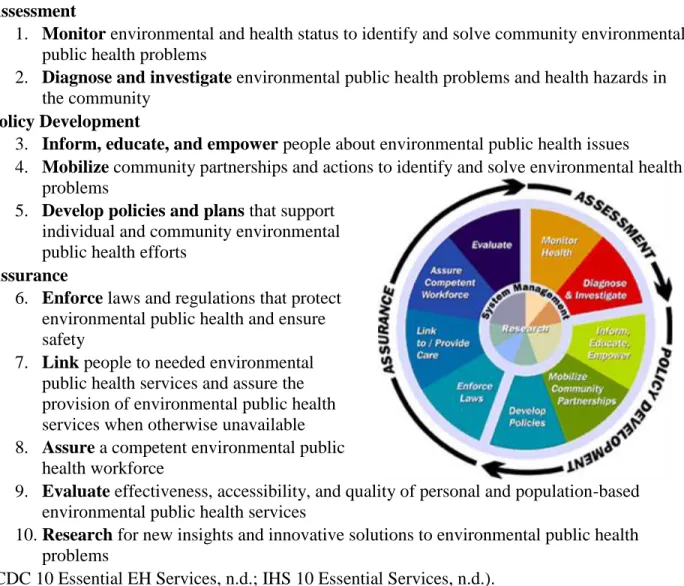
The 10 Essential EH Services
The 10 Essential Environmental Health Services is a framework that has been developed for
identifying and implementing comprehensive, community-based EH services effectively and has
been widely adopted by EHP programs nationally, including the Indian Health Service (DHHS)
(IHS 10 Essential Services, n.d.). The essential services are identified as falling into 3 key
categories: assessment, policy development, and assurance. These core functions are further
Table 1: 10 Essential Environmental Public Health Services
(CDC 10 Essential EH Services, n.d.)
Assessment
1. Monitor environmental and health status to identify and solve community environmental public health problems
2. Diagnose and investigate environmental public health problems and health hazards in the community
Policy Development
3. Inform, educate, and empower people about environmental public health issues
4. Mobilize community partnerships and actions to identify and solve environmental health problems
5. Develop policies and plans that support individual and community environmental public health efforts
Assurance
6. Enforce laws and regulations that protect environmental public health and ensure safety
7. Link people to needed environmental public health services and assure the provision of environmental public health services when otherwise unavailable 8. Assure a competent environmental public
health workforce
9. Evaluate effectiveness, accessibility, and quality of personal and population-based environmental public health services
10. Research for new insights and innovative solutions to environmental public health problems
(CDC 10 Essential EH Services, n.d.; IHS 10 Essential Services, n.d.).
The 2002 UK Health Development Agency’s report on the role of EH as a key partner in
meeting future public health goals echoes several of these key points regarding the shrinking
scope of EH practice, concern about the fragmentation of the EHP field, and the negative impact
the focus on prescribed and regulatory enforcement responsibilities have had on effective
practice. Unintended negative consequences of the diversification of the EHP system included
the practice of EH becoming organizational and function specific, with EHP commonly defined
health, there has been a growing shift towards health care and treatment, and away from the
traditional population and community health. Over decades, the relationship and collaboration
between environmental protection and environmental public health programs continued to erode,
with public health more and more removed from ecological health issues and operating from a
regulatory approach, rather than more holistically and with the issues driving the work.
The Health Development Agency report (2002) outlines the essential components of a
strategic EH vision to reinvigorate the profession and reintegrate a focus on assessing and
addressing broad determinants of health. The connection that EH practitioners have to the local
community, the holistic view of how various factors impact human health, and the direct
influence the functions of EH have on both human health and maintaining healthful
environments illustrate the importance of EH in both EH practice and leadership roles. Surveys
of EH practitioners conducted as part of the research for this report indicated a desire to
implement a more holistic approach to EH practice, but organizational structure and prescriptive
practice duties have created significant barriers to such changes in approach that are necessary
for effective EHP. Also significant was the impact of EH and organizational leaders without
public health backgrounds on the direction and strategic vision of EH programs. As described in
this report, this shift contributed to EHP being reduced to its regulatory functions and a move
away from a comprehensive public health approach that focused on broader determinants of
population health (Health Development Agency, 2002, pg 5).
The authors stress that the resulting lack of skill development and dissatisfaction in the
existing EH workforce, as well as the limited scope of environmental health practice, is
contributing to the decreasing number of individuals entering EH training and education
practitioners in meeting the nation’s public health goals based on a strategic vision that embraces
a broader scope of practice and a more holistic, integrated approach. Training, organizational
restructuring, benchmarks, and skill testing are emphasized in their vision document, as is
dedicated lines of funding and resources to achieve these objectives. The report emphasized
public health leadership and strategic planning as essential to success in creating and maintaining
an effective EHP system (Health Development Agency, 2002).
From at the Mercy of Nature to Molding Nature to the Needs of Man
J. R. McNeill (2001) writes about the environmental impacts that have occurred in the
20th century. He suggests that fundamental changes in how we live occurred in the last hundred
years. These changes include the ability of human activity to impact the planet for the first time.
He describes the successes in quality of life and the human condition as directly linked to the
availability of cheap oil. Cheap and plentiful oil fueled the industrial revolution and led to
tremendous population growth and movement. These changes allowed man to realize
improvements in the quality of life for millions. However, these same advancements have
shaped many of the environmental challenges we face today and will face tomorrow (McNeill,
2001). Ecosystem destruction, the migration of toxic chemicals throughout ecosystems on a
global scale, and climate disruption from greenhouse gasses are examples of global impacts that
are directly linked to human activity. However, according to the author, a perception gap
remains between man’s historical view of man’s relationship to nature and the realities of the
modern age of global environmental impact. This historical view of being at the mercy of nature
and man lacking the ability to have any lasting negative impact on the earth is not in line with
modern realities that industrialization, the population explosion, and technological advances have
A challenge we face in addressing growing environmental threats to human health is the
view held by many from the past century that our impact is small and insignificant. Further, the
ability of man to manage and manipulate the environment – to change the flow of rivers and
create agricultural valleys in deserts - has lent itself to the view that no matter what happens, we
can use technology and science to fix it (McNeill, 2001).
Climate Change and EHP
Luber and Hess (2007) characterize climate change as a “novel public health problem
with unprecedented scope, timeline, and complexity” (Luber and Hess, 2007, pg. 44). The
interdependence of the natural environment and human health is termed eco-environmental
health by Strand, Tong, Aird, & McRae (2010). Much work over the past several decades to
revitalize the EHP system has been in anticipation of such a far-reaching, complex public health
issue. The recognition of climate change as an emerging and now significant EHP problem has
served to not only highlight challenges, but also the opportunities for public health to regain a
leadership role in environmental issues. Climate change is ultimately a public health issue
(Gordon, 1998). The health of the environment and public health are intrinsically linked and will
require an integrated environmental protection and public health approach to understand and
address them. This is an opportunity to create the systems change that has been advocated over
the past several decades, to include realigning EHP programs organizationally and functionally
to create a more integrated system. This crisis also provides opportunities to capitalize on public
and political support for climate planning and action to create fundamental changes with EHP
practice, to include adoption of appointment and performance standards, changes in funding for
EH programs to move away from prescriptive and mandated service approaches, and to affect
Three broad categories of health impacts are associated with climatic conditions:
impacts that are directly related to weather and climate; impacts that result from environmental
changes that occur in response to climatic change; and impacts resulting from consequences of
climate-induced economic dislocation, environmental decline, and conflict (McMichael, &
Martens, 2002). Despite the growing awareness of climate change as a potentially serious global
threat, a perception gap exists between that awareness and connecting awareness to human health
threats and actions to avert such threats (Portier, Tart, Carter, Dilworth, Grambsch, Gohlke,
Hess, Howard, Luber, Lutz, Maslak, Prudent, Radtke, Rosenthal, Rowles, Sandifer, Scheraga,
Schramm, Strickman, Trtanj, Whung, 2010). The authors (Portier et al., 2010) suggest this is
because climate change continues to be portrayed by the media as primarily an ecological threat.
Coverage is most often related to disappearing ice caps and associated species challenges. Such
presentations make the issues seem abstract and hard to connect to human activity, both in the
sense of contributing human activity and strategies to reduce or prevent climate change effects.
Climate research has also focused primarily on environmental impacts, so there is a dearth of
information on human health effects. According to Portier, et al. (2010), it is clear that climate
change endangers human health, but there is need to improve the science and knowledge base on
how it occurs in order to anticipate and respond effectively, and equally importantly, guide the
public and policymakers on these issues.
This was affirmed in the summary reports on climate change and health by the Chartered
Institute of Environmental Health (Stanwell-Smith, 2008), which identified key public health
impacts of climate change to be in the areas of heat and weather extremes; injuries and infections
related to storms and weather variants; respiratory health issues from degraded air quality; food
vectorborne and zoonotic diseases. Climate change has the potential to undo many of the public
health and quality of life advances that EHP was instrumental in achieving in the 20th century
(Stanwell-Smith, 2008). The report suggested that the perception of health risk would
significantly influence the individuals willingness to take environmental action, and that this
disconnect has already delayed development of policy towards climate change mitigation and
adaptation within the public health system (Stanwell-Smith, 2008).
EHP has a key role to play in adaptation and mitigation planning and action, as well as in
efforts to build community resilience to climate change. Mitigation is aimed at reducing the
sources and emissions of greenhouse gases. Adaptation is defined by the Intergovernmental
Panel on Climate Change (IPCC) as the natural or human systems adjusting to the actual or
expected effects of climate change. Resilience, although a term often used interchangeably with
adaptation, might be more correctly understood as the capacity to effectively respond to the
effects of climate change and even recover from or thrive (Stanwell-Smith, 2008).
While mitigation strategies were proposed for reducing greenhouse gas emissions, the
CIEH report argues that EHP should be more focused on adaptation strategies to increase
community resilience to climate change because mitigation alone will not be effective and will
take years to have a measurable impact (Stanwell-Smith, 2008; Environmental Defense Fund,
2008; Ebi, Kovats, and Menne, 2005). Adaptation includes the strategies, policies, and measures
taken to reduce the eco-environmental health impact of climate change. Key considerations in
adaption planning are strategies to strengthen the adaptive capacity of communities and
populations; that is, their capacity to cope with the effects of climate change (Ebi, Kovats, and
Surveillance and climate models are in the early stages of development and use in trying
to understand and predict climate impacts. Only recently have climate model developers
recognized the need to downscale global models to local and regional levels. Localizing climate
threats is now viewed as inherently important in motivating local and regional action and policy.
Downscaling helps answer the “so what does this mean to me?” questions (Cooney, 2012). As policy makers begin recognizing the need for and moving forward with climate policy work,the
presence and role of EHP is important in framing climate change as a public health issue and
communicating that despite the uncertainty and gaps in scientific knowledge about the issue. ,
Strategies to assess vulnerability and implement adaptation measures should begin
(Stanwell-Smith, 2008; Auld, Hatcher, 2010). EH promotion is defined as “any planned process employing
comprehensive health promotion approaches to assess, correct, control, and prevent those factors
in the environment that can potentially harm the health and quality of life of present and future
generations” (Howze, Baldwin, and Kegler, 2004, pg 1). Health promotion concepts have not
been widely implemented within the EH field in the past, which Auld et al. suggest may have
been causative in the lack of healt protectionmhas resulted in the lack of proficient
environmental health promotion specialists as well as a lack of robust environmental health
education interventions directed to both the general population and those communities
specifically coping with environmental contamination (Auld, Hatcher, 2010). Adaptation
planning and preparation should also include considerations of unintended negative
consequences and competing interests. The authors use grey water reuse and potential infection
and pollution risks associated with this practice as an example (Stanwell-Smith, 2008).
The Environmental Defense Fund conducted a survey of public health representatives in
and capacity within their organizations. More than 70% responded positively that climate
impacts were already being experienced within their jurisdictions and will be experienced in the
next 20 years (Environmental Defense Fund, 2008). Interestingly, although more than half of
program directors felt that climate change preparation was an important priority; very few
identified it as an actual program priority in their organization (Environmental Defense Fund,
2008). However, the survey also revealed a lack of perceived expertise to prepare for public
health problems that arise from climate change. Seventy-seven percent of local health
directors felt they lacked the expertise to assess local health impacts of climate change
in their region, and 83% felt they lacked the expertise to craft adaptation plans. Local
health directors did not perceive that much help is currently available from their state
or federal public health agencies (Environmental Defense Fund, 2008).
In the 2009 article on strengthening the EH workforce, Resnick, Zablotsky, & Burke
emphasize systems, competencies, relationships, and resources as critical for meeting the
mission of public health. The changing scope of environmental health to include global
challenges, such as climate change and water shortages, requires an interdisciplinary,
comprehensive approach. Such issues and failures of the public health system to adequately
respond and protection the public health during disasters such as Hurricane Katrina, have shone
a spotlight on the critical importance of effective public health and infrastructure gaps.
Decades of declining funding has had direct and indirect negative impacts on that workforce:
morale, training, understaffing, loss of program components and narrowed scope, recruitment
and retention issues, and weakened core programs. On the issue of climate change, although
many of the impacts are within the purview of local and state EH programs, such as food,
impacts been seen with climate change and responding accordingly (Environmental Defense
Fund, 2008).
Despite these significant and pervasive EHP workforce issues, Resnick et al. (2009)
identify opportunities for strengthening the EHP workforce. Technological and scientific
advancements provide great potential for improving public health capacities. Other significant
opportunities include the greater awareness of environmental health issues and ecological
perspectives that can influence interest in pursuing careers in EHP, as well as the attention and
support the Obama Administration has shown in regards to public health prevention and climate
change issues (Resnick et al.2009; Gordon, 2008). EHP leadership development and action is
vital for translating these opportunities into a strengthened, restructured, and coordinated EPH
system (Resnick et al, 2009).
According to Gerding and Price (2012), opportunities for and examples of improvements
in EHP systems to improve efficiency and effectiveness include funding and the adoption of
performance standards. This article discusses the funding for public health prevention through
the Affordable Care Act of 2010. Grants were provided to 76 health departments across levels of
government in the US to implement capacity building and performance management strategies.
Implementation of Environmental Public Health Performance Standards provides a mechanism
for integrating the 10 Essential Environmental Health Services into the performance framework.
This allows for a systems-level assessment of performance and the identification of key areas for
improvement. Examples of outcomes and impacts in health departments that had implemented
the performance standards to improve performance management included uniting EH programs
with partners and stakeholders; of improved data sharing across organizational boundaries; and
In 2003, CDC issued the National Strategy to Revitalize EH in response to growing
recognition that EH programs and the EHP system was not adequately prepared and structured
to address the growing complexity of EHP issues and emerging threats such as climate change,
reemerging vectorborne diseases, and terrorism (CDC, 2003). CDC identified the leadership
role the agency should play in efforts to build capacity at local, state, tribal and regional levels
to improve infrastructure and EHP response. The report also strongly emphasized a focus on
building practitioner-level leadership and system capacity. The strategy for revitalization
included the following goals and objectives:
Build capacity to include improving access to technology and other tools;
Support research to better define effective approaches to emerging EH issues;
Foster leadership to enhance partnerships and leadership within EH;
Communicate and marketing to enhance the understanding of EH; and
Develop the workforce to include defining scope of work and competencies needs to
meet emerging EH needs.
Create Strategic Partnerships to advance goals and initiatives and improve
communication ad interaction among stakeholders. (CDC, 2003).
The CDC, the National Association of City and County Health Officials (NACCHO), the
National Environmental Health Association (NEHA), and the American Public Health
Association (APHA) have all undertaken initiatives aimed at the revitalization goals identified in
the CDC’s 2003 plan. Examples include Mobilizing for Action through Planning and
Partnerships (MAPP). MAPP is a framework for community health improvement through
strategic planning that involves focuses on community empowerment and leadership. In
the resources available or needed to address them. Both the process of strategic planning and
prioritizing, and the partnership with the community are aimed at ultimately improving
community health and public health performance (NACCHO MAPP, n.d.).
The promulgation and adoption of National Public Health Performance Standards (NEnvPHPS)
and the integration of the 10 Essential Services of Environmental Public Health have also
focused on building capacity through workforce development and program performance. The
CDC has used funding as a mechanism to strengthen environmental health capacity, providing
cooperative agreement grants that address improving EH service delivery, EH capacity to
respond to emerging and future threats, and improving the science base in EH to directly
improve EH practice (CDC Capacity Building, n.d.).
The NEnvPHPS provide a mechanism for measuring performance based on impact. This
is significant shift from the way program effectiveness has been widely measured within EHP
programs in the past; numbers of functions performed (inspections for example) or similar
counts of something done. Moving to impact measures will also require a focus on improving
the infrastructure. This will be a shift in focus from measuring functions to identifying and
implementing ways to measure impact on protecting and improving health (Buchanan, 2007).
Leadership development, recognized widely as a gap in EHP, has been a focus across
EHP professional organizations, to include the CDC through its Environmental Public Health
Leadership Institute (EPHLI). The EPHLI is a yearlong leadership development fellowship that
targets leadership development among the participants, who largely come from local and state
EH programs. Participants complete a public health leadership project, generally aimed at
strengthening and/or capacity building within their respective organizations. The process
critical thinking to enhance EH outcomes and service capacity. In other words, systems level
changes versus process and functional changes alone to achiever broader, systems level impacts
and outcomes (CDC EPHLI, n.d.; Leischow et al., 2008).
Brooks, Adger, & Kelly (2005) conclude that national-level climate change indicators are
needed as part of a methodology for assessing vulnerability to climate change impact. These
indicators would serve as a basis for mitigation and adaptation strategies, to include capacity
promoting effort (mitigation) to address identified vulnerabilities. Mitigation and adaptation
efforts, although unlikely to eliminate vulnerabilities, could serve to build adaptive capacity and
thereby reduce the significance of the impact. Using a systems approach to build adaptation
capacity at a community level was identified as a strategy to have a broader impact beyond a
specific issue (climate change) to promoting overall environmental quality and sustainability and
suggested as more impactful in building community resilience to hazards such as climate change
than disaster response or post event response (IPCC, 2007).
Despite the seriousness of environmental health issues facing our world, Hecht, Fiksel,
Fulton, Yosie, Hawkings, Leuenberger, Golden & Lovejoy (2012), identify the growing science
and technology in the field of sustainable development as showing promise for promoting health
and economic interests. For this article, sustainability was defined as meeting society’s needs
without undermining environmental quality to meet future needs (pg. 63). The authors describe
the corporate trend globally to adopt sustainability plans, which incorporate three pillars: social
well-being, economic prosperity, and environmental protection. A corporate focus on
sustainability can be a driver on innovation while maximizing the efficient use of resources to
minimize environmental impact. Moving from traditional relationships between government and
sustainability from awareness and practice into policy and law. The authors detail the
opportunity to create shared value across lines of government, industry, and society globally.
Rising energy costs, resources challenges, economic stresses and public awareness are all factors
currently driving sustainable development actions in industry (Hecht, et al., 2012).
RESEARCH METHODS
This study of climate change as an opportunity for the reintegration of EHP as a field of
practice was done through a literature review. Sources included professional and trade journals,
books, conference presentations and educational materials, as well as agency and organization
websites and published materials. In order to identify relevant articles and other sources, I used
search terms related to environmental health and climate change, public health impacts of
climate change, the state of the environmental health professions, competencies and education
for environmental health professionals, leadership, systems thinking and public health. The
reference lists for papers and articles selected for review were also used to identify additional
sources.
The following databases were searched in conducting this review:
Pubmed and Medline, which index over 3,600 international medical and health care journals (1949 to present);
Academic Search Premier, which indexes abstracts for over 8,500 journals, and full articles for more than 4,600 of them (1975 to present);
GreenFILE, an ecological database through which one can access scholarly and general interest titles, as well as government documents and reports;
Google Scholar, which is Google search engine that indexes scholarly literature on topics to include, but not limited to, science and technology;
Academic Search Complete, which indexes articles for more than 4,000 popular and scholarly journals and abstracts for over 8,200 journals (1975 to present); and
UNC University Libraries, which was a primary source for this literature review.
In total, 62 articles, publications, and sources (web based information) were identified for
inclusion in this paper. Twelve examined infrastructure and needs related to environmental
health competencies, education and training. Fifteen sources primarily examined climate
change, sustainability, and the role of public health. Fourteen of the 62 sources reviewed for this
paper examined policy, leadership, and systems approaches, directly or indirectly related to
environmental health or climate change. Fourteen of the sources examined the field of
environmental health practice, included the divide between the environmental movement,
environmental health, and environmental protection. Finally, seven sources focused on
approaches to community based practice and strategies for localizing efforts and adaptation
planning.
FINDINGS
The literature points to the diversification of environmental health and protection
functions across agencies and levels of government as resulting in part from a growing concern
about the complexity of EHP issues and a cultural shift to valuing the importance of protecting
the environment from human degradation (Berg, 2005; Gordon, 2008; Johns Hopkins, 2008).
However, most sources agree that despite the historic successes of EHP in protecting health and
improving the quality of life for millions of individuals, the organizational divisions have
resulted in a fragmented, complex, and functionally divided EHP system (Gordon, 1998; Orians
et al., 2009).
service and policy-making, Gordon (1998 and 2008) proposes that the diversification of EH from
public health agencies might have been desirable as a mechanism to dissociate EH from health
care and the growing move of public health programs to align themselves with healthcare.
Gordon further suggests this diversification was necessary to create a system diversified enough
to meet the complexity of EHP challenges.
Many of the successes of the 20th century that made the tremendous public health
advances possible may be contributing to the looming public health threat that is climate change
(McNeil, 2001). Cheap oil is part of every story of technological advance, globalized
economies, development, and even public health and health care advances (McNeil, 2001). The
impacts of climate change may threaten the most basic necessities of health: water quality and
supplies, food production and safety, air quality, and vectorborne and zoonotic disease
distributions (Stanwell-Smith, 2008).
Several sources describe environmental health and protection activities as carried out by
agencies other than health departments and departments of health. Responsibilities for programs
such as air, noise, and water pollution control; industrial discharges and accidental spills;
brownfields clean-up and redevelopment; hazardous materials control; and managing hazardous
waste sites are spread across many agencies, organizations, and levels of government. This is
described as a complex system with no one entity ultimately in charge of EHP (Johns Hopkins,
2008, Gordon, 1998; Berg, 2005).
The literature describes these organizational separations as have resulting in functional
and operational separations as well (Resnick, Zablotsky, Burke, 2009). Several sources
described the lack of interconnectedness between program and the silo approach to programs and
environmental protection programs have been organizationally split from environmental public
health programs in all but 5 states in the US (Berg, 2005; Johns Hopkins, 2008; Gordon, 1998 &
2008).
Several articles indicated that a key challenge for EHP lies in defining itself, its scope of
work, and the role of EHP in climate change response. There is disagreement and confusion
about these issues, even within the field (Berg, 2005; Gordon, 2008). Even when identifying the
fragmentation between local/state EH programs and other agencies and organizations responsible
for EHP functions, the authors lack a unified definition of the field and the scope (Gordon and
Stern, 2008; Shaluata et al; 1999; Berg, 2005). The need for redefining EHP in terms of the
field of EHP, rather than defining it in terms of where the organizational responsibilities for EH
activities were highlighted by several articles. The argument was that narrowly defining of EH
by function and organizational divide creates gaps in the practice and the capacity of the EHP
system to function effectively – as a system that is ultimately focused on public health (Gordon,
1998; Shaluata et al., 1999; Gordon and Stern, 2008). Several articles further described the need
for EHP programs to be organizationally aligned to promote functional and operational
alignment, arguing that the terms environmental health and environmental protection are the
same except for the organizational settings in which the functions and activities are carried out
(Gordon, 1998; Shaluata et al., 1999).
A significant focus in the literature was on the importance and lack of EHP leadership in
creating organizational and policy change (Gordon, 1998; Resnick et al., 2009). Much of the
effort in recent years to strengthen the environmental health infrastructure and build leadership
has been predicated on the view that we have created an EHP system that may not be able to
change was widely described as having the potential to be the most significant public health
issue of this century (APHA, 2011; IPCC, 2007).Climate change is predicted to have local,
regional, national, and global impacts and will require a linked public health system, to include a
comprehensive EHP system, and approach (Luber & Hess, 2007; Gordon, 2008). Awareness of
the connection between the environment and human health and the need a systems thinking
approach was identified by several authors, to include the applications to climate change (Arndt,
2011; Berg, 2005; Orians et al., 2009).
The literature identified the lack of a PH and EHP presence at the table for climate
change policy and action planning (IPCC, 2007). Climate change is still most widely seen as an
environmental protection issue rather than a human health concern (APHA, 2011; Bedsworth,
2007). There was much agreement in literature that climate change is ultimately a public health
issue and that EHP involvement and leadership is critical in understanding, planning for, and
responding to it’s impacts (Gordon, 2008; APHA 2001 & 2011). There was significant
emphasis on a more integrated, systems-thinking model, such as the implementation of the
PACE EH approach to community based EH initiatives (Orians et al., 2005; CDC EPHLI, n.d.).
Literature on climate change suggested that a key challenge for individuals in affecting change
is to address the disconnect between the concept of climate change and local impact; to make it
relevant, understandable, and important to the individual and at a local level (IPCC, 2007; Luber
and Hess, 2007; Bedsworth, 2009).
However, despite a significant amount of literature detailing the importance of public
health involvement in climate change planning and action, there were not a lot of specifics about
EHP in terms of roles, scope of practice, and the types of organizational change that were
leadership at the table in developing climate policy and strategies for mitigation and adaptation.
However, EHP was not widely identified specifically.
Another gap in the literature was that despite broad agreement on redefining (broadening)
the definition and scope of EHP and implementing a systems-thinking approach that focused on
interconnectedness and a multidisciplinary approach, there were few specifics. Examples
seemed limited to partnering on programs and initiatives, versus substantial organizational
alignment of programs. No clear framework for example, was identified for an
eco-environmental health approach within programs. What the literature review did not identify to
any significant degree or in any significant detail was examples of integration of protection into
traditional environmental health programs or success in moving back from environmental health
programs focusing on prescriptive or mandated services to one that bases environmental health
action on issues of greatest public health significance and community focused approaches that
drive this.
Also, despite policy change and systems thinking approaches being emphasized in
literature, specific examples of the role of EH and PH on climate focused more on educating
individuals about behavioral change and policy change. There was minimal emphasis on
changing relationship with government and business or focusing on organizational, community,
and government level change (NEHA, 2010; APHA, 2011; Bedsworth, 2007).
Several articles explored the image traditional environmental health faces of being seen
as part of the establishment, bureaucratic, focused on regulation and slow to act until science can
link a cause and effect (a scientific standard is set). Environmental protection advocates argue
that a precautionary approach that recognizes that the potential eco-environmental health
approach (Berg, 2005; Gordon, 1998) This can be a significant divide between these two groups
and create mistrust, with traditional public health citing the lack of science (Berg 2005) to
support links to health impact and environmentalists considering public health as favoring
industry and not recognizing that science may not be advanced enough to make the connection
until long after exposures, harm, or irreversible environmental degradation has occurred (Smith,
2000, Raffensperger 2000)
CONCLUSIONS AND RECOMMENDATIONS
The fragmentation of the EHP system has resulted in significant gaps in practice that
have been highlighted by severe weather events, chronic chemical exposures, and novel disease
and vector trends in recent years. Programs and EHP activities targeting air quality, water,
food, vector control, emergency preparedness, sustainability, built environment, and healthy
housing are operated by many agencies and organizations. Efforts often are not collaborative,
so a silo approach exists which fails to have the comprehensive impacts that an integrated
approach could.
Climate change is a complex, multifaceted issue that will require significant partnership,
interconnectedness, and a multidisciplinary approach to understand and address the factors that
influence it, and strategies to protect human health and the environment. These very challenges
posed by climate change also provide opportunities to reintegrate EHP to address the
operational and functional divides that are barriers to the comprehensive, interdisciplinary
approach required for effective climate change mitigation and adaptation.
An example of integration might include efforts in the area water resources related to
climate change. Projected sea level rise may threaten habitat, housing, wildlife and drinking