University Libraries. A Master’s Paper for the M.S. in L.S degree. March, 2012. 63 pages. Advisor: Jeffrey Pomerantz.
This exploratory study assesses use of the group study rooms at North Carolina State University D.H. Hill Library. Two approaches were used to collect data: observations by the researcher, and surveys distributed to users of the group study rooms. The study focused on collaboration amongst students, and technology usage. It was discovered that the students using the Libraries collaborative learning spaces value flexibility and control of their learning spaces, and enjoy working with their peers. The results of this study identified the strengths and weaknesses of the current collaborative learning spaces, and provided recommendations for design of the group study rooms for the new Hunt Library, scheduled to open in 2013.
Headings:
College and university libraries -- Evaluation North Carolina State University -- Libraries
Study environment
by
Elizabeth M. Johns
A Master’s paper submitted to the faculty of the School of Information and Library Science of the University of North Carolina at Chapel Hill
in partial fulfillment of the requirements for the degree of Master of Science in
Library Science.
Chapel Hill, North Carolina March 2012
Approved by
Table of Contents
List of Figures, Images, and Tables ... 3
Acknowledgements ... 5
Introduction ... 6
Background ... 9
Description of Group Study Rooms ... 9
Hunt Library ... 14
Literature Review -- Technology, Spaces and Library Services ... 15
Methodology ... 22
Population ... 23
Data Collection ... 24
Data Analysis ... 29
Expected Results ... 30
Limitations of Study ... 31
Results ... 32
Activity in the Group Study Rooms ... 34
Writable Walls ... 37
Projection Screens ... 38
Identification of Lacking Technology ... 40
Collaboration ... 44
Exploratory Questions ... 46
Discussion and Recommendations for New and Old Space ... 49
Activity in the Group Study Rooms ... 49
Writable Walls ... 50
Projection Screens ... 50
Collaboration ... 54
Conclusion ... 54
References ... 57
Appendix A. Observation Protocol ... 59
Appendix B. Description of Study ... 60
List of Figures, Images, and Tables
Figures
Figure 1. Floor plan of group study rooms.
Figure 2. Students per Room. Combined Observations and Surveys.
Figure 3. Relationships between Surveyed Students.
Figure 4. Type of Project of Surveyed Students.
Figure 5. Type of Project of Surveyed Students, Separated "Other."
Figure 6. Observed Activity: Academic vs. Social.
Figure 7. Academic vs. Social Activity, Combined Observations and Surveys.
Figure 8. Observed Whiteboard Use.
Figure 9. Students Observed Using Laptops.
Figure 10. Power Outlet Use.
Figure 11. Materials brought into the Study Rooms by Students.
Figure 12. Suggestions for New Technology.
Figure 13. Collaborative Work, Combined Observations and Surveys
Figure 14. Common Themes: S6 and S7
Figure 15. Suggested Changes.
Images
Image 1. Group Study Room.
Image 2. Writable Walls, white.
Image 3. Writable Walls, colored.
Image 5. Group Study Room, Floor 3.
Image 6. Tent Card.
Tables
Table 1. Students per Room.
Table 2. Observed Use of Projectors.
Table 3. Self-reporting of Projector Use.
Table 4. Ratio of Students to laptops per room.
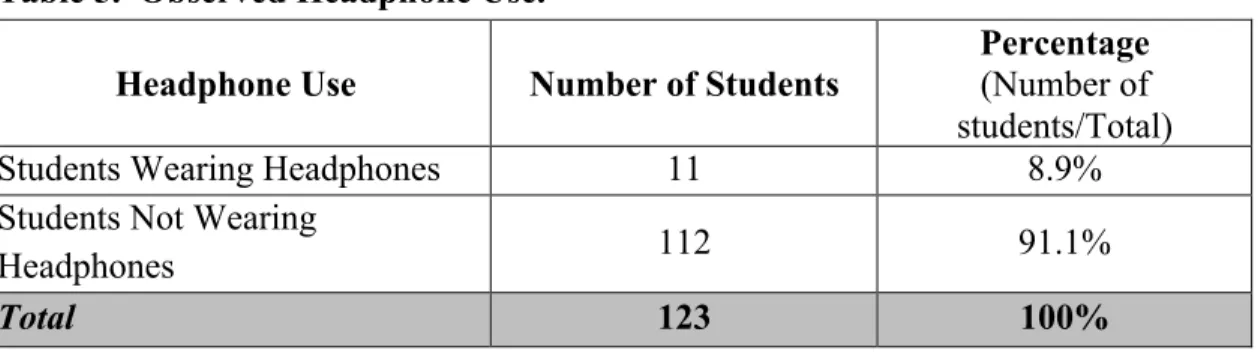
Table 5. Observed Headphone Use.
Table 6. Observed Collaboration.
Table 7. Student Reasons for Using the Group Study Rooms.
Acknowledgements
The author thanks the North Carolina State University Libraries in its support and
cooperation in this study, with particular thanks to Kim Duckett, Principal Librarian for
Digital Technologies and Learning of Research and Information Services Department in
D.H. Hill Library. Thanks is also given to Dr. Jeffery Pomerantz for his continued
Introduction
Traditional libraries no longer satisfy the needs of the 21st century college student.
Today’s students expect the library, its services, and its tools to fit right in with their
everyday lives without much extra effort. Students are accustomed to the integration of
modern tools into every aspect of their daily lives, often using multiple technologies at
once. (Manuel, 2002) With personal access to many devices, students use these
technologies throughout the day, and they have come to expect access to the technology
for their academic pursuits as well. (Merritt, 2003) Students turn to the library for the
tools they need, and the spaces they require to do their work, often collaborating with
their peers. (Gardner and Eng, 2005) No longer are many academic libraries the silent,
intimidating buildings of the past, filled with stacks of books and the shushing librarian –
many are transforming into hubs of activity. They are common grounds for students not
only to study, but to meet with their peers to do research and work on collaborative
projects in a welcoming, accessible, and modern space. However, there is still much to
learn about student behavior and attitudes beyond the general expectation of accessibility
to technology and spaces. The North Carolina State University Libraries (NCSU) has
made changes to its services in the past ten years that reflect the new trends, such as
building a learning commons and integrating new technologies into much of its spaces.
Now that the changes have been in place for a few years, the Libraries wishes to gain a
NCSU has transformed parts of their physical space to become more
user-focused, service-oriented, and technologically advanced to help students. D.H. Hill
Library has incorporated new technologies into their group study rooms such as
projection screens and writable walls. Additionally, D.H. Hill has developed a variety of
alternative collaborative learning spaces featuring various new technologies. The Digital
Media Lab, located in the Learning Commons, provides software and workstations for
video editing, audio production, and document and image scanning. One of the
Libraries’ newest developments, the Technology Sandbox, provides students access to
large-scale display and gesture-based computing tools, in addition to writable surfaces
and moveable furniture. These high-tech learning spaces allow students to come together
and work collaboratively, using new equipment in creative and experimental ways to
advance their unique projects. Students have embraced the idea of a collaborative space
in the library, as shown through the constant activity in D.H. Hill’s Learning Commons.
The library has become a comfortable, social place where students can come together to
engage in a variety of activities. Through these innovative services, NCSU demonstrates
a new model for modern libraries to follow, showing that in order for libraries to provide
the best services it can in regards to information and research, technology must now play
a major role.
Effective library spaces should respond to the needs of its users. This exploratory
study is to determine those user needs to make the collaborative study areas in NCSU’s
main library, D.H. Hill Library, more suitable. According to McDonald (2006), “A
environmentally suitable, safe and secure, efficient, and appropriate for information
technology.” The group study rooms in the library need to fit this description in order to
provide students with the best service possible. The library provides other collaborative
learning spaces, but these group study rooms were selected for study because they were
specifically designed to provide enclosed spaces for groups to study and work on projects
together. Other spaces throughout the library incorporate more advanced technology for
student use, but these study rooms serve the basic need for students to collaborate and
work together without disturbing others. The Libraries at NCSU recognized the need to
fulfill this need, but took its spaces a few steps into the future by equipping the study
rooms with a few pieces of relevant technology, such as writable walls, and multi-display
projection screens.
Although the Libraries knows that the group study rooms are popular - as
witnessed by most rooms being reserved for most hours of the day – the Libraries has
little idea about how students used the rooms when they occupied them. How many
students gather to study together? Do they use the technologies in the rooms? Are they
using the rooms and the technology in them for reasons other than for working on
academic projects? This study sought to gather information about how students use the
rooms. Advanced technology can be integral for student learning and development, and
the findings of this study will be used to improve the group study rooms in D.H. Hill
Library, as well as influence plans for group study rooms in NCSU’s new Hunt Library,
which will open on Centennial Campus in 2013. This study seeks to discover how
rooms to collaborate? How are they using technology? What do students like about the
collaborative learning spaces? What does the Libraries need to improve? The study will
gather information from students, in order to discover the specific needs of NCSU
students.
Background
Description of Group Study Rooms
D.H. Hill is one of the few places on NCSU’s campus where students can go to
study and work together. There are other specialized libraries on campus1, but as the
main library, D.H. Hill is the largest and supports all disciplines. The main floor of D.H.
Hill is mostly a collaborative floor. In the West Wing, the main collaborative space is the
Technology Sandbox, which features large-scale displays and gesture-based computing
tools, such as Microsoft Surfaces and a perspective pixel. However, the East Wing
serves as the main hub for library activity, with most of the space dominated by the
Learning Commons. The Learning Commons provides students access to a computer lab
with both PCs and Macs, the reference collection, the Digital Media Lab, GIS
workstations, two group study rooms, a practice presentation room, and a variety of
flexible, movable furniture for studying or lounging. The Learning Commons is typically
a loud, high-energy area, providing students with various technology and spaces to work
Until recently, D.H. Hill Library had one group study room on each of the floors
2-8, each of which provided students with chairs, a table, and space to work without
disturbing silent studiers. In response to requests from students that the library expand
the number of reservable study spaces, the Libraries recently divided six existing group
study rooms (the rooms on floors 3-8) in half and outfitted them with new, more flexible
furniture and display technology. By doing this, D.H. Hill was able to almost double the
number of groups able to be accommodated. Instead of larger rooms that can hold up to
12 people and accommodate only seven groups, the new structure can accommodate 13
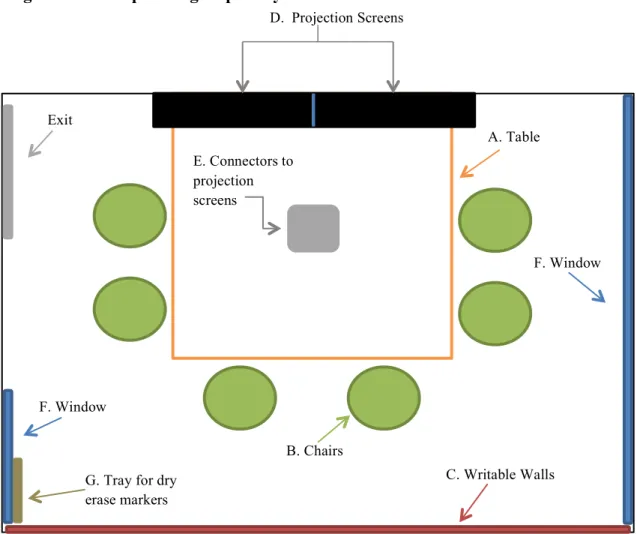
groups: 12 groups of up to six people, and one group of up to 12 people. See Figure 1,
and Images 1-5. The newly divided rooms on floors 3-8 are almost all identical with the
following features:
A. Table, flush with the outer wall, which also doubles as a surface to be
written on with dry-erase markers. Rooms on each floor designated as room “A” have square tables, rooms designated as “B” have round tables. With the exception of Floor 3, all tables are at a height of 30”, so the average person can sit in a chair with their feet resting on the floor. The rooms on the third floor contain higher tables, at a height of 38.5", and stools with seat backs. See Image 5.
B. Six chairs that can be moved about the room.
C. Wall that can be written on with dry-erase markers. The walls vary in
color between white (floors 3 and 6), orange (floors 4 and 7) and red (floors 5 and 8). See Images 2-3.
D. Two large display monitors to which laptop computers can be attached.
Each room contains six hook-ups, so multiple computers may be displayed. The cord attachments can be put away underneath a lid that contains the cords underneath the table, keeping them easily accessible, but out of the way when not in use.
F. Glass windows on two sides.
G. Tray for dry erase markers.
The study room on the second floor remains its original size, but it was updated at
the same time as the rooms on floors 3-8, and contains the same glass walls, two display
monitors, the same chairs, and a large table. However, this room is twice the size of the
others, and instead of a writable wall, contains two double-sided moveable whiteboards
that students can use and move about the room. See Image 4.
Students at NCSU can reserve the group study rooms by using an online room
reservation system. The system is password protected, allowing access only to users with
an NCSU identification name and password. The reservation will show up online, with
their name, and the description of their group, as determined by the students. A student
may make a reservation for, “Chem 207 study group,” or, “English 300 group 3,” for
example. Group study rooms can be reserved online for 2-hour blocks, limited to one
12
A. Table
F. Window
C. Writable Walls B. Chairs
G. Tray for dry erase markers F. Window
D. Projection Screens
E. Connectors to projection screens Exit
Figure 1. Floor plan of group study rooms.
Image 2. Writable Walls, white. Image 3. Writable Walls, colored.
Image 5. Group Study Room, Floor 3.
Hunt Library
NCSU’s new library will be located on its Centennial Campus and serve as a main
library for that section of the university. This library seeks to be a collaborative space for
NSCU students, and focus its services on the faculty, students and staff of the College of
Textiles, the College of Engineering, and some of the sciences and veterinary programs.
According to the library’s website, the mission of the Hunt Library is to serve as a
“vibrant intellectual and social forum for the campus community, showcasing the latest
technologies and research achievements of the university.”3 To fulfill this mission, the
library will include a dynamic set of various spaces to serve students, including a café,
reading rooms and two research commons, individual study seats, and almost 100 group
study rooms. The library already knows that there is a need for the large number of
group study rooms, but there are not yet plans for the furniture and technology that will
be in them.
Lin (2010) stresses how important it is to consider the uses of particular library
spaces before they are designed. NCSU already has a captive audience to draw
information from in order to make more appropriate decisions for the new design, and the
results of this study can help the design staff of the Hunt Library make informed and
appropriate decisions in equipping the new spaces. This study looks to evaluate the way
students are currently using group study rooms. The observations and surveys address
collaboration, nature of work, and technology in various ways. The current set-up of the
findings here. Furniture design, lighting, colors, and flexibility of the furniture can all be
reconsidered based on these results. Additionally, the type of technology that should be
included, such as the projection screens, writable walls, and new ideas from student
responses can be included. However, this study can certainly be expanded further to
address the various concerns brought up by students in the surveys, and follow-up
assessments and other methods, such as focus groups and interviews, can help further
identify various student needs. The collaborative learning spaces in Hunt Library could
end up having a very different feel and structure than the current rooms in D.H. Hill.
Literature Review -- Technology, Spaces and Library Services
The main focus of most academic libraries is to serve the academic and
professional development of its students, faculty and other members of the university
community. Student needs often drive the direction of many academic library services,
and a change in these needs can sometimes dramatically change the face of a library.
Recent technological changes have made it easy for some students to avoid using a
tangible book in the physical space of the library, and rely solely on electronic resources
for research. Because of this change, libraries have been able to shift into different
service areas, such as providing spaces and technology for students to complete their
work. Libraries have become “a forum for students to collaborate, enjoy fellowship,
engage in healthy debate, create and challenge ideas, and experience learning and
discovery in a multitude of meaningful ways” (Sens, 2009). The advent of the Internet in
library, and students are using the physical spaces and materials in different ways.
(Bennett, 2003) However, since providing these types of services, spaces and equipment
to students is a relatively new phenomenon, most libraries do not have a model to follow,
or even many examples from which to learn. Libraries like NCSU are forging ahead on
their own, experimenting with new technology, design, and services.
The trend in providing learning spaces is not limited to just academic libraries.
Other types of libraries, including public libraries, are experiencing the need to provide
similar spaces for their users to come together to collaborate (Cohen, 2009). This
indicates that it may not just be a trend amongst college students who need more dynamic
study spaces, but a larger movement in the way people live and work together.
Therefore, design of collaborative learning spaces should not just be temporary solutions
to present problems, but long-term, strategic planning goals for libraries to effectively
serve their populations. (Cohen, 2009)
To meet the developing changes in student learning, the traditional library space
is no longer sufficient. Even if a library starts to provide certain technologies for student
use, if the space in which the technology is used fails to change as well, both the
technology and the space can be insufficient and ineffective. Learning and study
environments must reflect the way modern students work, and library spaces must be
reevaluated in their design, funding, and maintenance (Hundley and Jacobs, 2005).
Students expect continued and uninterrupted access to information and services in
Additionally, students prefer to work together in groups rather than alone, even if they are
not working on the same projects. (Howe and Strauss, 2000) Studying and learning has
become more social, and the spaces needed to allow for this need to change as well.
Foote (2004) identifies new design practices in libraries that foster collaborative learning,
an important feature being the provision of ample space with characteristics that
encourage active, collaborative learning. Due to the potential for high energy and
activity, it will not be enough to just provide sectioned-off spaces, but to also attend to
the acoustic needs of spaces when they become more active and collaborative. A
collaborative learning space, such as a group study room, that is situated near or in the
middle of a more traditional, silent study area, as are the group study rooms at NCSU,
can be counter-productive in student learning if the walls are not soundproof. Simply
sectioning off an area, or hastily putting up dividers is not enough – serious thought must
be put into the design and development of these spaces. (Cohen, 2009 and Forrest, 2005)
The mere presence of a group study room will not meet the expectations of the
students who will use them. Many libraries such as Emory University have identified the
key components of a successful and appropriate room in which students can
collaboratively learn and work. Forrest and Hinchliffe (2005) describes the
accommodations of the Emory University Library:
These variables such as color, lighting, noise, and arrangement are all environmental
factors that have a strong influence on social behavior, and, as indicated by Graezt and
Goliber (2002), may have an effect on collaborative learning as well. Another example,
the main library at the University of Illinois at Urbana-Champaign also demonstrates its
commitment to modern, relevant library spaces through its “Statement on Learning
Spaces.” This statement outlines the library’s commitment to providing appropriate and
comfortable spaces for the campus community, committing to learning spaces that are,
“varied, flexible, and conveniently co-located with library services and collections, as
well as designed specifically for learning, instead of being re-purposed on an ad-hoc
basis.” (Forrest and Hinchliffe, 2005) These libraries, along with many others, are
demonstrating the larger trend of a shift in the design of library spaces, keeping up with
the changing nature of student learning.
New trends in higher education have changed the way students study and interact
with each other. Rather than sitting in a lecture hall, taking notes, and memorizing facts
and theories, student learning has become more interactive through the deliberate efforts
of educators. While lecture-based classes are still the norm, students are more active in
their own learning, doing research and applying their knowledge to both independent and
collaborative creative projects. (Graetz and Goliber, 2002, and Hundley, 2005). As the
nature of learning in higher education changes, so should their study spaces. As Wilson
(2002) points out, “Collaborative learning requires collaborative space.” NCSU has been
studies similar to this one at other institutions to learn more about student needs and
trends in regards to collaborative learning spaces and technology.
Research has shown that technology in academic libraries, and particularly in
study spaces, is welcomed, and even expected by students. Technology is expected in the
library, especially in today’s overloaded world of information. Without advanced
technology, students may spend more time looking for information than they are actually
understanding, analyzing and applying it to their own work. (Freeman, 2005)
Universities, and especially their libraries, are expected to be innovators in teaching and
learning, and today, that means using technology effectively (Twigg, 2003). It has been
shown that in interactive learning environments such as group study rooms, “energetic
group discussions and intense conversations accompany learning and sharing.” (Lin, et.
al., 2010) Technology is important to the development of student research, and libraries
must evolve with new technology in order to stay relevant, and helpful to its students.
Technology enriches both the library and the library experience for students. Bringing
technology into the library is logical, in that it allows libraries to become more of a
hybrid space that better suits the needs of students. Students need information and
resources, as well as a place to study. In addition, students have a higher need for certain
technologies not only to enhance their learning or help encourage creativity, but to
complete basic assignments. (Lin, et. al., 2010)
Hundley and Jacobs (2005) hint that technology should be appropriate to the
institutions should “rethink the specific ways in which they are unique and to leverage
unrivaled strengths in pursuit of leadership in certain fields of study.” Applying this idea
to technology in libraries, it would be important for libraries to consider their student
populations before incorporating new technologies. Just because a new technology is
innovative, exciting, and appealing, it may not be useful to that university’s particular
students.
However, some universities have discovered that their collaborative learning
spaces have not been used for collaboration. After opening technology-enhanced
classrooms and group study spaces in the Perkins Library in August 2008, Duke
University Library conducted an assessment of this new collaborative learning space and
its technology. The study found that students were satisfied with the type and availability
of technology, such as rooms with multiple projections and videoconferencing
technology, but were concerned about prioritization of group study spaces. They found
that some students use the group study rooms for individual study, in order to gain a quiet
place for better concentration. (“Assessment of the LINK,” 2008) However, such
practices can make it more difficult for groups to find a space to study where they will
not disturb other students in quiet areas. While this was not a known concern at NCSU, it
became a variable to look out for during the analysis observational and survey data of this
study.
The increase in the desire for more collaborative learning spaces in the library
socialization and interaction. Bennett (2005) suggests that library study spaces for 21st
century students are responsive to both academic and social dimensions of study.
Socialization is one of the major facets of university life, and the lines between
intellectual and social interaction are often blurred. Traditionally, university libraries
were the centers of intellectual study, which in the earlier days of American higher
education, implied independent and silent study. But today, intellectual and social
interaction walk hand and hand, and new technology often helps this bond grow stronger.
Instead of trying to resist this change, libraries can embrace it, by supporting the modern
social dimensions of intellectual interaction and provide the spaces in which such
interaction can occur. For students on some campuses, the library is the only place for
them to gain access to certain technologies, and spaces for them to meet and work with
other students (Cohen, 2009).
Freeman (2005) nicely sums up the main drive of this case study:
Although it is difficult to predict how exactly technology might shape library space, more and more libraries have provided technology-supported group study rooms…which have been designed to be easily responsive to new technologies and pedagogies. In this interactive learning environment, energetic group discussions and intense conversations accompany learning and sharing.
The NCSU Libraries incorporates a great deal of new technologies into various spaces
throughout the library, but has not yet done a study as to how students are using it. The
Libraries recognizes that as Freeman says, they do not know how exactly technology is
shaping the library space, and how students are using it, but they hope that it is helping to
unpredictable nature of human behavior, especially the behavior of college students, there
is really no way of knowing how students are interacting with each other and with
technology, unless a systematic study is done to capture information about that behavior.
Methodology
Much of the data collected in library and information science studies is
quantitative. For this study, an evaluation of the group study rooms could have been
conducted by counting things such as the number of people using the rooms at any given
time, and the number of times a projection screen was used. However, this study sought
a deeper understanding of student use of the group study rooms, and therefore, more
qualitative data was obtained. The NCSU Libraries already knew that the group study
rooms were popular and served as highly coveted study spots, but to really gain a better
understanding of student needs, more specific data was needed. The qualitative data,
used with some quantitative statistics, provided a deeper look into the needs of these
particular students.
This exploratory study focused on a specific type of collaborative learning space,
the group study rooms in D.H. Hill Library at NCSU. Thirteen such rooms were
included. This case study collected data via multiple means (observations and surveys),
and took place in the natural setting – right in the rooms addressed here. Many students
use these group study rooms, and a sample of students was observed and surveyed.
Because D.H. Hill is most busy in the evenings, and other studies such have shown that
distributed on weekdays between 5:30p.m. and 11 p.m. (Gardner and Eng, 2005) Each
time observations were done, the researcher started by observing the rooms on the 8th
floor, and working down each level to the 2nd floor. Rooms that did not contain students
were not counted. The same group of students was not observed more than once on the
same day, however, it is possible that some students were observed using the rooms on
different days. Surveys were also distributed in the same time frame, but on different
days from the observations in attempt to reach different students. They were given to
students as groups were entering or leaving a room, or left on the table in empty rooms,
and collected a few hours later.
Interaction (verbal or non-verbal communication between two or more students),
activity, and technology use was observed, and students were surveyed about their time
in the rooms. The results of these observations and surveys provide insights into the type
of technology and services students deem necessary and expect in the rooms, and what
they currently need changed. The findings of this exploration can make
recommendations for making these specific rooms, and future collaborative learning
spaces, more appealing and useful to students.
Population
NCSU is the largest four-year institution in North Carolina, with almost 35,000
students (about 25,000 undergraduates and 9,600 graduate and professional). NCSU
offers bachelor’s degrees in 106 fields, master’s degrees in 104 fields, doctorates in 61
D.H. Hill can only support five percent of the student population at a given time. The
group study rooms can in turn only support a small fraction of that percent. Therefore,
this study was only able to represent a very small sample of the overall NCSU student
body, but the students in the sampled population are key stakeholders in the future of the
group study rooms. A majority of the students in the room were most likely
undergraduate students, but also may have included graduate students, faculty, and
NCSU staff. In order to make a reservation for the rooms, a user must have an NCSU
identification card, so it is unlikely that anyone in the rooms was a not affiliated with
NCSU. Demographic information about users of the group study rooms was not obtained
for this study, because the Libraries was more interested in how the rooms were being
used, rather than who was using them. Future work may take into account user
characteristics such as gender, level of study, and major, do further identify the needs of
students in different disciplines and departments, or support the efforts of other
dimensions of the university community.
Data Collection
The goal of this study was to discover how students used the group study rooms.
Use is defined as, occupying the physical space of the room. Data was gathered from
students indiscriminately even if their behavior was obviously non-academic, such as
consuming food in the room with no additional materials on the table or nearby.
Additionally this study was particularly interested in student interaction with
technological tools in the study rooms, defined here as the presence of a type of
To discover these phenomena, two types of field research were conducted. The first step
was naturalistic research, making observations over the course of a few weeks during late
February and early March, the point in the semester leading to mid-term examinations
before spring break. To capture observation data, each study room was observed for
about five minutes on a rotating basis in order to cover different groups and different
floors. Observations were kept short in order for the observer to remain inconspicuous,
and allow the students to behave naturally. Observations were made to notes things such
as the number of students in the rooms, and the type of technologies being used.4
During observations, students were not approached. From a short distance away,
the rooms were observed a total of 50 times through glass windows that made their
activity publicly viewable. In the event that a student questioned the data gathering, a
description of the project was ready to be provided to them.5 By conducting
non-participant observations the results remained unbiased. Bias was also prevented by
adhering to a checklist during the observation period, to record only what was actually
happening in the rooms, rather than the interpretations of the observer. By conducting an
unobtrusive evaluation, the data collector remaining inconspicuous, students in the rooms
were unaware that they were being observed, and were therefore unable to adjust their
behavior in any way. However, one of the disadvantages of observational data is that
some behaviors may be only intermittent, so perhaps some behaviors were missed, but
with the inclusion of over 80 students during observation, a wide variety of activities
The observations sought information on two types of behavior: collaboration and
technology usage. Some questions in the observation protocol could provide indications
of both behaviors.
Collaboration indicators:
1. Does the activity seem academic or social?
Observations looked for indications of academic work, such as Word Documents,
PowerPoint Presentations, journal articles, textbooks, calculators, and writing equations
on the whiteboards. Social indicators were Netflix movies on the projection screen, or
playing games.
2. Are students interacting with each other working silently?
Interaction between students was also noted by students speaking to one another,
comparing notes, or sharing resources. Silence and students wearing headphones was an
indication of non-collaborative use of the rooms.
Technology use indicators:
1. How many students are using laptops?
A count of the number of laptops was taken. Notations were made if the number
of laptops did not match the number of students, or if laptops were in the room, but
inactive.
2. Have students used the whiteboard markers on the writable surfaces?
Notations were made if students were actively writing on the surfaces, or were
writing was visible on the walls, but it was unclear whether or not the students currently
in the room had done the writing. Nevertheless, it was determined that it was more
important to note whether or not the writable surfaces were being used, rather than if the
students were using the technology at the very moment they were being observed.
3. What other materials or technologies are the students using?
To identify technology that may be lacking in the rooms, any technology and
other study materials brought into the rooms by students was recorded.
Indicators of both collaboration, and technology use:
1. How many students are using headphones?
The observer counted the number of students wearing headphones.
2. Are the students using the projectors in the room to display content from the laptops?
The observer first looked whether or not the screens were powered on and
displaying content. If content was displayed, it was recorded whether both screens were
in use, or just one. If both were in use, the observer noticed whether the content on the
screens was the same, or different.
3. Are students charging their various technological instruments by using the outlets in the room?
If students had plugged in their laptops, cell phones, music players, or other
devices, the response was recorded as ‘yes.’
The second phase of data collection involved surveys that directly asked the
students about their activities in the collaborative learning spaces. These surveys asked
understanding by asking the students directly about their activity and opinions about the
space. Survey questions included inquiries as to their reasons for using the room, how
they knew the other people in the room with them, and questions about their experience
with the technology in the rooms.6 Surveys were distributed by approaching students
who were in the rooms, when they were entering or leaving the room, and asking once if
they were willing to participate. The goal was to gain as much data as possible directly
from the students. To cover a greater variety of students, those who were observed were
not given surveys. It is possible that a student who occupied a particular room at one
time and was observed was later given a survey at a different time. However, even if that
occurred, the data gathered covered two distinct instances of group study room use.
Like the notes made during observations, the survey sought insight into
collaboration and technology use.
Collaboration questions:
1. How do you know the students who were in the room with you?
Students could choose from three answers, or fill in a response for “Other”. This
question sought insight on why students may be forming a group to meet the rooms.
2. What kind of project/assignment were you working on?
This question inquires about the nature of their work, whether it was academic or
social.
Technology questions:
This is where students had the opportunity to provide input.
Questions about both technology and collaboration:
1. Did you use the projection screen? For what purpose?
The projection use question was to evaluate whether or not the screens are
actually being used, and how they may be helpful for students.
2. Why did you choose the group study room as a place to work, rather than another location in the library or on campus?
This question helps the Libraries to understand what they may be doing well.
Exploratory questions:
1. What do you like best about this room?
This question helps the Libraries to understand what they may be doing well.
2. If you had the power to change this room in any way, what would you change about it?
Allows for student input, and helps the Libraries to identify improvement areas.
Data Analysis
The data from both the surveys and observations were coded to identify major
themes and patterns. Use of a conventional qualitative analysis – creating coding
categories by directly and inductively capturing information from the raw data – allowed
both latent and manifest themes to emerge beyond just those indicated by the high
frequency of some particular word. The observations were recorded on paper, and then
entered into Survey Monkey for organization and analysis. Likewise, information
Monkey. Additionally, certain data from both collection methods were later combined to
demonstrate higher frequencies of certain behaviors.
An open coding method was used to identify key words in every answer, and
coded to fit major, broad themes that emerged throughout the analysis process. A coding
unit is a word or group of words that can be characterized under a single category. In
cases where a single response had multiple themes, each theme was indicated and coded
separately. The open coding method was used because the purpose of this research was
exploratory, and pre-conceived biases and predictions were inappropriate here. The goal
was to obtain information from the students about their needs, in order to define and
address them more accurately. Besides looking at basic data about frequency of projector
and whiteboard use, analysis of student survey responses identified major themes that
brought to light new or overlooked student needs. Student responses were very direct
and made the coding process easy to identify major themes such as privacy, space, and
quiet.
Expected Results
This study will most directly benefit the staff and students at NCSU, as well as
future planners of collaborative learning spaces in libraries. The D.H. Hill Learning
Commons staff can immediately implement changes to their amenities by adjusting
furniture, removing or adding technological equipment, or otherwise altering the current
space. Students will benefit from the Libraries’ response to their needs during group
Hunt Library will be able to make better decisions about purchasing equipment and
organizing the almost 100 group study rooms to be installed in the new building.
Students will find spaces that are more welcoming to their comfort, and more conducive
to their academic needs, allowing them to collaborate and interact on projects with each
other, without struggling to find a space that suited them. If it was discovered for
example, that the laptops students were using were more technologically advanced than
the projectors in the study rooms, and therefore incompatible, the library could resolve
this issue by providing adaptors for the current projectors, and purchasing more advanced
projectors for the new facility. An issue like this would then be on the radar of the
librarians, who could then be on the lookout for future advances in technology that may
have adverse effects on their available equipment. With the presence of necessary and
advanced technology, students can work together with ease, allowing them to focus on
their projects and creativity, without being limited technologically or logistically.
Limitations of Study
There are a few ways in which this study may be limited. Currently, D.H. Hill
Library serves as the main library for NCSU, but it can accommodate only five percent of
its population at one time. This has limited the number of students from which data
could be collected. Since this data can be used for planning in the new Hunt Library, the
students using D.H. Hill may not be the most accurate representation of the students who
may use the new library, since the Hunt Library will be on the Centennial Campus, and
will focus its collection resources for the College of Textiles and the College of
difficult to convince students to even take the time to fill out a survey, and not all
questions received complete answers. This is an exploratory study of one specific
library, and the result here may not be relevant to all academic libraries. However, the
hope was that by using two types of data collection, enough information could be
gathered to make concrete conclusions to apply to the development and adaptation of the
NCSU Libraries.
Results
A total of 234 students were observed and surveyed from February 27-March 12,
2012. Fifty surveys were distributed, and 29 were completed, a 58% response rate.
Students in the same room were asked to complete the survey as a group, and the 29
completed surveys covered opinions and experiences of 111 students. Observations were
conducted of 50 different groups using the group study rooms, covering 123 users.
With one exception, the range of students in a room at a particular time was
between 1 and 6. There exception, in which a group of 11 students met in one of the
rooms meant for six people, was one of the three groups indicating a desire for a bigger
room. (See Figure 15) The average number of students in a room was about 3, but most
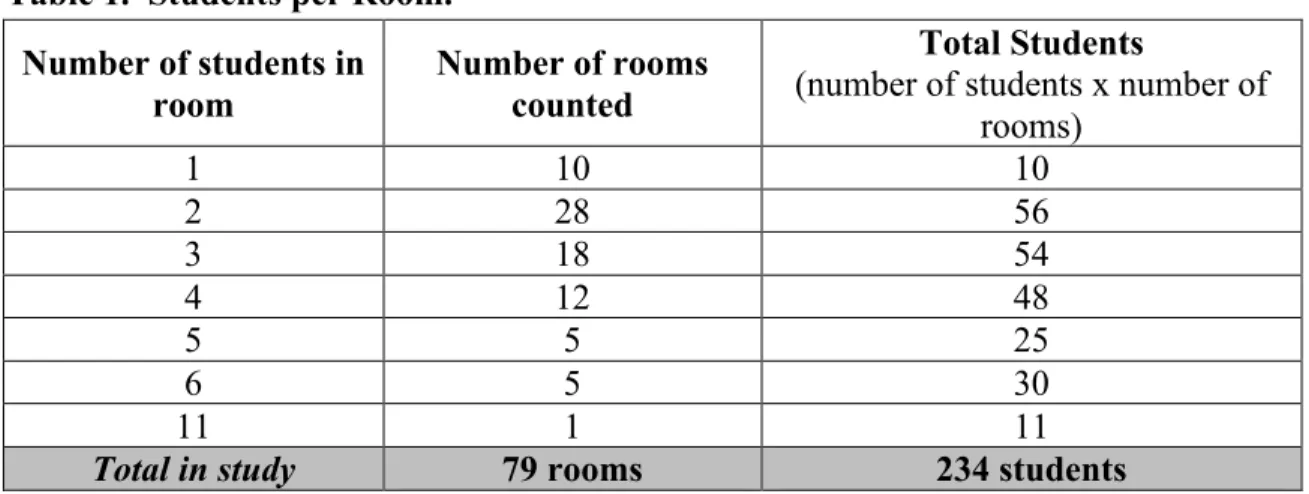
often, as shown in Table 1 and Figure 2, rooms were occupied by only two students at a
Table 1. Students per Room.
Number of students in room
Number of rooms counted
Total Students
(number of students x number of rooms)
1 10 10
2 28 56
3 18 54
4 12 48
5 5 25
6 5 30
11 1 11
Activity in the Group Study Rooms
The Libraries was interested in what type of work students were doing in the
rooms. Two survey questions, S2 and S3, and one part of the observation protocol, O5
sought this information. S2 asked how students knew each other, and S3 asked what type
Most of the time, surveyed students were taking the same course. Comments in
the “Other” category included students who were friends, roommates, student clubs and
organizations, and even a romantic couple who were taking same class. However, there
was a varied range of work being completed, both academic, and non-academic. Half of
the comments in the “Other” category for S3 indicated that students were studying for a
quiz or test. This data can be separated out from the remaining responses in the “Other”
category, to show a better visual representation of the events.9 See Figure 5.
Although Figure 5 shows what type of work students were specifically doing, the
libraries was also interested in a broad sense of whether the room activity was
academic-related or social. One part of the observation, O5, prompted the researcher to determine
whether or not the activity observed was academic or social. Figure 6 shows these
If the data from S3 (Figure 5) is recoded into categories of “academic,” “social,”
and “unsure,” it can be combined with data from O5 (Figure 6). By doing this, it can be
more clearly seen that most often, the activity in the group study rooms was related to
academics.
Writable Walls
Design of the group study rooms allowed the actual walls to serve as writable
surfaces, equipped with dry erase markers. O6 prompted the researcher to look for signs
of whiteboard use. As shown in Figure 8, students more often than not declined to use
Writable surface technology comments also appeared in S5, S6, S7, and S8.
Students complained that there were not enough dry erase markers available in the room
when needed, and 21% of the groups did not like that some of the writable walls were not
white. (See Figure 15) One group commented that they would like to “have all the
boards on the walls white because colors make it hard to read.” However, although there
were complaints about the wall color and availability of markers, 31% of the groups
indicated that the writable surfaces were one of the things they liked best about the
rooms, or one of the reasons why they chose to study there. (See Figure 14.)
Projection Screens
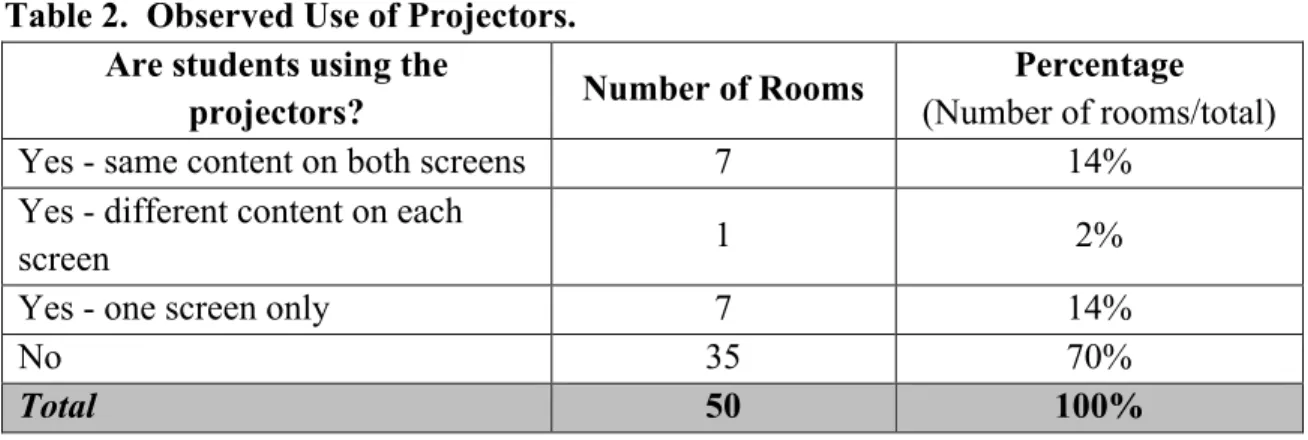
As shown in Table 2, both the survey and the observations sought information
about the projector use (S4 and O4). Observations found that 70% of the time students
were not using the screens, and only 2% of the time were students using the screens to
researcher observed activity such as students working on presentations, watching movies,
viewing journal articles.
Table 2. Observed Use of Projectors. Are students using the
projectors? Number of Rooms
Percentage
(Number of rooms/total)
Yes - same content on both screens 7 14%
Yes - different content on each
screen 1 2%
Yes - one screen only 7 14%
No 35 70%
Total 50 100%
Similarly, S4 results, shown in Table 3, indicated almost the same response rate, that 69%
of student groups were using the projection screens.
Table 3. Self-reporting of Projector Use.
Did you use the projector? Number of Rooms Percentage
(Number of rooms/total)
Yes 9 31%
No 20 69%
Total 29 100%
Students said that they used the screens to pull up documents and presentations, and one
group even said they used the projection screen, “Just because it is awesome.” The
projectors were also mentioned in other parts of the survey, in responses to questions
S5-S8. Some students were frustrated when they were unable to get the screens to work,
others wanted Mac adaptors in the rooms, and some said that projectors were one of the
reasons they chose the rooms or what they liked best about the study space. (See Tables
Identification of Lacking Technology
Observations and surveys sought to identify gaps in services that the library could
improve upon. S8 asked students if the room was lacking anything; observations looked
for outlet use (O9), and the tools students were bringing into the rooms themselves,
specifically looking for laptops (O2), in addition to other materials (O7).
As shown in Figure 9, 72% of the students observed were using a laptop in the
room.
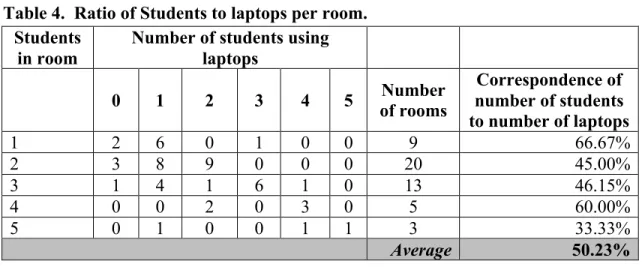
About 50% of the time, all students in a given room were each using a different laptop.
See Table 4. Students were sometimes sharing computers, or doing different tasks
without one at all. In only six of the 50 surveyed rooms were no students using laptops.
as a suggested change (S5), but the data indicates that students brought their own (or
borrowed) laptops into the rooms when needed.
Table 4. Ratio of Students to laptops per room. Students
in room
Number of students using laptops
0 1 2 3 4 5 of rooms Number
Correspondence of number of students to number of laptops
1 2 6 0 1 0 0 9 66.67%
2 3 8 9 0 0 0 20 45.00%
3 1 4 1 6 1 0 13 46.15%
4 0 0 2 0 3 0 5 60.00%
5 0 1 0 0 1 1 3 33.33%
Average 50.23%
Students often use multiple types of technology at once that may need to be
charged at an electrical outlet. Because the rooms only had six outlets, this could have
proposed an issue for some groups that may have needed more. Initially, observations
tried to count the number of outlets used in the room. This proved too difficult to do
without drawing the attention of the students being observed, so observations were
modified to record only whether or not students were using the outlets at all. Figure 10
shows that students were only charging their equipment about 58% of the time. The
survey did not show any mention of outlets in any way, so this part of the study did not
The observations looked for other materials students were bringing into the rooms
besides laptops, to see if there was any particular need for something new to be available
on a regular basis. However, these results did not provide any significant data indicating
that a change was needed. Besides bringing in their own study materials such as binders,
notebooks, paper, and calculators, and personal items such as iPods, tablets and mobile
phones, few students were using other materials that were visible. One group had a video
game controller sitting on their table, and another had a complex mechanical gadget.
But, neither of these groups were actively using this equipment. Figure 11 shows the
other materials students were using, besides laptops and the equipment already provided
The best way to find out what students needed in the group study rooms was to
ask them directly through the surveys. When asked S5, “What technology or equipment
would you like in the room that is not already present, and how would you use it?”
students were given the opportunity to provide ideas specifically about technology.
Through open coding, four main categories emerged, with a fifth category for “Other,” as
shown in Figure 12. Only two responses were applied to the “Other” category: one
request for bean bag chairs and pillows, and one for making the dividing wall between
study rooms more soundproof. Audio requests called for speakers for students to play
music, and the ideas varied in the visual technology category. Students suggested
Collaboration
The collaborative learning spaces were meant to be just that – collaborative. But
as noted earlier, in some libraries, such as Perkins Library at Duke University, some
students may use the room for independent use. (“Assessment of the LINK,” 2008) The
study sought to identify this as a problem through O1 and S1 by asking how many
students were in the room at the time the survey or observation was completed. Only
12.7 percent of the time was the room occupied by a sole student. (See Table 1 and
Figure 2.) Additionally, notes were made if students were speaking to each other and
sharing materials (O8), or wearing headphones (O3). Very few students were observed
Groups in which interaction was apparent were coded as “collaborative,” and those
working silently were coded as “non-collaborative.”
Table 5. Observed Headphone Use.
Table 6. Observed Collaboration.
Collaboration Number of Rooms Percentage
(Number of rooms/Total)
Collaboration 33 66%
Non-Collaboration 18 36%
Total 5010
To take this a step further, the above data in Table 6 can be combined with the
data in Figure 4, to cover a broader scope of student activity. The data from Figure 4 was
recoded as “collaborative,” “non-collaborative,” or “unsure.” Those responses recorded
as “We were working on a group project,” was coded as “collaborative.” The responses
recorded as “We were working individually on the same assignment,” and “We were
working individually on different assignments,” were both coded as “non-collaborative.”
Review of comments made for the “Other” category were reviewed on an individual
basis and coded. Those who wrote in that they were studying for a quiz or test were
coded as “unsure,” recognizing the flaw noted earlier. The comments, “Bible study,”
Headphone Use Number of Students
Percentage
(Number of students/Total)
Students Wearing Headphones 11 8.9%
Students Not Wearing
Headphones 112 91.1%
“organizing an event,” and “lab report” were coded as “collaborative.” The final
comment, “Working on a test,” was coded as “unsure.” The combined data is shown in
Figure 13.
Exploratory Questions
Two survey questions showed responses with similar themes. S6 asked why
students chose this room over others, and S7 asked what they liked best. The themes that
emerged were almost identical for both questions, although respondents did not always
Table 7. Student Reasons for Using the Group Study Rooms. Theme Frequency
Quiet 11
Not disturb others 10
Privacy 8
Location 7
Table Space 6
Concentration 3
Whiteboard 3
Technology 2
Comfort/Furniture 1
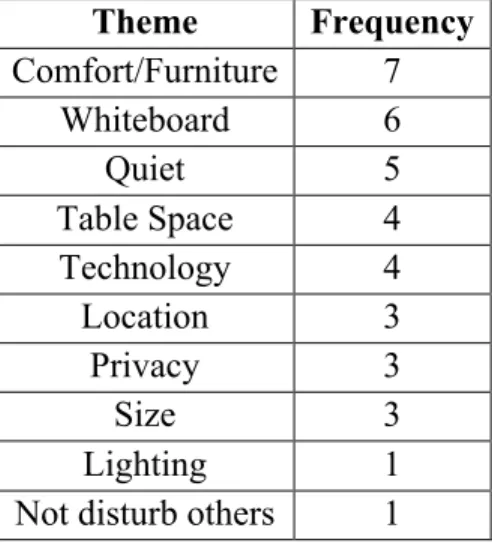
Table 8. Features Students liked best about the Group Study Rooms.
Because these themes were identical in most cases, the data has been combined in Figure
14 give greater impact to the features of the study rooms most often noted.
Theme Frequency
Comfort/Furniture 7
Whiteboard 6
Quiet 5
Table Space 4
Technology 4
Location 3
Privacy 3
Size 3
Lighting 1
Lastly, students were given the opportunity to provide their opinions on what they
would change about the rooms. The most common complaint, shown in Figure 15, was
Discussion and Recommendations for New and Old Space
Activity in the Group Study Rooms
The number of students in a room averaged three people, although the rooms
could hold up to 6. With one exception, all groups were between one and six users.
However, since three groups indicated that they needed a bigger room, the Libraries
should reevaluate the options for larger groups. There are only four reservable rooms in
D.H. Hill that can accommodate more than six people.11 Since the majority of groups did
not indicate a problem with the size of the rooms, these rooms may not be the problem.
Instead, the Libraries should further evaluate the size of groups, and instead of making
changes to the current group study rooms, consider adding additional rooms that can
accommodate more than six people.
The study found that most of the time, the work done in the rooms was academic
by nature, and students were together because they were in the same course. Further
study could explore the non-academic use of the study rooms. For the few groups not
doing academic work, such as the bible study group and the group of students planning
an extracurricular event, why were they using the library space, rather than somewhere
else on campus? Was there a shortage of space throughout campus for students to use for
small group meetings? Do the rooms in the library provide access to technology or
resources that other campus locations lack? Such follow up questions and perhaps
interviews with students could provide more insight into this phenomenon. This data
non-academic uses, and further market D.H. Hill as a gateway to knowledge - indiscriminate
between academic and non-academic learning and collaboration efforts.
Writable Walls
Evidence of whiteboard use was observed only 36% of the time. While students
were not specifically asked about the writable walls in the survey, they were frequently
mentioned in the free response categories. Students valued their presence, but
complained about the colors. While one student said that the “orange wall causes [a] less
stressful environment,” the colored walls were less than ideal as a writable surface,
because students found that the writing on them was difficult to read. To balance these
needs, a solution would be to replace the colored writable walls with white ones, and
paint one or more of the remaining walls a different color. Students would still have the
benefit of some color contributing to the atmosphere of the room, while retaining the
writable surfaces.
Projection Screens
Over two thirds of studied students did not make any use of the projection
screens. However, in free response questions, the projectors were cited as features that
students particularly liked. Some students were unable to get the screens to work, and
shared their frustration in the surveys. This could be addressed by installing clearer
instructions near the hook-ups. The researcher would have liked to be able to expand on
this part of the study by asking follow up questions to the students who had technological
suggested that one of the things they would like changed about the rooms was to “have
someone monitor the technology to make sure it worked.” This was an interesting
remark: students expected the technology to be ready exactly at the moment of need.
Further exploration could study more specifically why students were using the
projectors, and what they projected onto them. The observer noted social content, such
as movies, but also academic content such as journal articles, presentations, and
documents. Student descriptions of their personal use of the screens was vague, and did
not provide much insight. Additionally, more information could be obtained to judge
whether or not two screens in each room was really necessary, since only 2% of the time
were students viewing different content on each screen.
Identification of Lacking Technology
Today’s students are multi-taskers, often using various types of technology
simultaneously. (Manuel 2002) The study tried to address this by identifying the
technology students were bringing into the rooms themselves, which the library could
possibly turn into a service. Besides laptops and calculators, few students were using
other technologies besides their personal study materials; however, one frequent request
was the desire for audio hookups or speakers of some sort. A few survey results
indicated the desire to listen to music through provided speakers, and perhaps those who
were watching movies through the projection screens would also benefit from this
The requests for dry erase markers and Mac adaptors for the computers further
support the idea that today’s students want resources available at their fingertips, looking
for instant gratification. Both of these materials were available for students to pick up
from the Learning Commons, but students may not have known this information. This
problem can be addressed by installing clear, visible, permanent, signs in the group study
rooms directing students to the Learning Commons Service Desks if they need these
items. There are already tent cards in every group study room, directing students to use
the Libraries’ text messaging service for assistance, but they are non-permanent, and
easily be removed or discarded. More durable signs directing students to library staff
should be installed, and should include all ways staff can be contacted, and for what
purposes. Students may not know when it is appropriate to ask for help. Additionally,
the Libraries should consider installing Mac adaptors or direct hookups in each room, so
if students miss or ignore the signage, the issue of their absence can be resolved.
These issues and others can also be addressed by adding more content to the
description of the group study rooms on the Libraries' website. The current description
This description says nothing about obtaining dry erase markers, Mac adaptors, or use of
the projection screens. Nor does it indicate how students can get help when they are in
one of the rooms. This webpage provides the direct link to the reservation system, and
could reach many students who use this avenue to make a reservation. Richer description
can be added to inform students of the services and resources associated with the rooms.
Furthermore, it is clear that today’s students not only expect the latest technology,
such as iPads and other types of touch-screen technologies, but they look to popular
culture for examples. The reference to the touch screen technology in the Hawaii Five-0
television show is an excellent example of how students see and relate technology to their
everyday lives. The "Surface Table" in the television show is similar to Microsoft
Surfaces, which D.H. Hill does have in its Technology Sandbox. Using a Microsoft
Surface, students can manipulate digital content with their fingertips by touching the
screen. Hawaii Five-0 makes its technology appear similar, but in the television show,
the data on the "Surface Table" can be swept up onto a monitor hanging from the ceiling. The fifteen study rooms available in D.H. Hill include:
• two group study rooms in the Learning Commons with a large display
capability
• a large 12-seat study room on the 2nd floor of the bookstacks with multiple display switching capabilities
• two 6-seat study rooms on each floors 3-8 of the bookstacks with multiple display switching capabilities
All study rooms contain large writable walls or movable whiteboards.
Students can use the Microsoft Surfaces in the Technology Sandbox to play games and
use NCSU Libraries learning tools, but currently nothing else. The student who
mentioned this technology may have made the connection between the television show,
and the equipment NCSU already owns.
Collaboration
The study found that indeed, students were using the room to collaborate. The
library is a place for students to complete their academic assignments, and the group
study rooms were cited as favorable study areas because they were quiet, private, and
allowed students to work together in a group without disturbing the silent studiers
throughout the stacks. However, their availability was still an issue for some students.
There are just not enough spaces for them to collaborate without disturbing others, and
groups noted that since they were in such high demand, it was sometimes difficult to
make a reservation for a room when they needed one. Currently, D.H. Hill may not be
able to accommodate these requests, but after the opening of the Hunt Library, which will
have over 100 study rooms, this problem may be lessened, as Hunt Library will double
the current library study seating. However, even with the new library, NCSU will still
only be able to seat about 10% of its student body.
Conclusion
The Libraries is always hoping to improve its services to further advance the
academic and professional development of their students. Particularly in regards to
their students in an effort to foster creativity and further research projects. D.H. Hill even
has an experimental collaborative learning space, the Technology Sandbox, where
students can experiment with innovative technologies that encourage collaborative
learning through large-scale displays and gesture-based computing tools. Such
technology will be found throughout the Hunt Library, but the specifics of what is needed
in smaller-scale, more private collaborative learning spaces is still a question.
Hunt Library can look to include the large tables and comfortable furniture
students enjoyed. Instead of installing colored writable walls, Hunt Library should
adhere to white writable walls, and add color to other parts of the room. Mac adaptors
should be included with the PC connections to the projection screens, and signs pointing
students toward help from staff should be clearly posted. Speakers built into the
monitors, or installed separately will allow students to play music, or listen to other types
of audio. Students also like control: control of room configuration, lighting and
temperature. Chairs should be able to move about the room, and lights that can be
dimmed or adjusted should be installed instead of just an on/off switch. Additionally,
large numbers of students in a small enclosed room with lots of running technology can
quickly make a room hot and uncomfortable, and students should be able to control the
temperature within their room.
NCSU is already at the forefront of leading academic libraries in advanced
technologies available for their students. A concrete study of the needs and behaviors of