ABSTRACT
LEO MICHAEL BLADE. The efficiency of aqueous sodium bisulfite as a
collection medium for formaldehyde, using the midget impinger and varying
sampling conditions, and the development of a vapor generation system for
use in the study. (Under the direction of AVEAM GOLD, PH.D.)
Currently, the most popular method for the collection of atmospheric
samples of formaldehyde, known as the chromotropic acid method (and
published by the National Institute for Occupational Safety and
Health [NIOSH] as NIOSH Method 3500), includes the use of an impinger
containing aqueous sodium bisulfite. A review of the literature indicated
that the documentation of the collection efficiency for this method is
limited to only a few combinations of air-flow rate, sampling time, and
airborne formaldehyde concentration, and the consequent normal sampling
time is about 1 hr. This study evaluated the collection efficiency across
wide ranges of these factors for the purpose of extending the useful range
of the method. A laboratory apparatus was developed that can precisely
generate known airborne formaldehyde concentrations ranging from 0.4 to 6.4
ppm, and this generation apparatus was used to conduct the study. Very
good collection efficiency, averaging 96%, was found across a wide range of
each of the three factors varied in the study. Specifically, flow rates
between 0.1 and 1 L/min, sampling times between 1 and 4 hr, and
concentrations between 0.4 and 6.4 ppm were determined to provide good
collection efficiency. An exception to this statement is that for the
combination of long sampling times and high concentrations, a statistically
significant trend of declining efficiency was detected; however, it was not
ACKNOWLLUGEMENTS___...iv
DEDICATIGH...v
I. INTRODUCTION...1
II. OVERVIEW OF INDUSTRIAL HYGIENE IMPLICATIONS OF FORMALDEHYDE: A LITERATURE REVIEW...4
III. COLLECTION EFFICIENCY OF GASES IN LIQUID MEDIA — GENERAL CONSIDERATIONS AND SPECIFICS RELATING TO FORMALDEHYDE..53
IV. STUDY OBJECTIVES...74
V. STUDY DESIGN...76
VI. METHODS...92
VII. RESULTS...139
VIII. ANALYSIS AND DISCUSSION...___...141
IX. CONCLUSIONS...166
X. RECOMMENDATIONS...167
REFERENCES...169
APPENDICES...182
Appendix A. Spectrophotometric Standard Analytical ("Calibration")
Curve...183Appendix B. Evaluation of the Generation System...192
Appendix C. Raw Data...213
Appendix D. Calibrations and Other Measures of Equipment Pareimeters.215
Appendix E. NIOSH Method 3500 (45)...225
IV
ACKNOWLEDGEMENTS
The extensive assistance with the statistical designs and analyses
provided by Richard Homung, Ph.D., of the National Institute for
Occupational Safety and Health (NIOSH) is gratefully acknowledged. The
advice provided on the original study idea and on various technical
issues by Avram Gold, Ph.D., University of North Carolina research
adviser for this project, is also gratefully acknowledged. I would
also like to acknowledge Robert Harris, Ph.D., my academic advisor at
the University for additional such advice, and for his kind support,
and Eugene R. Kennedy, Ph.D., NIOSH, for his technical assistance and
help in procuring some of the equipment. I would further like to
acknowledge: the assistance with procuring and using the equipment
provided by James Woodfin, Michelle Bolyard, Ronald Kovien, and David
A. Marlow, all of NIOSH; illustration services provided by Richard A.
Carlson, NIOSH; and assistance preparing the manuscript provided by
Nancy Beck, Joanna Bennett, Pat Lovell, and Kathy Conway, all of
NIOSH. Finally, I would like to gratefully acknowledge the support,
without which this project would have been impossible, of my
supervisors at NIOSH, Dawn Tharr and Richard W. Hartle, my former
supervisors Robert Herrick, Ph.D., and Dennis D. Zaebst, and my advisor
INTRODUCTION
Formaldehyde, the simplest member of the family of hydrocarbon
compounds known as aldehydes (3), is a colorless, flammable gas with a
strong, pungent odor (136). It has a molecular weight of 30.05 (134),
its chemical structure is ^c = 0 (3), and it is available
h'
commercially in an aqueous 37% solution known as Formalin.
Formaldehyde (HCHO) is used as a feedstock in the synthetic chemical
industry (123) and in the production of synthetic resins (92). It is
also used as a disinfectant and tissue preservative (123).
The widespread use of this chemical provides many sources of the vapor
in the occupational and general environment. The production and use of
HCHO within the chemical industry, the preparation, use, or presence of
formaldehyde-based resins during production and handling of many
industrial and consumer products, and the use by consumers of
resin-containing products which evolve (or "off-gas") free formaldehyde
are some sources of environmental levels of HCHO, as is the use of
Formalin in various activities such as embalming, disinfecting, and
others. Additionally, HCHO is formed during combustion processes and
is present in engine »xhaust, cigarette smoke, and other
and non-occupationally (23), due to the many environmental sources, and this presents a serious industrial and environmental hygiene problem when the health effects of this compound are considered. Its irritant effects on the eyes, respiratory tract, and skin are well recognized (7), and the relatively recent evidence of its animal carcinogenicity (35) has raised concern that this important compound is
a potential carcinogen in htmieins (92). Because of this concern, both
the National Institute for Occupational Safety and Health (NIOSH) and the American Conference of Governmental Industrial Hygienists (ACGIH) have revised and tightened their recommendations for acceptable levels of occupational exposure to HCHO (7, 92).
All of this activity has increased the need for accurate, versatile, and practical methods for measuring airborne concentrations of this chemical. Sampling airborne HCHO by drawing the air through an aqueous solution in a midget impinger, and analyzing the solution for HCHO using the chromotropic acid procedure prescribed by NIOSH (45), has remained very popular among industrial hygienists, despite the drawbacks of liquid sampling media for use in the field (especially for breathing-zone measurements). This is because the analytical method has been well characterized in terms of accuracy, offers excellent sensitivity, and has the practical benefits of relatively quick and uncomplicated analysis, low cost, and proven durability (45). These
features contrast with those of some of the newer methods which call
technique but requiring highly sophisticated, costly analytical
techniques or having other serious drawbacks (20, 44).
The NIOSH method noted above (impingers/chromotropic acid) does have a
further disadvantage, which, unlike its relative inconvenience for
breathing-zone sampling, can be corrected. This is a relative paucity
of information dociunenting the collection efficiency of the sampling
method under a wide range of conditions. Although the literature
search conducted as part of this study (see Part III.B. for a full
description) found doctmientation of the collection efficiency under
certain conditions (60, 78, 86, 135), the effects of varying the flow
rate (particularly at the very low flow rates) and/or the sampling time
(for example, up to 4 or 8 hours) are not well documented. The
versatility of the method would be greatly increased if industrial
hygienists could confidently collect samples at reduced flow rates over
longer portions of a workday (the former keeping total analyte mass to
a reasonable level, the latter allowing a simpler sampling strategy for
the hygienist). Therefore, this study was undertaken to provide the
data required to determine if these modifications are feasible. It is
hoped that the results of this study are of value in improving this
method, aiding industrial hygienists and other health professionals as
they work to better protect the health of industrial workers and of the
A. Physical and Chemical Properties
Formaldehyde is the simplest member of the family of hydrocarbons
known as aldehydes, which are characterized by the carbon-oxygen
double bond and at least one hydrogen atom bonded to that same R
carbon, as shown by the following generic structure: C = 0 (where H
R is an alkyl group) (3). The chemical and physical properties of
formaldehyde (HCHO) are given in Table II-l.
As noted in the Table, this compound is very reactive, combines
easily with many substances, and polymerizes easily. The
reactivity, and a versatile structure, endow formaldehyde with
perhaps its most important characteristic: it can form, in
combination with other substances, compounds known as "resin
precursors" which can link together to form high-molecular-weight
polymeric structures. These polymers, known as "formaldehyde-based
resins", include phenol-formaldehyde, urea-formaldehyde, and
raelaminfc ^'ormaldehydt »--""in2 amoiig others (131). These resins,
which have great commercial significance, and their chemistry are
Table II-l. Chemical and Physical Properties of Formaldehyde
Molecular Weight = 30.05 Molecular Structure '"C=0
H^
Physical state and description of pure compound (§ 25''C, 760 mmHg):
gaseous, flammable and colorless, with suffocating, pungent odor
Physical properties:
density: of gas (6 25"C, 760 mmHg) = 1.067 (where air = 1.000)
of liquid (e -aCC) = 0.815 g/mL
boiling point: (@ 760 mmHg) = -19.5''C; (6 400 mmHg) = -33.CC
melting point = -ga'C
ignition temperature = 300''C
solubility: very soluble in water (up to 55%); soluble in ethyl alcohol,ethyl ether Chemical properties, description:
very reactive, combines readily with many substances, polymerizes easily
Properties of 37% Aqueous Solution known as Formalin:
composition and physical description: 37% formaldehyde by weight,
10-15% methanol (as a stabilizer); colorless aqueous liquid solution
density (@ 25°C) = 1.081 to 1.085 (where water @ 25''C = 1.000) = 9.1 lb/gal
boiling point (6 760 mm Hg) = geoC; flash point = 60''Cmiscible with water, alcohol, acetone
Sources: The Merck Index, 10th Edition (136); CRC Handbook of Chemistry and
Formaldehyde (HCHO) is an important industrial chemical used in
many processes and in the production of many products (91, 136).
It has many pesticide uses: as a germicide, an insecticide, a
fungicide (136), a mildew retardant (as vapor from the
decomposition of the solid formaldehyde polymer "paraformaldehyde")
(25), a general disinfectant and, medically, an antiseptic (7, 123,
136) (including use to disinfect kidney dialysis machines [25]).
As a preservative (7, 136), HCHO is used extensively for tissue
preservation (123), such as in histology or similar fields (25),
and in embalming fluids (7, 92, 123, 136). Other medical (92) and
veterinary (136) uses are found. HCHO is also used in photography
and tanning (92, 136), fabric finishing (as dye fasteners) and
chemical analysis (136), as a corrosion inhibitor (7), and in many
other processes (92, 136). The majority of the formaldehyde
produced in the United States, however, is used in the production
of other chemical substances (14).Formaldehyde is used as a feedstock for many organic
chemicals (7, 123, 131, 136), such as pentaerythritol,
hexamethylenetetramine, acetylene derivatives, and various
fertilizers (91), and in the production of dyes and
other uses, such as imparting crease and shrink resistance (92) to
fabric used in clothing (25, 123). The production of these
versatile resins consumed over 60% of the estimated 5.2 billion lb
of (aqueous 37%) HCHO produced in the United States in 1983; almost
40% of the domestic HCHO production was used to produce
urea-formaldehyde (UF) resins, while over 20% was used to produce
phenolic resins (14). In addition to UF and phenol-formaldehyde
resins, melamine-formaldehyde, polyacetal, and other resins are
produced (7, 91, 131). The phenolic resins are used to construct
plywood, and almost all of the UF resins are used as binders in
wood products (14). Other uses for UF resins include production of
foiims, such as UF foam insulation (UFFI) (23), coatings, and paper
(92). Polyacetal resins can be used to mold plastics (92).
C. Sources and Corresponding Concentrations of Airborne Formaldehyde
Innumerable anthropogenic activities are responsible for the
introduction of formaldehyde (HCHO) into the air of workplaces,
homes and other non-occupational settings, and the ambient outdoor
environment. These activities can be divided into the following
two broad categories: those involving the combustion of materials,
and those which entail the production and/or use of products
containing formaldehyde. The former group includes combustion of a
wide variety nf ore,''.-'ic-bar«'^ msterials, which may or may not
contain HCHO thems^xves. The latter group includes: (1) the
production of formaldehyde and its aqueous solutions; (2) the use
production of other materials via chemical reactions and/or mixing;
and, (3) the use of products and materials containing HCHO.
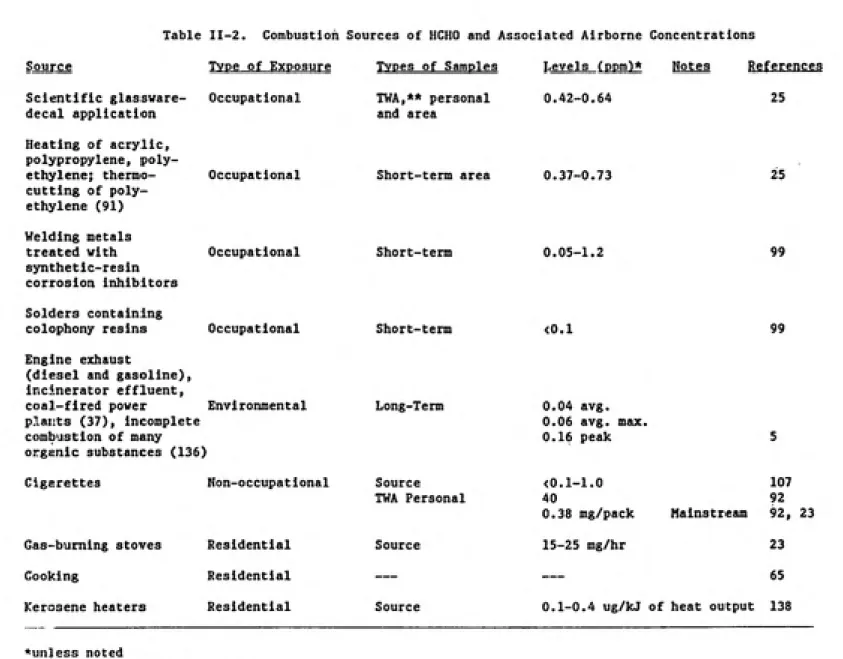
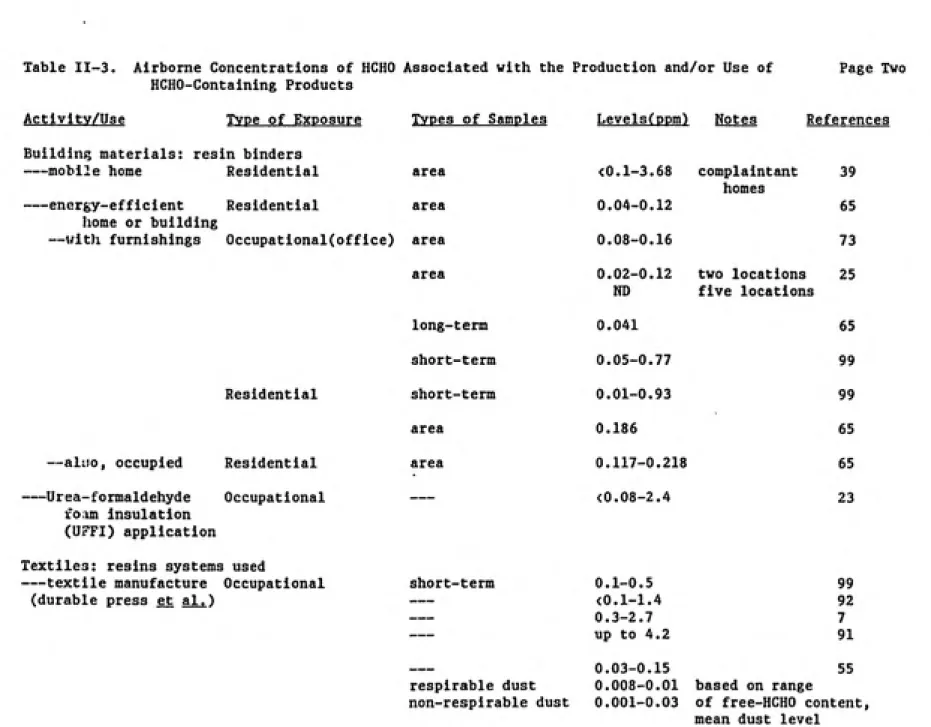
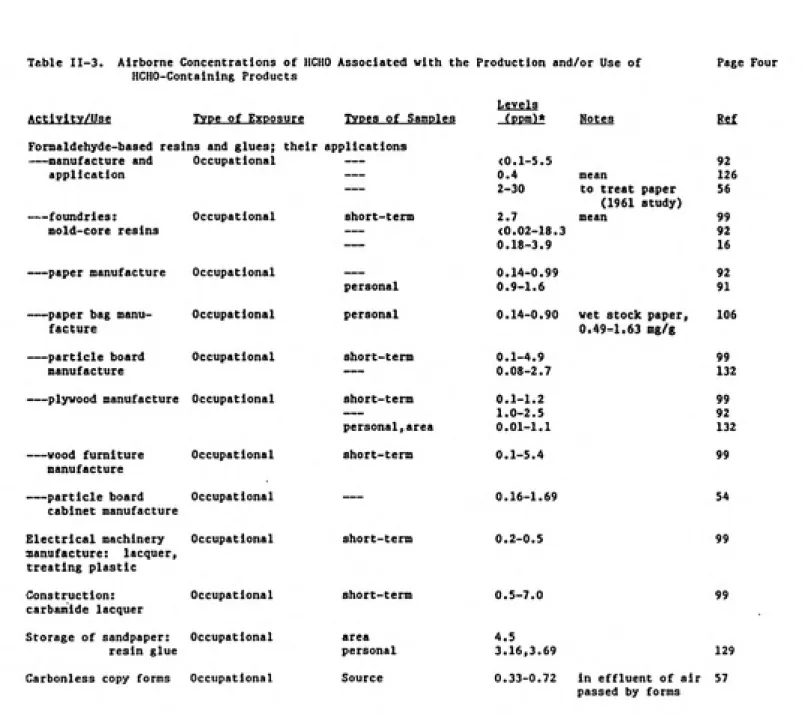
Table II-2 provides the levels of airborne HCHO associated with
many of the combustion processes responsible for its evolution.
Table II-3 contains the airborne concentrations associated with the
production and/or use of HCHO-containing products. These
activities were described in the previous subsection (B.), and
include the use of HCHO as a preservative, pesticide, chemical
Table 11-2. Combustion Sources of HCHO and Associated Airborne Concentrations
Source
Scientific glassware-decal application Heating of acrylic, polypropylene, poly¬ ethylene; thermo-cuttlng of poly¬ ethylene (91) Welding metals treated with synthetic-res in corrosion inhibitors Solders containing colophony resins Engine exhaust
(diesel and gasoline). Incinerator effluent, coal-fired power
p.'.aits (37), Incomplete combjstlon of many organic substances (136) Cigarettes
Gas-bamlng stoves Cooking
Ker:)sene heaters
Type of Exposure
Occupational
Occupational
Occupational
Occupational
Types of Samples
TWA,** personal and area Short-term area Short-term Short-term Levels (ppm)* 0.42-0.64 0.37-0.73 0.05-1.2 <0.1 Notes References 25 25 99 99
Environmental Long-Term 0.04 avg.
0.06 avg. max
0.16 peak 5
Non-occupational Source <0.1-1.0 107
TWA Personal 40 92
0.38 mg/pack Mainstream 92, 23
Residential Source 15-25 mg/hr 23
Residential — -- 65
Residential Source 0.1-0.4 ug/kJ of heat output 138
*unless noted
Activity/Use Type of Exposure
Laboratories: formalin Occupational
Bmbalining Hospitals: formalin —and policlinics —dialysis unit disinfection —autopsy room Occupational
* TWA = Time-Weighted Average
** intermittent use of Formalin *** KD = none detected
Types of Samples
1-hr breathing zone
personal (short-and long-term) (short-and area (long-term)
long-term (area
and personal)
personal TWA* area (short- and
long-term)
short-terra
long-term area personal
Levels(ppm) Notes 0.3-2.63 5%-formalin
(1/2 embalming
between solutions
0.6 and 1.0)
1.9-2.3 0.8-2.4 <0.38-1.04 0.11-0.41 0.25-1.39 References 117 25 25 25
= range of the 7
mean values for
multiple embalming
establishments
ND»**-1.99 embalming fluid 47
HD-2.93 was 6 to 52%
formalin by weight
Occupational short-term 0.05-3.5 99
Occupational personal TWA 0.27-0.63 ** 25
area, long--term ND-0.90 ** area, real--time 0.04-0.50 **
peak 0.9-1.6 15
peak 25 67
Table II-3. Airborne Concentrations of HCHO HCHO-Containing Products
Activity/Use Type of Exposure
Building materials: resin binders
---mobile home Residential
---energy-efficient Residential home or building
—with furnishings Occupational(office)
Residential
Residential
Occupational - al.'o, occupied
---Urea-formaldehyde
to im insulation
(il^FI) application Textile3: resins systems used
---textile manufacture Occupational
(durable press et al.)
Types of Samples
area area area area long-term short-term short-term area area short-term respirable dust non-respirable dust
tduction and,^or Use of Page Two
Levelsfppm) ?lotes References
<0.1-3.68 complaintant homes
39
0.04-0.12 65
0.08-0.16 73
0.02-0.12 two locations 25 ND five locations
0.041 65 0.05-0.77 99 0.01-0.93 99 0.186 65 0.117-0.218 65 <0.08-2.4 23 0,1-0.5 <0.1-1.4 0.3-2.7 up to 4.2
99 92 7 91 55 0.03-0.15
0.008-0.01 based on range
0.001-0.03 of free-HCHO content,
Activity/Use
---durable-press
garment manufacturing
Type of Exposure
Occupational
---durable-press Occupational/
garment retailing Non-occupational
Chemical pr-^duction: raw material ---fertilizar Occupational ---dyestuffa ---unspecified spec¬ ialty chemicals Paraformaldehyde packaging Shoe manufacture: (formalin, spraying) Occupational Occupational Occupational Occupational
Types of Samples
area, short-term area, peak personal, area area personal short-term area short-term
personal 8-hr TWA
area real-time short-term
Levels (ppBi) 99%U R^f^rences
0.03-0.94 25 0.39-1.12 0.13-0.45 7 0.1-1.0 123 0-0.8 132 0.9-3.3 91 0.2-1.9 <0.1-5.9 0.04-1.6 0.03-0.43 <0.25-0.85 0.28-3.40 0.9-2.7 area means Adhesivas:
---manufacture Occupational short-term 0.8-3.5
---use: lamination Occupational short-term 0.04-8.
Table II-3. Airborne Concentrations of HCHO Associated with the Production and/or Use of HCHO-Containing Products
Page Four
Actlvltv/Use
Formaldehyde-based resins and glues; their applications
—manufacture and Occupational application
-foundries: mold-core resins
Occupational
---paper manufacture Occupational
-paper bag manu- Occupational
facture
-particle board
manufacture
Occupational
plywood manufacture Occupational
---wood furniture Occupational
manufacture
---particle board Occupational
cabinet manufacture
Electrical machinery Occupational manufacture: lacquer,
treating plastic
.Construction: Occupational carbamide lacquer
Storage of sandpaper: Occupational resin glue
Carbonless copy forms Occupational
Levels
Types of Samples _(Epml* Rot^fl Ref
jllcations
-- <0.1-5.5 92
-- 0.4
mean 126
-- 2-30
to treat paper
(1961 study)
56
short-term 2.7 mean 99
<0.02-18.3 92
-- 0.18-3.9 16
-- 0.14-0.99 92
personal 0.9-1.6 91
personal 0.14-0.90 wet stock paper, 0.49-1.63 mg/g
106
short-term 0.1-4.9 99
-- 0.08-2.7 132
short-term 0.1-1.2 99
-- 1.0-2.5 92
personal,area 0.01-1.1 132
short-term 0.1-5.4 99
-- 0.16-1.69 54
short-term 0.2-0.5 99
short-terra area personal Source 0.5-7.0 4.5 3.16,3.69 99 129
D. Known and Suspected Health Effects and Corresponding Air
Concentrations
1. Acute Effects
a. animal
Numerous studies of the health effects of formaldehyde have
been conducted on various animal species. Although this
section is primarily concerned with the inhalation effects,
the toxicity studies which have measured the LD doselevel for other routes of exposure provide valuable
information which can indicate the relative acute toxicity
of formaldehyde compared to other chemicals. Table II-4
provides this information for a variety of species.
Table II-4. Acute Health Effects of Formaldehyde, Animal Studies: LD50S (66)
Species Dose, Route of
mg/kg body weight Administration
Rat 800 oral
Rat 420 subcutaneous
Rat 87 intravenous
Mouse 300 subcutaneous
Rabbit 070 dermal
15
A common non-lethal effect is skin irritation by direct
dermal contact. This irritant effect has been seen in rats
emd guinea pigs (7); sensitization was noted after repeated
application.
The effects on animals of formaldehyde inhalation have been extensively studied. The most important of these effects involve the irritation of the respiratory system; these are
summarized in Table II-5.
b. human
As in animals, formaldehyde acts as an acute irritant in humans. Direct contact with formaldehyde solutions affects primarily the site of contact, while the vapor primarily affects the eyes and respiratory tract.
Species Concentration,
ppm
Exposure
time
Effect
Cat 700 8 hr death
Mouse 700 2 hr death
Rat 810 30 min LC50
Guinea Pig 15-16 (aerosol) 10 hr death
Mouse; Rabbit 15-16 (aerosol) 10 hr approx. LC50
Rat (Fischer 344) 15, 6, 2 6 hr/d, 1-9 d Nasal cavity
References
Rat (Fischer 344),
Mouse (B6G3F1) 0.4-56
Guinea Pig 0.31
10 min
1 hr
inflammation at 15 ppm; increased replication of respiratory epithelial cells at 6 and 15 ppm.
dose-dependent depression of respiratory rate; in rats only, minute-volume
compensation.**
increased airway resistance
7
7
91 7 91
66
34
91
* Other studies confirm local necrosis, by different route (intrapulmonary injection).
17
Formaldehyde induces eye and respiratory tract irritation in most individuals above a vapor concentration in the 0.1 to 5 ppm range (depending upon individual sensitivity)
(92); however, it may induce symptoms below 0.1 ppm in
individuals with bronchial hyperreactivity (23). Other effects have been docimiented above 0.25 ppm. Eye irritation only was dociunented in a population exposed to 0.13 to 0.45 ppm, and among an tmacclimatized group whose
exposure was only stated to be much less than 5 ppm (7);
eye irritation was also documented in a study group exposed
to an average of 0.4 ppm (132). However, another study
population exposed to 0.25 to 1.39 ppm suffered skin
irritation Jind headaches in addition to eye irritation.
Similarly, a study documented eye and upper respiratory
irritation, headaches, and cough among a group whose
exposure was only stated to be much less than 3 ppm. Two
occupational study groups, one exposed to 0.9 to 1.6 ppm
and the other to 0.3 to 2.7 ppm (average 0.68 ppm), were
found to experience irritation (to the eyes and skin in the
former group and to the mucous membranes in the latter) and
disturbed sleep; the former group also experienced unusual
thirst. Other instances of eye and upper respiratory
irritation and general complaints of irritation have been
reppitid to occur in *-his range of concentrations. Most
reports agret that - Lolerance to a given level of
formaldehyde will develop in time in most individuals.
Some suggest that sensitization will occur, but not many
Above 10 ppm, formaldehyde will induce in humans more severe irritation and other symptoms. Between 10 and 20
ppm, coughing, tightening in the chest, a sense of pressure
in the head, and palpitation of the heart may occur. Between 50 and 100 ppm, severe respiratory irritation will
occur; single acute exposures to these levels have produced
pulmonary edema (fluid in the lungs) and even death (92).
Chronic Effects
a. animal
The chronic effects of formaldehyde on non-htraian organisms
and tissues include carcinogenic, mutagenic, and other
effects. These "other effects," mainly irritant in nature,
include low body weight and nasal cavity lesions among
groups of monkeys and rats exposed to airborne
concentrations of formaldehyde of 1 and 3 ppm almost
continuously (22 hr/d) for 26 wk, as well as groups of
Fisher 344 rats and B6C3F1 mice exposed to 2, 6, and 15 ppm
for 6 hr/d, 5d/wk, for up to 24 mo (66). The Fisher 344
rats and the mice also developed tracheal lesions. In
other studies, rats exposed by inhalation to 0.8 and 2.5
ppm for 3 Hinnth*' exp^'^''^aced re,'?p''r»to'"y sysl;5m and other
19
focal inflammatory changes of the heart and kidney, and among rats 1 death was noted (91).
Formaldehyde has tested positive for mutagenicity in
bacterial systems. In m«uranalian-cell assays, it has
exhibited mutagenic properties in some species and tissues,
but not others; likewise for arthropods in vivo, for which
positive results were found for some species and routes of administration but not others, and even vegetables, for
which some species but not others tested positive (66).
In an early carcinogenicity study (1963), groups of 42 to
60 G3H mice exposed to 41, 81, and 163 ppm of formaldehyde
for 1 hr/d, 3 d/wk, for 35 wk (except for the high exposure
group, due to severe intoxication after the 11th day),
experienced no pulmonary tumors, but the nasal epithelia
were not examined; basal-cell hyperplasia, squamous
metaplasia, and atypical metaplasia were seen in most of
the exposed animals, and in no controls (66). Two more
recent studies, from 1979 and 1980, have demonstrated that
formaldehyde is carcinogenic in laboratory animals (92).
In one, rats (Fischer 344) and mice (B6C3F1), 240 of each,
were exposed 6 hr/d, 5 d/wk for up to 24 months to
formaldehyde vapor. Squamous-celi carciaomas of the nasal
turbinates developed in 93 rats and 2 mice exposed to 15
In the other study, 100 Sprague-Dawley rats were exposed to 14.6 ppm only (the exposure pattern was otherwise similar to the preceding study), but in conjunction with 10.6 ppm hydrochloric acid (HCl), as a test of their reaction product bis(chloromethyl)ether (BCME). Squamous-cell
carcinomas of the nasal turbinates (which are not
characteristic of BCME exposure) developed in 25 rats, although they had never been seen in unexposed animals of this strain. Further work was conducted to clarify these results (66). Groups of 100 rats were similarly exposed to formaldehyde only, mixtures of it and HCl mixed before (at
high concentrations; presumably, more BCME would form) and
during the exposure testing, and HCl only. Nasal
carcinomas, almost all squamous-cell, were found in 10, 12,
6, and none, respectively, of the rats in these groups, and
in no control animals.
The International Agency for Research on Cancer (lARC) (66)
reviewed other studies which reported the induction of local tumors after subcutaneous injection in hamsters and
rats and direct application to the oral mucosa in rabbits.
These studies suffered from problems like poor reporting,
21
b. human
Regarding the chronic effects of formaldehyde on hiomans, the greatest concern focuses on the issue of carcinogenicity, and numerous studies have now been completed in this regard. However, some other chronic effects have been noted; most of these are related to the irritant properties of this substance. Respiratory effects include airway obstruction and reduced lung function (formaldehyde concentration uncertain due to sampling problems; the range of possible concentrations was 0.4 to 12 ppm) (92), as well as pnuemonitis (7) (inflammation) after 50 to 100 ppm acute exposures (92). Dermatitis has occurred due to dermal exposures (66). Also, menstrual disorders and secondary sterility in women have been reported (66) (exposure levels unknown).
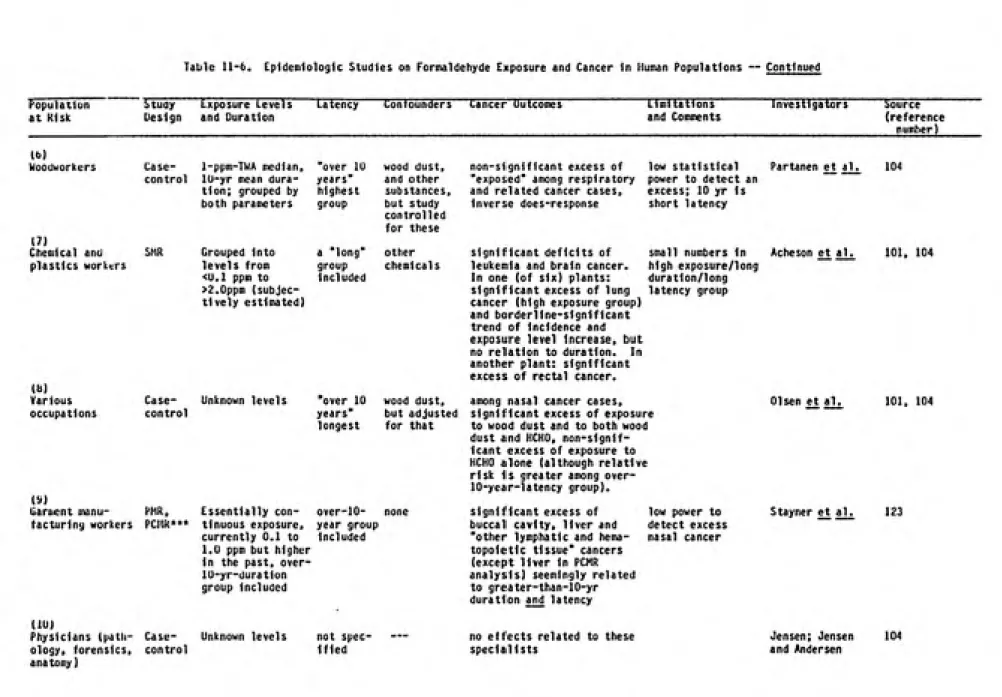
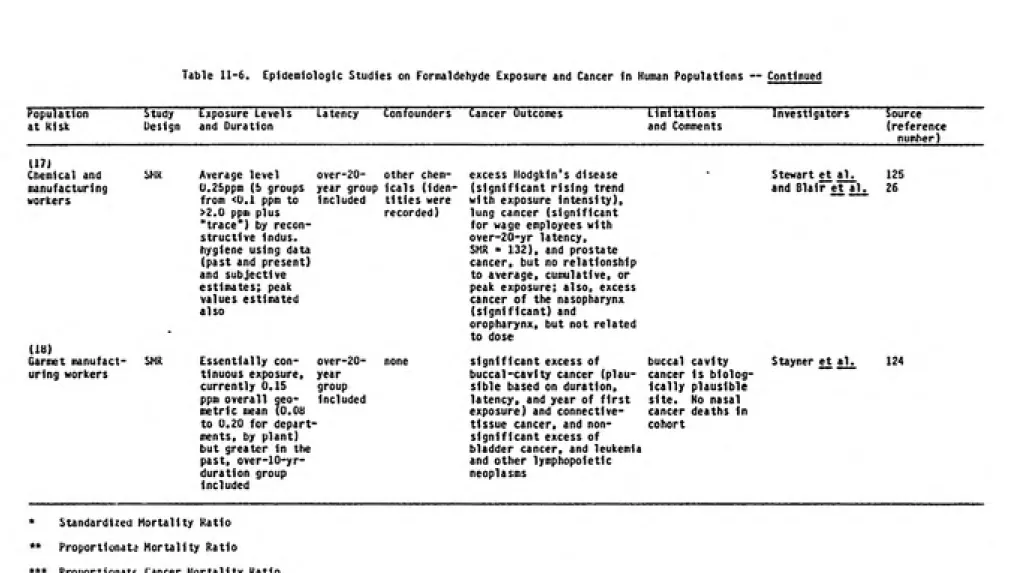
Numerous epidemiologic studies of human populations have now been completed which address the issue of formaldehyde as a carcinogen. These are simunarized in Table II-6. No one study provides sufficient evidence to conclude that formaldehyde is carcinogenic in htmian populations, and some
studies cited found no excesses of cancers (although often
Population
at Kisk Design and Duration and Comments (reference
number)
Pathologists anu lau tectinicians
SMK* Unknown Levels "shorl"(lD4) Suicide (significant excess); lymphatic and
hematopoietic neoplasms among pathologists, but these excesses disappeared
in later followup when
significant excess of brain cancer (astrocytoma
and glioma) was found
Harrington and
Shannon
Harrington and
Oakes
66 101, 104
Physicians
involveu with
laboratory work
SHK Unknown levels not specified deficits of lung,
esophagus, oral cancers
Doll and Peto 66
Morticians WBl** Unknown levels; short average
duration
14)
Formaldehyde SMk, Unknown levels;
nanutacturing PMR short average
workers duration
(i)
Forjiialdehyue and
resin manuta
-turing worke's
PMK Unknown levels;
short average
duration
"short" other
embalming-fluid components
some over other
20 yr; chemicals average was "short" "short" added 4 yrs followup other chemicals
significant excess of skin low statistical
(apparent dose-response power to detect relationship), kidney, nasal cancer
and brain cancer; no excess
excess respiratory or
nasal cancer
SMR: non-significant excess of brain and prostate cancer and Hodgkins' disease, with prostate significant in the "over 20-yr latency" group;
PHR: significant excess of "all" and prostate cancer excess of digestive system cancers, but was seen among
the youngest (at death) and shortest duration/longest latency groups only
low statistical
power to detect
various cancer
excesses
low statistical power to detect
various cancer excesses Walrath and Fraumeni Wong 66 66 Harsh
additional followup: signi- only analyzed for Liebling et al. ficant excesses of colon,
and buccal and pharyngeal
cancer
66
101, 104 the 4 years of add¬
itional followup, rather than combining with previous results;
therefore, small numbers of deaths in
Table 11-6. Epidemiologic Studies on Formaldehyde Exposure and Cancer in Human Populations — Continued
Latency Contounders Cancer Uutcomes Limitations
and Comments
Investigators
Population
at Kisk
Study Exposure Levels Design and Duration
Source (reference number) 16) Woodworkers 17) Chemical ano plastics workers
Case- 1-ppm-TWA median, "over 10 wood dust.
control SMR (ti) Various Case-occupations control (a)
liariiient inanu- PMR, facturiny workers PCHR***
lU-yr mean dura¬
tion; grouped by both parameters
Grouped into
levels from
<U.l ppm to >2.0ppm (subjec¬
tively estimated)
years highest
group
a "long"
group Included
Unknown levels "over 10
years" longest
Essentially con¬ tinuous exposure, currently 0.1 to
1.0 ppm but higher
in the past,
over-lU-yr-duration group included and other substances, but study controlled for these other chemicals wood dust, but adjusted for that
over-10- none year group included
non-significant excess of low statistical
"exposed" among respiratory power to detect an
and related cancer cases, excess; 10 yr Is inverse does-response short latency
Partanen et al. 104
significant deficits of
leukemia and brain cancer.
In one (of six) plants:
significant excess of lung
cancer (high exposure group) and borderline-significant
trend of incidence and
exposure level Increase, but
no relation to duration. In
another plant: significant
excess of rectal cancer.
among nasal cancer cases, significant excess of exposure
to wood dust and to both wood
dust and HCHO, non-signif¬
icant excess of exposure to
HCHO alone (although relative risk Is greater among over-10-year-latency group).
small numbers In
high exposure/long
duration/long latency group
Acheson et al. 101, 104
01 sen et al. 101, 104
significant excess of
buccal cavity, liver and
"other lymphatic and hema¬ topoietic tissue" cancers (except liver In PCMR
analysis) seemingly related
to greater-than-10-yr
duration and latency
low power to detect excess
nasal cancer
Stayner et al. 123
(lOJ
Physicians (path- Case-ology, forenslcs, control anatomy)
Unknown levels not spec¬
ified
no effects related to these
specialists
Jensen; Jensen
and Andersen
{reference number) Population
at Risk
Study Exposure Levels Latency Confounders Cancer Outcomes
Design and Duration and Comments
lil)
Morticians SMk 0.(J2 ppm 4U-hr-wk-TWA average; long
duration
"long" phenol no cancer excesses; only non-maligant excesses
(probably alcoholic in origin)
low exposure
levels
Levlne et al. 104
112)
Chemical workers Case- 3 TWA exposure
Control groups from <0.1 to >2.0 ppm
(some assigned
by recall of odor), or 2 peak exposure
groups (>2 ppm,
or not)
113)
Various oceup*- Case- Unknown levels tions control
"adequate' other chem¬ icals 114) Anatomists (lb) Various occupa¬ tions (10) Various occupa¬ tions unknown
SMR 3 groups, by spe- not spec-cialty; typically Ifled 1 to 3 ppm, higher Intermittently,
estimated exposures
Case- Subjective not spec-control ranking (high, 1ffe«J
low) by occupation
Case- Subjective rank
control of exposures;
levels unknown unknown; presumed other chemicals other chemicals
not spec¬ wood dust
ified and smoking.
but study controlled for these
non-significant excess of "exposed" among bladder and
prostate cancer cases
possible over¬ matching (104)
Fayerweather
et al.
49
among nasal cancer cases, exposures based on significant association with report of subjects working In textile Industry
{RR=1.72) (women only),
deficit of exposure to HCHO
significant excess of brain cancer (glial cell) and
chronic myeloid leukemia,
non-significant excess of "all" leukemia, deficit of lung and "all" cancers
among lung cancer cases,
highly significant excess
(RR = 1.5) of those in
HCHO-exposed occupations (but no relation to exposure group);
among bladder cancer cases,
no association.
Brinton et al.
Stroup
32
101
Coggon et a]K 101
among squanious-cel 1
carcinoma cases, excess of
those in "exposed" occupa¬
tions, but unclear If con¬ founded by wood dust
two Independent
exposure assess¬
ments
Table U-b. Epidemiologic Studies on Formaldehyde Exposure and Cancer in Human Populations — Continued
Population
at Risk
Study Design
Latency Confounders Cancer Outcomes Limitations and Comments Source (reference number) Exposure Levels and Duration Investigators 117J Chemical and manufacturing workers (LB) barmet manufact¬ uring workers
SMK Average level 0.25ppm (b groups from <0.1 ppm to
>2.0 ppm plus
"trace") by recon¬
structive Indus,
hygiene using data
(past and present)
and subjective estimates; peak
values estimated also
SMR Essentially con¬
tinuous exposure, currently 0.15 ppm overall geo¬
metric mean (0.08
to 0.20 for depart ments, by plant)
but greater in the
past,
over-10-yr-duration group
included
over-20- other
chem-year group icals
(iden-included tities were
recorded) over-20-year group included none
excess Hodgkin's disease (significant rising trend with exposure intensity), lung cancer (significant for wage employees with over-20-yr latency, SMR = 132), and prostate cancer, but no relationship to average, cumulative, or peak exposure; also, excess cancer of the nasopharynx (significant) and
oropharynx, but not related
to dose
significant excess of buccal-cavity cancer (plau¬
sible based on duration,
latency, and year of first exposure) and connective-tissue cancer, and non¬
significant excess of
bladder cancer, and leukemia
and other lymphopoietic
neoplasms
Stewart et al. and Blair et al.
125 26
buccal cavity cancer is biolog¬ ically plausible
site. No nasal cancer deaths In cohort
Stayner et jVg^ 124
been consistent between studies, some biologically unlikely sites have been implicated, and confounding variables have been reported. Nevertheless, some researchers now believe
that the studies, viewed together, seem to provide
sufficient evidence to conclude that formaldehyde plays a role in carcinogenesis. The National Institute for Occupational Safety and Health (NIOSH) has recently stated, "We concur with OSHA that the weight of available evidence__does suggest that formaldehyde exposure may be associated with increased risk of Ivmg cancer, brain
cancer, and leukemia, although a plausible carcinogenic
27
E. Maximum Exposure Level Recommendations and Legal Standards
Recommendations and legal standards for the maximum level of
exposure to airborne formaldehyde vapor to protect human health are
published by several organizations in the United States. Both the
occupational and non-occupational environments are addressed by
these compilations. The occupational limits include the Threshold
Limit Values recommended by the American Conference of Industrial
Hygienists (ACGIH TLVs) (8), the NIOSH Recommended Exposure Limits
(NIOSH RELs) (89), and the Permissible Exposure Limits promulgated
and legally enforcable by the Occupational Safety and Health
Administration (OSHA PELs) (100, 101). A non-occupational limit
for all indoor spaces has been recommended by the American Society
of Heating, Refrigerating, and Air-conditioning Engineers (ASHRAE)
(12). Table II-7 provides these recommendations and standards.
Occupational standards of varying magnitude have also been adopted
in many foriegn countries (7).
F. Air Seunpling and Analysis Methods
A large number of methods have been proposed for the determination
of airborne formaldehyde concentrations, utilizing a variety of
collection and analytical procedures. This subpart simmiarizes the
important feattus? o^ many of rliose which have been published. A
number of tii£ ^l2tlio^^£. JenoteH ^n the literature as methods for
formaldehyde are actually non-specific total aldehyde methods;
Occupational Non-occupational
Organization 8-hr TWA* Ceiling** MaximiJm STEL^ Indoor
(Area)
Peak*** Maximum
ACGIH 1.0
NIOSH
---OSHA, Current 3.0 Proposed 1.0 or 1.5
ASHRAE
---5.0 10
2.0
o.iee
0.1
* TWA = Time Weighted Average
** Generally, maximum allowed above the 8-hr TWA
*** Maximum peak excursion above the ceiling, allowed for no more than
30 min during an 8-hr shift
^ STEL = Short Term Exposure Limit, a 15-min TWA
^® Designated as "lowest feasible concentration that can be reasonably or
29
1. Methods for Total Aldehydes (Non-specific for Formaldehyde)
a. Early Methods
The bisulfite method is the classic method of aldehyde
determination, and was proposed for use in airborne
sampling in 1943 (60). Air ssunples are collected at flow
rates of 1 to 3 Lpm in midget impingers containing 10 mL of
aqueous 1% sodium bisulfite (NaHSO ) (sodium hydrogen
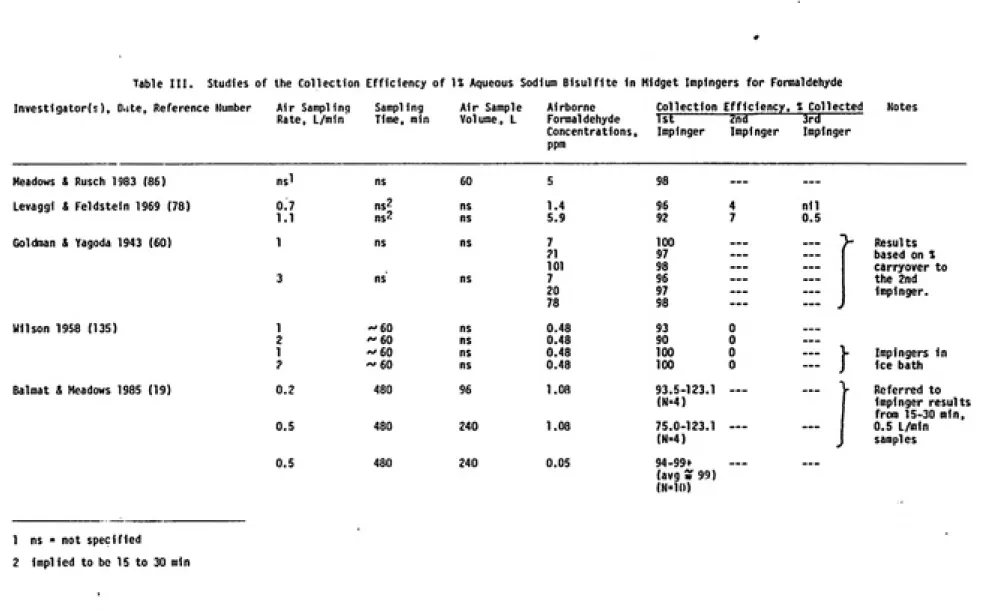
sulfite) (the collection efficiency is discussed in Part
III.B., below), or at 28 Lpm in large impingers with 100 mL
of this solution. Formaldehyde reacts with NaHSO to
form the stable complex soditmi formaldehyde bisulfite. For
analysis, unreacted bisulfite is destroyed with iodine
under neutral conditions, then the solution is made
alkaline to decompose the complex. The liberated sulfite
is then titrated with standardized iodine solution for an
indirect measure of the aldehyde originally collected. The
method is sensitive to aldehydes and ketones, and the
sensitivity is not the best (60). Slight modifications,
including the use of two midget impingers "with fritted
disks" in series in an ice bath, and a minor change in the
titration procedure, were proposed in 1958 (135).
In 1940, Kersey et al. reported Schryver's method, or the
phenylhydrazine method, calling for collection in dilute
hexacyanoferrate (III) in acid solution, a reaction occurs to form a purple chromogen, for a colorimetric determination (109). This method was determined to respond to acetaldehyde and acrolein (91). Modifications in the collection procedure have subsequently been reported, including collection in 1.5% potassium hydroxide (91) and in distilled water (22), as well as the impregnation of silica gel with phenylhydrazine to make indicator tubes proposed by Fedotov (91).
Newer Methods
The newer (1961) 3-methyl-2-benzothiazolone hydrazone
(MBTH) method, although still sensitive to a variety of
aliphatic aldehydes, is most sensitive to HCHO. MBTH reacts with HCHO in the presence of iron (III) chloride to
form a blue cationic dye in acidic solution, for a
spectrophotometric determination (113). Collection in aqueous 0.2% MBTH-HCl (113) or in aqueous 0.05% MBTH in bubblers has been reported, the latter with air flow rates from 0.47 to 1 Lpm (11, 63). The latter is a modification to increase the sensitivity to the parts per billion (ppb)
range (63). Collection efficiencies of 95-98% (113) and
84% (60) wer*> '•".ported.
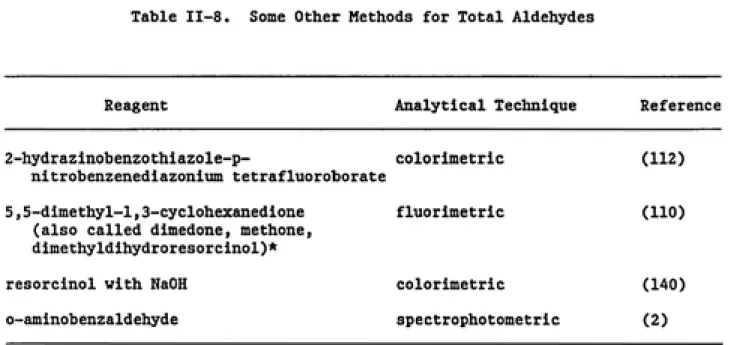
Some other methods for total aldehydes are summarized in
Table II-8. Some Other Methods for Total Aldehydes
Reagent Analytical Technique Reference
2-hydrazinobenzothiazole-p- colorimetric (112)
nitrobenzenediazonitun tetrafluoroborate
5,5-dimethyl-l,3-cyclohexanedione fluorimetric (110) (also called dimedone, methone,
dimethyldihydroresorcinol)*
resorcinol with NaOH colorimetric (140)
o-aminobenzaldehyde spectrophotometric (2)
including ones based on alkaline peroxide (71), soditmi sulfite (for very high concentrations) (29), and
1,3-cyclohexanedione (or dihydroresorcinol [136]) (110)
reagents, and the Envirotech Services, Inc., passive dosimeter, which features collection on a polycarbonate sponge impregnated with 0.1 N NaOH, and analysis by the Purpald method (58). Also, infrared (IR) einalysis has been
employed, after freeze-trap or evacuated-bulb collection
(139) or direct collection into the cell of a continuous monitor such as the MIRAN Gas Analyzer (19). Good
review articles covering many of these methods are
available (48, 109, 110).
2. Formaldehyde-specific Methods with Collection in Aqueous Media, Except for the Chromotropic Acid Method
The chromotropic acid method, which is a formaldehyde-specific
method with collection in aqueous media, and is the method used in the present study, is reviewed in Section 3, below. Other such formaldehyde-specific methods are discussed in the present
Section.
a. Pararosaniline (Schiff's Reagent) Method
One of the most important of these is the pararosaniline
method, which utilizes Schiff's reagent (also called
33
sulfite. It was first reported as a reagent for the
determination of formaldehyde by Schiff in 1866 (91), and
its reaction with formaldehyde (HCHO) produces a
rose-violet chromogen for a colorimetric analysis.
Zhitkova (140) was one of the earliest, in 1936, to report
the use of this method for the analysis of air samples, and
numerous versions have been subsequently published (91).
These include collection in 0.005N hydrochloric acid (HCl)
(107), modified Schiff's reagent (see a description of this
in the next paragraph) (1), and distilled water in midget
impingers at high flow rates for short times (<20 min) (43,
83) or in large bubblers (43).
Modified Schiff's reagent is a mixture of
dichlorosulfitomercurate (II) complex and acid-bleached
pararosaniline hydrochloride; it is more selective than the
version described above (83). The modified reagent is
currently used in commercially available automatic
analyzers (88); according to Godish (58), the only
continuous formaldehyde monitor available in 1985 was the
TGM 555 by CEA Instruments, Inc., which utilizes this
interference for this method) in a refrigerated container,
a 0.8 Lpm air flow rate for 12 to 24 hr, and color
development by the addition of pararosaniline
hydrochloride, then sodium sulfite; sulfur dioxide and
cyanide are interferences (88).
b. Girard-T Reagent Method
In 1978, the Girard-T Reagent method was published by NIOSH
as Method S327 (95); NIOSH currently designates it as
Method 3501 (46). This method is based on the reaction of
formaldehyde and Girard T reagent,
(trimethylaminoacetohydrazide chloride, or
[carboxymethyl]trimethylammoniimi chloride hydrazide
[136]). Collection occurs in aqueous buffered Girard T
reagent in a midget bubbler at 50 to 200 cc/min. Formaldehyde-Girard T derivative forms from the reaction, and the solution is analyzed polarographically for this derivative after a small amount of mercury is added.
c. 2,4-Dinitrophenylhydrazine (2,4-DNPH) Method
This method utilizes 2,4-DNPH as a reagent, and employs
HPLC for arislys'''!. (Joiipctio". of airborne samples has been
reported using aqueous 2,4 DKFfi in a high-flow washer
packed with Raschig rings, with good collection efficiency
35
HCl solution in 2 midget bubblers in series at 0.5 to 1.5 Lpm (76). This method has been adapted to solid-sorbent collection (see Section 4, below)
d. Other Formaldehyde-specific Methods with Collection in Aqueous Media
Some other formaldehyde-specific methods with collection in
aqueous media are summarized in Table II-9. Still other
methods have been reported, including ones based on
reagents such as 2-hydroxycarbazole (for spot tests; not
proposed as an air sampling method) (114), paraphenylenediamine (18), and an equilibritmi mixture of potassium tetracyanonickelate and dimethylglyoxime (a test-paper, not air sampling, method) (133), as well as ones utilizing polarographic analysis following simple collection in dilute KOH (91) or in water in a gas scrub tower immersed in an ice bath (85).
3. Method Used in the Present Study: Chromotropic Acid (GTA)
Method
Chomotropic acid (GTA), l,8-dihydroxynaphthalene-3,6-disulfonic
acid, in sulfuric acid fK^SQ ), iorrns a vioiet-p^nli color
when warmed with formaldehyde (50). The intensity of tlie color
is essentially proportional to the quantity of formaldehyde
Name of Method Collection Reagent Analysis Determination Other Information
hydrazine polarographlc aqueous ^0% methanol
in midget bubblers
extra-purified
distilled water in midget bubblers (36)
2-hydrazinobenzoth azole aqueous 0.25?
2-hydrazinobenzothiazole in impingers
J-acid (air sampling method not specified)
pteqyl J-acfd (air sampling method not specified)
llantzsch's reagent water in jet bubblers (or acetyl acetone [40]) (not fritted) (52)
hydrazine polarographic 2-hydrazino¬ benzothiazole colorimetric Reference Number 0.2'i J-acid(6-amino-l-naphtho1-3-sulfonic acic [112], or 7-amino-4-
hydroxy-2-naphthalenesul fom'c acid [136]) in concentrated H2SO4
spectrophotometric
O.n phenyl J-acid (6-anilino-l-naphthol-3-sulfonic acic) in concentrated H2SO4 Hantzsch's reagent (acetyl acetone and ammonium salt [90]; mix ammonium acetate, acetic acid, acetyl acetone [71 ])
spectrofluorimetric
(115)
spectrophotometric
colorimetric (90)
spectrofluorimetric
(21)
intended for peak
measurements under
10-ppm peak OSHA standard
(higher than the currently useful range); good specificity
little interference from other aldehydes; detector tube variation discussed in Section 4, below more sensitive than CTA method; adapted to solid-sorbent collection in air (discussed in Section 4, below)
more sensitive than CTA or J-acId (spectrophotometric) methods 116 36, 116 112 112 112, 115 112 52, 90
37
as a specific reagent for formaldehyde by Eegriwe in 1937
(41). The chemistry of the color reaction is not known with
certainty, but Feigl (50) has proposed the reactions shown in Figure II. He states that, "Since aromatic hydroxy compoimds condense with formaldehyde to yield colorless hydroxydiphenylamines, it is probable that the initial step consists of a condensation of the phenolic chromotropic acid
with formaldehyde as shown in [equation] (1) [in Figure II]
followed by oxidation to a para-quinoidal compound as shown in
(2)...Concentrated sulfuric acid participates in both (1) and
(2). In the former it functions as a dehydrant to bring about
the condensation; in (2) it is an oxidant and is reduced to
sulfurous acid."
The air sampling and analysis procedure based on this reagent
was proposed in 1954 by McDonald (84) essentially in the form
used today, as recommended by the National Institute for
Occupational Safety and Health (NIOSH) in NIOSH Method 3500
(45), except that collection in aqueous 1% sodiimi bisulfite
(NaHSO.) (sodium hydrogen sulfite) is now exclusively
recommended. (The method was formerly designated P&CAM 125 by
NIOSH (93); at that time, collection in distilled water was
still recommended.) Procedures sucessfully utilizing
collection in ?.nueous NaHSO^ have been widely
reported [33, 78, 7", 8o); th3s crillection meditmi was first
proposed as a way to avoid interference by oxides of nitrogen
in pollution samples (33), and later to improve
SO,H
HO-
J>={ + CH.O
X
SO.H
-H.0 HO^VCH.
HO—<^ \ ^
Formaldehyde ^-f ^
SO.H(1)
SO,H
Chromotropic Acid
SO.H SO,H
Intermediate (colorless
hydroxydiphenylmethane compound)
SO.H
HO-HO
f"
VcH.-SO.H
SO,H
\ ^^
-OH HO
+ O ^^
SO.H
Intermediate
-OH i from reduction
HO—
SO,H
SO.H
S0,H
CH=
/
i
SO,H
=o OH
(2)
of II^SO^
to H-SO„ Chromagen (pink-violet
39
Also, samples collected in NaHSO are stable in storage (at
room temperature) for at least 10 days (69), much longer than
samples collected in distilled water (even if refrigerated)
(38, 86), as discussed below. The formation of the
formaldehyde-bisulfite adduct probably accounts for the
enhanced performance of the method when collection in bisulfite
is incorporated. A discussion of this is included in Part
III.B. The chromotropic acid method is the most commonly used
method for airborne formaldehyde determination (116).
The basic procedure of NIOSH 3500 (45) is as follows: Air
samples are collected in midget impingers at 0.2 to 1.0 Lpm,
although collection efficiency below about 1 Lpm has not been
evaluated. This is the method under study; a complete
discussion of the collection procedures that have been
evaluated is in Part III.B. When sampling in atmospheres with
significant particulate concentrations, it is recommended by
NIOSH researchers that consideration be given to the
possibility that formaldehyde and/or interfering compounds may
be released into the stored impinger solutions by desorption
from or degradation of the particulates, and that pre-fliters
be employed when appropriate to eliminate such problems (69).
An aliquot of the sjimple is treated with chromotropic acid
(CTA) end sulfuric acid (H SO ), and ? puri-i" color
dtivelops (45) with no external heating required, as the
reaction is exothermic (4). The absorbance of this solution is
standard analytical curve generated by measuring the absorbance of a series of color-developed solutions of known formaldehyde concentrations. A more complete description of the analytical procedure may be found in Part VI, METHODS; also, a copy of the NIOSH method is provided in Appendix E.
The intensity of the color developed in the reaction has been stated to be proportional to the concentration of formaldehyde
in the solution (93); thus, the spectrophotometrically-measured
absorbance response is essentially linear with respect to concentration throughout a wide concentration range (4, 84).
The analytical precision of the method as listed is +5% (93),
while the overall precision (s ), including sampling, sample
workup, and analysis, is 0.09. The lower detection limit in
air is about 0.02 ppm for an 80-L sample, or 0.1 ppm for a 15-L
sample (the latter is specified as the lowest reliably
quantifiable [short term] concentration in the most recent
NIOSH policy statement on formaldehyde [89]); the working range
has listed upper limits of 0.4 ppm, or 2 ppm, respectively, although these can be increased by dilution of the aliquot of ssimple to be analyzed.
Some interferences to this method have been documented, the most -serious of vb^rb ^r .roiu ohenols. This interference has
generally been accepted aa a negative bias of 10 to 20% at an
8-fold excess of phenol over formaldehyde (93), but a recent
41
decline in formaldehyde recoveries, to 50% at a 2-fold excess and 0% at a 20-fold excess of phenol over formaldehyde, was seen in one study (116); in another, at phenol-formaldehyde ratios as low as 3:1, almost total inhibition of the color development in water, and a strong HCHO-concentration-independent inhibition in aqueous 1% NaHSO , were seen (72). However, phenol cem be selectively absorbed from collected samples prior to analysis, using washed XAD-7 polymeric resin, thereby avoiding the interference (62). Acrolein is a slight positive interference; other aldehydes are
not (4, 45, 93). Methanol is not em interference, but ethanol
and higher alcohols, if present in rather high concentrations
(such as tenfold excesses [4, 93] over formaldehyde), are
negative interferences (4, 45, 93), as are olefins (alkenes)
(45, 93), such as ethylene, propylene, and
2-methyl-l,3-butadiene (93). Pre-trapping with Tenax-GC, a
porous-polymer sorbent, has been used to remove ethanol from an air stream being sampled (77). Aromatic hydrocarbons are not serious interferences when collected in water or aqueous bisulfite (4, 118) iinless, presumably, they are present in relatively high concentrations, since the reduced interference is due to low collection efficiency of these compounds in the
aqueous media (as is also the case for the olefins) (118).
This is true for x^'leae, bnt if necessary It can be removed with Tenax-GC as described above tor ethaiici (77). Ketones are
generally not an interference (4), although cyclohexanone
chloroform (77). Nitrogen dioxide (4) is not generally an
interference, although in pollution samples with great excesses
of nitrogen oxides concentrations over formaldehyde
concentrations, the nitrate and/or nitrite ions formed in the
solution are interferences. Sampling in aqueous 10% NaHSO
has been found to eliminate the interferences from these twoions (33). Dimethoxymethane (methylal) is a positive
interference if present in great excess over formaldehyde, but
can be pre-scrubbed from an air sample using "Porapak Q" solid
sorbent (a styrene-divinylbenzene adsorbent which does not
retain significant quantities of formaldehyde) (51).
Interferences caused by orgemic compoTinds, such as higher
alcohols, have been controlled by evaporating the solution to
be analyzed to dryness; the formaldehyde has been found to be
retained by the CTA so that upon addition of H SO the
correct amount of purple chromagen is produced (31). An
unusual interference problem is caused by aluminum cap liners
on sample storage vials (the NaHSO in the absorbing solution
attacks the aluminum and forms a fine precipitate which
interferes with the analysis) (86). Also, of course, any other
compound that will release formaldehyde when hydrolyzed with
sulfuric acid is a positive interference (30); additional
examples include formic acid and dextrose (118).
43
water (86). A recent investigation by Daggett and Stock of the
stability of stored environmental seimples collected in
1% NaHSO also indicates excellent stability, at least 8 days
for refrigerated and im-refrigerated samples (38). Also, a
NIOSH study found good stability for at least 10 days for similar un-refrigerated samples stored in Nalgene
cross-linked polyethylene (CPE) bottles, with declines in
recoveries noted by the 30th day (69). (A previous study found
some deterioration of field samples refrigerated overnight,
despite collection in bisulfite, while laboratory-generated
samples were not affected [75]. However, the Daggett and Stock
study found a similar decline in recovery to be temporary,
possibly due to some unknown slow equilibritim process, and it
reversed itself [38] . Furthermore, the deteriorating field samples were collected in a textile plant [75], where a
pre-filter should have been incorporated to keep potentially
interfering particulate-bome compounds out of the s«imples [69] .)
Numerous variations in the sampling technique have been
employed, although few have been evaluated for their effects on
collection. Some of those used are: flow rates from 0.1 to
1.1 Lpm (5, 73, 78); sampling times of 90 min to 24 hr (19, 58,
73, 75, 120^' rzc -^^ Gree-nbnrir-Smith impingers (78, 79); use of
fritted bubblers ^84, 120); and, aqueous NaOH as the collection
medium (84). Collection of diesel exhaust samples in ethanol
for collection and NO, was an interference (80). Another
variation, the purpose of which is to account for particulate containing HCHO (or compounds with the potential to degrade to HCHO) in an air sample, calls for the use of a pre-fliter and, if appropriate, the extraction of HCHO from the filter with aqueous 1% NaHSO for a separate CTA analysis (69). Also,minor variations in the procedure for sample work-up and
analysis have been reported. For ex£unple, the addition of a step to concentrate the sample if its concentration is below the detection limit has been reported (84).
A major modification of the procedure for certain "source"
sfunples (5, 80, 118), as well as environmental samples for
total aldehydes (6), calls for collection of the air sample in a solution of CTA and H SO which simplifies the procedure, and raises the collection efficiency and sensitivity (4). However, this may increase the collection of certain contaminants to the point of their becoming interferences. For example, olefins can be a negative interference with the analysis if collection is conducted this way (although their collection efficiency appears to be sufficiently reduced at
flow rates equal to or exceeeding 1 Lpm to essentially
eliminate the interference) (4). Aromatic hydrocarbons can
also becore In-eiT^PTenr.es using i-hi'' aodification (4). A
similar, but slightly different, Ticaification calling for
45
due to declining recovery as the HCHO concentration
increased (86).
Modifications to the basic procedure to allow easier
simultaneous determination of HCHO and related compounds have
been published. One of these, for combining HCHO and total
aldehyde samples, calls for sampling with bubblers containing
aqueous 0.05% 3-methyl-2-benzothiazolone hydrazone (MBTH) so
that an aliquot of solution can be analyzed for total aldehydes
by the MBTH method (described in Section l.b, above) (87).
Another such modification, for simultaneous determination of
HCHO, acrolein, and low-molecular-weight (MW) aldehydes (C.
to C_) calls for sampling with impingers containing aqueous
1% NaHSO , in an ice bath, so that aliquots can be analyzed
for acrolein by a modified mercuric-chloride-hexylresorcinol
method and for the C to C_ aldehydes by gas chromatography
(GC) (79); this procedure can be expanded to include low-MW
ketones, and the ice-bath collection can be deleted if acrolein
is not present (78). These two modifications have also been
combined, with sampling in MBTH for the analysis of total
aldehydes, and subsequent analysis for acrolein using the
4-hexylresorcinol method (6).
4. Formaldehyde-specific Methods with Co2lection on Solia Sorbents
1975 (137), utilizes collection on alumina at an air flow rate
of 200 cc/min for up to 30 min, followed by immediate elution
with aqueous 1% methanol for at least 16 hr. The solution obtained is then zinalyzed by the chromotropic acid method (described in Section 3, above). A significant loss of analyte from the sorbent occurs after 1 hr, which is why the sampling
time is limited and the elution must be done immediately; the
methanol in the eluting solution stabilizes the desorbed formaldehyde. This method was published by the National
Institute for Occupational Safety and Health (NIOSH) in 1977 as
P&CAM 235 (94). The air concentration range is 0.3 to 42 ppm;
NIOSH indicates that only 1 hr of elution is required. Other
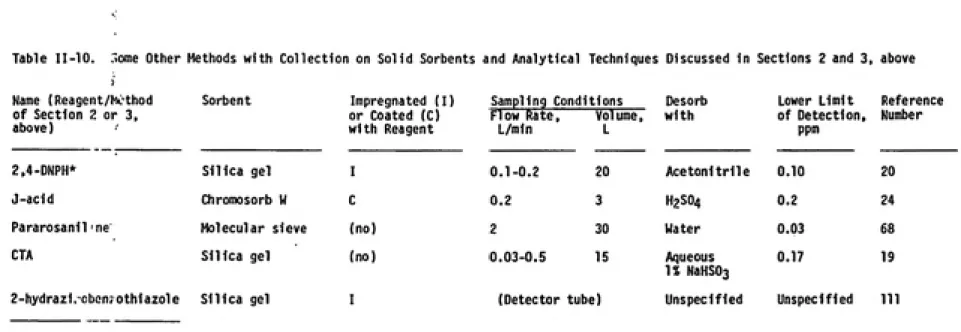
methods with collection on solid sorbents that are based on
analytical techniques discussed in Sections 2 and 3, above,
have been reported; these are summarized in Table 11-10.
In 1980, NIOSH published P&CAM 318 (96). This method utilized
a specially-prepared charcoal sorbent, impregnated with a
proprietary chemical (by SKC, Inc., Eighty Four,
Pennsylvania). The formaldehyde was desorbed from the charcoal
with hydrogen peroxide for analysis by ion exchange
chromatography. This method is no longer recommended due to
instability of the siunples in storage, believed to be related
to the ipTigth v.* storage time and the storage temperature,
Table 11-10. iome Other Methods with Collection on Solid Sorbents and Analytical Techniques Discussed In Sections 2 and 3, above
Name (Reagent/Kthod of Section ?. or 3, above)
Sorbent Impregnated (I)
or Coated (C) with Reagent
Sampling Conditions Flow Rate, Volume,
L/min L
Desorb with
Lower Limit of Detection,
ppm
Reference Number
2,4-DNPH* Silica gel I 0.1-0.2 20 Acetonitrile 0.10 20
J-acid Chromosorb W C 0.2 3 H2SO4 0.2 24
Pararosanil me' Molecular sieve (no) 2 30 Water 0.03 68
CTA Silica gel (no) 0.03-0.5 15
Aqueous
n NaHS03
0.17 19
2-hydrazi. oben; othiazol e Silica gel I (Detector tube) Unspecified Unspec fled 111
For long term and personal sampling, NIOSH currently recommends NIOSH Method 2502 (44) (formerly P&CAM 354 [97]). This method incorporates XAD-2 resin coated with 2-(benzylamino)ethanol for collection. Airborne formaldehyde reacts with the latter to form 3-benzyloxazolidine, which is stable on the sorbent. The oxazolidine is analyzed by gas chromatography (GC) with
flame ionization detection (FID) to quantify the formaldehyde equivalent originally collected. The method was formally
evaluated using a flow rate of 10 to 50 cc/min, over an air
concentration range of 0.46 to 3.92 ppm, for sample volumes of
1 (@ 3 ppm) to 15 L; however, further work indicates a range of
0.1 to 23 ppm should be obtainable at 80 cc/min for 8-hr samples. The reported detection limit indicates that the
method is not as sensitive as the chromotropic acid method, but
no interferences are known except acid mists (which may inactivate the sorbent).
5. Diffusional (Passive) Monitors
Commercially produced samplers for airborne formaldehyde are
available which are based on collection by diffusion of
formaldehyde into a sampling media, followed by analysis of the
media by the producer's laboratory, or by the user. These
prof'Ticts i'icludf the di.Pcnt Pro-Tek C-60 Series II
49
incorporates aqueous 1% NaHSO. as the absorbing solution as
well as emalysis by some version of the chromotropic acid (CTA) method discussed in Section 3, above. The differences between them mainly involve the design of the collection device: The duPont product has a multicavity diffuser element containing
the absorbing solution, the 3M version uses a fiber filter pad
impregnated with the absorbing solution, and the Air Quality
Research product contains a pad similar to that in the 3M
Monitor but at the end of a Palmes diffusion tube (58, 74).
Evaluations of these monitors have been published (19, 58, 74)
eind should be consulted prior to the use of them.
Each of the above diffusional monitors may provide the benefit of selectively sampling for formaldehyde in comparison to any
interfering compounds present, since the diffusion coefficient
for formaldehyde is larger than that of most compounds interfering with the CTA method (68).
6. Instantaneous Instriiments
The Lion Formaldemeter Model 681 by MDA Scientific, Inc.,
is, according to Balmat and Meadows, the only instrument
available in 1985 for the instantaneous determination of
formaldehyde level.:: In air. The determination is made from an
electrochemical reaction in a fuel-cell-cyps detector. An accurate measure of formaldehyde concentrations ranging from
compounds, such as methanol, ethanol, formic acid, phenol, resorcinol, and furfuryl alcohol, will also oxidize in the fuel cell eind thus act as positive interferences (19). This
p
instrument is not a "continuous monitor" like the TGM 555 discussed in Section 2.a, above.
7. Other Methods (Foinnaldehyde-specific)
a. Gas and Gas-liquid Chromatography (GC and GLC) Methods
(Direct Analysis)
GLC methods are apparently not suitable for the direct determination of low concentrations of formaldehyde in air due to interference and sensitivity problems (137). A GC method for formaldehyde utilizing direct injection of air has been evaluated and foimd to have poor sensitivity (71).
b. Collection in Non-aqueous Liquid Media
An air sampling and analysis method for formaldehyde utilizing collection in a non-aqueous solution in a midget impinger (at a moderate air flow rate) was reported to have excellent collection efficiency. The sampling solution was the reagent 2-diphenylacetyl-l,3-i.ndar.dione-l-hy<irazone,
plus a catalyst (HCl), in acetonitrile. A reaction occurs
in the sampling solution to form an azine derivative, which
is analyzed by high-performance liquid chromatography