HOLLY M. BIVINS. A Pilot Study Evaluation of Interventions Used By a Childhood Lead Poisoning Prevention Program to Reduce Elevated Blood Lead Levels. (Under the Direction of Dr. FRANCES LYNN)
This study evaluated a set of interventions used by the North Carolina Childhood Lead Poisoning Prevention Program
to eliminate the elevated blood lead levels (BLLs) of 36 children. Abatement, education, housekeeping techniques, and relocation to lead-free housing were analyzed in terms of their effectiveness in significantly reducing BLLs. The study also assessed the attitudes, beliefs, and behaviors of the population at risk for lead poisoning. Health records and a questionnaire given to the families provided the data for the study.
Education provided by public health nurses was
successful in improving the mothers' knowledge about lead poisoning, however, the vast majority of mothers were unaware of lead poisoning prior to their children's
exposure. Although only four families were able to abate, all these children had significantly lower BLLs six to twelve months later. The majority of those children who used housekeeping techniques or relocation as an
intervention also significantly reduced their BLLs. Based on answers to the questionnaire, most mothers expressed real concern for their children's situation, trust for the
I would like to thank Dr. Frances Lynn, Mr. David
Brown, and Dr. John Dement for their continual support and
guidance throughout the preparation of this report. I am
also grateful to Dr. Alvis Turner for his interest and
support of this report.
I would also like to thank Mr. Bruce Groce for his
frequent assistance with computer software packages used in
the preparation of this report.
This investigation was conducted as part of a research
program at the National Institute of Environmental Health
Sciences, U.S. Department of Health and Human Services.
This project support made my education at Environmental
Despite continual attention from federal and state
governments through regulations and policies, childhood lead
poisoning remains a serious national health problem.
Reports issued in 1988 by the Agency for Toxic Substances
and Disease Registry (1) estimate that 17.2% (2 to 3
million) of U.S. children under 5 years had blood lead
levels (BLLs) exceeding 15 ug/dl. This is the level at
which the Centers for Disease Control (CDC) currently
recommends that interventions begin (13). Interventions
include medical treatment (chelation therapy), education,
abatement to remove the lead exposure, relocation, or
housekeeping techniques.
The sources of lead in the environment as well as the
effects of lead poisoning in children are well known. Lead
sources responsible for poisoning are primarily man-made.
Lead-based paint, storage batteries, secondary smelters and
other industrial emissions, lead solder used in piping, as
well as soil contamination from leaded gas emissions and
leaded paint chips are significant sources of exposure for
young children (5,12,14,25). Studies conclude that lead
exposure occurs through inhalation of fumes and dust
particles, and hand-mouth activity with soils, dust, and
ug/dl have been known for some time and include severe brain
damage, convulsions and even death (13,21). Symptomatic
effects from levels lower than 80 ug/dl include kidney
damage, bone deformaties, and severe blood disorders (8,13).
Less severe symptoms, which occur at levels as low as 45
ug/dl, include lethargy, anorexia, vomiting, and
constipation (13,22).
Recent research indicates that there are serious
asymptomatic effects which occur at levels previously
thought safe. Levels between 10-25 ug/dl are now thought to
have permanent adverse effects on children. Of utmost
concern is the neurobehavioral effects seen at low levels of
lead including I.Q. deficits and learning disabilities
(18,19,26). Longitudinal studies show that low lead level
exposure during childhood may result in irreversible effects
on I.Q. levels as well as academic and social interaction
problems in later years (2,19).
In order to eradicate childhood lead poisoning,
children at risk must first be properly and quickly
identified. Well-known risk factors for children include
living in older dwellings with peeling paint, living near
environmental sources such as lead smelters or heavily
at high risk (11,13). Although all young children can be
susceptible, children in low socioeconomic families
typically have more of the preceding risk factors. Lower
socioeconomic children can also be more susceptible because
of their poor nutritional habits: iron deficiency typical
of poor families can result in an increased uptake of lead
into the body (17). Thus, childhood lead poisoning
disproportionately affects poor and minority families (13).
The purpose of this research was to examine a set of
intervention strategies used by the North Carolina Childhood
Lead Poisoning Program (NCCLPPP) and discuss their relative
effectiveness in lowering BLLs of poisoned children. The
NCCLPPP was created in 1982 through funds received from the
Maternal and Child Health Block Grant Program. The
program's goals are to 1) provide for the prevention and
early management of childhood lead exposure; 2) identify the
populations at risk for childhood lead poisoning; and 3)
implement legislation to prevent and control childhood lead
poisoning in NC (20). In achieving these objectives, the
program is committed to adhering to CDC guidelines on the
prevention of childhood lead poisoning. The program's
duties include 1) targeted screening of children for lead
poisoning; 2) laboratory analysis to identify lead poisoned
children; 3) surveillance of identified children; 4)
follow-up activities including education and environmental
and families regarding hazard elimination procedures (20).
In 1991, there were thirty-nine children confirmed by
the NCCLPPP as having elevated BLLs. Because of this
limited number of children involved in the NCCLPPP when the
research was initiated, this study was undertaken as a
qualitative pilot study. Any full-scale statistical or
epidemiological analysis would not provide meaningful
results due to these small numbers. The research examined
the relationship of intervention strategies such as
abatement, housekeeping techniques, and health education to
the prevention of childhood lead poisoning. Other disease
prevention studies indicate the important role of a person's
attitudes, beliefs, and behavior to the success of an
applied prevention program (3,16,29); therefore, the effect
of these variables were also considered in this study.
Knowledge of the many factors involved in successfully
lowering BLLs is pertinent to reaching the national goal, as
stated by the Public Health Service (23), of eliminating
childhood lead poisoning.
The results of this pilot study should provide useful
information for state and local disease prevention programs
in designing more effective prevention protocols to address
childhood lead poisoning. This study will also provide
specific information to help evaluate North Carolina's
current prevention program. Future research can utilize the
METHODS General Study Design
In order to evaluate the interventions used by the
NCCLPPP, a qualitative study was designed. A group of
children being assisted by the program were divided into two
groups based on their relative BLL reductions. One group
had a significant overall BLL reduction whereas the other
group did not. Selected variables were selected to explain
the discrepancies in BLL reductions between the two groups.
Descriptive information gathered from a questionnaire
provided insight to the attitudes, beliefs, and behaviors of
the population at risk. The questionnaire also helped to
determine the family's overall satisfaction with the
services of the NCCLPPP. ^; *
Study Group Description
The study population was identified from records
maintained by the NCCLPPP. This population consisted of all
children who entered the program after January, 1991 with a
confirmed elevated BLL of 25 ug/dl or higher. A total of 39
children met these preliminary criteria. Follow-up
procedures immediately began for children with BLLs in this
elevated range. Public health nurses typically recorded
medical histories of the children and provided education to
the families. Lead investigators then performed an
Surveillance of these children usually continued until they
were no longer at risk. Therefore, longitudinal data
provided information on changes in BLL during and after
intervention. After data from each of the children's
records were gathered and assessed, three children were
eliminated from the study due to missing records. The
records of most of the remaining thirty-six children
contained information on BLL measurements, health history,
interventions used, and any evidence of relocation.
In addition to using the data contained in health
records, visits and interviews with the mothers of a sample
of the population group were performed (see Appendix A).
Due to time constraints on this pilot study, mothers of only
fifteen of the remaining 36 children were interviewed. The
criteria for selection of these fifteen included
thoroughness of their records, and ability to contact them
by telephone or via their county health department. Because
of the low frequency of abatement among the study group
(n=4), all of these cases were selected to be interviewed in
order to gather more information on the use of abatement as
an intervention. The families interviewed also included
cases which involved interesting sources of exposure: a
lead musket shot and occupational lead-dust. The
questionnaire was directed to the mothers because they were
the primary caregivers for the family. The interview
explain their situation in-depth. The fifteen interviews
took place at each family's residence and involved
travelling to ten different counties.
A separate group of 24 children was chosen from the
Program to provide some comparison to those interviewed from
the study group. These children were involved in another
lead poisoning study investigating the exposure sources for
children with elevated BLLs between 15 ug/dl and 24 ug/dl.
Because these children had lower initial BLLs than the study
group, they did not receive equivalent levels of
intervention (i.e. education, abatement, or relocation) from
the Program. Only approximately half of these families,
instead, received a standard informative pamphlet with
little or no additional education from the public health
nurses. Comparisons between the two groups included the
mothers' knowledge of lead poisoning and their attitudes,
beliefs, and behavior in response to this knowledge.
Identification of Variables
The dependent variable related to intervention
effectiveness was each child's PbB measure. The confirmed
elevated BLL before the period of intervention was compared
to a BLL taken at least six months into the
post-intervention period. The degree of BLL reduction was the
difference between the two measurements. Health department
or capillary methods.
The study analyzed several independent variables in
terms of their relationship to the dependent variable (see
Table 1). The first set of independent variables assessed
was the actual intervention used in each case. County
health department personnel typically provided the education
program to the families. This study evaluated the education
program by measuring the mother's knowledge about lead
poisoning. Other variables examined included abatement
procedures performed and learned housekeeping techniques.
Abatement is defined as the permanent removal of lead
exposure to the child through remediation techniques.
Housekeeping techniques, on the other hand, are used to
temporarily remove the lead hazard by sweeping, vacuuming,
wet cleaning, or dusting. These techniques are taught
through the education process. The last variable evaluated
in this particular set was relocation to lead-free housing.
This study did not necessarily evaluate the effectiveness of
chelation therapy as an intervention but did consider its
overall use within the study group.
The family's attitudes, beliefs, and behavior were
related to the family's knowledge of lead poisoning and the
interventions provided. There have been many studies which
directly relate these variables to the relative success of
disease prevention programs (3,16,29). This study used the
beliefs, and behavior variables related to childhood lead
poisoning (3). The current HBM consists of six parts
relating to a person's willingness to comply with a disease
prevention intervention: motivation to avoid an illness/get
well, perceived susceptibility to an illness, perceived
severity of the illness, perceived barriers to compliance,
perceived benefits to compliance, and a measure of
self-efficacy (3). By assessing the attitudes and beliefs of
these families, descriptive information about the population
at risk could be attained.
Although this study attempted to evaluate the
interventions used for the study group, other factors such
as socioeconomic status and child-caretaker interactions
were also included. Other childhood lead poisoning studies
have recognized the role of these variables in determining
at-risk populations (4,28).
Data Sources
This study used records from the NCCLPPP to obtain
information on each case. After a child screens positive
for an elevated ELL, a repeat test is performed for
confirmation. The NCCLPPP then begins standard procedures
which include education by a public health nurse,
environmental investigation of the exposure sources, and
repeat blood testing, usually every three months. The
extracted from the records for each of the thirty-six cases
included health history, BLL measurements, home and county
residence, abatements performed, evidence of relocation, and
the primary nurse investigator. The nurses or lead
coordinators involved in each county were also available for
information on the cases. The environmental investigations
determined the sources of lead exposure. The health records
provided the results of these investigations as well as any
medical treatment used to lower BLLs.
A questionnaire attempted to gain information on the
family's response to their experiences with the NCCLPPP as
well as their attitudes, beliefs, and behavior related to
childhood lead poisoning. This original questionnaire
consisted of the following five sections: 1) parent's
knowledge about lead poisoning; 2) questions about the home
inspection and any abatement; 3) child's medical treatment;
4) parent's thoughts on medical care in general; 5) and
general information about the family. The questionnaire was
closed-ended, but the mothers were encouraged to clarify or
discuss further any of the questions as desired.
Each section of the questionnaire attempted to gather
information on the child's specific situation and story.
Most of the sections also contained questions using the
Health Belief Model as a guide. These questions helped to
collect information on the family's attitudes and beliefs
questions used in the interview.
Another question was added to the questionnaire to
assure that all topics of interest for each mother were
addressed. This question provided an opportunity for the
mother to discuss anything about her experiences that was
not previously covered. Two health professionals in the
N.C. Department of Environment, Health, and Natural
Resources tested content validity. The questionnaire was
revised several times in response to comments on its
understandability and simplicity.
Data Analysis
The information from the records and the questionnaire
was coded and entered into Statistical Analysis Software
(SAS) data file for basic statistical analysis. With the
use of this basic data, comparisons could be made between
different cases thus providing information about the basic
outcomes of the interventions used within the NCCLPPP. The interventions used in the individual cases were
evaluated in terms of their ability to significantly lower
BLLs. The cases were divided into categories of relative
BLL reduction, and the frequencies of interventions used in
each group were compared. Two sets of groups were formed
based on two different definitions of a significant BLL
reduction. The two definitions, a reduction in BLL of 10 ug
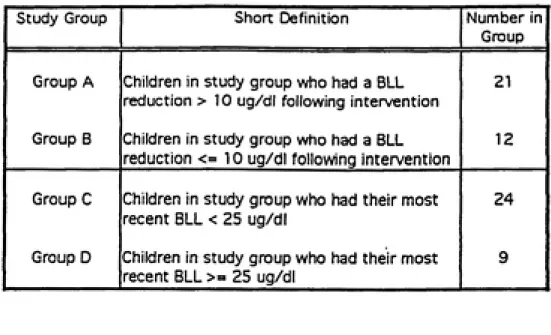
used to evaluate the interventions used. Table 3 provides simple definitions of these groups.
The first set consisted of a group of children whose BLL dropped by more than 10 ug (Group A) and a second group
of children which did not achieve this level of reduction in
BLL (Group B). Other studies evaluating the effects of
abatement on BLL reduction have used this definition (7,27). Using a reduction of at least 10 ug/dl also reduces the chance of laboratory error in blood analysis (13).
The second definition of a significant BLL reduction
was based on the action level used when these children
entered the program in 1991. At that time, complete
intervention began for children with confirmed elevated BLLs above or equal to 25 ug/dl. Once a child's level went below this action level, the child was considered improved. Many nurses would not continue the intervention program for these children at the same level of intensity. Therefore, those children whose most recent BLL was below 25 ug/dl (Group C) and the remaining children whose recent BLL did not achieve this reduced level (Group D) formed the second set of two
groups.
Due to the small number of families interviewed, the
same group divisions by BLL reduction could not be performed
to evaluate the variables addressed in the questionnaire.
Therefore, any data ascertained from the questionnaire was
RESULTS
Descriptive statistics produced from information in the
case records provided a general overview of the study
population. Table 7 provides a flow chart describing the
children in the program by method of intervention, source of
exposure, relative BLL reduction, and inclusion in the
interviewed sample. The highest initial elevated BLL
reading among the study population was 64 ug/dl, and the
mean initial reading was 3 5.3 ug/dl. The mean BLL reduction
was 15.4 ug/dl, and the mean latest BLL reading was 21.0
ug/dl. The records of thirty-three children contained
enough information to group BLL readings based on their
relative reductions. Twenty-one of these children (64%) had
more than a 10 ug/dl reduction in BLL from their initial
readings (Group A). Twenty-four of these children (74%) had
their latest BLL reading under 25 ug/dl (Group C).
The records of thirty-one children contained
information on the source of lead exposure. Twenty-seven of
the children (87%) received their exposure from lead-based
paint and/or dust and soil contaminated from lead-based
paint. Three (10%) received exposure from contaminated
particles brought home by parents exposed to lead in their
occupation. The remaining case received exposure from a
lead musket shot which she repeatedly put in her mouth. The
records of thirty-three children contained information on
four children (12%) received formal abatement to permanently
eliminate their exposure. Twenty-one (64%) moved to new
housing to avoid further exposure whereas eight children
(24%) remained in their unabated homes and used housekeeping
techniques to reduce their exposures. The mean reductions in BLLs for those who abated, relocated, or used
housekeeping techniques were 23.3 ug/dl, 14.6 ug/dl, and
12.3 ug/dl, respectively. Eleven of thirty-six children
with complete records (31%) received medical treatment (such
as chelation therapy) because their blood lead levels were
exceptionally high.
Variables from the health records were used to compare
the characteristics of the interviewed group (n=l5) and the
remainder of the study group. Table 4 provides an analysis
of any differences between the interviewed sample and the
remaining uninterviewed group based on variables extracted
from the children's health records. Such a comparison can
help determine if the information gathered from the
interviewed sample can be generalized to the entire study
group. 71.5% of fourteen children in the interviewed sample
received their exposure from paint, or paint-contaminated
soil and dust, whereas all those in the uninterviewed group
had this exposure. The percentage of those receiving
medical treatment (e.g., chelation therapy) was equal in
both groups. Because all those families which abated were
incidence of abatement in the uninterviewed group. There
was a large discrepancy in relative BLL reductions between
the two groups. For example, 80% of the interviewed sample
had a BLL reduction of more than 10 ug/dl while only 33.3%
of the uninterviewed group had this same significant
reduction.
Blood Lead Level Changes and Impact of Education
All cases which abated (n=4) had BLL reductions
larger than 10 ug/dl and a latest BLL reading under 25 ug/dl
(Table 5). Twelve of the twenty-one children (57%) who
relocated had a BLL reduction larger than 10 ug/dl. Fifteen
of these same twenty-one children (71%) had a latest BLL
reading under 25 ug/dl. For those children who remained
near the exposure and used housekeeping techniques (n=8),
five (63%) had a BLL reduction over 10 ug/dl. The same
number of children also had their latest BLLs below 25
ug/dl. All children received education as part of their
intervention.
Questions asked during the interview assessed the
mother's knowledge about lead poisoning and thus provided an
evaluation of the education used by the health care
providers. These questions were formulated based on
information in the pamphlets the mothers received as well as
on other basic facts about lead poisoning. Fifteen of the
mothers of the twenty-four children which had BLLs between 15 ug/dl and 24 ug/dl also answered these knowledge
questions. The data is presented in Table 6. Because those
in the study group had more elevated initial BLLs, they
received more in-depth education than those in the
comparison group. For many of the questions, there was a
large difference in those answering correctly between the
study group and the comparison group. For instance, eight
of ten mothers in the study group understood that mopping
the lead-exposed areas in the house would be very helpful.
However, only seven of the twenty-four mothers in the
comparison group knew this fact.
Attitudes and Beliefs
The questions formulated using the Health Belief Model
and given to the fifteen mothers in the study group provided
information about the family's attitudes and beliefs about
lead poisoning and health care in general. The comparison
group (n=24) also received the same questions. Both these
groups represent a sample of the overall population at risk.
Therefore, both group's responses to these Health Belief
Model questions were combined to provide total results.
However, not all mothers from both groups answered each question. Thirty-one of thirty-eight mothers (82%)
interviewed could easily find transportation to the doctor
that it was difficult to find the time to go to doctors'
appointments. Thirty-six of thirty-eight mothers (95%)
believed that going to the doctor for check-ups would
improve their children's health. The mothers were asked if
they believed they had already helped their children get
better. Thirty-two of thirty-eight mothers (84%) said they
felt they had. Thirty-five of thirty-eight mothers (92%)
agreed that a doctor or nurse can help their children get
well. Thirty-two of thirty-eight (84%) said that when their
children get ill, they would most likely take them to the
doctor. Lastly, twenty-five of thirty-seven mothers (68%)
believed that lead poisoning was more serious than the many
other dangers to which their children are exposed.
Other questions exclusively asked of the fifteen
mothers in the study group helped gather information on the
mothers• level of satisfaction with the services of the
NCCLPPP. All these mothers received informative pamphlets
about lead poisoning, and thirteen (87%) of them found the
pamphlets very helpful. The case health-care providers
typically demonstrated how to keep the children away from
the lead sources, and nine of the mothers who received this
instruction (n=13) found it very helpful. The lead
inspectors involved in the case also provided information on
lead poisoning to twelve of the fifteen mothers. Ten of
these mothers (83%) found this assistance very helpful. In
to show the family the locations of the lead sources.
However, when asked if they were aware of the dangers of
lead poisoning before their children were tested, thirteen
of the fifteen mothers (86%) admitted they had no previous
knowledge.
Nine of the mothers who moved or remained at the
exposure source received questions regarding why they did
not abate. Six of these mothers (68%) said they were not
responsible for abatement because they were renting their
homes. All of these mothers indicated that abatement was
too costly.
The last questions in the interview considered
socioeconomic status and child-caretaker interactions. Six
of the fifteen mothers (40%) interviewed had at least four
children living in the home. All of the families had
medical insurance; eight of the fifteen (53%) had insurance
through medicaid services. All mothers completed high
school, and two out of the fifteen went on to complete
college. Eight of the families (53%) had less than $15,000
per year in income, but six of the families (40%) received
DISCUSSION
Information from the records and the interview helped
to describe the specific population at risk for lead
poisoning in North Carolina. The mean initial BLL reading
for these children was not exceptionally high; however, it
was high enough to assume that some permanent damage could
have taken place. Using two methods to determine
significant BLL reductions, the group as a whole received
successfully-implemented interventions. Most lead-based
paint abatement studies tested homes in large urban cities
(5,7,9,10,15,24), thus providing evidence that lead-based
paint is the major source in these areas. However, less
information is available concerning the major sources of
lead in rural and small towns. Based on the records
examined for this study, the primary source for exposure was
also lead-based paint. The homes of these children were
located in rural areas or small towns. Therefore,
lead-based paint is a major cause of lead poisoning in rural as
well as urban areas.
Socioeconomic status (SES) helped to describe the
population at risk. Not all families were considered to be
of low SES based on income and maternal education.
Therefore, although low SES, in general, is associated with
an increased risk, other sectors of the population may be at
risk as well.
w
were enrolled in Medicaid programs. This fact may indicate
a bias in the children screened by the NCCLPPP. Most of the
children screened by the NC program have Medicaid which
currently mandates PbB screening. However, a large
population at risk may not be in the Medicaid program and
thus are much less likely to be tested. The following
simple statistics indicate that screening is not being
adequately performed. Census data from 1990 estimate
549,276 children under six years old living in NC (20).
Brewer et al. (6) suggest that there may be up to 8,222
children and 87,356 children under six years in NC with BLLs
over 25 ug/dl and 15 ug/dl, respectively. The NCCLPPP
screened a total of only 23,790 children under six in 1991,
39 of whom were confirmed as having BLLs equal to or above
25 ug/dl. Many children in NC are without any health
insurance or have private insurance which does not cover the
cost of testing. These situations help to explain the
obviously low screening rates.
There were positive child-caretaker interactions within
these families as well as positive attitudes about the
abilities of medical personnel. Most mothers said they
would take their sick child to the doctor/nurse because they
felt the doctor/nurse could help. Therefore, these mothers
perceived large benefits from going to the doctor. These
mothers also realized the dangers of lead poisoning and thus
children. This descriptive information about the mothers
may help the NCCLPPP in designing prevention efforts. Once
these mothers are properly educated about lead poisoning, they show real concern for their children, and this should be a positive factor in their children's recuperation.
These feelings of concern should be reinforced as they
indicate a mother's willingness to cooperate with the
personnel in the program.
However, there are barriers which may lessen this
positive effect. Most mothers discussed the everyday tasks
and chores which often keep them busy through the day.
These typical everyday tasks could inhibit the mothers from
providing their best efforts to see that their children are protected from lead poisoning. A few found that the
hospital was far away and transportation was sometimes difficult to find. Large family size could increase the difficulty of performing the duties required to reduce children's exposure. Two interviewed mothers each had families of nine.
A comparison between the interviewed sample and the
remainder of the study group provided information on any
different characteristics between the two. The methods
section discusses how the interview sample was chosen. However, as Table 4 indicates, there was an unintentional
difference in BLL reductions between the interview sample
reductions in the interview sample may be a result of
criteria used for selection into this group. The
interviewed sample included all those children who received
abatement (n=4) as an intervention. All these children
experienced significant BLL reductions by both definitions.
This fact may help to explain the disproportionate
frequencies of significant BLL reductions in the interview
sample. Another explanation may be the differences in lead
sources among the two groups. The interviewed sample also
included children who had a source other than lead based
paint. These sources (occupational dust, lead musket shot)
may have been easier to eliminate with less expense and tine
involved. Therefore, these children may have added to the
disproportionate frequencies of significant BLL reductions
in the interview group. This apparent difference in BLL
reductions implies that the data from the questionnaire
reflects the opinions of those mothers which benefited the
most from the interventions received. That is, the
interventions used for those in the questionnaire group were
relatively successful.
Information from the records and the interviews helped
to explain and evaluate the interventions used by the
NCCLPPP. Abatement proved to be a successful intervention
in all four cases in which it was used (see Table 5). The
abatement techniques used for these four children included
lead based chips. However, the fact that only four of the
twenty-seven cases involving lead based paint used abatement
indicates a serious problem. The primary reasons for the
low incidence of abatement is its large expense as well as
landlords who may be uncooperative in performing the
necessary repairs. At least one of these reasons forced
most families to move. The U.S. Department of Housing and
Urban Development (HUD) has estimated average abatement
costs for a single housing unit by either encapsulation or
removal methods (30). The majority of units abated by
either method would cost $2,500 or less. However, those
units having multiple lead-based paint surfaces would cost
an average of $8,870 for encapsulation and $11,870 for
removal. Those homes with peeling lead-based paint would
cost much more to abate.
Although personnel from the NCCLPPP have the right to
prosecute those who refuse to abate, this seldom occurs. By
taking legal action, the families could lose their hones,
leaving them in an even worse situation. In one instance, a
mother was almost forced out of her rented home after asking
her landlord several times for the required abatement. It
was only after much pressure from the state health
department that the landlord complied. Although the
abatement was completed, the mother still feels strong
tension between herself and the landlord and is therefore
just a problem inherent to the NC program, as all lead
poisoning programs must deal with this problem. Further
studies of the use of abatement in NC should include
interviews with the landlords and/or abaters to learn more
about the forms of abatement used in each case as well as
their opinions on the issue of abatement. Gaining more
information could be helpful in pinpointing some problems as
well as ultimately finding some solutions.
Relocation was the more utilized intervention. Based
on the number of significant BLL reductions as a measure,
relocation was not as successful as abatement (see Table 5).
Nevertheless, the majority of those who relocated
experienced a BLL reduction of at least 10 ug or had their
latest BLL under 25 ug/dl. The fact that these mothers
moved their families provides further evidence of their true
concern for their children as well as their understanding of
the dangers of lead poisoning. However, relocation involved
many logistical problems for the families such as finding
another affordable home which was lead-free. One
resourceful mother's story provides an example. After being
informed that her child had lead poisoning and her newly
purchased first home contained the source, she received no
help from the seller to pay for abatement. Having spent all
the family's savings on the home, she became very concerned
her special situation, and was eventually able to find
housing with his help. The same provisions for those in
similar situations, however, can not be guaranteed. Using
relocation as an intervention leads to many other
potentially negative effects. Moving does not necessarily
guarantee an exposure is no longer present, as the family
can very easily move into another lead-contaminated house.
Moreover, any child who moves into the originally contaminated home becomes an addition to the at-risk
population. Further studies evaluating relocation as an
intervention for childhood lead poisoning could analyze the
frequencies of these situations.
In the study, housekeeping as an intervention performed
moderately well in terms of lowering BLLs (see Table 5).
Unlike abatement and relocation to lead-free housing,
housekeeping is not a permanent solution. Whether or not
housekeeping techniques work depends on multiple factors.
The mothers must receive proper training in the ways to
clean, have the time to do frequent and thorough cleanings,
and be financially able to purchase the proper cleaning
supplies. With so many variables involved in the success of
housekeeping, problems are likely to arise. One family
remained in their lead-contaminated home and, due to high
costs, was not able to abate. The county lead investigators
were unable to complete their first investigation to locate
Although the workers returned several times to finish the investigation, the mother remained unsure of all locations of the lead sources. Therefore, her attempts to decrease exposure by cleaning was considerably ineffective.
Based on an analysis of the mothers' knowledge about
lead poisoning, the education used by the health care professionals was a successful intervention (Table 6).
The data indicate that those mothers which received thorough education (i.e. the study group) had more knowledge about lead poisoning than those mothers which did not receive equivalent levels of education (i.e. the comparison group). According to these results, the health care providers are doing an adequate job of educating the families. The more thorough education often involves repeated visits to the homes as well as continual written and verbal reminders to
the mothers regarding doctor appointments. All the mothers in the study group received pamphlets on lead poisoning, and some of the mothers in the comparison group similarly
received pamphlets. Although these pamphlets contained the same information, it is obvious that the mothers in the study group were more knowledgeable about this information. The additional factor of thorough and repeated discussions by the nurses involved with the study cases is obviously
beneficial. The nurses typically use the pamphlet material
as a guide to more fully explain lead poisoning in such a
created her own additional information sheets to give to her
patients. This material was formulated to be interesting
and simple for the nurse's specific cases. The mothers'
overall high level of satisfaction with the nurses and the
NCCLPPP is another indicator of the success of the education
program.
Whether or not this level of individual attention and
education can continue with the expected rise in cases is
questionnable. Due to the new lower level signaling an
elevated blood lead (15 ug/dl), the more precise screening method now being used, and the more efficient laboratory equipment being used, the number of cases is expected to increase considerably. In fact, within the first two months of 1993, 241 cases were already identified as having BLLs above 15 ug/dl. This is compared to the 39 elevated BLL cases identified in all of 1991, using 25 ug/dl as the action level. The NCCLPPP will require more funding to maintain adequate resources for the increase in screenings,
lead investigations, and laboratory procedures. But just as important, the program will have to train additional
personnel to adequately provide education for this new caseload. More resources will be required in order to
maintain the current level of individualized instruction for all cases. The current number of nurses will not be able to
handle the expected increased caseload and still provide the
Although the mothers answered most of the knowledge
questions correctly, there were several questions with a
high percentage of wrong answers chosen. For example, most
mothers believed that sweeping paint chips to the outside
was very helpful. They felt that by removing the chips from
the interior, the exposure was no longer present. However,
sweeping the chips outside only transfers the area of
exposure and may cause recontamination. This indicates that
some aspects of the education program may not be thorough
enough. Health care providers must be sure to stay abreast
of current lead poisoning literature and provide this
information to their patients.
One serious problem discovered through the interviews
is that a full 8 6% of the mothers were unaware of lead poisoning prior to the screening of their children. This
strongly suggests that the NCCLPPP is not adequately
targeting at-risk populations for education before the
poisoning occurs. The easiest way to control the increase
in lead poisoning is to provide education to parents of
children at risk before they experience dangerous levels of
exposure. The CDC has indicated this primary prevention as
a national priority in eliminating childhood lead poisoning
(13). The NCCLPPP must first identify and target the
high-risk communities based on known high-risk factors. There is an
ongoing research effort in NC attempting to locate
of housing, location near an enviromental source, etc. This
research uses geographic computer software to quickly and
accurately locate the at-risk population.
Once this population is identified, there are several
ways the NCCLPPP could provide this pre-exposure education.
First, health department personnel working with future
mothers or mothers with newborns should immediately proceed
with education and not wait until a blood lead test is
performed. Second, both private and public pediatricians
and general practicioners should be educated on the dangers
and high incidence of lead poisoning. Once they are
properly educated, they will become much more of a factor in
identifying and caring for the at-risk population. Third,
the NCCLPPP should implement community-wide intervention
activities. By addressing the community, mothers which
otherwise would not have been reached can be identified.
Introducing the general knowledge about lead poisoning into
the community can ultimately increase the number of at-risk
children identified prior to exposure. Theoretically, with
more mothers made aware of the dangers of lead poisoning
before their children are exposed, the number of children
eventually poisoned will decrease.
Examples of current or upcoming national education
programs include the following: 1) the Council on
Environmental Quality's lead poisoning prevention education
announcements; 2) a new federal interagency hotline
providing information materials and brochures through the
U.S. Environmental Protection Agency; 3) and the National
Lead Information Center providing information on lead
poisoning, home repairs, and environmental testing of homes. Information on these national education programs must be made available through the state and local agencies to the population at risk. Currently, NC public health departments are being instructed on how to handle the expected increase in inquiries about lead poisoning. Information materials have been created addressing commonly asked questions about
lead poisoning.
Performing this pilot study involved several problems. One major difficulty was contacting enough mothers to
interview. Many mothers were unreachable because they had no telephone or had moved to an unknown location. Two mothers who originally agreed to the interview were not at home at the agreed-upon time. A large amount of time was
spent contacting nurses, health departments, and the families, but ultimately, only the mothers of fifteen children could be interviewed. The uncertain validity of some of the questions in the interview was also a problem.
For instance, many of the attitude and belief questions
sick, several mothers said probably not because their
children usually got only a simple cold. These mothers who said they would not take their children to the doctor may
still trust doctors and medical services as well as have
concern for their children. Therefore, the responses to these Health Belief Model questions may not be meaningful.
Future studies could use this pilot study to determine
several important aspects to evaluate an intervention
program. Using similar methods in a larger case-control study may provide significant results. The NCCLPPP has already begun revised procedures to provide case management
to children with BLLs now considered elevated as well as to
expand the screening program. Therefore, the numbers of lead poisoning cases identified has already greatly
increased, providing a larger population for a more formal
study. As previously mentioned, 241 cases were identified in the first two months of 1993, all of which should at least be receiving parental education and repeat testing.
Consideration in similar future studies should include
not only interviews with the mothers but also interviews with the nurses and lead abaters. The nurses can provide
invaluable information on their educational and teaching
Table 1: List of Independent Variables Used to Explain BLL
Reductions of Children Enrolled in the North Carolina
Childhood Lead Poisoning Prevention Program
INTERVENTIONS USED:
Abatement
Relocation
Housekeeping
Medical Therapy
Education
FAMILY'S ATTITUDES, BELIEFS, AND BEHAVIOR (RBM):
Motivation to avoid illness
Perceived susceptibility to illness
Perceived severity of illness Perceived barriers to compliance Perceived benefits to compliance
36
Table 2: Questions Used to Explain Attitudes, Beliefs, and Behavior Based on
the Health Belief Model
j HBM Category Sample Question |
1. Motivation to Avoid Illness
Will having check-ups help your child get better? j
2. Perceived Susceptibility to Illness
Do you agree that your child could look and act j
healthy but still be sick? j
13. Perceived Barriers to Compliance
Has keeping your child away from the lead been easy? |
k4. Perceived Benefits to Compliance
Do you agree that your doctor can make your child j
well when he/she is sick? 15. Perceived Seventy of the Illness
Compared to other dangers to your child's health, do 1
you think lead poisoning is more serious? |
6. Measure of Self-efficacy
Do you feel that there are things you can do to help j
Table 3: Short Definitions of Groups Based on Significant BLL Reductions
1 Study Group Short Definition Number in
Group I
Group A
Group B
Children in study group who had a BLL reduction > 10 ug/dl following intervention
Children In study group who had a BLL
reduction <= 10 ug/dl following intervention
21
12
Group C
Group D
Children in study group who had their most
recent BLL < 25 ug/dl
Children in study group who had their most recent BLL >= 25 ug/dl
24
Table 4: Comparison of Sample Interviewed to Remaining Study
Group Based on Variables from Health Records
1 Variable
Frequency |
1 1
Interviewed
Sample
Uninterv ewed 1
Group 1
pource of Exposure
Paint/Soil Dust Occupational Other (n=14) 72% 21 7 (n=16) 100%
0 1
0 1
Medical Treatment Yes No (n=14) 29 71 (n=2 )
29 1
71 1
Intervention Used
Abatement Relocation Housekeeping (n=14) 29 43 29 (n=18)
0 1
78 1
22 1
Education 100
100 1
BLL Reduction:
Change > 10 ug/dl
Change <= 10 ug/dl
(n=15)
80 20
(n=18)
33 1
67 1
Latest level < 25 ug/dl
1 Latest level >= 25 ug/dl
87 13
62
Table 5: Number of Children Receiving Each Intervention and Frequency of Children in Each BLL Reduction Category
llntervention Used
No. Receiving
Intervention
BLL Reduction Achieved |
Group A Group B 1
1 Abatement
Relocation
1 Housekeeping
4
21 8
100%
57% 63%
0%
43%
38% 1
5A: Children Receiving Intervention in Group A or B
[Intervention Used
No. Receiving
Intervention
Latest BLL Achieved | Group C Group D 1
1 Abatement 4 100% 0%
Relocation 21 71% 29%
1 Housekeeping
. 8 63%38% 1
Table 6: Summary of Answers to Questions Assessing Knowledge of Lead Poisoning
Question and Correct Answer Frequency Answering Correctly |
Study Group Comparison Group
Lead poisoning causes learning problems n=14 85.7%
n=24 83.8%
Lead poisoning can cause death n=14 100.0
n=24 58.3
Lead can cause head/stomach aches n=14 71.4
n=24 62.5
Changing playing areas will help n=14 71.4
n=15
45.8
Mopping is very helpful n=10
80.0
n=24
29.2
Washing child's hands is very helpful n=10 100.0
n=24 62.5
Covenng cracked painted surfaces is not helpful n=7 85.7
n-24 58.3
Sweeping chips to outside of house is not helpful n=10 20.0
n=24 8.3
Melting down old paint is not helpful n=7
57.1
Children < 6 yrs screened for BLL's - 1991
23,790
Interviewed
15
Method of Intervention
identified 33
i
Abatement Relocation Housekeeping
4 21 8
BLL's >=25 ug/dl 1991
39
i
.Included in pilot. study evaluation
36
Incomplete records 3
.^^ource of exposure identified
31
Paint or lead Parental Lead musl<et shot
contaminated occupation 1
soil/dust exposure
27
0
3
BLL reductions indicated
33
> 10ug reduction in BLL 21
Latest BLL reading <= 25 ug/dl
REFERENCES
1. Agency for Toxic Substances and Disease Registry, The Nature and Extent of Lead Poisoning in Children in the U.S.: A Report to Congress, (July, 1988) .
2. Baghurst P.A., McMichael A.J., Wigg N.R., Vimpani G.V., Robertson E.F., Roberts R.J., Tong S., Environmental Exposure to Lead and Children's Intelligence at the Age
of Seven Years: The Port Pirie Cohort Study, New England Journal of Medicine. Vol. 327, pp.1279-1284,
(Oct., 1992).
3. Becker M.H., Maiman L.A., Kirscht J.P., Haefner D.P.,
Drachman R.H., The Health Belief Model and Prediction
of Dietary Compliance: A Field Experiment, Journal of Health and Social Behavior, Vol. 183, pp.48-366,
(1977).
4. Bornschein R.L., Influence of Social Factors on Lead Exposure and Child Development, Environmental Health
Perspectives, Vol. 62, pp.343-351, (Oct., 1985).
5. Bornschein R.L., Succop P.A., Krafft K.M., Clark C.S.,
Peace B., Hammond P.B., Exterior Surface Dust Lead,
Interior House Dust Lead and Childhood Lead Exposure in
an Urban Environment, Trace Substances in Environmental
Health. XX. pp.322-332, (1986).
6. Brewer R.D., Miller C.P., Norman E.H., Freeman J.I., Wester T., The Prevention of Childhood Lead Poisoning
in North Carolina, North Carolina Medical Journal. Vol. 53, pp. 149-152, (April, 1992).
7. Charney E., Kessler B., Farfel M., Jackson D.,
Childhood Lead Poisoning: A Controlled Trial of the Effect of Dust-Control Measures on Blood Lead Levels,
New England Journal of Medicine Vol. 309, pp.1089-93,
(1983).
8. Chisolm J.J. Jr., Barltrop D., Recognition and
Management of Children With Increased Lead Absorption : Review Article, Archives of Disease in Childhood. Vol. 54, pp. 249-262, (1979).
9. Chisolm J.J., Mellits E.D., Quaskey S.A., The
Relationship Between the Level of Lead Absorption in Children and the Age, Type, and Condition of Housing,
10. Clark C.S., Bornschein R.L., Succop P., Que Hee S.S., Hammond P.B., Peace B., Condition and Type of Housing
as an Indicator of Potential Environmental Lead
Exposure and Pediatric Blood Lead Levels, Environmenta1
Research. Vol. 38, pp. 46-53, (1985).
11. De La Burde B., Reames B., Prevention of Pica, the
Major Cause of Lead Poisoning in Children, American Journal of Public Health. Vol. 63, pp. 737-43, (Aug.,
1973) .
12. Diemel J.A., Brunekreef B., Boleig J.S., Biersteker K., Veenstra S.J., The Arnheim Lead Study: Indoor
Pollution and Indoor/Outdoor Relationships,
Environmental Research^ Vol. 25, pp. 449-456, (1981).
13. Falk H., Binder S., Preventing Lead Poisoning in Young
Children, Centers for Disease Control, Oct., 1991.
14. Farfel M.R., Reducing Lead Exposure in Children, Annual
Review of Public Health. Vol. 6, pp. 333-360, (1985).
15. Farfel, M.R., Chisolm J.J. Jr., Health and
Environmental Outcomes of Traditional and Modified Practices for Abatement of Residential Lead-Based
Paint, American Journal of Public Health. Vol. 80, pp.
1240-1245, (Oct., 1990).
16. Glanz K., Lewis F.M., Rimer B.K., eds., Health Behavior and Health Education; Theory. Research, and Practice. Jossey-Bass Pub., San Francisco, CA, 1990, Chapter 3 by
Rosenstock I.M.
17. Mahaffey K.R., "Role of Nutrition in Prevention of Pediatric Lead Toxicity," Lead Absorption in Children; Management. Clinical, and Environmental Aspects.
Chisolm J.J. Jr., O'Hara D.M., eds., Urban and
Schwartz, 1982, pp. 63-78.
18. Needleman, H.L., Landrigan P.P., The Health Effects of Low Level Exposure to Lead, Annual Review of Public
Health. Vol. 2, pp. 277-298, (1981).
19. Needleman H.L., Schell A., Bellinger D., Leviton A., Allred E.N., The Long-Term Effects of Exposure to Low
Doses of Lead in Childhood: An 11 Year Follow-up
Report, New England Journal of Medicine. Vol. 322, pp.
83-88, (Jan., 1990).
Poisoning Prevention Program; Grants for State and
Community-Based Childhood Lead Poisoning Prevention Programs. April, 1992.
21. Perlstein M.A., Attala R., Neurologic Sequelae of
Plumbism in Children, Clinical Pediatrics. Vol. 5, pp.
292-298, (1966).
22. Piomelli S., Rosen J.F., Chisolm J.J. Jr., Graef J.W.,
Management of Childhood Lead Poisoning, Pediatrics^
Vol. 105, pp. 523-532, (Oct., 1984).
23. Public Health Service, Healthy People 2 000; National
Health Promotion and Disease Prevention Objectives. US
Department of Health and Human Services, Public Health Services, 1991.
24. Rabinowitz M., Leviton A., Bellinger D., Home
Refinishing, Lead Paint, and Infant Blood Lead Levels,
American Journal of Public Health. Vol. 75, pp.
403-404, (April, 1985).
25. Roberts T.M., Parkinson D.K., Lead Contamination Around Secondary Smelters; Estimation of Dispersal and
Accumulation by Humans, Science Vol. 186, pp. 1120-1123, (Dec., 1974).
26. Schroeder S.R., Hawk B., Otto D.A., Mushak P., Hicks R.E., Separating the Effects of Lead and Social Factors on I.Q., Environmental Research. Vol. 38, pp. 144-154,
(Oct., 1985).
27. Staes C., Centers for Disease Control, Personal communications, June, 1992.
28. Stark A.D., Meigs J.W., Fitch R.A., DeLouise E.R., Family Operational Co-Factors in the Epidemiology of Childhood Lead Poisoning, Archives in Environmental
Health. Vol. 33, pp. 222-226, (Sept.-Oct., 1978). 29. Strecher V.J., Devellis B.M., Becker M.H., Rosenstock
I.M., The Role of Self-Efficacy in Achieving Health Behavior Change, Health Education Quarterly. Vol. 13, pp. 73-92, (1986).
i
North Carolina Department of Environment, Health, and Natural Resources
Division of Maternal and Child Health
P.O. Box 27687 • Raleigh, North Carolina 27611-7687
James G. Martin, Governor Ann F. Wolfe, M.D., M.P.H.
William W.Cobey, Jr., Secretarv' DirectorN.C. CHILDHOOD LEAD POISONING PREVENTION PROGRAM EVALUATION INTERVIEW
NAME OF INTERVIEWEE _____'______________________
NAME OF CHILD
ADDRESS
COUNTY_______
TELEPHONE NO.
Hello, my name is Holly Bivins. As we have already
discussed, I am a student at the University of North Carolina at
Chapel Hill. I am evaluating North Carolina's Childhood Lead
Poisoning Prevention Program. With your help, I hope to improve
the program to help others.
I want to assure you that everything that you say will be held in the strictest confidence. I will summarize my findings
in a report, but no individuals will be named.
Directions to
home:
Other
information:
Lead Program. Most of the questions can have just one-word answers, but if you would like to explain more, please do. The more information I get, the
better.
The first set of questions focuses on how you learned that your child had lead in his/her blood and what information you received about children and lead.
1) I would like to know who talked to you about lead poisoning. Could
you please answer "yes" or "no" to the following people if they discussed any lead poisoning information with you? (y=yes, n=no)
X H a. a nurse _____ _____
b. an inspector who looked for lead _____ _____ c. a person who helped you remove lead _____ _____
from your house
d. a doctor _____ _____ e. other___________________ _____ _____
2) Do you remember a nurse or someone from the health department coming to talk to you about your child and lead? (i.e. a home visit)
a. yes b. no
IF NO. go to Q#4
3) Was this conversation:
a. very helpful b. somewhat helpful c. not helpful at all
d. not sure
How much time do you feel these people spent with you explaining lead
poisoning?
a. too much time
b. just the right amount of time
c. not enough time
4) Do you remember receiving any pamphlets or brochures about lead poisoning?
a. yes
b. no
IF NO. go to Q#5
IF YESf Were these pamphlets or brochures:
a. very helpful
b. somewhat helpful
c. not helpful at all
away from your child?
a. yes b. no
IF NO, go to Q#6 IF YES, was this
a. very helpful b. somewhat helpful
c. not helpful at all
d. not sure
6) compared to other dangers to your child's health, do you think lead
poisoning is
a. less serious
b. as serious c. more serious
7) Does your child spend a part of the day with someone besides you or at
day-care?
a. yes b. no
IF NO. go to Q#8
IF YES, does this person who takes care of your child know of the dangers of lead poisoning?
a. yes
b. no
c. unsure
8) I am now going to list some possible places where children could come in contact with lead. Please answer "yes" or "no" to the following
places where you believe your child may have been in contact with lead.
1 E
a. in your house _____ _____
b. in your yard _____ ͣ
c. in a neighbor's house or yard _____ _____
d. where you used to live _____ _____ e. from where a parent works _____ _____ f. other__________________ _____ _____
g. not sure
9) Before you had your child tested for lead in his/her blood, did you
know about lead poisoning?
a. yes
b. no
IF NO. go to Q#10
IF YES, where did you learn about it? a. a friend, relative, or neighbor
b. school
c. doctor or nurse at health department d. doctor or nurse not at health department e. T.V., newspaper, book, or radio
know whether you agree or disagree with them or are not sure. (A=agree, D«disagree, NS=not sure)
a. Lead can cause learning problems for your child.
b. Lead can cause hair loss. ,
c. Lead can cause death.
d. Lead can cause headaches and upset
stomachs.
e. Changing the area where your child is allowed to play can keep your child
from being lead poisoned.
f. The source of lead in your home is from:
1. lead on walls
2. soil and/or dust
3. water or food
4. burning printed paper or painted
boards
5. toys or play things your child
puts in his mouth j
6. other
h fiS
11. Please tell me if you think the following activities would be very helpful, somewhat helpful, or not helpful at all in keeping your child
away from lead. (VH=very helpful, SH=somewhat helpful, NH= not
helpful at all)
1. wet mopping the floor
2. washing your child's hands often 3. covering cracked painted surfaces 4. sweeping chips/dust to outside
of house
5. melting down old paint
3ja SH mi
Now I would like to ask you a few questions about the inspection done by
the State to find the lead.
12) Were you the person who was home when the inspection took place?
a. yes b. no
IF NO. go to Q#15
13) Do you remember getting any information from the inspectors about lead
in your home?
a. yes
b. no
IF NO. go to Q#14
IF YES, did you think this information was: a. very helpful
b.
c.
d.
somewhat helpful
poisoning?
a. too much time
b. just the right amount of time
c. not enough time
14) Did the inspectors show you where the lead is/was in your home? a. yes
b. no
15) Was the source of lead removed?
a. yes
b. no
c. not sure
IF YES, go to Q#16-Q#19
IF NO or NOT SURE, go to Q#20-Q#21
16) Who removed the lead?
a. you or your spouse b. the landlord
c. other
17) Do you remember getting information about lead from any people who
helped remove it? a. yes
b. no
IF NO. go to Q#18
IF YES, was this information:
a. very helpful b. somewhat helpful c. not helpful at all
d. not sure
18) Did you stay somewhere else while work was being done on your home? a. yes
b. no
IF NO. go to Q#19
IF YES, how easy was it for you to find somewhere to stay? a. very easy
b. somewhat easy c. not easy at all
19) Are you still living in the same house? a. yes
b. no
IF YES, go to Q#22
IF NO. how difficult was it for you to find another house?
a. very difficult b. somewhat difficult c. not difficult at all
20) I am going to read a list of possible reasons why the source of lead was not removed from your home. Please answer "yes" or "no" to the
following reasons if they apply or do not apply in your situation: X H
a. You are renting so you are not _____ _____
responsible
b. The landlord has not abated _____ _____
riF YES to b., skip to #16)
c. It was too much money _____ _____ d. It took too much time _____ _____ e. You were not told how to do it _____ _____ f. You were not told you should do it _____ _____ h. It was easier to move _____ _____
i. Other______________________ _____ _____
21) Are you still living in the same house?
a. yes
b. no
IF NO. how difficult was it for you to find another house?
a. very difficult b. somewhat difficult
c. not difficult at all i
d. not sure GO TO Q#22
IF YES. Now I would like to ask you how you are handling the lead that is still in your home. The following activities could be done to
reduce the amount of lead in you home. Could you please tell me if you do these activities "very often, "somewhat often", or "not often at all"?: (VO=very often, SO=somewhat often, NO=not often
at all)
YQ S2 MQ a. You wet-mop ___ ___ ___ b. You wash your child's hands ___ ___ ___ c. You vacuum or sweep _ ___ ___
Now I would like to know your opinion on some possible problems you might have in handling the lead that is still in your home. Do you agree, disagree, or are unsure about these statements?
h Jl US. a. Keeping your child away from lead has ___ ___ ___
been easy.
b. Cleaning the house often interferes ___ ___ ___
with other things you must do during the day.
c. You often have many errands and___ ___ ___ chores you must do during the day.
your child has received.
22) How did it happen that your child was tested for lead in his/her blood?
a. it was done through Medicaid or EPSDT
b. check-up or the health department scheduled you
c. a doctor advised you to
d. you decided on your own
e. other_________________________
23) Where was your child screened for lead in his/her blood?
a. at the hospital
b. at the health department c. at a private doctor's office d. other_____________________ e. not sure
24) Has your child ever been hospitalized because of his/her lead poisoning or has the doctor/nurse given him/her a pill for lead
poisoning? a. yes b. no
c. not sure
IF YES. I would like to ask you some questions about this treatment. What is your opinion on the following statements? Please tell me if you agree, disagree, or are unsure about them.
a. It was difficult for you to get ___ ___ ___
transportation to the hospital.
h. It was difficult for you to find the ___ ___ ___
time for the appointments.
c. These treatments will definitely help ___ ___ ___
my child get better.
25) I would like to ask you a few questions about taking your child for his/her check-ups to test for lead in his/her blood. What is your opinion on the following statements. Please tell me if you agree,
disagree, or are unsure about them.
h U USi a. It is/was difficult for you to get ___ ___ ___
transportation to the health dept.
b. It it/was difficult for you to make the ___ ___ ___ time to go to all the appointments.
c. Having check-ups will definitely help ___ ___ ___ your child get better.
Now I would like to ask you a few questions about your child's medical care
in general.
26) Does your family have a regular doctor to go to? a. yes
b. no