Hidden
in Plain View: Paintings
Reveal
Dietary Disparities Between
European
Social
Classes(c.
1850
-
1900)
ABSTRACT:
The period of European industrialization and urbanization in the latter half of the nineteenth century brought about significant change in traditional food systems. This study identifies differences in diet quality between the upper and lower socioeconomic classes based on their depictions in selected major works of art from the period. Twenty European
paintings were chosen, ten each from the upper and lower classes, which show people eating typical fare of the period. To examine class differences in diet, the artworks were
coded for dietary diversity, gender, setting, and tone. Content analysis was examined in
detail by comparing a randomly selected work portraying each of the two classes. Dietary diversity was measured using a questionnaire from the Food and Agriculture Organization
of the United Nations, from which variable frequencies and average diversity scores were tabulated and compared. The average dietary diversity score of the higher-class group was more than double the score of the lower-class group. Depictions were equivalent for the
genders, but the upper classes had more scenes in private exterior settings. In addition, the higher class paintings contained only warm and neutral tones, while the lower classes had primarily cool and neutral tones.
INTRODUCTION:
During the latter half of the 19th century, high population growth rates, coupled
with
the transition to urbanization and industrialization, drastically altered the social andproblems. Rapid urban growth, fueled by the migration of rural workers, led to food and housing shortages as well as class tensions (1). Despite a rise in real wages, working class couples spent approximately 65-85% of their income on food, often at the expense of other basic needs like clothing and shelter [2J.
The context of urbanization also spawned a wave of new artistic movements. Realist and Impressionist painters rebelled against the conventions of academic art by disavowing
traditional subject matter and brushwork (2). For these artists, painting served as a means of recording social truths and capturing perceptions of modern-day life in an ever-changing
society. These artworks reflect cultural values and can be an effective tool for studying the
subjective experience of class inequalities as they relate to issues of food security, dietary
quality, and nutrition.
In recent decades, the impact of urbanization and industrialization on food supply
and nutrition has gained popularity as a research theme, but there are still many gaps in
the literature (3). For example, little consensus has been reached on the differences in diet
quality between European social classes in the period from 1850 to L900. Some historians
argue that the industrial working-class diet was surprisingly balanced by contemporary
standards, while others assert that the poor were chronically undernourished [4,5). The purpose of this research is to examine class disparities in diet quality as they are
represented in artwork with the goal of elucidating how individuals who lived during that
time period perceived the issue.
Using a diversity index to quantifii and compare diet quality in paintings is a unique
fresh perspectives applicable to other fields of social research. Studying historical
problems related to feeding European cities in the late nineteenth century seems
particularly appropriate given the contemporary background of rapid urban growth in
developing countries leading to shortages and social conflicts.
METHODS:
Painting Selection
A sample of twenty paintings was chosen using the ARTstor Digital Library. ARTstor
is a non-profit, on-line resource that provides a collection of over one million images from museums, archives, photographers, and artists across the globe (6J. Paintings were
identified with the advanced search option by entering the following key words: food, breakfast luncheon, dinner, meal, table, kitchen, interior, eat, cooh and caf6. Search results were narrowed using filters for geography [Europe), classification (paintingJ, and date range [1845 to L900). Paintings were excluded if they did not portray meals, if they were too abstract to identify food groups, or if they lacked contextual clues about social class, such as artvyorks in the still-life genre. Ten paintings representing the upper-middle to upper classes and ten paintings representing the lower to lower-middle classes were
selected. The artists, titles, and dates of these paintings are listed in Table l-. Social class was determined by research and the primary investigator's background in Art History.
Study Design and Content Analysis
This qualitative study was conducted by calculating dietary diversity scores for the
included in the Individual Dietary Diversity Score (IDDS) developed by the Food and Agriculture Organization of the United Nations
(7).
Awide variety of studies in differentage groups have shown that a higher IDDS is related to increased nutrient adequacy and
overall diet quality (7,8,9). Paintings were coded and assigned one point for the presence of
each food group. IDDS was calculated by summing the number of food groups portrayed in
each painting with potential scores ranging from 0
-
l-4.In addition to dietary diversity, we also examined aspects of gender, setting, and
tone in the paintings. For the gender variable, all adult figures were coded as male or female. For the setting variable, the following three categories were defined: private interior, private exterior, and public. The three researchers from our team coded paintings
as having private interior settings if they depicted kitchen scenes, dining rooms, or other home interiors. Private exterior settings included suburban picnics or backyard lunches and public settings included caf6s, restaurants, or crowded urban parks. For the tone
variable, researchers coded paintings as warm, neutral, or cool based on color criteria.
Warm images used bright, vibrant colors with red, orange, pink, or yellow accents. Neutral pictures used subdued, washed-out colors [e.g. earth tones, pastels, or shades of whiteJ
with some colorful accents. Cool paintings used dark tones with blue, gray, brown, green, or
purple hues. These secondary variables were coded to further examine disparities in class
representation.
If it was difficult to determine the food groups or other variables portrayed in
of painted cuisine items varied between coders, but there was still a high percent
agreement of 860/o in overall dietary diversity scores for the paintings. Percent agreement
for gender was 98o/o, setting was 85%0, and tone was 9Lo/o between coders. The research
team examined and discussed results to reconcile coding discrepancies. Once consensus
was reached on all of the paintings, variable frequencies and average diversity scores were
analyzed by social class to identify emergent themes'
RESULTS:
Dietary
Diversity
The average dietary diversity score for the upper-middle to upper class sample was 4.1 with individual painting scores ranging from 3 to 6 points. The average lower to
lower-middle class score was l-.9 with a range from L to 4 points. The food diversity portrayed in the higher-class group was more than double of that in the lower class images. The greatest
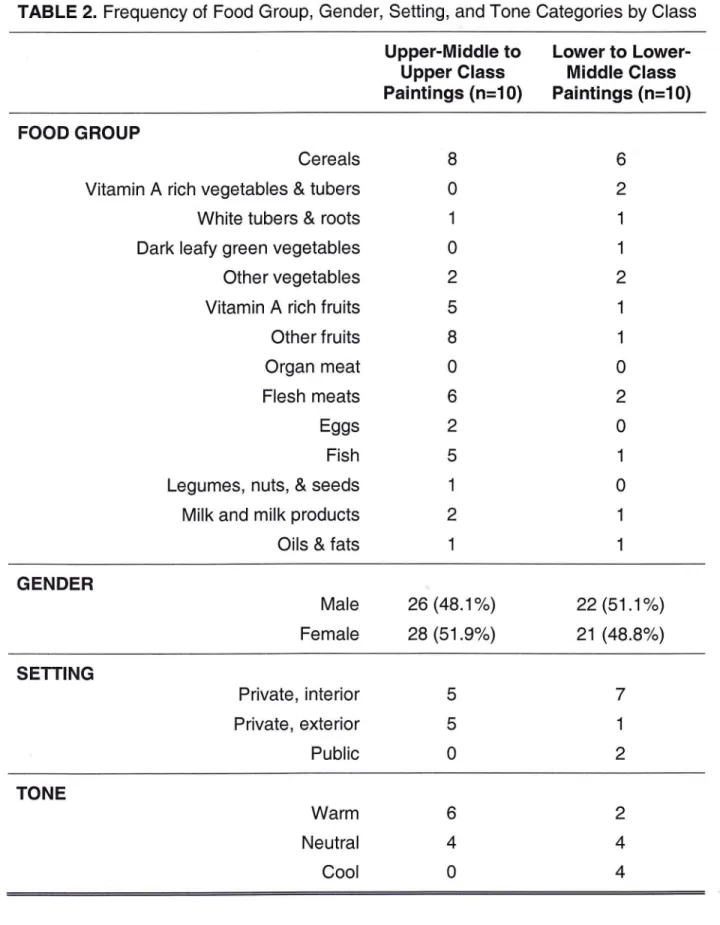
disparities were in the vitamin A rich fruit, other fruit, flesh meat, and fish categories. The IDDS of each painting, along with averages by social class, are presented in Table 1. The category frequencies of each variable are summarized in Table 2.
It is important to note distinctions between rural peasants and urban workers.
Peasant paintings by Isradls,
Millet
and Van Gogh portray only one foodgroup-namely
cereals or white tubers and roots. Urban or suburban dining scenes, such as those by Fouri6 or Renoir for example, contain at least two or more food groups. These resultsnineteenth century significant gaps in nutritional well-being remained prevalent between
European social classes [3, 10).
Other Variables
In both class groups, gender was evenly represented with about half of adult figures
being male and the other half female. In terms of setting, the higher class paintings included
more private scenes of outdoor leisure and dining than the lower-class group. Paintings of the wealthier classes had only warm and neutral tones, while images of the poorer classes
were mainly comprised of cool and neutral tones.
DISCUSSION:
Content analysis revealed class disparities in dietary diversity, setting, and tone. To
further examine these themes, the discussion portion of this paper
will
compare andcontrast a randomly chosen painting from each class category. The Luncheon on the Grass,
painted by Monet in 1865, was selected from the upper-middle to upper class paintings (Figure
t).
The Potato Eaters, which Van Gogh painted in L885, was chosen from the sample of lower to lower-middle class images (Figure 2). Despite the radical differences in subject matter and formal techniques, the paintings share a similaraspiration-to
offer a visualescape from the effects of industrialization and urbanization. Although both works achieve
this objective, the upper class is depicted enjoying greater dietary diversity in a more
pleasant setting with warmer, more jovial tones.
ln The Luncheon on the Grass, Monet portrays a party of picnickers in the forest of Fontainebleau (11). The party consists of twelve figures and a dog gathered around a
seated woman passes out white porcelain dishes, as if inviting the viewer, along with the other guests, to enjoy a plate of the appetizing fare. In addition to several bottles of wine,
the meal includes four food
groups-"vitamin
A rich fruits" (e.g. peaches), "other fruits"[e.g. grapes], "flesh meats" [e.g. chicken), and "cereals" (e.g. cake).
ln The Potato Eaters, Van Gogh depicts five figures seated around a square table in a
dimly lit interior. The peasants dine on a simple meal of potatoes and coffee. In contrast to the upper-middle class picnickers, the peasants' meal is composed of only one food
group-"white
tubers and roots."Compatible with these visual representations, other investigators have gathered evidence pointing to socioeconomic differences in diet and nutritional status from
historical accounts, economic surveys, and height records of the era (1,L2). Content
analysis of food group depictions revealed key disparities in meats, fish, and fruits.
Narrative descriptions of European eating habits and data on per capita consumption
indicate that meat was abundant for the privileged classes, but very limited for the rest of society in the early 1800s
[13).
Although a gradual democratization of meat occurred throughout the nineteenth century, the wealthy still enjoyed approximately triple the percapita meat consumption of the average industrial worker in 1902 [13). Half of the paintings in the lower class sample showed meals composed of one food group, either cereals or white tubers and roots in each of the cases. These results are substantiated by studies on household budget surveys collected in Great Britain between 1887 and L9OL,
which suggest that working-class families spent most of their wages on food, but obtained
The findings are also consistent with historical narratives, which tell us that the diets of
working-class and lower-middle class families were likely to consist of a couple ounces of tea or coffee, some cheese, a few vegetables, and an occasional small serving of
meat-all
the rest was bread or potatoes [1aJ. Other studies using stature as a measure of net
nutritional status have discovered height disparities, which signal diet inequalities,
between various segments of European industrial society (15, 16J.
Monet depicts a bountiful picnic in a lush forest, classifying the setting as a private exterior. By painting the scene en plein air, or outdoors, at the Forest of Fontainebleau,
Monet sought to capture immediate visual impressions and the ephemeral effects of light
and weather on the landscape. The carvings in the tree imply that this idyllic setting has been used as a picnic site many times before, adding a sense of romance to the picture.
According to content analysis results, private exterior dining scenes were more common among paintings in the higher-class group. The Impressionist tradition of portraying the upper-middle class enjoying elegant outdoor activities developed in response to the
emergence of new social structures in this era. The Pushkin Museum version of The Luncheon on the Grass (figure LJ was originally intended as a study for a larger-scale
composition that was to measure fifteen by twenty feet [17J. By painting a scene of
contemporary leisure on such a large scale, Monet aimed to elevate the subject matter to
the status of history painting. The representation of spontaneous, informal activities reflects art as a field of personal enjoyment rather than pure academicism.
Van Gogh's domestic scene takes place in a humble, wooden house, which classifies
right, some kitchen utensils are visible. The prominent ceiling beams and lack of
perspective elicit a sense of claustrophobia. While this dreary, unadorned setting is in keeping with the Realist tradition, Van Gogh adds a new, more expressive style to the
figures. The faces of the peasants appear knobby and curved, gnarled like the potatoes
themselves.
Monet's Luncheon on the Grass was categorized as having a warm tone. Dappled
sunlight creates a luminous contrast between light and shadows throughout the
composition. Sunlight filters through the beech trees transforming the foliage into
brilliant
green and gold flecks. These rich, golden tones are echoed in the yellow dress and fruits in
the foreground. The vibrant palette and large, visible brushstrokes render an air of
spontaneity and movement. Overall, the subject matter and tone combine to create a lively,
enjoyable scene full of light and color.
In contrast to the warmth of Monet's painting, Van Gogh's Potato Eaterswas
categorized as having a cool tone. The only light in the composition emanates from the dingy lamp hanging above the table. The artist employs a darh earthy palette inspired by
lozef Isradls and fean-Frangois Millet [18). The color range evokes the earth from which the peasants eke out a living. In a letter to his brother, Van Gogh wrote, "l have tried to
emphasize that those people, eating potatoes in the lamplight, have dug the earth with those very hands they put in the dish, and so it speaks of manual labor, and how they have
Despite stylistic differences, both paintings offer a visual escape from the pervasive
effects of industrialization and urbanization, Monet isolates the pleasure of everyday life in
an Arcadian forest setting with no signs of industry or man-made structures. The Luncheon on the Grass is appealing, lacks any indication of unease, and accentuates the dappled
sunlight and elegant picnickers. Although The Potato Eaters exposes the hardships of rural
working-class life, it also conveys a sense of veneration for the simplicity of their lifestyle.
In a letter to his brother, the artist wrote, "l often think how the peasants form a world
apart, in many respects better than the civilized world (19]." Van Gogh portrays simple country people, unspoiled by industrialization.
CONCLUSION:
Higher-class Europeans were depicted in late nineteenth-century paintings as
enjoying greater dietary diversity in more congenial exterior settings with warm, positive
tones. These results suggest that individuals were acutely aware of class inequalities and
dietary disparities. In particular, the results suggest that the upper classes had greater
access to meat, fish, and fresh fruits, which is consistent with previously published
literature (20). Within the lower to lower-middle class group, urban workers had higher
diversity scores than rural peasants. This reflects social change and the gradual
improvement in diet quality that occurred during the industrial era. There are several ways
in which this study could be meaningfully extended. It would be interesting to conduct a
similar study relating to Asian, African, or American art during the same period. Likewise,
examining art works from pre-industrial periods in European history would provide a
1.
quality betvyeen classes narrowed during the industrial era, but further work is required to validate this supposition.
REFERENCES:
Teuteberg Hf. Urbanization and nutrition: historical research reconsidered. In: Atkins
P|, Lummel P, Oddy Df, eds. Food and the City in Europe since 1800. Burlington, VT:
Ashgate Publishing; 2007 : L3-24.
Facos M. An Introduction to Nineteenth-Century
Art.
New York, NY: Routledge;20tt.Atkins Pf, Oddy DJ. Food and the city. In: Atkins Pf, Lummel P, Oddy Df, eds. Food and the City in Europe since 7800. Burlington, VT: Ashgate Publishing;2007: 1-I2.
Logan TD. Food, nutrition, and substitution in the late nineteenth century. Exploratians
Econ Hist.20A6; a3 [3J: 527-545.http://dx.doi.org/L0.L01,6/j.eeh.2005.07.002.
Accessed September L8, 20t2.
Oddy Df. Working-class diets in late nineteenth-century Britain. Econ Hist Rev. L970;23 (2):3L4-323. http://www.istor.org/stable/2593832. Accessed September L0,20L2. About ARTstor Digital Library. http ://www.artstor. org/what-i
s-artstor/w-html/artstor-overview.shtml. Accessed September 30, 20 1.2.
FAO. Guidelinesfor Measuring Household and Individual Dietary Diversity. Rome,ltaly:
Food and Agriculture Organization of the United Nations, Food and Nutrition Technical Assistance (FANTA) Project; 2008.
Foote f, Murphy S, Wilkens L, Basiotis P, Carlson A. Dietary variety increases the
probability of nutrient adequacy among adults./ Nutr.2004; L34 (7):1779-L785.
http : / / in.nutrition. or g I content / t3 4 / 7 / 17 7 9. Access e d O ctob er L, 20 L2.
FANTA. Developing and Validating Simple Indicators of Dietary Quality and Energy Intake
of Infants and Young Children in Developing Countries: Summary of findings from analysis of 10 data sefs. Washington, DC: Working Group on Infant and Young Child Feeding
Indicators, Food and Nutrition Technical Assistance (FANTA) Project, Academy for
Educational Development IAEDJ; 2006.
4.
5.
7.
()
c}.
L0. GratzerW. Terrors of the Table: the Curious History of Nutrition. New Yorh NY: Oxford University Press; 2005.
1L. fones K.In the Forest of Fontainebleau: Painters and Photographers from Corot to Monet.
Washington, DC: National Gallery of ArU 2008.
L2.Logan TD. Nutrition and well-being in the late nineteenth century. J Econ Hist.2006;
66(2):313-341.. http://www.jstor.org/stable/3874879. Accessed November 19,20L2.
13. Knapp VJ. The democratization of meat and protein in late eighteenth- and
nineteenth-century Europe. Historian. L997 ; 59(3) : 541-5 5 1. doi: 10.1 11 L
/j.L540-6563.1997.tb01004.x.
L4. Bryson B. At Home. New York, NY: Doubleday; 20L0.
15. Horrell S, Oxley D. Bringing home the bacon? Regional nutrition, stature, and gender in
the industrial revolution. Econ Hist Rev.20L2;65 (a); t354-t379. doi:
10.11II/j.I468-0289.20LL.00642.x.
l-6. Steckel RH. Stature and the standard of living.J of Econ Hist. L995; 33[4J: t903-L940.
http : / / www.jstor,or g/ stable / 27 29 3 17. Acces s ed N ovemb er 2L, 20 L2.
17. SeltzWC. Monet. New York, NY: Abrams; L982.
LB. Van Tilborgh L. The Potato Eaters by Vincent Van Gogh.Zwolle, Netherlands: Waanders; L993.
19. Raskin R. On the "Vincent" signature and the values embodied in "The Potato Eaters," Zeitschrift
ftir
Kunstg eschi chte. L99 0 ; 5 3 [3) : 39 1,-39 6.http: //www.j stor. org/stable/ 148 2 543. Access ed October 30, 20L2.
TABLE 1. lndividual Dietary Diversity Scores by Painting and Average Diversity Scores by Social Class
IDDS
UPPER.MIDDLE TO UPPER CLASS PAINTINGS
Caillebotte, Le Ddjeuner, 1876
Ensor, Woman Eating Oysters,1882 Forain, The &uffet,1884 Manet, Le D6jeuner sur l'Herbe, 1863
Manet, Luncheon in the Sfudio, 1868 Monet, The Luncheon, 1868 Monet, The Luncheon on the Grass, 1865 Monet, Luncheon lndoors, 1868
Tissot, Le Ddjeuner sur I'Herbe, 1881-82
Tissot, The Picnic, 1876
4
3
5
4
3
3
4
6
5
4
Ave rage Diversity Score : 4.1
LOWER TO LOWER.MIDDLE CLASS PAINTINGS
Fourie, Wedding Meal at Yport,1886
Frere, Preparing Dinner, 1868
lsraels, Frugal Meal, c. 1850
-
1 900lsraels, Pancake day, 1885
Millet, Young Mother Preparing a Meal,1847-49
Pieters, A Family Meal,1890s
Renoir, Luncheon of the Boating ParU, 1880
-
81 Tassaert, The Bourgeois' Kitchen, 1854Toulouse-Lautrec, At the Caf6 La Mie, c.1891 Van Gogh, The Potato Eaters,1885
3
3
1
1
1
1
2
4
2
1
TABLE 2. Frequency of Food Group, Gender, Setting, and Tone Categories by Class
Upper-Middle
to
Upper Class Paintings (n=10)Lower
to
Lower-Middle Class Paintings (n=10)FOOD GROUP
Cereals
Vitamin A rich vegetables & tubers White tubers & roots Dark leafy green vegetables
Other vegetables
Vitamin A rich fruits Other fruits
Organ meat Flesh meats
Eggs
Fish
Legumes, nuts, & seeds
Milk and milk products
Oils & fats
8 0 1 0 2 5 8 0 6 2 5 1 2 1 6 2 1 1 2 1 1 0 2 0 1 0 1 1 GENDER Male Female
26 (48.1"/") 28 (51.e%)
22 (51.1%)
21 (48.8%) SETTING
Private, interior
Private, exterior
f i
i
itd rsd, 15)t
, #41 :rb'"'!i€
.r{
.od
rui"ffi
;'-#.##
I
t'.*''
ry
''.#iw+,
, - il "
rfi3e
r:
tu#%
'+jt#
ti.
S -,1
7:
,l*"
F-.
rrt
*tl ,.
.F:
rl
h
i
::
-"L'. 'q--r-
fr
\.-\
--qn
I
.i