Abstract
WORK A. MftNZIONE. Effluent Chlorination Health Effects and Policies (Under the direction of Prof.
JftMES C. L«MB, III ).
Evaluation of recent literature regarding the
adverse effects and the benefits of effluent chlorination for disinfection indicates that for
most cases, secondary effluents should continue to
be disinfected. Chlorine continues to be the most
EFFLUENT CHLORINATION HEALTH EFFECTS AND POLICIES
TABLE OF CONTENTS
Page
I INTRODUCTION i II OBJECTIVES 5 III PATHOGENS IN WASTEWATER TREATMENT PLANT EFFLUENTS 6
A. Pathogens in sewage 6 B. Removal by conventional treatment 13
IV WASTEWATER CHLORINATION AND ITS EFFECTS ON 18 PATHOGENS AND OTHER MICROORGANISMS
A. Chemistry of chlorine in wastewater £1 B. Effects of effluent chlorination on microorganisms £5
V THE NEED FOR AND BENEFITS OF PATHOGEN REDUCTION 37 A. Hazard of water related infections 38
B. Exposure to pathogens 47
VI POTENTIAL ADVERSE EFFECTS OF EFFLUENT CHLORINATION 61 ON HUMAN HEALTH
A. Chlorinated compounds in wastewater treatment 61 plant effluents
B. Potential health effects of chlorination products 69 VII ADVERSE EFFECTS OF EFFLUENT CHLORINATION ON AQUATIC 75
ECOSYSTEMS
A. Toxicity of residuals 75 B. Mitigating factov-s 78 C. Bioaccumulation 82 VIII RECENT REGULATORY POLICY 84 IX DISINFECTION OPTIONS 88 X DISCUSSION g£ XI CONCLUSIONS 95 XII RECOMMENDATIONS 96 BIBLIOGRAPHY
11
LIST OF Ti=iBLES
Page
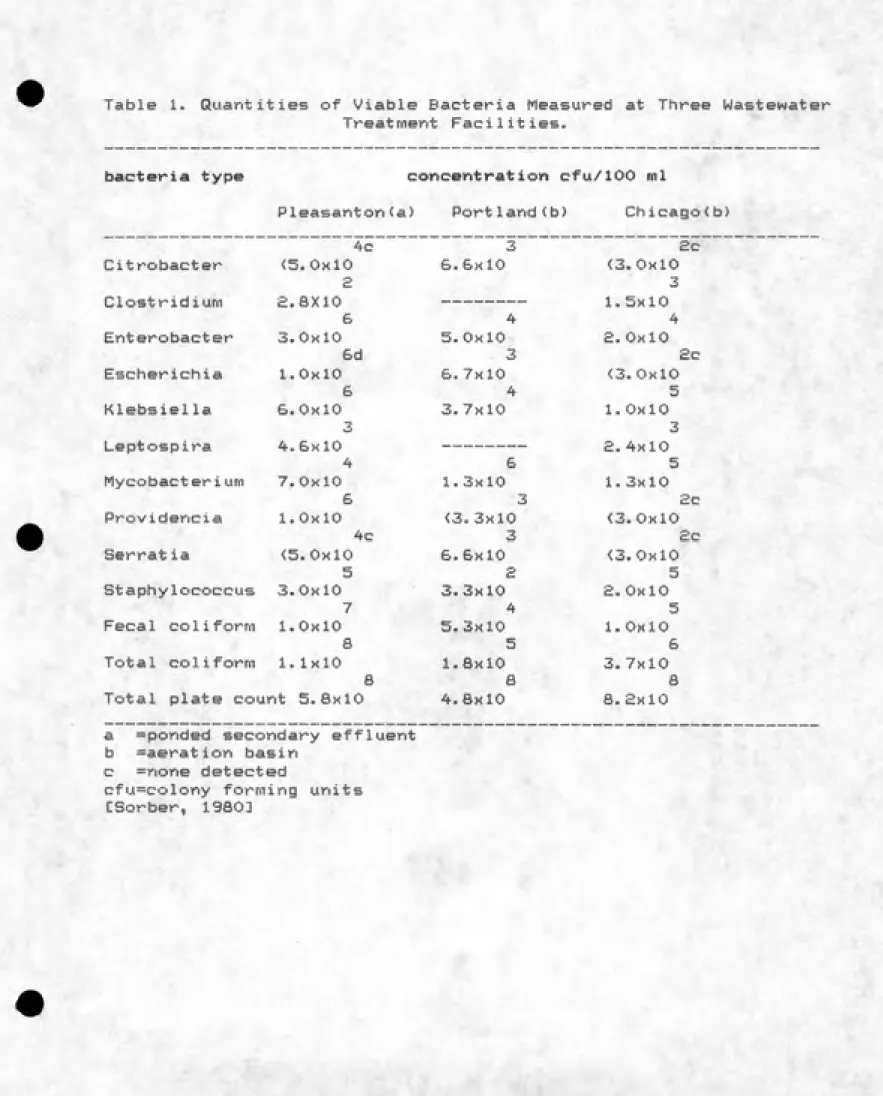
TftBLE 1. Quantities of viable bacteria measured at three 7
wastewater treatment facilities.
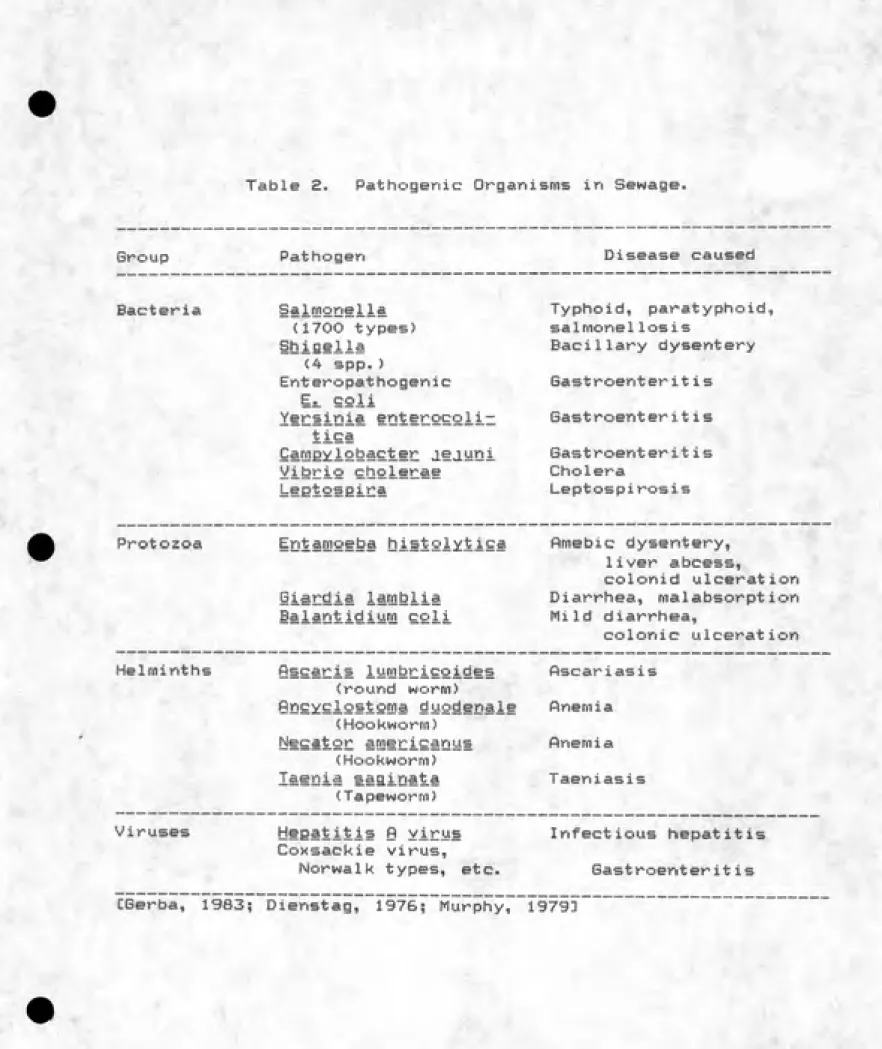
TfiBLE £. Pathogenic organisms is sewage. 10
TftBLE 3. Removal of various organisms by conventional 14
treatment.
TABLE 4. Experimental results of Endamoeba coli cysts 4£
ingested in capsules or drinking water and consequent
infection rates.
TfiBLE 5. Experimental results of Giardia Iambiia cysts 42
ingested in capsules or drinking water and consequent
infection rates.
TABLE 6. Experimental v^esults of Salmonella typhosa 43
ingested and consequent disease rate.
TABLE 7. Experimental results of Shigella flexneri 2a 43
ingested and consequent infection and disease rates.
TABLE 8. Experimental results of attenuated 44
poliovirus ingested in capsules by adults and consequent
infection rate.
TABLE 9. Experimental results of attenuated 44
poliovirus ingested by infants and consequent infection
rate.
TABLE 10. The six largest reported outbreaks in 53
systems using surface water, U.S. 1971-1978,
TABLE 11. Bacterial contamination of oysters from 57
suppliers sampled during associated outbreaks.
TABLE 1£. Specific analysis of chlorinated organics 64
in wastewater effluent and estimated concentrations.
TABLE 13. Tentative identifications and 65
concentrations of chlorine-containing constituents in a
X 1 1
LIST OF TABLES cont inued
TftBLE 14. Volatile organic compounds identified in 67
a treatment plant effluent, prior to disinfection.
TftBLE 15. Some volatile chlorinated organic &&
compounds in water at sewage treatment plants.
TftBLE 16. Toxicity of wastewater effluent chlorine 79
residuals to aquatic animals.
TftBLE 17. Economic cost comparisons of various 91
IV
LIST OF FIGURES
Page
FISURE 1. Chlorination breakpoint curve. £3 FIGURE £. Bactericidal and viricidal effects of rapid £8
mixing CKruse],
FIGURE 3. Chlorination of waters containing ammonia and 31 glycine and their effect on the rate of disinfection for
coliforms, dose 5.6 pprn C01ivieri3.
FIGURE 4. Chlorination of waters containing ammonia and 32 glycine and their effect on the rate of disinfection for
viruses, dose SO ppm COlivieri].
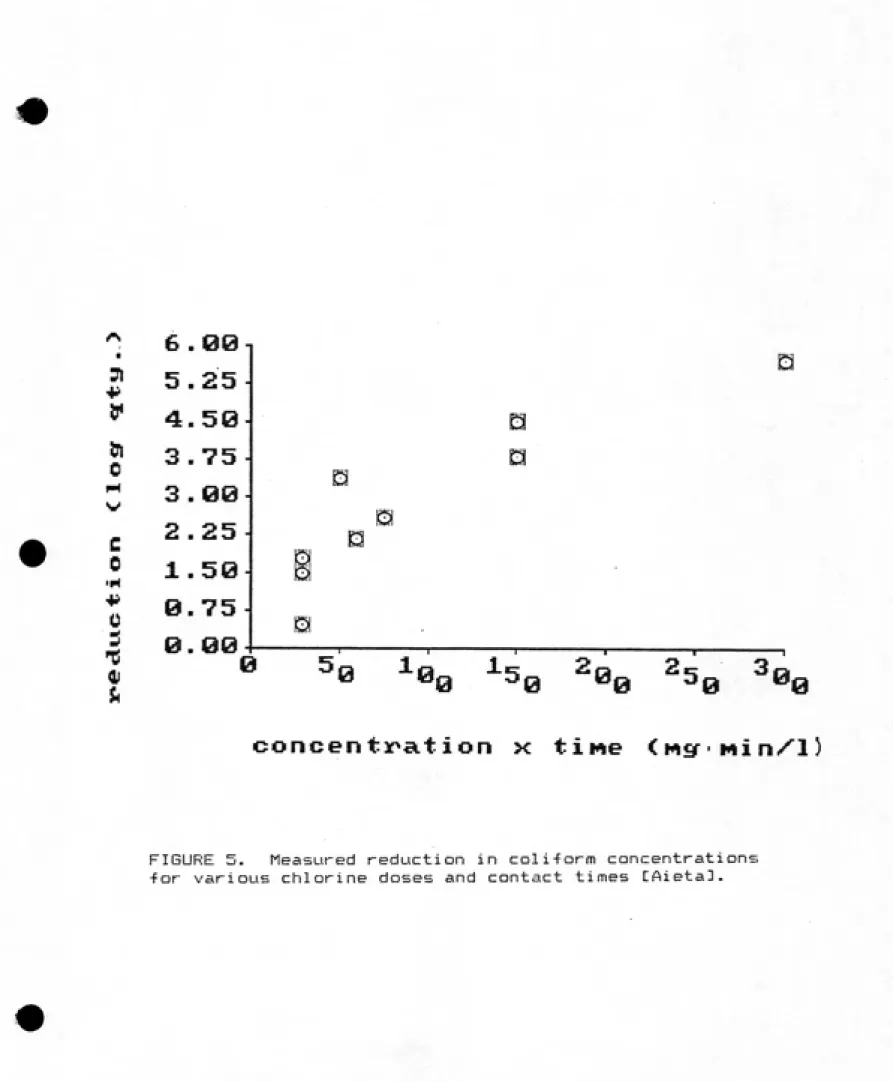
FIGURE 5. Measured reduction in coliform concentrations 33 for various chlorine doses and contact times Cfiieta3.
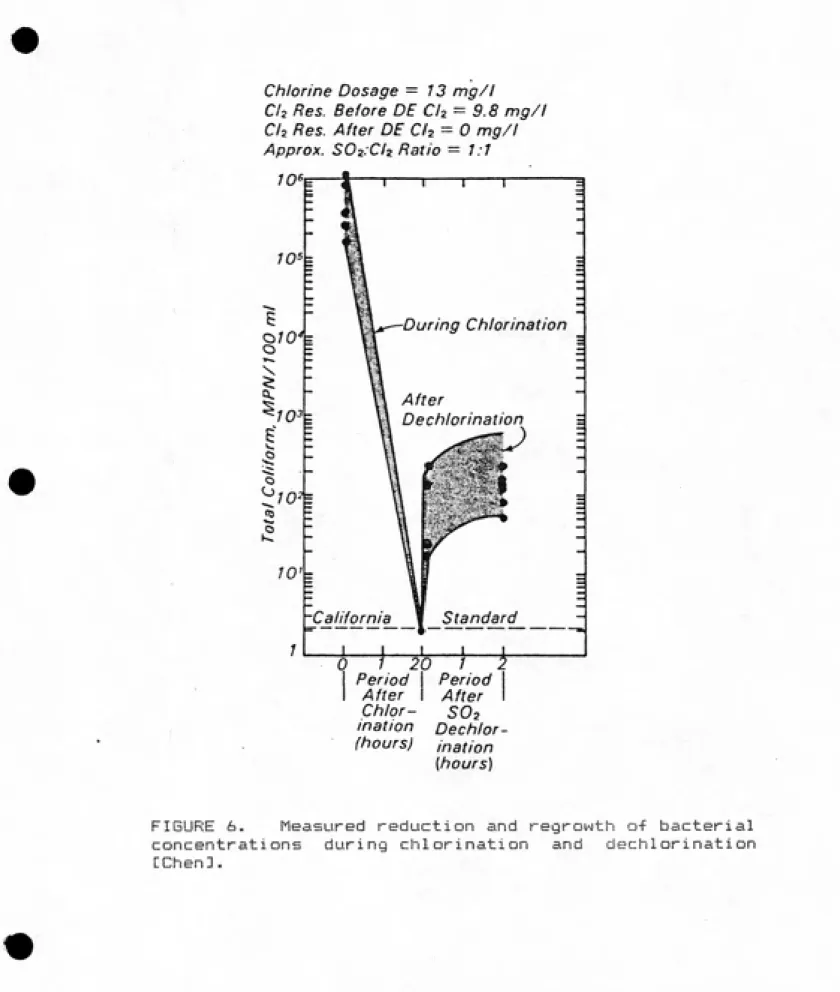
FIGURE 6. Measured reduction and regrowth of bacterial 36
concentrations during chlorination and dechlorination CChenl.
FIGURE 7. Itemised economic costs of chlorination, the 90
Effluent Chlorination Health Effects
and Policies
I. INTRODUCTION
Chlorination of the effluent from sewage treatment plants
has been widely practiced in the United States. Chlorination
is the method of disinfection with the best established
reliability, ease of operation, and lowest cost. In the United
States, it is the method used in over 99^ of the wastewater
treatment plants which disinfect, accounting for about two-thirds
of total municipal wastewater flow CMaxted,1983; Virginia
Disinfection Task Force (VDTF), 1984]|. It appears that as the
nation's wastewater treatment capacity expands, the use of
chlorination increases at equal or greater rates.
Requirements for disinfection of wastewater reflect coriceTrn
for protecting public health, but vary considerably from state to
state since the primary benefits of disinfection in preventing
the transmission of waterborne disease do not apply uniformly to
all locations at all times. In areas where there is high
dilution of the effluent, only seasonal recreational uses, or
even no downstream uses involving human contact, the benefits of
disinfection may be non-existent or may not justify the expense
and possible adverse effects.
Disinfection of sewage treatment plant effluent reduces the
microbial populations , since the discharge of viable pathogens
into the environment can constitute a hazard to human health. If
pathogens Are discharged into sewers, survive through treatment
plants, and sire released, people may ingest them from waters
used for potable water sources, seafood growth, or swimming.
Users of waters receiving discharges may be directly exposed to
contamination, as in swimming, and therefore depend on the
protection provided by sewage treatment or they may be protected
by further treatment, as in most drinking water systems.
Although downstream drinking water system withdrawers do not rely
upon upstream dischargers' disinfection, they do nevertheless
benefit from a reduced disease risk due to lower pathogen load on
their protective treatment.
There are^ however, adverse secondary effects accompanying
chlorinat ion. These a^re mainly the toxicity of residuals to
aquatic life and the possible formation of chlorinated organic
compounds harmful to human health. Attention in recent years to
the harmful effects on aquatic life by various chlorine compounds
has led more than two-thirds of the states to establish water
quality standards and criteria that limit chlorine discharges
CVDTF, 19843. Also, discovery of the formation of
trihalomethanes(THMs) in drinking water from reaction of chlorine
with trace organic compounds has caused alarm. Chloroform, the
most common THM, is suspected of being a carcinogen based on
extrapolation from studies of animals given unusually high doses
of chloroform. The potential effects on human health of lifelong
consumption of trace amounts of chlorinated organic compounds in
chlorinated wastewaters. Partly due to concerri about adverse
effects, over half the states are currently reviewing their
disinfection or chlorine residual regulations CVDTF, 19843.
Ideally, all adverse effects should be evaluated and considered
along with all expected benefits of a particular wastewater
disinfection policy.
Rational policy for regulation of sewage treatment plant
effluent disinfection requires determining the best solution for
a problem which involves a tradeoff between two potential public
health risks:
ft. Requiring disinfection on a broad scale maximizes 1) the
protection against transmission of infectious
waterborne disease, but also £) the production of
whatever chlorinated organ ics are fov^med and the
potential health risk imposed on downstream users.
6. flllowing the reduction or elimination of chlorination
lowers the operating costs and may minimise formation
of chlorination byproducts, but presents the
possibility of higher risk of waterborne infection.
R rational evaluation of the benefits and adverse effects of
effluent chlorination would require, in theory at least,
knowledge of the quality of waters, effects of chlorination on
thera, and the exposure and effects on the environment and humans.
Unfortunately, some of these sets of data, such as scientific
evidence of the actual long-term human exposures and effects of
halogenated organic micropollutants, are unlikely to ever be
4
Other needed sets of information, such as estimates of the risk
of waterborne disease, involve major variability and uncertainty.
Altogether, the present state of knowledge about the benefits and
detriments of effluent chlorination is fair to poor, but
available information can and should be evaluated and taken into
II. OBJECTIVES
The objective of this report is to present and assess
information about the benefits and detriments of effluent
chlorination. Specifically, the following questions relating to
effluent chlorination will be addressed through evaluation of
recent publications on the subject.
1. What is the pathogen content of wastewater treatment
plant effluents ?
2. What is the impact of chlorination on the pathogen
content of those effluents?
3. What &yre the benefits provided by effluent disinfection
in preventing waterborne disease?
4. What chlorinated byproducts are formed during
chlorination of secondary treatment plant effluent?
5. What are their potential adverse impacts on human
health?
6. What are their demonstrated adverse impacts on human
health?
7. What damages to aquatic life result from effluent
chlorinat ion?
8. What have been the policies in regulatory agencies with
respect to effluent chlorination?
9. What are the recent trends in these regulatory policies?
10. What alternatives to chlorination of effluent av^e
available, including modified chlorination, no disinfection,
III. PATHOGENS IN WfiSTEWftTER TREATMENT PLANT EFFLUENTS
(^' B§fe!ll2flsns in sewage
In areas served by sewerage systems, nearly all human wastes are discharged into the sewage which consequently contains any pathogenic organisms excreted. The extent and likelihood of new
infections depends, among other factors, on the survival of the pathogens and subsequent exposure of humans to them.
Disinfection of wastewater effluent is intended to reduce the chances of pathogens surviving into water to which humans will be
exposed, thereby lowering the risk of transmitting infectious
disease.
Large numbers of microorganisms are present in sewage, their concentrations and types varying considerably with time and between communities. Reported bacterial isolates and concentrations from a recent field study of several wastewater treatment plants &re shown in Table 1 CSorber, 198011. The presence of pathogenic microorganisms in sewage depends particularly on the disease rates in the contributing community. Most places in the United States currently have a very low incidence of infectious disease and therefore the sewage will usually receive few pathogens. When an enteric disease occurs in a community, that pathogen will be present in the sewage in quantities roughly proportional to the number of infected persons CGerba, 19833.
Table 1. Quantities of Viable Bacteria Measured at Three Wastewater Treatment Facilities.
bacteria type concentration cfu/100 ml
Pleasanton(a) Portland(b) Chicago(b) 4c 3 £c Citrobacter <5.0xi0 6.6x10 <3.0x10
a 3 Clostridium £.8X10 --- 1.5x10
6 4 4 Enterobacter 3.0x10 5.0x10 £.0x10
6d 3 £c Escherichia 1.0x10 6.7x10 <3.0x10
6 4 5 Klebsiella 6.0x10 3.7x10 1.0x10
3 3
Leptospira 4.6x10 --- £.4x10
4 6 5
Mycobacterium 7.0x10 1.3x10 1,3x10
6 3 £c
Providencia 1.0x10 <3.3xl0 <3.0xl0 4c 3 £c Serratia <5.0x10 6.6x10 <3.0x10
5 £ 5
Staphylococcus 3.0x10 3.3x10 £.0x10
7 4 5 Fecal coiiform 1.0x10 5.3x10 1.0x10
8 5 6
Total coiiform 1.1x10 1.8x10 3.7x10
8 8 8
Total plate count 5.8x10 4.8x10 8. £xl0
a =ponded secondary effluent b =aeration basin
c =none detected
cfu=colony forming units
8
waterborne scourges such as typhoid and cholera that were major
concerns for earlier sanitary engineering are not currently
significant problems in the United States, but sre, however,
still present. Typhoid in the U.S. progressively decreased from
1900-1960 then leveled during the late 1960's to a current
incidence of 0. £-0.3 cases v^eported per 100,000 general
population per year; about half of these typhoid cases are
acquired during travel outside the country CHornick,19833. Rarer
than typhoid in the fimericas, cholera has been present once
recently in the United States. Thirteen cases, all caused by the
eltor strain, were identified in coastal Louisiana in 1978. fit
that time, the same strain of Vibris choigrae was isolated from
shellfish and crabs in several local coastal marshes CCarpenter,
19633. It is important to see here that a policy including
effluent disinfection as a public health protective measure
should be based on the potential biological hazard of
sewage-contaminated waters, not on just the hazard presented by current
condit ions.
The hazard of biologically contaminated water is routinely
measured by surrogates (indicators). Discovery, identification,
and enumeration of various actual pathogenic microorganisms is
not commonly done because of insufficient techniques for some
pathogens, expense of doing vast quantities of laboratory tests,
and availability of better methods for evaluating the
microbiological risk. Standard counts of indicator organisms
which are assumed to be proportionally representative of overall
198Ea, 1983; Dudley,1976; Hendricks,1978; Pipes,19783.
There are problems with using bactev^ial indicators for other
than routine screening. One result of the assumptions necessary
for the use of indicator organisms is the addition of uncertainty
to the assessment of the risk of infectious disease associated
with wastewater effluents. Estimating the probability of an
occurrence by sampling its frequency becomes difficult arid less
precise when that event is rare, as is the case with waterborne
disease in the United States. The potential risk of a particular
disease being transmitted by sewage would be underestimated if
that risk is estimated on the basis of analysis of sewage which
currently contained no pathogens of that type. For any
particular disease, the sewage from a community where there is no
actively infected person discharging to that system will not
contain pathogens of that type. This is a source of uncertainty
in estimates of risk regarding waterborne disease in the United
States and the effects on that risk of various protective
practices such as effluent chlorination.
The bacterial pathogens most commonly associated with sewage
include species of Salmonella, Campylobacter, Shigella, and
Vibrio (Table £). Among the 1700 identified types of Salmonella
are those responsible for typhoid and paratyphoid fevers. Some
other Salmonella species cause gastroenteritis, as do Yersinia
and Campylobacter. Fecal coliforms, present in great quantities,
are predominantly non-pathogenic but some strains of Es_ coli have
been found to cause severe diarrhea CDupont, 19713.
Table 2. Pathogenic Organisms in Sewage.
Group Pathogen Disease caused
Bacteria Salmonella Typhoid, paratyphoid,
(1700 types) salmonellosis
itiiflella Bacillary dysentery
(4 spp.)
Enteropathogenie Gastroenteritis
Ea. coli
Yersinia entergcoliz Gastroenteritis
tica
SafflEYiebsicter J.ejuni Gastroenteritis
yifeCie choleCSt Cholera
LeBieSEiCS Leptospirosis
Protozoa Entamoeba histolytica Amebic dysentery,
liver abcess,
CO1on i d u1cerat i on
iiSE^ia iSQlfeiiS Diarrhea, malabsorption
ililQfeidium cgii Mild diarrhea,
colonic ulceration
Helminths Sscaris iurQbricoides flscariasis
(round worm)
QDeie!£i£'Stgma duodenale Anemia (Hookworm)
NgeafeSE afflericanus Anemia (Hookworm)
I^enia saginata Taeniasis
(Tapeworm)
Viruses Heeatitis Q virus Infectious hepatitis
Coxsackie virus.
Nor walk types, etc. Gastroenteritis
11
of 8-10 cases per 100,000 population per year CCenter for Disease
control (CDC), 19823. Shigellosis is spread primarily by human
contact, but indirect transmission has been shown in £5 foodborne
or waterborne outbreaks documented in the U.S. between 19&A-1968.
Four of the twelve water related shigellosis outbreaks were
associated with swimming in small contaminated freshwater lakes
CCDC, 19833.
Of the common protozoa which may be found in wastewater,
only three species are significant in the transmission of disease
to humans s EQdSfQSsba histol.;jitica;,, Giardia iSfflbiia, and
iailQfeMiMQl eeii" significant waterborne outbreaks of illnesses
due to Ei. histolytica and B^ eoli have not been repov^ted recently
in the U.S. CSerba, 1983D, but it is estimated that l-3y. of the
United States population is infected with these organisms
CJuniper, 1983a3. The possibility of infection with these
protozoans from domestic sewage in the United States is,
therefore, significant.
There has been a significant recent rise in the United
States of the number of reported waterborne outbreaks of Giardia
enteritis (giardiasis), which has been reported for about 10,000
cases in the U.S. since 1971 C CDC,1982; Craun, 19793. Giardia
lamblia, a protozoan, is usually fecally-orally transmitted: by
contamination of food, hand to mouth, or via drinking water where
the cysts are resistant to common doses of chlorine (<3.0 mg/1 )
CDykes, 19803. Sewage may be a major carrier of the organisms
since levels of Giardia cysts in feces from infected pev^sons can
6
12
by human-human fecal oral vectors, giardiasis has been found to
not always be transmitted from humans to humans only. Evidence
has indicated that beavers in &ri upland watershed may serve as a
reservoir for Oiardia CDykes, 19803. Even though such an outbreak
of giardiasis originating from a non-human source would not be
prevented by reducing pathogen concentrations at a different
source (such as sewage effluent), the benefit of effluent
disinfection in reducing the risk of wastewater transmission of
giardiasis remains valid.
Helminth parasites are present in the United States
population, but the reported incidence of disease due to these
agents has been low for the last few decades CGerba, 19833.
Enteric viruses (those fecally excreted by and pathogenic to
humans) at^e also excreted in widely varying amounts in different
places but generally in lesser numbers than pathogenic bacteria
CIrving,1981; Hanson,19733. The numbers of virus that are
measured depend, in addition to the wastewater source, on the
detection technique employed CSorber,19803. More than one hundred
strains have been isolated from sewage and most Bire in six
categories: polio, hepatitis, coxsackie, adeno, echo, and
reoviruses. Mean total virus concentrations isolated from raw
sewage run the range from 150 infectious units per liter (IU/1)
to 15,000 IU/1, with 90-100"/. of samples positive Clrving, 19813.
Enteric viv-uses isolated from samples taken from a
sewage-polluted river have been identified generally as the same types
as those found in sewage effluents CMetcalf,19683. Only the
Hepatitis-fi virus(HflV) has been clearly shown to cause waterborne
13
Recently, however, Norwalk type viruses have been implicated as
the cause of orie large gastroenteritis outbreak CMurphy, 19793.
With the current United States incidence of Hepatitis ft at about
30,000 clinical cases per year CCDC, 19823, and an estimated
ratio of inapparent infections to clinical cases of 10 si
CHanson,19733, there could easily be 300,000 people in the U.S.
each year infected with and excreting Hepatitis 0 virus. Each
infected person excretes 10,000 to 100,000 infectious doses per
gram of feces CMetcalf & Eddy, 197£3. Even after dilution, raw
sewage HflV quantities may be very high if infected persons are
discharging to that sanitary system.
B. Remoyai by conventional, treatment
Sewage treatment achieves both a decrease in numbers of
bacteria and, of major importance, a change in the kinds present.
Microorganisms pathogenic within the human body generally do not
multiply in the wastewater environment. Although pathogenic
bacteria are not absolutely eliminated by treatment, the effect
is to greatly reduce their numbers, replacing them with
saprophytic varieties CCarlson,19433. Removals of various
pathogens that are accomplished by sedimentation, trickling
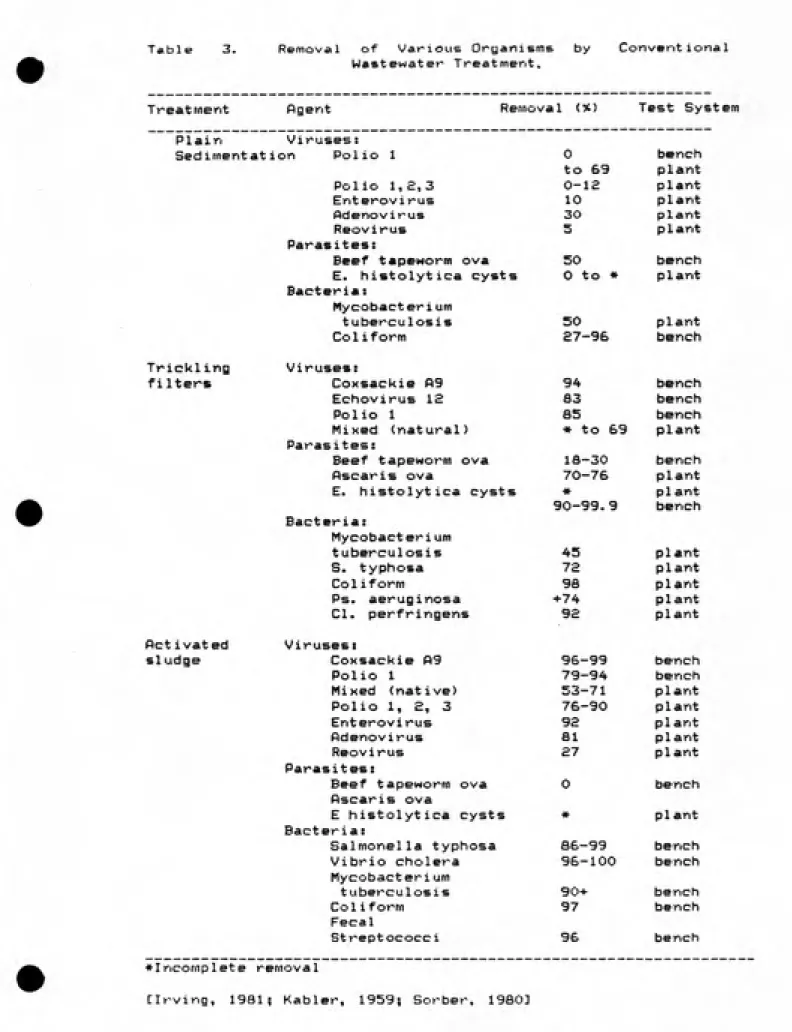
filters and activated sludge are shown in Table 3.
Helminth ova settle readily and ara removed to the primary
sludge CCram, 1943; Kabler, 19593. Protozoan cysts, though, are not
so extensively removed during primary sewage treatment. Cysts of
Table 3. Removal of Various Organisms Wastewater Treat merit.
by Convent ional
Treatment figent Rernoval (%) Test System
Plain Virusesi
Sedimentat ion Polio 1 0 bench to 69 plant Polio 1,£,3 0-12 plant
Enterovirus 10 plant
Adenovirus 30 plant
Reovirus S plant
Parasites:
Beef tapeworm ova 50 bench
E. histolytica cysts 0 to » plant
Bacteria:
Mycobact er i urn
tuberculosis 50 plant
Coliform £7-96 bench
TricklinQ Viruses:
filters Coxsackie A9 94 bench
EchoviruB IS 83 bench
Polio 1 85 bench
Mixed (natural) * to 69 plant
Parasites:
Beef tapeworm ova 18-30 bench
Ascarls ova 70-76 plant E. histolytica cysts w plant
90-99.9 bench Bacteria:
Mycobacterium
tuberculosis 45 plant
S. typhosa 72 plant
Coliform 98 plant
Ps. aeruginosa +74 plant CI. perfringens 92 plant
Rctivated Viruses:
sludge Coxsackie 09 96-99 bench
Polio 1 79-94 bench
Mixed (native) 53-71 plant Polio 1, 2, 3 76-90 plant
Enterovirus 92 plant
Adenovirus 81 plant
Reovirus 27 plant
Parasites;
Beef tapeworm ova 0 bench
Pscaris ova
E histolytica cysts « plant
Bacteria:
Salmonella typhosa S6-99 bench
Vibrio cholera 96-100 bench
Mycobacterium
tuberculosis 90+ bench
Coliform 97 bench
Fecal
Streptococci 96 bench
Incomplete removal
Many processes, both in the treatment plant and in the receiving waters, accomplish reduction of pathogen concentration. The pathogen concentrations expected in the effluent are
important for evaluating the disinfection process, and the overall pathogen reduction is important for evaluating the risk of infectious waterborne disease. For certain pathogens, though,
such as Mycobacteria, disinfection appears to be the only reliable process for their removal CHeukelekian, 195&3.
Effluent disinfection is a process solely intended for reducing the concentration of viable microrganisms, but many other natural and artificial processes act to affect the microbiological character of discharged wastewater. Pill wastewater treatment processes which reduce the concentration of pathogenic micro-organisms contribute to the overall reduction of the infectious disease hazard. The removal of various organisms by conventional treatment processes precedes effluent disinfection. Removal or inactivation of pathogens that occurs
after discharge, but prior to human exposure to the water,
affects the need for disinfection of the effluent.
There are many conditions in natural surface waters which help to inactivate microorganisms. One of these is the effect of
sunlight. Light at the wavelength of sunlight has been shown to increase the die-off rate for viruses and E^. col.i [Kapuscinski, 19833. Inactivation rates under light for thv^ee types of
bacteriophage and for Ej. Coli were found to be one order of
magnitude faster than for organisms kept in the dark. Of
16
conditions of ambient sunlight was greater than that of
bacteriophage virus under identical conditions, indicating that the former would not be a valid surrogate for measuring the
presence of the latter in open waters.
Virus inactivation (loss of infectivity) in natural waters is exponential and appears to be influenced primarily by temperature CO'Brien, 13773. The influence of temperature is such that the l-log inactivation of coxsackie and poi1ioviruses
o
that occured in Rio Grande water at £5 C over 19~£5 hours took
o
more than twice as long when chilled to 5 C. In the normal river o
warmth of £3-£7 C, inactivation of £ logs occurred in £-3 days and 3 logs in 3-4 days CO'Brien, 1977]. In the waters of streams and rivers, the significant inactivation of viruses usually takes several days and is usually slower than the inactivation occuring in saline waters. In natural estuarine water a mean 3 log reduction of various initial virus titers occurred in £-3 days. Comparable inactivation of viruses in freshwater required from three to more than fourteen days depending on the type of virus
CHurst, 19803.
Competition and predation by other microorganisms present in the treatment or receiving waters is a factor contributing to reduced pathogen survival. Experiments have shown greater decreases in the numbers of foreign bacteria when the full natural microbiotic community was present. When indigenous protozoans were filtered out of estuarine water, die-off of
17
£Sii to maintain populations 3 logs greater than in natural
estuarine water, or alternatively, required 4 days longer for
die-off to reach the same levels CMcCambridgel. In the latter
study with natural complete estuarine water, predacious protozoa
exerted theiv^ major influence on E. coli destruction during the
first two days. The former study established protozoan—positive
sample by seeding one milliliter of fresh bay water into 50 mis
of sterilized bay water and observed greater protozoan predation
between days two and four. It has been noted but not
investigated that the predacious destruction of foreign bacteria
is appav^ently greater in marine waters than in freshwater systems
CEnzinger, 1976; McCambridge, 19803.
Removal of pathogens by conventional primary and secondary sewage treatment processes is not consistently sufficient enough
to accomplish the task of disinfection. Processes such as
activated sludge or trickling filters cannot be relied upon to
achieve more than a 1 to £ log reduction in pathogen
concentrations. Considering the high numbers of pathogens which
can be present in sewage, this is a reduction which, by itself,
provides insufficient assurance of protection from the
possibility of infection and disease to persons who &re exposed
la
IV. WfiSTEWfiTER CHLORINATION fiND ITS EFFECTS ON PATHOGENS AND
OTHER MICROORGANISMS
Chlorination has been and continues to be the preferred method for disinfection of wastewater effluents. According to a 1980 EPA survey, 6S54 of the total municipal wastewater flow in
the United States is chlorinated. It was found that the practice of effluent disinfection is increasing in the U.S. and that at least 30% of the time the preferred method is chlorination
CMaxted 19833.
Primary among the several reasons why chlorine is the predominant method for wastewater disinfection is that chlorine is the most cost-efficient method of reliably destroying microorganisms in water. Also, operation of chlorination is generally simpler than other disinfection methods, and there has been extensive experience with it. Successful experience with chlorination has also shown that its effectiveness can be easily approximated by measuring the contact time and residual concentration of chlorine in the effluent, rather than by bioassay CWhite 19723.
Use of chlorine compounds in the tv^eatment of sewage preceded their use in potable water. Disinfection with chlorine for the purpose of controlling disease transmission was done as
early as 1879 when, in England, calcium hypochlorite was applied to typhoid feces before discharge to a sewer [American Public
19
several attempts at sewage puv^if icat ion with hypochlorite
solutions, generated onsite by electrolysis of brine, were done.
Several studies on disinfection of raw sewage and trickling
filter effluent by application of hypochlorite powders and
solutions were done in the U.S. and Europe during this period.
The practice of wastewater ch1orination in the United States grew
concurrently with that of chlorination of water supplies,
beginning in about 1910 CRace, 1918; Thornan, 19583. Developments in
chemical manufacture during WWI made available cheap elemental
chlorine <C1 gas) which has since been the economically
S
preferable form for large scale water or wastewater disinfection
CPPHfl,1934; White 197£, 19783.
Chlorine has been used in sewage treatment plants for many
purposes. Chlorination of influent, or at other points, for odor
control, has been done. ft strong oxidant, chlorine will help
remove reduced species such as sulfides or ammonia. Chlorine
has been applied to effluents to reduce or delay BOD in the
receiving water CflPHfi, 19343. This report is concerned only with
effluent chlorination for the purpose of disinfection.
In the U.S. each year about 10.5 million tons of chlorine
are manufactured, most of which is used in chemical manufacture
and pulp/paper industries. fin estimated 3-4% of the total
generated, or 630-840 million pounds, is used for sanitary
purposes — including drinking water and wastewatev> treatment,
swimming pools, household use, cooling water biofouling control,
and food processing water CWhite, 197E3. Though estimates vary,
the total amount of chlorine that is used for disinfection and
£0
according to Maryland statistics, the use of chlorine for
disinfection in that state could contribute to the Chesapeake
Bay, assuming no degradation, £7 million lbs./year of chlorine
via municipal wastewater treatment plants, and £.£ million
Ihs,/year from power plant cooling water anti-fouling
chlorination CKopperman, 19783. Roughly 1% of manufactured
chlorine, or about £00 million pounds per year, is used for
wastewater chlorination CJolley, 19753.
The use of chlorine in sewage treatment plants in the
United States has accelerated during the middle part of this
century. From 1910 when ££ plants used chlov^ine in treating the
wastes from an estimated 0. l£?t of the nation's population, the
practice has grown faster than sewage treatment capacity
CLaubusch, 1958; Maxted, 1983; Thoman, 19583. The steady
increase in the use of chlorine from 4y. of surveyed plants in
1910, grew to 1B% in 1934, passed 4954 of all plants in 1957, and
now is py^acticed at over 6054 of all U.S. wastewater treatment
facilities CLaubusch,1958; Maxted,1983; Thoman,19583.
Recording to a survey by the Water Pollution Control
Federation done in 1979 of over £500 municipal wastewater
treatment plants, of the 740 responding, 8054 disinfect their
effluent, £054 do not CWPCF 19803. Of the nearly 600 plants which
practiced disinfection, nearly all did so by chlorination (1
plant reported using chlorine dioxide), and of these, less than
554 followed with any dechlorination process. The median dose
range for chlorine was 3-6 mg/i, at 5854 of the plants
21
fl. Chemistrii of chlorine i.n wastewater
Chlorine disinfection efficiency and the effect and fate of
discharged chlorine residuals depend on many factors. Primary
among these is the chemistry of chlorine in water.
Chlorine gas added to water rapidly hydrolyses to form
hypochlorous acid (HOCl) and hydrochloric acid.
+
-CI + H 0 —> HOCl + H + -CI
£ 2
Half of the chlorine applied becomes the non-disinfectant
chloride ion (CI ). Hypochlorous acid exists in equilibrium with
hypochlorite ions (OCl ).
- +
HOCl <==> OCl + H
The equilibrium relative quantities of HOCl and OCl depend on
pH, with HOCl predominating at low pH, equal amounts at pH = pKa
=7.5, and OCl predominating at higher pH. The sum amount of
HOCl and OCl is called free residual chlorine, and can be put
into water by addition of chlorine gas or hypochlorite compounds
such as NaOCl.
Free chlorine in wastewater will first react with any easily
oxidized species that are present, such as sulfide, nitrite, and
other reduced compounds. ftfter that demand is satisfied, combined
available chlorine (CflC) is formed as chlorine combines with
ammonia in a weight ratio of close to 5:1 to form monochloramine.
Municipal wastewaters receiving secondary treatment contain
+
significant amounts of ammonia (NH or NH , pka=9.3). Even
4 3
ammonia to nitrate will still contain some ammonia CSnoeyink,
19743.
NH HOCl H 0+ or
4 3
or + or —> NH CI + H 0 or
NH OCl OH
3
fls more chlorine is applied to convert the ammonia nitrogen
( 5 mg/1 CI for each 1 mg/1 NH -N>, dichloramine begins to form
2 3
and decompose, resulting in a decline of available combined
chlorine until free residual chlorine begins to be established at
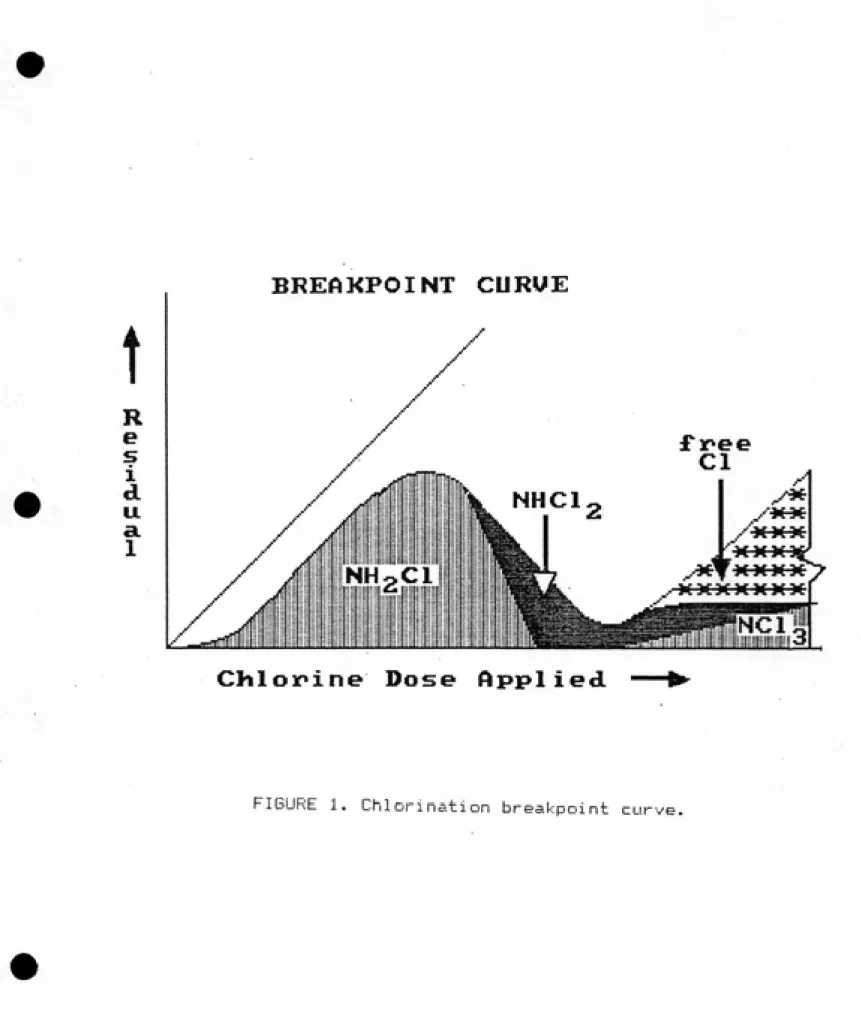
the "breakpoint" (Figure 1).
NH CI + HOCl —> NHCl + H 0 £ 2 £
£H 0 + 2NHC1 —> N + 4C1 + £H 0 S 2 £ 3
The rate of formation of monochloramine varies with pH because
the speciation of the reactants varies with pH. Monochloramine
formation is very fast in the pH range 7.5-9.3, in which the
reactants are predominantly hypochlorous acid (HOCl) and ammonium
+
(NH ) CLietzke, 19783. fit pH>7, essentially only monochloramine
4
is stably produced; at pH below 7 dichloramine will become
increasingly present; and nitrogen trichloride (NCI ) may be
3
significant at pH<4. Overall, at wastewater of typical pH, the
oxidation of ammonia nitrogen to monochloramine and dichloramine
will consume about 10 times as much free chlorine by weight
BREAKPOINT CURUE
t
R e s i d u a. 1
f inee
NHCl
^
NHgCl
ii iij III I!
ililililllllillllilil'lilllilliiiill^ BiB
Cliloinine Dose Applied
£4
free chlorine is consumed in oxidizing N - nitrogen to nitrate, thereby delaying the breakpoint slightly further CSaunier, 19793.
N + 6H0C1 ==> £N0 + 6C1 + 6H £ 3
Most wastewater chlorine doses are far below that needed to
reach the breakpoint and create a free residual. The actual distribution of chlorine forms in the effluent will vary, depending on the dose, pH, and which compounds present the demand. In nearly all chlorinated secondary effluents the predominant residuals form of chlorine is raonochloramine.
In addition to the production of several inorganic species, various reactions may occur with organic material in the water that form chlorinated organic compounds. These may include trihalomethanes, chlorophenols, chlorinated amino acids, and organic chloramines. The formation and significance of chlorinated organic compounds to human health will be addressed
in Section VI.
Chlorinated effluents which are discharged to saline waters involve some additional reactions. Brackish estuarine waters a.re
diluted seawater, and therefore contain bromide (Br ), a halogen not found in most fresh waters. In full strength seawater, there is 65-70 mg/1 bromide. In estuarine water that is only 1%
seawater, for example, there will be about 0.7 mg/1 bromide
concentration, which is of the same order or greater than
typical discharged chlorine residuals.
hypochlorite will react with bromide to produce hypobromite,
reducing the chlorine to chloride.
Br + HOCl —> HOBr + CI
Though monochloramine is less reactive than hypochlorite, there
is evidence that bromamines are formed from reaction of bromide with monoch1Oramine and/or hypobromite with ammonia. Similar to
chlorine, a set of bromamines, bromides, and brominated organics
may form CJohnson, 1S75; Scott, 19833.
B. Effects of effluent chl.orinatign on CQicroorganisms
Chlorine's effect on microorganisms depends on the nature, distribution, and concentration of the organisms and of the
chlorine, on the pH, temperature, and other characteristics of
the water, and on mixing and time of contact. The manageable variables ars 1) the nature and concentration of the disinfectant, £) mixing of water, and 3) assured time of contact.
Under the ideal conditions of;
1. no interfering substances in the water
2. disinfectant chemical composition doesn't change 3. disinfectant concentration doesn't change
4. disinfectant and target microorganisms are uniformly
dispersed;
the rate of disinfection can be modeled as a function of
contact time, disinfectant concentration, and temperature.
fts the time of contact between disinfectant and organisms is
longer, more destruction can occur. This important factor in the
2S
equation known as Chick's Law. Applying chemical reaction
principles to the study of disinfection. Chick found that, with
excess disinfectant, the death rate of anthrax cells, dN/dt, was
proportional to N,the number remaining CChick, 19083.
-dN/dt = KM where: N=number of cells
t =t i me
K=rate constant
Or, for the period t and having begun with N cells,
o
-kt N/N = e
o
Chemical disinfection proceeds more rapidly at warmer
temperature. This relation basically follows the firrhenius
relationship, and was noticed by Chick. To achieve equal extent
of disinfection at lower temperature, T (absolute), requires a
1
longer contact time, t . 1
t T -T 1 £ 1 log--- = ---t T T
£ 2 1
Chick also noticed vav^iations in the first order kinetics.
In one set of experiments this was attributed to varying
susceptibility within a species, where she found that younger
B. paratyphosa were more resistant than older cells. For lower
disinfectant doses, a logarithmic relation between disinfection
rate and disinfectant concentration, c, was found. Watson later
used Chick's data to define a second order expression CWatson,
27
N log c + log t = K = rate constant
Or, in the exponential form CTrussell, 1977]:
-kct N/N = 10
o
It must be kept in mind, however, that the ideal conditions
are not met, especially in wastewater disinfection.
Particulates, especially aggregates, shield microorganisms from
exposure to disinfectant CCulp, 19783. fimmonia and other
chlorine-demanding materials react with chlorine to reduce
available disinfectant concentrations and/or convert it to less
effective forms. In addition to the intraspecies variation in
organism susceptibility pointed out by Chick, the various types
of target pathogens a\re quite different in their resistance to
disinfection. Certain organisms such as mycobacteria, amebic
cysts, and some enteric viruses, have been found to be
significantly more resistant to chlorine disinfection than
others, such as coliform bacteria CBurns,1967; Dudley,1976;
Hendricks, 19783.
Thorough mixing of disinfectant with wastewater is of great
importance because the process seeks reductions extending over
several orders of magnitude. Experiments have shown that
thorough initial mixing, rapid or slow, of chlorine with
wastewater gave consistently better disinfection efficiency of
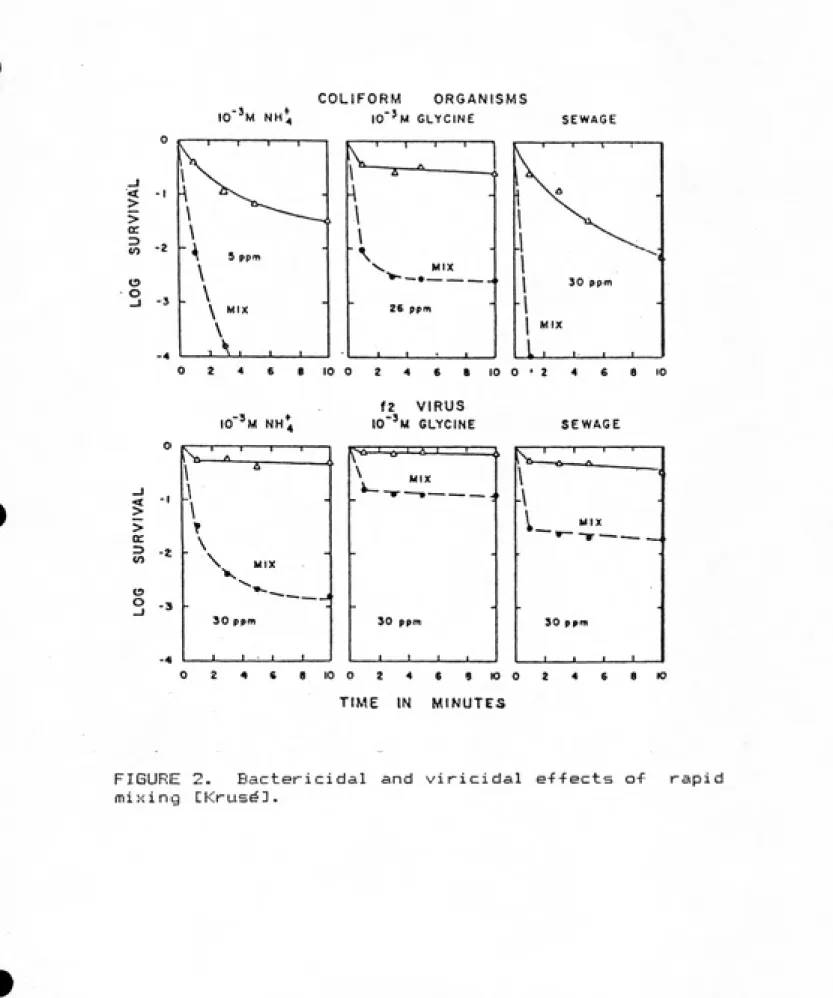
conforms (MPN) than with no initial mixing CEliassen, 19483. fl
rapid initial mix was also found to be necessary for efficient
virus inactivation in wastewater because the viral disinfection
IO"'m NH4
< > > a: CO o o -2COLIFORM ORGANISMS
lO'^M GLYCINE 5 ppm
N .
ͣ ͣͣͣ .,_, . ---<\ ^
\
-\
\ A ͣ V MIX v-ͣ—•- ---,Z6
t
PPIT
J ... .
SEWAGE
,111
1 ^^
•
-1
^-1
1 30 ppm
.1
I
MIX
L, , ,
1 ,.n ..O 2 4 6 «I0 0 2 4 6 8 10 0*2 4 « a 10
IO''m NH4
f2 VIRUS
io"'m glycine
< > > cr o o -4in ͣ*
T---1---1---\ a
---.1
\
-r
\
" \ MIX
30 ppm
,
. . . I
r>a I c I szx: \
MIX
90 ppm
J___' I ͣ
SEWAGE
l-_"
IX30 ppm
J_____L
O 2 4C 810 0 2 4 6 9K>02 4 6 8(0
TIME IN MINUTES
FIGURE 2. Bactericidal and viricidal effects a<- rapid
was still in the more effective free form CKruse, 19713. (Figure £). The importance of uniform dispersion of disinfectant is
illustrated by a hypothesized contact chamber in which £"/. of the
flow is short-circuiting enough to only receive a 50% reduction
in microorganism concentration The maximum overall disinfection
that could then be achieved is a two log <99"/-) reduction in microorganism concentration - generally insufficient for the numbev^s of microorganisms in sewage effluents.
Inefficiency of ch1orination facilities seems to be a
widespread problem CSepp, 1981; Trussell, 19773, and results in
insufficient disinfection or overapplication of chlorine since the operators's primary control is the chemical dose. Sepp's
study of six California treatment plants whose normally applied
doses were from 6 to 47 mg/1 chlorine showed that sri optimized
pilot plant at each site improved disinfection efficiency. The process improvements consisted of rapid mix, direct automatic control of dosage by residual monitoring, and plug flow contact
chamber design. ftt all plants the disinfection process was improved, with up to 50% less chlorine used CSepp, 19813.
Since the physical, chemical, and biological character of wastewaters are so varied, definitive conclusions v^egarding
chlorine disinfection effectiveness in wastewater are not
possible. There are^ however, reviews of the factors influencing
disinfection, and many experiments with chlorine and chloramine
disinfection, mostly with clean water CBrodtman, 1979; Mancini,
1978; National Research Council (NRC), 1977; Olivieri, 19833.
30
inactivation efficiencies <time * concentration product for a
given viability reduction) of hypochlorous acid, hypochlorite
ion, and rnonoch lor amine are on the order of i, 10 and 1000 CNRC,
1977; Olivieri, 1983; White, 197£3.
Sewage disinfection is different from potable water
chlorination, though. fls discussed above, many influential
factors vary over wide ranges, some with effects that make
several orders of magnitude difference in the numbers of
microorganisms surviving, such as the effect of rapid mixing.
Effluent chlorination can and does routinely provide
excellent disinfection. In Figure 3 data are shown for
chlorination of water containing ammonia at concentrations
similar to those found in secondary effluent; the disinfection is
a four log reduction. Note, however, that the same dose in a
glycine solution had an inconsequential effect. Figure 4 shows
the chlorination of the same two solutions, inoculated this time
with virus and dosed with £0 ppm chlorine. The greater
resistance to chlorine of viruses compared to colifov^ms is
evident. There is no epidemiological indication though, that
United States wastewater disinfection practices (usually based on
coliform indicators) allows significant risk of waterborne viral
disease CKruse, 1971].
o
o
o
o
z
o
o < c:
u.
>
>
a
z>
to
o o
-2
10-
M glycine,
5.6 ppm
-10"^ M NH4
5.5 ppm
I _L f J
13 5 10
CONTACT TIME IN MINUTES
FIGURE 3. Chlorination of waters containing ammonia and
glycine and their ef-fect on the rate of disinfection for
en
o
cc:
>
-I
r 2
->
CO
o
o
-3
10"^ M glycine
10-3 M NH^
f 13 5 10 15
CONTACT TIME IN MINUTES
_! 20
FIGURE 4. Chlorination of waters containing ammonia and
glycine and their e-ffect on the rate of disinfection for
•
3t
ft
0
V
C 0
e.es
5.25
4.50
3.75
3.68
2.25
1.50
e.75
0.00
m
m
n
0
0
00 0 0
0
00
0concent-3f^at ion x tine CnffMin/^l)
FIGURE 5. Measured reduction in coli-form concentrations
34
different days over a two week period during which the wastewater
o
characteristics were rathev- stables T= £4 C, COD 23-£9 mg/1, pH
6.7-7.4, and NH -N £7-34 mg/1 Cfiieta, 19803.
3
Nitrified effluents have been shown to require more chlorine
to achieve the same level of disinfection than typical secondary
effluents containing moderate amounts of ammonia CSepp, 1381;
Dhaliwhal, 1983; Gasser, 1984; White, 19813. For example,
filtered nitrified wastewater at San Jose, California, was found
to require application of 17 mg/1 chlorine to reduce coliforms to
a level of £.S/100 ml (MPN). This 17 mg/1 applied chlorine,after
49 minutes contact, left 9 mg/1 residual chlorine, about half free
and half combined. This wastewater had trace amounts of ammonia
<<0.1 mg/1), and 1.3-2,3 mg/1 organic nitrogen. However, when 2
mg/1 ammonia was added prior to chlorination, an application of
only IS mg/1 chlorine was sufficient to achieve the required
level of 2.2 coliforms/100 ml; the resultant 7 mg/1 residual was
about 3/4 monochloramine and 1/4 dichloramine CWhite, 19803.
White attributed this phenomenon to the chloramines having
greater disinfection efficiency than the chlorine species formed
with low NH -N levels. 3
Regrowth of bacteria populations after being damaged by
chlorination has been known for over 70 years CRace, 19183. This
recovery has been investigated in the laboratory and found to be
helped by growth in hospitable media CCamper, 19793. Observed
regrowth of coliforms in wastewater effluents in the field and
laboratory has been shown to be inversely proportional to
35
Hulka, 1973; Silvey, 1974; Shuval, 19733. In Shuval's study,
fecal coliforms in discharged effluents generally did not exhibit
regrowth as much as total coliforms. Regrowth did not always
occur, and when it did, it riever exceeded £ logs of population.
These observations saw e^n average 5 log reduction of coliforms
due to chlorination disinfection followd by a mean regrowth,
after 3 days in a storage reservoir, of 1 log CShuval, 19733.
Because residual chlorine is a factor holding down the
regrowth of coliforms, absence of any residual due to
dechlorination allows more regrowth. Indicated bacteria
aftergrowth following dechlorination is shown in Figure 6 CChen,
19813. As with the aftergrowth observed in effluents discharged
to rivers and ponds, this aftergrowth following dechlorination
recovers about one third of the logarithmic population reduction
accomplished by disinfection. Aftergrowth of indicator bacteria
cairt occur to even greater extents, but this does not imply that
significant regrowth of populations of pathogens occurs outside
Chlorine Dosage =73 mg/l
Ch Res. Before DE Clz = 9.8 mg/f
Ch Res. After DE Ch = 0 mg/l
Approx. S02:Ch Ratio = 1:1
California
During Chlorination
After
Dechlorination
W
Standard
I
f
0 1 20 1 I Period Period
I After After Chlor- SOz
/nation
Dechlor-(hours) /nation
{hours)
37
V. THE NEED FOR OND BENEFITS OF PfiTHOGEN REDUCTION
Disinfection of wastewater effluents serves to protect
public health. There 3^re other purposes and effects of
chlorination of wastewater effluents, such as discouraging odor
or reducing the effluent BOD, but this report is concerned with
chlorination of effluents for disinfection.
Maladies that Are transmitted through wastewater and water
systems can be caused by infectious microorganisms or by other
contaminants in water. This section addv-esses the hazard of
infectious disease and factors of exposure to its agents —
pathogenic organisms.
Where either the pathogenic hazard or the likelihood of
exposure is low, the direct protective effect of disinfection is
of reduced importance. Pis shown in Chapter III, pathogens and
other microorganisms Are physically removed from wastewater in
varying degrees by most conventional treatment processes.
Pathogens also die away or are destroyed in significant numbers
during treatment and after discharge in natural waters. The
specific goal of the unit process, wastewater effluent
disinfection, is to kill any pathogens in the wastewater before
release to the environment and, thus, to reduce the risk of
transmission of infectious waterborne disease. Methods of
disinfection which successfully kill pathogens do not distinguish
them from non-pathogenic microorganisms and so destroy, in
varying efficiencies, any microorganisms present in the water.
The accomplishment of the task of disinfection is usually
38
bacteria, either total ov" the fecal variety, that are in the
wastewater or v^eceiving water.
Risk of human exposure to pathogens released in wastewater
effluents occurs during subsequent intake or contact with
receiving waters. Diseases associated with contact with
contaminated open waters (water-contact disease) are often
categorized separately from those associated with the ingestion
of contaminated water (water-borne disease) CMcJunkin, iSBS.1.
This division serves to consider separately the risks of various
modes of exposure and to plan effective interventions for
breaking the disease transmission cycle CMcJunkin, 138£II. For
consideration of the health effects of effluent chlorination,
public exposure to wastewater effluents can be divided into two
categories as follows: 1) occupational or recreational contact
and £) the consumption of seafood taken from contaminated waters.
Both depend upon that water quality for biological safety.
Subsequent removal of water from the receiving waters, however,
includes atn opportunity for further treatment, and this
opportunity must be considered together with disposal treatment
before assessing the infectious hazard of wastewater effluents.
fi- Hssard Qf water related infections
Intake of sufficient quantity of viable pathogens to incur
infection depends on the amount of contaminated water ingested,
the concentration of viable pathogens in that water, and the
number of that type of pathogen which constitute the infective
dose.
39
risk factors mentioned above which is under the purview of water
quality management. Pin individual's exposure via consumption or
contact and that person's susceptibility to infection by
pathogens passing from wastewater systems are both factors that
Are not within the control of those wastewater systems.
This is not to imply that destruction of pathogens is the
only ov» best way to combat disease. For instance, people's
susceptibility to infection and illness can be altered by means
of vaccinations. For typhoid fever, vaccination effectiveness has
been known for over 80 years. The effect of acquired immunity is
seen in that in the areas of the world where typhoid is today
endemic the highest incidence is in children. Adults in
non-endemic areas such as the United States, however, ave also less
likely to have had subclinical infection and acquired immunity;
and, therefore, the population is potentially more susceptible in
such areas CHornick, 19833.
Infective doses vary for the different agents of disease
and among exposed individuals. The impact of a chemical poison
is a function of type, time, and concentration of exposure. For
some infectious agents, however, one viable organism may be
sufficient to establish infection CKoprowski, 1955; Rentdorff,
1954D. Other infectious maladies seem to get established in
normal people only upon ingestion of massive numbers of the
pathogen. The virulence of a pathogen is a widely varying
probability of its survival through the unfavorable conditions of
the gastric tract and hostile immune defenses.
Exposure to a pathogen may result in establishing an
40
defenses against microbial infection present a large but variable probability of destroying a microorganism and preventing its multiplication within the body. O microorganism may multiply within the body without producing overt or debilitating symptoms. Such inapparent infections can be important in the further transmission of infections. Disease results when the infection causes observable abnormality. The quantity of a type of microorganism that presents sufficient likelihood of establishing propagation is called the infective dose.
The establishment of an infection in a person can be inferred by measuring greater quantities of microorganism in the tissue or excretions than were originally inoculated. For enteric infections this would be shown by more of the infectious agent being present in the stool than was ingested. Serological measurement of the host producing antibodies against the agent also indicates infection.
Since the establishment of infection is not necessarily the
same event as the occurence of disease, the dose of infectious agent sufficiently likely to cause disease is termed the pathogenic dose and can be quite different from the infectious dose. For some waterborne disease, a general ratio of one percent of infections resulting in observable disease has been employed CPi pes, 1978D.
Pathogenesis, the progression of an infection to a disease, is not clearly dose-dependent, but the prerequisite factor of exposure leading to infection does carry a probability that is
41
Katz, 1967; Koprowski, 19555 Rentdorff, 1954].
Experimentation on prisonev> volunteers isolated and fed
iQdamaeba coli cysts or Giardiit larnbiia cysts in various doses
via gelatin capsules or drinking water has implied low infective
doses in the range of 1-10 cysts for those organisms tRentdorff,
19543. Results are shown in Tables 4 and 5.
Certain strains of enteropathogenic Escherichia col.i have
been tested in prisoner volunteers and found to cause severe
& a
diarrhea in a majority of men who ingested doses of 10 -10
bacteria CDupont, 19713.
Experiments with healthy adult Pimericans who developed fever
after being dosed with viable Sal.monelia tyghosa have indicated
that the pathogenic dose for typhoid fever is in the range of
7 a
10 -10 cells CHornick, 19703. See Table &.
While the human response to typhoid appears to be dose
related, the response to Shigella ingestion appears to be less
directly a function of quantity of cells ingested CDupont, 197S3.
See Table 7.
The only human experimental studies of infection from ingested
viruses is with attenuated vaccine polioviruses, but a rough
indication may be inferred of possible infectious dose for other
types of viruses. ftdults fed attenuated poliovirus in capsules
were found to be susceptible to infection at doses as small as £
plaque forming units (PFU) CKoprowski, 19553. ( The quantity of
virus expressed as plaque forming units (PFU) applies to tissue
culture and is not directly the quantity of viruses, since viruses
agglomerate or adsorb onto particles.) This positive
Table 4. Experimental Results of Endamoeba coli Cysts Ingested
in Capsule or Drinking Water and Consequent Infection Rate.
flpprox. quantity Infection Percentage
of cysts Rate
0 0/15 0 1 1/8 1£.5 10 3/10 30 100 £/4 50
1,000 0/£ 0
10,000 2/2 100
fill doses a/£6 31.1
CRentdorff, 19541
Table 5. Experimental Results of giardia lamblia Cysts Ingested
in Capsules or Drinking Water and Consequent Infection Rates.
flpprox. quantity Infection Percentage
of cysts rate
0 0/21 0 1 0/5 0 10 a/a 100 25 6/20 30 100 a/2 100
10,000 3/3 100
100,000 3/3 100
300,000 3/3 100
1,000,000 2/2 100
fill doses 21/40 53
Table '6. Experimental Results of Salmonella tyEhosa Ingested
and Consequent Disease Rate.
flpprox. quantity Disease Percentage
S. Typhosa Rate
„ _„
10 0/14 O
5
10 32/116 es 7
10 16/32 50 8
10 8/9 89
9
10 40/42 95 CHornick, 19703
Table 7. Experimental Results of Shigella flexneri 2a Ingested
and Consequent Infection and Disease Rates.
fipprox. dose Disease % Infection %
of cells Rate Rate
180 9/36 25 9/36 25 50O0 28/49 57 33/49 67
4
10 52/88 59 66/87 76
5
Table 8. Experimental Results of Attenuated Poliovirus Ingested in Capsules by Adults and Consequent Infection Rate.
Dose PFU Infection Rate Percent
0.2 0/2 0 2 2/3 &7 20 4/4 100 £00 4/4 100
CKoprowski, 19553
Table 9. Experimental Results of Attenuated Poliovirus Ingested by Infants and Consequent Infection Rates.
Dose Infection Percent (TCD-50 units) Rate
1 3/10 30 2.5 3/9 33 10 2/3 67
4£
measure of virus quantity sufficient to infect 50% of tissue
cultures inoculated, the TCD , was used to experimentally relate
50
infection response to ingested poliovirus dose in infants for the
study shown in Table 9 CKatz, 19673.
Different susceptibility among individuals has been shown
and complicates measurement of disease incidence but these
individual variations can be averaged by observation of large
populations. This differing response is due to the variance of
survival of pathogens in the human body's gastric tract and
immune defense system and differences thereof among individuals.
The human gastric environment is normally very hostile to
ingested microorganisms, operating at a pH of about £.0 . Age,
nutrition, and other variables of physical condition all affect
an individual's susceptibility to disease. Immune responses to
enteric virus infections appear to often provide that individual
with a lifelong resistance for that type of virus CShuval, 19843.
Immunity against enteric bacteria is less lasting and there seems to be little protection provided by immune responses to
protozoans CCliver, 19803. Differing exposure histories among
individuals, along with varying physiological condition and
genetically defined response abilities, can present major
variations in human responses to infective hazards.
Because of this varying reaction among persons exposed to
the same hazard, additional uncertainty enters arty attempt to
relate an estimate of average risk associated with cev^tain conditions to a particular individual. For purposes of assessing
47
whole populations are appropriate and ar^e able to include an
averaged susceptibility without defining the actual frequency
distribution of pathogen—host activity. For estimating the dose,
however, this frequency distribution can be defined CPipes,
19773.
One of the classical modes of infectious disease
transmission is the fecal-oral route via consumption of
contaminated water. Exposure routes relevant to assessment of
risk associated with wastewater effluents also include ingestion
and contact during recreational use of receiving waters, and
consumption of seafood taken from contaminated waters.
(Inhalation of micro-organisms lifted in wastewater aerosols
presents a risk that is significant only locally and
occupationally CMajeti, 19813.) Water-based sanitation systems
emptying into sources of drinking water comprise a potential
major circuit for spread of fecally-orally transmitted infectious
diseases. Most of these diseases are enteric CMcJunkin, 198£3.
When considering the health risks associated with wastewater
discharge, water related diseases classified as water contact
disease are also of concern. Occupational or v^ecr eat ional
exposure to contaminated waters can lead to many types of
illness. Common water contact illnesses include inflammations of
the ear (otitis), sinuses (sinusitis), eyes (conjunctivitis), and
infection of any exposed wound or abrasion CMcJunkinD.
Categorization of water related diseases according to
location and mode of water use is of particular relevance for
48
disinfection because it is important to consider the multiple mitigating conditions which apply to the various exposures to
effluent discharges. Dilution, natural die-off, and/or intervening treatment alter the health hazard of discharged
wastewater that is subsequently used by humans. Varying probable
exposures to the hazard must also be included in an assessment of the health risk.
The various opportunities for exposure to a microbiological hazard can, for the purposes of assessing wastewater disinfection, be separated according to whether risk depends
solely on the quality in receiving waters or whether deficiencies can feasibly be alleviated by further treatment.
Often it is uneconomical or impossible to obtain
satisfactorily plentiful and pure potable water that needs no
further treatment. Millions of persons in the U.S. are served by
supplies from surface waters, all of which have some potential for upstream contamination.
Where drinking water is taken from contaminated sources, intervening treatment effectively serves the basic need for
biological purity. The effectiveness of water treatment in the U.S. in protecting the health of consumers is well proven. Coagulation, sedimentation, filtration, and disinfection are the basic processes which provide clear, clean, safe drinking water,
fl significant reduction in measured waterborne disease in the U.S. during the early 20th century accompanied the advent of modern municipal water purification. For typhoid alone, the

![FIGURE 3. Chlorination of waters containing ammonia and glycine and their ef-fect on the rate of disinfection for colifarmsj dose 5.6 ppm CDlivieri].](https://thumb-us.123doks.com/thumbv2/123dok_us/8335579.2212549/36.936.51.902.47.1143/figure-chlorination-containing-ammonia-glycine-disinfection-colifarmsj-cdlivieri.webp)